New York Warehouse & Security Company (New York, NY)

Episode Information

Episode UID
2064105190885
Episode Type
Suspension β†’ Closure
Bank Type
private
Bank ID
206410519 hash
Start Date
September 8, 1873
Location
New York, New York (40.714, -74.006)

Metadata

Model
gemini-3-flash-preview (chosen from majority vote of a three-model LLM ensemble)
Short Digest
10fae070fdc890c2

Response Measures

None

Description

The company was a financial institution that lent on securities rather than a commercial bank of deposit; its suspension on Sept 8, 1873, is often cited as a precursor to the Panic of 1873.

Events (2)

1. September 8, 1873 Suspension
Cause
Bank Specific Adverse Info
Cause Details
Over-extension of loans to directors for railroad speculations (Missouri, Kansas and Texas Railway) which became non-negotiable.
Newspaper Excerpt
the formal announcement of the suspension of a heretofore sound financial institution... the New-York Warehouse and Security Company
Source
newspapers
2. September 11, 1873 Other
Newspaper Excerpt
The status of the Company's financial condition will be given to-morrow at the meeting oi creditors which has been called for that purpose.
Source
newspapers

Newspaper Articles (7)

Article from New-York Tribune, September 9, 1873

Click image to open full size in new tab

Article Text

A WALL-ST. CRISIS. THE DECLINE IN GOLD WORKS RUIN. SUSPENSION OF THE NEW-YORK WAREHOUSE AND SECURITY COMPANY-A MILLION INVOLVEDSUGAR MERCHANTS EMBARRASSED BY RAILROAD SPECULATIONS- MR. LAMONT'S LAST 'BOOK." The sensational events of the past week in Wall-st. culminated yesterday in a further deeline of gold to 112g, and the formal announcement of the suspension of a heretofore sound financial institution, with the probable failure of two heavy the stock and merchandise operators. With opening of business on the Stock Exchange a series of alarming rumors were set in circulation. Failures of wealthy merchants and bankers were freely reported by the bears," and there was a general rush to sell stocks. Prices deelined from t to 14 per cent. and the whole list was affected. Subsequently, however, there was a marked reaction and a better feeling prevailed. On Saturday morning. the rumors of impending evil which had been causing uneasiness in Wali-st. began to take shape, and suspicion was directed against several houses which as yet, however, have not shown any symptoms of weakness. Great uneasiness prevailed, and on Sunday evening large number of operators who had gone to Long Branch arrived in this city, determined to be on hand, and to avail themselves of the earliest phases of the market in the morning. This select circle of operators had received special information, and had come to the city with the view of selling out their long" stocks, and going short of others. Their information had come from peculiar sources, and was tinged with almost tragle interest. MR. LAMONT'S LAST SCHEME. It appears that the late Charles A. Lamont two days before his death had received intimations of the embarrassments of a financial institution, and with the char acteristic shrewdness of stock operator had promptly determined to turn the information to his own benefit. Knowing the depressing effect it would have upon the stock market, he went short of long line of stocks, amounting to many thousands of shares, and bought " puts" for about as much more. He then telegraphed to William R. Travers, his broker and partner, and some other friends to come to this city, with a view to as sisting him. At this interview with his broker and friends he im parted the information that it was the New-York Warehouse and Security Company of No. 26 Pine-st. which was in trouble, and that Francis Skiddy and Sheppard Gandy,two extensive sugar dealers, were also seriously, if not irretrievably involved. It was just after this terview that Mr. Lamont came to his untimely end. After the discovery of his body in the area, the news of his last financial and stock operations spread rapidly until they reached Wall-st., when other heavy sales were made with the effects noted above. It is alleged that when Mr. Skiddy discovered his precarious position be sought Lamont, with whom he had business relations when the latter was in the sugar business, under the name of Plume & Lamont. Telling him of his circumstances, he was imprudent enough to say that unless relief were extended he himself, Gandy, and the Warehouse Company would have to go under. It 18 reported that Mr. Lamont requested Mr. Skiddy to call again on the morrow. In the mean time Mr. La mont made his book" on the stock market as noted above, and when Mr. Skiddy called, informed him that nothing could be done for him or Gandy. The theory is that he intended to use the failure of Skiddv. Gandy, and the Warehouse Company as means of breaking the market for the profit of the bears." Mr. Lamont's friends, however, indignantly deny this story. SUSPENSION OF THE WAREHOUSE AND SECURITY COM PANY. Application was made to the officers of the New-York Warehouse and Security Company of No, 26 Pine-st., for information. The office was strangely quiet, and the two or three persons apparently connected with it were preoccupied and nervous. The doors were thrown open, but no business was apparently proceeding. An inquiry for the officials elicited a reference to a Mr. Johnson who stood in a corner talking with another person. Mr. Johnson declined to answer any inquiries and hurriedly retired from the reporter's presence to the back office, which was divided from the clerical department by ground-glass partitions. Through these partitions, ever, several men were to be seen, apparently engaged of in earnest discussion. Turning to another attachΓ© the office, the reporter again applied for information, but was refused, with the accompanying remark, that if there was anything to impart, it would be given after 3 p. m. Leaving the uncongenial atinosphere of the Company, the reporter sought other sources of information. and elicited the fact that the troubles of the Company were due to its relations with several of its directors. It appears that Francis Skiddy, importer of No. 101 Wall-st. and Sheppard Gandy of No. 60 Wall-st. both heavy sugar importers, were directors of the New-York Warehouse and Security Company and also directors of the Missouri, Kansas and Texas Railway Company now in course of construction. They had invested 80 heavily in this road and elsewhere that their large resources and excellent credit could not carry them through, and they therefore obtained loans from the Security Company on the stock and bonds of the latter and other corporations. The Warehouse and Security Company, however, had a large amount of paper in circulation which was about to mature, and unless some of the loans which it had made to Messrs. Skiddy and Gandy were taken up they could not meet their obligations. Frequent consultations were held, but without satisfactory resuits, as the disordered condition of the money market and the fact that the Kaneas, Missouri, and Texas se curities were not negotiable in Wall-st., precluded the making of loans in other and less partial quarters. A meeting of the directors had therefore been called yes terday morning, and it was resolved to suspend temporarily and call meeting of creditors on Thursday to take action in the matter. Returning again to the office of the suspended Warehouse and Security Company, the reporter this time sought the Secrotary, D. B. Bell, and resumed his inquiries. Mr. Bell said that it was true that the Com pany was in some embarrasement in consequence of the fact that it had made loans on securities W which were not immediately available, and at a meeting of directors in the morning it had been resolved to suspend, in order that justice might be done to all the creditors, a meeting of whom would be held on Thursday, at which an extension would be asked. In response to inquiries he that the loans were made to a number of Southern said and Western railroads. He could not specify particular road or amount, nor could he give any statement the Company assets or liabi lities. He said the Company had been operation about ten years administration The present with about the same Moses were H. Johnson, Francis Skiddy, directors Lazarus. Sheppard Gandy, Guton of Williams Guion, and Charles Luling. H A. Johnson is the President. The capital stock of the Company $1,000,000. half which is held by the directors. No deposits were re- to ceived, the principal business the Company securities being on proper lend its paper and funds to dealers and the ex paper was held by wealthy persons, tension This asked for would probably be granted. The Comwould undoubtedly pay dollar for dollar pany failure the Warehouse and Security Company was 'As attributed the to its relations with the Missouri, Kansas and Texas Railway Company applicat information was made to for officials of the latter corporation the the Vice President. and H. B. Heuson, Denison, George said that the Missouri, Kansas and Texas the Secretary Railway Company had not gone to protest that its coupons had been and would be paid. The Company was the Warehouse and Security Comunder no obliga tions relations and the ramor that there were any pronof pany, from the fact that two prominent directors ably arose who were also directors of the the Railway Company Warehouse Company, were said to be embarrassed. STATEMENTS OF SKIDDY AND GANDY. Franeis Skiddy is the head of the firm of Skiddy,
Article from The Sun, September 9, 1873

Click image to open full size in new tab

Article Text

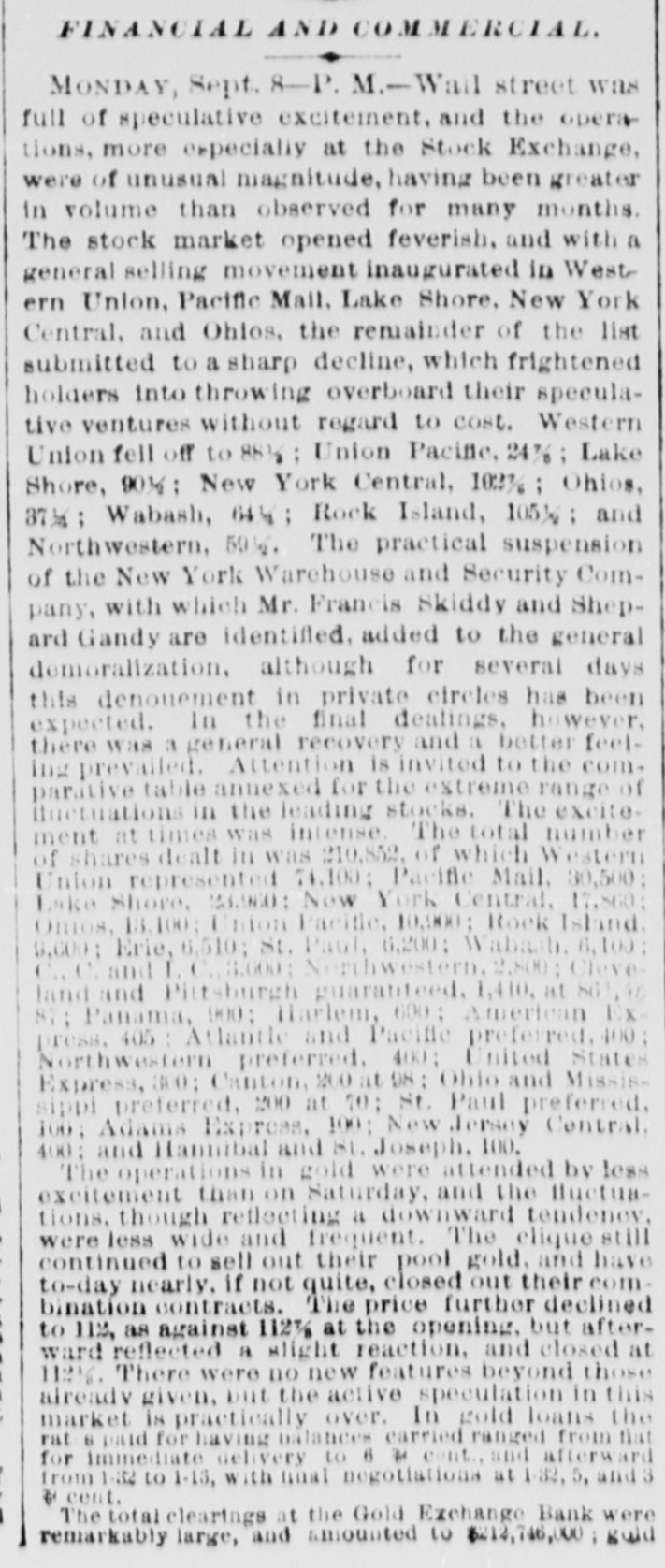
AND MONDAY, Sept. 8-P. M.-Wail street was full of speculative excitement, and the operations, more expecially at the Stock Exchange, were of unusual magnitude, having been greater in volume than observed for many months The stock market opened feverish. and with a general selling movement inaugurated in West ern Union, Pacific Mail, Lake Shore. New York Central, and Ohios, the remainder of the list submitted to a sharp decline, which frightened holders into throwing overboard their speculative ventures without regard to cost. Western Union fell off to 88 1/2 Union Pacific, 24% Lake Shore, 9014: New York Central, 102% Ohios, 37 14; Wabash, 644 Rock Island, 105% and Northwestern, 59% The practical suspension of the New York Warehouse and Security Company, with which Mr. Francis Skiddy and Shepard Gandy are identified. added to the general demoralization, although for several days this denouement in private circles has been expected. In the final dealings, however, there was a general recovery and a better feeling prevailed. Attention is invited to the comparative table annexed for the extreme range of fluctuations in the leading stocks. The excite. ment at times was intense The total number of shares dealt in was 210,852 of which Western Union represented 74,100 Pacific Mail. 30,500: Lake Shore. 131.960: New York Central 17,860: Omios, 13,100: Union Pacific, 10,900 ; Rock Island. 9,000: Erie, 6,510; St. Paul, 6,200: Wabash. 6,100 C., and 1. C.,3.000: Northwestern, 2,800 ; Cleveland and Pittsburgh guaranteed. 1,410, at 863.40 87; Panama, 900: Harlem, 600: American Ex press. 405 Atlantic and Pacific preferred 400: Northwestern preferred. 400: United States Express, 300: Canton 200 at 98: Ohio and Mississippi preferred, 200 at 70: St. Paul preferred. 100. Adams Express. 100: New Jersey Central 400: and Hannibal and 81. Joseph. 100. The operations in gold were attended by less excitement than on Saturday, and the Huctuations, though reflecting a downward tendency, were less wide and frequent. The elique still continued to sell out their pool gold. and have to-day nearly. if not quite, closed out their combination contracts. The price further declined to 112, as against 112% at the opening. but afterward reflected a slight reaction, and closed at 112% There were no new features beyond those already given. but the active speculation in this market is practically over. In gold loans the rat b paid for having palances carried ranged from flat for immediate delivery to 6 # cent., and afterward from 1.32 to 1-13, with unal negotiations at 1.32, 5, and 3 & cent. The total clearings at the Gold Exchange Bank were remarkably large, and amounted to $212,746,000 Build


Article from The New York Herald, September 10, 1873

Click image to open full size in new tab

Article Text

UNABLE TO PAY. The Suspension of the New York Ware house and Security Company-Its Assets and Liubilitics-How They Are Involved. Further investigations into the reported failures published in yesterday's issue of this paper prove that as far as the New York Warehouse and Security Company is concerned the information about its suspension was correct. Mr. Bell, the Secretary, would make no other statement than that already given by him. The status of the Company's financial condition will be given to-morrow at the meeting oi creditors which has been called for that purpose. Mr. William H. Guion, one of the directors of this company, makes the following statement:-"Theassets of the New York Warehouse and Security Company amounted to about $2,500,000; but without looking over the books he could not state how much of this was in the form of unpaid loans. The liabilities of the company were in the vicinity of $1,300,000. The Missouri. Kansas and Texas Rallway owed the company $1,000,000, one hall of which was secured by bonds of the road and notes of the LAND GRANT, RAILWAY AND TRUST COMPANY, and the other half by the personal guarantee of five of the railroad directors, two of whom were Messrs. Francis Skiddy and Sheppard Gandy, who are likewise directors in the New York Warehouse and Security Company. Three more of the directors are responsible, but the amount of their guarantee is not officially known. Francis Skiddy is President of the Land Grant, Railway and Trust Company, and it is presumed that the stock of this concern, which recently sold as high as 165. is not worth nearly as much now, and it is doubtful whether it would sell at present at par, since the suspension of the Warehouse Company. It is supposed that the notes of this corporation held by the lormer company will cover all tue liabilities. At the creditors' meeting to-morrow it will be ascertained whether THE SUSPENSION OF THE WAREHOUSE COMPANY will be only temporary or final, as everything depends upon their action. The loan of the last named company, which will mature next month, would, in Mr. Guion's opinion, be good within a year at least. The Missouri, Kansas and Texas Railway is completed and doing a large business, which yielde heavy returns. Already $12,000,000 or its bonds have been negotiated, chiefly in Europe, leaving $3,000,000 which the company had been unable to place. If these were not taken abroad they would be sold here to stockholders of the Land Grant Company, to pay off the bonded debt of $15,000,000. The Warehouse Company also made a loan of $200,000 to the New Orleans, Mobile and Texas Railroad Company, whose road IS not completed. This loan matured last spring and remains unpaid, but IS secured by the personal guarantee of two persons connected with the road, and Mr. Guion believed that the Warehouse Company would eventually obtain the money. He further said that the Warehouse and Security Company made a loan of $50,000 to the West Wisconsin Railroad, which is secured by the bonds of the road and the personal guarantee of one of its officers. This loan was good, but had not matured. and the same was true of loans made to several other railroad companies. In regard to the reported failures of Messrs. Francis Skiddy and Sheppard Gandy nothing further has been ascertained. The latter days that many erroneous statements have been circulated, but he did not feel willing to make any explanations at present. He did not know whether he would be compelled to suspend or not.


Article from New Orleans Republican, September 10, 1873

Click image to open full size in new tab

Article Text

NEW YORK. Suspension of the Warehouse and Befue rity Company. NEW YORK, September :- appears that the grouble in the New York Ware house and Security Company arose from de lations with two of its directors, Francis Skiddy, importer, of No. 10g Wall street. and Shepherd Gandy, of No. 60 Wall street, both heavy sugar importers, They svere directors of the New York Warehouse and Security Company, and also directors of the Missouri, Kansas and Texas Railroad Company, now in course of construction. They had invested 80 heavily in this coad and elsewhere that their large resources and excellent credit could not carry them through, and they therefore obtained loans from the Security Company of stock and bonds of the latter and other corporations The Warehouse and Security Company. however, had a large amount of pape? in circulation, which was about feature. and unless some of the loans which st bad made to Messrs. Skiddy & Gandy were taken up they could not meet their obligations Frequent consultations were had, but with out satisfactory resulte, as the disordered condition of the money market and the fact that Kansas, Missouri and Texas seo curities were not negotiable in Wall street precludes making loans in other and less partial quartere. A meeting of directors had, therefore, been called gesterday morne ing, and it was resolved to suspend tempse rarily, and call & meeting of the on Thursday to take action In the matter Francis Skiddy is the head of :he firm of Skiddy, Munford & Co., of No. :0: Wall street, who are among the heaviest importe ers in this city. Mr. Skiddy has been iden tified with the steamboat. railroad and other interests for many years. and his has always been a good name for financial strength. Sheppard Gandy is a member of the firm of Sheppard Gandy & Co., of No. 60 Wall street. Neither of these houses base suse pended as yet. A director of the New York Warehouse Company states the company's assets are about $250,000, but does not know how much of this is in the form of unpaid loans. The liabilities are $13,000,000. The Missouri, Kansas and Texas railroad owes the company $7,000,000, one-half of which was secured by bonds of the road and notes of land grants to the railway and trust company, and the other half by the personal guarantee of five of the railway directors. Two of these were Skiddy and Gandy, directors also of the warehouse company. The notes of the land grants of the railway company of which Skiddy is the president he considered to be good. The warehouse company also made a loan of $2,000.000 to the New Orleans, Mobile and Texas railroad, not yet completed. The loan matured last spring, and has not yet been paid, but is secured by personal guarantes. A loan was also made to the Wisconsin railroad, amounting to $50,000. which loan was good, though not yet matured. The same was true of several other railroads. Whether the suspension of the warehouse company be tempory ordinal de pends entirely on the decision of its creditors. Susan Coates, the baby farmero was 90. day released on bail, two physicians testio fying she did no wrong. The President Invited to Attend the Mexi can War Celebration Commodore Meade and other officers Vis ited the President to-day with an invitation to join them in celebrating the anniversary of the capture of the City of Mexicco An Appeal 1or Aid. An appeal for aid for the destitute who were burned out of their homes by the Plaza Vapor fire, which involved a loss of $8,000,000, has been made by Alexander & Sons. owners of the Havana steamship line, of this city. The firm was to-day appealed to by telegram from Havana, the dispatch stating there is great destitution there. Suits Against the Erie Railroad. It is stated that a number of suits by Jay Gould will soon be brought againt the Erie Railroad Company, and the directors personally, for alleged illegal acts done in connection with the recent declaration of dividends. New York County Affairs. Controller Green has communicated to


Article from New-York Tribune, September 18, 1873

Click image to open full size in new tab

Article Text

WALL-ST. ALARMED. A BREAK IN THE MARKET. STOCKS DECLINE FROM 1 TO 71 PER CENT-THE NEWYORK AND OSWEGO MIDLAND RAILROAD GOES TO PROTEST-GROUNDLESS REPORTS OF OTHER FAILURE8. The "bears" held high carnival in Wall-st. yesterday. With the opening of business on the Exchanges they began the circulation of doleful rumors of more than ordinary calamities throughout "the street." Impending failures of extraordinary magnitude were mysteriously hinted at early in the morning, but no positive details could be gleaned. As the day wore on, however, the names of several railroad companies became linked with the evil rumors, and reports of the failure of their promoters were freely circulated where they would do the most harm. New railroad companies, with incomplete or freshly completed roads, were fiercely assailed and with great effect in the stock market. The rumors of the previous day in relation to the entanglement of the Chicago, Rock Island and Pacific Railroad with the Canada Southern Railway were revived, and it was freely asserted that the former had loaned large amounts of money to the latter, in order to enable it to pursue the work of construction. This rumor, however, was officially denied by the officers of both companies. Each rumor seemed tolgrow as it proceeded from mouth to mouth, and the general result was a feeling of depression and distrust even in the minds of the most sanguine. The more conservative were at first disposed to resist the coutagion, but the ofttold stories of dishonesty and disaster proved too much for their logic. Whenever the public-spirited "bull" ventured to speak of the ** glorious future of the great Republic," he was met with the familiar details of the ruin of the Brooklyn Trust Company, city defalcations, the arrest of City Treasurer Sprague and his accomplice Rodman, the failure of the New-York Warehouse and Security Company, the embarrassment of Messrs. Skiddy and Gandy. the entanglement of the Missouri, Kansas and Texas Railroad, the suspension of Kenyon Cox & Co., and the troubles of the Canada Southern Railway. If the " bull " in an enthusiastic and prophetic outburst dwelt upon the good time soming, he was silenced by the hard logic of the facts of the demoralized present. At about noon it became generally known that the New-York and Oswego Midland was the railroad company in trouble this time, and it was asserted that George Opdyke & Co., who were its financial agents, had suspended, or were about to do so. Inquiry developed the fact that the construction and equipment "paper" of the Company had gone to protest, but that George Opdyke & Co. had not suspended and were doing business as usual, though greatly annoyed by the irritating rumors in circulation about them.


Article from The New York Herald, September 19, 1873

Click image to open full size in new tab

Article Text

FEELING ON THE STREET. On the 8th inst. the New York Warehouse and Security Company, a monetary institution, in Pine street, established for the purpose of advancing money on collaterals, suspended payment, and it was alleged as the cause that they had loaned money on securities from the Kansas, Missouri and Texas Railroad, which were not met, and in the vortex of destruction Francis Skiddy and Shepard Gandy were reported as mixed up and as having "gone by the board." Speculations in sugar and Pacific Mall were likewise quoted as having been the primary cause of the suspensions, all of which were duly reporte1 in the HERALD of the 9th inst. At that time a prominent banker, who was interviewed by the writer upon the subject of the failure, gave it as his opinion that the beginning of the end had only just commenced, and before the end or September was reached not only the city of New York, but the whole country, and mayhap Europe, would be convulsed with A GREAT FINANCIAL PANIC. The gentleman based his premonitions on the reckless manner in which money was invested in wild-cat speculations, especially in the building of railroads which had no visible means of support, and the loose manner in which financial institutions loaned money on flimay securities. How well the prognostications of this gentleman are verified was painfully visible in Wall street and vicinity yesterday, as made apparent by the suspension of Messrs. Jay Cooke & Co. and others who are named above. HISTORY REPEATS ITSELF. In 1857, on the report of the suspension of the Ohio Life and Trust Company becoming known, the panic which was engendered thereby must still be fresh in the minds of all business men. The ruin which it wrought was not confined to one locality, but had its disastrous effect upon the entire country. Small iry-financial houses made this failure a pretext for suspension, and the effects on commerce were felt for three years after, when the late rebellion brought back similar scenes by a general suspension of specie payment in 1861. Passing rapidly over the stirring war scenes, in field the as all as in financial circles, superinduced the great fluctuations in gr by successes or reverses experie by our armies in the field, we come to the ever memorable Black Friday. and since then comparative quiet has


Article from The Andrew County Republican, September 26, 1873

Click image to open full size in new tab

Article Text

FRIDAY MORNING, SEPT. 26, 1873. BANK FAILURES. A prophetic article under the caption of "Who Next?" appeared in the New York Tribune of Tuesday last. It recounted the failures of The Brooklyn Trust Comyany, The New York Warehouse and Security Company, and Kenyon Cox & Co., all of whom recently suspended. The cause of failure in every instance was a departure from the line of legitimate banking business, and trading in speculative railway shares. One bank undertook to build the New Haven, Middletown and Willimantie railroad. Another made heavy advances to the Canada Southern, and a third undertook to float some Texas, Alabama and New $Orleans railway enterprise. To the Tribune's question, "How many more examples will be needed before the lesson is learned?" come the reponsive occurrences of the past few days. One after another have the supposed strong men of Wall street succumbed to the pressure, and it seems now to be highly probable that the whole class of bankers who have made it their business to divert the capital of the country from its legitimate uses will ba overtaken by bankruptcy. The banks of the country are organized and sustained primarily for the purpose of afiording facilities for carrying on the mercantile and manufacturing business of the people. When densely populated communities require additional means of transportation, and it is demonstrable at there is a present demand for railthe which will unquestionably pay a SWAVE the investment, it is right for n' groft banks:ann capitalists to encourage such enterprises. It 18 different when calls in oney to build railways in :all serts of out-of-the-way places, wherethereis 170 pol rulation or trade to susurin them. To such applications. sound bankers . ill turn a deaf ear. Just at tiee time, he wever, when theavailable funds of the country are needed to move the crops of the west, it is ascustodians of certained that some of the of the currency in Wam street have been scattering the money of 1 heir depositors to supply the demands a moonshine of the land. railway schemes in all parts must necesBanks doing such a business. for loans sarily discourage applications engaged made by merchants and others Suel is the in legitimate enterprises. tone of the Tribune's article, wh ich appeared two days before the house. of Jay Cooke & Co. closed its doors. , Other banks that have done business after the same fashion must go the same way, a nd the houses that withstand the storm wi be found to be of that class which is unwilling to hazard the funds of depositors in reckless speculations for large gains, and whose managers have anticipated and provided for emergecies like the present.