Atchison National Bank (Atchison, KS)

Episode Information

Episode UID
208201197
Episode Type
Suspension โ†’ Closure
Bank Type
national
Bank ID
20820 national
Charter Number
2082
Start Date
September 5, 1899
Location
Atchison, Kansas (39.563, -95.122)

Metadata

Model
gpt-5-mini (chosen from majority vote of a three-model LLM ensemble)
Short Digest
e60116936df364ca

Response Measures

None

Receivership Details

Depositor recovery rate
50.0%
Date receivership started
1899-09-05
Date receivership terminated
1901-10-25
OCC cause of failure
Excessive lending
Share of assets assessed as good
30.9%
Share of assets assessed as doubtful
35.0%
Share of assets assessed as worthless
34.1%

Events (4)

1. February 8, 1873 Chartered
Source
historical_nic
2. September 5, 1899 Receivership
Source
historical_nic
3. September 5, 1899 Receivership
Newspaper Excerpt
C. S. Jobes, national bank examiner of Kansas has been appointed temporary receiver.
Source
newspapers
4. September 5, 1899 Suspension
Cause
Government Action
Cause Details
Closed by the Comptroller of the Currency due to bad investments and the bank being in bad condition.
Newspaper Excerpt
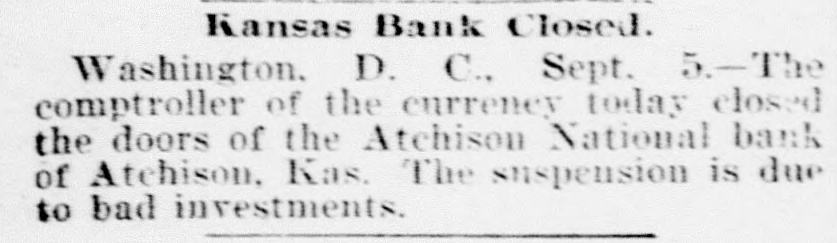
The comptroller of currency today closed the doors of the Atchison National bank, Atchison, Kansas. ... The suspension is due to bad investments.
Source
newspapers

Newspaper Articles (23)

Article from Santa Fe New Mexican, September 5, 1899

Click image to open full size in new tab

Article Text

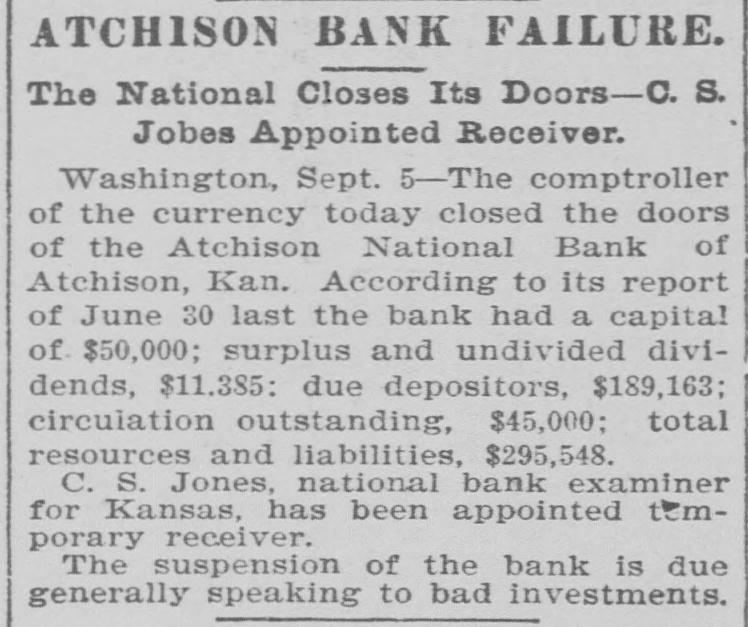
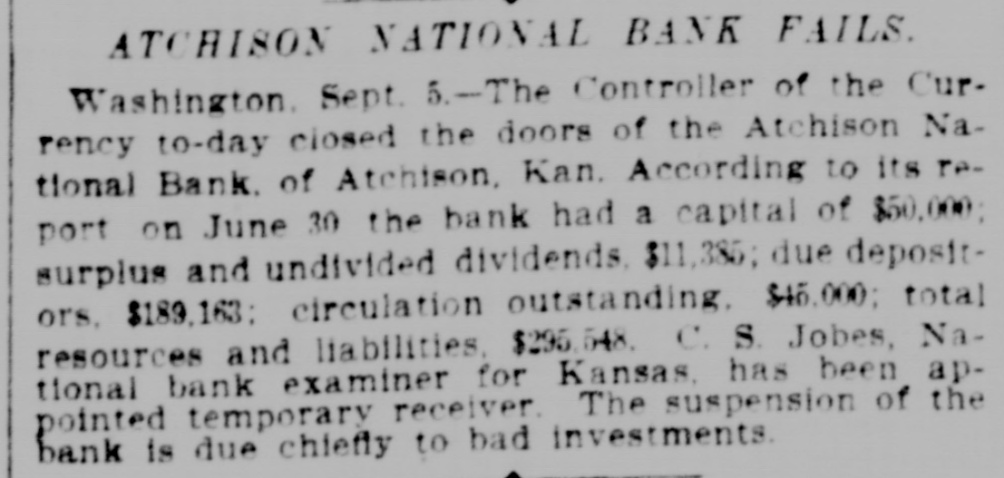
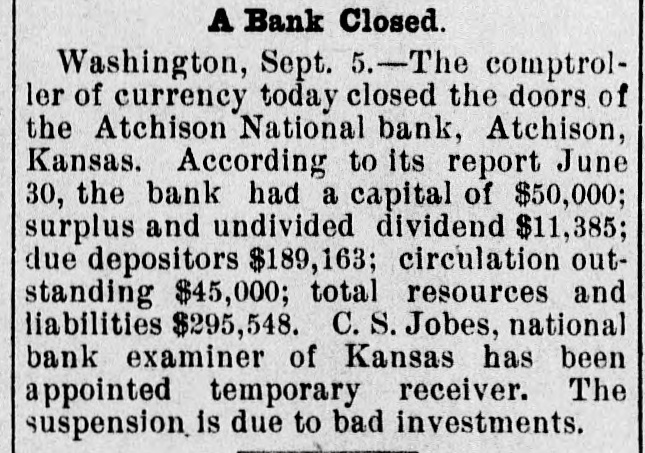
Bank Closed. Washington, Sept. - -The comptroller of currency today closed the doors of the Atchison National bank, Atchison, Kansas. According to its report June 30, the bank had a capital of $50,000; surplus and undivided dividend $11,385; due depositors $189,163; circulation outstanding $45,000; total resources and liabilities $295,548. C. S. Jobes, national bank examiner of Kansas has been appointed temporary receiver. The suspension is due to bad investments.


Article from Evening Times-Republican, September 5, 1899

Click image to open full size in new tab

Article Text

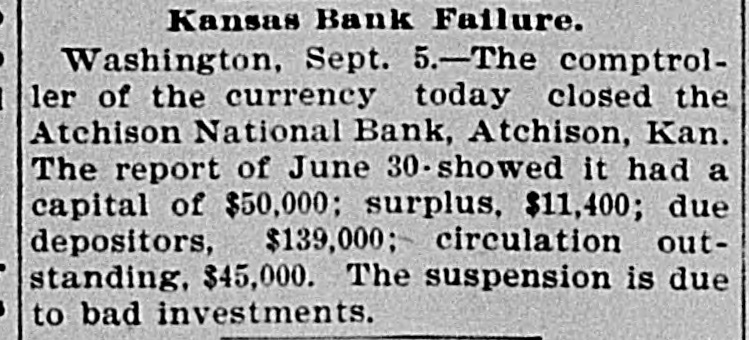
) Kansas Bank Failure. Washington, Sept. 5.-The comptroller of the currency today closed the Atchison National Bank, Atchison, Kan. The report of June 30-showed it had a capital of $50,000; surplus, $11,400; due depositors, $139,000; circulation outstanding, $45,000. The suspension is due to bad investments.


Article from The Florence Daily Tribune, September 5, 1899

Click image to open full size in new tab

Article Text

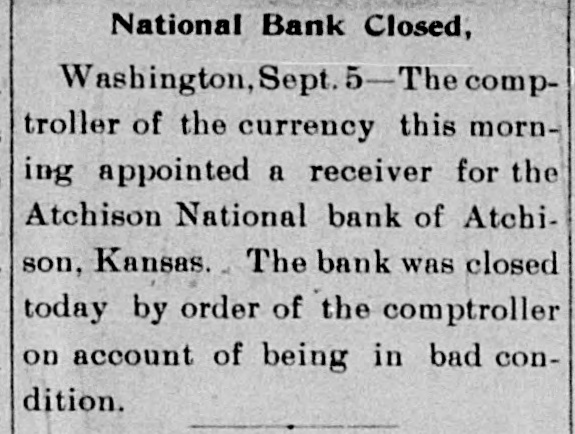
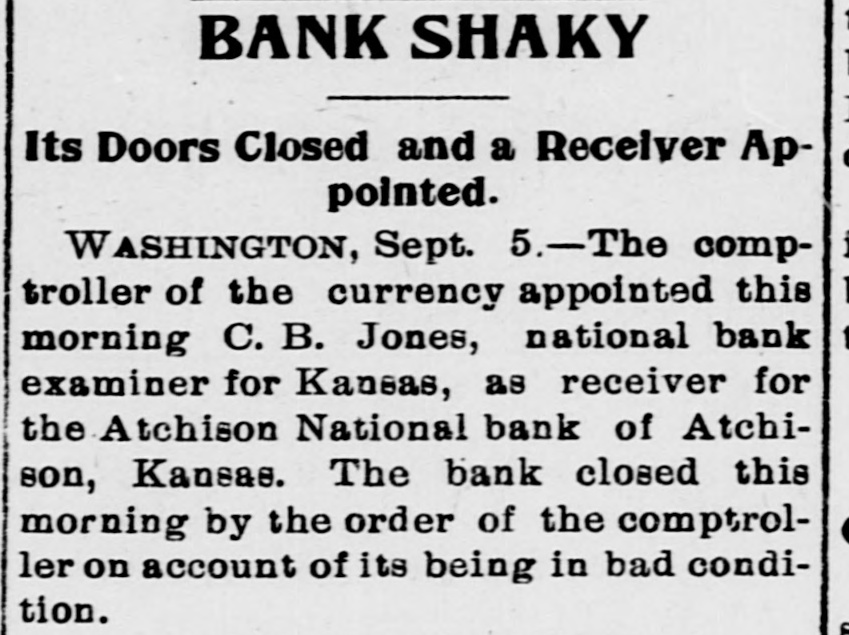
National Bank Closed, Washington, Sept. 5-The comptroller of the currency this morning appointed a receiver for the Atchison National bank of Atchison, Kansas. The bank was closed today by order of the comptroller on account of being in bad condition.


Article from The Daily Ardmoreite, September 6, 1899

Click image to open full size in new tab

Article Text

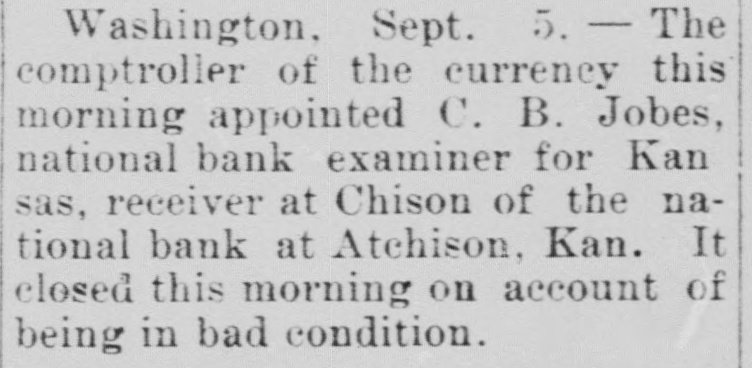
Washington, Sept. 5. - The comptroller of the currency this morning appointed C. B. Jobes, national bank examiner for Kan sas, receiver at Chison of the national bank at Atchison, Kan. It closed this morning on account of being in bad condition.


Article from The Saint Paul Globe, September 6, 1899

Click image to open full size in new tab

Article Text

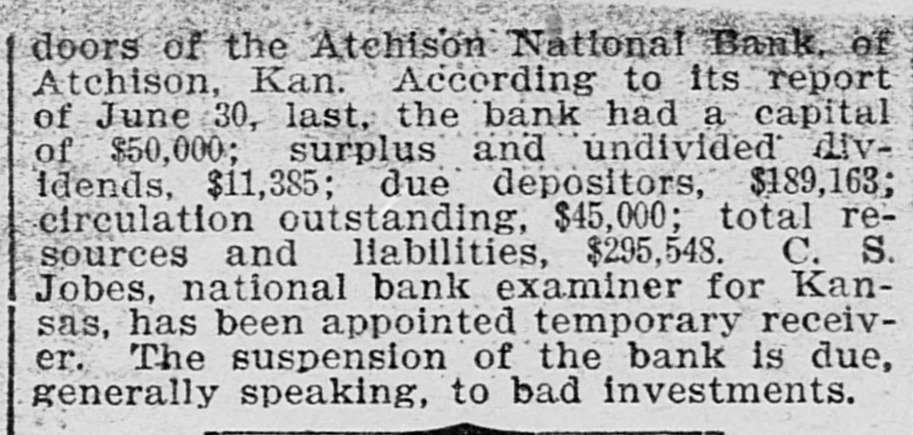
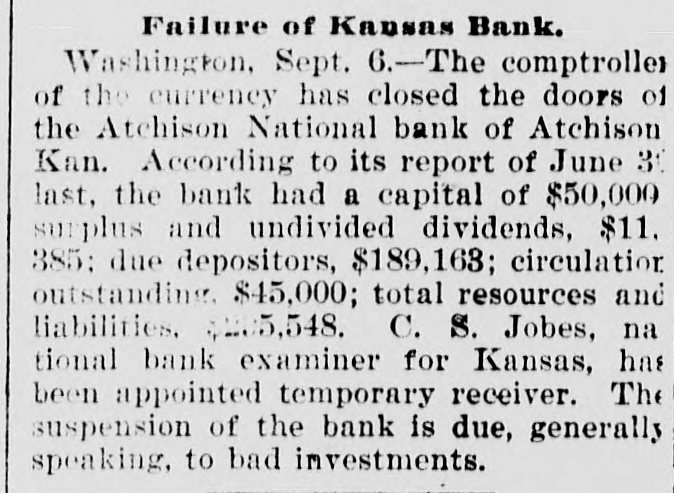
doors of the Atchison National Bank. of Atchison, Kan. According to its report of June 30, last, the bank had a capital of $50,000; surplus and undivided dividends, $11,385; due depositors, $189,163; circulation outstanding, $45,000; total resources and liabilities, $295,548. C. S. Jobes, national bank examiner for Kansas, has been appointed temporary receiver. The suspension of the bank is due, generally speaking, to bad investments.


Article from Bryan Morning Eagle, September 6, 1899

Click image to open full size in new tab

Article Text

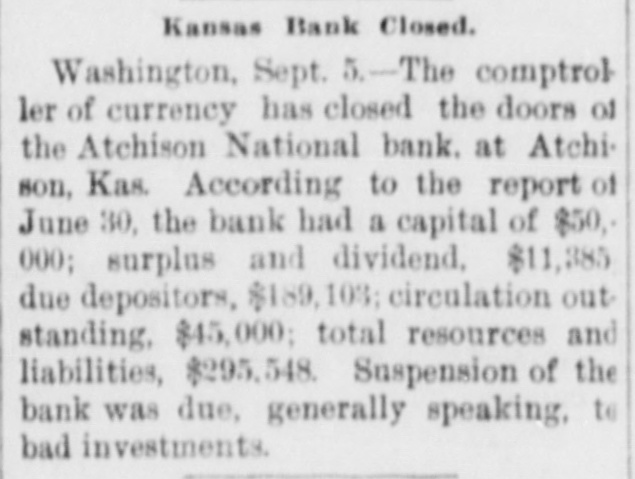
Kansas Bank Closed. Washington, Sept. 5.-The comptrol ler of currency has closed the doors of the Atchison National bank. at Atchison, Kas. According to the report of June 30, the bank had a capital of $50,000; surplus and dividend. $11,385 due depositors, $189, 103; circulation outstanding, $45,000; total resources and liabilities, $295,548. Suspension of the bank was due, generally speaking, to bad investments.


Article from The Topeka State Journal, September 6, 1899

Click image to open full size in new tab

Article Text

Will Pay Depositors From 60 to 80 Per Cent. BRIDGE CO. GETS TIP. Withdrew a $17,000 Deposit Before the Doors Closed. Corn Carnival Funds In the Sum of $607 Lost. Atchison County Had $47,000 on Deposit Fully Protected. Atchison, Sept. 6.-It is now thought that the assets of the defunct national bank which closed its doors yesterday will pay the depositors from 60 to 80 per cent. W. F. Guthrie, who was in temporary charge before Mr. Jobes, the receiver arrived, said: Milton Barratt, who was president of the bank until his death at Hot Springs a little over a year ago, made some heavy losses. The Barratt paving brick plant was one of them, and a Kansas City ice business was another. These losses were made from ten to fifteen years ago, and bad been carried by the bank, being gradually reduced by the personal paper of Mr. Barratt and by the earnings of his different in. terests. Still, the losses had not been made up to any material extent. and it seems that no objection was made by the bank examiners to the assets until a few days ago, when an examiner notifled the bank that it would have to charge off $20,000 of its paper as bad, and make an assessment on the stockholders to make good the impairment of the bank's capital. Norman Barratt, who succeeded his father as president of the bank, was practically the sole stockholder. He had no means of raising the money that he felt justified in resorting to, and concluded that if he had to quit business ultimately, the sooner he did it the better for all concerned. Mr. Guthrie says that Norman Barratt consequently sent a telegram to Mr. Jobes Monday afternoon, the telegram being sent to Wichita, where Mr. Jobes was supposed to be. No reply was received from Mr. Jobes, and W. F. Guthrie says that at 8:30 o'clock Monday night he wired the comptroller of the currency at Washington, that Mr. Barratt had broken down; could not look after the bank, and that if the bank was not taken care of by the comptroller at once that the assets might be eaten up by preferences secured by attachments. No word having been received from the comptroller, at that hour, the bank was opened for business as usual at 9 o'clock Tuesday morning, although all deposits tendered that morning and collections made, were kept separate, and afterwards taken to the First National to be paid back to the parties from whom or for whom they were received. Mr. Guthrie says that immediately upon the receipt of word from the comptroller, which was not until 11:40 a. m., the bank was closed. At 10 o'clock Tuesday morning the balances of the Atchison & Eastern Bridge company and N. D. Todd, personally, amounting to between $16,000 and $17,000, were drawn from the bank. This was the only "run." The closing of the bank was a surprise to the other depositors. Being attorney for the bridge company, he says he is placed in an awkward position, but that he is not responsible for the knowledge of the bridge company. He says he even lost his personal account. Mr. Guthrie says he hasn't any idea of what there is due the bank, but there should be about $25,000 in cash and sight exchange on hand. There was due depositors this morning, $165,000. The Atchison National was the depository for county funds. Atchison county had $47,000 on deposit, but is protected by the bond of the American Surety company. Among the depositors are the following: Mrs. Cosgrove, said to have from $10,000 to $15,000 in the bank; Mrs. D. N. Wheeler, from $4,000 to $5,000; Louis W. Voigt, $4,000: James M. Chisham, $1,200; Mrs. J. L. Bliss, $5,000; Mrs. John M. Crowell, amount not known, but said to be very large; R. B. Drury, $1,000; Dr. Bogle, $400; Fritz Heckelnkaemper, $300. Harouff Bros., $800: Charley Crawford, Bosanko & Poehler, Jacob George, J. J. Ingalls, J. J. Kelley, Joseph Symns, A. W. Simpson, Mart Miller, M. E. Seitz, and B. O. Running; A. A. Webber, Sheffield Ingalls, Ellsworth Ingalls, T. C. Treat, Fred Townsend, who had $450 on deposit; the Standard Oil company, $300. The bank has lost no money during the past year. People who claim to know, say that in the past twelve months $12,000 of the bank's indebtedness has been paid. The Corn Carnival committee had
Article from Wheeling Register, September 6, 1899

Click image to open full size in new tab

Article Text

DUE TO BAD INVESTMENTS. WASHINGTON, September 5. - The comptroller of the currency to-day closed the doors of the Atchison National Bank, of Atchison, Kansas. The suspension is due to bad investments,


Article from The Superior Times, September 9, 1899

Click image to open full size in new tab

Article Text

Kansas Bank Closed. Washington. D. C., Sept. 5.-The comptroller of the currency today closed the doors of the Atchison National bank of Atchison. Kas. The suspension is due to bad investments.


Article from The Topeka State Journal, September 12, 1899

Click image to open full size in new tab

Article Text

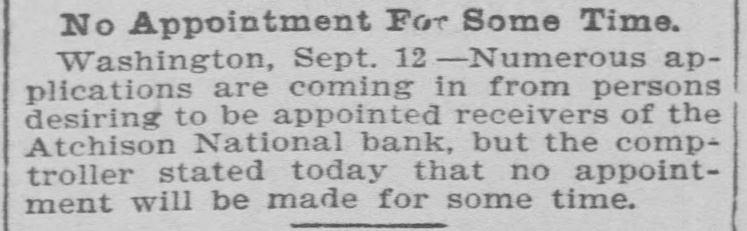
No Appointment For Some Time. Washington, Sept. 12 -Numerous applications are coming in from persons desiring to be appointed receivers of the Atchison National bank, but the comptroller stated today that no appointment will be made for some time.


Article from The Topeka State Journal, September 28, 1899

Click image to open full size in new tab

Article Text

EASTMAN FOR RECEIVER Emporia Man Probably Be Placed In Charge Atchison Bank. The latest rumor concerning the receivership of the Atchison national bank, which recently failed is that D. W. Eastman of Emporia is to have the place. It is said that Frank Crowell of Atchi-


Article from The Weekly Intelligencer, October 7, 1899

Click image to open full size in new tab

Article Text

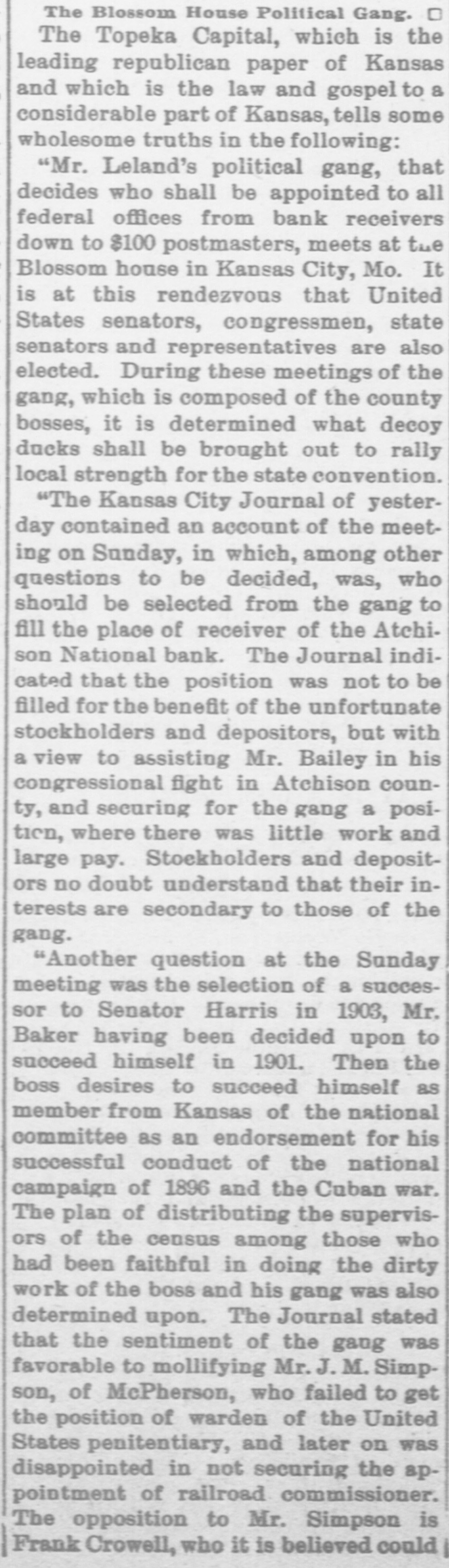
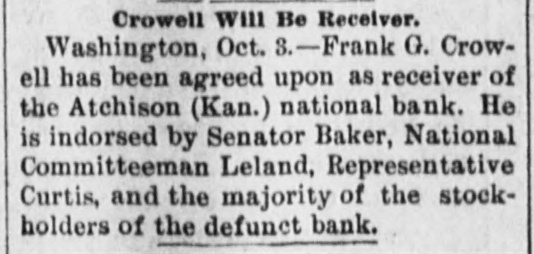
Crowell Will Be Receiver. Washington, Oct. 8.-Frank G. Crowell has been agreed upon as receiver of the Atchison (Kan.) national bank. He is indorsed by Senator Baker, National Committeeman Leland, Representative Curtis, and the majority of the stockholders of the defunct bank.


Article from Kansas City Journal, October 12, 1899

Click image to open full size in new tab

Article Text

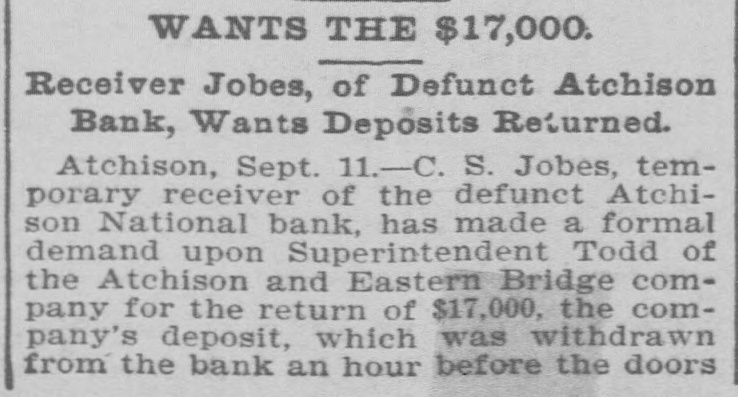
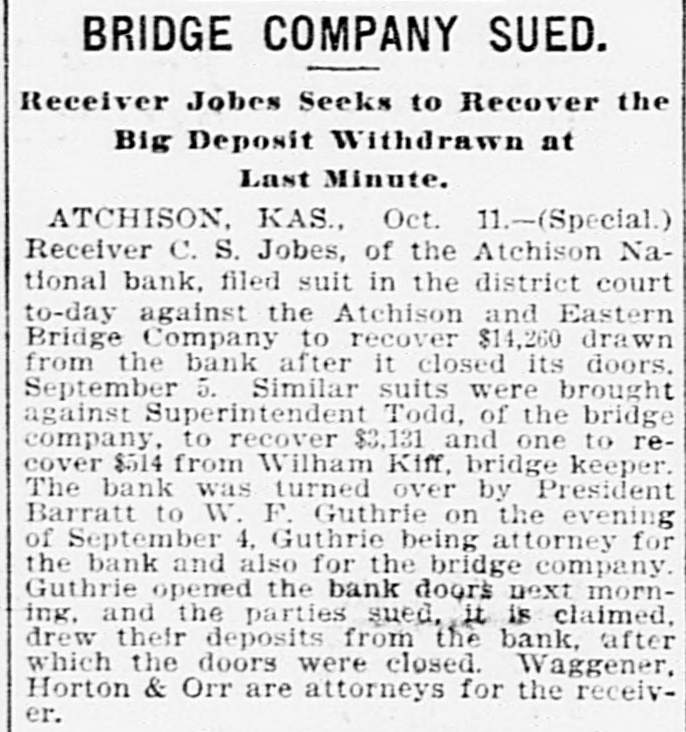
BRIDGE COMPANY SUED. Receiver Jobes Seeks to Recover the Big Deposit Withdrawn at Last Minute. ATCHISON KAS., Oct. 11.-(Special.) Receiver C. S. Jobes, of the Atchison National bank. filed suit in the district court to-day against the Atchison and Eastern Bridge Company to recover $14,260 drawn from the bank after it closed its doors. September 5. Similar suits were brought against Superintendent Todd, of the bridge company, to recover $3,131 and one to recover $514 from Wilham Kiff, bridge keeper. The bank was turned over by President Barratt to W. F. Guthrie on the evening of September 4. Guthrie being attorney for the bank and also for the bridge company. Guthrie opened the bank doors next morning. and the parties sued, it is claimed, drew their deposits from the bank, after which the doors were closed. Waggener, Horton & Orr are attorneys for the receiver.


Article from The Globe-Republican, October 12, 1899

Click image to open full size in new tab

Article Text

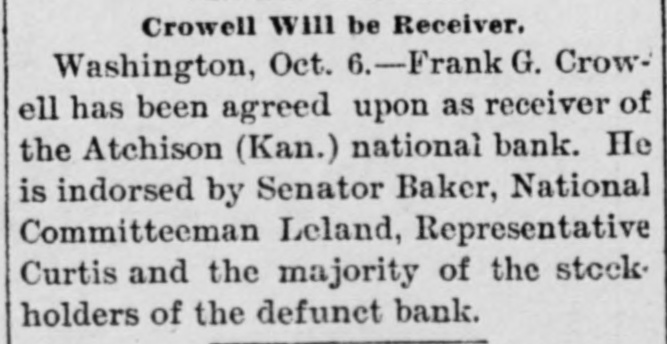
Crowell Will be Receiver. Washington, Oct. 6.-Frank G. Crowell has been agreed upon as receiver of the Atchison (Kan.) national bank. He is indorsed by Senator Baker, National Committeeman Leland, Representative Curtis and the majority of the stockholders of the defunct bank.


Article from Hutchinson Gazette, October 12, 1899

Click image to open full size in new tab

Article Text

Crowell will be Receiver. Washington, Oct. 6.-Frank G. Crowell has been agreed upon as receiver of the Atchison (Kan.) national bank. -He is indorsed by Senator Baker, National Committeeman Leland, Representative Curtis and the majority of the stockholders of the defunct bank.


Article from The Chanute Times, October 13, 1899

Click image to open full size in new tab

Article Text

Crowell Will be Receiver. Washington, Oct. 6.-Frank G. Crowell has been agreed upon as receiver of the Atchison (Kan.) national bank. He is indorsed by Senator Baker, National Committeeman Leland, Representative Curtis and the majority of the stockholders of the defunct bank.


Article from Free Press, October 14, 1899

Click image to open full size in new tab

Article Text

Crowell Will be Receiver. Washington, Oct. 6.-Frank G. Crowell has been agreed upon as receiver of the Atchison (Kan.) national bank. He is indorsed by Senator Baker, National Committeeman Leland, Representative Curtis and the majority of the stockholders of the defunct bank.


Article from Free Press, October 28, 1899

Click image to open full size in new tab

Article Text

Crowell Will be Receiver. Washington, Oct. 6.-Frank G. Crowell has been agreed upon as receiver of the Atchison (Kan.) national bank. He is indorsed by Senator Baker, National Committeeman Leland, Representative Curtis and the majority of the stockholders of the defunct bank.


Article from The Topeka State Journal, November 29, 1899

Click image to open full size in new tab

Article Text

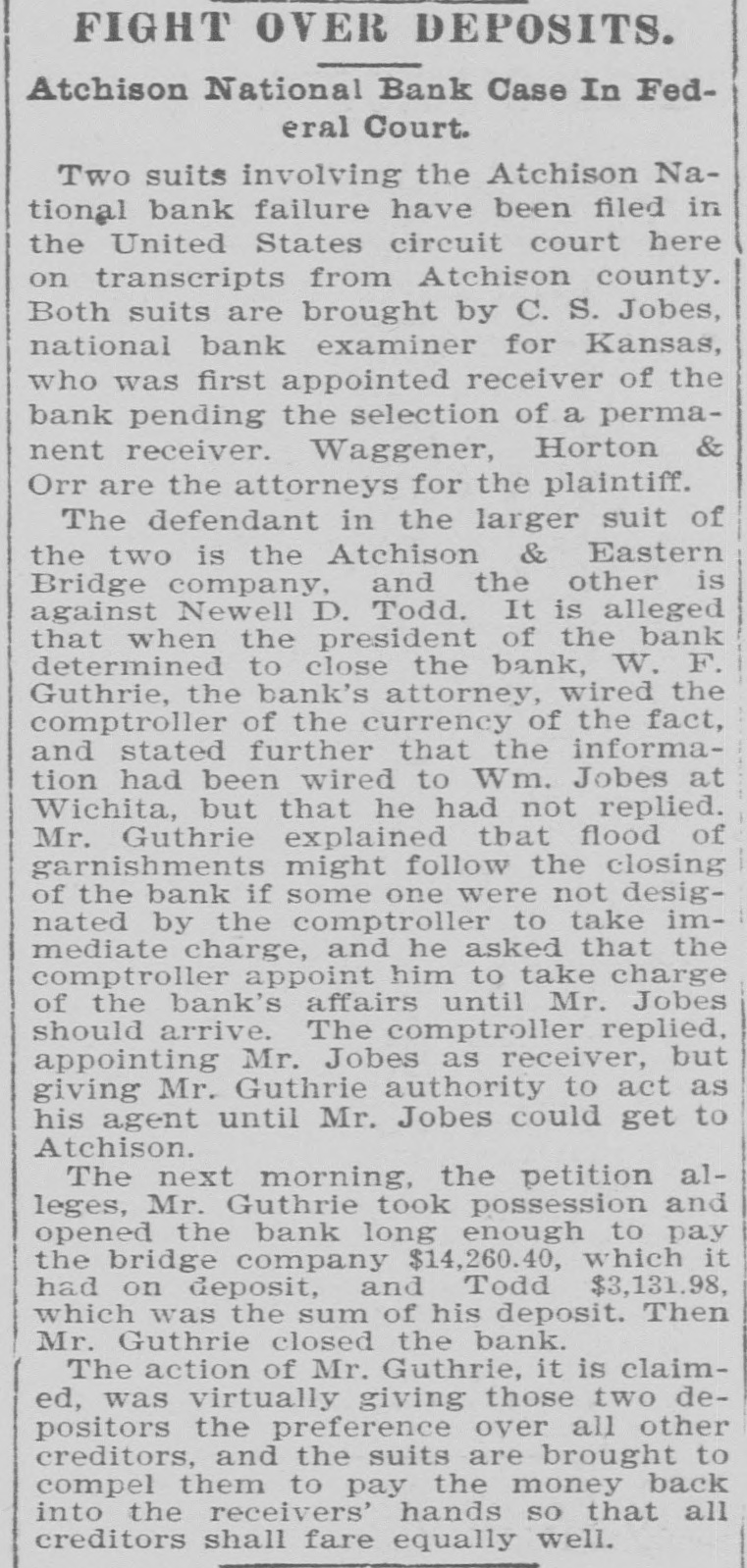
FIGHT OVER DEPOSITS. Atchison National Bank Case In Federal Court. Two suits involving the Atchison National bank failure have been filed in the United States circuit court here on transcripts from Atchison county. Both suits are brought by C. S. Jobes, national bank examiner for Kansas, who was first appointed receiver of the bank pending the selection of a permanent receiver. Waggener, Horton & Orr are the attorneys for the plaintiff. The defendant in the larger suit of the two is the Atchison & Eastern Bridge company, and the other is against Newell D. Todd. It is alleged that when the president of the bank determined to close the bank, W. F. Guthrie, the bank's attorney, wired the comptroller of the currency of the fact, and stated further that the information had been wired to Wm. Jobes at Wichita, but that he had not replied. Mr. Guthrie explained that flood of garnishments might follow the closing of the bank if some one were not designated by the comptroller to take immediate charge, and he asked that the comptroller appoint him to take charge of the bank's affairs until Mr. Jobes should arrive. The comptroller replied, appointing Mr. Jobes as receiver, but giving Mr. Guthrie authority to act as his agent until Mr. Jobes could get to Atchison. The next morning, the petition alleges, Mr. Guthrie took possession and opened the bank long enough to pay the bridge company $14,260.40, which it had on deposit, and Todd $3,131.98, which was the sum of his deposit. Then Mr. Guthrie closed the bank. The action of Mr. Guthrie, it is claimed, was virtually giving those two depositors the preference over all other creditors, and the suits are brought to compel them to pay the money back into the receivers' hands so that all creditors shall fare equally well.


Article from Hutchinson Gazette, November 29, 1900

Click image to open full size in new tab

Article Text

STATE NEWS PARAGRAPHED. It took Judge Monroe just four hours to dispose of the court business at the recent term in Logan county. The average age of school-teachers in Morton county is 30 years. In some counties the ages run as low as 18. The canning factory at Girard has shut down for the season, after putting up 20,000 cans of tomatoes and 16,000 cans of apples, Running out of Topeka on the Santa Fe is a locomotive engineeer who is paying alimony to no less than three divorced wives. Norman Baratt, eashier of the defunct Atchison national bank, has been indicted by the federal grand jury for misappropriating funds of the bank. Capt. W. A. Bonner, who is dead at Concordia at the age of 81, was born on the high seas, while his parents were coming from England to America. A bust of Louisa M. Alcott has been presented to the state university and will be placed in the library with appropriate exercises sometime during December. The next legislature will be pooltioned to allow the coal taken from the penitentiary mine at Leavenworth to be sold to the public. It is now all used up by state institutions. The state bank commissioner has issued a charter for the Burns state bank, capital $6,000. Burns is n little village in Marion county, and two hours after the bank opened for business it had received deposits of $10,000. 1 Two brothers by the name of Coe were candidates in the recent election, one for clerk of the district court on the republican ticket, and the other for probate judge on the populist ticket. in Stafford county. They were both defented. Gov. Stanley's move to abolish the live stock sanitary board has brought an avalanche of protests down upon him. The governor believes that one state sanitary commissioner is enough, SO long as the federal government has a board that does all and more than the state board can do. In Rush county there was a tie in the votes received by Mr. McCormick and Mr. Anderson for the office of county attorney. Before drawing straws as provided by law the men agreed that the winner should make the loser his deputy and equally divide his salary. A boiler in the Clipper flour mills at Eldorado exploded, completely wrecking the mill. A. N. Crowther and Grant Rogers, owner of and engineer at the mill, were seriously scalded. Charles Dye, a patron, was blown against the wall and received fatal injuries. Kansas millers are protesting against the action of the Santa Fe railroad in making an order that the milling-in-transit rate would not be given them unless they consigned their flour over the road as far east as Chicago. The millers prefer to have the railroads compete for their business at Kansas City. A sensation was created in church circles at Kansas City when Mrs. John F. Von Herlich, wife of the rector of St. Paul's Episcopal church, announced her intention of going on the operatic stage. Her husband fully approves of her course and declares he has $10,000 to spend in preparing her voice for grand opera. Republicans are depending upon 300 soldier votes in the Philippines to elect George Wheatley to congress in the Third district, but John S. Gilmore, the Fredonia editor, says not more than 50 Third district soldiers are in the islands. The majority of Judge Jackson, Wheatley's opponent, is about 175, so Wheatley's only chance to beat Jackson is to make a contest. Lee Johnson, state labor commissioner, will cause to be introduced in the legislature a bill for the prevention of child labor. He says the factories and other industries of the state are full of boys and girls who ought to be in school, and that in planing and other mills where edged tools and SITWS are used nearly all the boys employed have mutilated hands. An organized effort will be made to have a creditable educational exhibit at the Kansns seii expรฉe


Article from Albuquerque Daily Citizen, September 26, 1902

Click image to open full size in new tab

Article Text

Committed Suicide. Atchison, Kan., Sept. 26.-Norman Barrett, formerly president of the defunct Atchison national bank, committed suicide in his room at the Byram hotel here to day, cutting his throat with a razor. Worry over failure of his bank and the financial troubles that followed probably are the causes. The Atchison national bank suspended in September, 1899.


Article from Santa Fe New Mexican, September 26, 1902

Click image to open full size in new tab

Article Text

FINANCIAL TROUBLES. Former Bank President, Cut His Norman Barratt, Throat With a Razor. Atchison, Kans., Sept. 26.-Norman Barratt, formerly president of the defunct Atchison National bank, committed suicide in his room at the Byram hotel here today cutting his throat with a razor. Worry over the failure of his bank and the financial troubles that followed probably are the causes. The Atchison National bank suspended in September, 1899.


Article from The Coalville Times, October 3, 1902

Click image to open full size in new tab

Article Text

Bank President Suicides. Norman Barratt, formerly president of the defunct Atchison, Kansas, National bank, committed suicide in his room at the Byron hotel Friday, cutting his throat with - razor, Worry over the failure of his bank and the financial troubles that followed probably are the causes. The Atchison National bank suspended in September, 1899, unfortunate investments by Barratt's father, Milton Barratt, now deceased, having placed the bank in a bad condition financially,