Hibernia National Bank (New Orleans, LA)

Episode Information

Episode UID
208600951
Episode Type
Run β†’ Suspension β†’ Reopening
Bank Type
national
Bank ID
20860 national
Charter Number
2086
Start Date
March 19, 1879
Location
New Orleans, Louisiana (29.955, -90.075)

Metadata

Model
gemini-3-flash-preview (chosen from majority vote of a three-model LLM ensemble)
Short Digest
acede196c516b5aa

Response Measures

Borrowed from banks or large institutions, Partial suspension, Full suspension

Other: The banks acted collectively through the Clearing House to limit withdrawals to $200 per day for a 10-day period while awaiting currency shipments from New York.

Clearinghouse involved: Yes (loan, examination, or other measures)

Description

The suspension was a collective action by the New Orleans Clearing House banks to limit currency withdrawals during a panic.

Events (5)

1. February 18, 1873 Chartered
Source
historical_nic
2. March 19, 1879 Run
Cause
Local Banks
Cause Details
Failure of the Southern Bank and Mechanics' and Traders' Bank following a savings bank failure triggered a general panic.
Measures
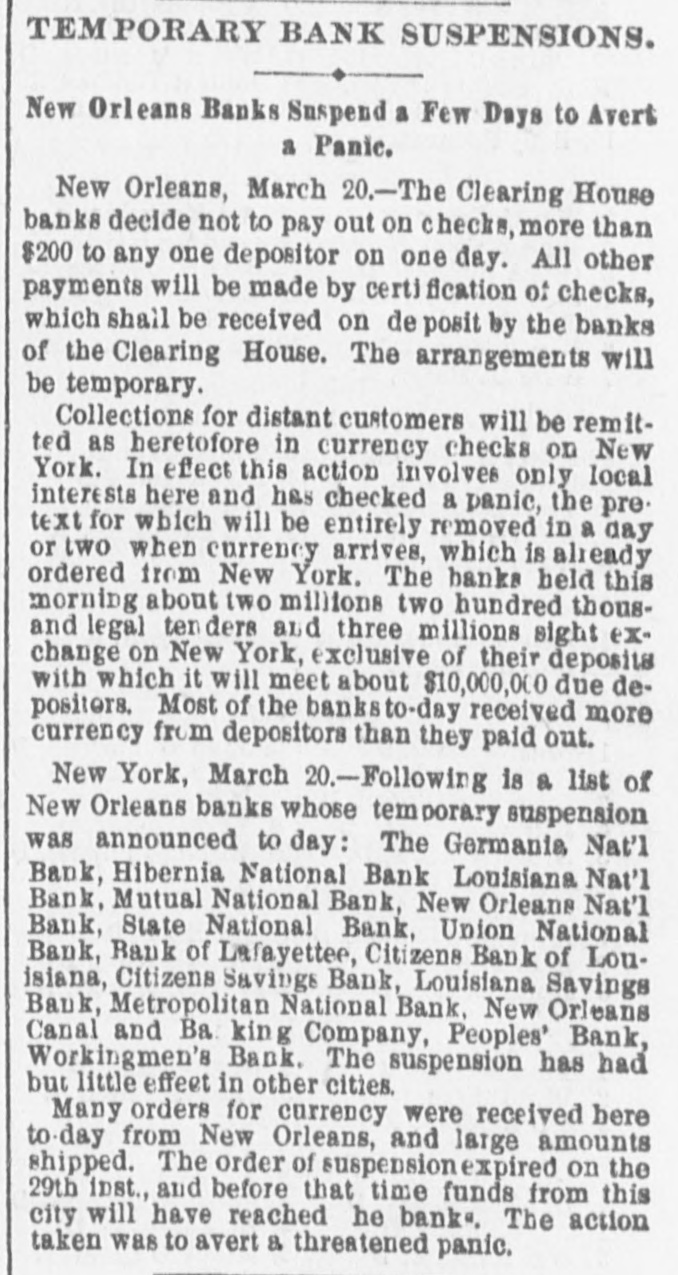
The Clearing House adopted a resolution refusing to pay out more than $200 to any one depositor for ten days.
Newspaper Excerpt
Those having money on deposit desired to draw it out, and a general run on all the bapks was the consequence.
Source
newspapers
3. March 20, 1879 Suspension
Cause
Local Banks
Cause Details
Collective temporary suspension of currency payments to avert a threatened panic following local bank failures.
Newspaper Excerpt
A growing scarcity of currency caused the temporary suspension here of the following banks: ... Hibernia National
Source
newspapers
4. March 24, 1879 Reopening
Newspaper Excerpt
The New Orleans banks have resumed payment of currency on demand.
Source
newspapers
5. July 31, 1902 Voluntary Liquidation
Source
historical_nic

Newspaper Articles (20)

Article from New-York Tribune, March 21, 1879

Click image to open full size in new tab

Article Text

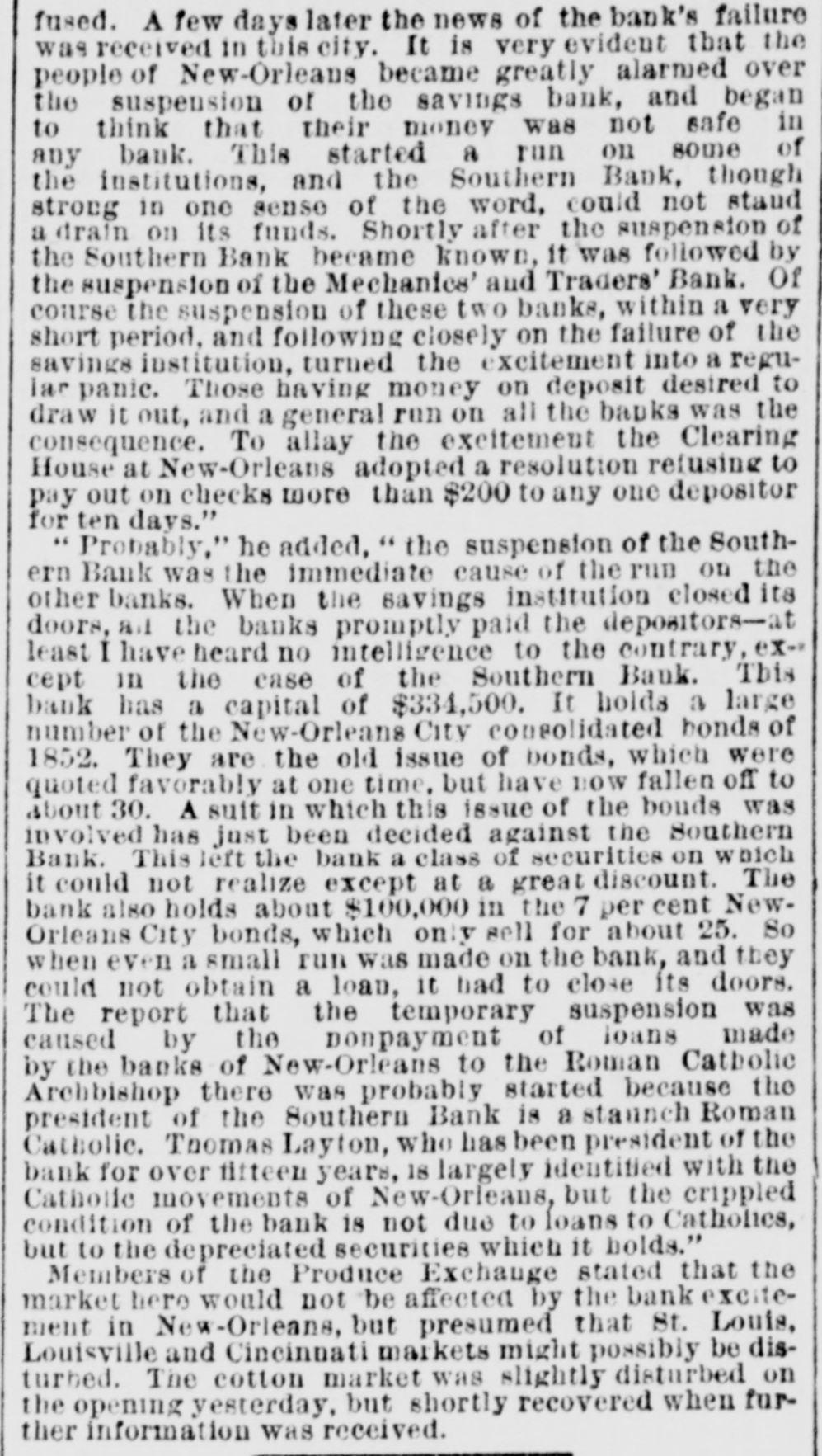
fused. A few days later the news of the bank's failure was received in this city. It is very evident that the people of New-Orleans became greatly alarmed over the suspension of the savings bank, and began to think that their money was not safe in any bank. This started a run on some of the institutions, and the Southern Bank, though strong in one senso of the word, could not stand a drain on its funds. Shortly after the suspension of the Southern Bank became known, it was followed by the suspension of the Mechanics' and Traders' Bank. Of course the suspension of these two banks, within a very short period, and following closely on the failure of the savings institution, turned the excitement into a regular panic. Those having money on deposit desired to draw it out, and a general run on all the bapks was the consequence. To allay the excitement the Clearing House at New-Orleans adopted a resolution refusing to pay out on checks more than $200 to any one depositor for ten days." " Probably," he added, " the suspension of the Southern Bank was the immediate cause of the run on the other banks. When the savings institution closed its doors, ail the banks promptly paid the depositors-at least I have heard no intelligence to the contrary, except in the case of the Southern Bank. This bank has a capital of $334,500. It holds a large number of the New-Orleans City consolidated bonds of 1852. They are the old issue of bonds, which were quoted favorably at one time, but have now fallen off to about 30. A suit in which this issue of the bonds was involved has just been decided against the Southern Bank. This left the bank a class of securities on which it could not realize except at a great discount. The bank also holds about $100,000 in the 7 per cent NewOrleans City bonds, which only sell for about 25. So when even a small run was made on the bank, and they could not obtain a loan, it had to close its doors. The report that the temporary suspension was caused by the nonpayment of loans made by the banks of New-Orleans to the Roman Catholic Archbishop there was probably started because the president of the Southern Bank is a staunch Roman Catholic. Toomas Layton, who has been president of the bank for over fifteen years, IS largely identified with the Catholle movements of New-Orleans, but the crippled condition of the bank is not due to loans to Catholics, but to the depreciated securities which it holds." Members of the Produce Exchange stated that the market here would not be affected by the bank excitement in New-Orleans, but presumed that St. Louis, Louisville and Cincinnati markets might possibly be disturbed. The cotton market was slightly disturbed on the opening yesterday, but shortly recovered when further information was received.
Article from The Cheyenne Daily Leader, March 21, 1879

Click image to open full size in new tab

Article Text

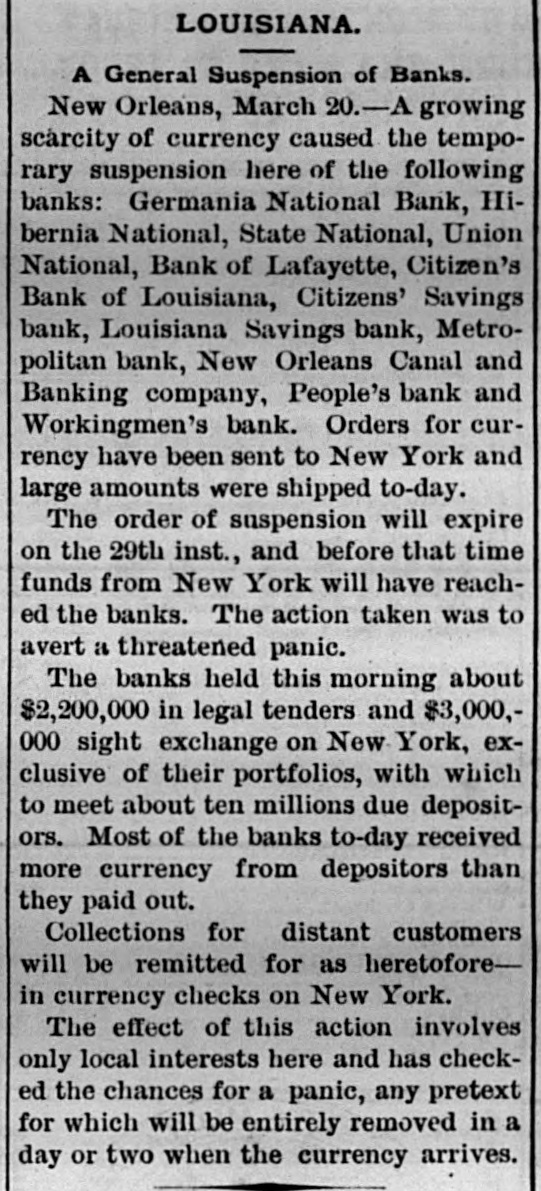
LOUISIANA. A General Suspension of Banks. New Orleans, March 20.-A growing scarcity of currency caused the temporary suspension here of the following banks: Germania National Bank, Hibernia National, State National, Union National, Bank of Lafayette, Citizen's Bank of Louisiana, Citizens' Savings bank, Louisiana Savings bank, Metropolitan bank, New Orleans Canal and Banking company, People's bank and Workingmen's bank. Orders for currency have been sent to New York and large amounts were shipped to-day. The order of suspension will expire on the 29th inst., and before that time funds from New York will have reached the banks. The action taken was to avert a threatened panic. The banks held this morning about $2,200,000 in legal tenders and $3,000,000 sight exchange on New York, exclusive of their portfolios, with which to meet about ten millions due depositors. Most of the banks to-day received more currency from depositors than they paid out. Collections for distant customers will be remitted for as heretoforein currency checks on New York. The effect of this action involves only local interests here and has checked the chances for a panic, any pretext for which will be entirely removed in a day or two when the currency arrives.


Article from Daily Globe, March 21, 1879

Click image to open full size in new tab

Article Text

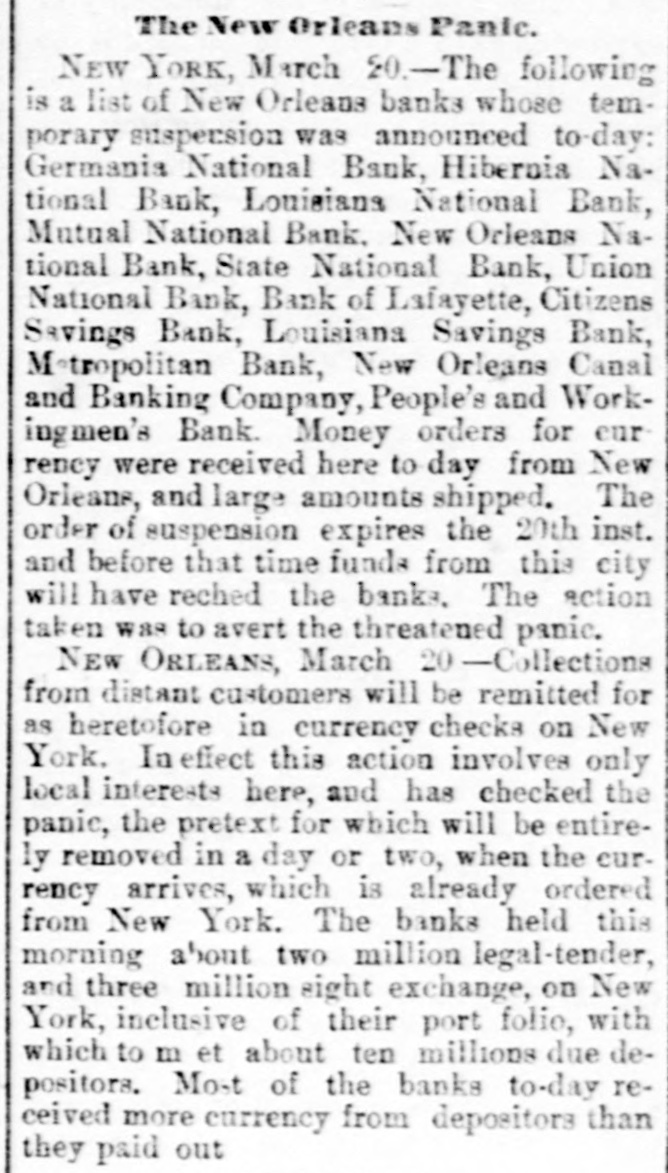
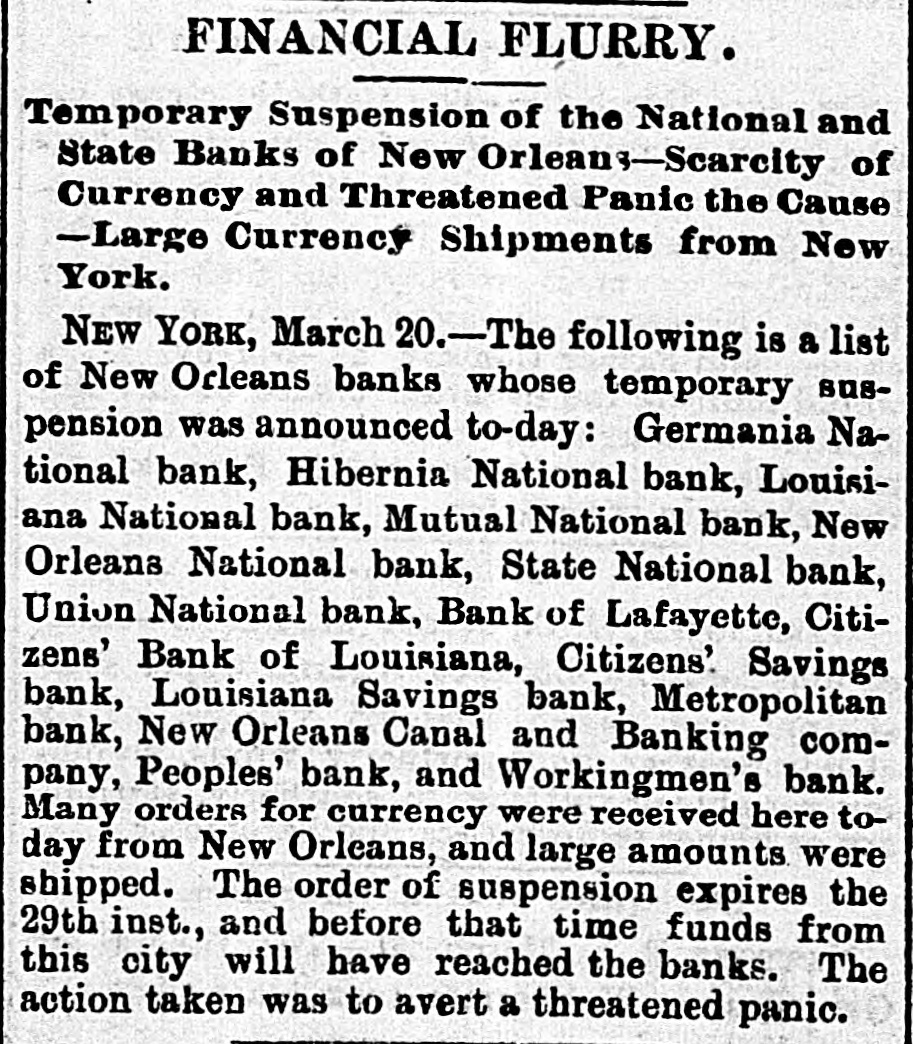
FINANCIAL FLURRY. Temporary Suspension of the National and State Banks of New Orlean-Scarcity of Currency and Threatened Panic the Cause -Large Currency Shipments from New York. NEW YORK, March 20.-The following is a list of New Orleans banks whose temporary suspension was announced to-day: Germania National bank, Hibernia National bank, Louisiana National bank, Mutual National bank, New Orleans National bank, State National bank, Union National bank, Bank of Lafayette, Citizens' Bank of Louisiana, Citizens' Savings bank, Louisiana Savings bank, Metropolitan bank, New Orleans Canal and Banking company, Peoples' bank, and Workingmen's bank. Many orders for currency were received here today from New Orleans, and large amounts were shipped. The order of suspension expires the 29th inst., and before that time funds from this city will have reached the banks. The action taken was to avert a threatened panic.


Article from Lexington Weekly Intelligencer, March 22, 1879

Click image to open full size in new tab

Article Text

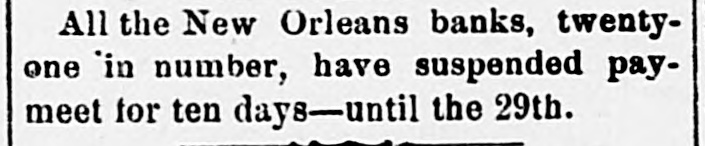
All the New Orleans banks, twenty-one in number, have suspended payment for ten days-until the 29th.


Article from Daily Press and Dakotaian, March 22, 1879

Click image to open full size in new tab

Article Text

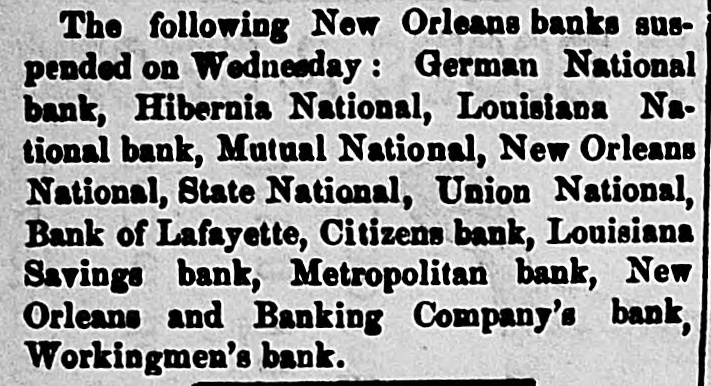
The following New Orleans banks suspended on Wednesday: German National bank, Hibernia National, Louisiana National bank, Mutual National, New Orleans National, State National, Union National, Bank of Lafayette, Citizens bank, Louisiana Savings bank, Metropolitan bank, New Orleans and Banking Company's bank, Workingmen's bank.


Article from The Portland Daily Press, March 24, 1879

Click image to open full size in new tab

Article Text

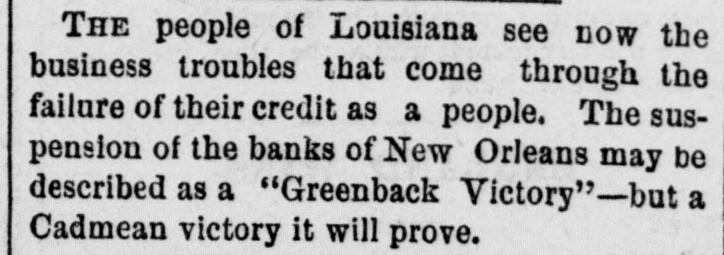
THE people of Louisiana see now the business troubles that come through the failure of their credit as a people. The suspension of the banks of New Orleans may be described as a "Greenback Victory"-but a Cadmean victory it will prove.


Article from Daily Globe, March 25, 1879

Click image to open full size in new tab

Article Text

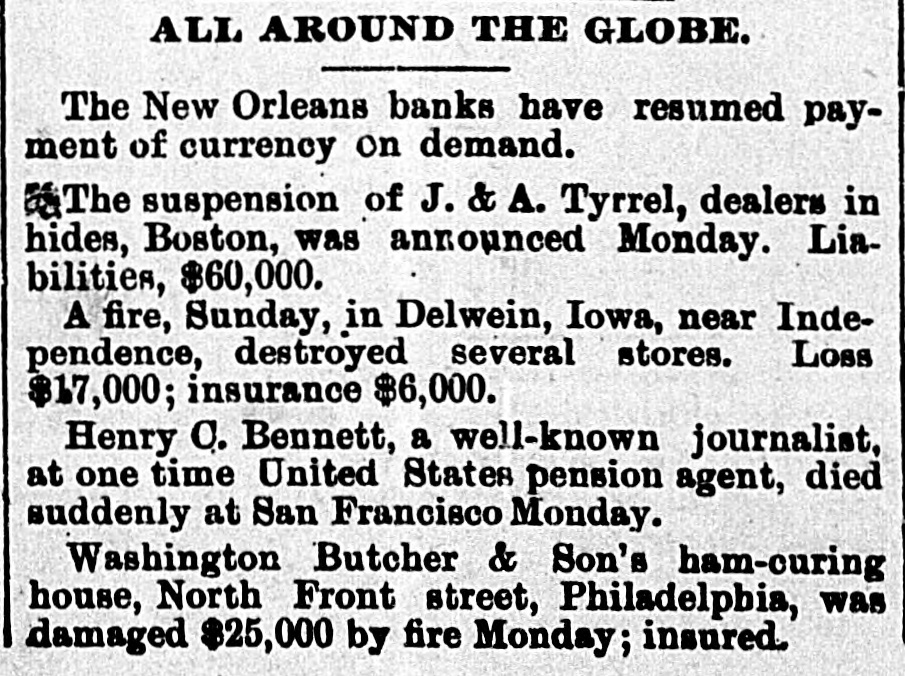
# ALL AROUND THE GLOBE. The New Orleans banks have resumed payment of currency on demand. The suspension of J. & A. Tyrrel, dealers in hides, Boston, was announced Monday. Liabilities, $60,000. A fire, Sunday, in Delwein, Iowa, near Independence, destroyed several stores. Loss $17,000; insurance $6,000. Henry C. Bennett, a well-known journalist, at one time United States pension agent, died suddenly at San Francisco Monday. Washington Butcher & Son's ham-curing house, North Front street, Philadelphia, was damaged $25,000 by fire Monday; insured.


Article from The Rock Island Argus, March 25, 1879

Click image to open full size in new tab

Article Text

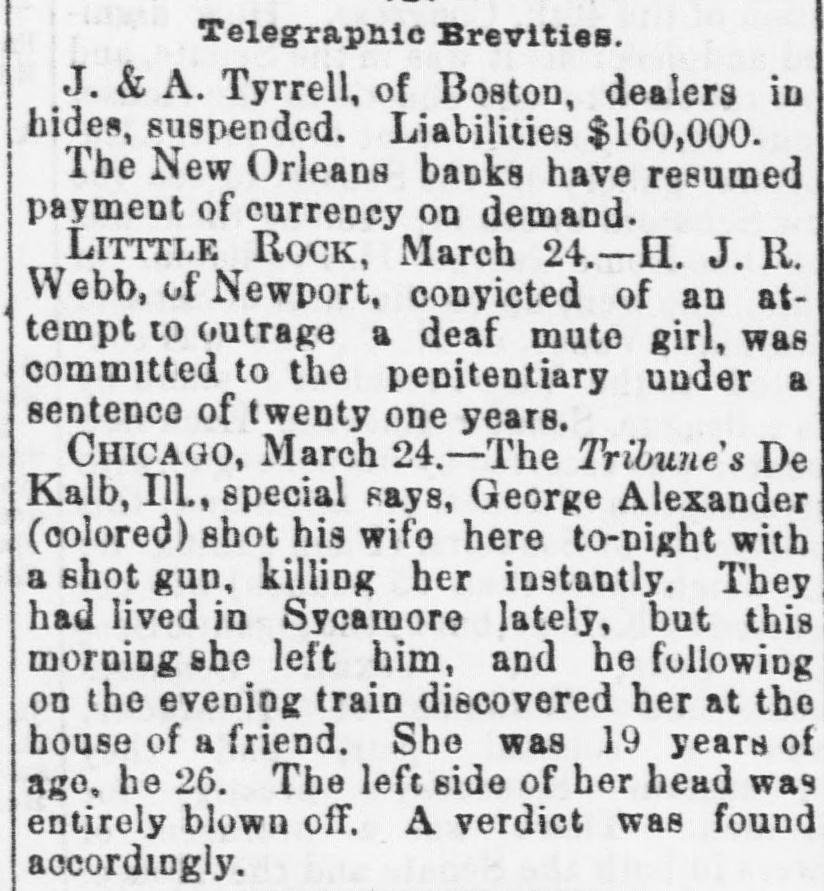
Telegraphic Brevities. J. & A. Tyrrell, of Boston, dealers in hides, suspended. Liabilities $160,000. The New Orleans banks have resumed payment of currency on demand. LITTTLE Rock, March 24.-H. J. R. Webb, of Newport, convicted of an attempt to outrage a deaf mute girl, was committed to the penitentiary under a sentence of twenty one years. CHICAGO, March 24.-The Tribune's De Kalb, Ill., special says, George Alexander (colored) shot his wife here to-night with a shot gun, killing her instantly. They had lived in Sycamore lately, but this morning she left him, and he following on the evening train discovered her at the house of a friend. She was 19 years of age. he 26. The left side of her head was entirely blown off. A verdict was found accordingly.


Article from Evening Star, March 25, 1879

Click image to open full size in new tab

Article Text

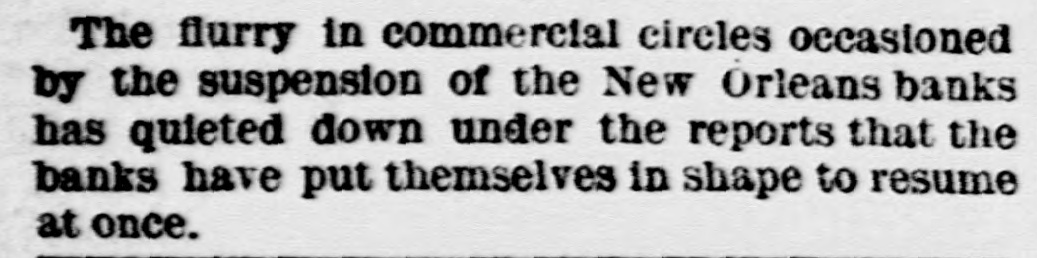
The flurry in commercial circles occasioned by the suspension of the New Orleans banks has quieted down under the reports that the banks have put themselves in shape to resume at once.


Article from Chicago Daily Tribune, March 25, 1879

Click image to open full size in new tab

Article Text

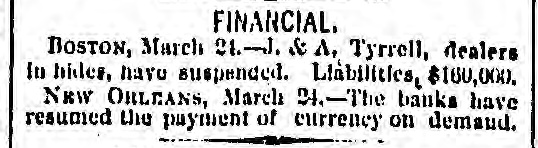
# FINANCIAL. BOSTON, March 21.-J. & A, Tyrrell, dealers in hides, have suspended. Liabilities, $160,000. NEW ORLEANS, March 24.-The banks have resumed the payment of currency on demand.


Article from The Weekly Clarion, March 26, 1879

Click image to open full size in new tab

Article Text

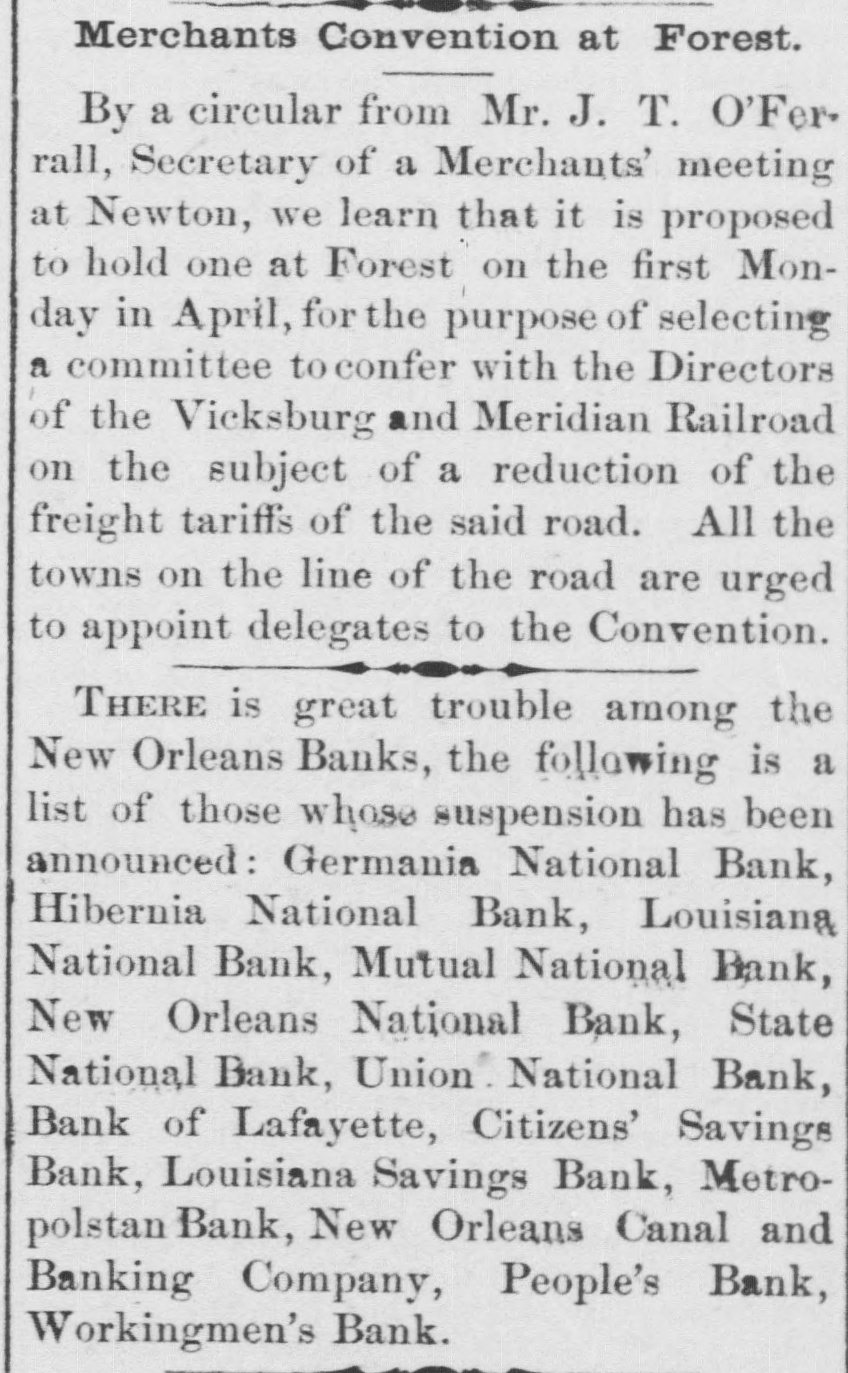
Merchants Convention at Forest. By a circular from Mr. J. T. O'Ferrall, Secretary of a Merchants' meeting at Newton, we learn that it is proposed to hold one at Forest on the first Monday in April, for the purpose of selecting a committee to confer with the Directors of the Vicksburg and Meridian Railroad on the subject of a reduction of the freight tariffs of the said road. All the towns on the line of the road are urged to appoint delegates to the Convention. THERE is great trouble among the New Orleans Banks, the following is a list of those whose suspension has been announced: Germania National Bank, Hibernia National Bank, LouisianΔ… National Bank, Mutual National Bank, New Orleans National Bank, State National Bank, Union National Bank, Bank of Lafayette, Citizens' Savings Bank, Louisiana Savings Bank, Metropolstan Bank, New Orleans Canal and Banking Company, People's Bank, Workingmen's Bank.


Article from The New Orleans Daily Democrat, March 26, 1879

Click image to open full size in new tab

Article Text

The New York Herald of Saturday last reports that the bankers claim that the recent temporary suspension of the New Orleans banks, and the withdrawal of $1,500,000 from New York banks, will be of benefit to that city, because it will reduce proportionately the legal tender reserve, and banks will be thus enabled to claim and obtain a stiffer interest on called loans.


Article from The New Orleans Daily Democrat, March 26, 1879

Click image to open full size in new tab

Article Text

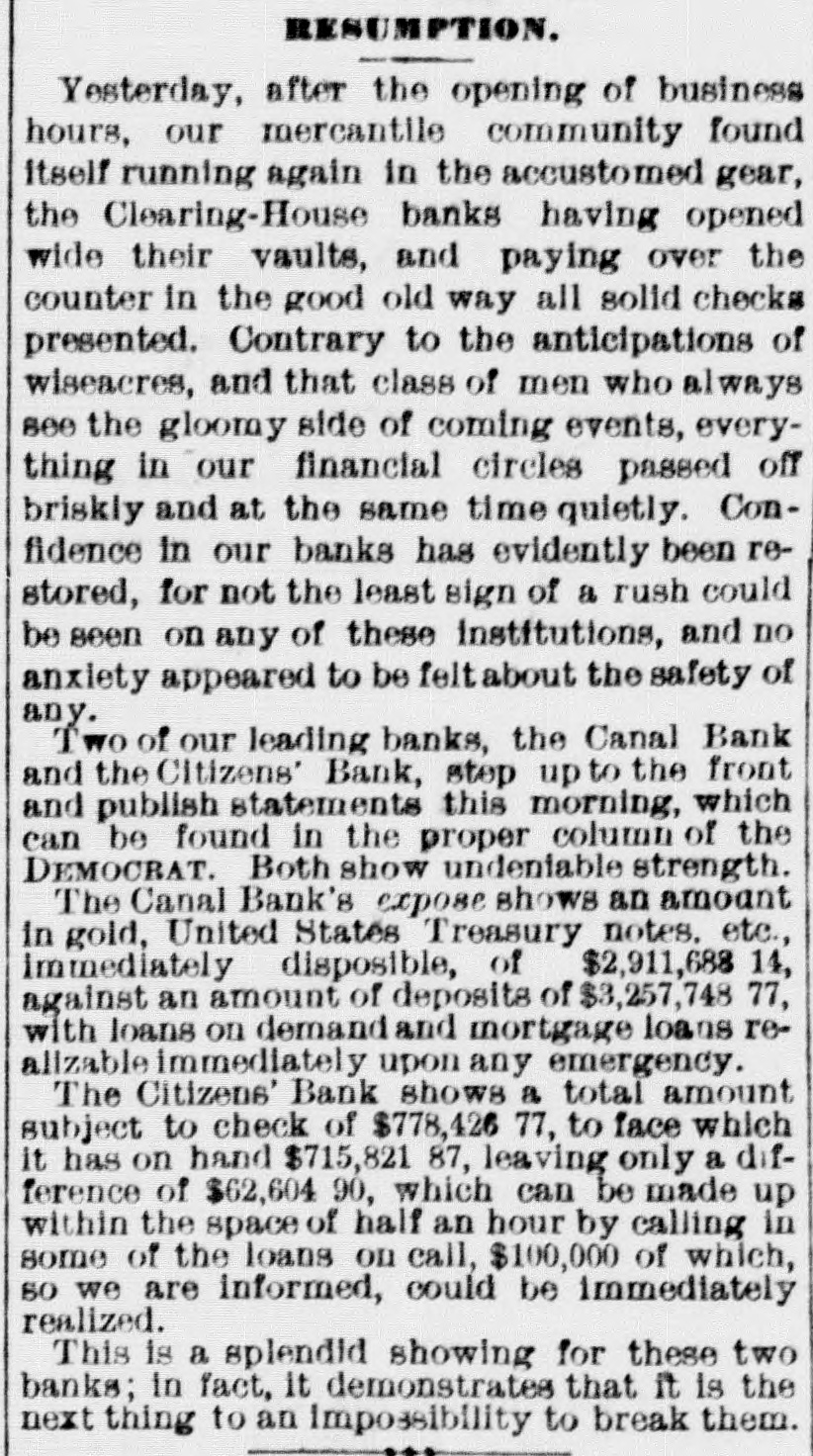
RESUMPTION. Yesterday, after the opening of business hours, our mercantile community found Itself running again in the accustomed gear, the Clearing-House banks having opened wide their vaults, and paying over the counter in the good old way all solid checks presented. Contrary to the anticipations of wiseacres, and that class of men who always see the gloomy side of coming events, everything in our financial circles passed off briskly and at the same time quietly. Confidence in our banks has evidently been restored, for not the least sign of a rush could be seen on any of these institutions, and no anxiety appeared to be felt about the safety of any. Two of our leading banks, the Canal Bank and the Citizens' Bank, step up to the front and publish statements this morning, which can be found in the proper column of the DEMOCRAT. Both show undeniable strength. The Canal Bank's expose shows an amount in gold, United States Treasury notes. etc., immediately disposible, of $2,911,688 14, against an amount of deposits of $3,257,748 77, with loans on demand and mortgage loans realizable immediately upon any emergency. The Citizens' Bank shows a total amount subject to check of $778,426 77, to face which it has on hand $715,821 87, leaving only a difference of $62,604 90, which can be made up within the space of half an hour by calling in some of the loans on call, $100,000 of which, 80 we are informed, could be immediately realized. This is a splendid showing for these two banks; in fact, it demonstrates that it is the next thing to an impossibility to break them.


Article from The Stark County Democrat, March 27, 1879

Click image to open full size in new tab

Article Text

THE New Orleans banks all suspended temporarily last week, but have resumed the payment of currency. They got help from New York city, about two millions.


Article from The Lake Charles Echo, March 29, 1879

Click image to open full size in new tab

Article Text

# RESUMPTION. The panic is over, and the New Orleans Banks resumed payment on the 25th inst.


Article from The Weekly Elko Independent, March 30, 1879

Click image to open full size in new tab

Article Text

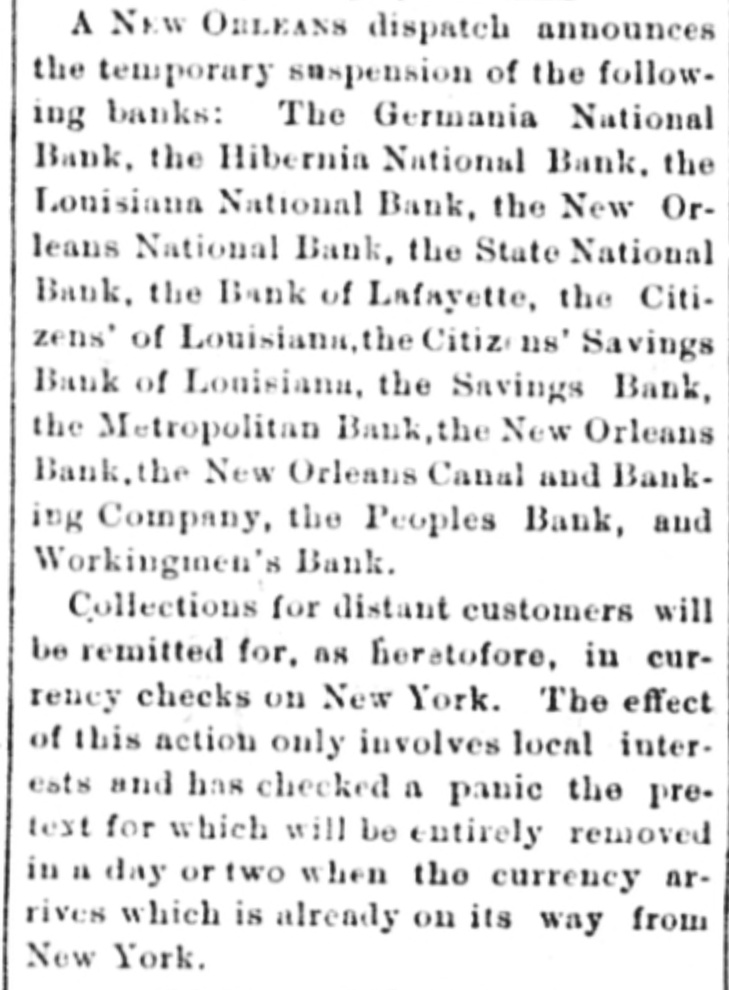
A NEW ORLEANS dispatch announces the temporary suspension of the following banks: The Germania National Bank, the Hibernia National Bank. the Louisiana National Bank, the New Orleans National Bank, the State National Bank, the Bank of Lafayette, the Citizens' of Louisiana, the Citiz ns' Savings Bank of Louisiana, the Savings Bank, the Metropolitan Bank, the New Orleans Bank. the New Orleans Canal and Banking Company, the Peoples Bank, and Workingmen's Bank. Collections for distant customers will be remitted for. as heretofore, in currency checks on New York. The effect of this action only involves local interests and has checked a panic the pretext for which will be entirely removed in 11 day or two when the currency arrives which is already on its way from New York.


Article from The New York Herald, March 31, 1879

Click image to open full size in new tab

Article Text

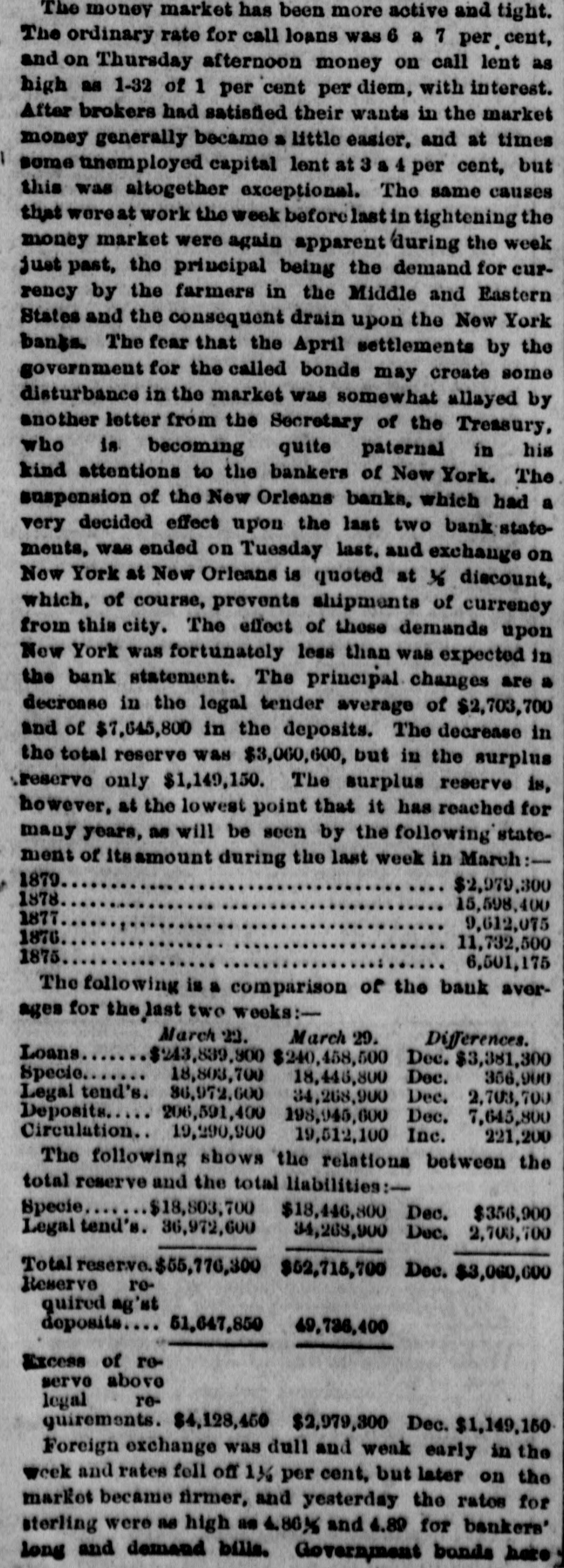
The money market has been more active and tight. The ordinary rate for call loans was 6 a 7 per. cent, and on Thursday afternoon money on call lent as high as 1-32 of 1 per cent per diem, with interest. After brokers had satisfied their wants in the market money generally became a little easier. and at times some unemployed capital lent at 3 a 4 per cent, but this was altogether exceptional. The same causes that were at work the week before last in tightening the money market were again apparent during the week just past, the principal being the demand for currency by the farmers in the Middle and Eastern States and the consequent drain upon the New York banks. The fear that the April settlements by the government for the called bonds may create some disturbance in the market was somewhat allayed by another letter from the Secretary of the Treasury, who is becoming quite paternal in his kind attentions to the bankers of New York. The suspension of the New Orleans banks, which had a very decided effect upon the last two bank statements, was ended on Tuesday last. and exchange on New York at New Orleans is quoted at Β½ discount, which, of course, prevents shipments of currency from this city. The effect of these demands upon New York was fortunately less than was expected in the bank statement. The principal changes are a decrease in the legal tender average of $2,703,700 and of $7,645,800 in the deposits. The decrease in the total reserve was $3,060,600, but in the surplus reserve only $1,149,150. The surplus reserve is, however, at the lowest point that it has reached for many years, as will be seen by the following statement of amount during the last week in March:1879 $2,979,300 1878 15,598,400 1877 9,612,075 1876 11,732,500 1875 6,501,175 The following is a comparison of the bank averages for the last two weeks:March 22. March 29. Differences. Loans $243,839,900 $240,458,500 Dec. $3,381,300 Specie 18,803,700 Dec. 18,448,800 356,900 36,972,600 Legal tend's. Dec. 34,268,900 2,703,700 Deposits 206,591,400 Dec. 198,045,600 7,645,800 Circulation. 19,290,900 Inc. 19,512,100 221,200 The following shows the relations between the total reserve and the total liabilities:$18,803,700 Specie $18,446,800 Dec. $356,900 Legal tend's. 36,972,600 34,268,900 Dec. 2,703,700 Total reserve. $55,776,300 Dec. $52,715,700 $3,060,600 Reserve required ag'st deposits 51,647,850 49,736,400 Excess of reserve above relegal quirements. $4,128,450 $2,979,300 Dec. $1,149,150 Foreign exchange was dull and weak early in the week and rates fell off 1Β½ per cent, but later on the market became firmer, and yesterday the rates for sterling were as high as 4.86% and 4.89 for bankers' long and demand bills. Government bonds here


Article from Watertown Republican, April 2, 1879

Click image to open full size in new tab

Article Text

THE WORLD'S WORK. MISCELLANEOUS. THE revolution in Sonora, Mexico, has been squelched. THE negro exodus from the south to Kansas continues unabated. THE New Orleans banks after three days suspension have all resumed. NATHAN P. PRATT. treasurer of the Reading savings bank, Boston, is the latest bank defaulter. SEVERAL persons were injured by a collision on the New York elevated railroad March 25th. THE governor of Louisiana has signed the bill repealing the charter of the state lottery. COL. THOMAS A. SCOTT was re-elected president of the Pennsylvania railroad March 26th. ONE hundred and sixty families of Philadelphia are going to Kansas to settle on the public lands. THE Marquis of Lorne, governor of Canada, and his wife, are expected to visit New York city in May. A DISTRUCTIVE gale of wind swept over eastern Georgia on March 23rd. Milledgeville suffered a loss of $100,000. THE constitutional convention of Louisiana will stand as follows: 94 democrats, 33 republicans, and 7 fusionists and nationals. A SAN FRANCISCO dispatch of March 26th says: John W. Coughlan, ex-congressman for the third district of California, died to-day at his residence in Oakland. THE Virginia senate concurred in the house amendments to the senate bill providing for the settlement of the state debt, known as the "McCulloch compromise bill." THE national white lead association which closed its annual session in Chicago yesterday, decided not to raise the price of lead. It will remain at 71 cents per pound for large lots. AT Providence, R. I., on the 24th the legislature voted upon the question of woman suffrage. The vote stood, ayes, 25; noes, 21-not the necessary twothird vote for submiting it as an amendment to the constitution to the people. THE Michigan university laboratory suit has been a good one for the lawyers, the expenses of litigation footing up to not less than $80,000. Silas H. Douglass won the suit. SENOR ZAMACONA, Mexican minister, is doing a good work for his country in a commercial way. He is the best known foreign diplomat in the United States. He has just visited St. Louis and other cities. THE house of representatives of Rhode Island refused to pass the resolution submitting to the people an amendment granting the right of suffrage to women, although the vote stood ayes 25, noes 21. It required a twothirds vote. A LEXINGTON, Ky., dispatch says the centennial celebration of the first settlement of Lexington will take place OF Wednesday, April 2nd, when a vast assemblage from this and adjoining states is expected. Preparations are being made on the most extensive scale to make the occasion worthy of the ancient reputation of Lexington for hospitality THE socialists of Chicago gave a ball on Sunday March 23rd, which called together a monster concourse of people. A large number of men participated in a military drill, which showed great proficiency in the use of arms. Nodisturbance occurred. GENERAL C. B. Comstock, General G. Weitzel and Colonel D. C. Houston, United States engineers, are at Keokuk, Iowa, by direction of the secretary of war, to investigate and report as to the practicability of utilizing the waterpower of the Des Moines Rapids canal, as well as establishing dry-docks therein. THE Milwaukee News: Billy Holbert received such a handsome offer to play with the Syracuse Stars this season that he could not well refuse, and will leave Milwaukee Sunday afternoon for Syracuse, where he will go into training at once. The arrangements to keep Holbert in Milwaukee did not succeed. A SPECIAL from Leadville, Col., says that "considerable excitement has been produced in the camp by rumors of the "find" of a rich fissure vein of gold in California gulch. Two miners brought into the Leadville Bank specimens of quartz assaying $20,000 a ton, and claim


Article from The Emporia News, April 4, 1879

Click image to open full size in new tab

Article Text

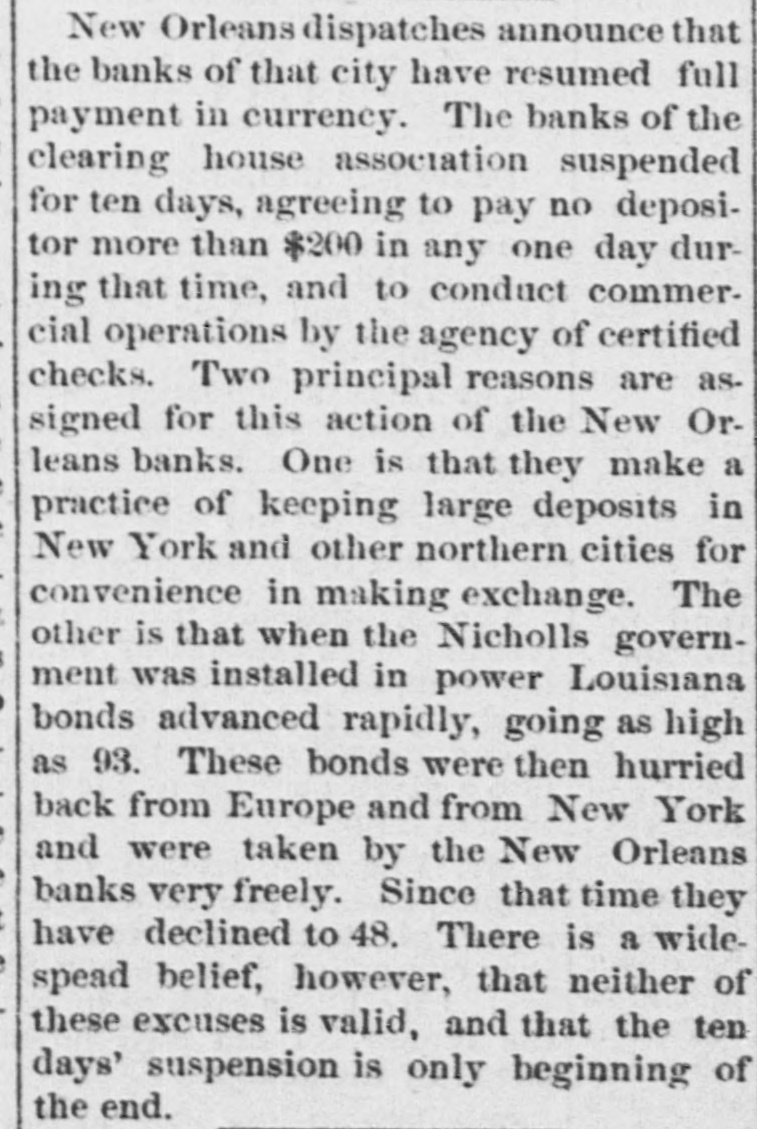
New Orleans dispatches announce that the banks of that city have resumed full payment in currency. The banks of the clearing house association suspended for ten days, agreeing to pay no depositor more than $200 in any one day during that time, and to conduct commercial operations by the agency of certified checks. Two principal reasons are assigned for this action of the New Orleans banks. One is that they make a practice of keeping large deposits in New York and other northern cities for convenience in making exchange. The other is that when the Nicholls government was installed in power Louisiana bonds advanced rapidly, going as high as 93. These bonds were then hurried back from Europe and from New York and were taken by the New Orleans banks very freely. Since that time they have declined to 48. There is a widespead belief, however, that neither of these excuses is valid, and that the ten days' suspension is only beginning of the end.


Article from Essex County Herald, April 4, 1879

Click image to open full size in new tab

Article Text

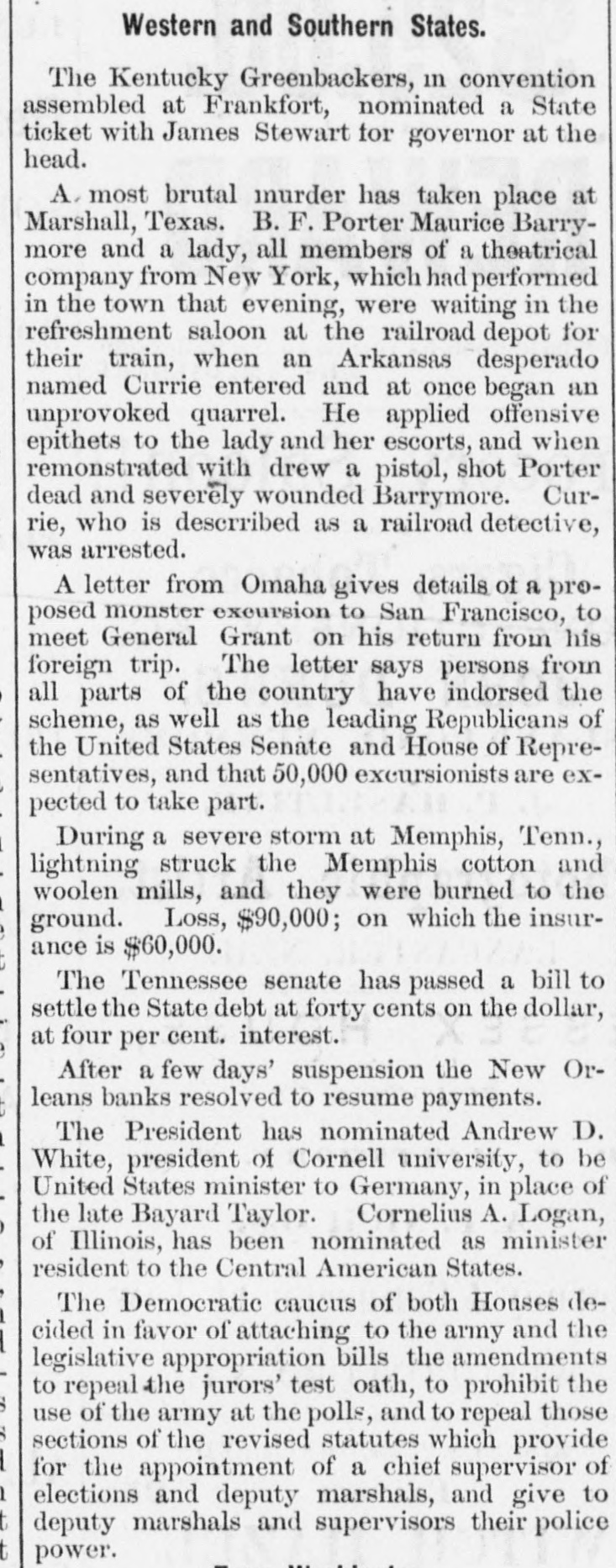
Western and Southern States. The Kentucky Greenbackers, in convention assembled at Frankfort, nominated a State ticket with James Stewart for governor at the head. A. most brutal murder has taken place at Marshall, Texas. B. F. Porter Maurice Barrymore and a lady, all members of a theatrical company from New York, which had performed in the town that evening, were waiting in the refreshment saloon at the railroad depot for their train, when an Arkansas desperado named Currie entered and at once began an unprovoked quarrel. He applied offensive epithets to the lady and her escorts, and when remonstrated with drew a pistol, shot Porter dead and severely wounded Barrymore. Currie, who is descrribed as a railroad detective, was arrested. A letter from Omaha gives details of a proposed monster exeursion to San Francisco, to meet General Grant on his return from his foreign trip. The letter says persons from all parts of the country have indorsed the scheme, as well as the leading Republicans of the United States Senate and House of Representatives, and that 50,000 excursionists are expected to take part. During a severe storm at Memphis, Tenn., lightning struck the Memphis cotton and woolen mills, and they were burned to the ground. Loss, $90,000; on which the insurance is $60,000. The Tennessee senate has passed a bill to settle the State debt at forty cents on the dollar, at four per cent. interest. After a few days' suspension the New Orleans banks resolved to resume payments. The President has nominated Andrew D. White, president of Cornell university, to be United States minister to Germany, in place of the late Bayard Taylor. Cornelius A. Logan, of Illinois, has been nominated as minister resident to the Central American States. The Democratic caucus of both Houses decided in favor of attaching to the army and the legislative appropriation bills the amendments to repeal the jurors' test oath, to prohibit the use of the army at the polls, and to repeal those sections of the revised statutes which provide for the appointment of a chief supervisor of elections and deputy marshals, and give to deputy marshals and supervisors their police power.