Caldwell & Co., an investment banking house in Nashville, was placed in the hands of a federal receiver (Nov 13-14, 1930) after a general creditors' bill; articles describe receivership and subsequent liquidation/legal proceedings and linked failures of Caldwell-connected banks. No contemporaneous run on Caldwell itself is described in these articles, though its failure triggered runs/closures at other institutions.
Events (2)
1.November 14, 1930Receivership
Newspaper Excerpt
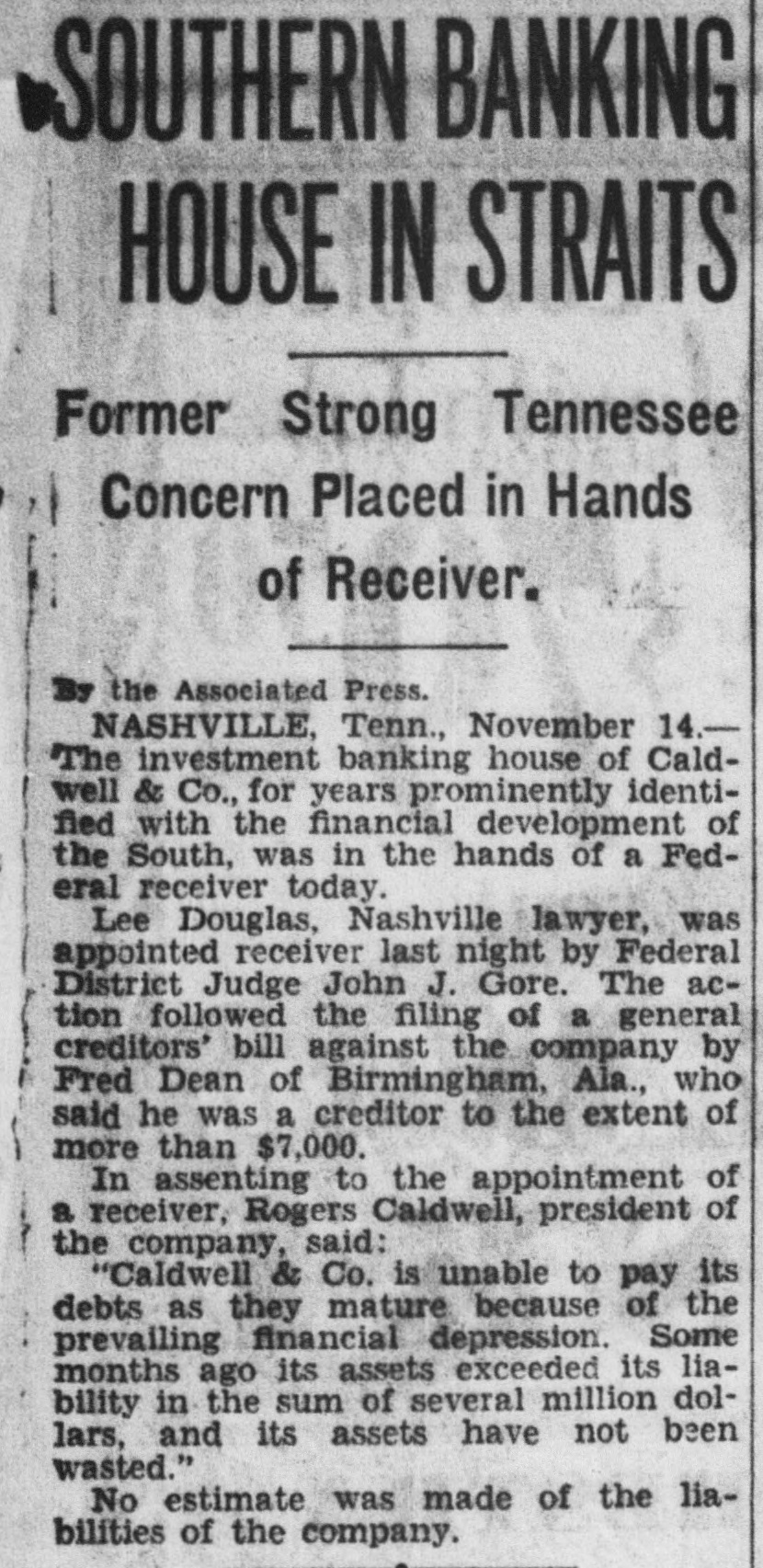
Lee Douglas, Nashville lawyer, was appointed receiver last night by Federal District Judge John J. Gore. The action followed the filing of a general creditors' bill against the company by Fred Dean of Birmingham, Ala., who said he was a creditor to the extent of more than $7,000.
Source
newspapers
2.November 14, 1930Suspension
Cause
Bank Specific Adverse Info
Cause Details
General creditors' bill filed; firm unable to pay debts as they matured amid prevailing financial depression; petition alleging insolvency and improper asset handling led to receivership.
Newspaper Excerpt
The investment banking house of Caldwell & Co., for years prominently identified with the financial development of the South, was in the hands of a Federal receiver today. Lee Douglas, Nashville lawyer, was appointed receiver last night by Federal District Judge John J. Gore.
Source
newspapers
Newspaper Articles (13)
1.November 14, 1930Evening StarWashington, DC
Click image to open full size in new tab
Article Text
SOUTHERN BANKING HOUSE IN STRAITS Former Strong Tennessee Concern Placed in Hands of Receiver. By the Associated Press. NASHVILLE, Tenn., November 14.The investment banking house of Caldwell & Co., for years prominently identified with the financial development of the South, was in the hands of a Federal receiver today. Lee Douglas, Nashville lawyer, was appointed receiver last night by Federal District Judge John J. Gore. The action followed the filing of a general creditors' bill against the company by Fred Dean of Birmingham, Ala., who said he was a creditor to the extent of more than $7,000. In assenting to the appointment of a receiver, Rogers Caldwell, president of the company, said: "Caldwell & Co. is unable to pay its debts as they mature because of the prevailing financial depression. Some months ago its assets exceeded its liability in the sum of several million dollars, and its assets have not been wasted." No estimate was made of the liabilities of the company.
2.November 14, 1930Hartford CourantHartford, CT
Click image to open full size in new tab
Article Text
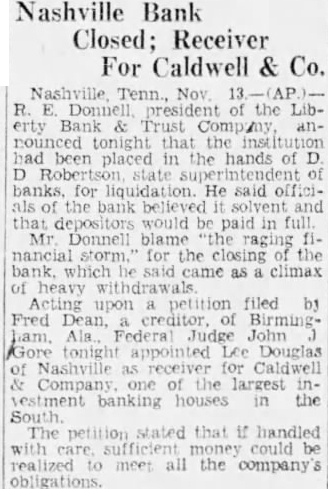
Nashville Bank Closed: Receiver For Caldwell & Co.
Nashville Nov Donnell the Libhands for liquidation. He said would paid Donnell blame raging the said as climax heavy upon filed Douglas Nashville Company largest vestment banking houses the South stated if handled meet the obligations.
3.November 17, 1930Brooklyn EagleBrooklyn, NY
Click image to open full size in new tab
Article Text
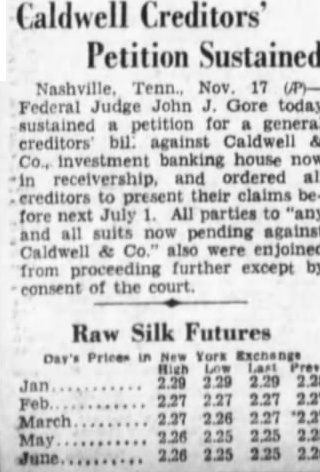
Galdwell Creditors' Petition Sustained
Nashville, Tenn. Nov. 17 (P)Federal Judge John J. Gore today sustained a petition for general creditors bil: against Caldwell & Co., investment banking house now *in receivership, and ordered all ereditors to present their claims before next July All parties to "any and all suits now pending against Caldwell & Co." also were enjoined from proceeding further except by consent of the court.
Raw Silk Futures Day's Prices in New York Exchange 2.29 2.29 Jan 2.27 2.27 March May 2.26 June 2.26
4.November 18, 1930Press and Sun-BulletinBinghamton, NY
Click image to open full size in new tab
Article Text
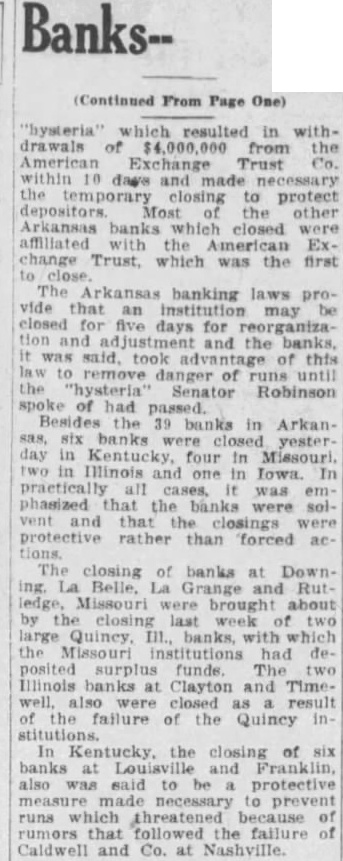
Banks--
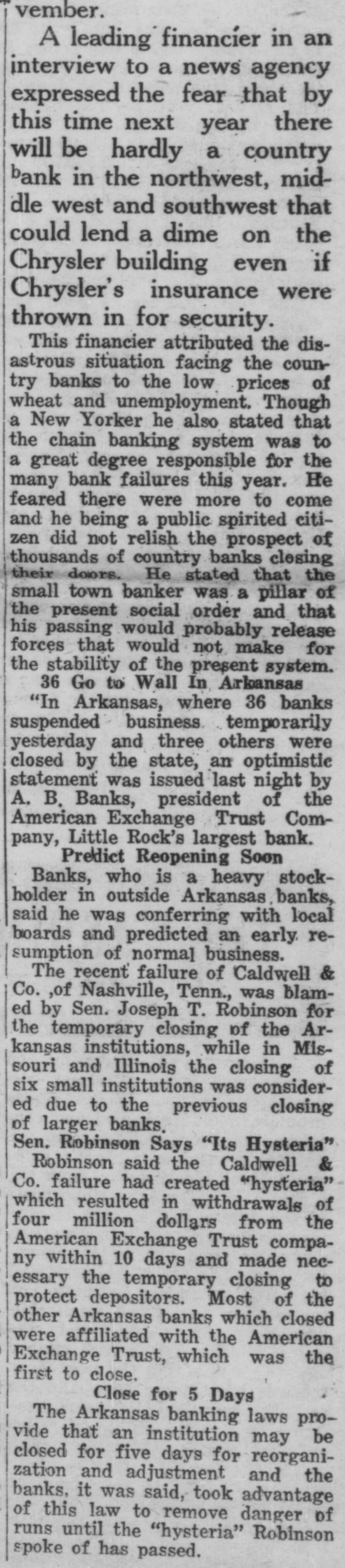
'hysteria' which resulted in withdrawals of $4,000,000 from the American Exchange Trust Co. within 10 days and made necessary the to closing protect Most the other Arkansas banks which closed were affiliated with the American Exchange Trust, which was the first to The Arkansas banking laws provide that an institution may be for for reorganizaand and the said, took of this to remove danger of until 'hysteria' Senator Robinson spoke of had Besides the banks in Arkansix banks closed yester day in four Missouri in Illinois in Iowa. was phasized the banks solprotective rather than forced acclosing of banks at ing. La Belle, La Grange and Rut Missouri brought about by week large the deposited funds. The two Illinois banks at Clayton and Timewell, closed result of failure of the Quincy institutions. In Kentucky, the closing of six banks Louisville Franklin, also was said to protective necessary to runs which threatened because of rumors that followed the failure of Caldwell and Co. at Nashville.
5.November 20, 1930The Indianapolis TimesIndianapolis, IN
Click image to open full size in new tab
Article Text
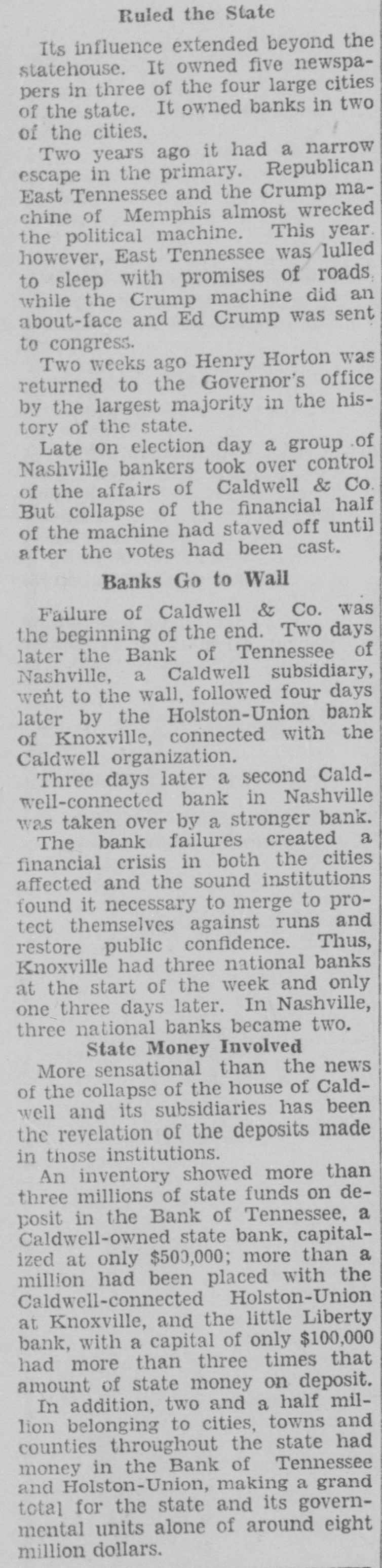
Ruled the State Its influence extended beyond the statehouse. It owned five newspapers in three of the four large cities of the state. It owned banks in two of the cities. Two years ago it had a narrow escape in the primary. Republican East Tennessee and the Crump machine of Memphis almost wrecked the political machine. This year. however, East Tennessee was lulled to sleep with promises of roads while the Crump machine did an about-face and Ed Crump was sent to congress. Two weeks ago Henry Horton was returned to the Governor's office by the largest majority in the history of the state. Late on election day a group of Nashville bankers took over control of the affairs of Caldwell & Co. But collapse of the financial half of the machine had staved off until after the votes had been cast. Banks Go to Wall Failure of Caldwell & Co. was the beginning of the end. Two days later the Bank of Tennessee of Nashville, a Caldwell subsidiary, went to the wall, followed four days later by the Holston-Union bank of Knoxville, connected with the Caldwell organization. Three days later a second Caldwell-connected bank in Nashville was taken over by a stronger bank. The bank failures created a financial crisis in both the cities affected and the sound institutions found it necessary to merge to protect themselves against runs and restore public confidence. Thus, Knoxville had three national banks at the start of the week and only one three days later. In Nashville, three national banks became two. State Money Involved More sensational than the news of the collapse of the house of Caldwell and its subsidiaries has been the revelation of the deposits made in those institutions. An inventory showed more than three millions of state funds on deposit in the Bank of Tennessee, a Caldwell-owned state bank, capitalized at only $500,000; more than a million had been placed with the Caldwell-connected Holston-Union at Knoxville, and the little Liberty bank, with a capital of only $100,000 had more than three times that amount of state money on deposit. In addition, two and a half million belonging to cities, towns and counties throughout the state had money in the Bank of Tennessee and Holston-Union, making a grand total for the state and its governmental units alone of around eight million dollars.
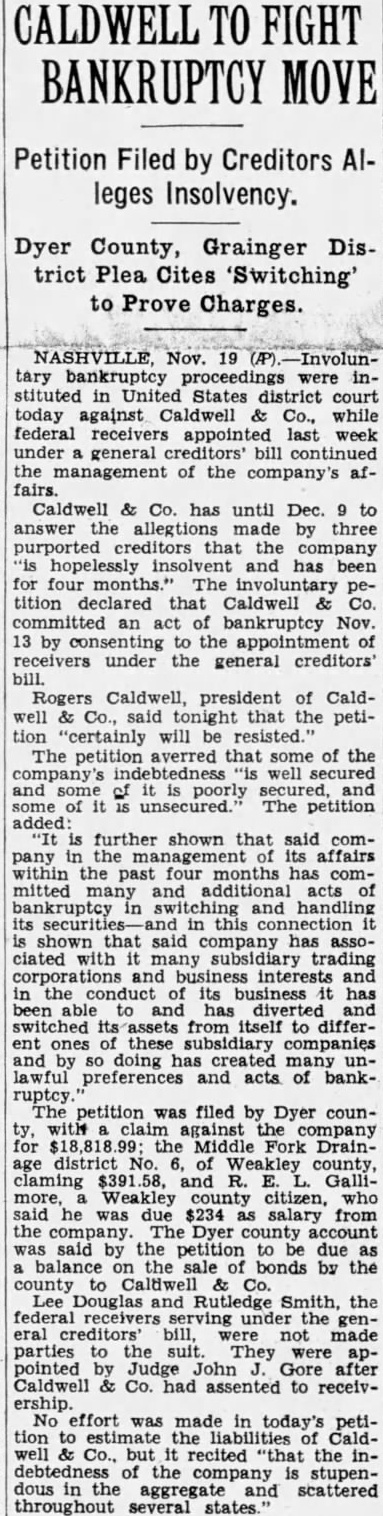
CALDWELL FIGHT BANKRUPTCY MOVE
Petition Filed by Creditors AIleges Insolvency.
Dyer County, Grainger District Plea Cites 'Switching' to Prove Charges.
NASHVILLE Nov. 19 tary were instituted United States district court today against Caldwell Co., while federal receivers appointed last week under general continued the management of the company's afCaldwell & Co. has until Dec. to answer allegtions made by three purported the company The tition that Caldwell act bankruptcy Nov 13 by to of receivers under the general creditors Rogers Caldwell, president Caldwell that the petition "certainly will be The petition that of the some poorly unsecured The petition added: further shown that said comits affairs within has mitted and and handling its this connection shown that said company has ciated subsidiary trading switched assets from different these subsidiary by doing created lawful preferences of bankpetition filed by Dyer counthe Middle Fork Draindistrict Weakley claming GalliWeakley county citizen, he salary said the due bonds by the Lee Douglas and Smith, the under the bill. made They were Judge John Gore Caldwell had receiveffort made today's petition estimate the CaldCo., but recited "that the indebtedness the company stupenaggregate scattered states
A leading financier in an interview to a news agency expressed the fear that by this time next year there will be hardly a country bank in the northwest, middle west and southwest that could lend a dime on the Chrysler building even if Chrysler's insurance were thrown in for security.
This financier attributed the disastrous situation facing the country banks to the low prices of wheat and unemployment. Though a New Yorker he also stated that the chain banking system was to a great degree responsible for the many bank failures this year. He feared there were more to come and he being a public spirited citizen did not relish the prospect of thousands of country banks closing their doors. He stated that the small town banker was a pillar of the present social order and that his passing would probably release forces that would not make for the stability of the present system.
36 Go to Wall In Arkansas
"In Arkansas, where 36 banks suspended business temporarily yesterday and three others were closed by the state, an optimistic statement was issued last night by A. B. Banks, president of the American Exchange Trust Company, Little Rock's largest bank.
Predict Reopening Soon
Banks, who is a heavy stockholder in outside Arkansas banks, said he was conferring with local boards and predicted an early resumption of normal business.
The recent failure of Caldwell & Co., of Nashville, Tenn., was blamed by Sen. Joseph T. Robinson for the temporary closing of the Arkansas institutions, while in Missouri and Illinois the closing of six small institutions was considered due to the previous closing of larger banks.
Sen. Robinson Says "Its Hysteria"
Robinson said the Caldwell & Co. failure had created "hysteria" which resulted in withdrawals of four million dollars from the American Exchange Trust company within 10 days and made necessary the temporary closing to protect depositors. Most of the other Arkansas banks which closed were affiliated with the American Exchange Trust, which was the first to close.
Close for 5 Days
The Arkansas banking laws provide that an institution may be closed for five days for reorganization and adjustment and the banks, it was said, took advantage of this law to remove danger of runs until the "hysteria" Robinson spoke of has passed.
8.November 21, 1930Nashville BannerNashville, TN
Click image to open full size in new tab
Article Text
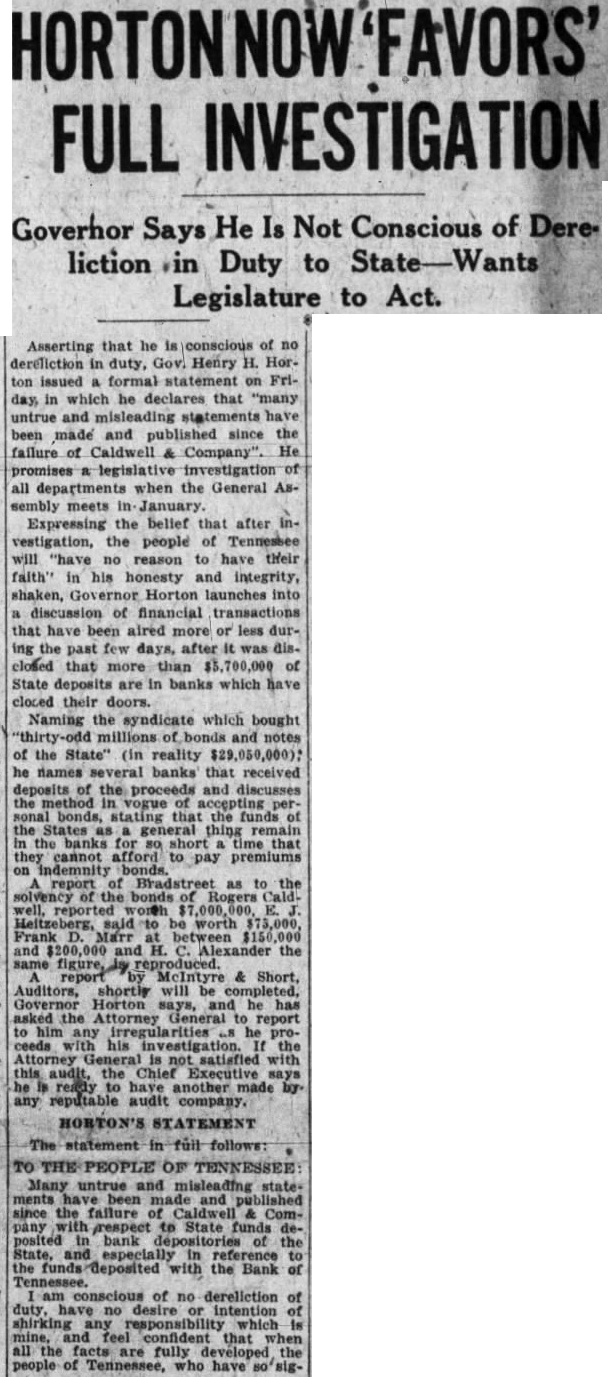
HORTON NOW FAVORS' FULL INVESTIGATION
Goverhor Says He Is Not Conscious of Dereliction in Duty to State-Wants Legislature to Act.
Asserting conscious of no Henry H. ton statement on Friday, which he that "many and have been made and published since the failure of Caldwell & legislative all when the General Asmeets the belief that after the people will no reason their faith" in his honesty and integrity, Horton launches into financial that been aired more or less ing the past few was closed that more of State deposits are in banks which have cloced their Naming the which bought millions bonds and the reality he names several that of and the thod bonds States general the banks that they cannot to pay premiums well, and H. the same report Auditors, will be asked Attorney to to any he ceeds satisfied have another any audit ATEMENT The follows: TO OF Many untrue and the failure State in the funds with the am of no duty, no desire any and confident that all the facts are the of have sig-
9.November 23, 1930Evening StarWashington, DC
Click image to open full size in new tab
Article Text
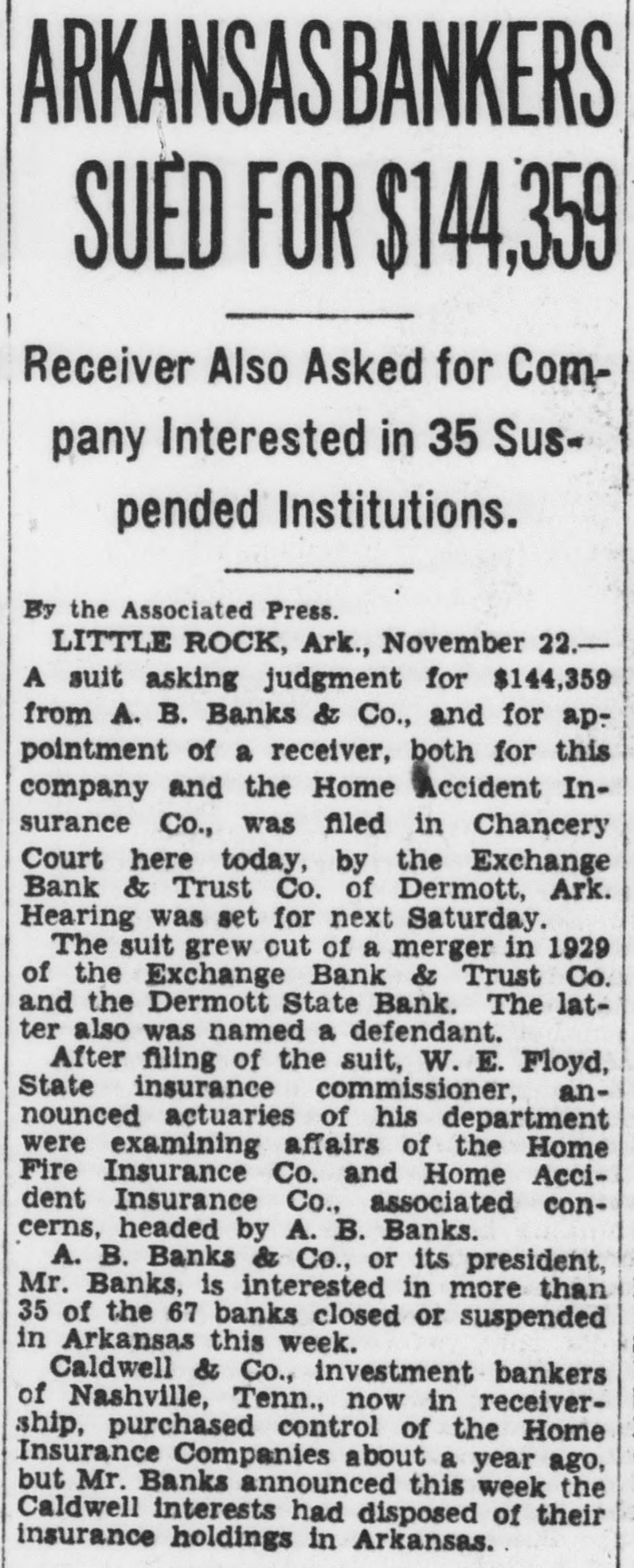
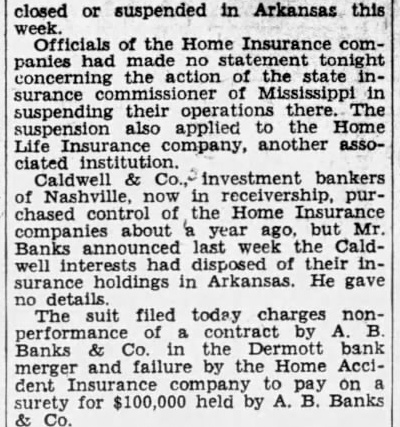
ARKANSASBANKERS SUED FOR $144,359 Receiver Also Asked for Company Interested in 35 Suspended Institutions. By the Associated Press. LITTLE ROCK, Ark., November 22.A suit asking judgment for $144,359 from A. B. Banks & Co., and for appointment of a receiver, both for this company and the Home Accident Insurance Co., was filed in Chancery Court here today, by the Exchange Bank & Trust Co. of Dermott, Ark. Hearing was set for next Saturday. The suit grew out of a merger in 1929 of the Exchange Bank & Trust Co. and the Dermott State Bank. The latter also was named a defendant. After filing of the suit, W. E. Floyd, State insurance commissioner, announced actuaries of his department were examining affairs of the Home Fire Insurance Co. and Home Accident Insurance Co., associated concerns, headed by A. B. Banks. A. B. Banks & Co., or its president, Mr. Banks, is interested in more than 35 of the 67 banks closed or suspended in Arkansas this week. Caldwell & Co., investment bankers of Nashville, Tenn., now in receivership, purchased control of the Home Insurance Companies about a year ago, but Mr. Banks announced this week the Caldwell interests had disposed of their insurance holdings in Arkansas.
closed or suspended in Arkansas this week. Officials of the Home Insurance companies had made no statement tonight concerning the action of the state insurance commissioner of Mississippi in suspending their operations there. The suspension also applied to the Home Life Insurance company, another associated institution. Caldwell & Co.,~ investment bankers of Nashville, now in receivership, purchased control of the Home companies about year ago, but Mr. Banks announced last week the Caldwell interests had disposed of their insurance holdings in Arkansas. He gave no The suit filed today charges nonperformance of a contract by A. B Banks & Co. in the Dermott bank merger and failure by the Home Accident Insurance company to pay on a surety for $100,000 held by A. B. Banks & Co.
11.March 19, 1931Evening StarWashington, DC
Click image to open full size in new tab
Article Text
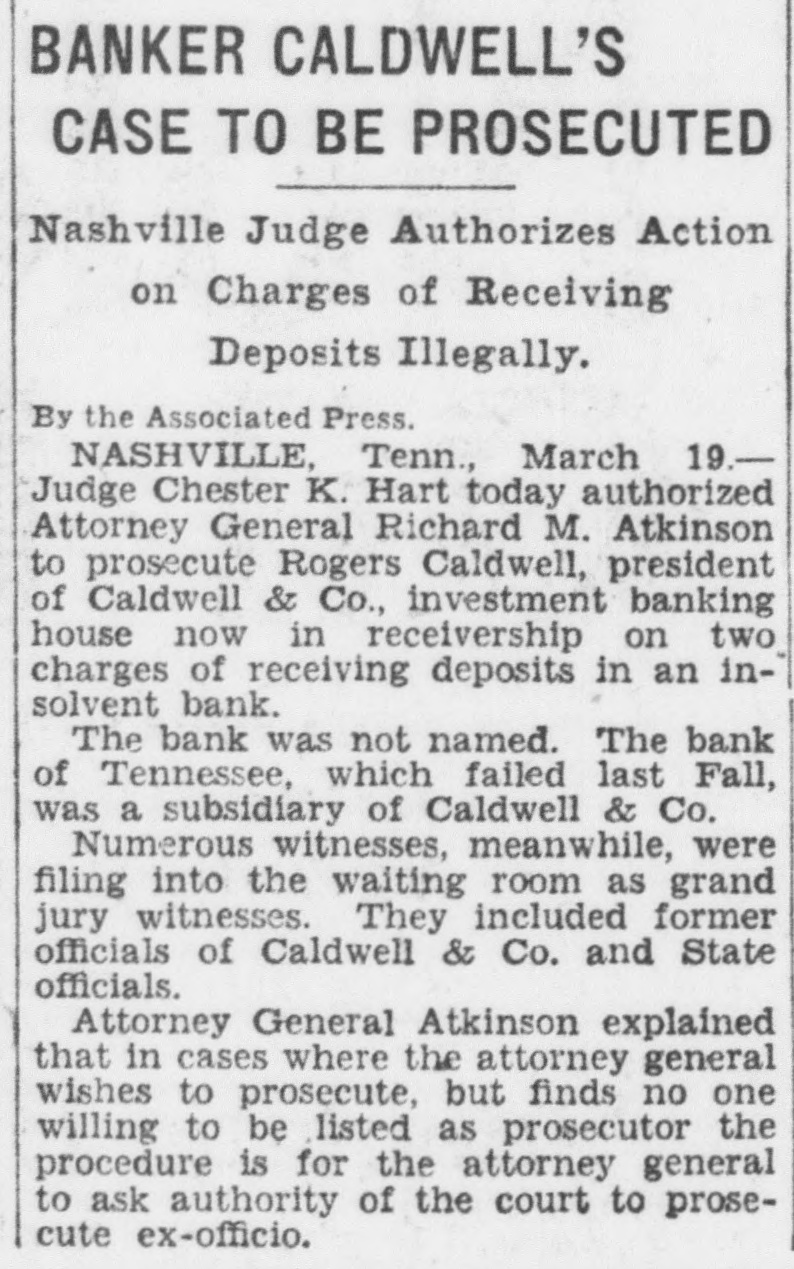
BANKER CALDWELL'S CASE TO BE PROSECUTED Nashville Judge Authorizes Action on Charges of Receiving Deposits Illegally. By the Associated Press. NASHVILLE, Tenn., March 19.Judge Chester K. Hart today authorized Attorney General Richard M. Atkinson to prosecute Rogers Caldwell, president of Caldwell & Co., investment banking house now in receivership on two charges of receiving deposits in an insolvent bank. The bank was not named. The bank of Tennessee, which failed last Fall, was a subsidiary of Caldwell & Co. Numerous witnesses, meanwhile, were filing into the waiting room as grand jury witnesses. They included former officials of Caldwell & Co. and State officials. Attorney General Atkinson explained that in cases where the attorney general wishes to prosecute, but finds no one willing to be listed as prosecutor the procedure is for the attorney general to ask authority of the court to prosecute ex-officio.
12.April 5, 1931Evening StarWashington, DC
Click image to open full size in new tab
Article Text
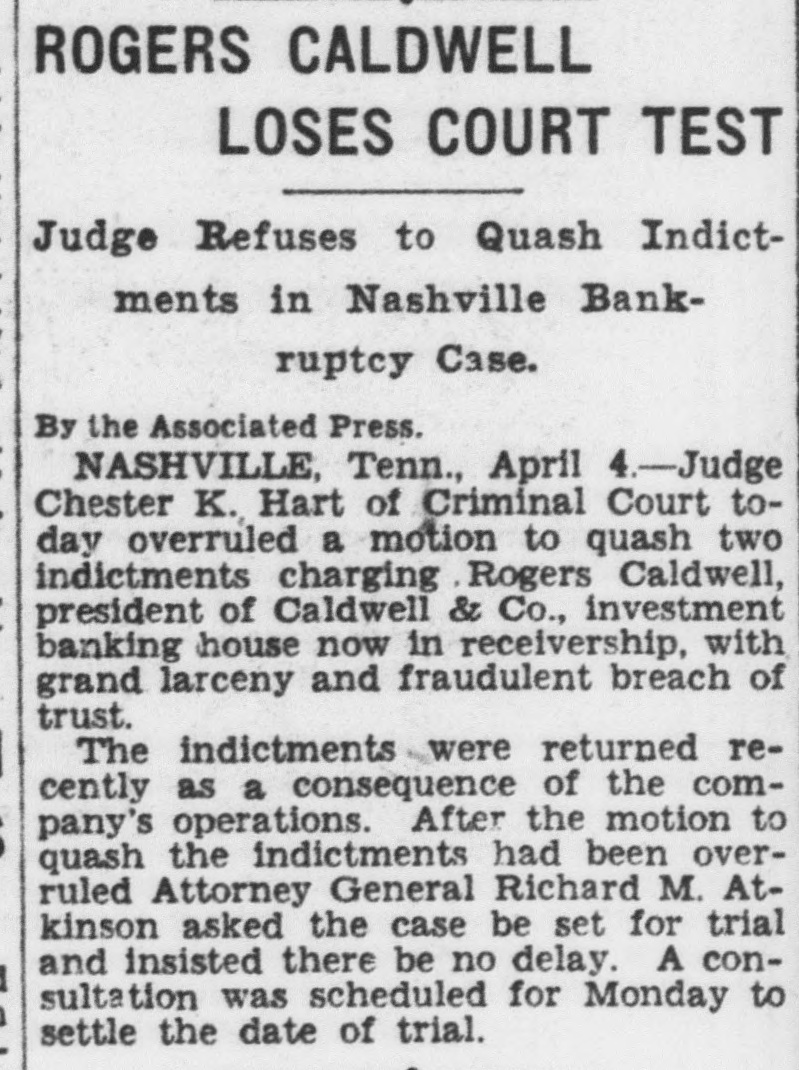
ROGERS CALDWELL LOSES COURT TEST Judge Refuses to Quash Indictments in Nashville Bankruptcy Case. By the Associated Press. NASHVILLE, Tenn., April 4.-Judge Chester K. Hart of Criminal Court today overruled a motion to quash two indictments charging Rogers Caldwell, president of Caldwell & Co., investment banking house now in receivership, with grand larceny and fraudulent breach of trust. The indictments were returned recently as a consequence of the company's operations. After the motion to quash the indictments had been overruled Attorney General Richard M. Atkinson asked the case be set for trial and insisted there be no delay. A consultation was scheduled for Monday to settle the date of trial.
13.September 10, 1931Evening StarWashington, DC
Click image to open full size in new tab
Article Text
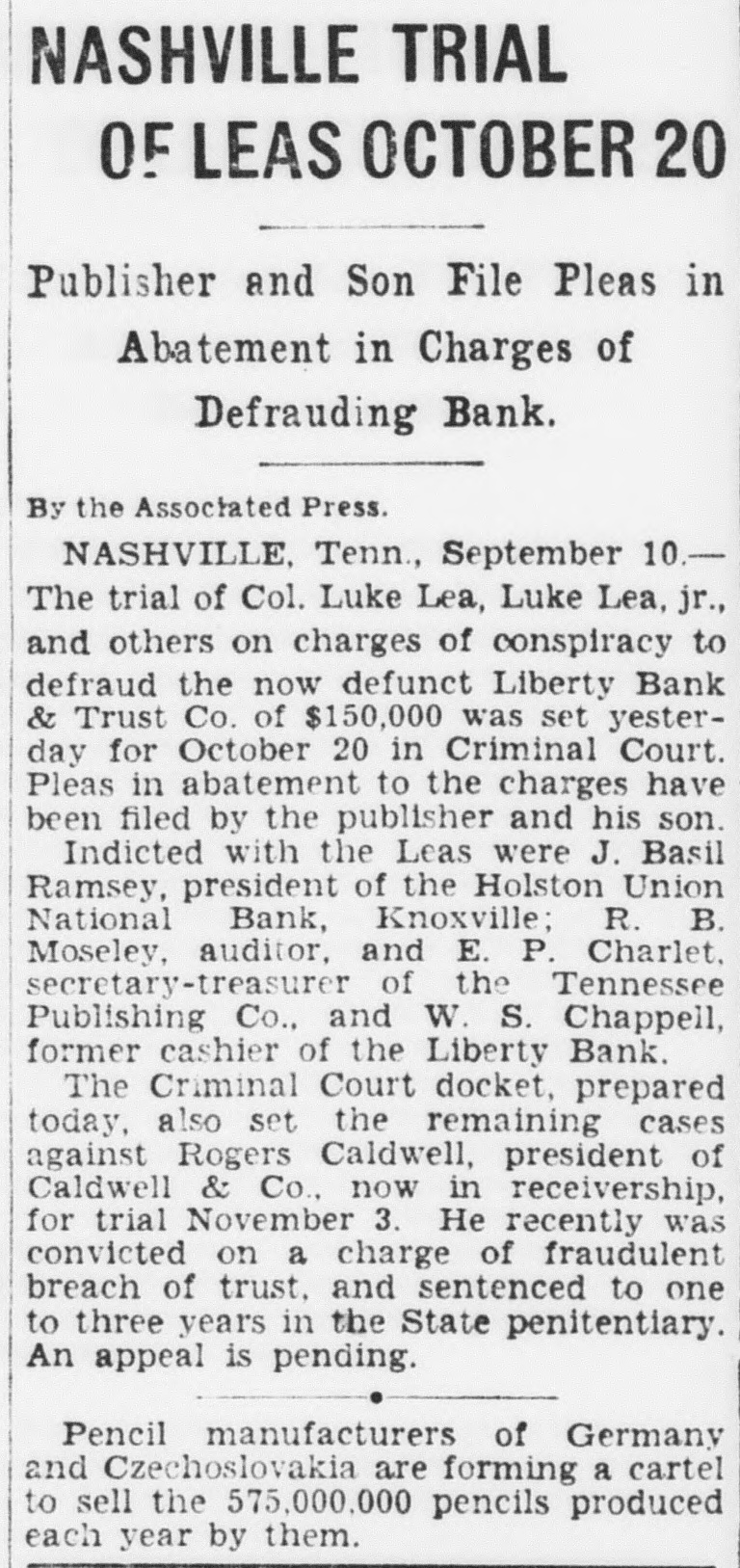
NASHVILLE TRIAL OF LEAS OCTOBER 20 Publisher and Son File Pleas in Abatement in Charges of Defrauding Bank. By the Associated Press. NASHVILLE, Tenn., September 10. The trial of Col. Luke Lea, Luke Lea, jr., and others on charges of conspiracy to defraud the now defunct Liberty Bank & Trust Co. of $150,000 was set yesterday for October 20 in Criminal Court. Pleas in abatement to the charges have been filed by the publisher and his son. Indicted with the Leas were J. Basil Ramsey, president of the Holston Union National Bank, Knoxville; R. B. Moseley, auditor, and E. P. Charlet, secretary-treasurer of the Tennessee Publishing Co., and W. S. Chappell, former cashier of the Liberty Bank. The Criminal Court docket, prepared today, also set the remaining cases against Rogers Caldwell, president of Caldwell & Co., now in receivership, for trial November 3. He recently was convicted on a charge of fraudulent breach of trust, and sentenced to one to three years in the State penitentiary. An appeal is pending. Pencil manufacturers of Germany and Czechoslovakia are forming a cartel to sell the 575,000,000 pencils produced each year by them.