Citizens Bank (Union City, IN)

Episode Information

Episode UID
2099446391157
Episode Type
Run โ†’ Suspension โ†’ Closure
Bank Type
trust
Bank ID
209944639 hash
Start Date
May 8, 1896
Location
Union City, Indiana (40.202, -84.809)

Metadata

Model
gpt-5-mini (chosen from majority vote of a three-model LLM ensemble)
Short Digest
2d630db6e0465b68

Response Measures

None

Description

Closure followed a run triggered by a discovered cashier shortage and related rumors; a receiver was appointed.

Events (3)

1. May 8, 1896 Run
Cause
Bank Specific Adverse Info
Cause Details
Shortage discovered after cashier E. W. Reeves resigned; transfers of property and gossip prompted withdrawals and city funds were removed.
Measures
Directors decided to wind up business; requested State Bank Examiner to take charge pending receiver appointment.
Newspaper Excerpt
gossip began to cause people to determine to get their deposits ... The result of the whole thing was that there was a run on the bank.
Source
newspapers
2. May 8, 1896 Suspension
Cause
Bank Specific Adverse Info
Cause Details
Management, after cash exhaustion from withdrawals stemming from discovered cashier shortage and ensuing rumors, decided to suspend and wind up.
Newspaper Excerpt
The bank closed its doors yesterday morning ... the bank had decided to suspend business and close up its affairs.
Source
newspapers
3. May 9, 1896 Receivership
Newspaper Excerpt
State Bank Examiner T. B. Millikan ... to take charge of the Citizens' Bank, of Union City, pending the appointment of a receiver for that institution.
Source
newspapers

Newspaper Articles (11)

Article from The Indianapolis Journal, May 9, 1896

Click image to open full size in new tab

Article Text

A BANK HAS TO CLOSE STATE EXAMINER TAKES CHARGE OF THE CITIZENS', OF UNION CITY. The Assets Will Probably Equal Liabilities-The Former Cashier Was a Little Short. Auditor of State Daily yesterday notified State Bank Examiner T. B. Millikan, of New Castle, to take charge of the Citizens' Bank, of Union City, pending the appointment of a receiver for that institution. This was done in response to a request from President Cadwallader, of the bank, in a letter in which it was stated that the bank had decided to suspend business and close up its affairs. The receiver will be appointed by the Randolph Circuit Court, and until that time Mr. Millikan will act as custodian of the affairs of the bank. The bank closed its doors yesterday morning, after over thirty years of existence. It was founded in 1865 by ex-Governor Isaac P. Gray and Nathan Cadwallader. It was operated as a private banking house, and was known as the Gray & Cadwallader Bank until the passage of the State banking law, in 1872. In the spring of 1873 the bank was incorporated as the Citizens' Bank of Union City, being the second bank in the State to incorporate. The bank has always been looked upon as one of the sound institutions of its kind in the State, and It is still so considered by persons who know anything about it. Its reports at the Statehouse and the information which the Auditor is able to gather about to lead him to the belief that the suspension will not result in loss to either depositors or stockholders. The application for the appointment of a receiver, however, shows that it is not the Intention of the management of the bank to attempt to resume again, but that it is the intention to wind up the business. The last report of the bank made to the State Auditor, as well as many previous reports, shows that the bank held a large part of its assets in real estate. This fact would naturally weaken the ability of the bank to stand a heavy run, and would also make the winding up of its affairs slow. As to the reasons which led to its suspension the Auditor of State is not informed. The letter asking for some one to take charge of the oank gave no information concerning the condition of the bank. From a gentleman who has just returned from Union City, and who is in a position to know considerable about the bank, some facts were learned. The trouble began with the resignation some time ago of Cashier E. W. Reeves. Shortly after his withdrawal from the bank a shortage was discovered, and he was called upon quietly to make it good. He turned over to the bank some real estate, and the recorder's office at Union City shows a similar transfer made by his mother. This action is believed to have set rumors afloat regarding the solvency of the bank. The sureties on the bond of the city treasurer had a meeting, and the result was a request that the treasurer withdraw the city funds from the bank. The meeting of these bondsmen and the subsequent withdrawal of the funds was not kept very quiet, and gossip began to cause people to determine to get their deposits from the institution. The result of the whole thing was that there was a run on the bank. It did not take long to exhaust the supply of cash on hand, and then there was nothing left but suspension. In considering the situation Tuesday evening the directors came to the conclusion that they would wind up the bank's affairs, and wrote the State Auditor to that effect.

Article from The Indianapolis Journal, May 14, 1896

Click image to open full size in new tab

Article Text

Cadwallader Bank Affairs. Special to the Indianapolis Journal. UNION CITY, Ind., May 13.-State Bank Inspector Millikan has completed his work with the Citizens' Bank, which was compelled to close its doors, and has returned to his home in New Castle, awaiting the appointment of a receiver by the court next Saturday. An appraisement was made yesterday of the mortgages and notes, and it is said that the character of the notes is good, and the depositors will be paid in full. The directors say the affairs of the bank are in good condition, and the report that C. H. Cadwallader, cashier, was short, and that the bank was in a "rotten" condition, is said to be untrue.


Article from Highland Recorder, May 15, 1896

Click image to open full size in new tab

Article Text

$130,000, insurance the weave the cloth ments is destroyed were card and picker room. rooms, boiler mule rooms, and dye live houses stock and dealer of Chambers- The 72d Wilson Ely, committed a suicide. School Sunday burg, Pa., of the American the United Congreat Conn. anniversary Union was celebrated New Haven, W Va., Church, at and Sistersville, bit several the grand jury of Jersey against Henry City gational Mad rected dogs at persons.- Palatine of corruption Justice Garrison. City to take was dithe charges F. Michellon. Neb., Treasurer Bolls, up city of treasurer Frank embezzlement of Omaha, in Ashland, Fire destroyed Wis. convicted valuable milling property saw Mike Rae, thousand people Birmingham, Ala., for of Angus a freight colored, the murder Five Au into open executed a shifting switch at engine caused McSwean at Air the Line. and Portsmouth, his train wife. to run of the Seatoard suicide in Spokane, S. Va., Hilgard, yard committed terrifle storm swept was through shot Wash. -A Annie Anderson J., who South Joseph Dakota. Graham in Trenton, N. from San schooner Seas, is by then killed himself. Norma, bound probably Haag, Francisco The for the South a member of a suistrychnine cide lost. club, George poisoned G. himself Patrick with J. indicted Sexton, by in millionaire, The charge Father grand jury. of the the Chicago spiracy. San federal Francisco.- Church, Kolaszewski, has been of Cleveland, is Inde- con- and is Catholic church property pendent to transfer the Methodist Church. ready to the was shot and while burglarat J. C. congregation Rodgers, fatally injured a colored Sylene, desperado, in o., Crawford's old, emizing the Fred postofice Crawford, sixteen Felpel, years an did the Lancast r Pa., The 1,200was Daniel B. store. ploye pany, of shooting. the crushed schooner -Henry to death. Caramel Fearing, about Com- a foor-master coal, went ashore Station, in a cargo of the Highland of nine men Masgachusetts. saved ton mile with north by the of life-savers. total The crew loss. Light The -The Railroa vessel Pennsyl- Is were will are Cumberland extension probably be a Vailey into vania on the Crawford sh ot at the killed work coal and Kintley regions. burglariz) Rogers, proposed -Fred one his arrested of store. two in men _James Wheel- who and on the W. Va., Juene's was trying and to his wife were charge of robbing the banks of the oldest one it?, Yaxwell Mansion. Bank. Citizens of for want funds. The Union City, Ind., paid closed out, and the auditor assets, in last dollar was Liabilities, $75,000; to col The of state notified. Cause of money. failure, inability Gamble Broth High$135,000. Ject and scarcity of lumber dealers at Fidelity Co., extensive assigned to the and ers & Ky., have of assets liabilities was gang of outlaws, the murder of land Trust of notorious Park, Company. made. No statement -Taylor for who Delk, captured has leader been a for several Ga., was Atwanted of Pike County, weeks Looney, of the sheriff by Detective Cotell, the lanta police murderer of was arraigned near self-confessed the Senola force. Romulus ago, the Stone family, Judge six weeks Pleas The in Akron, Kohler, O., and pleaded E. F. Voris judge to Pa. J.A. at Tallmadge, appointed Musser before Attorneys suicide defend Common in not him. York, guilty. blew Melchoin and out Harvey committed Bethlehem, Pa., ConGeorge Young, Methodist approference and Heiser his brains. passed to sectarian -The a of resolution the Indian Chicago opposing schools. General arrested Fort in priations Homer Judd. Company, of was violating. the on the charge R. D. the aid of the Linseed Fillsburys, in E. Worth Fort Interstate head Worth. Packing Commerce of law. the Oil of Trust, has Hubbard Rev. suc- perceeded. with the millers' combine. Theologica fecting a great of the Lane succeeded by D. Morris, will Freehold, N. Henry at the Cincinnati. head Smith, be of a Seminary Goodwin retired missionary Y. in Rev David Smith. at Hamilton, N. hanged the murderer, round houses Queer at committed J. Philadelphia H. Holmes, locomotives suicide The belonging was to the Somer $300, and twelve Railroad Company, loss, Crescent destroyed by fire: electric that passed over Pa., an unknown other persons get. storm and 000; ville Ky., fully were Abbottstown. insured. geveral East During Berlin, Philadelphia an Thomas mai and dead and of in aged forty Cape Charles City, at Westmont, at Works. were destroyer stunned. was hotel struck Point years. A. A. Stetson. attempted Va. suicide The N: @15. Cry J. loss is of 425 owned sta! Lake by James Flynn estimated & Co., at from to 98 th 000 to General and confer M. E. on the annual at Co by of fire. committee $20,000. The Conference & By eligibility, a vote adopted the refers repor th the question back again.- to A jury ex-Stat ences, woman to be voted the on case of Ohio vs. indicte for verdiet of not gui'ty. lumbus, Senator alleged John Ohio, solicitation L. in Geyer, of of bribes, Paulding. returned ADJOURN.


Article from The Indianapolis Journal, August 4, 1896

Click image to open full size in new tab

Article Text

Cadwallader Suit Dismissed. Special to the Indianapolis Journal. UNION CITY. Ind., Aug. 3.-The attachment suit brought some months ago by the Citizens' Bank of this city against the individual property of the president of that institution, ex-Senator Nathan Cadwallader, was dismissed in the Circuit Court to-day. This action was brought on the affidavit of Mr. Thomas McMahan, one of the directors of the bank. It was charged that Mr. Cadwallader was about to dispose of his property, and that he had wrongfully taken and used the funds of the bank to the amount of $50,000, and judgment was asked for that amount. The suit was dismissed at the request of the receiver of the bank, Mr. Jesse Canady.


Article from New-York Tribune, August 8, 1896

Click image to open full size in new tab

Article Text

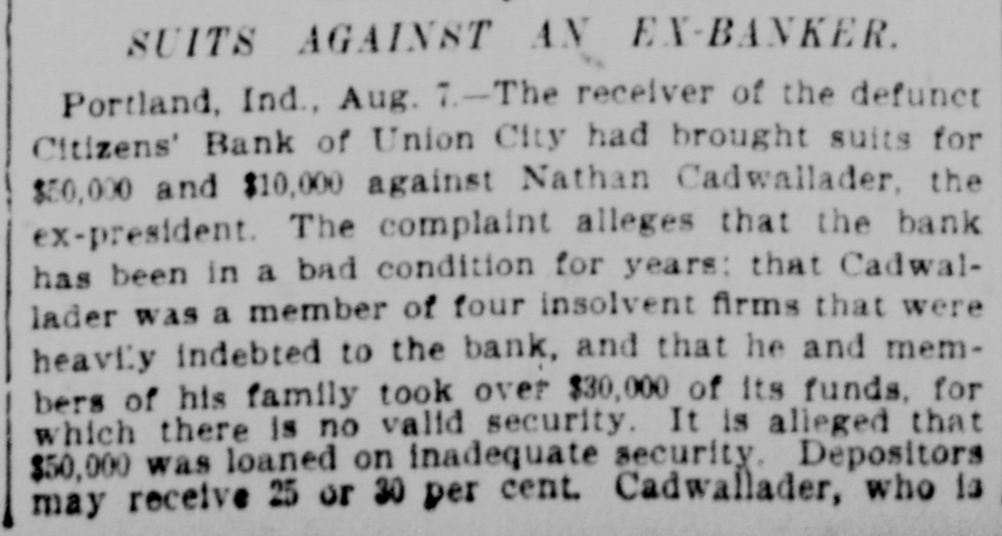
SUITS AGAINST AN EX-BANKER. Portland, Ind., Aug. T.-The receiver of the defunet Citizens' Bank of Union City had brought suits for $50,000 and $10,000 against Nathan Cadwallader, the ex-president. The complaint alleges that the bank has been in a bad condition for years: that Cadwallader was a member of four insolvent firms that were heavily indebted to the bank, and that he and members of his family took over $30,000 of its funds, for which there is no valid security. It is alleged that $50,000 was loaned on inadequate security. Depositors may receive 25 or 30 per cent. Cadwallader, who is


Article from The Indianapolis Journal, September 21, 1898

Click image to open full size in new tab

Article Text

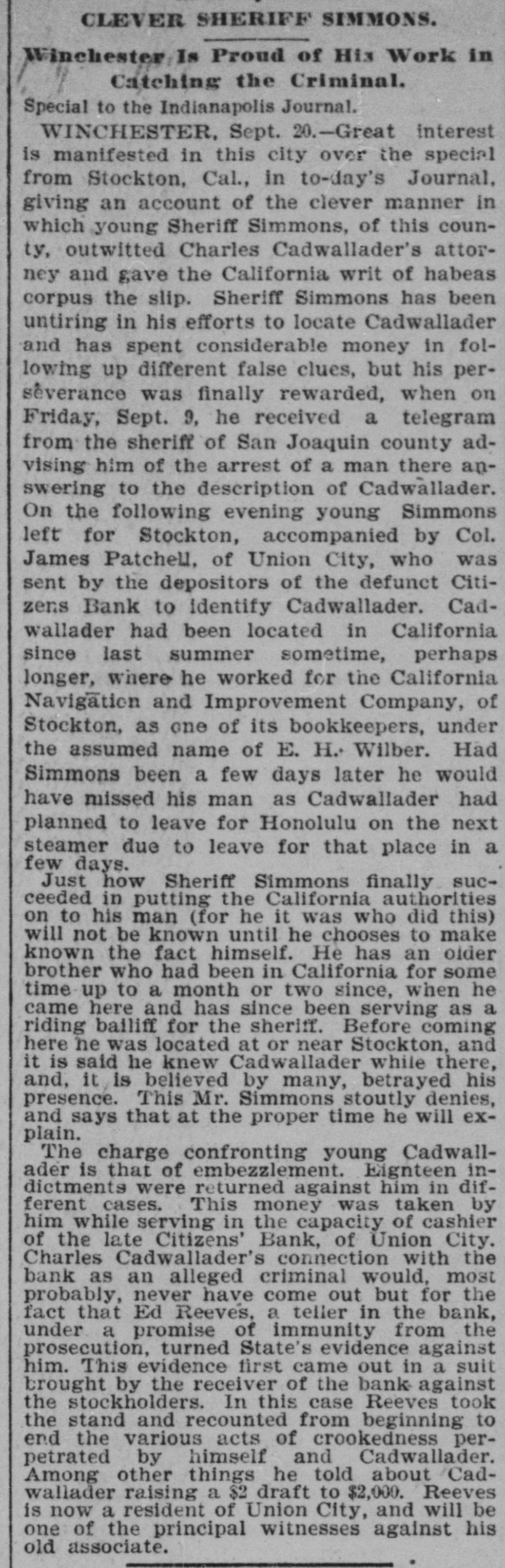
# CLEVER SHERIFF SIMMONS. Winchester Is Proud of His Work in Catching the Criminal. Special to the Indianapolis Journal. WINCHESTER, Sept. 20. -Great interest is manifested in this city over the special from Stockton, Cal., in to-day's Journal, giving an account of the clever manner in which young Sheriff Simmons, of this county, outwitted Charles Cadwallader's attorney and gave the California writ of habeas corpus the slip. Sheriff Simmons has been untiring in his efforts to locate Cadwallader and has spent considerable money in following up different false clues, but his perseverance was finally rewarded, when on Friday, Sept. 9, he received a telegram from the sheriff of San Joaquin county advising him of the arrest of a man there answering to the description of Cadwallader. On the following evening young Simmons left for Stockton, accompanied by Col. James Patchell, of Union City, who was sent by the depositors of the defunct Citizens Bank to identify Cadwallader. Cadwallader had been located in California since last summer sometime, perhaps longer, where he worked for the California Navigation and Improvement Company, of Stockton, as one of its bookkeepers, under the assumed name of E. H. Wilber. Had Simmons been a few days later he would have missed his man as Cadwallader had planned to leave for Honolulu on the next steamer due to leave for that place in a few days. Just how Sheriff Simmons finally succeeded in putting the California authorities on to his man (for he it was who did this) will not be known until he chooses to make known the fact himself. He has an older brother who had been in California for some time up to a month or two since, when he came here and has since been serving as a riding bailiff for the sheriff. Before coming here he was located at or near Stockton, and it is said he knew Cadwallader while there, and, it is believed by many, betrayed his presence. This Mr. Simmons stoutly denies, and says that at the proper time he will explain. The charge confronting young Cadwallader is that of embezzlement. Eignteen indictments were returned against him in different cases. This money was taken by him while serving in the capacity of cashier of the late Citizens' Bank, of Union City. Charles Cadwallader's connection with the bank as an alleged criminal would, most probably, never have come out but for the fact that Ed Reeves, a teller in the bank, under a promise of immunity from the prosecution, turned State's evidence against him. This evidence first came out in a suit brought by the receiver of the bank against the stockholders. In this case Reeves took the stand and recounted from beginning to end the various acts of crookedness perpetrated by himself and Cadwallader. Among other things he told about Cadwallader raising a $2 draft to $2,000. Reeves is now a resident of Union City, and will be one of the principal witnesses against his old associate.


Article from The Indianapolis Journal, December 6, 1898

Click image to open full size in new tab

Article Text

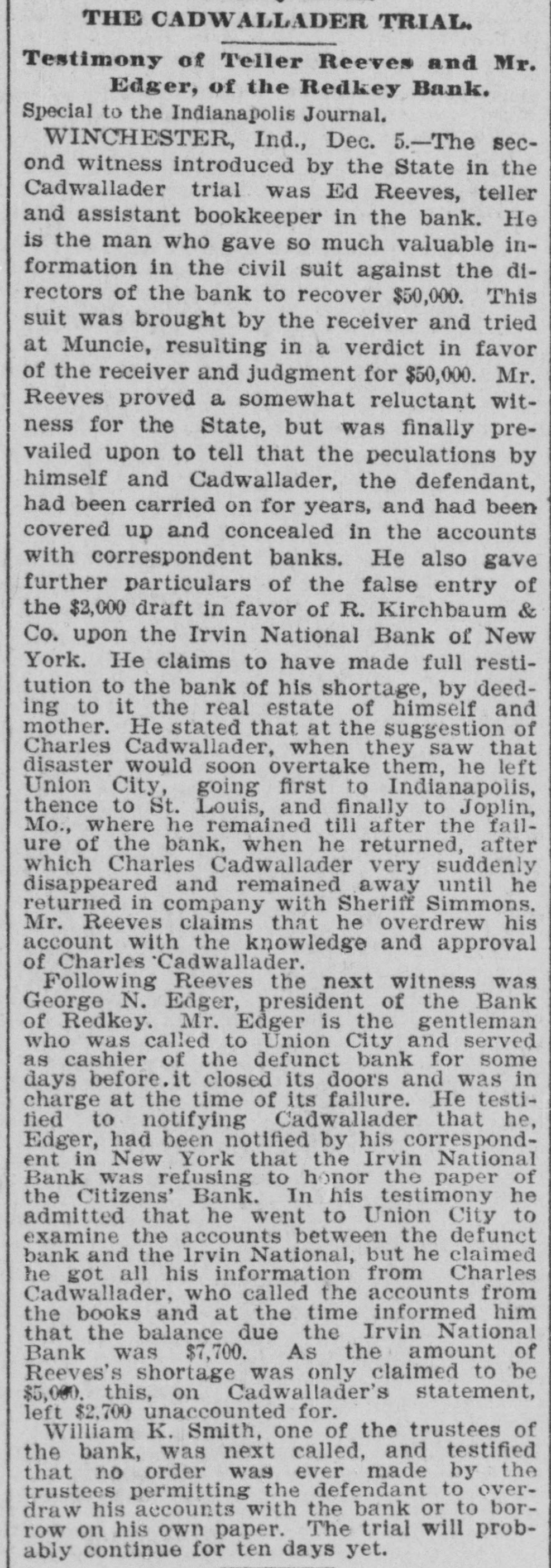
THE CADWALLADER TRIAL. Testimony of Teller Reeves and Mr. Edger, of the Redkey Bank. Special to the Indianapolis Journal. WINCHESTER, Ind., Dec. 5.-The second witness introduced by the State in the Cadwallader trial was Ed Reeves, teller and assistant bookkeeper in the bank. He is the man who gave so much valuable information in the civil suit against the directors of the bank to recover $50,000. This suit was brought by the receiver and tried at Muncie, resulting in a verdict in favor of the receiver and judgment for $50,000. Mr. Reeves proved a somewhat reluctant witness for the State, but was finally prevailed upon to tell that the peculations by himself and Cadwallader, the defendant, had been carried on for years, and had been covered up and concealed in the accounts with correspondent banks. He also gave further particulars of the false entry of the $2,000 draft in favor of R. Kirchbaum & Co. upon the Irvin National Bank of New York. He claims to have made full restitution to the bank of his shortage, by deeding to it the real estate of himself and mother. He stated that at the suggestion of Charles Cadwallader, when they saw that disaster would soon overtake them, he left Union City, going first to Indianapolis, thence to St. Louis, and finally to Joplin, Mo., where he remained till after the failure of the bank, when he returned, after which Charles Cadwallader very suddenly disappeared and remained away until he returned in company with Sheriff Simmons. Mr. Reeves claims that he overdrew his account with the knowledge and approval of Charles Cadwallader. Following Reeves the next witness was George N. Edger, president of the Bank of Redkey. Mr. Edger is the gentleman who was called to Union City and served as cashier of the defunct bank for some days before. it closed its doors and was in charge at the time of its failure. He testitied to notifying Cadwallader that he, Edger, had been notified by his correspondent in New York that the Irvin National Bank was refusing to honor the paper of the Citizens' Bank. In his testimony he admitted that he went to Union City to examine the accounts between the defunct bank and the Irvin National, but he claimed he got all his information from Charles Cadwallader, who called the accounts from the books and at the time informed him that the balance due the Irvin National Bank was $7,700. As the amount of Reeves's shortage was only claimed to be $5,000. this, on Cadwallader's statement, left $2,700 unaccounted for. William K. Smith, one of the trustees of the bank, was next called, and testified that no order was ever made by the trustees permitting the defendant to overdraw his accounts with the bank or to borrow on his own paper. The trial will probably continue for ten days yet.


Article from The Indianapolis Journal, June 7, 1900

Click image to open full size in new tab

Article Text

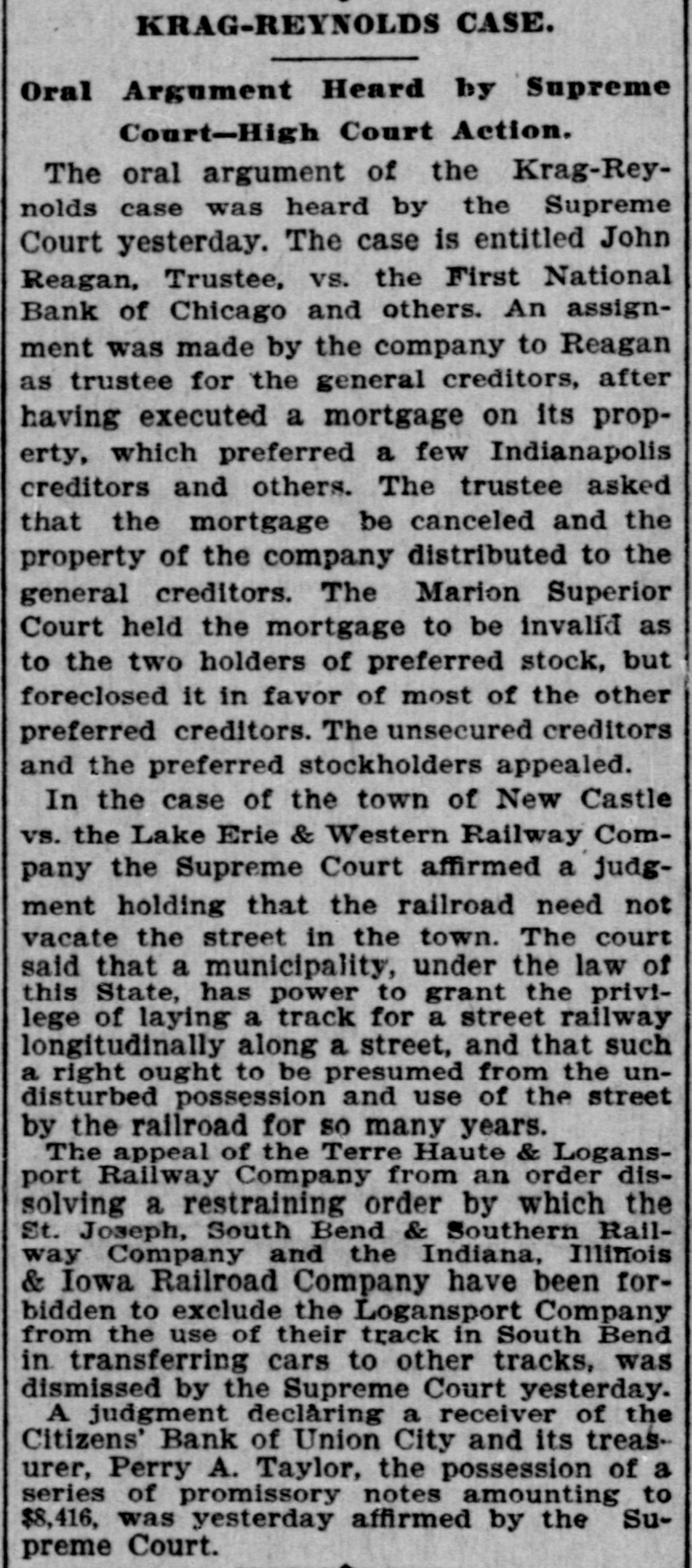
KRAG-REYNOLDS CASE. Oral Argument Heard by Supreme Court-High Court Action. The oral argument of the Krag-Reynolds case was heard by the Supreme Court yesterday. The case is entitled John Reagan, Trustee, vs. the First National Bank of Chicago and others. An assignment was made by the company to Reagan as trustee for the general creditors, after having executed a mortgage on its property, which preferred a few Indianapolis creditors and others. The trustee asked that the mortgage be canceled and the property of the company distributed to the general creditors. The Marion Superior Court held the mortgage to be invalid as to the two holders of preferred stock, but foreclosed it in favor of most of the other preferred creditors. The unsecured creditors and the preferred stockholders appealed. In the case of the town of New Castle vs. the Lake Erie & Western Railway Company the Supreme Court affirmed a judgment holding that the railroad need not vacate the street in the town. The court said that a municipality, under the law of this State, has power to grant the privilege of laying a track for a street railway longitudinally along a street, and that such a right ought to be presumed from the undisturbed possession and use of the street by the railroad for so many years. The appeal of the Terre Haute & Logansport Railway Company from an order dissolving a restraining order by which the St. Joseph, South Bend & Southern Railway Company and the Indiana, Illinois & Iowa Railroad Company have been forbidden to exclude the Logansport Company from the use of their track in South Bend in transferring cars to other tracks, was dismissed by the Supreme Court yesterday. A judgment declaring a receiver of the Citizens' Bank of Union City and its treasurer, Perry A. Taylor, the possession of a series of promissory notes amounting to $8,416, was yesterday affirmed by the Supreme Court.


Article from The Indianapolis Journal, October 11, 1901

Click image to open full size in new tab

Article Text

REBUKE FROM THE COURT THE SUPREME TRIBUNAL PRODS CARELESS BANK DIRECTORS. Case of Citizens' Bank of Union City, Ind.-Matters in the Local Courts. A sharp rebuke to careless bank directors was administered yesterday by the Indiana Supreme Court through Justice Dowling in the case of the late Citizens' Bank of Union City against its directors. In addition to administering the "scoring" the higher court affirmed a judgment of $50,000 recovered by the receiver of the bank from the directors. The board of directors was charged with acts of neglect numbering 119, among which were: Allowing the bank to take several thousand dollars' worth of worthless paper at face value from a bank to whose business *it succeeded; taking a large amount of real estate at excessive valuation; allowing overdrafts that were never settled; permitting the president and cashier to squander the bank's funds and to appropriate $25,000 each to their own use. The officers of the bank have been tried for embezzlemnt, but were acquitted. Justice Dowling said the directors had the means of knowing and were bound to know the value of paper and securities held by the bank, and that they were also bound to know the habits and character of the men they allowed to manage the bank. Continuing the learned judge said: "Under the statutes of this State the directors of a bank are the agents of the corporation, having the general custody, control and management of its property and affairs, and, as such agents, they are liable to account for all of the property of the corporation which has been intrusted to their control and management. For mere errors of judgment they are not responsible, but for losses and waste of money and property, occurring through their gross inattention to the busines of the bank, or their willful violation of their duties they * are liable. "It should be plainly understood by gentlemen occupying the position of directors in a bank that they are not mere lay figures, but that they have actual and responsible duties to perform, and that by gross inattention to those duties, resulting in the waste or loss of the capital of the bank, they render themselves liable to the corporation. A primary duty is that they should understand the financial condition of the bank. They owe this duty to the shareholders, the depositors and other creditors, and to the public. "Ignorance of the important transactions of the corporation, and of the general state of its affairs, unless excusable for some special reason which it is incumbent on them to establish, constitutes no defense to an action for damages for losses OCcasioned by or traceable to their failure to perform their official duties."


Article from The Butler Weekly Times, October 17, 1901

Click image to open full size in new tab

Article Text

BANK DIRECTORS HELD LIABLE. Indiana Supreme Court Renders Decision in Receivership Case. Indianapolis, Ind., October 10.The supreme court, in a decision handed down to-day in the case of the receiver of the defunct Citizens' Bank of Union City against its former directors, declared in emphatic terms that the defendants, on account of their negligence, were liable for damages to the amount asked for $50,000. The decision is considered by attorneys as one of the broadest and most sweeping ever rendered by the supreme court of thestate. The ruling was made on the charge that the directors of the bank, through neglecting their duties, had allowed the institution to become bankrupt. The decision says, in part: "It should be plainly understood by gentlemen occupying the position of directors in a bank that they are not mere lay figures, but haveactual and responsible duties to perform. Ignorance of the book's financial transactions and its financial condition does not constitute a defense against action for recovery."


Article from The Indianapolis Journal, September 17, 1902

Click image to open full size in new tab

Article Text

Important Banking Suit Begun. Special to the Indianapolis Journal. WINCHESTER, Ind., Sept. 16.-Judge Barnard, of New Castle, to-day sat as special judge here to make up the issues in the cases brought by Jesse Canada, receiver of the late Citizens' Bank of Union City, against numerous stockholders of the bank. Should the receiver win these suits it will mean a large addition to the dividends which he will be able to pay.