Commercial Bank (Natchez, MS)

Episode Information

Episode UID
2105425190494
Episode Type
Suspension β†’ Closure
Bank Type
state
Bank ID
210542519 hash
Start Date
February 17, 1841
Location
Natchez, Mississippi (31.560, -91.403)

Metadata

Model
gpt-5-mini (chosen from majority vote of a three-model LLM ensemble)
Short Digest
355832a988d97d6f

Response Measures

None

Description

Multiple articles describe court judgment, charter forfeiture and winding up; exact suspension date and receiver appointment could use additional primary coverage.

Events (3)

1. February 17, 1841 Suspension
Cause
Bank Specific Adverse Info
Cause Details
State legislative act to withdraw branches and wind up the bank, indicating insolvency/mismanagement and legal action toward winding up.
Newspaper Excerpt
An act to provide for the withdrawal of the branches of the Commercial Bank of Natchez and to wind up the Bank.
Source
newspapers
2. April 10, 1844 Other
Newspaper Excerpt
An injunction has also been issued against the Commercial Miss., and legally served on the Commercia Bank These injunctions will result in winding them up as speedily as possible for the interest of the stockholders.
Source
newspapers
3. June 24, 1845 Receivership
Newspaper Excerpt
The Supreme Court of Mississippi has decided against the Commercial Bank of Natchez ... If the bank does not plead over or appeal, she stands convicted ... making the amount charged to construction account ... decided against the Commercial Bank of Natchez.
Source
newspapers

Newspaper Articles (7)

Article from Southern Argus, February 17, 1841

Click image to open full size in new tab

Article Text

An act from the Mississippi and Alabama Railroad Company. An act prescribing the mode of authenticating Lists of Inso,vencies returned by Tax Collectors. An act to incorporate the Columbus Fire Company, No. 1. An act to amend the Revenue Laws of this State. An act for the extension of the time now prescribed by law for returning Executions in the county of Wilkinson and for other purposes. An act for the relief of Samuel S. Moore and for other purposes. An act concerning Attornies at Law and their paying over money. An act supplemental to an act entitled an act to amend an act entitled an act to incorporate the Grand Gulf Rail Road and Banking Company, approved December 23, 1833, and, also, to amend an act entitled an act to amend the Charter of the President and Directors of the Grand Gulf Rail Road and Banking Company approved Feb. 12, 1838. An act declaring Hobolochitto Creek a navigable stream. An act to incorporate the Trustees of the Oakland Male and Female Academy in the county of Yallobusha An act to grant land titles to rightful owners of lands in the State of Mississippi. An act for the benefit of John Alsworth. An act to repeal an act entitled an act granting premiums to persons killing wolves in Tippah, Marshall, Chickasaw, Newton, Neshoba, Lafayette and Ponola counties, approved, May 13, 1837, and so much of an act granting premiums to persons killing wolves in the counties of Tishemingo, Itawamba, Attala and Yallobusha, approved Feb. 8, 1838. An act to authorize the County Police of the several counties in the State to expose to public sale all the depreciated bank paper in their respective county treasuries and for other purposes. An act to incorporate Mason Lodge, Number Eight, of ΕΏhe Independent Order of Odd Fellows, in the City of Vicksburg. An act to provide for the Revenue of this State. An act to divide the Militia of Itawamba Ponola and Yallobusha courties into two regiments. An act for the relief of McLin Evans and for other purposes. Resolutions in relation to a Tariff. An act to regulate the fees of certain officers therein named and for other purposes. An act for the benefit of the administrator of Howel N. Runnels, deceased, &c. Resolutions relative to the fugitives from Justice from Georgia and Virginia. An act for the relief of Sinah Ford, wife of Pleasant P. Ford, of Tippah county, and her children. An act to provide for Funding the Treasury Warrants, of the State of Mississippi, issued prior to the first day of January, 1841. An act to incorporate the Commerce, Hernando and Eastport Rail Road Company. An act to change the times of holding the regular sessions of the Board of Police of Carroll county and for other purposes. An act to prohibit the use of Cotton Hooks. An act to regulate the times of Judgments and Decrees. An act to facilitate the collection of the Revenue of this State. An act to amend an act entitled an act to incorporate the Male and Female Academies of Grenada, approved Feb. 15, 1839. An act to amend the Penitentiary Code of this State and for other purposes. An act to fix the apportiontment of Representatives and Senators in this State. An act to secure the rights of appellants and plaintiffs in error and for other purposes. An act to incorporate the Macon Lodge, No. 40, of free and accepted Masons. An act to legalize the lease of certain School Lands in the county of Coahoma. Resolutions relative to the establishment of an over land mail from Memphis to Vicksburg. An act to incorporate the officers and members of Warren Lodge, No. 3, of the Independent Order of Odd Fellows of the State of Mississippi, at Vicksburg. An act to amend the 16th section of an act approved the 16th Feb., 1838, entitled an act to amend an act for the erection of levees in the county of Washington, passed March 2d, 1833. An act to authorize the Auditor of Public Accounts, to cancel and rescind contracts in relation to the sale of lots in the city of Jackson. An act for the appointment of State Printers. An act to regulate the fees of the Reporter of the High Court of Errors and Appeals and for other purposes. An act to provide for the withdrawal of the branches of the Commercial Bank of Natchez and to wind up the Bank. An act to abolish the office of Commissioner of Public Buildings and for other purposes. An act making certain appropriations therein named. An act to authorize the Chancellor to exercise certain necessary powers in vacation and for other purposes. ### Bills and Resolutions Vetoed by the Governor An act to extend the benefit of writ of error to all criminal cases. Resolutions in relation to the State Bonds. An act to incorporate the town of Canton Madison county, A bill for the encouragement of School Academies and Colleges. A bill for the benefit of the Creditors and for the relief of the Stockholders of the Real Estate Banking Company of Hinds County A bill to incorporate the Elmwood Academy in the county of Choctaw. A bill to incorporate the town of Colbert Lowndes county. A bill for the relief of Charles Dobbs Noxubee county. ### RELATIONS WITH BRITAIN We call particular attention to the following article which we copy to-day from the Madisonian of the 22d Jan.
Article from Macon Herald, March 26, 1842

Click image to open full size in new tab

Article Text

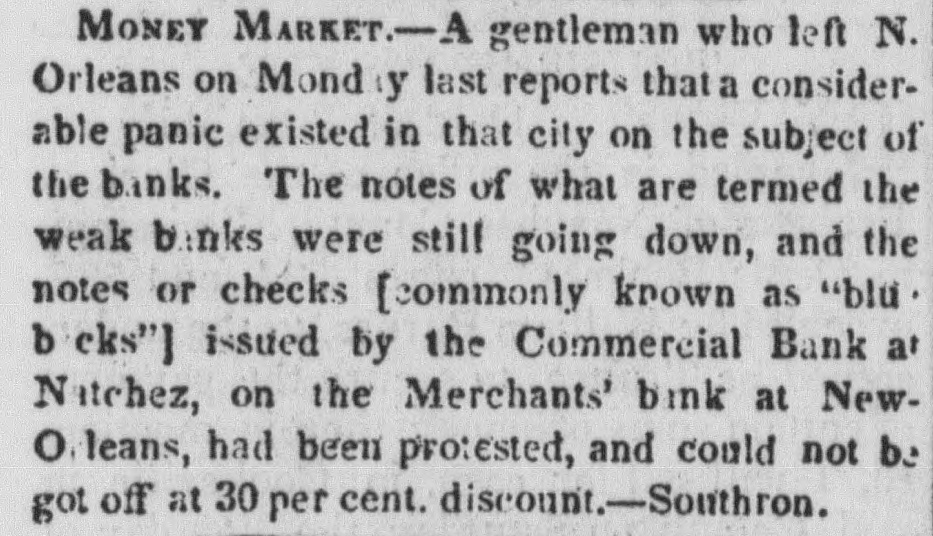
MONEY MARKET.-A gentleman who left N. Orleans on Monday last reports that a considerable panic existed in that city on the subject of the banks. The notes of what are termed the weak banks were still going down, and the notes or checks [commonly known as "blu . bicks"] issued by the Commercial Bank at Natchez, on the Merchants' bink at NewOrleans, had been protested, and could not be got off at 30 per cent. discount.-Southron.


Article from The New York Herald, April 10, 1844

Click image to open full size in new tab

Article Text

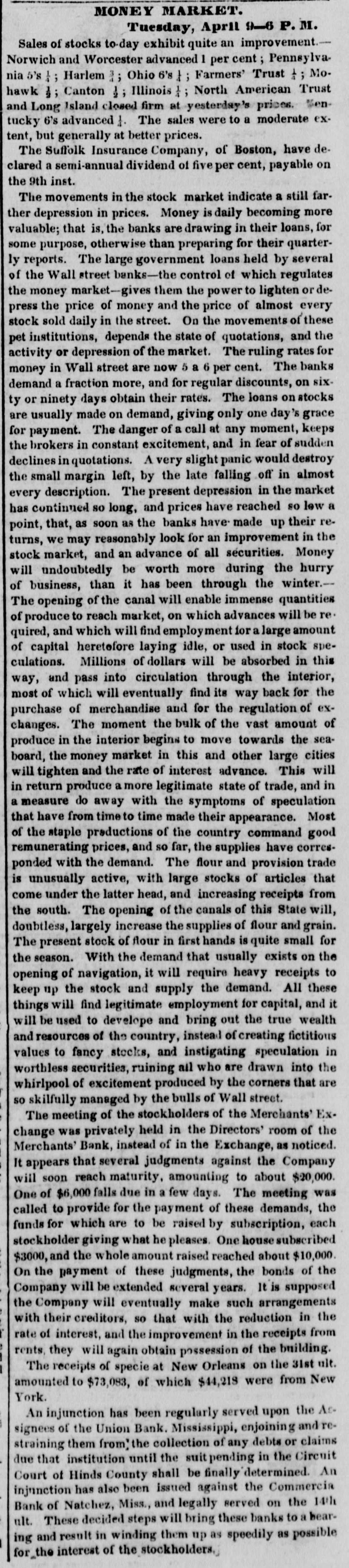
MONEY MARKET. Tuesday, April 9-6 P. M. Sales of stocks to-day exhibit quite an improvement. Norwich and Worcester advanced 1 per cent; Pennsylvania 5's Harlem Ohio 6's Farmers' Trust 1; Mohawk 1; Canton 1; Illinois North American Trust and Long Island closed firm at yesterday's prices. Sentucky 6's advanced 1. The sales were to a moderate extent, but generally at better prices. The Suffolk Insurance Company, of Boston, have declared a semi-annual dividend of five per cent, payable on the 9th inst. The movements in the stock market indicate a still farther depression in prices. Money is daily becoming more valuable; that is, the banks are drawing in their loans, for some purpose, otherwise than preparing for their quarterly reports. The large government loans held by several of the Wall street banks-the control of which regulates the money market-gives them the power to lighten or depress the price of money and the price of almost every stock sold daily in the street. On the movements of these pet institutions, depends the state of quotations, and the activity or depression of the market. The ruling rates for money in Wall street are now 5 a 6 per cent. The banks demand a fraction more, and for regular discounts, on sixty or ninety days obtain their rates. The loans on stocks are usually made on demand, giving only one day's grace for payment. The danger of a call at any moment, keeps the brokers in constant excitement, and in fear of sudden declines in quotations. A very slight panic would destroy the small margin left, by the late falling off in almost every description. The present depression in the market has continued so long, and prices have reached so low a point, that, as soon as the banks have made up their returns, we may reasonably look for an improvement in the stock market, and an advance of all securities. Money will undoubtedly be worth more during the hurry of business, than it has been through the winter.-The opening of the canal will enable immense quantities of to reach market, on which advances will be re. and which will find employment for a quired, produce used in large stock amount of capital heretofore laying idle, or speculations. Millions of dollars will be absorbed in this way, and pass into circulation through the interior, most of which will eventually find its way back for the purchase of merchandise and for the regulation of exchanges. The moment the bulk of the vast amount of produce in the interior begins to move towards the seaboard, the money market in this and other large cities will tighten and the rate of interest advance. This will in return produce a more legitimate state of trade, and in a measure do away with the symptoms of speculation that have from time to time made their appearance. Most of the staple productions of the country command good remunerating prices, and so far, the supplies have corresponded with the demand. The flour and provision trade is unusually active, with large stocks of articles that come under the latter head, and increasing receipts from the south. The opening of the canals of this State will, doubtless, largely increase the supplies of flour and grain. The present stock of flour in first hands is quite small for the season. With the demand that usually exists on the opening of navigation, it will require heavy receipts to keep up the stock and supply the demand. All these things will find legitimate employment for capital, and it will be used to develope and bring out the true wealth and resources of the country, instead of creating fictitious values to fancy stocks, and instigating speculation in worthless securities, ruining all who are drawn into the whirlpool of excitement produced by the corners that are so by the skilfully managed bulls of Wall street. The meeting of the stockholders of the Merchants' Exchange was privately held in the Directors' room of the Merchants' Bank, instead of in the Exchange, as noticed. It appears that several judgments against the Company will soon reach maturity, amounting to about $20,000. One of $6,000 falls due in a few days. The meeting was called to provide for the payment of these demands, the funds for which are to be raised by subscription, each stockholder giving what he pleases. One house subscribed $3000, and the whole amount raised reached about $10,000. On the payment of these judgments, the bonds of the Company will be extended several years. It is supposed the Company will eventually make such arrangements with their creditors, so that with the reduction in the rate of interest, and the improvement in the receipts from rents, they will again obtain possession of the building. The receipts of specie at New Orleans on the 31st ult. amounted to $73,083, of which $44,218 were from New York. An injunction has been regularly served upon the Assignees of the Union Bank. Mississippi, enjoining and restraining them from) the collection of any debts or claims due that institution until the suit pending in the Circuit Court of Hinds County shall be finally determined. An has also been issued against the Commercia Miss., and legally served on decided steps will bring these a ult. injunction Bank These of Natchez, banks to the bear- 14th ing and result in winding them up as speedily as possible for the interest of the stockholders.


Article from The New York Herald, June 24, 1845

Click image to open full size in new tab

Article Text

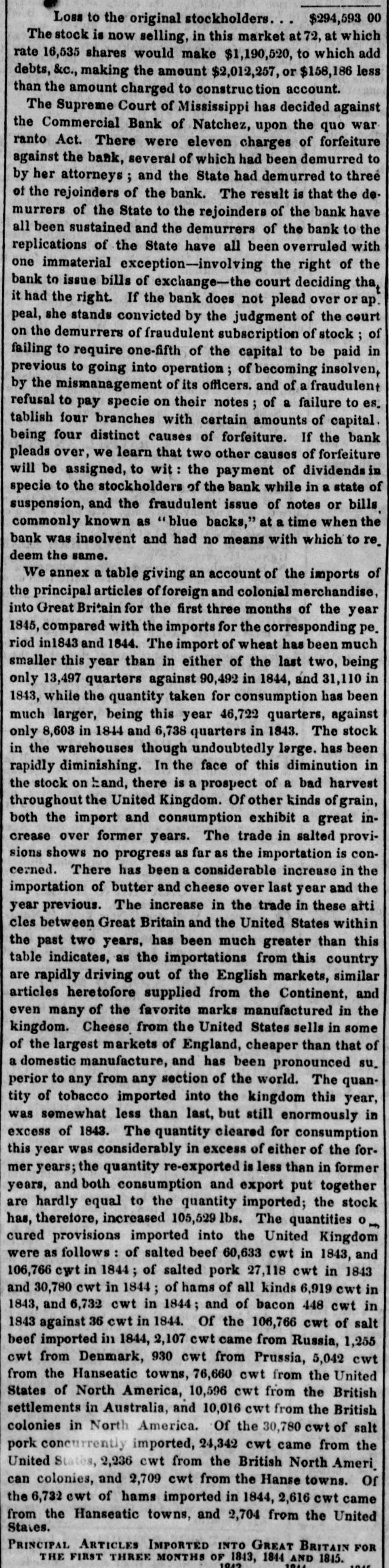
$294,593 Loss to the original stockholders The stock is now selling, in this market at 72, at which rate 16,535 shares would make $1,190,520, to which add debts, &c., making the amount $2,012,257, or $158,186 less than the amount charged to construction account. The Supreme Court of Mississippi has decided against the Commercial Bank of Natchez, upon the quo war ranto Act. There were eleven charges of forfeiture against the bank, several of which had been demurred to by her attorneys; and the State had demurred to three of the rejoinders of the bank. The result is that the demurrers of the State to the rejoinders of the bank have all been sustained and the demurrers of the bank to the replications of the State have all been overruled with one immaterial exception-involving the right of the bank to issue bills of exchange-the court deciding tha it had the right. If the bank does not plead over or ap. peal, she stands convicted by the judgment of the court on the demurrers of fraudulent subscription of stock; of failing to require one-fifth of the capital to be paid in previous to going into operation; of becoming insolven+ by the mismanagement of its officers. and of a fraudulent refusal to pay specie on their notes; of a failure to es. tablish four branches with certain amounts of capital. being four distinct causes of forfeiture. If the bank pleads over, we learn that two other causes of forfeiture will be assigned, to wit: the payment of dividends in specie to the stockholders of the bank while in a state of suspension, and the fraudulent issue of notes or bills commonly known as "blue backs," at a time when the bank was insolvent and had no means with which to re. deem the same. We annex a table giving an account of the imports of the principal articles of foreign and colonial merchandise, into Great Britain for the first three months of the year 1845, compared with the imports for the corresponding pe. riod in1843 and 1844. The import of wheat has been much smaller this year than in either of the last two, being only 13,497 quarters against 90,492 in 1844, and 31,110 in 1843, while the quantity taken for consumption has been much larger, being this year 46,722 quarters, against only 8,603 in 1814 and 6,738 quarters in 1843. The stock in the warehouses though undoubtedly large. has been rapidly diminishing. In the face of this diminution in the stock on hand, there is a prospect of a bad harvest throughout the United Kingdom. Of other kinds of grain, both the import and consumption exhibit a great increase over former years. The trade in salted provisions shows no progress as far as the importation is concerned. There has been a considerable increase in the importation of butter and cheese over last year and the year previous. The increase in the trade in these arti cles between Great Britain and the United States within the past two years, has been much greater than this table indicates, as the importations from this country are rapidly driving out of the English markets, similar articles heretofore supplied from the Continent, and even many of the favorite marks manufactured in the kingdom. Cheese from the United States sells in some of the largest markets of England, cheaper than that of a domestic manufacture, and has been pronounced su. perior to any from any section of the world. The quantity of tobacco imported into the kingdom this year, was somewhat less than last, but still enormously in excess of 1843. The quantity cleared for consumption this year was considerably in excess of either of the former years; the quantity re-exported is less than in former years, and both consumption and export put together are hardly equal to the quantity imported; the stock has, therefore, increased 105,529 lbs. The quantities o cured provisions imported into the United Kingdom were as follows: of salted beef 60,633 cwt in 1843, and 106,766 cwt in 1844; of salted pork 27,118 cwt in 1843 and 30,780 cwt in 1844; of hams of all kinds 6,919 cwt in 1843, and 6,732 cwt in 1844 and of bacon 448 cwt in 1843 against 36 cwt in 1844. Of the 106,766 cwt of salt beef imported in 1844, 2,107 cwt came from Russia, 1,255 cwt from Denmark, 930 cwt from Prussia, 5,042 cwt from the Hanseatic towns, 76,660 cwt from the United States of North America, 10,596 cwt from the British settlements in Australia, and 10,016 cwt from the British colonies in North America. Of the 30,780 cwt of salt pork concurrently imported, 24,342 cwt came from the United States, 2,236 cwt from the British North Ameri_ can colonies, and 2,709 cwt from the Hanse towns. Of the 6,732 cwt of hams imported in 1844, 2,616 cwt came from the Hanseatic towns, and 2,704 from the United States. PRINCIPAL ARTICLES IMPORTED INTO GREAT BRITAIN FOR THE FIRST THREE MONTHS OF 1843, 1844 AND 1815. 1012 1046


Article from New-York Daily Tribune, June 27, 1845

Click image to open full size in new tab

Article Text

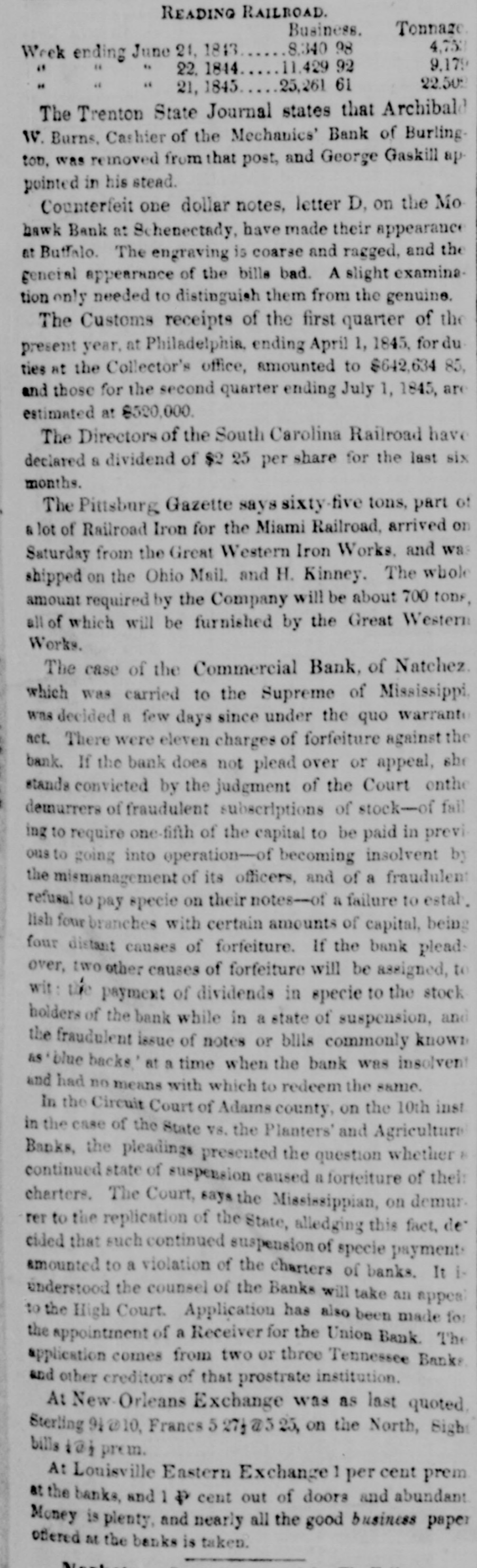
READING RAILROAD. Business. Tonnage. Week ending June 21, 18438.340 98 4,75 " " " 22, 184411.429 92 9.179 " " " 21, 184525,261 61 22.502 The Trenton State Journal states that Archibald W. Burns, Cashier of the Mechanics' Bank of Burling- ton, was removed from that post, and George Gaskill ap pointed in his stead. Counterfeit one dollar notes, letter D, on the Mo hawk Bank at Schenectady, have made their appearance at Buffalo. The engraving is coarse and ragged, and the general appearance of the bills bad. A slight examina- tion only needed to distinguish them from the genuine. The Customs receipts of the first quarter of the present year, at Philadelphia, ending April 1, 1845, for du ties at the Collector's office, amounted to $642,634 85, and those for the second quarter ending July 1, 1845, are estimated at $520,000. The Directors of the South Carolina Railroad have declared a dividend of $2 25 per share for the last six months. The Pittsburg Gazette says sixty-five tons, part of a lot of Railroad Iron for the Miami Railroad, arrived on Saturday from the Great Western Iron Works, and was shipped on the Ohio Mail. and H. Kinney. The whole amount required by the Company will be about 700 tons, all of which will be furnished by the Great Western Works. The case of the Commercial Bank, of Natchez, which was carried to the Supreme of Mississippi, was decided a few days since under the quo warranto act. There were eleven charges of forfeiture against the bank. If the bank does not plead over or appeal, she stands convicted by the judgment of the Court onthe demurrers of fraudulent subscriptions of stock-of fail ing to require one-fifth of the capital to be paid in previ ous to going into operation-of becoming insolvent by the mismanagement of its officers, and of a fraudulent refusal to pay specie on their notes--of a failure to estab- lish four branches with certain amounts of capital, being four distant causes of forfeiture. If the bank plead over, two other causes of forfeiture will be assigned, to wit: the payment of dividends in specie to the stock holders of the bank while in a state of suspension, and the fraudulent issue of notes or bills commonly known as 'blue backs' at a time when the bank was insolvent and had no means with which to redeem the same. In the Circuit Court of Adams county, on the 10th inst in the case of the State vs. the Planters' and Agriculture Banks, the pleadings presented the question whether a continued state of suspension caused a forfeiture of their charters. The Court, says the Mississippian, on demur- rer to the replication of the State, alledging this fact, de- cided that such continued suspension of specie payments amounted to a violation of the charters of banks. It is understood the counsel of the Banks will take an appeal to the High Court. Application has also been made for the appointment of a Receiver for the Union Bank. The application comes from two or three Tennessee Banks and other creditors of that prostrate institution. At New Orleans Exchange was as last quoted, Sterling 91 @10, Francs 5 27Β½@5 25, on the North, Sight bills ΒΌ@Β½ prem. At Louisville Eastern Exchange 1 per cent prem. at the banks, and 1 ΒΌ cent out of doors and abundant Money is plenty, and nearly all the good business paper offered at the banks is taken.


Article from Indiana State Sentinel, July 10, 1845

Click image to open full size in new tab

Article Text

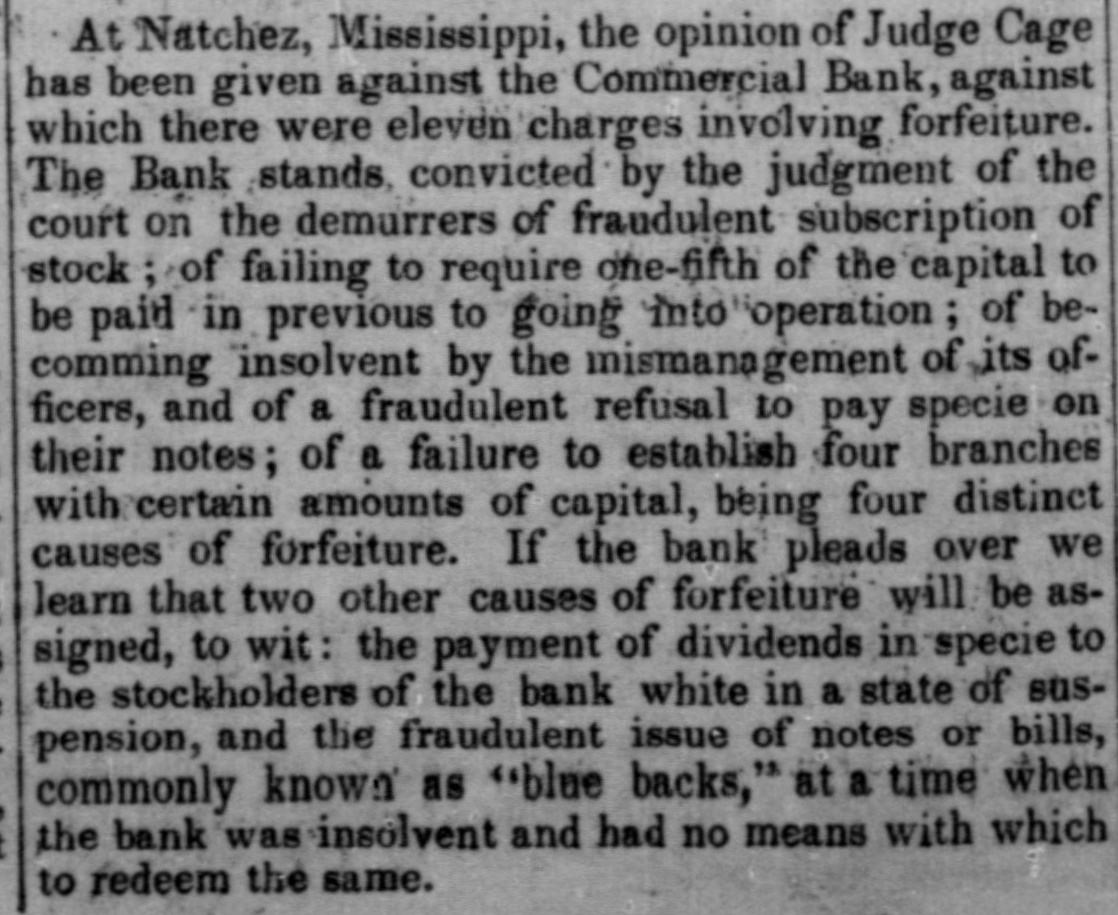
At Natchez, Mississippi, the opinion of Judge Cage has been given against the Commercial Bank, against which there were eleven charges involving forfeiture. The Bank stands, convicted by the judgment of the court on the demurrers of fraudulent subscription of stock; of failing to require one-fifth of the capital to be paid in previous to going into'operation of becomming insolvent by the mismanagement of its officers, and of a fraudulent refusal to pay specie on their notes; of a failure to establish four branches with certain amounts of capital, being four distinct causes of forfeiture. If the bank pleads over we learn that two other causes of forfeiture will be assigned, to wit: the payment of dividends in specie to the stockholders of the bank white in a state of suspension, and the fraudulent issue of notes or bills, commonly known as "blue backs," at a time when the bank was insolvent and had no means with which to redeem the same.


Article from The Kalida Venture, August 12, 1845

Click image to open full size in new tab

Article Text

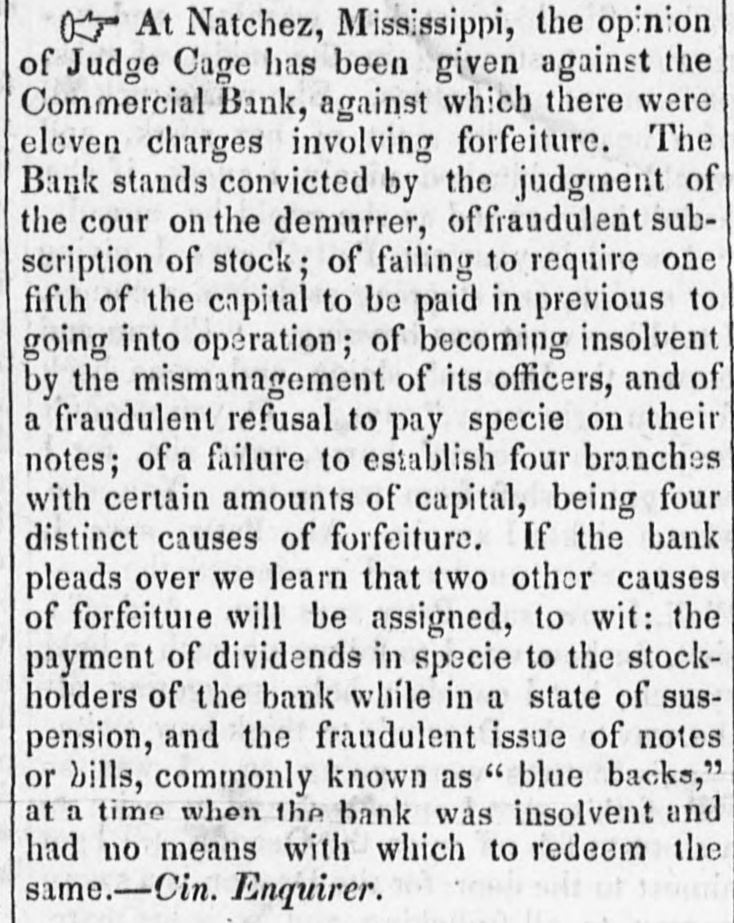
03 At Natchez, Mississippi, the opinion of Judge Cage has been given against the Commercial Bank, against which there were eleven charges involving forfeiture. The Bank stands convicted by the judgment of the cour on the demurrer, f fraudulent subscription of stock; of failing to require one fifth of the capital to be paid in previous to going into opΓ©ration; of becoming insolvent by the mismanagement of its officers, and of a fraudulent refusal to pay specie on their notes; of a failure to establish four branches with certain amounts of capital, being four distinct causes of forfeiture. If the bank pleads over we learn that two other causes of forfeiture will be assigned, to wit: the payment of dividends in specie to the stockholders of the bank while in a state of suspension, and the fraudulent issue of notes or bills, commonly known as " blue backs," at a time when the bank was insolvent and had no means with which to redeem the same.-Cin. Enquirer.