Article Text
All the Richmond and Petersburgh (Va.) banks have suspended specie payment.
e6dd185bNone

Click image to open full size in new tab
All the Richmond and Petersburgh (Va.) banks have suspended specie payment.
Click image to open full size in new tab
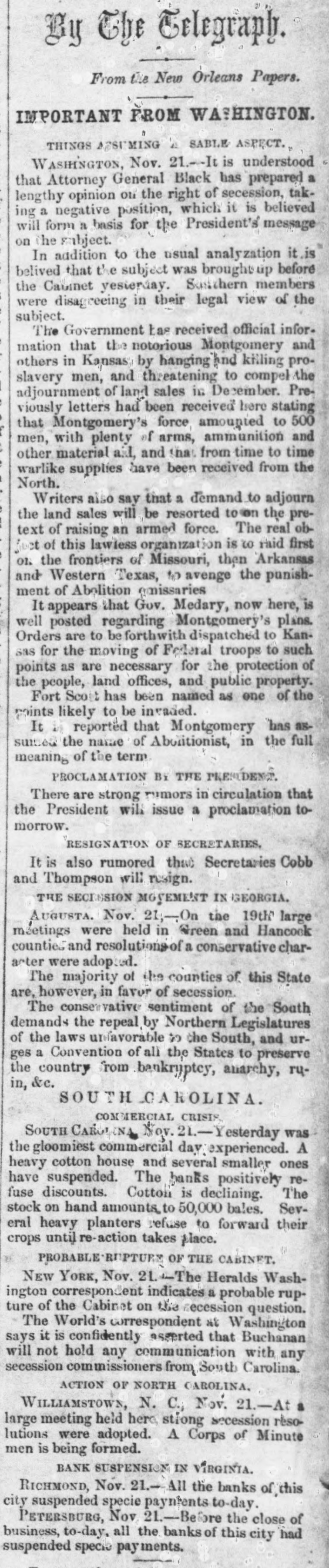
By The Gelegraph. From the New Orleans Papers. IMPORTANT FROM WASHINGTON. THINGS ASSUMING A SABLE ASPECT. WASHINGTON, Nov. 21.--It is understood that Attorney General Black has prepared a lengthy opinion on the right of secession, taking a negative position, which it is believed will form a basis for the President's message on the subject. In addition to the usual analyzation it is belived that the subject was brought up before the Caunet yesterday. Southern members were disagreeing in their legal view of the subject. The Government tas received official information that the notorious Montgomery and others in Kansas, by hanging and killing proslavery men, and threatening to compel the adjournment of land sales in December. Previously letters had been received here stating that Montgomery's force, amounted to 500 men, with plenty of arms, ammunition and other material aid, and that from time to time warlike supplies have been received from the North. Writers also say that a demand to adjourn the land sales will be resorted to on the pretext of raising an armed force. The real objust of this lawiess organization is to raid first on the frontiers of Missouri, then Arkansas and Western Texas, w avenge the punishment of Abolition @missaries It appears that Gov. Medary, now here, is well posted regarding Montgomery's plans. Orders are to be forthwith dispatched to Kansas for the moving of Federal troops to such points as are necessary for the protection of the people, land offices, and public property. Fort Scott has been named as one of the points likely to be invaded. It 119 reported that Montgomery has assunced the name of Abolitionist, in the full meaning of the term. PROCLAMATION Bi THE PRESIDENT. There are strong rumors in circulation that the President will issue a proclamation tomorrow. RESIGNATION OF SECRETARIES, It is also rumored that Secretaries Cobb and Thompson will resign. THE SECESSION MOYEMENT IN GEORGIA. AUGUSTA. Nov. 21;-On the 19th large meetings were held in Green and Hancock counties and resolutionsof a conservative chararter were adopted. The majority of the counties of this State are, however, in favor of secession. The conservative sentiment of the South demands the repeal by Northern Legislatures of the laws uniavorable in the South, and urges a Convention of all the States to preserve the country from bankruptcy, anarchy, ruin, &c. SOUTHCAROLINA COMMERCIAL CRISIS, SOUTH Caro! Nov. 21.-Yesterday was the gloomiest commercial day experienced. A heavy cotton house and several smaller ones have suspended. The banks positively refuse discounts. Cotton is declining. The stock on hand amounts, to 50,000 bales. Several heavy planters refuse to forward their crops until re-action takes place. PROBABLE OF THE CABINET. NEW YORK, Nov. 21. -The Heralds Washington correspondent indicates a probable rupture of the Cabinet on the secession question. The World's correspondent st Washington says it is confidently asserted that Buchanan will not hold any communication with any secession commissioners from South Carolina. ACTION OF NORTH CAROLINA. WILLIAMSTOWN, N. C., Nov. 21.-At a large meeting held hero, stiong secession rèsolutions were adopted. A Corps of Minute men is being formed. BANK SUSPENSION IN VIRGINIA. RICHMOND, Nov. 21.- All the banks of this city suspended specie payments to-day. PETERSBURG, Nov 21.-Before the close of business, to-day, all the banks of this city had suspended specio payments.
Click image to open full size in new tab
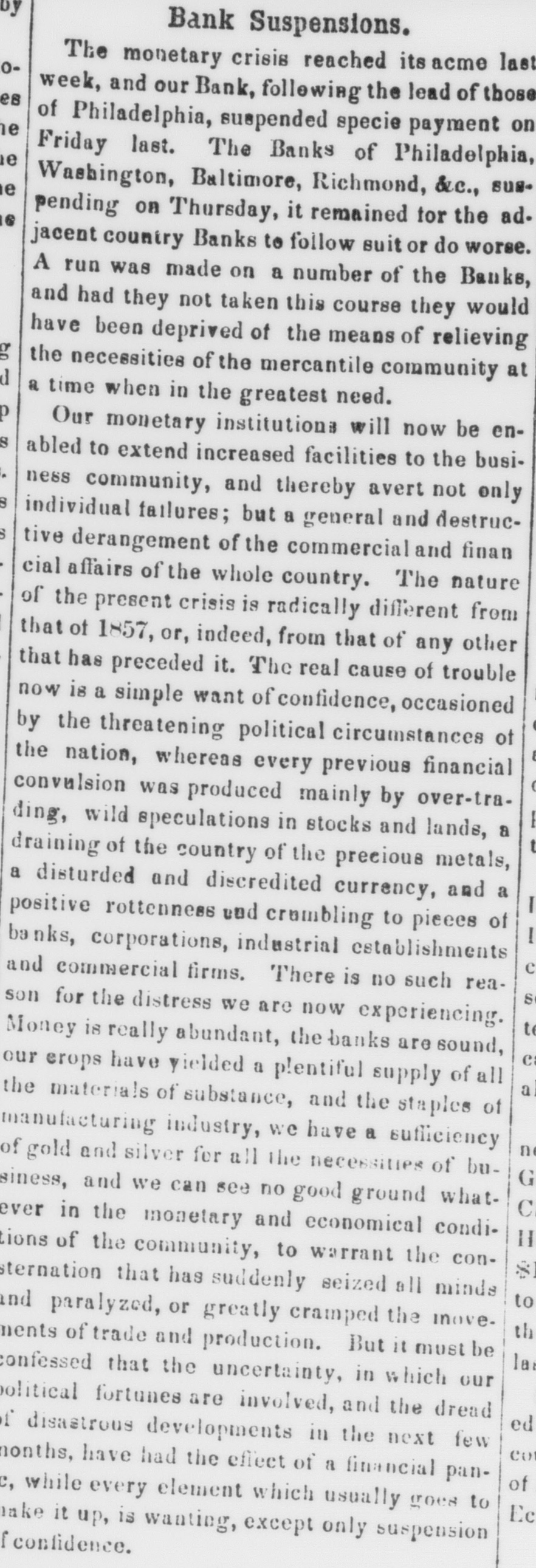
by Bank Suspensions. The monetary crisis reached itsacme last oes week, and our Bank, following the lead of those e of Philadelphia, suspended specie payment on e Friday last. The Banks of Philadelphia, e Washington, Baltimore, Richmond, &c., SUNpending on Thursday, it remained for the ad. 16 jacent country Banks to follow suit or do worse. A run was made on a number of the Banks, and had they not taken this course they would have been deprived of the means of relieving the necessities of the mercantile community at a time when in the greatest need. p Our monetary institutiona will now be enS abled to extend increased facilities to the business community, and thereby avert not only S individual failures; but a general and destructive derangement of the commercial and finan cial affairs of the whole country. The nature of the present crisis is radically different from that of 1857, or, indeed, from that of any other that has preceded it. The real cause of trouble now is a simple want of confidence, occasioned by the threatening political circumstances of the nation, whereas every previous financial convulsion was produced mainly by over-trading, wild speculations in stocks and lands, a draining of the country of the precious metals, a disturded and discredited currency, and a positive rottenness end crumbling to pieces of banks, corporations, industrial establishments e and commercial firms. There is no such reaS son for the distress we are now experiencing. te Money is really abundant, the banks are sound, C our erops have yielded a plentiful supply of all a the materials of substance, and the staples of manufacturing industry, we have a sufficiency ne of gold and silver for all the necessities of buG siness, and we can see no good ground whatC ever in the monetary and economical conditions of the community, to warrant the consternation that has suddenly seized all minds to and paralyzed, or greatly cramped the move. th nents of trade and production. But it must be la confessed that the uncertainty, in which our political fortunes are involved, and the dread ed if disastrous developments in the next few cot months, have had the effect of a financial panof c, while every element which usually goes to Ec lake it up, is wanting, except only suspension f confidence.

Click image to open full size in new tab
BY TELEGRAPH. BANK SUSPENSIONS. WASHINGTON, D. C., Nov. 22d,11860. The Baltimore, Washington, Richmond and Petersburg Banks have all suspended specie payment. The money panic in New York is equal to that of 1857. All Southern Bank notes are 20 to 25; Illinois and Wisconsin 15; and other Western Banks from 3 to 5 per cent discount. The New York Banks are discussing the policy of issuing 7 per cent scrip, based on good collateral security. BLOODY WORK IN KANSAS. WASHINGTON, D. C., Nov. 22d, 1860. Advices received from Leavenworth state that the outlaw Montgomery bad commenced hanging and killing the pro-slaveryites in Kansas. It is stated that he has five hundred men well-armed and equipped, and will make a raid on Missouri, Arkansas and Texas. There is great excitement in consequence. SECOND DISPATCH. WASHINGTON CITY, Nov. 22, 1860-1 o'clock P. M. Official dispatches, telegraphic, just received, state that Montgomery has commenced war on the Federal officers of Kansas Territory. General Harney has been ordered 10 proceed thither to suppress the disturbances. THIRD DISPATCH. NEW YORK, Nov. 22d, 1860-1 1-2 P. M. The City Banks have resolved to make common stock of their specie as long as it lasts, and if insufficient to meet the demand, they will all suspend together. The balances between the Banks will be settled by certificates based on National and State securities. THE DISTURBANCES IN KANSAS. Gen. Harney has been telegraphed to to use every endeavor to suppress the Outlaw, Montgomery, in Kansas. OFFERS HIS SERVICES CONDITIONALLY. NORFOLK, Va., Nov. 24th, 1860. Gov. WISE conditionally offers his services to South Carolina. FROM NEW ORLEANS. NEW ORLEANS, Nov. 26th, 1860. There has been an immense Mass Meeting at this place, irrespective of party, at which a Southern rights association was formed, and it was resolved to organize minute men throughout the State. LATER FROM VERA CRUZ. Vera Cruz dates to the 21st inst. have been received here. The British Embassy at the capital had been sacked and robbed of one million dollars. There was great excitement in consequence thereof. TROOOPS FOR KANSAS. ST. LOUIS, Nov. 26, 1860. Gen. Frost's brigade of 600 strong left for the frontier of this State on Saturday last. LATER FROM OREGON. ST. JOSEPH'S, Mo., Nov. 26, 1860. Dates from San Francisco to the 14th inst. have been received here. In Oregon, Lincoln was 250 ahead, and three counties to hear from. LATER FROM EUROPE. PORTLAND, Me., Nov. 22d, 1860. The steamship Palestine has arrived at this port from Liverpool, bringing dates to the 9th inst. The Prince of Wales had arrived home. There has been a dissolution of the Pope's army, with the exception of a guard of three thousand troops. Victor Emanuel and Garibaldi were at Naples. LIVERPOOL, Nov. 9th, 1860. Cotton-The sales for the week reach 95,000 bales— the market closing at an advance of 1/8 a 1/1d. for the week. The middling qualities had improved most. Stock in port 686,000 bales, of which 477,000 are American. For Flour and Wheat there is but little enquiry and prices are weak. Corn-all qualities have slightly declined. Consols 931/4 a 93%. ARRIVAL OF THE AFRICA. NEW YORK, Nov. 24, 1860. The steamship Africa arrived here yesterday with Liverpool dates to the 10th inst. IMPORTANT FROM ITALY. Victor Emanuel has formally accepted the sovereignty of Naples. Garibaldi has resigned the Dictatorship and gone to his Island home. COTTON SUPPLY ASSOCIATION. The projected Cotton Company is assuming definite shape. The capital is to be one hundred thousand pounds, ti be invested india to promote the growth of Cotton there. LIVERPOOL MARKETS. Cotton was steady and an average business has been done without quotable change. Breadstuffs were quiet and prices steady. Rice firm with a large speculative inquiry at an advance of 3d. Rosin dull at 5s. a 5s. 2d., to arrive. Spirits Turpentine closed heavy. Flour has declined 6d. Wheat 2d a 4d. Corn 6d to 1s. Consols closed at 931/4 a 93½. LATER FROM EUROPE. ST. JOHN'S, N. F., Nov. 26, 1860. The steamship Arago from Southampton on the 14th inst. for New York has arrived off Cape Race
Click image to open full size in new tab
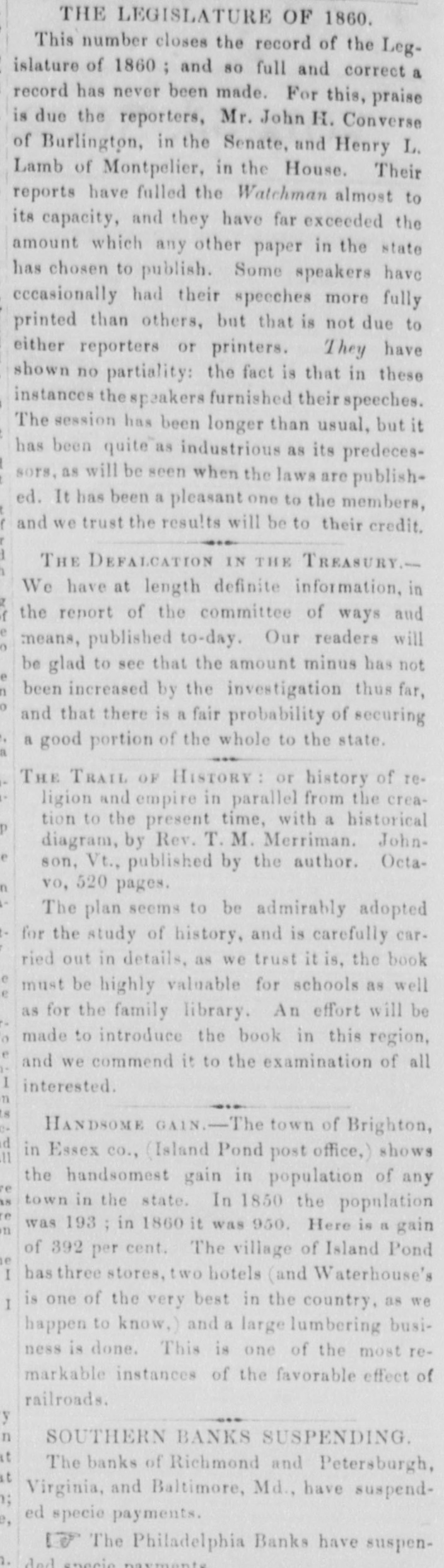
THE LEGISLATURE OF 1860. This number closes the record of the Legislature of 1860 ; and 80 full and correct a record has never been made. For this, praise is due the reporters, Mr. John H. Converse of Burlington, in the Senate, and Henry L. Lamb of Montpelier, in the House. Their reports have fulled the Watchman almost to its capacity, and they have far exceeded the amount which any other paper in the state has chosen to publish. Some speakers have eccasionally had their speeches more fully printed than others, but that is not due to either reporters or printers. They have shown no partiality: the fact is that in these instances the speakers furnished their speeches. The session has been longer than usual, but it has been quite as industrious as its predecessors, as will be seen when the laws are published. It has been a pleasant one to the members, and we trust the results will be to their credit. THE DEFALCATION IN THE TREASURY.We have at length definite information, in the report of the committee of ways and means, published to-day. Our readers will be glad to see that the amount minus has not been increased by the investigation thus far, and that there is a fair probability of securing a good portion of the whole to the state. THE TRAIL OF HISTORY: or history of religion and empire in parallel from the creation to the present time, with a historical diagram, by Rev. T. M. Merriman. Johnson, Vt., published by the author. Octavo, 520 pages. The plan seems to be admirably adopted for the study of history, and is carefully carried out in details, as we trust it is, the book must be highly valuable for schools as well as for the family library. An effort will be made to introduce the book in this region, and we commend it to the examination of all I interested. n HANDSOME GAIN.-The town of Brighton, in Essex co., (Island Pond post office,) shows 11 the handsomest gain in population of any town in the state. In 1850 the population was 193 ; in 1860 it was 950. Here is a gain n of 392 per cent. The village of Island Pond I has three stores, two hotels (and Waterhouse's I is one of the very best in the country, as we happen to know,) and a large lumbering business is done. This is one of the most remarkable instances of the favorable effect of railroads. y SOUTHERN BANKS SUSPENDING. it The banks of Richmond and Petersburgh, it Virginia, and Baltimore, Md., have suspended specie payments. 17 The Philadelphia Banks have suspended specie pavmente
Click image to open full size in new tab
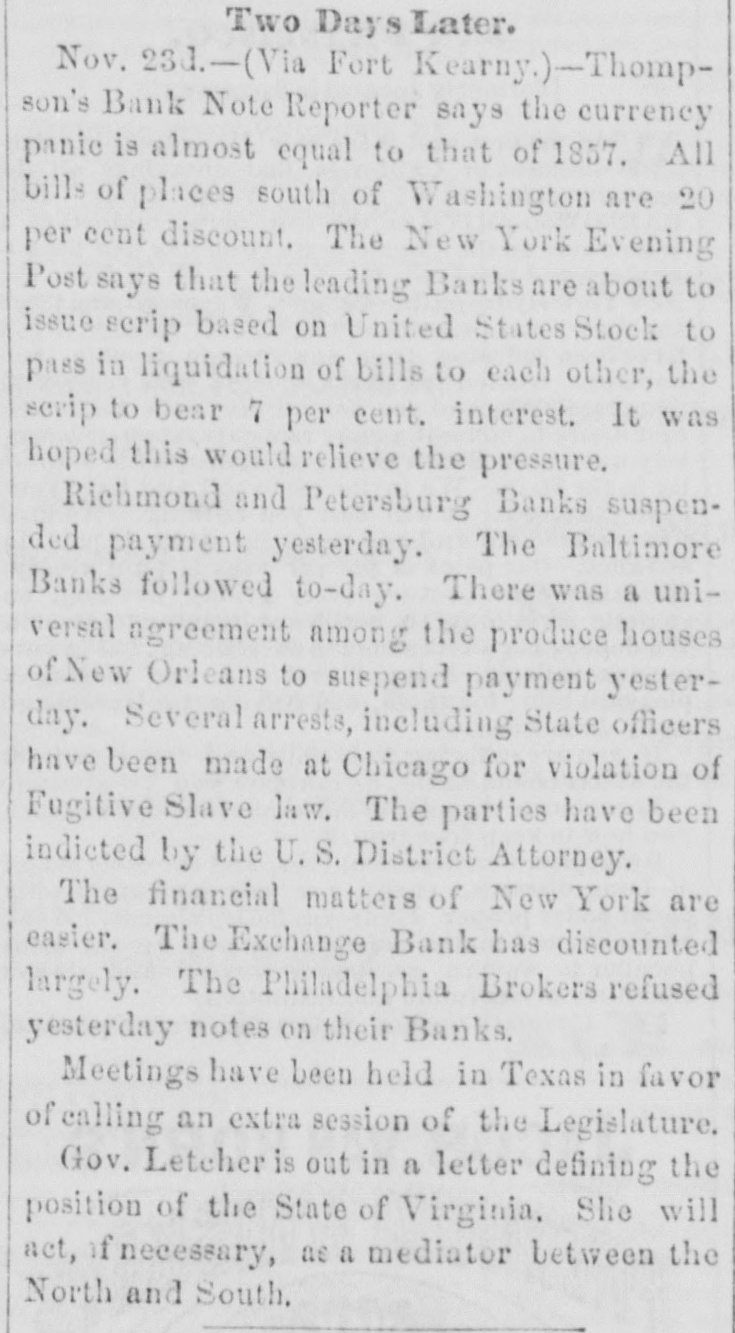
Two Days Later. Nov. 23d.-(Via Fort Kearny.)-Thomp- son's Bank Note Reporter says the currency panic is almost equal to that of 1857. All bills of places south of Washington are 20 per cent discount. The New York Evening Post says that the leading Banks: are about to issue scrip based on United States Stock to pass in liquidation of bills to each other, the scrip to bear 7 per cent. interest. It was hoped this would relieve the pressure. Richmond and Petersburg Banks suspended payment yesterday. The Baltimore Banks followed to-day. There was a universal agreement among the produce houses of New Orleans to suspend payment yesterday. Several arrests, including State officers have been made at Chicago for violation of Fugitive Slave law. The parties have been indicted by the U.S. District Attorney. The financial matters of New York are easier. The Exchange Bank has discounted largely. The Philadelphia Brokers refused yesterday notes on their Banks. Meetings have been held in Texas in favor of calling an extra session of the Legislature, Gov. Letcher is out in a letter defining the position of the State of Virginia. She will act, if necessary, as a mediator between the North and South.
Click image to open full size in new tab
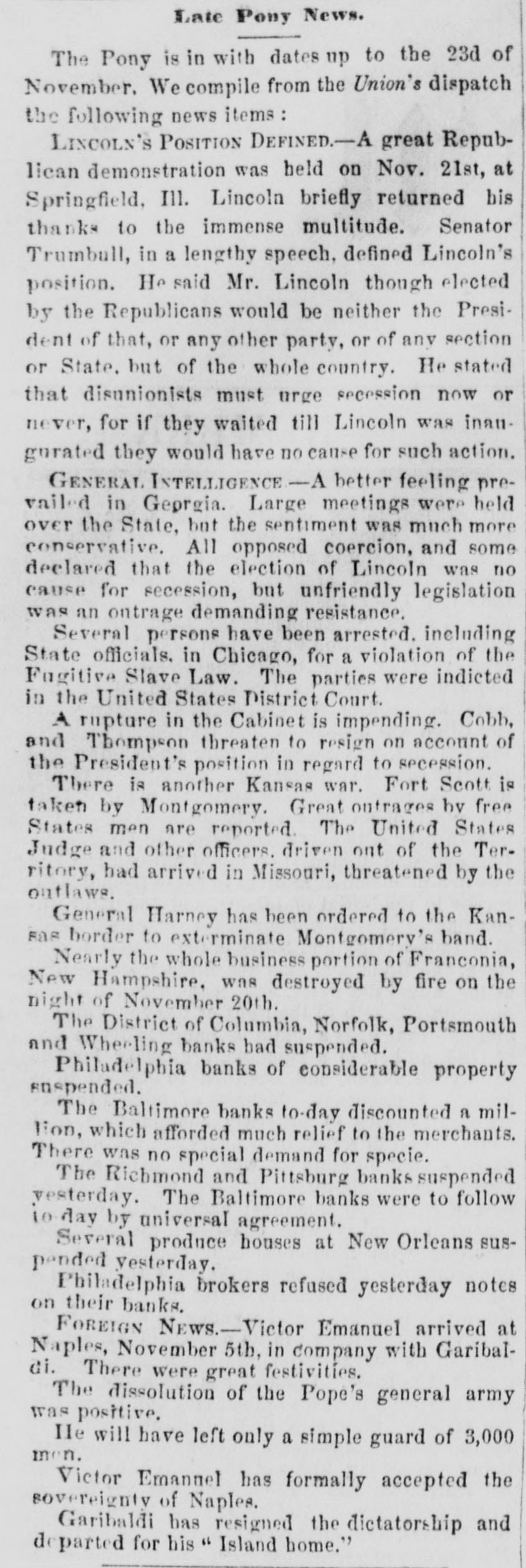
Late Pony News. The Pony is in with dates up to the 23d of November. We compile from the Union's dispatch the following news items : LINCOLN'S POSITION DEFINED.-A great Republican demonstration was held on Nov. 21st, at Springfield, Ill. Lincoln briefly returned his thanks to the immense multitude. Senator Trumbull, in a lengthy speech, defined Lincoln's position. He said Mr. Lincoln though elected by the Republicans would be neither the President of that, or any other party, or of any section or State. but of the whole country. He stated that disunionists must urge secession now or never, for if they waited till Lincoln was inaugurated they would have no cause for such action. GENERAL INTELLIGENCE.-A better feeling prevailed in Georgia. Large meetings were held over the State, but the sentiment was much more conservative. All opposed coercion, and some declared that the election of Lincoln was no cause for secession, but unfriendly legislation was an ontrage demanding resistance. Several persons have been arrested. including State officials. in Chicago, for a violation of the Fagitive Slave Law. The parties were indicted in the United States District Court. A rupture in the Cabinet is impending. Cobb, and Thompson threaten to resign on account of the President's position in regard to secession. There is another Kansas war. Fort Scott is taken by Montgomery. Great outrages by free States men are reported The United States Judge and other officers. driven ont of the Territory, had arrived in Missouri, threatened by the outlaws. General Harney has been ordered to the KanFas border to exterminate Montgomery's band. Nearly the whole business portion of Franconia, New Hampshire. was destroyed by fire on the night of November 20th. The District of Columbia, Norfolk, Portsmouth and Wheeling banks had suspended. Philadelphia banks of considerable property enspended. The Baltimore banks to-day discounted a million, which afforded much relief to the merchants. There was no special demand for specie. The Richmond and Pittsburg banks suspended yesterday. The Baltimore banks were to follow in day by universal agreement. Several produce houses at New Orleans suspended yesterday. Philadelphia brokers refused yesterday notes on their banks. FOREIGN NEWS.-Victor - Emanuel arrived at Naples, November 5th, in company with Garibaldi. There were great festivities. The dissolution of the Pope's general army was positive. IIe will have left only a simple guard of 3,000 men. Victor Emannel has formally accepted the sovereignty of Naples. Garibaldi has resigned the dictatorship and departed for his Island home."

Click image to open full size in new tab
of trade is largely in our favor ss a nation. Therefore it is obvious to the most super- ficial observer, that a general distrust, and the secession movement in the south con- sequent upon Lincoln's election, have brought about our present financial troub- les. We frequently hear it stated that the South has no reason te complain, for a ma- jority should rule. Whether the South -has reason to complain or not, she does complain, and in our humble opinion, unless there should, at the present session of Congress, be a compromise effected by f the conservative men of the two extremes, our financial troubles have only commen- -ced. Our western money is principally based on southern State Bonds. The se- acession movement has caused a general distrust, which has caused the bonds to depreciate in value, consequently the bills for which the bonds were deposited as se- curity, which have been the principal cir- -culating medium have also depreciated to the tune of ten per cent or more. This secession movement has not only caused bankruptcy and ruip in the North. in the midst of plenty, but is making bad work in the South. When South Carolina began to exhibit symptoms of setting up on her own hook, the business men saw the storm gatherering, and those bills is- sued by the Banks of that state, hurried them home for redemption before the evil day would come upon them, consequently the Banks suspended which added fuel to the fire; in quick succession the Banks of Richmond, Baltimore, Philadelphia and Pittsburgh followed in their wake, in order to escape bankruptcy. But the end is not yet. Exchange on New York has run up in one short month, from one to ten per cent and the culminating point is probably not yet reached. It was promulgated by all the Democratic papers and speakers of the North, in the late campaign that if a sectional man, as was Mr. Lincoln, was elected, that the Union would be in great danger of dissolu- tion, and that bankruptev and ruin wou'd be the consequence. These predictions were considered by the Republicans, as made for electioneering purposes--as ille talk. They feared no darger, they would soon "whip the South into submission," and we would hear nothing more of disun- ion after Mr. Lincoln was elected. The matter was usually disposed of in this man- rer before the election, but now, after the campaign excitement has subsided, the notes of preperation in the South and the financial crisis which is upon us, are like- ly to open their eyes to the fearful respon- sibilities which they will have to shoulder. That the South has good cause to complain of many of the Northern States, all admi: as some six or seven of the free states have enacted laws, declaring the Fugitive slave law unconstitutional and making it a criminal offence to assist a United States Marshal in reclaiming a fugitive from a slave state. It is very seldom that a slave who is caught in a free state is ever per- mitted to be returned. Even if he is iden- tified and caught, he is generally rescued by a mob, and if the Marshal and owner escape with whole bones they are thankful. In our humble opinion, unless those Abo- lition states give some assurance that they will repeal those laws making the fugitive slave law void, and that they will dis- countenance all such expeditions as these, that Jim Lane, John Brown and Montgom- ery have been engaged in, that even an at- tempt to make a compromise would be useless. The south has endured those insuits and wrongs until in her opinion, "forbearance has ceased to be a virtue."- On the other hand the south ought to con- sent to a modification of the fugitive slave law. The idea of a man violating the law by giving a starving fugitive a peice of bread, is entirely repugnant to the north- ern idea of philanthropy. There are sev- eral items in the law that could be modi- fied, that would not materially conflict with the interest of the slaveholder and at the same time be much more palatable to the north. It appears to us that the natural way to dispose of the matter, would be for Con- gress to raise a committee of good sound conservative men, of age and experience, from both parties and submit the whole question of difference to them for adjust- ment. The report of such a committee, gotten up under such circumstances would have great weight with all parties. The South will not remain as a part of the Un- ion, unless those laws, declaring the fugi- tive slave law inoperative, be repealed.- The states that enacted those laws, will undoubtedly demand a nullificacion of the
Click image to open full size in new tab
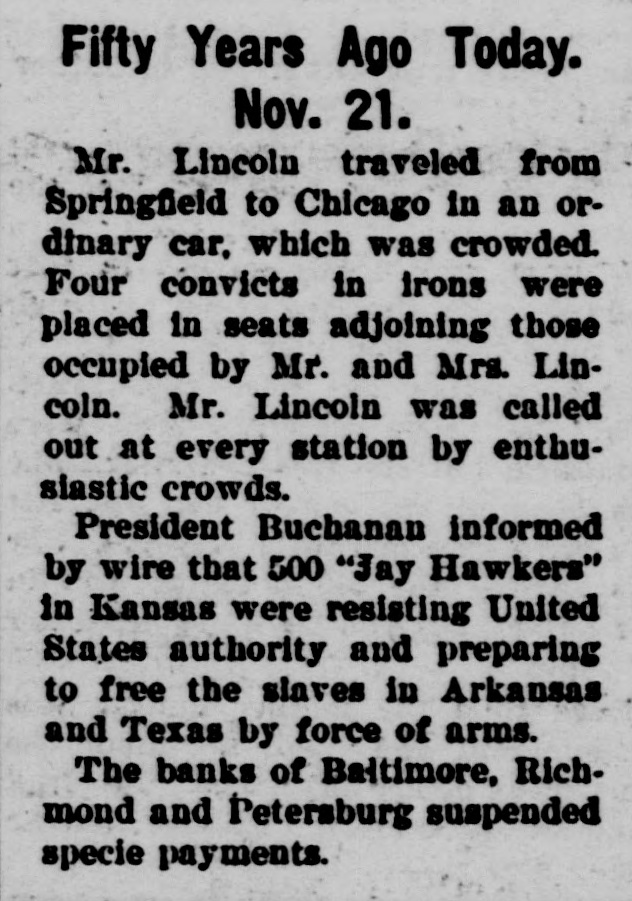
Fifty Years Ago Today. Nov. 21. Mr. Lincoln traveled from Springfield to Chicago in an ordinary car, which was crowded. Four convicts in irons were placed in seats adjoining those occupied by Mr. and Mrs. Lincoln. Mr. Lincoln was called out at every station by enthusiastic crowds. President Buchanan informed by wire that 500 "Jay Hawkers" in Kansas were resisting United States authority and preparing to free the slaves in Arkansas and Texas by force of arms. The banks of Baltimore, Richmond and Petersburg suspended specie payments.
Click image to open full size in new tab
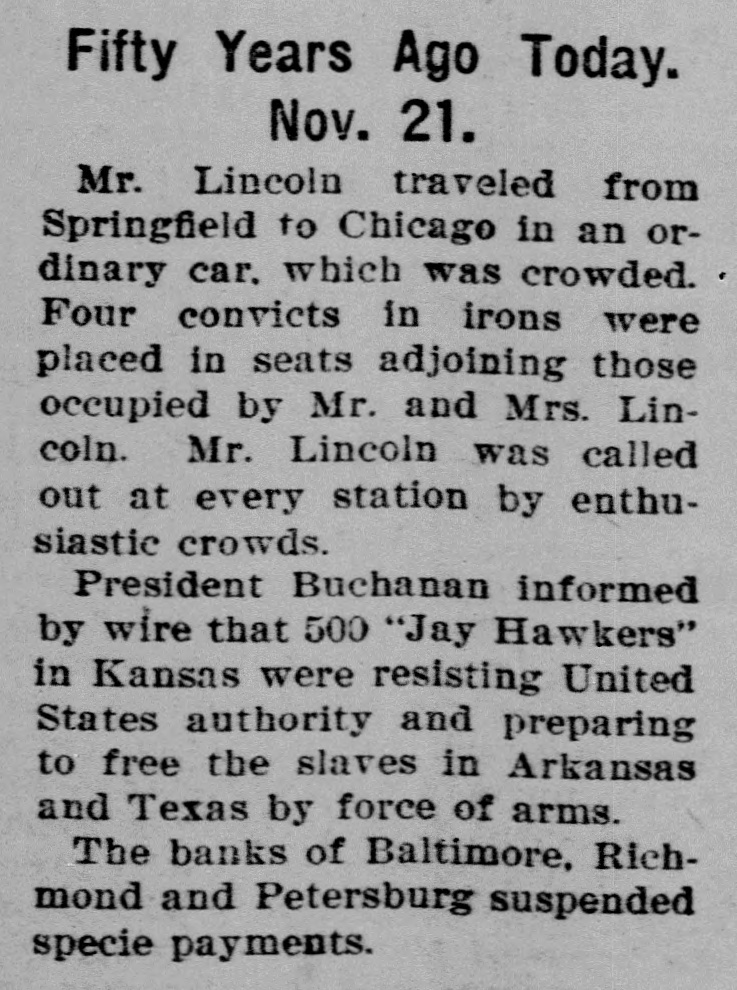
Fifty Years Ago Today. Nov. 21. Mr. Lincoln traveled from Springfield to Chicago in an ordinary car. which was crowded. Four convicts in irons were placed in seats adjoining those occupied by Mr. and Mrs. Lincoln. Mr. Lincoln was called out at every station by enthusiastic crowds. President Buchanan informed by wire that 500 "Jay Hawkers" in Kansas were resisting United States authority and preparing to free the slaves in Arkansas and Texas by force of arms. The banks of Baltimore, Richmond and Petersburg suspended specie payments.