Second National Bank (Chicago, IL)

Episode Information

Episode UID
22500885
Episode Type
Suspension β†’ Closure
Bank Type
national
Bank ID
2250 national
Charter Number
225
Start Date
September 26, 1873
Location
Chicago, Illinois (41.850, -87.650)

Metadata

Model
gpt-5-mini (chosen from majority vote of a three-model LLM ensemble)
Short Digest
358f3fab254c7044

Response Measures

None

Description

Bank suspended during the Panic of 1873 and subsequently went into private liquidation rather than resuming full operations.

Events (4)

1. February 1, 1864 Chartered
Source
historical_nic
2. September 25, 1873 Voluntary Liquidation
Source
historical_nic
3. September 26, 1873 Suspension
Cause
Macro News
Cause Details
Part of the widespread Panic of 1873 and acute local shortage of currency leading Chicago banks to suspend payments.
Newspaper Excerpt
It is just announced that the Union National, Second National and Manufacturers' National Banks have suspended.
Source
newspapers
4. October 9, 1873 Other
Newspaper Excerpt
The Manufacturers' and Second National banks had decided to go into liquidation; the Second National forced into liquidation by the panic and lack of currency thereafter remained in liquidation rather than resuming business.
Source
newspapers

Newspaper Articles (25)

Article from The Daily State Journal, October 16, 1871

Click image to open full size in new tab

Article Text

ACCIDENT TO STEAMERS A FLOOD IN CHINA A TERRIBLE TYPHOON &c. &c. &c. &c. From Chicago. A FURIOUS GALE-THE BANKS RESUMING BUSINESS, &C. Chicago, October 16.-A urious gale prevailed here Saturday night, blowing firebrands in all directions and prostrating walls. Fortunately, however, the rain, which had previously fallen, prevented any damage from fire. The supply of food now on hand is ample. The banks pay 15 per cent. at once, and will resume regular business on the 17th inst. R. H. Hurlbert, comptroller of currency, certifies to the solvency of the Chicago National bank. The Fires in the Northwest. PREVIOUS REPORTS CONFIRMED-FEARFUL LOSS OF LIFE, &C. Chicago, October 16.--Advices from the Northwest, in relation to the fircs prevailing here, grow hourly worse. Milwaukie, October 16.-Later accounts corfirm previous disastrous reports. The loss of life in the neighborhood of Pishtego will reach 1,200. Fifteen per cent of the injured will die. The only escape was the water, where maddened cattle and horses drowned many. The population of Pishtego was two thousand; a third of whom perished. New York Items. New York, Oct. 13.-The Manhattan Insurance Company has resolved to suspend. It's losses are stated to be a million and a quarter dollars. The company possesses a large surplus besides capital. It is not expected that the assured will sustain any loss. The President of the Empire City Company, which was reported yesterday to have lost a quarter of a million of dollars, states that it has sustained no loss. It is reported that the Western Union Telegraph has effected a loan in Europe and will cancell four million dollars worth of stock. Douglas, of Sappho, has challenged Samuels, of Dreadnaught, to race 25 miles windward and back in a 10 knot breeze. Bennett's Dauntless offers Dreadnought a similar match. Dispatches from Vienna, Paris, Brussels, Berlin and London represent that active subscriptions are going on to aid Chicago. The Council of Political Reform last evening elected Wm. M. Evarts president, and Eugene Kelly, Wm. H. Aspinwall, James W. Beekman and Oscar Zollicoffer, vice presidents. Destructive Whirlwind. Porlland, Me., Oct. 15.-A dispatch from Halifax says that the heaviest hurricane known for the last twenty years occurred there last evening. The tide rose two feet over the wharves. Many vessels were injured and several lost. The Fever in Charleston. Charleston, Oct, 15.-One fever death reported yesterday and one to-day.


Article from The Daily State Journal, October 18, 1871

Click image to open full size in new tab

Article Text

# THE WRIT OF HABEAS CORPUS SUSPENDED IN SOUTH CAROLINA, &C. Washington, October 17.--The President to-day, after reciting the causes and quoting the laws under which he acts, issued a proclamation in which he suspends the writ of habeas corpus in Spartanburg, York, Marion, Chester, Laurens, Newberry, Fairfield, Lancaster, and Chesterfield counties, of South Carolina. The suspension extends to the arrest by the United States marshal, his deputies, any military officer of the United States, or any soldier or citizen acting under the orders of said marshal, deputy, or such military officer within said counties, of persons charged with any violation of the Ku-Klux act of Congress during the continuance of the "rebellion" in said counties. The Attorney-General has a dispatch from North Mississippi that five Ku-Klux with disguises complete have been captured. Seven hundred and fifty thousand dollars in revenue stamps were found safe in the government vault in Chicago. Secretary Boutwell has received the following dispatch from Chicago: "The Chicago banks are saved, and are paying every dollar on demand. A good feeling prevails. [Signed] H. R. Hurlbut, Comptroller of Currency." Mexican Affairs. Havana, October 17.-A steamer just arrived from Vera Cruz brings late dates from the Mexican capital. Juarez had been re-elected President by Congress, receiving 108 votes-all that were cast. The opposition abstained from voting. Everything was quiet in the city. The telegraph wire between the capital and Matamoras had been cut by Trevina. Telegraphic Summary. Eighty Catholic children have arrived at Cincinnati from Chicago, and have been committed to the care of the bishop. The cholera has again appeared in an epidemie form in Constantinople. Sixty deaths have occurred in two days, nine of whom are Englishmen. Hon. James McNab, Governor of Nova Scotia, is dead. The preparations for the exposition of the Industrial Association of Georgia, to be held in Savannah on the 21st of November, are nearly complete. A suit has been instituted in the Federal Court at Memphis, Tenn., against Gen. Forrest and others, by Capt. Houston, of the steamer Hester, for arms destroyed some years ago by disguised men. A dispatch from Raleigh states that the exhibition of the North Carolina State Fair at that place is unsurpassed in every respect. The sub-Ku-Klux Committee has been investigating at Montgomery, Ala., whence they go to Demopolis, in the same State, and thence return to Washington. Four deaths from yellow fever have occurred in Charleston during the past two days. The Security Insurance Company has suspended. Fires are raging in Deer and Harrison Creek Valley; extending to Jefferson county, Nebraska. The loss is estimated at $50,000. A later dispatch from Glocester, Canada, says an American fleet of four vessels is outside, and that any attempt to seize the "Horton" will meat with disastrious defeat. The vessels spoke the "Horton," but did not see the British gunboats.


Article from Litchfield Enquirer, October 26, 1871

Click image to open full size in new tab

Article Text

Money is extremely scarce in Paris, and the Bank of France is issuing notes of small denominations. Favorable reports have been received from Algeria. Prince Napoleon has been mobbed in Valence. Germany.-A labor riot has occurred at Mayence. The new treaty with France has been approved by the Emperor William. ; Switzerland.-An international Workingmen's Congressis in session at Geneva. Turkey.-The deaths from cholera in Constantinople average 30 per day. China.-It is reported that 3,000 lives have been lost by the floods in China. Persia.-A terrible state of affairs pre) vails. The whole country is in a state of an arcby, and the capita! in posession of a band of insurgents. Southern America.-The Spanish Consul at Port-au-Priuce has demanded the surrender of the steamer Hornet, but the Haytian Government has refused to comply with the request. Juarez has been re elected President of Mexico. The Brazilian Senate has passed the Abolition bill. . Cabral's victory over Gen. Baez in San to Domingo is confirmed. North Pole.-The reports of the last German Expedition claim the discovery of an open Polar Sea, free from ice and swarming with whales. DOMESTIC. A fishing schooner which had been arrested by the Canadian authorities was cut out by the Americans and brought into Glouscester, Mass. last week. One prominent Mormon has been arres. ted for adultery and another for murder. Brigham Young's trial has not yet commenced. The Chicago banks have resumed business. A large number of shipwrecks have occurred on the lakes. The President has declared martial law and suspended the writ of habeas corpus in nine counties of South Carolina. Five Ku Klux have been arrested in Mississipbi while in disguise. Destructive forest fires have occurred in Kansas. One man has been killed and several injured, in New Orleans, by the explosion of a wagon-load of Union torpedoes. A church was blown down in Malone, N. Y., on Sunday. A steamer has foundered in Saginaw Bay, several lives being lost. The local insurance companies of Chicago are charged with fraud. Hawkins, the Mormon Elder, has been found guilty of adultery. A daring robbery has occurred on the Mobile and Ohio Railway. A committee of the National Police Convention has endorsed the St. Louis system of treating the Social Evil. Asteamboat's crew has been fired on near Mulatto Bayon, Red River, and seval of them wounded. Serious forests fires are reported in Nsw York and Kentucky. Active operations have been commenced against the South Carolina Ku-Klux, a large number of whom have been arrested.


Article from New-York Tribune, December 2, 1872

Click image to open full size in new tab

Article Text

THE CURRENCY. We complete to-day our extracts from the annual report of the Controller of the Currency, of which we printed a portion on Saturday. The limit of the National Bank issues in each State and Territory is fixed on the basis of population. resources, businees, and bank capital, as ascertained by the census. The last census required a new apportionment, as it showed a total increase in the population of the Union of more than 7,000,000 persons, and in wealth of nearly $14,000,000,000. An act was accordingly passed providing for an additional issue of $54,000,000. Of this the largest sum, $8,400,000, apportioned to any State, went to Illinois; Ohio and Kentucky each got over $5,000,000; Indiana, $4,000,000; Michigan and Louisiana each over $3,000,000; the distribution being made one-half on the population and one-half on the wealth of the country. It will be noticed that the increase all goes to the South and West, and more is yet needed to give those sections their due apportionment; to accomplish this, $25,000,000 is to be withdrawn and redeemed from the circulation of banks in New-York and New-England, and a corresponding amount authorized to banks in States that have not now their quota. It is a commonly received but somewhat erroneous opinon that the amount of currency in the hands of each individual member of the community has been on the average largely increased by the National Bank system; but this report only gives it now as, for the whole United States, $9 18 per capita, against $7 59 before National Banks existed: but the circulation of U. S. Treasury notes should be added before any conclusion is reached from these figures. The State of Rhode Island has the largest per capita circulation: $61 56; Mississippi the least:-one centexcept Florida and California, which have none. New-York has but $14 08. The National Banks have paid in the last eight years some $40,000,000 taxes to the United States; their State and national taxes for four specified years together amount to $71,000,000. The bank dividends are not so large on the average as is generally supposed: they do not exceed in the aggregate those of the old State banks; for the whole Union they but slightly exceed five per cent on invested capital. The great question of the proper reserve to be held by the National Banks is discussed in this report, and the conclusion reached that it is only the smaller and weaker banks that want to go below the present limit. Their necessities arise from putting out their funds at interest on deposit with Eastern banks-a condition which has more than once given riso to the most serious financial convulsions, as in 1857 - and a remedy proposed by the Controller is the issue of a new security by Government which will afford these banks the needful investment at interest. Not the least interesting feature of this report is the announcement that the Chicago banks, 80 far from being crippled as was anticipated after the fire by losses on discounted paper and the withdrawal of their balances, in point of fact steadily increased in business and profit, after resuming without embarrassment as soon as their safes were cool. There is a similar prospect in Boston, where the aggregate losses since the fire on bills receivable are estimated at less than three millions of dollars, which the bank surpluses will cover without touching capital or reserve. The question of usury is discussed. It appears that the penalty for its practice by National Banks is not clearly defined, and the Controller therefore declines to institute proceedings concerning it. A general law for the establishment of Savings Banks in the District of Columbia seems desirable. Locking up greenbacks is reprehended, and the New-York Stock Board and Clearing House are asked to discourage it. A table of the specie kept on hand by the banks shows it as less in October last than in many years before; as $10,000,000 against a usual average of $25,000,000. In the few cases of failure among the National Banks, the unfortunate institutions seem to be wound up with less ruinous loss to depositors and stockholders than has ever been re-


Article from The Rock Island Daily Argus, September 25, 1873

Click image to open full size in new tab

Article Text

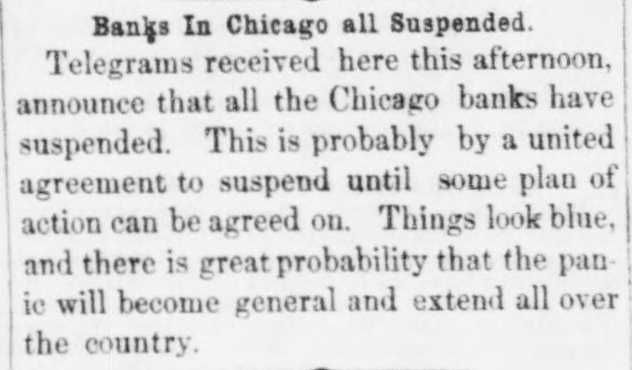
# Banks In Chicago all Suspended. Telegrams received here this afternoon, announce that all the Chicago banks have suspended. This is probably by a united agreement to suspend until some plan of action can be agreed on. Things look blue, and there is great probability that the panic will become general and extend all over the country.


Article from Wilmington Daily Commercial, September 26, 1873

Click image to open full size in new tab

Article Text

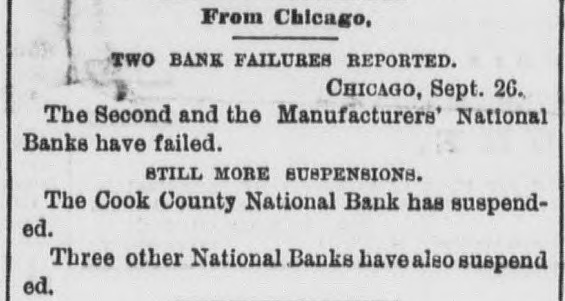
From Chicago, TWO BANK FAILURES REPORTED. CHICAGO, Sept. 26. The Second and the Manufacturers' National Banks have failed. STILL MORE SUSPENSIONS. The Cook County National Bank has suspended. Three other National Banks havealso suspend ed.


Article from Eureka Daily Sentinel, September 27, 1873

Click image to open full size in new tab

Article Text

ILLINOIS. CHICAGO, Sept. 26. It is just announced that the Union National Second National and Manufacturers' National Banks. have suspended. A notice on the dcor of the former savs the bank has abundant securities, but is compelled to suspend payment on account of lack of currenev until able to realize. Nothing has been lost from failures. and depositors will be made safe. The Cook County, City National and National Bank of Commerce, have followed the example of the Union National Bank. and closed their doors. There was a run for an hour on coin at the Exchange Bank. but. as everything was paid. the run stopped. Some who drew have redeposited. This bank is considered very strong The other National Banks are paying regularly. There is considerable excitement among business men, and the grain trade shows the effect. Coolbaugh, President of the Union National Bank. IS severely censured by other bankers and the whole community. It is suggested that there must be something rotten in his bank. though it has been regarded as very strong.


Article from The Wheeling Daily Intelligencer, September 27, 1873

Click image to open full size in new tab

Article Text

EXCITEMENT IN THE GRAIN TRADE. CHICAGO, Sept. 26.-It is just announced that the Union National, Second National and Manufacturers' National Banks have suspended. A notice on the door of the former says that the bank has abundant securities, but is compelled to suspend payment, on account of lack of currency, until they are able to realize. Nothing has been lost by failures, and their depositors will be made secure. CHICAGO, Sept. 26.-The Cook County City National Bank and the National Bank of Commerce have followed the example of the Union National Bank, and closed their doors. There was a run for an hour on the Commercial Exchange Bank, but as everything was paid, the run soon stopped. Some who drew have redeposited. This bank is considered very strong. The other National banks are paying regularly. There is considerable excitement among the business men, and the grain trade shows the effect. Mr. Coolbaugh, the President of the Union National Bank, is severely censured by the other bankers, and the whole community think the course proposed by him wholly unnecessary. It is suggested that there must be something rotten in his bank, though it has been regarded very strong.


Article from The Rutland Daily Globe, September 27, 1873

Click image to open full size in new tab

Article Text

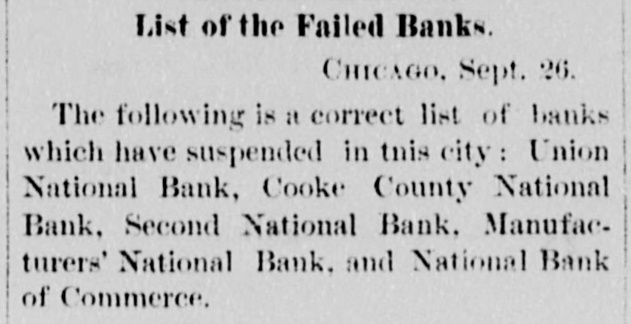
List of the Failed Banks. CHICAGO, Sept. 26. The following is it correct list of banks which have suspended in this city: Union National Bank, Cooke County National Bank, Second National Bank. Manufacturers' National Bank. and National Bank of Commerce.


Article from The New York Herald, September 27, 1873

Click image to open full size in new tab

Article Text

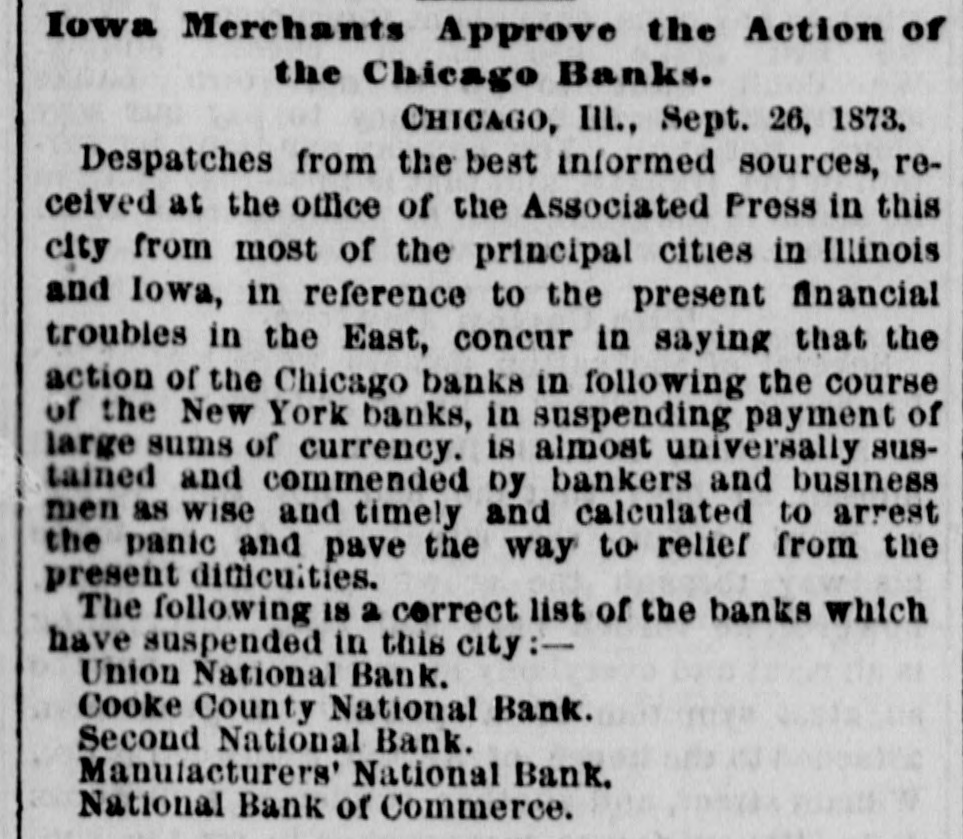
Iowa Merchants Approve the Action of the Chicago Banks. CHICAGO, III., Sept. 26, 1873. Despatches from the best informed sources, received at the office of the Associated Press in this city from most of the principal cities in Illinois and Iowa, in reference to the present financial troubles in the East, concur in saying that the action of the Chicago banks in following the course of the New York banks, in suspending payment of large sums of currency. is almost universally sustained and commended by bankers and business men as wise and timely and calculated to arrest the panic and pave the way to relief from the present difficulties. The following IS a correct list of the banks which have suspended in this city:Union National Bank. Cooke County National Bank. Second National Bank. Manulacturers' National Bank. National Bank or Commerce.


Article from Oxford Democrat, September 30, 1873

Click image to open full size in new tab

Article Text

LATEST. The latest telegraphie up to Monday, 29th, is that the suspension by banks of currency payments in large sums. is becoming general. The Boston banks have adopted this course, as a precaution. ary movement. The Stock Exchange is to open Tuesday, 30th, and an improved state of feeling exists. Quite an eff'ort will be made to secure specie payments. Five Chicago Banks Suspended. The Union National, Manufacturers National, Second National, Cook County and National Commerce banks have clos. ed their doors. Other National banks are paying regularly. There is considerable excitement among business men, and the grain trade shows the effect.


Article from The Middlebury Register, September 30, 1873

Click image to open full size in new tab

Article Text

LIST OF FAILED BANKS.-Chicago. Sept. 26.-The following is a correct list of banks which have suspended in this city; Union National Bank, Cooke Couny National Bank, Second National Bank, Manufacturers' National Bank of Com. merce.


Article from Chicago Daily Tribune, September 30, 1873

Click image to open full size in new tab

Article Text

LAWRENCE, KS. Special Dispatch to The Chicago Tribune. LAWRENCE, Ks., Sept. 20.-Financial matters are looking brighter. The news of resumption by the Chicago banks is hailed with delight. Our banks have paid without suspension through the panic.


Article from Chicago Daily Tribune, September 30, 1873

Click image to open full size in new tab

Article Text

SAN FRANCISCO. Special Dispatch to The Chicago Tribune. SAN FRANCISCO, Sept. 20.-To-day was devoted almost exclusively to collections and legitimate channels, and the result inspirod confidence. Tho resumption of business by the Chicago banks was the subject of much congratulation, showing the panic had no serious effects on Western finance and stability. This, with the promptness with which to-day's matured obliga- tions were mot, has reopened the current of exchange, which resumed with some briskness. Coin drafts on New York sold at ΒΎ to 1 por cent; telegraphic transfers at 2 por cent. The panic has fully demonstrated the unadvisability of stock speculations. Capitalists are more unwilling than ever to invest in outside real estate, preferring legitimate enter- prises and staple products. The panic is charged


Article from The Kenosha Telegraph, October 2, 1873

Click image to open full size in new tab

Article Text

MONETARY. Since our last issue there has passed a week of great anxiety and fear throughout the country, the best of financiers and the wisest not being able to forsee what S day might bring forth. In New York there were but few or no more important failures and the panic has gradually subsid ed and business is assuming its usual activity The Gold and Produce Exchanges were ecarcely more than closed till they were opened again. The Stock Exchange remained closed till Tuesday morning at 10 o'clock when it was opened and immediately filled by the crowds rushin in at the three entrances on Wall Broad and New streets. Stocks at first rose and then remained etationary or fell. Dividend paying stocks generally held an ad vance. The day passed and closed as fa. vorably as was expected-perhaps more favorably. The Secretary of the Treasury paid out $14,000,000 for the purchase of government indebtedness and then declined paying out any more. His declining to purchase any more bonds had a depressing effect but the orders for the prepayment of the interest accruing in November and the President's letter on the situation and the USJ of currency to restore confidence and legitimate trade and commerce had a reassuring effect. During tne week the financial stringen cy reached Chicago and six National Bankssuspended,namely-Union Natioual, Cook County National, National Bank of Commerce, Second National, Third National, Manufacturers National. The Bank Officers held several meetings but could come to no agreement as to the course to be pursued. Two plans were before the meetings, one to issue Clearing House certificates as 1 New York to be used in the settlement of balances, the other to go on as usual A motion to issue Clearing House certifi cates was voted down and the last meeting adjourned. Two of the suspended banks, Manufacturers National and Sec ond National, went into liquidation last week. On Monday three of the suspended banks, Unlon National, Cook County National, National Bank of Commerce after a suspension of two business days. reopened at the usual time and continued open till the hour for closing without any unusual rnn on the banks. On Tuesday one of the three, Union National Bank of Chicago, did not open, and gavo notice that it had gone into liquidation. The reason given by the Union National for going into liquidation was that it had out on their would soon out currency paid Monday $400,000 all be drawn and and the bank would become crippled,but by going into liquidation it could in thirty or forty days pay all demands, save the capital and have a surplus left. The Union going into liquidation had an un favorable effect but all the banks including the other three which reopened on Monday went safely through the day and paid their clearances as on Monday. Altogether the prospect Tuesday night was that the crisis had passed and that business was assuming a healthy tone. y Yesterday was an encouraging day. All the bank in Chicago doing business passed e safely through the day, many or all receiving n more in deposits than was withdrawn. The produce trade is reviving and prices advanc. ing. The general aspect is more cheerful o and confidence is becoming more general. e There have been no bank suspensions in Milwaukee and it is thought there will not d be. Business has been partly suspended by the adjournment of the Chamber of Commerce but otherwise is passing on about as usual. n In New York the panic seems to have n subsided, business being transacted and n confidence increasing. Boston has thus n far had no panic, no bank failures, and h not much suspension of business. I. Gold to a large amount is being imkported from England and currency to very large amount has been transmitted g and is being transmitted by express from y the East to the West. Of the currency st transmitted Chicago has received and is receiving it by millions. The produce er and pork business cannot be fully carried g, on without the use and assistance of the gy e banks. And this cannot be had without naccommodation on the part of the banks de and confidence by the banks in each other and in the banks by the people. The


Article from Iowa Voter, October 9, 1873

Click image to open full size in new tab

Article Text

body known as the "People's Party;" repudiates party fealty as a tyrannical rule, sinking the citizen to a servile partisan; condemning the system of using money corruptly in elections; condemning all political rings and cliques formed to control elections; pledging the party to civil-service reform and to resist all Credit-Mobilier contracts with finance companies; denounces the present system of the distribution of lands and grants of lands to railway and other corporations; opposes all kinds of subsidy by Federal, State, county or municipal governments; opposes the present tariffs; favors taxing solvent debts; favors the eight-hour law; opposed to Chinese immigration, and also opposed to the election of the President for more than one term of four years. The last resolution indorses the stand taken by Governor Booth in behalf of popular rights against the encroachments of politicians and railway corporations. A dispatch from Denver, Col., states that over two-thirds of the mining town of Fairplay, Col., had been consumed on the 26th. All the stores, printing offices, the United States land office, post office, express office, hotels and other business places, with two or three exceptions, had been utterly destroyed. The Right Rev. Geo. M. Randall, Episcopal Bishop of Colorado, New Mexico and Wyoming, died at Denver, Colorado, on the 28th, of typhoid pneumonia. The Third National Bank, of Chicago, closed its doors on the 27th. The Cook County National, one of the suspended banks of that city, had announced its resumption. The Manufacturers' and Second National banks had decided to go into liquidation. The Union National, the first of the Chicago banks that closed its doors, had announced its assets at $5,600,000, and its liabilities at $4,300,000, and given notice of its speedy resumption of business. The Clearing-House Association met on the evening of the 27th, and after an animated discussion resolved not to issue Clearing-House certificates. A dispatch from St. Louis of the 27th says that the rear wall of the five-story warehouse, on the corner of Second and Chestnut streets, had fallen, opening a gap in the building fifty feet wide from the ground to the roof. One man had been killed and two seriously injured. In Chicago, on the 29th, business had resumed very nearly its normal condition. Three of the suspended banks had resumed business and were receiving deposits and paying out on checks as before the panic. Over $3,000,000 currency had been received during the preceding forty-eight hours. Traffic had fallen off on the various lines of railroad, and a large number of trains had been drawn off, and many men discharged. A St. Louis dispatch of the 29th says that while Joseph H. Fore, who attempted to kill his wife, on the 4th of June last, was being tried in that city on the 29th for that offense, he threw a heavy cut glass inkstand at his wife as she was giving in her testimony. The missile missed her, but struck her counsel full in the forehead, inflicting an ugly and dangerous wound. At a late hour on the night of the 29th the Union National Bank of Chicago, which had resumed business on that morning, and during the day had paid out $400,000, decided to go into liquidation, under the provisions of Sec. 42 of the National Currency Act. A call has been issued for a Northwestern Farmers' Convention, to meet at Chicago on the 22d of October, to consist of delegates from Granges and farmers' organizations. In Chicago, on the 30th, matters had very nearly resumed their normal condition, so far as the banks were concerned. The effect of the late panic was just beginning to be felt by merchants and traders. Trade was unmistakably dull and collections difficult to be made. A Madison, Wisconsin, dispatch of the 1st announces that the Bank of Madison had failed. A dispatch from Springfield, III., of the 1st, says the Leland House of that city had been damaged by fire to the extent of $10,000.


Article from The Redwood Gazette, October 9, 1873

Click image to open full size in new tab

Article Text

Federal, State, county or musicipal governments; opposes the present tariffs; favors taking solvent debts: favors the eight-hour law; opposed to Chinese immigration, and also opposed to the election of the President more than one term of four years. The last resolution indorses the stand taken by Governor Booth in behalf of popular rights against the encroachments of politicians and railway corporations. A dispatch from Deaver, Col., states that over vo-thirds of the mining town of Fairplay, Col., had been consumed on he 26th. All the stores, printing offices, the United States land office, post office, express office, als and other business places, three exceptions, had been utterly destroyed. The Right Rev. Geo. M. Randall, Episcopal Bishop of Colorado New Mexico and Wyoming, died at Denver, Colorado, on the 28th, of typhold pneumonia. The Third National Bank, of Chicago, closed its doors on the 27th. The Cook County National, one of the suspended banks of that city, had announced its resumption. The Manufacturers' and Second National banks had decided to go into liquidation. The Union National, the first of the Chicago banks that closed its doors, had announced its assets at $5,600,000, and its liabilities at $4,300,000. and given notice of its speedy resumption of business. The Clearing-Ho Association met on the evening of the 27th, and after an animated discussion resolved not to issue ClearHouse certificates. A dispatch from St. Louis of the 27th says that the rear wall of the five-story warehouse, on the corner of Second and Chestnut streets, had fallen, opening gap in the building fifty feet wide from the ground to the roof. One man had been killed and two seriously injured. In Chicago, on the 29th, business had resumed very nearly its normal condition. Three of the suspended banks had resumed business and were receiving deposits and paying out on checks as before the panic. Over $3,000,000 currency had been received during the preceding forty-eight hours. Traffic had fallen off on the various lines of railroad, and a large number of trains had been drawn off, and many men discharged. A St. Louis dispatch of the 29th says that while Joseph H. Fore, who attempted to kill his wife, on the 4th of June last, was being tried in that city on the 29th for that offense, hethrew heavy cut glass inkstand at his wife as she was giving in her testimony. The missile missed her, but struck her counsel full in the forehead, inflicting an ugly and danger wound. At a late hour on the night of the 29th the Union National Bank of Chicago, which had resumed business on that morning, and during the day had paid out $400,000, decided to go into liquidation, under the provisions of Sec. 42 of the National Currency Act. A call has been issued for a Northwestern Farmers' Convention, to meet at Chicago on the 22d of October, to consist of delegates from Granges and farmers' organizations. The South. A dispatch from Richmond, Va., of the 23d, says that the Merchants' National, the Planters', the Mechanics', the Peoples', the First National, and the Citizens' banks, of Petersburg, had suspended. A Baltimere telegram of the 24th announced that all the banks of that city had stopped currency payment. Brown, Lancaster & Cowell, agents of the Chesapeak and Ohio Railway, having houses in Baltimore, New York and Richmond, had also suspended. A Little Rock, Ark., dispatch of the 24th says the money panic in that city continued, caused not 80 much by Eastern financial complications as by the refusal of the city banks to take the shinplasters that have been current there. A dispatch from Richmond, Va., says that the Richmond Dollar Savings Bank had suspended, and that Taylor & Williams, bankers, had failed. A dispatch to the Associated Press, from Brownsville, Texas, of September 24, says that a series of butcheries and robberies had recently been committed in Mexico, the victime every case being Americans. The perpetrators of these crimes were arrested, and their guilt fully established, yet not one of them had been punished, the authorities being either indifferent or powerless. The facts had been reported by the Consuls to Washington, in the hopes that redress would be demanded. A Memphis dispatch of the 25th says that the First National and De Soto banks, of that city, had closed their doors. A dispatch from Nashville Tenn., says that the National Banks of that city had suspended currency payments on all balances exceeding $200. A dispatch from Selma, Ala., of the 25th. says the Savings Bank of Selma had suspended in consequence of an extraordinary run by depositors. All the banks of New Orleans partially suspended payment on the 25th, according to a dispatch from that city. The suspension was to remain in force for thirty days. Telegrams from various cities in Georgia, of the 25th, say the following banks had suspended: National Exchange, the Merchants' and Planters' National, the Planters' Loan and Savings Banks, of Augusta, Ga.; the Dollar Savings Bank, of Atlanta, Ga.: Savannah Bank and Trust Company, and the South ern Bank of Georgia. A dispatch from Shreveport, La., of the 25th, says the fever, which seemed to have abated on the preceding day, had broken out with renewed violence. The interments numbered twenty-two. A dispatch from Shreveport, La., of the 29th says that within the last four days sever al of the most prominent and useful citizens of that city had fallen victims to the epidemic. The dispatch adds: "The population has been fearfully thinned out by sickness and death We no longer have funerals. The hearses, followed by one or two carriages, dash through the streets like a section of artillery in a battle seeking position. A few men are drummed up, the coffins shoved into the hearse, and driven rapidly to the cemetery. This is the case even with the most prominent citizens. The Howards have opened an orphan asylum, and are feeding about two-thirds of the resident population. There are fewer deaths and new cases, because there are fewer people.' A Jackson, Miss., dispatch of the 29th says Governor Powers, acting under the advice of Attorney-General Morris, had issued proclamation postponing the State election. The Governor says that he will convene the Legislature in extraordinary session as soon as possible. The Pilot, the State organ, has pronounced the Governor's movement incendiary, and calculated to lead to revolution and anarchy.


Article from Wood County Reporter, October 9, 1873

Click image to open full size in new tab

Article Text

DOMESTIC. New York telegrams of the evening of the 27th say that the week had closed on a more cheerful financial aspect. The greenback reserve had been drawn down from $34,700,000 to $12,000,000. Clearing-House certificates had been issued as demanded or desired, and it was thought that with the aid of these and a small infusion of National currency the crops could be moved and mercantile embarrassment and failure averted. The Third National Bank, of Chicago, closed its doors on the 27th. The Cook County National, one of the suspended banks of that city, had announced its resumption. The Manufacturers' and Second National banks had decided to go into liquidation. The Union National, the first of the Chicago banks that closed its doors, had announced its assets at $5,600,000, and its liabilities at $4,300,000, and given notice of its speedy resumption of business. The Clearing-House Association met on the evening of the 27th, and after an animated discussion resolved not to issue Clearing-House certificates. A telegram from St. Louis of the 27th says that the rear wall of the five-story warehouse, on the corner of Second and Chestnut streets, had fallen, opening a gap in the building fifty feet wide from the ground to the roof. One man had been killed and two seriously injured. A New York dispatch of the 28th says that the President of the First National Bank of that city had urged the immediate resumption of specie payment, on the ground that such action will add $60,000,000 positive relief to the money market. A Washington telegram of the 28th says the President had expressed his determination to recommend to Congress the adoption of a system of free banking. The Secretary of the Treasury had ordered the anticipation of the payment of the November interest. The following letter had been sent by the President to the parties named: EXECUTIVE MANSION, Sept. 28, 1873. Messrs. H. B. Claflin and Charles L. Anthony: GENTLEMEN: In response to the views you have communicated as to the using by the President of currency to restore confidence and legitimate trade and commerce, I have the honor to communicate the following: The Government is desirous of doing all in its power to relieve the present unsettled condition of business affairs, which is holding back the immense resources of the country now awaiting transportation to the seaboard and a market. Confidence on the part of the people is the first thing needed to relieve this condition and avert the threatened destruction of business, with its accompanying disasters, to all classes of people. To re-establish this feeling the Government is willing to take all legal measures at its command, but it is evident that no urgent efforts will avail without the active co-operation of the bank and moneyed corporations of the country. With the $14,000,000 already paid out in the purchase of Government indebtedness, and the withdrawal of large deposits from the Treasury, the banks are strong enough to adopt a liberal policy on their part, and by a general system of discounts, to sustain the business interests of the country. Should such a course be pursued, the $44,000,000 of reserve will be considered as money in the Treasury to meet the demand of public necessity as the circumstances of the country may require. Close attention will be given to the course pursued by those who have the means at their command of rendering all aid necessary to restore trade to its proper channels and condition. With a view of strengthening those who carry out the measures above indicated, orders have already been issued for the prepayment of interest accruing in November. U. S. GRANT President. According to a dispatch from Denver, Col., over two-thirds of the mining town of Fairplay, Col., had been consumed on the 26th. All the stores, printing offices, the United States land office, post-office, express office, hotels and other business places, with two or three exceptions, had been utterly destroyed. New York dispatches of the 29th say the situation in finance and trade had become altogether more hopeful and cheering, not only in that city but in all parts of the country. The money pressure was being gradually overcome; there had been a larger advance in the price of dividend-paying stocks; business had gradually improved in the produce market; the gloomy apprehensions as to the moving of the crops had yielded to brighter hopes; there had been continued large shipments of coin from England to the United States, and a general feeling of security pervaded not only that market, but all the Southern and Western markets. On that day over $3,000,000 in currency had been released. Gold had been lower, and at one period during the day was sold as low as 110 in greenbacks. The Glenham Woolen Mills, at Glenham, N. Y., had suspended. The Tribune had prepared a leader advocating the immediate resumption of specie payment, closing with the following significant language: "The country is passing its grandest opportunity since the war. There has not been, since the passage of the legal-tender act, any financial situation or crisis that so held out all its hands inviting to resumption. Shall we let it go by? The crisis calls for a firm hand, clear head and determined purpose. That's all. To-day's opportunity is for the country, for the dominant party, for the President. Let the President issue his proclamation convening Congress in an extra session at eight or ten days' notice, with the sole object stated distinctly in the call. For ten days past the people have done almost nothing but stand in front of their balance-sheets and inventories, and see a rapid and constant shrinkage in values, and there's no knowing where it will stop or when, for the simple reason that there is no financial hard-pan. Some time we must get back to specie; that's admitted. Why not now? When will there be a better time? When would the whole country be more benefited by it than now? There ought to be statesmanship enough in Congress to devise a simple, practicable method. Let President Grant settle it as far as he is concerned by convening Congress and putting upon it the responsibility of meeting the emergency." According to a Washington dispatch of the 29th, the depositors of the First National Bank of that city would not receive to exceed fifty per cent. of their deposits. In Chicago, on the 29th, business had resumed very nearly its normal condition. Three of the suspended banks had resumed business and were receiving deposits and paying out on checks as before the panic. Over $3,000,000 currency had been received during the preceding forty-eight hours. Traffic had fallen off on the various lines of railroad, and a large number of trains had been drawn off, and many men discharged. At a late hour in the night the Union National Bank of Chicago,


Article from Ottumwa Weekly Courier, October 16, 1873

Click image to open full size in new tab

Article Text

At last it turns out that of the twenty-one National banks of Chicago before the panic, three have gone into liquidation, viz: the Union, the Second National, and the Manufacturers'. The three other banks which suspended have all opened again, and are moving along as usual. Rapidly currency is coming into Chicago, and the best and most hopeful teeling prevails. It is confidently expected that the three banks which have gone into liquidation, will pay everybody, depositors and all.


Article from The New York Herald, November 4, 1873

Click image to open full size in new tab

Article Text

CHICAGO PREPARED. No Present Distress in the City-Business Active and Unhampered, but the Winter Dreaded-A Table of Receipts and Shipments. CHICAGO, Nov. 3, 1873. Less, perhaps, than any large city on the Continent has Chicago been affected by the panic which commenced with the suspension of the Buchu banker of Philadelphia and continues with the failures and rumors of failures in Rhode Island. The panic among our banks was short and sharp, but all have weathered the storm save the Second National and Manufacturers' National, both of which have gone into private liquidation, and the Franklin, a small institution, which has been declared bankrupt. The liquidating banks will pay dollar for dollar, as Chicago never adopted the plan of issuing Clearing House certificates. Each bank stood from the outset on its own bottom. and the result is that all our other banking institutions are in excellent condition, doing business as usual, save that discounts are not granted as readily as of old. The savings banks having decided to stand by time rule, are all intact, and as their line of deposits was very large, frugal poor people. who were almost entirely their customers, will have a resource in case of distress. There has not been a single failure of note in mercantile circles, and BUSINESS IS ACTIVE AND UNHAMPERED, except by the difficulty of making collections. Take, for example, the dry goods-line:Mr. Leiter, of the firm of Field, Leiter & Co., the heaviest house here, declares that we are better prepared for hard times than any other section of the country. Business is flourishing and our orders average 100 a day. The past week was the best we have ever seen in the way of filling orders. It 'is our largest week on record. Our banks are in superb condition: they were never better. Not a single manufacturing house has thus tar shut down. THE PORK PACKING SEASON has not, however, fairly opened, and the prospect is at present that general scarcity of money will prevent anything like the business of former seasons. As this is our principal industry in winter, it is greatly leared that much distress will prevail among a large class dependent upon it for their winter's sustenance. No building operations have been suspended. The city goes on with its improvements, employing thousands of men, but the season for this kind of labor will close about the 1st of December, and if the packing houses are not in full blast men who usually work at anything in summer, and in the packing houses in winter, will suffer in the cold. As a rule the railways having shops in the city, or anywhere in the Northwest, have made no considerable, if any, reduction in their force; but the Chicago, Burlington and Quincy, Northwestern and LakeShore lines have cut down the wages of all their operatives from seven to ten per cent. I hear that THE WHOLESALE CLOTHIERS will not employ a large number of tailors this winter, and as the manufacture of clothing was carried on largely here it is likely that there will be much suffering among those depender upon this line of industry. Business upon 'Change is lively, though there is net 80 much speculation as usual, owing to the feeling of distrust among operators. To indicate how little trade in grain has been affected, I send a statement of receipts and shipments of breadstoffs and live stock at this point during the past week, comparing them with those of the corresponding week of last year :RECEIPTS.


Article from The Wheeling Daily Intelligencer, December 15, 1873

Click image to open full size in new tab

Article Text

Another Man Short in his Accounts. CHICAGO, Dec. 14.-It is stated that David Gage, City Treasnrer, is short in his accounts with the city to an amount which will reach nearly or quite four hundred thousand dollars. A portion of this amount is locked up in the suspended Second National and Manufacturer's National Banks. It is said that Mr. Gage will be able to obtain security from any ultimate loss.


Article from Alexandria Gazette, December 15, 1873

Click image to open full size in new tab

Article Text

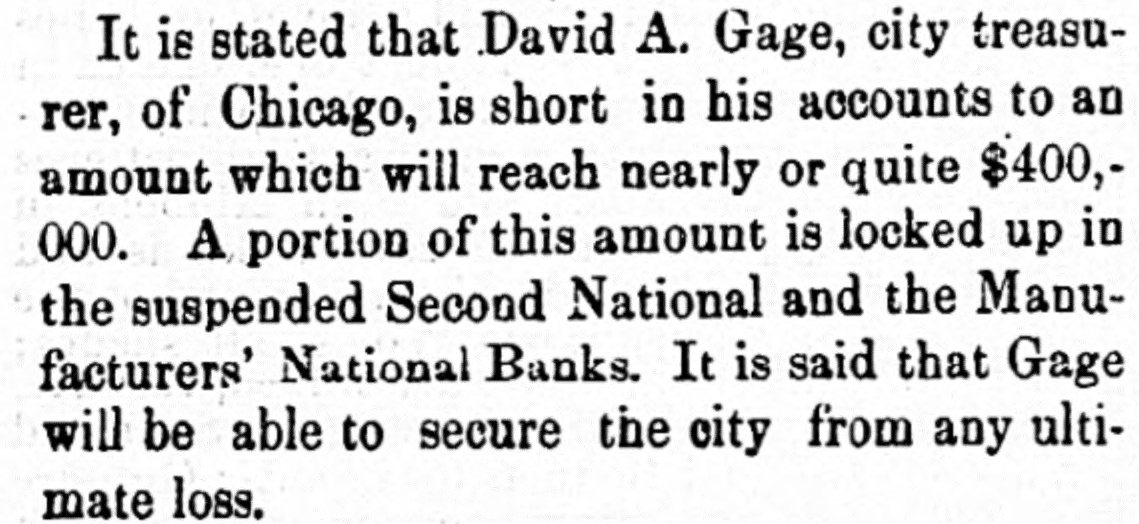
It is stated that David A. Gage, city treasurer, of Chicago, is short in his accounts to an amount which will reach nearly or quite $400,000. A portion of this amount is locked up in the suspended Second National and the Manufacturers' National Banks. It is said that Gage will be able to secure the city from any ultimate loss.


Article from Chicago Daily Tribune, June 18, 1875

Click image to open full size in new tab

Article Text

FINANCIAL The tendency of the loan market in towards on case increasing supply of funds, and A corresponding weakness in rates. The shipments of produce such a and which have begun, though they do not reach has volume as WAS hoped for, release the money which the in use here to carry them, and embarrass no banks been with additional surplus. If there has been ther good in the accumulation of grain and provisions, conhas enabled the banks to find employment for a other siderable t portion of their loanable resources. In respects, the financial situation remained unchanged, Morcanbeyond a slight increase in counter business. tile operations are restricted, and manufacturing Intershares in the depression that has come upon this eat everywhere. Rates of discount at the banks are 8310 per kind cent of to good outside borrowors who have the right made. securities concessions of several per cent are The number of such borrowers is very small. On the street, business is light. Rates are 6318 por cent. New York exchange remains steady at premium between banks for $1,000. large, The movement of currency to the country is not The clearings were $1,000,000. THE SINKING FUND AND THE TREASURY. current fiscal year ends with the 30th of this to month, The and the accounts of the United States show are a be balanced for that date. They will not of bankrupt Government, as the inconsiderable Kelley, doubt Pennsylvania, crazily puts it, but there is no $25,there will be a deficiency of $20,000,000 or the that The calculations made for the year Internal by 000,000. Department were that the customs, takTreasury and miscollaneous receipts, would yield, taxes, revenue, into account the effect of the increased the about ing $300,000,000. This was to be expended for ordinary expenses of the Government, $275,000,000, fund, and for the purchase of bonds for the sinking $31,000,000. But the receipts have failed to respond includ. at all to the increase of taxes, the expenditures, and the those for the sinking fund, have gone on, yearly result ing will be at the and that the Government's and income has been about $234,000,000 or leas, is its expenditures $300,000,000 or more. This has not the best kind of Ananciering. but the Treasury abundant means-$64,000,000 of cash gold, for instance -to meet the drain on Its resources. THE SITUATION IN CANADA. The good times which Canada has been enjoying with its railroad-building and general speculations have been followed by something which appronehes A punic. The suspension of busthouses we have already announced are succesded ness by others equally serious. The closing of the doors of the Jacques Cartier Bank is sufficiently serious to make IL advisable for the other banks to come to Its aid. A lumber firm of QuebecBenson. Bennett & Co.-bave falled, with liabilities of $1,000,000. The banks appear, from the reports by telegraph, to be pursuing a policy that will intensify to the distress. They are curtailing their advances merchants. The opposite course is a safe and sure antidote to a crisis of this character. The Bank of England has learned this by periious experience, 1800* and seted upon It with great effect in the panic of The action of the Canada banks seems to be occasioned, if not caused, by the ill-advised circular of the Finance Minister, informing the banks that the Government was about to withdraw its deposits. ENGLISH THADE. The London Times of June 5, in its money-article, discountenances the hope that a general revival of trade is at hand. It maye: The revival shown in our foreign commerce anticipa- during the month of April has given rise to sanguine throughout tions that trade generally was improving manufacthe country. Advices, however, from the in the turing districts, more especially those engaged a cheerwoolen and metal branches, give by no means Trade ful account, and it is probabl that the Board of whether for May, due on Monday, will show, returns it be any trustworthy indication $8 to the future course in of our export trade or not, that the advance made the proceding month has not been sustatued. The wide rauge of the phenomena which are at present so conspicuous in our markets is shown by 8 the Intest mail advices from Manchester, June 4: The pressure to sell causes buyers to have an to advan- purT in price, but this does not tempt them delivtage except in small lota, and for inimediate B chase, The sales of to-day and of provious days cloth-mar- this wook ery. nearly np to the production. The E ket are is not But. Although the financial troubles may they not have affected the operations of the larger firms, T undentably induenced the dealings of the smaller adhave The unfavorable rate of exchange and bad F 01104, from nearly all quarters, are subtident in themsolves victs to provent much enterprise at present. I INSOLVENT NATIONAL BANKS AND RECEIVERS. E It is A defect in the National Banking law, to which attention has been called by THE TRIBUNK, that It permits banks that are in bad condition to go into voluntary liquidation under the administration of the men who have reduced them to bankruptcy, and very whose interests, to put it mildly, are not one with those of the creditors. The cases of the Manufacth turers' National and the Second National of this city tv gave plenty of illustration of the hardships that deB positors undergo in such liquidations. The National as Board of Trade has before it for discussion the following with regard to an amendment to the National Banking law to cover such casos: Resolved, That Congress be memorialized to the no amend the National Banking law that, ID case of Fl failure of any National Bank to promptly redocin, on W presentation, any of its obligations payable on doCo whether of circulating notes or any other class Oa mand, of its indebtedness, that It shall be the imperative Its duty of the Comptroller of the Currency to immediate- noBa by cause the bank to be placed in the hands of a Gr ceiver. who shall at ouco take charge of and proceed FI to realize upon its assets. as is provided in caso of the Br appointment of a Receiver under the existing laws: On provided, however, that If within thirty days after the Be appointment of such Receiver It shall be shown to that the 1'o satisfaction of the Comptroller of the Currency Ia such bank is then In a condition in all respects to meet Ta its obligations, as they are likely to be presented in the usu ordinary course of business, and to resume business 14 under the law, the Receiver may, in the discretion of Ca the Compiraller, be relieved, and the bank be perSh & National Bank. mitted to resume its regular standing and business us If HI At the Inst session of Congress, an amendment of We I'o this purport, generally understood to have been Lu drafted by Comptroller Knox, who knows how to do it Su if any one does, was submitted to the House Banking La to pass it. Committee. An effort should be made next winter SA GOVERNMENT BONDS. / Bid. Ashed. 128 United States Co of "81 1201 Pot 117% United States 5-20m of '02 11812 Po United States 5-20a of N4 118% 110% Eg 1234 United States 5-20s of '0' 12216 Ch 12311 5-20s of 05-January and July, 1241, Dr 124 V 1235 6-308 of '67-January and July Be 1249. 1214 4-20g of 188-January and July, Hn 10.40m 114% 11934 Hu 117% 118 United States new 54 of '81 Fn 1217 United States currency 6a. Gold was 1185@117% anst FOREIGN EXCUANGE. bu Sterling exchange was 438@401 cable transform, London, 492; Paris, 51036. Other rates of foreign ex-


Article from The Manitowoc Tribune, August 5, 1875

Click image to open full size in new tab

Article Text

THURSDAY, AUGUST 5, 1875. REPUBLICAN STATE TICKET. FOR GOVERNOR, HARRISON LUDINGTON. FOR LIEUT. GOVERNOR, H. L. EATON. FOR SECRETARY OF STATE, H. B. WARNER. FOR STATE TREASURER, HENRY BATZ. FOR ATTORNEY GENERAL, JOHN R. BENNET. FOR SUPT. OF PUE. INST'N., ROBERT GRAHAM. CAMPAIGN LIES EXPOSED. WE do not publish the following letter from Major Bætz because we think that any one believes him guilty of the charges made against him; but now that they have been circulated, it is but justice to the Major to give his plain concise refutation of the vile slander heaped upon him by that most depraved of all Wisconsin newspapers, the Milwankee News: Milwaukee, July 26. To the Editor of the Sentinet: Will you kindly permit me to notice, through the medium of the Sentinel, a few pasages in the Madison letter of Saturday's Milwaukee News, by which the anonymous writer tries to impeach my integrity as a former State officer. He says : The fact that Baetz, as treasurer, had some $12,000 of the State funds in the Second Nationa! Bank of Chicago hen it failed, $15,000 in the broken City Bank of this city, $6,000 in Wisconsin Central Railroad lands, and $4,000 in that digest of laws which was printed under a special act, is telling strongly against him. To the first charge I plead guilty, except that the amount is overstated. This bank was considered sound and safe, but the panic of 1873 forced it to go in to liquidation, The State Treasurer's Chicago account had been kept with it for years before 1 came into office. I


Article from Watertown Republican, August 18, 1875

Click image to open full size in new tab

Article Text

he Republican. Reform Malignity. : Republican State Ticket has n the field now over a month, as been made the target by the cratic light artillery The is have been SO weak that no imon has been made nor a single iscovered. Their guns are get so dirty that they recoil upon gunners. They may keep up a noise, but people are get use at kind of warfare. Chinese will not answer in the place of hot. Every charge nade has satisfactorily explained or dis1% ER are they dn pamming E Major BΓ¦tz deposited money in , which the Madison Democrat as direct violation of law." teform Treasurer Kuehn also demoney in banks, and what is in his own bank, and loans Cut tate money to his own customers. othered the Democrat, which ands crawfished by saying that uestion is not in issue, and that been "sanctioned by custom." re the Reformers are at a disad94 Major BΓ¦etz has $12,000 in one and $10,000 in another bank, 1 banks at the time of the panic to pay in full. But did the lose the money? Not a cent. I Major Batz left the office, he 1 over the full amount of public for which he was accountable. successor, the present Reform urer, taking his receipt therefor. ears have elapsed, and it is only his nomination that any fault has found. As to the case of one we will let the Milwaukee News r its own charges as follows: en Mr BΓ¦tz went out of office, Jan. 74, he had about $12,00 of State on deposit in the bankrupt Second al Bank, of Chicago, of which J A. formerly of Madison, was cashier. am 01 pood ΡΡ€ΠΊΡˆ ziecy ** inom There is no default nor deficiency in cality, so far as Mr. BΓ¦tz is concerned ain; Gen. Mills was Treasurer of isabe Hospital at Madison, and enerally understood to be conI with the bank of Madison. etz had some $10,000 in This in anticipation of the quarterly ent soon to become due. He Mr. Mills a check for the amount : a receipt on account of the tal appropriation. Mr. Mills the amount to the Hospital what has the State to do with atter? Major BΓ¦z has accountthe State for the money, and Mills has settled the same with ospital. The bank failed soon and he asks as a private matter,