Article Text
Run on a Bank
Philadelphia, Dec. 1.-[Special]Rumors about thecondition of Keystone National Bank, of this city, caused a run on the bank, and $350,000 was paid out to depositors. The bank is perfectly solvent.
Accommodated withdrawals, Clearinghouse loan, Capital injected, Full suspension, Books examined
Clearinghouse involved: Yes (loan, examination, or other measures)
Click image to open full size in new tab
Philadelphia, Dec. 1.-[Special]Rumors about thecondition of Keystone National Bank, of this city, caused a run on the bank, and $350,000 was paid out to depositors. The bank is perfectly solvent.
Click image to open full size in new tab
PHILADELPHIA, Pa., Dec. 2.-The run on the Keystone National bank continues today with unabated vigor. All persons presenting checks for $100 or less were paid in currency, but any whose demands exceeded that amount are given clearing house due bills. By an arrangement with the clearing house banks, these due bills will be honored at any bank.
Click image to open full size in new tab
P1 ILADELPHIA, Dec. 2.--There was a run Mon day on the Keystone National bank. The bank has a capital of $000,000 and a surp us of $100,000. A large check from Bost on recently sent to the bank, and return d because not properly indorsed, is said to have occasioned the rumor that the chec C bad gone to protest. President Mar h says the bank is all right. It has about 4400,000 of the county's money.
Click image to open full size in new tab
PHILADELPHIA, Dec. 3.-The run on the Keystone National Bank has collapsed. and the officers of the institution, and those who have stood behind it in the hour of its peril, are rejoicing over their victory. Many depositors who drew out their funds have redeposited them.
Click image to open full size in new tab
A run of depositors on the Keystone National Bank, Philadelphia, on Monday caused considerable excitement in financial circles. The deposits for the day, the cashier said, amounted to $117,000 and the withdrawals $409,000. City Treasurer Bardsley said he would make no demand for nearly $400,000 of city money deposited in the bank. The president said last night matters have been adjusted and payments would be resumed this morning.
Click image to open full size in new tab
SEEKING A SOLUTION FOR THE WAY OUT OF THE KEYSTONE BANK DIFFICULTIES. A Consultation of Officials Held, but no Decision Arrived At-Four Heavy Stockholders Ready to Act-The Amount of Philadelphia's Deposit Not Known. EPECIAL TELEGRAM TO THE DISPATCH.: PHILADEL PHIA, March 21.-The Keystone National Bank is still closed. Bank Examiner W. P. Drew was about the first person to reach the institution this morning, and an hour later President G. W. Marsh arrived. The bookkeeper was called into the President's office, and for about 20 minutes the three persons were in consultation. When the conclave was ended Mr. Marsh was asked about the present condition of affairs. He said: "There has been no material change. We have been endeavoring to overcome the present difficulty, and think that within a few days we will have good news for all parties concerned. "There are only two ways, however, of bringing about a resumption. One way is to obtain a sufficient advancement of funds from the stockholders to warrant the Comptroller in allowing the resumption. The other way is to realize on the bank's assets in order to reach the same result. My opinion is that it is far better to obtain additional funds from the stockholders. Four heavy stockholders have come forward and said they would stand by me in any course we might conscientiously choose to adopt in trying to bridge the difficulty. "My experience as President of the bank teaches me that the head of a large financial institution should be a man of wealth. As I am not possessed of wealth I am perfectly willing to retire from the presidency when the present trouble is ended." Treasurer Bardsley was seen this afternoon with reference to the deposit of the city's money. He said it would be impossible to tell the exact amount in the bank until Monday or Tuesday next. He admitted placing an extra $50,000 in the bank on Thursday afternoon, in excess of the $400,000, but added that he had given out checks to withdraw part of the amount, and until there was some certainty as to the number cashed, he could not tell just how matters stood.
Click image to open full size in new tab
PHILADELPHIA, March 24-An effort is being made to establish the Keystone National Bank with new capital. The bank was placed in the hands of a receiver last week.
Click image to open full size in new tab
PHILADELPHIA, April 2.-The affairs of the Keystone National bank are gradually issuing from a state of chaos, and the officers are confident that within a few days the doors of the institution will be again opened for business, which will be conducted on a firmer basis than has existed since the panic of last winter.
Click image to open full size in new tab
The collateral was not for the city's account, but for the personal account. He knew they had helped the Keystone in various amounts, from $10,000 to $50,000, but professed not to known that it was to meet any emergency in view of a visit from the bank examiner. When asked why he discounted for Mr. Bardsley long before he had any account there President Kennedy said: "I felt that he was a good man to keep in with. He was an influential man."
The younger Kennedy, who is cashier, told how they sent the interest on the state money the first of each month in an envelope carried by a messenger. The $50,000 collateral was sent on the day of the closing of the bank in spite of the fact of Bardsley's long standing discount of a $15,000 note. President Moffey of the Manufacturers' National Bank, swore to a similar arrangement to pay Bardsley three per cent and afterward two per cent on the state money deposited in his own name. Of half a dozen other bankers called to the witness chair all but one admitted that they had long discounted Bardsley's single paper, which had been regularly renewed in a course of years. The disclosures will be greatly facilitated by the fact that Comptroller Lacy has granted permission for the committee to get at the Keystone books in the hands of Receiver Yardley.
Governor Pattison to-day nominated William Redwood Wright, of the firm of Peter Wright & Sons, the big shipping firm, to succeed Treasurer Bardsley. He is a conservative Democrat. City Council will contest the right of the governor in filling the office, but a court decision upon this point favor's the governor's position.
Click image to open full size in new tab
WASHINGTON, June 3.-Mr. - Lacey, comptroller of the currency, replying to criticisms of the bureau for having allowed the Keystone National bank, of Philadelphia, to remain open for business after the discovery of the Lucas defalcation, said that, as a matter of fact, both the closing of the bank and the appointment of the receiver were ordered by the comptroller against the unanimous advice of all. The delay had been caused by a desire to see if the bank could not be helped out of its trouble, and thus protect its creditors. Similar measures, Mr. Lacey said, had caused the re-opening for business of at least four national banks, whose capital had become seriously impaired during the past six months, and two more will open soon.
Click image to open full size in new tab
Mr. Lacey Explains the Delay in Closing the Keystone Bank. W ASHINGTON, June 4.-Mr. Lacey, the comptroller of the currency, replying to criticisms of his bureau for having allowed the Keystone National bank of Philadelphia to remain open for business after the discovery of the Lucas defalcation, said: "As a matter of fact both the closing of the bank and the appointment of a receiver were ordered by the comptroller against the unanimous protest of all who had sufficient interest to express an opinion. There were many reasons why it was especially desirable to avoid a receivership, notably on account of its assets being so largely in real estate, which could only be sold by a receiver under order of the court, and hence at great disadvantage. Hence to were the yield the comptroller made to several to reopen hopeful deemed the attempts it bank his duty by which contribution of new capital under new and competent management. "A a matter of fact it was officially reported to the comptroller that $300,000 of new capital had been subscribed and that the Lucas estate was expected to make good all amounts which a complete examination should show to be due from them. Recent developments have shown that these plans could never have been carried out, but they were sufficiently promising at the time to warrant the delay asked for. In short, whatever was done was with the sole purpose of best serving the interests of creditors of the unfortunate bank."
Click image to open full size in new tab
WASHINGTON, June 3.-Referring to the criticisms of his bureau in connection with the Keystone bond failure of Philadelphia, Comptroller Lacey said, to-day, as a matter of fact, both the closing of the bond and appointment of a receiver were ordered by the comptroller against the wish of one who has sufficient interest to express his opinion; that there were many reasons why it was desirable to avoid a receivership, notably on account of its assets being so large in real estate, hence the comptroller deemed it his duty to aid in several hopeful attempts made to reopen the bank by contributions of new capital, under new management. As a matter of fact, it was officially reported to the comptroller that $300,000,000 of the new capital had been subscribed and that the Lucas estate was expected to make good all amounts due. Recent developments have shown these plans could not have been carried out, but they were sufficiently promising at the time to warrant the delay asked for. Similar measures, Lacey said, have caused the re-opening for business within the past six months of at least four national banks whose capital become impaired and two more will open soon.
Click image to open full size in new tab
Asked to Investigate the Treasury Department, Postmaster-General Wanamaker has been asked to appear before the committee of Philadelphia Councilmen, at present engaged in investigating the affairs of City Treasurer Bardsley and the wrecked Keystone National Bank. The committee want Gen. Wanamaker's testimony as to his knowledge of the bank's affairs. Mayor Stuart, of Philadelphia, has written a letter to President Harrison, requesting him to have an investigation made into the action of the Treasury Department with regard to its delay in closing the Keystone Bank, and its appointment of a receiver for said bank; that the Comptroller of the Currency be instructed to appear before the committee of these Councils appointed to investigate the said bank, and that the receiver of said bank be directed to permit the said committee or its expert accountants to examine and inspect any and all the books, documents and records of the said bank. The President will take no action in the matter until he has conferred with Secretary Foster, who is not in Washington.
Click image to open full size in new tab
there was no special significance attaching to the visit of Mr. Yardley, receiver of the Keystone National Bank of Philadelphia, to Washington. He came simply to consult with the controller of the currency in regard to matters pertaining to the execution of his trust as receiver.
Click image to open full size in new tab
No special attempt at decoration was made last night at Albert hall. The audience numbered about 6,000 and the artists included Albani, Nordia Belle, Edward Lloyd and the choral society. The kaiser wore the uniform of a British admiral. The kaiserin had a dress of cardinal silk with a dazzling tiara of diamonds. At the conclusion of the "Kaiser's March" the audience arose and cheered the imperial visitors and the kaiser and kaiserin bowed repeatedly. The queen's box, enlarged for the occasion, was occupied by the imperial royal personages. To Make an Exhaustive Examination WASHINGTON, July 10. - Secretary Foster has instructed Messrs. Brown and Faunce, the experts appointed to examir e the Keystone and Spring Garden banks in Philadelphia, to make a complete and exhaustive examination of those banks, exercising their own discretion as to whether they would work singly or together. They are instructed to submit partial reports every Saturday, showing the progress made and results attained, and at the conclusion of their work they are directed to make a complete report. The comptroller has directed Receivers Yardley and Fisher to furnish Messrs. Brown and Faunce all possible facilities to render their work effective.
Click image to open full size in new tab
"How many of these checks do you hold and what do they aggregate?"
"I hold three checks, paid to John Bardsley between July 16th, 1890, and September 30th, 1890, amounting to $6,677.78; and 31 checks paid to him between October 10th, 1890, and May 22d, 1891, amounting to $1,264,729.79, in all $1,271,407.57. Of the whole sum $755,860.58 was recived by John Bardsley between December 11th, 1890, and May 22d, 1891, which was after the run on the Keystone Bank had ceased. The sum of $193,605.74 was received by him after the Keystone Bank had closed its doors and every bit of it, save the first mentioned sum of $6,677.78, was received after Mr. Bardsley deposited the money in the Keystone Bank which he claims to be represented by the due bills, which, it will be remembered, bear dates running from February Sth, 1890, to October 6th, 1890. What still further strengthens my view of the matter is the fact that in examining the indorsements of the checks I find that but $47,947 represented by eight checks, bear the clearing house stamp of the Keystone National Bank. One check amounting to $50,083.33, bears the written indorsement of John Bardsley and G. W. Marsh, president. So that it would appear that only $98,030.33 went in the direction of the Keystone Bank, while eighteen checks, representing $570,652.87 bear the clearing house stamp of the Third National Bank. Seven checks, representing $602,724.37 were checks drawn to 'cash' or to 'John Bardsley' or 'bearer,' and do not bear an indorsement of any kind, but appear to have been paid by the bank upon which they were drawn either in cash over the counter or by exchanging their own due bills for these checks.
"While it is possible that the tracing of the checks representing the large sum of money may result in proving that Mr. Bardsley placed most of it in the depositories where he kept the funds entrusted to his care as city treasurer, nothing but a careful examination and a thorough analysis of the facts would satisfactorily prove what disposition was finally made of it. The mere fact that so large a sum as $600,000, represented by seven checks, should be drawn to 'cash' or 'bearer' would appear as something very unusual. Business men, as a rule, exercise greater care in the transmission of such large sums of money in the settlement of accounts, and this fact alone, it seems to me, would justify a careful examination of the accounts."
my belief that it is possible that efforts may have been made to quietly and safely hide the funds represented by some of the other checks."
Click image to open full size in new tab
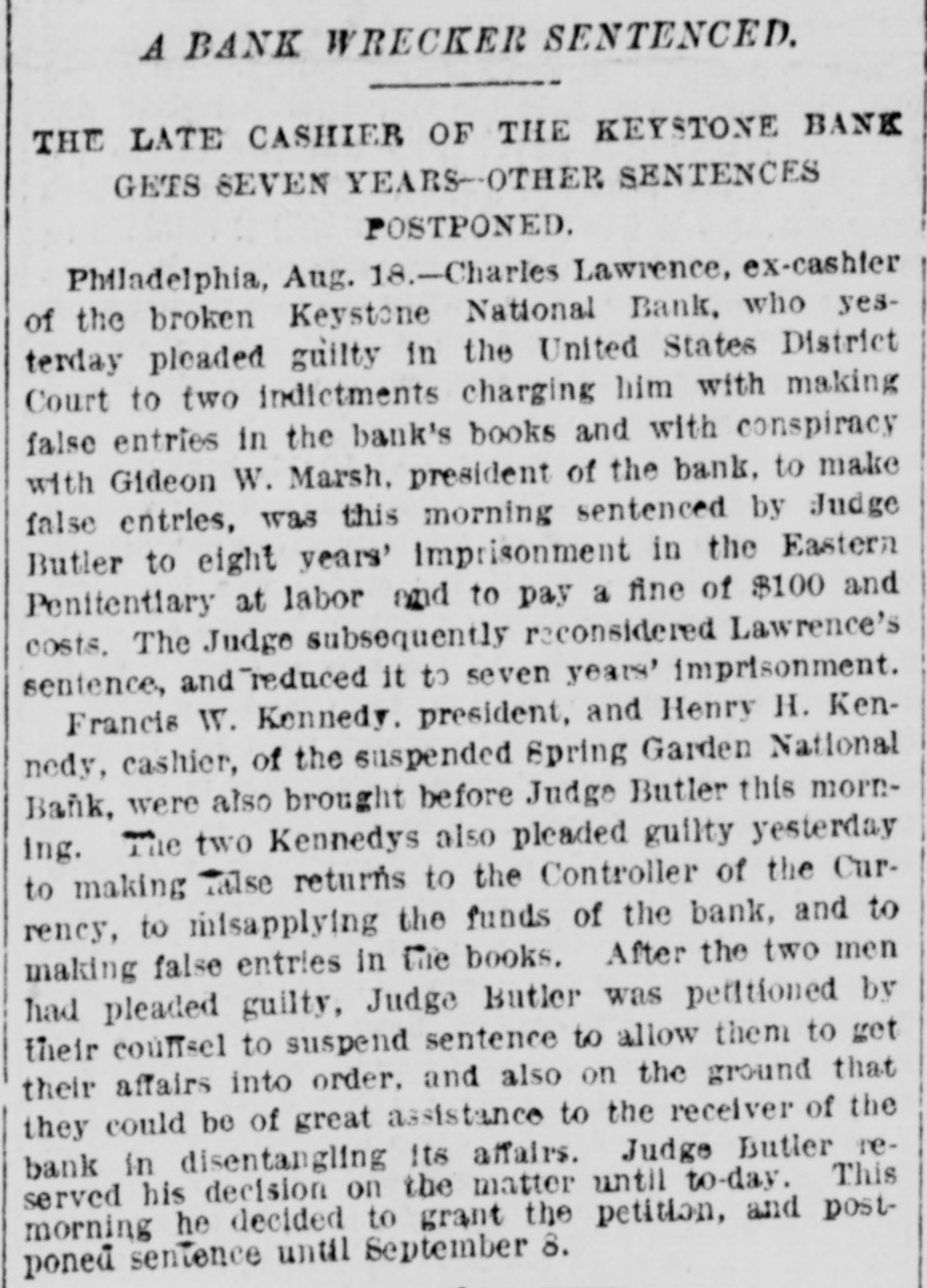
THE LATE CASHIER OF THE KEYSTONE BANK GETS SEVEN YEARS-OTHER SENTENCES POSTPONED. Philadelphia, Aug. 18.-Charles Lawrence, ex-cashier of the broken Keystone National Bank, who yesterday pleaded guilty in the United States District Court to two indictments charging him with making false entries in the bank's books and with conspiracy with Gideon W. Marsh. president of the bank, to make false entries, was this morning sentenced by Judge Butler to eight years' Imprisonment in the Eastern Penitentiary at labor and to pay a fine of $100 and costs. The Judge subsequently reconsidered Lawrence's sentence, and reduced it to seven years' imprisonment. Francis W. Kennedy. president, and Henry H. Kennedy, cashier, of the suspended Spring Garden National Bank, were also brought before Judge Butler this morning. The two Kennedys also pleaded guilty yesterday to making alse returns to the Controller of the Currency, to misapplying the funds of the bank, and to making false entries in the books. After the two men had pleaded guilty, Judge Butler was petitioned by their counsel to suspend sentence to allow them to get their affairs into order. and also on the ground that they could be of great assistance to the receiver of the bank in disentangling Its affairs. Judge Butler reserved his decision on the matter until to-day. This morning he decided to grant the petition, and postponed sentence until September 8.
Click image to open full size in new tab
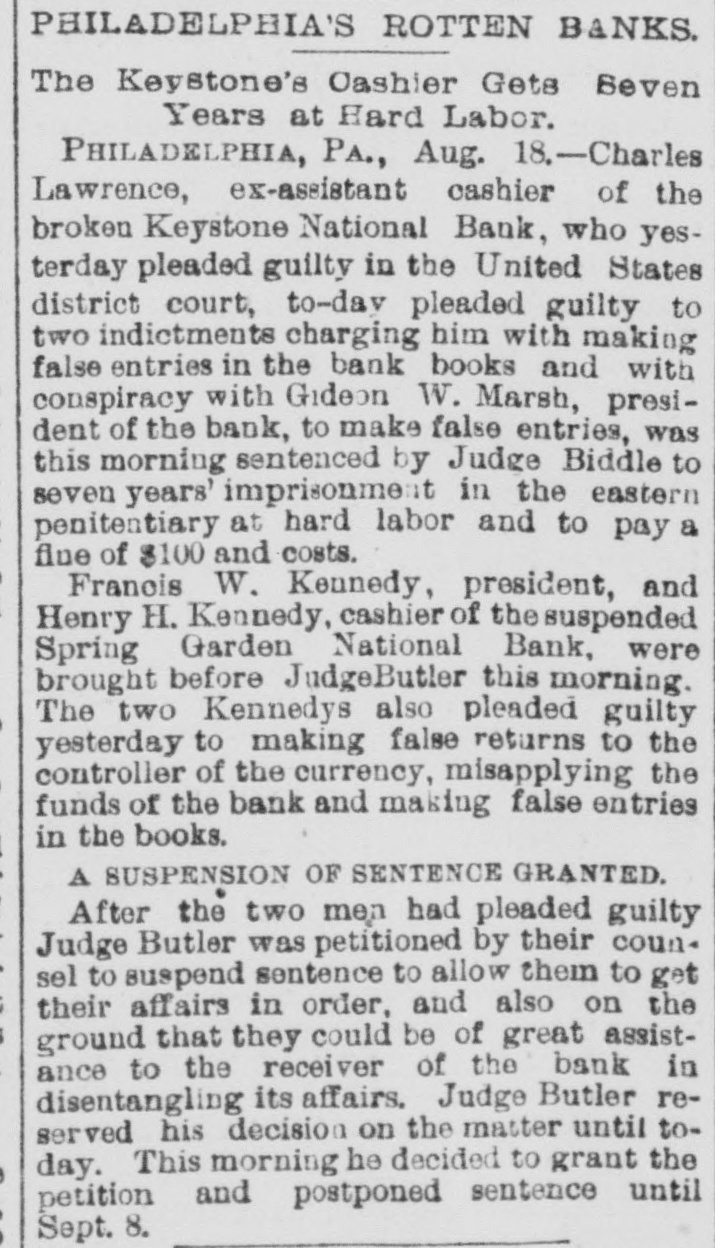
The Keystone's Cashier Gets Beven Years at Hard Labor. PHILADELPHIA, PA., Aug. 18.-Charles Lawrence, ex-assistant cashier of the broken Keystone National Bank, who yesterday pleaded guilty in the United States district court, to-day pleaded guilty to two indictments charging him with making false entries in the bank books and with conspiracy with Gideon W. Marsh, president of the bank, to make false entries, was this morning sentenced by Judge Biddle to seven years' imprisonment in the eastern penitentiary at hard labor and to pay a flue of $100 and costs. Franois W. Kennedy, president, and Henry H. Kennedy, cashier of the suspended Spring Garden National Bank, were brought before JudgeButler this morning. The two Kennedys also pleaded guilty yesterday to making false returns to the controller of the currency, misapplying the funds of the bank and making false entries in the books. A SUSPENSION OF SENTENCE GRANTED. After the two men had pleaded guilty Judge Butler was petitioned by their coun. sel to suspend sentence to allow them to get their affairs in order, and also on the ground that they could be of great assistance to the receiver of the bank in disentangling its affairs. Judge Butler reserved his decision on the matter until today. This morning he decided to grant the petition and postponed sentence until Sept. 8.
Click image to open full size in new tab
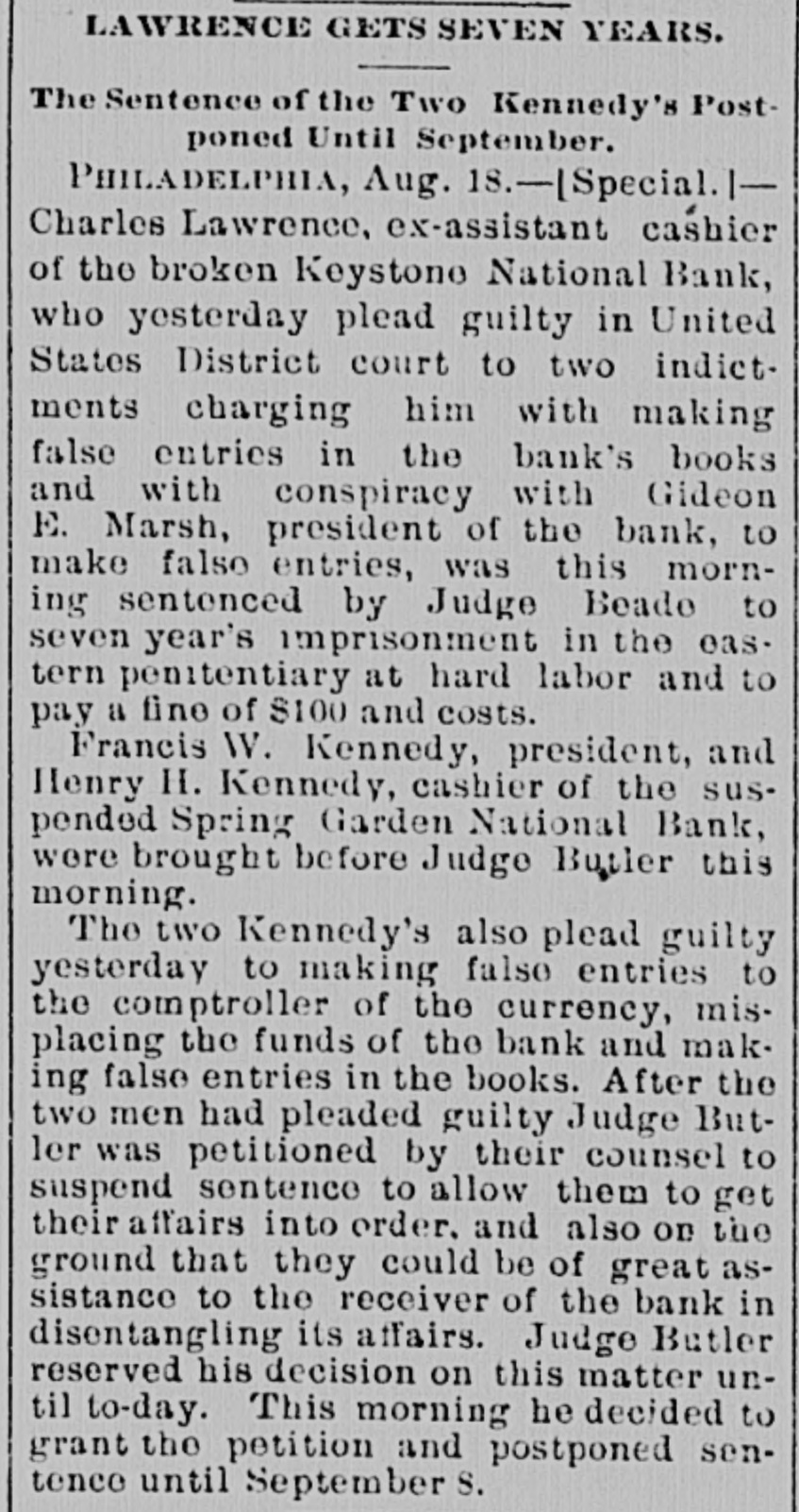
The Sentence of the Two Kennedy's Postponed Until September. Philadelphia, Aug. 18.-[Special.]- |Charles Lawrence, ex-assistant cashier of the broken Keystone National Bank, who yesterday plead guilty in United States District court to two indictments charging him with making false entries in the bank's books and with conspiracy with Gideon E. Marsh, president of the bank, to make falso entries, was this morning sentenced by Judge Beade to seven year's imprisonment in the eas. tern penitentiary at hard labor and to pay a fine of $100 and costs. Francis W. Kennedy, president, and Henry H. Kennedy, cashier of the suspended Spring Garden National Bank, were brought before Judge Butler this morning. The two Kennedy's also plead guilty yesterday to making false entries to the comptroller of the currency, misplacing the funds of the bank and making false entries in the books. After the two men had pleaded guilty Judge Butler was petitioned by their counsel to suspend sentence to allow them to get their affairs into order. and also on the ground that they could be of great assistance to the receiver of the bank in disentangling its affairs. Judge Butler reserved his decision on this matter until to-day. This morning he decided to grant the petition and postponed sentence until September S.
Click image to open full size in new tab
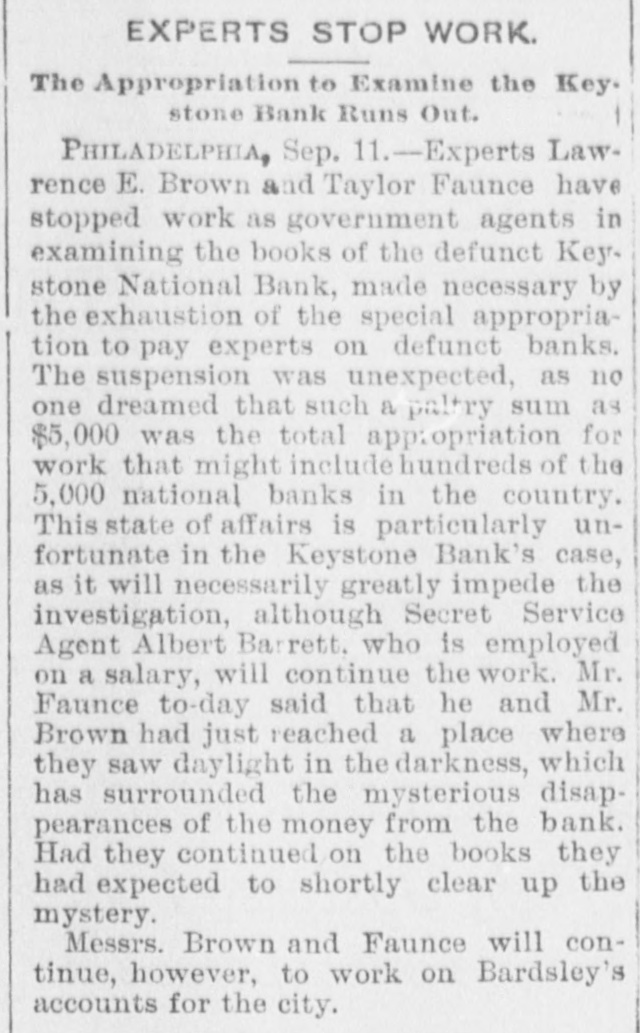
The Appropriation to Examine the Key. stone Bank Runs Out. PHILADELPHIA, Sep. 11.-Experts Lawrence E. Brown and Taylor Faunce have stopped work as government agents in examining the books of the defunct Keystone National Bank, made necessary by the exhaustion of the special appropriation to pay experts on defunct banks. The suspension was unexpected, as no one dreamed that such a paltry sum as $5,000 was the total applopriation for work that might include hundreds of the 5,000 national banks in the country. This state of affairs is particularly unfortunate in the Keystone Bank's case, as it will necessarily greatly impede the investigation, although Secret Service Agent Albert Barrett. who is employed on a salary, will continue the work. Mr. Faunce to-day said that he and Mr. Brown had just reached a place where they saw daylight in the darkness, which has surrounded the mysterious disappearances of the money from the bank. Had they continued on the books they had expected to shortly clear up the mystery. Messrs. Brown and Faunce will continue, however, to work on Bardsley's accounts for the city.
Click image to open full size in new tab
Philad Iphia, Jan. .Edward W. Magill, assignee of John Bardsley, this morning entered suit in Common Pleas Court, against the suspended Keystone National Bank to recover $100,000. Mr. Magill says that on November 25, 1890, the bank received from Bardsley, as a loan for the use of the bank, 100 bonds of the Baltimore Traction Company, valued at $1,000 each. Mr. Magill says that the bank sold the bonds and appropriated the proceeds to its own use.
Click image to open full size in new tab
PHILADELPHIA, Jan. 5.-Edward W. Magill, assignee of John Bardsley, entered suit in common pleas court against the suspended Keystone national bank to recover $100,000 Magill says that November 25, 1890, the bank received from J. Bardsley, as a loan, 100 bonds of the Baltimore Traction Co., valued at $1,000 each, the bank promising at the same time to return the bonds or give face value for them and that on November 25 President Marsh gave Bardsley a receipt for them but sold them and appropriated the proceeds to their own use.