23109. Jefferson Savings Bank (Shepherdstown, WV)

Bank Information

Episode Type
Suspension โ†’ Reopening
Bank Type
savings bank
Start Date
January 17, 1892
Location
Shepherdstown, West Virginia (39.430, -77.804)

Metadata

Model
gpt-5-mini
Short Digest
e437be81

Response Measures

None

Description

The Jefferson Savings Bank suspended in January 1892 after the failure of its correspondent Nicholson & Co. of Baltimore. Multiple articles describe the suspension as temporary and express expectation of resumption (depositors signed agreement to limit withdrawals), but no definite reopening date is reported in the provided clippings. Cause is failure of a correspondent bank.

Events (1)

1. January 17, 1892 Suspension
Cause
Correspondent
Cause Details
Heavy deposits ($15,000) and extensive dealings with Nicholson & Co. of Baltimore, whose failure heavily involved Jefferson Savings Bank and forced suspension.
Newspaper Excerpt
MARTINSBURG, W. VA., Jan. 17.-The Jefferson Savings bank, of Shepherdstown, suspended yesterday. It had extensive dealings with the large banking firm of Nicholson & Co., of Baltimore, Md., which failed on Friday and which SO heavily involved the Shepherdstown bank that it was compelled to make an assignment.
Source
newspapers

Newspaper Articles (10)

Article from The Wheeling Daily Intelligencer, January 18, 1892

Click image to open full size in new tab

Article Text

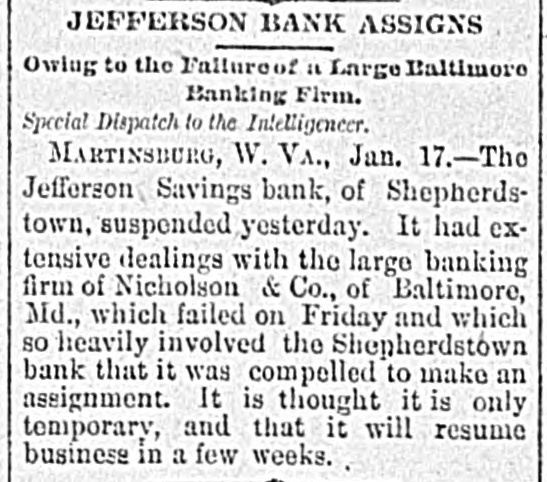
JEFFERSON BANK ASSIGNS Owing to the Failureof it Large Baltimore Banking Firm. Special Dispatch to the Intelligencer. MARTINSBURG, W. VA., Jan. 17.-The Jefferson Savings bank, of Shepherdstown, suspended yesterday. It had extensive dealings with the large banking firm of Nicholson & Co., of Baltimore, Md., which failed on Friday and which SO heavily involved the Shepherdstown bank that it was compelled to make an assignment. It is thought it is only temporary, and that it will resume business in a few weeks.


Article from Shepherdstown Register, January 22, 1892

Click image to open full size in new tab

Article Text

Jefferson Savings Bank Closed. When the daily papers arrived in Shepherdstown last Friday morning, and the failure of the old banking firm of J. J Nicholson & Sons, of Baltimore, was revealed, considerable excitement was created here, for it was known that the Jefferson Savings Bank was a heavy depositor with that institution. A meeting of the directors of the Jefferson Savings Bank was immediately called, and after a conference it was decided to close the bank temporarily to avoid a run upon its funds that might prove disastrous. The doors were thereupon locked and a notice posted up announcing temporary suspension, with the statement that no loss to depositors was anticipated. Jefferson Savings Bank had $15,000 on deposit with the Nicholson Bank. The loss of this sum of itself would not have prevented a continuance of business, but of course the bank was not in a position to stand a heavy run upon its funds, which would in all probability have resulted had it remained open. The directors have been using every endeavor to make arrangements for resuming business at as early a date as possible, but at this writing we can give noassurance of when that will be. A paper has been signed by most of the depositors agreeing not to withdraw more than ten per cent of their deposits in any one month, and when a sufficient amount shall have been signed, in all probability the bank will resume business. The creditors of the bank have shown every disposition to help it out of its present difficulty, and the directors assure the depositors that no loss will besustained by them. The failure of the Nicholson bank was a great surprise, not only to the people of the South and West, where they had extensive connections, but to Baltimoreans also. It was established in 1828, and has always done a large business. A few weeks ago its head, Mr. Andrew J. Nicholson, died very suddenly, and its rotten condition could no longer be successfully concealed. It now transpires that for some time past it has been in a shaky condition and its business conducted in a very loose way. After the death of Andrew Nicholson, Mr. J. H. R. Nicholson had practical charge of the bank, but in a couple of weeks he gave way under the strain and he is now reported to be a men tal and physical wreck. The Nicholson bank was the correspondent of a number of banks in West Virginia and in the Valley of Virginia, several of which are report. d to be heavy losers by it. Its failure has also resulted in the assignment of three Baltimore firms: the Baltimore Publishing Company, the building supplies firm of George O. Stevens, and the boot and shoe house of Allnutt, Nixon and Goldsborough. Trustees of the defunct bank have not yet prepared a statement of its assets and liabilities, but it is generally believed that it is a complete smash. The liabilities may run up to a million dollars, while the assets will scarcely be a couple of hundred thousand.


Article from Martinsburg Herald, January 23, 1892

Click image to open full size in new tab

Article Text

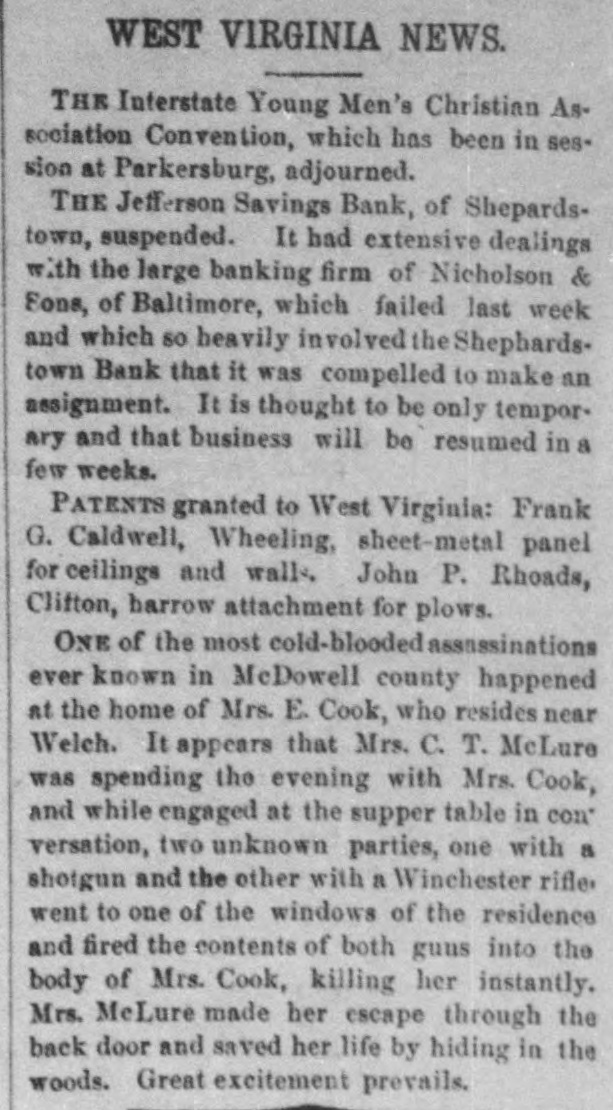
WEST VIRGINIA NEWS. THE Interstate Young Men's Christian Association Convention, which has been in session at Parkersburg, adjourned. THE Jefferson Savings Bank, of Shepardstown, suspended. It had extensive dealings with the large banking firm of Nicholson & Sons, of Baltimore, which failed last week and which so heavily involved the Shephardstown Bank that it was compelled to make an assignment. It is thought to be only temporary and that business will be resumed in & few weeks. PATENTS granted to West Virginia: Frank G. Caldwell, Wheeling, sheet-metal panel for ceilings and walls. John P. Rhoads, Clifton, harrow attachment for plows. ONE of the most cold-blooded assassinations ever known in McDowell county happened at the home of Mrs. E. Cook, who resides near Welch. It appears that Mrs. C. T. McLure was spending the evening with Mrs. Cook, and while engaged at the supper table in con' versation, two unknown parties, one with a shotgun and the other with a Winchester rifle. went to one of the windows of the residence and fired the contents of both guus into the body of Mrs. Cook, killing her instantly. Mrs. McLure made her escape through the back door and saved her life by hiding in the woods. Great excitement prevails.


Article from Martinsburg Herald, January 23, 1892

Click image to open full size in new tab

Article Text

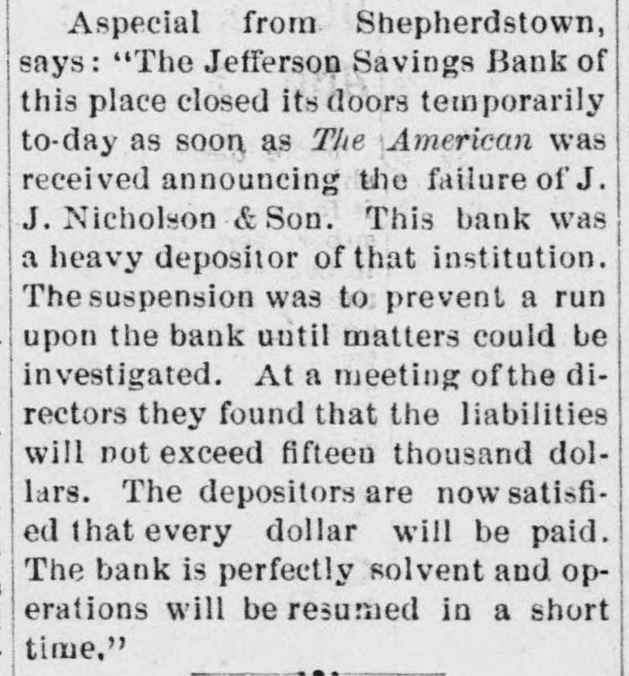
Aspecial from Shepherdstown, says: "The Jefferson Savings Bank of this place closed its doors temporarily to-day as soon as The American was received announcing the failure of J. J. Nicholson & Son. This bank was a heavy depositor of that institution. The suspension was to prevent a run upon the bank until matters could be investigated. At a meeting ofthe directors they found that the liabilities will not exceed fifteen thousand dollars. The depositors are now satisfied that every dollar will be paid. The bank is perfectly solvent and operations will be resumed in a short time."


Article from The Helena Independent, January 26, 1892

Click image to open full size in new tab

Article Text

Pulled Down by Another Failure. SHEPHERDSTOWN, W. Va.. Jan. 25.-The Jefferson bank closed its doors to-day. The suspension was due to the failure of the Nioholson bank of Baltimore. No statement is given out.


Article from The Seattle Post-Intelligencer, January 26, 1892

Click image to open full size in new tab

Article Text

A West Virginia Bank Fails. BHEPHERDSTOWN, W. Va., Jan. 25.-The Jefferson bank closed its doors today. The suspension was due to the failure of the Nicholson bank of Baltimore. No statement has been made.


Article from The World, January 26, 1892

Click image to open full size in new tab

Article Text

could be heard. He was a fine looking young man, and looked to be about 35 yearsof age. Hisname was ascertained to have been John Burns, of Omaha, Neb. He was a moulder by trade. JEFFERSON SAVINGS BANK CLOSED. Shepherdstown Register. When the daily papers arrived in Shepherdstown last Friday morning, and the failure of the old banking firm of J. J. Nicholson & Sons, of Baltimore, was revealed, considerable excitement was created here, for it was known that ths Jefferson Savings Bank was a heavy depositor with that institution. A meeting of the directors of the Jefferson Savings Bank was immediately called, and after a conference it was decided to close the bank temporarily to avoid a run upon its funds that might prove disastrous. The doors were thereupon locked and a notice posted up announcing temporary suspension, with the statement that no loss to depositors was anticipated. Jefferson Savings Bank had $15,000 on deposit with the Nicholson Bank. The loss of this sum of itself would not have prevented a continuance of business, but of course the bank was not in a position to stand a heavy run upon its funds, which would in all probability have resulted had it remained open. The directors have been using every endeavor to make arrangements for resuming businessat as early a date as possible, but at this writing we can give no assurance of when that will be. A paper has been signed by most of the depositors agreeing not to withdraw more than ten per cent. of their deposits in any one month, and when a sufficient amount shall have been signed, in all probability the bank will resume business. The creditors of the bank have shown every disposition to help it out of its present difficulty, and the directors assure the depositors that no loss will be sustained by them. The failure of the Nicholson Bank was a great surprise, not only to the people of the South and West, where they had extensive connections, but to Baltimoreans also. It was established in 1828, and has always done a large business. A few weeks ago its head, Mr. Andrew J. Nicholson, died very suddenly, and its rotten condition could no longer be successfully concealed. It now transpires that for some time past it has been in a shaky condition and its business conducted in a very loose way. After the death of Andrew Nicholson, Mr. J. H. R. Nicholson had practical charge of the bank, but in a couple of weeks he gave way under the strain and he is now reported to be a mental and physical wreck. The Nicholson Bank was the correspondent of a number of banks in West Virginia and in the Valley of Virginia, several of which are reported to be heavy losers by it. Its failure has also resulted in the assignment of three Baltimore firms the Baltimore Publishing Company, the building supplies firm of Geo. O. Stephens, and the boot and shoe house or Allnutt, Nixon and Goldsborough. Trustees of the defunct bank have not yet prepared a statement of its assets and liabilities, but it is generally believed that it is a complete smash. The liabilities may run up to a million dollars, while the assets will searcely

Article from The Record-Union, January 26, 1892

Click image to open full size in new tab

Article Text

Bank Failure. SHEPHERDSTOWN (W. Va.), Jan 25.The Jefferson Bank closed its doors today. The suspension is due to the failure of the Nicholson Bank of Baltimore. There was no statement made.


Article from The Morning Call, January 26, 1892

Click image to open full size in new tab

Article Text

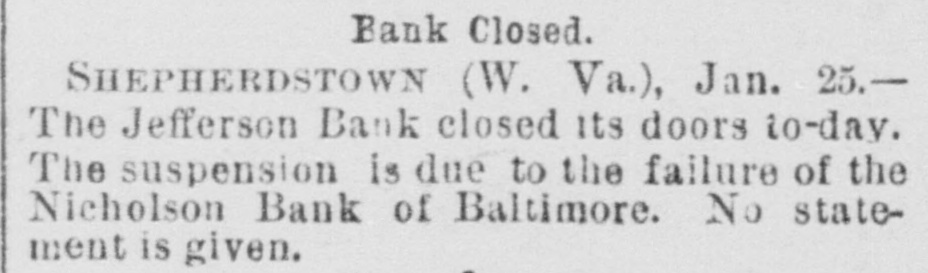
Bank Closed. SHEPHERDSTOWN (W. Va.), Jan. 25.The Jefferson Bank closed its doors to-day. The suspension is due to the failure of the Nicholson Bank of Baltimore. No statement is given.


Article from The World, January 29, 1892

Click image to open full size in new tab

Article Text

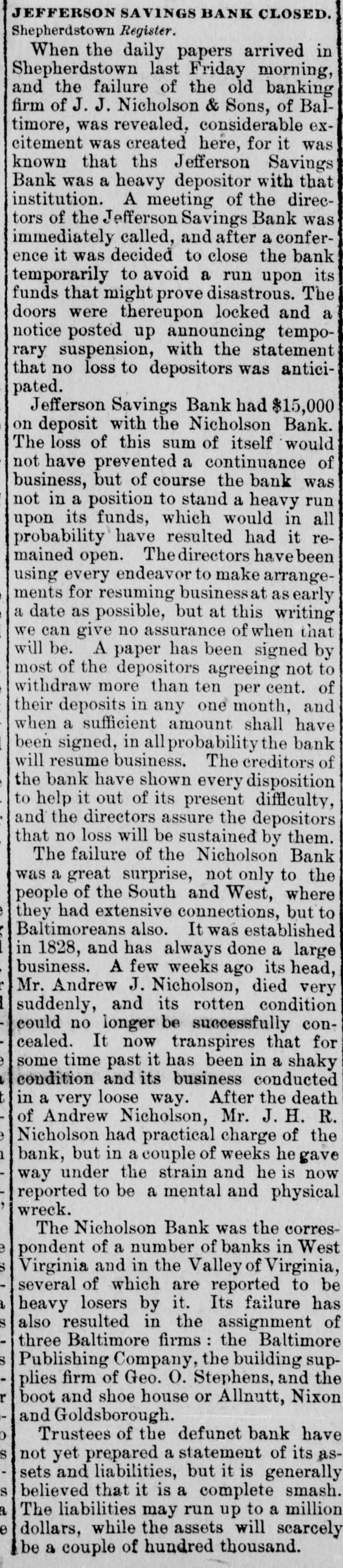
JEFFERSON SAVINGS BANK CLOSED. Shepherdstown Register. When the daily papers arrived in Shepherdstown last Friday morning, and the failure of the old banking firm of J. J. Nicholson & Sons, of Baltimore, was revealed, considerable excitement was created here, for it was known that ths Jefferson Savings Bank was a heavy depositor with that institution. A meeting of the directors of the Jefferson Savings Bank was immediately called, and after a conference it was decided to close the bank temporarily to avoid a run upon its funds that might prove disastrous. The doors were thereupon locked and a notice posted up announcing temporary suspension, with the statement that no loss to depositors was anticipated. Jefferson Savings Bank had $15,000 on deposit with the Nicholson Bank. The loss of this sum of itself would not have prevented a continuance of business, but of course the bank was not in a position to stand a heavy run upon its funds, which would in all probability have resulted had it remained open. The directors have been using every endeavor to make arrangements for resuming businessat as early a date as possible, but at this writing we can give no assurance of when that will be. A paper has been signed by most of the depositors agreeing not to withdraw more than ten per cent. of their deposits in any one month, and when a sufficient amount shall have been signed, in all probability the bank will resume business. The creditors of the bank have shown every disposition to help it out of its present difflculty, and the directors assure the depositors that no loss will be sustained by them. The failure of the Nicholson Bank was a great surprise, not only to the people of the South and West, where they had extensive connections, but to Baltimoreans also. It was established in 1828, and has always done a large business. A few weeks ago its head, Mr. Andrew J. Nicholson, died very suddenly, and its rotten condition could no longer be successfully concealed. It now transpires that for some time past it has been in a shaky condition and its business conducted in a very loose way. After the death of Andrew Nicholson, Mr. J. H. R. Nicholson had practical charge of the bank, but in a couple of weeks he gave way under the strain and he is now reported to be a mental and physical wreck. The Nicholson Bank was the correspondent of a number of banks in West Virginia and in the Valley of Virginia, several of which are reported to be heavy losers by it. Its failure has also resulted in the assignment of three Baltimore firms the Baltimore Publishing Company, the building supplies firm of Geo. O. Stephens, and the boot and shoe house or Allnutt, Nixon and Goldsborough. Trustees of the defunct bank have not yet prepared a statement of its assets and liabilities, but it is generally believed that it is a complete smash. The liabilities may run up to a million dollars, while the assets will scarcely be a couple of hundred thousand.