Article Text
or not, it contains a principle, which judiciously expressed, ought to be engrafted on every charter.)
MISSOURI—The election for a Representative to Congress in the place of Mr. Harrison, dec'd, has resulted in the election of Mr. Jameson (V. B.) by a considerable majority. The election has been thin; but sufficiently decisive. The Whig majority in St. Louis county has been reduced in this election from more than 800 to about 400.
BANKS AND STOCKS
The N. York Evening Post of Saturday says, "There was a decided improvement in Stocks to day, and the specie paying policy of our Banks will be soon brought into favorable comparison with the dishonest course pursued and advocated with so much zeal by our neighbors in Philadelphia; the hard money system finds favor here on all sides, and a large majority are willing to possess and purchase property with a standard of value so durable. Delaware and Hudson advanced 1 per cent—North American Trust 3 per cent.—Harlem 1 1-2; Stonington 1 1-4—this being a heavy settling day, U. S. Bank was in demand for cash and closed at a rise, on the cash price of yesterday, of 2 per cent, viz: 69 1-2; but was freely offered, payable in a few days, at a lower rate."
The New York Express, same date, states, that "Notwithstanding the bank let out a little and confidence is gaining strength, yet the money market is still very tight. Good notes are sold at 3 per cent. a month.—There are, it is true, but few failures—very few to what were anticipated—but there are some, and among them men who have stood firm for the last thirty years, through embargos, non intercourses, wars and panics—whose credit has never before been shaken or suspected. It is a subject of deep regret to see persons thus advanced, and of high honor and probity, in their latter years fall beneath the deranged state of the times.—Most of the orders for Flour for England have been countermanded by the last steamer, and no more shipments have been made. Indeed, some of the Flour previously ordered has been ordered to be sold here. The shipments now are wholly to France, and it is not certain they will continue. Exchange on London is dull at 104 1-2 to 105, and on Paris at 5 50. This is at least 4 per cent. in favor of New York."
The sales of Treasury notes at the N. Y. Board on Friday were $10,000 at 99.
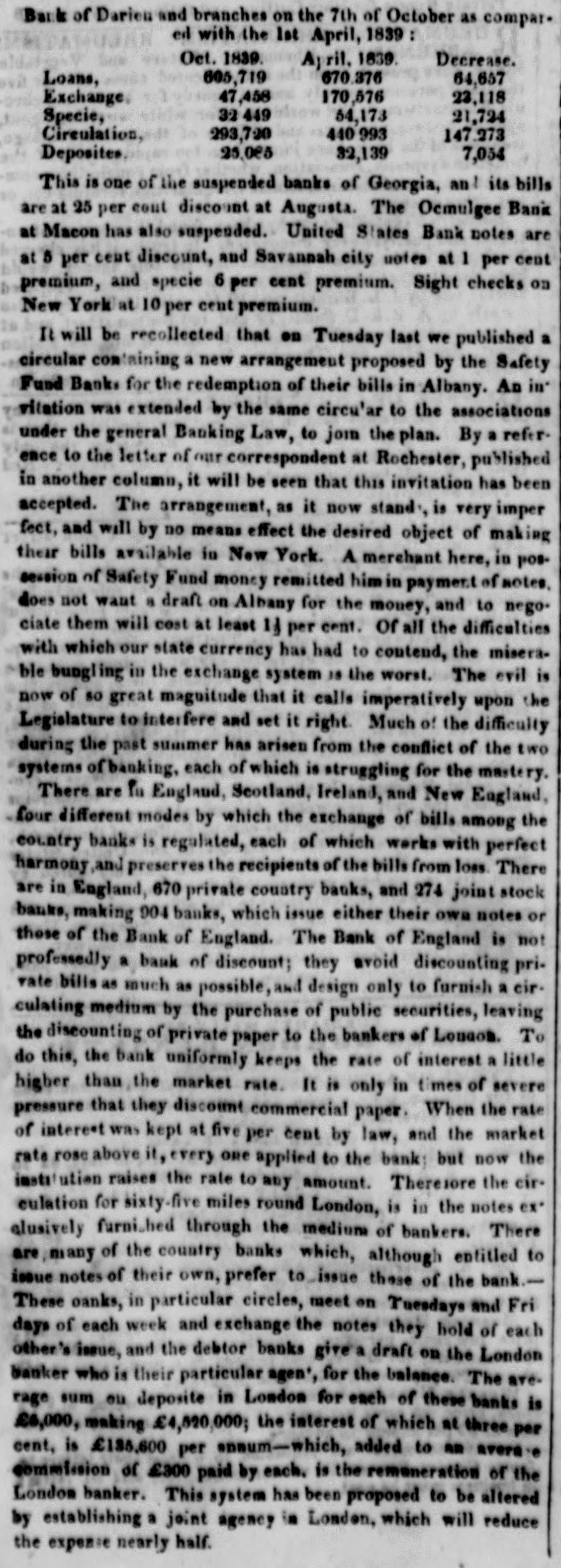
Letters from Macon (Georgia) state that the Monroe Rail Road Bank and the Ocmulgee Bank, have formally suspended specie payments.
BANKS OF UPPER CANADA—A call has been made on Sir George Arthur, by the Board of Trade to prolong the suspension of specie payments by the Banks of Upper Canada, which he declined. The Banks resumed on Friday; they had not made any application.
A general resumption of specie payments by the Banks of Tennessee is confidently spoken of by the papers of that State, of both political parties.
The debt of that State is only $2,666, smaller perhaps than any other State in the Union.
Ohio Banks—Of the 36 Banks enumerated in the "Mississippi Valley," 25 will run to 1843, when their charters will expire—and the remainder to future years.
Strange Report!—We have lately witnessed several attempts on the part of the Whig press, to revive the question of the Tariff; and the ostensible ground now taken by some of them is, that it will reduce our balance with England, and supersede the necessity of exporting specie, of disturbing the currency, and convulsing the community—The pretext is specious only; but the argument is utterly fallacious. The South will never be gulled in this way. The soundest maxims of Political Economy, and the true principles of our Constitution, are not to be upset by such shallow sophistries.
But the most amusing part of the story, is the following report relative to two of the most distinguished citizens of South Carolina:
The Tariff.—Rumor says that Gen. Hamilton of South Carolina has come out in favor of a 'High Tariff,' having been convinced of its necessity by his late visit to England. It is also said, that John C. Calhoun has come to the same views. We do not know what degree of credit is to be attached to these reports. [Providence Journal.
Without knowing any thing more of this matter, than the Providence Journal, we undertake to pronounce this Rumor unfounded. We will not believe, that Mr. Calhoun has come into any such views.—Even if he has, we are satisfied, that the South will not imbibe his error—We shall enclose this No. to Mr. Calhoun, and ask of him some notice of the subject.
We are indebted to a political friend for a nomination in the columns of the Globe, to a high office in this Commonwealth. We are also indebted to its liberal Editor for a very handsome compliment which he publishes on the occasion. We ought, perhaps, also to acknowledge our obligations to some of the Whig papers, for the various notices which they have taken of the subject—and especially to the Petersburg Intelligencer, which says, that Mr. Ritchie "is the last man (the Loco Foco party) would choose, for the very obvious reason, that he is more useful to the party while in his arm chair, than he probably would be while doing the honors of the Gubernatorial mansion." However this may be, we can assure the Petersburg Intelligencer, that we have no design to leave our arm chair—and, to save the further shedding of Whig ink, we may say at once, that we would not accept the office, if it were conferred upon us; and that the Legislature cannot have the most distant intention of such a thing. We are not qualified for the office—we are too poor to accept it—We have no time to devote to it. We have neither pretensions nor aspirations for such a distinction. In a word, if we may repeat the old expression of the French Tailor in this city, we "are not made for de pantaloon."
The good county of Louisa is becoming famous as the great Dinner ground of the contending parties. First, a dinner to Mr. Rives—then one to Mr. Roane—and now one is to be given to Mr. Wise on Saturday next. The Whigs constitute about 1-4th of that county; and we presume the ultra Conservatives will return the compliment, and assist in eking out the number of landlords or of guests.
Eat away, gentlemen—and if your magnificent Whig provider give you as good Mutton and Ham and other entertainment, as we have witnessed on a similar occasion you will have no cause to complain of your generous fare. Drink away, too, Sirs—spout away—wage war to the knife—but it will not all do. The People of Virginia will stand firm to their principles—and all the festivals in the world cannot convert them into the supporters of H. Clay. The Little Magician will distance him at the next great sweepstakes of 1840.
—To a Gentleman in this City— "ST AUGUSTINE, E. F., 28th Oct., 1839.
"Our city has been suffering under the pestilence; but I trust it is abating, as my husband mentions only eight cases on his list to day. There are however three other physicians; and Dr. P., whose health does not enable him to go out at night, has to make a consulting room of his bed chamber. My distress has been inconceivable—5 of our number being down at the same time, and a part of them almost past hope; but, thanks to an ever kind Providence, they have all been preserved, and are now convalescent.
"Mr. Henderson, the Episcopal Clergyman, died last week, and Mr. Dunlop, of the Presbyterian Church, who attended his Funeral, was taken very ill the next day—Gen. Smith was severely attacked, but is better."
We are advised that it is best to postpone the publication in extenso of the opinions of the Attorney General, on the Bank Question, until they have been submitted to the Legislature—But shall lay a Sketch of them before our readers, in our next.
(From the Tallahassee Floridian, Nov 2) UNION BANK—Charles Fenton Mercer, Esq, for many years a member of Congress from Virginia, has