Third National Bank (Chicago, IL)

Episode Information

Episode UID
23600885
Episode Type
Suspension β†’ Reopening
Bank Type
national
Bank ID
2360 national
Charter Number
236
Start Date
September 27, 1873
Location
Chicago, Illinois (41.850, -87.650)

Metadata

Model
gpt-5-mini (chosen from majority vote of a three-model LLM ensemble)
Short Digest
a22a2aeea296f971

Response Measures

None

Receivership Details

Depositor recovery rate
100.0%
Date receivership started
1877-11-24
Date receivership terminated
1907-12-31
OCC cause of failure
Losses
Share of assets assessed as good
58.0%
Share of assets assessed as doubtful
27.6%
Share of assets assessed as worthless
14.4%

Description

Suspension occurred during the 1873 panic; reopening reported about ten days later.

Events (4)

1. February 5, 1864 Chartered
Source
historical_nic
2. September 27, 1873 Suspension
Cause
Macro News
Cause Details
Inability to convert securities into currency during the financial panic of 1873
Newspaper Excerpt
The Third National Bank, which suspended on the 27th of September
Source
newspapers
3. October 8, 1873 Reopening
Newspaper Excerpt
The Third National Bank ... reopened its doors and resumed business to-day
Source
newspapers
4. November 24, 1877 Receivership
Source
historical_nic

Newspaper Articles (21)

Article from The Emporia News, October 20, 1871

Click image to open full size in new tab

Article Text

ITEMS FROM CHICAGO. An attempt was made on Tuesday by a number of Chicago lumber dealers to carry up the price of lumber from three to four dollars per thousand feet, but this was resisted by a number of the and more and larger the attempted respectable extortion defeated. dealera, Lumber is selling at the old prices. There are fully two hundred and fitty million feet in the yards in the city, and the supply will be abundant. -The total number of bodies upon inquests have been held up to Tuesday was ninety-two. denight. in the district When has been the bris burnt removed, it 18 thought many more will be discovered. -Robbert Bonner, of the New York Ledger, has given ten thousand dollars to the needy editors, reporters and printers of Chicago. -Subscriptions to the Chicago relief fund are still progressing in England. The subscriptions received at the Mansion House,London, already amount to $138,000. -The Caledonia club, of New York, has sent $3,000 each to the Chicago and Michigan sufferers. -Baltimore su bscriptions to date are $187,000, liberal provisions being made for Michigan and Wisconsin; Boston $403,000; Birmingham, N. Y., $5,000: officers and employees of the Boston navy yards gave $3,608. The executive committee of the chamber of commerce relief asked the general committee for power to use a portion of the donation for sufferers in Michigan and Wisconsin. -Arrangements have been made by a special agent of the post office department for the removal of the postoffice to the Wabash avenue church, corner of avenue street, and it will be purpose Wabash occupied and builds Harrison for that and until the government a new suitable building. -The banks, national and savings, resumed business Tuesday. Call from depositors were for immediate use. Many sought to ascertain their balances, and to what extent they could safely draw hereafter. Many deposits were made. There was no excitement or rush whatever. The drafts in savings banks were very light, and in many instances deposits were made. There was considerable excitement at the clearing" house, and many checks were thrown out. In the Third National bank $45,000 were checked out and $72,000 deposited. The State Saving's bank prepared for a rush, but only some forty depositors called for money, the aggregate of which was greatly exceeded by deposits. -Many contracts for rebuilding were consummated Tuesday. Among those who propose to rebuild at once, are Win. F. Coolbaugh, H. G. Power, C.T. Wheeler, Brown Bros., Geo. Armour, John Drake, of Drake block, J. C. Potter & Palmer, Matthew C. H. Brekwith, Lafflin, Walker, Edward Hunt, & Tribune Company, Reese, Fred Tuttle, Gregstein Mackin, etc. The J.H. enon house from the east, and tire quare block fronting running court streets, from will to Washington at once. The be Randolph rebuilt Union to Depot be at at the foot of Lake street, is once rebuilt, and on a greatly enlarged scale. The number of passes issued Wednesday for person leaving the city was one thousand. The action of the postal authorities in locating the post office on the South side, where there are than one third less gas, bas of the popula- created tion of the city, and DO and a good great surprise seeming deal to of have indignation, less regard been had for the accommodation of a majority of the citizens than there should have been. -A furious gale prevailed in Chicalast, the They alarmed go on Sunday city. night which thought greatly down the eneire city would either be blown or destroyed by fire. Fortunately, # had rained in the twenty.four hours


Article from The Rock Island Daily Argus, September 25, 1873

Click image to open full size in new tab

Article Text

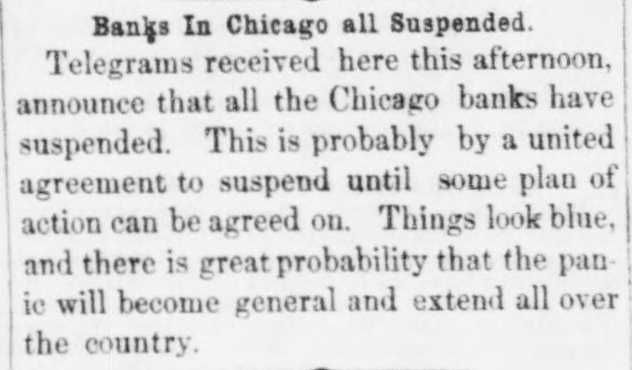
# Banks In Chicago all Suspended. Telegrams received here this afternoon, announce that all the Chicago banks have suspended. This is probably by a united agreement to suspend until some plan of action can be agreed on. Things look blue, and there is great probability that the panic will become general and extend all over the country.


Article from Chicago Daily Tribune, September 28, 1873

Click image to open full size in new tab

Article Text

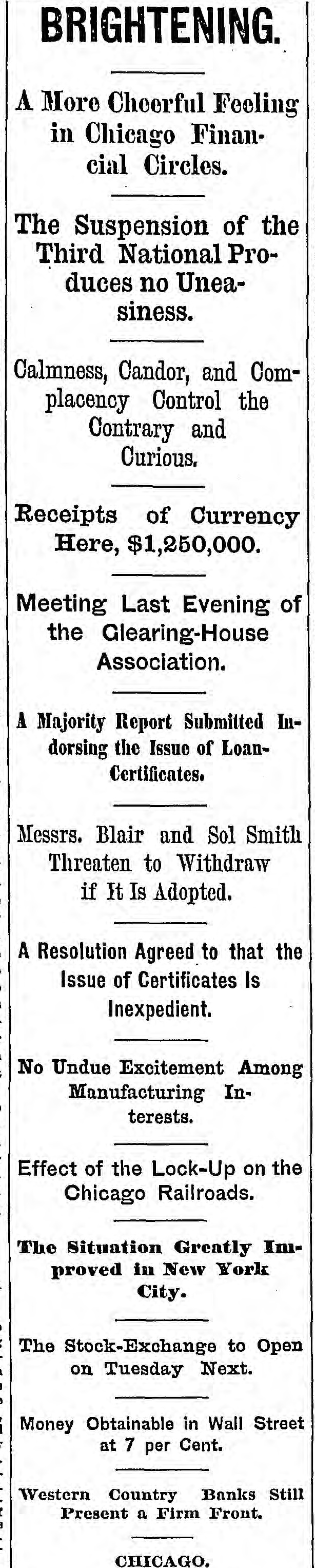
BRIGHTENING. A More Cheerful Feeling in Chicago Financial Circles. The Suspension of the Third National Produces no Uneasiness. Calmness, Candor, and Complacency Control the Contrary and Curious. Receipts of Currency Here, $1,250,000. Meeting Last Evening of the Glearing-House Association. A Majority Report Submitted Indorsing the Issue of LoanCertificates. Messrs. Blair and Sol Smith Threaten to Withdraw if It Is Adopted. A Resolution Agreed to that the Issue of Certificates Is Inexpedient. No Undue Excitement Among Manufacturing Interests. Effect of the Lock-Up on the Chicago Railroads. The Situation Greatly Improved in New York City. The Stock-Exchange to Open on Tuesday Next. Money Obtainable in Wall Street at 7 per Cent. Western Country Banks Still Present a Firm Front. CHICAGO.


Article from Chicago Daily Tribune, September 28, 1873

Click image to open full size in new tab

Article Text

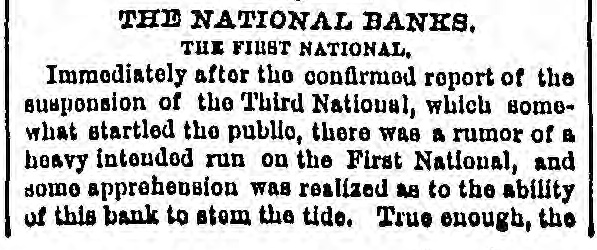
THE NATIONAL BANKS. THE FIRST NATIONAL, Immediately after the confirmed report of the susponsion of the Third National, which somewhat startled the public, there was a rumor of a heavy intended run on the First National, and some apprehension was realized As to the ability of this bank to stom the tide. True enough, the


Article from Chicago Tribune, September 28, 1873

Click image to open full size in new tab

Article Text

AT THE FIFTH NATIONAL everything was quiet during the day, and business was conducted with perfect composure. The urbane Cashier was smiling and cheerful, and readily devoted time and good humor to every business applicant. He said that in the morning, owing to the deeply regretted suspension of the Third National, they had anticipated a general "run," but had been most agreeably disappointed. Upon an investigation of the reasons why no "run" had occurred one of the chief developed facts was that the deposits in this bank had been very largely drawn upon before, leaving only a comparatively small balance, which was the money of staunch business men who had no fear of failure. The receipts of money on Friday, he said, had been much less than payments, in consequence of the fact that this bank had been compelled to redeem checks heretofore given on other banks which had suspended. During yesterday the case was exactly reversed, and the amount of deposits exceeded the sum of payments, leaving the bank with an augmented currency balance. Large amounts of currency, he said, had been received from the East Saturday, and he thought THE TRIBUNE estimate in yesterday's issue was very nearly correct of the sums in actual greenbacks that had come to the city during the day. The bank, he had no doubt, would be able to respond to every demand in the legitimate line of trade, but, as a precautionary measure for protection, they were refusing currency on sight drafts.


Article from Chicago Tribune, September 28, 1873

Click image to open full size in new tab

Article Text

THE FIRST NATIONAL. Immediately after the confirmed report of the suspension of the Third National, which somewhat startled the public, there was a rumor of a heavy intended run on the First National, and some apprehension was realized as to the ability of this bank to stem the tide. True enough, the demand at the counter of the First National grew strong, but there was nothing like the semblance of a panicky run. From 11 o'clock in the morning until 2 o'clock the afternoon there was a constant and steady demand for currency at this counter, and every check was met promptly by a smiling Cashier, who disbursed greenbacks to the greedy. There was nothing like confusion or excitement about the bank, and the street rumors, as usual, exaggerated the reality. After banking hours, a reporter of THE TRIBUNE conversed with the accomplished and cool-headed cashier, Mr. L. J. Gage, and the substance of the information derived from this gentleman may thus be briefly summarized: The so-called "run" on the bank had not amounted to anything serious, and was not precipitated by resident depositors or country correspondents. Numbers of small checks, that in the usual course of business would have lain in other banks for at least a day, or passed through the Clearing-House, had been presented immediately in consequence of the suspension of other banks, and this had occasioned a temporary small excitement. All of these checks have been promptly paid on presentation, and such payments had to a small extent exceeded the amounts of deposits during the day. The result was that the amount of actual currency on hand had been somewhat reduced since the opening of the bank in the morning, but they had closed business with a large surplus, and were abundantly able to meet all legitimate demands they could foresee. Mr. Gage thought the day (Saturday) was the trying one in the emergency, and that all those who had stood the brunt would issue successfully from the conflict, and have attested their ability to meet all obligations.


Article from The Rock Island Daily Argus, September 29, 1873

Click image to open full size in new tab

Article Text

A Better Look There seems to be a more hopeful financial feeling in New York and Chicago. The Union National and the Cook County National resumed this morning. The Union National is the bank with which the First National in this city does business and of course that releases their balances SO they can be used. Mitchell & Lynde do business with the First National, in Chicago, and that bank did not suspend at all. The Third National, in Chicago, has suspended. That is the bank with which the Rock Island National does business-but it is believed to be a perfectly sound institution, and the suspension is thought to be merely temporary. The question is being raised as to the effect of these suspensions. It is held by some that it vitiates their organization and will compel them to wind up, if prosecuted. But we presume no one will be technical if they resume very soon. The Moline National (Wheelock's bank) has got the "age" of all of them in this county, for that institution never suspended at all.


Article from Chicago Daily Tribune, September 30, 1873

Click image to open full size in new tab

Article Text

LAWRENCE, KS. Special Dispatch to The Chicago Tribune. LAWRENCE, Ks., Sept. 20.-Financial matters are looking brighter. The news of resumption by the Chicago banks is hailed with delight. Our banks have paid without suspension through the panic.


Article from Chicago Daily Tribune, September 30, 1873

Click image to open full size in new tab

Article Text

SAN FRANCISCO. Special Dispatch to The Chicago Tribune. SAN FRANCISCO, Sept. 20.-To-day was devoted almost exclusively to collections and legitimate channels, and the result inspirod confidence. Tho resumption of business by the Chicago banks was the subject of much congratulation, showing the panic had no serious effects on Western finance and stability. This, with the promptness with which to-day's matured obliga- tions were mot, has reopened the current of exchange, which resumed with some briskness. Coin drafts on New York sold at ΒΎ to 1 por cent; telegraphic transfers at 2 por cent. The panic has fully demonstrated the unadvisability of stock speculations. Capitalists are more unwilling than ever to invest in outside real estate, preferring legitimate enter- prises and staple products. The panic is charged


Article from Burlington Weekly Free Press, October 3, 1873

Click image to open full size in new tab

Article Text

SUSPENSION OF THE CHICAGO BANKS. - A A telegram received Saturday from Chicago announces that all the banks in that city have suspended.


Article from Chicago Daily Tribune, October 8, 1873

Click image to open full size in new tab

Article Text

THE FINANCIAL NEWS. The principal item of local interest is the announcement of the Third National Bank, that it will open its doors this morning at 10 o'clock, and rosumo its business as before suspension. It is said that the bank is now fully propared to meet all the demands that may be mado upon it. The other banks make a favorable report. In spite of the fact that there has boon a very large contraction in loans, the morcantile community experiences no bad results, and maturing commercial paper is paid much more promptly than the bankers had roason to expect. The clearings of the Chicago banks yesterday were about three times as large as thoso of the corresponding day last week. While this is partially explained by the fact that, at this time last week, checks were presented directly to the banka on which they wore drawn, and not deposited In other banks for collection, the largo difforenΓ§o indicates a return to the old line of business, which, in turn, means a restoration of confidence in all the banks in the ratio of increased clearances. The local grain market was somewhat loss active yesterday, but this is offset by the increased bouyancy in the Now York grain market, which will speedily exort a stimulating influonce upon the Chicago trade. Asido from this singlo feature, which is more in the Intorest of the West than of New York, the reports from the latter city are not CHpecially cheering. Though the loan-certificates are announced as having been reduced one-fifth, and as commanding a nominal premium over cortified checks, greenbacks are worth a premium of from % to 11/5 por cont, showing that the Now York banks are still cousiderably removed from a full rosumption. This premium on greenbacks is highor than it was on either Saturday or Monday, though the legal-tender circulation has been further inoreased e316,000. There wore various rumors of mercantilo failures in Now York yesterday,


Article from The Wheeling Daily Intelligencer, October 9, 1873

Click image to open full size in new tab

Article Text

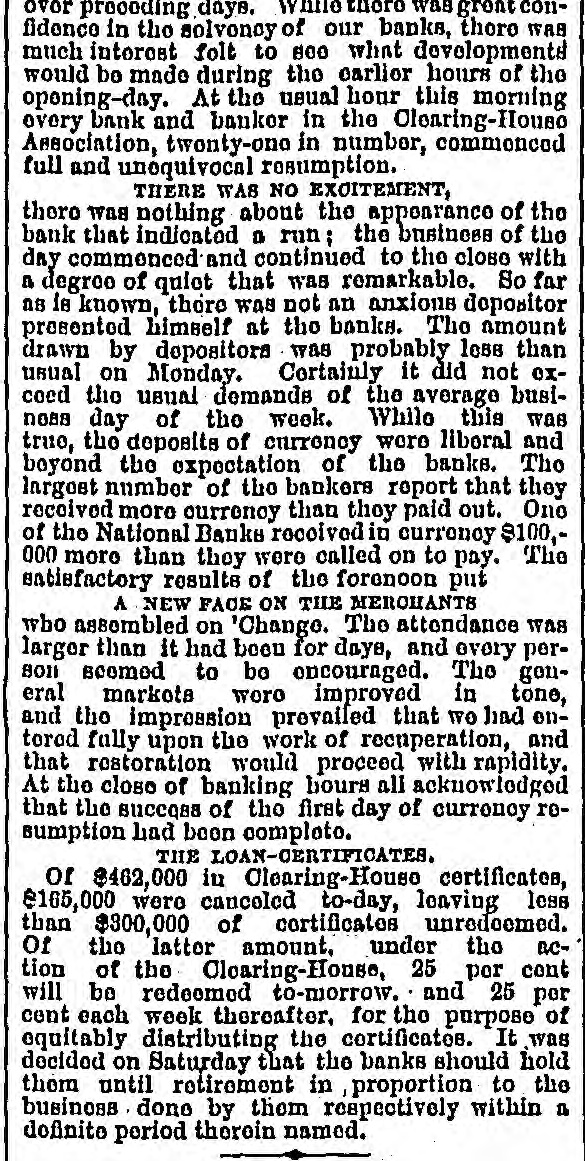
CHICAGO. The 3rd National Bank Resumes Payment. CHICAGO, Oct: 8.-The Third National Bank, which suspended on the 27th of September, reopened the its doors and resumed business to-day. The result of the day's business was most gratifying to the officers, as there was not only an entire absence of anything like a run, but the bank had a considerable balance to its credit in the clearing house, and received more during the day than it paid out, a fact which is taken 28 proof not alone of the confidence in the bank, but of the entire recovery of the city from the recent financial excitement. A meeting of railway managers was held at the Grand Pacific Hotel to day, at which the question abolishing the practice of paying commissions on the sale of tickets, which was referred to them by the general ticket agents, was considered. No decision was reached, but a committee was appointed to consult with the officers of Eastern and Western roads upon the subject.


Article from The Wheeling Daily Register, October 9, 1873

Click image to open full size in new tab

Article Text

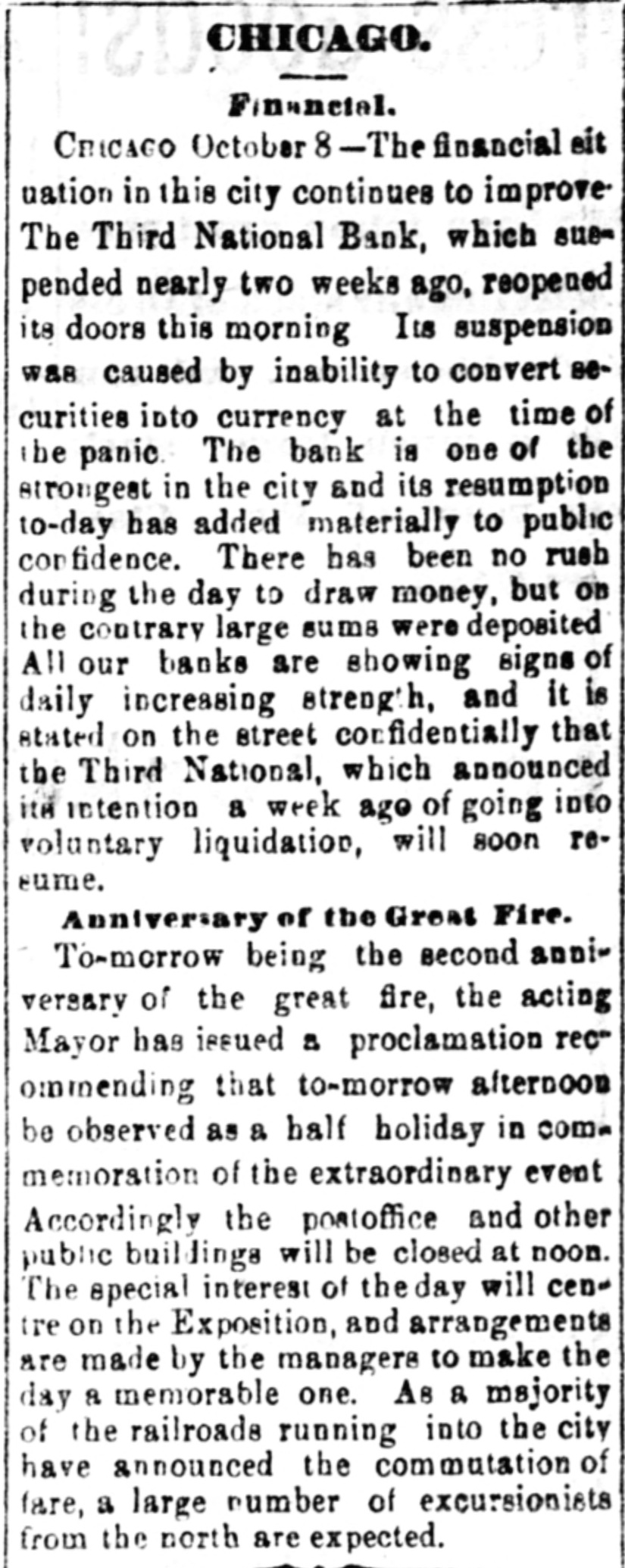
CHICAGO. Financial. CRICAGO October 8 - The financial sit uation in this city continues to improve The Third National Bank, which sue= pended nearly two weeks ago, reopened its doors this morning Its suspension was caused by inability to convert securities into currency at the time of the panic The bank is one of the strongest in the city and its resumption to-day has added materially to public confidence. There has been no rush during the day to draw money, but OB the contrary large sums were deposited All our banks are showing signs of daily increasing strength, and it is stated on the street confidentially that the Third National, which announced itΓ© intention a week ago of going into voluntary liquidation, will soon resame. Anniversary of the Greas Fire. To-morrow being the second anniversary of the great fire, the acting Mayor has issued a proclamation rec" commending that to-morrow afternoon be observed as a half holiday in com. memoration of the extraordinary event Accordingly the postoffice and other public buildings will be closed at noon. The special interest of the day will centre on the Exposition, and arrangements are made by the managers to make the day a memorable one. As a majority of the railroads running into the city have announced the commutation of fare, a large number of excursionists from the north are expected.


Article from Nashville Union and American, October 9, 1873

Click image to open full size in new tab

Article Text

FINANCIAL Cameron in Conference With Grant Opposition to Richardson's Policy In Drawing on the Reserves. NEW YORK, Oct. 8.-A Washington dispatch says Senator Cameron had a long interview with the President yesterday, and reports the latter, s well as himself strongly opposed to drawing on the forty four millton greenback reserves. The outstanding legal tenders are $358, 966,488. Special to the Louisville Courier-Journal WASHINGTON, Oct. 7.-The report of Mattingly, the receiver appointed for the Washington City Savings Bank, is generally considered as more rose-colored than the facts warrant. There is an effort make more out of very questionable assets than their true value. It seems to be thought that a favorable, or t least a mild report, will be made by the examiner appointed for the National Metropolitan Bank; but for reasons already stated, this report will not carry much weight. Resumed. CHICAGO Oct. 8.-The Third National Bank, which suspended on the 27th ult., reopered its doors and resumed business to-day. The result of the day's business was most gratifying to the officers as there was not only an entire absence of anything like a run, but the bank had a considerable sum to its credit in the clearing house, and received more than it paid out during the day, a fact which is taken as proof not alone of confidence in the bank, but of the entire recovery of the city from the late financial excitement. Gone into Liquidation. The Directors of the National Bank of this city decided to-day to go into liquidation. The assets are said largely to exceed the liabilities, and nobody will lose any thing. Cause, stringency of currency. New Orleans. NEW ORLEANS, Oct. -Gold 112@ 112g; currency 4@5 premium. Sterling 118 sight 1@11 premium and very scarce. Bankrupt Delos E. Colver, of Jersey City, one of the wealthiest capitalists in New Jersey, has been adjudged bankrupt. He was Vice President of the New York and Oswego Midland Railroad Company His abilities are said to be $8,000,000. Te the Associated Press. St. Louis Anxious to Resume. ST. Louis, Oct. 8.-At a meeting of the Clearing House Association last evening the question of resuming currency payments was considered and the general opinion expressed was in favor of doing so as soon as the New York banks lead off. A proposition to gradually cancel the Clearing House certificates and in this way resume without reference to New York was discussed, but no action taken. Special to the Cincinnati Commercial. Effect of the Panic on Government. WASHINGTON, Oct. 6.-Including to day's receipts from internal revenue the collections from that source thus far this month amount to $1,216,737, being at the ratio of only about $6,000,000 for the whole month. This is a great falling off. During the dulness of the past summer the receipts from internal revenue exceeded $8, 000,000 per month, and but for the effect of the financial panic upon general business the collections this month would have amounted to over $9,000,000, and would probably have reached $10,000,000. No Immediate Improvement Anticipated. Not much improvement in the condition of affairs will likely be noticsable for some days, even if financial matters and the general money market were to settle down at once to their former quietness and steadiness, although, as previ usly stated in these dispa ches, the present decrease or smallness of collections will not, in the belief of the commissioner of internal revenue, cause a loss to the government, for the resson that distillers, from whose products is obtained the greatest portion of the revenue DOW collected from internal sources, will go ahead with their business as usual, storing their goods in warehouses, and only withdrawing them in quantities sufficient to meet actual demands. In the meantime the Tressury Department will, in order to meet the expenses of the government, continue to draw upon the legal tender reserves to make up the deficiency resulting from the diminution in the receipts of currency from the principal, in fact the only source upon which the government now relies. Two million six hundred and forty nine thousand dollars of the forty-four million legal tender reserves have, according to the treasury financial exhibit this afternoon, f been paid out. Customs Receipts. The falling off in the receipts from customs duties is considerable, though not near as large as the reduction of internal revenue collections. of Settling Jay Cooke's Hash. il t Among the plans is one proposing that in e one of the pending proceedings in banl k. ruptcy, remembering that the government is largely interested in the Northern Pacific y Railroad, which promises to be the most valuable of the assets of the firm, Jay Cooke e & Co. shall nominate one trustee, the gove ernment another, and the creditors of each of the houses of the firm one each, making e five in all. This, it is claimed, would inof h clude and be obligatory upon all the creditors of the firm to prevent any unreasonable y and dissatisfied creditor from instituting proceedings hereafter to annul the act of any private trustee, and would slow magnanimous creditors, if the calamity prove to be greater than now believed, to give Cooke 8; & Co. a discharge which may become nec D essary and proper. BIRDS


Article from Alexandria Gazette, October 9, 1873

Click image to open full size in new tab

Article Text

Financial Affairs. LONDON, Oct. 9-12.30 p. in.-At -- 12.15 o'clock the Bank of England Directors posted their card announcing that the expected change in the rate of discount had not been made. The rate for money at the Stock Exchange on Government securities is 24 per cent. NEW YORK, Oct --The National Trust Company, it is understood, has resumed business and is paying obligations. NEW YORK, Oct. .-Gold opened at 109. Some of the down town banks have virtually resumed payment of greenbacks. The manager of the Clearing House says that since the issue of loan certificates there has not bee 11 seen SO many greenbacksas were seen yesterday when the clearances were made. A Wall street bank president spoken to on the subject said he thought greenbacks had become sufficiently numerous to allow of such course being taken. In case, however, the pressure became too great the banks would no doubt fall back to the plan which has been followed during the past two weeks as a measure of safety. There seemed 00 reason, he said, why the payment of legal tenders should not go on; trade was prosperous. CHICAGO, Oct. 9.-The Third National Bauk, which suspended September 27th. resumed business yesterday with gratifying results to its officers. LONDON, Oct. 9.--Three thousand pounds of bullion were shipped from Liverpool to day per steamer Celtic. LONDON, Oct. 9--3.30 p. m. - -The bullion in the Bank of England has decreased 617,000 pounds during the past week. The amount gone into the Bank on balance to-day is 13,000 pounds. NEW YORK, Oct. 9.-It is understood that measures have been taken by the managers of the Umon Trust Company, whereby loans which were made to delinquent customers will be taken up and the company be enabled to resume business. NEW YORK, Oct. 9. - Forty thousand pounds sterling were received at assay office to-day total amount since Monday, 644,000 pounds. LOWELL, MASS., Oct. - -Pierce's defalcation is DOW stated by the Merchants' Bank officials at $63,000.


Article from The Kenosha Telegraph, October 9, 1873

Click image to open full size in new tab

Article Text

The third National Bank Chicago which suspended payment on the 27th., ultimo, reopened its doors and resumed business yesterday. The Third is one of the strongest banks in Chicago.


Article from Wilmington Daily Commercial, October 10, 1873

Click image to open full size in new tab

Article Text

Business and Commercial Items. -The banks of Augusta. Ga., have resumed payment. The receipts of cotton in Augusta are large, but money is still too scarce to move the crops. -The Third National Bank of Chicago, which suspended on the 27th ult., resumed business on Wednesday. -It is announced from Washington that the Treasury reserves are drawn upon only to pay the actual expenses of the Government, and the outstanding legal tenders will be reduced again to three hundred and fifty-six millions at the earliest possible momont-ti may be before the issue of the next debt statement" The draft on the reserves 18 caused by the smallness of the revenue receipts. -The Cincinnati Clearing House Association decided, yesterday, to retire enough of the certiticates issued to make the aggregata only $45.000, and to issue no more certificates. They al80 instructed their President to correspond with the Clearing Houses of other cities concerning the mode and time of currency resumption. -The Biltimore and Ohio Railroad Company announces a semi-annual dividend of 5 per cant on the main stem. payable November 15. and 5 per cent on the Washington Branch, payable October 31. -The amount of currency coming Eastward to the large cities from the West is said to be double the amount moving in an opposite direction. This, if true, will soon relieve the difli sulties experienced in all the Atlantic seaboard cities arising from a want of currency. --As an evidence of the stringency at New York one of the largest dry goods houses there offered by a circular to allow two per cent. a month discount on all notes due them for cash in band. As high as four per cent. a month was also paid.


Article from Elizabeth Daily Monitor, October 10, 1873

Click image to open full size in new tab

Article Text

s'eard NEW , ITEMS The Chicago Third National Bank, which suspended Sept. 27, has resumed. The issue of the currency reserve in the United States Treasury has reached about five million dollars. The First Controller decides that back pay and salaries not drawn within two years revert to the treasury as unexpended balances. The Boston and Washington base ball clubs played in Boston yesterday. The game resulted in a victory for the Bostons, twenty-five to six. Charles Boyd, a colored convict, who escaped from Snake hill penitentiary on Saturday, was recaptured in Jersey City yesterday, and sent back to prison. The Augusta, Ga., banks have resumed currency payments. There have been heavy receipts of cotton, but money is too scarce to move the crops,


Article from The Lambertville Record, October 22, 1873

Click image to open full size in new tab

Article Text

There has been a gradual but decided improvement in financial matters during the last week. On Saturday, in New York and Philadelphia, confidence had-been largely restored and business was moving with almost its accustomed activity. It now appears that the worst effects of the panic have been limited to banking and speculative interests, and to those branches of manufactures that depend upon railroad enterprises for most of their work. These have had a pretty hard time, and many fortunes have been lost or greatly impaired. But the dealers in produce and general merchandise seem to have lost little of their trade, and as currency gets into circulation again they resume their usual business. The agricultural interests of the country have suffered little or nothing. The panic of course could not effect the amount of their products, and it has not perceptibly changed the market rates. Prices are certainly not tending downward, nor are they likely to do so. Thus the farmer, who apparently makes money slowly, is shown to be engaged in the safest of all occupations. The New York and Philadelphia banks have not yet fully resumed the payment of currency to their depositors. Those in Chicago and Cincinnati have done so, while the banks of Pittsburg never suspended. As soon as the eastern instituti ons redeem their obligations, as they must do at an early day, the usual current of affairs will be promptly resumed.


Article from The Morning News, July 16, 1899

Click image to open full size in new tab

Article Text

BANKING NI ROMANCE H STRANGE STORY OF A BANK THAT 'SLUMO SALI 1411 GXV Failure Turued to Wonderful SucV eess-How Col. Huntington W. Jackson Financed the Third National Bank of Chicago and Made Millions Out of Apparently Worth8801 Chicago, July M.-More than twenty years ago the Third National Bank of Chicago formally closed its doors and a receiver was appointed to satisfy the clamoring depositors. Some of the stockholders feared an immediate assessment for the payment of liabilities and offered to give their stock to anyone who would assume its obligations. To-day this stock is held at nearly double its par value; and it is regarded as "gilt-edged" security. Within five years, although the bank has received no deposits, made no loans, issued pied seq 11 dereis, ou plos ou two substantial dividends to its stockholders and promises many more. The very name of the bank has been forgotten except a few gray-headed men who are personally interested in its affairs, but it is even yet an important financial institution with its regular stockholders' meetings, its taxes, its law suits, its reports and its bookkeeping. Moreover, it is unique in being a corporation having large assets and no liabilities-beyond the obligation to its stockholders. All of the entries except driblets of expense, appear on the credit side of the ledger. The circumstances which led up to these pecullar, even unprecedented conditions, make a storv probably without parallel in he annals of national banking Prior to the panic of 1873 the Third National Bank ranked as one of the stanchest financial institutions in the West. It -IP pue 10 B pay rectory included some of the most prominent names in Chicago-such men as George M Pullman, J. Irving Pearce, JosHeader- "IN is H to HIDON qda son. R Steele, John H. Thompson, WilHam T Allen and S. S. Benjamin. Only up IT pepeeoxe and home su u! rueq auo -Isnq S11 JO the pue que:xe and SSDU When the financial crisis of 1873 was at its hight the Third National Bank suspended payment for a single week as a precaution against a threatened run. When " opened again and prepared 10 resume its old place in the business world. But a bank is like a man. It is trusted implicitly until it reveals some inherent weakness. After that its business friends watch it keenly and approve its methods with an "if" and its business enemies await the train which again shall test its surength The Third National Bank had the finest offices in Chicago, the largest force of clerks the longest list of country correstip state the peq 03[8 11 inq squapuods from the path of financial rectitude to live away Some of its officers, knowing the $11 maintain 01 effors tensnun 10 peau business supremacy, signed the bonds of the treasurer of Cook county, thereby recelving large deposits of the public mon ey to swell the quarterly reports. The bank JO depositor main our SB persodds 0820 a board of park commissioners of which its president had become the treasurer Other bankers, looking on, saw the signs inem. poolsrepan pus In 1873 the deposits exceeded $4,000,000, but in spite of all the bank could do, they kept creeping down and down until late in 1877 they were only $1,164,000. During most of this time the bank officers were firmly optimistic; they believed in the solidity and business worth of their queq In September, 1877. an extensive hotel property owned by President Pearce and one of the other diretors was destroyed by fire It had no connection with the bank and yet the bank felt the shock. A few weeks later President Pearce called on the New York correspondent of his bank and asked for a temporary loan to be used in case the heavy deposits of public money should be withdrawn suddenly The New York bank hesitated and hedged. If it were not for the large demands now being made as an incident to the hard times, and the uncertainty of the money market-and other circumstances that assist a bank president who does not wish to loan money-they might possibly spare a few hundred thousands. On President Pearce's return to Chicago he found that some of the directors of the bank had been touched with the growing distrust. They were losing confidence ability of their own bank to meet the demands which might be made upon it They had kept the feeling to themselves and yet, after the manner of such things it was all down the street in a single day, traveling by such secret ways as only an evil rumor knows. In spite of the loss of confidence there SII bank. the no una Tenner ou SBA business was conducted by the usual number of clerks and its mail had not diminperioddns pue dn personq SUM 11 by the eputation of substantial prosperIty and dignity which it had known in the past and yet it was suffering from B SE insuciers 01 umoux disease supsem 8 "vest pocket run." Depositors came smilwas ingly not and drew out their money, and it replaced


Article from The San Francisco Call, July 23, 1899

Click image to open full size in new tab

Article Text

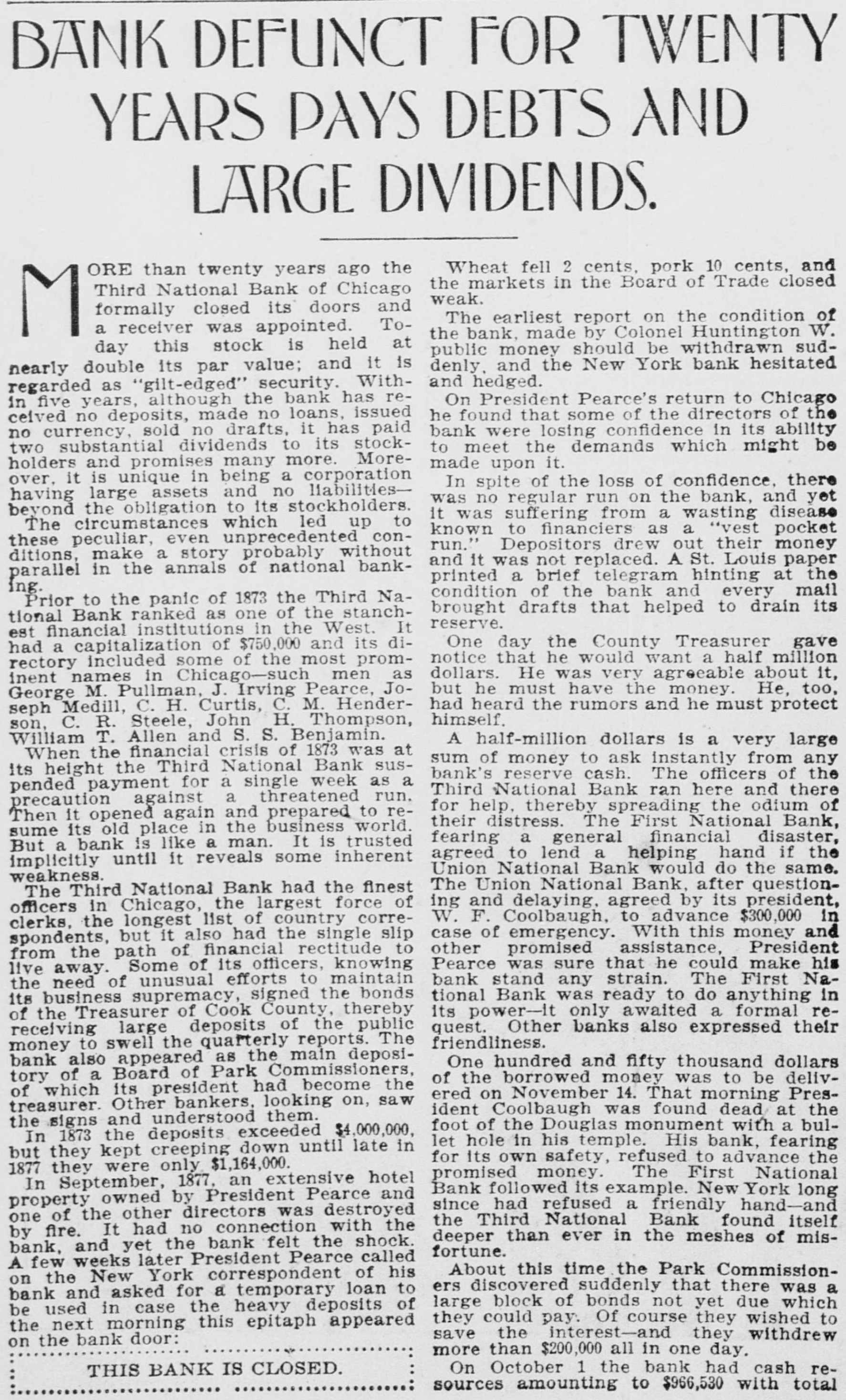
BANK DEFUNCT FOR TWENTY YEARS DAYS DEBTS AND LARGE DIVIDENDS. Wheat fell 2 cents, pork 10 cents, and ORE than twenty years ago the the markets in the Board of Trade closed Third National Bank of Chicago weak. formally closed its doors and The earliest report on the condition of a receiver was appointed. ToM the bank, made by Colonel Huntington W. day this stock is held at public money should be withdrawn suddenly, and the New York bank hesitated nearly double its par value; and it is and hedged. regarded as "gilt-edged" security. WithOn President Pearce's return to Chicago in five years, although the bank has rehe found that some of the directors of the ceived no deposits, made no loans, issued bank were losing confidence in its ability no currency, sold no drafts, it has paid to meet the demands which might be two substantial dividends to its stockholders and promises many more. Moremade upon it. over. it is unique in being a corporation In spite of the loss of confidence, there having large assets and no liabilitieswas no regular run on the bank, and yet beyond the obligation to its stockholders. it was suffering from a wasting disease The circumstances which led up to known to financiers as a "vest pocket these peculiar, even unprecedented conrun." Depositors drew out their money ditions, make a story probably without and it was not replaced. A St. Louis paper parallel in the annals of national bankprinted a brief telegram hinting at the ing. condition of the bank and every mail Prior to the panic of 1873 the Third Nabrought drafts that helped to drain its tional Bank ranked as one of the stanchreserve. est financial institutions in the West. It One day the County Treasurer gave had a capitalization of $750,000 and its dinotice that he would want a half million rectory included some of the most promdollars. He was very agreeable about it, inent names in Chicago-such men as but he must have the money. He, too, George M. Pullman, J. Irving Pearce, Johad heard the rumors and he must protect seph Medill, C. H. Curtis, C. M. Henderhimself. son, C. R. Steele, John H. Thompson, William T. Allen and S. S. Benjamin. A half-million dollars is a very large When the financial crisis of 1873 was at sum of money to ask instantly from any its height the Third National Bank susbank's reserve cash. The officers of the pended payment for a single week as a Third National Bank ran here and there precaution against a threatened run. for help, thereby spreading the odium of Then it opened again and prepared to retheir distress. The First National Bank, sume its old place in the business world. fearing a general financial disaster, But a bank is like a man. It is trusted agreed to lend a helping hand if the implicitly until it reveals some inherent Union National Bank would do the same. weakness. The Union National Bank, after questionThe Third National Bank had the finest ing and delaying, agreed by its president, officers in Chicago, the largest force of W. F. Coolbaugh, to advance $300,000 in clerks, the longest list of country correcase of emergency. With this money and spondents, but it also had the single slip other promised assistance, President from the path of financial rectitude to Pearce was sure that he could make his live away. Some of its officers, knowing bank stand any strain. The First Nathe need of unusual efforts to maintain tional Bank was ready to do anything in its business supremacy, signed the bonds its power-it only awaited a formal reof the Treasurer of Cook County, thereby quest. Other banks also expressed their receiving large deposits of the public friendliness. money to swell the quarterly reports. The bank also appeared as the main deposiOne hundred and fifty thousand dollars tory of a Board of Park Commissioners, of the borrowed money was to be delivof which its president had become the ered on November 14. That morning Prestreasurer. Other bankers. looking on, saw ident Coolbaugh was found dead at the the signs and understood them. foot of the Douglas monument with a bulIn 1873 the deposits exceeded $4,000,000, let hole in his temple. His bank, fearing but they kept creeping down until late in for its own safety, refused to advance the 1877 they were only $1,164,000. promised money. The First National In September, 1877. an extensive hotel Bank followed its example. New York long property owned by President Pearce and since had refused a friendly hand-and one of the other directors was destroyed the Third National Bank found itself by fire. It had no connection with the deeper than ever in the meshes of misbank, and yet the bank felt the shock. fortune. A few weeks later President Pearce called About this time the Park Commissionon the New York correspondent of his ers discovered suddenly that there was a bank and asked for a temporary loan to large block of bonds not yet due which be used in case the heavy deposits of they could pay: Of course they wished to the next morning this epitaph appeared save the interest-and they withdrew on the bank door: more than $200,000 all in one day. On October 1 the bank had cash reTHIS BANK IS CLOSED. sources amounting to $966,530 with total