State Bank (Portland, OR)

Episode Information

Episode UID
24005971466
Episode Type
Run β†’ Suspension β†’ Closure
Bank Type
state
Bank ID
2400597 routing
Routing Number
24-0059
Start Date
February 15, 1922
Location
Portland, Oregon (45.523, -122.676)

Metadata

Model
gpt-5-mini (chosen from majority vote of a three-model LLM ensemble)
Short Digest
e86fa502a0563e3e

Response Measures

None

Description

Run Feb 15 led directors to close Feb 16; bank later declared insolvent and liquidated.

Events (3)

1. February 15, 1922 Run
Cause
Rumor Or Misinformation
Cause Details
Malicious rumors prompted heavy withdrawals and a run beginning Feb. 15, 1922.
Measures
Directors closed bank to protect depositors; state bank examiner called in.
Newspaper Excerpt
On February 15 a disastrous run on the bank started
Source
newspapers
2. February 16, 1922 Suspension
Cause
Rumor Or Misinformation
Cause Details
Directors decided to suspend operations to forestall a run caused by malicious reports; state bank examiner placed the bank in his charge.
Newspaper Excerpt
The State Bank of Portland failed to open for business this morning ... closing was necessitated by a desire to prevent a run on the bank. O. B. Robertson, state bank examiner, is in charge.
Source
newspapers
3. April 1, 1922 Receivership
Newspaper Excerpt
On April 1 the bank was declared insolvent and put into liquidation by the Banking Department.
Source
newspapers

Newspaper Articles (17)

Article from The Seattle Star, February 16, 1922

Click image to open full size in new tab

Article Text

OREGON BANK CLOSES DOORS PORTLAND, Ore., Feb. 16.-The State Bank of Portland failed to open for business this morning. The institution is capitalized at $300,000, with deposits of $2,700,000 and loans of $1,900,000. Conrad P. Olson, president of the Institution since February 1, in a statement today declared that he anticipated no loss to creditors, that the bank's affairs are in sound, condition, but that the closing was necessitated by a desire to prevent a run on the bank. A considerable amount of "slow" paper was given by Olson as the hasis for the bank's uncertain condition. O. B. Robertson, state bank examiner, is in charge. President Olson declared the bank's reserves to be in good condition, with the reopening of the Institution certain within a short time.


Article from East Oregonian : E.O, February 16, 1922

Click image to open full size in new tab

Article Text

PRESIDENT SAYS BANK IS IN GOOD CONDITION PORTLAND, Feb. 16.-(A. P.)The State Bank of Portland today is in the hands of O. B. Robertson, state bank examiner. as the result of an action by Conrad P. Olson, president. Olson said the action was taken to forestall a run expected because of "malicious rumors." He said affairs of the bank are in good shape and expects to reopen in a short time.


Article from Imperial Valley Press, February 16, 1922

Click image to open full size in new tab

Article Text

PORTLAND BANK FAILSTO OPEN United Press Leased Wire PORTLAND, Ore., Feb. 16.-The State Bank of Portland failed to open for business this morning. The institution is capitalized at $300,000, with deposits of $2.700,000, with loans of $1,900,000. Conrad P. Olsen, president of the institution since February 1, in a statement issued today declared that he anticipated no loss to creditors, that the bank's affairs are in sound condition but that the closing was necessitated by a desire to prevent a run on the bank. A considerable amount of "slow" paper was given by Olsen as the basis for the bank's uncertain condition. O. B. Robertson, state bank examiner, is in charge. President Olsen declared the bank's reserves to be in good condition with re-opening of the institution certain within a short time.


Article from Capital Journal, February 17, 1922

Click image to open full size in new tab

Article Text

Portland Bank, Closed Thursday Will Reopen Soon Portland, Ore., Feb. -There was an atmosphere of confidence today in and around the State Bank of Portland, which was closed yesterday to avert a continued run. O. B. Robertson, state bank examiner, was in charge of the work of analyzing the notes and other securities and it was said about ten days would be required to complete this. ''Many friends have volunteered to furnish new capital to carry through the proposed reorganization, into which the directors and officers have already pledged to pay additional funds," said Conrad P. Olson, president of the bank today. "It is too early to say when the bank will reopen, but I am confident that it will not be long.


Article from The Nenana News, February 18, 1922

Click image to open full size in new tab

Article Text

PORTLAND BANK SUSPENDS BUT MAY RESUME BUSINESS PORTLAND, Feb. 18-The State Bank of Portland is in the hands of the state bank examiner, following a decision of the directors to suspend business temporarily. Conrad Olson, who became president of the institution on the first of February, has issued a statement in which he explains that the decision of the board was due to "malicious reports". He declares that the affairs of the bank are in good shape and that he expects the institution to reopen shortly. The bank has deposits aggregating $2,700,000.


Article from The Oregon Daily Journal, January 1, 1923

Click image to open full size in new tab

Article Text

INDICT FOUR OF STATE BANK GROUP (Continued From Page One) gardless of the outcome of the cases." Myers said that the state considers that it has a strong case against the former bank officials, but he refused to give out any of the details of the prosecution. Walker, Olson and Eckern all denied any criminal responsibility for the failure of the bank. They said they welcomed the opportunity to prove their own innocence. WARRANTS SERVED The indictments were returned Saturday afternoon. Early Sunday morning a deputy sheriff started out to serve the warrants. He found Walker, Olson and Eckern at their homes and served the warrants. Olson issued a statement relative to his connection with the defunct institution. The statement was as follows: "During the summer of 1921 I entered into a contract on behalf of myself and others for the purchase of the control of the stock of the State Bank of Portland for the purpose of the consolidation of the Peo-


Article from The Los Angeles Times, January 1, 1923

Click image to open full size in new tab

Article Text

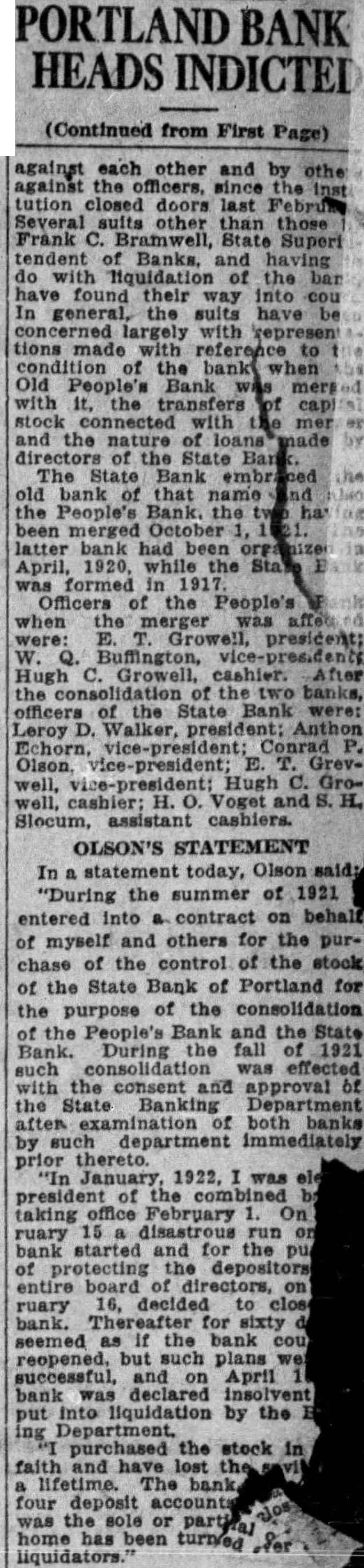
PORTLAND BANK HEADS INDICTED (Continued from First Page) against each other and by others against the officers, since the institution closed doors last February. Several suits other than those by Frank C. Bramwell, State Superintendent of Banks, and having to do with liquidation of the bank, have found their way into court. In general, the suits have been concerned largely with representations made with reference to the condition of the bank when the Old People's Bank was merged with it, the transfers of capital stock connected with the merger and the nature of loans made by directors of the State Bank. The State Bank embraced the old bank of that name and also the People's Bank, the two having been merged October 1, 1921. This latter bank had been organized in April, 1920, while the State Bank was formed in 1917. Officers of the People's Bank when the merger was affected were: E. T. Growell, president; W. Q. Buffington, vice-president; Hugh C. Growell, cashier. After the consolidation of the two banks, officers of the State Bank were: Leroy D. Walker, president; Anthon Echorn, vice-president; Conrad P. Olson, vice-president; E. T. Grevwell, vice-president; Hugh C. Growell, cashier; H. O. Voget and S. H. Slocum, assistant cashiers. OLSON'S STATEMENT In a statement today, Olson said: "During the summer of 1921 I entered into a contract on behalf of myself and others for the purchase of the control of the stock of the State Bank of Portland for the purpose of the consolidation of the People's Bank and the State Bank. During the fall of 1921 such consolidation was effected with the consent and approval of the State Banking Department after examination of both banks by such department immediately prior thereto. "In January, 1922, I was elected president of the combined bank, taking office February 1. On February 15 a disastrous run on the bank started and for the purpose of protecting the depositors the entire board of directors, on February 16, decided to close the bank. Thereafter for sixty days it seemed as if the bank could be reopened, but such plans were unsuccessful, and on April 1 the bank was declared insolvent and put into liquidation by the Banking Department. "I purchased the stock in good faith and have lost the savings of a lifetime. The bank... four deposit accounts... was the sole or partial... home has been turned over to liquidators."


Article from The Oregonian, January 2, 1923

Click image to open full size in new tab

Article Text

INDICTED OFFICIALS TO APPEAR TODAY Battle of State to Convict ex-Bankers to Open. SPEEDY TRIAL IS SOUGHT Defendants and District Attorney Anxious to Bring Prompt Hearing of Charges. With Leroy D. Walker, Conrad P. Olson and Anthon Eckern, indicted officials of the defunct State Bank of Portland, scheduled to appear before Presiding Judge Hewitt of the circuit court at 10 o'clock this morning for arraignment, the battle of the state to convict the three, and E. T. Gruwell, another official, will officially commence. Walker, Olson and Eckern will be required to deposit bail or furnish bonds for their appearance, having been released on their own recognizance when arrested Sunday morning. Gruwell's relative will also be present in court to furnish bond in order that the former vice-president of the wrecked institution will not be returned under guard from California. Yesterday being a holiday, saw no new developments in the bank case. Mr. Walker conferred with his attorney, James P. Wilson, regarding the defense. Mr. Olson, to whom the indictments and the arrest were a complete surprise, stated that he had made no preparation for such action by the grand jury. As yet he has not selected attorneys to conduct his case. Speedy Trial Sought. "Of course, I could conduct my own case," he stated, "but I do not think that I will. This action by the grand jury was a complete surprise to me, and I did not expect any indictments against me to follow the investigation. "I am going to insist on a speedy and prompt trial. I have been in this city for years, and do not like this cloud of suspicion hanging over my head. There will be no attempt at delay on my part. I had no knowledge of the condition of the bank, and as the district attorney says, was indicted because I should have known its status." Guy C. T. Corliss has been retained by Mr. Eckern to defend him in the action. As yet the friends and relatives of Mr. Gruwell have not selected attorneys to represent him. Prosecution Is Silent. Gruwell Is Defended. Hugh C. Gruwell, cashier of the bank and a son of the vice-president under indictment, issued the following statement yesterday anent his father's connection with the wrecked institution: "My father's indictment in connection with the State bank, even though only on the technical grounds of receiving deposits knowing the bank to be insolvent, comes as a complete surprise to me. My father and I, together with Mr. Olson and others, came into the State bank so shortly before the disastrous run against the bank that there was no opportunity of making a searching investigation that would be necessary to disclose concealed defects in the securities. It was only on February 1 that the new officers assumed control, just two weeks before the run began. "My father invested heavily in the bank and as a result lost this investment. In addition he has already turned over all his property to cover his double liability and is now employed in California on a salary. Secure in the knowledge that my father is not guilty of any wrong doing, I await his complete vindication." The district attorney's office had no further information to add to that already published. The three joint indictments, charging the receipt of deposits in a bank known to be insolvent, were drawn to cover the actions of the bank officials on February 7, 8 and 9, a week before the institution was forced to close its doors. With Walker and Eckern, the state claims that the proving of this charge will be a simple manner, as the two men, by reason of their connection with subsidiary concerns, had knowledge of the worthlessness of some of the security held by the institution. Olson and Gruwell, being officials of the institution, are held to have known that the firm was bankrupt and that they committed crimes in accepting other people's money for deposit in such an institution. Others Are Involved. The misapplication of funds charge is expected to throw the spotlight of publicity on various high financiers of the city and to reveal shady transactions between the bank and loan and discount concerns. District Attorney Myers yesterday announced that he would demand a prompt trial of the four men and would oppose any attempts to continue or to drag out the case.
Article from The Oregon Daily Journal, March 1, 1923

Click image to open full size in new tab

Article Text

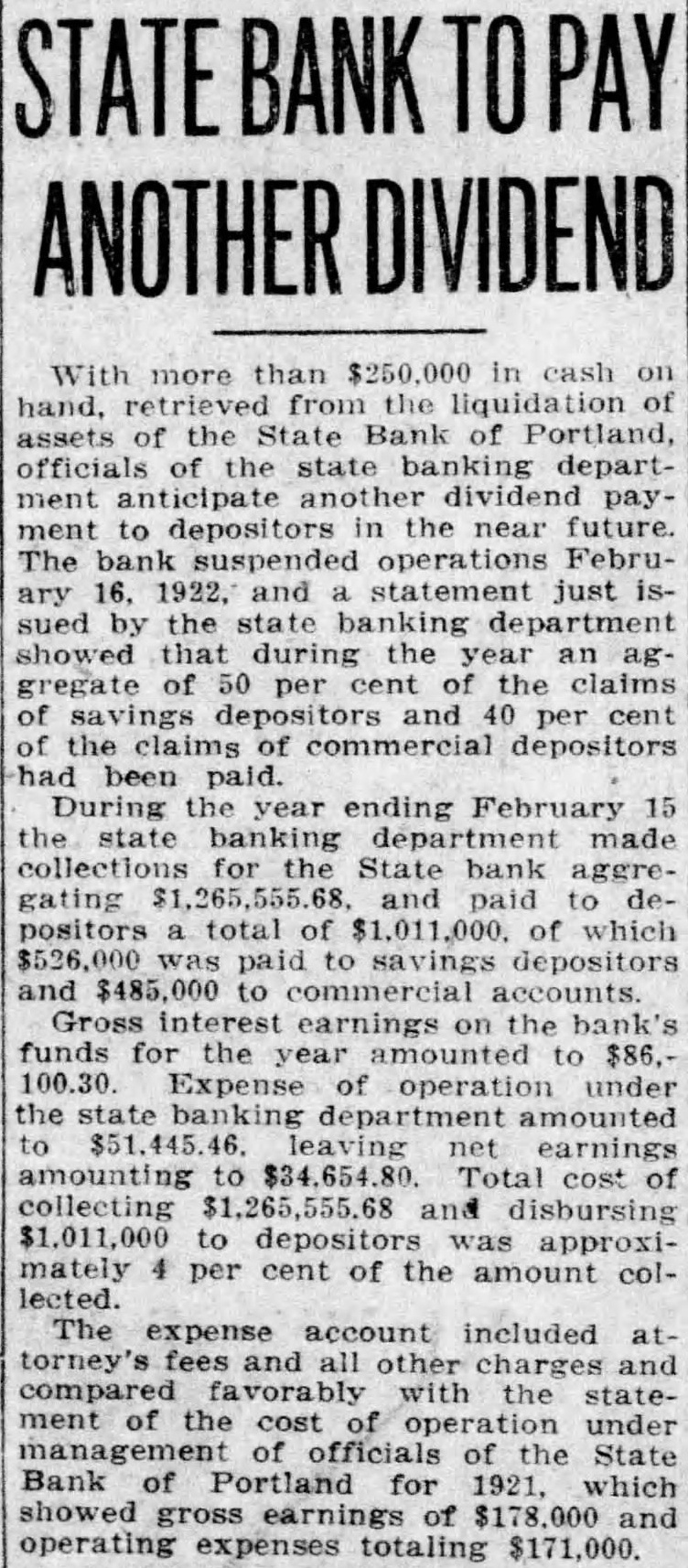
STATE BANK TO PAY ANOTHER DIVIDEND With more than $250,000 in cash on hand, retrieved from the liquidation of assets of the State Bank of Portland, officials of the state banking department anticipate another dividend payment to depositors in the near future. The bank suspended operations February 16, 1922, and a statement just issued by the state banking department showed that during the year an aggregate of 50 per cent of the claims of savings depositors and 40 per cent of the claims of commercial depositors had been paid. During the year ending February 15 the state banking department made collections for the State bank aggregating $1,265,555.68, and paid to depositors a total of $1,011,000, of which $526,000 was paid to savings depositors and $485,000 to commercial accounts. Gross interest earnings on the bank's funds for the year amounted to $86,100.30. Expense of operation under the state banking department amounted to $51,445.46, leaving net earnings amounting to $34,654.80. Total cost of collecting $1,265,555.68 and disbursing $1,011,000 to depositors was approximately 4 per cent of the amount collected. The expense account included attorney's fees and all other charges and compared favorably with the statement of the cost of operation under management of officials of the State Bank of Portland for 1921, which showed gross earnings of $178,000 and operating expenses totaling $171,000.


Article from The Oregon Daily Journal, March 1, 1923

Click image to open full size in new tab

Article Text

With more than $250,000 in cash on hand, retrieved from the liquidation of assets of the State Bank of Portland, officials of the state banking department anticipate another dividend payment to depositors in the near future.


Article from The Oregon Daily Journal, June 17, 1923

Click image to open full size in new tab

Article Text

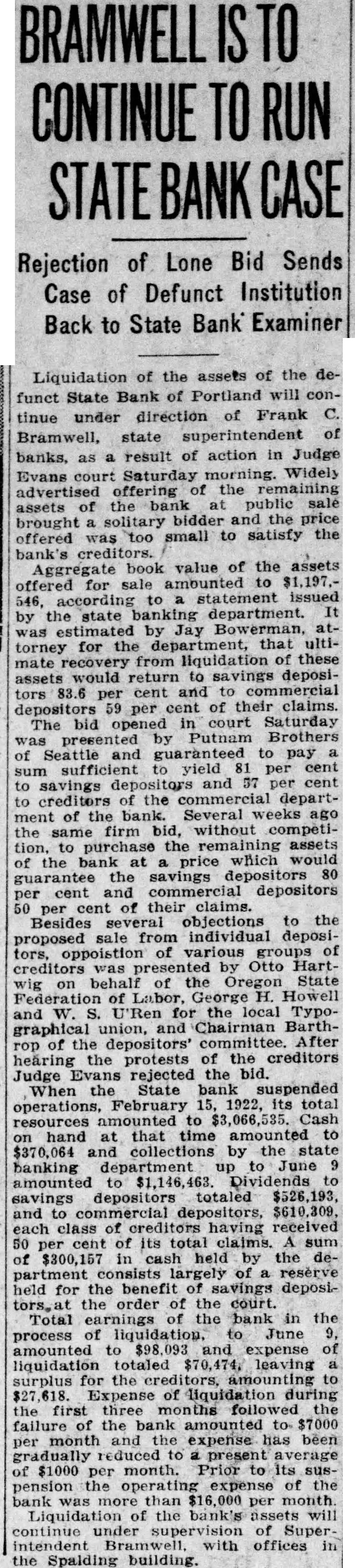
BRAMWELL IS TO CONTINUE TO RUN STATE BANK CASE Rejection of Lone Bid Sends Case of Defunct Institution Back to State Bank Examiner Liquidation of the assets of the defunct State Bank of Portland will continue under direction of Frank C. Bramwell, state superintendent of banks, as a result of action in Judge Evans court Saturday morning. Widely advertised offering of the remaining assets of the bank at public sale brought a solitary bidder and the price offered was too small to satisfy the bank's creditors. Aggregate book value of the assets offered for sale amounted to $1,197,546, according to a statement issued by the state banking department. It was estimated by Jay Bowerman, attorney for the department, that ultimate recovery from liquidation of these assets would return to savings depositors 83.6 per cent and to commercial depositors 59 per cent of their claims. The bid opened in court Saturday was presented by Putnam Brothers of Seattle and guaranteed to pay a sum sufficient to yield 81 per cent to savings depositors and 57 per cent to creditors of the commercial department of the bank. Several weeks ago the same firm bid, without competition, to purchase the remaining assets of the bank at a price which would guarantee the savings depositors 80 per cent and commercial depositors 50 per cent of their claims. Besides several objections to the proposed sale from individual depositors, opposition of various groups of creditors was presented by Otto Hartwig on behalf of the Oregon State Federation of Labor, George H. Howell and W. S. U'Ren for the local Typographical union, and Chairman Barthrop of the depositors' committee. After hearing the protests of the creditors Judge Evans rejected the bid. When the State bank suspended operations, February 15, 1922, its total resources amounted to $3,066,535. Cash on hand at that time amounted to $370,064 and collections by the state banking department up to June 9 amounted to $1,146,463. Dividends to savings depositors totaled $526,193, and to commercial depositors, $610,309, each class of creditors having received 50 per cent of its total claims. A sum of $300,157 in cash held by the department consists largely of a reserve held for the benefit of savings depositors at the order of the court. Total earnings of the bank in the process of liquidation, to June 9, amounted to $98,093 and expense of liquidation totaled $70,474, leaving a surplus for the creditors, amounting to $27,618. Expense of liquidation during the first three months followed the failure of the bank amounted to $7000 per month and the expense has been gradually reduced to a present average of $1000 per month. Prior to its suspension the operating expense of the bank was more than $16,000 per month. Liquidation of the bank's assets will continue under supervision of Superintendent Bramwell, with offices in the Spalding building.


Article from Medford Mail Tribune, October 1, 1923

Click image to open full size in new tab

Article Text

PORTLAND BANKER DENIES HE KNEW BANK'S CONDITION PORTLAND, Ore., Oct. 1.β€”Anthon E. Eckern, former vice president of the defunct State bank of Portland, was not a director at the time of the bank's failure and did not know of its condition, according to his testimony before jury in Circuit Judge Skipworth's court this morning. Eckern is on trial on charges of receiving deposits when he knew the bank was insolvent. "The first time I knew anything was wrong with the affairs of the bank," said the witness, "was when I arrived to go to work on the morning of February 16, 1922 and saw the 'closed' sign on the door." Eckern said he asked Leroy D. Walker, president of the bank, who died recently, while under indictment with Eckern and Conrad Olson, what was wrong, and that Walker told him there had been a run on the bank the day before and that the directors had decided to close the institution to protect depositors. Eckern said he was dropped as a director on January 1, 1922, when the bank was re-organized and that he devoted only one half of his time to affairs of the bank. His salary as vice president, he said was $150 a month. The case is expected to go to the jury tomorrow. Cross examination of Eckern was begun just before the noon adjournment.


Article from The Oregon Daily Journal, October 1, 1923

Click image to open full size in new tab

Article Text

ECKERN DID NOT KNOW, HE SAYS Anthon Eckern, formerly vice president of the defunct State Bank of Portland, testified today that the first he knew that anything was wrong with the bank, was when he visited the bank the morning of February 16, 1922, and found the doors closed. He went to Leroy D. Walker, another official of the bank, and asked what was the matter. "Walker said that the run on the bank the day before had prompted the directors to order the doors closed so as to protect the depositors," Eckern testified. Walker, who was jointly indicted with Eckern and Conrad P. Olson, former president of the bank, has since died. Olson has been granted a separate trial. Eckern is charged with receiving deposits, knowing the bank to be insolvent. Eckern testified that he had been dropped from the board of directors of the bank early in January, 1922, and that he had been instructed to devote only one half of his time to his duties as vice president. He received a salary of $150 a month for these duties, he said. Other witnesses today were Will T. Wright, former state superintendent of banks, and Walter Gover, cattleman. The latter testified to certain cattle loans of the bank. The case is expected to reach the jury some time Tuesday.


Article from San Francisco Bulletin, October 1, 1923

Click image to open full size in new tab

Article Text

PORTLAND, Ore., Oct. 1.β€”Anthon Eckern, former vice-president of the defunct State Bank of Portland was not a director at the time of the bank's failure and did not know of its condition, according to his testimony before a jury in Circuit Judge Skipworth's court today. Eckern is charged with receiving deposits when he knew the bank was insolvent. "The first time I knew that anything was wrong with the affairs of the bank," said the witness, "was when I arrived to go to work on the morning of February 16, 1922, and saw the 'closed' sign on the door." Eckern said he asked Leroy D. Walker, president of the bank, who died recently, and Conrad Olson what was wrong and that Walker told him there had been a run on the bank the day before and that the directors had decided to close the institution to protect depositors. Eckern said he was dropped as a director on January 1, 1921, when the bank was reorganized, and that he devoted only one-half of his time to the affairs of the bank. His salary as vice-president, he said, was $150 a month. The case is expected to go to the jury tomorrow.


Article from San Francisco Bulletin, October 1, 1923

Click image to open full size in new tab

Article Text

PORTLAND, Ore., Oct. 1.β€”Anthon Eckern, former vice-president of the defunct State Bank of Portland was not a director at the time of the bank's failure and did not know of its condition, according to his testimony before a jury in Circuit Judge Skipworth's court today. Eckern is charged with receiving deposits when he knew the bank was insolvent. "The first time I knew that anything was wrong with the affairs of the bank," said the witness, "was when I arrived to go to work on the morning of February 16, 1922, and saw the 'closed' sign on the door." Eckern said he asked Leroy D. Walker, president of the bank, who died recently, and Conrad Olson what was wrong and that Walker told him there had been a run on the bank the day before and that the directors had decided to close the institution to protect depositors. Eckern said he was dropped as a director on January 1, 1921, when the bank was reorganized, and that he devoted only one-half of his time to the affairs of the bank. His salary as vice-president, he said, was $150 a month. The case is expected to go to the jury tomorrow.


Article from The Daily Herald, October 2, 1923

Click image to open full size in new tab

Article Text

HE KNEW IT NOT Portland Banker Not Director When It Flopped PORTLAND, Ore., Oct. 1.β€”Anthon Eckern, former president of the defunct State Bank of Portland, was not a director at the time of the bank's failure and did not know of its condition, according to his testimony before a jury in circuit Judge Skipwith's court this morning. Eckern is on trial on charges of receiving deposits when he knew the bank was insolvent. "The first time I knew anything was wrong with the affairs of the bank," said the witness, "was when I arrived to go to work on the morning of February 16, 1922 and saw the 'closed' sign on the door." Eckern said he asked Leroy D. Walker, president of the bank, who died recently, while under indictment with Eckern and Conrad Olson, what was wrong, and that Walker told him there had been a run on the bank the day before and that the directors had decided to close the institution to protect depositors. Eckern said he was dropped as a director on January 1, 1922, when the bank was reorganized, and that he devoted only one-half of his time to affairs of the bank. His salary was vice president, he said, was $150 a month. The case is expected to go to the jury tomorrow.


Article from Medford Mail Tribune, December 11, 1925

Click image to open full size in new tab

Article Text

DEMAND OF BRAMWELL Portland Bankers Accuse State Bank Examiner of Unfair Discrimination and Request for Removal Is ExpectedBramwell Denies Charges and Asks for a Hearing. SALEM, Ore., Dec. 11.-Statements relative to the administration of Frank C. Bramwell, state superintendent of banks. were made to the state banking board today by representatives of the Portland National bank, formerly the Broanway bank. The bank Bramwell of arbitrarily refusing to grant charter as reserve depository for state and thereby discriminating against it in an unfair manner. Members of the board pressed the bank say plainly whether they were demanding Bramwell's removal. To this, in reply to question by Secretary of State Kozer, Will Haines, president of the bank, replied you will be patient you will soon know what we want. If you give us time will prove everything we said and more, too. before we get of this room. There are other matters that could bring up in the same connection, but cannot betray the confidences of those talked the John Davis, cashier of the Portland bank. was asked by newspaper man after the noon adjournment if the bank was going to demand Bramcan't talk now." he said. "You will see afternoon. Bramwell has not made his reply. but indicated that he would be able to answer the accusations of his Mr. Haines told of an examination of his bank that was the state department after the failure of the State bank of Portland, which had caused small run on the Broadway bank. and said the examination was objectionable in number of ways. "Even If our application to become reserve depository is granted. said Haines, that banks who deposit their reserves with us are going be penalized and we demand change the attitude of the state Demand Know. In reply question bv State Treasurer Kay Hart, attorney for the bank. replied that the purpose of the hearing to find out the Portland bank has not been made depository for state funds: why banks have been refused permission to deposit their serves with us and why we are being discriminated against Hart read series of letters that passed Bramwell in which he insisted on knowing why permission serve as reserve depository had been refused the bank. He accused Bramwell of having evaded direct and said: "We demand to reply. know now." Secretary Kozer brought up the question whether banking law board had jurisdiction and asking were exclusively in the hands of superintendent banks. Hart replied that his opinion the creature was not greater than the creator and that believed the board had advisory control of the superintendent. State Treasurer Kay referred to the new banking code saying that it took from the board about all the power had except that of appointing bank superintendent. granting bank charters and annroving charters. Bramwell Explains. Superintendent Bramwell explained that the new code does not change of the board but that the authority charters as reserve degranting positories has always been discretion with the superintendent. has always been poor law." said Governor Pierce. very poor in this day and age. 'Have you any other evidence to support of present?" asked Kay. statements that you have made that would tend to show that Bramwell has unfair. arbitrary or incompetent been might cause the board to and that consider his removal? Bramwell wanted to know At this was on what want to said "That's think they have right to ahead and present all they added Bramwell. the call in and hear my side. me Several country bankers were duced by Mr. Haines to testify be Portland National They half of the had been advised testified that they (Continued on Page