First National Bank (Carthage, NY)

Episode Information

Episode UID
244201181
Episode Type
Suspension โ†’ Closure
Bank Type
national
Bank ID
24420 national
Charter Number
2442
Start Date
May 3, 1898
Location
Carthage, New York (43.978, -75.609)

Metadata

Model
gpt-5-mini (chosen from majority vote of a three-model LLM ensemble)
Short Digest
24126304183017b2

Response Measures

None

Receivership Details

Depositor recovery rate
99.5%
Date receivership started
1898-11-04
Date receivership terminated
1903-02-17
OCC cause of failure
Fraud
Share of assets assessed as good
31.7%
Share of assets assessed as doubtful
57.8%
Share of assets assessed as worthless
10.6%

Description

President E. H. Myers absconded May 3, 1898; bank closed and later placed in receivership.

Events (5)

1. December 12, 1879 Chartered
Source
historical_nic
2. May 3, 1898 Suspension
Cause
Bank Specific Adverse Info
Cause Details
President E. H. Myers absconded after long-term defalcation (~$110,000), prompting directors to close the bank for examination.
Newspaper Excerpt
The president of this bank, E. H. Myers, has absconded; and the directors ascertained last night that his accounts are short. They have ordered the bank closed for a more thorough examination.
Source
newspapers
3. November 4, 1898 Receivership
Source
historical_nic
4. November 4, 1898 Receivership
Newspaper Excerpt
Josiah Van Vranken for the First National Bank of Carthage, N. Y.; ... The Comptroller ... has appointed temporary receivers ... for the First National Bank of Carthage, N. Y. (Nov. 4, 1898 report).
Source
newspapers
5. November 15, 1898 Receivership
Newspaper Excerpt
The comptroller ... appointed Mr. Edward N. Smith receiver in place of Mr. J. Van Vranken, resigned. The bank suspended payment May 3, 1898. (Nov. 15, 1898 report).
Source
newspapers

Newspaper Articles (16)

Article from The Indianapolis Journal, May 4, 1898

Click image to open full size in new tab

Article Text

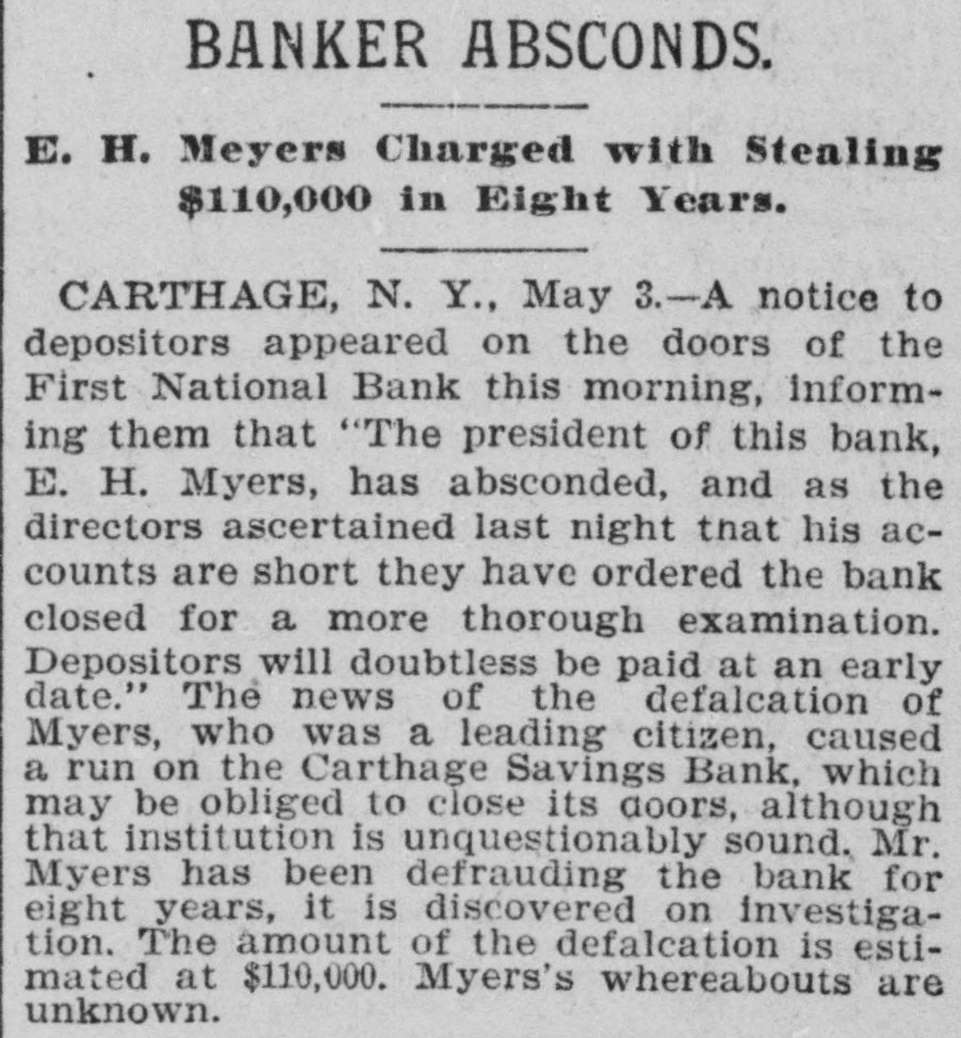
BANKER ABSCONDS. E. H. Meyers Charged with Stealing $110,000 in Eight Years. CARTHAGE, N. Y., May 3.-A notice to depositors appeared on the doors of the First National Bank this morning, informing them that "The president of this bank, E. H. Myers, has absconded, and as the directors ascertained last night that his accounts are short they have ordered the bank closed for a more thorough examination. Depositors will doubtless be paid at an early date." The news of the defalcation of Myers, who was a leading citizen, caused a run on the Carthage Savings Bank, which may be obliged to close its doors, although that institution is unquestionably sound. Mr. Myers has been defrauding the bank for eight years, it is discovered on investigation. The amount of the defalcation is estimated at $110,000. Myers's whereabouts are unknown.


Article from The Herald, May 4, 1898

Click image to open full size in new tab

Article Text

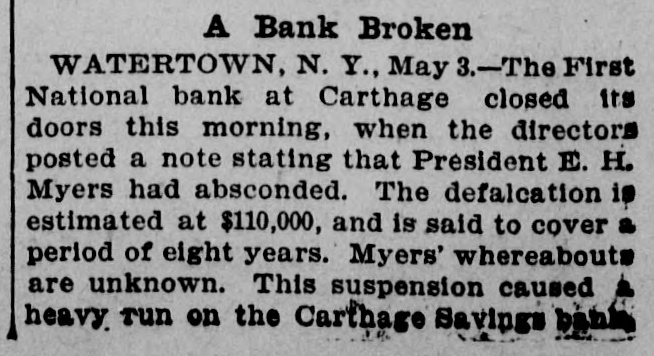
A Bank Broken WATERTOWN, N. Y., May 3.-The First National bank at Carthage closed its doors this morning, when the directors posted a note stating that President E. H. Myers had absconded. The defalcation is estimated at $110,000, and is said to cover a period of eight years. Myers' whereabouts are unknown. This suspension caused heavy run on the Carthage Savings bahl


Article from The Saint Paul Globe, May 4, 1898

Click image to open full size in new tab

Article Text

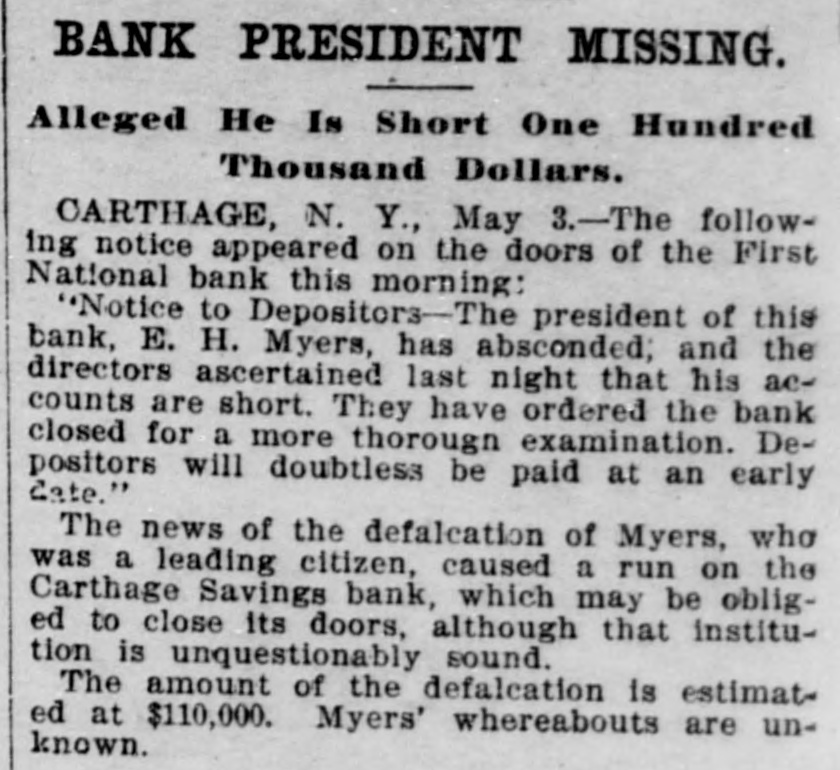
BANK PRESIDENT MISSING. Alleged He Is Short One Hundred Thousand Dollars. CARTHAGE, N. Y., May 3.-The following notice appeared on the doors of the First National bank this morning: "Notice to Depositors-The president of this bank, E. H. Myers, has absconded; and the directors ascertained last night that his accounts are short. They have ordered the bank closed for a more thorough examination. Depositors will doubtless be paid at an early Cate." The news of the defalcation of Myers, who was a leading citizen, caused a run on the Carthage Savings bank, which may be obliged to close its doors, although that institution is unquestionably sound. The amount of the defalcation is estimat ed at $110,000. Myers' whereabouts are unknown.


Article from The Times, May 4, 1898

Click image to open full size in new tab

Article Text

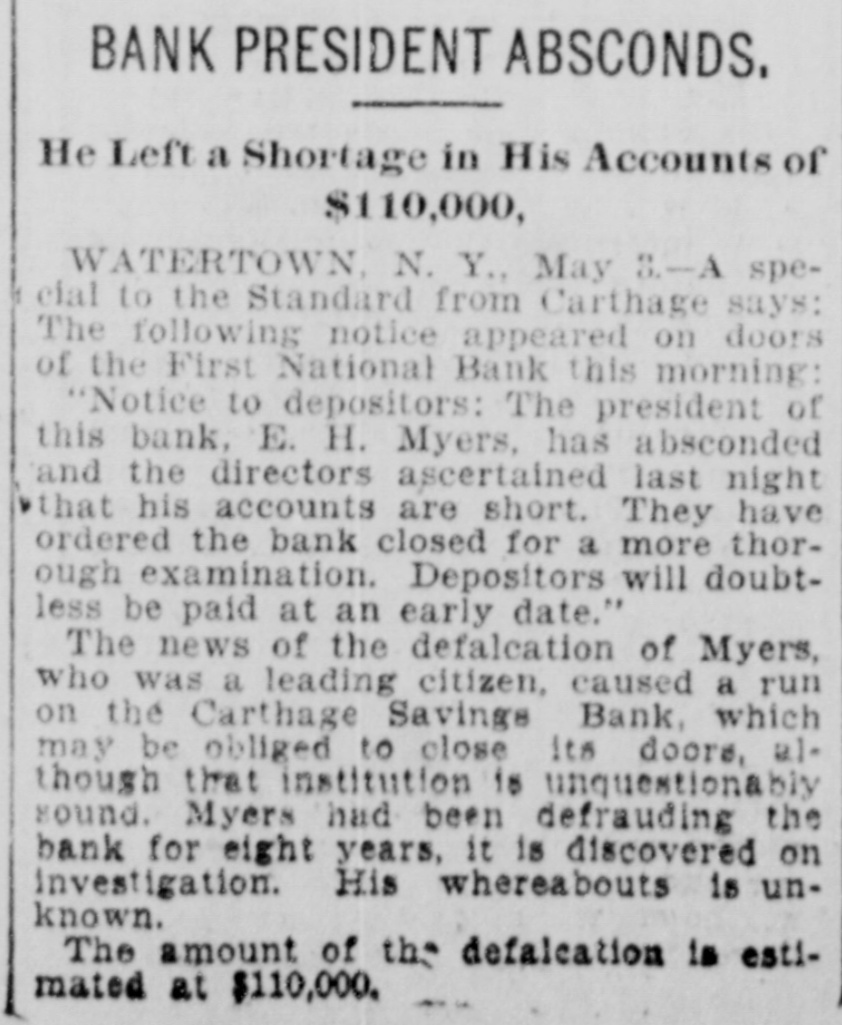
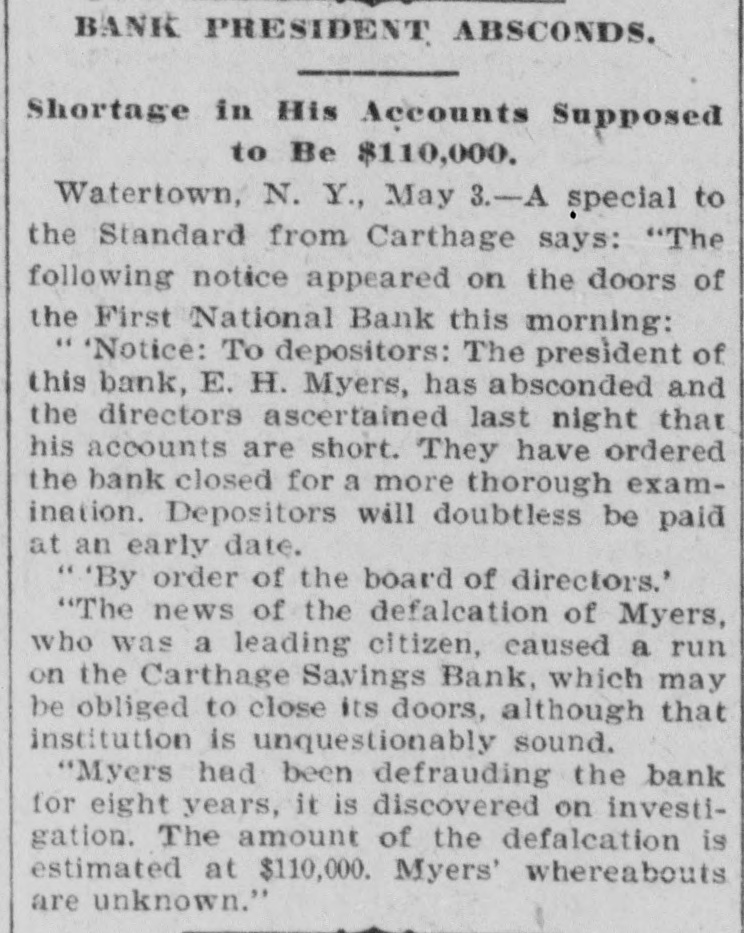
BANK PRESIDENT ABSCONDS. He Left a Shortage in His Accounts of $110,000, WATERTOWN N. Y., May 3.-A special to the Standard from Carthage says: The following notice appeared on doors of the First National Bank this morning: "Notice to depositors: The president of this bank, E. H. Myers, has absconded and the directors ascertained last night that his accounts are short. They have ordered the bank closed for a more thorough examination. Depositors will doubtless be paid at an early date." The news of the defalcation of Myers, who was a leading citizen, caused a run on the Carthage Savings Bank, which may be obliged to close its doors, although that institution is unquestionably sound. Myers had been defrauding the bank for eight years, it is discovered on investigation. His whereabouts is unknown. The amount of the defalcation is estimated at $110,000.


Article from Richmond Dispatch, May 4, 1898

Click image to open full size in new tab

Article Text

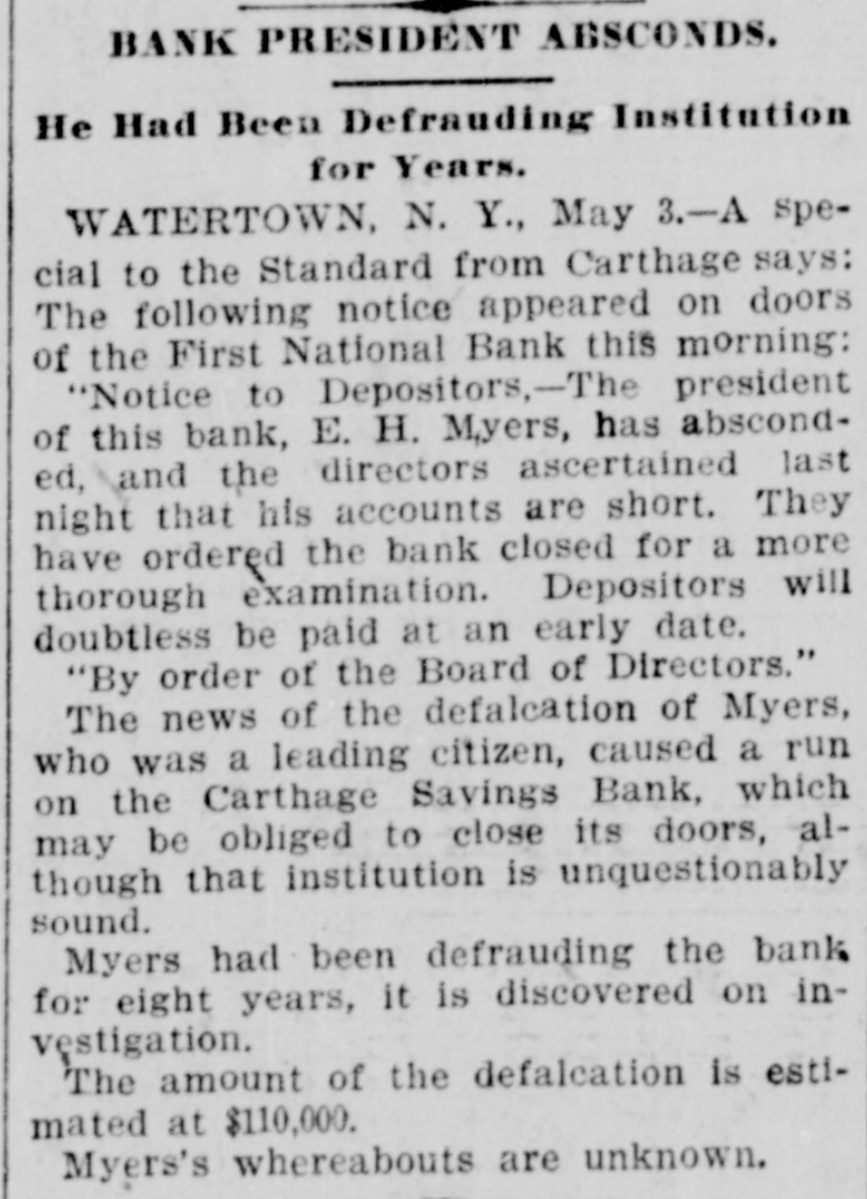
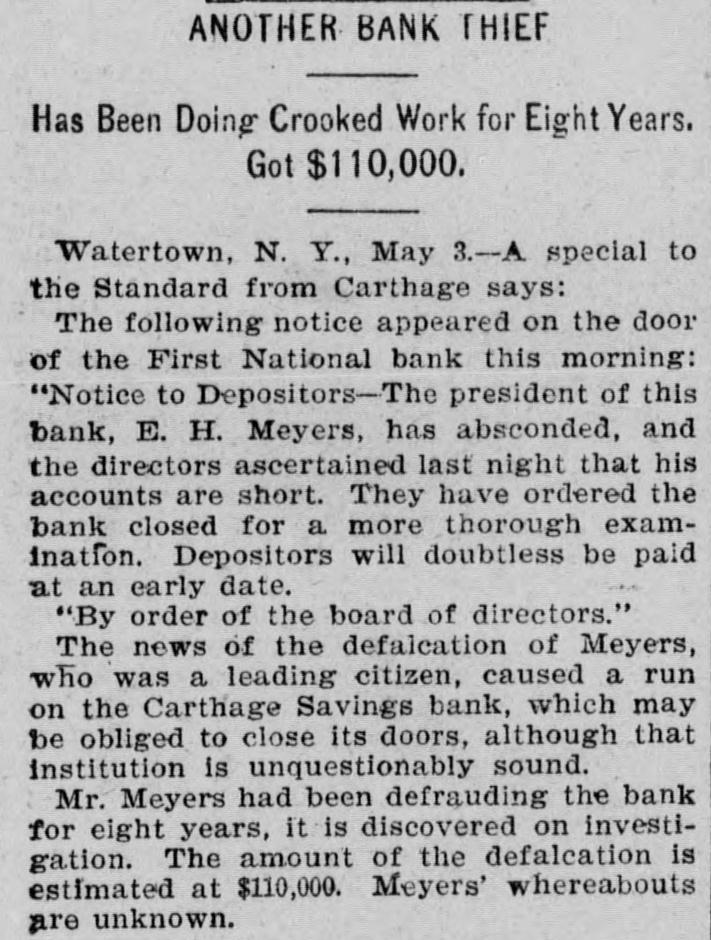
BANK PRESIDENT ABSCONDS. He Had Been Defrauding Institution for Years. WATERTOWN, N. Y., May 3.-A special to the Standard from Carthage says: The following notice appeared on doors of the First National Bank this morning: "Notice to Depositors,- The president of this bank, E. H. Myers, has absconded, and the directors ascertained last night that his accounts are short. They have ordered the bank closed for a more thorough examination. Depositors will doubtless be paid at an early date. "By order of the Board of Directors." The news of the defalcation of Myers, who was a leading citizen, caused a run on the Carthage Savings Bank, which may be obliged to close its doors, although that institution is unquestionably sound. Myers had been defrauding the bank for eight years, it is discovered on investigation. The amount of the defalcation is estimated at $110,000. Myers's whereabouts are unknown.


Article from Perrysburg Journal, May 7, 1898

Click image to open full size in new tab

Article Text

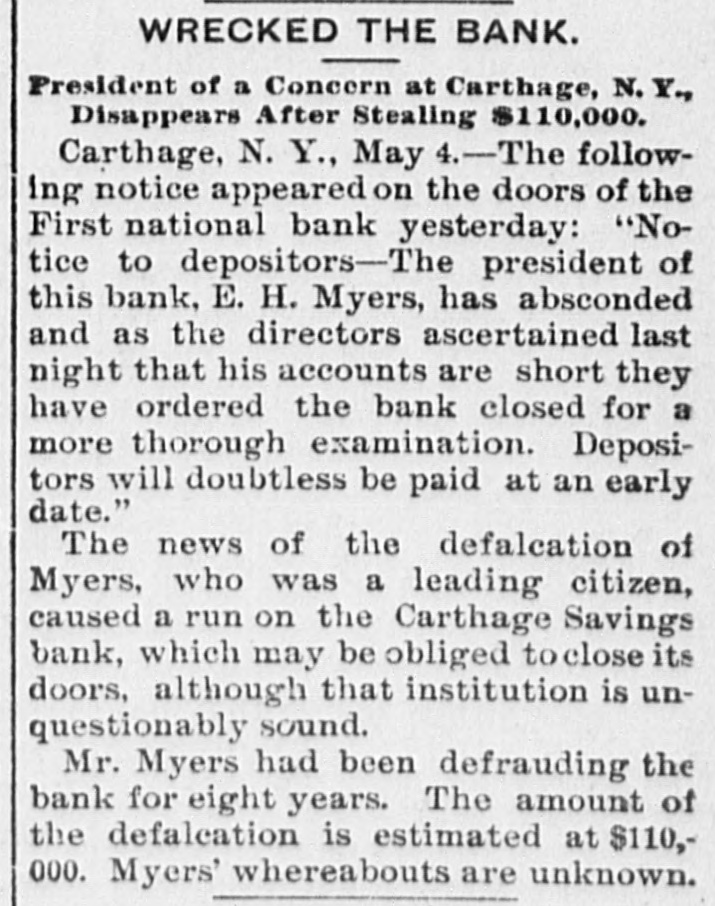
WRECKED THE BANK. President of a Concern at Carthage, N.Y., Disappears After Stealing $110,000. Carthage, N. Y., May 4.-The following notice appeared on the doors of the First national bank yesterday: "Notice to depositors-The president of this bank, E. H. Myers, has absconded and as the directors ascertained last night that his accounts are short they have ordered the bank closed for a more thorough examination. Depositors will doubtless be paid at an early date." The news of the defalcation of Myers, who was a leading citizen, caused a run on the Carthage Savings bank, which may be obliged to close its doors, although that institution is unquestionably sound. Mr. Myers had been defrauding the bank for eight years. The amount of the defalcation is estimated at $110,000. Myers' whereabouts are unknown.


Article from The News-Herald, May 12, 1898

Click image to open full size in new tab

Article Text

WRECKED THE BANK. President of a Concern at Carthage, N. Y., Disappears After Stealing $110,000. Carthage, N. Y., May 4.-The following notice appeared on the doors of the First national bank yesterday: "Notice to depositors-The president of this bank, E. H. Myers, has absconded and as the directors ascertained last night that his accounts are short they have ordered the bank closed for a more thorough examination. Depositors will doubtless be paid at an early date." The news of the defalcation of Myers, who was a leading citizen, caused a run on the Carthage Savings bank, which may be obliged to close its doors, although that institution is unquestionably sound. Mr. Myers had been defrauding the bank for eight years. The amount of the defalcation is estimated at $110,000. Myers' whereabouts are said to be unknown.


Article from Cameron County Press, May 12, 1898

Click image to open full size in new tab

Article Text

WRECKED THE BANK. President of a Concern at Carthage, N. Y., Disappears After Stealing $110,000. Carthage, N. Y., May 4.-The following notice appeared on the doors of the First national bank yesterday: "Notice to depositors-The president of this bank, E. H. Myers, has absconded and as the directors ascertained last night that his accounts are short they have ordered the bank closed for a more thorough examination. Depositors will doubtless be paid at an early date." The news of the defalcation of Myers, who was a leading citizen, caused a run on the Carthage Savings bank, which may be obliged to close its doors, although that institution is unquestionably sound. Mr. Myers had been defrauding the bank for eight years. The amount of the defalcation is estimated at $110,000. Myers' whereabouts are said to be unknown.


Article from The Herald, May 27, 1898

Click image to open full size in new tab

Article Text

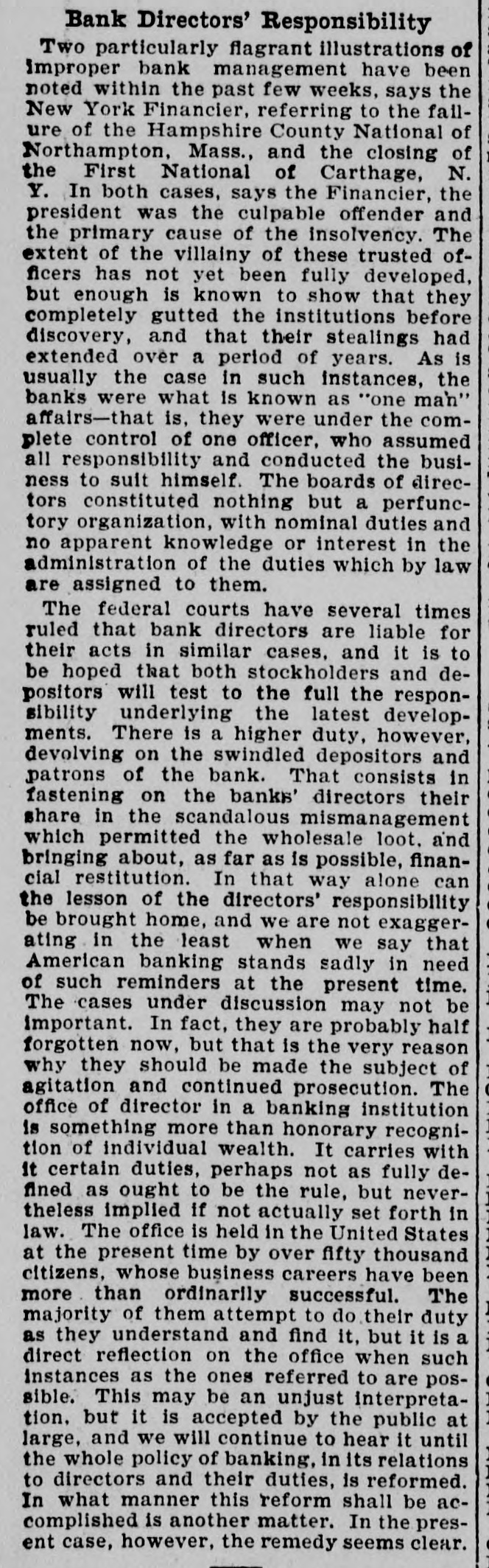
Bank Directors' Responsibility Two particularly flagrant illustrations of improper bank management have been noted within the past few weeks, says the New York Financier, referring to the fallure of the Hampshire County National of Northampton, Mass., and the closing of the First National of Carthage, N. Y. In both cases, says the Financier, the president was the culpable offender and the primary cause of the insolvency. The extent of the villainy of these trusted officers has not yet been fully developed, but enough is known to show that they completely gutted the institutions before discovery, and that their stealings had extended over a period of years. As is usually the case in such instances, the banks were what is known as "one man" affairs-that is, they were under the complete control of one officer, who assumed all responsibility and conducted the business to suit himself. The boards of directors constituted nothing but a perfunctory organization, with nominal duties and no apparent knowledge or interest in the administration of the duties which by law are assigned to them. The federal courts have several times ruled that bank directors are liable for their acts in similar cases, and it is to be hoped that both stockholders and depositors will test to the full the responsibility underlying the latest developments. There is a higher duty, however, devolving on the swindled depositors and patrons of the bank. That consists in fastening on the banks' directors their share in the scandalous mismanagement which permitted the wholesale loot. and bringing about, as far as is possible, financial restitution. In that way alone can the lesson of the directors' responsibility be brought home, and we are not exaggerating in the least when we say that American banking stands sadly in need of such reminders at the present time. The cases under discussion may not be important. In fact, they are probably half forgotten now, but that is the very reason why they should be made the subject of agitation and continued prosecution. The office of director in a banking institution is something more than honorary recognition of individual wealth. It carries with it certain duties, perhaps not as fully defined as ought to be the rule, but nevertheless implied if not actually set forth in law. The office is held in the United States at the present time by over fifty thousand citizens, whose business careers have been more than ordinarily successful. The majority of them attempt to do their duty as they understand and find it, but it is a direct reflection on the office when such instances as the ones referred to are possible. This may be an unjust interpretation. but it is accepted by the public at large, and we will continue to hear it until the whole policy of banking, in its relations to directors and their duties, is reformed. In what manner this reform shall be accomplished is another matter. In the present case, however, the remedy seems clear.


Article from The Sun, November 5, 1898

Click image to open full size in new tab

Article Text

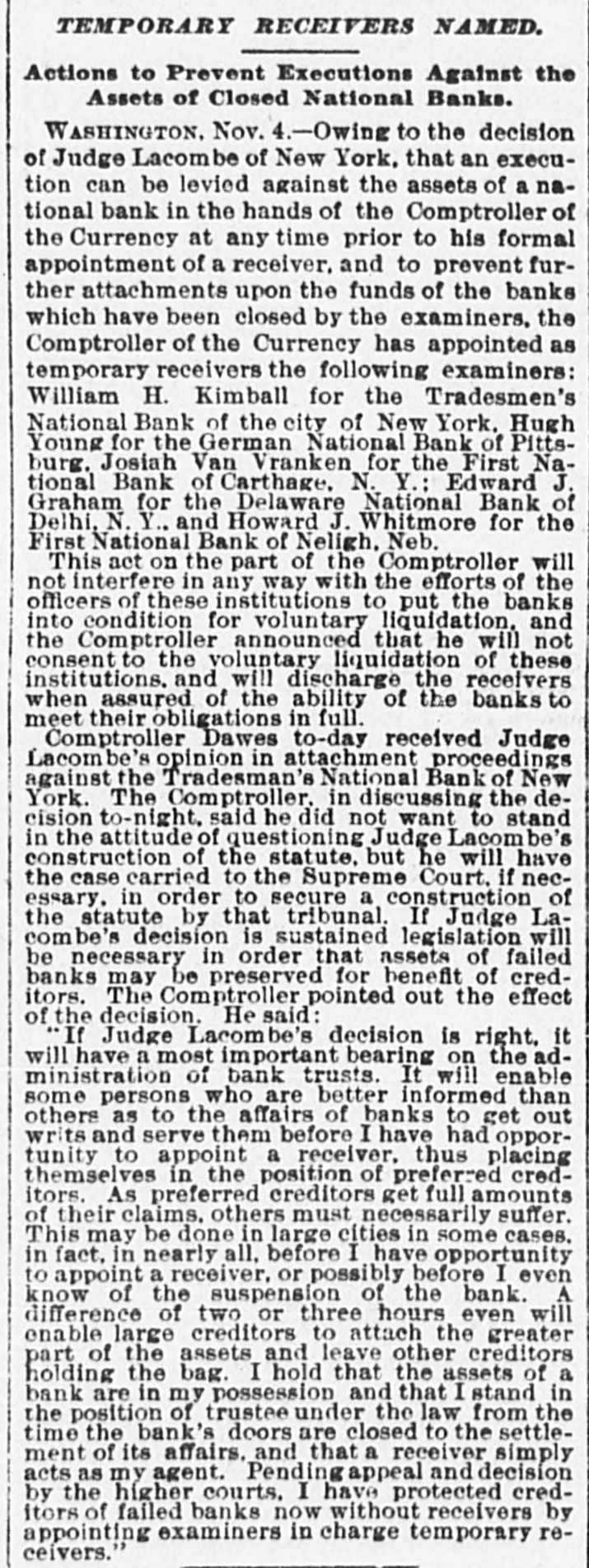
TEMPORARY RECEIVERS NAMED. Actions to Prevent Executions Against the Assets of Closed National Banks. WASHINGTON. Nov. 4.-Owing to the decision of Judge Lacombe of New York. that an execution can be levied against the assets of a national bank in the hands of the Comptroller of the Currency at any time prior to his formal appointment of a receiver. and to prevent further attachments upon the funds of the banks which have been closed by the examiners. the Comptroller of the Currency has appointed as temporary receivers the following examiners: William H. Kimball for the Tradesmen's National Bank of the city of New York. Hugh Young for the German National Bank of Pittsburg. Josiah Van Vranken for the First National Bank of Carthage. N. Y.: Edward J. Graham for the Delaware National Bank of Delhi, N. Y.. and Howard J. Whitmore for the First National Bank of Neligh. Neb. This act on the part of the Comptroller will not interfere in any way with the efforts of the officers of these institutions to put the banks into condition for voluntary liquidation, and the Comptroller announced that he will not consent to the voluntary liquidation of these institutions. and will discharge the receivers when assured of the ability of the banks to meet their obligations in full. Comptroller Dawes to-day received Judge Lacombe's opinion in attachment proceedings against the Tradesman's National Bank of New York. The Comptroller. in discussing the decision to-night. said he did not want to stand in the attitude of questioning Judge Lacombe's construction of the statute. but he will have the case carried to the Supreme Court. if necessary. in order to secure a construction of the statute by that tribunal. If Judge Lacombe's decision is sustained legislation will be necessary in order that assets of failed banks may be preserved for benefit of creditors. The Comptroller pointed out the effect of the decision. He said: "If Judge Lacombe's decision is right. it will have a most important bearing on the administration of bank trusts. It will enable some persons who are better informed than others as to the affairs of banks to get out writs and serve them before I have had opportunity to appoint a receiver. thus placing themselves in the position of preferred creditors. As preferred creditors get full amounts of their claims. others must necessarily suffer. This may be done in large cities in some cases. in fact. in nearly all, before I have opportunity to appoint a receiver, or possibly before I even know of the suspension of the bank. A difference of two or three hours even will enable large creditors to attach the greater part of the assets and leave other creditors holding the bag. I hold that the assets of a bank are in my possession and that I stand in the position of trustee under the law from the time the bank's doors are closed to the settlement of its affairs. and that a receiver simply acts as my agent. Pending appeal and decision by the higher courts. I have protected creditors of failed banks now without receivers by appointing examiners in charge temporary receivers.


Article from New-York Tribune, November 5, 1898

Click image to open full size in new tab

Article Text

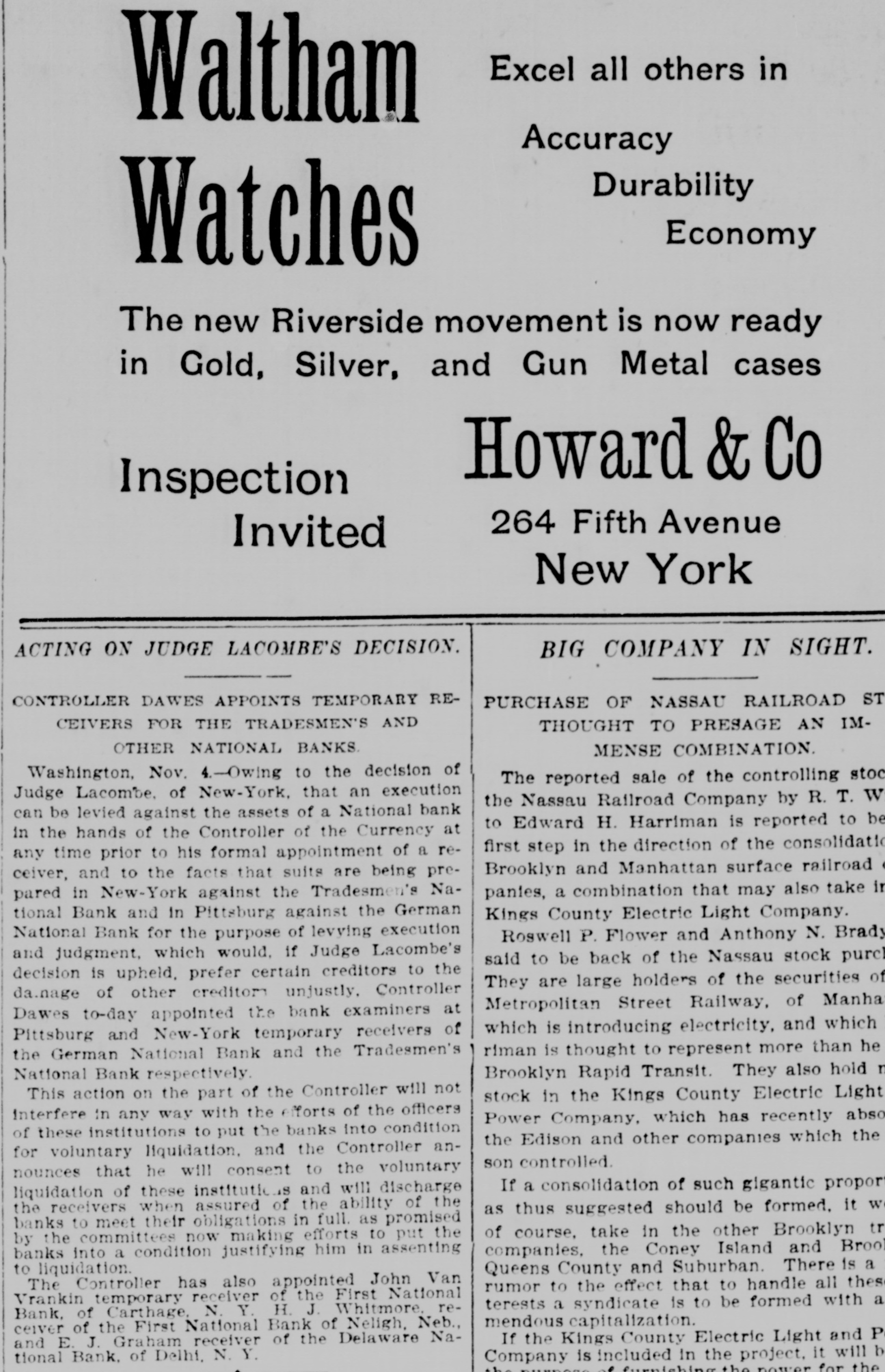
Excel all others in Waltham Accuracy Durability Economy Watches The new Riverside movement is now ready in Gold, Silver, and Gun Metal cases Howard & Co Inspection 264 Fifth Avenue Invited New York ACTING ON JUDGE LACOMBE'S DECISION. BIG COMPANY IN SIGHT. CONTROLLER DAWES APPOINTS TEMPORARY REPURCHASE OF NASSAU RAILROAD ST CEIVERS FOR THE TRADESMEN'S AND THOUGHT TO PRESAGE AN IMOTHER NATIONAL BANKS MENSE COMBINATION. Washington, Nov. 4.-Owing to the decision of The reported sale of the controlling stoc Judge Lacombe, of New-York, that an execution the Nassau Railroad Company by R. T. W can be levied against the assets of a National bank to Edward H. Harriman is reported to be in the hands of the Controller of the Currency at first step in the direction of the consolidati any time prior to his formal appointment of a reBrooklyn and Manhattan surface railroad ceiver, and to the facts that suits are being prepanies, a combination that may also take in pared in New-York against the Tradesmen's National Bank and in Pittsburg against the German Kings County Electric Light Company. National Bank for the purpose of levying execution Roswell P. Flower and Anthony N. Brady and judgment, which would. if Judge Lacombe's said to be back of the Nassau stock purch decision is upheld, prefer certain creditors to the They are large holders of the securities of da.nage of other creditory unjustly. Controller Metropolitan Street Railway, of Manha Dawes to-day appointed the bank examiners at which is introducing electricity, and which Pittsburg and New-York temporary receivers of riman is thought to represent more than he the German National Bank and the Tradesmen's National Bank respectively. Brooklyn Rapid Transit. They also hold This action on the part of the Controller will not stock in the Kings County Electric Light interfere in any way with the fforts of the officers Power Company, which has recently abso of these institutions to put the banks into condition the Edison and other companies which the for voluntary liquidation, and the Controller anson controlled nounces that he will consent to the voluntary If a consolidation of such gigantic propor liquidation of these institutic and will discharge the receivers when assured of the ability of the as thus suggested should be formed, it W banks to meet their obligations in full. as promised of course, take in the other Brooklyn tr by the committees now making efforts to put the companies, the Coney Island and Broo banks into a condition justifying him in assenting to liquidation. Queens County and Suburban. There is a The Controller has also appointed John Van rumor to the effect that to handle all thes Vrankin temporary receiver of the First National terests a syndicate is to be formed with a Bank, of Carthage, N. Y. H. J. Whitmore, remendous capitalization. ceiver of the First National Bank of Neligh, Neb., If the Kings County Electric Light and P and E. J. Graham receiver of the Delaware National Bank, of Delhi, N. Y. Company is included in the project, it will b furnishing the


Article from The Indianapolis Journal, November 5, 1898

Click image to open full size in new tab

Article Text

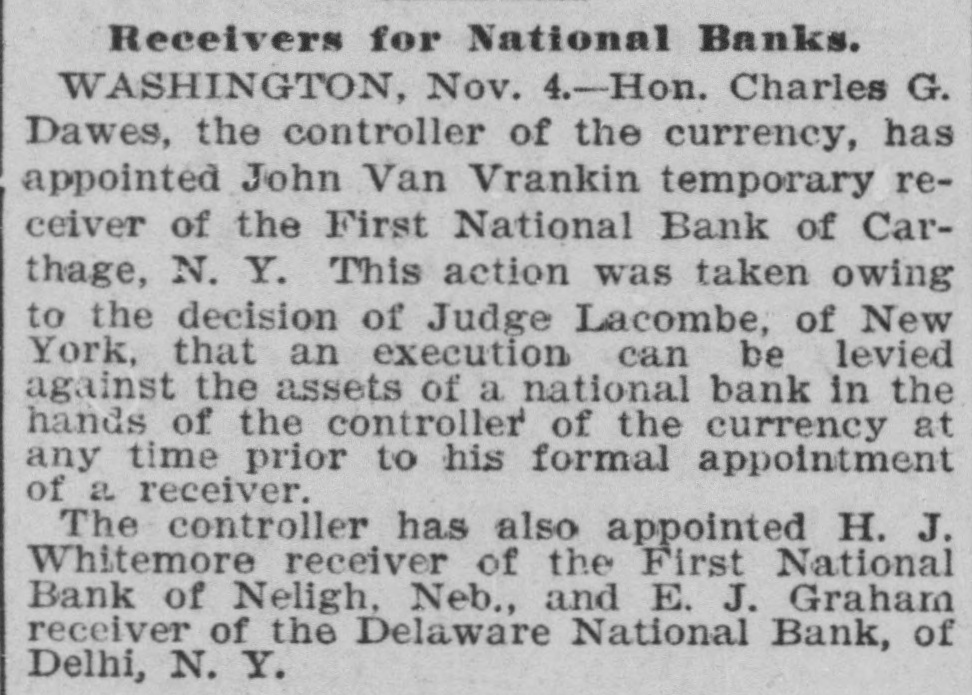
Receivers for National Banks. WASHINGTON, Nov. 4.-Hon. Charles G. Dawes, the controller of the currency, has appointed John Van Vrankin temporary receiver of the First National Bank of Carthage, N. Y. This action was taken owing to the decision of Judge Lacombe, of New York, that an execution can be levied against the assets of a national bank in the hands of the controller of the currency at any time prior to his formal appointment of a receiver. The controller has also appointed H. J. Whitemore receiver of the First National Bank of Neligh, Neb., and E. J. Graham receiver of the Delaware National Bank, of Delhi, N. Y.


Article from The Enterprise, November 9, 1898

Click image to open full size in new tab

Article Text

EAST. The New York board of education has decided that no teacher in Greater New York's public schools could hold her position after marriage. The "her" in the resolution is emphasized as it is held that a male teacher may marry and retain his position. The decision will affect married women who arenow employed as teachers in the schools. The resumption of window glass factories in the Pittsburg district on the 3d was not as general as was expected, but a good start was made and the manufacturers expect that the split in the ranks of the blowers and gatherers will soon result in a resumption in full. From the opening of navigation to date shipments of grain by the Erie total 20,844,783 bushels, as against 21,940,180 bushels last year and 32,146,385 bushels in 1896. There has been no shipment of flour so far this season. A broken axle caused the wreck of 16 coal cars on the Lehigh Valley railroad near White Haven, Pa., on the night of the 1st. While walking to the wreck Edward Teel and Samuel Steener, of White Haven, were struck by an engine and killed. The long threatened trust among the manufacturers of envelopes has evidently become a fact as the paper stationery trade have received circulars quoting an advance averaging 25 per cent. in all grades of envelopes. The trust is said to control 90 per cent. of the production. A temporary receiver for the First national bank of Carthage, N. Y., has been appointed by the comptroller of the currency. The steamer Kaiser Wilhelm has landed 17 Cubans at New York City who were released from the Spanish prison at Ceuta recently. They were sent to this country at the expense of the United States government and are the first batch of released political prisoners to arrive in New York. They will be returned to Cuba. For the week ended November 4 business failures in the United States numbered 194, as compared with 276 for the corresponding period of last year, and 28 in Canada, as against 30 for the same time in 1897. The Rutland & Canada railroad bill passed the senate at Montpelier, Vt., on the 4th. It had previously passed the house. The bill incorporates the Rutland & Canada Railroad Co. with a capital stock of $1,000,000, giving it the right to construct a road from Burlington to the Canadian line. The construction of this line will give the Vanderbilts a line from New York to Canada and the great lakes. The Maritana, a big steel freight steamer, crashed into the Starucca, a steel freighter belonging to the Erie Railroad Co. at Buffalo, N. Y., on the night of the 3d. The Starucca sank in 25 feet of water, with a huge hole in her side. The damage is estimated at about $20,000. The steamer will be raised. The motion for a temporary injunction compelling express companies to pay the one-cent stamp tax on express receipts has been denied by Judge Lacombe in the United States circuit court at New York City. A very serious accident has happened to ex-Gov. Roswell Farnham and he now lies in a critical condition with concussion of the brain at his home in Bradford, Vt. He fell from a railway station platform. For the week ended November 5, the statement of the New York clearing house banks shows an actual loss of $5,190,200 in specie and legal tenders and the reserve suffered a loss of over $7,000,000. The death of Hugh H. Cole, a prominent lawyer, occurred at New York City on the 5th. He assisted in the prosecution of the Tweed ring. The well-known writer on political economy, David A. Wells, died at Norwich, Conn., on the 5th. WEST AND SOUTH. The city council of St. Louis has
Article from Barre Evening Telegram, November 15, 1898

Click image to open full size in new tab

Article Text

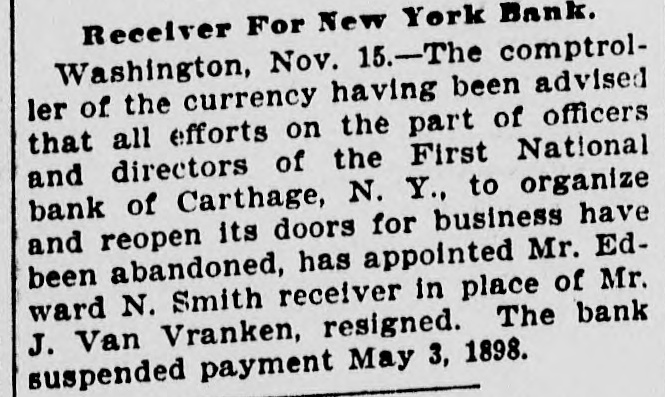
Receiver For New York Bank. Washington, Nov. 15.-The comptroller of the currency having been advised that all efforts on the part of officers and directors of the First National bank of Carthage, N. Y., to organize and reopen its doors for business have been abandoned, has appointed Mr. Edward N. Smith receiver in place of Mr. J. Van Vranken, resigned. The bank suspended payment May 3, 1898.


Article from Delaware Gazette and State Journal, November 17, 1898

Click image to open full size in new tab

Article Text

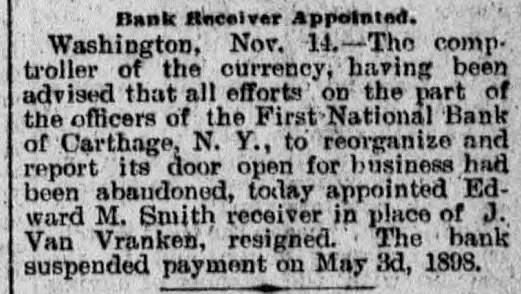
Bank Receiver Appointed. Washington, Nov. 14. - -The comp. troller of the currency, having been advised that all efforts on the part of the officers of the First National Bank of Carthage, N. Y., to reorganize and report its door open for business had been abaudoned, today appointed Edward M. Smith receiver in place of J. Van Vranken, resigned. The bank suspended payment on May 3d, 1898.


Article from New-York Tribune, June 17, 1901

Click image to open full size in new tab

Article Text

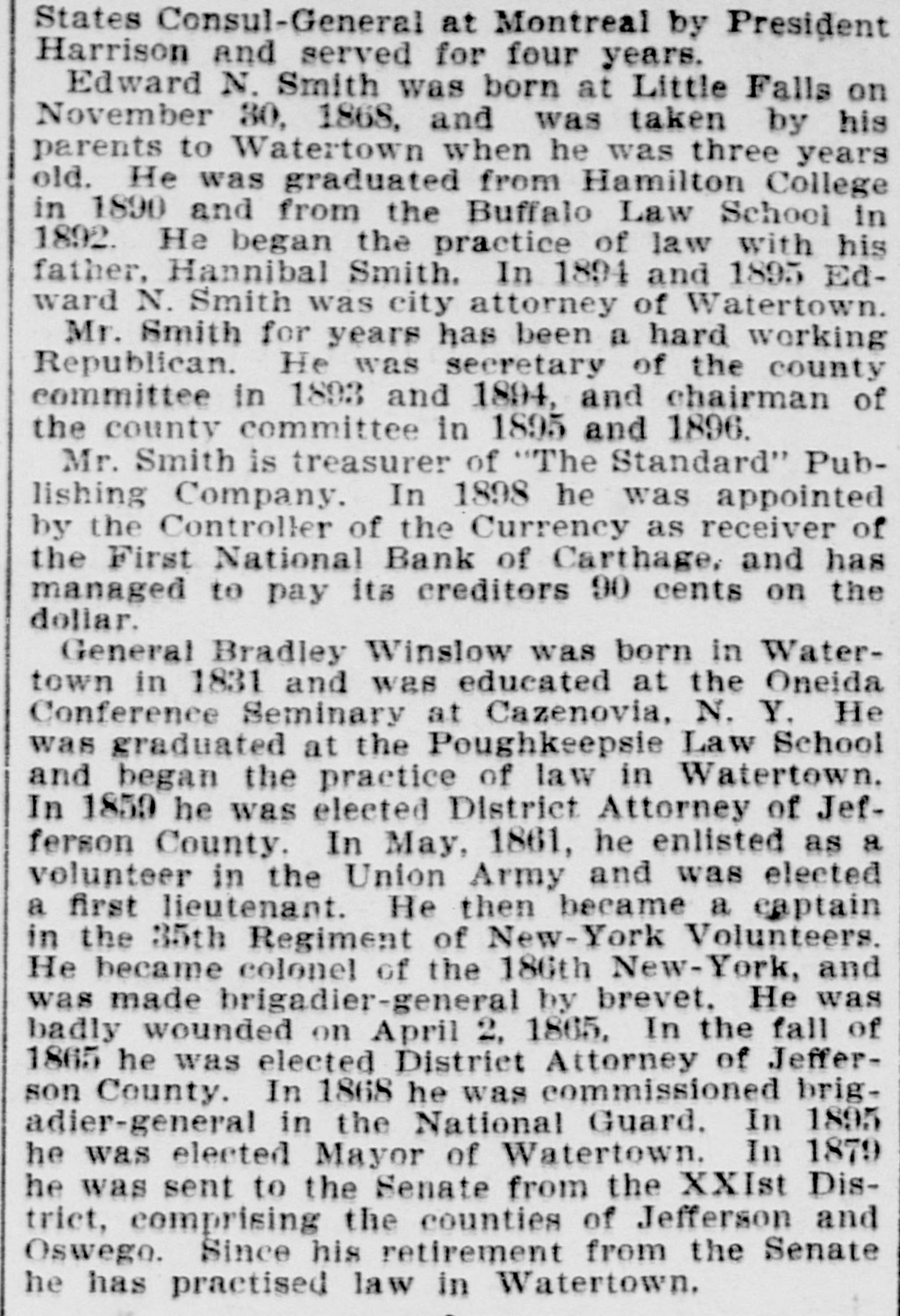
States Consul-General at Montreal by President Harrison and served for four years. Edward N. Smith was born at Little Falls on November 30, 1868, and was taken by his parents to Watertown when he was three years old. He was graduated from Hamilton College in 1890 and from the Buffalo Law School in 1892. He began the practice of law with his father, Hannibal Smith. In 1894 and 1895 Edward N. Smith was city attorney of Watertown. Mr. Smith for years has been a hard working Republican. He was secretary of the county committee in 1893 and 1894, and chairman of the county committee in 1895 and 1896. Mr. Smith is treasurer of "The Standard" Publishing Company. In 1898 he was appointed by the Controller of the Currency as receiver of the First National Bank of Carthage, and has managed to pay its creditors 90 cents on the dollar. General Bradley Winslow was born in Watertown in 1831 and was educated at the Oneida Conference Seminary at Cazenovia, N. Y. He was graduated at the Poughkeepsie Law School and began the practice of law in Watertown. In 1859 he was elected District Attorney of Jefferson County. In May, 1861, he enlisted as a volunteer in the Union Army and was elected a first lieutenant. He then became a captain in the 35th Regiment of New-York Volunteers. He became colonel of the 186th New-York, and was made brigadier-general by brevet. He was badly wounded on April 2, 1865, In the fall of 1865 he was elected District Attorney of Jefferson County. In 1868 he was commissioned brigadier-general in the National Guard. In 1895 he was elected Mayor of Watertown. In 1879 he was sent to the Senate from the XXIst Distriet, comprising the counties of Jefferson and Oswego. Since his retirement from the Senate he has practised law in Watertown.