Homestead Bank (New York, NY)

Episode Information

Episode UID
2451527091084
Episode Type
Suspension โ†’ Closure
Bank Type
state
Bank ID
245152709 hash
Start Date
April 29, 1890
Location
New York, New York (40.714, -74.006)

Metadata

Model
gpt-5-mini (chosen from majority vote of a three-model LLM ensemble)
Short Digest
ff7a28a657bf09fd

Response Measures

None

Events (1)

1. April 29, 1890 Suspension
Cause
Local Banks
Cause Details
Falling off in deposits after many accounts were withdrawn when the Sixth National, Lenox Hill and Equitable banks were in trouble; generally described as 'bad business'.
Newspaper Excerpt
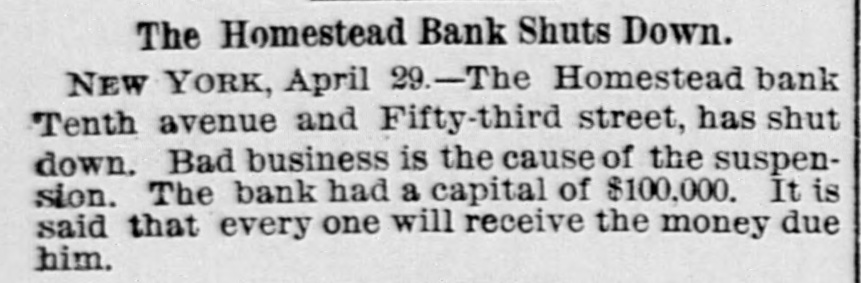
The Homestead bank, at Tenth avenue and Fifty-third street, has shut down. Bad business was the cause of the suspension. The bank had a capital of $100,000. It is said that every one will receive the money due to him.
Source
newspapers

Newspaper Articles (14)

Article from Fort Worth Daily Gazette, March 6, 1890

Click image to open full size in new tab

Article Text

SPECULATIVE. Wanamaker's Postal Telegraph Scheme Continues to Bear Western Union. How a Bank was Dangerously Near the Closing-Up Point-The Market stagnant Treasury Fond Paying. Special to the Gazette. NEW YORK, March 5.-There was some disappointment reflected in this morning's market over the lack of the confirmation of yesterday's report that the treasury would resume free bond purchases. Added to this was the growing expectation of another bad bank statement for Saturday. No aggressive support was developed by yesterday's rallies: accordingly the bears began to put out short stock again. The movement of the forenoon was irregular. Louisville and Nashville declined ยฝ, New England 3/4. New Jersey Central 3/4. Northern Facific preferred ยฝ, Reading โท/โ‚ˆ Tennessee coal 1ยฝ, Western Union 5/a. On the other hand grangers were firm as a rule. Lackawanna was well held and Union Pacific gained 3/8, while Manbattan opened two points higher, and sugar trusts gained 1ยฝ. Outside of Reading, New Jersey Central and Louisville and Nashville, the weak stocks rallied materially before noon, Tennessee coal gaining a point and New England 5/8 over the lowest figures of the forenoon. The early afternoon market developed little change from noon prices and speculation continued dull. Reading continued to supply demoralization in the later afternoon market and declined further on exceptionally heavy selling. Sugar was bid up again to a high figure. Generally the market was dull and a trifle lower. Tennessee coal was sent down again on stop orders. Dispatches of the afternoon indicated with a reasonable approach to certainty that treasury bond buying would be resumed, and hence the feeling was better. The fall in Reading was attributed to liquidation by some of the large Philadelphia holders, and was accelerated by sales for the short account. Large blocks of stock were sold by individual brokers, and the only noteworthy sensation in to-day's work outside of Manhattan was supplied by the movements in this stock. Investors have been dumbfounded at seeing Western Union going down on Wanamaker's postal telegraph scheme, which they do not think amounts to a row of pins. In face of the earnings at the rate of per cent. of increase, and a belief that it is Jay Gould's pet investment for his surplus, the bears have knocked it off 5 points since the last dividend, which, with the extra 3/4 made 2 per cent. C. P. Huntington was asked this morning about the contracts reported to have just been made in San Francisco between the Union Pacific and the Japan people for a line of steamers between Portland and Asiatic ports. He stated that he did not believe the report was true, although he knew nothing about it. He based his belief upon the fact that there are not extra steamers for use at San Francisco, and such contracts would have to be made in Boston and not in San Francisco. Referring to the proposed use of the Pacific Mail steamers between Tacoma and Asiatic ports by the Northern Pacific, he said: ''I am a director of the Pacific Mail and want to do what is best for the interests of the Pacific Mail. I have also large 8 railroad interests. The Northern Pacific people claim that it will make a difference of $30,000 a year in favor of the Pacific Mail company if the present payment by the railroads is also kept up. But the establishment of the line may endanger railroad payt ments, which amount to $75,000 a r month, and I don't see where the money will come in to the Pacific Mail to make up for these payments if they are stopped. 1 The Homestead bank, at Fifty-Third street and Tenth avenue, came very near closing up to-day. When it was organized, two years ago, certain of the r notes it had taken from the Ninth Avenue bank, whose successor it was, were considered by the bauk examiners to have impaired its capital stock to the extent of $15,561.40. Last October Dept uty Superintendent Charles B. Hall, of 14 the stare banking department, reported I to the department that the impairment had existed some time, and recommend-

Article from Daily Kennebec Journal, April 30, 1890

Click image to open full size in new tab

Article Text

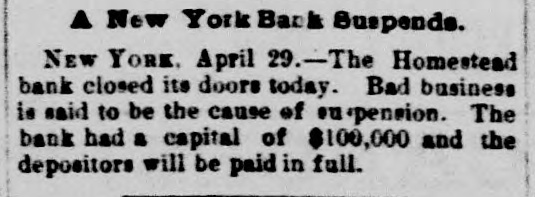
New York Back Suspends. NEW YORK. April 29.-The Homestead bank closed its doors today. Bad business is said to be the cause of outpension. The bank had a capital of $100,000 and the depositors will be paid in full.


Article from The Portland Daily Press, April 30, 1890

Click image to open full size in new tab

Article Text

The Homestead Bank, New York city, has suspended.


Article from The Helena Independent, April 30, 1890

Click image to open full size in new tab

Article Text

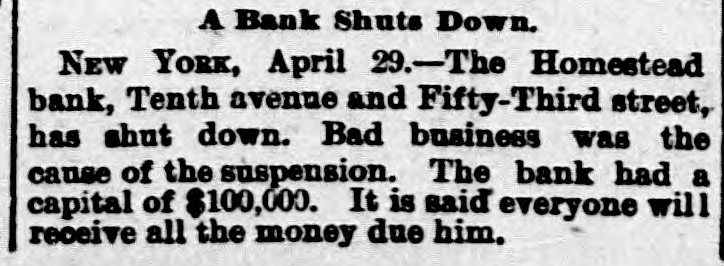
A Bank Shuts Down. NEW YORK, April 29.-The Homestead bank, Tenth avenue and Fifty-Third street, has shut down. Bad business was the cause of the suspension. The bank had a capital of $100,000. It is said everyone will receive all the money due him.


Article from The Anaconda Standard, April 30, 1890

Click image to open full size in new tab

Article Text

A Bank Shuts Down. NEW YORK, April 29.-The Homestead bank. Tenth avenue and 53d street has shut down. Bad business was the cause of the suspension. The bank had a capital of $100,000. It is said every one will receive the money due him.


Article from Waterbury Evening Democrat, April 30, 1890

Click image to open full size in new tab

Article Text

New York Bank Suspends. NEW YORK, April 30.-The Homestead Bank has closed its doors and is now in the hands of N. A. Chapman. Bad business is said to be the cause of its suspension. It is said the depositors will be paid in full.


Article from New-York Tribune, April 30, 1890

Click image to open full size in new tab

Article Text

THE HOMESTEAD BANK TO BE CLOSED. All the depositors of the Homestead Bank, at Tenthave. and Fifty-third-st., have beeh asked to withdraw their accounts, and the bank will close its doors probably in a few days. It is now in the hands of N. A. Chapman, who was formerly connected with the Western National Bank and helped to wind up the affairs of the Equitable Bank after it got clear of the Sixth National wreck. Bad business is the cause of the suspension. The Homestead Bank had a capital It has been patronized by the of $100,000. small storekeepers and private citizens of its immediate vicinity. Its situation is considered a good one by bankers generally, but the business of the bank has so steadily decreased since the recent bank troubles that it was compelled a few days ago to refuse deposits. The bank's officials say that every depositor will receive the money due him. At the Western National Bank President Ives said that the Homestead Bank had cleared through his institution, and that the suspended bank would pay its accounts in full. He had learned that the Homestead


Article from Deseret Evening News, April 30, 1890

Click image to open full size in new tab

Article Text

A New York Bank Failure. NEW YORK, April 29. - The Homestead Bank, at Tenth Avenue and Fifty-third Street has shut down. Bad business was the cause of suspension. The bank had a capital of $100,000. It is said that every one will receive the money due to him. Be 110m


Article from Rock Island Daily Argus, April 30, 1890

Click image to open full size in new tab

Article Text

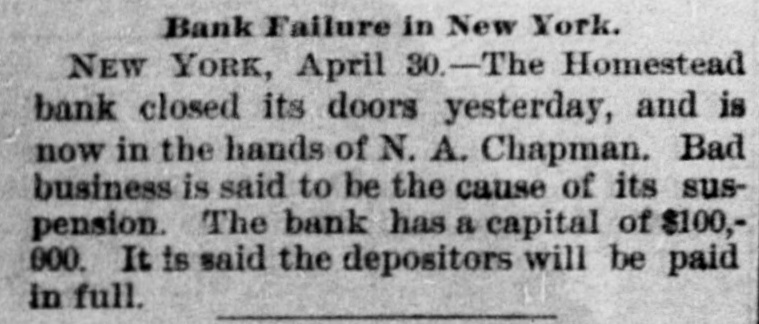
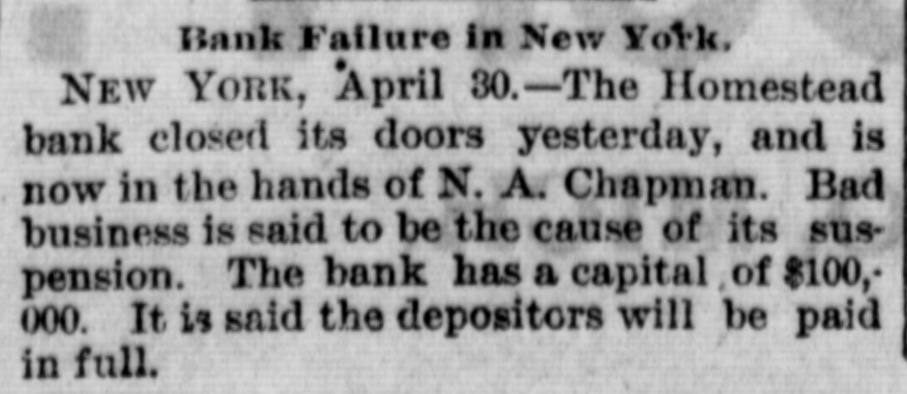
Bank Failure in New York. NEW YORK, April 30.-The Homestead bank closed its doors yesterday, and is now in the hands of N. A. Chapman. Bad business is said to be the cause of its suspension. The bank has a capital of $100,000. It is said the depositors will be paid in full.


Article from Morning Journal and Courier, April 30, 1890

Click image to open full size in new tab

Article Text

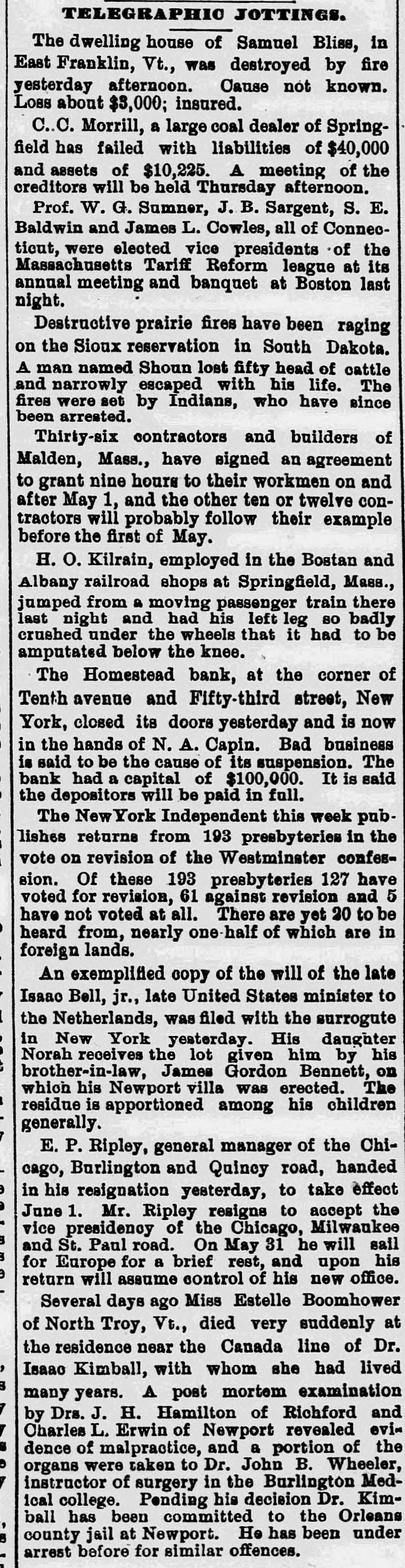
TELEGRAPHIO JOTTINGS. The dwelling house of Samuel Bliss, in East Franklin, Vt., was destroyed by fire yesterday afternoon. Cause not known. Loss about $3,000; insured. C..C. Morrill, a large coal dealer of Springfield has failed with liabilities of $40,000 and assets of $10,225. A meeting of the creditors will be held Thursday afternoon. Prof. W. G. Sumner, J. B. Sargent, S. E. Baldwin and James L. Cowles, all of Connecticut, were elected vice presidents of the Massachusetts Tariff Reform league at its annual meeting and banquet at Boston last night. Destructive prairie fires have been raging on the Sioux reservation in South Dakota. A man named Shoun lost fifty head of cattle and narrowly escaped with his life. The fires were set by Indians, who have since been arrested. Thirty-six contractors and builders of Malden, Mass., have signed an agreement to grant nine hours to their workmen on and after May 1, and the other ten or twelve contractors will probably follow their example before the first of May. H. O. Kilrain, employed in the Bostan and Albany railroad shops at Springfield, Mass., jumped from a moving passenger train there last night and had his left leg SO badly crushed under the wheels that it had to be amputated below the knee. The Homestead bank, at the corner of Tenth avenue and Fifty-third street, New York, closed its doors yesterday and is now in the hands of N. A. Capin. Bad business is said to be the cause of its suspension. The bank had a capital of $100,000. It is said the depositors will be paid in full. The New York Independent this week publishes returns from 193 presbyteries in the vote on revision of the Westminster confession. Of these 193 presbyteries 127 have voted for revision, 61 against revision and 5 have not voted at all. There are yet 20 to be heard from, nearly one-half of which are in foreign lands. An exemplified copy of the will of the late Isaac Bell, jr., late United States minister to the Netherlands, was filed with the surrogute in New York yesterday. His daughter Norah receives the lot given him by his brother-in-law, James Gordon Bennett, on which his Newport villa was erected. The residue is apportioned among his children generally. E. P. Ripley, general manager of the Chicago, Burlington and Quincy road, handed in his resignation yesterday, to take effect June 1. Mr. Ripley resigns to accept the vice presidency of the Chicago, Milwaukee and St. Paul road. On May 31 he will sail for Europe for a brief rest, and upon his return will assume control of his new office. Several days ago Miss Estelle Boomhower of North Troy, Vt., died very suddenly at the residence near the Canada line of Dr. Isaao Kimball, with whom she had lived many years. A post mortem examination by Drs. J. H. Hamilton of Richford and Erwin of revealed evi of a dence Charles L. malpractice, Newport and portion of the organs were taken to Dr. John B. Wheeler, instructor of surgery in the Burlington Medical college. Pending his decision Dr. Kimball has been committed to the Orleans county jail at Newport. He has been under arrest before for similar offences.


Article from The Salt Lake Herald, April 30, 1890

Click image to open full size in new tab

Article Text

The Homestead Bank Shuts Down. NEW YORK, April 29.-The Homestead bank Tenth avenue and Fifty-third street, has shut down. Bad business is the cause of the suspension. The bank had a capital of $100,000. It is said that every one will receive the money due him.


Article from The Daily State Chronicle, May 1, 1890

Click image to open full size in new tab

Article Text

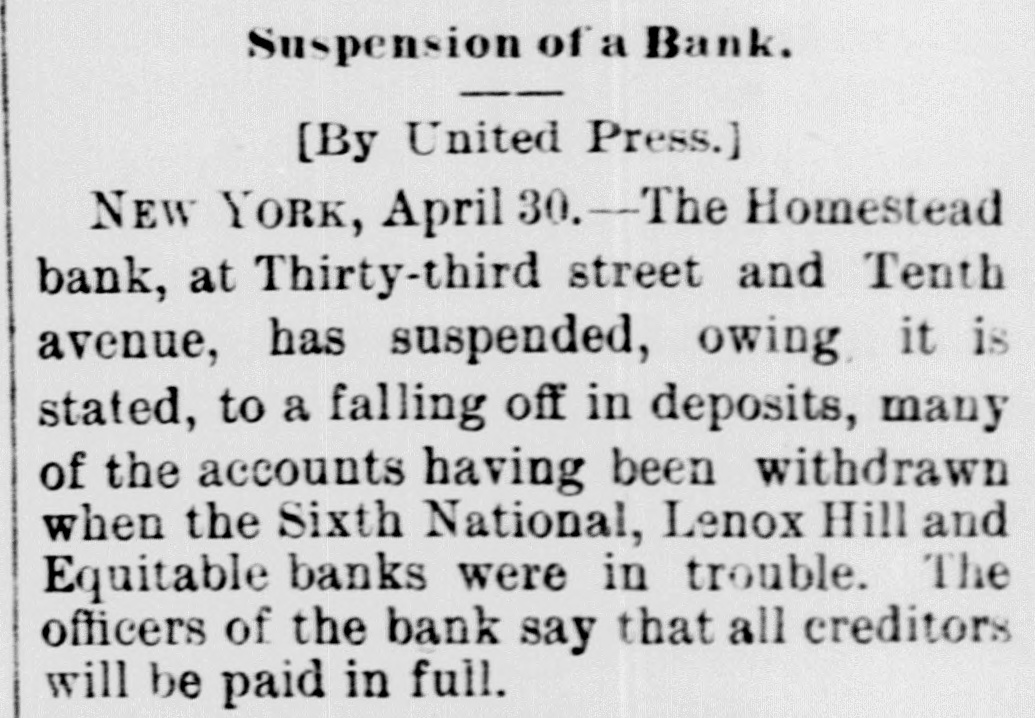
Suspension of a Bank. [By United Press.] NEW YORK, April 30.--The Homestead bank, at Thirty-third street and Tenth avenue, has suspended, owing it is stated, to a falling off in deposits, many of the accounts having been withdrawn when the Sixth National, Lenox Hill and Equitable banks were in trouble. The officers of the bank say that all creditors will be paid in full.


Article from The Times, May 2, 1890

Click image to open full size in new tab

Article Text

Bank Failure in New York. NEW YORK, April 30.-The Homestead bank closed its doors yesterday, and is now in the hands of N. A. Chapman. Bad business is said to be the cause of its suspension. The bank has a capital of $100,000. It is said the depositors will be paid in full.


Article from Pittsburg Dispatch, January 1, 1891

Click image to open full size in new tab

Article Text

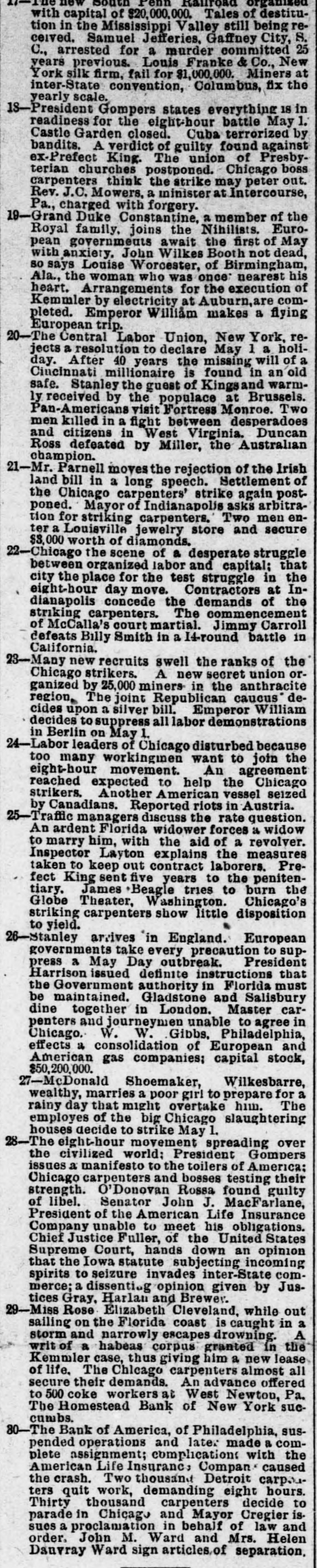
uner unos men ent with capital of $20,000,000. Tales of destituPre- Dated III38 seller Addissional the up uon cerved. Samuel Jefferies, Gaffney City, S. C., arrested for a murder committed 25 years previous. Louis Franke & Co., New York silk firm, fail for $1,000,000. Miners at inter-State convention, Columbus, fix the yearly scale. -President Gompers states everything 18 in readiness for the eight-hour battle May 1. Castle Garden closed. Cuba terrorized by bandits. A verdict of guilty found against ex-Prefect King. The union of Presbyterian churches postponed. Chicago boss carpenters think the strike may peter out. Rev. J.C. Mowers, a minister at Intercourse, Pa., charged with forgery. -Grand Duke Constantine, a member of the Royal family, joins the Nihilists. European governmeuts await the first of May with anxiety, John Wilkes Booth not dead, so says Louise Worcester, of Birmingham, Ala., the woman who was once: nearest his heart. Arrangements for the execution of Kemmler by electricity at Auburn,are completed. Emperor William makes a flying European trip. -The Central Labor Union, New York, rejects a resolution to declare May 1 a holiday. After 40 years the missing will of a Cincinnati millionaire is found in an old safe. Stanley the guest of Kingsand warmly received by the populace at Brussels. Pan-Americans visit Fortress Monroe. Two men killed in a fight between desperadoes and citizens in West Virginia. Duncan Ross defeated by Miller, the Australian champion. 1-Mr. Parnell moves the rejection of the Irish land bill in a long speech. Settlement of the Chicago carpenters' strike again postponed. Mayor of Indianapolis asks arbitration for striking carpenters. Two men enter a Louisville jewelry store and secure "spuomerip JO 42.10M 000'8$ -Chicago the scene of a desperate struggle between organized labor and capital; that city the place for the test struggle in the eight-hour day move. Contractors at Indianapolis concede the demands of the striking carpenters. The commencement of McCalla's court martial. Jimmy Carroll ut battle punos+1 e up quitte Billy coffets California. -Many new recruits swell the ranks of the Chicago strikers. A new secret union organized by 25,000 miners in the anthracite region. The joint Republican caucus decides upon a silver bill. Emperor William decides to suppress all labor demonstrations T May no Berrin up 1-Labor leaders of Chicago disturbed because too many workingmen want to join the eight-hour movement. An agreement reached expected to help the Chicago strikers. Another American vessel seized by Canadians. Reported riots in Austria. 5-Traffic managers discuss the rate question. An ardent Florida widower forces a widow to marry him, with the aid of a revolver. Inspector Layton explains the measures taken to keep out contract laborers. Prefect King sent five years to the penitentiary. James Beagle tries to burn the Globe Theater, Washington. Chicago's striking carpenters show little disposition Pield 01 -Stanley arrives in England. European governments take every precaution to suppress a May Day outbreak. President Harrison issued definite instructions that 1snw III anthority eqq be maintained. Gladstone and Salisbury dine together in London. Master carpenters and journeymen unable to agree in Chicago. W. W. Gibbs, Philadelphia, effects a consolidation of European and American gas companies; capital stock, $50,200,000. 27-McDonald Shoemaker, Wilkesbarre, wealthy, marries a poor girl to prepare for a rainy day that might overtake him. The employes of the big Chicago slaughtering houses decide to strike May 1. -The eight-hour movement spreading over the civilized world: President Gompers issues a manifesto to the toilers of America: Chicago carpenters and bosses testing their strength. O'Donovan Rossa found guilty of libel. Senator John J. MacFarlane, President of the American Life Insurance Company unable to meet his obligations. Chief Justice Fuller, of the United States Supreme Court, hands down an opinion that the Iowa statute subjecting incoming spirits to seizure invades inter-State commerce; a dissenting opinion given by Justices Gray, Harlan and Brewer. -Miss Rose Elizabeth Cleveland, while out sailing on the Florida coast is caught in a storm and narrowly escapes drowning. A writ of a habeas corpus granted in the Kemmler case, thus giving him a new lease of life. The Chlcago carpenters almost all secure their demands. An advance offered to 500 coke workers at West Newton, Pa. The Homestead Bank of New York suecumbs. -The Bank of America, of Philadelphia, suspended operations and later made a complete assignment; complications with the