Schuylkill Bank (Philadelphia, PA)

Episode Information

Episode UID
2487869590478
Episode Type
Run โ†’ Suspension โ†’ Closure
Bank Type
state
Bank ID
248786959 hash
Start Date
October 10, 1839
Location
Philadelphia, Pennsylvania (39.952, -75.164)

Metadata

Model
gpt-5-mini (chosen from majority vote of a three-model LLM ensemble)
Short Digest
b7ccbe48df593b0c

Response Measures

None

Description

A run in Oct. 1839 precipitated a city-wide suspension; subsequent discovery of cashier fraud and a court injunction led to receivership.

Events (5)

1. October 10, 1839 Run
Cause
Rumor Or Misinformation
Cause Details
A severe run reportedly precipitated by a small newspaper item that spurred withdrawals.
Measures
All Philadelphia banks suspended specie payments city-wide in response.
Newspaper Excerpt
This measure has been precipitated in consequence of a severe run upon the Schuylkill Bank, caused by one of the small papers here.
Source
newspapers
2. December 18, 1839 Receivership
Newspaper Excerpt
place its affairs in the hands of receivers; in addition to the large amount of fraudulent certificates issued by the late cashier ... over-drafts to a very large amount have been made with his connivance.
Source
newspapers
3. December 18, 1839 Suspension
Cause
Government Action
Cause Details
Court injunction (suit by the Bank of Kentucky) stopped payments and led to receivership.
Newspaper Excerpt
An injunction was yesterday granted by Judge Hopkinson ... The effect of this is to stop the payments to its note-holders ... and to place its affairs in the hands of receivers.
Source
newspapers
4. December 20, 1839 Other
Newspaper Excerpt
false certificates of stock ... had been issued by H. J. Levis, cashier of the Schuylkill Bank ... the Directors announce ... they have found themselves compelled to suspend their payments for the present.
Source
newspapers
5. March 31, 1849 Other
Newspaper Excerpt
The suit ... was finally settled ... the Schuylkill Bank ... pay unto the Bank of Kentucky ... This decision will sweep away the entire assets of the Schuylkill Bank ... receivers appointed to hold the funds
Source
newspapers

Newspaper Articles (18)

Article from Morning Herald, October 10, 1839

Click image to open full size in new tab

Article Text

POSTSCRIPT. BY THIS MORNING'S BOAT. [Private Correspondence.] Important from Philadelphia-Suspension of Specio Payments-Resuita of the Election. PHILADELPHIA, Wednesday Morning. DEAR SIR:-All the banks suspended specie payments this morning. The North American and Commercial tried to stick it out, but were obliged to come into the measure before noon. Although the measure was not expected so soon, yet it has not created any great sensation. It appears that the Girard Bank has had it in contemplation so long that, immediately after it opened this morning, it paid out newly-engraved one dollar bills! This measure has been precipitated in consequence of a severe run upon the Schuylkill Bank, caused by one of the small papers here. The banks would have suspended yesterday morning, had it not been for the election. Had they suspended twenty-four hours sooner, Mr. Kane, the lecofoce candidate, would have been mayor of the city. As it is, the whig majority in this city has been reduced about 1800 since the election of last year, this is owing to three circumstances; the bad conduct of the banks and whig leaders, the apathy of the electors, and the bad accommodations for voting, the facilities not being sufficient to enable all the electors to vote in one day as the law requires. There were two whig candidates for mayor; Swift had but 49 votes over Kane; but as he had not a majority of the whole number, the Common Council have to elect a mayor, there being no choice by the people; and they being whig, of course will elect Swift. This is the first year that the people ever voted for mayor; the choice always being by the Council before. The whigs have still a majority in all the wards in this city for city officers exclusively, except in the Upper Delaware Ward; and have caried all their city officers; but the locofocos have carried all the county officers. The effect of the suspension upon business has been beneficial. All the Western and Southern merchants in the city are delighted at the movement. Money fell today from 21 to 1 per cent. Nothing could have saved many of the Philadelphia merchants and banks from utter ruin, but this movement. Two millions in specie would have had to leave for New York in three weeks. The Insurance Offices and Brokers ran the banks very hard for specie, on Monday and Tuesday; but it was not till near midnight last night, that the measure was determined upon by a private committee from the Banks and the Board of Trade.
Article from Richmond Enquirer, November 12, 1839

Click image to open full size in new tab

Article Text

VIEWS on the Bank Suspension. EXTRACTS from a late Letter of an intelligent Observer. "The Banks of Philadelphia would have suspended sooner than they did, but for the election of the 8th Oc. tober. There were various little signs and hints in the Whig papers, which satisfied me the Bank of the U S was waiting for a fair pretence to stop payment, which I thought would be afforded by the return of the Liverpool. But its necessities were so great, that it could not wait for that event. The notes of the Schuylkill Bank had been rejected at the Bank counters, on the 7th or 8th, and great distrust was entertained of the Girard Bank. It was known, that the post notes of the U. S. Bank were falling due, and it was thought by the judicious, that it never would have resorted to such an expedient to raise money, but from the failure of other means to provide for their liabilities in Europe. Hence, R suspen. sion ought to have been anticipated as to that Bank and its affiliated institutions, if indeed the system itself were not so radically vicious as to justify an anticipation of danger from every fluctuation of the money market in Europe. "What sort of a system is that, which its advocates admit may be utterly deranged by a bad crop in England or by the prohibition of the Opium trade in China? The Experiment has now, at least, been fairly tried. The action of the Government has, for the last 12 months, been altogether favorable to the Banks. Its issue of Treasury notes aided the merchants in paying their duty bonds, and prevented the withdrawal of so much specie from their vaults. It has extended credit to the spec ie. paying Banks, and given extraordinary indulgences. It has employed the Banks to a very considerable extent, as the depositories of the public money, in consequence of the neglect of Congress to provide for its security in the hands of the public officers, and it it had not been for the great securities they have taken, it might have incurred serious losses from the confidence it has been forced to repose in them. In short. 88 the Globe save,


Article from The Madisonian, December 21, 1839

Click image to open full size in new tab

Article Text

PHILADELPHIA, Dec. 18. THE SCHUYLKILL BANK.-An injunction was yesterday granted by Judge Hopkinson, of the U. S. District Court, against this institution, at the suit of the Bank of Kentucky. The effect of this is to stop the payments to its note-holders, in which it was yesterday engaged, and to place its affairs in the hands of receivers. In addition to the large amount of fraudulent certificates issued by the late cashier, we learn that over-drafts to a very large amount have been made with his connivance. Other rumors of various kinds are in circulation in regard to it, against too hasty a credence of which we would guard the public. The true affair is bad enough, without any necessity of embellishment from the thousand and one crude stories which are afloat.-North American.


Article from Morning Herald, December 23, 1839

Click image to open full size in new tab

Article Text

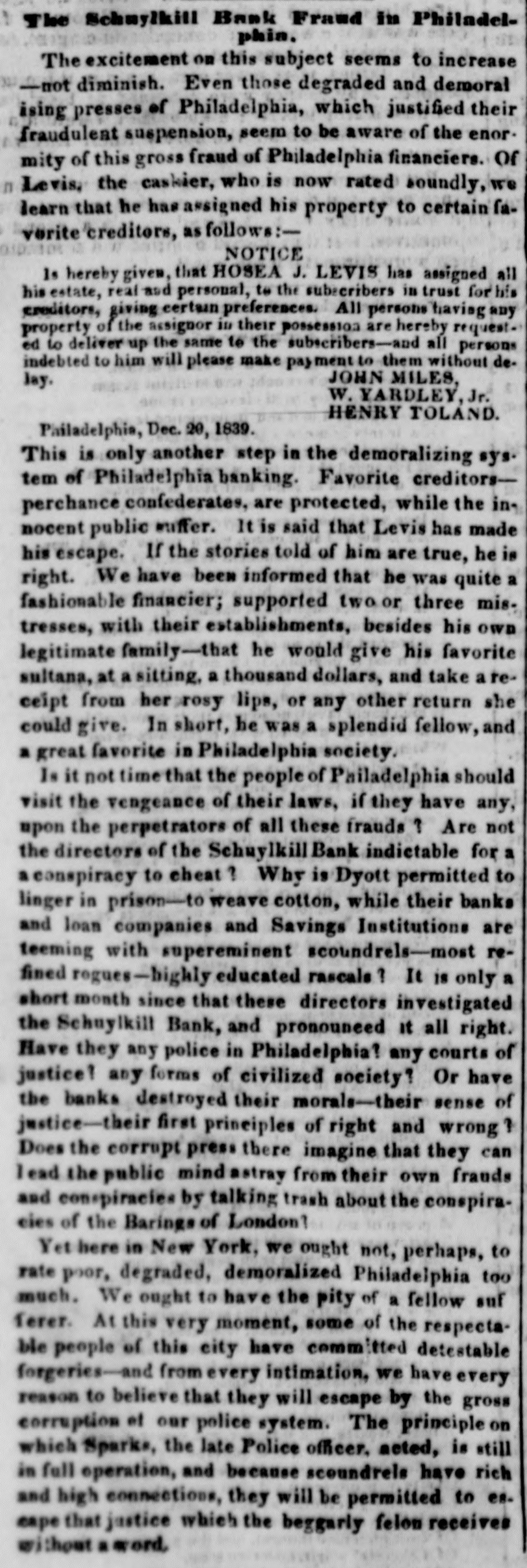
The Schnylkill Bank Fraud in Philadelphin. The excitement on this subject seems to increase -not diminish. Even those degraded and demoral ising presses of Philadelphia, which justified their fraudulent suspension, seem to be aware of the enor. mity of this gross fraud of Philadelphia financiers. Of Levis, the cashier, who is now rated soundly, we learn that he has assigned his property to certain faverite creditors, as follows:NOTICE Is hereby given, that HOSEA J. LEVIS has assigned all his estate, real and personal, to the subscribers in trust for his creditors, giving certain preferences. All persons having any property of the assignor in their possession are hereby requested to deliver up the same to the subscribers-and all persons indebted to him will please make payment to them without de. JOHN MILES. Jay. W. YARDLEY, Jr. HENRY TOLAND. Pailadelphia, Dec. 20, 1839. This is only another step in the demoralizing sys. tem of Philadelphia banking. Favorite creditorsperchance confederates. are protected, while the innocent public suffer. It is said that Levis has made his escape. If the stories told of him are true, he is right. We have been informed that he was quite a fashionable financier; supported two or three mistresses, with their establishments, besides his own legitimate family-that he would give his favorite sultana, at a sitting, a thousand dollars, and take a receipt from her rosy lips, or any other return she could give. In short, he was a splendid fellow, and a great favorite in Philadelphia society. Is it not time that the people of Pailadelphia should visit the vengeance of their laws, if they have any, upon the perpetrators of all these frauds ? Are not the directors of the Schuylkill Bank indictable for a a conspiracy to cheat ? Why is Dyott permitted to linger in prison-to weave cotton, while their banks and loan companies and Savings Institutions are teeming with supereminent scoundrels-most refined regues-highly educated rascals ? It is only a short month since that these directors investigated the Schuylkill Bank, and pronouneed it all right. Have they any police in Philadelphia? any courts of justice! any forms of civilized society? Or have the banks destroyed their morals-their sense of justice-their first principles of right and wrong Does the corrupt press there imagine that they can lead the public mind astray from their own frauds and conspiracies by talking trash about the conspiracies of the Barings of London? Yet here in New York, we ought not, perhaps, to rate poor, degraded, demoralized Philadeiphia too much. We ought to have the pity of a fellow suf ferer. At this very moment, some of the respectable people of this city have committed detestable forgeries and from every intimation, we have every reason to believe that they will escape by the gross corruption et our police system. The principle on which Sparks, the late Police officer. acted, is still in full operation, and because scoundreis have rich and high connections, they will be permitted to es. cape that justice which the beggarly felon receives without a word


Article from Staunton Spectator, and General Advertiser, December 26, 1839

Click image to open full size in new tab

Article Text

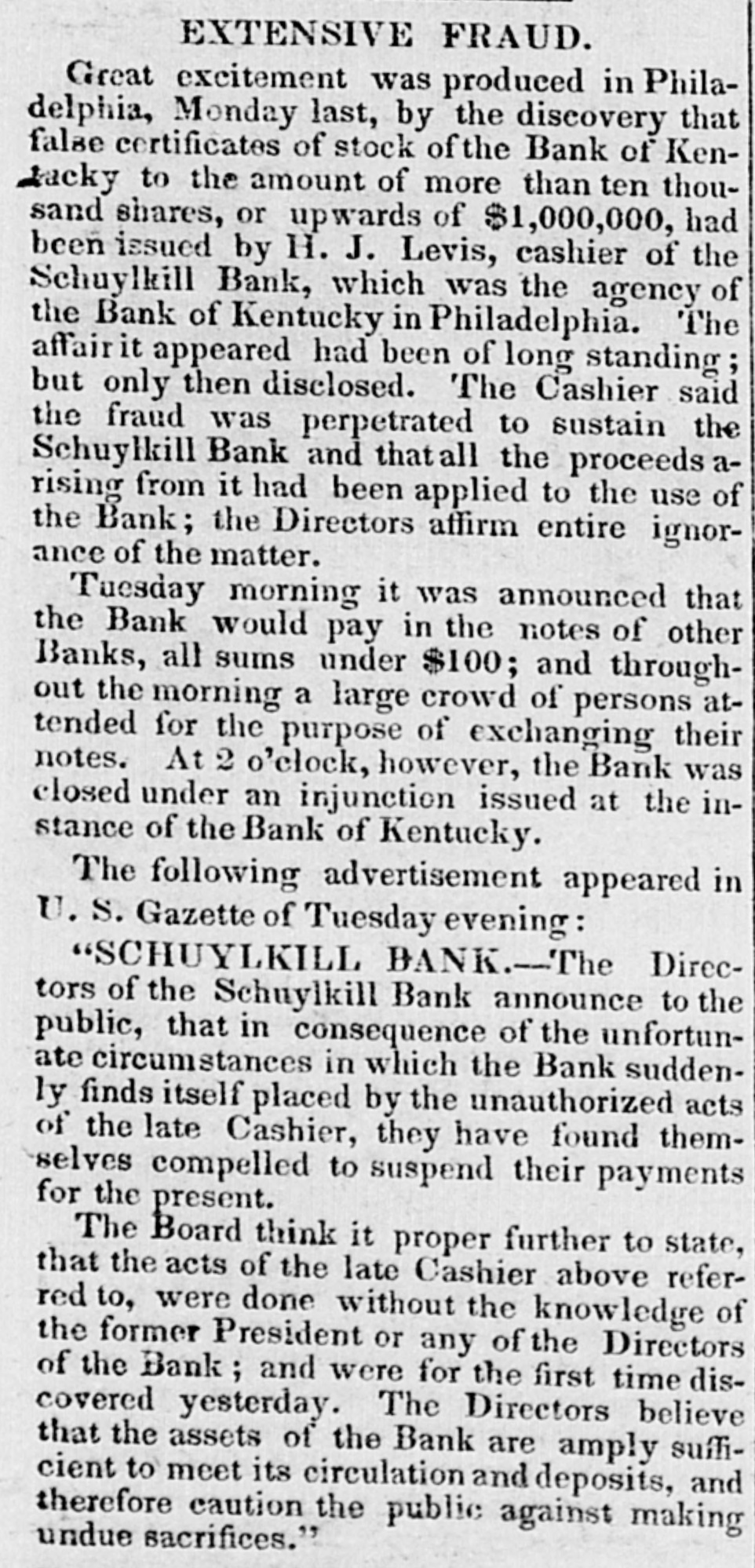
EXTENSIVE FRAUD. Great excitement was produced in Philadelphia, Monday last, by the discovery that false certificates of stock of the Bank of KenJacky to the amount of more than ten thousand shares, or upwards of $1,000,000, had been issued by H. J. Levis, cashier of the Schuylkill Bank, which was the agency of the Bank of Kentucky in Philadelphia. The affair it appeared had been of long standing; but only then disclosed. The Cashier said the fraud was perpetrated to sustain the Schuylkill Bank and that all the proceeds arising from it had been applied to the use of the Bank; the Directors affirm entire ignorance of the matter. Tuesday morning it was announced that the Bank would pay in the notes of other Banks, all sums under $100; and throughout the morning a large crowd of persons attended for the purpose of exchanging their notes. At 2 o'clock, however, the Bank was closed under an injunction issued at the instance of the Bank of Kentucky. The following advertisement appeared in U. S. Gazette of Tuesday evening: "SCHUYLKILL BANK.--The Directors of the Schuylkill Bank announce to the public, that in consequence of the unfortunate circumstances in which the Bank suddenly finds itself placed by the unauthorized acts of the late Cashier, they have found themselves compelled to suspend their payments for the present. The Board think it proper further to state, that the acts of the late Cashier above referred to, were done without the knowledge of the former President or any of the Directors of the Bank; and were for the first time discovered yesterday. The Directors believe that the assets of the Bank are amply sufficient to meet its circulation and deposits, and therefore caution the public against making undue sacrifices."


Article from Lynchburg Virginian, December 26, 1839

Click image to open full size in new tab

Article Text

DEFERRED ARTICLES. EXTENSIVE FRAUD. Great excitement was produced in Philadelphia. Monday last, by the discovery that false certificates of stock of the Bank of Kentticky to the amount of more than Ten thousand shares, or upwards of 1. 000.000 had been issued by 11. J. Levis, cashier of be Schuvikill Bank, which was the agency of the Bank of Kentucky 144 Phi'adelphia. The affair it appeared had been of long standing but only then disclosed. The Cashier said the fraud was perpe trated to sustain the Schuylki Bank and that all the proceeds arising from it had been at plied to the use of the Bank: the direct is affirm entire ignoranca of the matter. Tuesday morning it was announced that the Bank would pay in the notes of other Books. al. sums under $100; and throu hour the worning a large crowd of persons attended for the purpose of ex hanging their notes. A1 2 o'clock however, the Bank was closed underan injunction issued at the instace of the Bank of Kentucky, The following advertisement appeared in the U. S. Gazette of Tuesday evening : "SCHUYLKILL BANK.-The mine Directors of the Schoylkill Bank ansounce to the I ublie, that in consegnesce of the unfortunate circunstances in which the Bank saddenly finds itself placed by the unauthorsed acts of the late Cashier, they have found themselves con pelled to suspend their payments for the present. The Board think it proper further to state, that the acts of the late Cashier above referred to were done without the knowledge of the former President or any of the Directors of the Bank; the assets of the Bank are amply eufficient to ment its circulation and deposites, and therefore causion the public a gainst making undute sacrifices."


Article from Vermont Phล“nix, December 27, 1839

Click image to open full size in new tab

Article Text

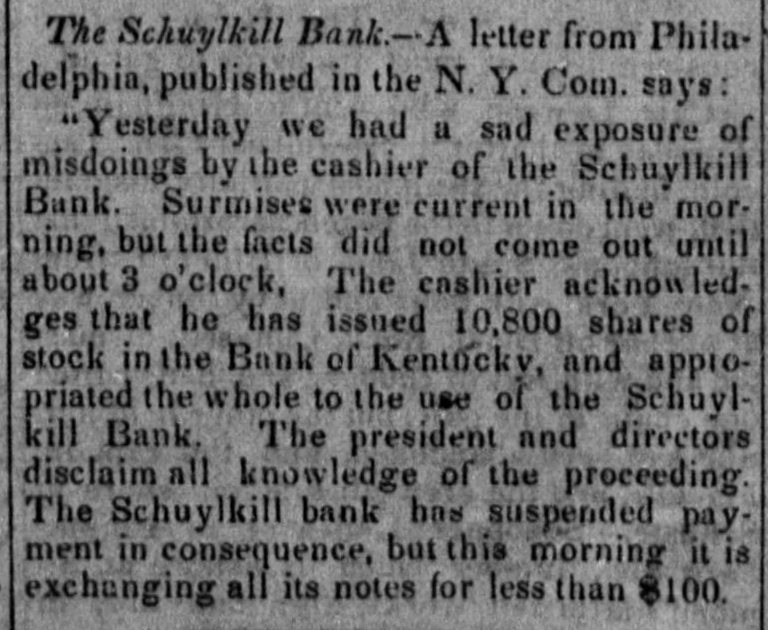
The Schuylkill Bank.-A letter from Philadelphia, published in the N. Y. Com. says: "Yesterday we had a sad exposure of misdoings by the cashier of the Schuylkill Bank. Surmises were current in the morning, but the facts did not come out until about 3 o'clock, The enshier acknowled. ges that he has issued 10,800 shares of stock in the Bank of Kentucky, and appropriated the whole to the use of the Schuylkill Bank. The president and directors disclaim all knowledge of the proceeding The Schuylkill bank has suspended payment in consequence, but this morning it is exchanging all its notes for less than $100.


Article from The Ohio Democrat and Dover Advertiser, December 27, 1839

Click image to open full size in new tab

Article Text

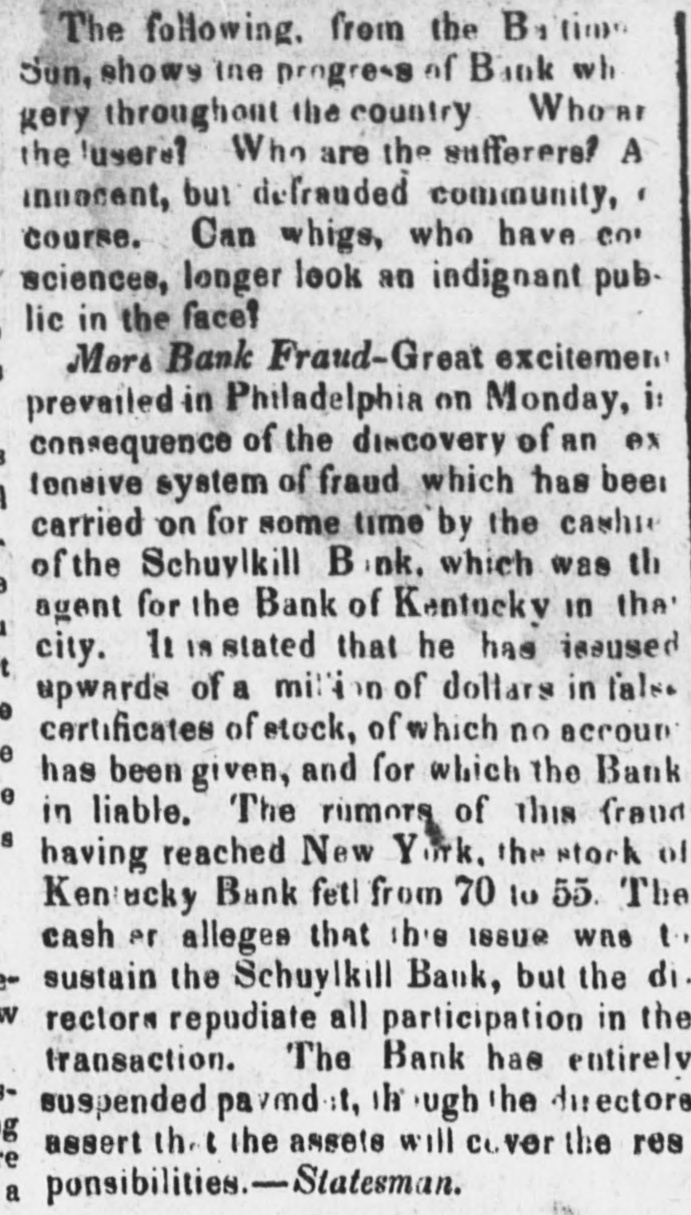
The following. from the Batimo Sun, showy the progress of Bank wh gery throughout the country Who n the lusera? Who are the sufferers? A innocent, but defrauded community, course. Can whigs, who have en' sciences, longer look an indignant pub. lic in the face? More Bank Fraud-Great excitement prevailed in Philadelphia on Monday, it consequence of the discovery of an ex tensive system of fraud which has beer carried on for some time by the cashie of the Schuylkill B nk. which was th agent for the Bank of Kentucky in the' city. 11 18 stated that he has issues upwards of a million of dollars in false certificates of stock, of which no acroun has been given, and for which the Bank in liable. The rumors of this fraud having reached New York, the stark of Kentucky Bank feti from 70 to 55. The cash er alleges that this ISSUE was , sustain the Schuylkill Bank, but the di W rectors repudiate all participation in the transaction. The Bank has entirely suspended pavmd it, ih ugh the directore g assert that the assets will Cc ver the res a ponsibilities.-Statesma


Article from Morning Herald, January 4, 1840

Click image to open full size in new tab

Article Text

that some grand humbug should be got up to prevent any investigation of their concerns, and to conceal the defalcations and frauds, which are, as yet, only whispered among the rogues themselves. As one of the plans to cheat the legislature, a ridiculous story of a conspiracy" by the Barings, of London, and Prime & Ward of this city, has been manufactured and published, first in the "Courier & Enquirer" here, of $52,000 noteriety, and afterwards in the other Wall st. papers, every one of which have been paid for the service. These ridiculous cheats,-for Prime & Co. have not brains enough, to say nothing of capital, to conspire against a fat hen and well fed chickens-have been carefully reprinted in the Penn sylvania papers, and are intended to produce an effect on the governor and legislature of Pennsylvania, so as to conceal the bank defalcations. As part of the same game, the silly bank-bought press of Philadelphia is constantly filled with such tirades, as that which we have given from the "Commercial Herald"-but their very laughable violence and ridiculous bluster defeat their own purpose So far as this journal is concerned, we belong to no " New York system," that is opposed to Philadelphia-and the people of Philadelphia-the honest people-acknowledge, in the most substantial form, the truth of this assertion. When their banks suspended fraudulently a second time in August last, our circulation in the city of Philadelphia was hardly fifty. As soon as that suspension became certain, although we bave had, and still have, the most friendly personal relations with Mr. Biddle, Mr. Jaudon, and Mr. Humphreys. of Liverpool, yet we never permitted the friendship and personal esteem for these amiable men for one moment to cloud our mind as to the character of the movement of which the United States Bank became the instigator and patron. We have expressed the sense of an honest and upright heart upon all the bank movements of Philadelphia, from the first suspension, up to the recent exposรฉ of the Schuylkil Bank-and what is the fact ? From a circulation of fifty Heralds in August last, we now count a circulation of nearly 1000 copies in the city of Philadelphia, without any solicitation, expectation, or effort on our part. This curious fact has satisfied us that in spite of the villanies of these banks, and the corruption of her newspapers, there now exists in Philadelphia, and throughout Pennsylvania, a vein of honesty, as pure and as inexhaustible as her eternal beds of anthracite; and however sh may be tied up in the meshes of a swindling system, she will vet burst her bonds and come forth honest and free. Hostility to Pennsylvania or to Philadelphia, as such, never crossed our mind for a moment. We are only hostile to dishonesty and and fraud whether it be generated in New York or Philadelphia. We have treated the bank frauds of New York with the same severity that we have ever treated those of Philadelphia In every instance, in this State, we have been the first to sound the alarm of bank mismanagement, and for this watchfulness and industry in the cause of public morals, we have received a support and a patro. nage, unparalleled in the annals of the New York press. Let not, therefore, the honest community of Penn sylvania be deceived by the tricks of their great financiers and great felons. The erisis of the bankingsstem has come in good ea rnest-and the legis latures of Pennsylvania and New York may be bough and bribed for the approaching session, but that will not do long. In this state the free bank system will be thoroughly examined, and in Penn. sylvania the real condition of the whole array of banks must undergo a like search. The fruit is ripening fast. And now to close, we put it to the people of Philadelphia themselves, to say, which of the two Heralds is the most " crazy," the most 'defamatory," the most libellous"-whether it is the New York Herald or the Philadelphia HeraldDromio of Epheses or Dromio of Syracuse? Don't laugh-decide.


Article from The Illinois Free Trader, February 5, 1841

Click image to open full size in new tab

Article Text

Resumption of Specie Payments The Banks of Pennsylvania have at length resumed specie payment, in conformity with the law of that State passed at the last session of the Legislature. A correspondent of the New York Herald, dated on the 15th ult. at Philadelphia, says: "This was resumption day, and has been passed through to the present time, by all our banks, with good order, good humor, and what is more important, good faith. There was no bustle or throng about any of them but the Girard and United States, and very little about the former of these. The latter was pretty well run. There were four men behind the counter, two of them with their coats off and sleeves rolled up, who were actively engaged from the opening to the close, in answering the demand for specie. At the opening of the doors, about 200 persons of all grades and occupations, principally those holding small amounts of bills, entered, and forming into line, they extended into the street, which was kept up for several hours by some new comers. The broken Schuylkill Bank to-day paid all her balances in full in United States Bank Bills--SO that the resumption is complete in Philadelphia." It is to be regretted that the banks of Baltimore have refused to co-operate with those of Philadelphia, as without their aid the resumption in the South-west will not take place. The Baltimore Patriot of the 13th ult. says: We learn that at a meeting of the Presidents of the several Banks in the city of Baltimore, on Monday evening, the question of the resumption of specie payments came up-when a resolution was adopted by a decided vote, that it was inexpedient for the Banks of this city to resume, unless there was a simultaneous act of resumption on the part of the Banks of Virginia." This course by the Baltimore Banks renders it certain that there will be no resumption south of Pennsylvania, and should the report be true that the banks of Baltimore are secretly drawing on the banks of Philadelphia for specie, it may lead to a third suspension there!


Article from Sunbury American and Shamokin Journal, March 26, 1842

Click image to open full size in new tab

Article Text

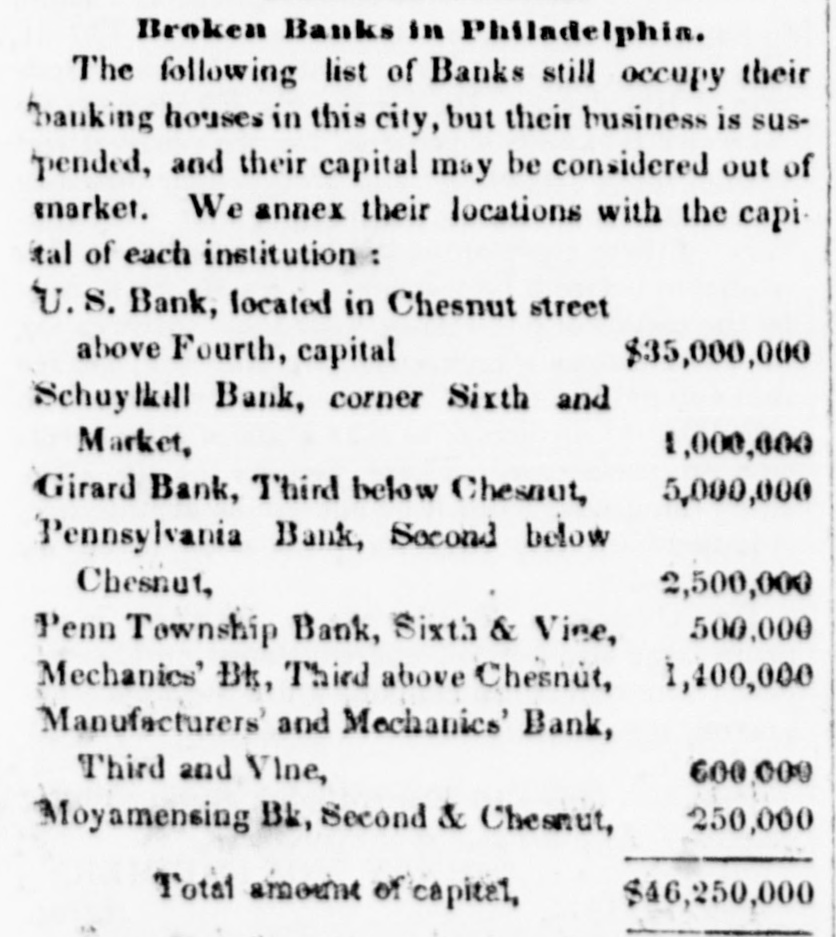
Broken Banks in Philadelphia. The following list of Banks still occupy their banking houses in this city, but their business is suspended, and their capital may be considered out of market. We annex their locations with the capital of each institution : U. S. Bank, located in Chesnut street $35,000,000 above Fourth, capital Schuylkill Bank, corner Sixth and Market, 1,000,000 Girard Bank, Third below Chesnut, 5,000,000 Pennsylvania Bank, Second below Chesnut, 2,500,000 500,000 Penn Township Bank, Sixth & Viee, Mechanics' Bts, Third above Chesnut, 1,400,000 Manufacturers' and Mechanics' Bank, 600.000 Third and Vlne, 250,000 Moyamensing Bk, Second & Chesnut, $46,250,000 Total amount of capital,


Article from Richmond Enquirer, April 1, 1842

Click image to open full size in new tab

Article Text

Philadelphia, March 24.-The Marble Banks in this city have generally been very unfortunate institutions Out of the eight suspended banks here, six of them occupy costly and elegant marble edifices, constituting some of the best specimens of architecture in the city. The Schuylkill and Moyamensing are the exceptions. The latter bank, we notice to-day, still has its windows "bowed." We do not understand whether it is the public, the stockholders, or the officers of the bank, who are most deeply interested in this mourning. The Relief Notes, which constitute a large proportion of the currency of the city, continue wretchedly depreciated. Most of the banks which issued them are closed, and their vaults are as speechless as the brick with which they are erected. Something should be done, and that should be done quickly. The sound Banks cannot at once supply the currency, and these notes must circulate, especially for the convenience of their size. Those institutions which are closed should give the public some idea of their means of redemption, or at least, the time when it probably will be done. The public have a right to demand this at their hand. [Gazette.


Article from New-York Daily Tribune, April 29, 1846

Click image to open full size in new tab

Article Text

The Detroit Advertiser states that a bill has pass" ed the two houses and received the Executive signature to levy 8 specific tax on the Farmers' and Mechanics' Bank of that city. The legal effect of the bill is under. stood to be to waive all past forfeiture of its charter, and to reinvest it with all its former franchises. We presume, says the Advertiser, that the bank will soon resume business, which has been suspended in the main since the proceedings in Chancery. We are notinformed, however, whether any specific arrangements have been made. Mr. Seymour, the President, is now absent at Canandaigua, but is expected home daily. The bill recently passed by the Pennsylvania Leg. islature, granting to the Schuylkill Bank, of Philadelphia, a right to appeal from the decision of the Court of Common Pleas, in the matter of the claim of the Bank of Kentucky, has been signed by the Governor. The law stands in the place of a supersedeas and stay of execution requires that security for the payment of costs be given by the Schuylkill Bank: that 8 Receiver be ap. pointed by the Bank of Kentucky. subject to the approval of the Court, who shall be empowered to take possession of all the personal assets of the Schuyiki Bank, and superintend all payments and transfers; to deposit the cash received, in some place to be designated by the Court. subject to the first draft of himself and the Direct ors, and to the order of the Court. This bill will give to the Directors of the Schuy Ikill Bank, an opportunity of trying the issue between them and the Bank of Kentucky before e higher tribunal. The debt of Arkansas is $3,500,000. The Arkansas papers contend that the interest on this debt cannot be paid. One paper, with what It calls " 8 spirit of self sacrificing honor," recommends that the Legislature propose "to the creditors of said State of Arkansas, that they cancel their present evidences of liability and re celve in place thereof State bonds, not bearing interest payable in fifteen years after date."


Article from New-York Daily Tribune, May 12, 1848

Click image to open full size in new tab

Article Text

Correspondence of The Tribune. PHILADELPHIA, Thursday, May 11. A large four-story brick building in the rear of as Race-st. was burned down about midnight last night.It belonged to E. & D. Ford, who occupied the fourth story as ivory turners. Hall & Boardman, Britannia ware manufacturera; Mr. Jackson, Turuer; Mr. Stewart, saw miller, and Mr. Cook, tosaw blind state, occupied the other parta. All the stock and machinery, with the building was destroyed, except the engine in the basement. William Bechtel, in prison for the marder of his wife, is suffering under a famil malady of insanity, and is 80 violent that be has been ironed. There will be a large parade of our volunteers to receive Gen. CADWALADER, upon his return house. Job R. Tyson, receiver of the funds arising from sales of property and debts collected, belonging to the assets of the Schuylkill Bank, made application to the Court of Common Pleas this morning, for power to invest $49,000 now in his hands, in City o's, the stock to be held in hype* theration, wish Mr. M' Allister's addisional security rof line repryment of the money, with an interest of 5 per cooc. the Schuylkill Bank. and Caleb Cope, special agent of the Back of Kentucky, agreeing to the same A dog la a rabid state was killed this morning in the upper part of Viae-st. Six hundred and revealy-si Immigrants arrived at this port yesterday. The son of . poor woman restored this morning to Harrisen, Brothers & Co. the 8250, comprised in five notes of 850 each, lost on Monday by a lad in their employ The boy picked up the notes from the pavement on Monday, is Frost-at. near Market-at. where the lad had dropped them. Floor more active to-day; sales 1,000 bble at 85 94 for fair Penas. and 200 at $6 for good. Cotton in better in. quiry, with sales at about 1 as. advance on fice grades. Sales 1,500 bbie Corn Meal as 225; holders asked 237 at close, which was givea for some lots. Rye Flour 87. Sales Red Wheat at 142, the supply still small. Corn has advanced, with sales 3,000 bushels good Yellow South at 61 Mess Pork held at $10 25 Bacon in fair request Western cured selling at St to St for shoulders; 4 to 43 for sides, and 5f to 7is for Hame. Sales 500 kege Laid as 7 CE# 4 mos. Groceries ionnimate. Whisky in bole 23 eta SALES OF STOCKS.-- Board-200 U. d. 5a, '51. 91; 50 Reasing Rd, 16th 100 do, b5, 161; 20 U.S. Bank, S; 595 Lehigh Scrip b5, 79 109 Treasury Notes. 1014, 500 U.S. 6a. . FF. 102}; 300 Lenigh Mt. Loss. 84; 200 U. S. 6s, '67, 1043, 500 Lehigh 6a. 60; 500 State 5a, 8it Second Board-500 City 6s. '76. 99$; 44,925 Peam5s, (lota) 75; 1,000 do 6s, 87f; 200 N. Y. War Bounty Scrip, 97 : 300 N. J. Cop. 4 18 Reading 161; 415 Lehigh Canal Scrip, 79; 5,000 N. Y. 6s, '67, 1041.


Article from The New York Herald, March 27, 1849

Click image to open full size in new tab

Article Text

LLICENCE BY THE MAILS. PHILADELPHIA, March 3,1849. The Kentucky and Schuylkill Banks-The Robber of the Government Jewels-A Murder-Killed by an Omnibus-Parade of Firemen-The Steam. ship Columbus-The Bark Warsaw, Sc. A compromise between the Bank of Kentucky and the Schuyikill Bank is understood to be in progress, and will probably be concluded in a day or wo, which will put an end to the vexatious litigation that has been 80 long existing, and enable the Schuylkill Bank to resurre operations for the remainder of the time for which the charter has to run. The Kentucky Bank is to surrender some of the advantages acquired by the recent decision in its favor. The officers of the Schuylkill Bank, by placing certain property agreed upon in the hands of the victor, gracefully terminate the controversy. A bill 18 now pending before our Legislature, to enable the Kentucky Bank to hold, in its corporate capacity, the property that is so delivered up. A further hearing in the case et Jacob Shuster, alias Tom Hand, was had this morning before Judge Kane, when, after some additional evidence, the prisoner was ordered to be conveyed to Washington, to take his trial for the robbery of the government jewels. The letter sent to the late President was compared with the hand-writing of the prisoner, and identified as being very similar. George Righter, who was stabbed last week in Moyamensing, by some unknown person, died last night at the Hospital. An investigation 18 now in progress by the Coroner. Robert Robinson, a machinist, was killed on Saturday night, by an omnibus running over him while in the act of crossing Second street. The driver drove off at full speed, without waiting to see what injury had been committed through his carelessness. He has not yet been arrested. The unfortunate deceased leaves a wife and eight children. Our firemen are making the most extensive arrangements for their triennial parade to-morrow. They have brought from Bethlehem an ancient engine, built in London in 1686, which was the first engine used in this city, one hundred and thirty years since. It is to be placed on an elevated platform on wheels, and will form a feature in the procession. The steamship Columbus arrived this morning, from Charleston. She spoke the steamer Osprey, hence for Charleston, at eight o'clock yesterday morning. The Columbus put into the Breakwater, and placed on board a vessel bound to Charleston a runaway slave who had concealed himself on board. He made his appearance too soon to effect his escape to the free soil of Pennsylvania. The brig America, Captain Treadwell, arrived this morning from Salem, having on board Captain Taylor and the crew of the bark Warsaw, which vessel took fire on the 19th instant, off Cape Henlopen, and was burned to the water's edge. They took to their boats, and were picked up during the succee ding night by Capt. Treadwell. The Warsaw was from New York, bound for Panama. MARKETS. The flour market continues dull; some of the holders demand $4 for common brands for export, but others have made rales stashadelower. Extra brands, for city consumption, command $5 to $525. There is but little inquiry for corn made. Rye flour is quoted $8 0614 to $3121. Grain is coming into market plentifully. Prime Pennsylvania red wheat sells at $1 03, and n lot of good quality sold at $1. Rye is dull at 62 to 63c. The request for corn is moderate, and no sales of cats are reported. Whiskey, in hbds., sells at 21c., and in bbls., at 22c. STOCK SALES. First Board.- Wilm'n RR b5 2734; 50 do 271; 109 do 2714; $5900 City 6's '79 101/1; $700 U. S. 6's '67 110; $1000 do 110; $1000 do 110; $1000 do 110; $3000 do 110; $1000 do $1000 do 110; $8000 Reading Bds 82 581/2; 25 Girard 121/2; 50 Girard Bk 121/2; 100 do 121/2; $250 Lehigh CI Sep 77; 60 Girard Bk b5 123/2; 50 do 123; 50 do 121/2; 100 do 121/2; 50 do 121/2; $300 Lehigh Int 57; 100 U S Bank 31/; $3000 Treas'y 1081/; 100 Coal Scrip c 77. Second Board and af ter-50 Reading RR 16; 100 NJ Copper 1/2: 5 N A Bk cash 1243; $30,000 Read'g Bds #5 541/2; $1000 Nav 6s 461/2; 50 Reading RR 16; 50 do 16; $500 Penna 5s 79%


Article from The New York Herald, March 31, 1849

Click image to open full size in new tab

Article Text

The movement of this institution has largely increased, and the increase has been confined to the circula-tion and the exchange department. Without any ad-dition of consequence to the supply of specie on hand, the issues of the bank have increased, since last July, $430.555. The aggregate movement, and the move-ment in the principal departments, compare more fa-vorably with those for the same time-January, 1848-last year, than with any previous period. It will be perceived by the above comparative state-ment, that the Bank of Kentucky and branches have purchased nearly all the over-issue of stock by the Schuylkill Bank, and it will hereafter be able to de-clare better dividends, without making any reserva-tion to carry to the stock fund. The suit which has so long been going on between the Bank of Kentucky and the Schuylkill Bank, for the recovery of this over-issue of stock, has at last been finally settled, the de-cision being in favor of the Bank of Kentucky. The following is the decree of the Supreme Court of Penn-sylvania:- This cause came on to be heard at this term, (viz. September term, 1845,) and was argued by counsel, and therefore upon consideration thereof it was ordered, adjudged and decreed, that the Schuyikill Bank, in the city of Philadelphia, and Hosea J. Levis, pay unto the said complainants, the president, directors and com-pany of the Bank of Kentucky, one million one hun-ared and eighty-four thousand seven hundred and thirty eight dollars, ($1.184.738) as a just indemnity for the loss, detriment and damage to which they, the said complainants, and the holders of the stock herein-after mentioned, have been put or have suffered by reason of the fraudulent issue of thirteen thousand one hundred and eighty five (13,185) shares of the stock of the said president, directors and company of the Bank of Kentucky, by the said the Schuytkill Bank, in the city of Philadelphia while transfer agent of the said president directors and company of the Bauk of Kentucky, by, with and through the pro-curement, knowledge and assistance of the said Hosea J. Levis, and which said shares of the said stock the said president, directors and company of the Bank of Kentucky have either assumed or are entitled to rep-resent by the act of Assembly in such case made and provided. and that the said defendants, the Schuylkill Bank in the city of Philadelphia, and Hosea J Levis, do further pay unto the said president, directors and company of the Bank of Kentucky the costs of this suit. This decision will sweep away the entire assets of he Schuylkill Bank, amounting to about $450,000, which have been in the hands of receivers appointed to hold the funds when the Schuylkill Bank appealed from the decree of the Court of Common Pleas. The whole claim of the Bank of Kentucky amounts to $1.345.000, so that its loss will be at least nine hundred thousand dollars. Since the recent decision, the stock of the Schuylkill Bank has been much depreciated, sales having been made at ยฝ a 1 per cent.


Article from New-York Daily Tribune, June 28, 1849

Click image to open full size in new tab

Article Text

The amount of goods entered in the CustomHouse in San Francisco from October 1. 1848, to March 31, 1849, was $1,084,801, of which $90,520 was free.The official export of gold dust in the same period was $2,812,040, but this probably only approximates the truth. Two-thirds of this amount was exported in fo reign vessels. The number of emigrants reported to have arrived by sea was 2,433. The project of resuscitating the Schuylkill Bank, Phil. does not seem to proceed very favorably At the last meeting of the stockholders it was proposed that each stockholder shall sign an agreement covenanting to pay $20 & share on as many shares by them res pectively held as they see proper, and to sell the re. mainder to the Bank for 50 cents P share, reserving the privilege of reclaiming the same at any time within twelve months, on payment of $20 with interest for every share 80 reclaimed The charter has two or three years to run, and the Bank has not, we believe, a dollar of assets The railway fever runs high in New-Hampshire, 50 much so, that some of the papers are free to predict railroads and ruin as the speedy result. The railroads already in progress of building are 22 in number, and comprise a length of 834 miles. This amount of roads furnished with depota, cars, engines, &c. it is estimated will average at least $30,000 & mile, which sum, multiplied by 834, the number of miles, gives & total of 825, 000,000 invested in railroads in the State of New-Hampshire. We stated some time since that a party of capi talists were about to take hold of the Owego and Itha ca Road, relay it with heavy iron, and avoid the inclined plane at Ithaca. The arrangement has, we understand been completed, and has been taken by the parties en gaged in constructing the Liggett's Gap Railroad The latter extends from the coal fields of the Lackawanna Valley in Pennsylvania, to the Erie Railroad at Great Bend. Thus, by the use of a section of the Erie Rail road, the proprietors of the two roads just mentioned will have a continuous line of railroad from the Lacka wanna Valley to the south end of Cayuga Lake, which they intend to make their channel for distributing 811 thracite coal throughout central New-York The importance of this undertaking will be appreciated when it is understood that coal can be sold at Utica, Syracuse, Auburn, Rochester, at about New-York prices. The Cayuga and Susquehanna Railroad is to be in operation by the 1st of October next, at which time passengers may leave Ithaca at 6 o'clock in the morning, and ar. rive in New-York at 74 in the evening. At a late meeting the following gentlemen were elected Directors viz George W. Scranton of Lackawans, J. B. Williams of Ithaca, George S. Pompelly of Owego, D. Miller, John Howland and W. E. Dodge of New-York, Henry Hotebkiss of New-Haven, Conn : T. R. Griffen of Guilford, Conn.; J. N. Perkins of Norwich, Conn. It is es timated that when the line of railroad is completed from the Lackawanna Valley to Cayuga Lake, it will add $100,000 โ‚ฝ annum to the revenue of the Erie Railroad A corps of Engineers are now engaged in surveying 8 route for a railroad from Auburn, N. Y. to Big Sodus Bay on Lake Ontario. The work of the laying down the track of the Vermont Central Railroad to Montpelier, was completed on Wednesday last, at noon, and an excursion train immediately passed over the line amid great rejoicings.


Article from The New York Herald, October 13, 1849

Click image to open full size in new tab

Article Text

# A NEW FISCAL AGENCY-WALL STREET AND BUNCOMBE IN THE F. E. D. Who does not recollect the glorious times of the old United States Bank, when Wall street was but a stipendiary of Nick Biddle, and jobbers, editors, currency, commerce, and the elections, were ruled and directed by the monster? Who does not remember the fierce, savage and protracted war which it made against Old Hickory and the people, and the universal panic, ruin and distress which followed its ignominious defeat? What became, then, of the pensioners? They crept into holes and corners-they denied their master as bluntly as St. Peter, and admitted that a bank was an "obsolete idea," and a nuisance. But with the election of Harrison, the leeches of the old bank were on the ground-the dried skeleton of the monster was galvanized, and wanted but the scrape of a pen to return it to full vigor. But they could "not head Captain Tyler;" and bank, whigs, jobbers, pensioners, and hucksters, all fell together. This time the monster was believed to be dead and damned, soul and body, forever and ever. And so it is. But as half a loaf is better than no bread, a substitute has been proposed. Wall street and Buncombe are in the field. The Hon. Thomas L. Clingman, of North Carolina, in a letter first published in a paper without a circulation, proposes a new "scheme of a national currency." Reduced to its simplest form, he proposes to establish a free system of banking throughout the United States, on the faith of the public stocks. Mr. Clingman is from the Buncombe district, famous for rocks of the secondary formation, its mineral springs, pine shingles, and buckwheat cakes. Having secured his re-election to the House, and having the leisure of the summer upon his hands, Mr. Clingman, emerging from the woods of Buncombe, has been for some months engaged in the inspection of the factories of cotton and politics in the North. He has been initiated into the mysteries of the Albany junto-the secrets of the money changers-the science of stock-jobbing-and Buncombe is in the field. Mr. Draper, chief of the forlorn hope in behalf of Col. Webb at Washington, has found his man; and the topic of a conversation over a bottle of wine, has become a great national measure. Everybody is wondering that the wiseacres of Congress did not think of it before. But the scheme of Mr. Clingman looks suspicious. It has the sulphurous odor of Wall street all over it. The hoofs of the old monster stick out, though his tail is coiled up in his breeches. Feasting, feting and lionizing, a juicy dinner at the Astor House, and the tour of our public institutions in an Alderman's carriage to the Penitentiary, are hard to be resist-ed, though all for Buncombe. There is something of a plot at the bottom. The pensioners of the old bank, who, after betraying and murdering their master and benefactor, have pined away to skin and bone, cannot stand it any longer. Twelve years fast is long enough. It was the father of our present Secretary of the Treasury who was President of the Schuylkill Bank when it broke down; it was Mr. Meredith's collector at Philadelphia who broke up with the Girard concern; it was this last appointment, and others like it, that contributed to the late whig defeat in that city. But still this does not prevent the conspiracy. We may expect all these men, and all those who fattened on the old bank-all who were bought or sold, whether for five, ten, or twenty thousand, or for $52,765 37ยฝ-to go for the new scheme. Mr. Chhogman only lifts the curtain. The scene shifters are behind. The treasury is an old cow, whose milk is too rich to be lost. The scheme of Mr. Chngman is but the first movement. Pass it, and a bank comes next in order. Somehow or other the stock-jobbing brotherhood must get into the treasury. Let us have, then, the bill of Buncombe. Then the purlieus of Wall street will become the valleys of the Sacramento and San Josquin; the very side-walks will be richer in gold than the mines of the desert; bank paper will increase by millions; everything will go up, up, until the explosion, when a bankrupt law will wind up the FELLOW FEELINGS-RAILROADS AND CURRENCY.