Eureka County Bank (Eureka, NV)

Episode Information

Episode Type
Suspension β†’ Closure
Start Date
March 25, 1910
Location
Eureka, Nevada (36.221, -114.144)
Bank Type
state

Metadata

Notes

Bank was closed by the banking board and placed in receivership amid charges of false reporting and misuse of special county deposits.

Events (2)

1. March 25, 1910 Suspension
Cause
Bank Specific Adverse Info
Cause Details
Bank closed after examinations revealed misreported assets and the mixing of a special county deposit into cash balances; concerns about insolvency and false reports to the banking board
Newspaper Excerpt
have application before Judge Breen to have a receiver appointed for the Eureka bank. Mr. Van Fleet, the State Bank Examiner, has already taken charge
Source
newspapers
2. March 25, 1910 Receivership
Newspaper Excerpt
W. B. Fowler ... will make application before Judge Breen to have a receiver appointed for the Eureka bank. Mr. Van Fleet, the State Bank Examiner, has already taken charge and is making a thorough investigation.
Source
newspapers

Newspaper Articles (24)

Article from Carson City Daily Appeal, March 25, 1910

Click image to open full size in new tab

Article Text

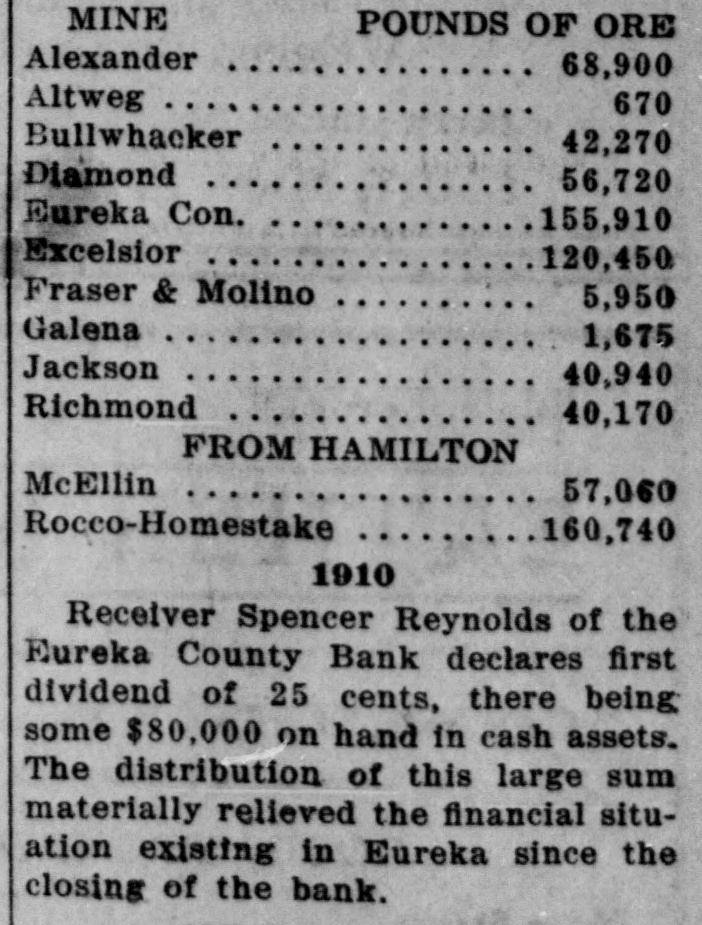
BANKS NOT AFFECTED That none of the other banks of the state will be affected by the closing of the Eureka County Bank is the positive assurance given by Sam Belford, one of the members of the State Board of Bank Commissioners. He says that the affairs of all the other banks are in an admirable condition The Banking Board was not in session yesterday but will probably be in session in a day or so. W. B. Fowler assistant to the attorney-general, left yesterday for Eureka where he will make application before Judge Breen to have a receiver ap pointed for the Eureka bank. Mr. Van Fleet, the State Bank Examiner, has already taken charge and is making a thorough investigation. His report will not be available for several days.


Article from Daily Independent, March 28, 1910

Click image to open full size in new tab

Article Text

Banks not Affected That none of the other banks of the state will be affected by the closing of the Eurcka County Bank is the positive assurance given by Sam Belford, one of the members of the State Board of Bank',Commissioners. He says that the affairs of all the other banks are in an admirable condition. The Banking Board was not in session hyesterday but will probably be in session in a day or so. W. B. Fowler, assistant to the attorney-general, left yesterday for Eureka where he will]make application before "Judge Breen to have a receiver/appointed [for the Eureka bank. Mr. Van Vleet, the State Bank Examiner, has already taken charge and is making a thorough investigation. HisTreport will not be available for several days.


Article from Weekly Independent, April 1, 1910

Click image to open full size in new tab

Article Text

Banks not Affected That none of the other banks of the state will be affected by the closing of the Eureka County Bank is the positive assurance given by Sam Belford, one of the members of the State Board of Bank Commissioners. He says that the affairs of all the other banks are in an admirable condition. The Banking Board was not in session yesterday but will probably be in session in a day or so. W. B. Fowler, assistant to the attorney-general, left yesterday for Eureka where he will make application before Judge Breen to have a receiver appointed for the Eureka bank. Mr. Van Vleet, the State Bank Examiner, has already taken charge and is making a thorough investigation. His report will not be available for several days.


Article from Daily Independent, April 4, 1910

Click image to open full size in new tab

Article Text

OSCAR J. SMITH INTERVIEWED Saturday's Reno Gazette contains the following interview with Oscar J. Smith, regarding the failure of the Eureka County Bank. The Gazettesays that Mr. Smith has aged perceptibly since the crash came and has assumed a more serious aspect than his wont, but is philosophic through it all: "My brother, my wife and I were in apparently prosperous circumstances before the crash came, but we played out our hands to the last card, or, as a billiard de votee would say, to the end of the string. We did not really know that the crash would come until the night before the suspension of the Rhyolite institution. It would have been better for our depositors and for ourselves if we had wound up our banking business months ago, but we had investments that were liable to prove of great value at any moment. That is all there is to the story and we have all three placed what fortune we posses back of the institutions. Mrs. Smith will posses absolutely nothing more than the equity in her house and I will have my law library, the tool of my trade; Bert will emerge equally stripped of his possesions. I am confident that the Rhyolitè bank will pay every cent of its indebtedness and am assured that the Eureka institution will do equally as well. My brother and I will only surrender all our present assets, but we will labor for the balance of our days to the end that no man can say we ever took advantage (Continued on page 5.)


Article from Daily Independent, April 4, 1910

Click image to open full size in new tab

Article Text

SALMAGUNDI erintendent Anderson and Mr. Bonham left for Lamoille this morning. The Elko Drug Company has the sweetest candies in the market. See the new ad. Miss Schuler left for Reno Friday night to spend her Easter vacation with her people. Mrs. M. W. Hough of Ely is visiting Miss M. E. Hough. She is on her return from California and Oregon, where she spent the winter. "Who's Brown" drew a large audience to the opera house Saturday night. The different actors did their best to please and the large audience retired at the close of the performance well satisfied with the evening's entertainment. Mr. Fred Crofut, one of the grand jurors summoned by Judge Breen to investigate the affairs of the Eureka County Bank, is in town after a load of provisions. He says conditions in Eureka are very bad, and that there is likely to be a famine on account of the scarcity of provisions. Eureka was sorely stricken by the flood and bank failure. Judge Langan has denied the motion of T. B. Rickey for a change of venue from Ormsby county in the case of Frank L. Wildes as receiver vs. T. B. Rickey and the directors of the defunct State Bank and set the case for trial on April 9th. Judge Breen evidently means busine in dealing with the affairs the Eureka County Bank. His reply to the statement of Deputy Attorney General Fowler has the right ring. Sworn officers of the law should do their duty to the people fearlessly and impartially. When they fail to do that, innocent people are sure to suffer. We hope Judge Breen will hew to the line in all matters connected with the failure of the Eureka County Bank. We give our readers today a full and complete statement of the affairs of the Eureka County Bank and matters connected therewith, as the same appeared in the Eureka Sentinel of Saturday. The failure of this bank is of intense interest to the people of Nevada and especially to this county, where Oscar J. and Bert L. Smith were once interested. The getting up of this amount of matter has made a great deal of extra work in this office, but through the kindness and interest of Mr. O. W. Andrews and the assistance of our new typesetting machine we are able to give our subscribers the latest authentic news of the failure of the EurekaCounty Bank and we feel sure that they will appreciate our enterprise in giving them the news, while it is news.


Article from Weekly Independent, April 8, 1910

Click image to open full size in new tab

Article Text

OSCAR J. SMITH INTERVIEW Saturday's Reno Gazette tains the followi ig interview Oscar J. Smith, regarding failure of the Eureka County Bank The Gazettesays that Mr. Smith has aged perceptibly since the crash came and has assumed a mor serious aspect than his wont, but philosophic through it all: "My brother, my wife and I we in apparently prosperous circum stances before the crash came, but we played out our hands to the las card, or, as a billiard de votee would say, to the end of the string. We did not really know that the crash would come until the night before the suspension of the Rhyolite institution. It would have been better for our depositors are for ourselves if we had wound our banking business months av but we had investments that W liable to prove of great valurat an moment. That is all there is to the stor and we have all three planed w} fortune we posses back of The in tutions. Mrs. Smith will posses absolutely nothing more than the equity in her house and 1 will have my law library, the tiol of no trade; Bert will emerge equality stripped of his possesion. I am confident that the bank will pay every cett debtedness and am assu Eureka institution wil as well. My brother md only surrender all or P sets, but we will labr to ance of our days to te end that man can say we everook advants (Continued on age 5.)


Article from The Goldfield News, April 9, 1910

Click image to open full size in new tab

Article Text

# The Eureka Bank Being Dragged Into Politics E may now expect to see all the Republican papers of the state, following the lead of the Reno Gazette, lay the blame for the failure of the Eureka county bank upon Governor Dickerson and the state banking board, the object being, of course, to discredit the Democratic administration, the governor and the members of the board. An effort will be made to so magnify the incident as to make of it a campaign issue, and the people should be advised in advance. The present board of bank commissioners are in no wise or in no degree responsible for the Eureka County bank failure. The new banking law went into effect; now about a year ago, and the first meeting of the banking board was April 14. The new law under which the board was working made various radical changes in methods and requirements, and it became apparent at once that it would take time for the banks of the state to adjust themselves to the new law. Some of the banksβ€”even those which were doing the largest business and supposedly the strongest, were in bad condition, owing to too liberal management, and the laxity of the old law and the inefficiency of the bank examiner's department. The board, construing the banking law as an act not only to protect depositors, but in so doing also to help the banks themselves, found it advisable to proceed cautiously but deal firmly with the delinquents. Reports were at once called for and carefully examined and analyzed. On the board were two bankers beside the bank examiner. The condition of the banks of Nevada as disclosed by these reports was such, that if the board had acted under the strict letter of the new banking law, it would have had to close about 50 per cent of the state banks then doing business. This, in addition to the depressed condition of affairs in Nevada due to the general panic, would have been a calamity nothing short of a crime, and it would have brought down upon the heads of the banking board just and overwhelming public condemnation. Imperative instructions were at once sent to the delinquent banks and the bank examiner proceeded immediately to check them up. It is not necessary or advisable to go into detail and name these banks, for with the time and assistance given them by the banking board they gradually adjusted their affairs to conform to the new law and placed themselves on a sound footing and are now doing a prosperous business. There were four banks, however, that were in a particularly bad way. One of these was a comparatively large bankβ€”the Eureka County bank, a bank at Manhattan and two in the Bullfrog district. The latter two were closed, the banking board taking charge. Within 27 days after the Pioneer bank went into the hands of the banking board, every depositor had been paid dollar for dollarβ€”a record never before made in this state. By agreement with depositors, the Bullfrog Bank & Trust company appointed the state bank examiner as trustee, rather than have an expensive receivership; one dividend of 33 1-3 per cent was paid to depositors within four months, and arrangements had been made with stockholders to pay in a large assessment which will realize as much more. The banking board a few weeks ago decided to force the Manhattan bank into liquidation.


Article from Daily Independent, April 12, 1910

Click image to open full size in new tab

Article Text

# THE EUREKA BANK BEING # DRAGGED INTO POLITICS We may now expect to see all the republican papers of the state, fol-lowing the lead of the Reno Gazette, lay the blame for the failure of the Eureka County bank upon Governor Dickerson and the state banking board, the object being, of course, to discredit the democratic administration, the governor and the members of the board.. An effort will be made to so magnify the incident as to make of it a campaign issue, and the people should be advised in advance. The present board of bank co amissioners are in no wise or in no degree responsible for the Eureka County bank failure. The new banking law went into effect, now about a year ago, and the first meeting of the banking board was April 14. The new law under which the board was working made various radical changes in methods and requirements, and it became apparent at once that it would take time for the banks of the state to adjust themselves to the new law. Some of the banks-even those which were doing the larg t business and supposedly the strongest were in bad condition, owing to too liberal management, and the laxity of the old law and the in-efficiency of the bank examiner's department. The board, construing the banking law as an act not only to protect depositors, but in so do-ing also to help the banks them-selves, found it advisable to proceed cautiously but deal firmly with the delinquents. Reports were at once called for and carefully examined and analyzed. On the board were two bankers beside the bank ex-aminer. The condition of the banks of Nevada as disclosed by these reports was such, that if the board had acted under the strict letter of the new banking law, it would have had to close about 50 per cent of the state banks then do-ing business. This, in addition to the depressed condition of affairs in Nevada due to the general panic, would have been a calamity nothing short of a crime, and it would have brought down upon the heads of the baking board just and overwhelm-in public condemnation. Im-porative instructions were at once sent to the delinquent banks and the bank examiner proceeded immedia-tek to check them up. It is not necessary or advisable to go into detail and name these banks, for with the time and assistance given them by the banking board they gradually adjusted their affairs to conform to the new law and placed themselves on a sound footing and


Article from Daily Independent, April 13, 1910

Click image to open full size in new tab

Article Text

# BANK COMMISSIONER WISHER Bank Commissioner Wicher gave this office a call this morning. He is one of the old residents of the state, having lived at Halleck several years ago. Mr. Wicher talked freely about the affairs of the Eureka County Bank and the action of the bank commissioners in relation thereto. He said if that bank had been closed a year ago eight or ten other banks would have closed. One of these was one of the largest banks in the western part of the state. That bank the board compelled to dig up $750,000 in cash. Mr. Wicher also said that Bank Examiner Van Fleet had not reported the Eureka County, Bank insolvent. The reports made to the board, he said, would confirm this statement. He also said that the affairs of the Eureka County Bank were not as bad as the people thought and that by proper management of the bank's assets he believed the depositors would be paid the full amount due them. He hoped to see a dividend of 15 per cent paid in the next two weeks. The bank commissioners, he said would render all the assistance in their power to the receiver and do everything possible to hasten an early settlement of the bank's affairs.


Article from Weekly Independent, April 15, 1910

Click image to open full size in new tab

Article Text

THE EUREKA BANK BEING DRAGGED INTO POLITICS We may now expect to see all the republican papers of the state, following the lead of the Reno Gazette, lay the blame for the failure of the Eureka County bank*upon Governor Dickerson and the state "banking board, the object being, of [course, to discredit the democratic administration, the governor and the members of the board. An effort will be made to so magnify the incident as to make of it a campaign issue, and the people should be advised in advance. The present board of bank commissioners are in no_wise or_in no degree responsible for the Eureka County bank failure. The new banking law_went into effect, now about a year ago, and the first meeting of the banking board was April 14. The new law under which the board was working made various radical changes in methods and requirements, and it became apparent at once that it would take time for the banks of the state to adjust themselves to the new law. Some of the banks-even those which were doing the largest business and supposedly the strongest were in bad condition, owing to too liberal management, [and the laxity of the old law and the inefficiency of the bank examiner's department. The board, construing the banking law_as an act not only to protect depositors, but in so doing also to help the banks themselves, found it advisable to proceed cautiously but deal firmly with the delinquents. Reports were at once called [for and carefully examined and analyzed. On the board were two bankers beside the bank examiner. The condition of the banks of Nevada as disclosed by these reports was such, that if the board had acted under the strict letter of the new banking law, it would have had to close about 50 per cent of the state banks then doing business. This, in addition to the depressed condition of affairs in Nevada due. to the general panic, would have been a calamity nothing short of a crime, and it would have brought down upon the heads of the banking board just and overwhelming public condemnation. Imperative instructions were at once sent to the delinquent banks and the bank examiner proceeded immediately to check them up. It is not necessary or advisable to go into detail and name these banks, for with the time and assistance given them by the banking board they gradually adjusted their affairs to conform to the new law and placed themselves on a sound footing and are now doing a prosperous business. There were four banks, however that were in a particularly bad way. One of these was a comparatively large bank-the Eureka County bank, a bank at Manhattan and two in the Bullfrog district. The latter two were closed the bank-


Article from The Goldfield News, June 4, 1910

Click image to open full size in new tab

Article Text

reports emanating from the inside, it is likely that the Eureka county grand jury will be assembled to consider further charges against Oscar and B. L. Smith in connection with the Eureka bank failure. The other day when Oscar Smith was arrested, and was asked by a reporter what the charges were, he replied "for accepting deposits in an insolvent bank that was not insolvent." Smith pretends to claim that the bank was not insolvent; that it had plenty of assets in the way of notes and securities, which, when converted into cash, would satisfy deposits. The bank examiner says that while upon the face of the bank statement the bank had plenty of assets, those assets were in fact to a large extent worthless as they were notes of the Smiths or stocks of their various companies none of which, except the cattle company, had any market value. While the Smiths may cherish the hope of being cleared of the technical charge of receiving money when their bank was insolvent, the new charges that will shortly be filed, according to report, will not be so technical or open to dispute. The facts upon which these charges will be founded have developed since the banking board closed the institution, and, since the grand jury met. The most serious of the charges will be that of making false reports to the banking board on the condition of the bank, reports which were designed to deceive the board and conceal the true condition of the bank. These reports were made over affidavit, and for which the banking laws of the state impose heavy penalties. For the six months prior to its final suspension, the banking board had been considering the Eureka county bank and had many reports from it and caused several examinations made. The Smiths were hailed before the board on several occasions. The sworn reports showed that the bank had on hand in cash, something like $37,000, which amount was above the legal requirements and which fact the board always took into consideration as in its favor. When the bank examiner at different times examined the bank and counted the cash he found the amount to be correct as claimed. But it transpires that there was no such amount to the credit of the general deposit account, and that about $30,000 was a "special" deposit, owned by Eureka county and simply put in bank for safe keeping with the understanding that it was to be kept separate from the bank's cash and not carried on the books. This was a secret agreement between the county treasurer on the one hand and Smith and his cashier on the other. But it develops that the bank carried this amount on its books to the credit of the general deposit fund and reported it to the bank as "cash on hand" for the purposes of the depositors. It developed that these funds were manipulated to suit the convenience and necessity of circumstances. When the bank examiner was nowhere in the neighborhood, the county money rested apart in its separate sack; but when the bank examiner was on hand it was found unsacked and mixed with the general


Article from The Pioche Record, July 30, 1910

Click image to open full size in new tab

Article Text

# ROCCO HOMESTAKE MINE. GOES UNDER HAMMER To satisfy a judgment of $1,633.33 the property of the Rocco Homestake Mining company, in Swansea canyon, near Hamilton, has been sold at a sheriff's sale. For a number of years this company paid the only bullion tax in White Pine county and was the source of considerable revenue to the county. It was originally owned by Rocco Kragnaz, one of the old timers of eastern Nevada, who worked it for a number of years and then sold it to Eureka parties, among them O.J. Smith and B. L. Smith, who are under indictment for violating the state banking laws. The property was worked for a couple of years by the new owners and netted many thousands of dollars in profits, after which it was incorporated and the dividends paid in the next few years aggregated considerably more than $150,000. Owing to the lack of money on the part of the Smiths who became heavily interested in southern Nevada mining ventures, the mine was gutted and no development work prosecuted, and as the machinery was not heavy enough for the deep workings, it became necessary to close it down and Gust Simon was placed in charge as watchman and it was for this service he received judgement. According to reports of eminent engineers, who have inspected the property recently, the Rocco-Homestake is a very valuable estate and with the expenditure of the necessary money for the installing of machinery and development work, it can again be placed in the dividend paying column. It is reasonable to expect the proper will be taken over by the receiver of the Eureka County bank, as the defunct institution holds a claim against the company for over $9,000, and in order to protect the interests of the bank, it will be necessary to pay off the amount ofthe judgment and interest.


Article from The Eureka Sentinel, November 12, 1910

Click image to open full size in new tab

Article Text

# THE CITIZENS' MEETING Judge Breen Addresses Large Audience at the Eureka Opera House Saturday Evening The citizens' meeting at the Eureka Opera House last Saturday evening was largely attended. District Attorney Thomas J. McParlin was chairman of the meeting. After a medley composed of patriotic airs by an orchestra consisting of Mrs. F. J. Brossemer, Mrs. T. A. Burdick and Sisto Marchiochi, Chairman McParlin, after a few introductory remarks, introduced Judge Peter Breen. Judge Breen spoke for about an hour and a half in answering the remarks made by Governor Dickerson at the meeting of Democratic candidates at the Opera House in Eureka on Sunday evening, October 30. Judge Breen paid particular attention to the Governor's statement that the depositors would have received more if a banker had been appointed receiver of the Eureka County Bank. He criticised the course pursued by the State Banking Board, and paid particular attention to the Governor and Charles S. Sprague, members of the Board, for their actions in the matter. A good portion of the Judge's remarks were the reading of statistical reports, which have already been published in the SENTINEL, and his comments as he proceeded were expressed in no uncertain language. Judge Breen also delivered a scathing arraignment of C. H. Gorman, former cashier of the Eureka County Bank, and gave his reasons for not acting on the Governor's suggestion that he appoint Mr. Gorman as receiver of the bank. At the conclusion of the Judge's remarks the floor was cleared and dancing was indulged in, which continued until midnight.


Article from Tonopah Daily Bonanza, January 17, 1911

Click image to open full size in new tab

Article Text

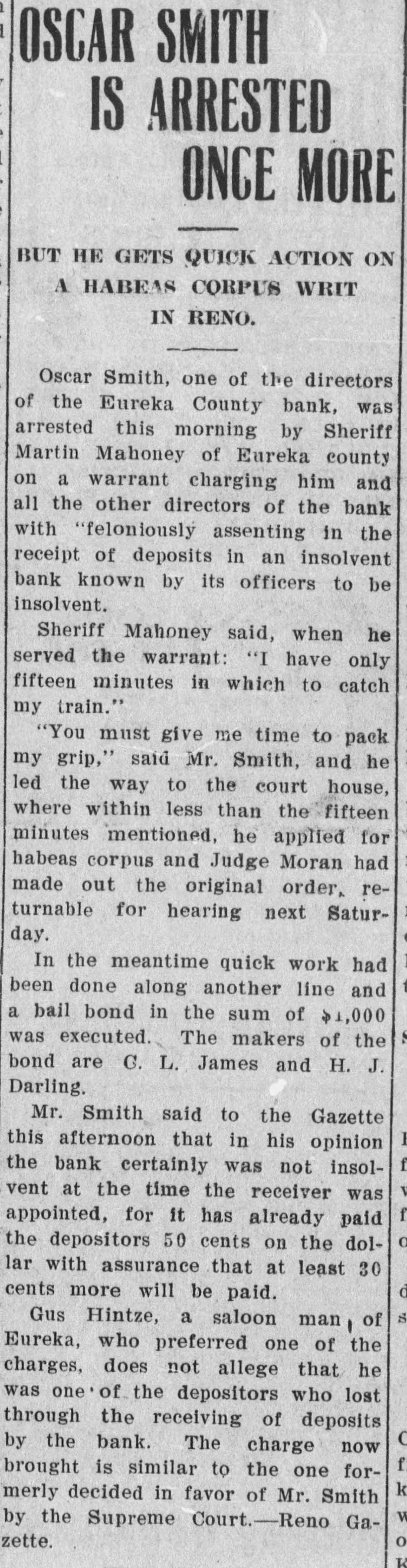
OSCAR SMITH IS ARRESTED ONCE MORE BUT HE GETS QUICK ACTION ON A HABEAS CORPUS WRIT IN RENO. Oscar Smith, one of the directors of the Eureka County bank, was arrested this morning by Sheriff Martin Mahoney of Eureka county on a warrant charging him and all the other directors of the bank with "feloniously assenting in the receipt of deposits in an insolvent bank known by its officers to be insolvent. Sheriff Mahoney said, when he served the warrant: "I have only fifteen minutes in which to catch my train." "You must give me time to pack my grip," said Mr. Smith, and he led the way to the court house, where within less than the fifteen minutes mentioned, he applied for habeas corpus and Judge Moran had made out the original order, returnable for hearing next Saturday. In the meantime quick work had been done along another line and a bail bond in the sum of $1,000 S was executed. The makers of the bond are C. L. James and H. J. Darling. Mr. Smith said to the Gazette 1 this afternoon that in his opinion f the bank certainly was not insolV vent at the time the receiver was f appointed, for it has already paid o the depositors 50 cents on the dollar with assurance that at least 30 d cents more will be paid. S Gus Hintze, a saloon man 1 of Eureka, who preferred one of the charges, does not allege that he was one of the depositors who lost through the receiving of deposits C by the bank. The charge now f brought is similar to the one fork merly decided in favor of Mr. Smith W by the Supreme Court.-Reno Gao zette. R


Article from The Pioche Record, February 4, 1911

Click image to open full size in new tab

Article Text

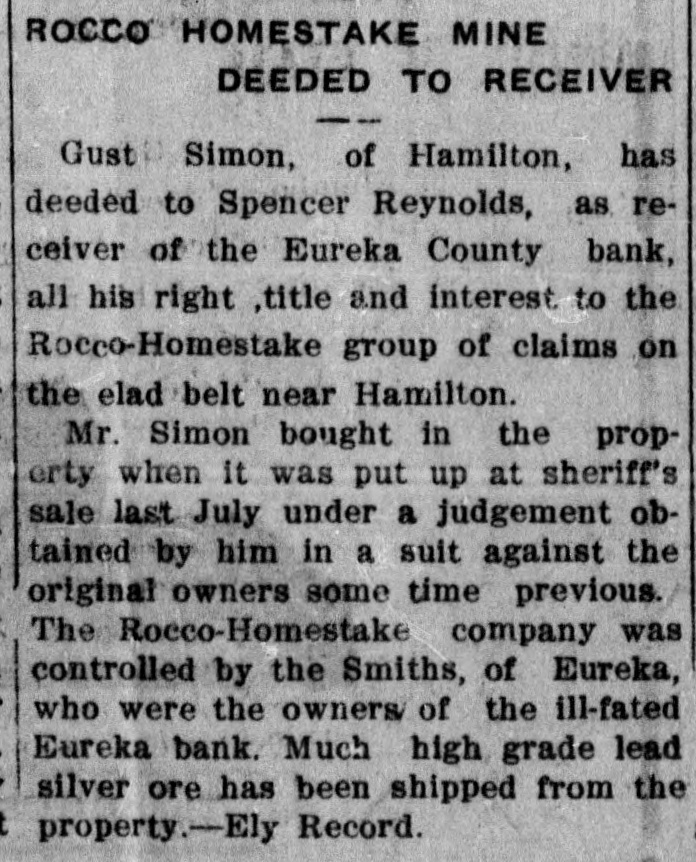
ROCCO HOMESTAKE MINE DEEDED TO RECEIVER Gust Simon, of Hamilton, has deeded to Spencer Reynolds, as receiver of the Eureka County bank, all his right ,title and interest to the Rocco-Homestake group of claims on the elad belt near Hamilton. Mr. Simon bought in the property when it was put up at sheriff's sale last July under a judgement obtained by him in a suit against the original owners some time previous. The Rocco-Homestake company was controlled by the Smiths, of Eureka, who were the owners of the ill-fated Eureka bank. Much high grade lead silver ore has been shipped from the property.-Ely Record.


Article from The Eureka Sentinel, April 1, 1911

Click image to open full size in new tab

Article Text

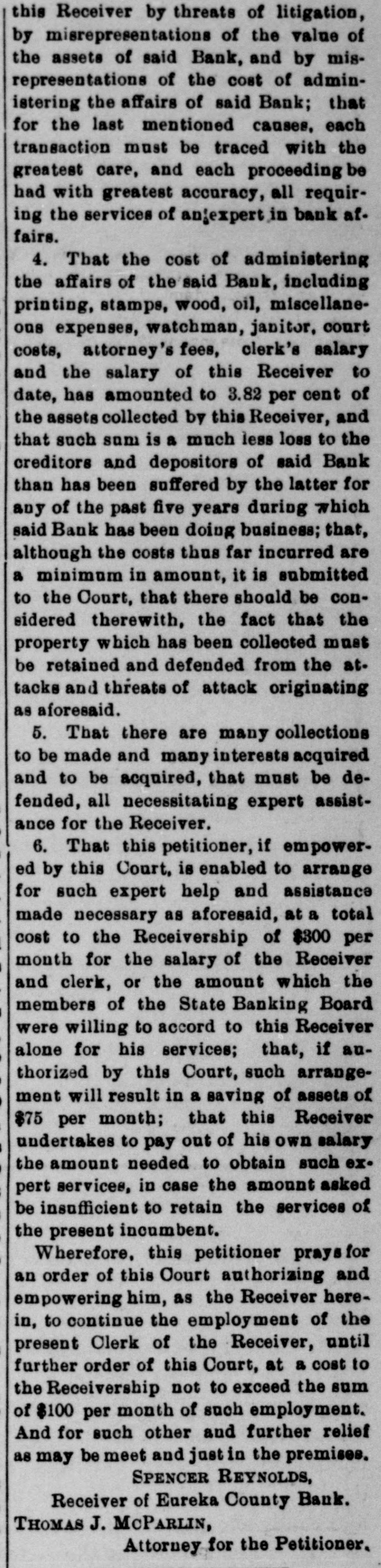
4. That the cost of administering the affairs of the said Bank, including printing, stamps, wood, oil, miscellaneous expenses, watchman, janitor, court costs, attorney's fees, clerk's salary and the salary of this Receiver to date, has amounted to 3.82 per cent of the assets collected by this Receiver, and that such sum is a much less loss to the creditors and depositors of said Bank than has been suffered by the latter for any of the past five years during which said Bank has been doing business; that, although the costs thus far incurred are a minimum in amount, it is submitted to the Court, that there should be considered therewith, the fact that the property which has been collected must be retained and defended from the attacks and threats of attack originating as aforesaid. 5. That there are many collections to be made and many interests acquired and to be acquired, that must be defended, all necessitating expert assistance for the Receiver. 6. That this petitioner, if empowered by this Court, is enabled to arrange for such expert help and assistance made necessary as aforesaid, at a total cost to the Receivership of $300 per month for the salary of the Receiver and clerk, or the amount which the members of the State Banking Board were willing to accord to this Receiver alone for his services; that, if authorized by this Court, such arrangement will result in a saving of assets of $75 per month; that this Receiver undertakes to pay out of his own salary the amount needed to obtain such expert services, in case the amount asked be insufficient to retain the services of the present incumbent. Wherefore, this petitioner prays for an order of this Court authorizing and empowering him, as the Receiver herein, to continue the employment of the present Clerk of the Receiver, until further order of this Court, at a cost to the Receivership not to exceed the sum of $100 per month of such employment. And for such other and further relief as may be meet and just in the premises. SPENCER REYNOLDS, Receiver of Eureka County Bank. THOMAS J. McPARLIN, Attorney for the Petitioner.


Article from The Eureka Sentinel, July 1, 1911

Click image to open full size in new tab

Article Text

Eureka, Nevada, June 24, 1911. To the Honorable Peter Breen, Judge of the District Court in and for the County of Eureka, State of Nevada. We, your Grand Jury impaneled by your Honor and assigned to duty on June 14, 1911, having investigated all cases submitted, also all public matters to which our attention was called by the District Attorney and others, and with the assistance of the Special Auditor employed by the County, having made a comprehensive examination of the books and papers of the various County officials, do now submit this, our report: The different committees were appointed as follows: Public Buildings-Chas. H. Rand, E. D. Walti, W. J. Harris. Books-I. H. Rogers, M. J. Hough, F. E. Leonard. Bridges and Roads-F. A. Fulkerson, Dan Johns, Miles McKinnon. Public Morals and Nuisances-James Mackey, F. J. Brossemer, W. S. Yates. Fire and Water-J. H. Fine, J. D. Murphy, F. J. Winzell. The reports of the respective committees are appended hereto. In the case of the State of Nevada, plaintiff, Indian Maggie, defendant, charged with murder, a true bill was found. In the case of the State of Nevada, plaintiff, Indian Tom, defendant, charged with murder, a true bill was found. In the indictments, B, C, D, E, F. G, H, I, J, and K, a true bill was found in each case respectively. The attention of the Grand Jury having been called to violations of the Gambling law, different parties were brought before this body and had read to them certain sections of the gambling law. Peace officers of the County also appeared upon request of the Grand Jury and had their attention directed to the gambling law, with instructions that they were expected to do their duty to the full extent of the law. The Grand Jury having been called upon to investigate the withdrawals of accounts by various parties just prior to the closing of the Eureka County Bank, beg to state that while we find this true, we do not find sufficient evidence to indict. For the benefit of the depositors in the said Eureka County Bank, and for the information of the general public, we wish to state that upon investigation we find that there is absolute and complete evidence to show that the deposit of the funds of this County in said bank by R. McCharles, Treasurer of this County, was placed therein as a special deposit, separate and distinct from all other deposits, and that he was fully justified in having same returned to him intact. In the opinion of this Grand Jury the conduct of the late State Banking Board (the predecessors of the present Banking Board, and to whom Mr. Van Fleet made his report of the condition of the Eureka County Bank during the last six months prior to the suspension of said bank) cannot be too severely censured. Had that Board taken steps to close the Eureka County Bank when their attention was first called to its deplorable condition, the results would have been much better for the depositors and all concerned, with the exception of the officials of the bank, as the deposits of the bank at that time were many thousands of dollars less than when the bank closed, while the assets were in much better shape. These are facts shown by the books notwithstanding the statements to the contrary issued by that Banking Board. Even during the time the Banking Board claimed to have been exercising supervision over the bank and its assets, the assets of the Eureka Live Stock the princi-


Article from Tonopah Daily Bonanza, September 7, 1911

Click image to open full size in new tab

Article Text

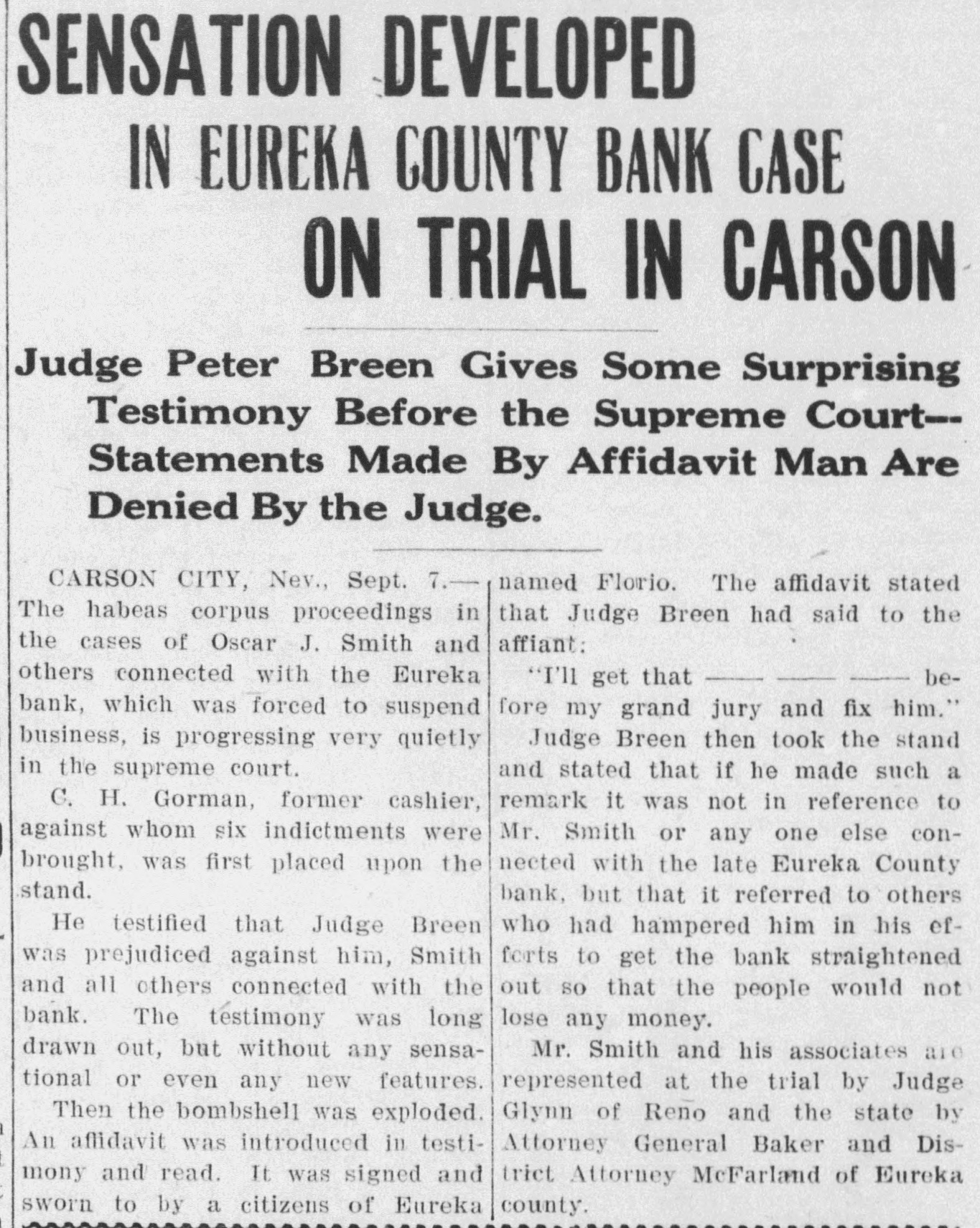
SENSATION DEVELOPED IN EUREKA COUNTY BANK CASE ON TRIAL IN CARSON Judge Peter Breen Gives Some Surprising Testimony Before the Supreme Court-Statements Made By Affidavit Man Are Denied By the Judge. named Florio. The affidavit stated CARSON CITY, Nev., Sept. 7. The habeas corpus proceedings in that Judge Breen had said to the the cases of Oscar J. Smith and affiant: others connected with the Eureka be"I'll get that bank, which was forced to suspend fore my grand jury and fix him." business, is progressing very quietly Judge Breen then took the stand in the supreme court. and stated that if he made such a remark it was not in reference to C. H. Gorman, former cashier, against whom six indictments were Mr. Smith or any one else conbrought, was first placed upon the nected with the late Eureka County stand. bank, but that it referred to others He testified that Judge Breen who had hampered him in his efwas prejudiced against him, Smith forts to get the bank straightened and all others connected with the out so that the people would not bank. The testimony was long lose any money. Mr. Smith and his associates are drawn out, but without any sensational or even any new features. represented at the trial by Judge Then the bombshell was exploded. Glynn of Reno and the state by An affidavit was introduced in testiAttorney General Baker and Dismony and read. It was signed and trict Attorney McFarland of Eureka sworn to by a citizens of Eureka county.


Article from Daily Independent, September 7, 1911

Click image to open full size in new tab

Article Text

# THE O. J. SMITH CASE A Carson dispatch of Wednesday to the Reno Gazette says: The habeas corpus proceedings in the cases of Oscar J. Smith and others connected with the Eureka bank, which was forced to suspend, is progressing very quietly in the supreme court. C. H. Gorman, former cashier, against whom six indictments were brought, was first placed upon the stand. He testified that Judge Breen was prejudiced against him, Smith and all others connected with the bank. The the testimony was long drawnout, but without any sensational or even any new features. Then the bombshell was exploded. An affidavit was introduced in testimony and read. It was signed and sworn to by a citizen of Eureka named Florio. The affidavit stated that Judge Breen had said to affiant: "I'll get that β€” before my grand jury and fix him." Judge Breen then took the stand and stated that if he made such a remark it was not in reference to Mr. Smith or any one else connected with the late Eureka County bank, but that it referred to others who had hampered him in his efforts to get the bank straightened out so that the people would not lose any money. Mr. Smith and his associates are represented at the trial by Judge Glynn of Reno and the state by Attorney McParand of Eureka county.


Article from Tonopah Daily Bonanza, January 18, 1912

Click image to open full size in new tab

Article Text

# ANOTHER DIVIDEND COMING # FROM THE EUREKA BANK Last Monday was the time set for opening the bids for the Eureka County bank property, as set forth in the recently posted notices. But one bid was submitted, that of Frank J. Winzell of Alpha, who offered $4854 for the property, with the understanding that the receiver of the Eureko County bank be allowed to retain possession of the premises, rent free, until March 10 next. Mr. Winzell's offer was satisfactory to Receiver Reynolds and Judge Breen, and check covering the full amount of the purchase price was accepted by the receiver. In the district court on Wednesday, when Spencer Reynolds, receiver of the Eureka County bank, informed Judge Breen that he had sufficient money on hand to pay depositors of the bank a five-cent dividend, the court ordered him to prepare a statement and petition for such a dividend. β€”Eureka Sentinel.


Article from The Eureka Sentinel, April 27, 1912

Click image to open full size in new tab

Article Text

# GRAND JURY REPORT Eureka, Nevada, April 24, 1912. To the Hon. Peter Breen, Judge of the Third Jadicial District of the State of Nevada, in and for the County of Eureka. We, the Grand Jury impanneled by your Honor and assigned to duty on the 17th day of April, A. D. 1912, having investigated all cases submitted and all public matters brought to our notice by the District Attorney and others, do now submit our report. The different committees were appointed as follows: Committee on Books-W. J. Mahoney, T. A. Bruffey, John Swan. Committee on Public Buildings-O. O. H. Hjul, D. Morris, F. Kopp. Committee on Fire and Water-Spencer Plummer, E. Affranchino, A. C. Dibble. Committee on Morals-John Depaoli, E. T. Flavin, J. J. Siri. Committee on Roads and Bridges-T. A. Burdick, Dennis Keefe, John Conway. In the case of the State of Nevada vs. Jean Banon, charged with arson, the bill was ignored. The Grand Jury, as a body, investigated certain statements concerning the Board of County Commissioners as published in the Eureka SENTINEL on the 16th day of March, 1912, and the causes that led up to that and similar publications. After a full and impartial hearing, it is concluded that said statements, or, charges, so-called, consisted of an ill-advised attack upon the Board of County Commissioners, which was inspired by a misunderstanding of the respective rights and duties of the County Board of Education in the matter of obtaining funds by taxation, and, backed up, undoubtedly, by persons who are interested in provoking trouble. If the publisher of the Eureka SENTINEL had refused the communication, as he knew that he should, the matter would have been unimportant. It was the publication in the paper which did much of the harm. The Grand Jury finds that the acts of and the bills, referred to, allowed by the Board of County Commissioners, were legal and proper; and, further finds, that the County Board of Education, in requiring the amount of its estimate from the Board of County Commissioners, were somewhat extravagant. It cannot be denied that after the washout of the railroad about two years ago, the shut-down of the mines and the bankruptcy of the Eureka County Bank, the irritability of some of the residents of this County towards others has been increased through a state of mind resulting from the many losses consequent upon the above named disasters. Much consideration should be and has been shown on this account. But, at the present time, when the railroad is rebuilt, new enterprises are starting and a revival of prosperity seems assured, a condition, involving indiscriminate accusations, must cease; or, must be punished as provided by the laws of this State. The reputation of a man, whether official or personal, is sacred, and must not be made the subject of insulting jest or indiscriminating attack. Those ill-natured persons who offend against this rule, merit and should have the contempt of all good citizens. The Grand Jury is assured that its investigation of this subject has done good and shall be productive of good results, and that many reprehensible phases shall be eliminated in the future. But, it has not finished its labors in this connection, and, if the matter be deemed of sufficient importance by the Court, the members of the Grand Jury would be willing, and hereby respectfully request to be continued as a body with power to take up again the question of libelling public officials. County Books To the Foreman of the Grand Jury- We. your Committee on County Books

Article from The Eureka Sentinel, February 22, 1913

Click image to open full size in new tab

Article Text

# FLORIO WINS BANK DECISION Judge Taber Decides Case Against Receiver of Eureka County Bank Judge E. J. L. Taber of the Elko District Court, before whom the case was tried, has rendered his decision in the case of A. C. Florio against Spencer Reynolds, Receiver of the Eureka County Bank. The case was tried at Elko in October, 1911. Florio sued to recover the sum of $9,051.40, collected for him from the Richmond-Eureka Mining Company through the Continental National Bank of Salt Lake City, its correspondent. Mr. Florio has heretofore received 50 per cent of this amount in dividends from the Receiver, and Judge Taber decides that Florio shall now receive judgment for $5,031.19, together with costs and necessary disbursements. The decision on file in the County Clerk's office covers 20 pages of typewritten matter and completely reviews the testimony offered and the trial proceedings.


Article from The Eureka Sentinel, May 1, 1920

Click image to open full size in new tab

Article Text

OLD NEWS FROM FILES OF "SENTINEL" As Told In Our Issues Corresponding To the Present Week of May and From 10 to 50 Years Ago 1872 The Odd Fellows celebrated the 53rd anniversary of Odd Fellowship in the United States. G. W. Baker, a talented lawyer, recently from the East, delivered the oration. One hundred and fifty Eurekans were in Austin attending court in the case of W. R. Street vs. Lemon Mill & Mining Co. Fish Creek, 16 miles south of Eureka, had a townsite surveyed and several prospects working. Pioche was agitating the building of a telegraph line to Eureka. 1880 Weather cold, snowing at intervals throughout week. Tom Robinson, Supt. Bay State Mine, sold the Trench mine for $30,000 cash. London quotations on Eureka stocks, Richmond $74, Dunderberg $44. F. Locan, president Eureka Con. arrives for inspection of property. Leasers of Union mine on Prospect Mountain taking out $200 ore; $18,000 already taken out. Leasers on Grant mine, besides doing dead work, have taken out in 45 days, 100 tons of ore running from $75 to $400 per ton. Leasers on San Jose claim taking e out one and a half to two tons daily of $150 ore. Work started on three compartment shaft of the Eureka Con. 1890 Silver 98% Alex Fraser was appointed foreman of the Ruby Mining Co. Thirty-four cars of ore shipped to ) Salt Lake during week. Wheeler Bros. shipped 24 tons of 3 wool. Weather cool and cloudy, with ) rain and snow. 1900 Silver 59%, Lead $4.57. F. J. Brossemer was in Hamilton looking after mining interests. La grippe epidemic claims many victims. Stockholders ask for a receiver for Whalen Copper Co. at Alpha. Ford Live Stock Co. shipped 20,270 pounds of wool. 1910 Warm, Summer weather, followed by a cold wave. P. H. Hjul moved his store from Courthouse block to present location. Cyanide mine erected hoist at their main shaft. Buckhorn Mines Co. incorporated. Twenty per cent dividend expected to be paid on defunct Eureka County Bank.


Article from The Eureka Sentinel, June 12, 1920

Click image to open full size in new tab

Article Text

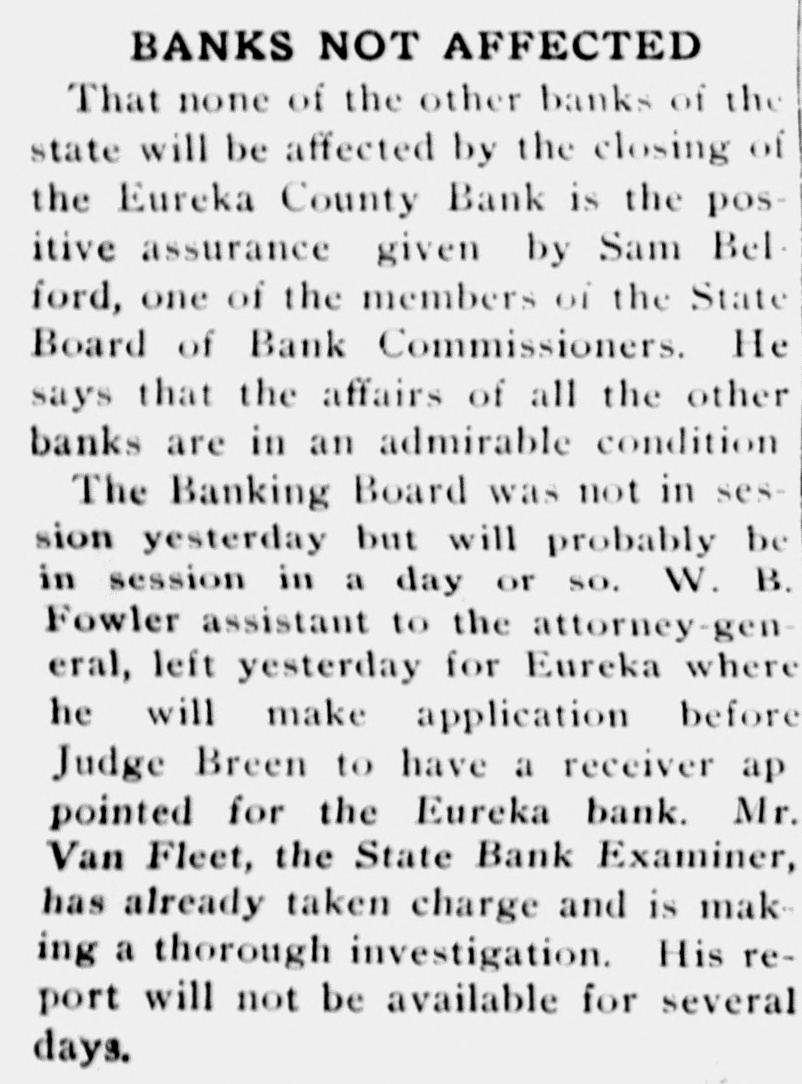
MINE POUNDS OF ORE Alexander 68,900 Altweg 670 Bullwhacker 42,270 Diamond 56,720 Eureka Con. 155,910 Excelsior 120,450 Fraser & Molino 5,950 Galena 1,675 Jackson 40,940 Richmond 40,170 FROM HAMILTON McEllin 57,060 Rocco-Homestake 160,740 1910 Receiver Spencer Reynolds of the Eureka County Bank declares first dividend of 25 cents, there being some $80,000 on hand in cash assets. The distribution of this large sum materially relieved the financial situation existing in Eureka since the closing of the bank.