Article Text
NATIONAL BANK CLOSES
ATLANTIC Jan. Atlantic City National Bank, largest financial institutions, failed open its doors for this This second City close here within the last week.
Accommodated withdrawals, Full suspension
ATLANTIC Jan. Atlantic City National Bank, largest financial institutions, failed open its doors for this This second City close here within the last week.
ATLANTIC CITY. N. Jan. Atlantic City Bank, largest institutions, failed open its doors for business this This the second Atlantic bank to close here within the week.
BANK AT ATLANTIC CITY SHUT UP BY DIRECTORS
ATLANTIC CITY, N. J., Jan. 30 (AP). —The Atlantic City National bank did not open for business today. Directors announced that the action had been taken to conserve assets for depositors.
At the close of business Dec. 31 last the bank published total resources of $14,200,740.36.
It is the second banking house to close in the history of the city. The first occurred last week, when the Chelsea Second National Bank and Trust company, with two branches, failed to open.
The effect of this was a small, orderly, but persistent "run" on Atlantic City National Friday and up until closing time at 1 o'clock Saturday afternoon. During that period all withdrawals of demand depositors were met.
Slaughter Named Receiver of Bank Laurance A. Slaughter, vice president the Commercial National Bank. has been named by the Comptroller the Currency receiver for the National Bank Atlantic City, Atlantic City, which was closed by the Treasury Department cently. He has already left to take over his duties. Mr Slaughter has been vice president the Bank for about 10 has, also, been active the the District Columbia Bankers Association.
Click image to open full size in new tab
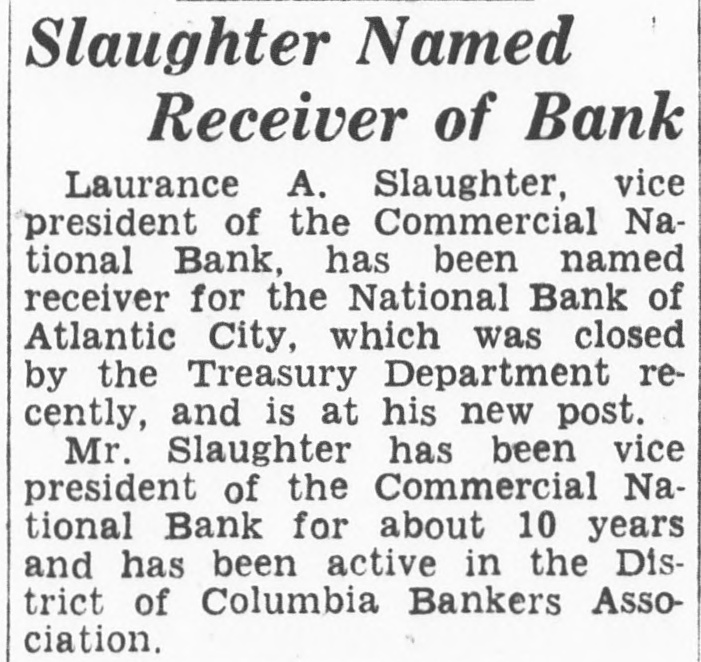
Slaughter Named Receiver of Bank Laurance A. Slaughter, vice president of the Commercial National Bank, has been named receiver for the National Bank of Atlantic City, which was closed by the Treasury Department recently, and is at his new post. Mr. Slaughter has been vice president of the Commercial National Bank for about 10 years and has been active in the District of Columbia Bankers Association.
Controller Appoints D. C. Man to Post in Atlantic
City.
BY EDWARD C. STONE. Laurence A. Slaughter, for the past 10 years one of the vice presidents of the Commercial National Bank, has resigned and repted appointment from the office the controller of the rency receiver National City which closed few days Mr. Slaughter has already the New Jersey resort and assumed new duties His appointment came day after the Atlantic City bank had been closed by the Laurence Slaughter Treasury DepartMr. Slaughter has been one of the most the younger bankers the city for years. He has been chair man the Transportation Committee and other important committees in conwith the the District Association. and is member and treasurer of the Washington Stock Exchange He will greatly missed by President Wade Cooper the Commerc and his many friends the financial district The liquidation of closed bank usually requires about two years. It will probably take that of time close the affairs of the Atlantic City institution
Dame North American President Directors the North American Co. Frank to fill the by the death on January 22 Edwin Gruhl Mr. Dame also remains chairman of the board. which he assumed April 25. 1932, when Mr. Gruhl became president. As of the board Mr Dame had not curtailed his active service. He been president of the company from 1921 nine months ago he of the board that Mr. Gruhl might receive the title of the position which in practical service as vice president and general manager. he had shared with Mr Dame as executive head for Williams was elected director and member the Executive Committee succeed Mr Gruhl Mr Williams and the of investment companies which interested represent the largest holdings in the North American Co.
Praise C. & P. Statement. The December and annual reports of the Chesapeake & Potomac Telephone Co. contained good optimistic figures. Total telephone operating revenues amounted to $9 during the 12 months. very substantial figure and well the sum in the Net operating rev for December deduction of all operating expenses, were $241,516 After all other deductions gross income reached the sum of $171 compared with in December. 1931 Total plant in service the end of December 1932, was valued at $33. 758.651. against $31 at the end of-1931 The gain of 621 in installed in while to the December. was large enough to be the envy of telephone companies in many other cities the increase more than 10,000,000 during the year should not be overlooked. total conversations numbern comment on the financial statement local consider the telephone combatted business very accessfully. Jones Elected New Director. Election of R. L. Houston Jones. Ta koma Park Md., of the Northwestern & succeeding the late B. Burdett is announced following the annual meeting of stockholders. All other ofand directors re-elected S.Dewhirst. first vice president: How Alfred B. Baker attorney Dewhirst, W Chappell. Dr. Coulon. Alfred B. Baker. Frederick Lewton. W. R. Tuckerman. Dr. W. W Stockberger. Jesse H. Powell, Howard Gott. A. Keefer and Mr Jones. Mr. Jones is engaged in the real estate busifiess. Association officers report gain of $15,000 in net assets during the year The usual dividends were paid and substantial amount added to surplus, they said.
Today's Trading on Exchange. The transaction on the Washington Stock Exchange $9,000 sale in the new Washington Gas 1958. at the same quotation which has prevailed all transfers. The bonds closed with 94 bid and 9416 The only other transaction of the day's 000 sale in tomac Electric 6s at the high figure of 108 This was an advance of point since the last previous sale. The advance in bond prices that began in the final week of continued through the first half of January carrying the level to the highest point reached in recent says the Guaranty Trust Co. January This was followed by an irregular reaction and then advance that raised the averages to level not far below the midmonth peak The advance is generally attributed to an improvement in business sentiment. for the ensuing it to have been least partly due the natural reaction that usually follows an exceptionally swift advance. though a contributing factor may have been the sale Government by the Federal Reserve after five months of absence from the The month's trend as whole is conspicuously favorable and is considered an encouraging not the bond market. but the general business outlook as well.
Heard in Financial District. The forty fourth statement of the Building & Loan Association was ssued today showing assets gain of 176 during the last year. Anacostia Bank. is president of the Drug which owns the Liggett has declared quarterly dividend of 75 cents share, payable March record This the on a $3 basis against $4 previously. The David Pender Grocery Co. has declared the regular quarterly dividend of 87½ cents stock. payable March to stock of record February 20. Jewel Tea Co. has declared the 'regular quarterly dividend of 75 cents on the common stock, payable April 15 to stock of record 13. Regular quarterly meeting directors of General Motors Corporation will be held on the first Monday of February, May August November instead of the first Wednesday of these months as previously.
SILVER QUOTATIONS NEW YORK February silver lower at 25%.
(Continued from Page One) stock. either my own name in the name of any other person, actdirectly my (the same owned any of stock the same banks) for 60 days (in January 1933 He further subscribes that he holder the stock the Northside Trust the Union National and that rent for my box has been paid No kind the public have been volunteered either receiver since the banks closed, there was street port yesterday that Walter Hanstein been appointed attorney for the receiver the National. Another report that Solicitor Joseph Perskie had been named attorney for the receivthe Atlantic City National, but report said that this without foundation, and no attorney had been appointed yet. The regulations concerning access deposit boxes after the closbank's banking business are said those of the Treasury Department at Washington.
zona's legislature has joined North Dakota, Minnesota, Wisconsin, Illinois Nevada, notified Senate 15, passage of the Frazler bill (S. 1197) which that farm shall be financed by federal This the legislation which the Hoover ministration fought communistic ruinous to the holders on farms.
000 would have been nearer the amount. boys the big banks in Michigan, other cities, not political would have had their institutions closed long ago. One be very innocent financial ters not know
Just as down to desk my write this article news that New Jersey has passed which enables banker refuse pay out depositor the amount of deposit and that bank Atlantic City has already taken advantage the law, its deposifinding themselves deprived their balances while the bank tinues to operate. Any new posits drawn deposits after the bank took advantage this new passed night session of the Legislature, but the old ones. In other words, if you can go out and dig up some money and it the bank which refuses give you your old deposit, then draw on this new deposit. living an insane asylum We certainly are. The Inmates, however, taking of the keepers in place of the keepers taking the inmates. THEY
What are the experts who cover the country telling their financial clients, "Business recovery, long hoped for but still by its absence, probably would have prevented latent difficulties, such existed in Detroit from coming is now, however, evident that recovery of sustained and healthy character not in immediate prospect, precisely for among others that the confidence of formed has be that disclosed in Michigan. Hence the action taken by Michigan authorities, though painful, had become prior to any revival confidence activity." You have just read "inside" reports made to the financiers. Note "painful." It painful all right hundreds of thousarids depositors. The trouble that those who are to blame for the existing conditions get most of the Note pain. also statement about formed business men.' The inferof course is that these men knowledge other situathose existing in the State of Michigan.
STORIES BEHIND COLD FIGURES
Figures are said to very cold things. lot them and find them else but cold. They the most illuminating material one use to get picture of what is happening. more people looked less would be fooled by spouting politicians, educated writ and the balance the breed spawn their in the columns the press. Through last year was to tell the truth this column Guardian readbecause deal with these figures week Now have before me almost the completed figures 1932 when the general press was telling about the coming upturn and telling about the steady downturn. Four hundred of the leading industrial showed decline earnings per railroads, the leading have completed their deficit of over in comes to wages almost every decline amount product great decline Those the are doing maybe their them trial financial lords backs they do terrible people organize reminds old feudal when to his an only power have is what you think really understood, really any power
Hint Transferred Property to Evade Obligations
Wholesale of many prosecution of the closed former depositors City and national attorneys for the receivers, night from an unoflearned last ficial but authoritative source. The impending prosecutions, aimed at both and owe either the notes for other and who within the months have made past transfers property other assets with intent to evade said to be under of and within the past months to termine which made escape obligations due the closed instituprocedure, stated. has been shorten the duration receiverships elimination needless affairs the defunct banks may settled the shortest possible While authoritative announcethe Thompand Hanstein, formerly represented Charles Faircloth, National been succeeded Bourgeois Coloumb, counsel Laurence Slaughter. receiver for the Atlantic National Bank. reason the change National Bank not learned.
Judgment notes by the City Bank entered in against John Slape, president the The judgments sought Laurence Slaughter receiver the included to totaling and totaling $133,158 on which the North Side Trust Company the Union National which merged the Atlantic City National notes included $10,000 paid directly Slape by endorsed other notes for and $13,000, on which judgment entered. Slaughter judgment for $55,000 assessments $100 shares capital of the Atlantic City National Bank.
Depositors Organize
Four months after the closing the of lantic City Bank organized the auditorium the Junior High School and discussed protect interests the was called by Henry Fink, of 127 Seaside through and than 200 attended Officers follows: Harry and Treasurer, Harry Mrs. Sackett, short the banks secrecy, and declared that was surprising depositors the institution had kept their patience for anticipation word Comptroller of the Currency Albert Pilkington expressed (Continued on Last Page)
May Last Four Years, According to Slaughter
Receiverships of two closed lantic City banks may years, according Laurence Slaughter Receiver for the Atlantic City National Bank He the process of liquidation moving slowly and be by the Comptroller Currency average required from four Slaughter said that there was nothing gained suing peotaking and getting what they could from forced He said be assumed that much the frozen assets would considerably more later The he getting people He declared that the bank foreclosing where there any disposition the part the owner but that some were taking the earnings from and giving the bank nothing.
Can't Accept Mortgage Swap Slaughter that national bank not authorized the present Home (Continued Page Four)
May Last Four Years, According to Slaughter
Receiverships two closed lantic banks last least four according Laurence Slaughter, Receiver for the Atlantic National Bank declared the process of dation moving would pushed by the Comptroller Currency pointthe required Slaughter that there be gained by peogetting what they could from forced He be assumed that much of the frozen considerably The difficulty, people He that the bank foreclosing where there any the the owner help. were taking from properties giving the nothing
Can't Accept Swap Slaughter that national receivers authorized present time accept Home Loan (Continued Page
Collections the Atlantic City National Bank since the date January totaled revealed the statement made federal receiver. The Slaughter, statement period ending September the largest secured from assets Cash collected the receiver and held trustee owners amounted There cash collected from interest, premium rents have $1,351,for and The expenses the ceivership amounted Cash hands the receiver totaled for secured the date of suspension The unsecured that time amounted $7,076,749.08. Additional the the total to be for the date pension $14,243,878.87 item total cash lected from assets, amounting received from assets amounted to from additional assets cash on stock assessments Losses charged off on assets amounted to $316,878.62
Outburst
Also Delinquent in Payments to Delve Into Holland Firm Wife, He Apologizes
Examination of the assets and liabilities of John Slape, president of the closed Atlantic City National Bank, in involuntary bankruptcy was made meeting creditors before Robert Steedle, referee in bankruptcy, yesterday. The hearing brought denials from Slape that had any assets other than schedule of liabilities month. that while no placed the which consiststocks companies and estate point the after he recently car, Slape people think sit death not supposed to have anything. Clarence Knauer has been named After the Slape hearing creditors delved into the affairs the another which by Slape and testified he received solicitor for and various vanced funds from company what might be termed dividends dividends declared. On occasion advanced $40,000 when pany's $150.000 he thought enough grease to pay the creditors. economic had caused the price grease brought out Holland had time time Both and Holland they felt the was could draw funds file liabilities for company The creditors hold another meeting on December
Lewis Moyer, delinquent band, became abusive in Domestic Relations Court escaped of from one three years State prison for tempt court, when he apologized Judge Moyer $628 arrears for the support of his child, who killed last March fall down elevator shaft. According court Moyer made his last to payment September, Being collecting the which due the death. Moyer had husband brought before the court two time stated that of the might the of the arrearage default payment time the from by the probation order chance to pay thing But called the Court the Judge the Court ought own medicine. Judge Corio sentenced contempt of desire offer apology for his was given the portunity Judge Corio the apology reminded the court order made had that only could tencing delinquents of and Court satisfied accept the apology and vacate theless would pay account of his arrearhis
(Continued from page seven) ported as $10,000,000 delinquent in taxes. Official city deposits amounting to $1,122,000 are gone; a million dollars borrowed from the Federal Reserve for city tax notes is gone; over $900,000 borrowed from the Reconstruction Finance Corpor2 ation is gone; Atlantic City Sinking Fund money amounting to $710,000 is gone," New Jersey State loan to the resort of $500,000 is gone; citizens' private bank de-9 posits amounting to $25,492,986.90 are gone; bank deposits from December, 1932, to June, 1933, of $27,514,930.63 are gone. At the rate of ten million dollars a year, $63,000,000 of Atlantic City business has disappeared in less than five years. Bonds of Atlantic City and County now in default approximate $36,143,635, an amount impossible of payment. And equally impossible of payment is the $7,364,960 necessary for debt requirements in 1933. Since 1920 the average annual payment on Atlantic City bonds has been $878,000 but during the same period the city issued annually $2,184,769 worth of bonds. In 1929, $6,000,000 in bonds was issued. Remember the historical progress of the Sabine army; One step forward, two steps backward, March! Railroad revenue from traffic to Atlantic City has decreased a million dollars a year, from $8,430,000 in 1927 to $2,922,000 in 1932.
Unless the citizens get relief from these staggering burdens they cannot hope to return to a period of normal, reasonable and stable prosperity. Closing and liquidating the banks would have proved emberrassing to say the least for certain businesses, politicians and certain individuals who obtained huge loans and made huge withdrawals from restricted banks. As neither the bondholders, nor city employees, nor city creditors, nor citizens had received any money, and as the money was at one time there, it is very evident that cash must have been divided among "smart money" -the sanctified few.
Strain Credit
On city credit $500,000 was borrowed from the New Jersey Sinking Fund and divided between three banks. This money belonged to the taxpayer, will have to be paid back by the taxpayer, and should have been held inviolate for the use of the city. Of this $500,000 the Atlantic City National Bank was given $250,000 two days before it closed; $125,000 was given to the Guarantee Trust Company before It was restricted; and $125,000 remained in Mayor Harry Bacharach's own bank, the Equitable Trust Company, before it was restricted. What legal or moral right has the Mayor of a city to use public money for the attempted salvation of any private bank? Why were banks propped with citizens', taxpayers', and city money, and what became of the money? Why was not the whole of the borrowed $500,000 held liquid and in safety? Why was $500,000 borrowed from State Sinking Fund when more than a million dollars of city money was reported as available on deposit? Why was nearly two million dollars worth of tax notes hypothecated with the Federal Reserve and the Reconstruction Finance Corporation at approximately the same time? Was city money actually available or had it also been used in private speculation of debilitated banks? Atlantic City is broke and hopelessly in debt because public money and private money; city deposits and citizens' deposits; city employees' salaries and debt requirement money; all were used for the maintenance of rickety banks, tottering reputations, and foundering directorates. Banks Looted
Atlantic City banks were looted by the political-business machine, and they were looted from the inside not from the outside. All semblance of honesty and justice was long ago abandoned by the political-business-banketeering group which has raped and ruined Atlantic City. Slick financiers dressed like undertakers and with the regulation artificial smile, ushered depositors to the wicket for the burial of their hard earned wages. The same financial morticians are officiating at the funeral of Atlantic City. Banks have said continually, "Be thrifty. Save against a rainy day!" The people are asking for whom they were saving. To the contrary of banks the Bible has said, "Lay not up for thyself treasure on earth where moths corrupt and thieves break through." In the light of financial exploitation of the people, which turned out to be right, the banks or the Bible? It is repeatedly stated that people have not the intelligence or training to grasp full significance of financial or political matters and that no Information on these subjects should be given them. Well, the people can grasp the full significance of their lost and departed deposits. Politicians believe devotedly that the people have intelligence enough to vote for them, but not intelligence enough to understand the full significance of lost life savings, of bread and butter, of home and children.
Banks in Atlantic City are not worried about the depositors for the latter are a very, very docile people. Preferred stock in banks was given them for their money on deposit and as Holy Writ has it, "The last stage will be worse than the first." In many states, especially Southern, the preferred stock for deposits racket would not work for the reason that preferred stock was made a double liability similar to national bank stock. But in New Jersey preferred stock seems not to be a double liability and SO the people will be enabled to use it for fuel or wall paper in the lean times to come. In a small community like Atlantic City the political leaders, business leaders, financial leaders and chamber of commerce are all of the same group. It is always the same bunch who are honorary pallbearers in any prominent funeral and they understand obsequies, civic or otherwise.
Add to this the fact that there are no two political parties and but one single political monopoly and it can be understood why not a word escapes as to what has gone on in banks, and as to what has become of depositors', bondholders', city creditors', city employees', and school teachers' funds. Mouths must be kept shut, and depositors know nothing going on in financial directions except that they have have lost their money. Why was it that the Guarantee Trust Company with a million dollars surplus was forced to jeopardize its depositors money by taking in two insolvent banks? Why Weaken Banks Why did the Guarantee Trust have to dangerously weaken itself by mothering two dilapidated financial institutions? Was the reputation and purse of a few unworthy directors in wobbly banks of more importance than the thousands of dollars in depositors' lifetime savings? What political-business-banketeering compulsion forced a futile salvaging? What kind of protected hi-jacking was this? In absorbing the defunct Seaside Trust Company-bank of the so-called Democratic leader Lafferty, "friend of the people" (except his depositors)-the Guarantee Trust Company was forced to take over an institution more than $200,000 in the red. And in absorbing the Atlantic Safe Deposit and Trust Company, the Guarantee Trust Company acquired an institution which was $900,000 in the red. What a fine use to make of depositors' money in acquiring foundered banks! What caused these diabolical combinations? Nothing but political-businessbanketeering. So also with the Equitable Trust Company, which acted big-hearted with its depositors' money by salvaging the Pacific Avenue National Bank and the Chelsea Safe Deposit and Trust Company. It is said that it takes the kind of bankers they have in Atlantic City to run a bank. Well, it does-the kind of a bank they run. The kind of a bank which was good enough for "smart money," but which was tough on business and the people.
The most important and the most controversial question brought about by bank failures, is the future necessity for guaranteeing deposits. The Glass-Steagall bill which encompasses this end becomes partially effective January 1, 1934. All deposits in solvent banks under government supervision will then be guaranteed up to $2500.
After July 1, 1934, deposits will be guaranteed one hundred per cent up to $10,000; seventy-five per cent from $10,000 to $50,000; and fifty per cent in excess of $50,000.
Under this Glass-Steagall Banking Act of 1933, assets of banks applying for insurance of deposits must be adequate to meet all liabilities to depositors and other creditors. Member banks of the Federal Reserve are automatically included in the pool from which the safety of depositors' funds will be guaranteed. The Guarantee Trust Company and the Equitable Trust Company are members of the Federal Reserve, but the Bankers Trust Company is not.
But the government does not intend to insure any bank deposits where the bank itself is not solvent in its set-up. A bank will have to be potentially able to insure its own deposits before the government will insure them. If a member bank of the Federal Reserve cannot meet all of its liabilities to depositors and creditors, it will be closed. State banks can do pretty much as they please, but if they desire deposit insurance they must meet the solvency requirements of the government. Inasmuch as the Guarantee Trust and the Equitable Trust were restricted, it will be interesting to observe whether they are solvent enough to obtain deposit insurance.
The Bankers Trust was formerly a member. Will it insure depositors' accounts?
Will any or all of these banks be closed by the government on January 1, 1934? The United States intends to make a fact of the theory that depositors have a right to their money. The Boardwalk National Bank carries a forty per cent ratio of capital and surplus against deposits and this is twice the margin of safety necessary and required. Thus it is always more than solvent. It has the honorable distinction of being one of the 313 government depositories in the United States, and is a member of the Federal Reserve. It has always insured the safety of its depositors and kept utterly aloof from the political machine and the political-business-banketeers.
Atlantic City has gone utterly a-smash and is scraping financial bottom. There is nothing left to loot. But this does not worry the political monopoly which gets its revenue from graft in rackets of all kinds, including beer, liquor, dope, banks, receiverships, scrip, contracts, protecting criminals and vice conditions generally. The tangible assets of the resort have been mortgaged for years to come and the debt left upon the backs of taxpayers for liquidation. The situation challenges belief. Waste and extravagance in municipal government-even now going onhas brought about financial catastrophe. The dead stop of bankruptcy was inevitable in a city spending each year more than its income.
Blind Politicians
The municipal administration-old fogies of a by-gone era in political servicewere blind to the economic foundering of the city. Year after year the political coterie indulged in an orgy of spending. Payrolls were glutted and padded with useless employees, salaries were raised beyond the limits of common sense, and departments were created overnight to pro- vide for patronage seekers. The golden stream was thought to be endless and a day of reckoning was never considered. No one asked if taxpayers could continue to pay the bills. Now that the end has arrived, accompanied with closed and restricted banks, an empty citizenry's purse is asking questions. If Atlantic City can be saved at alland this is not certain-nothing less will do than a drastic scaling down of municipal debt; a cancellation of all past interests thereon; a fifty per cent cut in all taxes past and present; a government acting within the limits of income; and an entirely new municipal regime. Ordinary processes of law are not equal to the chaotic situation in Atlantic City. A corrupt monopolistic political machine has long since occupied the people's citadel of defense, the judiciary. Even now, confiscation of property is sought by empowering political officials to act as receivers for property which is tax delinquent. The security of homes has been invaded and domestic tranquillity guaranteed by the Constitution, is but a myth.
The "scarlet army of crime" as so designated by United States Senator Copeland, has long occupied the resort. Political organizations and leaders are in league with this "scarlet army" and protect the criminals operating within it. Citizens know the streets in Atlantic City which are not safe at night for men or women. It is an oft-repeated truism that the resort is the safest place in which to commit a murder. And these conditions are due as much to an indifferency of the citizens as to an indifferency and a corruption of the political machine and inefficiency of its municipal representatives.
Release of Funds for Student Awards Sought
Lawrence Slaughter receiver closed Atlantic City tional Bank, called United States Court trust fund the Northside Trust Company purpose buying prizes School pupils. The first started the State Chancery Court, but upon motion for the bank ceiver Vice Chancellor Sooy federal Frank Poucher, president of the Atlantic City Company, donor the fund and Board the plainants. for long time interested work schools. About addition placing owned the disposal boys games, placed the Trust $500 trust fund Both princiand for the prizes for athletic contests and other school When the Northside Trust Company Atlantic National Bank fund the funds of the NorthBank. the closing Atlantic City National Bank this fund frozen Demand the fund refused Slaughter. position prize fund became the other funds of the and therefore cannot be paid other depositors when dividends are clared under receivership
Release of Funds for dent Awards Sought
Lawrence receiver closed Atlantic City National Bank. called United States trust fund set the Trust purpose buying prizes pupils. The first started the but motion counsel for the ceiver Chancellor Sooy the federal courts. Frank president of the Atlantic Company, donor fund, Board the complainants. for time interested in the work vocational schools. About addition placing he owned disposal boys games, Poucher placed with the Northside Trust Company trust fund. Both princiincome be used for the purchase prizes awardathletic contests and other school When the Northside Trust Company turned the Atlantic National Bank for fund went the other funds of the NorthBank. closing the Atlantic City National Bank fund frozen. Demand refused Slaughter. the fund merged the other funds of the bank. cannot paid depositors clared under the receivership
Oil Charges ulent Transactions in Case Review Plea
COURT ORDERS BRIEFS
CAMDEN Sun Oil Company charged in Federal Court today the Atlantic City National and officers, bankrupt Island tilizer and John Slape, president of bank, and Edwin Holland, officer the company, were fraudulent. The allegation gument before Judge John Boyd the petition review referee in bankruptcy's company's request for rejection of creditor's claim the receiver for the bank against the bankrupt The company, creditor of the bankrupt firm. also petitioned review the referee's order request for examination certain witnesses under section Federal Bankruptcy
Orders Briefs Filed Judge took the latter request under and ordered counsel for the company to file briefs within ten days petition for rejection of the bank ceiver's claim. The company Alfred Atlantic contendthat addition president of the bank, also connected with the fertilizer that through his sition the bank borrowed than from sum, the company contended. immediately turned Slape and Holland, constituting fraud. The company's financial the that indebted the extent of The company counsel further alleged since the president puted fraudulent transactions present claim against bankrupt firm.
Federal Probe Department of Justice and the National Credit Men's Associainvestigating matter. company adding that Atlantic depositors interested Charles counsel present the hearWilliam Hunter appearing for the bank. the president the bank may gineered loans for his personal profit changethe alleged therefore Justified in claim against the fertilizer organization. The company asserted that officers fertilizer poration employes' Holland Slape that the obtain the money from company soon the bank made loans. "There basis for the loans corporation counsel tended. declaring that "some ments the were The money converted Holland and the oil company counsel claimed. their after had been obtained false statements bank Glenn referred transcript testimony taken bankruptcy hearing before Robert Steedle officers the Island Fertilizer Company which Holland Rose Mary Ochfenfeld testified that account page the ledger entitled MiscellaneHarbor special account reflecting presumably withdrawn by Holand advances used purposes expenses Harbor brewery. These