Article Text
THE BANKS OF NEW YORK.
Annual Report of the Superintendent of the Bank Department.
The number of banke, banking associations, and individual bankers doing business within the State at the close of the fiscal year, was three hundred and five. There were, at the same period, in addition to the number just stated, fifty-three closing and in- soivent banks, whose notes are in process of redemp- tion, either at their counters, or nader the direction of this Department.
Ten banking associations, with an aggregate capi- tal of $1,560,000, and six individual baok rs, have deponted the requisite securities and commenced the business of banking during the last fiscal year. Foar of the new associations were organized from incor- pora ed banks whose charters expired during the last fiscal year. The Bank of Rome, Bank of Salina, and Essex County Bank, whose charters expired on the 1st of January, 1862, have not reorganized, and are closing business.
The amount of securities held in trust in this De- partment on September 30, 1862, was $36,642,310 98. The amount of circulating notes issued and out- standing on the books of this Department at the same period, was $42,239,836. Of this sum there was in the vaults of the banks, on the 27th of Sep tember, 1862, $4,682,463, leaving in actual circula- tion $37,557,373,
The actual circulation reported September 21, 1861, was $23,045,748; showing an increase of $9,511,625 during the year.
The total amount of New-York State stock heli in trust for all the banks, on the 1st of October, 1862, was $19,022,890 10. Of which amount $5,928,966 was held for banks in the City of New York, and $13,056,924 10 for those in other sections of the State. The total atmount of New-York stork held December 1, 1562, was $19,812,225 10, and of United States stock, at the same date, $12,729,450.
There has been a decrease in the bonds and mort- gages held as security, during the past year, of $474,308; of Illinois stock, $36,783 33. Not regard- img Arkansas State stock as of any intrinsic value, I have caused it all to be withdrawn; and with the exception of $114,466 67 Illinois and Michigan stock, all the stock held in trust by this Department has bean issthed under the authority of this State and of the United States.
The amount of securities transferred by the De- partment and countersigned in the State Treasury for the year, was $6,067,800.
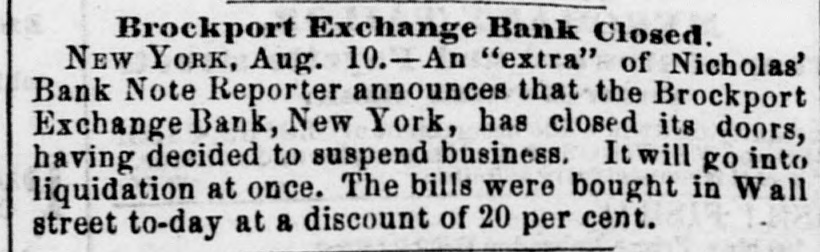
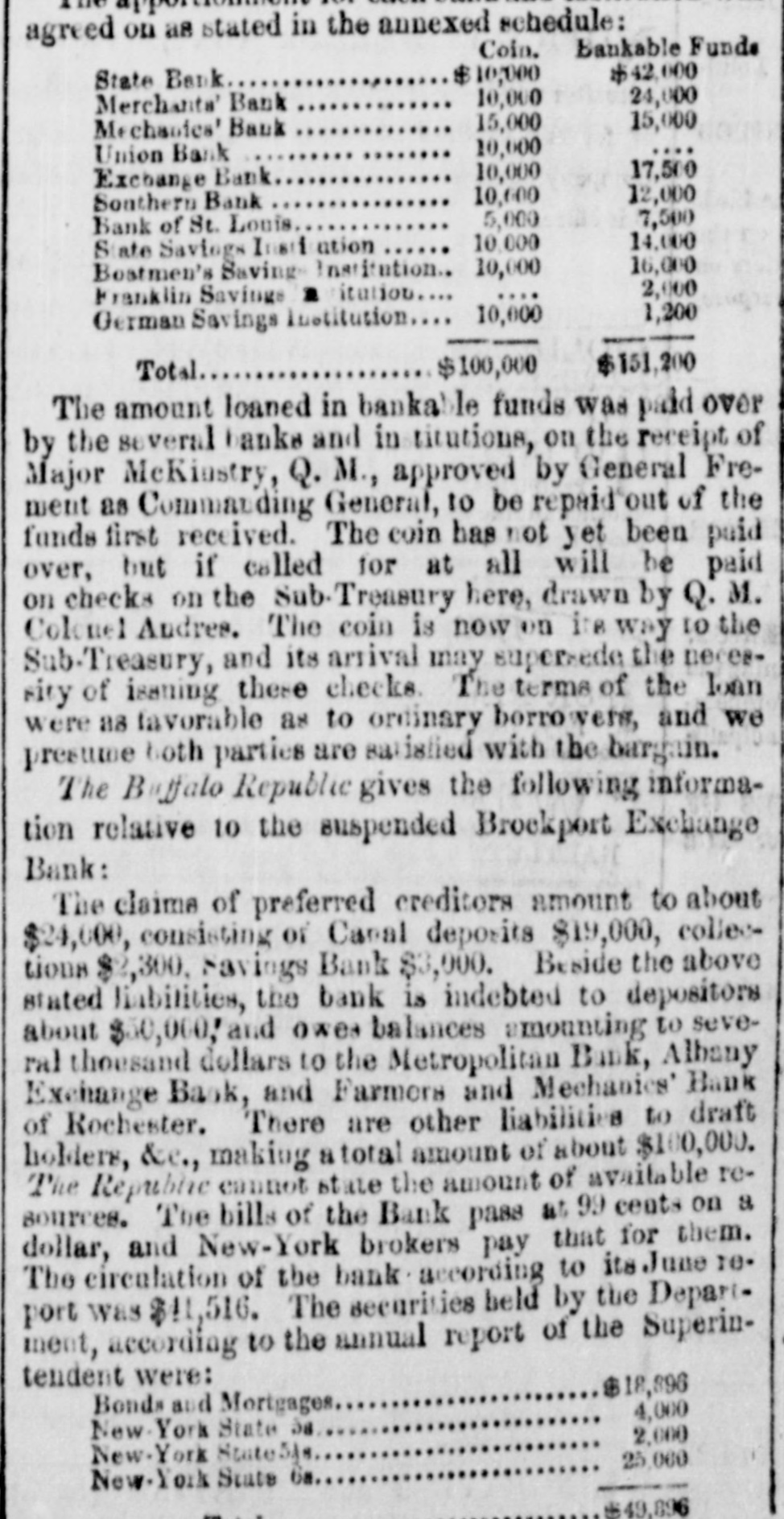
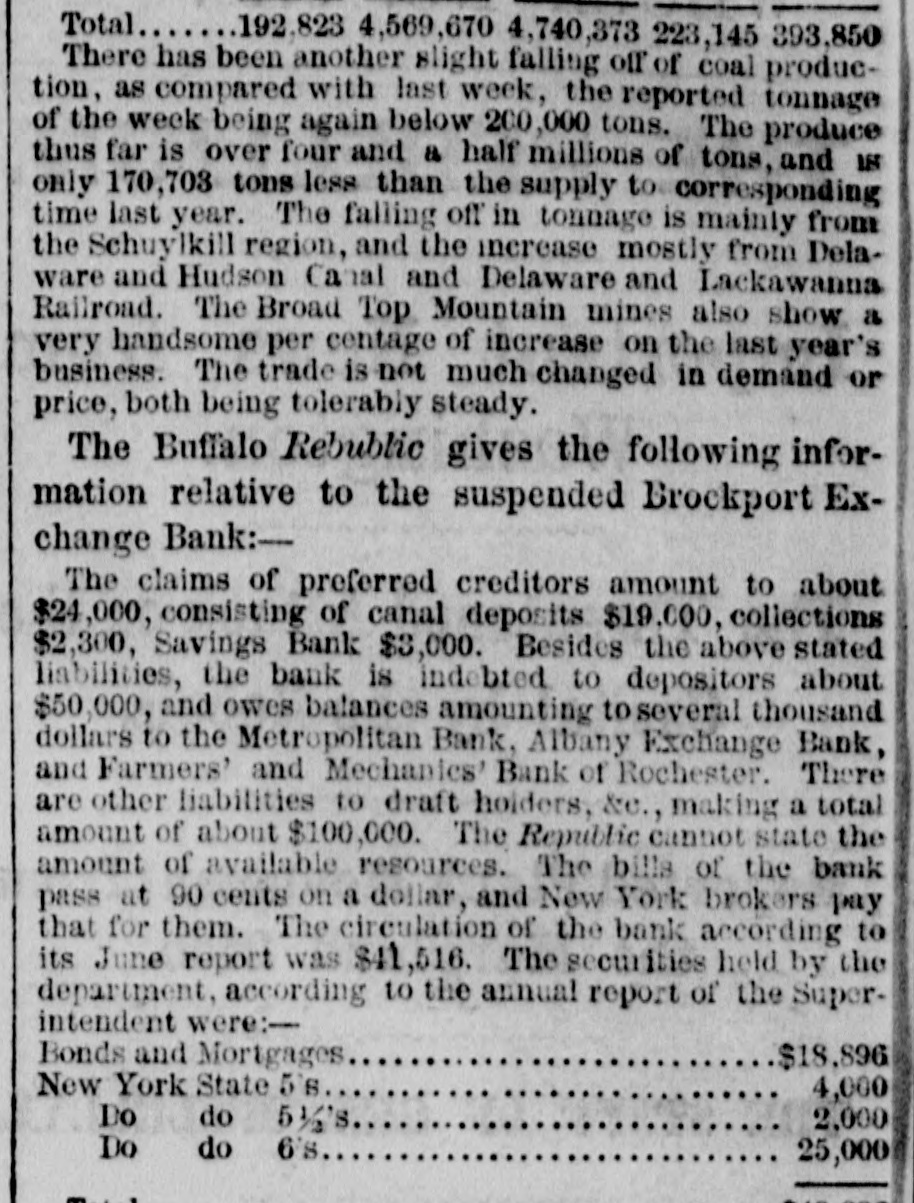
The Broekport Exchange Bank is the only one that has failed during the fiscal year.
The name of the "Iron Bank," an individual back located at Plattsburgh, was changed by au act of the Legislature, and the bank removed to lierki- mer.
REDEMPTION OF NOTES OF INSOLVENT BANKS.
It will be observed, from the statements herewith submitted, that there is now on deposit, in various banks, to the credit of the Superintendent of this Department, the sum of $103720 60. This mozey is held in trust for the redemption of the outstanding notes of banks which have failed, or which are clos- ing business voluntarily, and by expiration of char- ter. A considerable share of the amount thus beld results from the sule of securities belonging to banks which failed a number of years since.
EXPIRED INCORPORATED BANKS.
The charters of the following incorporated banks, viz: Cayuga County Bank, Chemung Canal, Bank, Herkimer County Bank, Seneca County Bank, Sev- enth Ward Bank, Troy City Bank, and Westchester County Bank, expired on the Ist of January, 1863. These banks, under their charters, had an author- ized circulation of $1,627,000, which enures to the benefit of the now associatione, conditioned only up- on the deposit, in each case, of $10,000 in stocks in this Department. The law requires the circulation of the expired institutions to be returned in thres an- nual installments. Such has been the demand for currency during the past season, that those banka whose charters expired on the las of January, 1862, have found it impracticable to comply with the pro- vision for the return of one-third of their circulation at the close of the present year. In such event, a cash deposit equal to the ceficiency is required. The length of time for which such deposit is to be held, will depend entirely upon the promptitude with which the notes are returned to be destroyed. If an interest of three per cent be received on the de posit thus made, it will be nearly equivalent to the interest received on New York stocks, at the present market value, deposited for banking purposes by as- sociations and individuals.
DEPOSIT OF SECURITIES BY NEW BANKS.
I renew the recommendation, made in the last an- nual report from this Department, for a modification of the law in relation to the deposit of securities by nesociations and individual bankers. In the case of the former, a deposit of $100,000, and in the latter, of $50,000, at the time of filing certificates of organi zation, is required. It is believed that a deposit of $10,080 by new organizations, and the retention of that surm from existing institutions, to be irrevocable save through the process of liquidation, would afford all the protection which the caze requires, as well as obviate existing inconsistencies.
SUSPENSION OF SPECIE PAYMENTS BY THE BANKS.
The most important event in the financial history of the last fiscal year is the suspension of specie pay- ments by the banks of this and other States. This occurrence dates from December 28, 1801, at whien time the annual report from this Department had al- ready passed through the press, thus pree uding allu- sion to the subject.
In view of the immunity granted to the banks by the Legislature, after the suspension of specie pay- ments in 1837, the framers of the present Constitu tion embodied therein the following inhibitory clause: "The Legislature shall have no power to pass any law sanctioning in any manner, directly or indirectly, the suspension of specie payments, by any person, association, or corporation, issuing bank notes of any description." It is obvious, therefore, that under the unrestricted operation of the laws of this State, an irredeemable paper currency cannot be maintained; It is true, the community might waive for a short period the payment of coin, if there was no extrinsic demand for the precious metals. Such was the case during the par ial suspension of 1857, which, being the result of a mere monetary spasm, lasted only three or four months, and therefore fails to invalidate the position that there could be no con tinued suspension of specie payments by the banks of this State, without the intervention of some sav- ing power not contemplated by the laws and Con- stitution of New-York.
It is not to be credited that, with this penalty of being forced into immediate liquidation hanging over them, any number of sound and judiciously man- aged banks would voluntarily incur the hazards re- sulting from a refusal to redeem their obligations in coiu. And yet the resolution to cuspend specie pay- ments was primarily adopted by the banks in the City of New-York-by institutions conceded to rank among the highest in the country for their monetary resources, and the intelligence with which those re- sources are directed. To what causes, then, are we to attribute this action, at once violative of financial honor, and at variance with the plainest dictates of i prudence?
It is evident, from a reference to the returns made by the banks to this Department, that they were t not forcedğinto suspension through the inability of the commercial and business classes to respond to the Labilities due from them. On the contrary, the