North American Trust Company (New York, NY)

Episode Information

Episode UID
2576347890493
Episode Type
Suspension β†’ Closure
Bank Type
trust
Bank ID
257634789 hash
Start Date
January 1, 1841*
Location
New York, New York (40.714, -74.006)

Metadata

Model
gemini-3-flash-preview (chosen from majority vote of a three-model LLM ensemble)
Short Digest
6fff0f40e6acedea

Response Measures

None

Description

The bank failed in 1841; the articles from 1844-1857 describe the long-running receivership and litigation over its 'million trust' and 'half million trust' assets.

Events (3)

1. January 1, 1841* Suspension
Cause
Bank Specific Adverse Info
Cause Details
Alleged illegal transactions, speculation in stocks and cotton, and fraudulent organization.
Newspaper Excerpt
the broken North American Trust Company
Source
newspapers
2. February 10, 1844 Receivership
Newspaper Excerpt
Mr. Leavitt, the receiver of the broken North American Trust Company
Source
newspapers
3. November 25, 1857 Other
Newspaper Excerpt
Mr. Palmer paid over to the agents of the claimants $1,321,485 30.
Source
newspapers

Newspaper Articles (10)

Article from The New York Herald, February 10, 1844

Click image to open full size in new tab

Article Text

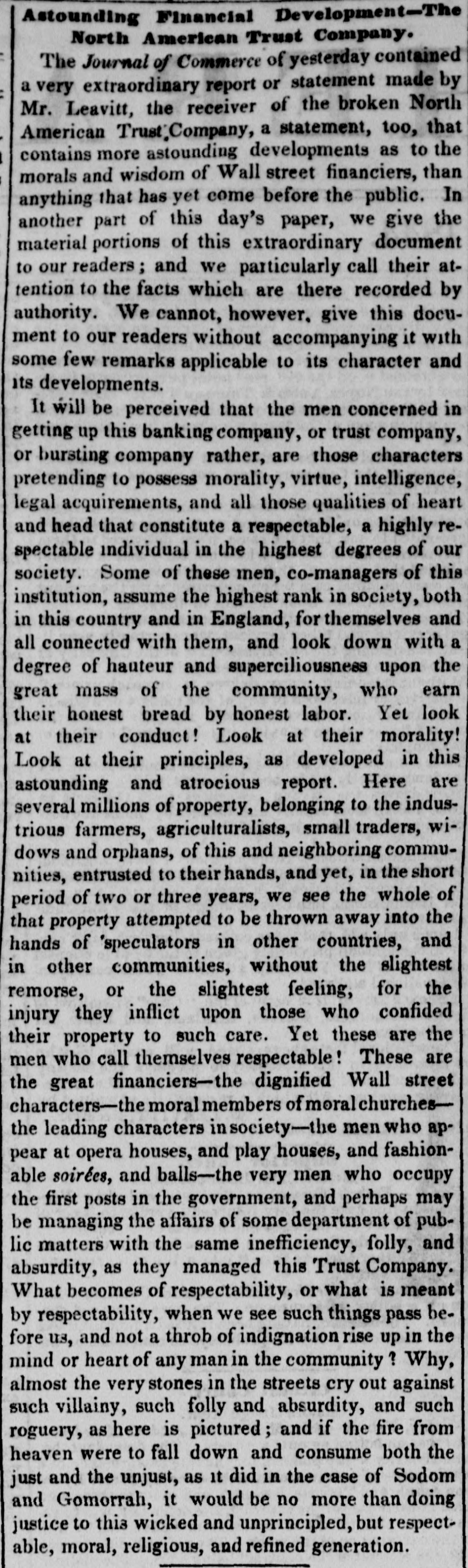
# Astounding Financial Development-The North American Trust Company. The Journal of Commerce of yesterday contained a very extraordinary report or statement made by Mr. Leavitt, the receiver of the broken North American Trust Company, a statement, too, that contains more astounding developments as to the morals and wisdom of Wall street financiers, than anything that has yet come before the public. In another part of this day's paper, we give the material portions of this extraordinary document to our readers; and we particularly call their attention to the facts which are there recorded by authority. We cannot, however, give this document to our readers without accompanying it with some few remarks applicable to its character and its developments. It will be perceived that the men concerned in getting up this banking company, or trust company, or bursting company rather, are those characters pretending to possess morality, virtue, intelligence, legal acquirements, and all those qualities of heart and head that constitute a respectable, a highly respectable individual in the highest degrees of our society. Some of these men, co-managers of this institution, assume the highest rank in society, both in this country and in England, for themselves and all connected with them, and look down with a degree of hauteur and superciliousness upon the great mass of the community, who earn their honest bread by honest labor. Yet look at their conduct! Look at their morality! Look at their principles, as developed in this astounding and atrocious report. Here are several millions of property, belonging to the industrious farmers, agriculturalists, small traders, widows and orphans, of this and neighboring communities, entrusted to their hands, and yet, in the short period of two or three years, we see the whole of that property attempted to be thrown away into the hands of 'speculators in other countries, and in other communities, without the slightest remorse, or the slightest feeling, for the injury they inflict upon those who confided their property to such care. Yet these are the men who call themselves respectable! These are the great financiers-the dignified Wall street characters-the moral members of moral churches-the leading characters in society-the men who appear at opera houses, and play houses, and fashionable soirΓ©es, and balls-the very men who occupy the first posts in the government, and perhaps may be managing the affairs of some department of public matters with the same inefficiency, folly, and absurdity, as they managed this Trust Company. What becomes of respectability, or what is meant by respectability, when we see such things pass before us, and not a throb of indignation rise up in the mind or heart of any man in the community? Why, almost the very stones in the streets cry out against such villainy, such folly and absurdity, and such roguery, as here is pictured; and if the fire from heaven were to fall down and consume both the just and the unjust, as it did in the case of Sodom and Gomorrah, it would be no more than doing justice to this wicked and unprincipled, but respectable, moral, religious, and refined generation.
Article from The New York Herald, February 12, 1844

Click image to open full size in new tab

Article Text

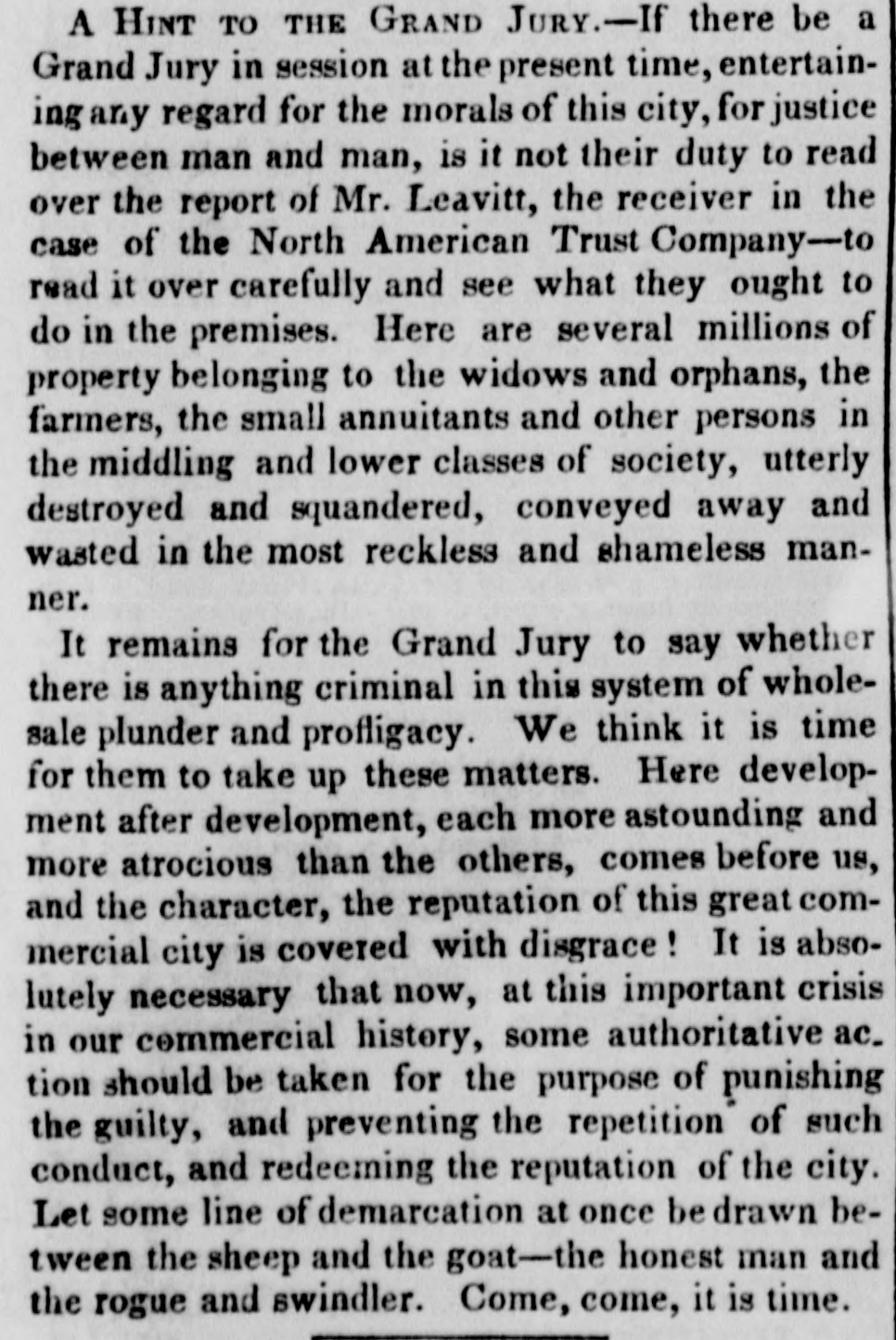
A HINT TO THE GRAND JURY.-If there be a Grand Jury in session at the present time, entertainingany regard for the morals of this city, for justice between man and man, is it not their duty to read over the report of Mr. Leavitt, the receiver in the case of the North American Trust Company-to read it over carefully and see what they ought to do in the premises. Here are several millions of property belonging to the widows and orphans, the farmers, the small annuitants and other persons in the middling and lower classes of society, utterly destroyed and squandered, conveyed away and wasted in the most reckless and shameless manner. It remains for the Grand Jury to say whether there is anything criminal in this system of wholesale plunder and profligacy. We think it is time for them to take up these matters. Here development after development, each more astounding and more atrocious than the others, comes before us, and the character, the reputation of this great commercial city is covered with disgrace It is absolutely necessary that now, at this important crisis in our commercial history, some authoritative ac. tion should be taken for the purpose of punishing the guilty, and preventing the repetition of such conduct, and redeeming the reputation of the city. Let some line of demarcation at once be drawn between the sheep and the goat-the honest man and the rogue and swindler. Come, come, it is time.


Article from New-York Daily Tribune, December 19, 1845

Click image to open full size in new tab

Article Text

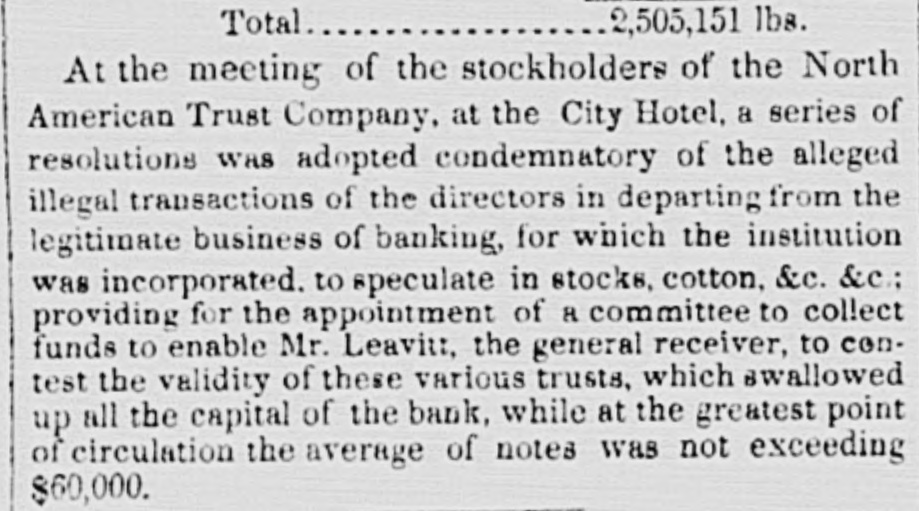
Total 2,505,151 lbs. At the meeting of the stockholders of the North American Trust Company. at the City Hotel, a series of resolutions was adopted condemnatory of the alleged illegal transactions of the directors in departing from the legitimate business of banking, for which the institution was incorporated. to speculate in stocks, cotton. &c. &c.; providing for the appointment of R committee to collect funds to enable Mr. Leavitt, the general receiver, to contest the validity of these various trusts, which swallowed up all the capital of the bank, while at the greatest point of circulation the average of notes was not exceeding $60,000.


Article from The New York Herald, April 30, 1847

Click image to open full size in new tab

Article Text

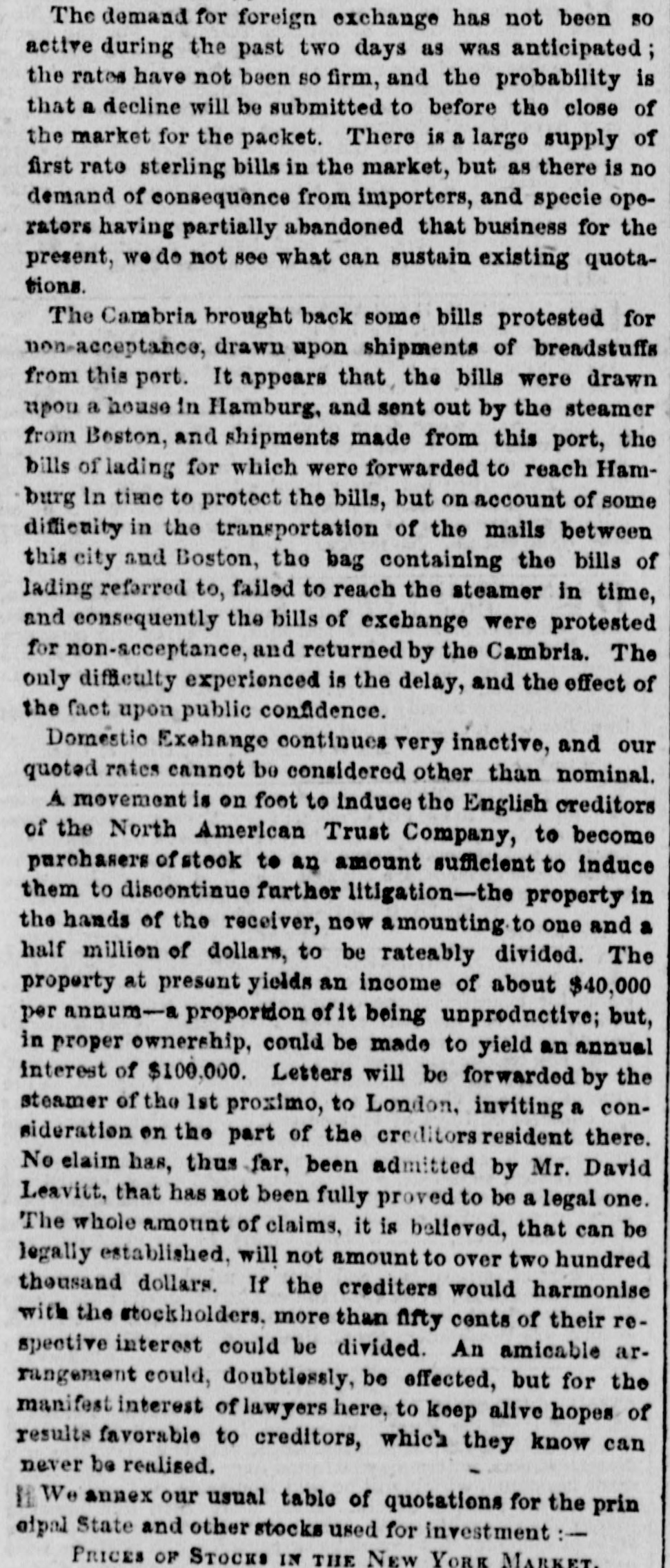
The demand for foreign exchange has not been so active during the past two days as was anticipated the rates have not been so firm, and the probability is that a decline will be submitted to before the close of the market for the packet. There is a largo supply of first rate sterling bills in the market, but as there is no demand of consequence from importers, and specie operators having partially abandoned that business for the present, we do not see what can sustain existing quotations. The Cambria brought back some bills protested for non-acceptance, drawn upon shipments of breadstuffs from this port. It appears that the bills were drawn upon a house in Hamburg, and sent out by the steamer from Beston, and shipments made from this port, the bills of lading for which were forwarded to reach Hamburg In time to protect the bills, but on account of some difficulty in the transportation of the mails between this city and Boston, the bag containing the bills of lading referred to, failed to reach the steamer in time, and consequently the bills of exchange were protested for non-acceptance, and returned by the Cambria. The only difficulty experienced is the delay, and the effect of the fact upon public confidence. Domestic Exchange continues very inactive, and our quoted rates cannot be considered other than nominal. A movement is on foot to induce the English creditors of the North American Trust Company, to become purchasers of stock to an amount sufficient to induce them to discontinue further litigation-the property in the hands of the receiver, now amounting to one and a half million of dollars, to be rateably divided. The property at present yields an income of about $40,000 per annum-a proportion of it being unproductive; but, in proper ownership, could be made to yield an annual interest of $100,000. Letters will be forwarded by the steamer of the 1st proximo, to London, inviting a consideration on the part of the creditors resident there. No claim has, thus far, been admitted by Mr. David Leavitt, that has not been fully proved to be a legal one. The whole amount of claims, it is believed, that can be legally established, will not amount to over two hundred thousand dollars. If the crediters would harmonise with the stockholders. more than fifty cents of their respective interest could be divided. An amicable arrangement could, doubtlessly, be effected, but for the manifest interest of lawyers here. to keep alive hopes of results favorable to creditors, which they know can never be realised. If We annex our usual table of quotations for the prin eipal State and other stocks used for investment :PRICES OF STOCKS IN THE NEW YORK MARKET.


Article from The New York Herald, July 15, 1849

Click image to open full size in new tab

Article Text

Superior Court-General Term. Before Judges Duer, Mason and Campbell. JULY 14 -DECISIONS - John J. Palmer US. Watson Lawrence et al. - In this cause. a petition was presented for the appointment of a receiver over the mortgaged premises in the pleadings revealed The defendant opposed the petition on two grounds: first, that the mortgage was granted to the North American Trust Company; that the Company was fraudulently organized, and consequently, that the mortgage itself was invalid; and secondly, that the mortgaged pretaises were emply sufficient for payment of the sum claimed, should there be a decree for the plainciff. Judge Duer, who delivered the judgment of the court, said. that as to the first objection set up by defendant, there was DO allegation that the mortgage was not executed. or that it was either in part or in the whole satisfied. and it was only where such a defence was set up that the court could deny a receiver; they would. therefore, overrule that part of the defence. in regard to the other defence, it was positively sworn that the mort. gaged premises were net a sufficient security. and the evidence on the other side did not show that they were Both grounds of defence must therefore be overruled and a receiver granted. unless the defendant shall. within one week from the date of the order, lodge $6,000 to the credit of this cause. Brower CS Strydam and others.-This was a creditor's bill, and was referred to a referee to appoint a receiver. On the examination the referee having notified that the defendant the judgment debtor. bad property. made an order for its delivery to the receiver. Several motions are made; the principal one for a review of the proceedings before the referee. it wa decided that the referee was correct in making the order. and the motion for a receiver is denied with easts. The plaintiff's motion to extend the receivership to the property in question allowed, with $10 costs. Durand and others us. Weyman -Defendant was sund rent of premises, No. 158 Bowery. The premises were originally leased to one Floudersu, and the plainliff accepted from him a surrender of the term. and the instrument of surrender was produced in court as evidence on the trial. by the plaintiffs themselves. Held that the plaintifs. having thus recognized Flauderou as the tenant. were excluded and cannot now charge the defendant. Fadler 18. Day and others. - The defendent, Day, exe. euted a deed of trust to the defendants, Morgan and Way ne. r porting to convey to them $2.000-then invested in business-in trust to secure the same, and apply the interest to the separate use of his wife. The Geed also allowed the trustees if they thought proper, to lend Day the money without interest, on his owa note or bond. The money or property was never paid over to the trustees. but they took from the grantor his note for $2.000, payable to them as trustees. and without interest. Day, not loog after, failed. and grabted an Resignment of all his property to Morgan, placing this note of $2,000 and a few other debts in a preferred class Held. the trust deed was fraudulent and void as to creditors who became so after the execution of the deed and that the assignment also was void. Redpoth vs. Rich and others.- The plaintiff. a naturalized citizen. claimed certain real estate in this city. as beir of Andrew Mather, who died in the year 1828 without issue, and intestate as to the property in question. The plaintiff is a nephew of the deceased, being the son of a deceased rister. who was an alien. Held. that plaintiff, claiming through his mother who was nation, could not inherit he case would have been different had the mother died after the adoption of the revised statutes. Rendall Parker - Motion for new trial. upon bill of exceptions, denied The Court adjourned, sine die.


Article from New-York Daily Tribune, September 28, 1849

Click image to open full size in new tab

Article Text

Law Courts. SUPREME COURT-General Term-John - J. Palmer Re ceicer of the North American Trust Company VB. Samuel R. Smith and others.-Bill to foreclose a mortgage for $8,000, but, with interest, we believe, amounts to nearly $15,000. on property at Staten Island, mortgaged to the Company. The claim is resisted, principally on the ground of invalidity on the part of the Company, kc.-Argument was heard, Mr. Barney appearing for the receiver, and Mr. Van Waggenen opposed


Article from New-York Daily Tribune, January 3, 1854

Click image to open full size in new tab

Article Text

A decision was made by the Supreme Court on SatFurday, in the case of Leavitt, Receiver of the North American Trust Company, against J. Horsley Palmer and others. The object of the action was to invalidate a large portion of the securities of the old North American Trust Company-some $2,000,000 value. The decision, dismissing the Receiver's bill, was adverse to the object above stated.


Article from New-York Daily Tribune, November 25, 1857

Click image to open full size in new tab

Article Text

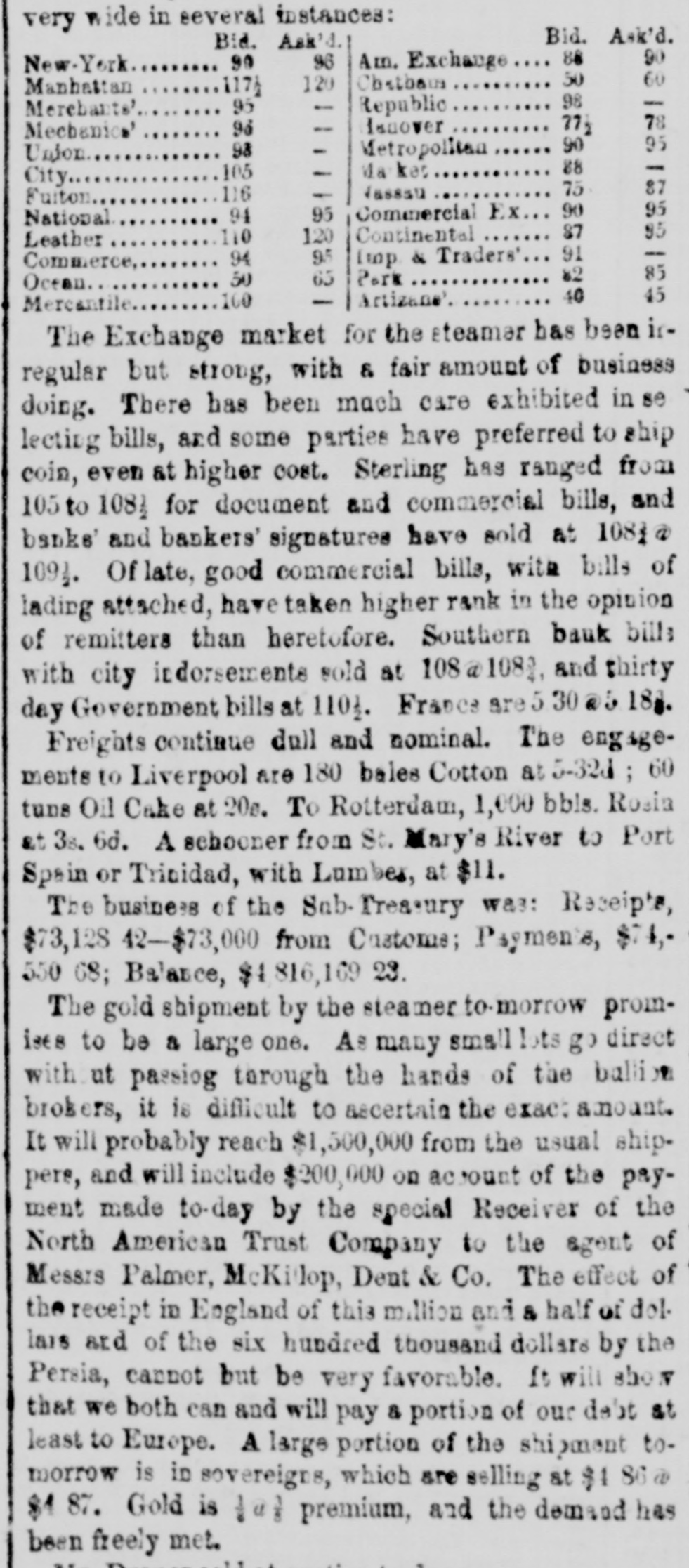
very wide in several instances: Ask'd. Bid. Ask'd. Bid. 06 88 96 90 Am. Exchange New-York 60 50 Chatbaus 120 Manhattan 117h 98 95 Republic Merchants' 78 -lanover 772 96 Mechanics' 95 05 98 Metropolitan Union I 88 da ket 105 City 87 75 (assau 116 Fuiton 95 90 Commercial Ex 95 94 National 87 95 Continental 120 110 Leather 91 95 94 top & Traders' Commerce 85 82 65 Park 50 Ocean 45 40 Artizane' 100 Mercantile The Exchange market for the steamer has been irregular but strong, with & fair amount of business doing. There has been much care exhibited in se lecting bills, and some parties have preferred to ship coin, even at higher cost. Sterling has ranged from 105 to 1081 for document and commercial bills, and banks' and bankers' signatures have sold at 1081 @ 1091. Of late, good commercial bills, with bills of lading attached, have taken higher rank in the opinion of remitters than heretofore. Southern bank bills with city indorsements sold at 108 a 1082, and thirty day Government bills at 1101. Francs are 5 30 @5 188. Freights continue dull and nominal. The engigements to Liverpool are 180 bales Cotton at 5-32d 60 tuns Oil Cake at 20s. To Rotterdam, 1,000 bbls. Rosia at 3s. 6d. A schooner from St. Mary's River to Port Spain or Trinidad, with Lumber, at $11. The business of the Sub. Treasury was: Receipts, $73,128 42-$73,000 from Customs; Payments, $74,550 68; Balance, $4,816,169 23. The gold shipment by the steamer to-morrow promises to be a large one. As many small lots go direct with ut passiog through the hands of the ballion brokers, it is difficult to ascertain the exact amount. It will probably reach $1,500,000 from the usual shippers, and will include $200,000 on account of the payment made to-day by the special Receiver of the North American Trust Company to the agent of Messrs Palmer, McKitlop, Dent & Co. The effect of the receipt in England of this million and & half of dollars and of the six hundred thousand dollars by the Persia, cannot but be very favorable. It will show that we both can and will pay & portion of our debt at least to Europe. A large portion of the shipment tomorrow is in sovereigns, which are selling at $1 86 a $1 87. Gold is fu} premium, and the demand has been freely met.


Article from New-York Daily Tribune, November 25, 1857

Click image to open full size in new tab

Article Text

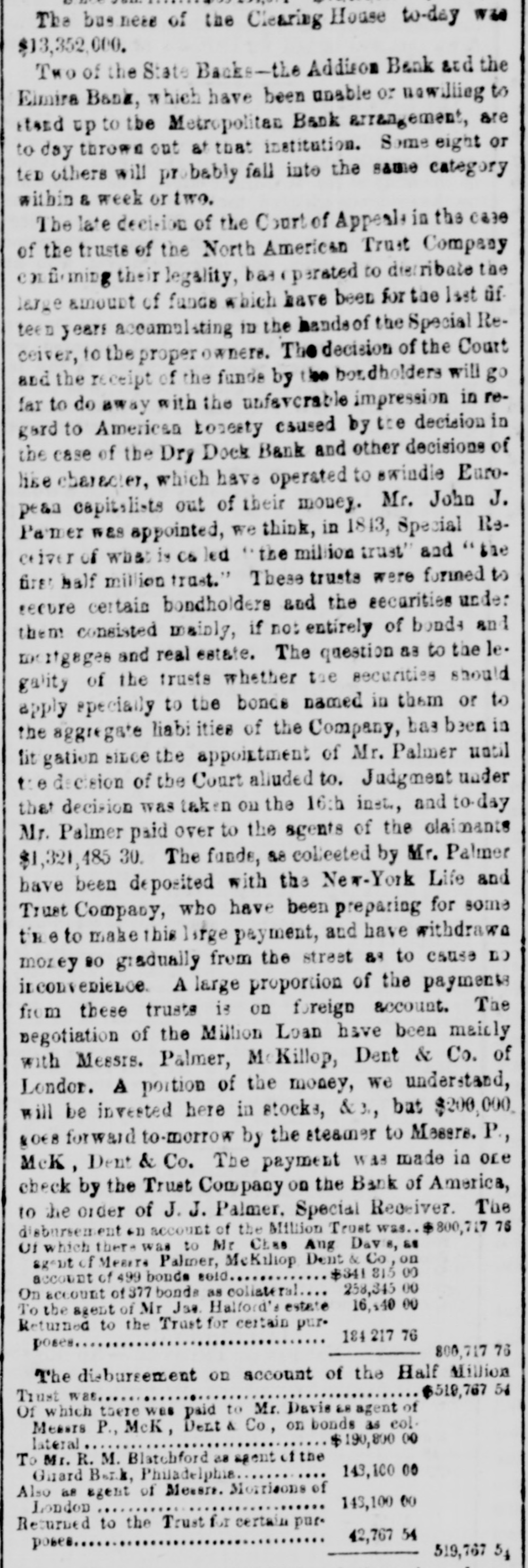
The bus ness of the Clearing House to-day was $13,352,000. Two of the State Banks-the Addison Bank and the Elmira Bank, which have been unable or nowilling to stand up to the Metropolitan Bank arrangement, are to day thrown out at that institution. Some eight or ten others will probably fall into the same category within & week or two. The late decision of the Court of Appeals in the 0830 of the trusts of the North American Trust Company confirming their legality, bas perated to distribute the large amount of funds which have been for the last fif teen years accumulating in the handsof the Special Receiver, to the proper owners. The decision of the Court and the receipt of the funds by the bondholders will go far to do away with the unfaverable impression in regard to American bonesty caused by the decision in the case of the Drg Dock Bank and other decisions of like character, which have operated to swindle European capitalists out of their money. Mr. John J. Paimer was appointed, we think, in 1843, Special Receiver of what is C& led "the million trust" and "the first half million trust." These trusts were formed to secure certain bondholders and the securities under them consisted mainly, if not entirely of bonds and mortgages and real estate. The question as to the le. gality of the trusts whether the securities should apply specially to the bonds named in them or to the aggregate liabi of the Company, has been in lit gation since the appointment of Mr. Palmer until t:e decision of the Court alluded to. Judgment under that decision was taken on the 16:h inst., and to-day Mr. Palmer paid over to the agents of the claimants $1,321,485 30. The funds, 88 collected by Mr. Palmer have been deposited with the New-York Life and Trust Company, who have been preparing for some th B to make this lirge payment, and have withdrawa money 80 gradually from the street 88 to cause no inconvenience. A large proportion of the payments from these trusts is on foreign account. The negotiation of the Million Loan have been mainly with Messrs. Palmer, McKillop, Dent & Co. of Londor. A portion of the money, we understand, will be invested here in stocks, &3, but $200,000. goes forward to-morrow by the steamer to Messrs. P., McK, Dent & Co. The payment was made in ore check by the Truet Company on the Bank of America, to the order of J.J. Palmer, Special Receiver. The disbursement 6-11 account of the Million Trust was $800,717 76 Of which there was to Mr Chas Ang Davis, as agent of Measure Palmer, MeKiliop Dent $341 815.00 & Co, on account of 499 bonds sold 258,345.00 On account of 377 bonds as collateral To the agent of Mr Jae. Halford's estate 16,40 00 Returned to the Trust for certain pur184217 76 poses 800,717 76 The disbursement on account of the Half Million $519,767 54 Trust was Of which there was paid to Mr. Davis as agent of Measrs P., McK, Dent & Co, on bonds as col. $190,800 € 00 lateral To Mr. R. M. Blatchford as agent of the 143,100.00 Guard Bank, Philadelphia Also as agent of Measrs. Morrisons of 148,100 00 London Returned to the Trust for certain pur42,767 54 poses 519,767 5,


Article from The Indianapolis Journal, December 24, 1903

Click image to open full size in new tab

Article Text

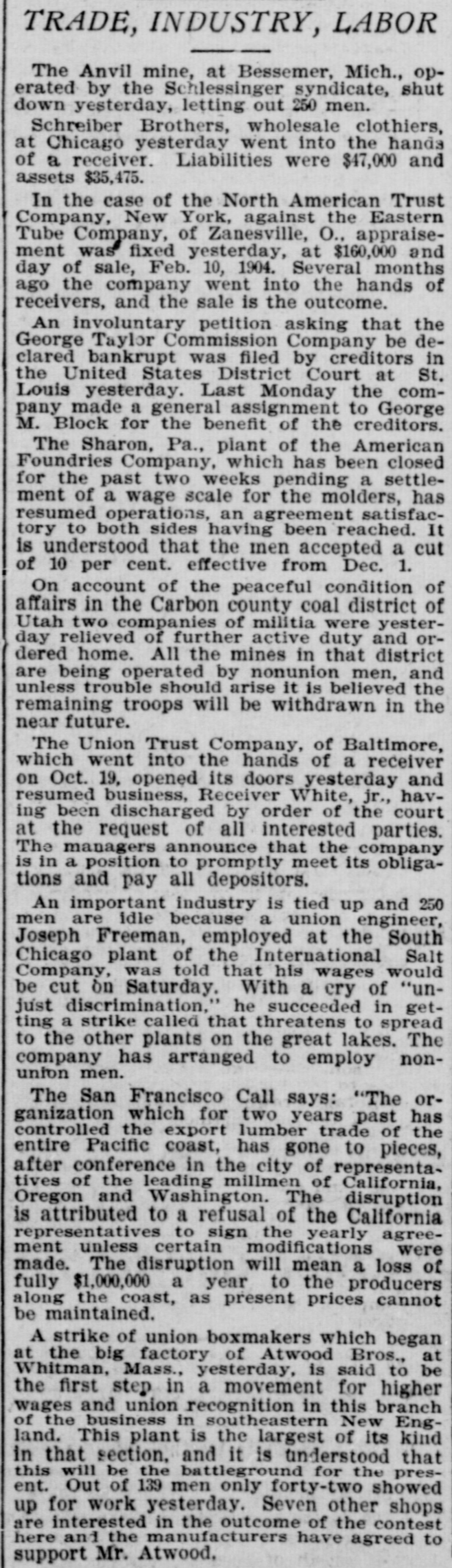
TRADE, INDUSTRY, LABOR The Anvil mine, at Bessemer, Mich., operated by the Schlessinger syndicate, shut down yesterday, letting out 250 men. Schreiber Brothers, wholesale clothiers, at Chicago yesterday went into the hands of a receiver. Liabilities were $47,000 and assets $35,475. In the case of the North American Trust Company, New York, against the Eastern Tube Company, of Zanesville, O., appraisement was fixed yesterday, at $160,000 and day of sale, Feb. 10, 1904. Several months ago the company went into the hands of receivers, and the sale is the outcome. An involuntary petition asking that the George Taylor Commission Company be declared bankrupt was filed by creditors in the United States District Court at St. Louis yesterday. Last Monday the company made a general assignment to George M. Block for the benefit of the creditors. The Sharon. Pa., plant of the American Foundries Company, which has been closed for the past two weeks pending a settlement of a wage scale for the molders, has resumed operations, an agreement satisfactory to both sides having been reached. It is understood that the men accepted a cut of 10 per cent. effective from Dec. 1. On account of the peaceful condition of affairs in the Carbon county coal district of Utah two companies of militia were yesterday relieved of further active duty and ordered home. All the mines in that district are being operated by nonunion men, and unless trouble should arise it is believed the remaining troops will be withdrawn in the near future. The Union Trust Company, of Baltimore, which went into the hands of a receiver on Oct. 19, opened its doors yesterday and resumed business, Receiver White, jr., having been discharged by order of the court at the request of all interested parties. The managers announce that the company is in a position to promptly meet its obligations and pay all depositors. An important industry is tied up and 250 men are idle because a union engineer, Joseph Freeman, employed at the South Chicago plant of the International Salt Company, was told that his wages would be cut on Saturday. With a cry of "unjust discrimination," he succeeded in getting a strike called that threatens to spread to the other plants on the great lakes. The company has arranged to employ nonunion men. The San Francisco Call says: "The organization which for two years past has controlled the export lumber trade of the entire Pacific coast, has gone to pieces, after conference in the city of representatives of the leading millmen of California, Oregon and Washington. The disruption is attributed to a refusal of the California representatives to sign the yearly agreement unless certain modifications were made. The disruption will mean a loss of fully $1,000,000 a year to the producers along the coast, as present prices cannot be maintained. A strike of union boxmakers which began at the big factory of Atwood Bros., at Whitman, Mass., yesterday, is said to be the first step in a movement for higher wages and union recognition in this branch of the business in southeastern New England. This plant is the largest of its kind in that section, and it is understood that this will be the battleground for the present. Out of 139 men only forty-two showed up for work yesterday. Seven other shops are interested in the outcome of the contest here and the manufacturers have agreed to support Mr. Atwood.