Miners Bank (Dubuque, IA)

Episode Information

Episode UID
2591101390496
Episode Type
Suspension โ†’ Closure
Bank Type
state
Bank ID
259110139 hash
Start Date
April 1, 1841*
Location
Dubuque, Iowa (42.501, -90.665)

Metadata

Model
gpt-5-mini (chosen from majority vote of a three-model LLM ensemble)
Short Digest
a17c9969c7733e46

Response Measures

None

Description

Charter later repealed and trustees/receivers were appointed, indicating permanent closure.

Events (4)

1. April 1, 1841* Suspension
Cause
Correspondent
Cause Details
Refusal of St. Louis offices/brokers to redeem its paper and large sums sent for redemption were not paid, prompting suspension.
Newspaper Excerpt
the Board of Directors...resolved to suspend specie payments.
Source
newspapers
2. July 1, 1842 Reopening
Newspaper Excerpt
The Miners' Bank of Dubuque resumed specie payments on the 1st inst, according to promise, and has continued to pay specie since for all her liabilities.
Source
newspapers
3. July 23, 1842 Suspension
Cause
Correspondent
Cause Details
Failure to arrange for redemption of notes at St. Louis and continued discounting of its notes in that market led to renewed suspension.
Newspaper Excerpt
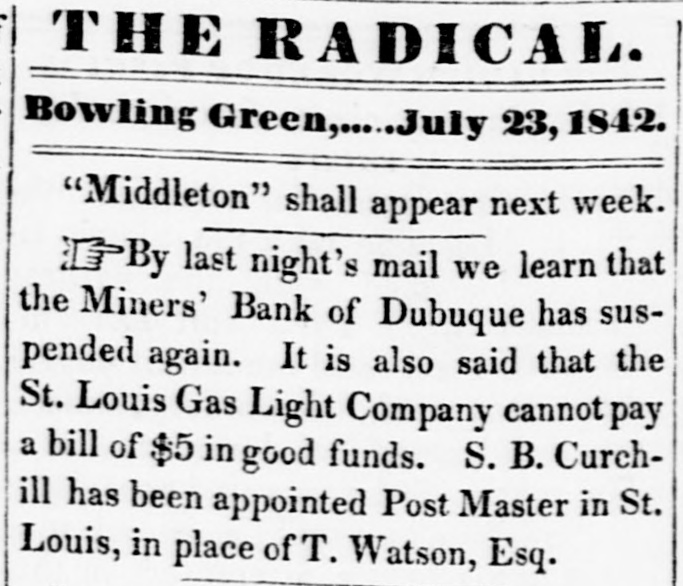
By last night's mail we learn that the Miners' Bank of Dubuque has suspended again.
Source
newspapers
4. June 12, 1847 Receivership
Newspaper Excerpt
the charter of this bank had been... declared to be forfeited and trustees were appointed to wind up its affairs; matter is now in the courts under an injunction restraining the bank from doing any business as a corporate body.
Source
newspapers

Newspaper Articles (23)

Article from The Hawk-Eye and Iowa Patriot, April 8, 1841

Click image to open full size in new tab

Article Text

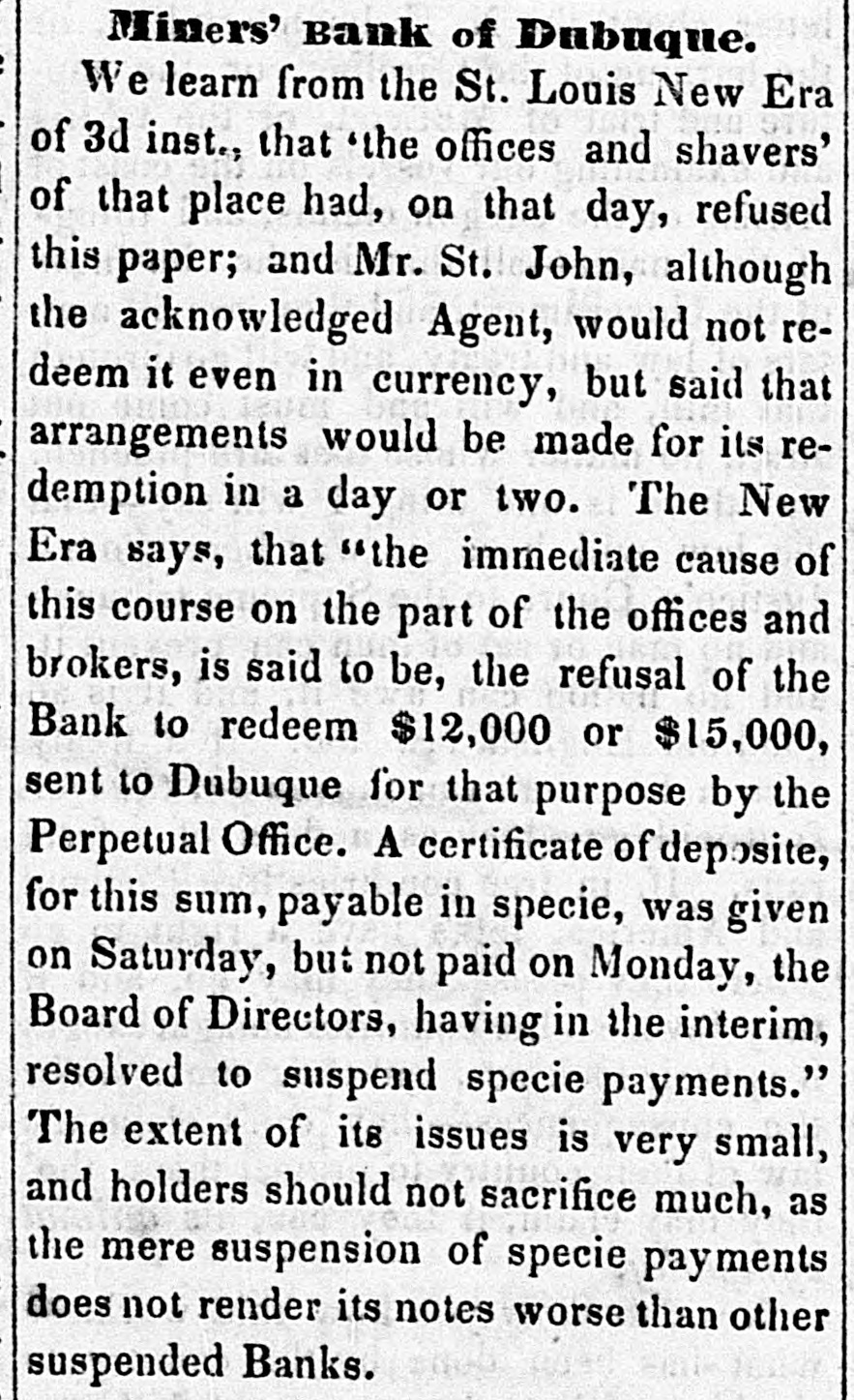
Miners' Bank of Dubuque. We learn from the St. Louis New Era of 3d inst., that 'the offices and shavers' of that place had, on that day, refused this paper; and Mr. St. John, although the acknowledged Agent, would not redeem it even in currency, but said that arrangements would be made for its redemption in a day or two. The New Era says, that "the immediate cause of this course on the part of the offices and brokers, is said to be, the refusal of the Bank to redeem $12,000 or $15,000, sent to Dubuque for that purpose by the Perpetual Office. A certificate of deposite, for this sum, payable in specie, was given on Saturday, but not paid on Monday, the Board of Directors, having in the interim, resolved to suspend specie payments." The extent of its issues is very small, and holders should not sacrifice much, as the mere suspension of specie payments does not render its notes worse than other suspended Banks.


Article from Bloomington Herald, April 16, 1841

Click image to open full size in new tab

Article Text

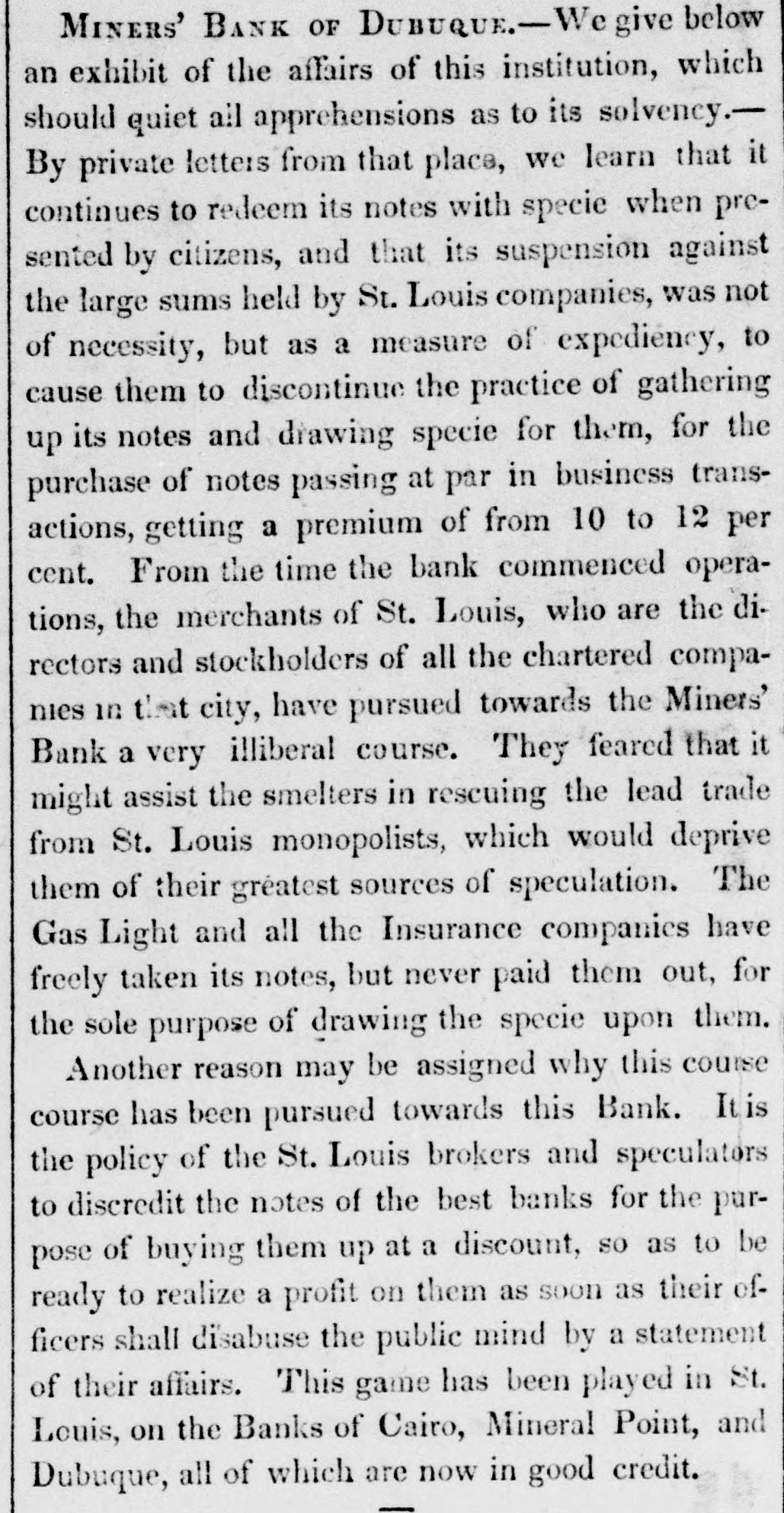
# MINERS' BANK OF DUBUQUE. We give below an exhibit of the affairs of this institution, which should quiet all apprehensions as to its solvency. By private letters from that place, we learn that it continues to redeem its notes with specie when presented by citizens, and that its suspension against the large sums held by St. Louis companies, was not of necessity, but as a measure of expediency, to cause them to discontinue the practice of gathering up its notes and drawing specie for them, for the purchase of notes passing at par in business transactions, getting a premium of from 10 to 12 per cent. From the time the bank commenced operations, the merchants of St. Louis, who are the directors and stockholders of all the chartered companies in that city, have pursued towards the Miners' Bank a very illiberal course. They feared that it might assist the smelters in rescuing the lead trade from St. Louis monopolists, which would deprive them of their greatest sources of speculation. The Gas Light and all the Insurance companies have freely taken its notes, but never paid them out, for the sole purpose of drawing the specie upon them. Another reason may be assigned why this course course has been pursued towards this Bank. It is the policy of the St. Louis brokers and speculators to discredit the notes of the best banks for the purpose of buying them up at a discount, so as to be ready to realize a profit on them as soon as their officers shall disabuse the public mind by a statement of their affairs. This game has been played in St. Louis, on the Banks of Cairo, Mineral Point, and Dubuque, all of which are now in good credit.


Article from Bloomington Herald, February 11, 1842

Click image to open full size in new tab

Article Text

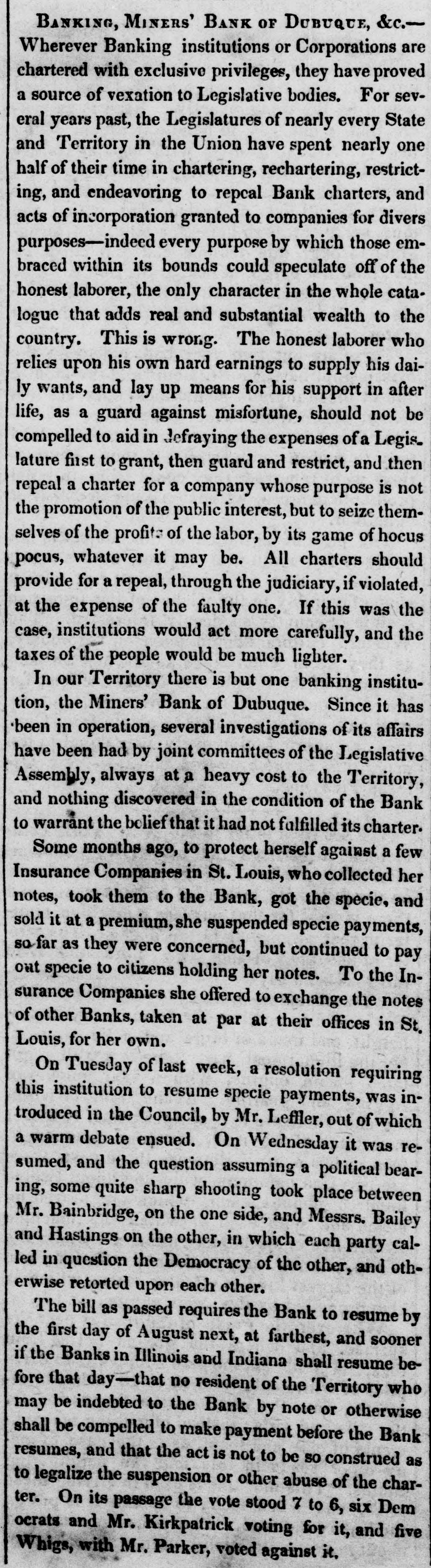
BANKING, MINERS' BANK OF DUBUQUE, &c.Wherever Banking institutions or Corporations are chartered with exclusive privileges, they have proved a source of vexation to Legislative bodies. For several years past, the Legislatures of nearly every State and Territory in the Union have spent nearly one half of their time in chartering, rechartering, restricting, and endeavoring to repcal Bank charters, and acts of incorporation granted to companies for divers purposes-indeed every purpose by which those embraced within its bounds could speculate off of the honest laborer, the only character in the whole catalogue that adds real and substantial wealth to the country. This is wrong. The honest laborer who relies upon his own hard earnings to supply his daily wants, and lay up means for his support in after life, as a guard against misfortune, should not be compelled to aid in Jefraying the expenses of a Legis. lature first to grant, then guard and restrict, and then repeal a charter for a company whose purpose is not the promotion of the public interest, but to seize themselves of the profit: of the labor, by its game of hocus pocus, whatever it may be. All charters should provide for a repeal, through the judiciary, if violated, at the expense of the faulty one, If this was the case, institutions would act more carefully, and the taxes of the people would be much lighter. In our Territory there is but one banking institution, the Miners' Bank of Dubuque. Since it has been in operation, several investigations of its affairs have been had by joint committees of the Legislative Assembly, always at a heavy cost to the Territory, and nothing discovered in the condition of the Bank to warrant the belief that it had not falfilled its charter. Some months ago, to protect herself against a few Insurance Companies in St. Louis, who collected her notes, took them to the Bank, got the specie, and sold it at a premium, she suspended specie payments, so far as they were concerned, but continued to pay out specie to citizens holding her notes. To the Insurance Companies she offered to exchange the notes of other Banks, taken at par at their offices in St. Louis, for her own. On Tuesday of last week, a resolution requiring this institution to resume specie payments, was introduced in the Council, by Mr. Leffler, out of which a warm debate ensued. On Wednesday it was resumed, and the question assuming a political bearing, some quite sharp shooting took place between Mr. Bainbridge, on the one side, and Messrs. Bailey and Hastings on the other, in which each party called in question the Democracy of the other, and otherwise retorted upon each other. The bill as passed requires the Bank to resume by the first day of August next, at farthest, and sooner if the Banks in Illinois and Indiana shall resume before that day-that no resident of the Territory who may be indebted to the Bank by note or otherwise shall be compelled to make payment before the Bank resumes, and that the act is not to be so construed as to legalize the suspension or other abuse of the charter. On its passage the vote stood 7 to 6, six Dem ocrats and Mr. Kirkpatrick voting for it, and five Whigs, with Mr. Parker, voted against it.


Article from Bloomington Herald, February 11, 1842

Click image to open full size in new tab

Article Text

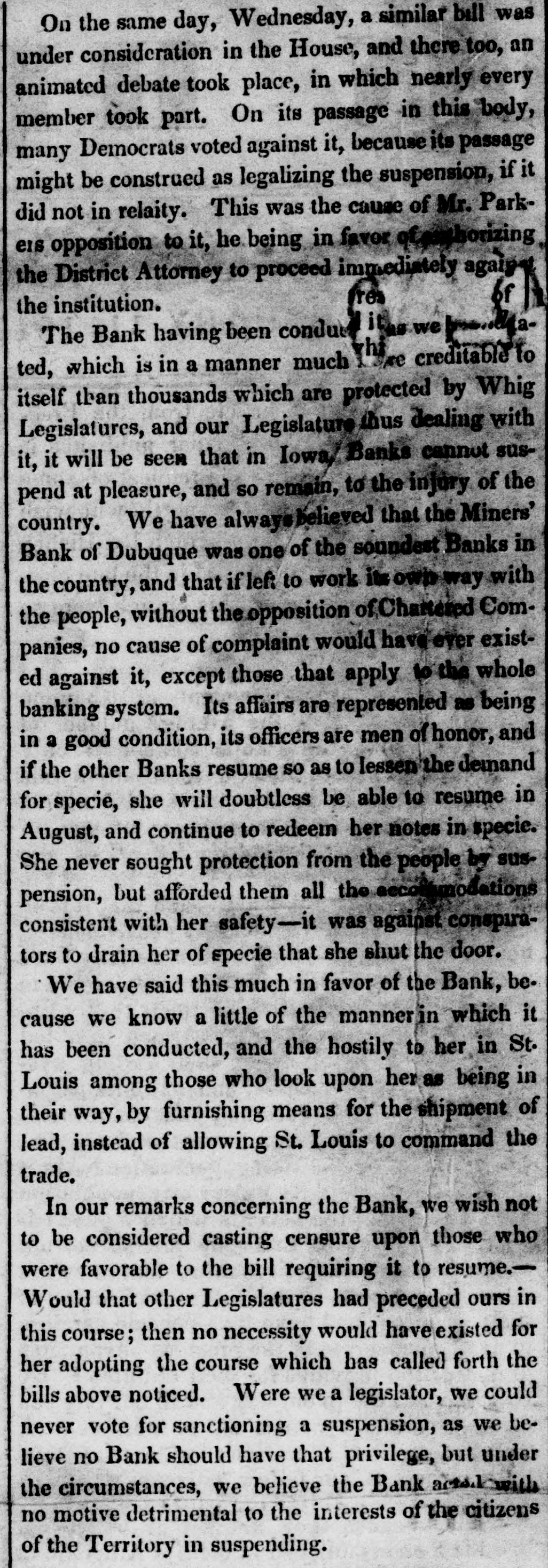
On the same day, Wednesday, a similar bill was under consideration in the House, and there too, an animated debate took place, in which nearly every member took part. On its passage in this body, many Democrats voted against it, because its passage might be construed as legalizing the suspension, if it did not in relaity. This was the cause of Mr. Parkeis opposition to it, he being in favor Camborizing the District Attorney to proceed immediately agaiy res the institution. The Bank having been condue itas we vhi ted, which is in a manner much re creditable to itself than thousands which are protected by Whig Legislatures, and our Legislature thus dealing with it, it will be seen that in Iowa Banks cannot suspend at pleasure, and so remain, to the injury of the country. We have always believed that the Miners' Bank of Dubuque was one of the soundest Banks in the country, and that if left to work its own way with the people, without the opposition of Chattered Companies, no cause of complaint would have ever existed against it, except those that apply to the whole banking system. Its affairs are represented as being in a good condition, its officers are men of honor, and if the other Banks resume so as to lessen the demand for specie, she will doubtless be able to resume in August, and continue to redeem her notes in specie. She never sought protection from the people by suspension, but afforded them all the aeco nodations consistent with her safety-it was against conspirators to drain her of specie that she shut the door. We have said this much in favor of the Bank, be. cause we know a little of the manner in which it has been conducted, and the hostily to her in St. Louis among those who look upon her as being in their way, by furnishing means for the shipment of lead, instead of allowing St. Louis to command the trade. In our remarks concerning the Bank, we wish not to be considered casting censure upon those who were favorable to the bill requiring it to resume.Would that other Legislatures had preceded ours in this course; then no necessity would have existed for her adopting the course which has called forth the bills above noticed. Were we a legislator, we could never vote for sanctioning a suspension, as we believe no Bank should have that privilege, but under the circumstances, we believe the Bank acts.c with no motive detrimental to the interests of the citizens of the Territory in suspending.


Article from Boon's Lick Times, February 26, 1842

Click image to open full size in new tab

Article Text

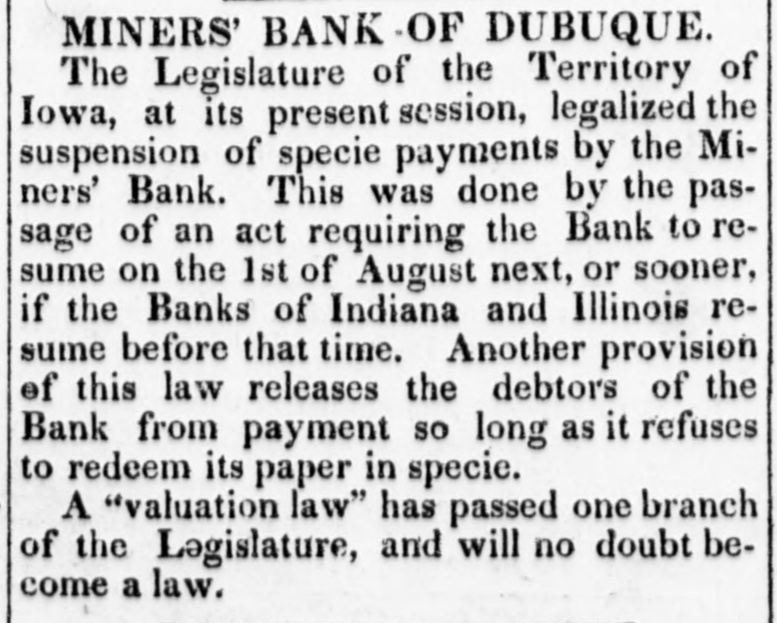
MINERS' BANK OF DUBUQUE. The Legislature of the Territory of Iowa, at its present session, legalized the suspension of specie payments by the Miners' Bank. This was done by the passage of an act requiring the Bank to resume on the 1st of August next, or sooner, if the Banks of Indiana and Illinois resume before that time. Another provision of this law releases the debtors of the Bank from payment so long as it refuses to redeem its paper in specie. A "valuation law" has passed one branch of the Legislature, and will no doubt become a law.


Article from New-York Tribune, April 13, 1842

Click image to open full size in new tab

Article Text

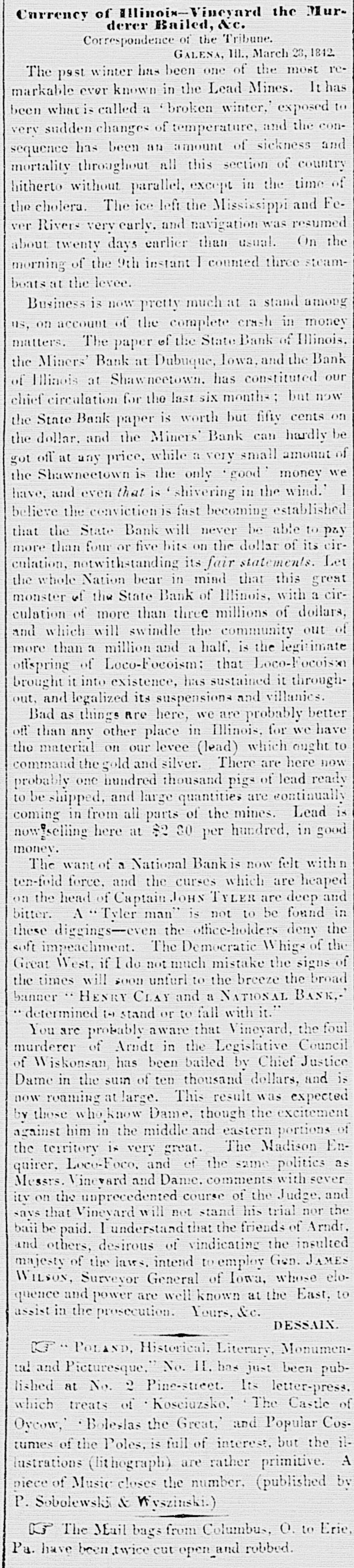
Currency of Illinoix-Vincyard the Murderer Bailed, Correspondence of the Tribune. GALENA, III., March 23, 1812 The past winter has been one of the most has remarkable ever known in the Lead Mines. It been what is called a broken winter, exposed to very sudden changes of temperature, and the consequence has been an amount of sickness and mortality throughout all this section of country of hitherto without parallel, except in the time the cholera. The ice left the Mississippi and Fever Rivers very carly. and navigation was resumed the about twenty days earlier than usual. On morning of the 9th instant I counted three steamboats at the levee. Business is now pretty much at a stand among on account of the complete crash in money us, matters. The paper of the State Bank of Illinois. the Miners' Bank at Dubuque, Iowa. and the Bank of Illinois at Shawneetown. has constituted our chief circulation for the last six months: but now the State Bank paper is worth but fifty cents on the dollar. and the Miners' Bank can hardly be got off at any price. while a very small amount of the Shawneetown is the only good money we I have, and even that is shivering in the wind.' believe the conviction is fast becoming established that the State Bank will never be able to pay than four or five bits on the dollar of its circulation, more notwithstanding its fair statements. Let the whole Nation bear in mind that this great monster of the State Bank of Illinois, with a circulation of more than three millions of dollars, and which will swindle the community out of more than a million and a half, is the legitimate offspring of Loco-Focoism: that Loco-Fucuism brought it into existence, has sustained it through out, and legalized its suspensions and villanics. Bad as things are here, we are probably better off than any other place in Illinois, for we have the material on our levee (lead) which ought to command the gold and silver. There are here now probably one hundred thousand pigs of lead ready to be shipped, and large quantities are continually coming in from all parts of the mines. Lead is now selling here at $2.80 per hundred, in good money. The want of a National Bank is now felt with ten-fold force. and the curses which are heaped the head of Captain JOHN TYLER are deep and in bitter. on A Tyler is not to be found these diggings-even the office-holders deny the soft impeachment. The Democratic Whigs of the of Great West. if Ido not much mistake the signs the times will soon unfurl to the breeze the broad banner HENRY CLAY and a NATIONAL BANK, determined in stand or to fall with it." You are probably aware that Vineyard, the foul murderer of Arndt in the Legislative Council of Wiskonsan has been bailed by Chief Justice Dame in the swin of ten thousand dollars, and is now roaming at large. This result was expected by those who know Dame, though the excitement against him in the middle and eastern portions En- of the territory is very great. The Madison as quirer. Loco-Foco. and of the same politics Messrs. Vinevard and Dame. comments with sever and the unprecedented course of the Judge, the itv on that Vineyard will not stand his trial nor baii savs be paid. 1 understand that the friends of insulted Arndr. and others, desirous of vindicating the majesty of the laws. intend to employ Gen. JAMES WILSON, Surveyor General of Iowa, whose eloquence and power are well known at the East, to assist in the prosecution. Yours, &c. DESSAIX K POLAND, Historical. Literary, Monumental and Picturesque. No. 11. has just been published at No. 2 Pine-street. Its letter-press. which treats of Kosciazsko. The Castle of Overwi Boleslas the Great, and Popular Costumes of the Poles, is full of interest, but the il- A instrations it hograph) are rather primitive. piece of Music closes the number, (published by P. Sobolewski & Wyszinski.) K The Mail bags from Columbus, O. to Erie, Pa. have been ,twice cut open and robbed.


Article from New-York Daily Tribune, June 20, 1842

Click image to open full size in new tab

Article Text

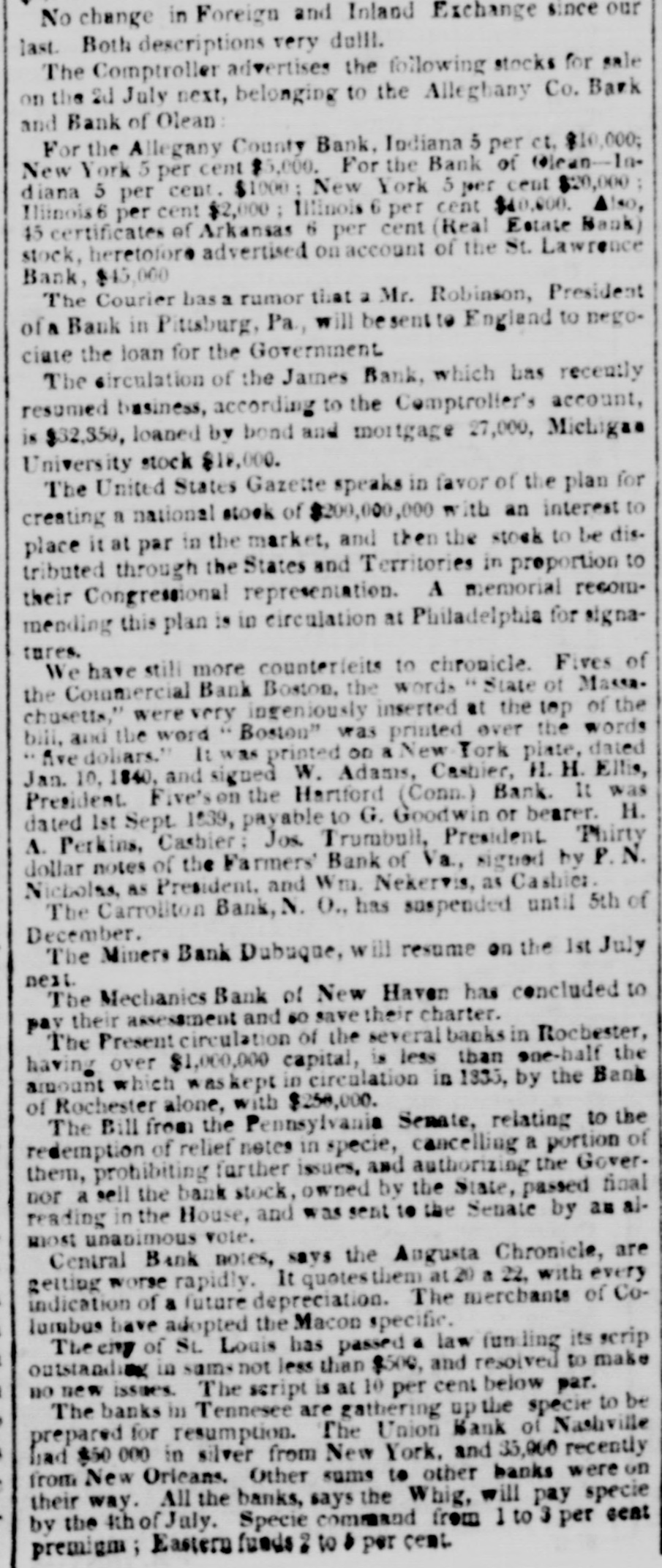
No change in Foreign and Inland Exchange since our last. Both descriptions very dull. The Comptroller advertises the following stocks for sale on the 2d July next, belonging to the Alleghany Co. Bark and Bank of Olean For the Allegany County Bank. Indiana 5 per ct. $10,000; New York 5 per cent $5,000. For the Bank of (lean-Indiana 5 per cent. $1000: New York 5 per cent $20,000; Illinois per cent $2,000; Illinois 6 per cent $40,000. Also, 15 certificates of Arkansas 6 per cent (Real Estate Bank) stock, heretotor advertised on account of the St. Lawrence Bank, $45,000 The Courier has a rumor that a Mr. Robinson, President of a Bank in Pittsburg, Pa., will besentite England to negociate the loan for the Government The circulation of the James Bank, which has recently resumed business, according to the Comptroller's account, is $32,850, loaned by bond and mortgage 27,000, Michigae University stock $18,000. The United States Gazette speaks in favor of the plan for creating a national stock of $200,000,000 with an interest to place it at par in the market, and then the stock to be dis. tributed through the States and Territories in proportion to their Congressional representation. A memorial recommending this plan is in circulation at Philadelphia for signatures. We have still more counterleits to chronicle. Fives of the Commercial Bank Boston. the words State of Massa. chusetts," were very ingeniously inserted at the top of the bill, and the word Boston" was printed over the words five dollars." It was printed on a New York plate, dated Jan. 10, 1840, and signed W. Adams, Cashier, H. H. Ellis, President Five's on the Hartford (Conn.) Bank It was dated 1st Sept. 1839, payable to G. Goodwin or bearer. H. A. Perkins, Cashier: Jos. Trumbull, President Phirty dollar notes of the Farmers' Bank of Va., signed by P.N. Nicholas as President. and Wm. Nekervis, as Cashier. The Carroliton Bank, N. O., has suspended until 5th of December. The Miners Bank Dubuque, will resume on the 1st July next The Mechanics Bank of New Haven has concluded to pay their assessment and 60 save their charter. The Present circulation of the several banks in Rocbester, having over $1,000,000 capital, is less than one-half the amount which waskept in circulation in 1835, by the Bank of Rochester alone, with $250,000. The Bill from the Pennsylvania Senate, relating to the redemption of relief netes in specie, cancelling a portion of them, prohibiting further issues. and authorizing the Gover. nor a sell the bank stock, owned by the State, passed final reading in the House, and was sent to the Senate by as almost unanimous vote. Central Bank notes, says the Augusta Chronicle, are getting worse rapidly. It quotesthem at 20 a 22, with every indication of a future depreciation. The merchants of Columbus have adopted the Macon specific. The civy of St. Louis has passed & law funding its scrip outstand in samsnot less than $500, and resolved to make no new issues. The script is at 10 per cent below par. The banks in Tennesee are gathering up the specie to be prepared for resumption. The Union Bank of Nashville had $50 000 in silver from New York, and 35,960 recently from New Oricans. Other sams to other banks were on their way. All the banks, says the Whig, will pay specie by the 4th of July. Specie command from 1 to 3 per seat premigm; Eastern fueds : to s per cent


Article from New-York Daily Tribune, July 20, 1842

Click image to open full size in new tab

Article Text

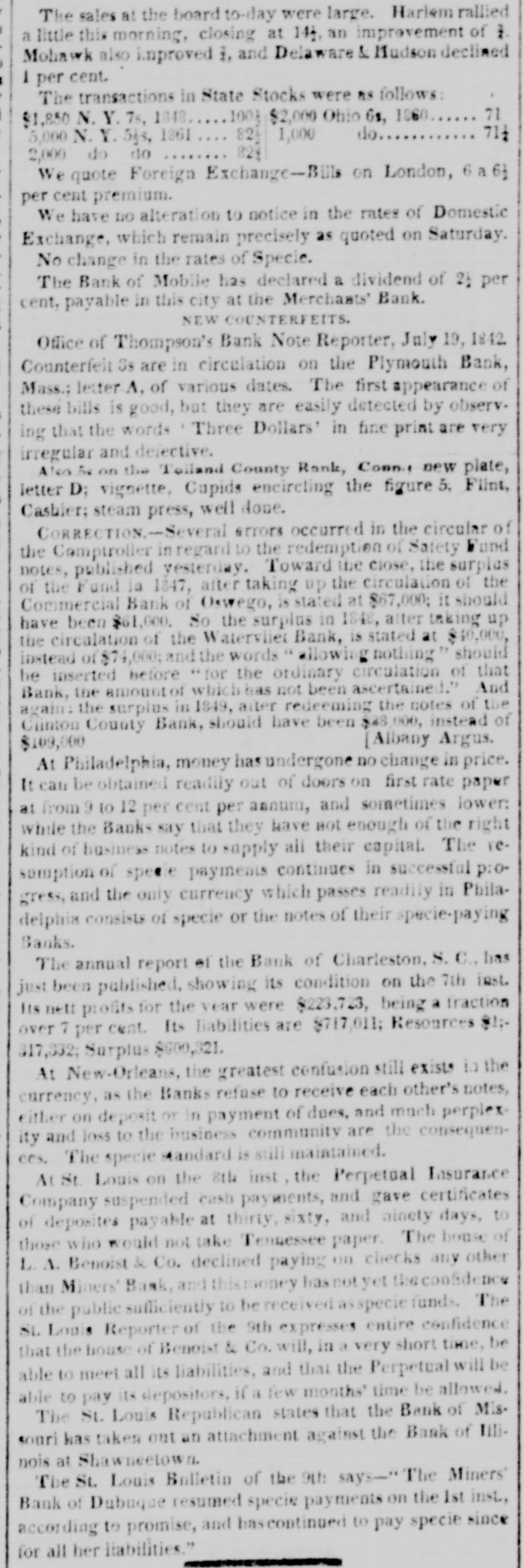
The sales at the board to-day were large. Harlem rallied a little this morning, closing at 143, an improvement of 7. Mohawk also improved i, and Delaware & Hudson declined 1 per cent. The transactions in State Stocks were as follows: 71 $1,850 N. Y. 7s, 1848 100% $2,000 Ohio 6s, 1860 do 71/2 82 1,000 5,000 N. Y. 5ts, 1861 824 2,000 do do We quote Foreign Exchange-Bills on London, 6 a 61 per cent premium. We have no alteration to notice in the rates of Domestic Exchange, which remain precisely as quoted on Saturday. No change in the rates of Specie. The Bank of Mobile has declared a dividend of 2: per cent, payable in this city at the Merchasts' Bank. NEW COUNTERFEITS. Office of Thompson's Bank Note Reporter, July 19, 1842 Counterfeit Ss are in circulation on the Plymouth Bank, Mass.; letter A. of various dates. The first appearance of these bills is good, but they are easily detected by observ. ing that the words Three Dollars' in fine print are very irregular and defective. Alen 5. on the Tolland County Bank, Conn. new plate, letter D; vignette, Cupids encircling the figure 5, Flint, Cashier; steam press, well done. CORRECTION-Several errors occurred in the circular of the Comptroller in regard to the redemption of Safety Fund notes, published yesterday. Toward the close, the surplus of the Fund in 1847, after taking up the circulation of the Commercial Bank of Oswego, is stated at $67,000; it should have been $61,000. So the surplus in 1848, alter taking up the circulation of the Waterville Bank, is stated at $40,000, should instead of $74,000;a the words allowing nothing be inserted before "for the ordinary circulation of that Bank, the amount of which has not been ascertained." And again: the surplus in 1849, after redeeming the notes of the Clinton County Bank, should have been $48 instead of Albany Argus. $109,000 At Philadelphia, money has undergone no change in price. It can be obtained readily out of doors on first rate paper at from 9 to 12 per cent per annum, and sometimes lower: while the Banks say that they have not enough of the right kind of business notes to supply all their capital. The resamption of specie payments continues in successful p:0gress, and the only currency which passes readily in Philadelphia consists of specie or the notes of their specie-paying Banks. The annual report of the Bank of Charleston, S.C., has just been published. showing its condition on the 7th inst. its nett profits for the year were $223,723, being a fraction over 7 per cent. Its liabilities are $717,011; Resources 81:317,832; Surplus $600,321. At New-Orleans, the greatest confusion still exists in the currency, as the Banks refuse to receive each other's notes, either on deposit or in payment of does. and much perplex. ity and loss to the business community are the consequenccs. The specie sandard is stili maintained. At St. Louis on the 8th inst, the Perpetual Insurance Company suspended cash payments, and gave certificates of deposites payable at thirty, sixty, and ainety days, to those who would not take Tennessee paper. The house of L. A. Benoist & Co. declined paying on checks any other than Miners' Bank, and thismoney has not yet the confidence of the public sufficiently to be received asspecie funds. The St. Louis Reporter of the 9th expresses entire confidence that the house of Beneist & Co. will, in a very short time, be able to meet all its liabilities, and that the Perpetual will be able to pay its depositors, if a few months' time be allowed. The St. Louis Republican states that the Bank of Missouri has taken out an attachment against the Bank of IIII. nois at Shawneetown. The St. Louis Bulletin of the 9th: says-' The Miners' Bank of Dubuque resumed specie payments on the 1st inst, according to promise, and hascontinued to pay specie since for all her liabilities."


Article from The New York Herald, July 22, 1842

Click image to open full size in new tab

Article Text

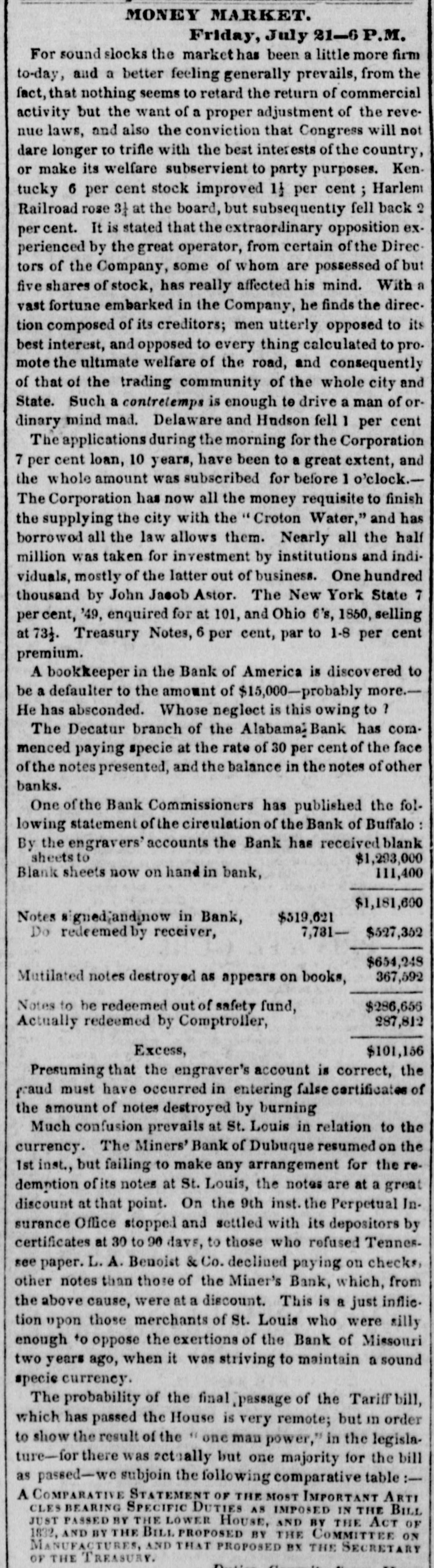
MONEY MARKET. Friday, July 21-6 P.M. For sound slocks the market has been a little more firm to-day, and a better feeling generally prevails, from the fact, that nothing seems to retard the return of commercial activity but the want of a proper adjustment of the revenue laws, and also the conviction that Congress will not dare longer to trifle with the best interests of the country, or make its welfare subservient to party purposes. Kentucky 6 per cent stock improved 1} per cent ; Harlem Railroad rose 31 at the board, but subsequently fell back 2 percent. It is stated that the extraordinary opposition experienced by the great operator, from certain of the Directors of the Company, some of whom are possessed of but five shares of stock, has really affected his mind. With a vast fortune embarked in the Company, he finds the direc. tion composed of its creditors; men utterly opposed to its best interest, and opposed to every thing calculated to promote the ultimate welfare of the road, and consequently of that of the trading community of the whole city and State. Such a contreiemps is enough to drive a man of ordinary mind mad. Delaware and Hudson fell 1 per cent The applications during the morning for the Corporation 7 per cent loan, 10 years, have been to a great extent, and the whole amount was subscribed for before 1 o'clock.The Corporation has now all the money requisite to finish the supplying the city with the "Croton Water," and has borrowed all the law allows them. Nearly all the half million was taken for investment by institutions and individuals, mostly of the latter out of business. One hundred thousand by John Jacob Astor. The New York State 7 per cent, '49, enquired for at 101, and Ohio 6's, 1850, selling at 733. Treasury Notes, 6 per cent, par to 1-8 per cent premium. A bookkeeper in the Bank of America is discovered to be a defaulter to the amount of $15,000-probably more.He has absconded. Whose neglect is this owing to ? The Decatur branch of the Alabama: Bank has commenced paying specie at the rate of 30 per cent of the face of the notes presented, and the balance in the notes of other banks. One of the Bank Commissioners has published the following statement of the circulation of the Bank of Buffalo By the engravers' accounts the Bank has received blank sheets to $1,293,000 111,400 Blank sheets now on hand in bank, $1,181,600 $519,621 Notes signed;andjnow in Bank, 7,731$527,352 Do redeemed by receiver, $654,248 367,592 Mutilated notes destroyed as appears on books, $286,656 Notes to he redeemed out of safety fund, 287,812 Actually redeemed by Comptroller, Excess, $101,156 Presuming that the engraver's account is correct, the fraud must have occurred in entering false certificates of the amount of notes destroyed by burning Much confusion prevails at St. Louis in relation to the currency. The Miners' Bank of Dubuque resumed on the 1st inst., but failing to make any arrangement for the redemption of its notes at St. Louis, the notes are at a great discount at that point. On the 9th inst. the Perpetual Insurance Office stopped and settled with its depositors by certificates at 30 to 90 davs, to those who refused Tennessee paper. L. A. Benoist & Co. declined paying on checks, other notes than those of the Miner's Bank, which, from the above cause, were at a discount. This is a just inflic. tion upon those merchants of St. Louis who were silly enough to oppose the exertions of the Bank of Missouri two years ago, when it was striving to maintain a sound specie currency. The probability of the final passage of the Tariff bill, which has passed the House is very remote; but in order to show the result of the one man power," in the legislature-for there was setually but one majority for the bill as passed-we subjoin the following comparative table :A COMPARATIVE STATEMENT OF THE MOST IMPORTANT ARTI CLES BEARING SPECIFIC DUTIES AS IMPOSED IN THE BILL JUST PASSED BY THE LOWER House, AND BY THE ACT OF 1832, AND BY THE BILL PROFOSED BY THE COMMITTEE ON MANUFACTURES, AND THAT PROPOSED BX THE SECRETARY OF THE TREASURY. -


Article from The Radical, July 23, 1842

Click image to open full size in new tab

Article Text

THE RADICAL Bowling Green, July 23, 1842. "Middleton" shall appear next week. I By last night's mail we learn that the Miners' Bank of Dubuque has suspended again. It is also said that the St. Louis Gas Light Company cannot pay a bill of $5 in good funds. S. B. Curchill has been appointed Post Master in St. Louis, in place of T. Watson, Esq.


Article from The Illinois Free Trader and Lasalle County Commercial Advertiser, September 16, 1842

Click image to open full size in new tab

Article Text

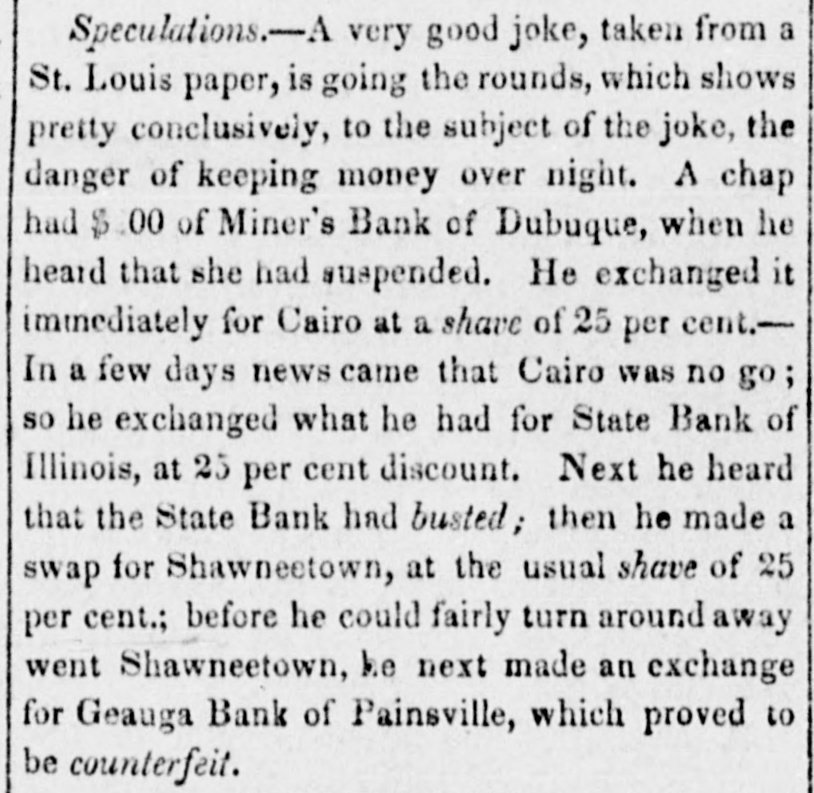
Speculations.-A very good joke, taken from a St. Louis paper, is going the rounds, which shows pretty conclusively, to the subject of the joke, the danger of keeping money over night. A chap had $.00 of Miner's Bank of Dubuque, when he heard that she had suspended. He exchanged it immediately for Cairo at a shave of 25 per cent.In a few days news came that Cairo was no go; so he exchanged what he had for State Bank of Illinois, at 25 per cent discount. Next he heard that the State Bank had busted; then he made a swap for Shawneetown, at the usual shave of 25 per cent.; before he could fairly turn around away went Shawneetown, he next made an exchange for Geauga Bank of Painsville, which proved to be counterfeit.


Article from Louisville Messenger, September 17, 1842

Click image to open full size in new tab

Article Text

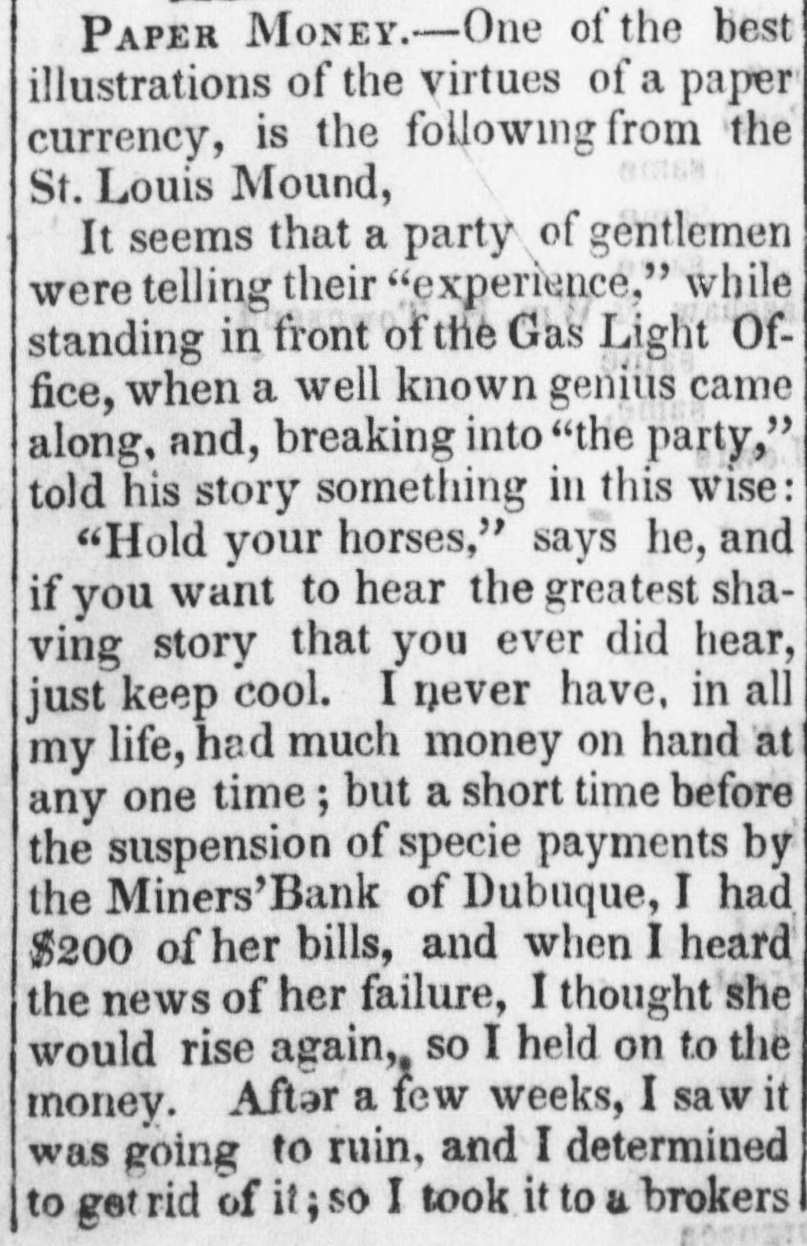
# PAPER MONEY One of the best illustrations of the virtues of a paper currency, is the following from the St. Louis Mound, It seems that a party of gentlemen were telling their "experience," while standing in front of the Gas Light Office, when a well known genius came along, and, breaking into "the party," told his story something in this wise: "Hold your horses," says he, and if you want to hear the greatest shaving story that you ever did hear, just keep cool. I never have, in all my life, had much money on hand at any one time; but a short time before the suspension of specie payments by the Miners' Bank of Dubuque, I had $200 of her bills, and when I heard the news of her failure, I thought she would rise again, so I held on to the money. After a few weeks, I saw it was going to ruin, and I determined to get rid of it; so I took it to a brokers


Article from Democratic Standard, September 20, 1842

Click image to open full size in new tab

Article Text

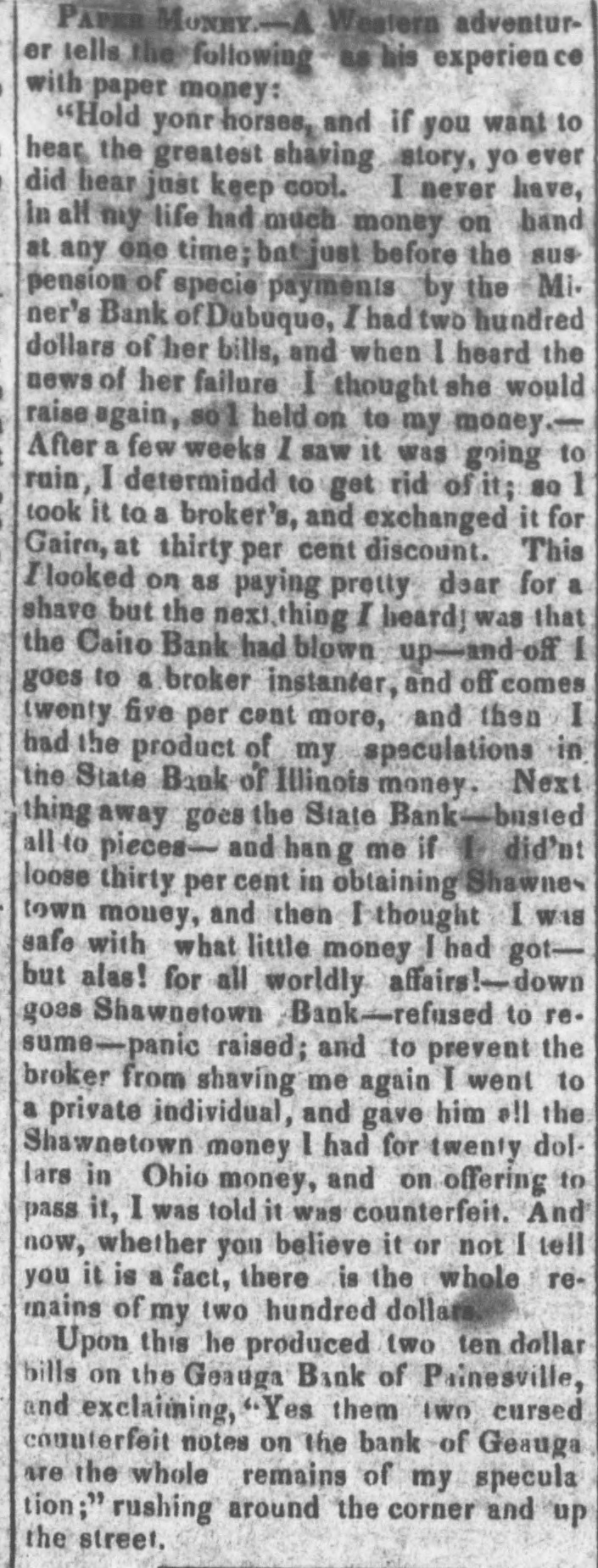
# PAPER MONEY.-A Western adventur- er tells the following as his experience with paper money: "Hold your horses, and if you want to hear the greatest shaving story, yo ever did hear just keep cool. I never have, in all my life had much money on hand at any one time; bat just before the suspension of specie payments by the Miner's Bank of Dubuque, I had two hundred dollars of her bills, and when I heard the news of her failure I thought she would raise again, so I held on to my money. After a few weeks I saw it was going to ruin, I determindd to get rid of it; so I took it to a broker's, and exchanged it for Gairo, at thirty per cent discount. This I looked on as paying pretty dear for a shave but the next thing I heard, was that the Caito Bank had blown up-and-off I goes to a broker instanter, and off comes twenty five per cont more, and then I had the product of my speculations in the State Bank of Illinois money. Next thing away goes the State Bank-busted all to pieces-and hang me if I did'nt loose thirty per cent in obtaining Shawne-stown money, and then I thought I was safe with what little money I had got-but alas! for all worldly affairs!-down goes Shawnetown Bank-refused to resume-panic raised; and to prevent the broker from shaving me again I went to a private individual, and gave him all the Shawnetown money I had for twenty dollars in Ohio money, and on offering to pass it, I was told it was counterfeit. And now, whether you believe it or not I tell you it is a fact, there is the whole remains of my two hundred dollars. Upon this he produced two ten dollar bills on the Geauga Bank of Painesville, and exclaiming, "Yes them two cursed counterfeit notes on the bank of Geauga are the whole remains of my speculation;" rushing around the corner and up the street.


Article from Southport Telegraph, September 28, 1842

Click image to open full size in new tab

Article Text

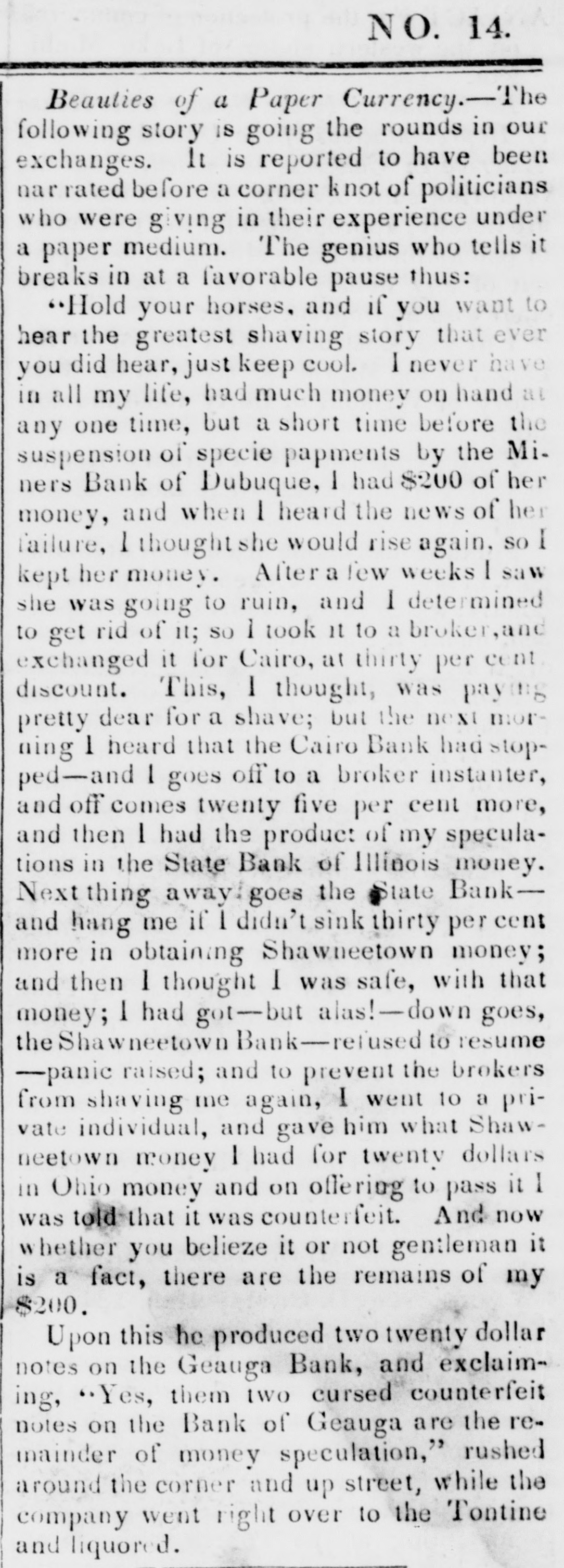
# Beauties of a Paper Currency. The following story is going the rounds in our exchanges. It is reported to have been narrated before a corner knot of politicians who were giving in their experience under a paper medium. The genius who tells it breaks in at a favorable pause thus: "Hold your horses, and if you want to hear the greatest shaving story that ever you did hear, just keep cool. I never have in all my life, had much money on hand at any one time, but a short time before the suspension of specie papments by the Miners Bank of Dubuque, I had $200 of her money, and when I heard the news of her failure, I thought she would rise again, so I kept her money. After a few weeks I saw she was going to ruin, and I determined to get rid of it; so I took it to a broker, and exchanged it for Cairo, at thirty per cent discount. This, I thought, was paying pretty dear for a shave; but the next morning I heard that the Cairo Bank had stopped-and I goes off to a broker instanter, and off comes twenty five per cent more, and then I had the product of my speculations in the State Bank of Illinois money. Next thing away goes the State Bank-and hang me if I didn't sink thirty per cent more in obtaining Shawneetown money; and then I thought I was safe, with that money; I had got-but alas!-down goes, the Shawneetown Bank-refused to resume -panic raised; and to prevent the brokers from shaving me again, I went to a private individual, and gave him what Shawneetown money I had for twenty dollars in Ohio money and on offering to pass it I was told that it was counterfeit. And now whether you belieze it or not gentleman it is a fact, there are the remains of my $200. Upon this he produced two twenty dollar notes on the Geauga Bank, and exclaiming, "Yes, them two cursed counterfeit notes on the Bank of Geauga are the remainder of money speculation," rushed around the corner and up street, while the company went right over to the Tontine and liquored.


Article from The Ohio Democrat, October 6, 1842

Click image to open full size in new tab

Article Text

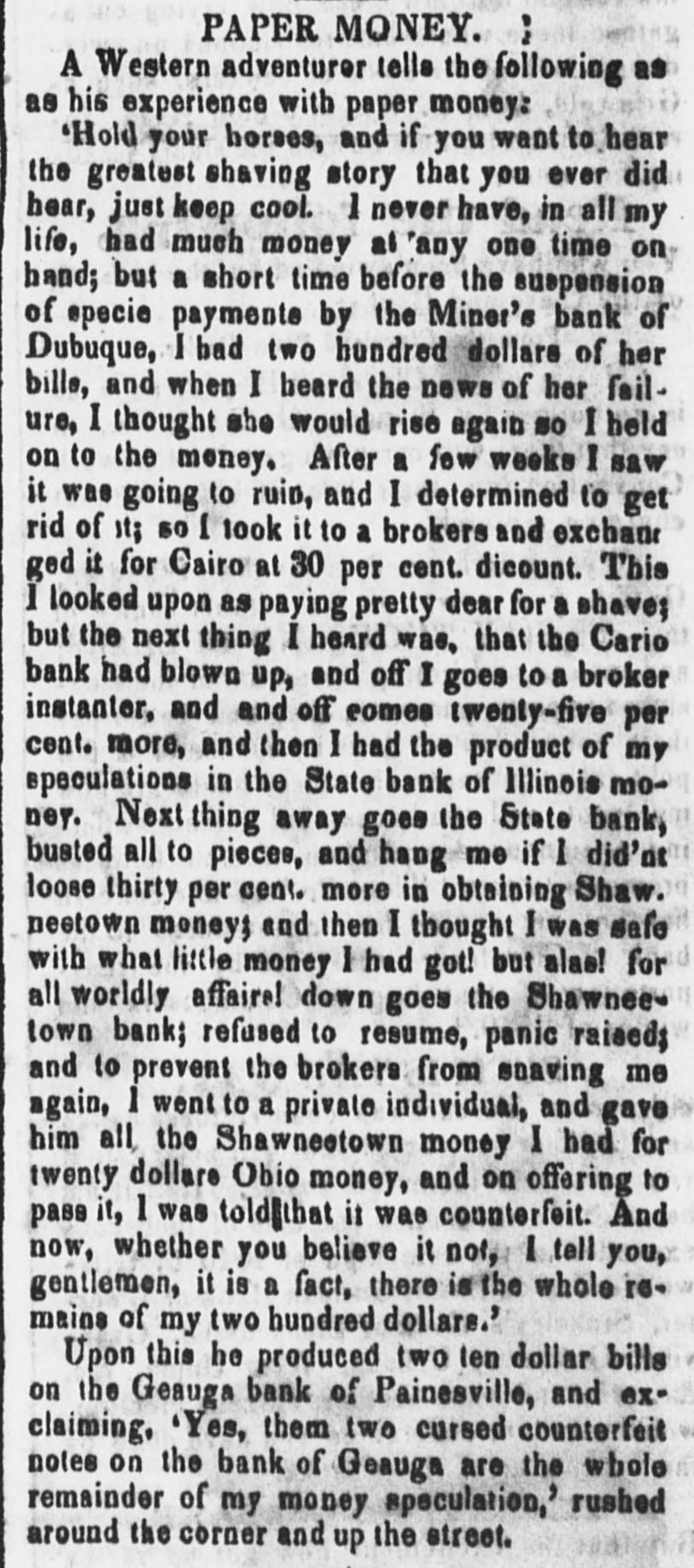
# PAPER MONEY. A Western adventurer tells the following as as his experience with paper money: 'Hold your horses, and if you want to hear the greatest shaving story that you ever did hear, just keep cool. I never have, in all my life, had much money at any one time on hand; but a short time before the suspension of specie payments by the Miner's bank of Dubuque, I had two hundred dollars of her bills, and when I heard the news of her failure, I thought she would rise again so I held on to the money. After a few weeks I saw it was going to ruin, and I determined to get rid of it; so I took it to a brokers and exchanged it for Cairo at 30 per cent. dicount. This I looked upon as paying pretty dear for a shave; but the next thing I heard was, that the Cario bank had blown up, and off I goes to a broker instanter, and and off comes twenty-five per cent. more, and then I had the product of my speculations in the State bank of Illinois money. Next thing away goes the State bank, busted all to pieces, and hang me if I did'nt loose thirty per cent. more in obtaining Shawneetown money; and then I thought I was safe with what little money I had got! but alas! for all worldly affairel down goes the Shawneetown bank; refused to resume, panic raised; and to prevent the brokers from snaving me again, I went to a private individual, and gave him all the Shawneetown money I had for twenty dollare Obio money, and on offering to pass it, I was told that it was counterfeit. And now, whether you believe it not, I tell you, gentlemen, it is a fact, there is the whole remains of my two hundred dollars.' Upon this he produced two ten dollar bills on the Geauga bank of Painesville, and exclaiming, 'Yes, them two cursed counterfeit notes on the bank of Geauga are the whole remainder of my money speculation,' rushed around the corner and up the street.


Article from Iowa Territorial Gazette and Advertiser, February 3, 1844

Click image to open full size in new tab

Article Text

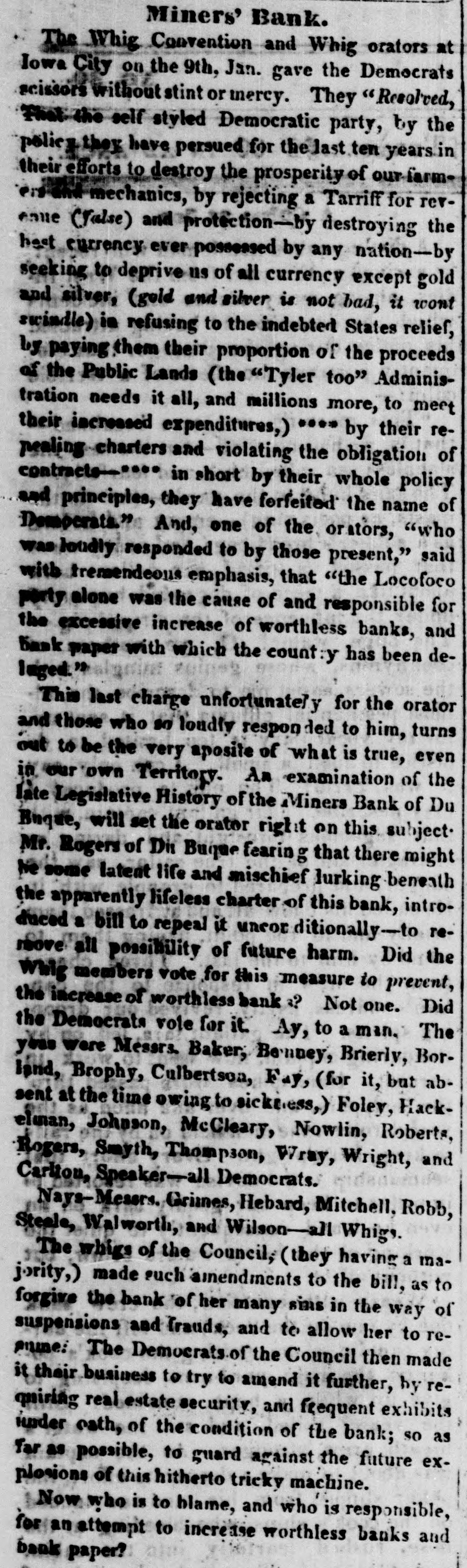
# Miners' Bank. The Whig Convention and Whig orators at Iowa City on the 9th, Jan. gave the Democrats scissors without stint or mercy. They "Resolved, That the self styled Democratic party, by the policy they have persued for the last ten years in their efforts to destroy the prosperity of our farmers and mechanics, by rejecting a Tarriff for revenue (false) and protection-by destroying the best currency ever possessed by any nation-by seeking to deprive us of all currency except gold and silver, (gold and silver is not bad, it wont swindle) in refusing to the indebted States relief, by paying them their proportion of the proceeds of the Public Lands (the "Tyler too" Administration needs it all, and millions more, to meet their increased expenditures,) **** by their repealing charters and violating the obligation of contracts.... in short by their whole policy and principles, they have forfeited the name of Demperata." And, one of the orators, "who was loudly responded to by those present," said with tremendeous emphasis, that "the Locofoco porty alone was the cause of and responsible for the excessive increase of worthless banks, and bank paper with which the country has been deluged." This last charge unfortunately for the orator and those who so loudly responded to him, turns out to be the very aposite of what is true, even in our own Territory. An examination of the late Legislative History of the Miners Bank of Du Buque, will set the orator right on this subject Mr. Rogers of Din Buque fearing that there might be some latent life and mischief lurking beneath the apparently lifeless charter of this bank, introduced a bill to repeal it uncor ditionally-to remove all possibility of future harm. Did the Whig members vote for this measure to prevent, the increase of worthless bank? Not one. Did the Democrats vote for it. Ay, to a man, The yeas were Messrs. Baker, Benney, Brierly, Borland, Brophy, Culbertson, Fay, (for it, but absent at the time owing to sickness,) Foley, Hackelman, Johnson, McCleary, Nowlin, Roberts, Rogers, Smyth, Thompson, Wray, Wright, and Carlton, Speaker-all Democrats. Nays-Mesers. Grimes, Hebard, Mitchell, Robb, Steele, Walworth, and Wilson-all Whigs. The whigs of the Council; (they having a majority,) made such amendments to the bill, as to forgive the bank of her many sins in the way of suspensions and frauds, and to allow her to resume: The Democrats of the Council then made it their business to try to amend it further, by requiring real estate security, and frequent exhibits under oath, of the condition of the bank; so as far as possible, to guard against the future explosions of this hitherto tricky machine. Now who is to blame, and who is responsible, for an attempt to increase worthless banks and bank paper?


Article from Iowa Territorial Gazette and Advertiser, February 3, 1844

Click image to open full size in new tab

Article Text

From the Iowa City Reporter. Sketch of the Debate on the Bill to repeal the Charter of the Miners' Bank of Du Buque. Mr. Grimes denied altogether the power of the Legislature to pass an act of the kind con templated. The dissolution of the charter de pended upon fact, and the finding of that fact was strictly judicial proceeding. The Organic law, which IS our Constitution. had placed all judicial power in ribunals created and appoint ed by the law. The powers of the Legislature were restricted to proper subjects of legislation, and this was not one of those proper subjects In support of this position and in opposition to the right of legislative body to repeal corporation, Mr Grimes produced number of author ities, Mr Rogers-Mr. Speaker: The gentleman from Des Moines, has made very able and eloquent defence of corporate rights. He closed his remarks by admonishing the House that the repeal of charter of a swindling institution. would be a stab at the constitution. This is no new warning- has been the constant of the whig party, wheney they wished to ral ly their forces against any leading measure of the democracy Since his recollection the con stitution has received many such deadly blows. The election of Gen. Jackson was one, his veto of the bill to renew the charter of the U. States Bank, was another, and his removal of the public deposites from that institution was deep and appalling thrust at its very vitals But notwith standing this yearly killing off of the constitution, that sacred charter of our liberties still survives, unscathed by these fatal wounds, and will continue to live and flourish, is the patriot's hope, for ages yet to come. He did not believe in the sacredness and irrepoalability of charters The same power that creates can destroy, and it should be exercised whenever the public interest demand it. One legislature has no right to bind its successors. such right be conceded, the people might be sold single session into disgraceful bondage for ever, and our liberties and all we hold dear, will depend on the frail tenure of legislative virtue He did not agree with his friend from Des Moines, that a bank charter is cont tract within the meaning of that provision of the constitution. which prohibits the passage of any law impair ing the obligation of contracts. That had reference to the contracts of individuals, and not to the exercise of sovereign power in conferring privileges. The legislature makes laws-not contracts- and it absurd to suppose that the same rules and regulations, which apply to the contracts between private parties, are to be applied to legislatures in creating corporations of This would be dwarfing the supreme power the State into mere bargaining, and the laws, in stead of being peremptory rules, would be only doubtful agreements. A charter is nothing more than permission, or license to do certain things, which the power granting can revoke at any time, if it judge that public policy require such course, These were his opinions, he spoke not for others The question now before the House, does not involve the general right of repeal of corporations, that is reserved in this charter, whenever the Bank shall "abuse or misuse its privileges. The repeal of this charter is asked on the sole ground of its refusal to redeem its issues in specie. The testimony taken before committee of the last session, proves that the Miners' Bank of Dubuque suspended specie payments in March 1841, and remained in that condition until July, 1842, then was galvanized into temporary vitality for some ten days, and then again suspended, and has remained in state of suspended animation up to this time. Not only suspended but barred and bolted against cred. itors. It is provided in the 10th section of the charter, that all bills of credit, notes and post notes, "shall be paid by said corporation. when demanded at their banking house, in the legal coin of the United States. The demand has been made and refusal has followed This sential provision to restrain over issues. and se cure the community against frauds, has been rolated. This "abade of the privileges under the charter" has clearly worked forfeiture. Admitting the charter forfeited. say the advocates of the bank, the legislature has no right to repeal it until that fact has been iudi cially ascertained. Although it is provide in the 23d sec. operation amount leges under this charter. it shall be in the power of the legislative assembly of this Territory at any time, to annul, vacate and make void this charter. It is earnestly contended that the legislature being party to the contract. has right to judge of the 'misuse or abuse" of the privileges granted That the condition on which the right of forfeiture arises, must be first found by the iciary, and when the courts have delared the charter forfeited, then the Legislature vill have the sublime privilege of doing the same hing- acting, when all action is both innecessary and ridiculous, of killing that which is already dead It familiar loctrine o lawyers, that when power is given all the means necessary to perfect that power are given Iso Incidental to this right of repeal, is that enquire into the "abuse or misuse" of the owers conferred-without this right, the pealing clause nullity, and the legislature ho made it, were fools beyond mption Suppose that this corporation had not gone into peration, how could that fact be ascertained acording to the logic of certain gentlemengainst whom would the writ of quo warranto sue? Being no corporation in existence, no ving being could be brought into court. And it is insisted that the legislature can only act grough the judiciary in this matter, the conseuence is irresistable, that this act of th on would have remained upon our Statute ook through all time to come-beyond ach of human power --mortal man would have eated an immortal thing, and stamped upon e frail work of his hand the atributes of Deity es, Mr Speaker--by the last ray of that sun efore he is turned into darkness forever, the man on earth might read by his expiring ght this charter unrepealed, in all its original rce and vitality-such startling absurdities ed no comment. This legislative right of repeal of charters new doctrine. Last winter on the other side the Mississippi the legislature of Illinois laid de. troying hand upon two bank incorpora ns not unknown to fame. Wisconsin in e manner, has visited summary justices on her ancial pets. In Ohio, in single session res of bank fell dead, touched by the potency democratic truth, notwithstandig the lamentcit ons and howls of the mercenary few over their sh th struggles. In New York and Pennsylvaculprit banks have been frequently arraigned he bar of legislative justice andrece ved their tence of death And he believed that in all States of the Union, this power to repeal has exercised without hesitation or question passing strange, that in this Territory, with ed the light of these examples before us, some uld be so awe struck by the majestic sacredof corporations, as not to dare to assert our its in opposition to their arrogant pretento Ir. Speaker We have the legal and constional right to repeal this charter, and I trust we shall exercise it, in ridding Iowa of an itution which has disgraced her soil- whose le existence has been bold defiance of law morality, and whose flood of depreciated r has fertilized the wastes of fraudule specdend on. Let us present the cheering spectaof of one spot in this glorious Republic, where eyed monopolies do not exist, and where who patriot may breathe an earnest prayer to the fee! e of Eternal Justice, for the spread of the occu d cause of the equal rights of man, unrnod by corporate insolence and rapacity.


Article from Bloomington Herald, April 12, 1844

Click image to open full size in new tab

Article Text

# THE MINERS' BANK OF DUBUQUE fall of this institution, promising to recur to it again, giving an opinion as to the proper course to be pursued by the people and their representatives towards it, which promise we shall proceed to fulfil. Since that time we have seen Maj. Mobley, cashier thereof, on his way to Dubuque, for the purpose of reviving it, which renders the present a proper time for the people to examine the matter, and mature their minds as to the course most proper to pursue in reference to it. In giving our opinions upon the matter, however little they may merit consideration, we disclaim any desire to wrest from the holders of its stock, any rights or privileges to which they are legally or morally entitled. We shall consider the subject in a manner to do full justice to the Bank, at the same time maintaining the rights of the Legislative government to protect the people, not only against injuries threatened, but against the power of a corporation to inflict injuries upon them. The right or power of a Legislative body to repeal a charter granted to private companies for specific objects, for violations and abuses, is doubted by some, and disputed by many, as often creating a protracted disscussion as it is attempted, thus consuming the people's money, debating upon matters which interest but a few. Instances of this kind are so numerous that we deem it unnecessary to cite a single instance; prudence, then, should dictate to us as a people, the propriety of thus early settling that question so far as we are concerned, by meeting this first issue with a firmness and decision which will teach all future speculators in stocks of whatever kind, that the laws of the territory are not to be trampled upon, and legislation baffled, but a strict compliance with the provisions of their charter will be demanded and enforced. In advocating the repeal of the charter of the Miners' Bank of Dubuque, we conceive that the question of vested rights does not come up in a shape to entitle it to consideration, the bank, by a total disregard of every testriction contained in the charter, having forfeited every privilege contained therein. But still we shall hear the cry of vested rights, of injury to its present stockholders, from those who are in favor of prolonging its existence. Let us see with what plausibility they can urge such reasons. If a charter such as that of the Miners' Bank, partakes of the nature of a contract, a failure on its part to comply with the stipulations of the contract, destroys its validity, and relieves the other contracting or implied. With the same propriety might it be argued that as a sale of a tract of land is a contract, the purchaser may take possession of it, and refuse payment therefor, pleading in maintainance of his right of possession the fact that he had made a CONTRACT for it, and that the judiciary have no right to interfere with a contract. The idea that a charter cannot be repealed for violations of its provisions is glaringly absurd, especially when no consideration is given to the people for the privileges granted. But it is asserted by the advocates of the Bank, that the repeal of its charter would inflict an injury upon its stockholders. Let us view its history, with a hop, skip, and a jump, and see how far they are entitled to the tender mercies of the people. The charter reserves to the Legislature the power to repeal the same for violations thereof, yet notwithstanding this reservation, the Bank, at the outset, violated the only provision which gave security to its note holders, by issuing without the requisite amount of specie in its vaults-issued post notes, without authority, thus obtaining interest on its debts, while the borrower was charged it upon his-suspended whenever specie was demanded for any considerablo amount-resumed when her charter was thought to be in danger-suspended again-then, its credit being down, its wealthy stockholders purchased its notes at about twenty-five cents on the dollar, and knowing that every right had been forfeited, and that it could not be revived under its old stockholders, sold the stock to the Illinois State Bank concern for what it was willing to give for the dull prospect of obtaining a remission of its sins by the Legislature. The present owners of the charter purchased it with a full knowledge of its history, and of course at such a price only as they were willing to hazard for the prospect of gain by its revival. Is it, then, a breach of faith in the Legisleture, to exercise its reserved rights, in prohibiting a continuation of such a series of abuses? Will its repeal inflict an injury upon its present stockholders which they could not forsee or anticipate? No-they made their purchases with a perfect knowledge of its abuses, and in doubt whether it would be permitted again to commence banking operations. Nor do those in-


Article from New-York Daily Tribune, April 24, 1844

Click image to open full size in new tab

Article Text

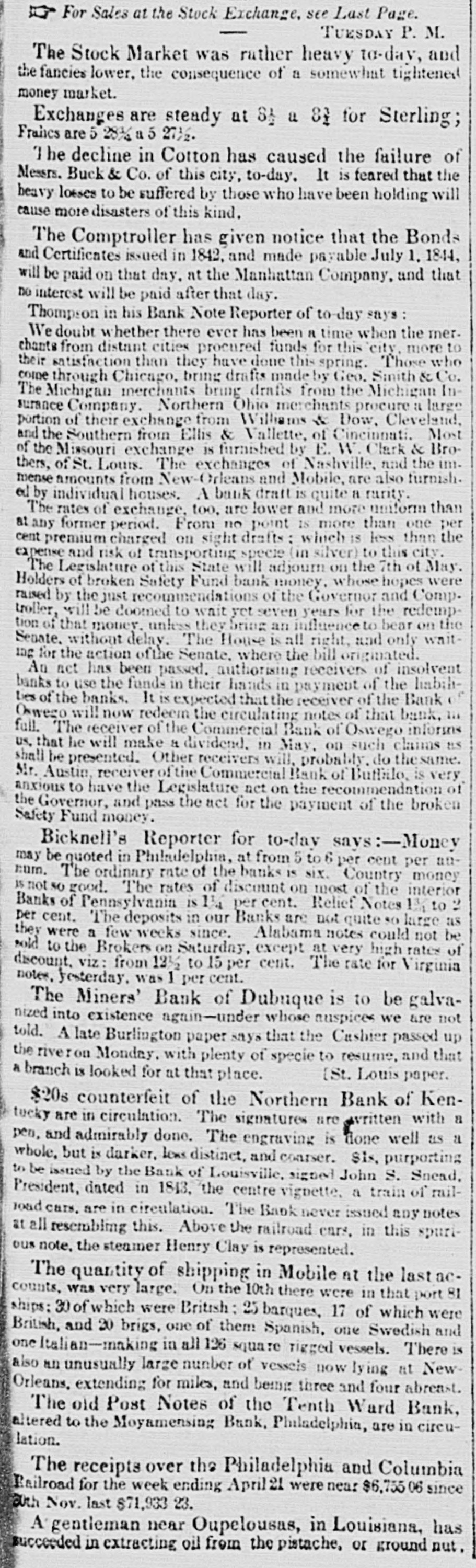
For Sales at the Stock Exchange, see Last Page. TUESDAY P. M. The Stock Market was rather heavy to-day, and the fancies lower, the consequence of a somewhat tightened money market. Exchanges are steady at 81 a 81 for Sterling; Francs are 5 2814 a 5 273 The decline in Cotton has caused the failure of Messrs. Buck & Co. of this city, to-day. It is feared that the heavy losses to be suffered by those who have been holding will cause more disasters of this kind. The Comptroller has given notice that the Bonds and Certificates issued in 1842, and made payable July 1. 1844, will be paid on that day, at the Manhattan Company, and that Do interest will be paid after that day. Thompson in his Bank Note Reporter of to day says: We doubt whether there ever has been a time when the merthants from distant cities procured funds for this city, more to their satisfaction than they have done this spring. Those who come through Chicago, bring drafts made by Geo. Smith & Co. The Michigan merchants bring drafts from the Michigan Insurance Company. Northern Ohio merchants procure it large portion of their exchange from Williams " Dow. Cleveland, and the Southern from Ellis & Vallette, of Cincinnati. Most of the Missouri exchange is furnished by E. W. Clark & Brothers, of St. Louis. The exchanges et Nashville, and the im. mense amounts from w-Orleans and Mobile, are also furnish. al by individual houses. A bank draft is quite a rarity. The rates of exchange, too, are lower and more uniform than at any former period. From no point IS more than one per cent premium charged on sight drafts: which 18 less than the expense and risk of transporting specie (in silver) to this city, The Legislature of this State will adjourn on the 7th of May. Holders of broken Safety Fund bank money. whose hopes were raised by the just recommendations of the Governor and Comp. troller, will be doomed to whit yet seven years for the redemption of that money. unless they bring an influence to bear on the Senate. without delay. The House is all right, and only wait10g for the action of the Senate, where the bill originated. An act has been passed. authorising receivers of insolvent banks to use the funds in their hands in payment of the liabiliLies of the banks. It is expected that the receiver of the Bank Oswego will now redeem the circulating notes of that bank, full. The receiver of the Commercial Bank of Oswego informs us. that he will make it dividend. in May, on such claims as shall be presented. Other receivers will, probably, do the same. Mr. Austin, receiver of the Commercial Bank of Buffilo, is very anxious to have the Legislature net on the recommendation of the Governor, and pass the act for the payment of the broken Safety Fund money. Bicknell's Reporter for to-day says:-Money may be quoted in Philadelphia, at from 5 to 6 per cent per anrum. The ordinary rate of the banks is six. Country money is not so good. The rates of discount on most of the interior Banks of Pennsylvania is 14 per cent. Relief Notes 134 to 2 per cent. The deposits in our Banks are not quite so large as they were a few weeks since. Alabama notes could not be sold to the Brokers on Saturday. except at very high rates of discount. viz: from 12 1/2 to 15 per cent. The rate for Virginia notes, yesterday. was 1 per cent. The Miners' Bank of Dubuque is to be galvanized into existence again-under whose auspices we are not told. A late Burlington paper says that the Cashier passed up the rivere Monday. with plenty of specie to resume. and that a branch is looked for at that place. (St. Louis paper. $20s counterfeit of the Northern Bank of Kentucky are in circulation. The signatures are written with a pen, and admirably done. The engraving is done well as a whole, but is darker. leas distinct. and coarser. Sis, purporting to be issued by the Bank of Louisville, signed John S. Snead, President, dated in 1843, the centre vignette, a train of railroad cars. are in circulation. The Bank never issued any notes at all resembling this. Above the railroad cars. in this spurious note, the steamer Henry Clay is represented. The quantity of shipping in Mobile at the last accounts, was very large. On the 10th there were in that port 81 ships: 30 of which were British: 25 barques, 17 of which were British, and 20 brigs, one of them Spanish, one Swedish and one Italian-making in all 126 square tigged vessels. There is also an unusually large number of vesseis now lying at New Orleans, extending for miles, and being three and four abreast. The old Post Notes of the Tenth Ward Bank, altered to the Moyamensing Bank, Philadelphia, are in circulation. The receipts over the Philadelphia and Columbia Railroad for the week ending April were near $6,755.06 since with Nov. last $71,933.23 gentleman near Oupelousas, in Louisiana, has succeeded in extracting oil from the pistache, or ground nut.


Article from Iowa Territorial Gazette and Advertiser, April 27, 1844

Click image to open full size in new tab

Article Text

Miners Bank of Debuque This institution. we learn from the papers, ing has resulted specie payments. after Dubuque two remained in a state of suspension for have or three years, during all of which some paper has been comparatively valueless. the notes ai the time of the parted with their at an almost have holders hct, its under of entire suspension period saeri- The the full knowledge that the was totally bankrupt, and the is exception of a very trifling of the agent. of the Bank the tien with Beak possession the itself. papar amount, and institu- now, in The injury inflicted the the by the repadiation of its comcannot be repaired by the and such being remeption; manity, by but the very Bank, therefore, apparent, upon there present issues are we opine, who will look made in the beginning of the as one of any general marks accurciation Viewed few, in importance. these upon reie another light, however-the effect it to have upon our next Legislature in forcing through of an act legalizing the past delinquencies the Bank-the resumption acquires import. since. The time and money expended, the the pertinacity with which the owners of the Bank all combine to prove that a favorite vistica taken, agers and and is object, pursue this spec- pains man- their involved in the result of a much was at first appliances were put into last winter and the winter tion extraorblarry duce amount the both the anticipated. before The upera- larger to most inLegislature to give its the institution from the attach to its forfeited att empt, in both instances, penalties but case'ul. act releasing the which sanction prured pains charter; unsue. to and an Th ree repeated rebuTs seem no to have discourage! those to whom they ne e adm nistered; for it is evident that preparations are now being made to beset the next Legislature with more vigorous effort than any ever before a this view, doubtless, the made, and the fact that the is specie for its complice the And at present with paying liabilities, present Bank made. with reof the risk it is as to induce favorable be made to the amount upon As appeal full knowledge expretied, sufficient will Legislature; ineurs, action. relied the properly magnified, will be set forth in imposing numbers; public the safety of the bill will be dwelt the ty (new will emission) be invoked; upon; generosi- injustice holders of permitting innocent persons, who had no hand in the former mismanagement of the institution, it can easily be held to suffer, and when averted, will be up; in this way, with the aid and influences as be other ed expedient arguments may of deem- such and suitable to the occasion, a free acquittal of all past offences is hoped to be obtained for the Bank. It is proper that the people should be advised thus early of what is going on, that they may vote understandingly for rep. resentatives at the approaching August election. The means that were resorted to last winter to instract the members from this county to vote for the resuscitation of the Bank are so generally and so well known that we need but allude to them; it is sufficient to say that those instructions did not express the sentiments of the ma. jerity of the rotess of Des Moines. This we are to submit io the next tion election, willing test of asser- the when the question will undoubtedly make up one of the issues to be tried before the people. But under the peculiar circumstances by which we are surrounded at present, we should oppose the extension of further legislative favor to the Book, even were it more deserving or worthy its history shows it to be. The of against a lowe than have decided remaining people Territoy much longer, and a convention of delegates will to November next to frame a constitution for thoig government as a State. Among the may questions which will come before that convention, none, perhaps, will be generally regarded as of greater importance than the power of chartering Banks; and whether the reauli be the constitutional assent to or prohibition of such institutions, it is equally important that the unfettered, and free to act as shall be be entirely State may thought best. A very large. portion of our people, who have witnessed the corruption of the banking system, and have and in favor of -its aboves, wholly withholding suffered from all power from the Legislature to establish banks of baykinli while there are others, again, who be impose Such guards and re-


Article from The Kalida Venture, June 6, 1845

Click image to open full size in new tab

Article Text

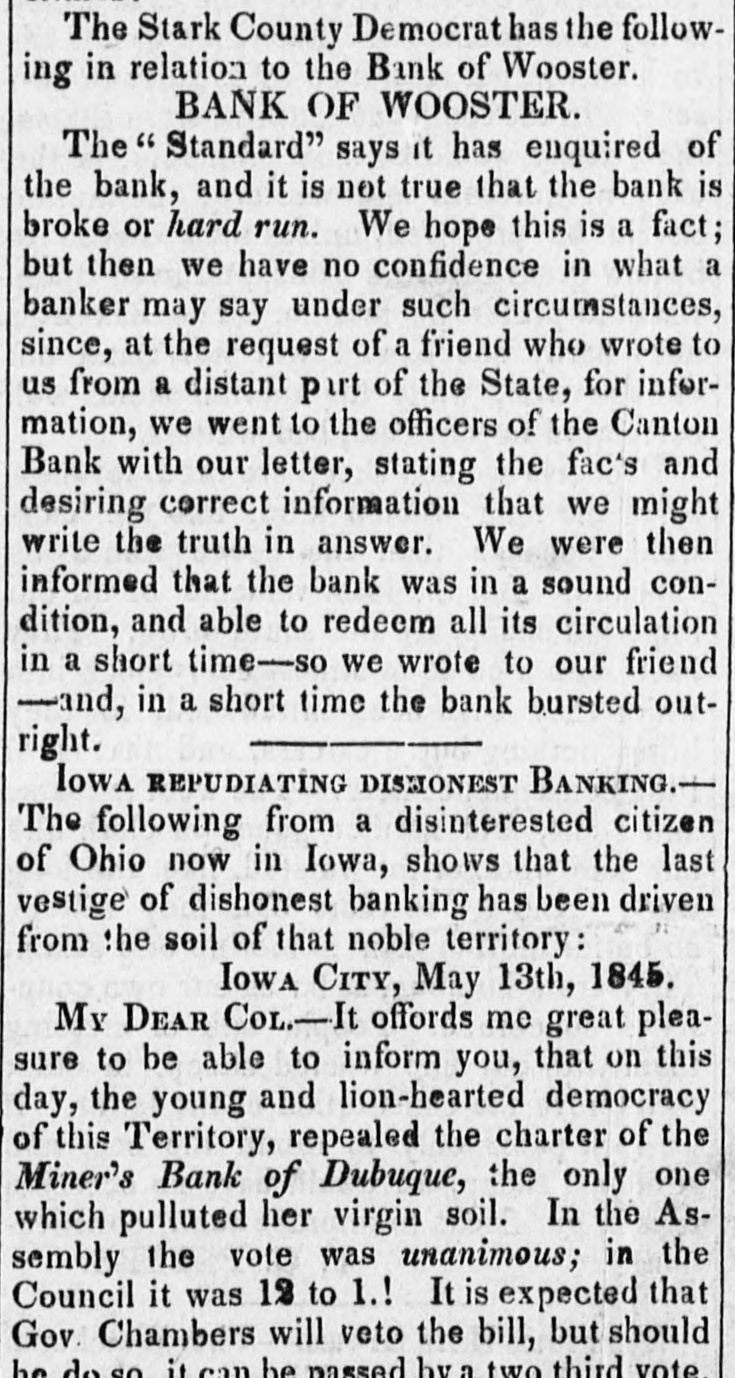
The Stark County Democrat has the following in relation to the Bank of Wooster. BANK OF WOOSTER. The Standard" says it has enquired of the bank, and it is not true that the bank is broke or hard run. We hope this is a fact; but then we have no confidence in what a banker may say under such circumstances, since, at the request of a friend who wrote to us from a distant part of the State, for information, we went to the officers of the Canton Bank with our letter, stating the fac's and desiring correct information that we might write the truth in answer. We were then informed that the bank was in a sound condition, and able to redeem all its circulation in a short time-so we wrote to our friend -and, in a short time the bank bursted outright. lowa REPUDIATING DISMONEST BANKING.-The following from a disinterested citizen of Ohio now in Iowa, shows that the last vestige of dishonest banking has been driven from the soil of that noble territory: IOWA CITY, May 13th, 1845. My DEAR COL.-It offords me great pleasure to be able to inform you, that on this day, the young and lion-hearted democracy of this Territory, repealed the charter of the Miner's Bank of Dubuque, the only one which pulluted her virgin soil. In the Assembly the vote was unanimous; in the Council it was 12 to 1.! It is expected that Gov. Chambers will veto the bill, but should he it can be passed hv third vote


Article from Wisconsin Herald, and Grant County Advertiser, June 7, 1845

Click image to open full size in new tab

Article Text

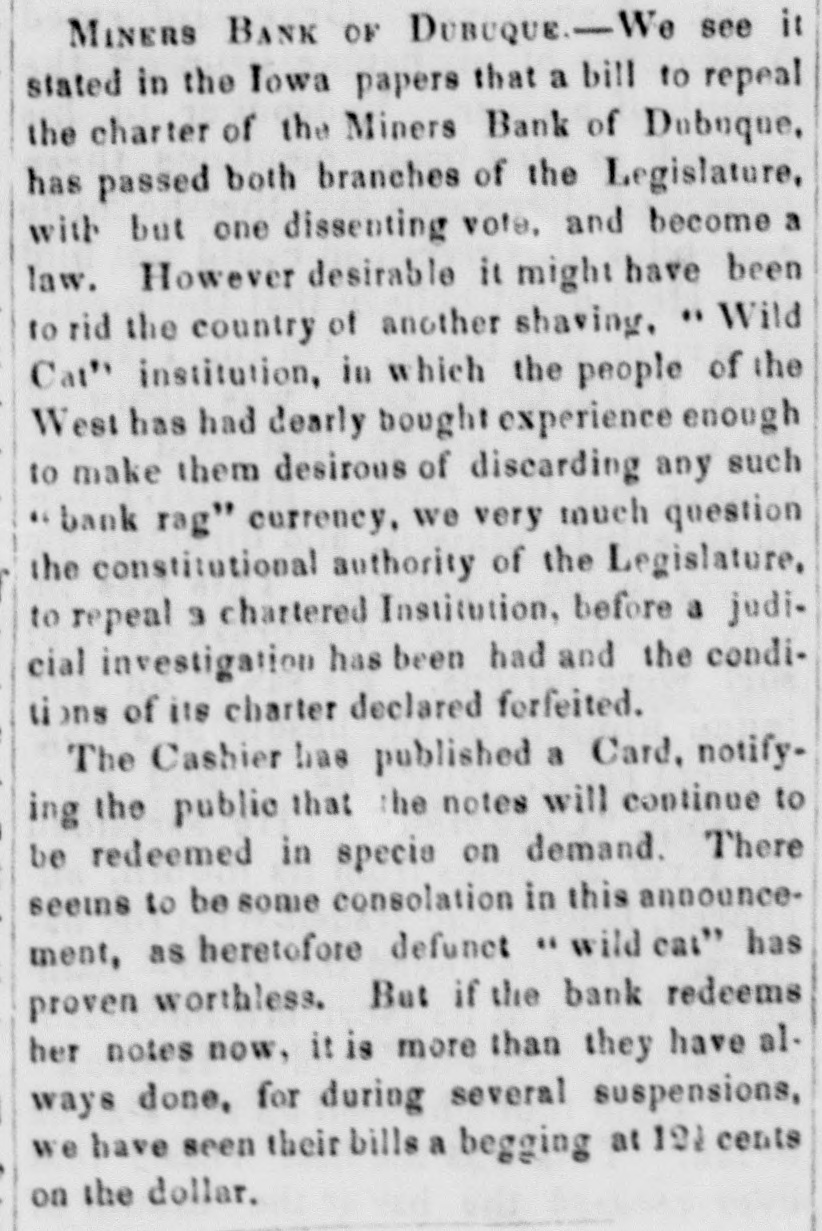
MINERS BANK OF DUBUQUE.-We see it stated in the Iowa papers that a bill to repeal the charter of the Miners Bank of Dubuque, has passed both branches of the Legislature, with but one dissenting vote, and become a law. However desirable it might have been to rid the country of another shaving. " Wild Cat" institution, in which the people of the West has had dearly bought experience enough to make them desirous of discarding any such bank rag" currency, we very much question the constitutional authority of the Legislature, to repeal 3 chartered Institution, before a judicial investigation has been had and the conditi ions of its charter declared forfeited. The Cashier has published a Card, notifying the public that the notes will continue to be redeemed in special on demand. There seems to be some consolation in this announcement, as heretofore defunct wild cat" has proven worthless. But if the bank redeems her notes now, it is more than they have always done, for during several suspensions, we have seen their bills a begging at 191 cents on the dollar.


Article from New-York Daily Tribune, June 12, 1847

Click image to open full size in new tab

Article Text

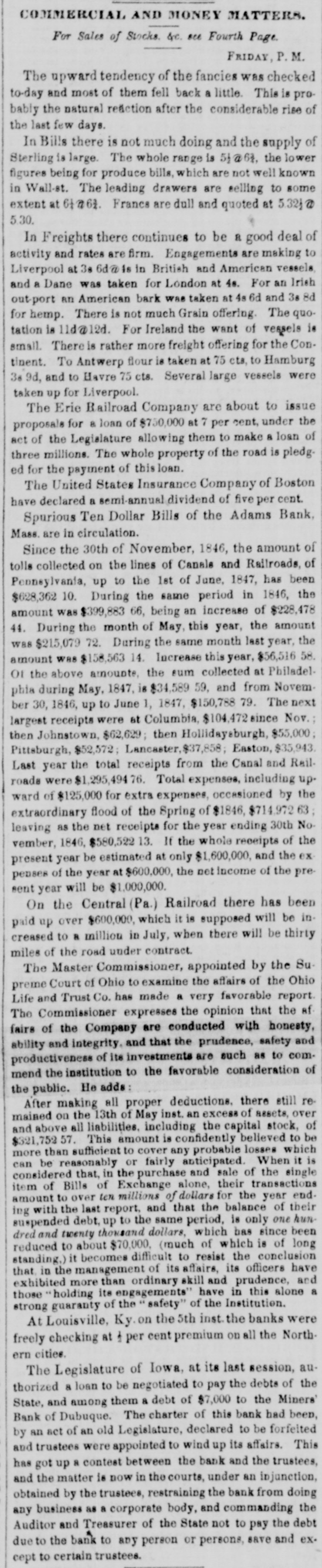
COMMERCIAL AND MONEY MATTERS. For Sales of Stocks. & see Fourth Page FRIDAY, P.M. The upward tendency of the fancies was checked to-day and most of them fell back a little. This is probably the natural reaction after the considerable rise of the last few days. In Bills there is not much doing and the supply of Sterling is large. The whole range is 51@67, the lower figures being for produce bills, which are not well known in Wall-st. The leading drawers are selling to some extent at 6+162 Francs are dull and quoted at 5.32}@ 5.30. In Freights there continues to be R good deal of activity and rates are firm. Engagements are making to Liverpool at 3a 6d@ is in British and American vessels and a Dane was taken for London at 4s. For an Irish out-port an American bark was taken at 4s 6d and 3a 8d for hemp. There is not much Grain offering. The quotation is 11d@12d. For Ireland the want of vessels is small. There is rather more freight offering for the Continent. To Antwerp flour is taken at 75 eta, to Hamburg 3a 9d, and to Havre 75 cts. Several large vessels were taken up for Liverpool. The Erie Railroad Company are about to issue proposals for a loan of $750,000 at 7 per cent, under the act of the Legislature allowing them to make a loan of three millions. The whole property of the road is pledged for the payment of this loan. The United States Insurance Company of Boston have declared a semi-annual dividend of five per cent. Spurious Ten Dollar Bills of the Adams Bank, Mass. are in circulation. Since the 30th of November, 1846, the amount of tolls collected on the lines of Canals and Railroads of Pennsylvania, up to the 1st of June, 1847, has been $628,362 10. During the same period in 1846, the amount was $399,883 66, being an increase of $228,478 44. During the month of May, this year, the amount was $215,079 72. During the same month last year, the amount was $158,563 14. Increase this year, $56,516 58. Of the above amounte the sum collected at Philadelphia during May, 1847, is $34,589 59, and from November 30, 1846, up to June 1, 1847, $150,788 79. The next largest receipts were at Columbia, $104,472 since Nov. then Johnstown, $62,629 then Hollidaysburgh, $55,000; Pittsburgh, $52,572 Lancaster,$37,858 Easton, $35,943 Last year the total receipts from the Canal and Rail. roads were $1,295,494 76. Total expenses, including up. ward of $125,000 for extra expenses, occasioned by the extraordinary flood of the Spring of $1846, $714,972.63 leaving as the net receipts for the year ending 30th No. vember, 1846, $580,522 13 If the whole receipts of the present year be estimated at only $1,600,000, and the ex penses of the year at $600,000, the netincome of the present year will be $1,000,000. On the Central (Pa.) Railroad there has been paid up over $600,000, which it is supposed will be increased to R million in July, when there will be thirty miles of the road under contract. The Master Commissioner, appointed by the Su preme Court of Ohio to examine the affairs of the Ohio Life and Trust Co. has made a very favorable report. The Commissioner expresses the opinion that the of fairs of the Company are conducted with honesty, ability and integrity. and that the prudence, safety and productiveness of its investments are such as to commend the institution to the favorable consideration of the public. He adds: After making all proper deductions. there still remained on the 13th of May inst. an excess of assets, over above all liabilities. including the capital stock, of $321,752 57. This amount is confidently believed to be more than sufficient to cover any probable losses which can be reasonably or fairly anticipated. When it is considered that, in the purchase and sale of the single item of Bills of Exchange alone, their transactions amount to over ten millions of dollars for the year end. ing with the last report, and that the balance of their suspended debt, up to the same period, is only one hun dred and twenty thousand dollars, which bas since been reduced to about $70,000, (much of which is of long standing,) it becomes difficult to resist the conclusion that in the management of its affairs, its officers have exhibited more than ordinary skill and prudence, and those "holding its engagements" have in this alone a strong guaranty of the ** safety" of the Institution. At Louisville, Ky on the 5th inst. the banks were freely checking at 1 per cent premium on all the North ern cities. The Legislature of Iowa, at its last session, authorized a loan to be negotiated to pay the debts of the State, and among them a debt of $7,000 to the Miners' Bank of Dubuque. The charter of this bank had been, by an act of an old Legislature, declared to be forfeited and trustees were appointed to wind up its affairs. This has got up 8 contest between the bank and the trustees, and the matter is now in the courts, under an injunction, obtained by the trustees, restraining the bank from doing any business as a corporate body, and commanding the Auditor and Treasurer of the State not to pay the debt due to the bank to any person or persons, save and except to certain trustees.