Article Text
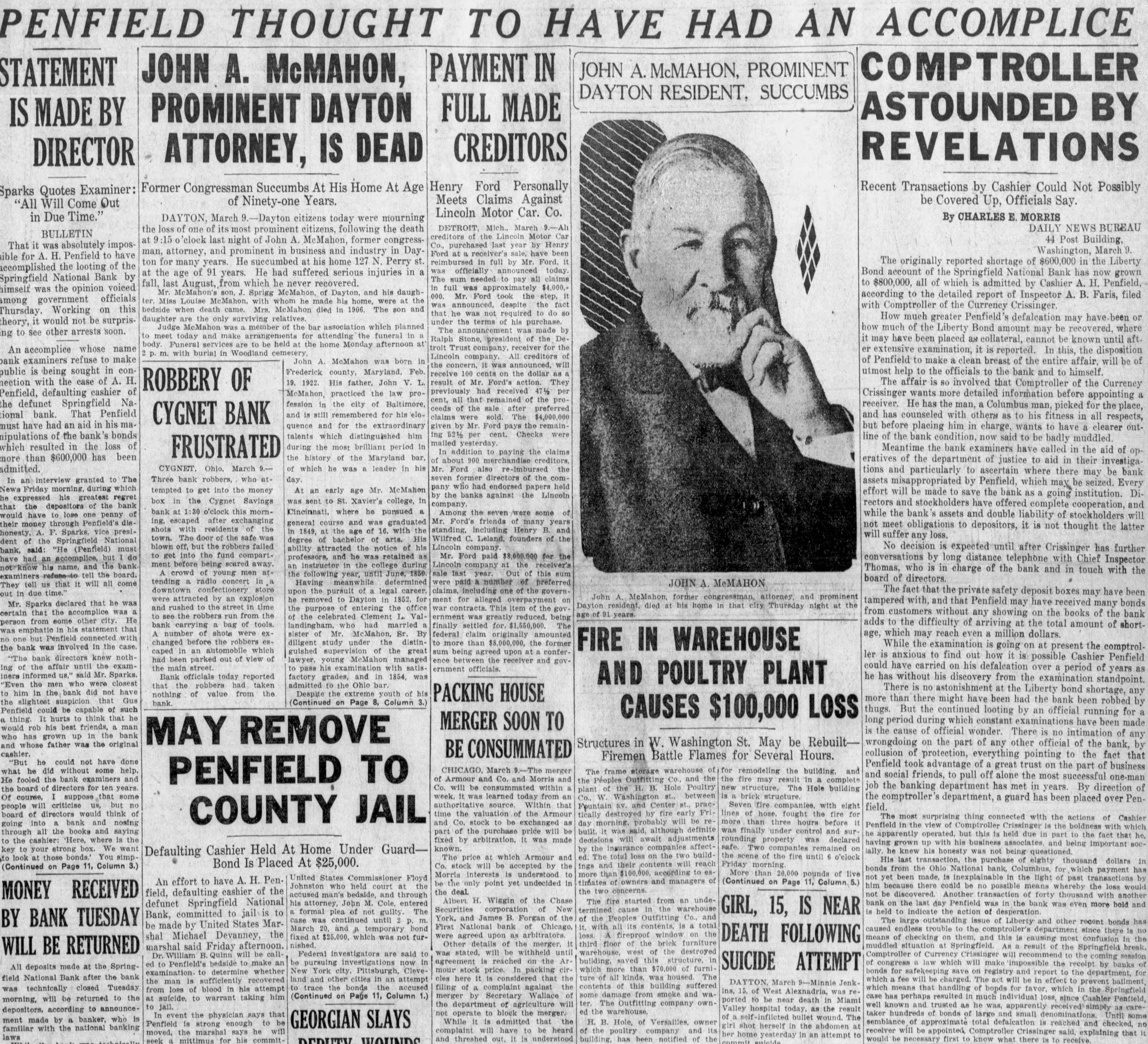
PENFIELD THOUGHT TO HAVE HAD AN ACCOMPLICE
STATEMENT IS MADE BY DIRECTOR
Sparks Quotes Examiner: "All Will Come Out in Due Time."
BULLETIN
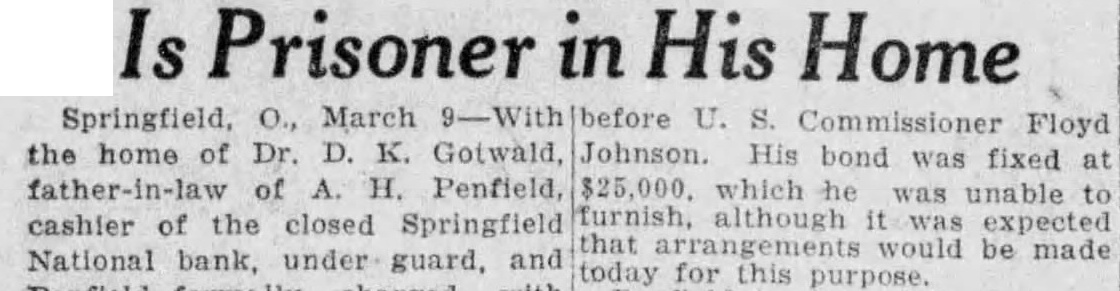
That it was absolutely impossible for A. H. Penfield to have accomplished the looting of the Springfield National Bank by himself was the opinion voiced among government officials Thursday. Working on this theory, it would not be surprising to see other arrests soon.
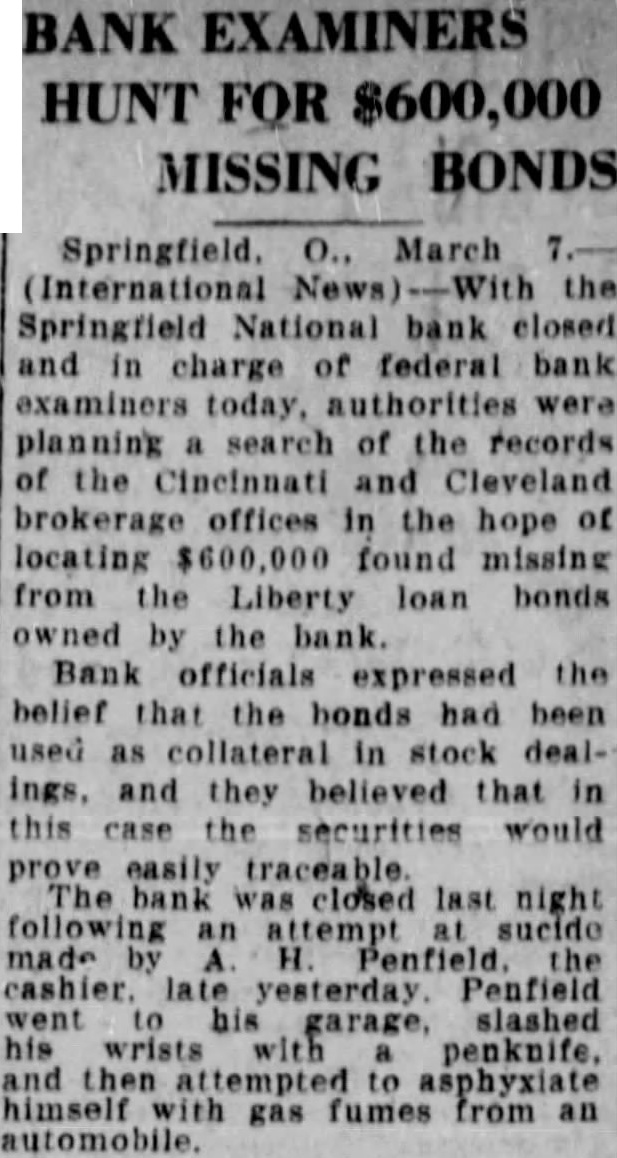
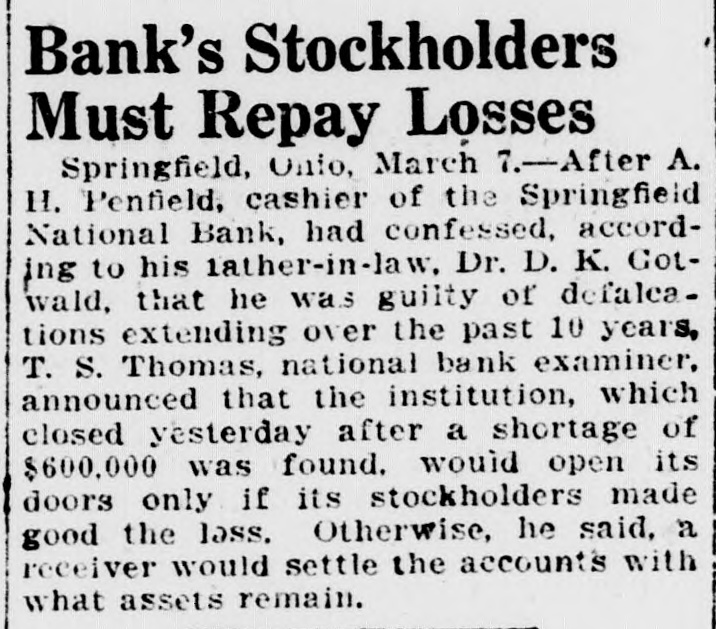
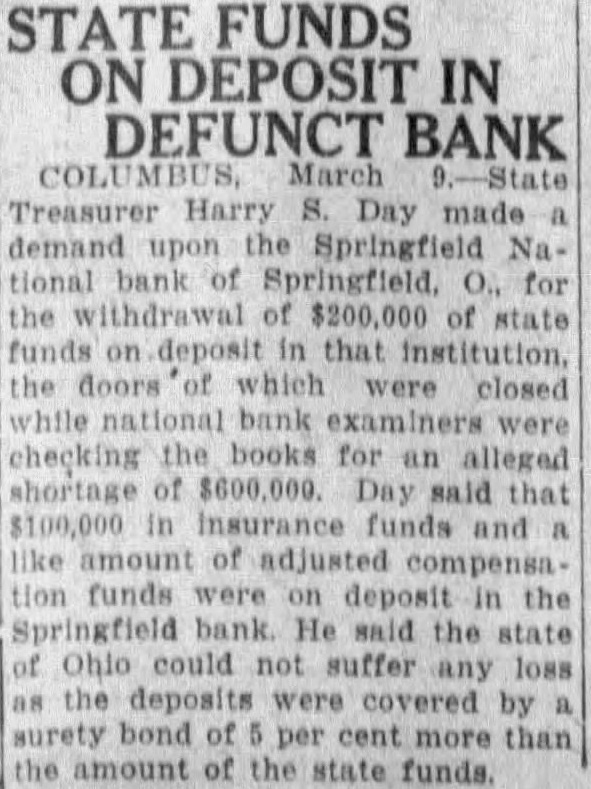
An accomplice whose name bank examiners refuse to make public is being sought in connection with the case of A. H. Penfield, defaulting cashier of the defunct Springfield National Bank. That Penfield must have had an aid in his manipulations of the bank's bonds which resulted in the loss of more than $600,000 has been admitted.
In an interview granted to The News Friday morning, during which he expressed his greatest regret that the depositors of the bank would have to lose one penny of their money through Penfield's dishonesty, A. F. Sparks, vice president of the Springfield National bank, said: "He (Penfield) must have had an accomplice, but I do not know his name, and the bank examiners refuse to tell the board. They tell us that it will all come out in due time."
Mr. Sparks declared that he was certain that the accomplice was a person from some other city. He was emphatic in his statement that no one but Penfield connected with the bank was involved in the case.
"The bank directors knew nothing of the affair until the examiners informed us," said Mr. Sparks. "Even the men who were closest to him in the bank did not have the slightest suspicion that Gus Penfield could be capable of such a thing. It hurts to think that he would rob his best friends, a man who has grown up in the bank and whose father was the original cashier.
"But he could not have done what he did without some help. He fooled the bank examiners and the board of directors for ten years. Of course, I suppose that some people will criticise us, but no board of directors would think of going into a bank and nosing through all the books and saying to the cashier: 'Here, where is the key to your strong box. We want to look at those bonds.' You simp- (Continued on Page 11, Column 3.)
JOHN A. MCMAHON, PROMINENT DAYTON ATTORNEY, IS DEAD
Former Congressman Succumbs at His Home at Age of Ninety-one Years.
DAYTON, March 9.—Dayton citizens today were mourning the loss of one of its most prominent citizens, following the death at 9:15 o'clock last night of John A. McMahon, former congressman, attorney, and prominent in business and industry in Dayton for many years. He succumbed at his home 127 N. Perry st. at the age of 91 years. He had suffered serious injuries in a fall, last August, from which he never recovered.
Mr. McMahon's son, J. Sprigg McMahon, and his daughter, Miss Louise McMahon, with whom he made his home, were at the bedside when death came. Mrs. McMahon died in 1906. The son and daughter are the only surviving relatives.
Judge McMahon was a member of the bar association which planned to meet today and make arrangements for attending the funeral in a body. Funeral services are to be held at the home Monday afternoon at 2 p. m. with burial in Woodland cemetery.
John A. McMahon was born in Frederick county, Maryland, Feb. 19, 1822. His father, John V. L. McMahon, practiced the law profession in the city of Baltimore, and is still remembered for his eloquence and for the extraordinary talents which distinguished him during the most brilliant period in the history of the Maryland bar, of which he was a leader in his day.
At an early age Mr. McMahon was sent to St. Xavier's college, in Cincinnati, where he pursued a general course and was graduated in 1849, at the age of 16, with the degree of bachelor of arts. His ability attracted the notice of his professors, and he was retained as an instructor in the college during the following year, until June, 1850.
Having meanwhile determined upon the pursuit of a legal career, he removed to Dayton in 1852, for the purpose of entering the office of the celebrated Clement L. Vallandigham, who had married a sister of Mr. McMahon, Sr. By diligent study under the distinguished supervision of the great lawyer, young McMahon managed to pass his examination with satisfactory grades, and in 1854, was admitted to the Ohio bar.
Despite the extreme youth of his (Continued on Page 8, Column 3.)
FORD TO PAY ALL MADE TO CREDITORS
Henry Ford Personally Meets Claims Against Lincoln Motor Car. Co.
DETROIT, MICH., March 9.—All creditors of the Lincoln Motor Car Co., purchased last year by Henry Ford at a receiver's sale, have been reimbursed in full by Mr. Ford, it was officially announced today. The sum needed to pay all claims in full was approximately $4,000,000. Mr. Ford took the step, it was announced, despite the fact that he was not required to do so under the terms of his purchase.
The announcement was made by Ralph Stone, president of the Detroit Trust company, receiver for the Lincoln company. All creditors of the concern, it was announced, will receive 100 cents on the dollar as a result of Mr. Ford's action. They previously had received 47 1/2 per cent, all that remained of the proceeds of the sale after preferred claims were paid. The $4,000,000 given by Mr. Ford pays the remaining 52 1/2 per cent. Checks were mailed yesterday.
In addition to paying the claims of about 900 merchandise creditors, Mr. Ford also re-imbursed the seven former directors of the company who had endorsed papers held by the banks against the Lincoln company.
Among the seven were some of Mr. Ford's friends of many years standing, including Henry B. and Wilfred C. Leland, founders of the Lincoln company.
Mr. Ford paid $8,000,000 for the Lincoln company at the receiver's sale last year. Out of this sum were paid a number of preferred claims, including one of the government for alleged overpayment on war contracts. This item of the government was greatly reduced, being finally settled for $1,550,000. The federal claim originally amounted to more than $8,000,000, the former sum being agreed upon at a conference between the receiver and government officials.
COMPTROLLER ASTOUNDED BY REVELATIONS
Recent Transactions by Cashier Could Not Possibly be Covered Up, Officials Say.
By CHARLES E. MORRIS
DAILY NEWS BUREAU 44 Post Building, Washington, March 9.
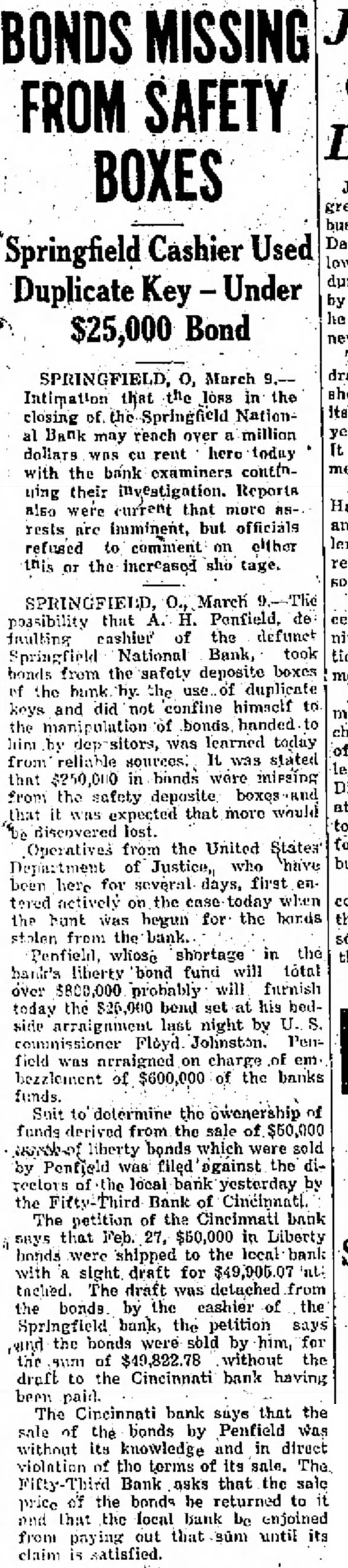
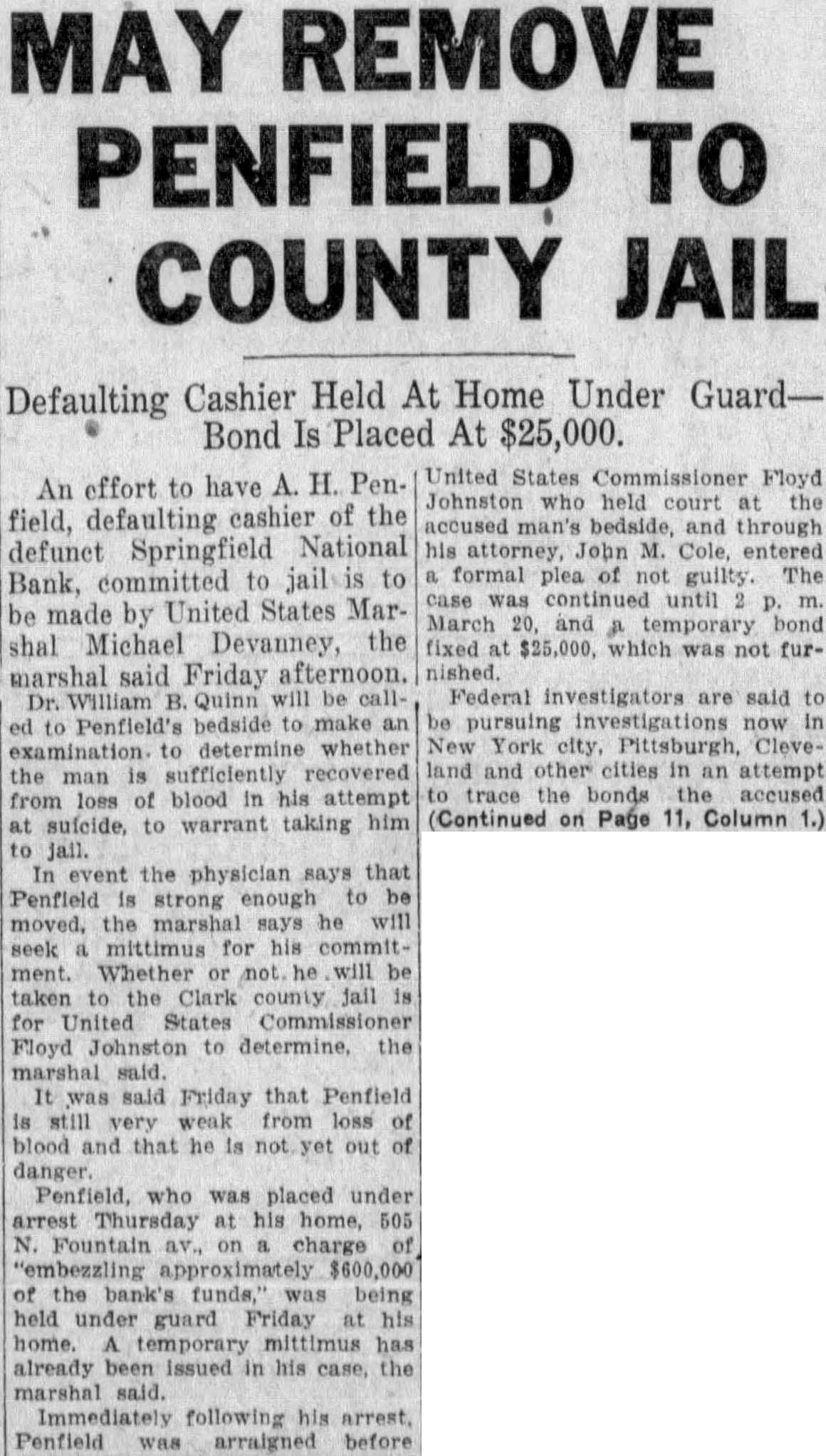
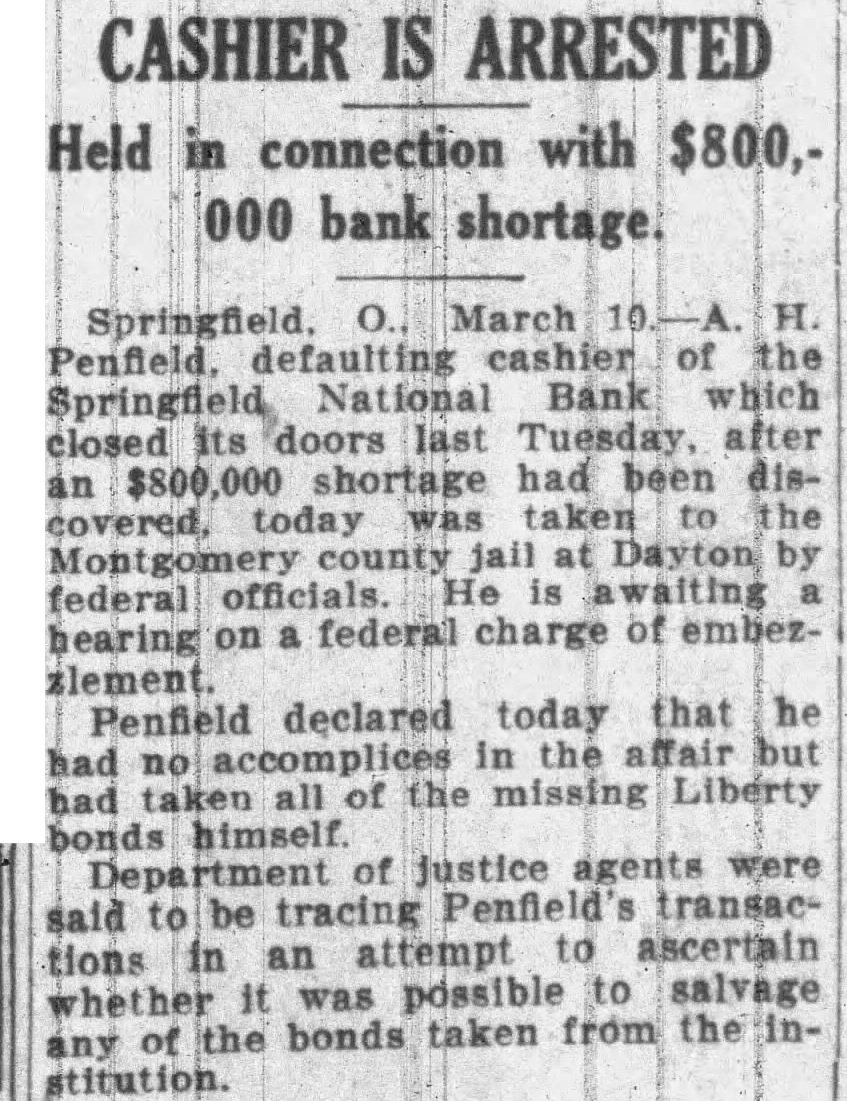
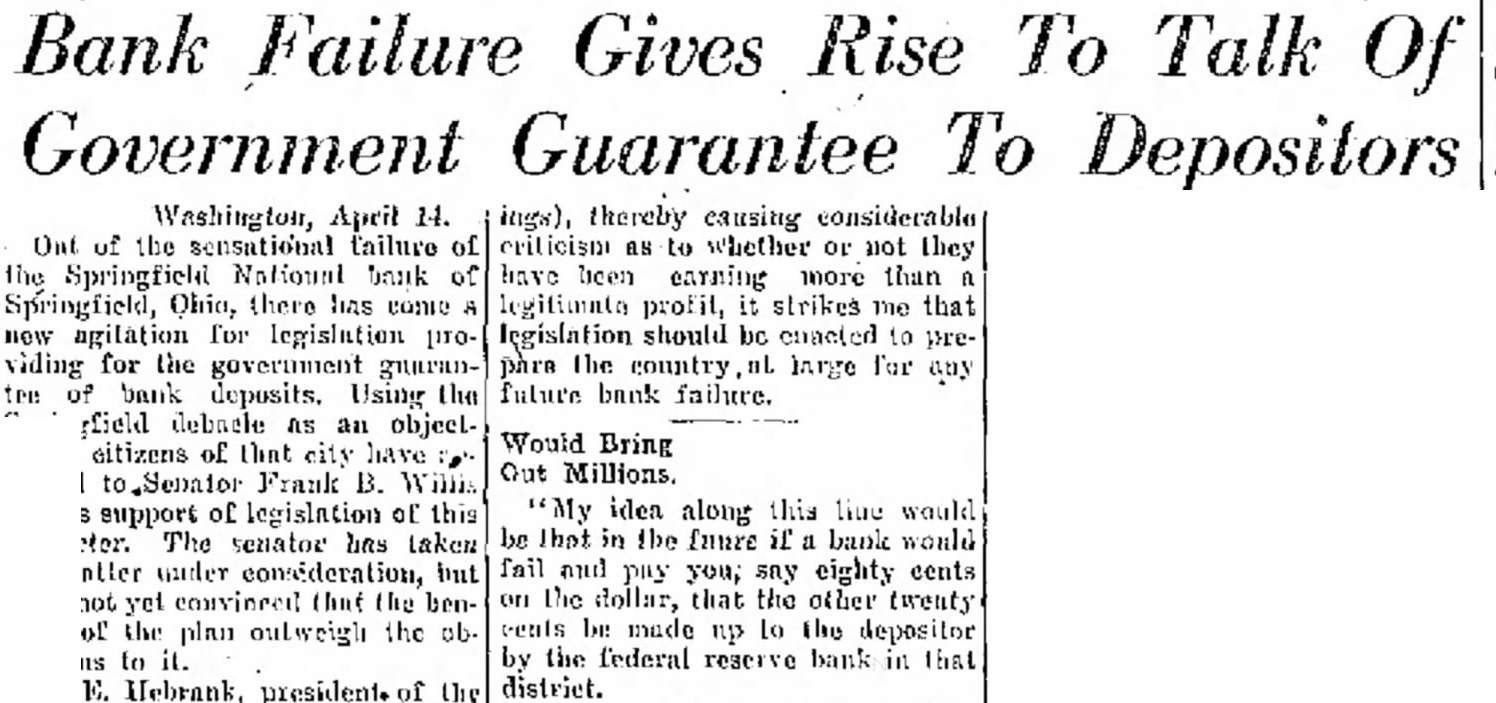
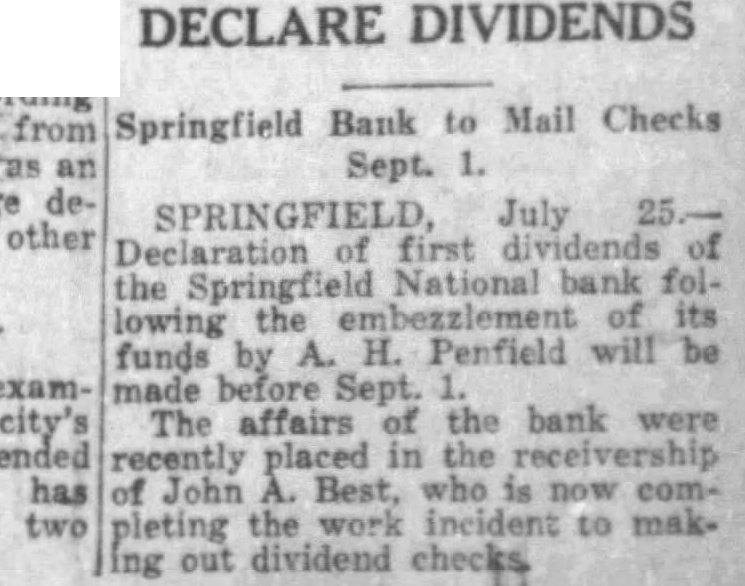
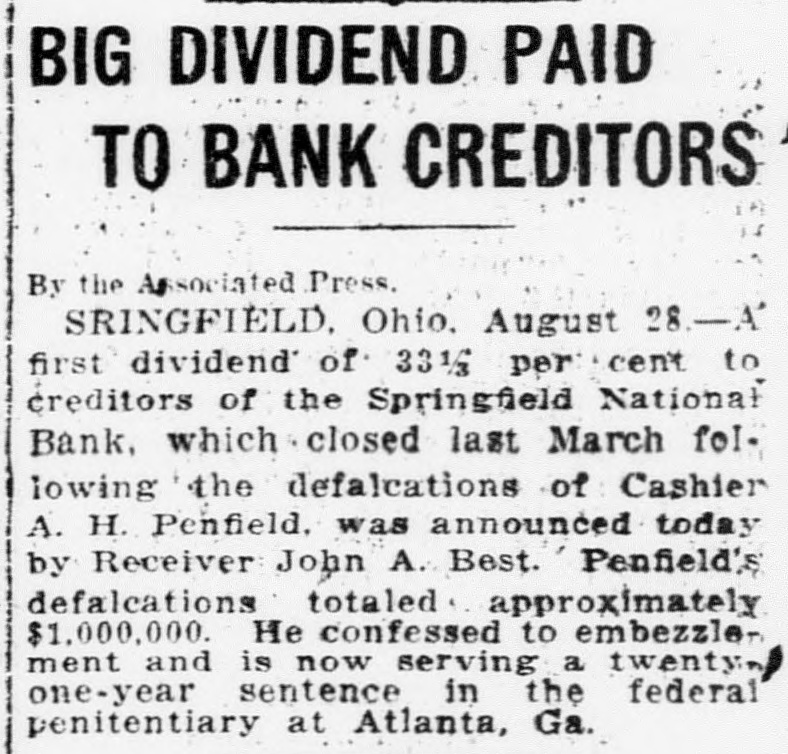
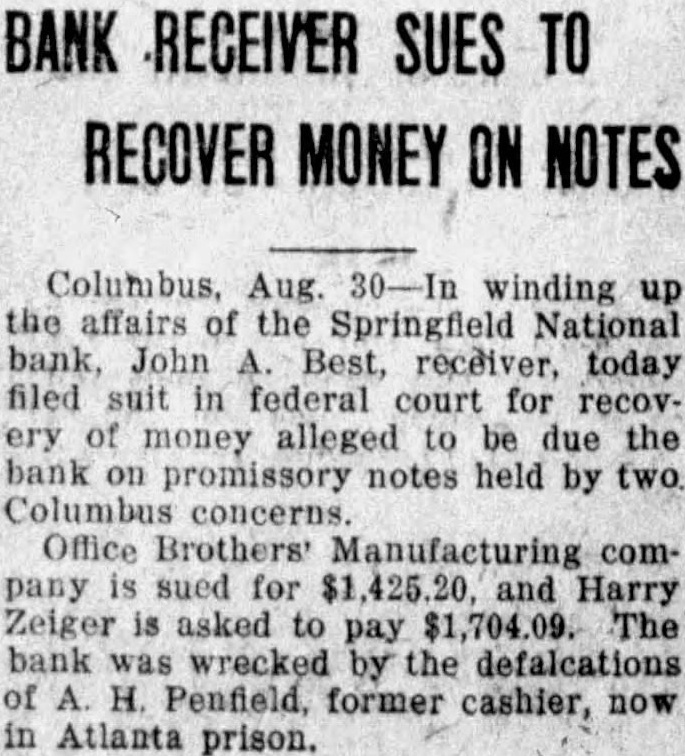
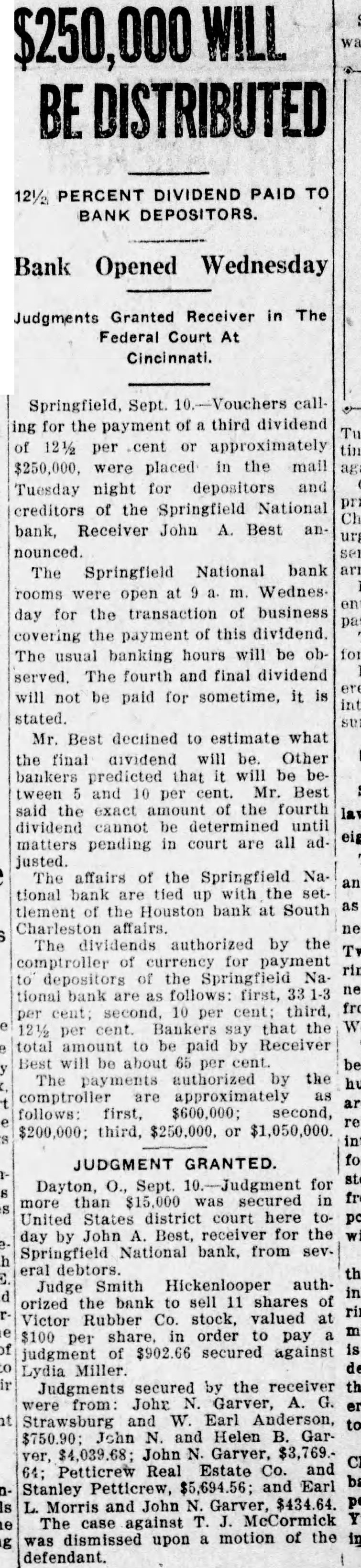
The originally reported shortage of $600,000 in the Liberty Bond account of the Springfield National Bank has now grown to $800,000, all of which is admitted by Cashier A. H. Penfield, according to the detailed report of Inspector A. B. Faris, filed with Comptroller of the Currency Crissinger.
How much greater Penfield's defalcation may have been or how much of the Liberty Bond amount may be recovered, where it may have been placed as collateral, cannot be known until after extensive examination, it is reported. In this, the disposition of Penfield to make a clean breast of the entire affair, will be of utmost help to the officials to the bank and to himself.
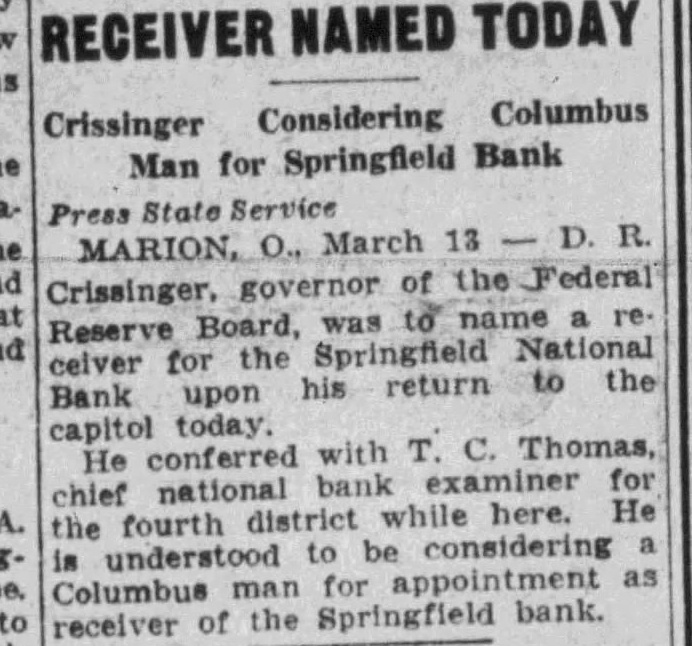
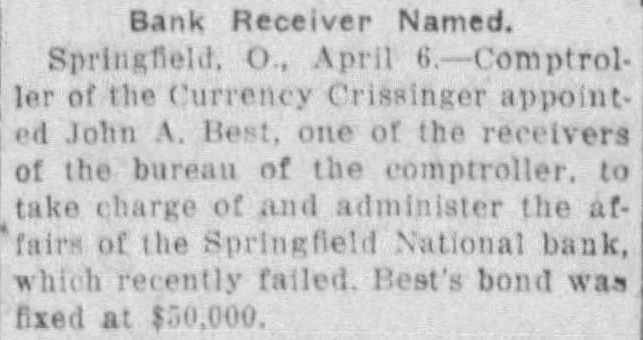
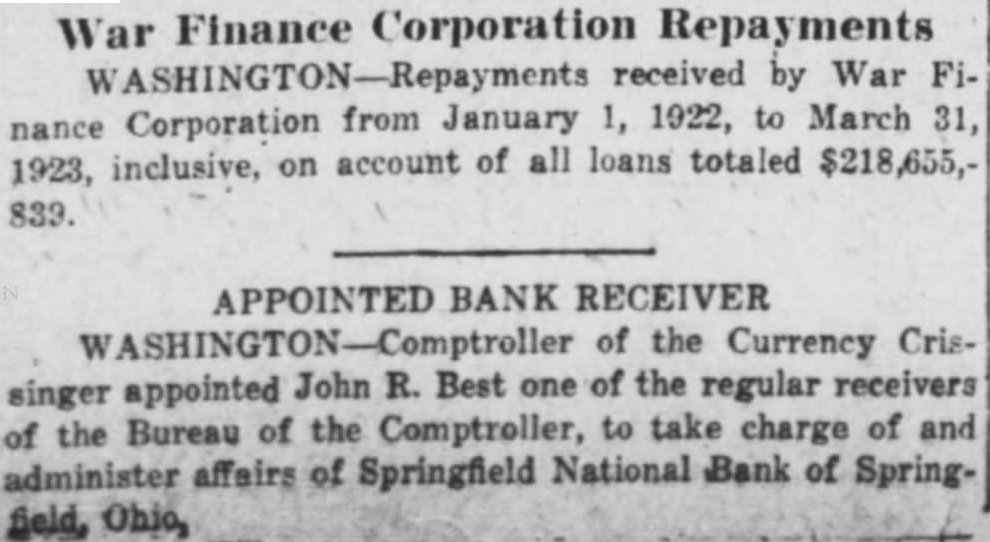
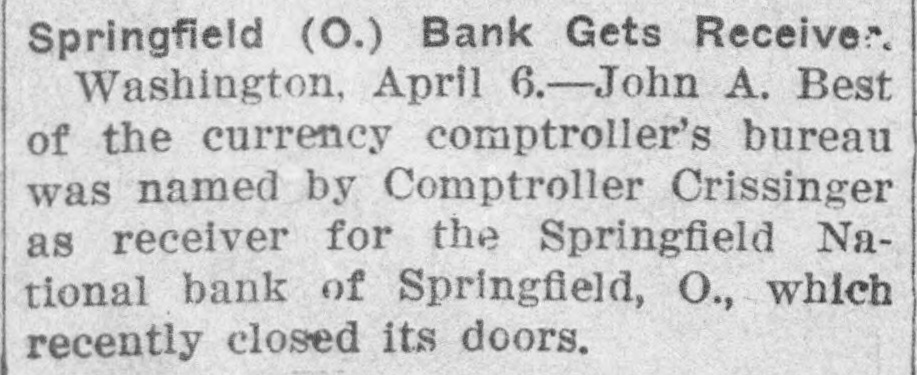
The affair is so involved that Comptroller of the Currency Crissinger wants more detailed information before appointing a receiver. He has the man, a Columbus man, picked for the place, and has counseled with others as to his fitness in all respects, but before placing him in charge, wants to have a clearer outline of the bank condition, now said to be badly muddled.
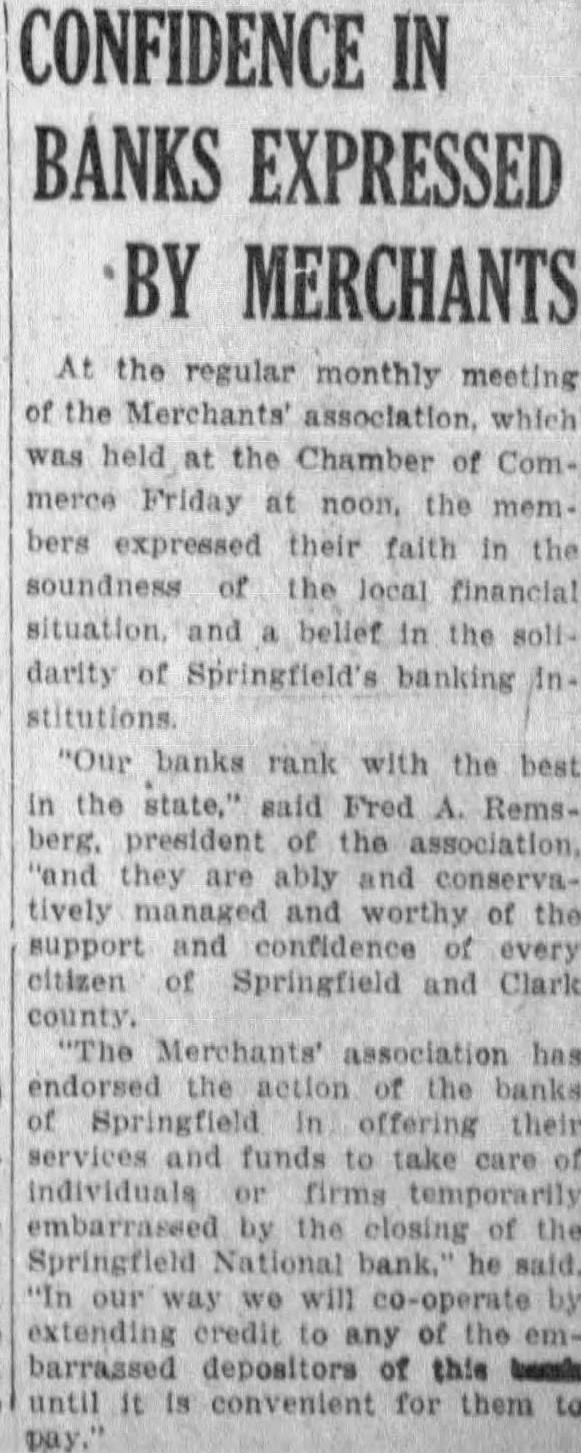
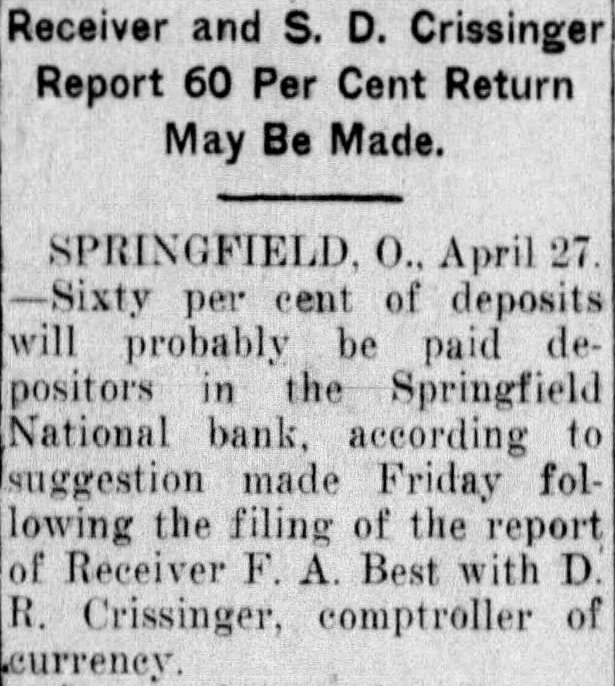
Meantime the bank examiners have called in the aid of operatives of the department of justice to aid in their investigations and particularly to ascertain where there may be bank assets misappropriated by Penfield, which may be seized. Every effort will be made to save the bank as a going institution. Directors and stockholders have offered complete cooperation, and while the bank's assets and double liability of stockholders will not meet obligations to depositors, it is not thought the latter will suffer any loss.
No decision is expected until after Crissinger has further conversations by long distance telephone with Chief Inspector Thomas, who is in charge of the bank and in touch with the board of directors.
The fact that the private safety deposit boxes may have been tampered with, and that Penfield may have received many bonds from customers without any showing on the books of the bank adds to the difficulty of arriving at the total amount of shortage, which may reach even a million dollars.
While the examination is going on at present the comptroller is anxious to find out how it is possible Cashier Penfield could have carried on his defalcation over a period of years as he has without his discovery from the examination standpoint.
There is no astonishment at the Liberty bond shortage, any more than there might have been had the bank been robbed by thugs. But the continued looting by an official running for a long period during which constant examinations have been made is the cause of official wonder. There is no intimation of any wrongdoing on the part of any other official of the bank, by collusion of protection, everything pointing to the fact that Penfield took advantage of a great trust on the part of business and social friends, to pull off alone the most successful one-man job the banking department has met in years. By direction of the comptroller's department, a guard has been placed over Penfield.
The most surprising thing connected with the actions of Cashier Penfield in the view of Comptroller Crissinger is the boldness with which he apparently operated, but this is held due in part to the fact that he, having grown up with his business associates and being important socially, he knew his honesty was not being questioned.
His last transaction, the purchase of eighty thousand dollars in bonds from the Ohio National bank, Columbus, for which payment has not yet been made, is inexplicable in the light of past transactions by him because there could be no possible where by the loss would not be discovered. Another transaction of forty thousand with another bank on the last day Penfield was in the bank was even more bold and is held to indicate the action of desperation.
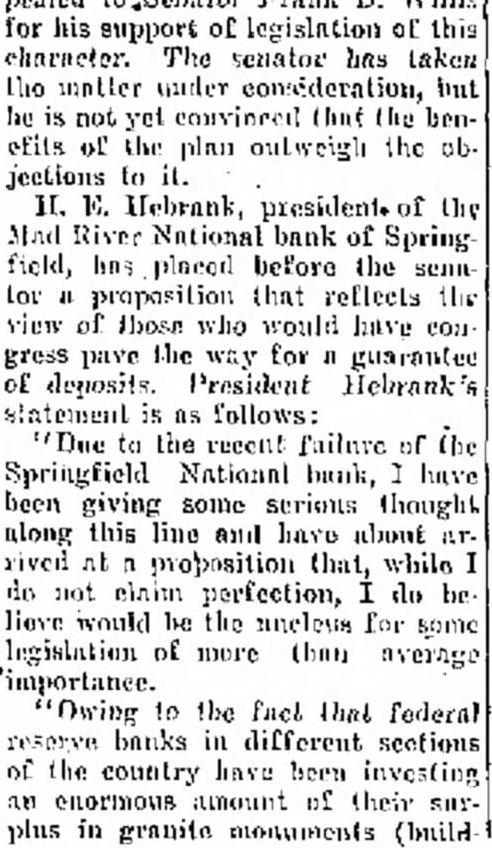
The large outstanding issue of Liberty and other recent bonds has caused endless trouble to the comptroller's department since there is no means of checking on them, and this is causing most confusion in the muddled situation at Springfield. As a result of the Springfield break, Comptroller of Currency Crissinger will recommend to the coming session of congress a law which will make impossible the receipt by banks of bonds for safekeeping save on registry and report to the department, for which a fee will be charged. The act will be in effect to prevent bailment, which means that handling of bonds for favor, which in the Springfield case has perhaps resulted in much individual loss, since Cashier Penfield, well known and trusted as he was, apparently received simply as caretaker hundreds of bonds of large and small denominations. Until some semblance of approximate total defalcation is reached and checked, no receiver will be appointed, Comptroller Crissinger said, explaining that it would be necessary first to know what there is to receive.