Philadelphia Bank (Philadelphia, PA)

Episode Information

Episode UID
2638383791112
Episode Type
Suspension β†’ Closure
Bank Type
state
Bank ID
263838379 hash
Start Date
August 17, 1892
Location
Philadelphia, Pennsylvania (39.952, -75.164)

Metadata

Model
gpt-5-mini (chosen from majority vote of a three-model LLM ensemble)
Short Digest
19eb546993c36448

Response Measures

None

Description

Articles describe the bank as failed/insolvent and put in hands of an assignee; closure/receivership implied.

Events (1)

1. August 17, 1892 Suspension
Cause
Bank Specific Adverse Info
Cause Details
Bank described as failed/insolvent, invested funds in worthless bonds and placed affairs in hands of an assignee/receiver
Newspaper Excerpt
the announcement of the failure of the Philadelphia bank, which holds $713.000 of the order's money
Source
newspapers

Newspaper Articles (10)

Article from Evening Journal, August 13, 1892

Click image to open full size in new tab

Article Text

THE IRON HALL SUIT. AppearanΓ©es Seem to Indicate That a Receiver Will Be Appointed. INDIANAPOLIS, Aug. 13.-Supreme Justice Somerby was on the stand in the Iron Hall receivership case. The testimony elicited was strong enough to lead the plaintiffs to beheve that a receiver will be appointed. Somerby, although having supreme authority, admitted that he had never given bond until this suit was brought, and then only in the sum of $5,000, with a Detroit undertaker as security. This bond has not been approved and is not in force. Supreme Cashier Davis is under $50,000 bond, the witness said, but one of thesureties is dead. Somerby admitted that the time for which the supreme sitting and officers had been elected (two years) had expired. He could point out no authority for the present body to exist, except a section authorizing a special call of the sitting. The witness did not know where any of the order's reserve funds, except $3,000 in this city, had been invested as required by the constitution. Accountant Davis had some transactions involving some $94,000, but Somerby did not know how this money was invested. Continuing, the witness told the story of the Philadelphia bank, of which he is vice president and which now has $72,000 of the order's money. He said that the reason $170,000 had been donated to the bank was to tide over the embarrassment of this bank The money was taken from the funds of the order. If the receiver for the bank had been appointed it would have resulted in the appointment of a receiver for the order and its utter ruination. The supreme officer deemed it justifiable to donate this money. It is the theory of the members of the supreme sitting that the $94,000 which Davis took to invest was dissipated by him and Dan W. Knefler, one of the plaintiffs, who was cashier. It is known that both lost heavily in wheat speculation. During the trial several members of the sitting called Davis outside and asked him if he would tell them where this large sum had been invested; but he replied that he had no time to talk.
Article from The Portland Daily Press, August 16, 1892

Click image to open full size in new tab

Article Text

BRIEFLY TOLD. A beautiful boat parade was among the gaities at Bar Harbor yesterday. The Republican League convention will be held at Buffalo September 15th instead of the 1st. Charles H. Abbot, shoe manufacturer of South Royalton, Vt., has disappeared owing $30,000 or more. In Last Tennessee Sunday a mob went to Inman and marched out all the convicts working in the mines. Much excitement prevails. Capt. Simmonds, who is dredging Hell Gate for the wreck of the Hussar, has been greatly encouraged at bringing up a gold guinea. Vessels from around Cape Horn report that the drift ice from the Antarctic Ocean has reached the most northern point ever known. Sunday, Rev. M. B. Bell, of Armenia, N. Y., by a blunder gave his congregation a battery mixture of sulphuric and nitric acid instead of communion wine. Thirty-seven are violently sick but will recover. The State Department have got our dispute with Spain relative to the treatment of Caroline Islands missionaries referred to arbitration. This is a good piece of work for the department. It is regarded as certain that a receiver will be appointed for the Iron Hall. The Philadelphia Bank will be taken out of control of its officers and put in care of trusty persons. The investigation has been adjourned to Philadelphia.


Article from The Wichita Daily Eagle, August 18, 1892

Click image to open full size in new tab

Article Text

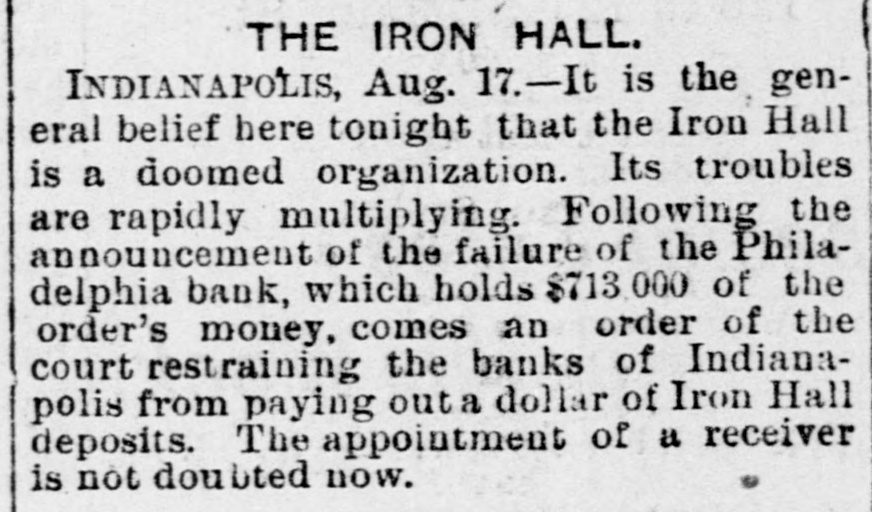
THE IRON HALL. INDIANAPOLIS, Aug. 17.-It is the general belief here tonight that the Iron Hall is a doomed organization. Its troubles are rapidly multiplying. Following the announcement of the failure of the Philadelphia bank, which holds $713.000 of the order's money, comes an order of the court restraining the banks of Indianapolis from paying outa dollar of Iron Hall deposits. The appointment of a receiver is not doubted now.


Article from The Wilmington Daily Republican, August 19, 1892

Click image to open full size in new tab

Article Text

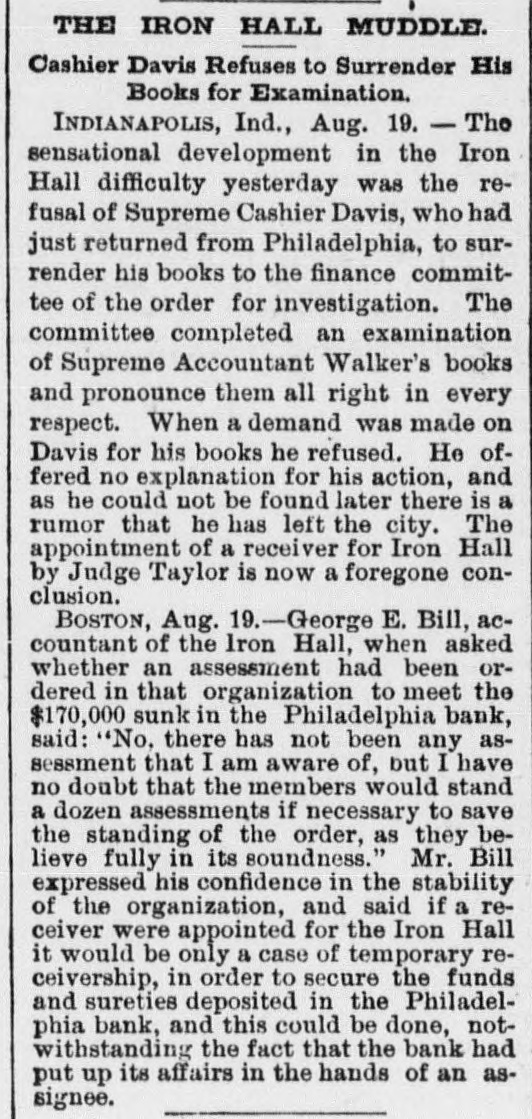
THE IRON HALL MUDDLE. Cashier Davis Refuses to Surrender His Books for Examination. INDIANAPOLIS, Ind., Aug. 19. - The sensational development in the Iron Hall difficulty yesterday was the refusal of Supreme Cashier Davis, who had just returned from Philadelphia, to surrender his books to the finance committee of the order for investigation. The committee completed an examination of Supreme Accountant Walker's books and pronounce them all right in every respect. When a demand was made on Davis for his books he refused. He offered no explanation for his action, and as he could not be found later there is a rumor that he has left the city. The appointment of a receiver for Iron Hall by Judge Taylor is now a foregone conclusion. BOSTON, Aug. 19.-George E. Bill, accountant of the Iron Hall, when asked whether an assessment had been ordered in that organization to meet the $170,000 sunk in the Philadelphia bank, said: "No, there has not been any assessment that I am aware of, but I have no doubt that the members would stand a dozen assessments if necessary to save the standing of the order, as they believe fully in its soundness." Mr. Bill expressed his confidence in the stability of the organization, and said if a receiver were appointed for the Iron Hall it would be only a case of temporary receivership, in order to secure the funds and sureties deposited in the Philadelphia bank, and this could be done, notwithstanding the fact that the bank had put up its affairs in the hands of an assignee.


Article from The Indianapolis Journal, August 19, 1892

Click image to open full size in new tab

Article Text

Accountant Bill Talks a Little. BOSTON, Aug. 18.-George E. Bill, accountant for the Iron Hall, when asked if an assessment had been ordered to meet the $170,000 sunk in the Philadelphia bank, said: "No, there has not been any assessment that I am aware of, but I Ihave no doubt the members would stand a dozen assessments, if necessary, to save the standing of the order. as they believe fully in the soundness of the principle." Mr. Bill ex pressed his confidence in the stability of the organization, and said if a receiver were appointed for the Iron Hall it would be only a case of temporary receivership in order to secure the funds and sureties deposited in the Philadelphia bank, and this could be done notwithstanding the fact that the bank had put its affairs in the hands of an assignee.


Article from St. Paul Daily Globe, August 19, 1892

Click image to open full size in new tab

Article Text

FAITH IN IRON HALL. Accountant Bill Talks of the Receivership. BOSTON, Aug. 18.-George E. Bill, accountant of the Iron Hall, when asked whether an assessment had been ordered in that organization to meet the $170,000 sunk in the Philadelphia bank, said: "No, there has not been any assessment that 1 am aware of." Mr. Bill expressed his confidence in the stability of the organization, and said if a receiver were appointed for the Iron Hall it was be only a case of temporary receivership, in order to secure the funds and sureties deposited in the Philadelphia, and this could .be done notwithstanding the fact that the bank had put its affairs in the hands of an assignee.


Article from New-York Tribune, August 20, 1892

Click image to open full size in new tab

Article Text

ADMISSIONS BY MR. SOMEEBY. Indianapolis, Aug. 19.-The Iron Hall receivership case was resumed before Judge Taylor to-day. Supreme Justice Somerby again took the stand. He admitted that the $170,000 sent to the Philadelphia bank to relieve Its temporary embarrassment was Iron Hall money. He testified that the $88,000 sent to Philadelphia to be invested by Hayes was put into bonds of the Philadelphia Mutual Bank, which he admitted were worthless. He also said that his son-In-law, McMeacham, had been forced to resign the place of Supreme Adjuster by Davis and Hayes before they would consent to the Philadelphia bank getting the $170,000. St. Louis, Aug. 19.-The recent developments in the status of the Iron Hall, coupled with the receivership suits, has led to an action here, begun by Charles F. Beergesch, against the Supreme Sitting of the Order of the Iron Hall, for $600, the amount which he alleges was to have been paid to him under a contract at the expiration of seven years. He alleges that the seven years have expired and that he has fulfilled his part of the contract, but that the order has refused to pay the $600.


Article from The Wilmington Daily Republican, August 20, 1892

Click image to open full size in new tab

Article Text

The Iron Hall, A dispatch from Indianapolis, Ind., says: The Iron Hall receivership case was resumed before Judge Taylor to-day. Supreme Justice Somerby again took the stand. He admitted that the $170. 000 sent to the Philadelphia bank to relieve its temporary embarrassment was Iron Hall money. He testifie. that the $88 000 sent to Philadelphia to be invested by Hayes was put int bonds of the Philadelphia Mutus. Bank, which he admitted were worth less. He also said that his son-in-law IcMeacham had been forced y Daviand Hayes to resign the position 0. supreme adjuster before they would consent to the Philadelphia bank get ting the $170,000. The members of the order in this city have the greatest confidence to its stability, and are paying the as sessments promptly. One fact tha. seems to be lost sight of by the onemies of the order, is that the assess ments are unlimited. An assessment or even two. can be called every week and will be responded to. At one or two assessments a month the income has been over $3,000,000 a year, ano there is no doubt but the order, which is one of the best of the kind in exist once, will meet every demand that is made upon it.


Article from Daily Kennebec Journal, August 23, 1892

Click image to open full size in new tab

Article Text

THE IRON HALL. Two Suits at Detreit Aimed at the Life of the Much Annoyed Order. DETROIT. Mich. Aug 22.-The fight against the existence of the Order of the Iron Hall has extended to this city. It consists of two suits against the order. brought by the former members of Branches No. 1 and 815, both of this city. It is asserted that the supreme sitting of the order placed in the Philadelphia bank. now insolvent, $720,000, and this amount is liable to be lost to the organization. Branch 1. it is declared. has 812,000 to $13,000 cash and securities deposited in Detroit banks, and Branch 815 has 81859. The complainants say the members generally desire that these funds be returned to them in just proportions. Each bill asks the court to appoint a receiver for the branch concerned. Judge Brevoort issued an injunction to restrain the disbursements of any funds and the transfer of the securities until after a hearing can be had.


Article from The Portland Daily Press, November 22, 1892

Click image to open full size in new tab

Article Text

# The Iron Hall. Mr. James G. Young of Kansas City. Mo., supreme attorney for the new Iron Hall, addressed a gathering of members of the order at Congress Hall last night. He handled Somerby without gloves, and told the story of the Philadelphia Bank and its connection with the great loss of Iron Hall funds. He related the plan under which the new Iron Hall will be put on its feet once more and the members of the old supreme sitting disposed of. In conclusion he advised all members to wait with patience and allow the receivership to continue in its legal course. Mr. Young is a forcible and interesting speaker.