Solicitors Loan & Trust Company (Philadelphia, PA)

Episode Information

Episode UID
2641754691153
Episode Type
Suspension β†’ Closure
Bank Type
trust
Bank ID
264175469 hash
Start Date
January 3, 1896
Location
Philadelphia, Pennsylvania (39.952, -75.164)

Metadata

Model
gpt-5-mini (chosen from majority vote of a three-model LLM ensemble)
Short Digest
7c9eb147b71c1c2d

Response Measures

None

Description

Multiple articles report an assignment/failure (Jan 3, 1896) caused by unauthorized speculation by an officer; assets later sold (Dec 28, 1897).

Events (2)

1. January 3, 1896 Suspension
Cause
Bank Specific Adverse Info
Cause Details
Unauthorized and unsuccessful speculations by J. Rush Ritter (real estate officer) leading to dishonored drafts and insolvency.
Newspaper Excerpt
The Solicitors' Loan and Trust Company ... assigned to-day.
Source
newspapers
2. December 28, 1897 Receivership
Newspaper Excerpt
The assets of the Solicitors' Loan and Trust Company ... which assigned in 1895, were sold under the hammer to-day.
Source
newspapers

Newspaper Articles (13)

Article from Alexandria Gazette, January 3, 1896

Click image to open full size in new tab

Article Text

The Solicitors Loan, and Trust Company at Philadelphia assigned to-day. The failure resulted from unsuccesful and unauthorized speculations on the part of J. Rush Ritter, real estate officer of the company. The amount involved was about $200,000.


Article from The Norfolk Virginian, January 4, 1896

Click image to open full size in new tab

Article Text

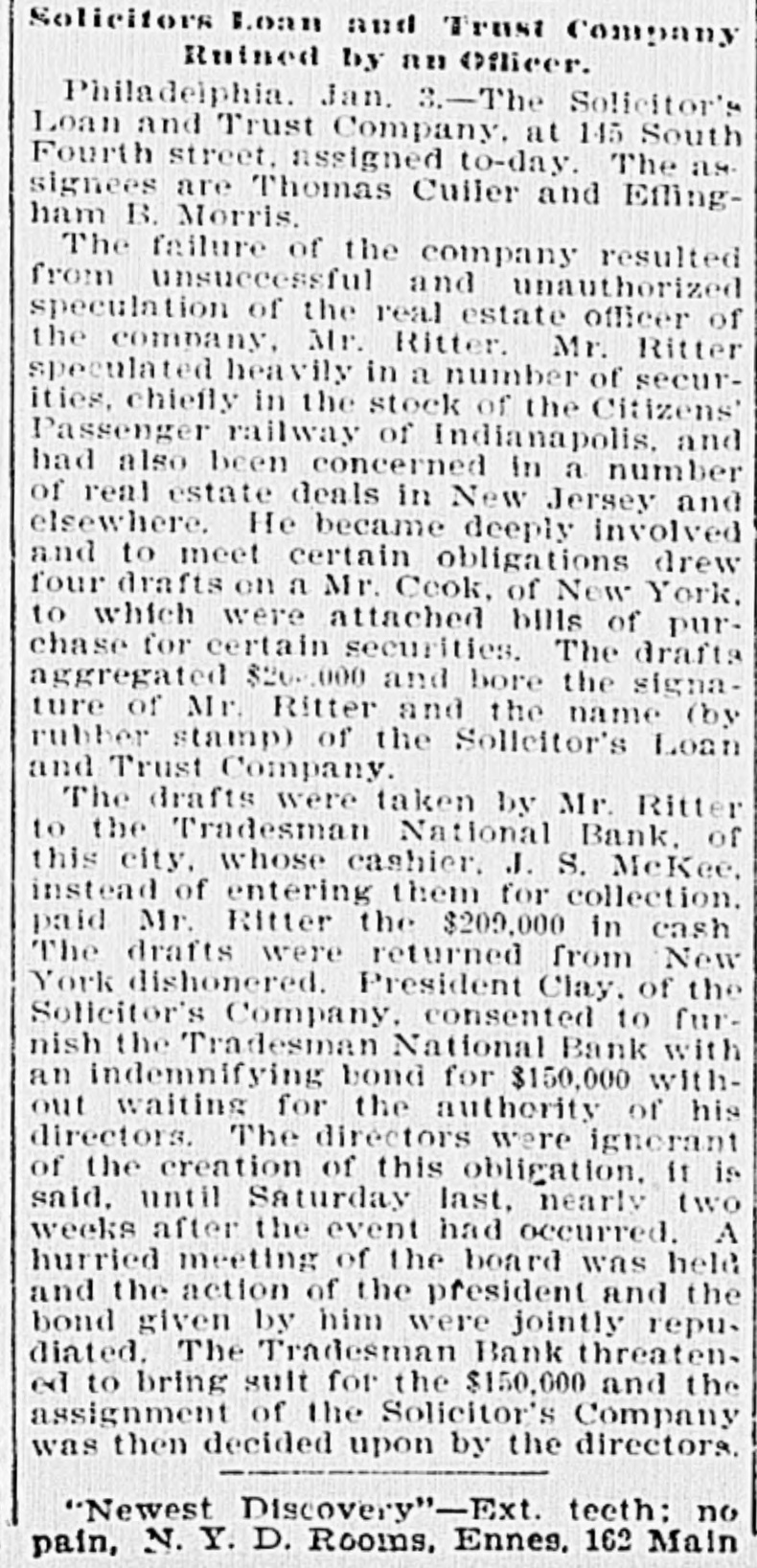
Solicitors Loan and Trust Company Rnined by an Officer. Philadelphia. Jan. The Solicitor's Loan and Trust Company. at 145 South Fourth street, assigned to-day. The as signees are Thomas Culler and Effingham B. Morris. The failure of the company resulted from unsuccessful and unauthorized speculation of the real estate officer of the company, Mr. Ritter. Mr. Ritter speculated heavily in a number of securities, chiefly in the stock of the Citizens Passenger railway of Indianapolis. and had also been concerned in a number of real estate deals in New Jersey and elsewhere. He became deeply involved and to meet certain obligations drew four drafts on a Mr. Cook. of New York, to which were attached bills of purchase for certain securities. The drafts aggregated $20.000 and bore the signature of Mr. Ritter and the name (by rubber stamp) of the Sollcitor's Loan and Trust Company. The drafts were taken by Mr. Ritter to the Tradesman National Bank. of this city, whose cashier. J. S. McKee, instead of entering them for collection. paid Mr. Ritter the $209,000 in cash The drafts were returned from New York dishonered. President Clay. of the Solleitor's Company. consented to furnish the Tradesman National Bank with an indemnifying bond for $150,000 without waiting for the authority of his directors. The directors were ignorant of the creation of this obligation, 11 is said. until Saturday last, nearly two weeks after the event had occurred. A hurried meeting of the board was held and the action of the president and the bond given by him were jointly repu. diated. The Tradesman Bank threaten, ed to bring suit for the $150,000 and the assignment of the Solicitor's Company was then decided upon by the directors. "Newest Discovery"-Ext. teeth: no pain, N. Y. D. Rooms. Ennes, 162 Main


Article from The Times, January 4, 1896

Click image to open full size in new tab

Article Text

LOAN AND TRUST COMPANY FAILS, Brought About by Unsuccessful Speculation and Dishonored Drafts. PHILADELPHIA, PA., Jan. 3.-The Solicitors' Loan and Trust Company, at 142 south Fourth street, assigned to-day. The assignΓ©es are Thomas DeWitt Cuyler and Effingham B. Morris. The failure of the company resulted from unsuccessful speculation of Mr. Ritter, in the real estate office, and a member of the board of directors. Mr. Riter speculated heavily in a number of securities, chiefly in the stock of the Citizens Passenger Railway of indianapolis, and had also been concerned in a number of real estate deals in New Jersey and elsewhere, he became deeply involved, and to meet certain obligations drew four drafts on a Mr. Cook, of New York, to which were attached bills of purchase for certain securities. the signature of Mr. Ritter and the name (by rubber stamp) of the Solicitors' Loan and Trust Company. The drafts were taken by Mr. Kitter to the Tradesmens National Bank of this city, whose cashier, J. S. McKee, instead of entering them for collection, paid Mr. Ritter the $209,000 in cash. The drafts were returned from New York dishonored, President Clay, of the Solicitors' Company, consented to furn sh the Tradesmens Bank with an indemnitying bond for $150,000 without waiting for the allthority of his directors. The directors were ignorant of the creation of this obligation, it is said, until Saturday last, nearly two weeks after the event had occurred. A hurried meeting 02 the board was held, and the action of the president and the bond given by him were jointly repudiated. The Tradesmens Bank threatened to bring suit for the $150,000, and the assignment of the Solicitors' Company was then decided upon by the directors.


Article from Rock Island Argus, January 4, 1896

Click image to open full size in new tab

Article Text

Absolutely Pure. A cream of tartar baking powder. Highest of all in leavening strength.-Latest United Stat s Government Food Report. ROYAL BAKING POWDER Co., 103 Wall si.. N.Y. ABBREVIATED TELEGRAMS. Richard Mansfield has decided to leave the stage and enter the lecture field. Sugar has advanced a quarter of a cent at Chicago in consequence of the wholesale burning of cane fields by the insurgents in Cuba. Estimates, which early in the season were 1,100,000 tons, are now placed at only 300,000. Professor L. S. Luther, of Trinity college, has been elected president of Kenyon college at Columbus, O. The exports from Sheffield, England, to the United States during the year 1895 show an increase of $750,000 over those of 1894. R. Paul, a switchman in the employ of the Chicago, Rock Island and Pacific Railroad company, was killed at Blue Island (Chicago) while switching cars. Prince Regent Luitpold of Bavaria has formally renounced the throne of which the crazy King Otto is the normal incumbent. Obituary: At Redbud, Ills., "Lucky Chris" Smith, aged 63. At Vincennes, Ind., Mrs. Elizabeth Brouillette, aged 86. At Anderson, Ind., Samuel Hurless, aged 61. At Monroe, Wis., Dr. S. W. Abbott. Yot Lee and Miss Sadie Leppert, the former a Chinaman and the latter a white woman, were married at Peoria, Ilis. Owing to losses resulting from outside speculation of one of its officers the Solicitors' Loan and Trust company of Philadelphia, has made an assignment. A receiver has been asked for the drug firm of Singer & William, Peoria, Ills. The application says the firm is insolvent. Simon Ensign, of Pontiac, Mich., who was confined at Havana, Cuba, for twenty years, has filed at Washington a claim for $200,000 against the Spanish government. Ensign was suspected of sympathy with the rebels and was imprisoned without a trial. Lieutenant Samuel S. Pague has been formally dismissed from the United States army in conformity with the recent order of the president approving the finding of the court martial.


Article from The Morning News, January 4, 1896

Click image to open full size in new tab

Article Text

A TRUST COMPANY ASSIGNS. Speculation by One of Its Officers Causes the Trouble. Philadelphia, Jan. 3.-The Solicitors' Loan and Trust Company, at 142 South Fourth street, assigned to-day. The assignees are Thomas Dewitt Cuyler and Effingham B. Morris. The failure of the company resulted from unsuccessful and unauthorized speculations on the part of J. Rush Ritter, the real estate officer of the company and a member of the board of directors. Mr. Ritter speculated heavily in a number of securities, chiefly in the stock of the Citizens' Passenger Railway of Indianapolis, and had also been concerned in a number of real estate deals in New Jersey and elsewhere. He became deeply involved, and to meet certain obligations drew four drafts on a Mr. Cook of New York, to which were attached bills of purchase for certain securities. The drafts aggregated $209,000, and bore the signature of Mr. Ritter and the name (by rubber stamp) of the Solicitor's Loan and Trust Company. The drafts were taken by Mr. Ritter to the Tradesman's National Bank of this city, whose cashier, J. S. McKee, instead of entering them for collection, paid Mr. Ritter the $209,000 in cash. The drafts were returned from New York dishonored. President Clay of the Solicitors' company consented to furnish the Tradesman's bank with an indemnifying bond for $150,000, without waiting for the authority of the directors. The directors were ignorant of the creation of this obligation, it is said, until last Sunday, nearly two weeks after the event had occurred. A hurried meeting of the board was held, and the action of the president and the bond given by him were jointly repudiated. The Tradesman's bank threatened to bring suit for the $150,000, and the assignment of the Solicitors' company was then decided upon by the directors. Through worriment over the affair, Mr. Ritter has become critically ill, and he is now lying at the point of death. Cashier McKee of the Tradesman Bank has retired from the service of the institution.


Article from Birmingham State Herald, January 4, 1896

Click image to open full size in new tab

Article Text

A Big Failure. Philadelphia, Jan. 3.-The Solicitors' Loan and Trust company at 142 South Fourth street assigned today. The assignees are Thomas Dewitt Cuyler and Effingham B. Morris. The failure of the company resulted from unsuccessful and unauthorized speculations on the part of J. Rush Ritter, real estate officer of the company, and a member of the board of directors. Mr. Ritter speculated heavily in a number of securities, chiefly in the stock of the Citizen's Pasenger railway of Indianapolis, and had also been concerned in a number of real estate deals in New Jersey and elsewhere. He became deeply involved and to meet certain obligations drew four drafts on a Mr. Cook of New York, to which were attached bills of purchase for certain securities. The drafts aggregated $209,000 and bore the signature of Mr. Ritter and the name (by rubber stamp) of the Solicitors' Loan and Trust company. The drafts were taken by Mr. Ritter to the Tradesmen's National bank office, and City Cashier J. S. McKee-instead of entering them for collection, paid Mr. Ritter the $209,000 in cash. The drafts were returned from New York dishonored. President Clay of the Solicitors' company consented to furnish the Tradesmen's bank with an indemnifying bond for $150,000 without waiting for the authority of his directors. The directors were ignorant of the creation of these obligations, it is said. until Sunday last, nearly two weeks after the event had occurred. A hurried meeting of the board was held and the action of the president and the bond given by him were jointly repudiated. The Tradesmen's bank threatened to bring suit for the $150,000 and the assignment of the Solicitors' company was then decided upon by the directors. Through worriment over the affair Mr. Ritter has become critically ill and he is now lying at the point of death. Cashier McKee of the Tradesmen's bank has retired from the service of the institution.


Article from The Morning News, January 6, 1896

Click image to open full size in new tab

Article Text

RITTER'S WORK OF RUIN. The Man He Drew on for $250,000 Secretary of One of His Companies. Philadelphia, Jan. 5.-The assignment of the Solicitors' Loan and Trust Company, of which J. Rush Ritter is the real estate officer, was followed yesterday by the appointment of a receiver for the Brigantine Transit Company, of which Mr. Ritter is president. Judge Thompson of Atlantic City was named as receiver. The company owns six and one-half miles of trolley railway, a power plant and pavilions and wharves at Brigantine Beach, a wharf at Atlantic City, which is said to have cost $50,000, and three small steamboats. The capital stock is $250,000 and there are outstanding $250,000 of 6 per cent. bonds. The company has not defaulted upon the bonds, but an officer of the company said that there were so many new debts cropping up that it was deemed best to appoint a receiver so as to protect all interests. Asked if it was possible that Mr. Ritter had put into the transit company any of the funds obtained by the drafts upon Secretary Cook, the officer said he thought not. The company had a prosperous season in 1895. The officers of the Brigantine Beach Transit Company are J. Rush Ritter, president; Josiah A. McKee, vice president; William Hacker, treasurer, and William H. Cook, secretary. Cook is the man on whom Ritter drew the drafts for $200,000, which were returned to the Tradesmen's National Bank dishonored.


Article from Evening Journal, January 7, 1896

Click image to open full size in new tab

Article Text

Receiver For a Trolley Line. TRENTON, Jan. 7. - Vice Chancellor Reed has appointed Judge John Thompson of Atlantic City receiver of the Brigantine Transit company, a trolley road from Atlantic City to Brigantine Beach. The liabilities are given at $472,000 and the assets at $300,000. J. Rush Ritter, who was involved in the recent failure of the Solicitors' Loan and Trust company of Philadelphia, of which he was real estate officer, was president of the transit company.


Article from The Seattle Post-Intelligencer, January 7, 1896

Click image to open full size in new tab

Article Text

The Solicitors' Loan and Trust Failur Tacoma, Jan. 6.-Special.-The principal Western office of the Solicitors' Loan and Trust Company, of Philadelphia, which assigned Saturday, is located in this city, with C. W. Richie as manager and T. M. Hawkes as cashier. The company is heavily interested in Western mortgages, and has over $3,000,000 invested in Washington securities. At the office of the company the Post-Intelligencer correspondent was informed that the assignment and suspension at Philadelphia are only temporary, and will cause no considerable loss or embarrassment. The business of the company in this state will be carried on as formerly. The suspension will afford an opportunity for a thorough house cleaning, and as soon as the directors are fully informed as to the company's condition resumption will follow. All of the directors of the company are of high financial standing and responsibility. The suspension was caused by no monetary stringency, but by the action of an officer of the company.


Article from The Indianapolis Journal, January 9, 1896

Click image to open full size in new tab

Article Text

# CLAY NOT IN THE DEAL STREET-CAR STOCK FLUCTUATIONS NOT CAUSED BY HIM. Some Reasons Why the Recent Stories of His Interests in the Matter Are Not Considered Reliable. Some new light was thrown on the local stret-car situation last night. When the announcement of the failure of the Solie- itors' Loan and Trust Company, of Phila- delpiha, was made last week, a number of wild rumors were at once heard, owing to the fact that Richard W. Clay, president of the trust company, was thought to be largely interested in the Citizens' Street- railroad Company. It was said he and R. T. McDonald had formed a combination against Messrs. Verner and McKee, for the purpose of gaining a controlling interest in the property of the company. The failure of the trust company was pointed out as cne of the first moves in the game, the sug- gestion being made that the trust company held a large block of street railway stock, and that the failure would result in this stock being thrown on the market, when it would decline still lower, and McDonald and Clay would attempt to buy a controlling interest. No notice was taken of the fact that the trust company, a corporation, could not hold stock of another corpora- tion. If there was any attempt to cause the stock to go down, it was not made by Me- Donald or Clay. A man who is thought to be as well versed in street-car affairs as Verner and McKee themselves, is authority for the statement that Clay does not hold anything like a controlling interest; is in no position to acquire more stock, and is so deeply involved in the affairs of the trust company he would never resort to the strategy of forcing it to the wall, when his own safety depended largely upon his abil- ity to maintain the standing and integrity of that corporation. It is said on the same authority that, as a matter of fact, a num- ber of the stockholders in the trust com- pany who held street-car steck have been compelled to unload as a re- suit of this failure. The decline in stocks is partially accounted for in this way. Instead of being in any wise in- jured or embarrassed by the declining mar- ket, says the Journal's informant, McKee and Verner are, if anything, benefited. It is only a question of time when the stock will reach the lowest notch. A reaction will set in and markets take an upward turn. They have always bought on a falling and sold on a rising market. In this way they have been able to manipulate the stocks at will and still retain a sufficient margin under their immediate control to keep an upper hand in the management of the af- fairs of the company. They are in a fair way to double their money many times over by this sort of tactics. Briefly stated, Clay had nothing to gain and everything to lose by the failure of the trust company, and instead of acquiring a stronger hold on street-car affairs, would be in danger of losing his grip entirely. As far as McDonald is concerned, he is never taken into consideration by the Eastern magnates, and when rumors of new deals reach their ears in which he is said to be the moving spirit they either regard him as an agent for some one else or dismiss the whole subject with a snap of their fingers. "McKee is always awake," said the Jour- nal's informant, "and they can never get the best of him, or Verner either, for that matter. Their interests are one and the same."
Article from New-York Tribune, January 9, 1896

Click image to open full size in new tab

Article Text

# ANOTHER RECEIVER ASKED FOR. AFFAIRS OF THE BRIGANTINE TRANSIT COMPANY TO BE TAKEN INTO COURT. Camden, Jan. 8 (Special).-George Pierce and E. G. C. Bleakly, representing creditors of the Brigantine Transit Company, propose to apply to Vice-Chancellor Reed next Monday to have a receiver appointed in place of Judge Thompson. In an interview this morning they said that the company was one of the schemes of J. Rush Ritter, an officer of the Solicitor's Loan and Trust Company, of Philadelphia, which failed recently, and that they proposed to examine into the manner in which it had been conducted. They said that the plant of the Brigantine Transit Company was valued at about $100,000, while the company was capitalized at $250,000, which is supposed to be fully paid in, that it is bonded for $250,000 more, and that it has a floating indebtedness of about $200,000, making a total of $700,000. They allege that Judge Thompson was appointed on the application of the treasurer of the company without any notice to the creditors and that the Judge was formerly counsel for the company and is therefore interested.


Article from Custer Weekly Chronicle, January 11, 1896

Click image to open full size in new tab

Article Text

A PHILADELPHIA FAILURE. Solicitor's Loan and Trust Company Ruined by an Officer. Philadelphia, Jan. 3.-The Solicitor's Loan and Trust company assigned to. day. The failure of the company result. ed from unsuccessful and unauthorize speculations on the part of J. Rush Rit ter, real estate officer of the company and a member of the board of directors Drafts aggregating $209,000. bearing the signature of Ritter and the name of the company were returned from New York dishonored. The Tradesmen's National bank of this city, which had cashed the drafts threatened suit and the assignment of the company was decided upon.


Article from The Sun, December 29, 1897

Click image to open full size in new tab

Article Text

TRUST COMPANY'S ASSETS. The Property of the Solicitors' Loan Company of Philadelphia Sold Under the Hammer. PHILADELPHIA, Dec. 28.-The assets of the Solicitors' Loan and Trust Company of this city, which assigned in 1895, were sold under the hammer to-day. They consisted largely of titles and mortgages in Western property and sections of land in Oregon and the State of Washington and some tracts much larger. The sale netted $103,000 for property of a face value of nearly $1,000,000. A block of $190,000 first mortgage 6 per cent. bonds, 10-20, of the Chambers & McKee Glass Company, Jeanette, Pa., was knocked down to George E. Shaw of Chicago, Chairman of the Reorganization Committee, for $95,000, subject to a prior indebtedness of $43,000 due the Fourth Street National Bank and Girard Trust Company.