Accommodated withdrawals, Public signal of financial health, Capital injected, Full suspension, Books examined
Receivership Details
Depositor recovery rate
82.5%
Date receivership started
1905-07-03
Date receivership terminated
1909-09-30
OCC cause of failure
Excessive lending
Share of assets assessed as good
35.7%
Share of assets assessed as doubtful
57.7%
Share of assets assessed as worthless
6.6%
Events (5)
1.March 13, 1882Chartered
Source
historical_nic
+23 years
2.July 1, 1905Run
Cause
Bank Specific Adverse Info
Cause Details
Large concentrated lending and indebtedness to C. J. Devlin produced depositor unease and withdrawals
Measures
Kept bank open ten minutes after closing to enable withdrawals; public reassurances by directors
Newspaper Excerpt
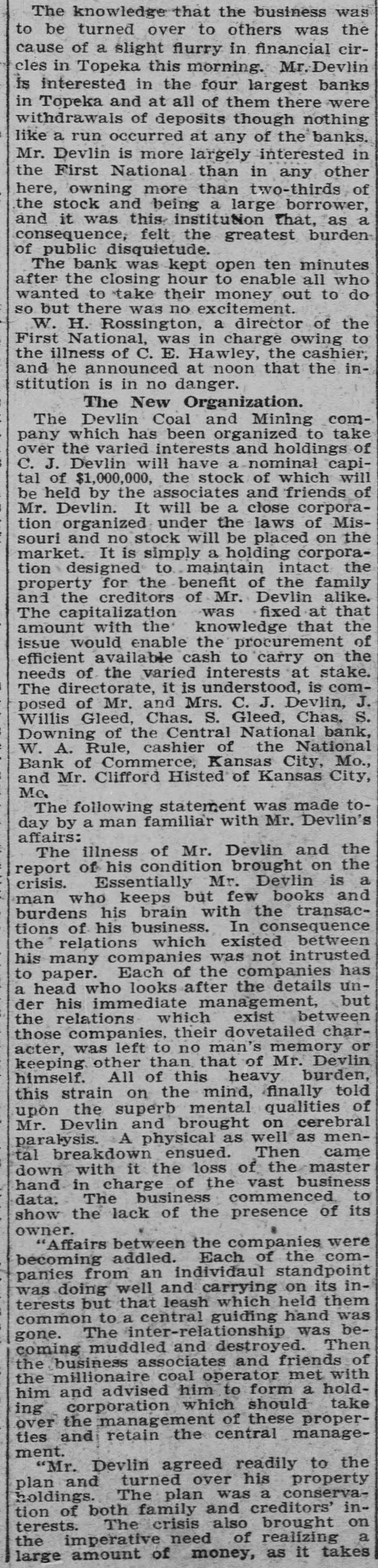
there were withdrawals of deposits though nothing like a run occurred at any of the banks...The bank was kept open ten minutes after the closing hour to enable all who wanted to take their money out to do so
Source
newspapers
+2 days
3.July 3, 1905Suspension
Cause
Bank Specific Adverse Info
Cause Details
Bank suspended/closed after heavy withdrawals and insolvency tied to large loans to Devlin
Newspaper Excerpt
The First National bank went into the hands of a receiver on Monday morning, July 3rd.
Source
newspapers
same day
4.July 3, 1905Receivership
Newspaper Excerpt
Receiver J. T. Bradley...The First National bank went into the hands of a receiver on Monday morning, July 3rd. Receiver Bradley of the First National bank of Topeka...gave notice to the depositors that a dividend of 55 per cent will be paid ... the bank failed in the Devlin crash. (multiple articles confirming receivership and receiver actions).
Source
newspapers
same day
5.July 3, 1905Receivership
Source
historical_nic
Newspaper Articles (24)
1.July 1, 1905The Topeka State JournalTopeka, KS
Click image to open full size in new tab
Article Text
The knowledge that the business was to be turned over to others was the cause of a slight flurry in financial circles in Topeka this morning. Mr. Devlin is interested in the four largest banks in Topeka and at all of them there were withdrawals of deposits though nothing like a run occurred at any of the banks. Mr. Devlin is more largely interested in the First National than in any other here, owning more than two-thirds of the stock and being a large borrower, and it was this institution that, as a consequence, felt the greatest burdenof public disquietude. The bank was kept open ten minutes after the closing hour to enable all who wanted to take their money out to do so but there was no excitement. W. H. Rossington, a director of the First National, was in charge owing to the illness of C. E. Hawley, the cashier, and he announced at noon that the institution is in no danger. The New Organization. The Devlin Coal and Mining company which has been organized to take over the varied interests and holdings of C. J. Devlin will have a nominal capital of $1,000,000, the stock of which will be held by the associates and friends of Mr. Devlin. It will be a close corporation organized under the laws of Missouri and no stock will be placed on the market. It is simply a holding corporation designed to. maintain intact the property for the benefit of the family and the creditors of Mr. Devlin alike. The capitalization was fixed at that amount with the knowledge that the issue would enable the procurement of efficient available cash to carry on the needs of the varied interests at stake. The directorate, it is understood, is composed of Mr. and Mrs. C. J. Devlin, J. Willis Gleed, Chas. S. Gleed, Chas. S. Downing of the Central National bank, W. A. Rule, cashier of the National Bank of Commerce, Kansas City, Mo., and Mr. Clifford Histed of Kansas City, Mc. The following statement was made today by a man familiar with Mr. Devlin's affairs: The illness of Mr. Devlin and the report of his condition brought on the crisis. Essentially Mr. Devlin is a man who keeps but few books and burdens his brain with the transactions of his business. In consequence the relations which existed between his many companies was not intrusted to paper. Each of the companies has head who looks after the details una der his immediate management, but the relations which exist between companies, their dovetailed charwas left to no man's memory or other than that of acter, those keeping Mr. burden, Devlin himself. All of this heavy this strain on the mind, finally told the superb mental qualities of upon Mr. Devlin and brought on cerebral paralysis. A physical as well as mental breakdown ensued. Then came down with it the loss of the master hand in charge of the vast business to The business commenced show data. the lack of the presence of its owner. "Affairs between the companies were becoming addled. Each of the companies from an individaul standpoint indoing well and carrying on its them was that leash which held to. a central guiding inter-relationship was common terests but The hand Then was begone. coming muddled and destroyed. of business associates and friends with the the millionaire coal operator met holdhim and advised him to form a take corporation which should ing the management of these properover ties and retain the central management. "Mr. Devlin agreed readily to the and turned over his property holdings. plan The plan was a conserva- inof both family and creditors' tion terests. The crisis also brought on a imperative need of realizing takes the large amount of money, as it
2.July 3, 1905Evening StarWashington, DC
Click image to open full size in new tab
Article Text
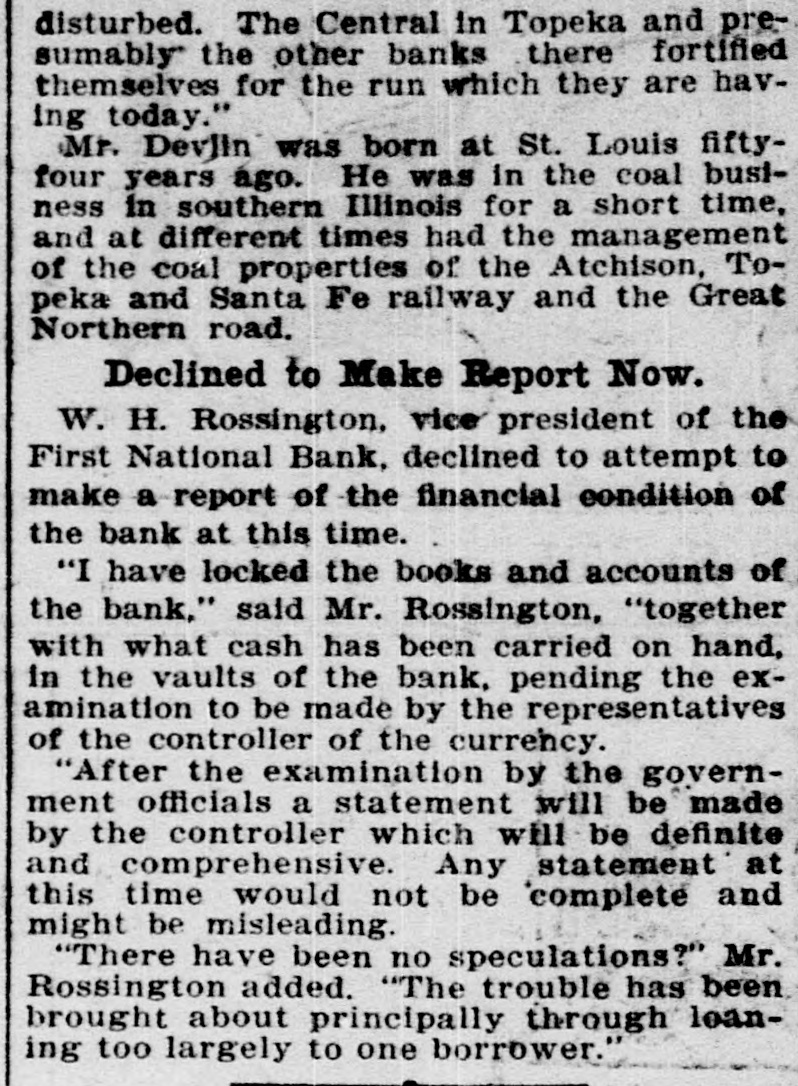
disturbed. The Central in Topeka and presumably the other banks there fortified themselves for the run which they are having today." Mr. Devjin was born at St. Louis fiftyfour years ago. He was in the coal business in southern Illinois for a short time, and at different times had the management of the coal properties of the Atchison, Topeka and Santa Fe railway and the Great Northern road. Declined to Make Report Now. W. H. Rossington, vice president of the First National Bank, declined to attempt to make a report of the financial condition of the bank at this time. "I have locked the books and accounts of the bank," said Mr. Rossington, "together with what cash has been carried on hand, in the vaults of the bank, pending the examination to be made by the representatives of the controller of the currency. "After the examination by the government officials a statement will be made by the controller which will be definite and comprehensive. Any statement at this time would not be complete and might be misleading. "There have been no speculations?" Mr. Rossington added. "The trouble has been brought about principally through loaning too largely to one borrower."
3.July 4, 1905The Topeka State JournalTopeka, KS
Click image to open full size in new tab
Article Text
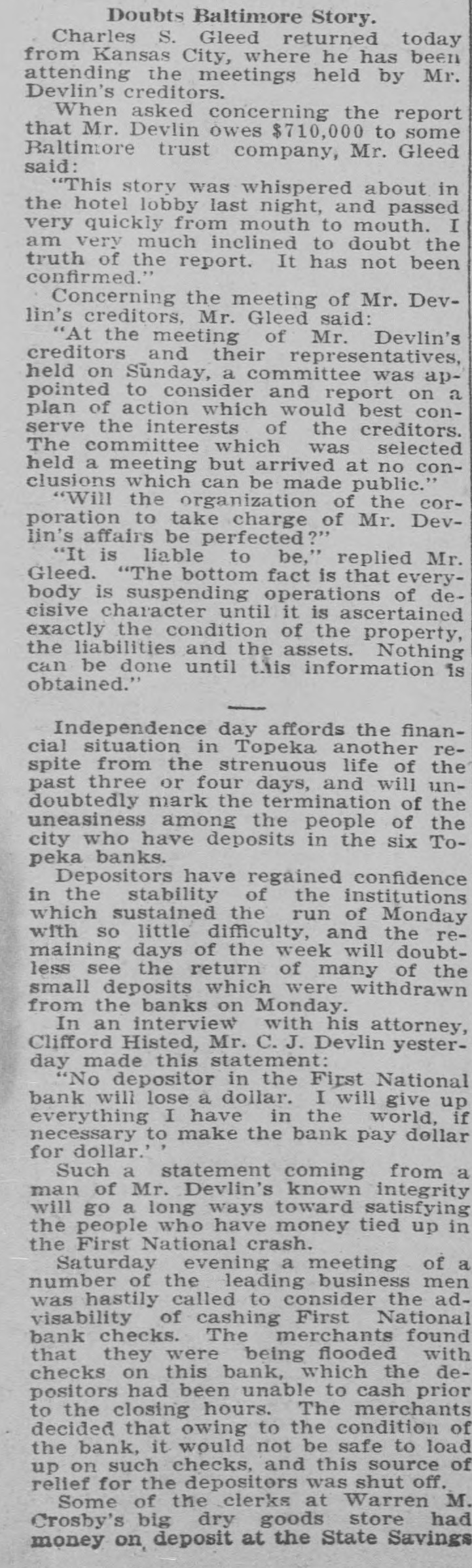
Doubts Baltimore Story
Charles S. Gleed returned today from Kansas City, where he has been attending the meetings held by Mr. Devlin's creditors. When asked concerning the report that Mr. Devlin owes $710,000 to some Baltimore trust company, Mr. Gleed said: "This story was whispered about in the hotel lobby last night, and passed very quickly from mouth to mouth. I am very much inclined to doubt the truth of the report. It has not been confirmed." Concerning the meeting of Mr. Devlin's creditors, Mr. Gleed said: "At the meeting of Mr. Devlin's creditors and their representatives, on a committee held Sunday, to consider was appointed and report on a plan of action which would best conserve the interests of the creditors. The committee which was selected held a meeting but arrived at no conclusions which can be made public." "Will the organization of the corporation to take charge of Mr. Devlin's affairs be perfected?" "It is liable to be," replied Mr. Gleed. "The bottom fact is that everybody is suspending operations of decisive character until it is ascertained exactly the condition of the property, the liabilities and the assets. Nothing can be done until this information is obtained." Independence day affords the financial situation in Topeka another respite from the strenuous life of the past three or four days, and will undoubtedly mark the termination of the uneasiness among the people of the city who have deposits in the six Topeka banks. Depositors have regained confidence in the stability of the institutions which sustained the run of Monday with so little difficulty, and the remaining days of the week will doubtless see the return of many of the small deposits which were withdrawn from the banks on Monday. In an interview with his attorney, Clifford Histed, Mr. C. J. Devlin yesterday made this statement: "No depositor in the First National bank will lose a dollar. I will give up everything I have in the world, if necessary to make the bank pay dollar for dollar. Such a statement coming from a man of Mr. Devlin's known integrity will go a long ways toward satisfying the people who have money tied up in the First National crash. Saturday evening a meeting of a number of the leading business men was hastily called to consider the advisability of cashing First National bank checks. The merchants found that they were being flooded with checks on this bank, which the depositors had been unable to cash prior to the closing hours. The merchants decided that owing to the condition of the bank, it would not be safe to load up on such checks, and this source of relief for the depositors was shut off. Some of the clerks at Warren M. Crosby's big dry goods store had money on deposit at the State Savings
4.July 5, 1905Evening Times-RepublicanMarshalltown, IA
Click image to open full size in new tab
Article Text
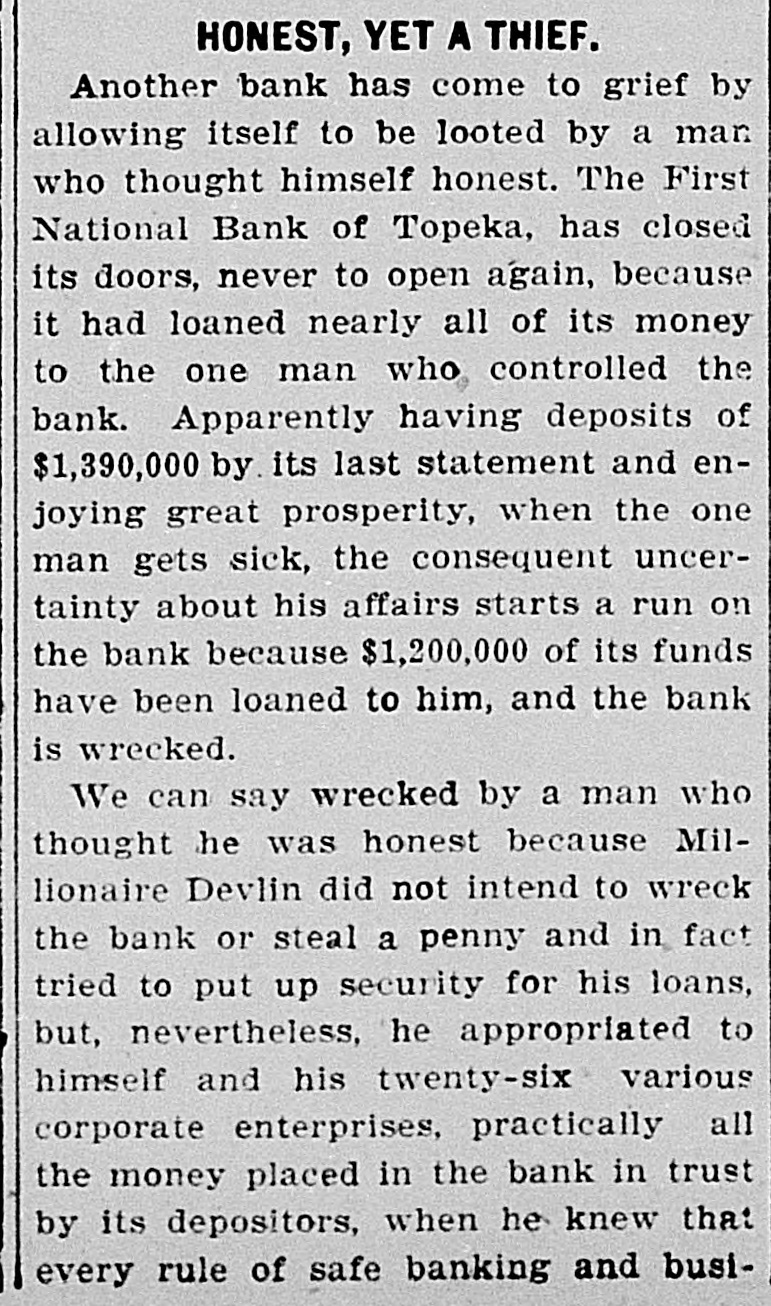
HONEST, YET A THIEF. Another bank has come to grief by allowing itself to be looted by a man who thought himself honest. The First National Bank of Topeka, has closed its doors, never to open again, because it had loaned nearly all of its money to the one man who controlled the bank. Apparently having deposits of $1,390,000 by. its last statement and enjoying great prosperity, when the one man gets sick, the consequent uncertainty about his affairs starts a run on the bank because $1,200,000 of its funds have been loaned to him, and the bank is wrecked. We can say wrecked by a man who thought he was honest because Millionaire Devlin did not intend to wreck the bank or steal a penny and in fact tried to put up security for his loans, but, nevertheless, he appropriated to himself and his twenty-six various corporate enterprises, practically all the money placed in the bank in trust by its depositors, when he knew that every rule of safe banking and busi-
5.July 6, 1905The SunNew York, NY
Click image to open full size in new tab
Article Text
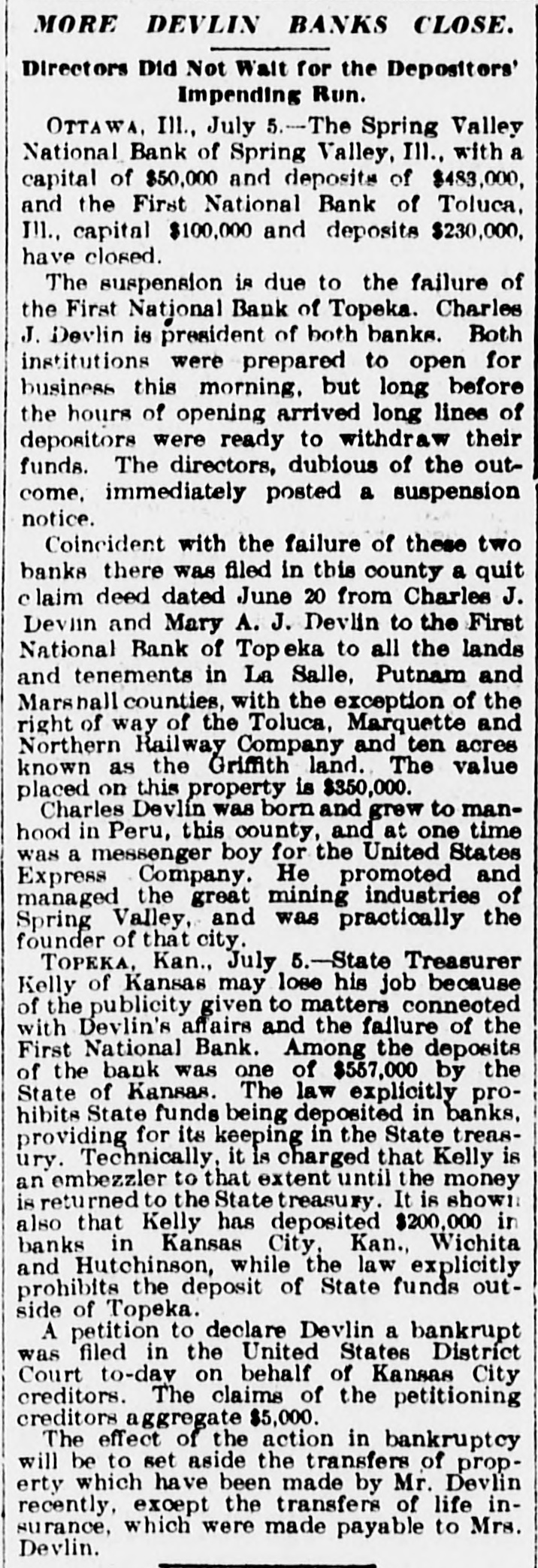
MORE DEVLIN BANKS CLOSE
Directors Did Not Wait for the Depositors' Impending Run. OTTAWA, Ill., July 5.-The Spring Valley National Bank of Spring Valley, Ill., with a capital of $50,000 and deposits of $483,000, and the First National Bank of Toluca, III., capital $100,000 and deposits $230,000, have closed. The suspension is due to the failure of the First National Bank of Topeka. Charles J. Devlin is president of both banks. Both institutions were prepared to open for business this morning, but long before the hours of opening arrived long lines of depositors were ready to withdraw their funds. The directors, dubious of the outcome, immediately posted a suspension notice. Coincident with the failure of these two banks there was filed in this county a quit claim deed dated June 20 from Charles J. Deviin and Mary A. J. Devlin to the First National Bank of Topeka to all the lands and tenements in La Salle, Putnam and Marshall counties, with the exception of the right of way of the Toluca, Marquette and Northern Railway Company and ten acres known as the Griffith land. The value placed on this property is $350,000. Charles Devlin was born and grew to manhood in Peru, this county, and at one time was a messenger boy for the United States Express Company. He promoted and managed the great mining industries of Spring Valley, and was practically the founder of that city. TOPEKA, Kan., July 5.-State Treasurer Kelly of Kansas may lose his job because of the publicity given to matters connected with Devlin's affairs and the failure of the First National Bank. Among the deposits of the bank was one of $557,000 by the State of Kansas. The law explicitly prohibits State funds being deposited in banks, providing for its keeping in the State treasury. Technically, it is charged that Kelly is an embezzler to that extent until the money is returned to the State treasury. It is shown also that Kelly has deposited $200,000 in banks in Kansas City, Kan., Wichita and Hutchinson, while the law explicitly prohibits the deposit of State funds outside of Topeka. A petition to declare Devlin a bankrupt was filed in the United States District Court to-day on behalf of Kansas City creditors. The claims of the petitioning creditors aggregate $5,000. The effect of the action in bankruptcy will be to set aside the transfers of property which have been made by Mr. Devlin recently, except the transfers of life insurance, which were made payable to Mrs. Devlin.
6.July 7, 1905The Daily ArdmoreiteArdmore, OK
Click image to open full size in new tab
Article Text
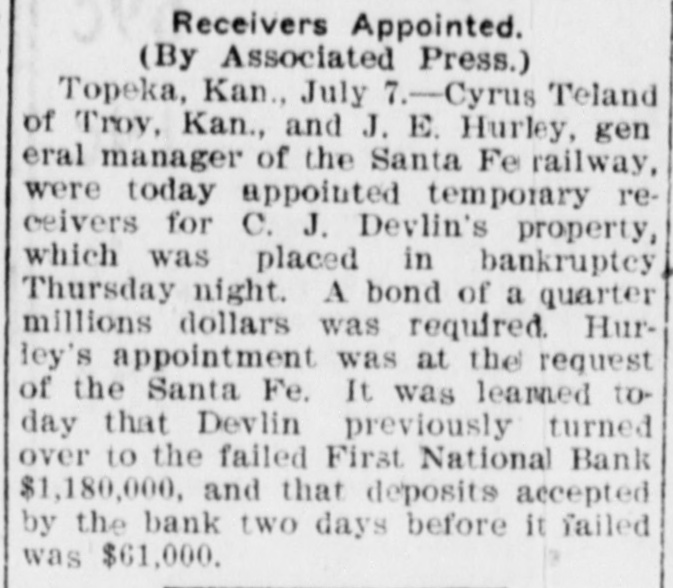
Receivers Appointed.
(By Associated Press.)
Topeka, Kan., July 7.-Cyrus Teland of Troy, Kan., and J. E. Hurley, general manager of the Santa Fe railway, were today appointed temporary receivers for C. J. Devlin's property, which was placed in bankruptcy Thursday night. A bond of a quarter millions dollars was required. Hurley's appointment was at the request of the Santa Fe. It was learned today that Devlin previously turned over to the failed First National Bank $1,180,000, and that deposits accepted by the bank two days before it failed was $61,000.
7.July 7, 1905The Goodland RepublicGoodland, KS
Click image to open full size in new tab
Article Text
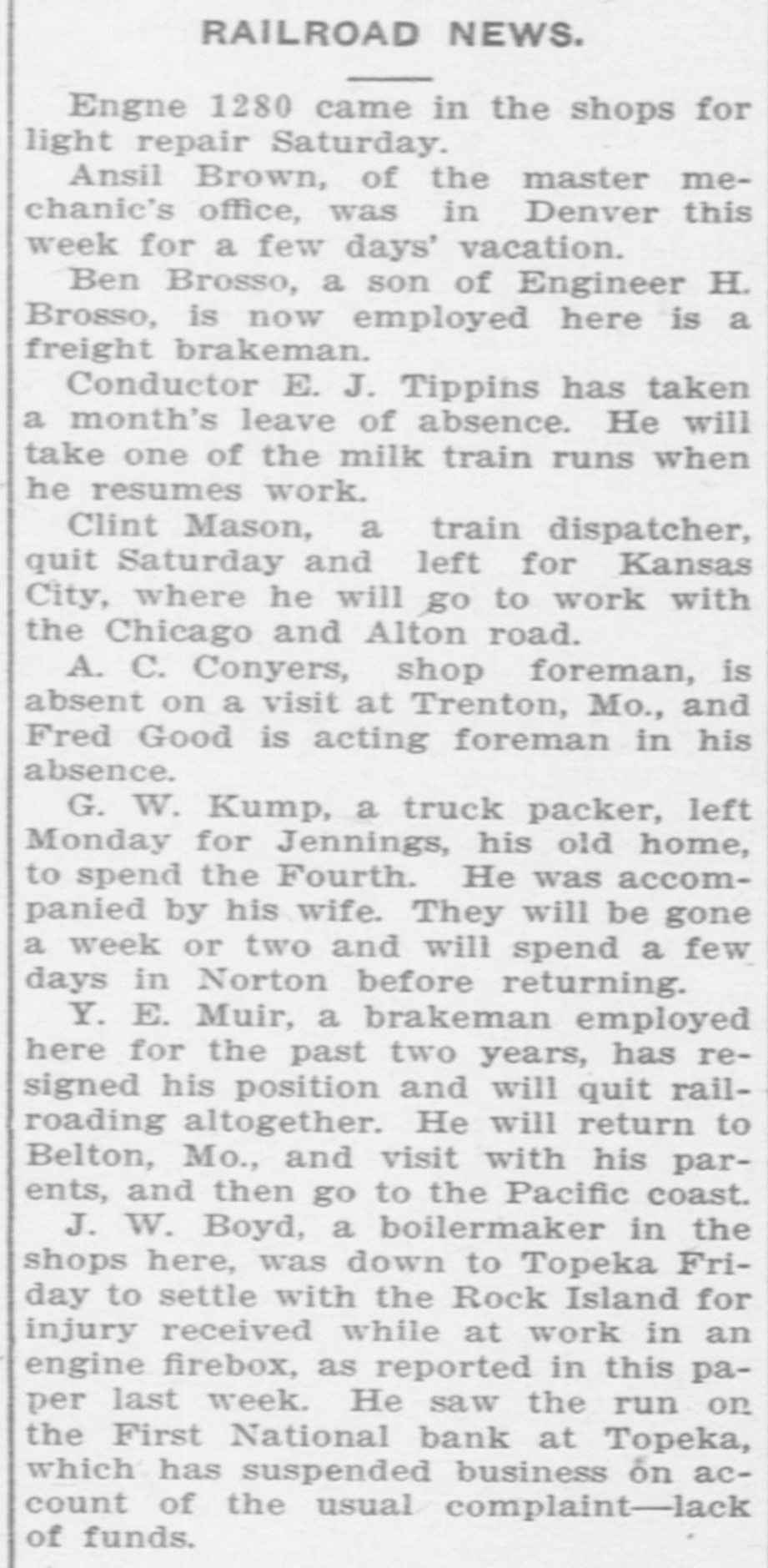
RAILROAD NEWS
Engne 1280 came in the shops for light repair Saturday. Ansil Brown, of the master mechanic's office, was in Denver this week for a few days' vacation. Ben Brosso, a son of Engineer H. Brosso, is now employed here is a freight brakeman. Conductor E. J. Tippins has taken a month's leave of absence. He will take one of the milk train runs when he resumes work. Clint Mason, a train dispatcher, quit Saturday and left for Kansas City, where he will go to work with the Chicago and Alton road. A. C. Conyers, shop foreman, is absent on a visit at Trenton, Mo., and Fred Good is acting foreman in his absence. G. W. Kump, a truck packer, left Monday for Jennings, his old home, to spend the Fourth. He was accompanied by his wife. They will be gone a week or two and will spend a few days in Norton before returning. Y. E. Muir, a brakeman employed here for the past two years, has resigned his position and will quit railroading altogether. He will return to Belton, Mo., and visit with his parents, and then go to the Pacific coast. J. W. Boyd, a boilermaker in the shops here, was down to Topeka Friday to settle with the Rock Island for injury received while at work in an engine firebox, as reported in this paper last week. He saw the run on the First National bank at Topeka, which has suspended business on account of the usual complaint-lack of funds.
8.July 10, 1905Vilas County NewsEagle River, WI
Click image to open full size in new tab
Article Text
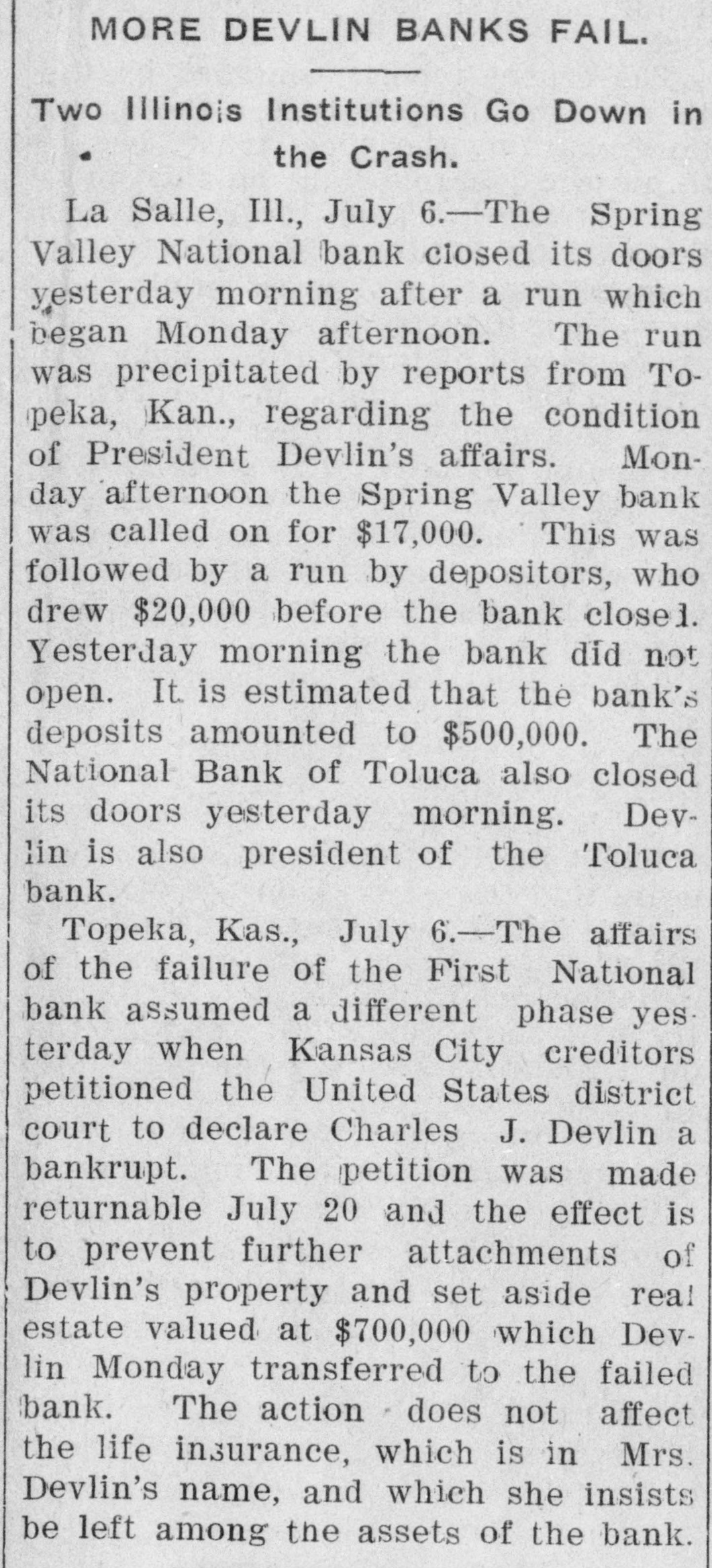
MORE DEVLIN BANKS fail
Two Illinois Institutions Go Down in the Crash. La Salle, III., July 6.-The Spring Valley National bank closed its doors yesterday morning after a run which began Monday afternoon. The run was precipitated by reports from Topeka, Kan., regarding the condition of President Devlin's affairs. Monday afternoon the Spring Valley bank was called on for $17,000. This was followed by a run by depositors, who drew $20,000 before the bank closed. Yesterday morning the bank did not open. It. is estimated that the bank's deposits amounted to $500,000. The National Bank of Toluca also closed its doors yesterday morning. Devlin is also president of the Toluca bank. Topeka, Kas., July 6.-The affairs of the failure of the First National bank assumed a different phase yes. terday when Kansas City creditors petitioned the United States district court to declare Charles J. Devlin a bankrupt. The petition was made returnable July 20 and the effect is to prevent further attachments of Devlin's property and set aside real estate valued at $700,000 which Devlin Monday transferred to the failed bank. The action does not affect the life insurance, which is in Mrs. Devlin's name, and which she insists be left among the assets of the bank.
9.July 16, 1905Los Angeles HeraldLos Angeles, CA
Click image to open full size in new tab
Article Text
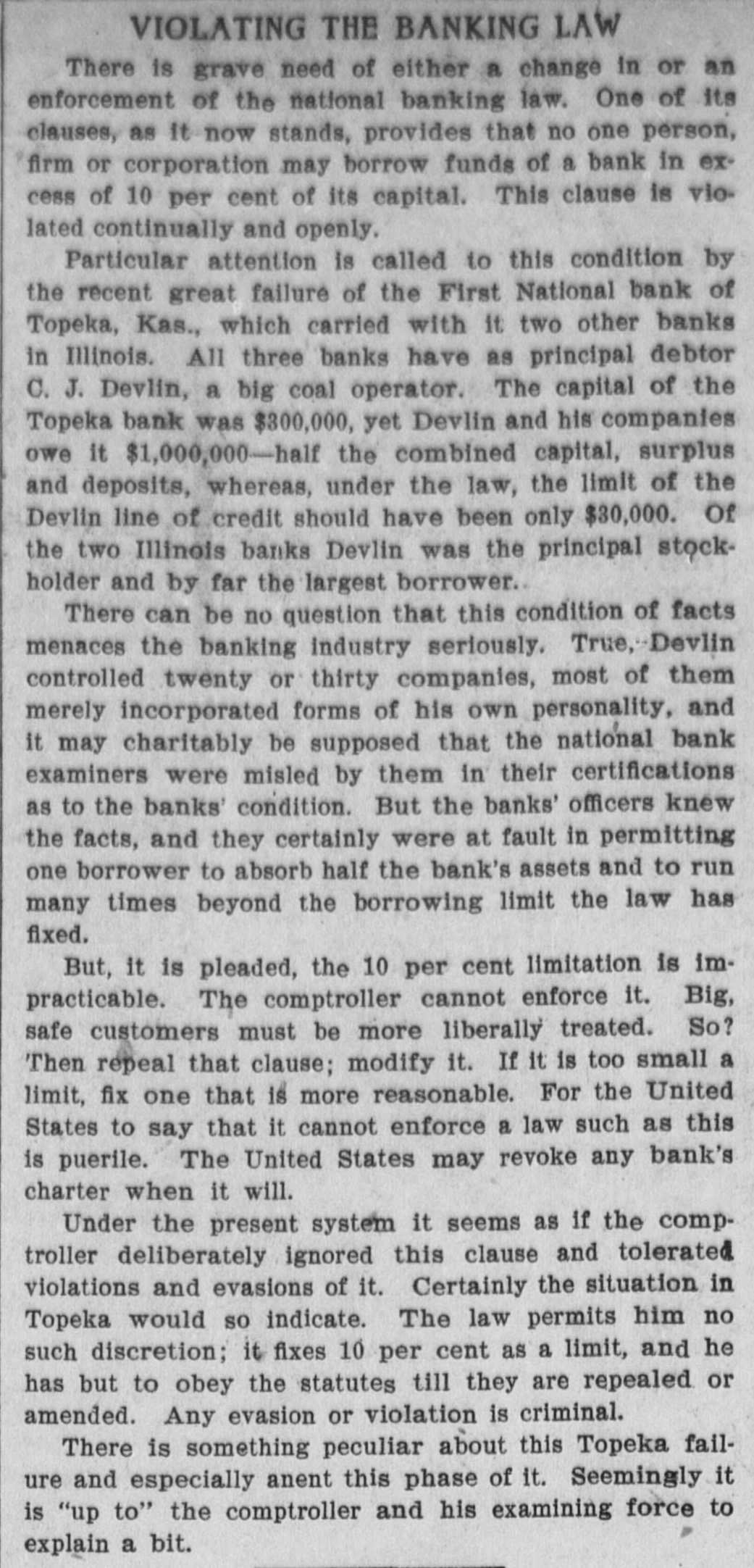
VIOLATING THE BANKING LAW There is grave need of either a change in or an enforcement of the national banking law. One of its clauses, as It now stands, provides that no one person, firm or corporation may borrow funds of a bank in excess of 10 per cent of its capital. This clause is violated continually and openly. Particular attention is called to this condition by the recent great failure of the First National bank of Topeka, Kas., which carried with it two other banks in Illinois. All three banks have as principal debtor C. J. Devlin, a big coal operator. The capital of the Topeka bank was $300,000, yet Devlin and his companies owe it $1,000,000-half the combined capital, surplus and deposits, whereas, under the law, the limit of the Devlin line of credit should have been only $30,000. Of the two Illinois banks Devlin was the principal stockholder and by far the largest borrower. There can be no question that this condition of facts menaces the banking industry seriously. True, Devin controlled twenty or thirty companies, most of them merely incorporated forms of his own personality, and it may charitably be supposed that the national bank examiners were misled by them in their certifications as to the banks condition. But the banks' officers knew the facts, and they certainly were at fault in permitting one borrower to absorb half the bank's assets and to run many times beyond the borrowing limit the law has fixed. But, it is pleaded, the 10 per cent limitation is impracticable. The comptroller cannot enforce it. Big, safe customers must be more liberally treated. So? Then repeal that clause; modify it. If it is too small a limit, fix one that is more reasonable. For the United States to say that it cannot enforce a law such as this is puerile. The United States may revoke any bank's charter when it will. Under the present system it seems as if the comptroller deliberately ignored this clause and tolerated violations and evasions of it. Certainly the situation in Topeka would so indicate. The law permits him no such discretion; it fixes 10 per cent as a limit, and he has but to obey the statutes till they are repealed or amended. Any evasion or violation is criminal. There is something peculiar about this Topeka failure and especially anent this phase of it. Seemingly it is "up to" the comptroller and his examining force to explain a bit.
10.July 18, 1905The Topeka State JournalTopeka, KS
Click image to open full size in new tab
Article Text
SNAPSHOTS AT HOME NEWS
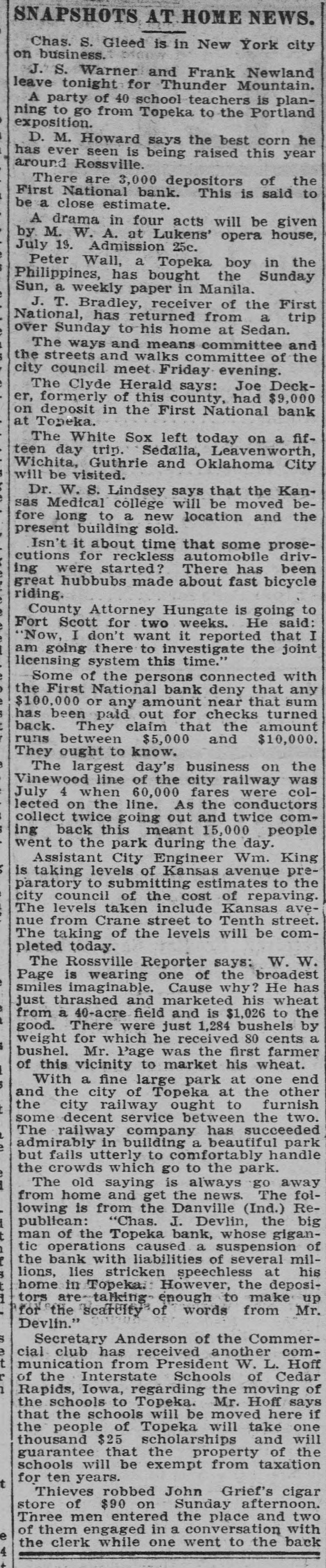
Chas. S. Gleed is in New York city on business. J. S. Warner and Frank Newland leave tonight for Thunder Mountain. A party of 40 school teachers is planning to go from Topeka to the Portland exposition. D. M. Howard says the best corn he has ever seen is being raised this year around Rossville. There are 3,000 depositors of the First National bank. This is said to be a close estimate. A drama in four acts will be given by M. W. A. at Lukens' opera house, July 19. Admission 25c. Peter Wall, a Topeka boy in the Philippines, has bought the Sunday Sun, a weekly paper in Manila. J. T. Bradley, receiver of the First National, has returned from a trip over Sunday to his home at Sedan. The ways and means committee and the streets and walks committee of the city council meet Friday evening. The Clyde Herald says: Joe Decker, formerly of this county, had $9,000 on deposit in the First National bank at TopeKa. The White Sox left today on a fifteen day trip. Sedalia, Leavenworth, Wichita, Guthrie and Oklahoma City will be visited. Dr. W. S. Lindsey says that the Kansas Medical college will be moved before long to a new location and the present building sold. Isn't it about time that some prosecutions for reckless automobile driving were started? There has been great hubbubs made about fast bicycle riding. County Attorney Hungate is going to Fort Scott for two weeks. He said: "Now, I don't want it reported that I am going there to investigate the joint licensing system this time." Some of the persons connected with the First National bank deny that any $100,000 or any amount near that sum has been paid out for checks turned back. They claim that the amount runs between $5,000 and $10,000. They ought to know. The largest day's business on the Vinewood line of the city railway was July 4 when 60,000 fares were collected on the line. As the conductors collect twice going out and twice coming back this meant 15,000 people went to the park during the day. Assistant City Engineer Wm. King is taking levels of Kansas avenue preparatory to submitting estimates to the city council of the cost of repaving. The levels taken include Kansas avenue from Crane street to Tenth street. The taking of the levels will be completed today. The Rossville Reporter says: W. W. Page is wearing one of the broadest smiles imaginable. Cause why? He has just thrashed and marketed his wheat from a 40-acre field and is $1,026 to the good. There were just 1,284 bushels by weight for which he received 80 cents a bushel. Mr. Page was the first farmer of this vicinity to market his wheat. With a fine large park at one end and the city of Topeka at the other the city railway ought to furnish some decent service between the two. The railway company has succeeded admirably in building a beautiful park but fails utterly to comfortably handle the crowds which go to the park. The old saying is always go away from home and get the news. The following is from the Danville (Ind.) Republican: "Chas. J. Devlin, the big man of the Topeka bank, whose gigantic operations caused a suspension of the bank with liabilities of several millions, lies stricken speechless at his home in Topeka. However, the depositors are talking enough to make up for the scarcity of words from Mr. Devlin." Secretary Anderson of the Commercial club has received another communication from President W. L. Hoff of the Interstate Schools of Cedar Rapids, Iowa, regarding the moving of the schools to Topeka. Mr. Hoff says that the schools will be moved here if
11.July 19, 1905Omaha Daily BeeOmaha, NE
Click image to open full size in new tab
Article Text
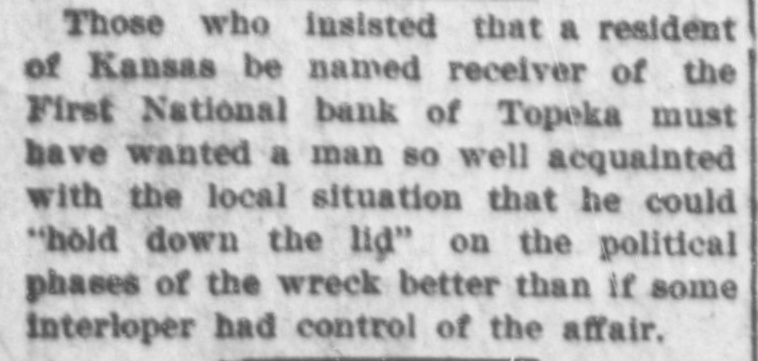
Those who insisted that a resident of Kansas be named receiver of the First National bank of Topeka must have wanted a man so well acquainted with the local situation that he could "hold down the lid" on the political phases of the wreck better than if some interloper had control of the affair.
12.July 20, 1905The Providence NewsProvidence, RI
Click image to open full size in new tab
Article Text
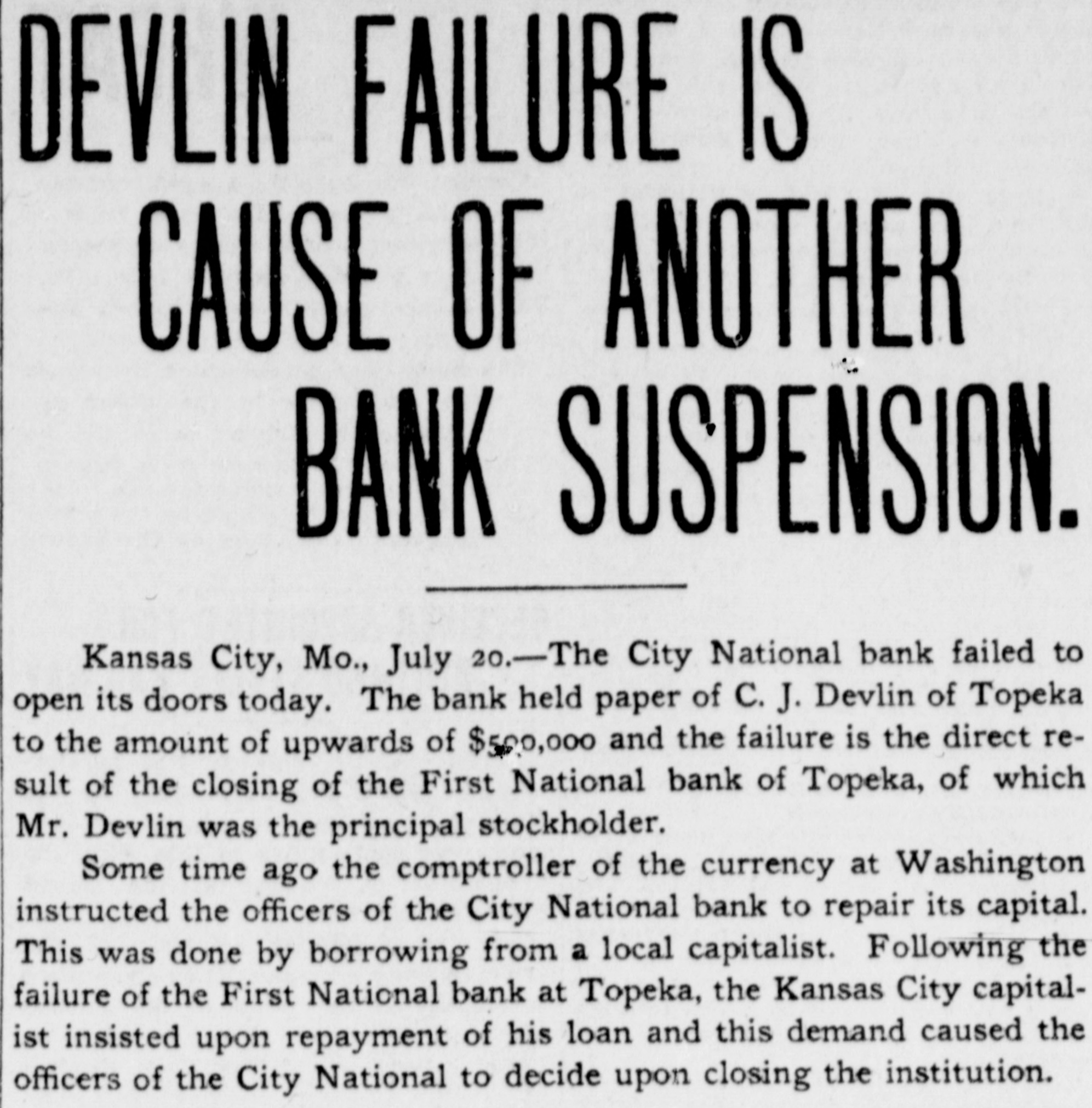
DEVLIN FAILURE IS CAUSE OF ANOTHER BANK SUSPENSION. Kansas City, Mo., July 20.-The City National bank failed to open its doors today. The bank held paper of C. J. Devlin of Topeka to the amount of upwards of $500,000 and the failure is the direct result of the closing of the First National bank of Topeka, of which Mr. Devlin was the principal stockholder. Some time ago the comptroller of the currency at Washington instructed the officers of the City National bank to repair its capital. This was done by borrowing from a local capitalist. Following the failure of the First National bank at Topeka, the Kansas City capitalist insisted upon repayment of his loan and this demand caused the officers of the City National to decide upon closing the institution.
13.July 28, 1905The Topeka State JournalTopeka, KS
Click image to open full size in new tab
Article Text
SNAPSHOTS AT HOME NEWS
Two alarms inside of three minutes made it a busy place around fire headquarters yesterday. Tomorrow Alfred Benjamin $22, $20 and $18 suits at $12.50 (blacks excepted) The Palace. The police court has taken a vaca tion, as far as liquor cases are concerned, until August 8. The city engineer says that the roof of the patrol barn at police headquarters can be repaired for $291.63. Rev. Axel Anderson, formerly of Topeka, has taken charge of a Lutheran church at Missoula, Montana. Secretary George E. Lerrigo of the Y. M. C. A., will leave this evening on a vacation trip to Winona Lake, Ind. City Clerk Jackson of Fort Scott has asked City Clerk Squires for a copy of the city's waterworks ordinance. That summer resort weather is beginning to wear off again though the evenings still remain cool and comfortable. L. J. Pittijohn, receiver of the Dodge City land office, spent a few hours in the city on political business yesterday afternoon. Hart, Scheffner & Max and Alfred Benjamin & Co. $22, $20 and $18 business and outing suits tomorrow $12.50 The Palace. Charles S. Engle has a new team of carriage horses-bright bays and a very handsome team. They are colts and are being city broke. The only marriage license issued by the probate court yesterday was to E. R. Kyler and Sarah J. Jones, both claiming Topeka as a residence. J. C. Scott, former representative of Scott county, was in town a few hours Thursday turning out big stories of the prosperity of western Kansas. A. neighborhood row in which a cur dog Bingo plays the leading role was aired in Judge McCabe's court Thursday. The judge has the case under advisement. A well known Topeka financial expert has it figured out that the depositors in the defunct First National bank will receive about 35 cents on the dollar. Most of the Union Pacific trains between Kansas City and Topeka have been delayed the past few days on account of soft track caused by the heavy rains. W. J. Dickie of the Jensen Manufacturing company will leave Monday for the Pacific coast to establish agencies of the company along the coast and in the western states. He will be absent six weeks. The Topeka Negro Business Men's league is making an effort to secure the national meeting of the club for Topeka next year. Governor Hoch, Mayor Davis and the Commercial club has been asked to co-operate. What has become of the kite flying boy? A few years ago there wasn't a telephone post in town or a telegraph wire but what had its full quota of wrecked kites hanging dangling down. You very seldom see one now. The fact that the Commercial club has $850 of its funds tied up in the First National bank failure has hampered somewhat the plans for the trade train which it is expected will be sent out in September. The train will not be given up. J. W. Kraemer was granted an order by the court yesterday preventing Carlos W. Jones and wife from removing certain household goods from the state until a certain note given by Jones and endorsed by Kraemer is paid. Labor Day this year falls on September 4th. The local labor unions are planning the usual celebration of a parade and pienic. Committees from the various members of the Trade and Labor council will meet next week to arrange for the details. H. P. Dillon who recently bought a new automobile has exhausted the novelty of motoring already and says riding about town in a touring car is no better sport than riding on a merrygo-round, the distances are so short. We were out for an hour the other day," he says, "and went all over Shawnee county. An effort will be made to bring the next convention of the National Negro Business Men's league to Topeka. It convenes this year in New York. Fifteen members of the league in Topeka will leave soon for New York in an endeavor to secure the 1906 meeting for Topeka. John M. Wright is on the programme for a paper upon "Fraternal and Industrial Insurance." The question of leasing the fair grounds by the city for park purposes is again being agitated. The county commissioners are thinking seriously of cutting it up into lots and disposing of it when the lease of the fair association expires. The lease has seven years yet to run. The plan is for the city to lease the grounds after the association turns back the place to the county commissioners, with an agreement to purchase within thirty years. To go down East Fourth street you would think that the middle of the street and the car tracks were never used. Grass from three to four inches tall has taken root between the crevices in the paving and lines the whole length of the center of the street and car tracks from Quincy street to the Santa Fe depot. The effect is hardly an inviting one. It looks as if the town had gone to sleep and was not doing enough business to keep the grass worn
14.August 5, 1905Chicago EagleChicago, IL
Click image to open full size in new tab
Article Text
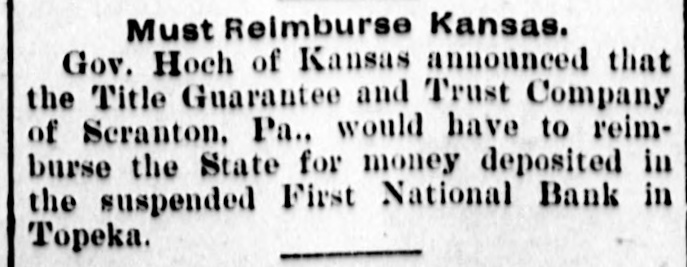
Must Reimburse Kansas
Gov. Hoch of Kansas announced that the Title Guarantee and Trust Company of Scranton, Pa., would have to reimburse the State for money deposited in the suspended First National Bank in Topeka.
15.August 17, 1905The Topeka State JournalTopeka, KS
Click image to open full size in new tab
Article Text
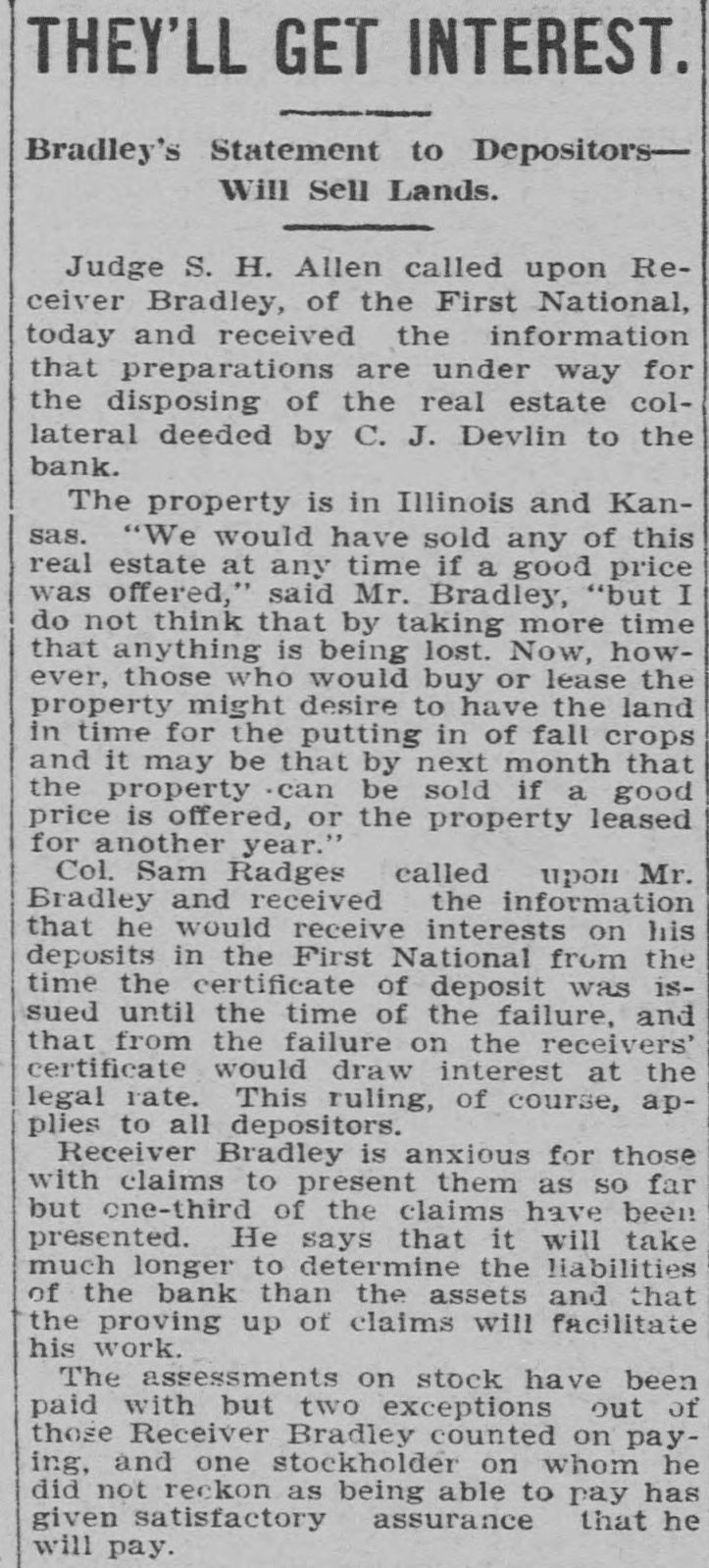
THEY'LL GET INTEREST.
Bradley's Statement to Depositors- Will Sell Lands.
Judge S. H. Allen called upon Receiver Bradley, of the First National, today and received the information that preparations are under way for the disposing of the real estate collateral deeded by C. J. Devlin to the bank.
The property is in Illinois and Kansas. "We would have sold any of this real estate at any time if a good price was offered," said Mr. Bradley, "but I do not think that by taking more time that anything is being lost. Now, however, those who would buy or lease the property might desire to have the land in time for the putting in of fall crops and it may be that by next month that the property can be sold if a good price is offered, or the property leased for another year."
Col. Sam Radges called upon Mr. Bradley and received the information that he would receive interests on his deposits in the First National from the time the certificate of deposit was issued until the time of the failure, and that from the failure on the receivers' certificate would draw interest at the legal rate. This ruling, of course, applies to all depositors.
Receiver Bradley is anxious for those with claims to present them as so far but one-third of the claims have been presented. He says that it will take much longer to determine the liabilities of the bank than the assets and that the proving up of claims will facilitate his work.
The assessments on stock have been paid with but two exceptions out of those Receiver Bradley counted on paying, and one stockholder on whom he did not reckon as being able to pay has given satisfactory assurance that he will pay.
16.November 2, 1905The News & ObserverRaleigh, NC
Click image to open full size in new tab
Article Text
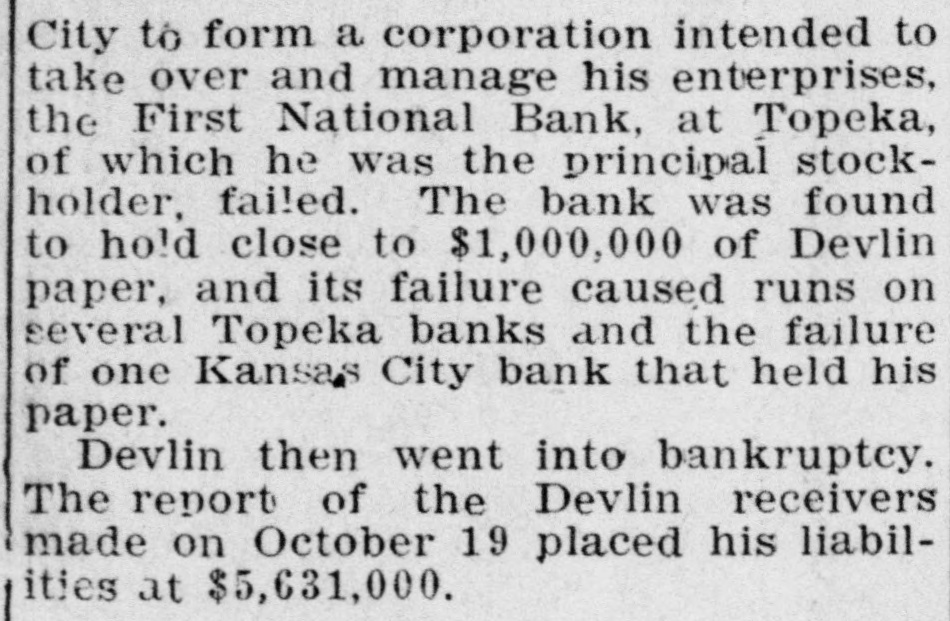
City to form a corporation intended to take over and manage his enterprises, the First National Bank, at Topeka, of which he was the principal stockholder, failed. The bank was found to hold close to $1,000,000 of Devlin paper, and its failure caused runs on several Topeka banks and the failure of one Kansas City bank that held his paper.
Devlin then went into bankruptcy. The report of the Devlin receivers made on October 19 placed his liabilities at $5,631,000.
17.November 2, 1905The Cairo BulletinCairo, IL
Click image to open full size in new tab
Article Text
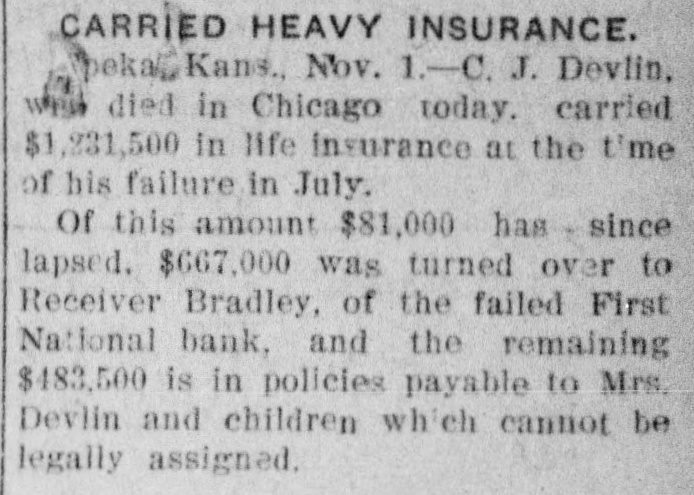
CARRIED HEAVY INSURANCE
peka Kans. Nov. 1.-C. J. Devlin, WILD died in Chicago today. carried $1,231,500 in life insurance at the t'me of his failure in July. Of this amount $81,000 has 19 since lapsed. $667,000 was turned over to Receiver Bradley, of the failed First National bank, and the remaining $483,500 is in policies payable to Mrs. Devlin and children which cannot be legally assigned.
18.November 4, 1905The Glenwood PostGlenwood Springs, CO
Click image to open full size in new tab
Article Text
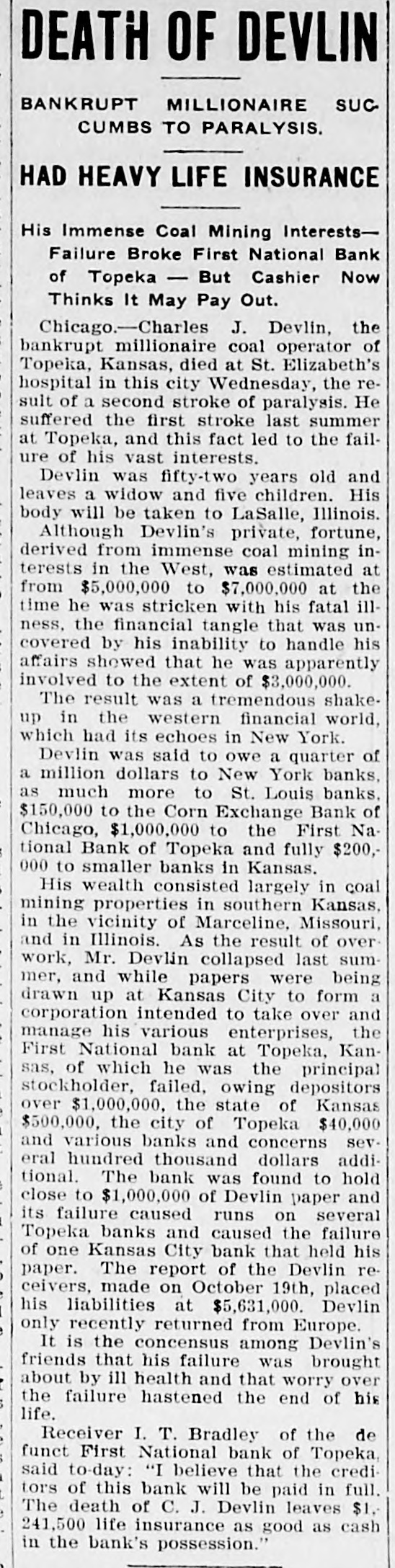
DEATH OF DEVLIN BANKRUPT MILLIONAIRE SUCCUMBS TO PARALYSIS. HAD HEAVY LIFE INSURANCE His Immense Coal Mining InterestsFailure Broke First National Bank of Topeka - But Cashier Now Thinks It May Pay Out. Chicago.-Charles J. Devlin, the bankrupt millionaire coal operator of Topeka, Kansas, died at St. Elizabeth's hospital in this city Wednesday, the result of a second stroke of paralysis. He suffered the first stroke last summer at Topeka, and this fact led to the failure of his vast interests. Devlin was fifty-two years old and leaves a widow and five children. His body will be taken to LaSalle, Illinois. Although Devlin's private, fortune, derived from immense coal mining interests in the West, was estimated at from $5,000,000 to $7,000,000 at the time he was stricken with his fatal illness, the financial tangle that was uncovered by his inability to handle his affairs showed that he was apparently involved to the extent of $3,000,000. The result was a tremendous shakeup in the western financial world, which had its echoes in New York. Devlin was said to owe a quarter of a million dollars to New York banks, as much more to St. Louis banks, $150,000 to the Corn Exchange Bank of Chicago, $1,000,000 to the First Na: tional Bank of Topeka and fully $200,000 to smaller banks in Kansas. His wealth consisted largely in coal mining properties in southern Kansas, in the vicinity of Marceline, Missouri, and in Illinois. As the result of over work, Mr. Devlin collapsed last summer, and while papers were being drawn up at Kansas City to form a corporation intended to take over and manage his various enterprises, the First National bank at Topeka, Kansas, of which he was the principal stockholder, failed, owing depositors over $1,000,000. the state of Kansas , $500,000. the city of Topeka $40,000 and various banks and concerns several hundred thousand dollars additional. The bank was found to hold , close to $1,000,000 of Devlin paper and its failure caused runs on several Topeka banks and caused the failure of one Kansas City bank that held his ; paper. The report of the Devlin receivers, made on October 19th, placed his liabilities at $5,631,000. Devlin I only recently returned from Europe. ) It is the concensus among Devlin's friends that his failure was brought : about by ill health and that worry over the failure hastened the end of his : life. Receiver I. T. Bradley of the de funct First National bank of Topeka, : i said to-day: "I believe that the creditors of this bank will be paid in full. t The death of C. J. Devlin leaves $1. e 241,500 life insurance as good as cash in the bank's possession." .
19.December 23, 1905The Topeka State JournalTopeka, KS
Click image to open full size in new tab
Article Text
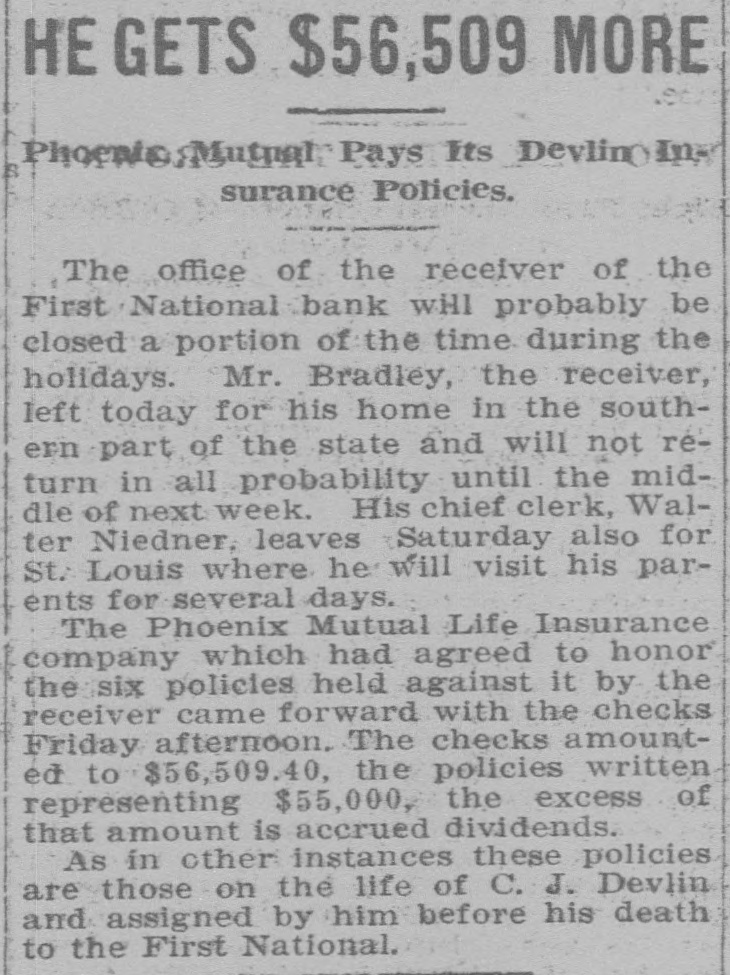
HE GETS $56,509 MORE
Phoenio Mutual Pays Its Devlin Insurance Policies.
The office of the receiver of the First National bank will probably be closed a portion of the time during the holidays. Mr. Bradley, the receiver, left today for his home in the southern part of the state and will not return in all probability until the middle of next week. His chief clerk, Walter Niedner, leaves Saturday also for St. Louis where he will visit his parents for several days.
The Phoenix Mutual Life Insurance company which had agreed to honor the six policies held against it by the receiver came forward with the checks Friday afternoon. The checks amounted to $56,509.40, the policies written representing $55,000, the excess of that amount is accrued dividends. As in other instances these policies are those on the life of C. J. Devlin and assigned by him before his death to the First National.
20.December 31, 1905The Topeka State JournalTopeka, KS
Click image to open full size in new tab
Article Text
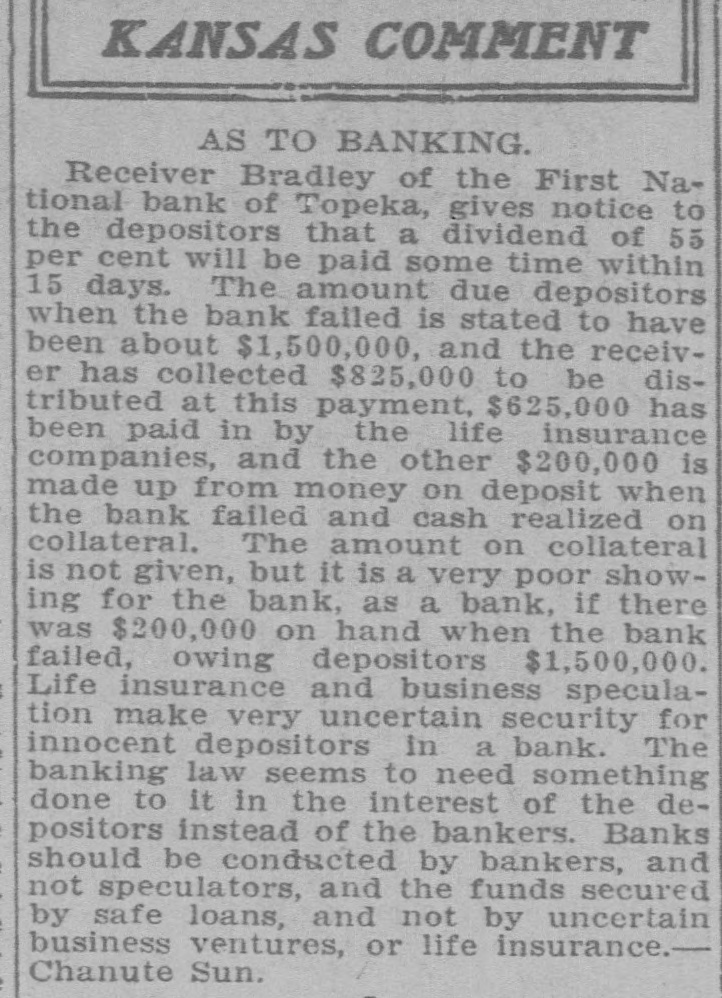
KANSAS COMMENT
AS TO BANKING. Receiver Bradley of the First National bank of Topeka, gives notice to the depositors that a dividend of 55 per cent will be paid some time within 15 days. The amount due depositors when the bank failed is stated to have been about $1,500,000, and the receiver has collected $825,000 to be distributed at this payment, $625,000 has been paid in by the life insurance companies, and the other $200,000 is made up from money on deposit when the bank failed and cash realized on collateral. The amount on collateral is not given, but it is a very poor showing for the bank, as a bank, if there was $200,000 on hand when the bank failed, owing depositors $1,500,000.
Life insurance and business speculation make very uncertain security for innocent depositors in a bank. The banking law seems to need something done to it in the interest of the depositors instead of the bankers. Banks should be conducted by bankers, and not speculators, and the funds secured by safe loans, and not by uncertain business ventures, or life insurance. Chanute Sun.
21.January 27, 1906The Topeka State JournalTopeka, KS
Click image to open full size in new tab
Article Text
IT'S HERE AT LAST First National Dividend No Longer a Myth. Becomes Reality When Checks Arrive Today. READY FOR MONDAY. Distribution Will Commence at 9 O'clock. Over Eight Hundred Thousand Dollars in Checks. SOME ARE LEFT OUT. Three Hundred Depositors Who Failed to Prove Claims. Check No. 1 Wlil Go to Eliza W. Bowman. The money for the first dividend, 55 per cent of the defunct First National bank, was réceived today by express at 10:10 o'clock. The amount represented in signed checks is $801,288.58 and is to be divided among 1,300 depositors of the bank. The receiver will commence issuing the checks at 9 o'clock Monday morning from the office of the receiver in the Real Estate building at the corner of Seventh and Jackson streets. The first to come will be the first served, no other form of paying out will be observed. Receiver J. T. Bradley is out of the city and will not return until Monday and his office force, Walter Niedner and John Morrisey, assumed the responsibility of taking charge of the nearly one million dollars worth of checks which came in a leather covered casket. The checks were filled out here in Topeka about two weeks since and were then shipped east to Washington to be signed by J. P. Kane, deputy comptroller of the currency. They had to be figured over again there by the clerical force in Washington for verification. But happy to state there was no error found. Upon the special request of Receiver Bradley that the work be hastened in Washington as speedily as possible, the work was rushed through instead of waiting the usual routine. The 55 per cent dividend was first announced on Christmas morning but it was delayed from time to time by the difficulty attending the collection of all of the insurance money. The $801,000 of money does not represent the total 55 per cent dividend but simply represents the amount of the claims of the depositors which have been proved up. There are about 300 deposi tors who still have failed to prove up their claims. The checks will be issued only to those of the depositors who hold receiver's certificates. Those who do not possess such certificates will have to present their pass books at the office Monday and certificates will be issued on their presentation. The checks are not on any national bank but upon the United States treasurer. They can be presented for payment at any bank in the city and will be honored just the same as any other form of check. That the flood of money which will be turned loose will be hailed with great glee by depositor and the business men of the town alike is only putting it mildly. The merchants have been waiting for this sort of thing for several months and the depositors will feel again the well filled pocket book. Check number one belongs to Eliza W. Bowman while check 1300 is the property of Martha Hackney. The payment, however, will be made to the one who first gets there. The First National bank went into the hands of a receiver on Monday morning, July 3rd.
22.February 5, 1906The Topeka State JournalTopeka, KS
Click image to open full size in new tab
Article Text
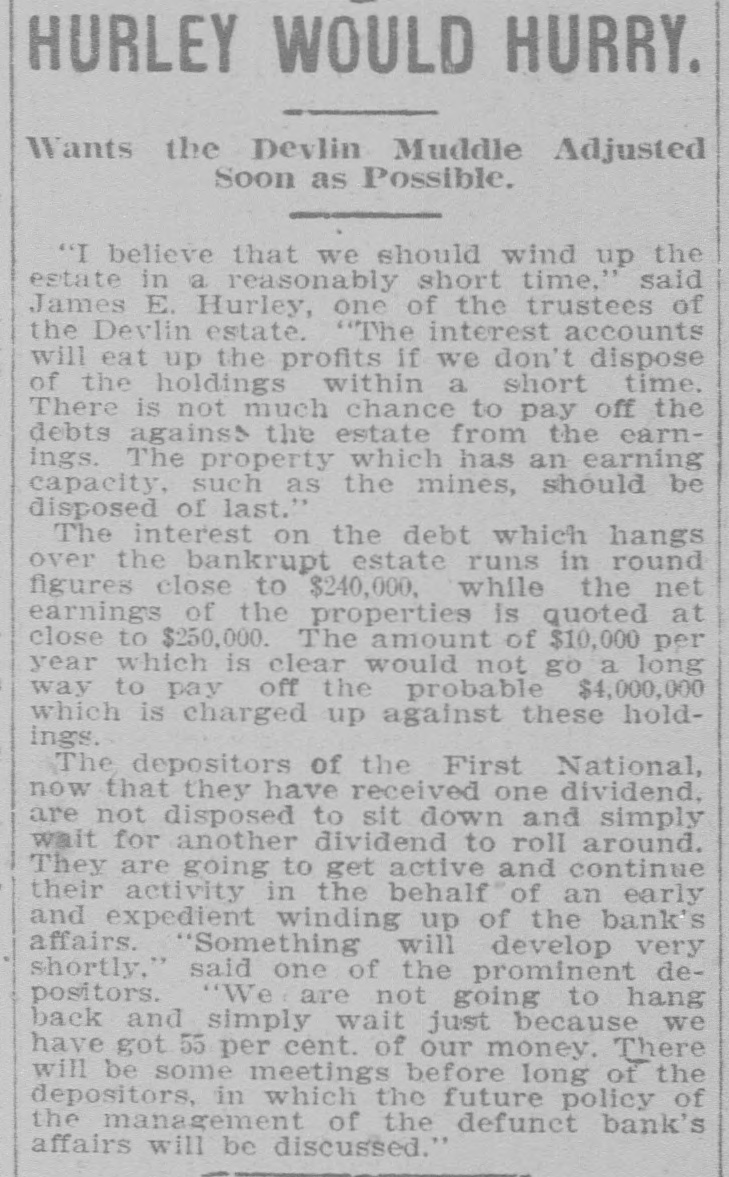
HURLEY WOULD HURRY.
Wants the Devlin Muddle Adjusted Soon as Possible.
"I believe that we should wind up the estate in a reasonably short time," said James E. Hurley, one of the trustees of the Devlin estate. "The interest accounts will eat up the profits if we don't dispose of the holdings within a short time. There is not much chance to pay off the debts against the estate from the earnings. The property which has an earning capacity, such as the mines, should be disposed of last."
The interest on the debt which hangs over the bankrupt estate runs in round figures close to $240,000, while the net earnings of the properties is quoted at close to $250,000. The amount of $10,000 per year which is clear would not go a long way to pay off the probable $4,000,000 which is charged up against these holdings.
The depositors of the First National, now that they have received one dividend, are not disposed to sit down and simply wait for another dividend to roll around. They are going to get active and continue their activity in the behalf of an early and expedient winding up of the bank's affairs. "Something will develop very shortly," said one of the prominent depositors. "We are not going to hang back and simply wait just because we have got 55 per cent. of our money. There will be some meetings before long of the depositors, in which the future policy of the management of the defunct bank's affairs will be discussed."
23.June 19, 1906Rock Island ArgusRock Island, IL
Click image to open full size in new tab
Article Text
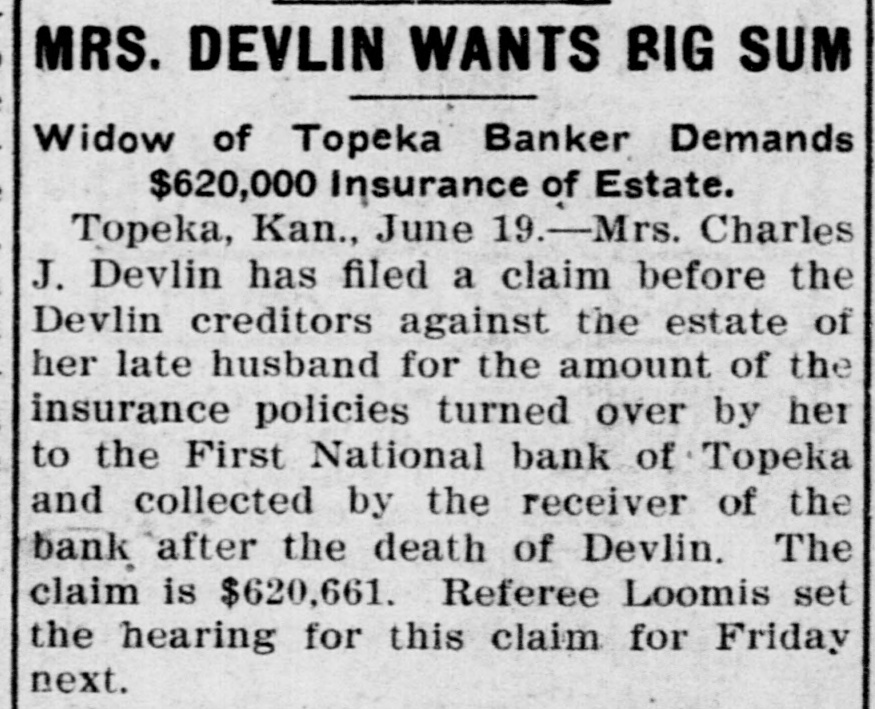
MRS. DEVLIN WANTS BIG SUM
Widow of Topeka Banker Demands $620,000 Insurance of Estate.
Topeka, Kan., June 19.-Mrs. Charles J. Devlin has filed a claim before the Devlin creditors against the estate of her late husband for the amount of the insurance policies turned over by her to the First National bank of Topeka and collected by the receiver of the bank after the death of Devlin. The claim is $620,661. Referee Loomis set the hearing for this claim for Friday next.
24.August 22, 1907The Globe-RepublicanDodge City, KS
Click image to open full size in new tab
Article Text
Rock Island passenger train
A Fortune From England.-Mrs. K. A. Bathurst of Horton is in receipt of intelligence that she is one of the heirs to a big estate in England and that her share will be $120,000. It is said the matter is now all settled and that the money will be forthcoming within a month. Cuts the Internal Revenue.-Because of the crusade of Attorney General Jackson against the breweries the internal revenue receipts for Kansas. according to Collector James Simpson. are $1.000 less for the month of July this year. than they were in July. 1906. The big per cent of this $1.000 decrease is ascribed to Kansas City, Kas. Plaintiffs Attach Brewery Property. -The supreme court has permitted Emma Bair and Martha Smith to file attachment claims on property of the Val Blatz Brewing Company in this state. subject to the receivers. These women sued the Val Blatz and other brewing companies for damages over a murder which took place in a North Topeka drinking resort. Receivers Got $3.750.-The Anheuser-Busch Brewing Company has surrendered completely to the ouster action brought against it by the attor ney general by paying up full costs assessed against it. summing up a tot al of $3,977.08. Of this sum, the three receivers got jointly $3,750. The expenses were $100: depositions, $107.98: sheriff fees, $2.70; court costs $16.40. Last Dividend Paid.-The checks for the payment of the last dividend of 12 per cent to the depositors of the First National bank at Topeka, which failed in the Devlin crash. have been filled out and forwarded to the comp. troiler at Washington. He will in spect and sign the checks and return them to Topeka. The money will probably be available within a few days. G. A. R. has a Grievance.-The G A. R. of Kansas has filed a complaint before the interstate commerce commission alleging discrimination against the rates granted them to Saratoga for the national encampment and in favor of the Jamestown rates. Not enough stopover privileges. it is alleged. are granted while the Jamestown trip is favored in that manner. Nebraska joined the Kansas complaint. Fifty Counties Crimeless. - Fifty counties in Kansas sent no prisoners to the state penitentiary during the past fiscal year. according to the report of expenses for the conveyance of prisoners to Lansing. The total cost per diem for expenses. guards and board of prisoners was $4,700. A total of 207 prisoners were sent to the penitentiary during the year. Wyandotte had the largest number, twenty; Montgomery was next with fifteen; Geary third with ten. Gift Larger than She Knew.-Mrs. Fanny Murray, of Lancaster, Atchison county, died three years ago. leaving/a lot in Can Diego, Cal., and two lots in Middleton. Cal., to the Women's Home Missionary Society of the Kansas conference of the Methodist Episcopal church and to the Women's Foreign Missionary society of the Methodist Fpiscopal church of New York. At the time of her death the lot in San Diego was believed to be worth about $3,000, but it sold last week for $20,000. Harvester Wore Low Shoes.-Jack Kyle, a St. Louis clerk, wore loose, low shoes while at work in the harvest fields in Kansas recently. His feet became badly blistered and bruised from striking the stubble. After working a week his right foot became swollen and blood poisoning set in. He is now at the Topeka Provident Association' hospital and the doctors fear his leg may have to be amputated. State Loans Money.-The state of Kansas has loaned $971.000 to banks of the state under the depository system. The highest rate of interest offered was 3½ per cent, by the Northup National bank, of Iola. Seventyseven banks bid for the money. It was given to thirty. The Commercial National bank of Kansas City, and
Bank runs are almost always and everywhere a deterioration of bank fundamentals.
But not for you.
You are the measure-zero exception: great fundamentals, solid bank, and yet the Diamond Dybvig fairy spread its rumor. Depositors woke up. Your collateral was not prepositioned. The Clearinghouse had it for you.
Do not pass Go. Do not collect $200. Go directly to jail… or worse.