Fourth National Bank (Chicago, IL)

Episode Information

Episode UID
27600885
Episode Type
Suspension β†’ Reopening
Bank Type
national
Bank ID
2760 national
Charter Number
276
Start Date
September 25, 1873
Location
Chicago, Illinois (41.850, -87.650)

Metadata

Model
gpt-5-mini (chosen from majority vote of a three-model LLM ensemble)
Short Digest
3a2147a4d0fb4e05

Response Measures

None

Receivership Details

Depositor recovery rate
51.0%
Date receivership started
1876-02-02
Date receivership terminated
1886-03-04
OCC cause of failure
Losses
Share of assets assessed as good
12.1%
Share of assets assessed as doubtful
58.5%
Share of assets assessed as worthless
29.4%

Events (4)

1. February 24, 1864 Chartered
Source
historical_nic
2. September 25, 1873 Suspension
Cause
Macro News
Cause Details
Coordinated suspension by Chicago banks amid the nationwide financial panic of September 1873 (Clearing-house arrangements to delay large withdrawals).
Newspaper Excerpt
Telegrams received here this afternoon, announce that all the Chicago banks have suspended.
Source
newspapers
3. October 14, 1873 Reopening
Newspaper Excerpt
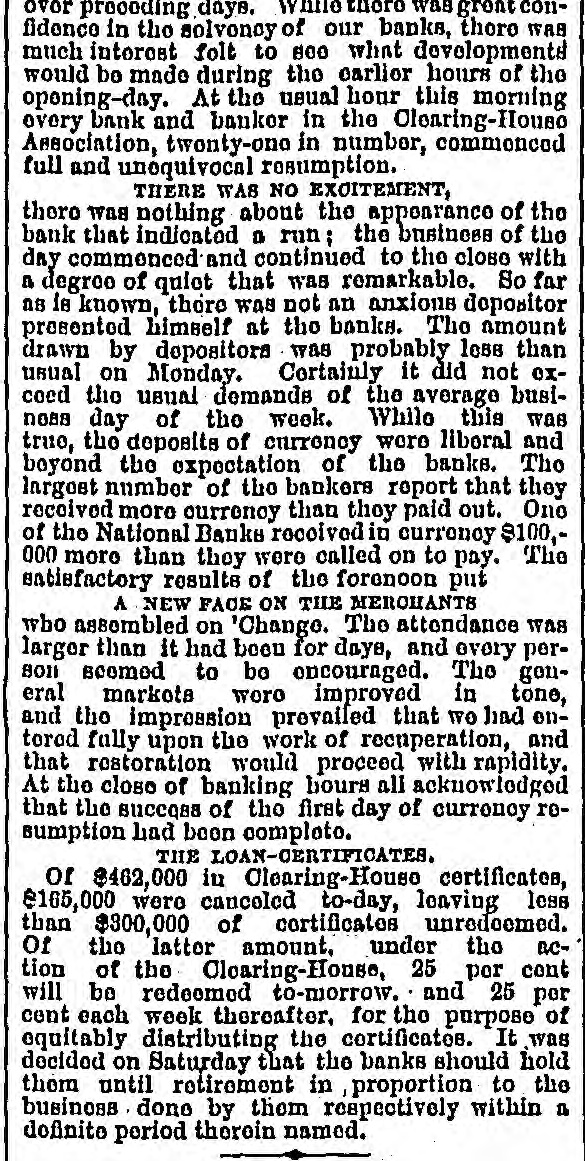
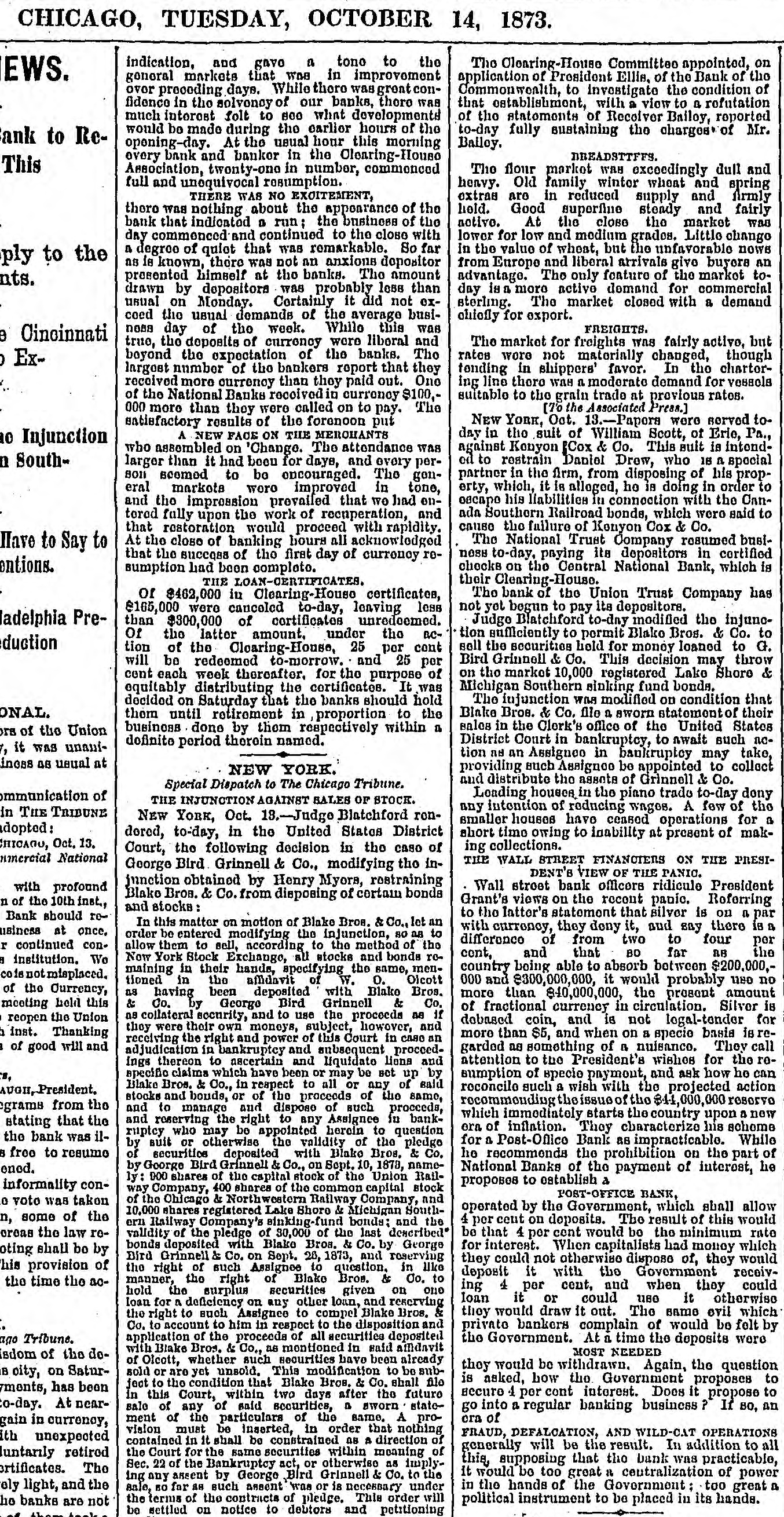
every bank and banker in the Clearing-House Association, twenty-one in number, commenced full and unequivocal resumption. THERE WAS NO EXCITEMENT, ... the success of the first day of currency resumption had been complete. (Chicago Tribune, Oct 14, 1873).
Source
newspapers
4. February 2, 1876 Receivership
Source
historical_nic

Newspaper Articles (14)

Article from The Daily State Journal, October 16, 1871

Click image to open full size in new tab

Article Text

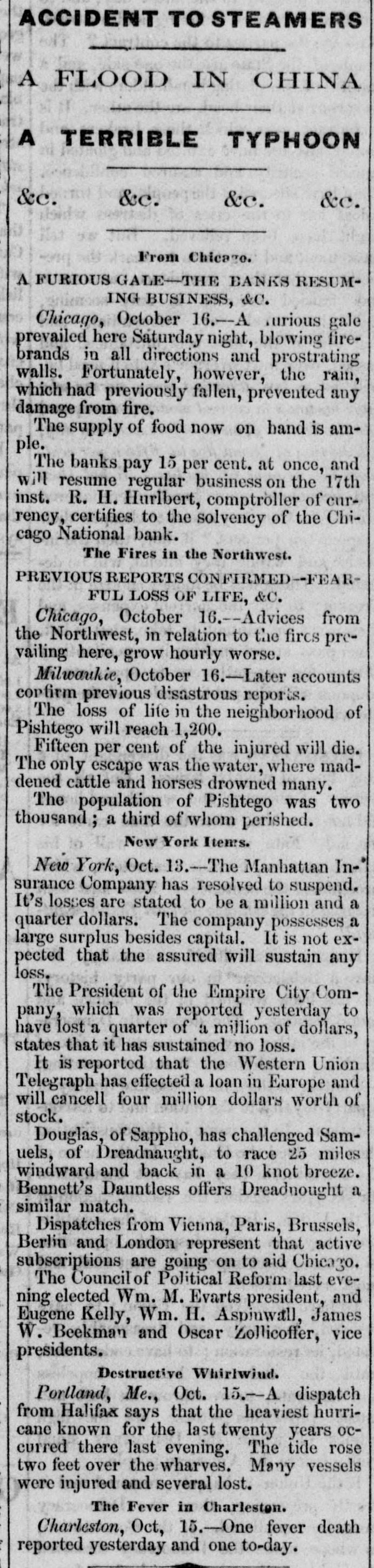
ACCIDENT TO STEAMERS A FLOOD IN CHINA A TERRIBLE TYPHOON &c. &c. &c. &c. From Chicago. A FURIOUS GALE-THE BANKS RESUMING BUSINESS, &C. Chicago, October 16.-A urious gale prevailed here Saturday night, blowing firebrands in all directions and prostrating walls. Fortunately, however, the rain, which had previously fallen, prevented any damage from fire. The supply of food now on hand is ample. The banks pay 15 per cent. at once, and will resume regular business on the 17th inst. R. H. Hurlbert, comptroller of currency, certifies to the solvency of the Chicago National bank. The Fires in the Northwest. PREVIOUS REPORTS CONFIRMED-FEARFUL LOSS OF LIFE, &C. Chicago, October 16.--Advices from the Northwest, in relation to the fircs prevailing here, grow hourly worse. Milwaukie, October 16.-Later accounts corfirm previous disastrous reports. The loss of life in the neighborhood of Pishtego will reach 1,200. Fifteen per cent of the injured will die. The only escape was the water, where maddened cattle and horses drowned many. The population of Pishtego was two thousand; a third of whom perished. New York Items. New York, Oct. 13.-The Manhattan Insurance Company has resolved to suspend. It's losses are stated to be a million and a quarter dollars. The company possesses a large surplus besides capital. It is not expected that the assured will sustain any loss. The President of the Empire City Company, which was reported yesterday to have lost a quarter of a million of dollars, states that it has sustained no loss. It is reported that the Western Union Telegraph has effected a loan in Europe and will cancell four million dollars worth of stock. Douglas, of Sappho, has challenged Samuels, of Dreadnaught, to race 25 miles windward and back in a 10 knot breeze. Bennett's Dauntless offers Dreadnought a similar match. Dispatches from Vienna, Paris, Brussels, Berlin and London represent that active subscriptions are going on to aid Chicago. The Council of Political Reform last evening elected Wm. M. Evarts president, and Eugene Kelly, Wm. H. Aspinwall, James W. Beekman and Oscar Zollicoffer, vice presidents. Destructive Whirlwind. Porlland, Me., Oct. 15.-A dispatch from Halifax says that the heaviest hurricane known for the last twenty years occurred there last evening. The tide rose two feet over the wharves. Many vessels were injured and several lost. The Fever in Charleston. Charleston, Oct, 15.-One fever death reported yesterday and one to-day.


Article from The Daily State Journal, October 18, 1871

Click image to open full size in new tab

Article Text

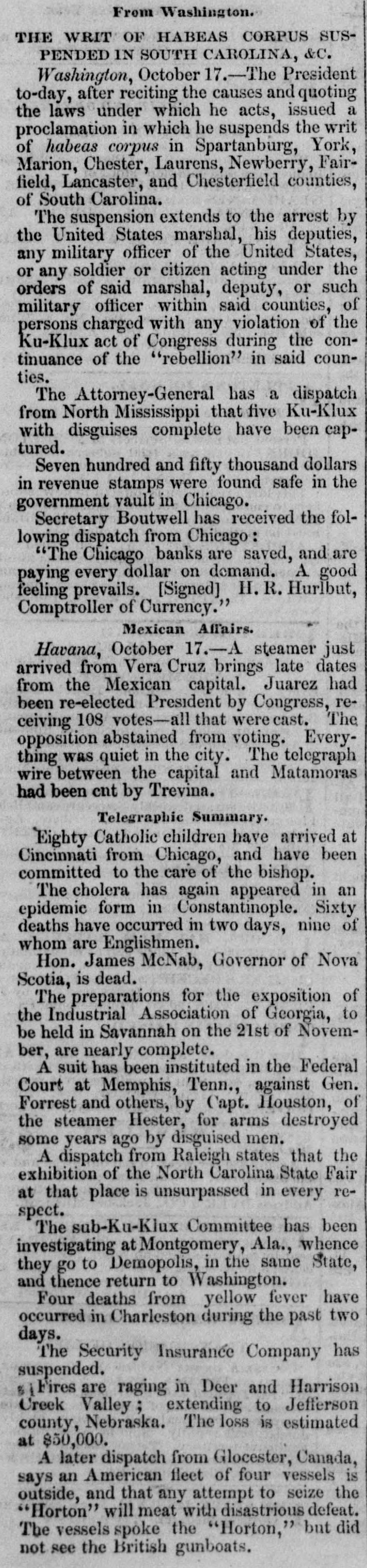
# THE WRIT OF HABEAS CORPUS SUSPENDED IN SOUTH CAROLINA, &C. Washington, October 17.--The President to-day, after reciting the causes and quoting the laws under which he acts, issued a proclamation in which he suspends the writ of habeas corpus in Spartanburg, York, Marion, Chester, Laurens, Newberry, Fairfield, Lancaster, and Chesterfield counties, of South Carolina. The suspension extends to the arrest by the United States marshal, his deputies, any military officer of the United States, or any soldier or citizen acting under the orders of said marshal, deputy, or such military officer within said counties, of persons charged with any violation of the Ku-Klux act of Congress during the continuance of the "rebellion" in said counties. The Attorney-General has a dispatch from North Mississippi that five Ku-Klux with disguises complete have been captured. Seven hundred and fifty thousand dollars in revenue stamps were found safe in the government vault in Chicago. Secretary Boutwell has received the following dispatch from Chicago: "The Chicago banks are saved, and are paying every dollar on demand. A good feeling prevails. [Signed] H. R. Hurlbut, Comptroller of Currency." Mexican Affairs. Havana, October 17.-A steamer just arrived from Vera Cruz brings late dates from the Mexican capital. Juarez had been re-elected President by Congress, receiving 108 votes-all that were cast. The opposition abstained from voting. Everything was quiet in the city. The telegraph wire between the capital and Matamoras had been cut by Trevina. Telegraphic Summary. Eighty Catholic children have arrived at Cincinnati from Chicago, and have been committed to the care of the bishop. The cholera has again appeared in an epidemie form in Constantinople. Sixty deaths have occurred in two days, nine of whom are Englishmen. Hon. James McNab, Governor of Nova Scotia, is dead. The preparations for the exposition of the Industrial Association of Georgia, to be held in Savannah on the 21st of November, are nearly complete. A suit has been instituted in the Federal Court at Memphis, Tenn., against Gen. Forrest and others, by Capt. Houston, of the steamer Hester, for arms destroyed some years ago by disguised men. A dispatch from Raleigh states that the exhibition of the North Carolina State Fair at that place is unsurpassed in every respect. The sub-Ku-Klux Committee has been investigating at Montgomery, Ala., whence they go to Demopolis, in the same State, and thence return to Washington. Four deaths from yellow fever have occurred in Charleston during the past two days. The Security Insurance Company has suspended. Fires are raging in Deer and Harrison Creek Valley; extending to Jefferson county, Nebraska. The loss is estimated at $50,000. A later dispatch from Glocester, Canada, says an American fleet of four vessels is outside, and that any attempt to seize the "Horton" will meat with disastrious defeat. The vessels spoke the "Horton," but did not see the British gunboats.


Article from Litchfield Enquirer, October 26, 1871

Click image to open full size in new tab

Article Text

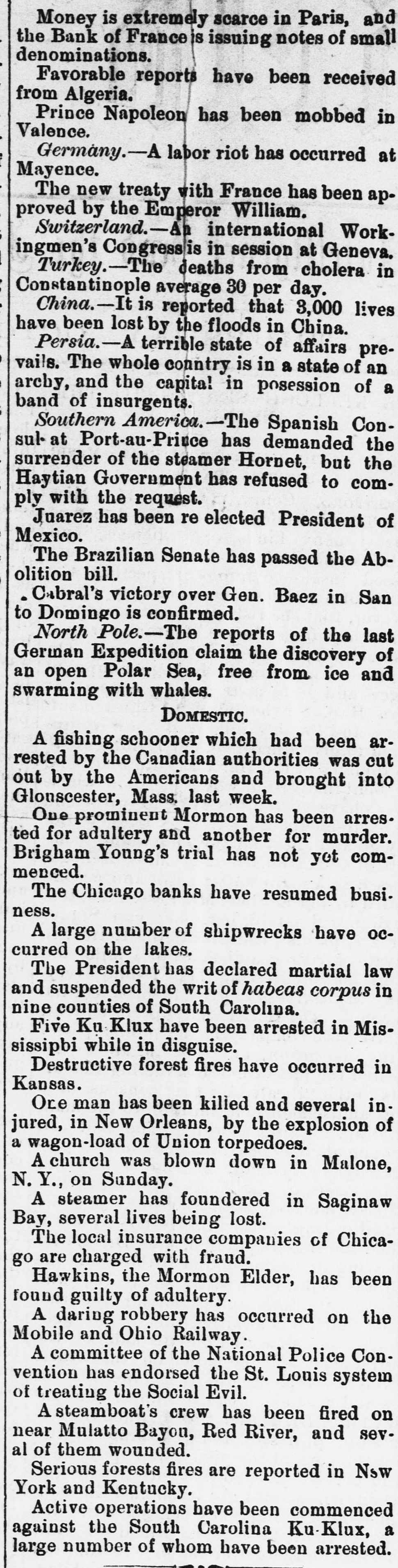
Money is extremely scarce in Paris, and the Bank of France is issuing notes of small denominations. Favorable reports have been received from Algeria. Prince Napoleon has been mobbed in Valence. Germany.-A labor riot has occurred at Mayence. The new treaty with France has been approved by the Emperor William. ; Switzerland.-An international Workingmen's Congressis in session at Geneva. Turkey.-The deaths from cholera in Constantinople average 30 per day. China.-It is reported that 3,000 lives have been lost by the floods in China. Persia.-A terrible state of affairs pre) vails. The whole country is in a state of an arcby, and the capita! in posession of a band of insurgents. Southern America.-The Spanish Consul at Port-au-Priuce has demanded the surrender of the steamer Hornet, but the Haytian Government has refused to comply with the request. Juarez has been re elected President of Mexico. The Brazilian Senate has passed the Abolition bill. . Cabral's victory over Gen. Baez in San to Domingo is confirmed. North Pole.-The reports of the last German Expedition claim the discovery of an open Polar Sea, free from ice and swarming with whales. DOMESTIC. A fishing schooner which had been arrested by the Canadian authorities was cut out by the Americans and brought into Glouscester, Mass. last week. One prominent Mormon has been arres. ted for adultery and another for murder. Brigham Young's trial has not yet commenced. The Chicago banks have resumed business. A large number of shipwrecks have occurred on the lakes. The President has declared martial law and suspended the writ of habeas corpus in nine counties of South Carolina. Five Ku Klux have been arrested in Mississipbi while in disguise. Destructive forest fires have occurred in Kansas. One man has been killed and several injured, in New Orleans, by the explosion of a wagon-load of Union torpedoes. A church was blown down in Malone, N. Y., on Sunday. A steamer has foundered in Saginaw Bay, several lives being lost. The local insurance companies of Chicago are charged with fraud. Hawkins, the Mormon Elder, has been found guilty of adultery. A daring robbery has occurred on the Mobile and Ohio Railway. A committee of the National Police Convention has endorsed the St. Louis system of treating the Social Evil. Asteamboat's crew has been fired on near Mulatto Bayon, Red River, and seval of them wounded. Serious forests fires are reported in Nsw York and Kentucky. Active operations have been commenced against the South Carolina Ku-Klux, a large number of whom have been arrested.


Article from New-York Tribune, December 2, 1872

Click image to open full size in new tab

Article Text

THE CURRENCY. We complete to-day our extracts from the annual report of the Controller of the Currency, of which we printed a portion on Saturday. The limit of the National Bank issues in each State and Territory is fixed on the basis of population. resources, businees, and bank capital, as ascertained by the census. The last census required a new apportionment, as it showed a total increase in the population of the Union of more than 7,000,000 persons, and in wealth of nearly $14,000,000,000. An act was accordingly passed providing for an additional issue of $54,000,000. Of this the largest sum, $8,400,000, apportioned to any State, went to Illinois; Ohio and Kentucky each got over $5,000,000; Indiana, $4,000,000; Michigan and Louisiana each over $3,000,000; the distribution being made one-half on the population and one-half on the wealth of the country. It will be noticed that the increase all goes to the South and West, and more is yet needed to give those sections their due apportionment; to accomplish this, $25,000,000 is to be withdrawn and redeemed from the circulation of banks in New-York and New-England, and a corresponding amount authorized to banks in States that have not now their quota. It is a commonly received but somewhat erroneous opinon that the amount of currency in the hands of each individual member of the community has been on the average largely increased by the National Bank system; but this report only gives it now as, for the whole United States, $9 18 per capita, against $7 59 before National Banks existed: but the circulation of U. S. Treasury notes should be added before any conclusion is reached from these figures. The State of Rhode Island has the largest per capita circulation: $61 56; Mississippi the least:-one centexcept Florida and California, which have none. New-York has but $14 08. The National Banks have paid in the last eight years some $40,000,000 taxes to the United States; their State and national taxes for four specified years together amount to $71,000,000. The bank dividends are not so large on the average as is generally supposed: they do not exceed in the aggregate those of the old State banks; for the whole Union they but slightly exceed five per cent on invested capital. The great question of the proper reserve to be held by the National Banks is discussed in this report, and the conclusion reached that it is only the smaller and weaker banks that want to go below the present limit. Their necessities arise from putting out their funds at interest on deposit with Eastern banks-a condition which has more than once given riso to the most serious financial convulsions, as in 1857 - and a remedy proposed by the Controller is the issue of a new security by Government which will afford these banks the needful investment at interest. Not the least interesting feature of this report is the announcement that the Chicago banks, 80 far from being crippled as was anticipated after the fire by losses on discounted paper and the withdrawal of their balances, in point of fact steadily increased in business and profit, after resuming without embarrassment as soon as their safes were cool. There is a similar prospect in Boston, where the aggregate losses since the fire on bills receivable are estimated at less than three millions of dollars, which the bank surpluses will cover without touching capital or reserve. The question of usury is discussed. It appears that the penalty for its practice by National Banks is not clearly defined, and the Controller therefore declines to institute proceedings concerning it. A general law for the establishment of Savings Banks in the District of Columbia seems desirable. Locking up greenbacks is reprehended, and the New-York Stock Board and Clearing House are asked to discourage it. A table of the specie kept on hand by the banks shows it as less in October last than in many years before; as $10,000,000 against a usual average of $25,000,000. In the few cases of failure among the National Banks, the unfortunate institutions seem to be wound up with less ruinous loss to depositors and stockholders than has ever been re-


Article from The Rock Island Daily Argus, September 25, 1873

Click image to open full size in new tab

Article Text

# Banks In Chicago all Suspended. Telegrams received here this afternoon, announce that all the Chicago banks have suspended. This is probably by a united agreement to suspend until some plan of action can be agreed on. Things look blue, and there is great probability that the panic will become general and extend all over the country.


Article from The True Northerner, September 26, 1873

Click image to open full size in new tab

Article Text

# True Northerner. PAW PAW, MICHIGAN, Sept. 26, 1873. # Local Department. Hon. Wilder D. Foster, Representative in Congress from the Fifth District of Michigan, died in Grand Rapids Sept. 20. H. P. McFarlin will hold an Auction Sale at the residence of Fdward Stowman, two miles north-west of Glendale P. O., Oct. 11. We advise every young man or lady who wish to qualify for business to attend the Kalamazoo Business College. The Ann Arbor Courier says the seating capactity of the new University Hall is 3,000, and by the use of temporary seats 4,000 can be accommodated. Charles Smolk has removed his Sewing Machine Depot to the new building on the corner of Main and Niles streets, adjoining the residence of T. A. Granger. The Fair of the Paw Paw Valley Agricultural Society commenced last Wednesday and closed to-day. We will give a more extended notice of it in our next issue. REV. R. C. WELCH, who has been assigned by the Michigan Conference to the charge of the M. E. Church in this place for the ensuing year. preached his first sermon on Sunday morning last. All the Banks of Chicago entered into an arrangement by which they closed their doors yesterday morning, and take thirty days in which to pay depositors. A genral derangement of business must be the result. The South Haven Sentinel says: "The condition of religion is good." That is just as we had supposed, and we are right glad to see that fact verified in so public a manner, for the past season has been unusually sickly. The Government Printing office in the City of Washington, in the Territory of Columbia, is one of the largest printing offices in the world. Six colored compositors are employed at the case in that concern. The Lapeer Clarion wants the fat men to stand back in future and give the lean men of the State a chance to hold a convention and get a good, square meal out of East Saginaw or some other philanthropic city. At a public gathering lately one of the gentlemen present was called upon for a speech, and this is how he responded: "Gentlemen and women, I ain't no speecher. More'n 20 years ago I came here a poor idiot boy, and now what are I?" On Saturday last, Miss Emma Pugsley left for Ann Arbor to enter the State University. She is a graduate of the school here, and is an excellent scholar. There are now two young ladies attending the University from this village, the other being Mies Emma Andrews. who has been there for the past two years. The Circuit Court has been in session during the past week. On Monday the Matteson case came up on a motion for change of venue, which motion, after a hearing and the reading of affidavits in support of the motion and counter affidavits opposed to it, was denied. The time for the trial will probably be set down for the next term of the Court. The most important other matter before the Court was a case between A. M. Merrifield and Philo Reed. LAWRENCE, Sept. 16, 1873. TRUE NORTHERNER: DEAR. SIR, I have been away all summer, and have but just returned. The first newspaper I saw after getting home was yourself going "Up in a Balloon." If a little money will save you, the enclosed Two Dollars will help. Keep the thing flying till they all respond, and keep the paper coming. Can't keep house without it. Yours Truly, The State Fair, held at Grand Rapids last week, was a success as regards the magnitude of the exhibition in all its departmentst-he Lumber of people who attended and financially. We learn that the receipts exceeded thirty thousand dollars. Our own Van Buren County maintained the ascendency she had heretofore attained. She bore off the highest prize for her County Collection of Fruit; the township of South Haven took the first prize for her Township collection of Fruit; and the Williams' process for evaporating fruit was pronounced superior to the Alden process. Mr. Williams. the inventor, is a resident and fruit grower of South Haven, in this countv. Our worthy and honored friend. Judge Monroe. met with a very serious mishap on Saturday night last, by which he is now lying in a critical condition. He had arrived here on the nine o'clock train on his way home from Grand Rapids, where he had been attending the State Fair. He started for his home, aboat eight miles from town, on foot and leading a ball by a cord attached to a ring in his nose. When about one-half mile from town the bull became somewhat refractory and refused to go. the Judge meanwhile pulling him along by the cord, when the animal suddenly attacked nim, throwing him to the ground and trampling him under his feet, bruising and lacerating him very seriously about the chest, side and bowels. fter becoming released the Judge crawled to the house of Mr. Clancy and aroused the inmates. who took him in and cared for him until he was taken home, Sunday morning. Ir not unfrequently happens that a party political convention is moved to deliberately falsify history in their platforms, declarations and resolves, as was the case of the Ohio in ther recant numatform adopted by


Article from Chicago Daily Tribune, September 30, 1873

Click image to open full size in new tab

Article Text

LAWRENCE, KS. Special Dispatch to The Chicago Tribune. LAWRENCE, Ks., Sept. 20.-Financial matters are looking brighter. The news of resumption by the Chicago banks is hailed with delight. Our banks have paid without suspension through the panic.


Article from Chicago Daily Tribune, September 30, 1873

Click image to open full size in new tab

Article Text

SAN FRANCISCO. Special Dispatch to The Chicago Tribune. SAN FRANCISCO, Sept. 20.-To-day was devoted almost exclusively to collections and legitimate channels, and the result inspirod confidence. Tho resumption of business by the Chicago banks was the subject of much congratulation, showing the panic had no serious effects on Western finance and stability. This, with the promptness with which to-day's matured obliga- tions were mot, has reopened the current of exchange, which resumed with some briskness. Coin drafts on New York sold at ΒΎ to 1 por cent; telegraphic transfers at 2 por cent. The panic has fully demonstrated the unadvisability of stock speculations. Capitalists are more unwilling than ever to invest in outside real estate, preferring legitimate enter- prises and staple products. The panic is charged


Article from Wood County Reporter, October 2, 1873

Click image to open full size in new tab

Article Text

the 24th, the authorities had been disappointed at the renewal of the financial trouble in New York on that day. It was reported that the Secretary of the Treasury had telegraphed to the President that, in his judgment, the purchase of bonds should cease whenever the amount of currency used should reach $12,000,000. The President had not replied to this dispatch. An application had been made to the Secretary by leading financial men to anticipate the redemption of the $20,000,000 of five per cent. gold bonds falling due in January next. A Milwaukee (Wis.) dispatch of the 24th says the Chamber of Commerce of that city had suspended operations, and that there would be no trading in grain until further notice. A telegram from Wilkesbarre, Pa., of the 24th announced that Brown & Gary, bankers of that city, had suspended. A Baltimore dispatch of the 24th announced that all the banks of the city had stopped currency payment. Brown, Lancaster & Cowell, agents of the Chesapeake & Ohio Railway, having houses in Baltimore, New York and Richmond, had also suspended. Little Rock, Ark., dispatches of the 24th say the money panic in that city continued, caused not so much by Eastern financial complications as by the refusal of the city banks to take the shinplasters that have been current there. According to a dispatch from Richmond, Va., the Richmond Dollar Savings Bank had suspended, and Taylor & Williams, bankers, had failed. A dispatch to the Associated Press, from Brownsville, Texas, of September 24, says that a series of butcheries and robberies had recently been committed in Mexico, the victims in every case being Americans. The perpetrators of these crimes were arrested, and their guilt fully established, yet not one of them had been punished, the authorities being either indifferent or powerless. The facts had been reported by the Consuls to Washington, in the hopes that redress would be demanded. Information had been received at Washington, on the 24th, that Collector Weidner, of the Second District of Alabama, was a defaulter to the amount of $20,000. Orders had been issued for his arrest. The wheat crop, according to the returns to the statistical division of the Agricultural Department, published on the 24th, presented an average of 95, which is about the same as the September report of 1872. The area of cultivation had been much larger this year than last. The Chicago Journal of the 25th says that it had become necessary to say that the banks of Chicago had not suspended payment or closed their places of business. The action of the preceding night was not in consequence of a panic but to prevent a panic. They had not ceased business, were continuing to receive deposits and pay out such sums as might be needed for ordinary business transactions, but where sums were demanded to hoard or withdrawn from business operations they had resolved to delay the payment of these until the financial storm had passed. The currency stringency in that city had had the effect to bring the extensive hog and cattle trade to a stand still, it being impossible to make cash sales. The Union Live Stock Yards contained 30,000 hogs and 10,000 head of cattle, all that the yards could possibly accommodate, and the live stock commission merchants had notified the railroads and country shippers that no more live stock would be received until further notice. According to a dispatch to the Associated Press the Cincinnati Clearing-House Association had adopted on the 25th a resolution substantially the same as that adopted on the 24th by the banks of Chicago. A dispatch from Kansas City, Mo., of the 25th, says that the banks of that city had suspended. A Memphis dispatch of the 25th says that the First National and De Soto banks, of that city, had closed their doors. There was great excitement in that city in consequence. A New York dispatch of the 25th says the day has been a comparatively quiet one in Wall street. The means of relief adopted by the banks in effecting bank clearances by loan certificates had eased the pressure on themselves but had not materially aided others. The extreme caution of those institutions, and their anxiety to protect themselves, had added largely to the actual scarcity of money, and there were grievous complaints from the great commercial world and the Produce Exchange in particular. Earnest appeals had been made to the Government for relief, and resolutions had been adopted by the Produce Exchange suggesting to the Treasurer the issue of currency to the banks and bankers on evidence that gold had been deposited in the Bank of England to the credit of the United States to be used only in buying exchange. The breadstuffs market was still under the influence of the block in exchange. A Washington dispatch of the 25th says that the President had returned to that city permanently. At a consultation held between the President, the Secretary of the Treasury and the Attorney-General, the latter officer held that the bonds of 1874 could not be redeemed legally before maturity. It was therefore decided that the Treasury could take no further steps to relieve the New York market, except as it was affected by the regular transactions of the department. Dr. Linderman, the Director of the Bureau of the Mint, had predicted that the effect of the stock panic would be to hasten the resumption of specie payments. He said that within a month, it was his belief, that silver and gold coin would be a medium of circulation at currency rates. In anticipation of this result, he had ordered the mints to largely increase the coinage, and stated that more bullion would be coined during the next three months than at any previous time in the same period. Secretary Richardson had stated that it would be a good policy for all the banks to suspend further currency payments. It was rumored, in Washington, on the 25th, that the President had been advised to call an extra session of Congress. A dispatch from St. Louis, of the 25th, says that the banks of that city had held a meeting on the evening of that day and resolved to


Article from Burlington Weekly Free Press, October 3, 1873

Click image to open full size in new tab

Article Text

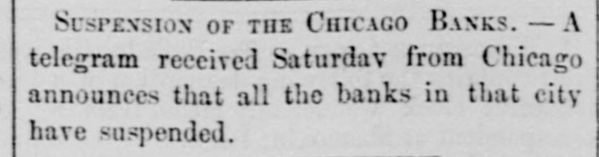
SUSPENSION OF THE CHICAGO BANKS. - A A telegram received Saturday from Chicago announces that all the banks in that city have suspended.


Article from Chicago Daily Tribune, October 14, 1873

Click image to open full size in new tab

Article Text

ovor proceding days. While thero was gront con- fidence in the solvency of our banks, thoro was much intorost folt to see what developments would be made during the carlior hours of the oponing-day. At the usual hour this morning overy bank and banker in the Olearing-Houso Association, twonty-ono in number, commenced full and unequivocal resumption. # THERE WAS NO Ξ•Ξ§ΞŸΞ™Ξ€Ξ•MENT, thero was nothing about the appearance of the bank that indicated a run; the business of the day commenced and continued to the close with a degroo of quiet that was remarkable. So far as is known, there was not an anxions depositor presented himself at the banks. The amount drawn by depositora was probably less than usual on Monday. Cortainly it did not ex- coed the usual demands of the average busi- noss day of the week. While this was true, the deposits of currency were liboral and boyond the expectation of the banks. Tho largost number of the bankers report that they recoived more currency than they paid out. Ono of the National Banks received in currency $100,- 000 more than they were called on to pay. The entisfactory results of the forenoon put # A NEW FACE ON THE MEROHANTS who assembled on 'Change. The attendance was larger than it had been for days, and overy per- son seemed to be encouraged. The gen- eral markots woro improved in tone, and the impression prevailed that we had en- torod fully upon the work of recuperation, and that restoration would proceed with rapidity. At the close of banking bours all acknowlodged that the success of the first day of curronoy ro- sumption had been comploto. # THE LOAN-CERTIFICATES. Of $462,000 in Clearing-House certificates, $165,000 wero canceled to-day, leaving less than $300,000 of cortificates unredeemed. Of the lattor amount, under the ac- tion of the Clearing-House, 25 por cont will be redeemed to-morrow. and 25 per cent each week thereafter, for the purpose of equitably distributing the cortificatos. It was decided on Saturday that the banks should hold them until retirement in proportion to the business done by them respectively within a definite period theroin named.


Article from Chicago Daily Tribune, October 14, 1873

Click image to open full size in new tab

Article Text

CHICAGO, TUESDAY, OCTOBER 14, 1873. NEWS. indication, and gave a tone to the general markets that was in improvement over preceding days. While there was great con- fidence in the solvency of our banks, there was much interest felt to see what developments would be made during the earlier hours of the Bank to Re- opening-day. At the usual hour this morning This every bank and banker in the Clearing-House Association, twenty-one in number, commenced full and unequivocal resumption. THERE WAS NO EXCITEMENT, there was nothing about the appearance of the bank that indicated a run; the business of the day commenced and continued to the close with ply to the a degree of quiet that was remarkable. So far nts. as is known, there was not an anxious depositor presented himself at the banks. The amount drawn by depositors was probably less than usual on Monday. Certainly it did not ex- ceed the usual demands of the average busi- noss day of the week. While this was true, the deposits of currency were liberal and boyond the expectation of the banks. The largest number of the bankers report that they received more currency than they paid out. One e Cincinnati of the National Banks received in currency $100,- Ex- 000 more than they were called on to pay. Satisfactory results of the forenoon put A NEW FACE ON THE MERCHANTS who assembled on 'Change. The attendance was larger than it had been for days, and every per- son seemed to be encouraged. The gen- o Injunction eral markets were improved in tone, n South- and the impression prevailed that we had en- tered fully upon the work of recuperation, and that restoration would proceed with rapidity. At the close of banking hours all acknowledged that the success of the first day of currency re- sumption had been complete. THE LOAN-CERTIFICATES. Of $462,000 in Clearing-House certificates, $165,000 were canceled to-day, leaving less Have to Say to than $300,000 of certificates unredeemed. entions. Of the latter amount, under the ac- tion of the Clearing-House, 25 per cent will be redeemed to-morrow, and 25 per cent each week thereafter, for the purpose of equitably distributing the certificates. It was decided on Saturday that the banks should hold them until retirement in proportion to the adelphia Pre- business done by them respectively within a eduction definite period therein named. NEW YORK. Special Dispatch to The Chicago Tribune. THE INJUNCTION AGAINST SALES OF STOCK. NEW YORK, Oct. 13.-Judge Blatchford ren- ONAL. dored, to-day, in the United States District ors of the Union Court, the following decision in the case of , it was unani- George Bird Grinnell & Co., modifying the in- iness as usual at junction obtained by Henry Myers, restraining Blake Bros. & Co. from disposing of certain bonds and stocks: ommunication of In this matter on motion of Blake Bros. & Co., let an in THE TRIBUNE order be entered modifying the injunction, so as to adopted: allow them to sell, according to the method of the CHICAGO, Oct, 13. New York Stock Exchange, all stocks and bonds re- umercial National maining in their hands, specifying the same, men- tioned in the affidavit of W. O. Olcott as having been deposited with Blake Bros. with profound & Co. by George Bird Grinnell & Co. n of the 10th inst., as collateral security, and to use the proceeds as if Bank should re- they were their own moneys, subject, however, and ausiness at once. receiving the right and power of this Court in case an r continued con- adjudication in bankruptcy and subsequent proceed- institution. We ings thereon to ascertain and liquidate liens and cois not misplaced. specific claims which have been or may be set up by of the Currency, Blake Bros. & Co., in respect to all or any of said meeting held this stocks and bonds, or of the proceeds of the same, reopen the Union and to manage and dispose of such proceeds, inst. Thanking and reserving the right to any Assignee in bank- of good will and ruptcy who may be appointed herein to question by suit or otherwise the validity of the pledge of securities deposited with Blake Bros. & Co. Π‘Π², by George Bird Grinnell & Co., on Sept. 10, 1873, name- AUGH, President, ly: 500 shares of the capital stock of the Union Rail- egrams from tho way Company, 400 shares of the common capital stock stating that the of the Chicago & Northwestern Railway Company, and the bank was il- 10,000 shares registered Lake Shore & Michigan South- free to resume ern Railway Company's sinking-fund bonds; and the ened. validity of the pledge of 30,000 of the last described bonds deposited with Blake Bros. & Co. by George informality con- Bird Grinnell & Co. on Sept. 26, 1873, and reserving Le voto was takon the right of such Assignee to question, in like n, some of the manner, the right of Blake Bros. & Co. to creas the law re- hold the surplus securities given on one oting shall bo by loan for a deficiency on any other loan, and reserving "his provision of the right to such Assignee to compel Blake Bros. & the time the ac- Co. to account to him in respect to the disposition and application of the proceeds of all securities deposited with Blake Bros. & Co., as mentioned in said affidavit ago Tribune. of Olcott, whether such securities have been already isdom of the do- sold or are yet unsold. This modification to be sub- s city, on Satur- ject to the condition that Blake Bros. & Co. shall file ments, has been in this Court, within two days after the future Co-day. At near- sale of any of said securities, a sworn state- gain in currency, ment of the particulars of the same. A pro- ith unexpected vision must be inserted, in order that nothing Juntarily retired contained in it shall be construed as a direction of ertificates. The the Court for the same securities within meaning of ely light, and the Sec. 22 of the Bankruptcy act, or otherwise as imply- he banks are not ing any assent by George Bird Grinnell & Co. to the sale, so far as such assent was or is necessary under the terms of the contracts of pledge. This order will be settled on notice to debtors and petitioning The Clearing-House Committee appointed, on application of President Ellis, of the Bank of the Commonwealth, to investigate the condition of that establishment, with a view to a refutation of the statements of Receiver Bailey, reported to-day fully sustaining the charges of Mr. Bailey. DREADSTTFFS. The flour market was exceedingly dull and heavy. Old family winter wheat and spring extras are in reduced supply and firmly hold. Good superfine steady and fairly active. At the close the market was lower for low and medium grades. Little change in the value of wheat, but the unfavorable news from Europe and liberal arrivals give buyers an advantage. The only feature of the market to- day is a more active demand for commercial sterling. The market closed with a demand chiefly for export. FREIGHTS. The market for freights was fairly active, but rates were not materially changed, though tending in shippers' favor. In the charter- ing line there was a moderate demand for vessels suitable to the grain trade at previous rates. [To the Associated Press.] NEW YORK, Oct. 13.-Papers were served to- day in the suit of William Scott, of Erie, Pa., against Kenyon Cox & Co. This suit is intend- ed to restrain Daniel Drew, who is a special partner in the firm, from disposing of his prop- erty, which, it is alleged, he is doing in order to escape his liabilities in connection with the Can- ada Southern Railroad bonds, which were said to cause the failure of Kenyon Cox & Co. The National Trust Company resumed busi- ness to-day, paying its depositors in certified checks on the Central National Bank, which is their Clearing-House. The bank of the Union Trust Company has not yet begun to pay its depositors. Judge Blatchford to-day modified the injunc- tion sufficiently to permit Blake Bros. & Co. to sell the securities held for money loaned to G. Bird Grinnell & Co. This decision may throw on the market 10,000 registered Lake Shore & Michigan Southern sinking fund bonds. The injunction was modified on condition that Blake Bros. & Co. file a sworn statement of their sales in the Clerk's office of the United States District Court in bankruptcy, to await such ac- tion as an Assignee in bankruptcy may take, providing such Assignee be appointed to collect and distribute the assets of Grinnell & Co. Loading houses in the piano trade to-day deny any intention of reducing wages. A few of the smaller houses have ceased operations for a short time owing to inability at present of mak- ing collections. THE WALL STREET FINANCIERS ON THE PRESI- DENT'S VIEW OF THE PANIC. Wall street bank officers ridicule President Grant's views on the recent panic. Referring to the latter's statement that silver is on a par with currency, they deny it, and say there is a difference of from two to four per cent, and that so far as the country being able to absorb between $200,000,- 000 and $300,000,000, it would probably use no more than $40,000,000, the present amount of fractional currency in circulation. Silver is debased coin, and is not legal-tender for more than $5, and when on a specie basis is re- garded as something of a nuisance. They call attention to the President's wishes for the re- sumption of specie payment, and ask how he can reconcile such a wish with the projected action recommending the issue of the $44,000,000 reserve which immediately starts the country upon a new era of inflation. They characterize his scheme for a Post-Office Bank as impracticable. While he recommends the prohibition on the part of National Banks of the payment of interest, he proposes to establish a POST-OFFICE BANK, operated by the Government, which shall allow 4 per cent on deposits. The result of this would be that 4 per cent would be the minimum rate for interest. When capitalists had money which they could not otherwise dispose of, they would deposit it with the Government receiv- ing 4 per cent, and when they could loan it or could use it otherwise they would draw it out. The same evil which private bankers complain of would be felt by the Government. At a time the deposits were MOST NEEDED they would be withdrawn. Again, the question is asked, how the Government proposes to secure 4 per cent interest. Does it propose to go into a regular banking business? If so, an era of FRAUD, DEFALCATION, AND WILD-CAT OPERATIONS generally will be the result. In addition to all this, supposing that the bank was practicable, it would be too great a centralization of power in the hands of the Government; too great a political instrument to be placed in its hands.
Article from The Lambertville Record, October 22, 1873

Click image to open full size in new tab

Article Text

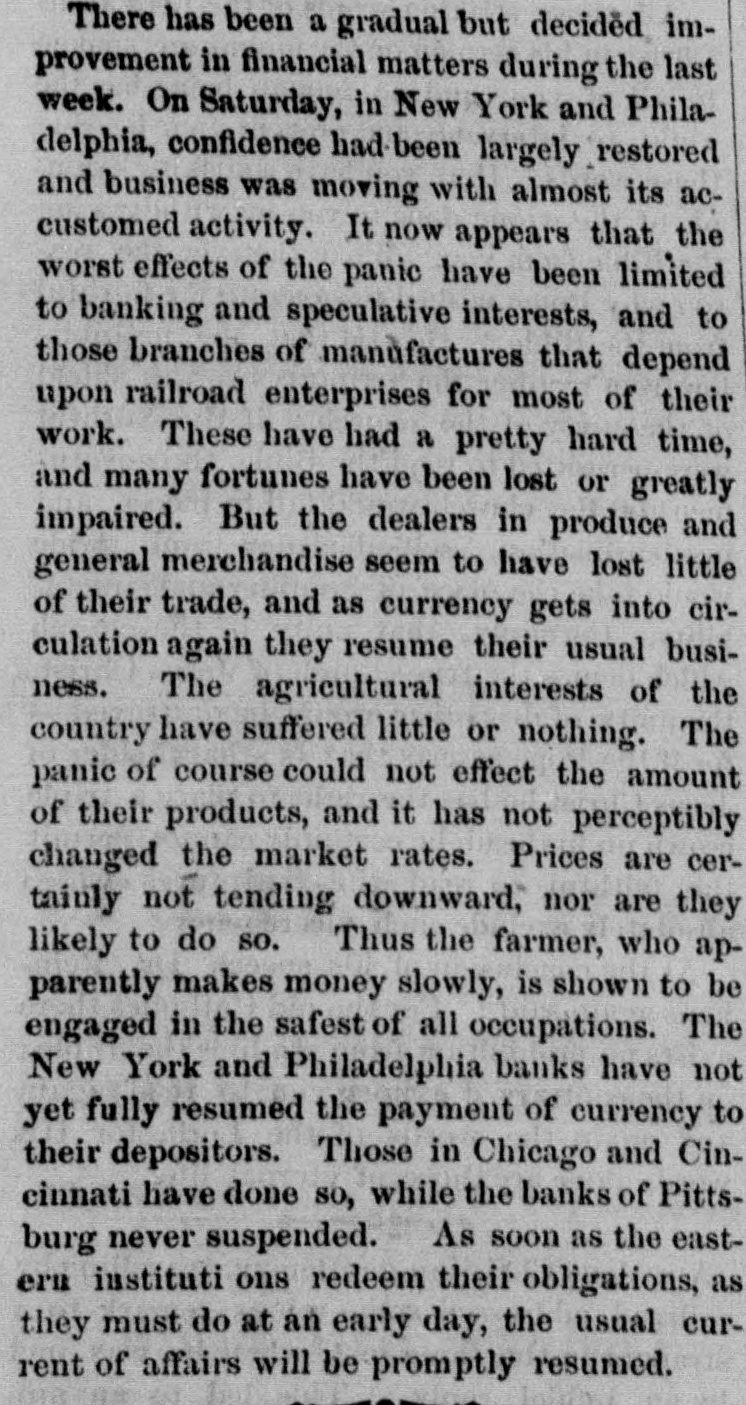
There has been a gradual but decided improvement in financial matters during the last week. On Saturday, in New York and Philadelphia, confidence had-been largely restored and business was moving with almost its accustomed activity. It now appears that the worst effects of the panic have been limited to banking and speculative interests, and to those branches of manufactures that depend upon railroad enterprises for most of their work. These have had a pretty hard time, and many fortunes have been lost or greatly impaired. But the dealers in produce and general merchandise seem to have lost little of their trade, and as currency gets into circulation again they resume their usual business. The agricultural interests of the country have suffered little or nothing. The panic of course could not effect the amount of their products, and it has not perceptibly changed the market rates. Prices are certainly not tending downward, nor are they likely to do so. Thus the farmer, who apparently makes money slowly, is shown to be engaged in the safest of all occupations. The New York and Philadelphia banks have not yet fully resumed the payment of currency to their depositors. Those in Chicago and Cincinnati have done so, while the banks of Pittsburg never suspended. As soon as the eastern instituti ons redeem their obligations, as they must do at an early day, the usual current of affairs will be promptly resumed.


Article from Deseret Evening News, September 16, 1893

Click image to open full size in new tab

Article Text

be right in that there are not fifty who would throw bombs but in times of panic and starvation you cannot tell how soon thousands can be organized into mobs." "What will be the effect of the times on political parties?" "If the hard times continue the Republicans will carry the country by a large majority and if McKinley should carry Ohio by an overwhelming vote the logic of the situation would point to him as our next presidential candidate. If however time should ease up under a revised tariff McKinley could not be nominated as he could be the head of a high protective tariff platform. If ConI gress should repeal the tax on state banks and legislate the national banks out of existence we might have flush times for a year or so and then the trouble would be worse than ever. In such a case the revised tariff might be carried on with apparent prosperity. It is hard to tell what will happen. I am afraid of Congress. If it does nothing times will certainly continue hard. If it does what some of its members wish to do the situation may grow better for a time only to leave us in a worse state than ever. HOW SENATOR CULLOM SAVED A BANK. I here asked Senator Cullom as to the panic of 1873 and his experiences in it. He replied: "I don't think the panic of 1873, or that of 1883 is to be compared to this. I was in business at the time of the panic in 1873. I left Congress in 1871, and was president of a bank in Springfield. We had six or seven banks in the place, and the situation for a time was critical. The New York banks had closed their doors. The banks of St. Louis and Chicago had suspended payment and the bank presidents of Springfield debated for a week whether they should not follow suit. We had meetings every day and every evening of this week up to Friday night, The next day was Saturday and we knew that the farmers would come in from the (country and that many of them would demand their money. At the beginning of the meeting the oldest bank president in the city had made a motion that we all suspend on the morrow. This hung fire until late and at last the chairman said: 'I suppose it is the sense of this meeting that all the banks will be closed tomorrow morning. All this time I had said nothing. I was thinking of the effect of the action upon my political career rather than upon myself as a banker. I was very ambitious and I did not want to appear before the people in the future as the ex president of a bursted bank. I got up and said: 'Gentlemen; I am, I think, the youngest bank president here. My bank has no more capital than the others. I probably know less about banking than any of you, but I say here and now, that rather than close my bank while I have a copper cent to pay out I would put my hand and arm in a red hot stove.' This speech changed the sense of the meeting. It restored con fidence to the others. We decided not to close and we passed through the next day without trouble. We have not had a failure since that time, and my speech saved us. What the country needs to day is more back-bone and nerve. A large part of the panic is due to fright, and what we need is confidence in ourselves." PRESIDENT LINCOLN AS A FINANICER. "You knew President Lincoln quite well, Senator, what kind of a financier was he?" "Theoretically and on political-economical grounds he was great. Practically he knew little about money and took no care of it. He kept no books to speak of, and I have been in his law office when he had returned from riding in circuit. He parcticed at the courts of all the counties about Springfleld. After trying a case he would take a piece of paper and wrap up the fee that he received from client and write on the back of the paper the name of the case. He would put the money thus wrapped away in his pocket. The next fee would be wrapped up in like manner and stored away in another pocket, and when he came home he would take out the fees from the different pockets one at a time and divide them with his partners." LINCOLN AS A LAWYER. "Was Abraham Lincoln a great lawyer?" "Yes," replied Senator Cullom, "I think there is no doubt of that. My g father knew him very well, and when asked to advise as to a lawyer for any person he would say: 'Get Judge n Logan if you can, but if you can't there U. is a young man in his office by the name of Lincoln who will do just as a well.' Lincoln was very strong with W both court and jury. He had a great deal of personal magnetism and his honest, common, plain way captured C the jurors. He would lean over them, W gesturing with his long arms and would hold them by his homely eloquence. yo "President Lincoln,' Senator Cullom fir went on, "was the greatest man this h: country has ever produced. He was a up great writer and his papers are full of n literary merit. He grasped things intuiW tively. He knew how to handle men th and he was able to make Congress do as to he judged best. I remember being one day at the White House when the news of Owen Lovejoy's death in New York was received. President Lincoln was very much affected by it. He walked IR up and down the room and during the talk about the death said: "Lovejoy D was a great radical in Congress but I could send him and