Pennsylvania Bank (Philadelphia, PA)

Episode Information

Episode UID
2820642390479
Episode Type
Suspension โ†’ Reopening
Bank Type
state
Bank ID
282064239 hash
Start Date
November 1, 1839*
Location
Philadelphia, Pennsylvania (39.952, -75.164)

Metadata

Model
gpt-5-mini (chosen from majority vote of a three-model LLM ensemble)
Short Digest
1d04c29c5880e137

Response Measures

None

Description

Articles describe Pennsylvania Bank suspending specie payments as part of wider Philadelphia banking stoppage; later pieces predict resumption but no explicit reopening article is present.

Events (2)

1. November 1, 1839* Suspension
Cause
Local Banks
Cause Details
Pennsylvania Bank suspended specie payments amid widespread stoppages among Philadelphia banks and pressure from actions of other major banks (U.S. and Girard).
Newspaper Excerpt
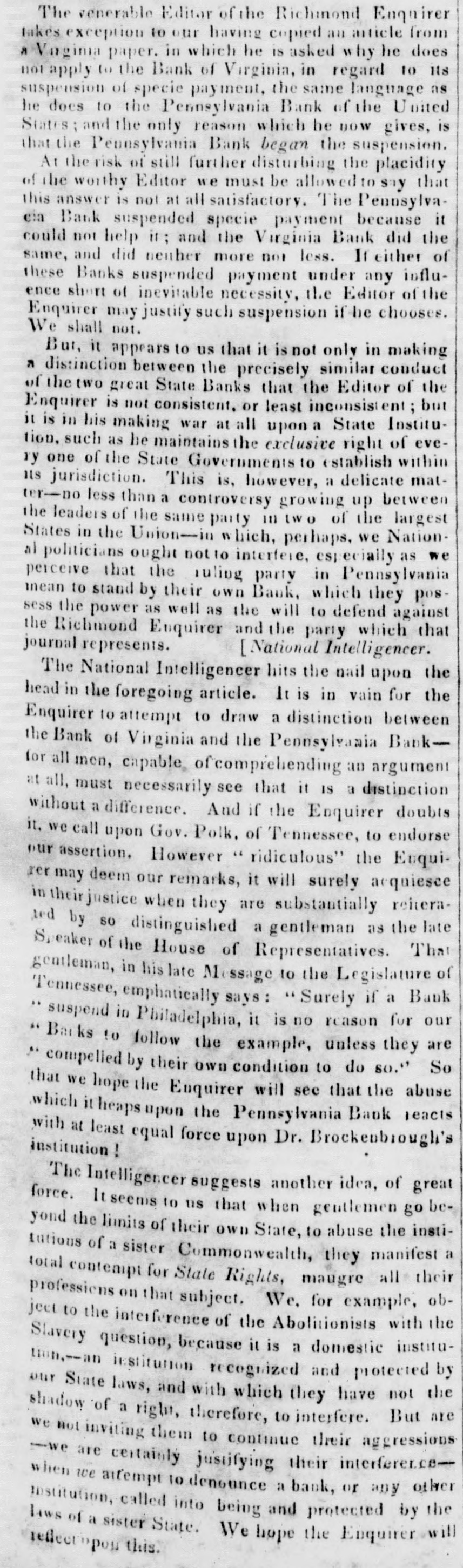
the Pennsylvacia Bank suspended specie payment because it could not help is
Source
newspapers
2. March 4, 1840 Suspension
Cause
Local Banks
Cause Details
Continued refusal of interbank clearing and aggressive actions by U.S. Bank and Girard Bank contributing to continued suspension of payments.
Newspaper Excerpt
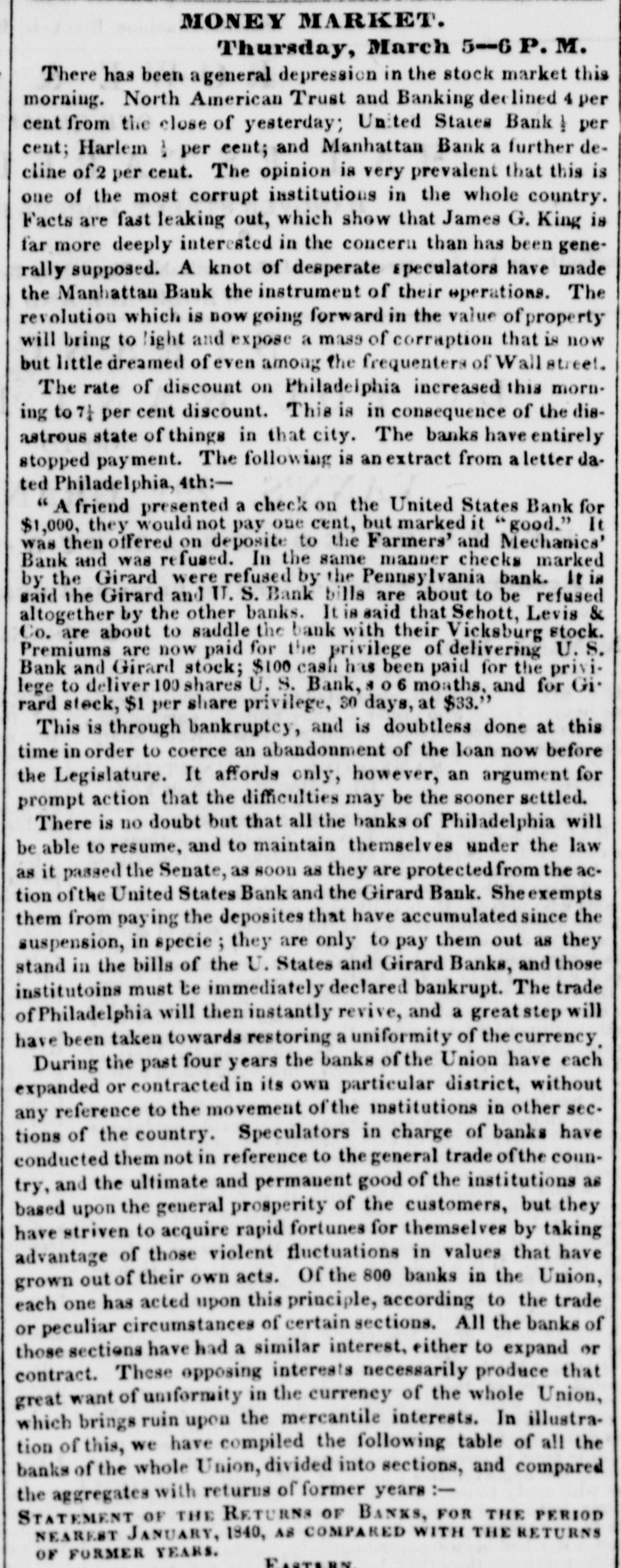
The banks have entirely stopped payment. ... In the same manner checks marked by the Girard were refused by the Pennsylvania bank.
Source
newspapers

Newspaper Articles (3)

Article from Lynchburg Virginian, November 7, 1839

Click image to open full size in new tab

Article Text

The venerable Editor of the Richmond Enquirer takes exception to our having copied au article from a Vagima paper. in which he is asked why he does not apply to the Bank of Virginia, in regard to its suspension of specie payment, the same language as the does to the Pennsylvania Bank of the United States: and the only reason which he now gives, is that the Pennsylvania Bank began the suspension. At the risk of still further disturbing the placidity of the worthy Editor we must be allowed to say that this answer is not at all satisfactory. The Pennsylvacia Bank suspended specie payment because it could not help is ; and the Virginia Bank did the same, and did menher more not less. If either of these Banks suspended payment under any influence short of inevitable necessity, the Editor of the Enquirer may justify such suspension if be chooses. We shall not. But, it appears to us that it is not only in making a distinction between the precisely similar conduct of the two great State Banks that the Editor of the Enquirer is not consistent, or least inconsistent; but war at all a State Instituas maintains one ry tion, is in such his of the making he State Governments the exclusive upon to establish right of within eveits jurisdiction. This is, however, a delicate matter-no less than a controversy growing up between the leaders of the same party 111 two of the largest States in the Union-in which, perhaps, we National politicians ought not interfeie, especially as we in perceive to stand that the their ruling party Pennsylvania mean by own Bank, which they possess the power as well as the will to defend against the Richmond Enquirer and the party which that journal represents. [National Intelligencer. The National Intelligencer hits the nail upon the head in the foregoing article. It is in vain for the Enquirer to attempt to draw a distinction between of and the Bankcapable of an the for all men, Bank Virginia `comprehending Pennsylvania argument at all, must necessarily see that it IS a distinction without a difference. And if the Enquirer doubts it. we call upon Gov. Polk. of Tennessee, to endorse our assertion. However ' ridiculous" the Euquirer may deem our remarks, it will surely acquiesce in theirjustice when they are substantially reiterated by so a as the late of the House of That Speaker distinguished Representatives. gentleman gentleman, in his late Message to the Legislature of Tennessee, if a in it is no reason for suspend Barks emphatically Philadelphia, says: "Surely Bank our " to follow the example, unless they are compelied by their own condition to do so." So that we hope the Enquirer will see that the abuse which it the Pennsylvania Bank reacts with at least equal force upon Dr. Brockenbrough's institution ! The Intelligencer another of seems to us that when beforce. It suggests gentlemen idea, go great yond the limits of their own the a sister manifest a for State all total tutions contempt of Commonwealth, Rights, State, maugre to they abuse insti- their professions on that for to interference of the with jeet Slavery the subject. We, Abolitionists example, institu- ob- the question, because it is domestic institution and laws, and with which have not our tion,--an State recognized they a protected the by shadow of a right, therefore, to interfere. But are them to are certainly their interferer.co--we we not inviting when justifying continue their aggressions we atfempt to denounce a bank, or any other Institution, laws called into being and protected by the of a sister State. We hope the Enquirer will

Article from Vermont Phล“nix, February 14, 1840

Click image to open full size in new tab

Article Text

not Speak To-day, Mee the Senate to-morrow. The Senate then passed to the consideration of some miscellaneous business. Correspondence of the N. Y. Journal of Commerce. PHILADELPHIA, Feb. 4, 1840. The Message of the Governor has crea. ted no little sensation among the faithful lieges of Martin of Kinderhook. They are in doubt and perplexity, not knowing how take it. The leaders are generally favor. ablet it, for they have something to loose, -the mass abuse him sorely. There is to be a meeting to-night. What they will do, they do not know themselves. The Conservative interest will I think, prevail. The leaders are not ready for desperate measures, and the cooler among them know, that should a split now occur, it is all up with the party in this State. In fact, should not be surprised to see the old Wolf and Muhlenburgh factions once more in condict.-Porter belongs to the former of these-the Radicals, almost to a man, to the latter. In the mean time let those do as they will, the business community breathe more freely. I have seen now several squeezes and panies-but never saw such general preparation for one as was evinced last Sat. urday. A few (and they were very lew) men of iron nerve, did not quail, but the mass, the 99 out of 100, were ready to give it all up. The Pennsylvania, and Farmers and Mechanics Banks, have called meetings of the Stockholders to authorize the appointment of Trustees to wind up their affairs, should an early resumption bill pass. They are not disposed to trust to the tender mer. cies of political receivers. We have nothing else, except lots of sleighing and the coldest day in the season. Cold winter, with his snows and bleak ness is upon us-the cheerful fire and well light adepartment forms an elegant contrast to the howling and dark storm without. But rethere no children of "our Father" in heaven-no brethren of ours who are suffering from the gripe of want? Has o each citizen exercised a just and benevolent d stewardship over the gilts of Providence in seeking out objects of want and relieving n them? It may be, at this moment that some of "Heavens last best gift to man," who e have ministered to the sick-have left their e own homes at midnight to aid a suffering r sister, or watched long weary nights over , the sick bed those who have abundance, h are in want of the necessaries of life. To II be ignorant of the situation of such is crimino al. The Son of God came to seek and to r save, thus affording us the highest example to seek out objects of suffering, as well as to relieve them when made known to us. 1, To the women seems to be given those e qualities which prepare them as ministers II of benevolence and mercy-they can reach y the heart and learn the real situation of all n and their appeals to the grosser sex are neve er made in vain, when pleading the cause d of humanity. We would therefore call it upon them to look about for the suffering Sand needy. and see that the men perform g the easier duty of bestowing of their abun0 dance to relieve them. f. II The first Signal of Alarm!-I is well to understood in this town, and we believe e there is no doubt of the fact, that the HON re LEVI WOODBURY, Secretary of the 8. Treasury. has recently offered for immediate g sale, HIS STOCK in different banks of e is town, Concord, Saco and Portland the S. aggregate amount is reported to be very n. large. This is a matter of no great importance, except as it indicates the opinion of on the Secretary of the Treasury that the Sub al Treasury Bill will pass, and that therby al d, bank stock will be greatly reduced in value as -Ports. Jour. is An afflicting occurrence took place in the s, family of our respected fellow citizen, Capt il Thompson, ast Sunday evening. An inter esting little daughter about a year old, who had just commenced walking, Deized hold to of a tea pot which had just been filled with ve boiling water and placed near the edge o isthe table, and pulling it off, it struck or he the infant's breast, and emptied its whole S. contents on her breast, neck, back, and arms ed scalding her in a most awful manner. The 0 lingering


Article from Morning Herald, March 6, 1840

Click image to open full size in new tab

Article Text

MONEY MARKET. Thursday, March 5-- P . M. There has been ageneral depression in the stock market this morning. North American Trust and Banking dec clined 4 per cent from the close of yesterday; United States Bank & per cent; Harlem : per cent; and Manhattan Bank a further decline of 2 per cent. The opinion is very prevalent that this is one of the most corrupt institutions in the whole country. Facts are fast leaking out, which show that James G. King is far more deeply interested in the concern than has been generally supposed. A knot of desperate speculators have made the Manhattan Bank the instrument of their operations. The revolution which is now going forward in the value of property will bring to light and expose a mass of corraption that is now but little dreamed of even among the frequenters of Wall street. The rate of discount on Philadelphia increased this morning to 71 per cent discount. This is in consequence of the disastrous state of things in that city. The banks have entirely stopped payment. The following is an extract from a letter dated Philadelphia, 4th:A friend presented a check on the United States Bank for $1,000, they would not pay one cent, but marked it "good." It was then offered on deposite to the Farmers' and Mechanics' Bank and was refused. In the same manner checks marked by the Girard were refused by the Pennsylvania bank. It is said the Girard and U. S. Bank bills are about to be refused altogether by the other banks. It is said that Sehott, Levis & Co. are about to saddle the bank with their Vicksburg stock. Premiums are now paid for the privilege of delivering U.S. Bank and Girard stock; $100 cash has been paid for the privilege to deliver 100 shares U. S. Bank, . o 6 months, and for Girard steck, $1 per share privilege, 30 days, at $33." This is through bankruptcy, and is doubtless done at this time in order to coerce an abandonment of the loan now before the Legislature. It affords only, however, an argument for prompt action that the difficulties may be the sooner settled. There is no doubt but that all the banks of Philadelphia will be able to resume, and to maintain themselves under the law as it passed the Senate, as soon as they are protected from the action of the United States Bank and the Girard Bank. Sheexempts them from paying the deposites that have accumulated since the suspension, in specie; they are only to pay them out as they stand in the bills of the U. States and Girard Banks, and those institutoins must be immediately declared bankrupt. The trade of Philadelphia will then instantly revive, and a great st will have been taken towards restoring a uniformity of the currency During the past four years the banks of the Union have each expanded or contracted in its own particular district, without any reference to the movement of the institutions in other sec. tions of the country. Speculators in charge of banks have conducted them not in reference to the general trade of the country, and the ultimate and permanent good of the institutions as based upon the general prosperity of the customers, but they have striven to acquire rapid fortunes for themselves by taking advantage of those violent fluctuations in values that have grown out of their own acts. Of the 800 banks in the Union, each one has acted upon this principle, according to the trade or peculiar circumstances of certain sections. All the banks of those sections have had a similar interest, either to expand or contract. These opposing interests necessarily produce that great want of uniformity in the currency of the whole Union, which brings ruin upon the mercantile interests. In illustration of this, we have compiled the following table of all the banks of the whole Union, divided into sections, and compared the aggregates with returns of former years :STATEMENT OF THE RETURNS OF BANKS, FOR THE PERIOD NEAREST JANUARY, 1840, AS COMPARED WITH THE RETURNS OF FORMER YEARS.