Article Text
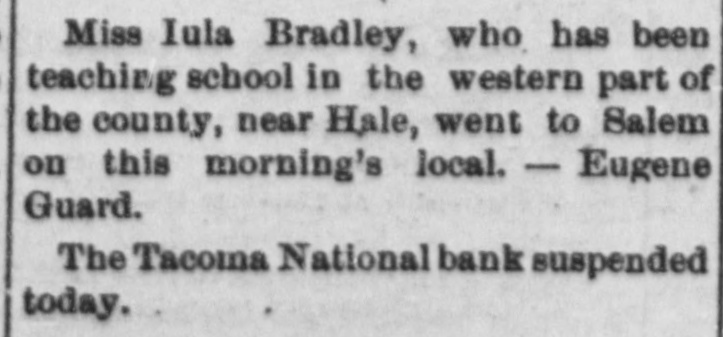
Miss Iula Bradley, who has been teaching school in the western part of the county, near Hale, went to Salem on this morning's local. - Eugene Guard. The Tacoma National bank suspended today.
Click image to open full size in new tab
Miss Iula Bradley, who has been teaching school in the western part of the county, near Hale, went to Salem on this morning's local. - Eugene Guard. The Tacoma National bank suspended today.
Click image to open full size in new tab
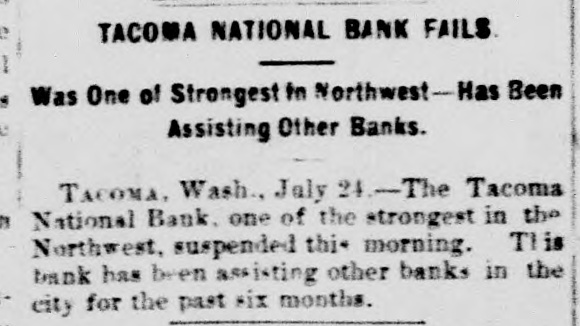
TACOMA NATIONAL BANK FAILS Was One of Strongest In Northwest-Has Been Assisting Other Banks. TACOMA, Wash., July 24.-The Tacoma National Bank. one of the strongest in the Northwest, suspended this morning. Tlis bank has bren assisting other banks in the city for the past six months.
Click image to open full size in new tab
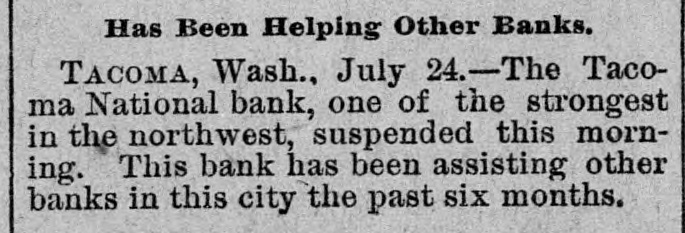
TACOMA, Wash., July 24.-The Tacoma National bank, one of the strongest in the northwest, suspended this morning. This bank has been assisting other banks in this city the past six months.
Click image to open full size in new tab
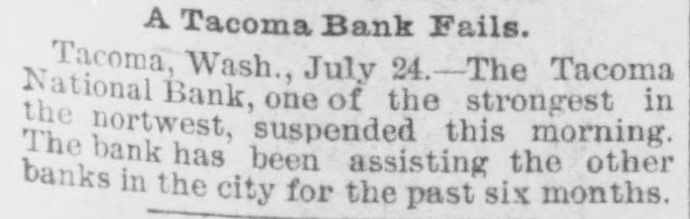
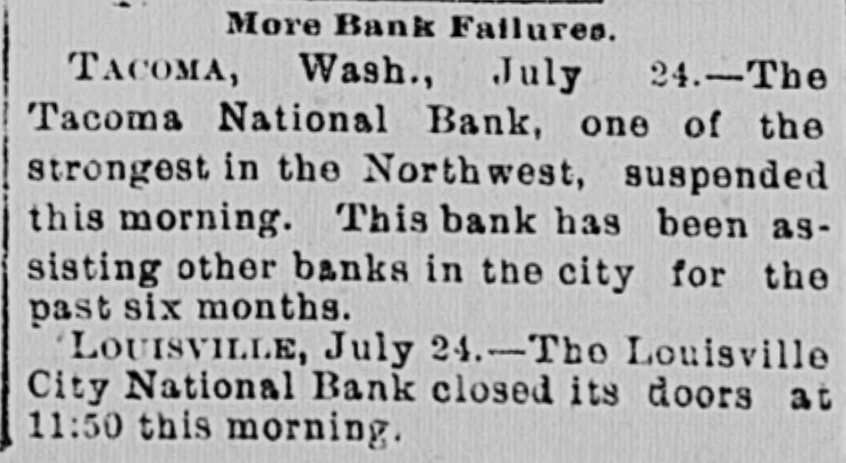
Tacoma, Wash., July 24.-The - Tacoma National Bank, one of the strongest in the nortwest, suspended this morning. The bank has been assisting the other banks in the city for the past six months.
Click image to open full size in new tab
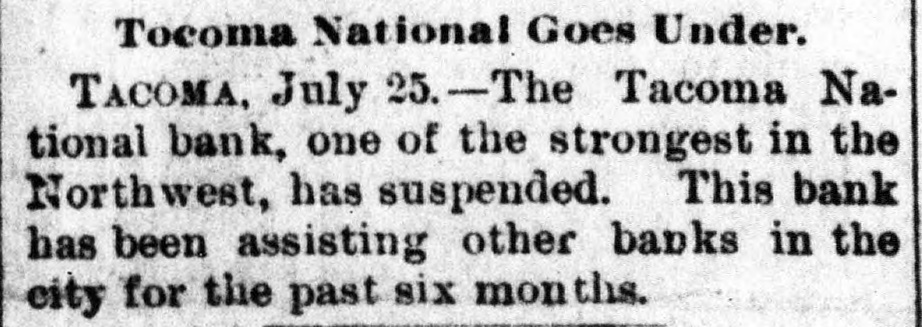
TACOMA, Wash., July 24.-The Tacoma National Bank, one of the strongest in the Northwest, suspended this morning. This bank has been assisting other banks in the city for the past six months. LOUISVILLE, July 24.-The Louisville City National Bank closed its doors at 11:50 this morning.
Click image to open full size in new tab
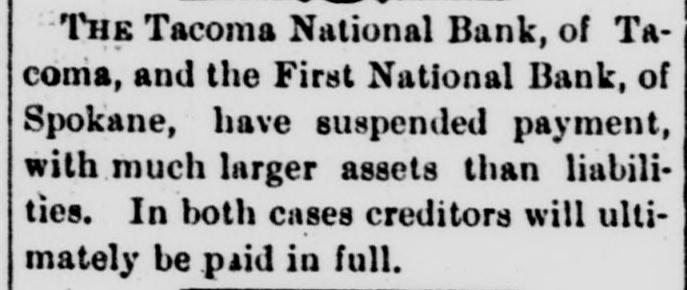
TACOMA. July 25.-The - Tacoma National bank, one of the strongest in the Northwest, has suspended. This bank has been assisting other banks in the city for the past six months.
Click image to open full size in new tab
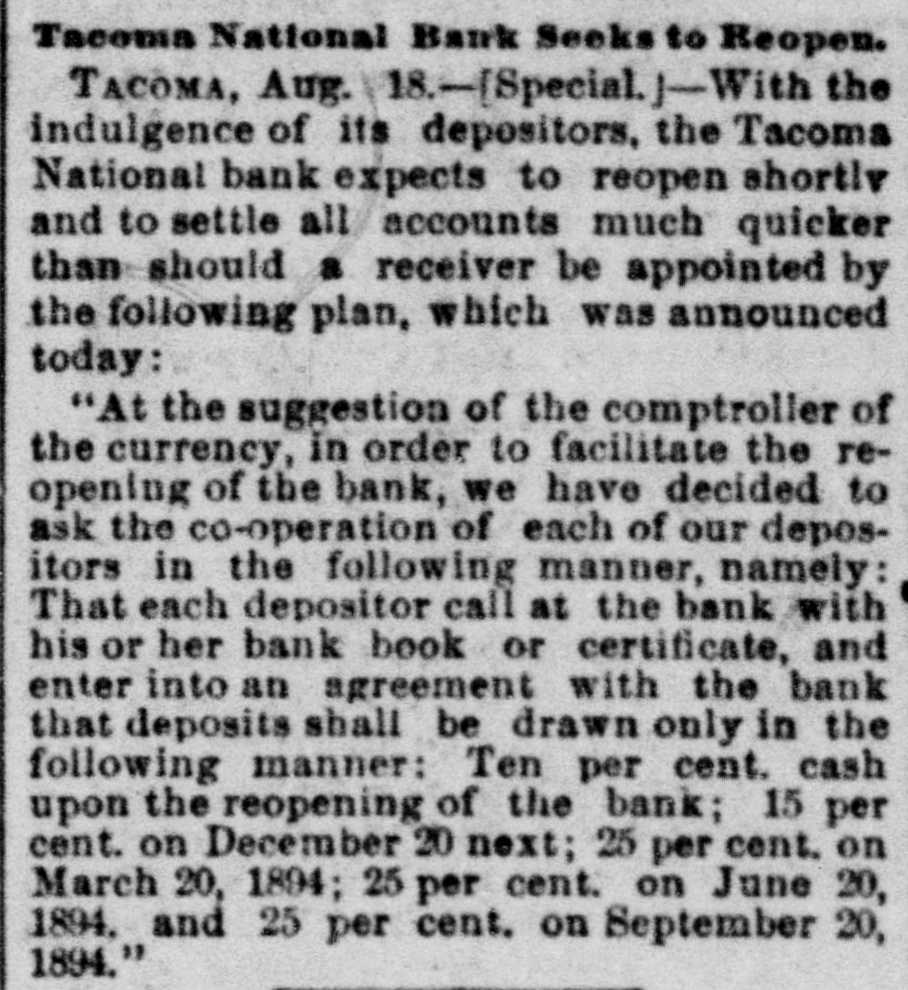
THE Tacoma National Bank, of Tacoma, and the First National Bank, of Spokane, have suspended payment, with much larger assets than liabilities. In both cases creditors will ultimately be paid in full.
Click image to open full size in new tab
Tacoma National Bank Seeks to Reopen. TACOMA, Aug. 18.-[Special.j-With the indulgence of its depositors, the Tacoma National bank expects to reopen shortly and to settle all accounts much quicker than should a receiver be appointed by the following plan, which was announced today: "At the suggestion of the comptroller of the currency, in order to facilitate the reopening of the bank, we have decided to ask the co-operation of each of our depositors in the following manner, namely: That each depositor call at the bank with his or her bank book or certificate, and enter into an agreement with the bank that deposits shall be drawn only in the following manner: Ten per cent. cash upon the reopening of the bank; 15 per cent. on December 20 next; 25 per cent. on March 20, 1894; 25 per cent. on June 20, 1894. and 25 per cent. on September 20, 1894."
Click image to open full size in new tab
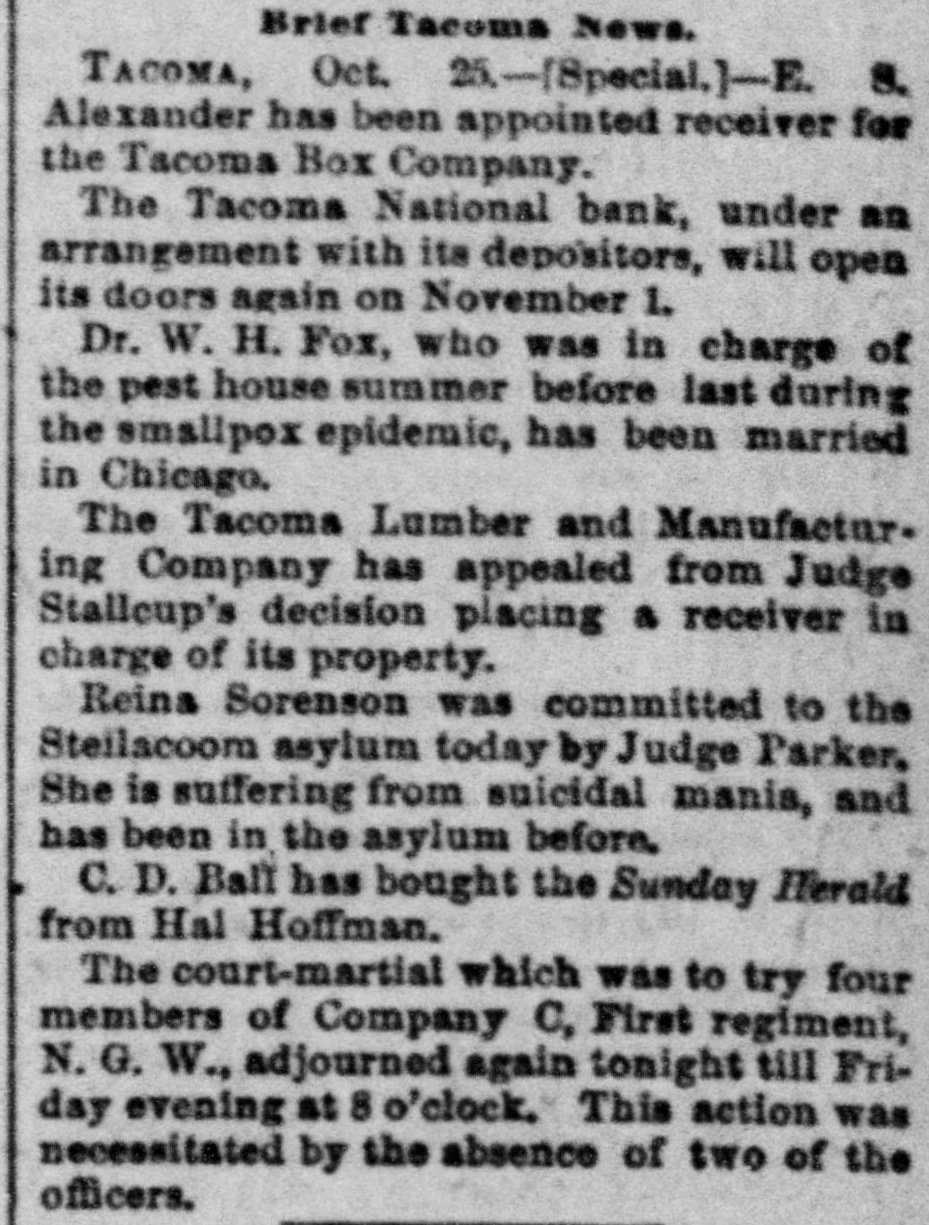
TACOMA, Oct. 25.-(Special.]-E. 8. Alexander has been appointed receiver for the Tacoma Box Company. The Tacoma National bank, under an arrangement with its depositors, will open its doors again on November 1. Dr. W. H. Fox, who was in charge of the pest house summer before last during the smallpox epidemic, has been married in Chicago. The Tacoma Lumber and Manufactur. ing Company has appealed from Judge Stallcup's decision placing a receiver in charge of its property. Reina Sorenson was committed to the Steilacoom asylum today by Judge Parker, She is suffering from suicidal mania, and has been in the asylum before, C. D. Ball has bought the Sunday Herald from Hal Hoffman. The court-martial which was to try four members of Company C, First regiment, N. G. W., adjourned again tonight till Friday evening at 8 o'clock. This action was necessitated by the absence of two of the officers.
Click image to open full size in new tab
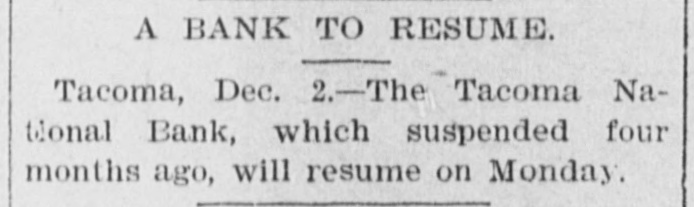
Tacoma, Dec. 2.-The Tacoma National Bank, which suspended four months ago, will resume on Monday.
Click image to open full size in new tab
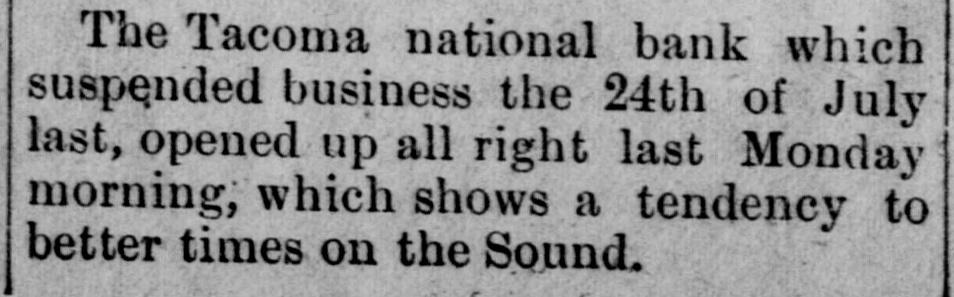
The Tacoma national bank which suspended business the 24th of July last, opened up all right last Monday morning, which shows a tendency to better times on the Sound.
Click image to open full size in new tab
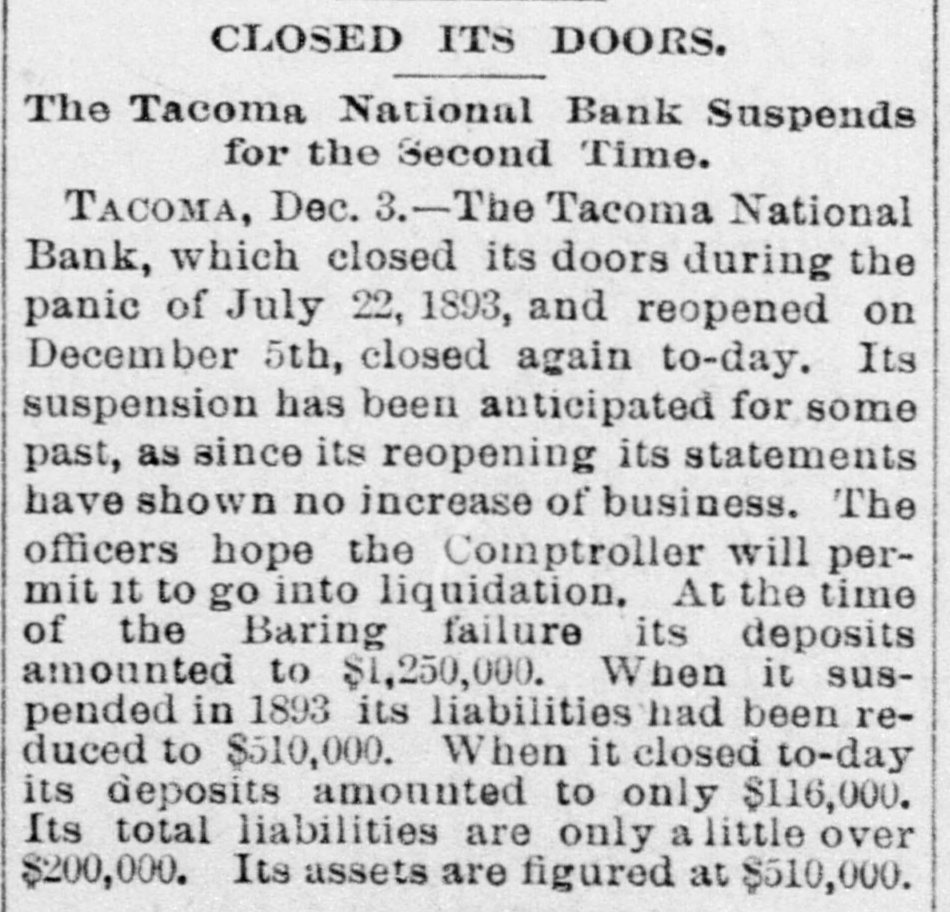
The Tacoma National Bank Suspends for the Second Time. TACOMA, Dec. - The Tacoma National Bank, which closed its doors during the panic of July 22, 1893, and reopened on December 5th, closed again to-day. Its suspension has been anticipated for some past, as since its reopening its statements have shown no increase of business. The officers hope the Comptroller will permit it to go into liquidation. At the time of the Baring failure its deposits amounted to $1,250,000. When it suspended in 1893 its liabilities had been reduced to $510,000. When it closed to-day its deposits amounted to only $116,000. Its total liabilities are only a little over $200,000. Its assets are figured at $510,000.
Click image to open full size in new tab
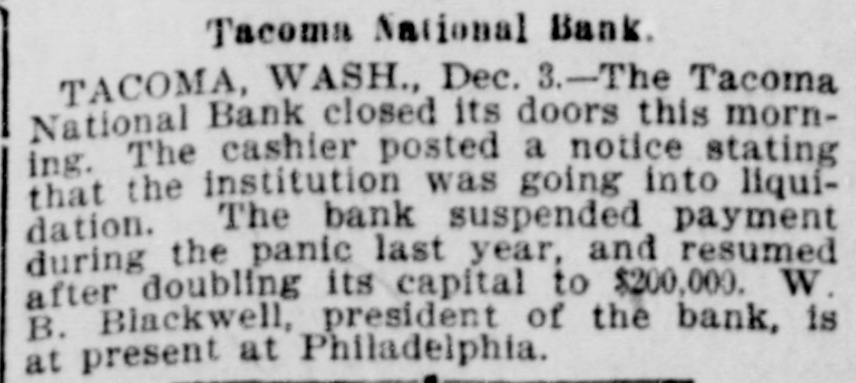
TACOMA, WASH., Dec. 3.-The Tacoma National Bank closed its doors this morning. The cashier posted a notice stating that the institution was going into liquidation. The bank suspended payment during the panic last year, and resumed after doubling its capital to $200,000. W. B. Blackwell, president of the bank, is at present at Philadelphia.
Click image to open full size in new tab
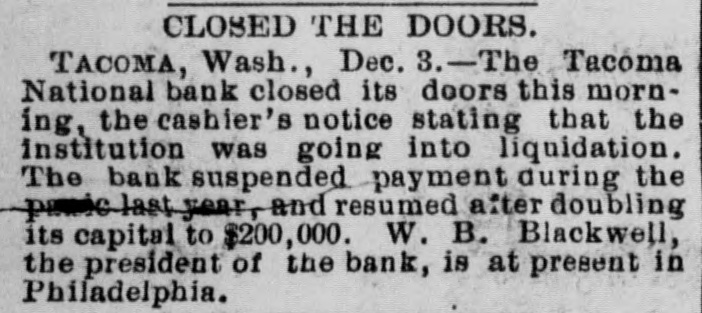
TACOMA, Wash., Dec. 3.-The Tacoma National bank closed its doors this morning, the cashier's notice stating that the institution was going into liquidation. The bank suspended payment during the pawic last year, and resumed after doubling its capital to $200,000. W. B. Blackwell, the president of the bank, is at present in Philadelphia.
Click image to open full size in new tab
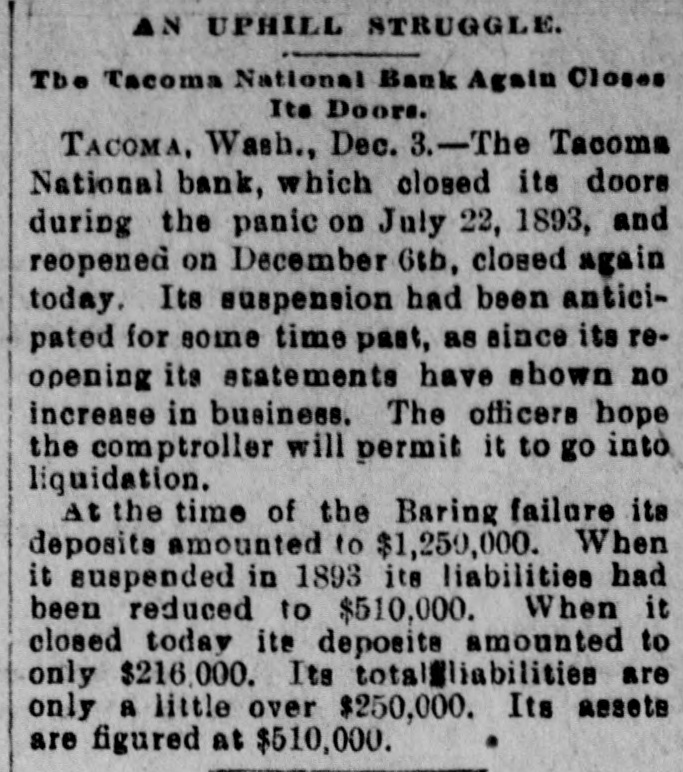
The Tacoma National Bank Again Closes Its Doors. TACOMA, Wash., Dec. 3.-The Tacoma National bank, which closed its doors during the panic on July 22, 1893, and reopened on December 6tb, closed again today. Its suspension had been anticipated for soine time past, as since its reopening its statements have shown no increase in business. The officers hope the comptroller will permit it to go into liquidation. At the time of the Baring failure its deposits amounted to $1,250,000. When it suspended in 1893 its liabilities had been reduced to $510,000. When it closed today ite depoeite amounted to only $216,000. Its total liabilities are only a little over $250,000. Its assets are figured at $510,000.
Click image to open full size in new tab
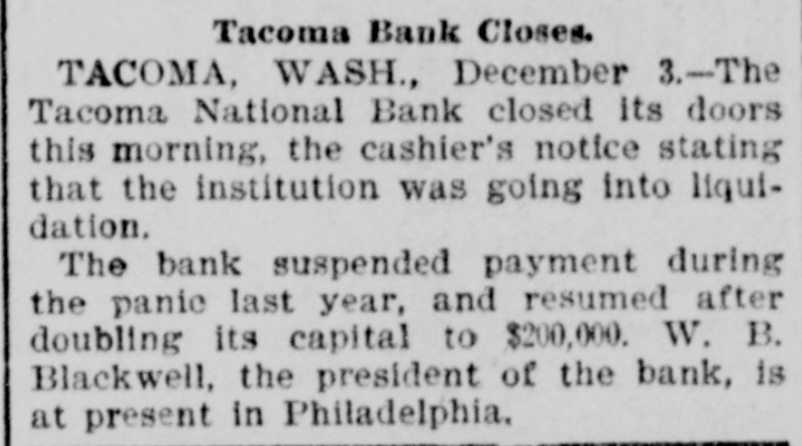
TACOMA, WASH., December 3.-The Tacoma National Bank closed its doors this morning, the cashier's notice stating that the institution was going into liquidation. The bank suspended payment during the panic last year, and resumed after doubling its capital to $200,000. W. B. Blackwell, the president of the bank, is at present in Philadelphia.
Click image to open full size in new tab
Tacoma, Dec. 14.-News was received tonight of the appointment of Phillip P. Anderson, son of the late General Adnla Anderson, chilef engineer of the Northern Pacific rtailroad, as receiver of the Tuoomia National Bank.
Click image to open full size in new tab
Tacoma, Wash., Dec. 15.-Phillp P. Anderson, son of the late General A.u. nderson, chief engineer of the Northern Pacific railroad, has been appointed receiver of the Tacoma National bank. There were numerous applicants for the appointment, which Anderson is credited with obtaining through influential connections at Washington.
Click image to open full size in new tab
gineer of the Northern Pacific railroad, has been appointed receiver of the Tacoma Na tional bank. There were numerous appli cants for the appointment, which Anderson is credited with obtaining through influential connections at Washington.
Click image to open full size in new tab
Tacoma, Aug. 14.-Special.-L. N. Hansen was today appointed receiver of the Pacific Supply Company on the suit of John Masury & Co. P. V. Anderson, receiver of the Tacoma National bank, secured a temporary injunction today, restraining the Meridian Brick Works and others from disposing of certain of their machinery, pending the foreclosure of a trust deed which the bank is prosecuting.

Click image to open full size in new tab
Washington, D.C., Oct. 2.-The reports of business improvement and activity in masufacturing and commercial lines which have come to the front since the enactment of the Dingley law has suggested to somebody with a good memory a comparison of present conditions with those ot the corresponding dates in the first year of the Cleveland administration. It is a curious fact that the enactment of the Wilson law came at just about a corresponding period with the meeting of the free-trade Congress in the first year of Ceveland's second term, [and that it is therefore possible to contrast business conditions under the shadow of approaching free trade with the business condition in the sunshine of returning protection. This comparison is startling. This period covered in the comparison of the two months since the final action upon the Dingley bill compared with the corresponding two months in the Cleveland term. or from July 24 to Seteraber 24, 1893, contrasted with July 24 to Setember 24, 1897. Here is the contrast; it is well worth laying for reference: Week ending July 24, 1893-Failure of Bozeman. Montana, national bank. Four Denver banks closed their doors. Bank suspensions in other Western cities. Two bank failures in Milwaukee, and runs on numerous other banks. Commercial Bank of Denver fails; capital, $250,000. Bank failures At Vernon, Tex., and Knoxville, Tenn.; capital. $200,000. Failure of Tacoma (Wash.) National Bank; capital, $200,000; also failures of banks at Great Falls. Mont., and Orladno, Fla. ; capital, $200,000. Suspension of work in manufactories reported from all sections. Week ending August 1, 1893,-National banks at Manchester, N.H., and Indianapolis, Ind fail; capital $500,000. Failure of First National Bank at Spokane, Wash. ; capital, 2500,000. Ten banks sus pended in one dav (July 27) capital, $2,000,000. Bank failures in South Dakota. Montana, Illinois, Kansas, Texas, Washington, New Hampshire, and correspendingly large number of business suspensions. Week ending August 8, 1893-Collapse of Chicago provision deal and many failures of commision houses. Failure of National Bank of El Paso, Texas. Failure of National Bank of San Antono, Texas. Failure of National Bank of Mounce, Ind. LIIId Congress meets in special session to begin its destruction of the McKinley law. Week ending August 28, 1893-Encounter between the Anarchists and Soeialists averted by New York police. Failure of National Bank at Hindman, Pa. Failure of National Bank at Tacoma, Wash. Suspension of manufacturing establishments in numerous states. Announcement by controller of the currency that 155 national banks and 560 private banks had failed during the year ending August 28. Railroad receivers appointed during August for Northern Pacific, Pt itadelphia & Reading, New England and Pittsburg, Akron & Western. September-Railroad receivers appointed for Wisconsin Central. Chicogo, Peoria & St. Louis, Cleveland, Canton & Southern. Evansville & Terre Haute railroads. The mileage of roads placed in the hands of receivers during the year 1893 was 25,375, nearly one-seventh of all the lines in the United States, and their indebtedness $1,212,217,033. During the year there were 16,115 mercantile suspensions, involving liabilities amounting to $346 779,889. During the bank suspensions of July loans were made on call at the New York Stock Exchange as high as 72 per cent. The following statements of revival of manufacturing industries during the sixty days following the enactment of the Dingley law. the period corresponding with the similar dates in the first year of Cleveland's second term, show the contrast between present conditions and those of the corresponding months of the preceding adminisration. The statements which follow are from "Brad street's:' Week ending July 24, 1897-Twenty thousand workmen resumed work in iron and steel industries. Bigelow Carpet Company, at Clinton, Mass. resumes

Click image to open full size in new tab
SOME COMPARISONS OFFICIAL REPORTS SHOW THE DIFFERENCE IN THE TIMES. Under the First 60 Days of the Cleve. land-Wilson Low Tariff the Country Was in a Panic-Under the McKinleyDingley Tariff the Country Confident. E. F. PARSONS, Special Correspondent. Washington, D. C.-The close of the first sixty days of the operations of the new tariff law and the business improvements which are visible in every direction during that time have suggested a comparison of the conditions during the two months in question with those of the corresponding date in the first year of the Cleveland administration, during which time the free trade congress, elected with President Cleveland, was just beginning its attack upon the protective system which the Dingley law sixty days ago re-established. The two periods from July 24 to September 24 in the years 1893 and 1897, respectively, present a marked contrast -Bod St 1! pus conditions business 01 SE sible to obtain from government records some data bearing upon this subject and now especially interesting. The following data gathered from official reports presents a picture of the sixty-day period of the year 1893 with which the two months just ended correspond both as to the portion of the year and the period of the presidential administration and also proximity to tariff legislation: Week ending July 24, 1893-Failure of Bozeman, Mont., National Bank; four Denver banks closed their doors; bank suspensions in other western cities; two bank failures in Milwankee and runs on numerous other banks; Commercial Bank of Denver fails, capital $250,000; bank failures at Vernon, Texas, and Knoxville, Tenn., capital $200,000; failure of Tacoma, Wash., National Bank, capital $200,000; also failures of banks at Great Falls, Mont., and Orlando, Fla., capital $200,000; suspension of work in manufactories reported from all sections. Week ending August 1,1893-Nation-uI pus "H N Manohester 18 queq 18 dianapolis, Ind., fail, epaital $500,000; failure of First National Bank at Spokane, Wash., capital $250,000; ten banks suspend in one day (July 27), capital $2,000,000; bank failures in South Dakota, Montana, Illinois, Kansas, Texas, Washington, New Hampshire, and correspondingly large number of business suspensions. Week ending August 8, 1893-Collapse of Chicago Provision Deal and many failures of commission houses; failure of National bank of El Paso, Texas; failure of National bank of San Antonio, Texas; failure of National bank of Muncie, Ind; fifty-third congress meets in special session to begin its destruction of the McKinley law. Week ending August 28, 1893-Encounter between the anarchists and socialists averted by New York police; meeting of anarchists broken up by New York police; failure of National bank at Hindman, Pa.; failure of National bank at Tacoma, Wash., suspension of manufacturing establishments in numerous states; announcement by comptroller of the currency that 155 National banks and 560 private banks had failed during the year tnding August 28; railroad receivers apppointed during August for Northern Pacific, Philadelphia & Reading, New England and Pittsburg, Akron & West"ure September-Railroad receivers