Smead, Collard & Hughes (Cincinnati, OH)

Episode Information

Episode UID
2939504390658
Episode Type
Run β†’ Suspension β†’ Reopening
Bank Type
private
Bank ID
293950439 hash
Start Date
October 20, 1854
Location
Cincinnati, Ohio (39.103, -84.515)

Metadata

Model
gpt-5-mini (chosen from majority vote of a three-model LLM ensemble)
Short Digest
464e212b86b59f3a

Response Measures

None

Events (3)

1. October 20, 1854 Run
Cause
Local Banks
Cause Details
Run triggered by failures and suspensions of other Cincinnati/private banks (Outcalt & Co., Manchester, Circleville Bank) and a general local panic.
Measures
Met many demands; depositors who drew often re-deposited; bank met withdrawals during pressure.
Newspaper Excerpt
experienced a tight run.
Source
newspapers
2. November 8, 1854 Suspension
Cause
Local Banks
Cause Details
Wider panic and runs on multiple Cincinnati private banking houses forced Smead, Collard & Hughes to stop payment temporarily (assets illiquid, convertible only in 60–90 days).
Newspaper Excerpt
drew $1700 from Smead & Co.'s Bank ... re-deposited the whole amount, a few minutes before the Bank suspended.
Source
newspapers
3. May 25, 1855 Reopening
Newspaper Excerpt
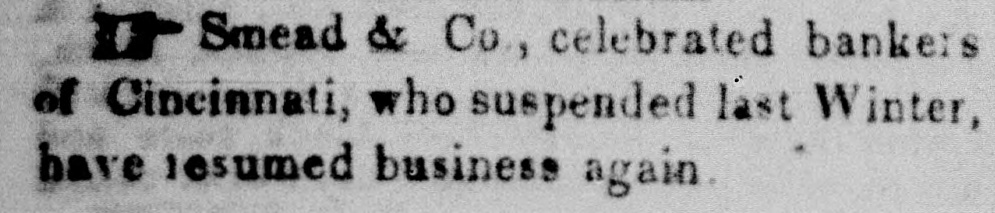
Smead & Co., celebrated bankers of Cincinnati, who suspended last Winter, have resumed business again.
Source
newspapers

Newspaper Articles (15)

Article from Wheeling Daily Intelligencer, October 21, 1854

Click image to open full size in new tab

Article Text

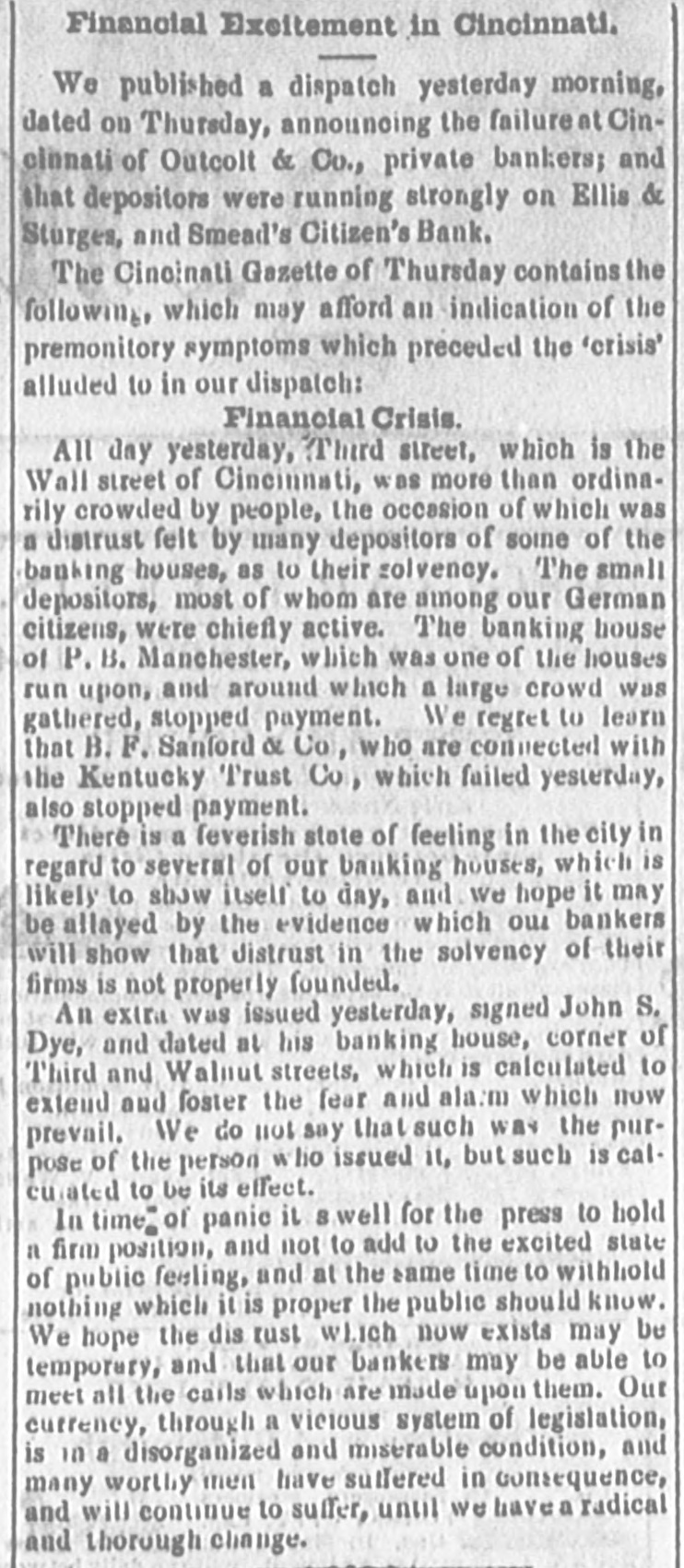
Financial Excitement in Cincinnati. We published a dispatch yesterday morning, dated on Thursday, announcing the failure at Cincinnati of Outcolt & Co., private bankers; and that depositors were running strongly on Ellis & Sturges, and Smead's Citizen's Bank. The Cincinati Gazette of Thursday contains the following, which may afford an indication of the premonitory symptoms which preceded the 'crisis' attuded to in our dispatch: Financial Crisis. All day yesterday, Third street, which is the Wall street of Cincinnati, was more than ordinarily crowded by people, the occasion of which was a distrust felt by many depositors of some of the banking houses, as to their solvency. The small depositors, most of whom are among our German citizens, were chiefly active. The banking house of P. B. Manchester, which was one of the houses run upon, and around which a large crowd was gathered, stopped payment. We regiel to learn that B. F. Sanford & Co, who are connected with the Kentucky Trust Co , which failed yesterday, also stopped payment. There is a feverish state of feeling in the city in regard to several of our banking houses, which is likely to show itself to day, and we hope it may be allayed by the evidence which our bankers will show that distrust in the solvency of their firms is not properly founded. An extra was issued yesterday, signed John S. Dye, and dated at his banking house, corner of Third and Walnut streets, which is calculated to extend and foster the fear and ala m which now prevail. We do not say that such was the purpose of the person ho issued it, but such is calcurated to be its effect. In time: of panie it 8 well for the press to hold a firm position, and not to add to the excited state of public feeling, and at the same time to withhold nothing which it is proper the public should know. We hope the dis rust which now exists may be temporary, and that our bankers may be able to meet all the cails which are made upon them. Out currency, through a vicious system of legislation, is in a disorganized and miserable condition, and many worthy men have suffered in consequence, and will continue to suffer, until we have a radical and thorough change.


Article from The Evansville Daily Journal, October 24, 1854

Click image to open full size in new tab

Article Text

They have been having a wild time of it up at Cincinnati. We have already noticed the closing of the doors of Manchester's Bank at Cincinnati, and the anticipated run on other Banks there, which might endanger them. On Thursday, there was a great run, and early in the day the Banking House of P. Outcalt & Co., closed its doors. The Columbian of Friday says: The busy crowd about Third street to-day, have manifested what a strong interest is felt in money matters just now. In addition to the suspensions of Manchester, Sanford, and the Covington Trust Company, who stopped payment yesterday, Messrs. P. Outcalt & Co., found themselves unable to meet the crisis to-day, and they also closed their doors. The Bank of Messrs. Hatch & Langdon, at the corner of Main and Court, Messrs. Ellis & Sturgess, and Messrs. Smead, Collard &: Hughes, experienced a tight run. Hatch & Langdon possess general confidence. Ellis & Sturgess, on two former OCcasions,have experienced similar occurences, and have always proved emselves competent to stand any degree of pressure. Smead & Co., are known as men of business, as a firm of long standing and experience, not immersed in personal frivolous expenses, but emulous above everything of a character for business integrity. The excitement towards these banks seems confined to that class of depositors whose situation, out of the commercial world, leaves them but little data on which to judgo for themselves. The readiness with which their demands were met, seemed to make them inclined to re-deposit what they had just drawn. Outcalt & Co., are gentlemen who enjoy the respect of the community; their business has been much in the real estate way. A house doing such a business has usually a good basis, but the nature of the property that they hold prevents the possibility of realizing large sums at a short notice. There are few men who could meet at a moments warning, every creditor they have, and pay them; yet this is what is expected of our monied men; our readers can judge how justly. Few persons in business, howe er wealthy they may be, have at every moment cash enough in their coffers to meet all their demands; yet this is what is expected of our bankers. Much anxiety exists with respect to the Kanawha Bank, whose issues are not bankable in this city; but its last exhibit present ed a f: ir appearance, and our bankerssay that its notes are good. Dispatches of the 20th say that the run has ceased, and no other failures reported. Our State Stock Banks appear to be kicking up an excitement all over the West.We have already given details of the excitement at Cincinnati and Louisville. The Louisville Journal of Saturday last says: THE CURRENCY.-The notes of the Indiana State Stock Banks are generally refused, though some of the wholesale dry goods houses take them in preference to sixty to ninety days' notes in exchange for goods. Some of the brokers are buying some of them at from 5 to 10 per cent. discount, while others refuse to touch them at any price. They are not considered valueless, but the impossibility of rendering them available for some time to come, and the large amount they already have on hand has forced most of the bankers to pursue this course. The stock bank at Madison and a few others are exceptions. They have funds deposited here for redemption of their notes, and so long as they continue to do so they will be taken at the same rates of discount as the notes of the State Bank of Indiana per cent. discount. The State Auditor at Indianapolis is redeeming the notes of the Bank of Albany. And at St. Louis the brokers are up in arms. The St. Louis News of the 19th says: The brokers, to-day, were throwing out several of the Indiana State Stock Shinplaster conerns. Those announced by telegraph as having failed, were of course not received on any terms. We understand a meeting of the brokers was held this forenoon to determine what would be received and what not. We nad not received the result up to the hour of going to press. Even away up in Chicago our Banks are receiving polite attention. The Chicago Tribune of a late date says: Nearly all of our city banks, and a portion of the brokers yesterday refused to receive the notes of the Indian Stock Security Banks as currency-Capt. Swift, Mr. Rogers. of the State Bank, and one or two others, not coming into the arrangement. What the result of all this is to be, we cannot anticipate with any great degree of certainty We presume the majority of these banks will gradually go into liquidation.β€” We notice a decline in Indiana State Stock already, as a natural result of a fall market, and an overflowing one being anticipated probably, as the State Stock forming the basis of the circulation of our Stock Banks is gradually offered for sale. Our Evansville Banks have been called upon lately to redeem immense amounts of their money, but they have always been prepared. An agent from Cincinnati was among them last week. He informed us that there were no Banks in the State prompter than ours in redeeming their notes. We consider their money, Canal, Crescent, and N. Y. & Va. State Stock Banks, as


Article from Eaton Democrat, October 26, 1854

Click image to open full size in new tab

Article Text

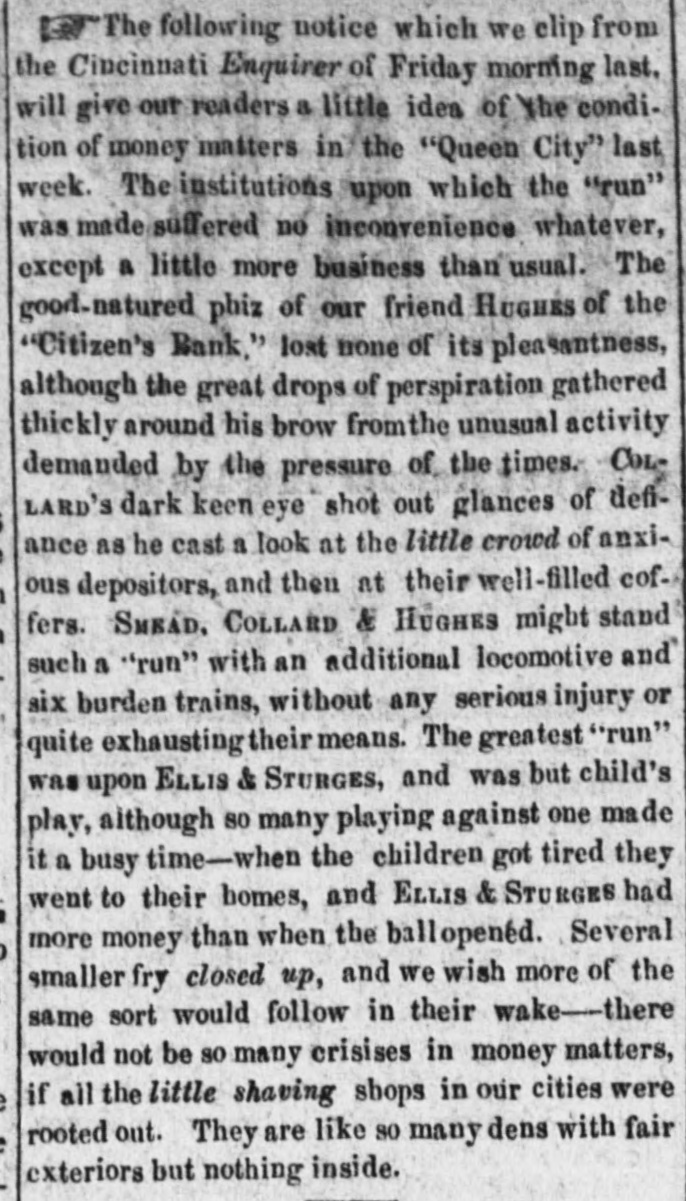
The following notice which we clip from the Cincinnati Enquirer of Friday morning last. will give our readers a little idea of the condition of money matters in the "Queen City" last week. The institutions upon which the "run" was made suffered no inconvenience whatever, except a little more business than usual. The good-natured phiz of our friend HUGHES of the "Citizen's Bank." lost none of its pleasantness, although the great drops of perspiration gathered thickly around his brow fromthe unusual activity demanded by the pressure of the times. CoLLARD'S dark keen eye shot out glances of defiance as he cast a look at the little crowd of anxious depositors, and then at their well-filled coffers. SMEAD, COLLARD & HUGHES might stand such a "run" with an additional locomotive and six burden trains, without any serious injury or quite exhausting their means. The greatest "run" was upon ELLIS & STURGES, and was but child's play, although so many playing against one made it a busy time-when the children got tired they went to their homes, and ELLIS & STURGES had more money than when the ballopenΓ©d. Several smaller fry closed up, and we wish more of the same sort would follow in their wake-there would not be so many crisises in money matters, if all the little shaving shops in our cities were rooted out. They are like so many dens with fair exteriors but nothing inside.


Article from New-York Daily Tribune, November 9, 1854

Click image to open full size in new tab

Article Text

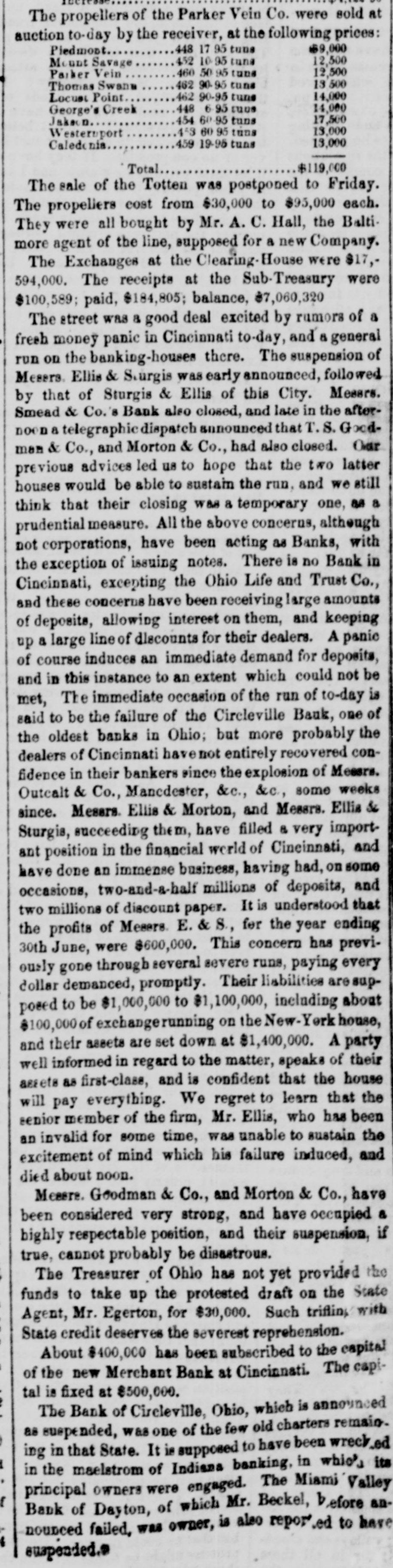
The propellers of the Parker Vein Co. were sold at auction to-day by the receiver, at the following prices: 448 17 95 tuns $9,000 Piedmont 452 10 tuns 12,500 Mount Savage 460 50 95 tuns 12,500 Parker Vein 13 500 462 90. tuns Thomas Swana 462 90-95 tune 14,000 Locust Point 448 6-95 tuus 14,000 George's Creek 17,500 454 60 95 tuns Jakson 13,000 453 60 tuns Westernport 459 19-95 tuns 13,000 Caledonia $119,000 Total The sale of the Totten was postponed to Friday. The propeliers cost from $30,000 to $95,000 each. They were all bought by Mr. A. C. Hall, the Baltimore agent of the line, supposed for a new Company. The Exchanges at the Clearing-House were $17,594,000. The receipts at the Sub-Treasury were $100,589; paid, $184,805; balance, $7,060,320 The street was a good deal excited by rumors of a fresh money panic in Cincinnati to-day, and a general run on the banking-houses there. The suspension of Messrs. Ellis & Sturgis was early announced, followed by that of Sturgis & Ellis of this City. Messrs. Smead & Co.'s Bank also closed, and late in the afternoon a telegraphic dispatch announced that T.S. Goodman & Co., and Morton & Co., had also closed. Our previous advices led us to hope that the two latter houses would be able to sustain the run, and we still think that their closing was a temporary one, as a prudential measure. All the above concerns, although not corporations, have been acting as Banks, with the exception of issuing notes. There is no Bank in Cincinnati, excepting the Ohio Life and Trust Co., and these concerns have been receiving large amounts of deposits, allowing interest on them, and keeping up a large line of discounts for their dealers. A panic of course induces an immediate demand for deposits, and in this instance to an extent which could not be met, The immediate occasion of the run of to-day is said to be the failure of the Circleville Bauk, one of the oldest banks in Ohio; but more probably the dealers of Cincinnati havenot entirely recovered confidence in their bankers since the explosion of Messrs. Outcalt & Co., Mancdester, &c., &c, some weeks since. Messrs. Eltis & Morton, and Messrs. Ellis & Sturgis, succeeding them, have filled & very important position in the financial world of Cincinnati, and have done an immense business, having had, on some occasions, two-and-a-half millions of deposits, and two millions of discount paper. It is understood that the profits of Mesers. E. & S., for the year ending 30th June, were $600,000. This concern has previously gone through several severe runs, paying every dollar demanced, promptly. Their liabilities are supposed to be $1,000,000 to $1,100,000, including about $100,000 of exchangerunning on the New-York house, and their assets are set down at $1,400,000. A party well informed in regard to the matter, speaks of their assets as first-class, and is confident that the house will pay everything. We regret to learn that the senior member of the firm, Mr. Ellis, who has been an invalid for some time, was unable to sustain the excitement of mind which his failure induced, and died about noon. Messre. Goodman & Co., and Morton & Co., have been considered very strong, and have occupied a highly respectable position, and their suspension, if true, cannot probably be disastrous. The Treasurer of Ohlo has not yet provided the funds to take up the protested draft on the State Agent, Mr. Egerton, for $30,000. Such trifling with State credit deserves the severest reprehension. About $400,000 has been subscribed to the capital of the new Merchant Bank at Cincinnati. The capital is fixed at $500,000. The Bank of Circleville, Ohio, which is announced as suspended, was one of the few old charters remain. ing in that State. It is supposed to have been wrecked in the maelstrom of Indiana banking, in whic's its principal owners were engaged. The Miami Valley Bank of Dayton, of which Mr. Beckel, before announced failed, was owner, is also report to have suspended.Β»


Article from The Evansville Daily Journal, November 10, 1854

Click image to open full size in new tab

Article Text

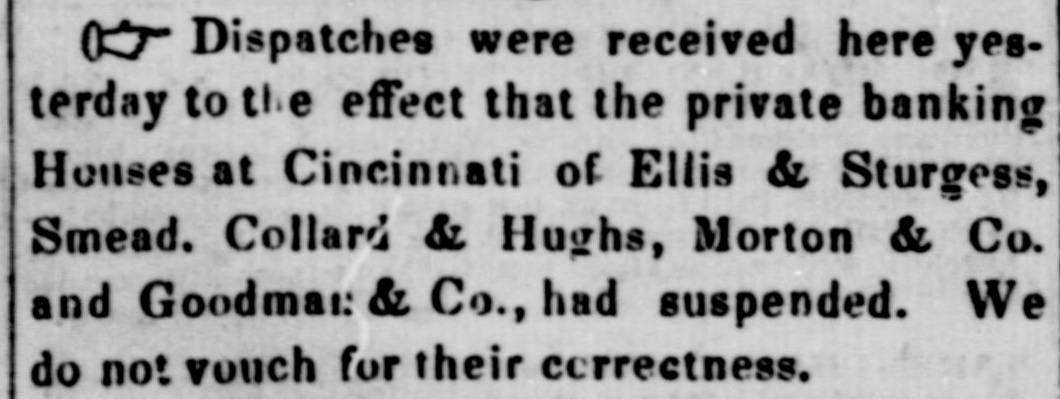
Dispatches were received here yesterday to the effect that the private banking Houses at Cincinnati of Ellis & Sturgess, Smead. Collard & Hughs, Morton & Co. and Goodmai: & Co., had suspended. We do not vouch for their correctness.


Article from Meigs County Telegraph, November 14, 1854

Click image to open full size in new tab

Article Text

Three of the New England Banks, viz: Bank of Hallowell, Ship Builder's Bank, and Brunswick Bank, are reported failed. We never had much confidence in these Yankee institutions. Their notes sell at 50 cents in New York. Several of the New York banks are at a heavy discount. Lewis County Bank re- ported failed. Erie and Kalamazoo, and Farmer's and Mechanic's Bank of Memphis are quoted at 40 cents in New York. With regard to Southern Bark of Ken- tucky and Commercial Bank of Kentucky we have nothing definite in our exchanges. So much for banks of issue. Let us now glance at the Private Banks, or Broker's shops. On Wednesday last, nearly all of the heav- iest establishments of this kind in Cincinnati, suspended payment. First Ellis & Sturgess, whose liabilities are estimated at over $1,- 000.000; then Smead, Collard & Hughes, whose liabilities are still greater; then T. S. Goodman, and lasily Langdon & Haich. These four houses had at the time of closing about four millions of dollars on deposit- placed there by the merchants and manu- facturers doing the business of the city. They all represent their assets as much greater than their liabilities, as perhaps they are; but these assets are not convertible into cash, and probably cannot be made availa- ble short of sixty or ninety days. In the meantim, how is the heavy business of Cincinnati to be carried on? How are these depositors to meet their liabilities, and find money to carry on their business? The stability of many of the mercantile houses will be severely tested, and the shock will be felt by all classes. A Bank mob was ex- pected on Wednesday night, and the milita- ry companies were ordered to hold them- selves in readiness to turn out; but no ap- pearances of such a demonstration were manifest in the evening. As in theatrical circles, a farce is expected after a tragedy, so to amuse our readers, we give the following ludicrous transaction, re- ported in the Cincinnati Commercial: It will be recollected that John S. Dye, the Counterfeit Detector man, was brought before our Police Court, about a year ago, charged with circulating unauthorized bank paper in this city. It will also be recollected that this bank paper was in the shape of bank bills, on the Exchange Bank of Mem- phis, with "Redeemable at the Banking House of John S Dye, in Cincinnati" placed conspicuously in a semi-circle on said bills Dye was fined, and promised not to abet in the circulation of this fraudulent paper in future. The world rolled on, and certain papers, for a consideration, resuscitated Mr. Dye's character. Bankers endorsed it, and the man became great in financial circles again. somewhat notorious as the author of financial bulletins, and the unflinching ad- vocate of the Indiana free banks. Day before yesterday, a somewhat unso- phisticated merchant from the interior of Indiana, came to our city to pay off his ac- count with his merchants here, and among his available means to do this, he produced two hundred and eighty, one dollar bills, on this same old bank of Mr. Dye notoriety done up neatly, and in good order, and well conditioned. Our merchant with some as- tonishment, and a little mirth, asked the In- diana gentleman, where in the world he came by that trash, to which the gentleman from Indiana replied, that he got it from a banker at Logansport, who told him it was perfectly good in Cincinnati, and would be protected by the celebrated Mr. John S Dye. Our merchant accordingly presented the whole amount at the office of Mr Dye, and about the half of it was redeemed, and promise given that the balance would be this morning; this morning the balance was duly presented, but, we suppose, finding the sum more than it was able to meet, the banking house of John S. Dye suspended, and, late in the day, it was reported that the desks the bulletin boards, and other furniture of the banking house of this remarkable man, had been seized by a constable, Some people were unkind enough to inti- mate that this Indiana State Stock Bank and the Banking house of John S. Dye were working together; the Indiana Bank circu- lations Mr. Dye's currency in Indiana while Mr. Dye was protecting the Indiana Free Bank paper in Cincinnati. This Dye is a most precious scamp. We might give many evidences of his rascality but content ourself this week with one other. The Ohio Statesman says that some one is putting into circulation in this State, new Bank notes, purporting to be of the Planters and Mechanics' Bank of Georgia, dated Dalton. signed, as it is said, by an individua in Trumbull county, Ohio, who has got John S. Dye, of the "Bank Mirror," Cincinnati to quote them at 2 per cent, discount. What is said in the Commercial, about Indiana Banks and John S. Dye we regard as un- generous, Similar remarks might be made of all other publishers of Detectors, for, we be

Article from The Ashland Union, November 15, 1854

Click image to open full size in new tab

Article Text

made, breaks. All that's necessary is to look into them, and they bust up " instanter. The following private banking houses have failed since our last issue CINCINNATI--McMicken & Co., Smead, Collord & Hughes, Ellis & Sturges and T. S. Goodman & Co. These bankers all promise to secure their depositors, principal and interest, and claim to have stopped payment for a few days only. The most intense excitement prevails in the city, and a general run has been made on all the depositing banks. PITTSBURGH-Hugh D. King, banker, failed on the 9th. Great excitement in the money market. Burralo-Robert Codd's Exchange Bank gone. Commercial circles very blue. In addition to these private failures, we have the following Banks of issue, in which our readers are more deeply interested The Pickaway County Bank, Circleville, stopped paymenton Wednesday last. The Cashier says they were compelled to stop on account of the course which the Chicago, Cleveland and Cincinnati Brokers pursued towards them. He says, further, that the Bank will redeem every dollar of its circulation. Its circulation is secured. by State Stocks. It is worth seventy-five-cents on the dollar at home. The Clinton Bank of Columbus has had quite a run and is considered in a very precarious condition. It is refused on deposit here, and weadvise our readers to keep clearof for the present. The City Bank of Columbus, to the surprise of every body, stopped payment on the 10th. This Bank was considered one of the safest in Ohio, as it had a large amount of the City and Township funds deposited with it, besides the proceeds of the late State Fair. Its notes are secured by State Stocks. BECKEL'S Miami Valley Bank, Day. ton, has also failed. Mr. BECKEL is represented as being principal owner of several Turnpikes, is a heavy stockholder in numerous Rail Roads, and owns a large amount of Real Estate. It is said that he is good for all his liabilities. The notes of this Bank are secured by State Stocks. BECKEL also owns the Wayne County Bank, of Indiana, so look out for that ! The Canal Bank of Cleveland, went by the board on Thursday. Italso was one of the State Stock Banks. It has closed down on its depositors to the tune of one hundred and eighty thousand dol. lars It will continue to redeem its notes SO long as its specie lasts. When that fails, it proposes to exchange the redoemed notes for Stocks in the hands of the State Auditor. These Stocks will then be sold at par if they can, and the redemption of the notes continued. We here give a list of all the Ohio Banks whose circulations are secured by State Stocks in the hands of the Auditor. So long as our State Stocks are worth their face, the notes of these Banks will be good, break or no break. Bank of Commerce, Cleveland; Bank of Marion Bank of Geauga Canal Bank of Cleveland; City Bank of Cleveland; City Bank of Columbus City Bank of Cincinnati Commercial Bank of Cincinnati; Champaign County Bank, Urbana; Franklin Bank of Zanesville; Franklin Bank of Portage County; Forest City Bank, Cleveland Iron Bank of Ironton; Mahoning Co. Bank, Youngstown; Merchant's Bank of Massillon; Miami Valley Bank of Dayton; Pickaway County Bank, Circleville Sandusky City Bank Seneca County Bank, Tiffin Springfield Bank Stark County Bank, Canton; Union Bank, Sandusky City. Western Reserve Bank, Warren: The reader will perceive that the above named five Banks which have suspended payment, are included in this list. If any of our readers have any of the notes of these Banks in their possession, we would advise them not to part with them at much of a sacrifice. They are amply secured, and the Banks have only stopped payment because they are unable to pay their depositors. Let it also be understood that the above list contains all the Banks in the State whose circulations are secured by State Stocks, and that all others are doing business upon private capital alone. Let every man cut out this list and paste it in his hat. We would advise our readers to pay strict obedience to the Small Note Law. Don't tak a single dollar of foreign bank paper, if you would be safe. Ohio mon-


Article from New Orleans Daily Crescent, November 17, 1854

Click image to open full size in new tab

Article Text

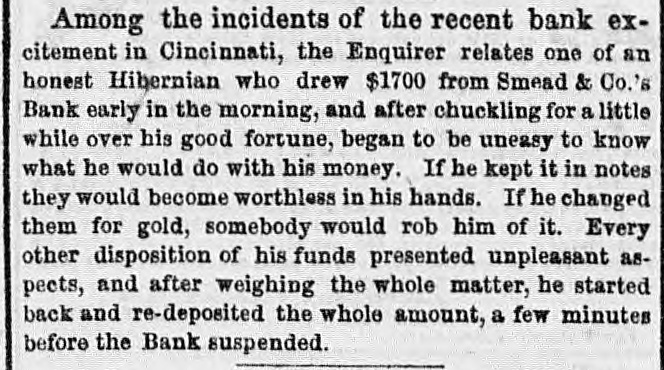
Among the incidents of the recent bank excitement in Cincinnati, the Enquirer relates one of an honest Hibernian who drew $1700 from Smead & Co.'s Bank early in the morning, and after chuckling for a little while over his good fortune, began to be uneasy to know what he would do with his money. If he kept it in notes they would become worthless in his hands. If he changed them for gold, somebody would rob him of it. Every other disposition of his funds presented unpleasant aspects, and after weighing the whole matter, he started back and re-deposited the whole amount, a few minutes before the Bank suspended.


Article from The Daily Minnesota Pioneer, November 18, 1854

Click image to open full size in new tab

Article Text

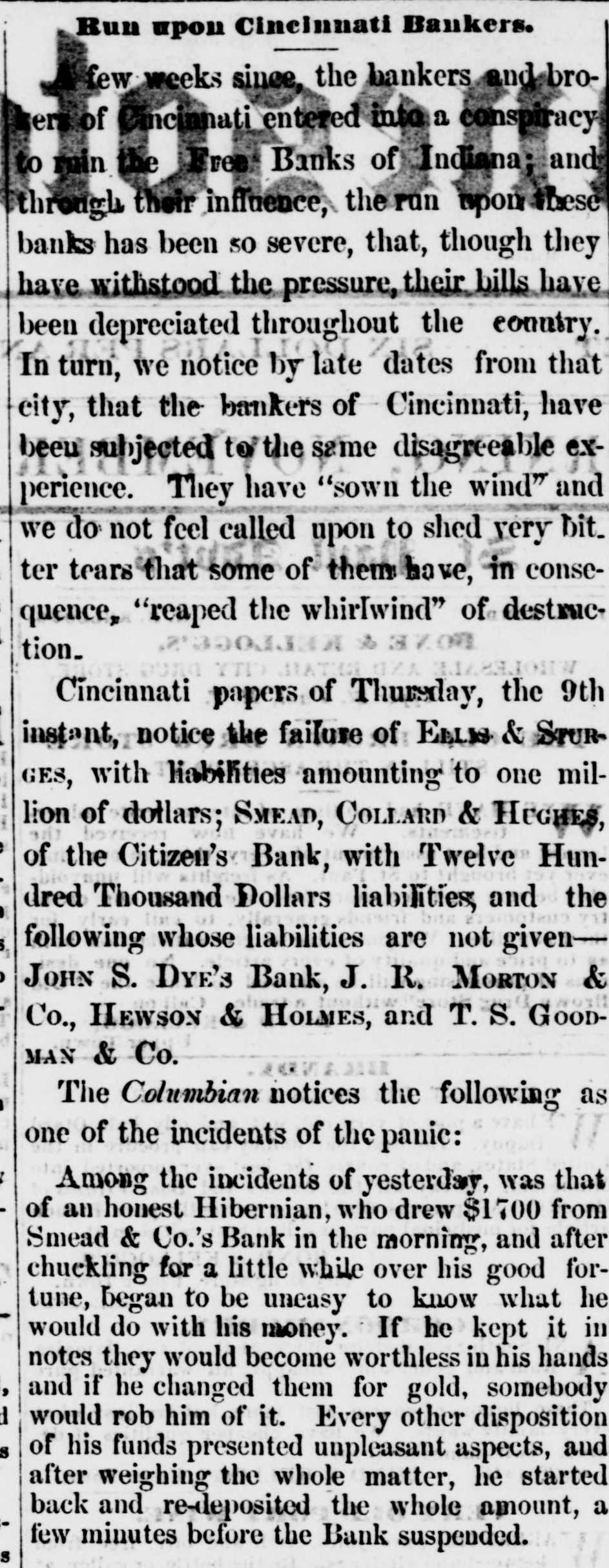
Run upon Cincinnati Bankers. few weeks since, the bankers and broters of Cincinnati entered into a conspiracy to ruin the Free Banks of Indiana; and through their influence, the run upon these banks has been so severe, that, though they have withstood the pressure, their bills have been depreciated throughout the country. In turn, we notice by late dates from that city, that the bankers of Cincinnati, have been subjected to the same disagreeable experience. They have "sown the wind" and we do not feel called upon to shed very bit_ ter tears that some of them have, in consequence, "reaped the whirTwind" of destruction_ Cincinnati papers of Thursday, the 9th instant, notice the failure of EMM & STURGES, with liabilities amounting to one million of dollars; SMEAD, COLLARD & HUGHES, of the Citizen's Bank, with Twelve Hundred Thousand Dollars liabilities, and the following whose liabilities are not givenJOHN S. DYE'S Bank, J. R. MORTON & Co., HEWSON & HOLMES, and T.S. GOODMAN & Co. The Columbian notices the following as one of the incidents of the panic: Among the incidents of yesterday, was that of an honest Hibernian, who drew $1700 from Smead & Co.'s Bank in the morning, and after chuckling for a little while over his good fortune, began to be uneasy to know what he would do with his money. If he kept it in notes they would become worthless in his hands and if he changed them for gold, somebody would rob him of it. Every other disposition of his funds presented unpleasant aspects, and after weighing the whole matter, he started back and re-deposited the whole amount, a few minutes before the Bank suspended.


Article from The New York Herald, November 19, 1854

Click image to open full size in new tab

Article Text

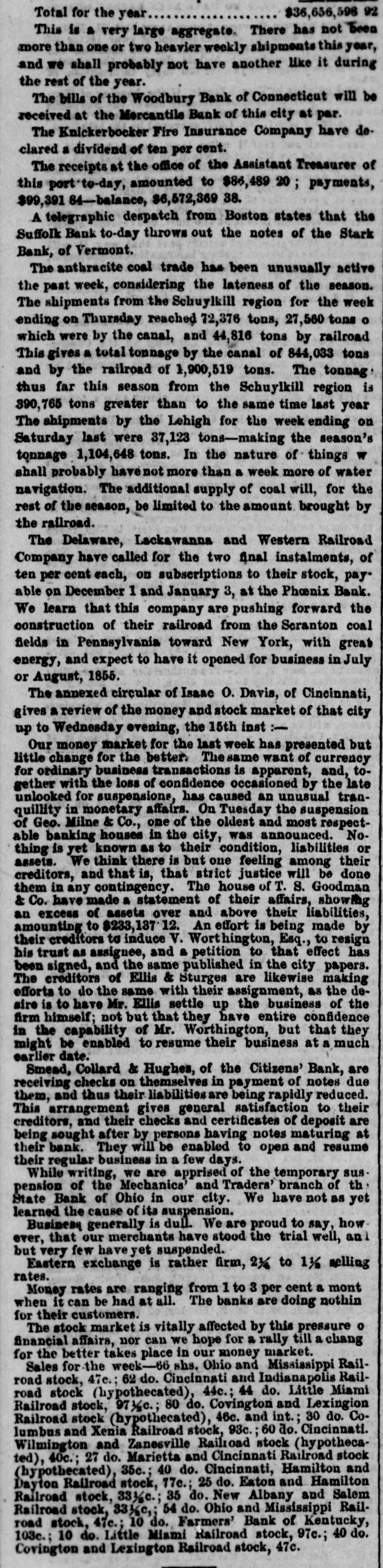
This is a very large aggregate. There has not been more than one or two heavier weekly shipments this year, and we shall probably not have another like it during the rest of the year. The bills of the Woodbury Bank of Connecticut will be received at the Mercantile Bank of this city at par. The Knickerbocker Fire Insurance Company have declared a dividend of ten per cent. The receipts at the office of the Assistant Treasurer of this port-to-day, amounted to $86,489 20 payments, $99,391 84-balance, $6,572,369 38. A telegraphic despatch from Boston states that the Suffolk Bank to-day throws out the notes of the Stark Bank, of Vermont. The anthracite coal trade has been unusually active the past week, considering the lateness of the season. The shipments from the Schuylkill region for the week ending on Thursday reached 72,376 tons, 27,560 tons o which were by the canal, and 44,816 tons by railroad This gives a total tonnage by the canal of 844,033 tons and by the railroad of 1,900,519 tons. The tonnag thus far this season from the Schuylkill region is 390,765 tons greater than to the same time last year The shipments by the Lehigh for the week ending on Saturday last were 37,123 tons-making the season's tonnage 1,104,648 tons. In the nature of things W shall probably have not more than a week more of water navigation. The additional supply of coal will, for the rest of the season, be limited to the amount brought by the railroad. The Delaware, Lackawanna and Western Railroad Company have called for the two final instalments, of ten per cent each, on subscriptions to their stock, pay. able on December 1 and January 3, at the Phoenix Bank. We learn that this company are pushing forward the construction of their railroad from the Seranton coal fields in Pennsylvania toward New York, with great energy, and expect to have it opened for business in July or August, 1855. The annexed circular of Isaae O. Davis, of Cincinnati, gives a review of the money and stock market of that city up to Wednesday evening, the 15th inst :Our money market for the last week has presented but little change for the better. The same want of currency for ordinary business transactions is apparent, and, together with the loss of confidence occasioned by the late unlooked for suspensions, has caused an unusual tranquillity in monetary affairs. On Tuesday the suspension of Geo. Milne & Co., one of the oldest and most respectable banking houses in the city, was announced. Nothing is yet known as to their condition, liabilities or assets. We think there is but one feeling among their creditors, and that is, that strict justice will be done them in any contingency. The house of T. S. Goodman & Co. have made a statement of their affairs, showing an excess of assets over and above their liabilities, amounting to $233,137 An effort is being made by their creditors to induce V. Worthington, Esq., to resign his trust as assignee, and a petition to that effect has been signed, and the same published in the city papers. The creditors of Ellis & Sturges are likewise making efforts to do the same with their assignment, as the desire is to have Mr. Ellis settle up the business of the firm himself; not but that they have entire confidence in the capability of Mr. Worthington, but that they might be enabled to resume their business at a much earlier date. Smead, Collard & Hughes, of the Citizens' Bank, are receiving checks on themselves in payment of notes due them, and thus their liabilities being rapidly reduced. This arrangement gives general satisfaction to their creditors, and their checks and certificates of deposit are being sought after by persons having notes maturing at their bank. They will be enabled to open and resume their regular business in a few days. While writing, we are apprised of the temporary sus. pension of the Mechanics' and Traders' branch of th State Bank of Ohio in our city. We have not as yet learned the cause of its suspension. Business generally is dull. We are proud to say, how. ever, that our merchants have stood the trial well, anl but very few have yet suspended. Eastern exchange is rather firm, 2Β½ to 1Β½ selling rates. Money rates are ranging from 1 to 3 per cent a mont when it can be had at all. The banks are doing nothin for their customers. The stock market is vitally affected by this pressure o financial affairs, nor can we hope for a rally till a chang for the better takes place in our money market. Sales for the week-66 shs. Ohio and Mississippi Railroad stock, 47c.; 62 do. Cincinnati and Indianapolis Railroad stock (hypothecated), 44c.; 44 do. Little Miami Railroad stock, 973/20.; 80 do. Covington and Lexingion Railroad stock (hypothecated), 46c. and int.; 30 do. Columbus and Xenia Railroad stock, 93c. 60 do. Cincinnati. Wilmington and Zanesville Railroad stock (hypothecated), 40c.; 27 do. Marietta and Cincinnati Railroad stock (hvnothecated) 35c. 40 do. Cincinnati, Hamilton and


Article from The Evansville Daily Journal, November 28, 1854

Click image to open full size in new tab

Article Text

CINCINNATI CORRESPONDENCE. CINCINNATI, Nov. 22, 1854. A. H. Sanders, Esq. Dear Sir:-Money matters here continue or in a chaotic condition, though within a ifest, two quite improvement has been day confidence owing in a great degree to manrather in the minds of the community, returning condition than to any real change in the since of things. Gold which few actual sold for 4 and 5, and even a higher days premium, cent is now in good supply at 2 holds and declining. Eastern Exchange per 21; but up to 2 per cent, and some is selling still at the prospect is that the rate will in a signs. day or two be down to 11. These are good Third street has lost its wonted animation. have The old and heavy banking houses which doors suspended, look sad and solemn, their closed, and "Bank shut" staring through their windows. The suspensions here, lis it is quite evident-that is those of El& Sturgess, T. S. Goodman & Co., Smead, Collard & Hughes, Mechanics' & 80 Traders' Bank, and some others-were much from actual insolvency au from not panic, which created an immediate call on a them, beyond their actual cash on hand. suspension now was therefore inevitable. And A ed that have suspended and are forcout to is go into liquidation, how they will and the uncertain. The times are unfavorable, come will delays and difficulties of ettlement that doubtless be great. The probability is der few, if any, will pay in full, though haps different circumstances there would unbe a handsome excess of assets in perexcept Geo. two or three cases. The failure all, worst Milne & Co. is considered about of over. of prominent houses which have gone the Since leaving home, two weeks since, n the have noticed various misrepresentations I Bank Indiana press, in regard to the State in n the of Indiana. It has been stated e that Lawrenceburgh Branch had suspended; that the meeting of the State Board dianapolis last week, was to consider at the Insubject that of a suspension of the whole Bank; e the meeting was to crush out the State Banks, with a view to a recharter of free d Bank; that the State Bank the league free with the brokers in the run upon was in er banks for coin; that the Bank had the re pended And once and would no doubt do so susis member. various other charges which I do not again. res, st notice Now with those who know the facts, ed ciations of such statements, or of the denun- any in interested of those who, either from ap and dishonest motives, or culpable malice, aignorance, are giving currency to them, is m entirely needless. The public at large, howa reckless ever, may be deceived and misled by these : assaults of a reckless and venal press, the and some reply may be due both to Bank and the public. st ch The charge that the Lawrenceburgh or any And other branch has suspended, is not true. or though this is now well known, the 8. dweit presses which first heralded the charge, and Supon it with hyena satisfaction, have not, to my knowledge, had the candor correct the statement. It is true that, ow. to Γ‰ ing to a transfer of the Lawrenceburgh hBranch into new hands, some months since, ng certain new irregularities were introduced by the ers America proprietors (who were full of Young of and and owned a free Bank in Indiana) rethe result might have been, what the on newspapers 80 much seemed to desire-a alpension-had taken not the State Board promptly sus. ill fer of the Branch in hand, requiring a transes, of its stocks, the election of a new Board Directors and a new President (an old Fogy at that), andset the whole concern ly good, old fasoioned conservative ground, and on be placed it in a position to defy the combined ey attacks of the most greedy Shylocks and sad most puny and mendacious squibsters. ely The charge that the State Board ho to plated a suspension of specie payments, contemed true met to consider that subject, is not only or but absurd. It was not a called, but unde, Ve regular and quarterly meeting, to declare dividends a ow pedient. transact any other business deemed exThe subject of a suspension of the Bank onwas not before the Board. With instrength of which she presents, the introduction the me such a subject would have been treason the to the institution. I enclose a copy of the bestatement of the condition of the Bank the 31st ult., and als a comparison of it or condition at that date with its condition ms year these previous. You will please publish one enstatements in connection with this let enter. Every one competent to judge, will one but CIBLY that the STRONG- Bank is amply has fortified-indeed INVIN se


Article from Spirit of the Times, November 28, 1854

Click image to open full size in new tab

Article Text

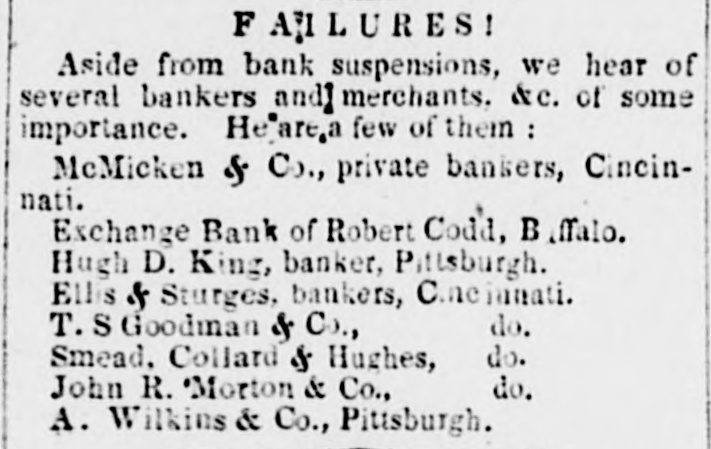
FAILURES! Aside from bank suspensions, we hear of several bankers and] merchants. &c. of some importance. He'are,a few of them : McMicken & Co., private bankers, Cincinnati. Exchange Bank of Robert Codd, Biffalo. Hugh D. King, banker, Pittsburgh. Ellis & Sturges, bankers, Cincinnati. do. T. S Goodman & Co., do. Smead, Collard s Hughes, do. John R. Morton & Co., A. Wilkins & Co., Pittsburgh.


Article from The Perrysburg Journal, January 27, 1855

Click image to open full size in new tab

Article Text

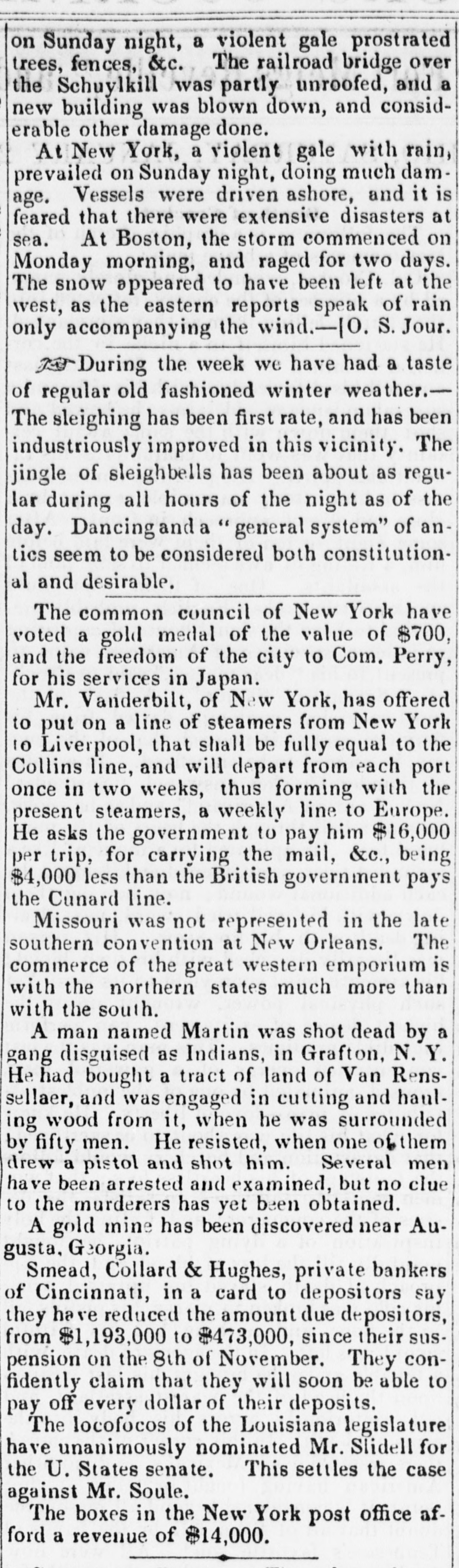
on Sunday night, a violent gale prostrated trees, fences, &c. The railroad bridge over the Schuylkill was partly unroofed, and a new building was blown down, and considerable other damage done. At New York, a violent gale with rain, prevailed on Sunday night, doing much damage. Vessels were driven ashore, and it is feared that there were extensive disasters at sea. At Boston, the storm commenced on Monday morning, and raged for two days. The snow appeared to have been left at the west, as the eastern reports speak of rain only accompanying the wind.-10. S. Jour. 150 During the week we have had a taste of regular old fashioned winter weather.The sleighing has been first rate, and has been industriously improved in this vicinity. The jingle of sleighbells has been about as regular during all hours of the night as of the day. Dancingand a general system" of antics seem to be considered both constitutional and desirable. The common council of New York have voted a gold medal of the value of $700, and the freedom of the city to Com. Perry, for his services in Japan. Mr. Vanderbilt, of New York, has offered to put on a line of steamers from New York 10 Liverpool, that shall be fully equal to the Collins line, and will depart from each port once in two weeks, thus forming with the present steamers, a weekly line to Europe. He asks the government to pay him $16,000 per trip, for carrying the mail, &c., being $4,000 less than the British government pays the Cunard line. Missouri was not represented in the late southern convention at New Orleans. The commerce of the great western emporium is with the northern states much more than with the south. A man named Martin was shot dead by a gang disguised as Indians, in Grafton, N. Y. He had bought a tract of land of Van Renssellaer, and was engaged in cutting and hauling wood from it, when he was surrounded by fifty men. He resisted, when one of them drew a pistol and shot him. Several men have been arrested and examined, but no clue to the murderers has yet been obtained. A gold mine has been discovered near Augusta. Georgia. Smead, Collard & Hughes, private bankers of Cincinnati, in a card to depositors say they have reduced the amount due depositors, from $1,193,000 to $473,000, since their suspension on the 8th of November. They confidently claim that they will soon be able to pay off every dollar of their deposits. The locofocos of the Louisiana legislature have unanimously nominated Mr. Slidell for the U. States senate. This settles the case against Mr. Soule. The boxes in the New York post office afford a revenue of $14,000.


Article from The Daily Gate City, May 25, 1855

Click image to open full size in new tab

Article Text

Smead & Co., celebrated bankers of Cincinnati, who suspended last Winter, have resumed business again.


Article from The Weekly Minnesotian, June 9, 1855

Click image to open full size in new tab

Article Text

Smead, Collard & Hughes, bankers in Cincinnati, who suspended last fall with liabilities of over a million, have resumed payment. actenbers 109091 9di dromA