National German American Bank (St Paul, MN)

Episode Information

Episode UID
294301124
Episode Type
Run β†’ Suspension β†’ Reopening
Bank Type
national
Bank ID
29430 national
Charter Number
2943
Start Date
August 4, 1893
Location
St Paul, Minnesota (44.944, -93.093)

Metadata

Model
gpt-5-mini (chosen from majority vote of a three-model LLM ensemble)
Short Digest
90d26d25e200dc96

Response Measures

Borrowed from banks or large institutions, Public signal of financial health, Capital injected, Partial suspension, Full suspension, Books examined

Events (6)

1. May 9, 1883 Chartered
Source
historical_nic
2. August 4, 1893 Run
Cause
Rumor Or Misinformation
Cause Details
Widespread panic/fright among depositors led to heavy withdrawals over preceding month, depleting cash.
Measures
Directors sought extensions from depositors and collected cash; solicited support from correspondent banks and comptroller.
Newspaper Excerpt
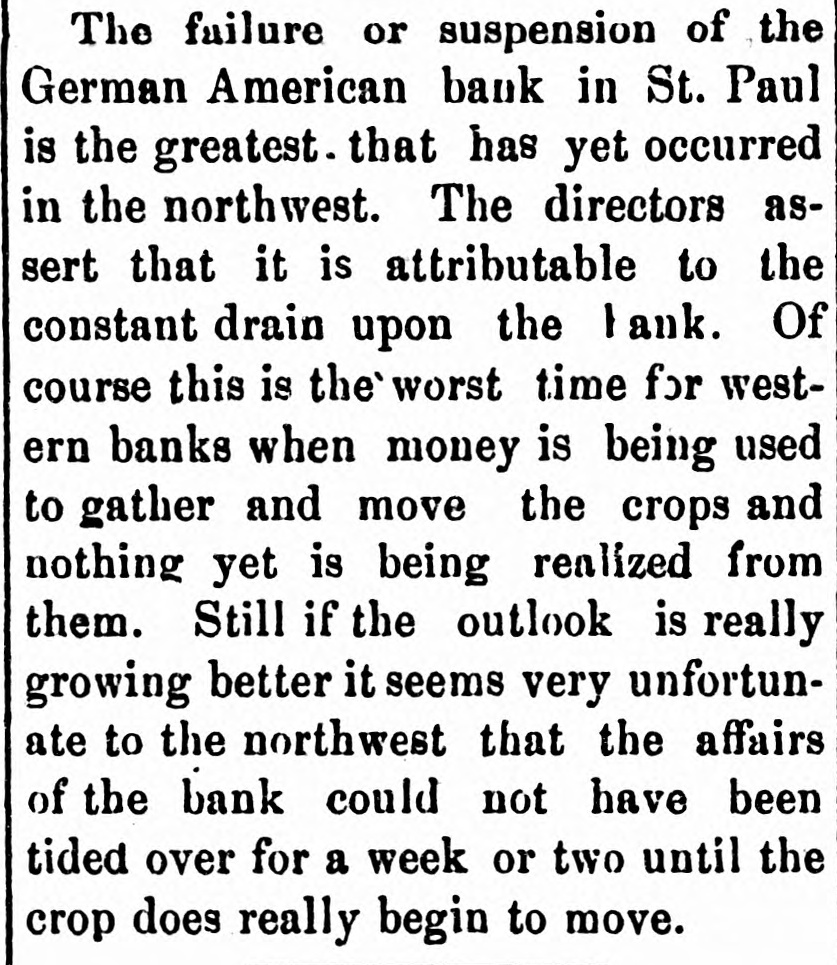
the depositors of this bank have withdrawn from it their money, so quickly that its assets cannot be converted into ready cash
Source
newspapers
3. August 4, 1893 Suspension
Cause
Rumor Or Misinformation
Cause Details
Temporary suspension declared because continued withdrawals made it impossible to realize assets quickly enough to meet demands.
Newspaper Excerpt
The National German American bank failed to open its doors this morning and announced a temporary suspension consequent upon a steady drain of withdrawals
Source
newspapers
4. August 5, 1893 Receivership
Newspaper Excerpt
Daniel W. Lawler has been appointed receiver / Daniel W. Lawler has been appointed to assume charge of the affairs of the bank . . .” (approx. Aug. 5 reports).
Source
newspapers
5. October 23, 1893 Reopening
Newspaper Excerpt
The National German American bank, which suspended August 4th, reopened its doors today by authority of comptroller of the currency Eckels.
Source
newspapers
6. November 27, 1912 Voluntary Liquidation
Source
historical_nic

Newspaper Articles (20)

Article from Deseret Evening News, August 4, 1893

Click image to open full size in new tab

Article Text

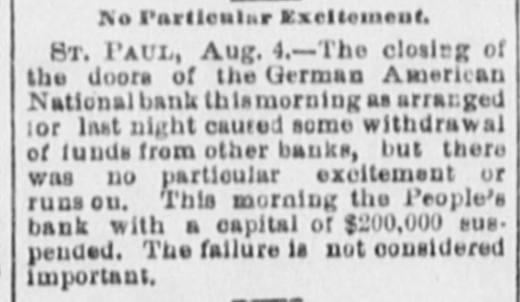
No Particular Excitement. ST. PAUL, Aug. 4.-The closing of the doors of the German American Nationalbank thismorning as arranged for Inst night caused some withdrawal of funds from other banks, but there was no particular excitement or runs on. This morning the People's bank with & capital of $200,000 suspended. The failure is not considered important.


Article from St. Paul Daily Globe, August 5, 1893

Click image to open full size in new tab

Article Text

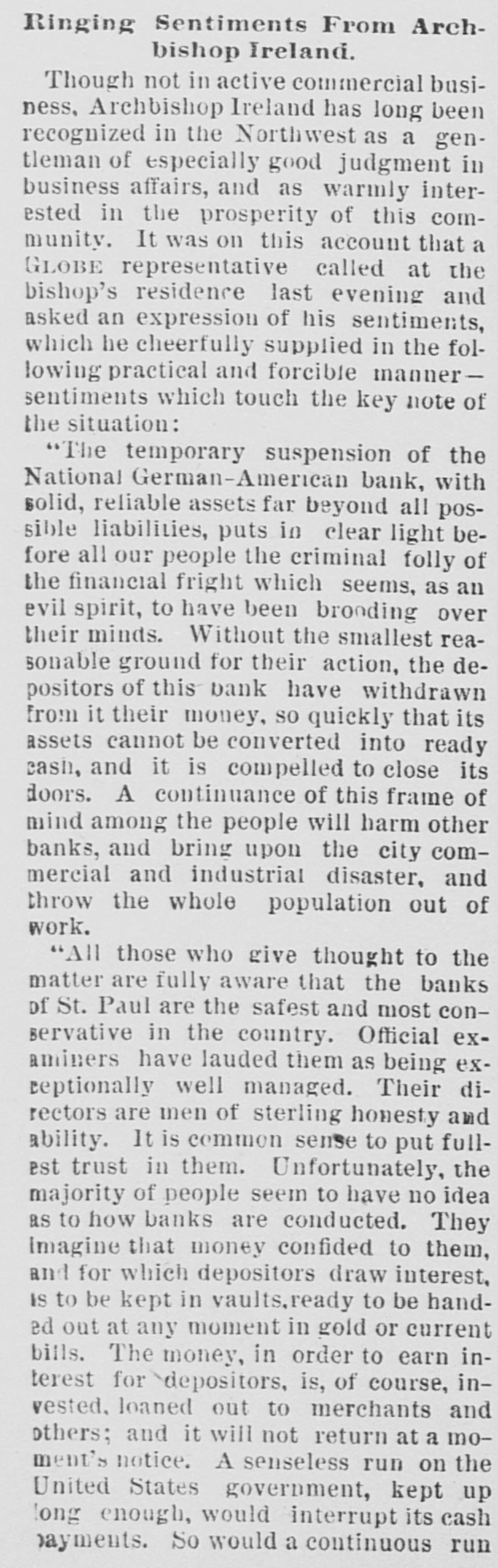
Ringing Sentiments From Archbishop Ireland. Though not in active commercial business, Archbishop Ireland has long been recognized in the Northwest as a gentleman of especially good judgment in business affairs, and as warmly interested in the prosperity of this community. It was on this account that a GLOBE representative called at the bishop's residence last evening and asked an expression of his sentiments, which he cheerfully supplied in the following practical and forcible mannersentiments which touch the key note of the situation: "The temporary suspension of the National German-American bank, with solid, reliable assets far beyond all possible liabilities, puts in clear light before all our people the criminal folly of the financial fright which seems, as an evil spirit, to have been brooding over their minds. Without the smallest reasonable ground for their action, the depositors of this bank have withdrawn from it their money, SO quickly that its assets cannot be converted into ready cash, and it is compelled to close its doors. A continuance of this frame of mind among the people will harm other banks, and bring upon the city commercial and industrial disaster, and throw the whole population out of work. "All those who give thought to the matter are fully aware that the banks of St. Paul are the safest and most conservative in the country. Official examiners have lauded them as being exreptionally well managed. Their directors are men of sterling honesty and ability. It is common sense to put fullest trust in them. Unfortunately, the majority of people seem to have no idea as to how banks are conducted. They Imagine that money confided to them, and for which depositors draw interest, is to be kept in vaults, ready to be handed out at any moment in gold or current bills. The money, in order to earn interest for depositors, is, of course, invested, loaned out to merchants and others; and it will not return at a moment's notice. A senseless run on the United States government, kept up long enough, would interrupt its cash payments. So would a continuous run


Article from St. Paul Daily Globe, August 5, 1893

Click image to open full size in new tab

Article Text

J. J. Hill's Diagnosis. A call at the office of the Great Northern yesterday atternoon found its president, J. J. Hill, immersed in business, as usual, but he halted long enough to briefly express himself. "Primarily," said Mr. Hill, "all of this financial difficulty arises from the attempt to secure by legislative law what is diametrically opposed to commercial law. That this cannot be done is manifest by the present condition of business. It has created a lack of confidence, and it is that lack of confidence which has caused the withdrawal of deposits from our banks and compelled the suspension ef one of our large institutions today. The St. Paul banks are solvent, and depositors are not in the slightest danger of loss. The National German-American bank will pay its depositors in full, and the fright which led to the withdrawal of funds has really damaged the parties engaged in it more than the bank itself. A large amount of the money being drawn out of banks is held by those in employment or seeking employment of some kind, and not by the active business men. These laboring people ought to see that they are cutting their own throats. If they withdraw their money from banks to hoard it, how can they expect business to be continued and give them employment? They not only lose their interest, but they cripple those who employ them, SO that they deprive themselves of the opportunity to earn their daily bread. There is no occasion for any one who has money in St. Paul banks to be alarmed, and if people will quietly go about their business and keep their heads there need be no trouble.


Article from Pawtucket Tribune, August 5, 1893

Click image to open full size in new tab

Article Text

Figures Show Up Well. ST. PAUL, Aug. 5.-An approximate estimate of the figures showing the conditian of the National German American bank gives the assets at $4,577,702.59 and the liabilities at $2,549,664. Daniel W. Lawler has been appointed receiver.


Article from The Providence News, August 5, 1893

Click image to open full size in new tab

Article Text

Figures Show Up Wells Sr. PAUL, Aug. 5.-An approximate estimate of the figures showing the conditian of the National German American bank gives the assets at $4,577,702.59 and the liabilities at $3,549,664. Daniel W. Lawler has been appointed receiver.


Article from St. Paul Daily Globe, August 8, 1893

Click image to open full size in new tab

Article Text

IN WASHINGTON, Messrs. Lockey, Doran and Lawler Confer With Eckels. Special to the Globe. WASHINGTON, Aug. 7. - National Committeeman Doran, Hon. Dat W. Lawler and President Joseph Lockey, of the National German-American bank, were three prominent Minnesota arrivals at the national capital today. All three gentlemen were closeted with Comptroller Eckels a good part of the afternoon regarding the resumption of the Gerinan-American, and found him willing and anxious to lend all the aid in his power towards bringing out the reopening, of the bank. President Lockey presented a resolution of the board of directors calling a meeting of the shareholders on Aug. 17, and asking that a receiver be appointed until the results of that meeting are known. Comptroller Eckels promptly said that he would not only grant that request, but he would also give a reasonable time after that meeting to enable the bank officials to make arrangements for reopeniug. This was very gratifying to the St. Paul men, and President Lockey left feeling greatly encouraged.


Article from Morris Tribune, August 9, 1893

Click image to open full size in new tab

Article Text

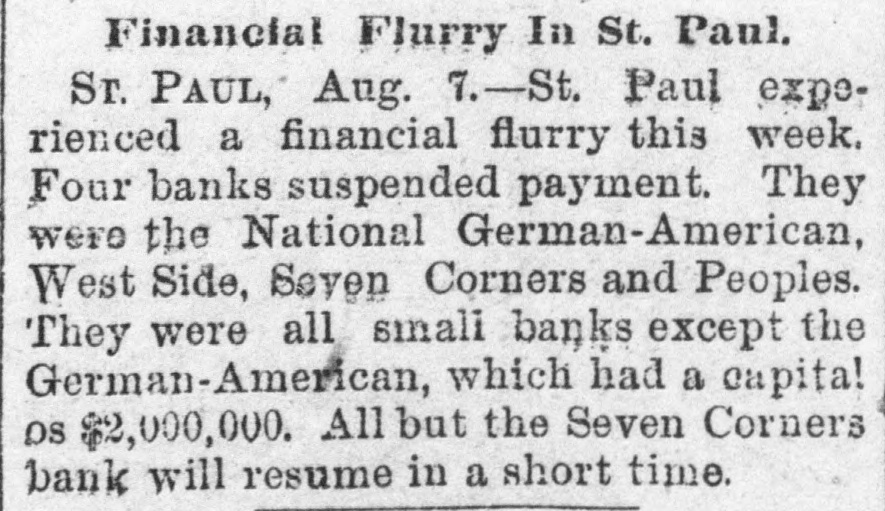
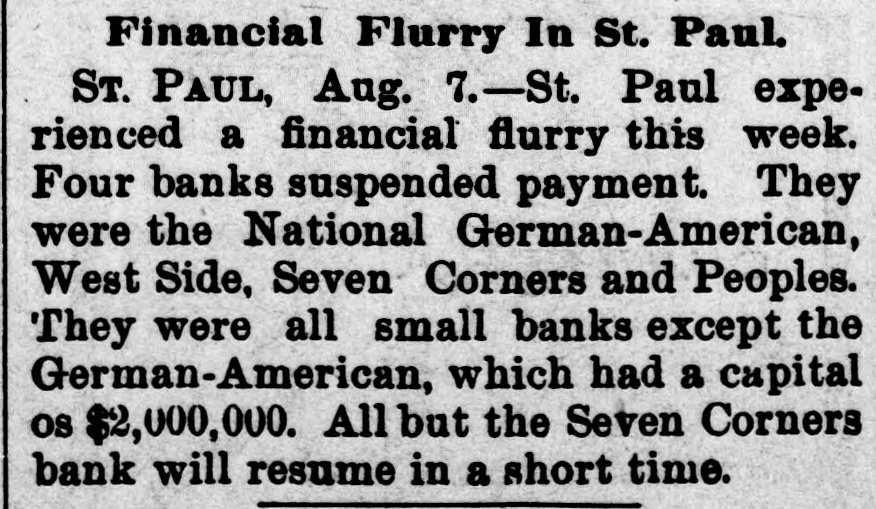
Financial Flurry In St. Paul. Sr. PAUL, Aug. 7.-St. Paul experienced a financial flurry this week. Four banks suspended payment. They were the National German-American, West Side, Seven Corners and Peoples. They were all smali banks except the German-American, which had a capita! os $2,000,000. All but the Seven Corners bank will resume in a short time.


Article from The Manitowoc Pilot, August 10, 1893

Click image to open full size in new tab

Article Text

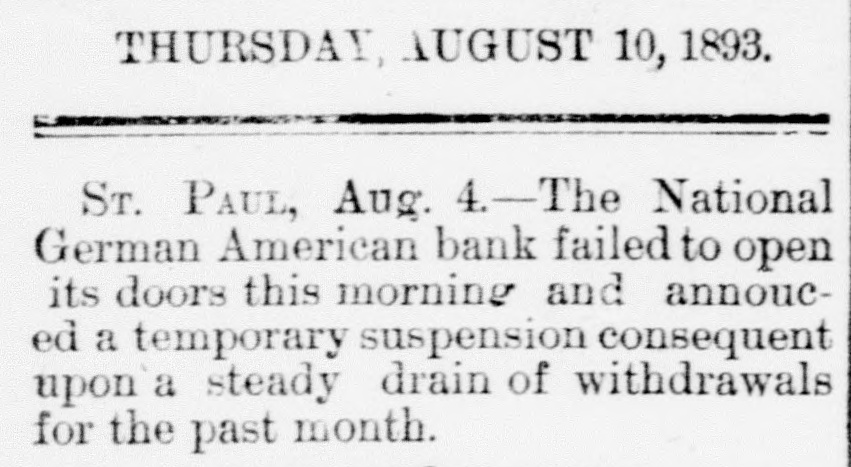
THURSDAY, AUGUST 10, 1893. ST. Paul, Aug. 4.-The National German American bank failed to open its doors this morning and annouced a temporary suspension consequent upon a steady drain of withdrawals for the past month.


Article from Oakes Weekly Republican, August 11, 1893

Click image to open full size in new tab

Article Text

Financial Flurry In St. Paul. Sr. PAUL, Aug. 7.-St. Paul experienced a financial Hurry this week. They suspended pay MY Four Dn were the National German-American West Side, Seven Corners and Peoples. 'They were all small banks except my Geritatt=American, which had a capital os $2,000,000. All but the Seven Corners bank will resume in it short time,


Article from Custer Weekly Chronicle, August 12, 1893

Click image to open full size in new tab

Article Text

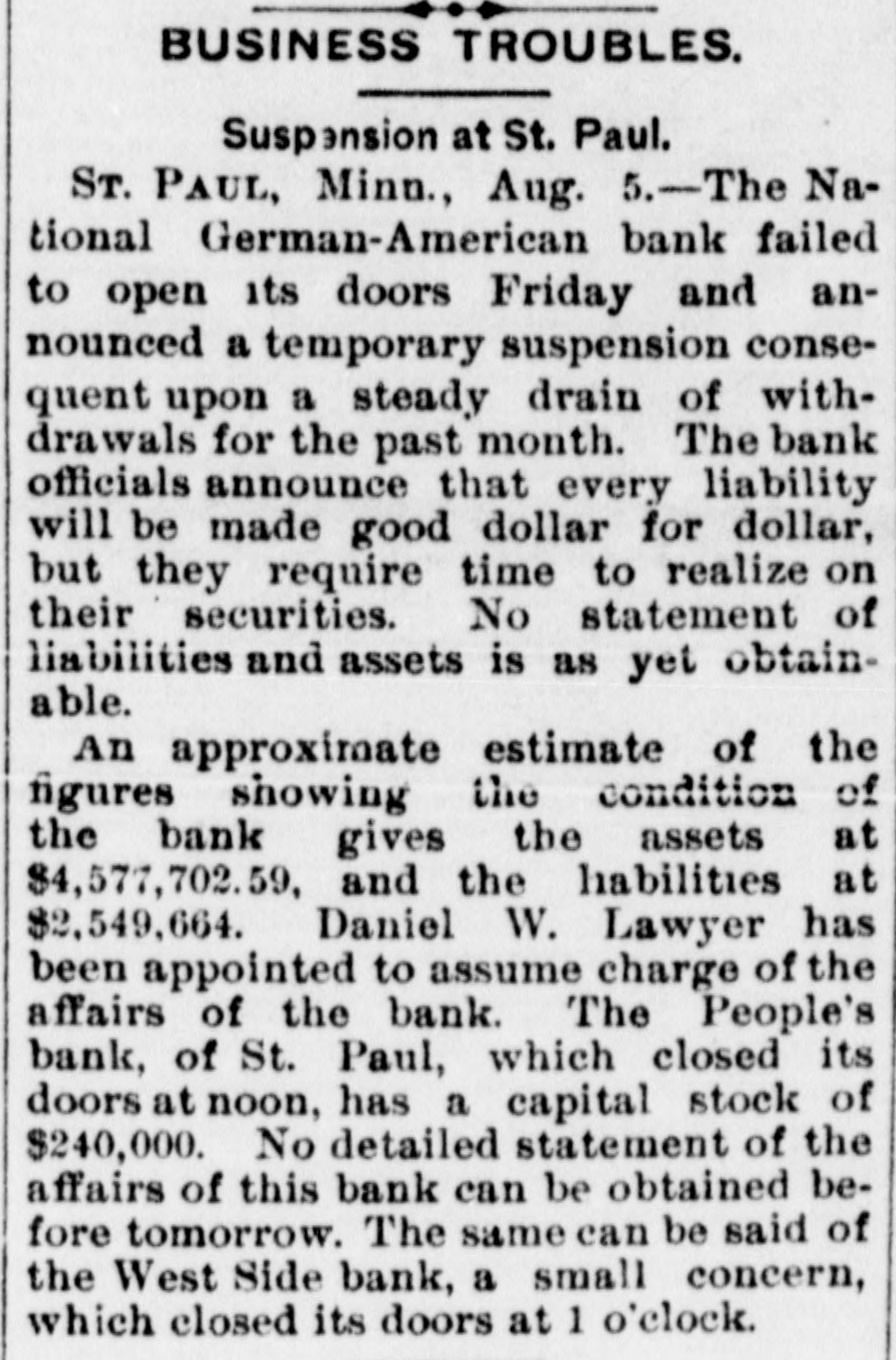
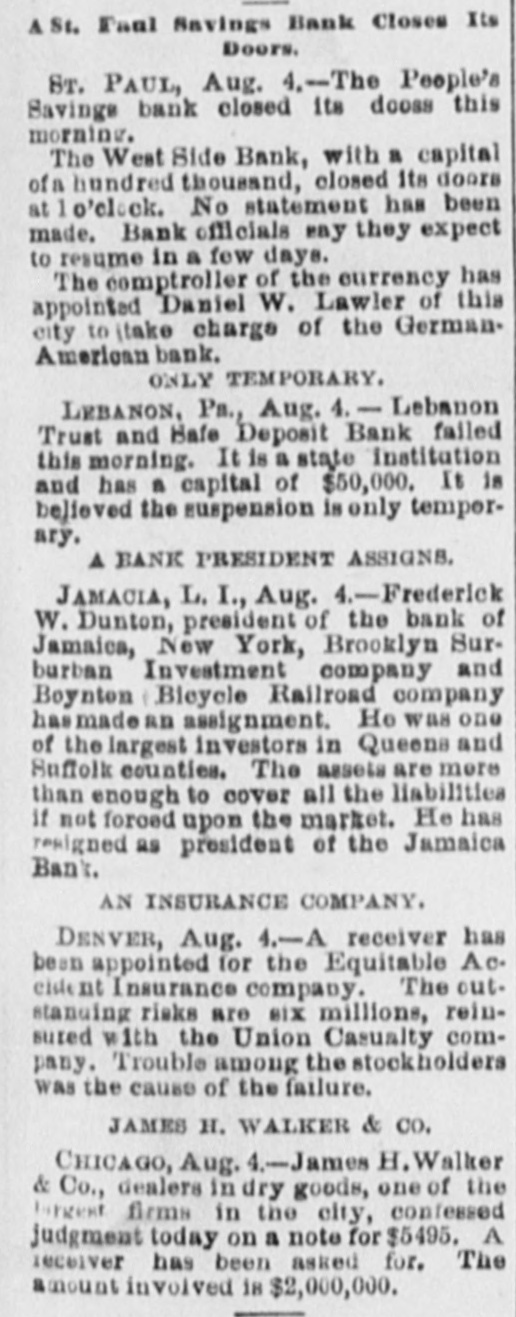
BUSINESS TROUBLES. Suspension at St. Paul. ST. PAUL, Minn., Aug. 5.-The National German-American bank failed to open its doors Friday and announced a temporary suspension consequent upon a steady drain of withdrawals for the past month. The bank officials announce that every liability will be made good dollar for dollar, but they require time to realize on their securities. No statement of liabilities and assets is as yet obtainable. An approximate estimate of the figures showing the condition of the bank gives the assets at $4,577,702.59, and the habilities at $2,549,664. Daniel W. Lawyer has been appointed to assume charge of the affairs of the bank. The People's bank, of St. Paul, which closed its doors at noon, has a capital stock of $240,000. No detailed statement of the affairs of this bank can be obtained before tomorrow. The same can be said of the West Side bank, a small concern, which closed its doors at 1 o'clock.


Article from Morris Tribune, August 16, 1893

Click image to open full size in new tab

Article Text

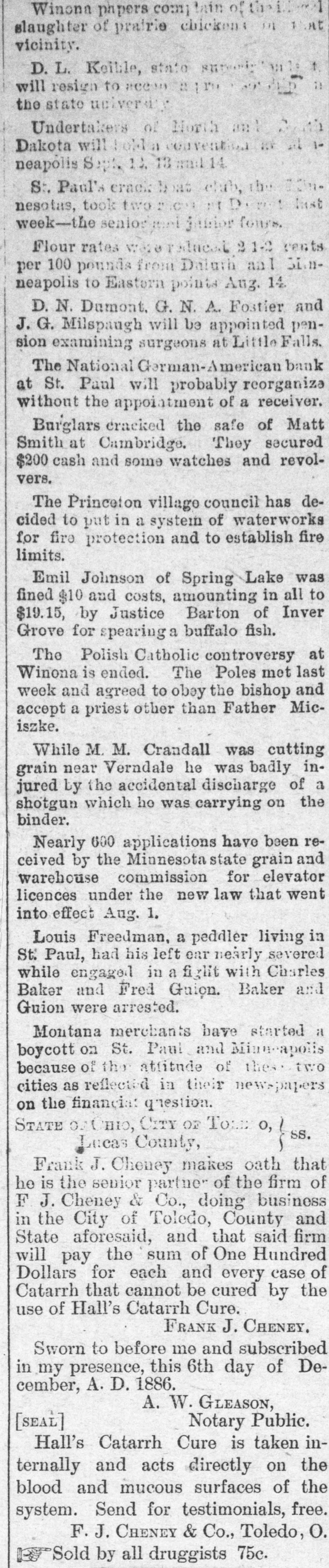
Winona papers contain complaint of the slaughter of prairie chickens in that vicinity. D. L. Keible, state supervisor, will resign to accept a position in the state university. Undertakers of North and South Dakota will hold a convention at Min- neapolis Sept. 12, 13 and 14. St. Paul's crack boat club, the Min- nesotas, took two races at Detroit last weekβ€”the senior and junior fours. Flour rates were reduced 2 1-2 cents per 100 pounds from Duluth and Min- neapolis to Eastern points Aug. 14. D. N. Dumont, G. N. A. Fostier and J. G. Milspaugh will be appointed pen- sion examining surgeons at Little Falls. The National German-American bank at St. Paul will probably reorganize without the appointment of a receiver. Burglars cracked the safe of Matt Smith at Cambridge. They secured $200 cash and some watches and revol- vers. The Princeton village council has de- cided to put in a system of waterworks for fire protection and to establish fire limits. Emil Johnson of Spring Lake was fined $10 and costs, amounting in all to $19.15, by Justice Barton of Inver Grove for spearing a buffalo fish. The Polish Catholic controversy at Winona is ended. The Poles met last week and agreed to obey the bishop and accept a priest other than Father Mic- iszke. While M. M. Crandall was cutting grain near Verndale he was badly in- jured by the accidental discharge of a shotgun which he was carrying on the binder. Nearly 600 applications have been re- ceived by the Minnesota state grain and warehouse commission for elevator licences under the new law that went into effect Aug. 1. Louis Freedman, a peddler living in St. Paul, had his left ear nearly severed while engaged in a fight with Charles Baker and Fred Guion. Baker and Guion were arrested. Montana merchants have started a boycott on St. Paul and Minneapolis because of the attitude of these two cities as reflected in their newspapers on the financial question. STATE OF OHIO, CITY OF TOLEDO, ss. Lucas County, Frank J. Cheney makes oath that he is the senior partner of the firm of F. J. Cheney & Co., doing business in the City of Toledo, County and State aforesaid, and that said firm will pay the sum of One Hundred Dollars for each and every case of Catarrh that cannot be cured by the use of Hall's Catarrh Cure. FRANK J. CHENEY. Sworn to before me and subscribed in my presence, this 6th day of De- cember, A. D. 1886. A. W. GLEASON, Notary Public. Hall's Catarrh Cure is taken in- ternally and acts directly on the blood and mucous surfaces of the system. Send for testimonials, free. F. J. CHENEY & CO., Toledo, O. Sold by all druggists 75c.
Article from The Waco Evening News, August 17, 1893

Click image to open full size in new tab

Article Text

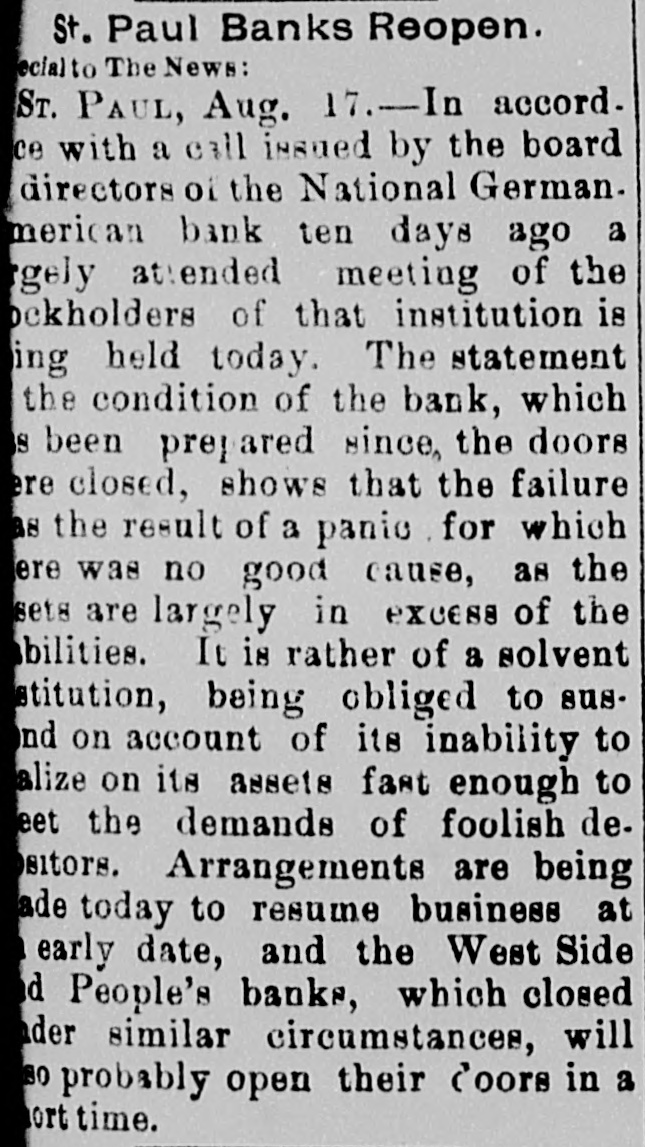
St. Paul Banks Reopen. ecial to The News: ST. PAUL, Aug. 17.-In accord. ce with a call issued by the board directors of the National Germanmerican bank ten days ago a gely attended meeting of the bekholders of that institution is ing held today. The statement the condition of the bank, which S been prepared since, the doors ere closed, shows that the failure as the result of a panic for which ere was no good cause, as the sets are largely in excess of the bilities. It is rather of a solvent stitution, being obliged to susnd on account of its inability to alize on its assets fast enough to eet the demands of foolish desitors. Arrangements are being ade today to resume business at early date, and the West Side d People's banks, which closed der similar circumstances, will 80 probably open their doors in a ort time.


Article from Fort Worth Gazette, August 18, 1893

Click image to open full size in new tab

Article Text

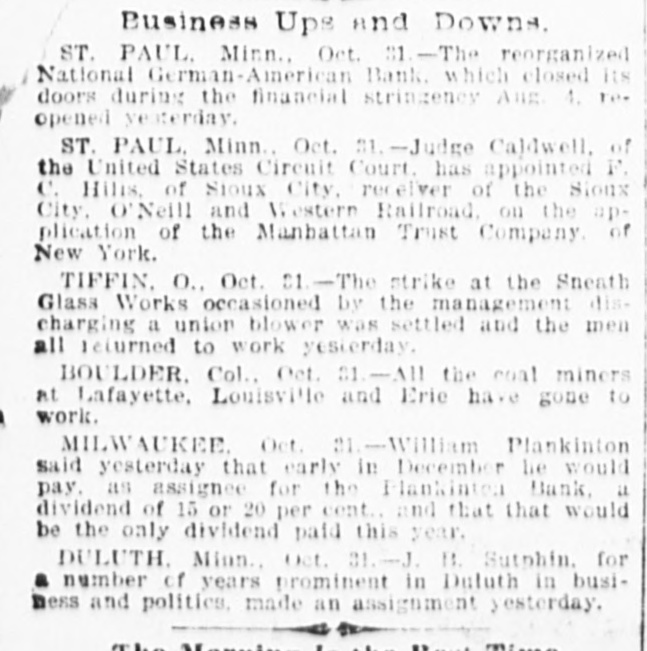
WILL REOPEN. ST. PAUL, Minn., Aug. 17.-The German-American National bank. which suspended a few days ago, will resume business just as soon as the necessary formalities can be complied with.


Article from The Prison Mirror, August 24, 1893

Click image to open full size in new tab

Article Text

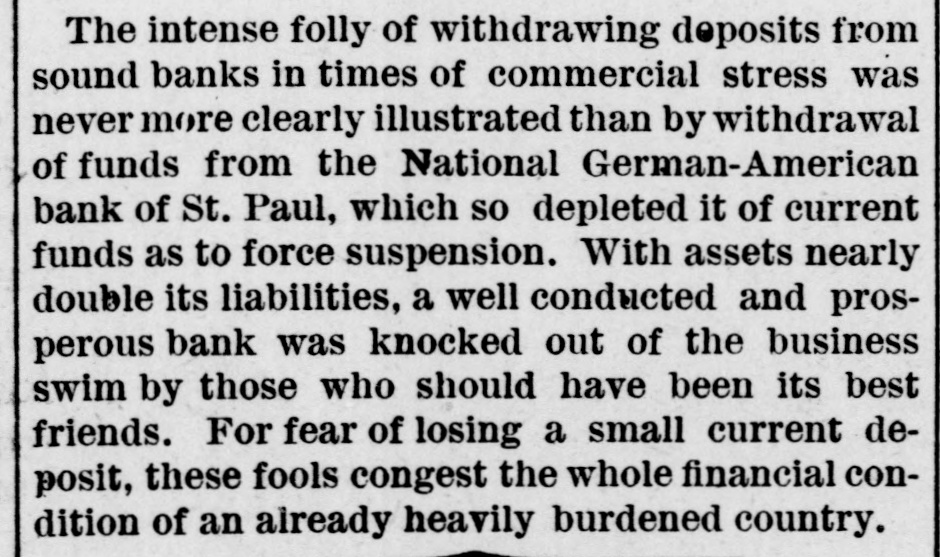
The intense folly of withdrawing deposits from sound banks in times of commercial stress was never more clearly illustrated than by withdrawal of funds from the National German-American bank of St. Paul, which so depleted it of current funds as to force suspension. With assets nearly double its liabilities, a well conducted and prosperous bank was knocked out of the business swim by those who should have been its best friends. For fear of losing a small current deposit, these fools congest the whole financial condition of an aiready heavily burdened country.


Article from St. Paul Daily Globe, October 1, 1893

Click image to open full size in new tab

Article Text

DEPOSITORS' EXTENSIONS ABSOLUTELY NECESSARY FOR GERMAN-AMERICAN TO RESUME. TALK WITH EXAMINER LYNCH. Meeting of the Bank Directors Yesterday - Mr. Lynch Tells Them What Must Be DoneDepositors Hold the Key They Can Secure Resumption and Their Money Shortly. A largely attended meeting of the di rectors of the National German-American bank was held yesterday, every director in the city being present. A. D. Lynch, of Washington, the special national bank examiner, was present to confer with the directors. Mr. Lynch devotes his entire time to investigating suspended national banks and aiding in their resumption or liquidation, as the case may be. He made a lengthy address to the directors, setting forth what was necessary for the bank to resume business. His views were excellently received and heartily coincided with, and the directtors propose to act along the lines laid down by him. A GLOBE representative called upon Mr. Lynch after the meeting, and received in substance the following: "It is evident," said Mr. Lynch, "that further extensions on the part of depositors are absolutely necessary, and, if they are not granted, resumption of the bank may be defeated. 1 consider that the officers of the bank have done excel lent work. They have collected $400,000 in cash, and secured extensions of deposits amounting to $1,482,000; but this is not enough. If the depositors do not grant the extensions a receiver will necessarily be appointed, and under the best administration possible it is not improbable that four years, if not more, would be required for liquidation of the trust. Through the plan now.proposed, the bank can be placed in a going condition, and those having deposits can obtain their money in the ordinary course very much earlier than if the bank should be forced into liquidation, Depositors should not wait to be called upon, but should call at the bank without delay and grant extensions. Doing so, they act in their own interests. If this is done, the bank can resume in a very short time. I cannot too strongly impress upon the depositors their interests and their duties in this matter. The directors, through their committee, are making the necessary collections and obtaining money required to perform their duty, but they must have the co-operation of the depositors, or all this will come to naught. There must be enough money secured, together with the extensions of the depositors, to enable the bank to meet the demand liabilities, as well as for a working capiital. I shall send the comptroller in a day or two a report of the present condition of affairs, and it is probable some representatives of the bank will visit Washington very shortly


Article from The Prison Mirror, October 12, 1893

Click image to open full size in new tab

Article Text

The National German-American bank of St. Paul will reopen its doors Oct. 23, and again do business. Its suspension was caused by the cowardly, who withdrew their cash just when the presence of cash was most needed and most unattainable. With assets almost double its liabilities, this sound concern was forced, for self-protection, to assign owing to foul blows from its supposed friends. Executive clemency in the case of Thompson the De Smet, S. D., murderer may be wisely exercised. But it would seem that when a jury and judge, these days. find a man guilty of a shocking, cold-blooded murder, and sentence him to be hanged in expiation, that that sentence should be carried out. Such cases of emotional leniency do not seem to benefit the cause of justice, law and order; but rather are inclined to antagonize the people towards them and incite disorder. In a speech in the Rotunda at Dublin. John Redmond, the Parnellite faction leader, clearly indicated that he and his followers had had enough of "the grand old" fraud, who had no more use for Ireland after the Irish had plucked the official chestnuts out of the political fire. Mr. Redmond declared that his faction would no longer vote with the Liberals on English questions. He eulogized Parnell and declared his belief in the lack of patriotism of the other wing of the Irish party. The closing scenes of the bi-metallic congress were pitifully ludicrous. A few earnest men striving to arouse enthusiam and attract the nation's attention which would not be attracted by their theories. Gov. Tillman mingled negro domination and Grant's bayonets with his belief that the South and West could control the presidency. Gov. Lewelling spoke of Kansas having sent ex-confederates to congress and the convention exhausted itself in cheering, and adjourned to meet at Atlanta, Ga., next year. The Ameer of Afghanstan shows his appreciation of Neil's genius, who during the Indian mutiny, promptly stopped assassinations by blowing the fanatics from a cannon's mouth. The dismemberd Moslem can not achieve his Paradise. To assassinate an infidel and be hanged is glorious martyrdom to the Moslem fanatic; to be shot to pieces is death and damnation combined. The Ameer saw the force of this argument and promptly put down his revolting soldiery by blowing the ringleaders to pieces,


Article from St. Paul Daily Globe, October 19, 1893

Click image to open full size in new tab

Article Text

THE GERMAN-AMERICAN, The Directors Meet and Formally Vote to Open on Oct. 30. A full meeting of the board of directors of the National German-American bank was held yesterday, only two members of the board being absent, and they were out of the city. Reports were made by President Lockey and the reorganization committee, showing that while the demand liabilities.are but a little over $300,000, $750,000 is in hand. Long time extensions have been secured for over a million and a half of deposits, and only detailed clerical work, writing up on the books all of the transactions which have occurred while the bank has been in charge of Receivers Lawler and Thorne, now remains to make the bank ready for business. The directors formally voted, in order to give time for this work, to delay the opening until 9 o'clock Monday morning, Oct. 30, when business will be fully resumed. The req uirements of the comptroller have been fully complied with, and Mr. Lynch, the special representative of the comptroller, stated. after the directors' meeting. that granting the authority for the reopening was now only a matter of formality. The statements of the GLOBE yesterday morning were fully verified by the action of the directors.


Article from The Waco Evening News, October 23, 1893

Click image to open full size in new tab

Article Text

Bank Resumes. Special to The News. ST. Paul, Minn., Oct. 23.-The National German American bank, which suspended August 4th, reopened its doors today by authority of comptroller of the currency Eckels. Its impaired capital has been strengthened, and it will receive the support of all its old customers.


Article from St. Paul Daily Globe, October 29, 1893

Click image to open full size in new tab

Article Text

nine financially strong and well-known business men, the bank should rank with the soundest institutions of St. Paul. He expressed his personal pleasure over the result, and his intercourse with the business men of the city, and thanked them cordially for the good will expressed toward him. There being no further business before the stockholders, and the arrangement for the reorganization being an accomplished fact, the stockholders' meeting adjourned sine die. Mr. Lynch leaves on Monday afternoon for Helena. The First National bank yesterday turned over to the newly organized National German-American bank $550,000 being money collected by it for the bank since its suspension. The payment was made in gold, and required the use of an express wagon to convey it. English Cashmeno Heziony


Article from Reporter and Farmer, November 2, 1893

Click image to open full size in new tab

Article Text

BUSINESS RESUMED. St. Paul, Oct. 30.-The German-American National bank, which suspended recently, reopened its doors to-day and is doing a good business. There was removed from the vaults of the Merchants' National bank Saturday to those of the German-American a sum approximating $610,000. part of the $896,000 cash reserve with which the bank opened its doors to-day. The transfer of this vast sum was made under the direction of Daniel W. Lawler. who, ever since the suspension of the German-American, has served as special bank examiner. Fifteen men were required to carry the sacks of gold, silver and currency between the vaults and the express wagon which had been hired of the Adams Express company. The transfer was protected from the assaults of the possibly avaricious and covetous by the presence of Chief Garvin. of the police force, and Chief of Detectives McGinn, not to mention six policemen in citizens' clothes, who patrolled the streets along the route taken by the wagon between the two banks.