Carroll Trust & Savings Bank (Carroll, IA)

Episode Information

Episode UID
2944279491518
Episode Type
Suspension β†’ Closure
Bank Type
trust
Bank ID
294427949 hash
Start Date
June 25, 1926
Location
Carroll, Iowa (42.066, -94.867)

Metadata

Model
gpt-5-mini (chosen from majority vote of a three-model LLM ensemble)
Short Digest
2baf59c390e59f1e

Response Measures

None

Description

OCR shows variant spellings of the president's name (Roelfsema / Rolfsema).

Events (3)

1. June 25, 1926 Other
Newspaper Excerpt
The judgments it won were for in excess of $25,000 claimed by the receiver of the Carroll Trust and Savings bank of Carroll, Iowa.
Source
newspapers
2. * Other
Newspaper Excerpt
the receiver of the Carroll Trust and Savings bank of Carroll, Iowa, ... claimed it had deposited $25,083 with the American State bank of Omaha when it went into a receiver's hands.
Source
newspapers
3. * Receivership
Newspaper Excerpt
receiver of the Carroll Trust and Savings bank of Carroll, Iowa
Source
newspapers

Newspaper Articles (3)

Article from Lincoln Journal Star, June 20, 1924

Click image to open full size in new tab

Article Text

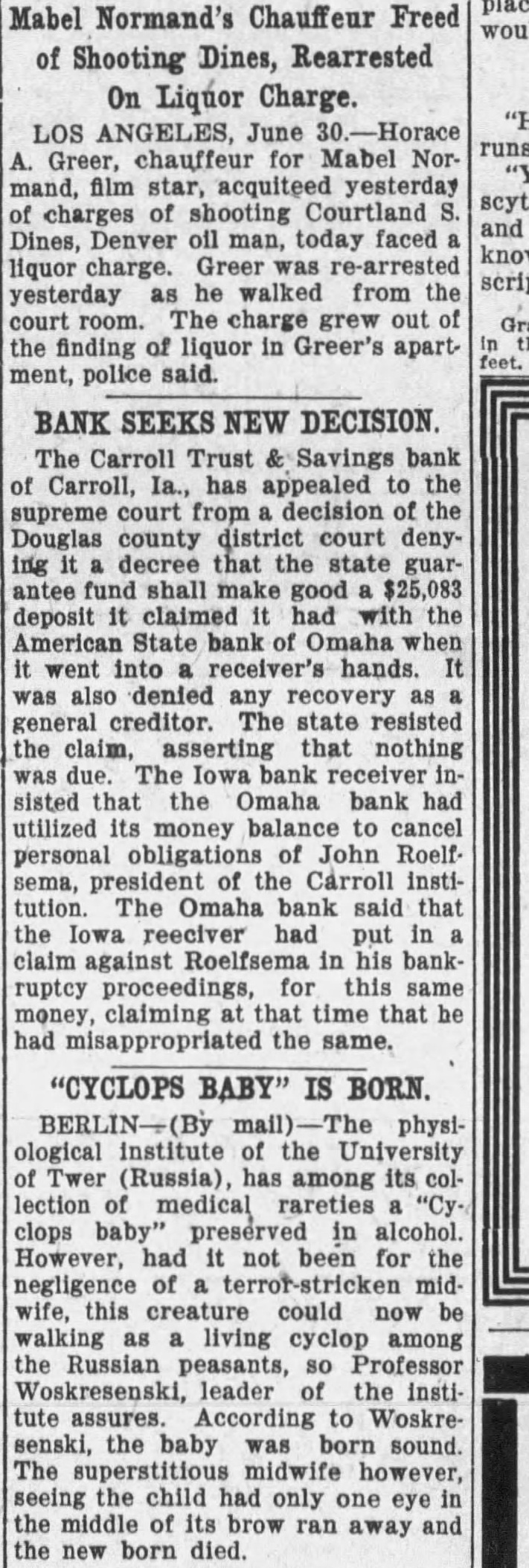
Mabel Normand's Chauffeur Freed of Shooting Dines, Rearrested On Liquor Charge. LOS ANGELES, June 30.β€”Horace A. Greer, chauffeur for Mabel Normand, film star, acquitted yesterday of charges of shooting Courtland S. Dines, Denver oil man, today faced a liquor charge. Greer was re-arrested yesterday as he walked from the court room. The charge grew out of the finding of liquor in Greer's apartment, police said. BANK SEEKS NEW DECISION. The Carroll Trust & Savings bank of Carroll, Ia., has appealed to the supreme court from a decision of the Douglas county district court denying it a decree that the state guarantee fund shall make good a $25,083 deposit it claimed it had with the American State bank of Omaha when it went into a receiver's hands. It was also denied any recovery as a general creditor. The state resisted the claim, asserting that nothing was due. The Iowa bank receiver insisted that the Omaha bank had utilized its money balance to cancel personal obligations of John Roelfsema, president of the Carroll institution. The Omaha bank said that the Iowa receiver had put in a claim against Roelfsema in his bankruptcy proceedings, for this same money, claiming at that time that he had misappropriated the same. "CYCLOPS BABY" IS BORN. BERLINβ€”(By mail)β€”The physiological institute of the University of Twer (Russia), has among its collection of medical rarities a "Cyclops baby" preserved in alcohol. However, had it not been for the negligence of a terror-stricken midwife, this creature could now be walking as a living cyclop among the Russian peasants, so Professor Woskresenski, leader of the institute assures. According to Woskresenski, the baby was born sound. The superstitious midwife however, seeing the child had only one eye in the middle of its brow ran away and the new born died.


Article from Lincoln Journal Star, June 25, 1926

Click image to open full size in new tab

Article Text

FUND HELD NOT LIABLE WINS $25,000 CASE IN THE SUPREME COURT. Two Receivers Battled Over Question If Responsibility for Loss Rested With American of Omaha. The state guaranty fund won two cases, totaling claims for over $27,000 and interest, and lost one for $2,109, by reason of supreme court decisions rendered Friday. The judgments it won were for in excess of $25,000 claimed by the receiver of the Carroll Trust and Sav ings bank of Carroll, Iowa, and for $1,400 claimed by two children of Cashier Amos of the failed Citizens State bank of Kimball, upon which excess interest was paid. It lost for $2,109 in favor of the Nebraska National bank of Hastings. The Carroll bank claim was based upon an alleged deposit of $25,000 in the American State bank of Omaha, also in receiver's hands. The was an involved one. John Rolfsema, president and chief owner of the Iowa bank, had $25,000 of the Omaha bank and placed the proceeds there as deposit in the name of his bank. He afterwards paid off the note by drafts drawn upon Chicago, the proceeds. which went into his personal account. Subsequently, to reimbures his bank for this appropriation of the money, he gave deed to his farm. The court says this was full settlement by the bank and amounted to ratification of what he had done. says the transaction, so far as borrowing money on his individual note and putting the proceeds to the credit of the bank was concerned, coupled with repayment of the note, was equivalent to the bank borrowing the money and subsequently paying the debt. It points out that it was not until the bank got into receiver's hands was any claim made that the legal effect of the transaction was that of deposit still in the Omaha bank to the credit of the Carroll institution. This status does not exist and not liable. The Nebraska National bank of Hastings was correspondent for the Farmers State bank of Belvidere, which failed at time when it had an overdraft in the Hastings insti tution by reason of the payment by the latter of drafts drawn upon The court says that where bank with checking account in correspondent bank draws a draft on the latter and the drawee pays the draft in good faith in the regular course of business pursuant to custom between the two institutions, theerby creating an draft of the drawer bank, which is closed in the meantime by reason of and having reason believe that funds or eredits are in transit to fully cover the overdraft, may in equity be to the rights of the original holder of the exchange, and may participate to the extent of the overdraft in the bank guaranty fund.


Article from Lincoln Journal Star, June 25, 1926

Click image to open full size in new tab

Article Text

FUND HELD NOT LIABLE WINS $25,000 CASE IN THE SUPREME COURT. Two Receivers Battled Over Question If Responsibility for Loss Rested With American of Omaha. The state guaranty fund won two cases, totaling claims for over $27,000 and interest, and lost one for $2,109, by reason of supreme court decisions rendered Friday. The judgments it won were for in excess of $25,000 claimed by the receiver of the Carroll Trust and Sav ings bank of Carroll, Iowa, and for $1,400 claimed by two children of Cashier Amos of the failed Citizens State bank of Kimball, upon which excess interest was paid. It lost for $2,109 in favor the Nebraska National bank of Hastings. The Carroll bank claim was based upon alleged deposit of $25,000 in the American State bank of Omaha, also in receiver's hands. The transaction an involved one. John Rolfsema, president and chief owner of the lowa bank, had borrowed of the Omaha bank and placed the proceeds there as deposit in the name of his bank. He afterwards paid off the note by drafts drawn upon Chicago, the proceeds of which went into his personal account. Subsequently to reimbures his bank for this of the money, he gave deed to his farm. says this was full settlement by the bank and amounted to a ratification of what he had done. It says the transaction, so far as borrowing money on his individual note and putting the proceeds to the credit of bank was concerned, coupled with his later repayment of the note, was equivalent to the bank borrowing the money and subsequently paying the debt. It points out that it was not until the bank got into receiver's hands was any claim made that the legal effect of the transaction was that of deposit still in the Omaha bank to the credit of the Carroll institution. This status does not exist and the fund is not liable. Nebraska National bank of Hastings was correspondent for the Farmers State bank of Belvidere, which failed at time when it had an overdraft in the Hastings institution by reason of the by the latter of drafts drawn upon The court says that where bank with account in correspondent bank draws draft on the latter and the pays the draft in good faith in the regular course of business pursuant to custom between the two institu tions. theerby creating an over draft of the drawer bank, which is closed in the meantime by reason insolvency, and having reason to believe that funds or eredits in transit to fully cover the overdraft. may in equity be subrogated to the rights the original holder of the exchange, and may participate to the extent of the overdraft in the bank guaranty fund.