Capital National Bank (Lincoln, NE)

Episode Information

Episode UID
298801117
Episode Type
Suspension β†’ Closure
Bank Type
national
Bank ID
29880 national
Charter Number
2988
Start Date
January 22, 1893
Location
Lincoln, Nebraska (40.800, -96.667)

Metadata

Model
gpt-5-mini (chosen from majority vote of a three-model LLM ensemble)
Short Digest
4e1518f737948e8d

Response Measures

None

Receivership Details

Depositor recovery rate
17.7%
Date receivership started
1893-02-06
Date receivership terminated
1903-12-28
OCC cause of failure
Fraud
Share of assets assessed as good
36.3%
Share of assets assessed as doubtful
18.9%
Share of assets assessed as worthless
44.8%

Description

Close followed discovery of large defalcation involving state funds; receiver appointed Feb 6, 1893.

Events (4)

1. June 29, 1883 Chartered
Source
historical_nic
2. January 22, 1893 Suspension
Cause
Bank Specific Adverse Info
Cause Details
Large defalcation/embezzlement discovered; State Treasurer funds (β‰ˆ$200k–$250k) missing leading examiner to close the bank.
Newspaper Excerpt
The capital National Bank of Lincoln was closed by the National Bank examiner to-day.
Source
newspapers
3. February 6, 1893 Receivership
Source
historical_nic
4. February 6, 1893 Receivership
Newspaper Excerpt
Comptroller Hepburn today appointed ... J. D. McFarland receiver of the Capital National bank of Lincoln.
Source
newspapers

Newspaper Articles (23)

Article from Wheeling Register, January 23, 1893

Click image to open full size in new tab

Article Text

A Nebraska Bank Closed. OMAHA, NEB., January 22 -The - capital National Bank of Lincoln was closed by the National Bank examiner to-day. Deposits $625,000; the State Treasthe in was urer caught crash in the sum of $250,000. What has caused the wreck is not known. A meeting of the other banks was held this evening to provide against a possible run on the banks to-morrow. A representative of the Omaha Bank came down sn a special engine bringing offers of assistance and the bankers feel equal to any contingency.


Article from The Morning Call, January 23, 1893

Click image to open full size in new tab

Article Text

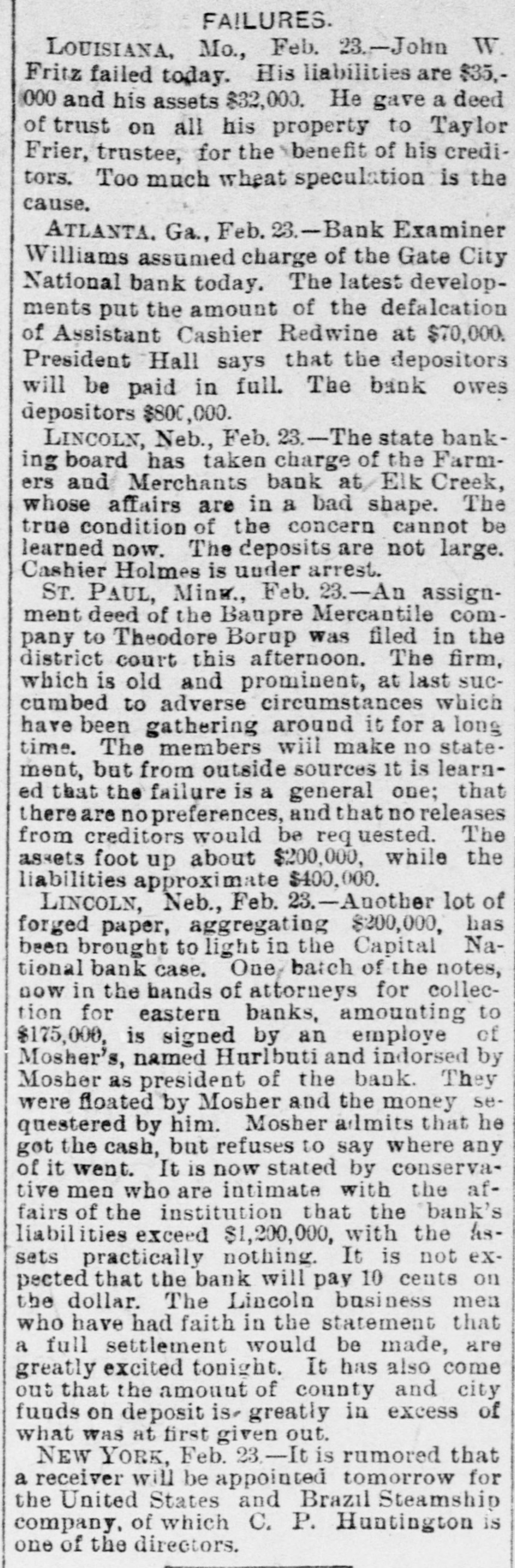
STOLE STATE FUNDS. Enormous Defalcation From a Lincoln Bank. The Sum Said to Amount to a Couple of Hundred Thousand-The Doors Closed. Special to THE MORNING CALD OMAHA, Neb., Jan. 22.-A Bee special com Lincoln says: The startling an. nouncement of the failure of the Capitol National Bank was made shortly after 11 o'clock to-night and with it came the statement that the State Treasurer had been caught in the crash to the extent of $250.000. It is stated that the failure is a bad one, but the exact condition of the bank cannot be ascertained to-night. The deposits amount to $625,000, and of this amount between $175,000 and $250,000 are State funds, for which the bond of the Treasurer will be responsible. The capital stock of the bank, amounting to $350,000, is all paid up. Cashier Outcalt stated that the assets would protect depositors, but there is a doubt expressed as to the correctness of the statement. State Treasurer Bartley is out of the city and no expression of the exact amount of the State funds on deposit can be obtained to-night. It is stated that Bartley's bond is for $3,100,000, $600,000 more than the law requires, and the bondsmen include nearly all the banks in Lincoln, two at Fremont, one at Columbus and the Globe Loan and Trust Company of Omaha, The present institution was built on the ruins of the Marsh Harvester Bank and the affairs of the bank have been in a bad shape for some time, What the immediate cause of the failure was is not known. A meating of other bankers was held this evening to provide against a run to-morrow, and, as a representative of the Omaha banks was present to offer assistance, the local bankers felt equal to any emergency. CHICAGO, Jan. 22.-A Lincoln special to a Tocal paper says: Bank Examiner Griffth demanded the books of the bank this morning. He soon discovered that something was wrong. A large sum is missing and the bank officials could not account for it. All they could say was that it had been stolen. The sum is said to reach $200,000.


Article from The Herald, January 23, 1893

Click image to open full size in new tab

Article Text

A FINANCIAL CRASH. Failure of a Bank at Ltacoln, Neb -The State Treasury Involved. OMAHA, Neb. Jan 22.-A Bee speed from Lincoin says: the startling au nouncement of the failure of the Capital national bank was made shortly after 11 'clock tonigat, and with it came the statement that the state treasury is thought to be in the crash. The amount is supposed to be $250 000 It is stated the failure is a bad one, but the exac condition cannot be ascertained tonight. The deposits amount to $625 $ 000, and of bis amount between $175 000 and $250.000 is state funds, for which the bond of the treasurer will be responsible. The capital stock is $350,000. all paid up Cashier Outcalt stated that the asset would protect the depositora, but there 18 doubt expressed as to the correctneer of the statement. State Treasurer Bartley is out of the city and no expression of the exact amount of state funds on deposit can be obtained tonight It is stated Bartley's bond is for $3,100, 000, $600,000 more than the law re quired, and that his bondsmen include nearly all the banks in Lincoln, two at Fremont, one at Columbus, and the Globe Loan and Trust company of Omaha. The present institution was built on the ruins of the Mareh-Harvester bank, and the affairs of the bank have been in bad shape for some time What was the immediate cause of the failure is not known. A meeting of other bankers was held this evening to provide against a run tomorrow, and as a representative of the Omaha banka was present to offer assistance the local bankers feel equal to any emergency. CHICAGO, Jan. 22.-A special to a local paper regarding the Lincoln bank failure says: Bank Examiner Griffith de manded the books of the bank this morning. He soon discovered that something was wrong. A large sum is missing and the bank officials could not account for it. All they could say was that it had been stolen. The sum is said to reach $200,000.


Article from Rock Island Daily Argus, January 23, 1893

Click image to open full size in new tab

Article Text

FAILURE OF A NATIONAL BANK. The Capital at Lincoln, Neb., SuspendedLoss of the State. LINCOLN, Jan. 23.-The startling announcement of the failare of the Capital National bank was made late last night and with it came the announcement that the state treasurer was caught in the crash in the sum of $225,000. This news spread rapidly and caused much excitement. It was stated that the failure is a bad one, but the exact situation could not be ascertained last night. The State Amply Secured. The state is secured by a bond for $700,000. The deposits amount to about $625,000, and of this amount between $175,000 and $250,000 are state funds, for which the bond of the treasurer will be liable. Cashier R. C. Outcalt stated that the assets would protect the depositors, but there is great doubt expressed as to the correctness of this statement.


Article from Omaha Daily Bee, January 23, 1893

Click image to open full size in new tab

Article Text

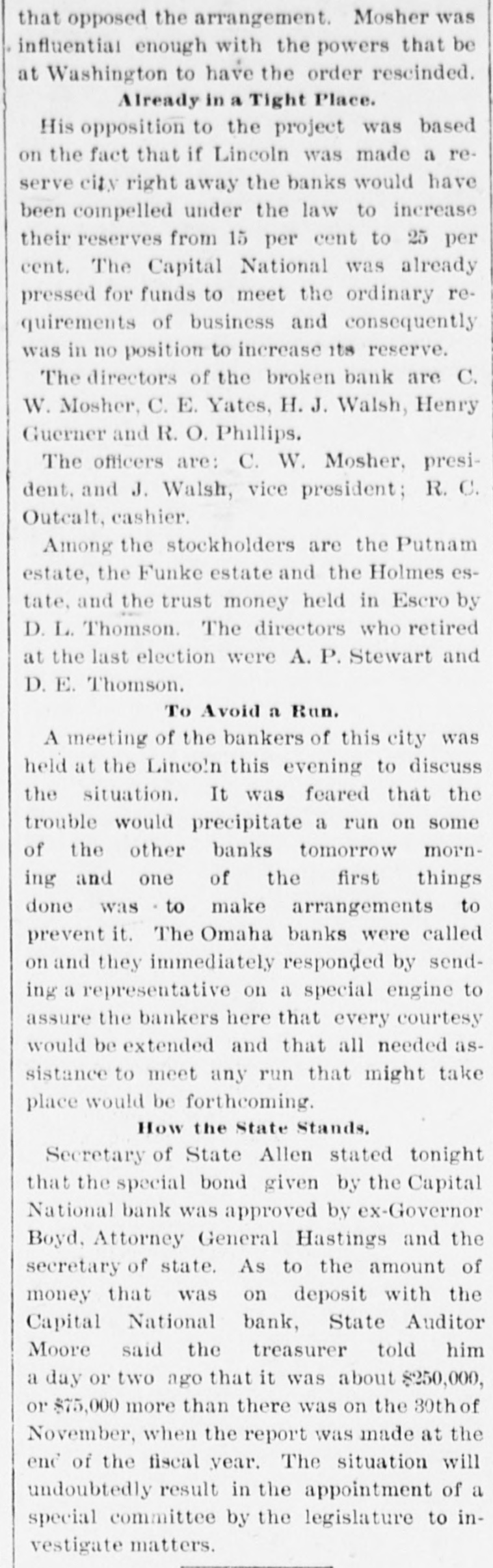
that opposed the arrangement Mosher was influential enough with the powers that be at Washington to have the order rescinded. Already in a Tight Place. His opposition to the project was based on the fact that if Lincoln was made a reserve city right away the banks would have been compelled under the law to increase their reserves from 15 per cent to 25 per cent. The Capital National was already pressed for funds to meet the ordinary requirements of business and consequently was in no position to increase its reserve. The directors of the broken bank are C. W. Mosher, C. E. Yates, H. J. Walsh, Henry Guerner and R. O. Phillips. The officers are: C. W. Mosher, president. and J. Walsh, vice president; R. C. Outcalt, cashier. Among the stockholders are the Putnam estate, the Funke estate and the Holmes estate. and the trust money held in Escro by D. L. Thomson. The directors who retired at the last election were A. P. Stewart and D. E. Thomson. To Avoid a Run. A meeting of the bankers of this city was held at the Lincoln this evening to discuss the situation. It was feared that the trouble would precipitate a run on some of the other banks tomorrow morning and one of the first things done was . to make arrangements to prevent it. The Omaha banks were called on and they immediately responded by sending a representative on a special engine to assure the bankers here that every courtesy would be extended and that all needed assistance to meet any run that might take place would be forthcoming. How the State Stands. Secretary of State Allen stated tonight that the special bond given by the Capital National bank was approved by ex-Governor Boyd. Attorney General Hastings and the secretary of state. As to the amount of money that was on deposit with the Capital National bank, State Auditor Moore said the treasurer told him a day or two ago that it was about $250,000, or $75,000 more than there was on the 30th of November, when the report was made at the end of the fiscal year. The situation will undoubtedly result in the appointment of a special committee by the legislature to investigate matters.


Article from The Morning Call, January 24, 1893

Click image to open full size in new tab

Article Text

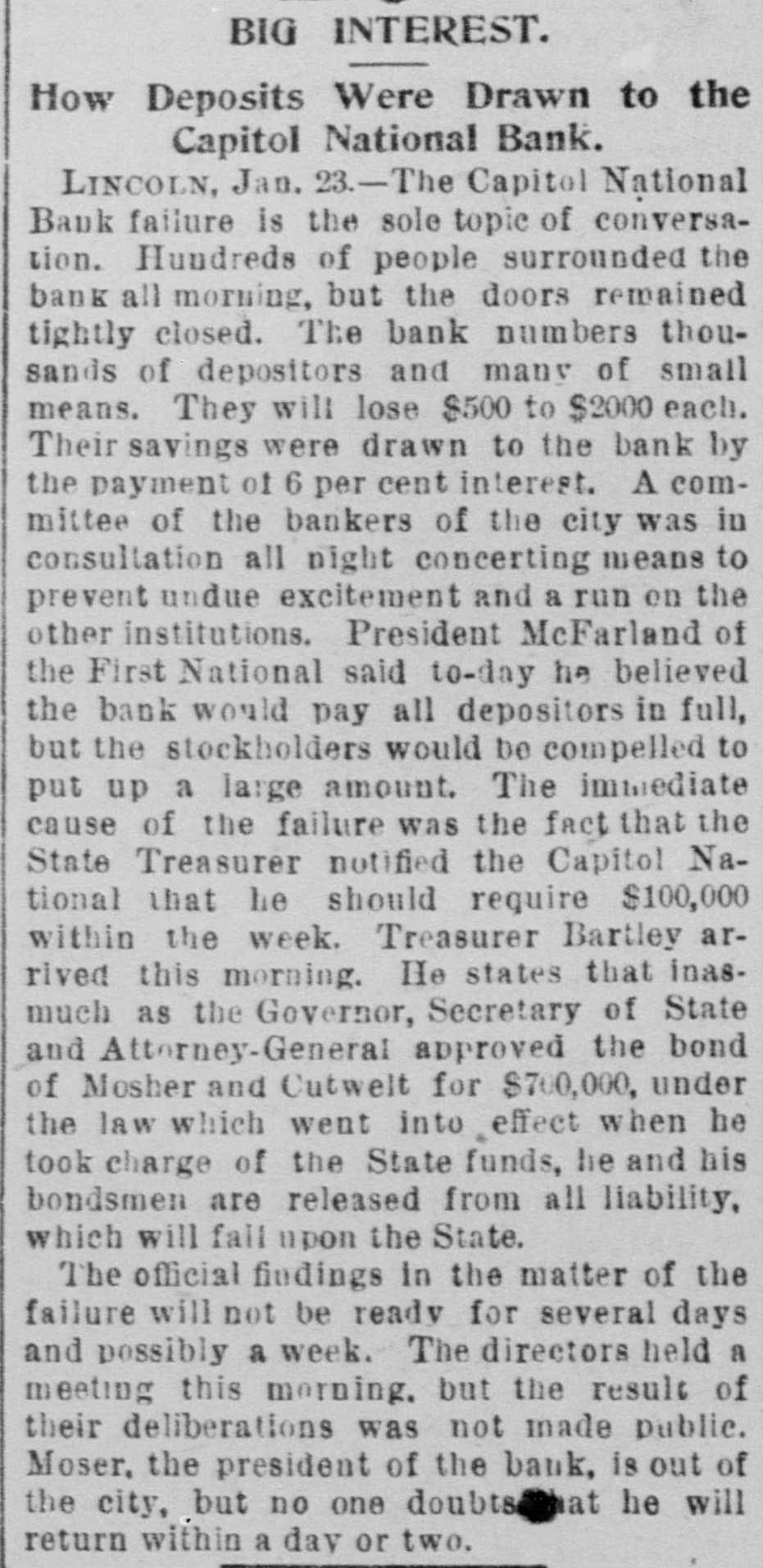
BIG INTEREST. How Deposits Were Drawn to the Capitol National Bank. LINCOLN, Jan. 23.-The Capitol National Bank failure is the sole topic of conversation. Hundreds of people surrounded the bank all morning, but the doors remained tightly closed. The bank numbers thousands of depositors and many of small means. They will lose $500 to $2000 each. Their savings were drawn to the bank by the payment of 6 per cent interest. A committee of the bankers of the city was in consultation all night concerting means to prevent undue excitement and a run en the other institutions. President McFarland of the First National said to-day he believed the bank would pay all depositors in full, but the stockholders would be compelled to put up a large amount. The immediate cause of the failure was the fact that the State Treasurer notified the Capitol National that he should require $100,000 within the week. Treasurer Bartley arrived this morning. He states that inasmuch as the Governor, Secretary of State and Attorney-General approved the bond of Mosher and Cutwelt for $700,000, under the law which went into effect when he took charge of the State funds, he and his bondsmen are released from all liability, which will fall upon the State. The official findings in the matter of the failure will not be ready for several days and possibly a week. The directors held a meeting this morning. but the result of their deliberations was not made public. Moser, the president of the bank, is out of at he will the city, but no one doubts return within a day or two.


Article from The Indianapolis Journal, January 25, 1893

Click image to open full size in new tab

Article Text

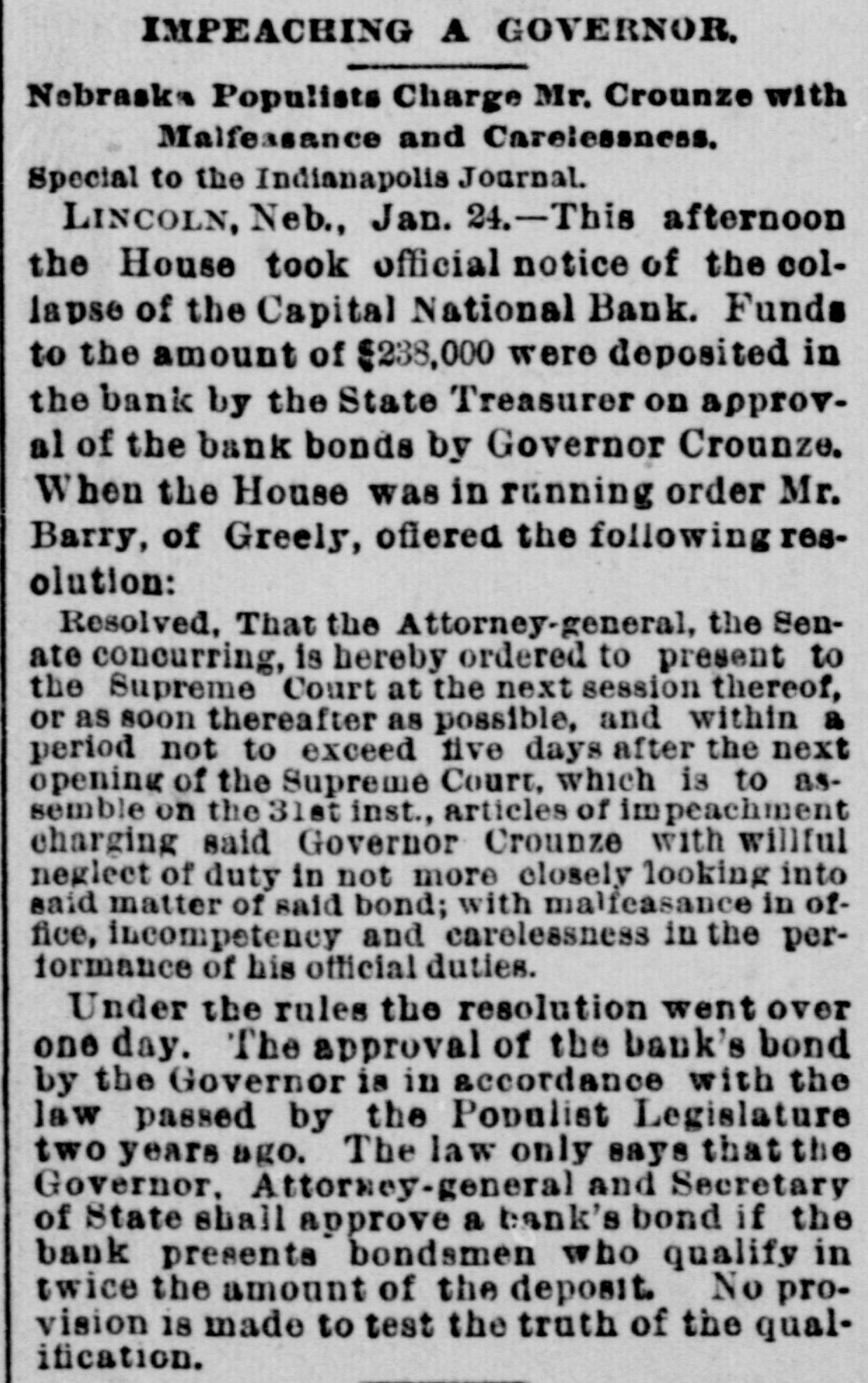
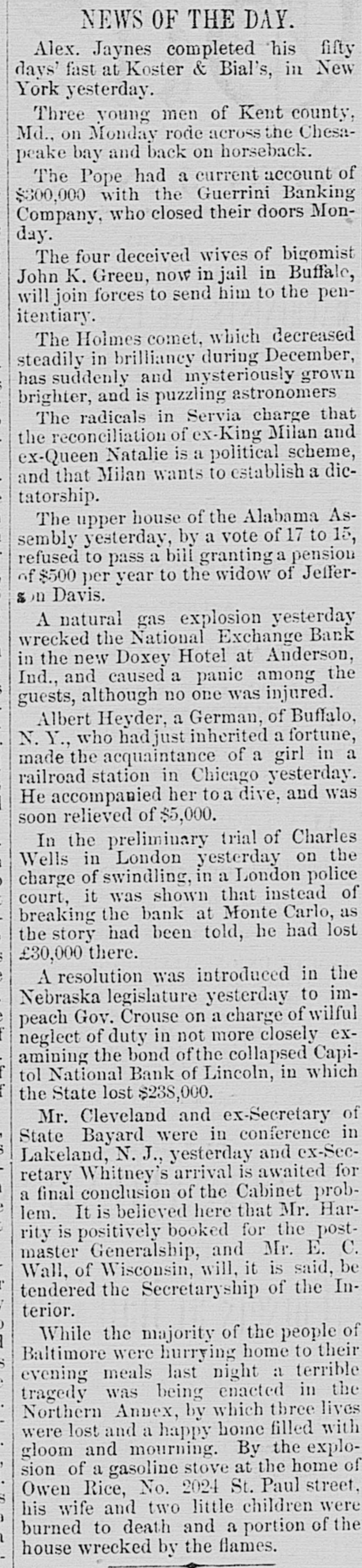
IMPEACHING A GOVERNOR. Nebraska Populists Charge Mr. Crounze with Malfessance and Carelessness. Special to the Indianapolis Journal. LINCOLN, Neb., Jan. 24.-This afternoon the House took official notice of the collapse of the Capital National Bank. Funds to the amount of $238,000 were deposited in the bank by the State Treasurer on approval of the bank bonds by Governor Crounze. When the House was in running order Mr. Barry, of Greely, offered the following resolution: Resolved, That the Attorney-general, the Senate concurring, is hereby ordered to present to the Supreme Court at the next session thereof, or as soon thereafter as possible, and within a period not to exceed five days after the next opening of the Supreme Court, which is to assemble on the 31stinst., articles of im peachment charging said Governor Crounze with willful neglect of duty in not more closely looking into said matter of said bond; with malfeasance in office, incompetency and carelessness in the performance of his official duties. Under the rules the resolution went over one day. The approval of the bank's bond by the Governor is in accordance with the law passed by the Populist Legislature two years ago. The law only says that the Governor. Attorsey-general and Secretary of State shall approve a bank's bond if the bank presents bondsmen who qualify in twice the amount of the deposit. No provision is made to test the truth of the qualitication.


Article from Waterbury Evening Democrat, January 25, 1893

Click image to open full size in new tab

Article Text

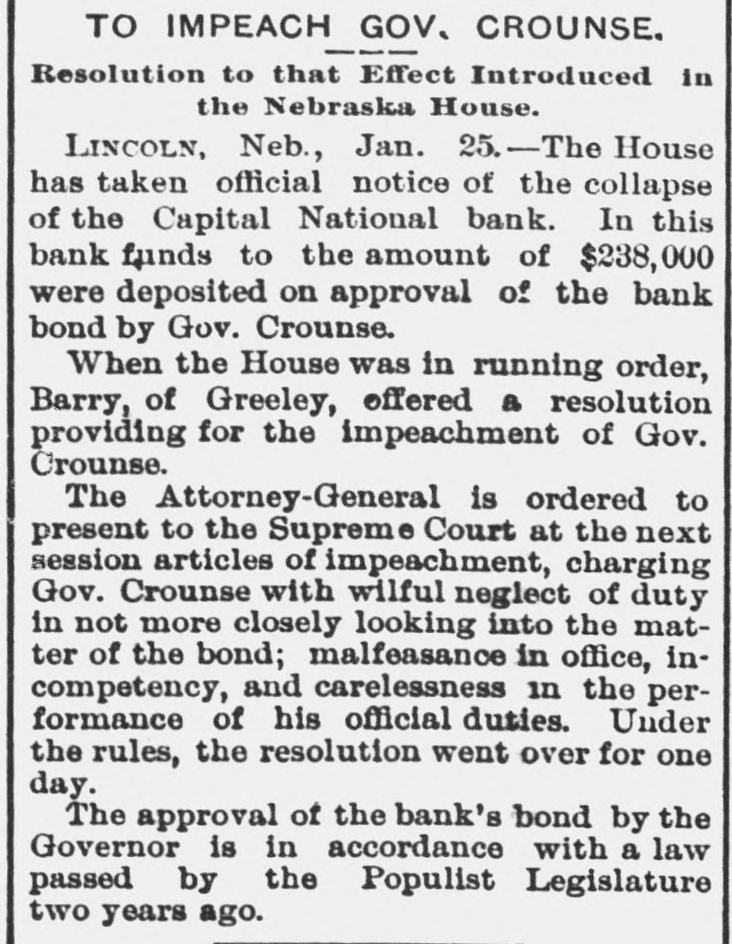
TO IMPEACH GOV. CROUNSE. Resolution to that Effect Introduced in the Nebraska House. LINCOLN, Neb., Jan. 25.-The House has taken official notice of the collapse of the Capital National bank. In this bank funds to the amount of $238,000 were deposited on approval of the bank bond by Gov. Crounse. When the House was in running order, Barry, of Greeley, offered a resolution providing for the impeachment of Gov. Crounse. The Attorney-General is ordered to present to the Supreme Court at the next session articles of impeachment, charging Gov. Crounse with wilful neglect of duty in not more closely looking into the matter of the bond; malfeasance in office, incompetency, and carelessness in the performance of his official duties. Under the rules, the resolution went over for one day. The approval of the bank's bond by the Governor is in accordance with a law passed by the Populist Legislature two years ago.


Article from Audubon County Republican, January 26, 1893

Click image to open full size in new tab

Article Text

NEBRASKA'S BROKEN BANK State Funds Tied Up in the ConcernWill Depositors Be Paid in Full. LINCOLN, Neb., Jan 25 - -The Capital City National Bank of this city is in the hands of the examiner. A large deficit was found to-day and the bank is closed. The deposits amount to $625,000, and of this sum about $200,000 is State funds, for which State Treasurer Bartley is liable on his bond, on which are nearly all the Lincoln banks, two at Frement, one private bank at Omaha and a capitalist or two out in the State. The capital stock of this bank is $350,000, all paid up. Cashier Outcalt asserts that the creditors will be paid in full, but others are not so hopeful. C. W. Mosher, late penitentiary contractor, was the president, J. Walsh, vice-president, and R. C. Outcalt, cashier Mosher was compelled some time ago by the bank examiner to assign the penitentiary contract and turn a lot of gas bonds into money. Omaha banks have assured other Lincoln banks that they will help them out in the event of run. State Treasurer Bartley is in Omaba, but is expected here to-night. The stockholders held a meeting today. It is said they will attempt to reopen within ten days.


Article from The Farmers' Union, January 26, 1893

Click image to open full size in new tab

Article Text

NEBRASKA BANK FAILURE. The State Treasurer said to Be Involved to the Extent of $250,000. At Lincoln, Neb., the startling announcement of the failure of the Capital National Bank was made late Sunday night, and with it came the announce. ment that the State Treasurer was caught in the era-h in the sum of $250, 000, This news spread rapidly and caused much excitement. The failure is a bad one. The dep sits amount to about $625,000, and of this amount between $175.000 and $250,000 are State funds. for which the bond of the Treasurer will be liable. Cashier li. C. Out calt stated that the assets would profeet the depositors, but there is gr at doubt expressed as to the correct. ness of this statement. Bank Examiner Griffith demanded the books of the bank. He began examining them at once and soon discovered that something was wrong. A larg. sum of cash was missing, and the bank officials could not account for it. All they could say was that it had been stolen. The sum is said to reach $200,000. A meeting of the bankers of the city was immediately held to discuss the situation. It was feared that the trouble would precipitate a run on some of the other banks, and one of the first things done was to make arrangements to prevent it. The Omaha banks were called on and they immediately responded by sending a repres ntative on a special engine to assure the b nkers there that every courtesy would be extended and that all needed assistance to meet any run that might take place would be forthcoming.


Article from The Weekly Tribune, January 27, 1893

Click image to open full size in new tab

Article Text

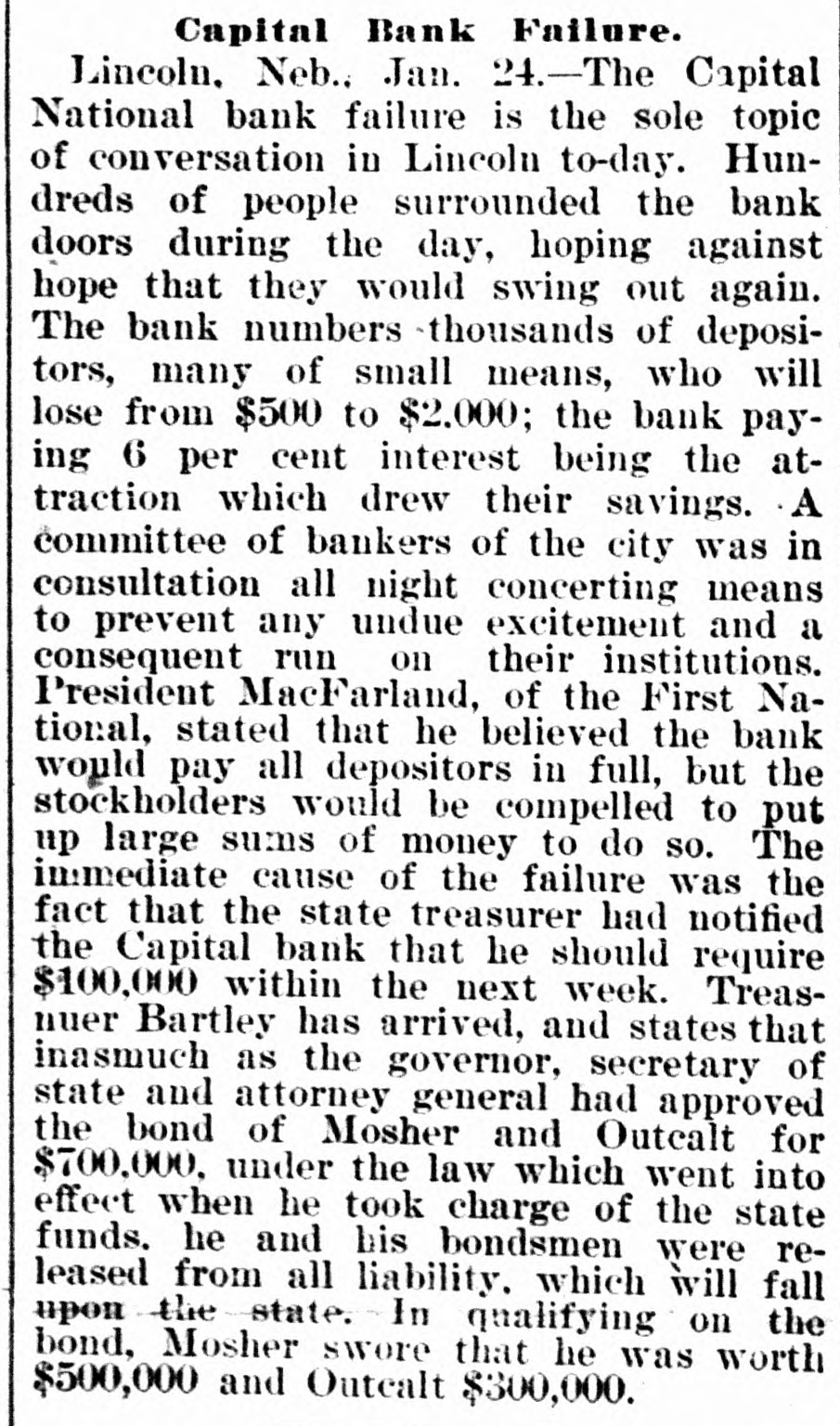
THE CAPITAL NATIONAL FAILURE Many Depositors of small Means Lose Their All. LINCOLN, Neb., Jan. 23.-The Capital National bank failure is the sole topic of conversation in Lincoln today. Hundreds of people surrounded the bank doors all the morning, hoping against hope that they would swing out again. The depositors number thousands, many of small means. who will lose from 8500 to 82,000: the bank paying six per cent interest being the attraction which drew their savings. t committee of bankers of the city was in consultation all night concerting means to prevent undue excitement and it consequent run on their institutions President MacFarland, of the First National, state this afternoon that he believed the bank would pay all of the depositors in full. but the stockholders would be compelled to put up large sums of money to do so. The immediate cause of the failure was the fact that the state treasurer had notified the National Capital that he should require 8100.000 within the next week. Treasurer Hartley arrived this morning and states that inasmuch as the governor. secretary of state and attorney-general had ap. proved the bond of Mosher and Outcalt for 8700,000 under the law which went into effect when he took charge of the state funds, he and his bondsmen were released from all liability which will fall upon the state. in qualifying on the bond Mosher swore that he was worth 8500,000 and Outcalt 8300,000.


Article from Grand Rapids Herald, February 7, 1893

Click image to open full size in new tab

Article Text

Appointed Receivers. WASHINGTON, Feb. 6.-Comptroller Hepbura today appointed Logan H. Root receiver of the First National bank of Little Rock and J. D. McFar. land of the Capital National bank of Lincoln.


Article from St. Paul Daily Globe, February 7, 1893

Click image to open full size in new tab

Article Text

Bank Receivers Appointed. WASHINGTON, Feb. 6.-Comptroller Hepburn today appointed Logan H. Root receiver of the First National Bank of Little Rock, and J. D. McFarland receiver of the Capital National Bank of Lincoln, Neb.


Article from Fort Worth Gazette, February 7, 1893

Click image to open full size in new tab

Article Text

BANK RECEIVER Washington, Feb. 6.-Comptroller Hepburn today appointed Logan H. Roots receiver of the First National bank of Little Rock and J. D. McFarland recriver of the Capital National bank of Lincoln. Neb.


Article from The Abbeville Press and Banner, February 8, 1893

Click image to open full size in new tab

Article Text

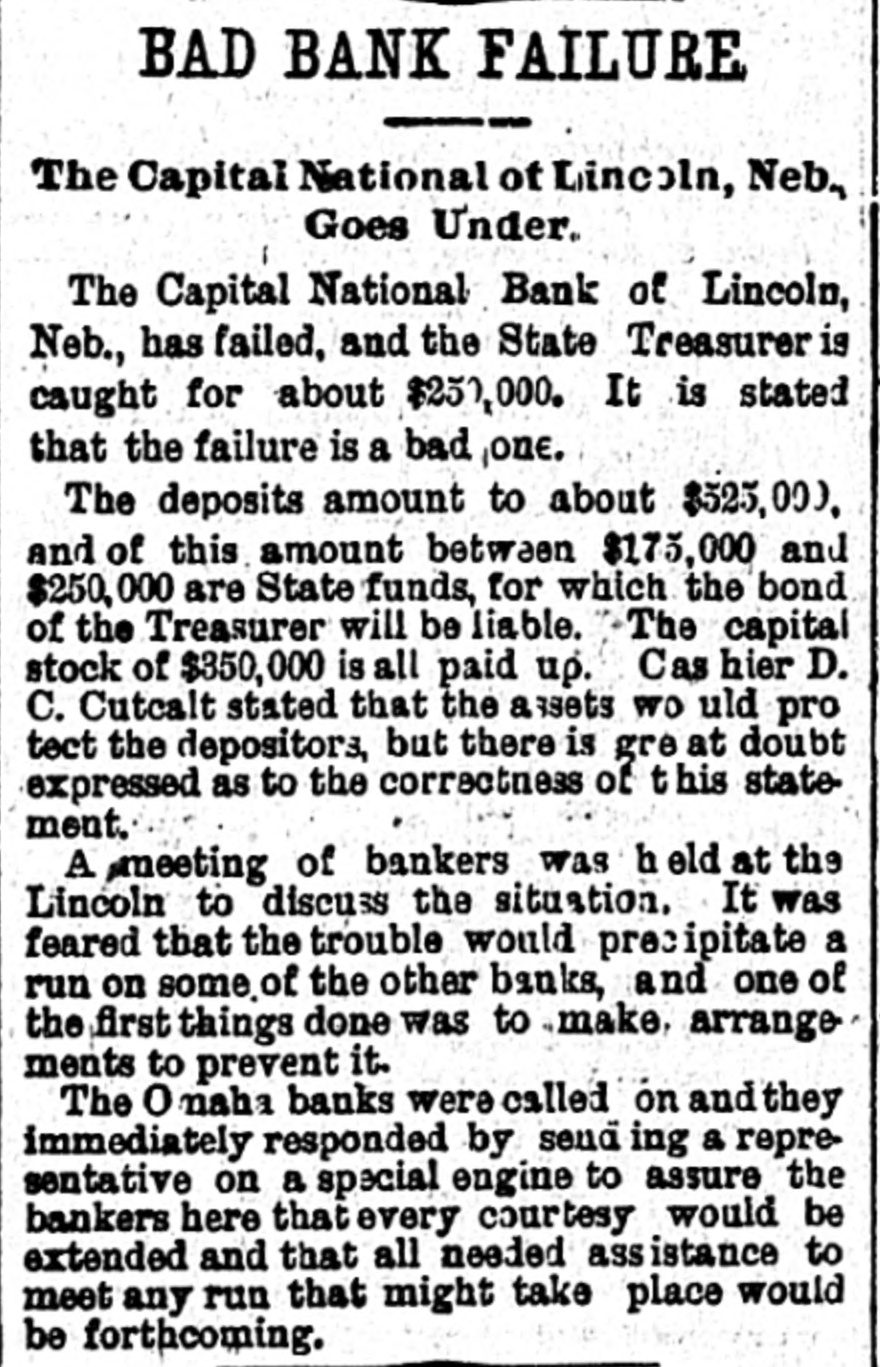
BAD BANK FAILURE The Capital National of Lincoln, Neb, Goes Under. The Capital National Bank of Lincoln, Neb., has failed, and the State Treasurer is caught for about $251,000. It is stated that the failure is a bad one. The deposits amount to about $523,000. and of this amount between $173,000 and $250,000 are State funds, for which the bond of the Treasurer will be liable. The capital stock of $350,000 is all paid up. Cas hier D. C. Cutcalt stated that the assets wo uld pro tect the depositors, but there is gre at doubt expressed as to the correctness of t his state ment. A meeting of bankers was h eld at the Lincoln to discuss the situation. It was feared that the trouble would precipitate a run on some of the other banks, and one of the first things done was to make, arrange ments to prevent it. The o naha banks were called on and ithey immediately responded by send ing a representative on a special engine to assure the bankers here that every courtesy would be extended and that all needed assistance to meet any run that might take place would be forthcoming.


Article from The Seattle Post-Intelligencer, May 21, 1893

Click image to open full size in new tab

Article Text

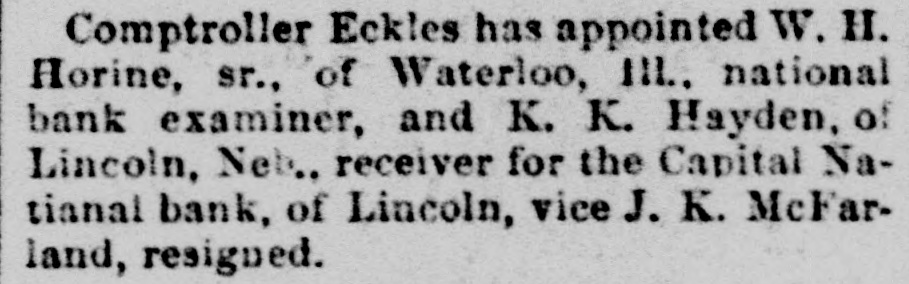
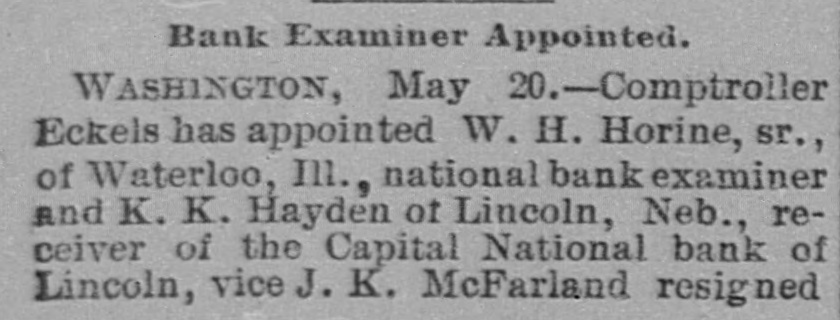
Comptroller Eckles has appointed W. H. Horine, sr., of Waterloo, III., national bank examiner, and K. K. Hayden, of Lincoln, Neb., receiver for the Capital Natianal bank, of Lincoln, vice J. K. McFarland, resigned.


Article from The Salt Lake Herald, May 21, 1893

Click image to open full size in new tab

Article Text

Bank Examiner Appointed. WASHINGTON, May 20.-Comptroller Eckels has appointed W. H. Horine, sr., of Waterloo, III., national bank examiner and K. K. Hayden of Lincoln, Neb., receiver of the Capital National bank of Lincoln, vice J. K. McFarland resigned


Article from The Morning Call, May 21, 1893

Click image to open full size in new tab

Article Text

Appointed by Eckels. WASHINGTON. May 20. - Comptroller Eckels appointed W. H. Horine Sr. of Waterloo, III., National Bank Examiner, and K. K. Hayden of Lincoln, Nebr., Receiver of the Capital National Bank of Lincoln, vice J. K. McFarland, resigned.


Article from The Seattle Post-Intelligencer, January 17, 1895

Click image to open full size in new tab

Article Text

CONDENSED DISPATCHES. A receiver has been appointed for the Five-Cent Savings bank of Dover, N. H. The printing bill signed by the president revives the franking privilege. This provision was never referred to when the bill was before congress. The plant of the G. H. Dume Milling company at Jefferson City, Mo., and a warehouse containing 35,000 bushels of wheat were burned this morning, Loss $85,000, insurance $63,000. James Bain, who assisted in erecting* the immense Firth wheel at the midwinter fair, San Francisco, was taking the whet apart Tuesday when a cross beam broke. Bain fell to the ground, sixty feet, and was killed. As a result of their destitution and helpless situation among hundreds of starving people, John Harris and wife, living a few miles in the country from Paxton, Neb., committed suicide, and the body of their newly born babe was found with its parents some time after. A rΓ©solution introduced in the Minnesota house calls for an investigation of charges that public officials have recelved $150,000 interest on public funds intrusted to their charge, and further charges that $202.841 is now on deposit in banks that have long since failed. The federal grand jury at Omaha has indicted R. Coutcalt, cashier of the broken Capitol National bank of Lincoln, charging him with faisifying the books of the bank. This is the bank on which the state lost $236,000, and President Mosher is now serving five years for footing. Attorney General Heari, of Arizona, has resigned and made public sensational charges against Gov. Hughes. He alleges that Hughes secretly supported Murphy, the Republican candidate, for congress. He charges Hughes with surrendering principle to secure release from financial embarrassments, and caite upon the guyernor to resign at once. The United States grand jury at Denver has Indicted Hamilton Armstrong, senwhor and chief of police, Kate Dwyer, matron of the city jail, and Dennis Mutlens, president of the fire and polica board, on a charge at embezzing and opening a letter addressed to Sadue W. Likens while shie was employed as police matron. The letter was opened with the expectation that it would compromise her. Night's Dream."


Article from Semi-Weekly Register, June 23, 1897

Click image to open full size in new tab

Article Text

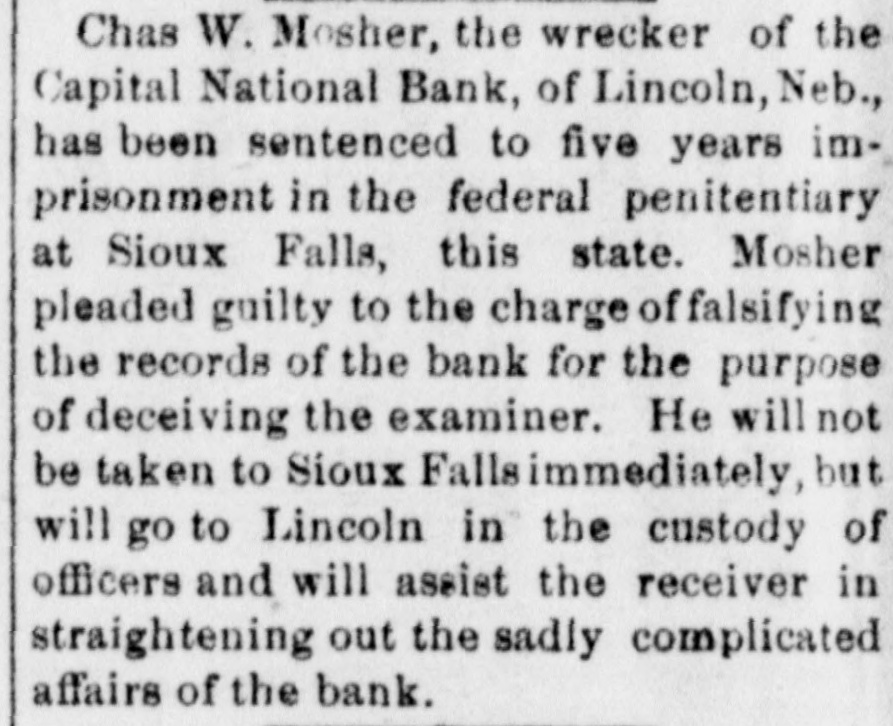
SUITS AGGREGATE $500,000 Receiver of a Nebraska Bank Wants Unearned Dividends Returned. LINCOLN, Neb., June 21.-Nearly 100 moneyed men of Illinois, scattered over the state from Chicago to East St. Louis, have been made defendants in what is likely to prove the most sensational national bank litigation ever instituted in the West; the next chapter in the famous case in which Charles Mosher, president of the defunct Capital National bank of this city, figured to the extent of stealing something over $1,000,000 and for which he is now serving five years in the penitentiary. His bank closed in 1891. Ten years prior to that time the Capital National had been paying immense dividends, amounting in the aggregate to $500,000. The stockholders were mostly Illinois people. Receiver Hayden of the Mosher bank now has brought suit against these stockholders to force them to return the dividends paid by Mosher on the ground that they were not earned, but were paid out of the money of the depositors. He says that the books show that the bank never made a dollar.


Article from The Weiser Signal, June 24, 1897

Click image to open full size in new tab

Article Text

SENSATIONAL BANK LITIGATION. Nearly 100 Moneyed Men of Illinois Figure in It. St. Louis, June 21.- special to the Republic from Lincoln, Neb., says: "Nearly 100 moneyed men of Illinois, scattered over the state from Chicago to East St. Louis, many of whom reside at Peoria and Galesburg, have been made defendants in what is likely to prove the most sensational bank litigation ever instituted in the west; the next chapter in the famous case in which Charles Mosher, president of the defunct Capital national bank of this city, figured to the extent of stealing something over a million dollars. "His bank closed in 1891. Ten years prior to that time the Capital national had been paying immense dividends, amounting in the aggregate to $500,000. The stockholders were mostly Illinois people. Receiver Hayden of the Mosher bank has brought suit against these stockholders to force them to return dividends on the grounds that they were paid out of the money of the depositors. He says that the books show that the bank never made a dollar. A similar suit has just been decided here against a New York stockholder, who must 1:4 turn $27,000 paid to him in dividends by Mosher.


Article from The Coalville Times, June 25, 1897

Click image to open full size in new tab

Article Text

A BIG SUIT EXPECTED. Another Unspler in the Capital National Bank Steal at Lincoln. Neb. Linceln, Neb., June 21.-Nearly 100 moneyed men of Illinois, scattered over the state from Chicago to East St. Louis, many of whom reside at Peoria and Galesburg, have been made defendants in what is likely to prove the most sensational bank litigation ever instituted in the west: the next chapter in the famous case in which Charles Mosher, president of the defunct Capital National bank of this city, figured to the extent of stealing something over a million dollars. His bank closed in 1891. Ten years prior to that time, the Capital National had been paying big dividends, amounting in the aggregate to half a million dollars. The stockholders were mostly Illinois people. Receiver Hayden of the Mosher bank now has brought suit against these stockholders to force them to return the dividends paid by Mosher, on the ground that they were not earned but were paid out of the money of the depositors. He says that the books show that the bank never made a dollar. A similar suit has just been decided against a New York stockholder, H. Ward Howard, who must return $28,000 paid him by Mosher.


Article from Omaha Daily Bee, February 7, 1902

Click image to open full size in new tab

Article Text

ON QUESTION OF SOLVENCY Referee in Capital National Bank Case Fixes Date When Insolvency Began. The report of W. D. McHugh, referee in the case of John W. McDonald, receiver, against D. E. Thompson and others, has been filed in the United States circuit court. This case was originally started by Kent K. Hayden, receiver of the Capital National bank of Lincoln, against a number of the stockholders of the defunct bank to secure the payment of $213,000 alleged to have been wrongfully taken from the bank by its officers and paid to the stockholders. In his complaint the receiver contended that for a period of six or eight years the bank had been insolvent and had earned no dividends upon its stock, but that, regardless of this fact, the officers had paid semi-annual dividends in varying sums for the period mentioned, the aggregate being $213,000. The report of the referee, while finding for the receiver, is considered a victory for the stockholders, as he finds that the bank was solvent at all times previous to July, 1891. Since that time the bank was insolvent, but it had paid three dividends, one on July 1, 1891; one of January 1, 1892, and the last July 1, 1892. The amount involved in these dividends is not stated. but an attorney for the receiver estimates it at between $30,000 and $40,000, much of which cannot be recovered, as the parties are not responsible. The attorneys have not announced their course, but it is understood that the receiver will object to an approval of the report, contending that the referee is in error as to the length of time the bank was insolvent before its failure.