Central Bank (Indianapolis, IN)

Episode Information

Episode UID
3039161290988
Episode Type
Suspension โ†’ Closure
Bank Type
private
Bank ID
303916129 hash
Start Date
April 8, 1882
Location
Indianapolis, Indiana (39.768, -86.158)

Metadata

Model
gpt-5-mini (chosen from majority vote of a three-model LLM ensemble)
Short Digest
be8d7aebaad2fbfa

Response Measures

None

Description

Directors closed the bank after a teller's disappearance and large defalcation; later proprietors assigned the bank to a judge.

Events (2)

1. April 8, 1882 Suspension
Cause
Bank Specific Adverse Info
Cause Details
Teller Arthur Mueller mysteriously disappeared and a $30,000 shortage/defalcation was discovered, prompting directors to close the bank.
Newspaper Excerpt
the shortage ... was found to be $30,000 ... he advised the closing of the bank until a further examination could be made ... the bank will remain shut until the stockholders are ready to resume.
Source
newspapers
2. April 17, 1882 Receivership
Newspaper Excerpt
The proprietors of the Central Bank of Indianapolis have made an assignment to Judge Lamb, who expresses the opinion that enough cannot be realized from the estate to pay for settling it up.
Source
newspapers

Newspaper Articles (6)

Article from Public Ledger, April 8, 1882

Click image to open full size in new tab

Article Text

A SHORT TELLER. $30,000 Missing and the Bank Shut Up. Not Much Margin Left. INDIANAPOLIS, April 8.-Since the mysterious disappearance of Arthur Mueller, the teller of the Central Bank, of this city, experts have been examining the books of the bank. The examination was concluded at a late hour last night, and the shortage which at first was supposed to be $2500, was found to be $30,000. The officers of the bank met in consultation at 90' clock this morning, with their attorney, and upon the information of the directors he advised the closing of the bank until a further examination could be made to verify the experts' repert. The record showing the accounts of the depositors was investigated by Mr. D. M. Taylor, who has had no connection with the bank, and he has found that large amounts have been entered falsely, some of the creditors being charged with too much overdraft, while with others were small. to the It was amounts impossible deposited tell too until all 0 accounts had been audited whether or not there was a shortage; so that while the investigation has been going h on since Muller left the city, nothing S definite could be learned until Mr. t n Taylor furnished his work last night. the the investigation, When he reported directors result met of and his e decided that it would be best for all interested to close at once; and in pursuance with that decision the bank will remain shut until the stockholders are ready to resume. r Mr. Wildman and Mr. Kennedy candid in their coaversathe latter was at had stated in press was only $2500. were tion, because the shortage and very he sick the think He feared heart that that might he to that had the attempted public mislead them. not done. g as as that This he he had had given nearly He said he of could the true account of the bank's d condition. and that while it was not 0, that that statement be h still it was to approbable disproven, then would all and to the best of his re and belief, correct. of are ct form of banking, rof knowledge the pearances, the clerical directors acquainted the statements None with and, being dependent upon he of their employes, they had been made d the victims of misplaced confidence. nt They are not yet able to tell their ex: t act condition, but are positive that none of their depositors will suffer. at Mr. Kennedy stated that the capital a stock of the bank is put at $100,000, ge and that the amount of the deposits to is about $105,000. He also said that of of cash now on hand was tis like the amount be At nothing the amount that be would if there should a run. rIts assets, se sufficient to ay and other was hsaid, on required depositors the were bank. creditors the he, protect accounts however, and the of of that all as the opinion within the bank could be netted up a er, year from this date. It is inferred re that the assets are very largely made he up of bills receivable upon real estate. he The exact amount of the shortage ecould not be given, but the Directors Care confident it would not exceed nd $30,000, an- was perhaps not so much The figures will be eft as soon as are for will not be rThere is no reckoning announced as cured, days. that. which proper they for how several long pro- is of the bank will remain shut, and it ed equally hard to tell whether the


Article from Memphis Daily Appeal, April 9, 1882

Click image to open full size in new tab

Article Text

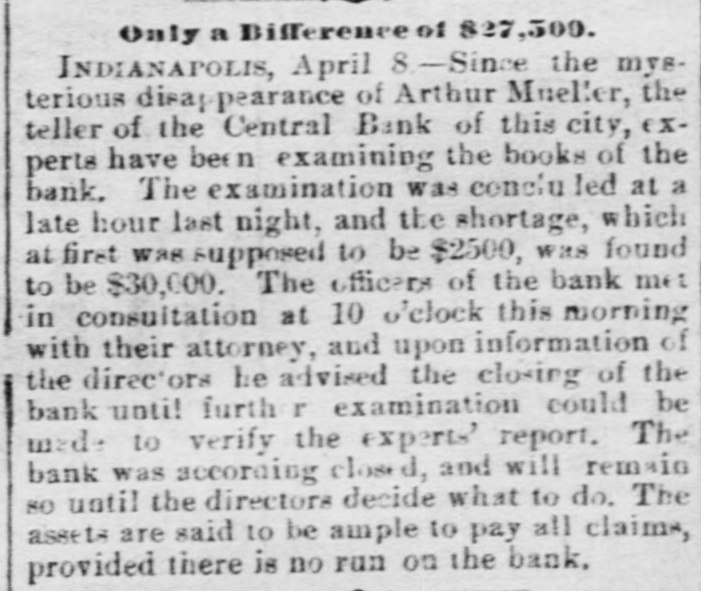
Only a Difference of 827,500. INDIANAPOLIS, April 8.-Since the mysterious disap-pearance of Artbur Mueller, the teller of the Central Bank of this city, experts have been examining the books of the bank. The examination was conclu led at a late hour last night, and the shortage, which at first was supposed to be $2500, was found to be $30,000. The officers of the bank met in consuitation at 10 o'clock this morning with their attorney, and upon information of the directors he advised the closing of the bank unti! furth r examination could be made to verify the experts' report. The bank was according closed, and will remain 80 until the directors decide what to do. The assets are said to be ample to pay all claims, provided there is no run on the bank.


Article from Daily Globe, April 9, 1882

Click image to open full size in new tab

Article Text

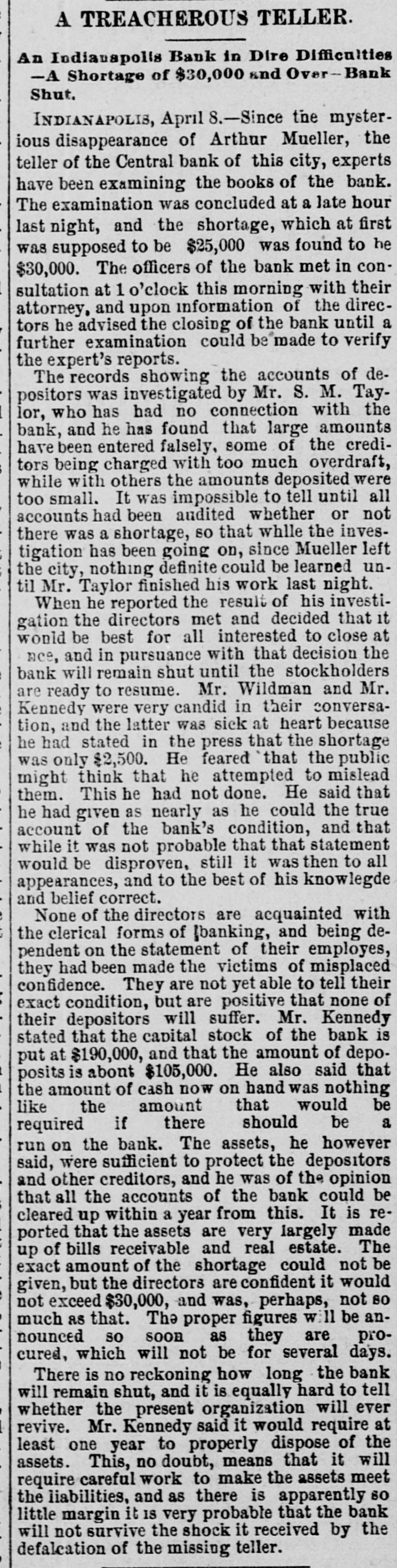
A TREACHEROUS TELLER. An Indianapolis Bank in Dire Difficulties -A Shortage of $30,000 and Over-Bank Shut. INDIANAPOLIS, April 8.-Since the mysterious disappearance of Arthur Mueller, the teller of the Central bank of this city, experts have been examining the books of the bank. The examination was concluded at a late hour last night, and the shortage, which at first was supposed to be $25,000 was found to he $30,000. The officers of the bank met in consultation at 1 o'clock this morning with their attorney. and upon information of the directors he advised the closing of the bank until a further examination could be made to verify the expert's reports. The records showing the accounts of depositors was investigated by Mr. S. M. Taylor, who has had no connection with the bank, and he has found that large amounts have been entered falsely, some of the creditors being charged with too much overdraft, while with others the amounts deposited were too small. It was impossible to tell until all accounts had been audited whether or not there was a shortage, so that while the investigation has been going on, since Mueller left the city, nothing definite could be learned until Mr. Taylor finished his work last night. When he reported the result of his investigation the directors met and decided that it would be best for all interested to close at nce, and in pursuance with that decision the bank will remain shut until the stockholders are ready to resume. Mr. Wildman and Mr. Kennedy were very candid in their conversation, and the latter was sick at heart because he had stated in the press that the shortage was only $2,500. He feared that the public might think that he attempted to mislead them. This he had not done. He said that he had given as nearly as he could the true account of the bank's condition, and that while it was not probable that that statement would be disproven, still it was then to all appearances, and to the best of his knowlegde and belief correct. None of the directors are acquainted with the clerical forms of |banking, and being dependent on the statement of their employes, they had been made the victims of misplaced confidence. They are not yet able to tell their exact condition, but are positive that none of their depositors will suffer. Mr. Kennedy stated that the capital stock of the bank is put at $190,000, and that the amount of depoposits is about $105,000. He also said that the amount of cash now on hand was nothing like the amount that would be a required if there should be run on the bank. The assets, he however said, were sufficient to protect the depositors and other creditors, and he was of the opinion that all the accounts of the bank could be cleared up within a year from this. It is reported that the assets are very largely made up of bills receivable and real estate. The exact amount of the shortage could not be given, but the directors are confident it would not exceed $30,000, and was, perhaps, not so much as that. The proper figures will be announced so soon as they are procured, which will not be for several days. There is no reckoning how long the bank will remain shut, and it is equally hard to tell whether the present organization will ever revive. Mr. Kennedy said it would require at least one year to properly dispose of the assets. This, no doubt, means that it will require careful work to make the assets meet the liabilities, and as there is apparently so little margin it IS very probable that the bank will not survive the shock it received by the defalcation of the missing teller.


Article from Wheeling Register, April 10, 1882

Click image to open full size in new tab

Article Text

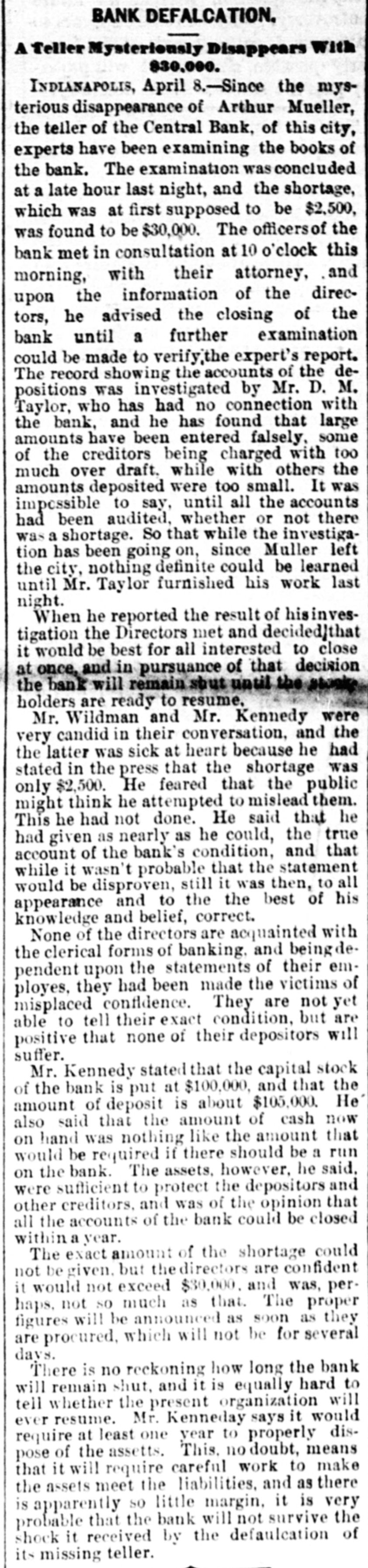
BANK DEFALCATION. A Teller Mysteriously Disappears with 830,000. INDIANAPOLIS, April 8.-Since the mysterious disappearance of Arthur Mueller, the teller of the Central Bank, of this city, experts have been examining the books of the bank. The examination was concluded at a late hour last night, and the shortage, which was at first supposed to be $2,500, was found to be $30,000. The officers of the bank met in consultation at 10 o'clock this morning, with their attorney, and upon the information of the directors, he advised the closing of the bank until a further examination could be made to verify,the expert's report. The record showing the accounts of the depositions was investigated by Mr. D. M. Taylor, who has had no connection with the bank, and he has found that large amounts have been entered falsely. some of the creditors being charged with too much over draft. while with others the amounts deposited were too small. It was impossible to say, until all the accounts had been audited, whether or not there was a shortage. So that while the investigation has been going on, since Muller left the city, nothing definite could be learned until Mr. Taylor furnished his work last night. When he reported the result of hisinvestigation the Directors met and decided/that it would be best for all interested to close at once, and in pursuance of that decision the bank will remain shut until the holders are ready to resume. Mr. Wildman and Mr. Kennedy were very candid in their conversation, and the the latter was sick at heart because he had stated in the press that the shortage was only $2,500. He feared that the public might think he attempted to mislead them. This he had not done. He said that he had given as nearly as he could, the true account of the bank's condition, and that while it wasn't probable that the statement would be disproven, still it was then, to all appearance and to the the best of his knowledge and belief, correct. None of the directors are acquainted with the clerical forms of banking. and beingdependent upon the statements of their employes, they had been made the victims of misplaced confidence. They are not yet able to tell their exact condition, but are positive that none of their depositors will suffer. Mr. Kennedy stated that the capital stock of the bank is put at $100,000. and that the amount of deposit is about $105,000. He also said that the amount of cash now on hand was nothing like the amount that would be required if there should be a run on the bank. The assets, however, he said. were sufficient to protect the depositors and other creditors. and was of the opinion that all the accounts of the bank could be closed within a year. The exact amount of the shortage could not be given. but thedirectors are confident it would not exceed $30,000. and was, perhaps. not so much as that. The proper figures will be announced as soon as they are procured, which will not be for several days. There is no reckoning how long the bank will remain shut, and it is equally hard to tell whether the present organization will Mr. Kenneday says it would at least one year to of the assetts. no means ever pose require resume. This. properly doubt, disthat it will require careful work to make the assets meet the liabilities, and as there is so little very apparently bank will margin. survive it is the probable that the not shock it received by the defaulcation of its missing teller.


Article from Daily Globe, April 10, 1882

Click image to open full size in new tab

Article Text

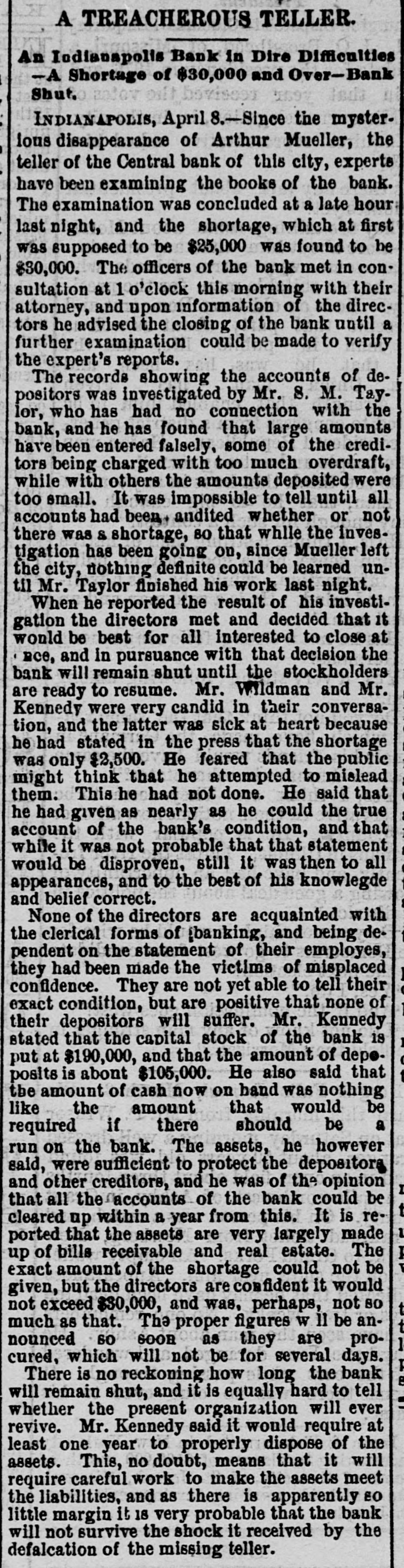
A TREACHEROUS TELLER. An Iodianapolis Bank in Dire Difficulties -A Shortage of $30,000 and Over-Bank Shut. INDIANAPOLIS, April 8.-Since the mysterlous disappearance of Arthur Mueller, the teller of the Central bank of this city, experts have been examining the books of the bank. The examination was concluded at a late hour last night, and the shortage, which at first was supposed to be $25,000 was found to be $30,000. The officers of the bank met in consultation at 1 o'clock this morning with their attorney, and upon information of the direc. tors he advised the closing of the bank until a further examination could be made to verify the expert's reports. The records showing the accounts of depositors was investigated by Mr. 8. M. Taylor, who has had no connection with the bank, and he has found that large amounts have been entered falsely, some of the creditors being charged with too much overdraft, while with others the amounts deposited were too small. It was impossible to tell until all accounts had been. andited whether or not there was & shortage, 80 that while the inves. tigation has been going on, since Mueller left the city, nothing definite could be learned until Mr. Taylor finished his work last night. When he reported the result of his investigation the directors met and decided that it would be best for all interested to close at ace, and in pursuance with that decision the bank will remain shut until the stockholders are ready to resume. Mr. Wallman and Mr. Kennedy were very candid in their conversation, and the latter was sick at heart because he had stated in the press that the shortage was only $2,500. He feared that the public might think that he attempted to mislead them. This he had not done. He said that he had given as nearly as he could the true account of the bank's condition, and that while it was not probable that that statement would be disproven, still it was then to all appearances, and to the best of his knowlegde and belief correct. None of the directors are acquainted with the clerical forms of (banking, and being dependent on the statement of their employes, they had been made the victims of misplaced confidence. They are not yet able to tell their exact condition, but are positive that none of their depositors will suffer. Mr. Kennedy stated that the capital stock of the bank is put at $190,000, and that the amount of depoposits is abont $105,000. He also said that the amount of cash now on hand was nothing like the amount that would be required if there should be a run on the bank. The assets, he however said, were sufficient to protect the depositors and other creditors, and he was of the opinion that all the accounts of the bank could be cleared up within a year from this. It is reported that the assets are very largely made up of bills receivable and real estate. The exact amount of the shortage could not be given, but the directors are confident it would not exceed $30,000, and was, perhaps, not so much as that. The proper figures W 11 be announced so GOOR as they are procured, which will not be for several days. There is no reckoning how long the bank will remain shut, and it is equally hard to tell whether the present organization will ever revive. Mr. Kennedy said it would require at least one year to properly dispose of the assets. This, no doubt, means that it will require careful work to make the assets meet the liabilities, and as there is apparently EO little margin it 18 very probable that the bank will not survive the shock it received by the defalcation of the missing teller.


Article from Sacramento Daily Record-Union, April 18, 1882

Click image to open full size in new tab

Article Text

April 17th. -When the new Chinese bill up to-day under a criti- of the Willis of Kentucky took the WASHINGTON, rules, was brought conclusion suspension floor in of his cism of the measure, and from the of the speech till adjournment the body was most started time in uproar and confusion, which minutes was for when Page, who was entitled to fifteen asked for a debate, instead of consuming that time, vote. He had no sooner declared his intention not floor to when Rice of Massachusetts claimed the to speak speak against the measure, but was not had recog- not nized the Speaker, who stated that he that by Willis as opposed to the bill, as gen- motleman recognized had demanded a second on the original tion. Randall asked leave to have the House vote upon at amendment fixing the term of suspension objections an fifteen years, but was met with a storm of from the Republican side. Then Springer and Kenna sprang to Rice their should feet, as a matter of justice that be permitted demanding to speak against the measure, and the a heated colloquy ensued between Kenna and parliaSpeaker, as to whether Kenna had risen to mentary inquiry, and as to his right to debate Roberts of New Jersey entered the discussion, which was being carried on in an excited manner, the and he W38 greeted with cries of Order from Democratic side. Kenna asserted his right to speak, and declared that the Chair shall not deny to me that right," to which Humphreys of Wisconsin replied that such bluster was unnecessary, as there had not been any right denied anybody. The Speaker stated that he would listen to the gentleman from West Virginia, but that gentleman had not proceeded far when again arose loud eries of " Order" from the Republican side, while Humphreys angrily exclaimed, directing his remarks to Kenna, Set him down.' shown There was a great deal of angry feeling on both sides, which led Kenna, joundly, to request no his Republican friends to have patience, and blood would be shed. Randall of Pennsylvania at this point took exception to some remark of the Speaker, and was recognized to make an explanation ; but had started in to make a speech. Then Valentine of Nebraska called " Order," and the call being taken up by other Republicans, Ranremarks were inaudible, and in a d cided tone he exclaimed that he would be heard. Valentine contended that this remark was unparliamentary, and asked that it be taken down. The Speaker-The Chair will state that he did not understand that the gentleman from Pennsylvania would be heard in spite of the Chair. Analysis of the Vote on the New Chinese Bill. WASHINGTON, April 17th. -Classifying the Greenback members according to their usual political qualifications on positions not involving financial issues, in an analysis of day's vote on the passage of the new Chinese bill, shows that 107 Democrats and 94 Republicans (total 201) were recorded in the affirmative, and that thirty-four Republicans and three Democrat (total 37) voted in the negative. These thirty-seven out-and-out, implacable and dyed in-the wool opponents of any restrictive or anti-Chinese legislation, are to be credited geographically as follows: Massachusetts 7, Vermont 2, New Hampshire 3, Maine and Connecticut 1 each, New New York 7, Iowa 5, Ohio 4, Wisconsin 3, and 1 Jersey, Pennsylvania, Indiana and Tennessee, each. The three Democrats dissenting were Bragg of Wisconsin, Hardenburg of New Jersey, and Morse of Massachusetts. The last named member made his opposition very conspicuous early this af terncon. and nearly succeeded in preventing any action on the Chinese bill for several weeks by the interposing of all the seventeen committees, each in turn, to refer it from, taking advantage of to-day's on a chance call, and thus give him behalf of the Committee on Education and Labor to offer the Chinese bill. The earnest personal appeals had the desired effect, for only five of the seventeen committees made use of their privilege, and the Chinese bill was brought before the the House without further difficulty at about usual bour for adjournment. The subsequent ?proceedings were very animated, and at times exciting; but from the moment that the bill was declared to be before the House there was not a question in the mind of any one in regard toits triumphant passage, but a contest simply for the advantage of political position, and a general scramble among men of all parties to exhibit their superior decision in the same cause. Destruction by Fire. CRISFIELD (Md.), April 17th. Seventeen stores and dwellings- third of the business section of the town-were burned last night. Loss, $75,000 insurance, $35,000. James Booth, in whose store the fire originated, has been arrested on a charge of arson. PEORIA (III.), April 17th. fire yesterday afternoon swept away the extensive distillery of Oace Furst, two miles below this city, together with the bonded warehouse adjoining Loss, $350,000. Fat cattle to the number of 700 were rescued from the pen. The Aurora Borealls. CHICAGO, April A remarkably bright aurora borealis was visible here last night. The corona was perfectly defined, extending nearly to the zenith. The air was so charged with electricity that the telegraph wires " ould not work with batteries connected, but the wires are now in operation between Chicago and New York and intermediate points, and between Chicago and Omaha. The wire between Chicago and St. Paul was closed on account of no warn ng to St. Paul to disconnect the battery The display at St. Paul is reported as very brilliant. Another Bank Gone Under. INDIANAPOLIS (Ind.), April 17th. The proprietors of the Central Bank of Indianapolis have made an assignment to Judge Lamb, who expresses the opinion that enough cannot be realized from the estate to pay for settling it up. The wives of the propriers have decided not to join in giving up their property. C. B. Cones last Friday morning liabilities mort. gaged his estate for $24,000 in cash. The of the bank are said to be $200,000. The Election Cases in South Carolina. CHARLESTON, April 17th. sealed verdict was rendered in the election cases. It is made known unofficially that defendants are found guilty of obstructing the counting of votes, but not guilty on all the other counts in the indictment The verdict is accompanied with a recommendation of mercy. The Savings Bank Failure. WASHINGTON, April 17th. The excitement about the savings bank continues. Papers were issued by Judge Hart, on of the 1 for Arrest of The charges them being and Saturday bank Ruth. afternoon resident, complaint R. J. damages the with Thompson oath a Birth hail $15.000 in conspiracy to rob the bank, and are