People's Bank (Philadelphia, PA)

Episode Information

Episode UID
3057938991179
Episode Type
Suspension โ†’ Closure
Bank Type
state
Bank ID
305793899 hash
Start Date
March 25, 1898
Location
Philadelphia, Pennsylvania (39.952, -75.164)

Metadata

Model
gpt-5-mini (chosen from majority vote of a three-model LLM ensemble)
Short Digest
d98939e8b5d0fdbd

Response Measures

None

Description

Cashier John S. Hopkins's suicide and connections with the Guarantors' Finance Company precipitated the bank's closing and receiver appointment.

Events (4)

1. March 25, 1898 Receivership
Newspaper Excerpt
Clay Kemble, Assistant Cashier of the Guarantors' Co., has been appointed receiver.
Source
newspapers
2. March 25, 1898 Suspension
Cause
Bank Specific Adverse Info
Cause Details
Closure followed discoveries of peculations by cashier John S. Hopkins and the collapse/connection with the Guarantors' Finance Company.
Newspaper Excerpt
The People's Bank closed today. ... The People's bank closed its doors March 25th
Source
newspapers
3. June 13, 1898 Other
Newspaper Excerpt
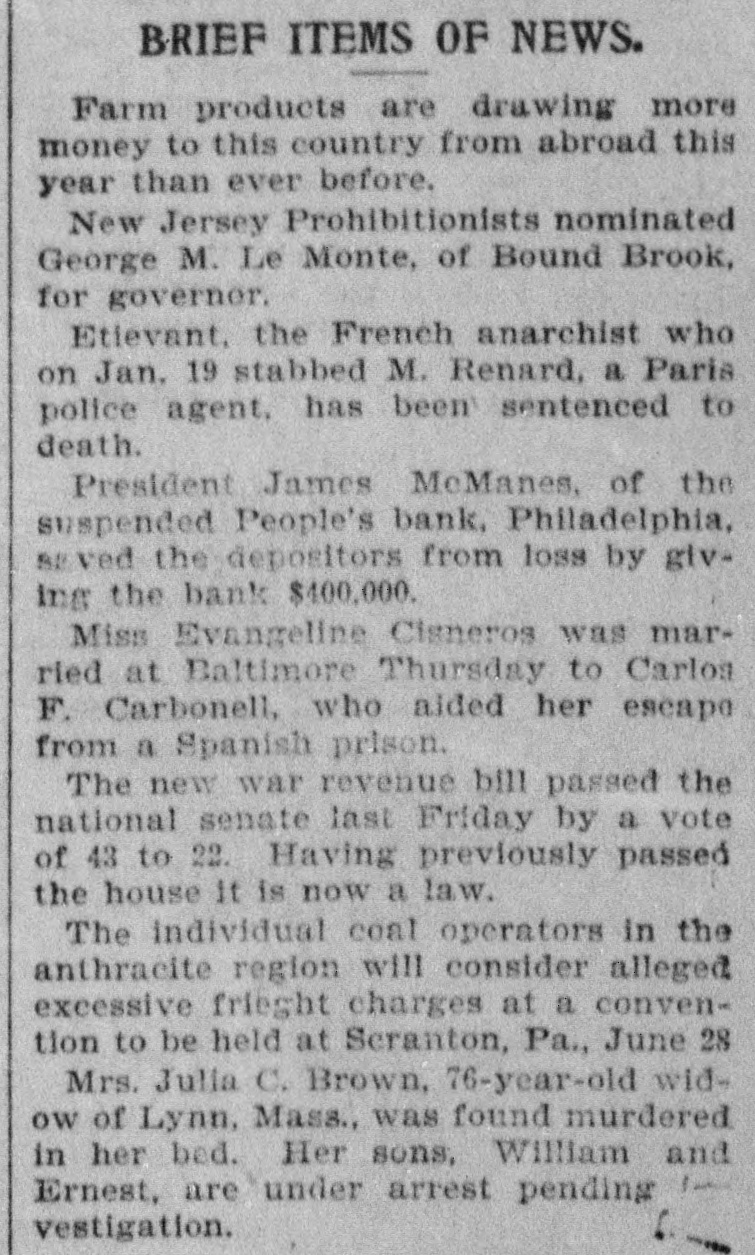
Receiver Thomas W. Barlow ... receiving a check for over $400,000 from President James McManes ... to pay a division of 90 per cent and remaining 10 per cent will follow in three months.
Source
newspapers
4. November 26, 1898 Other
Newspaper Excerpt
Thos. W. Barlow, receiver of the People's bank, notified the depositors that the remaining 10 per cent. due them will be paid on and after December 5, 1898.
Source
newspapers

Newspaper Articles (24)

Article from The Evening Times, March 29, 1898

Click image to open full size in new tab

Article Text

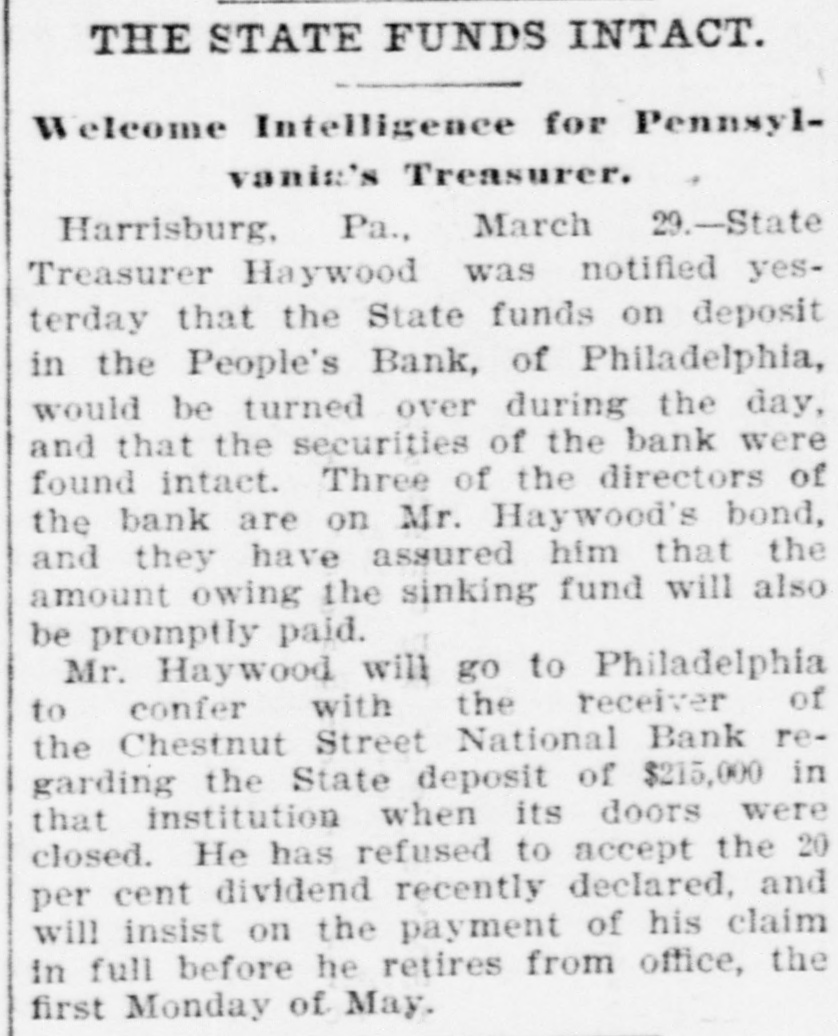
THE STATE FUNDS INTACT. Welcome Intelligence for Pennsylvanials Treasurer. Harrisburg, Pa., March 29.-State Treasurer Haywood was notified yesterday that the State funds on deposit in the People's Bank, of Philadelphia, would be turned over during the day, and that the securities of the bank were found intact. Three of the directors of the bank are on Mr. Haywood's bond, and they have assured him that the amount owing the sinking fund will also be promptly paid. Mr. Haywood will go to Philadelphia to confer with the receiver of the Chestnut Street National Bank regarding the State deposit of $215,000 in that institution when its doors were closed. He has refused to accept the 20 per cent dividend recently declared, and will insist on the payment of his claim in full before he retires from office, the first Monday of May.


Article from The Evening Herald, March 30, 1898

Click image to open full size in new tab

Article Text

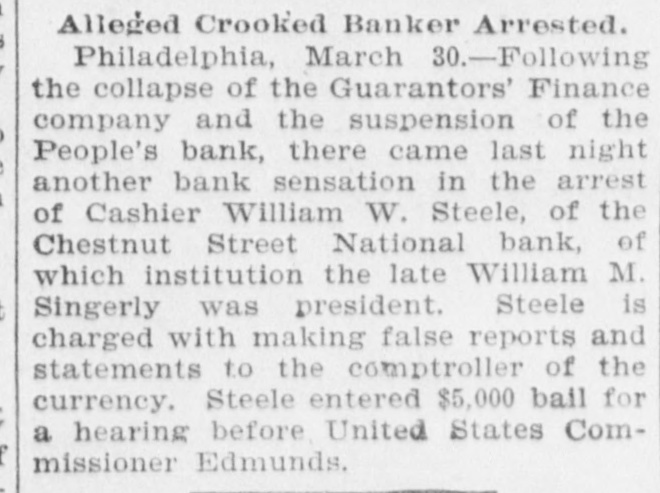
Alleged Crooked Banker Arrested. Philadelphia, March 30.-Following the collapse of the Guarantors' Finance company and the suspension of the People's bank, there came last night another bank sensation in the arrest of Cashier William W. Steele, of the Chestnut Street National bank, of which institution the late William M. Singerly was president. Steele is charged with making false reports and statements to the comptroller of the currency. Steele entered $5,000 bail for a hearing before United States Commissioner Edmunds.


Article from The Wilmington Daily Republican, March 30, 1898

Click image to open full size in new tab

Article Text

Alleged Crooked Banker Arrested. Philadelphia, March 30.-Following the collapse of the Guarantors' Finance company and the suspension of the People's bank, there came last night another bank sensation in the arrest of Cashier William W. Steele, of the Chestnut Street National bank, of which institution the late William M. Singerly was president. Steele is charged with making false reports and statements to the comptroller of the currency. Steele entered $5,000 bail for a hearing before United States Commissioner Edmunds.


Article from Evening Journal, March 30, 1898

Click image to open full size in new tab

Article Text

Here Is Another Sensation. PHILADELPHIA, March 30.-Following the collapse of the Guarantors' Finance company and the suspension of the People's bank there came last night Another bank sensation in the arrest on a warrant issued by United States District Attorney Beck of Cashier William W. Steele of the Chestnut Street National bank, of which institution the late William M. Singerly was president. Steele is charged with making false reports and statements to the comptrol1er of the currency.


Article from Richmond Dispatch, March 30, 1898

Click image to open full size in new tab

Article Text

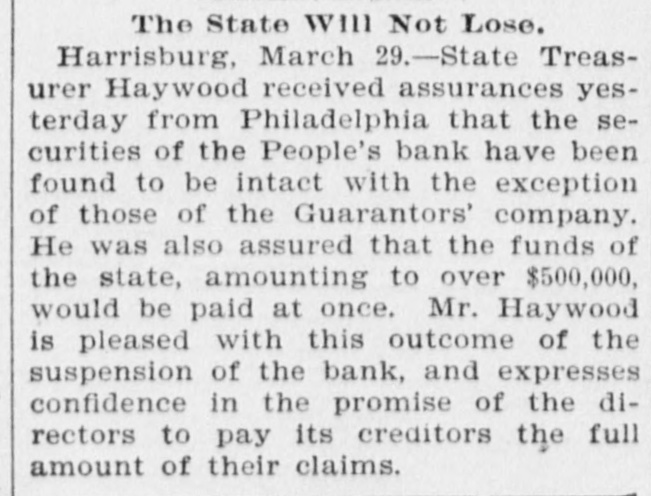
WILL PROTECT THEM. GUARANTOR'S VIRGINIA POLICYHOLDERS WILL NOT SUFFER. BE PAID OUT STATE DEPOSIT. Treasurer Harman will Not Surrender the Fund Until Their Claims Are Satisfied-A Suicide and an Arrest. The developments and disclosures made the connection with the failure of People's In Bank, of Philadelphia, on March 25th. involving. as they do, the Guaran- headtors' Finance Company, which has folquarters in the same city, have been the lowed with close interest here by numerous clients of the Guarantors' of Liability and Indemnity Company, abPennsylvania, which was recently morbed by the Finance Company The local agents for the Liability Comwere Messrs. Pleasants and Crenpany shaw, who stated yesterday afternoon that they had done little of no business and for the company since October last, that the liability in this city would hardly by exceed $7,000, fully secured, however, $25,000 deposited by the old company, with with Treasurer Harman, in accordance the State law regarding foreign corporations. Among the firms which have claims the company are the Chesapeake RichRailway Company, Traction Company, and and mond against Ohio the the on Rich- the mond Cedar-Works. An attempt recover of the Finance Company to the part these bonds has been frustrated them by to State Treasurer, who will hold desatisfy the claims of the Virginia inpositors, some of whom have already in the stituted suits, which have resulted Crenshaw appointment of Mr. Charles S. in RS receiver for the Finance Company this State. DRAMA WITH MONEY MOTIF. story which has come to light named as The result of the failure of the above its bank, a unfolds a drama with money in as its motif, a drama which embraces and of catastrophe the passion of grief the vengeance. In this modern drama husband, are three. First, a second, the the a demanding vengeance for characters suicide; the first, widow, woman weeping on bethird-the man whom that ruined her husband and caused of lieves to take his life. On all the spirit It him for money grains satirically. late is desire the story of John S. Hopkins, widow- the Bank cashier, of his RichPeople's week ago his wife-and of until F. a Loper, promoter and general man- Comard ager of the Guarantors' Finance pany. Before Mr. Hopkins sent the bullet career into brain that ended his earthly his penned a letter to his wife and daugh- Loper he ters. Briefly this letter charges with Hopkins's downfall. He (Hopkins) the Guartwo years ago had loaned securities some antors-Loper Company some them the bank. He could not get would of but, hoping that the tide eventually back, turn, hรฉ then began loaning them the bank's money to keep and afloat. them The tide never turned. Deeper indebted the Guarantors became after deeper the People's Bank, and as dollar bank to was thus thansferred, the dollar weaker and weaker. In this manner collategrew $790,000 of the bank's money and Comrals passed over to the Guarantors' consideraThe securities given in wellpany. tion for this sum are said to be night worthless. LETTER TO HIS WIFE. Harassed, weighed down by a burden overhad become heavier than his could strained that nerves and overtaxed brain but John S. Hopkins killed himself, letter bear, before dying he wrote the following is an his wife and daughters, which which appeal to for pity and for mercy, and clearly reflects his character: "My Dear, Devoted, Loving Wife and on Daughters, For months I have been the verge of insanity from trouble at bank. the After my first sleep of exhaustion fought the balance of the night of have through praying to God to get me out my trouble, but it was of no avail. "I, some two years ago, let the Guarantors-Loper Company have some securi- them of the bank, and could not get back, ties and then from that I had to loan money to keep them afloat, and could my them was in the lion's mouth and I has hand get it out. The only thing that tide not me alive was the hope that the would kept turn with them and I could get can the securities back, but now I see it never be, and I cannot bear this pressure on my brain any longer. "I say to you this and swear it before Almighty God never, from December 20. until this moment, have I on my family, my or 1869, dollar house, ever and spent mine my A yelf that was not earned by me the spend. I have to leave you to to nercy of a loving God. "Lovingly, HUSBAND AND PAPA. March 24, 1898. On Monday afternoon Richard F. Toper, of rice-president and general manager arrested Finance Company, was dethe charged with conspiracy to cheat and the People's Bank, whose president its !raud has agreed to pay in full the claims of
Article from The Western Sentinel, March 31, 1898

Click image to open full size in new tab

Article Text

PHILADELPHIA BANK CLOSES. Cashier, Who Died Yesterday, Believed to Have Committed Suicide. PHILADELPHIA, March 25.-The People's Bank closed today. Clay Kemble, Assistant Cashier of the Guarantors' Co., has been appointed receiver. There is believed to be connection between the failure of the Guarantors' Company and the People's Bank, but nothing can be confirmed. Cashier Hopkins, who died yesterday, is believed today to have committed suicided. He ran the bank.


Article from Richmond Planet, April 2, 1898

Click image to open full size in new tab

Article Text

Alleged Crooked Banker Arrested. Philadelphia, March 30.-Following the collapse of the Guarantors' Finance company and the suspension of the People's bank, there came last night another bank sensation in the arrest of Cashier William W. Steele, of the Chestnut Street National bank, of which institution the late William M. Singerly was president. Steele is charged with making false reports and statements to the comptroller of the currency. Steele entered $5,000 ball for a hearing before United States Commissioner Edmunds.


Article from New-York Tribune, April 22, 1898

Click image to open full size in new tab

Article Text

GUARANTORS' FINANCE COMPANY. RECEIVERS APPOINTED IN HARRISBURG YESTERDAY Harrisburg. April 21.-Judge Simonton to-day pointed District-Attorney Meade D. Detweiler, of Harrisburg Alexander Simpson, Jr., and Dimner Beever. of Philadelphia, receivers of the Guarantors' Finance Company of Philadelphia. The com. pany is now in the hands of H. Clay Kemble and Henry Clay, to whom an assignment was recently made. The embarrassment of the Guarantors' company and of its general manager, Richard F. Loper, caused the downfall of the People's Bank of Philadelphia.


Article from The Houston Daily Post, June 14, 1898

Click image to open full size in new tab

Article Text

People's Banks Affairs. Philadelphia, Pa., June 13.-Receiver Thomas W. Barlow of the suspended People's bank. has been enabled, as a result of receiving a check for over $400,000 from President James McMans, to make the very gratifying announcement to the depositors and creditors of the bank that he is now in a position to pay them a division of 90 per cent and that the remaining 10 per cent will follow in three months.


Article from The San Francisco Call, June 15, 1898

Click image to open full size in new tab

Article Text

DEPOSITORS ARE SECURED. PHILADELPHIA, June 14.-Receiver Thomas W. Barlow of the suspended People's Bank, has been enabled, as a result of receiving a check for over $400,000 from President James McManer, to make the very gratifying announcement to the depositors and creditors of the bank that he is now in a position to pay them a dividend of 90 per cent and that the remaining 10 per cent will follow in three months.


Article from The Saint Paul Globe, October 15, 1898

Click image to open full size in new tab

Article Text

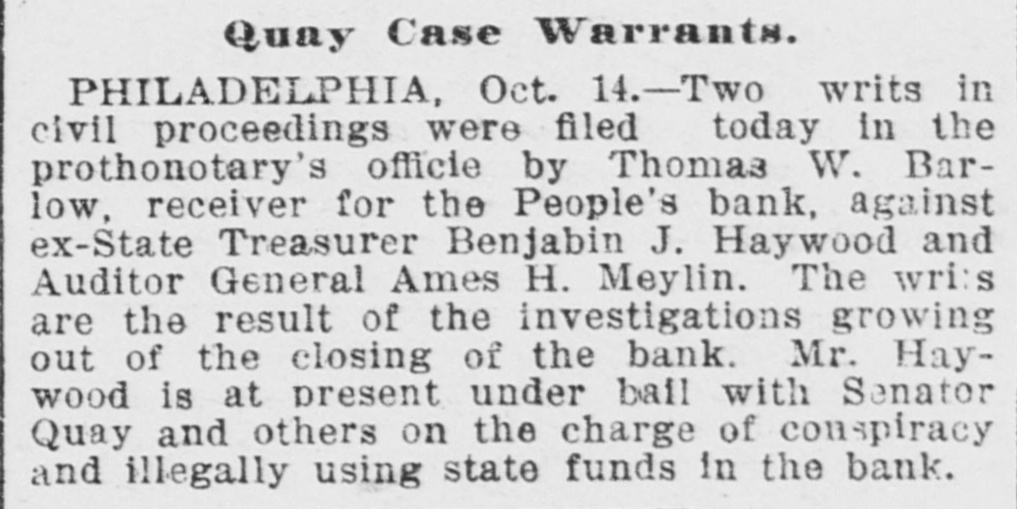
Quay Case Warrants. PHILADELPHIA, Oct. 14.-Two writs in civil proceedings were filed today in the prothonotary's officie by Thomas W. Barlow, receiver for the People's bank, against ex-State Treasurer Benjabin J. Haywood and Auditor General Ames H. Meylin. The writs are the result of the investigations growing out of the closing of the bank. Mr. Haywood is at present under bail with Senator Quay and others on the charge of conspiracy and illegally using state funds in the bank.


Article from Albuquerque Daily Citizen, November 26, 1898

Click image to open full size in new tab

Article Text

Paid the Depositors. Philadelphia, Nov. 26.-Thos. W. Burlow, receiver of the Peoples' bank, notified the depositors that the remaining 10 per cent. due them will be paid on and after December 5, 1898. The Peoples' bank closed on March 25 last, after Cashler John 8. Hopkins committed suicide. The liabilities were about $1,500,000, and the assets less than a million. President McManea pledged himself to pay the depositors dollar for dollar.


Article from The Indianapolis Journal, November 27, 1898

Click image to open full size in new tab

Article Text

DEPOSITORS PAID IN FULL. President McManes, of the People's Bank, Has Kept His Word. PHILADELPHIA, Pa., Nov. 26.-Thomas W. Barlow, receiver of the People's Bank, has notified the depositors of that institution that the remaining 10 per cent. due them will be paid on and after Dec. 5, 1898. This payment will close every contested claim against the bank, including the de-


Article from The Herald, November 27, 1898

Click image to open full size in new tab

Article Text

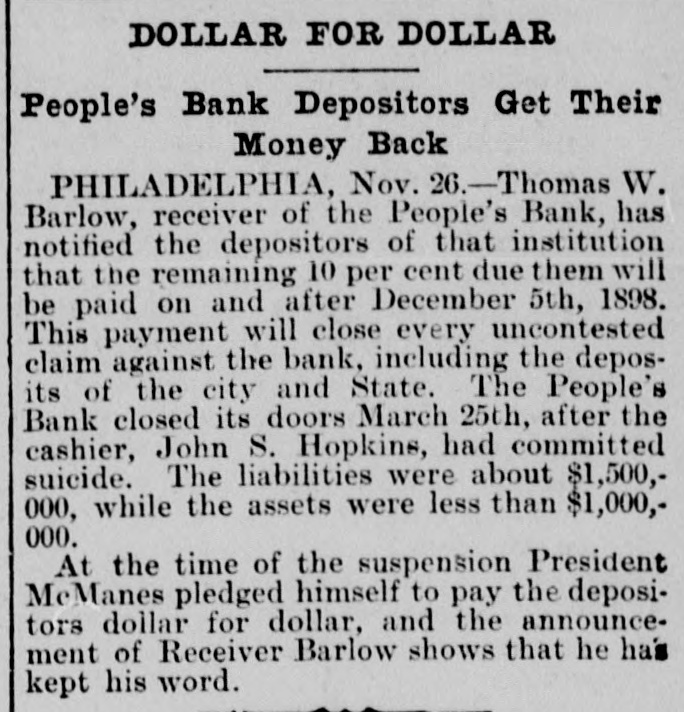
DOLLAR FOR DOLLAR People's Bank Depositors Get Their Money Back PHILADELPHIA, Nov. 26.-Thomas W. Barlow, receiver of the People's Bank, has notified the depositors of that institution that the remaining 10 per cent due them will be paid on and after December 5th, 1898. This payment will close every uncontested claim against the bank, including the deposits of the city and State. The People's Bank closed its doors March 25th, after the cashier, John S. Hopkins, had committed suicide. The liabilities were about $1,500,000, while the assets were less than $1,000,000. At the time of the suspension President McManes pledged himself to pay the depositors dollar for dollar, and the announcement of Receiver Barlow shows that he has kept his word.


Article from Rock Island Argus, November 28, 1898

Click image to open full size in new tab

Article Text

Depositors Will Be Paid in Full. Philadelphia, Nov. 28.-Thomas W. Barlow, receiver of the People's bank. has notified the depositors of that institution that the remaining 10 per cent. due them will be paid on and after Dec. 5, 1898. This payment will close every uncontested claim against the bank. including the deposits of the city and state.


Article from The Topeka State Journal, November 28, 1898

Click image to open full size in new tab

Article Text

A BANK PAYS OUT. a $ The People's of Philadelphia, Breaks a the Usual Custom. โ‚ฌ Philadelphia, Nov. 28.-Thomas W. Barlow, receiver of the People's bank, has noe tified the depositors of the institution that


Article from The Worthington Advance, December 1, 1898

Click image to open full size in new tab

Article Text

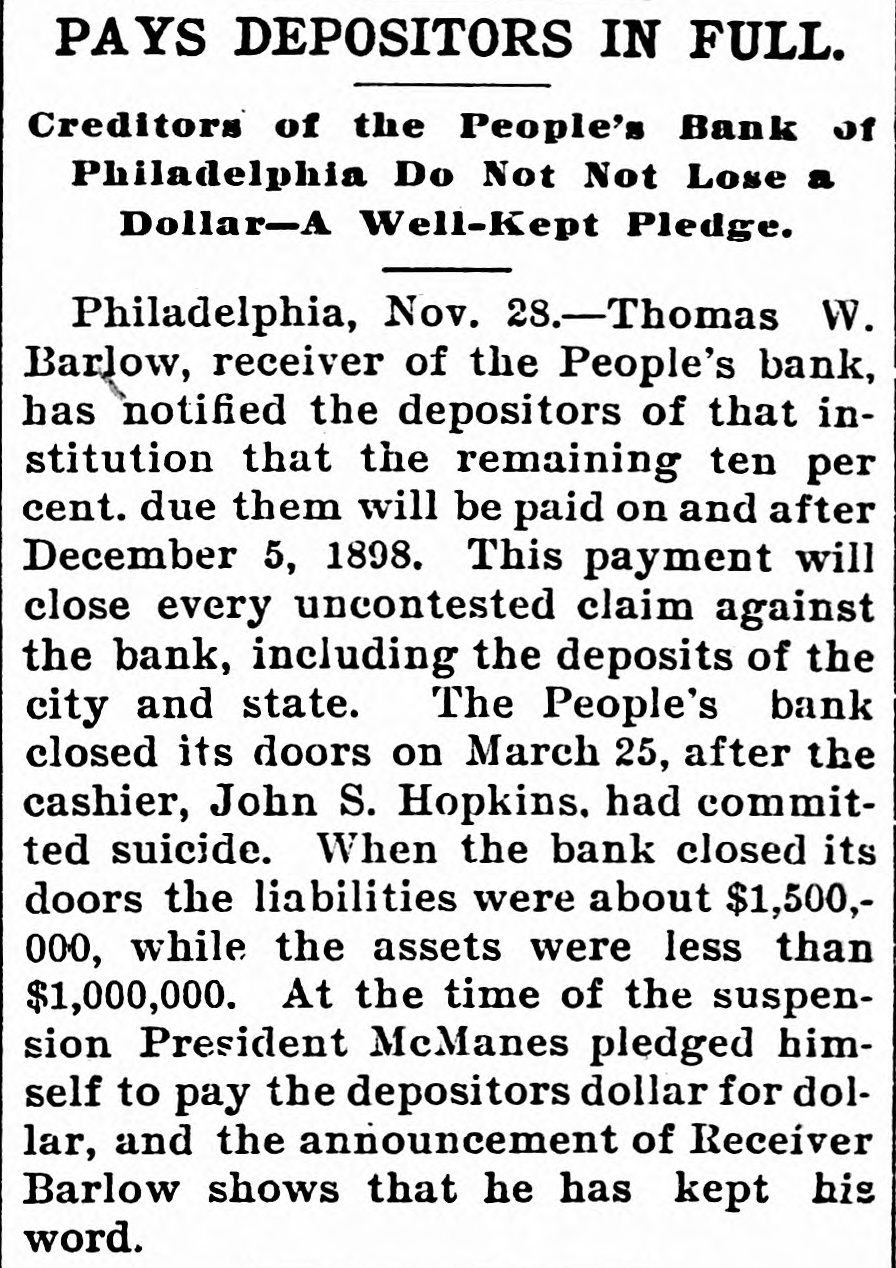
PAYS DEPOSITORS IN FULL. Creditors of the People's Bank of Philadelphia Do Not Not Lose a Dollar-A Well-Kept Pledge. Philadelphia, Nov. 23.-Thomas W. Barlow, receiver of the People's bank, has notified the depositors of that institution that the remaining ten per cent. due them will be paid on and after December 5, 1898. This payment will close every uncontested claim against the bank, including the deposits of the city and state. The People's bank closed its doors on March 25, after the cashier, John S. Hopkins. had committed suicide. When the bank closed its doors the liabilities were about $1,500,000, while the assets were less than $1,000,000. At the time of the suspension President McManes pledged himself to pay the depositors dollar for dollar, and the announcement of Receiver Barlow shows that he has kept his word.


Article from Twice-A-Week Plain Dealer, December 2, 1898

Click image to open full size in new tab

Article Text

Pay Depositors in Full. Philadelphia, Nov. 28.-Thomas W. Barlow, receiver of the People's bank, has notified the depositors of that institution that the remaining ten per cent. due them will be paid or and after December 5, 1898. This payment will close every uncontested claim against the bank, including the deposits of the city and state.


Article from The Neihart Herald, December 3, 1898

Click image to open full size in new tab

Article Text

GENERAL NEWS NOTES. Mrs. Pullman's income is $9,000 a month. Our export trade with England is on the increase. The Blackfeet Indians are trying to oust their agent. A powder mill and 6 men blown "p at Lamotte, Mo. A blizzard has raged in London during the past week. A post office has been established at Schley, Fergus county, Mont. The Tennessee court sustains the validity of the anti-cigarette law. There is an extensive movement of southern cattle to northern ranges. The spirit of independence at Seoul results in a riot. Several killed. An old time blizzard visits Kentucky and takes the thermometer to zero. Several rough riders have gone to San Juan hill, Cuba, to prospect for gold. The Pittsfield express on a Connecticut road is wrecked: no one killed. A fire in the Pinole works of the California powder company costs $25,000. Revolutionary bands from Brazil threaten an attack on the capital of Uraguay. A tribe of cannibals has been located in the German group of the Sula islands. The British navy has hoisted the union jack over the Chu San archipelago, near Shanghai. All the big elevator manufacturing concerns in America have formed an $11,000,000 trust. The president's message containing 60,000 words, twice the usual dose, is ready for congress. A Chinaman in Frisco dies of A disease resembling bubonic plague, and the officials are alarmed. Queen Wilhelmina of Holland t will wed Prince William of Wiede, who is an officer in the German army. The government experiments show that oats, barley, flax and h spuds can be successfully grown in Alaska. 0 South Dakota by a majority of 6,000 has made the initiative and , referendum a part of the state con stitution. . r The rotten People's bank of Phil . adelphia has arranged to pay all claims of depositors including city and state. d The Fe road has put on a train n which makes the distance from San Francisco to Chicago only two and e a half days. g r Two hand cars loaded with a parr ty returning from IL hoedown near n Elkhart, Ind., are run down by an . express. Three or four killed. y Fire destroys the big Baldwin hog tel in San Francisco. Two lives and a half million dollars lost, one fourth of the latter covered by insurance. Fire destroys the railroad bridge two miles east of Sand Coulee causing a temporary shut down of the n mines of Sand Coulee and Stockett. e of An awful storm sweeps the New h England coast, working great havoc is to shipping. More than eighty are known to have drowned, and a hunin h dred ships have been destroyed. 8, Gov.-elect Roosevelt assures the er labor leaders of New York that he will enforce every labor law on the statute books in New York. All n hands agree that there are laws to enough if properly enfored. ero The old Hope mine at Basin reIt ports an immense strike in the new 10 erossout on the 300 foot. This mine 100


Article from The Wisconsin Tobacco Reporter, April 14, 1899

Click image to open full size in new tab

Article Text

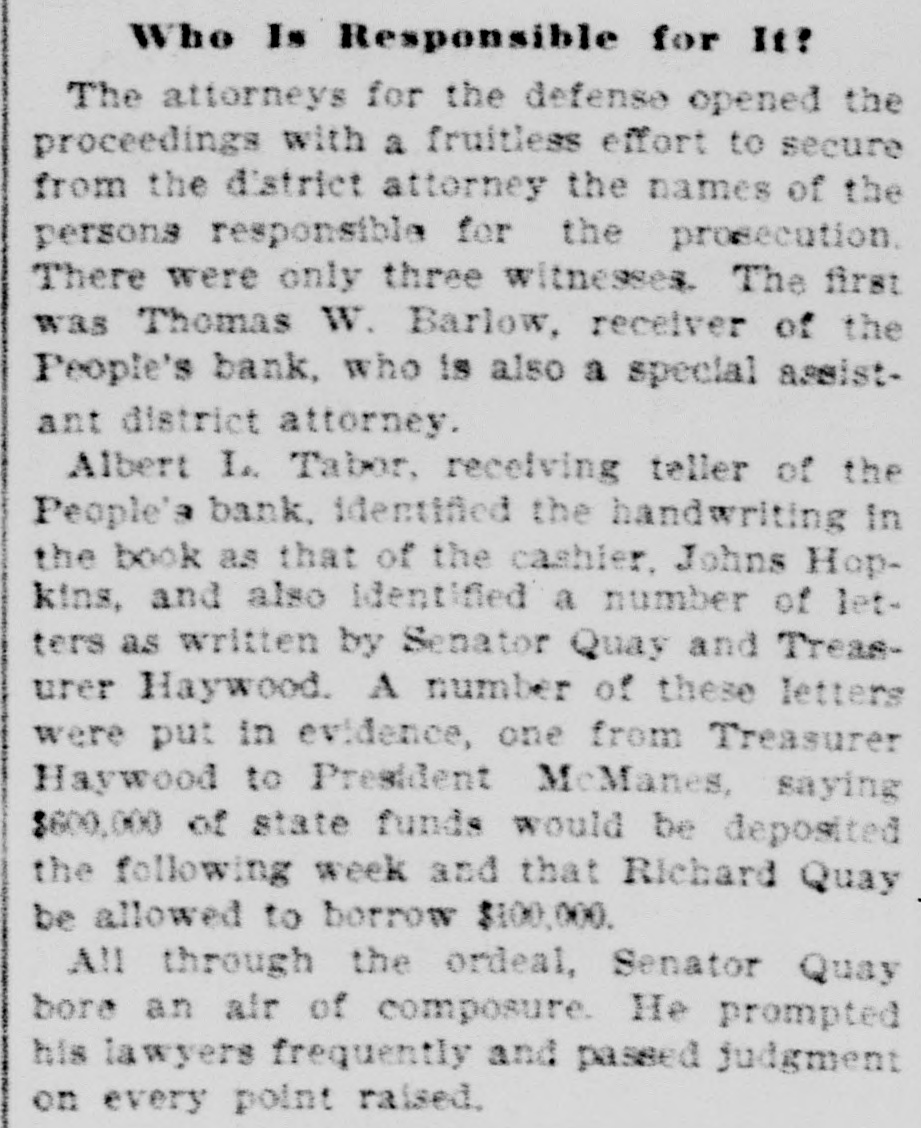
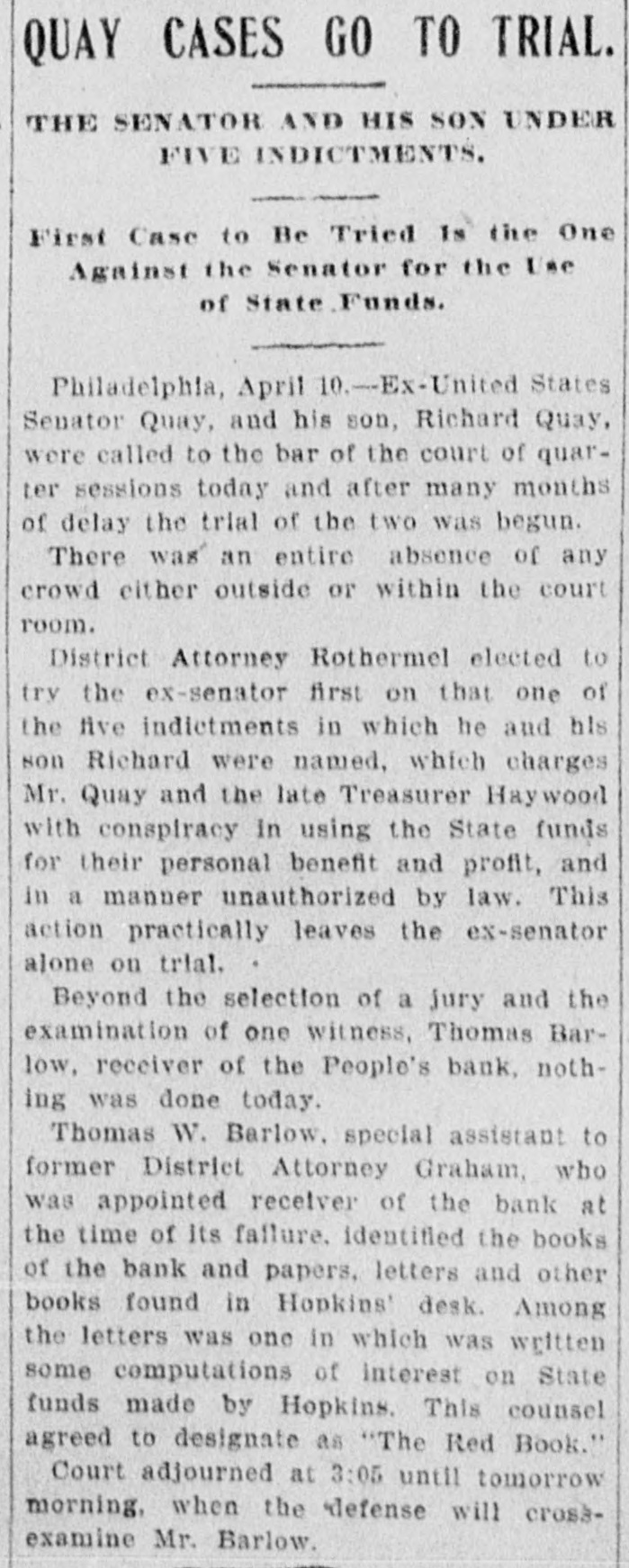
Serator Quay's Trial Begun. Philadelphia, April 11.-Ex-United States Senator Matthew S. Quay and his son, Richard R. Quay, were called to the bar of the court of quarter sessions yesterday and after many months of vexatious delay the trial of the two defendants was begun. A jury was empaneled and the testimony of Thomas W. Barlow, receiver of the People's bank, was taken. The trial is before Judge Craig Biddle.


Article from The Owosso Times, April 14, 1899

Click image to open full size in new tab

Article Text

Senator Quay's Trial Begun. Philadelphia, April 11.-Ex-United States Senator Matthew S. Quay and his son, Richard R. Quay, were called to the bar of the court of quarter sessions yesterday and after many months of vexatious delay the trial of the two defendants was begun. A jury was empaneled and the testimony of Thomas W. Barlow, receiver of the People's bank, was taken. The trial is before Judge Craig Biddle.


Article from Freeland Tribune, April 17, 1899

Click image to open full size in new tab

Article Text

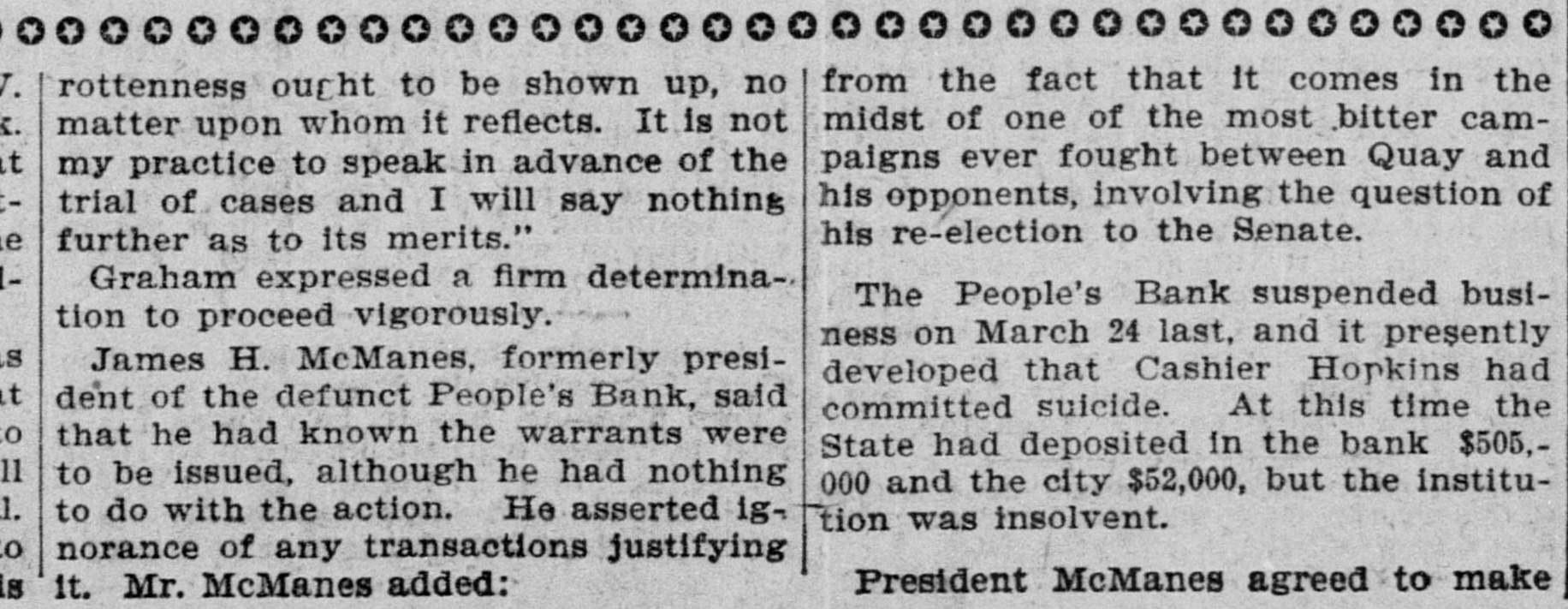
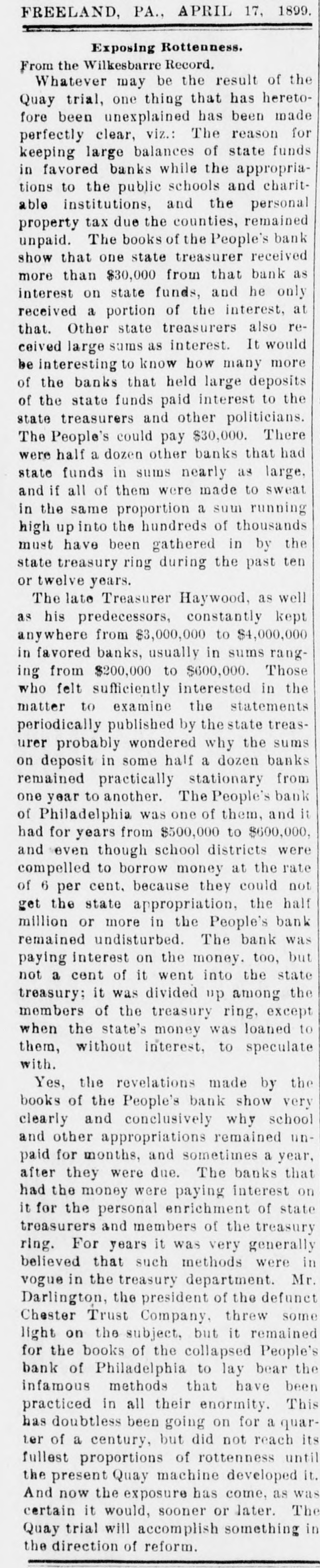
FREELAND, PA., APRIL 17, 1899. Exposing Rottenness. From the Wilkesbarre Record. Whatever may be the result of the Quay trial, one thing that has heretofore been unexplained has been made perfectly clear, viz.: The reason for keeping large balances of state funds in favored banks while the appropriations to the public schools and charitable institutions, and the personal property tax due the counties, remained unpaid. The books of the People's bank show that one state treasurer received more than $30,000 from that bank as interest on state funds, and he only received a portion of the interest, at that. Other state treasurers also received large sums as interest. It would be interesting to know how many more of the banks that held large deposits of the state funds paid interest to the state treasurers and other politicians. The People's could pay $30,000. There were half a dozen other banks that had state funds in sums nearly as large, and if all of them were made to sweat in the same proportion a sum running high upinto the hundreds of thousands must have been gathered in by the state treasury ring during the past ten or twelve years. The late Treasurer Haywood, as well as his predecessors, constantly kept anywhere from $3,000,000 to $4,000,000 in favored banks, usually in sums ranging from $200,000 to $600,000. Those who felt sufficiently interested in the matter to examine the statements periodically published by the state treasurer probably wondered why the sums on deposit in some half a dozen banks remained practically stationary from one year to another. The People's bank of Philadelphia was one of them, and it had for years from $500,000 to $600,000, and even though school districts were compelled to borrow money at the rate of 6 per cent. because they could not get the state appropriation, the half million or more in the People's bank remained undisturbed. The bank was paying interest on the money. too, but not a cent of it went into the state treasury: it was divided up among the members of the treasury ring, except when the state's money was loaned to them, without interest, to speculate with. Yes, the revelations made by the books of the People's bank show very clearly and conclusively why school and other appropriations remained unpaid for months, and sometimes a year, after they were due. The banks that had the money were paying interest on it for the personal enrichment of state treasurers and members of the treasury ring. For years it was very generally believed that such methods were in vogue in the treasury department. Mr. Darlington, the president of the defunct Chester Trust Company, threw some light on the subject, but it remained for the books of the collapsed People's bank of Philadelphia to lay bear the infamous methods that have been practiced in all their enormity. This has doubtless been going on for a quarter of a century, but did not reach its fullest proportions of rottenness until


Article from People's Voice, April 27, 1899

Click image to open full size in new tab

Article Text

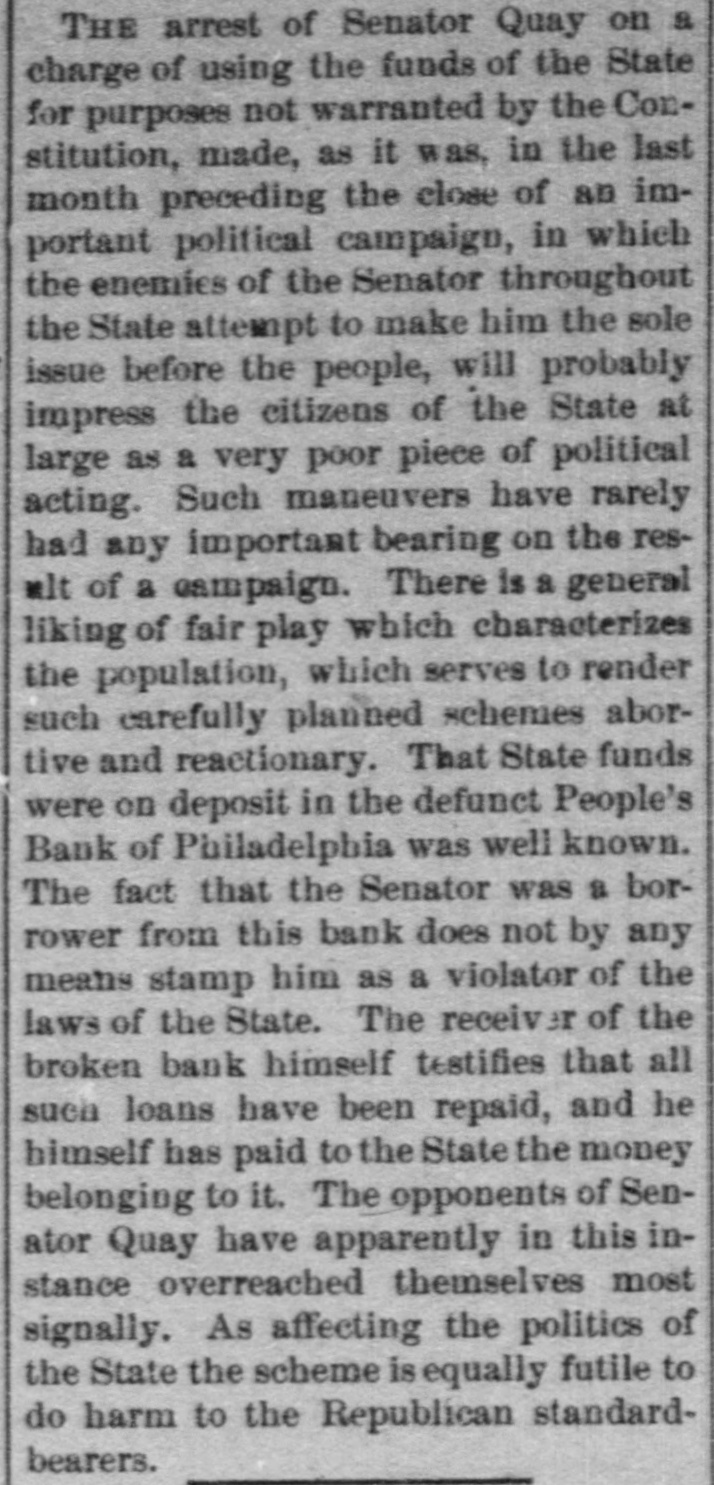
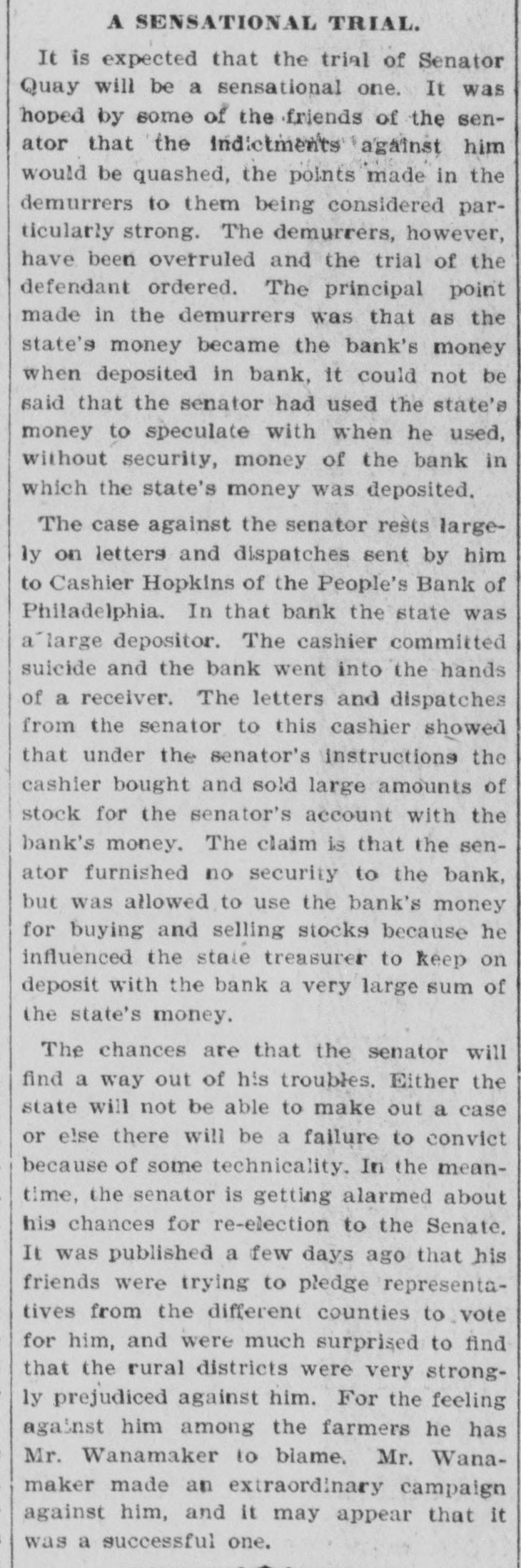
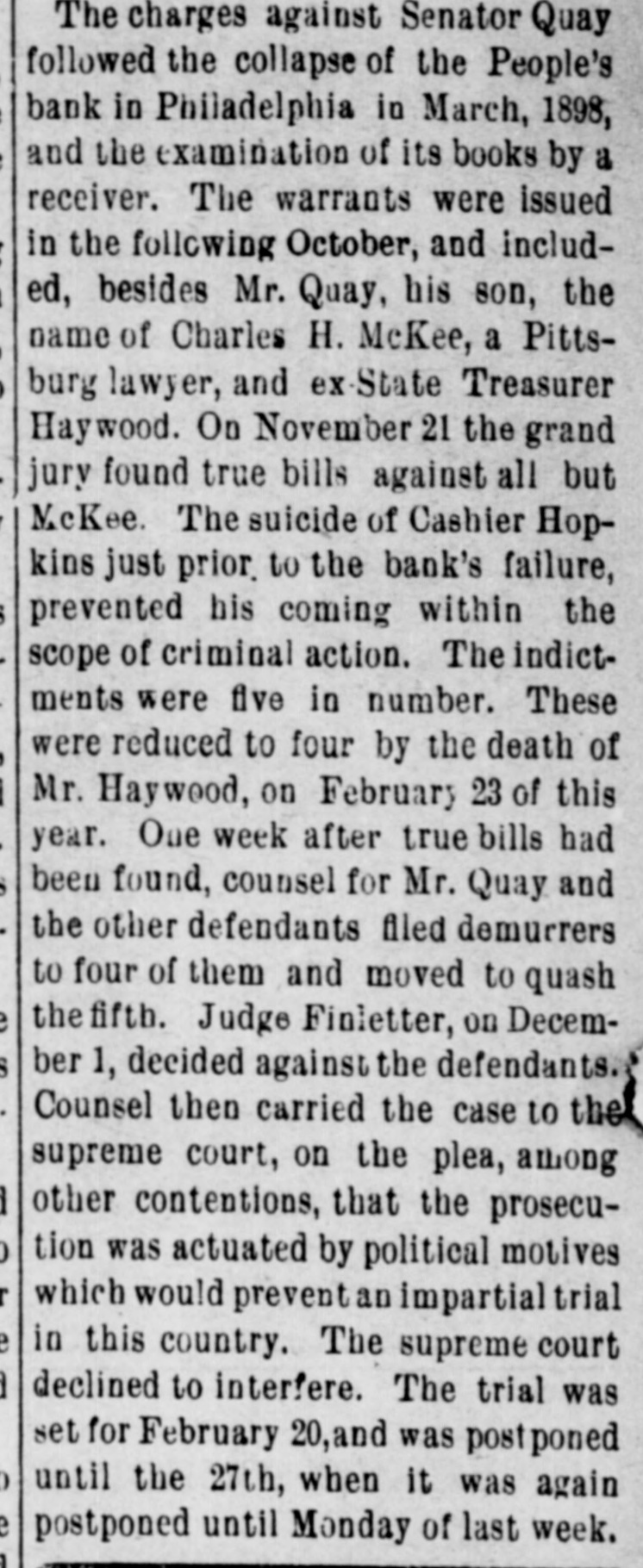
The charges against Senator Quay followed the collapse of the People's bank in Philadelphia in March, 1898, and the examination of its books by a receiver. The warrants were issued in the following October, and included, besides Mr. Quay, his son, the name of Charles H. McKee, a Pittsburg lawyer, and ex-State Treasurer Haywood. On November 21 the grand jury found true bills against all but McKee. The suicide of Cashier Hopkins just prior to the bank's failure, prevented his coming within the scope of criminal action. Theindictments were five in number. These were reduced to four by the death of Mr. Haywood, on February 23 of this year. One week after true bills had been found, counsel for Mr. Quay and the other defendants filed demurrers to four of them and moved to quash the fifth. Judge Finletter, on December 1, decided against the defendants. Counsel then carried the case to the supreme court, on the plea, among other contentions, that the prosecution was actuated by political motives which would prevent an impartial trial in this country. The supreme court declined to interfere. The trial was set for February 20,and was post poned until the 27th, when it was again postponed until Monday of last week.


Article from Richmond Dispatch, November 25, 1899

Click image to open full size in new tab

Article Text

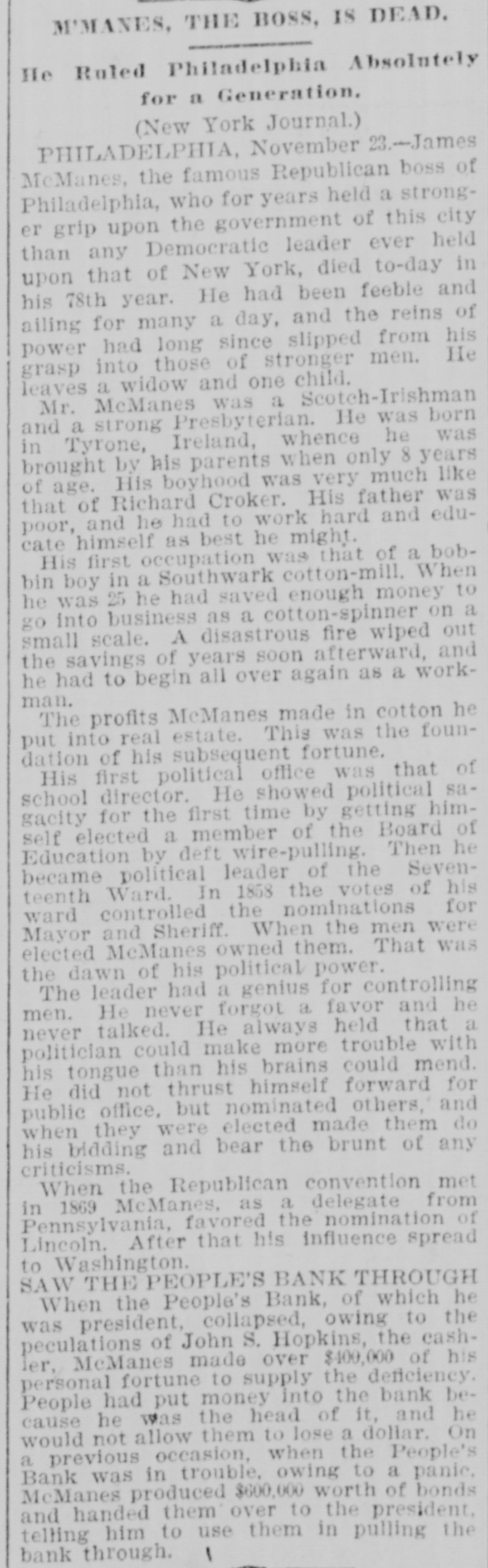
M'MANES, THE BOSS, IS DEAD. He Ruled Philadelphia Absolutely for a Generation. (New York Journal.) PHILADELPHIA, November 23.-James McManes, the famous Republican boss of Philadelphia, who for years held a stronger grip upon the government of this city than any Democratic leader ever held upon that of New York, died to-day in his 78th year. He had been feeble and ailing for many a day, and the reins of power had long since slipped from his grasp into those of stronger men. He leaves a widow and one child. Mr. McManes was a Scotch-Irishman and a strong Presbyterian. He was born in Tyrone, Ireland, whence he was brought by his parents when only 8 years of age. His boyhood was very much like that of Richard Croker. His father was poor, and he had to work hard and educate himself as best he might. His first occupation was that of a bobbin boy in a Southwark cotton-mill. When he was 25 he had saved enough money to go into business as a cotton-spinner on a small scale. A disastrous fire wiped out the savings of years soon afterward, and he had to begin all over again as a workman. The profits McManes made in cotton he put into real estate. This was the foundation of his subsequent fortune. His first political office was that of school director. He showed political sagacity for the first time by getting himself elected a member of the Board of Education by deft wire-pulling. Then he became political leader of the Seventeenth Ward. In 1858 the votes of his ward controlled the nominations for Mayor and Sheriff. When the men were elected McManes owned them. That was the dawn of his political power. The leader had a genius for controlling men. He never forgot a favor and he never talked. He always held that a politician could make more trouble with his tongue than his brains could mend. He did not thrust himself forward for public office, but nominated others, and when they were elected made them do his bidding and bear the brunt of any criticisms. When the Republican convention met in 1869 McManes, as a delegate from Pennsylvania, favored the nomination of Lincoln. After that his influence spread to Washington. SAW THE PEOPLE'S BANK THROUGH When the People's Bank, of which he was president, collapsed, owing to the peculations of John S. Hopkins, the cashier, McManes made over $400,000 of his personal fortune to supply the deficiency. People had put money into the bank because he was the head of it, and he would not allow them to lose a dollar. On a previous occasion, when the People's Bank was in trouble, owing to a panic, McManes produced $600,000 worth of bonds and handed them over to the president, telling him to use them in pulling the bank through. 1