Merchants Bank of South Carolina (Cheraw, SC)

Episode Information

Episode UID
3303251290721
Episode Type
Suspension โ†’ Closure
Bank Type
state
Bank ID
330325129 hash
Start Date
January 1, 1860*
Location
Cheraw, South Carolina (34.698, -79.883)

Metadata

Model
gpt-5-mini (chosen from majority vote of a three-model LLM ensemble)
Short Digest
53733906668089c4

Response Measures

None

Description

Supreme Court held the bank 'failed' when it suspended specie payments in 1860; later receivership and litigation followed.

Events (2)

1. January 1, 1860* Suspension
Cause
Macro News
Cause Details
Ceased to redeem its notes in specie in 1860 (suspension of specie payments); treated historically as the bank's failure.
Newspaper Excerpt
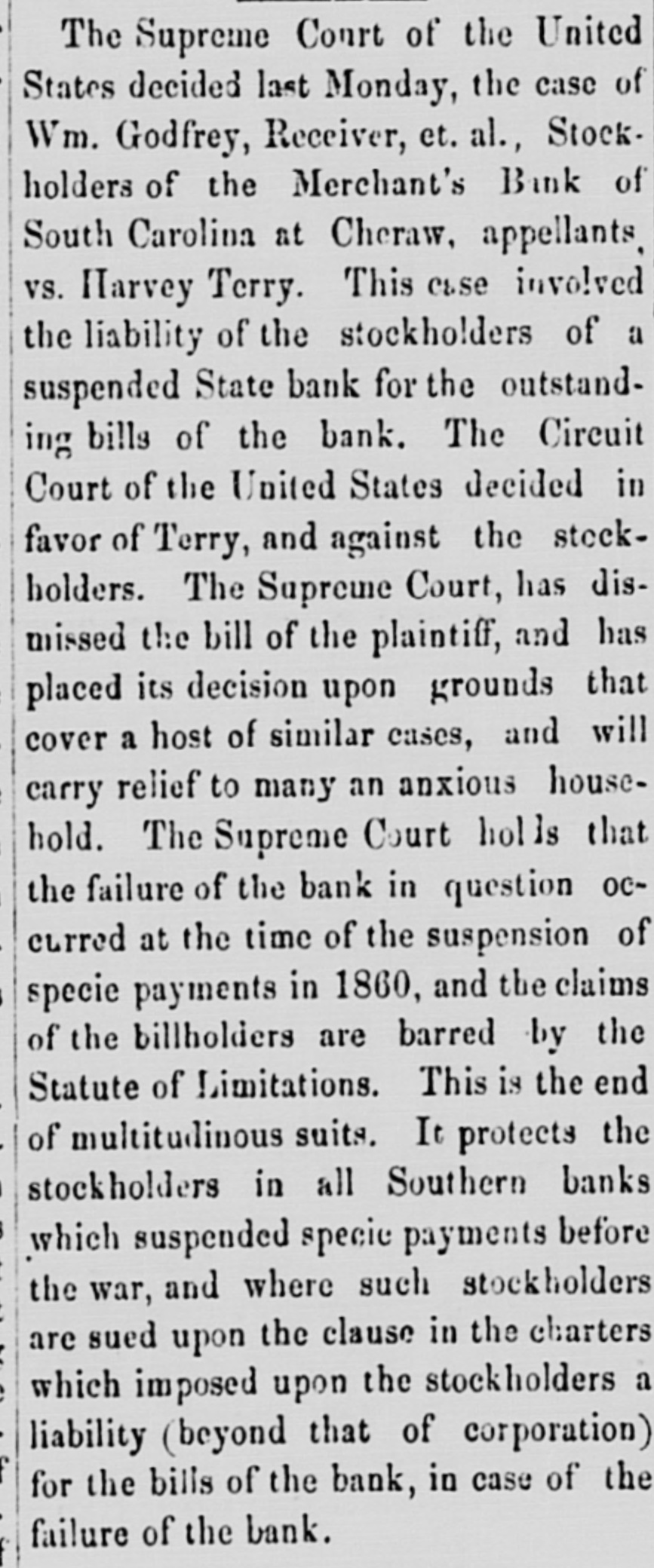
The Supreme Court holds that the failure of the bank in question occurred at the time of the suspension of specie payments in 1860
Source
newspapers
2. April 4, 1873 Receivership
Newspaper Excerpt
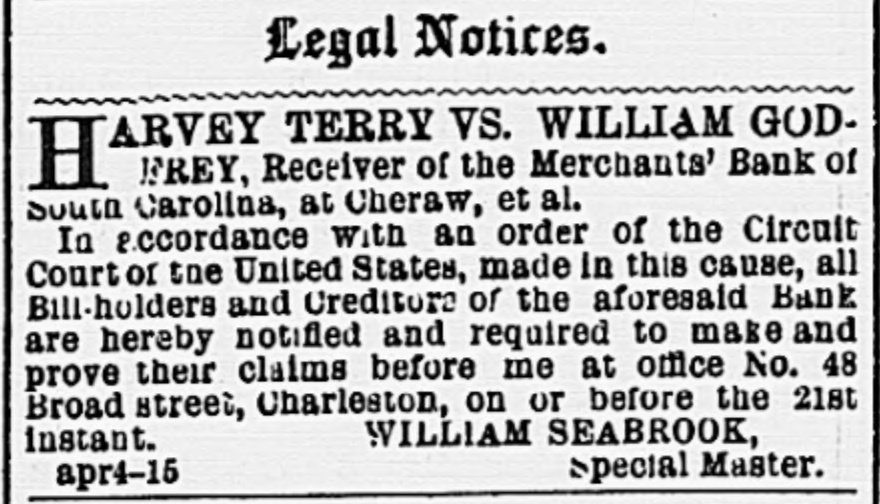
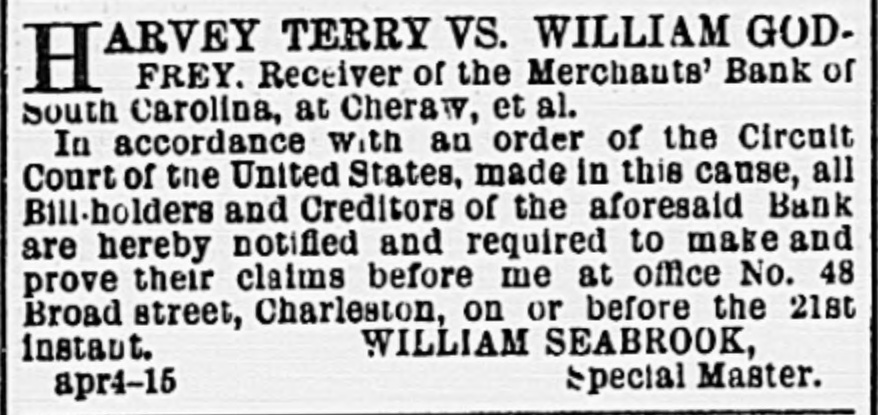
ARVEY TERRY VS. WILLIAM GODFREY, Receiver of the Merchants' Bank of South Carolina, at Cheraw ... notify and required to make and prove their claims before me at office No. 48 Broad street, Charleston; WILLIAM SEABROOK, Special Master. apr4-15
Source
newspapers

Newspaper Articles (10)

Article from The Charleston Daily News, August 9, 1867

Click image to open full size in new tab

Article Text

QUINN, copies of Orville Colege, by Mrs. HENRY WOOD, author of East Lyme, and The Rebel Chief, by GUSTAVE AIMARD, authorof thr Prairie Flower, and other works. The Rebel Chief is a tale of guerilla life, and will prove interesting to those who have some experience in this mode of warfare. Both of these Books are well gotten up, and from a cursory glance at thoir contents, will well repay the time spent in their perusal. Mr. QUINN has a large and full supply of modern literature at his King Street Stand, and can accommodate his customers with the latest novels and periodicals. DECREE OF THE COURT OF EQUITY ANNULLED. HEADQ'ES. SECOND MILITARY DISTRICT, CHARLESTON, S. C., August 7, 1867. [SPECIAL ORDERS, NO. 119.] (EXTRACT.) 1. Whereas, upon a bill of complaint filed in Equity in the Court of Chancery of South Carolina, by the Bank of Charleston 0S. James Tupper and the President and Directors of the Bank of the State of South Carolina, to which bill the Merchants' Bank of South Carolina at Cheraw and John T. Sloane were afterwards, upon their respective petitions, admitted to answer as defendants; a decree was made and entered by H. D. Lesesne, a Chancellor or said State, on the 5th day of March, A. D. 1867 ordering and directing James W. Gray, Master in Chancery, to pay to the Bank of Charleston the sum of five thousand two hundred and twentythree dollars ($5223) in specie, and to the Bank of Charleston and the Bank of Cheraw, jointly, the sum of five hundred and seventy-four dollars ($574) in specie, and to Hayne & Son, solicitors, representing John T. Sloan, and certain claimants on account of horses sold for the use of the Confederate army, the sum of three thousand dollars and thirty cents ($3,000 after deducting costs of suit, and giving certain directions in respect thereof; and it appearing by the statements and sworn answers of the parties above named, that the monies so ordered to be distributed constituted the balance of a fund created by a loan or advance made by certain banks of the State of South Carolina, in the early part of the year 1865, to aid the so-called Confederate government to remount a certain portion of the cavalry force with which it was endeavoring to resist the military forces of the United States, which balance, amounting to the sum of eight thousand seven hundred and ninety-seven dollars and thirty cents ($8,797 30) in gold at the time of the military occupation of the State aforesaid, and at the time of the surrender of the Confederate armies, remained unexpended in the hands of the Bank of the State of South Carolina, deposited to the credit of James Tupper, Auditor of the said State and it appearing that said decree was procured to be made by consent and connivance of James Tupper, Auditor of the State and the Bank of the State of South Carolina, the general fiscal agent of said State and it further appearing that neither the United State government nor the State of South Carolina appeared in said proceedings in Equity, or submittedtheirrespectiveright to the determination of the court-that the United States authorities had not notice of the proceedings aforesaid- that irregular and unusual means were employed to prevent knowledge of the said suit, and of the existence of said fund from coming to the United States authorities, of which it is alleged the said Chancellor and the parties before the court and their counsel were cognizant; and it further appearing that the said sum of eight thousand seven hundred and ninety-seven dollars and thirty cents ($8797 30), was the property of the United States at the time of the proceedings aforesaid, and that the Chancellor had no jurisdiction or authority to warrant his disposing of or interfering in any way with said monies, the same being a part of the funds of the United States: Therefore it is ordered, that the said decree in Equity be reversed and annulled as without jurisdiction, erroneous, irregular, and a fraud upon the rights of the United States. 1. It is further ordered, that the Bank of Charleston and James Tupper, Porter & Conner. the Bank of Cheraw, Simonton & Barker, J. L. Gantt, Register, Hayne & Son, and James W, Gray, and John T. Sloane, and such other person or persons, or claimants as have received any portion of the said sum of eight thousand seven hundred and ninety-seven dollars and thirty cents ($8,797.30), do forthwith pay over and refund the sums by them respectively, as received in specie, into the hands of A. J. Willard, at the office of the Bureau of Civil Affairs for the Second Military District, at the Citadel, Charleston; and the said A. J. Willard is hereby designated and appointed receiver thereof for the United States. 2. It is further ordered, that the said receiver have authority to take proofs, and ascertain and determine all persons to whom any portion of said funds has been paid, whether claiming through the said John T. Sloane or otherwise; and for that purpose to summon witnesses, administer oaths, and take. depositions; and that he report without unnecessary delay any person or persons, or corporate body in default for non-compliance with the terms of this order. 3. It is further ordered, that any deficiency that shall remain of the said sum of eight thousand seven hundred and ninetyseven dollars and thirty cents ($8,797 30) in gold, in consequence of the respective distributees thereof failing to pay over and refund, as ordered, shall be made good and paid by the Bank of the State of South Carolina and James Tupper, upon their being notified of said deficiency by said receiver. 4. And it is further ordered, that the said receiver take proofs as to the means employed by any person or persons to conceal from the proper civil and military officers of the United States, knowledge of the existence of said fund, or of the said suit, or of the decree therein pronounced, or of the proceedings under said decree, and whether the United States have been prejudiced thereby, and what person or persons have rendered themselves amenable to the United States by reason thereof, and the nature and extent of such responsibility and that said receiver report thereon with all convenient dispatch. By command of Major-General D. E. SICKLES J. W. CLOUS, Capt. 38th U. S. Infantry, A. D. C. and A. A. A. G. Official J. W. CLOUS, Capt. 38th Infantry, A. D. C. and A.A. A. G. THE FAIRIES OUTDONE.-The Princess, in the Fairy Tale, dropt pearls from her mouth when she opened it, but whoever uses that tajisman of science, SOZODONT, will have a mouthful of pearls wf2 that will never drop out, darken or decay.

Article from The Daily Phoenix, January 13, 1871

Click image to open full size in new tab

Article Text

Company, amounting to $2,098,312.40, and those of the North-eastern Railroad Company, amounting to $92,000, are past due, the former having matured in 1868, the latter in 1869. None of them have as yet been paid, but no demand has been yet made on the State for payment, and the Comptroller presumes "that the companies by whom they were issued have made, or are about to make, satisfactory arrangements relative thereto." DEBIT AND CREDIT. -Statement No. 12 credits an additional indebtedness of the State of $2,642,103.48, which, when added to the railroad debt of $8,787,608.20, makes the total debt of the State $11,429,711.68. So it will be perceived that from Mr. Neagle's own report the debt of the State is over $11,000,000. The advocates of reform were, therefore, not far from wrong in their estimates of the State debt during the late canvass. BANKS AND CAPITAL. - Statement No. 14 comprises abstracts of the returns of Banks of the State, filed in this office, under the provisions of the enabling Acts of March, 1869. In accordance therewith, the following named Banks have, during the last fiscal year, resumed business, with the amount of capital placed opposite their names, respectively, viz: Bank of Charleston, $850,000; People's Bank of South Carolina, $250,080; Planters' and Mechanics' Bank, $100,000. The Bank of Newberry and the South-western Railroad Bank are redeeming their bills, but have not resumed business. The following named are in the hands of receivers, &c., appointed under the provisions of the above named Act, or orders of the Courts prior to the passage thereof: Bank of Camden; Bank of Chester; Commercial Bank of Columbia; Exchange Bank of Columbia; Bank of Hamburg; Bank of Georgetown; Merchants' Bank of South Carolina, Cheraw; Planters' Bank of Fairfield; State Bank of Charleston, and Bank of South Carolina. RAILROADS. -The abstracts of the various railroad reports contain some very valuable statistical information, from which we make a few brief extracts. The net earnings of the various roads are set down as follows: Spartanburg and Union Railroad, $14,502.03; Greenville and Columbia, none; North-eastern, $96,207.94; South Carolina, $258,728.55. Out of this $58,194 have been paid in dividends, leaving a surplus of $200,534.55. The total number of persons killed on all the roads are reported as nine; injured, nine. THE PENITENTIARY. -The report of the Superintendent and Directors of the Penitentiary ask for an appropriation of $30,000 for the erection of a permanent brick building for work shops. There are now in confinement 317 persons, of whom 310 are males, and 7 females. It would seem that the inmates are kept well employed, as appears from the following exhibit of the work done by them during the past year: In carpenter shop has been manufactured 85 wheel-barrows, 160-cell benches, 180 spittoons, 3 derrick frames, 1,272 hammer handles, 430 axe and pick helves, 13 mess tables, 36 quarry buckets, performed work in erecting machine shop extension, erecting the new sheds for the protection of stone-workers, built aqueduct wood work in mill-race, fitted up store-room and hospital, repaired boats, wagons, fences and buildings, to an aggregate amount of at least $3,000. In blacksmith shop has been made 878 balcony bearers, a vast number of stone-cutters, and other tools used in the various departments, to an aggregate amount of not less than $5,000. The weaving shop has produced 8,208 yards of cloth of various kinds and qualities, to a value of $3,616.60, which has been made up into garments in the tailor shop. During the year 281 persons have been received; of whom 205 have been pardoned, 23 discharged, 24 died, and 6 escaped. LUNATIC ASYLUM. - The expenses of this institution, as appears by the report of the Treasurer, amount to $58,507. Its assets are $43,471, and liabilities $14,978. The South having exhibited of late signs of revival, and a somewhat independent expression and exercise of opinion consequent thereupon, the Radicals deem it necessary to again put on the legislative screws. With this view a special message is being prepared for Gen. Grant by some legal romancer, exhibiting the usual desperate state of affairs, so constantly encountered in the columns of the Washington Chronicle and New York Tribune. This is to be followed by the appointment of a com-


Article from The Charleston Daily News, April 4, 1873

Click image to open full size in new tab

Article Text

Legal Notices. ARVEY TERRY VS. WILLIAM GOD. FREY, Receiver of the Merchants' Bank of H South Carolina, at Cheraw, et al. In accordance with an order of the Circuit Court or the United States, made in this cause, all Bill-holders and Creditore of the aforesaid Bank are hereby notified and required to make and prove their claims before me at office No. 48 Broad street, Charleston, on or before the 21st WILLIAM SEABROOK, instant. special Master. apr4-15


Article from The Charleston Daily News, April 5, 1873

Click image to open full size in new tab

Article Text

ARVEY TERRY VS. WILLIAM GODFREY. Receiver of the Merchants' Bank of H South Carolina, at Cheraw, et al. In accordance with an order of the Circuit Court of the United States, made in this cause, all Bill-holders and Creditors of the aforesaid Bank are hereby notified and required to make and prove their claims before me at office No. 48 Broad street, Charleston, on or before the 21st WILLIAM SEABROOK, instant. Special Master. apr4-15


Article from The Daily Phoenix, April 24, 1873

Click image to open full size in new tab

Article Text

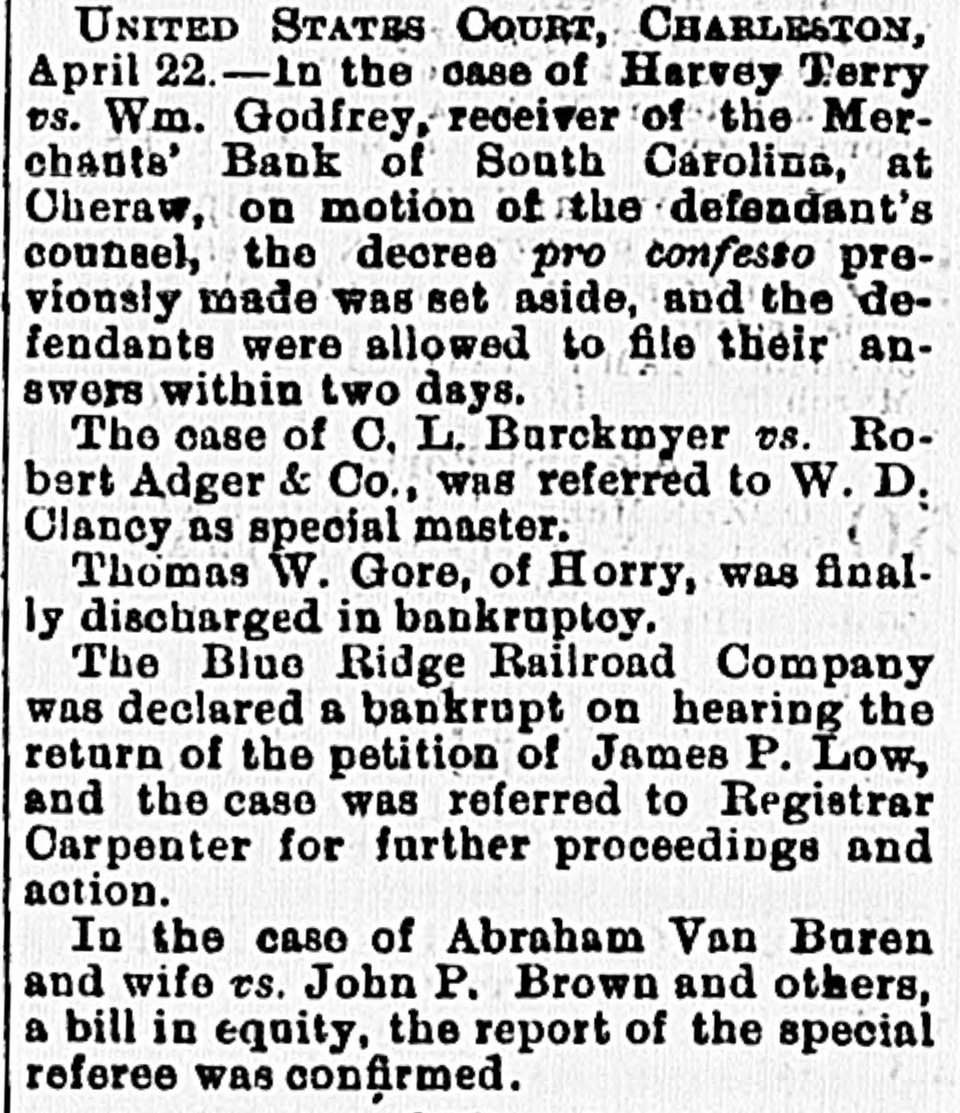
UNITED STATES OQURT, CHARLESTON, April 22.-1n the case of Harvey Terry vs. Wm. Godfrey, receiver of the Merchants' Bank of South Carolina, at Cheraw, on motion of the defendant's counse), the decree pro confesso previously made was set aside, and the defendants were allowed to file their answers within two days. The case of C. L. Burckmyer vs. Robert Adger & Co., was referred to W. D. Clancy as special master. Thomas W. Gore, of Horry, was finally discharged in bankruptoy. The Blue Ridge Railroad Company was declared a bankrupt on hearing the return of the petition of James P. Low, and the case was referred to Registrar Carpenter for further proceedings and action. In the caso of Abraham Van Buren and wife cs. John P. Brown and others, a bill in equity, the report of the special referee was confirmed.


Article from The Daily Phoenix, April 24, 1873

Click image to open full size in new tab

Article Text

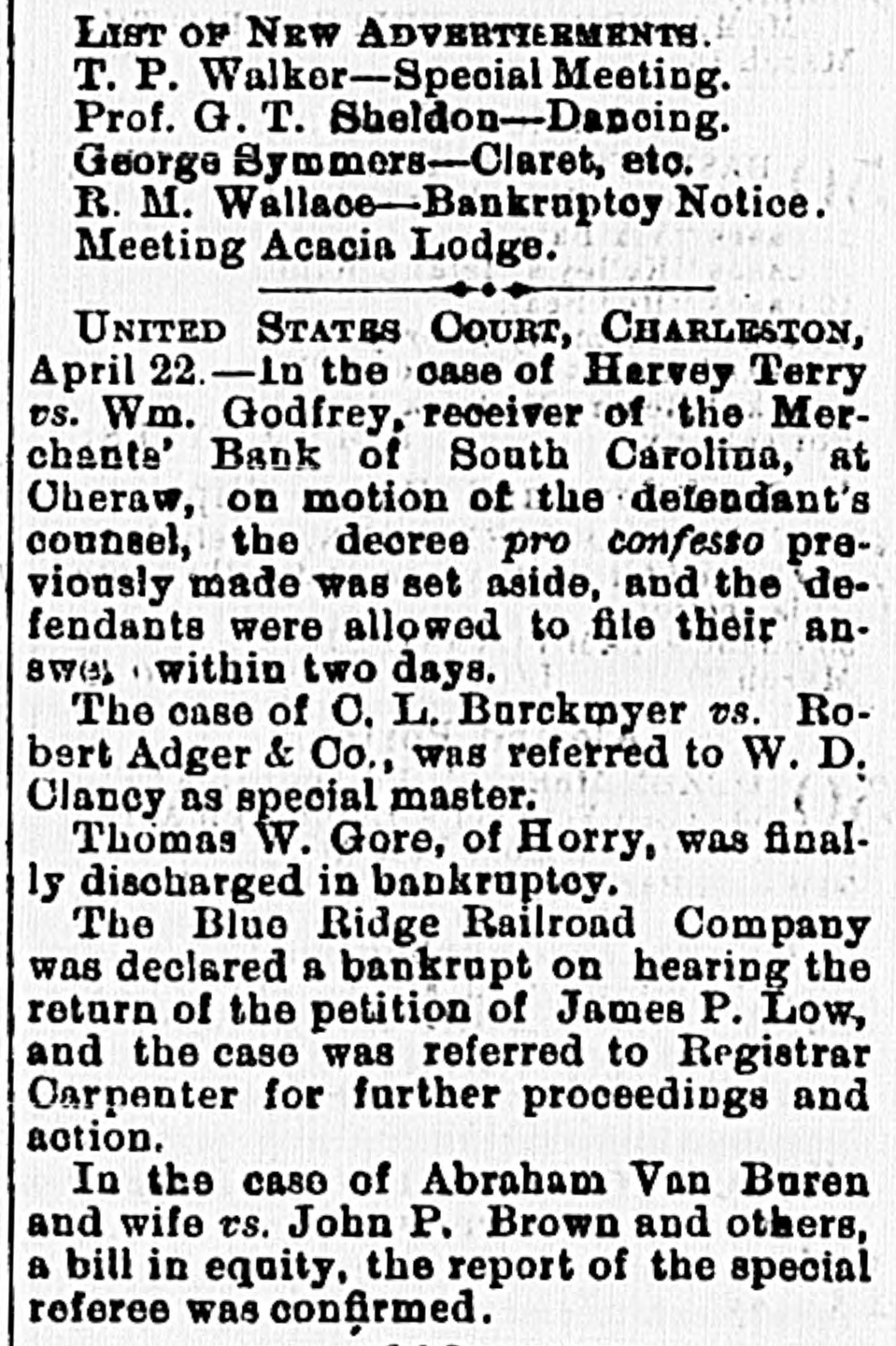
LIST OF NEW ADVERTIERMENTS T. P. Walker-Special Meeting. Prof. G. T. Sheldon-Dancing. George Symmers-Claret, etc. R. M. Wallace-Bankraptoy Notice. Meeting Acacia Lodge. UNITED STATES OQURT, CHARLESTON, April 22. -In the case of Harvey Terry vs. Wm. Godfrey, receiver of the Merchante' Bank of South Carolina, at Oheraw, on motion of the defendant's counsel, the decree pro confesso previously made was set aside, and the defendants were allowed to file their answe within two days. The case of C. L. Burckmyer vs. Robert Adger & Co., was referred to W. D. Clancy as special master. Thomas W. Gore, of Horry, was finally discharged in bankruptoy. The Blue Ridge Railroad Company was declared a bankrupt on hearing the return of the petition of James P. Low, and the case was referred to Registrar Carpenter for further proceedings and action. In the caso of Abraham Van Buren and wife vs. John P. Brown and others, a bill in equity, the report of the special referee was confirmed.


Article from The Daily Phoenix, April 15, 1874

Click image to open full size in new tab

Article Text

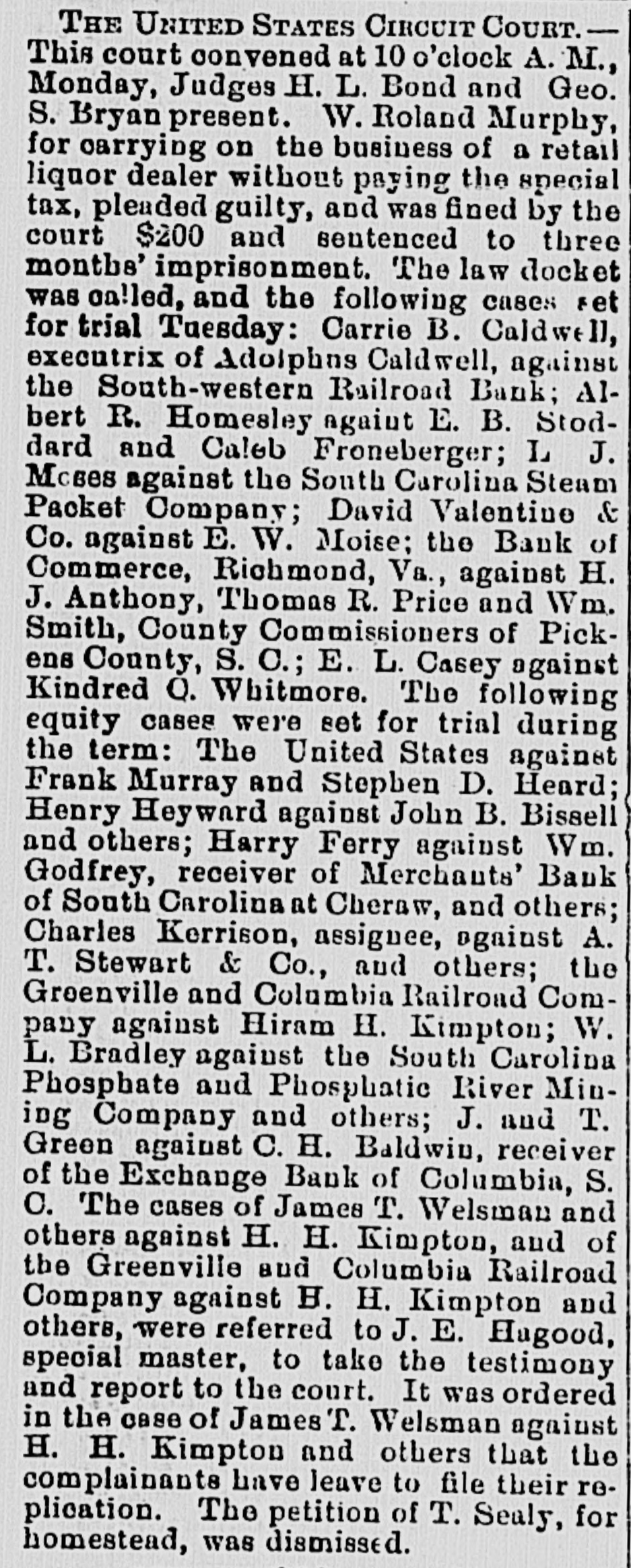
THE UNITED STATES CIRCUIT COURT. This court convened at 10 o'clock A. M., Monday, Judges H. L. Bond and Geo. S. Bryan present. W. Roland Murphy, for carrying on the business of a retail liquor dealer without paying the special tax, pleaded guilty, and was fined by the court $200 and sentenced to three months' imprisonment. The law docket was called, and the following cases set for trial Tuesday: Carrie B. Caldwell, executrix of Adolphns Caldwell, against the South-western Railroad Bank; Albert R. Homesley againt E. B. Stoddard and Caleb Froneberger; L J. Moses against the South Carolina Steam Packet Company; David Valentine & Co. against E. W. Moise; the Bank of Commerce, Richmond, Va., against H. J. Anthony, Thomas R. Price and Wm. Smith, County Commissioners of Pickens County, S. C.; E. L. Casey against Kindred Q. Whitmore. The following equity cases were set for trial during the term: The United States against Frank Murray and Stepben D. Heard; Henry Heyward against John B. Bissell and others; Harry Ferry against Wm. Godfrey, receiver of Merchants' Bank of South Carolina at Cheraw, and others; Charles Kerrison, assignee, egainst A. T. Stewart & Co., and others; the Greenville and Columbia Railroad Company against Hiram H. Kimpton; W. L. Bradley against the South Carolina Phosphate and Phosphatic River Mining Company and others; J. and T. Green against C. H. Baldwin, receiver of the Exchange Bank of Columbia, S. C. The cases of James T. Welsman and others against H. H. Kimpton, and of the Greenville and Columbia Railroad Company against H. H. Kimpton and others, were referred to J. E. Hagood, special master, to take the testimony and report to the court. It was ordered in the case of James Welsman against H. H. Kimpton and others that the complainants have leave to file their replication. The petition of T. Sealy, for homestead, was dismissed.


Article from Yorkville Enquirer, March 28, 1878

Click image to open full size in new tab

Article Text

EDITORIAL INKLINGS. Important Decision. - The Supreme Court of the United States decided last Monday, the case of Wm. Godfrey, Receiver, et. al., Stockholders of the Merchant's Bank of South Carolina at Cheraw, appellants, VS. Harvey Terry. This case involved the liability of the stockholders of a suspended State bank for the outstanding bills of the bank. The Circuit Court of the United States decided in favor of Terry, and against the stockholders. The Supreme Court, has dismissed the bill of the plaintiff, and has placed its decision upon grounds that cover a host of similar cases, and will carry relief to many an anxious household. The Supreme Court holds that the failure of the bank in question occurred at the time of the suspension of specie payments in 1860, and the claims of the billholders are barred by the Statute of Limitations. This is the end of multitudinous suits. It protects the stockholders in all Southern banks which suspended specie payments before the war, and where such stockholders are sued upon the clause in the charters which imposed upon the stockholders a liability (beyond that of corporation) for the bills of the bank, in case of the failure of the bank. The Outlaw Redmond. So far as is consistent with his duty, it is Governor Hampton's policy to aid the United States authorities in the capture of Redmond, the alleged illicit distiller and outlaw. The Governor has written a letter to Collector Brayton, in which he says: After full consultation with one of the members of the House from Pickens, I have come to the conclusion that the pursuit of Redmond just now, when he is on the alert, would not only be fruitless, but might result in bloodshed. I advise you, therefore, to let the matter rest for the present, and I feel sanguine that a plan can be devised to capture him in a short time. I shall write to the authorities in Washington on this matter, and suggest that you urge them to offer a reward of one thousand dollars for his capture. If you agree to my plan of operations, I will do everything in my power to have him brought to justice, and I think this can be done. I will write to Judge Mackey, who holds court at Pickens this week, giving him my views, and you can rely on his active co-operation. Subsequent to writing the above, the Governor received a lengthy communication from Judge Mackey, detailing the state of affairs as they now exist in Pickens. From Judge Mackey's letter it would appear that peaceable, law abiding citizens of Pickens are no less terrorized by Redmond and his followers than by revenue officers themselves, some of whom are reported to have acted in an outrageous manner, five of whom have been indicted for committing aggravating assaults and batteries upon unoffending citizens. A true bill has also been found against Redmond, by the grand jury of Pickens, charging him with grand larceny. Speights' Daily, of Greenville, of Tuesday's date, gives the following as the latest account of the operations of the revenue officials in Pickens and Oconee counties Deputy Collector G. P. Kirkland returned to Greenville on Sunday night, after a very successful raid on illicit distillers and moonshiners of Pickens and Oconee counties. He captured and destroyed ten distilleries, about 1500 gallons of sweet mash, 300 gallons of mountain dew, and twenty odd prisoners, among whom is the notorious Alex. Bryce, of postoffice notoriety at Walhalla, and who, it will be remembered, Judge Cooke sent to the penitentiary for holding the Auditor's duplicates. The revenue officers came near coming up with Redmond. He was hemmed in at Walhalla, but through the aid of numerous friends, he was spirited away. We understand that there is a rumor afloat that the Butler Guards, of this city, will be sent by Governor Hampton to capture Redmond.


Article from The News and Herald, March 28, 1878

Click image to open full size in new tab

Article Text

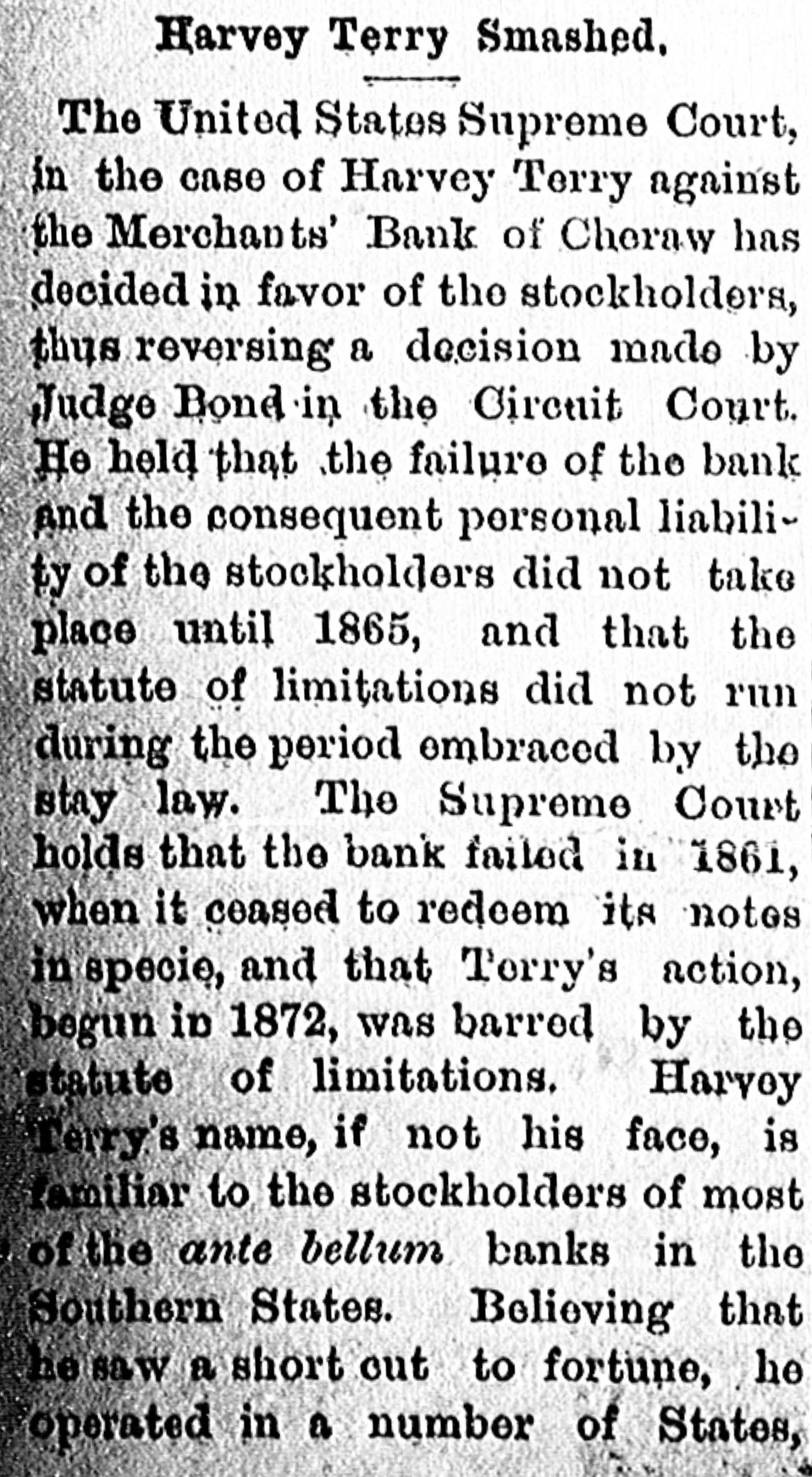
Harvey Terry Smashed. The United States Supreme Court, in the case of Harvey Terry against the Merchants' Bank of Cheraw has decided in favor of the stockholders, thus reversing a decision made by Judge Bond in the Circuit Court. He held that the failure of the bank and the consequent personal liability of the stockholders did not take place until 1865, and that the statute of limitations did not run during the period embraced by the stay law. The Supreme Court holds that the bank failed in 1861, when it ceased to redeem its notes in speciฤ™, and that Terry's action, begun in 1872, was barred by the statute of limitations. Harvey Terry's name, if not his face, is familiar to the stockholders of most of the ante bellum banks in the Southern States. Believing that hesaw a short out to fortune, he operated in a number of States,


Article from The Camden Journal, April 2, 1878

Click image to open full size in new tab

Article Text

The Supreme Court of the United States decided last Monday, the case of Wm. Godfrey, Receiver, et. al., Stockholders of the Merchant's Bank of South Carolina at Cheraw, appellants. vs. Harvey Terry. This case involved the liability of the stockholders of a suspended State bank for the outstanding bills of the bank. The Circuit Court of the United States decided in favor of Terry, and against the stockholders. The Supreme Court, has dismissed the bill of the plaintiff, and has placed its decision upon grounds that cover a host of similar cases, and will carry relief to many an anxious household. The Supreme Court hol is that the failure of the bank in question OCcurred at the time of the suspension of specie payments in 1860, and the claims of the billholders are barred by the Statute of Limitations. This is the end of multitudinous suits. It protects the stockholders in all Southern banks which suspended specie payments before the war, and where such stockholders are sued upon the clause in the charters which imposed upon the stockholders a liability (beyond that of corporation) for the bills of the bank, in case of the failure of the bank.