Click image to open full size in new tab
Article Text
Chilton Bank Fails
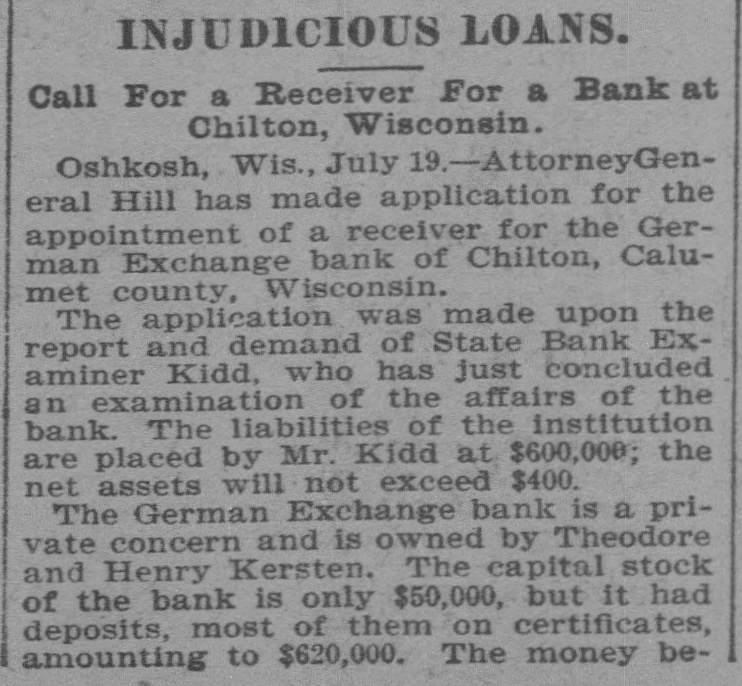
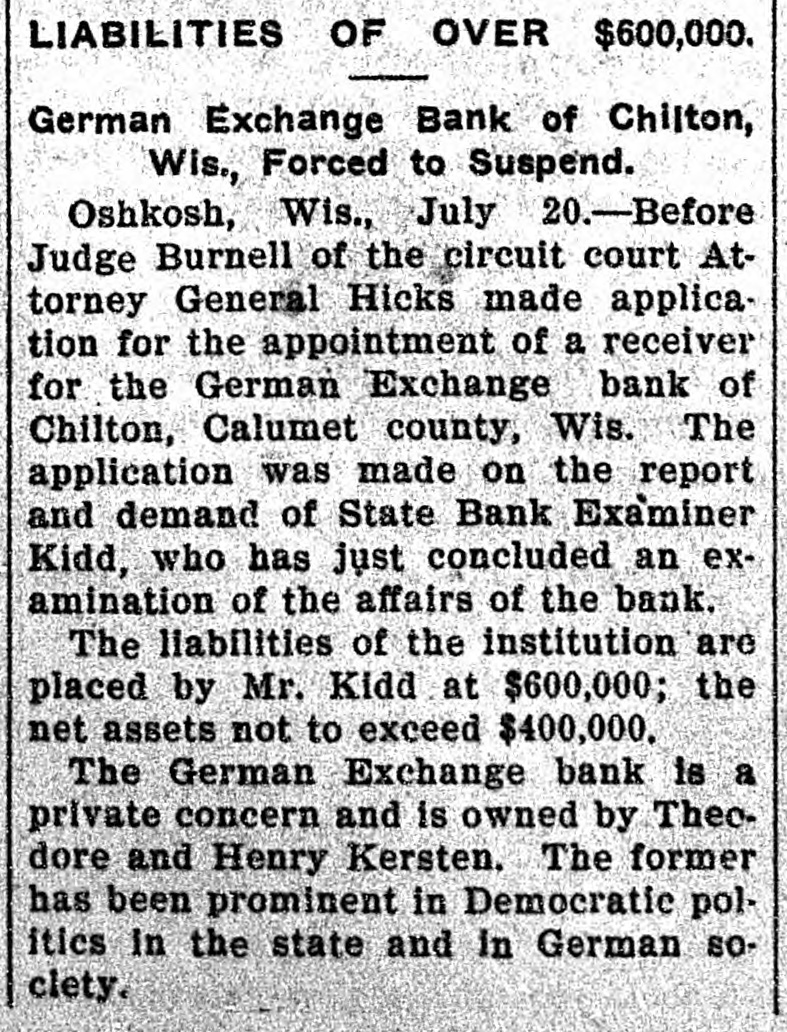
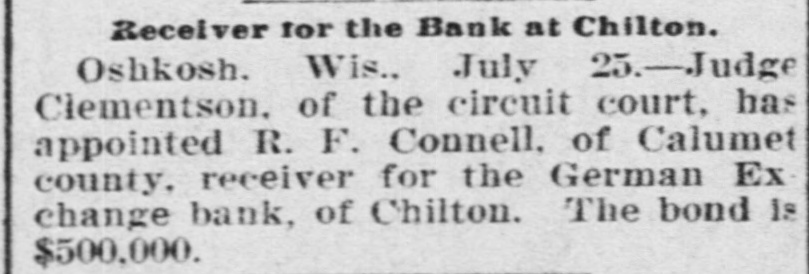
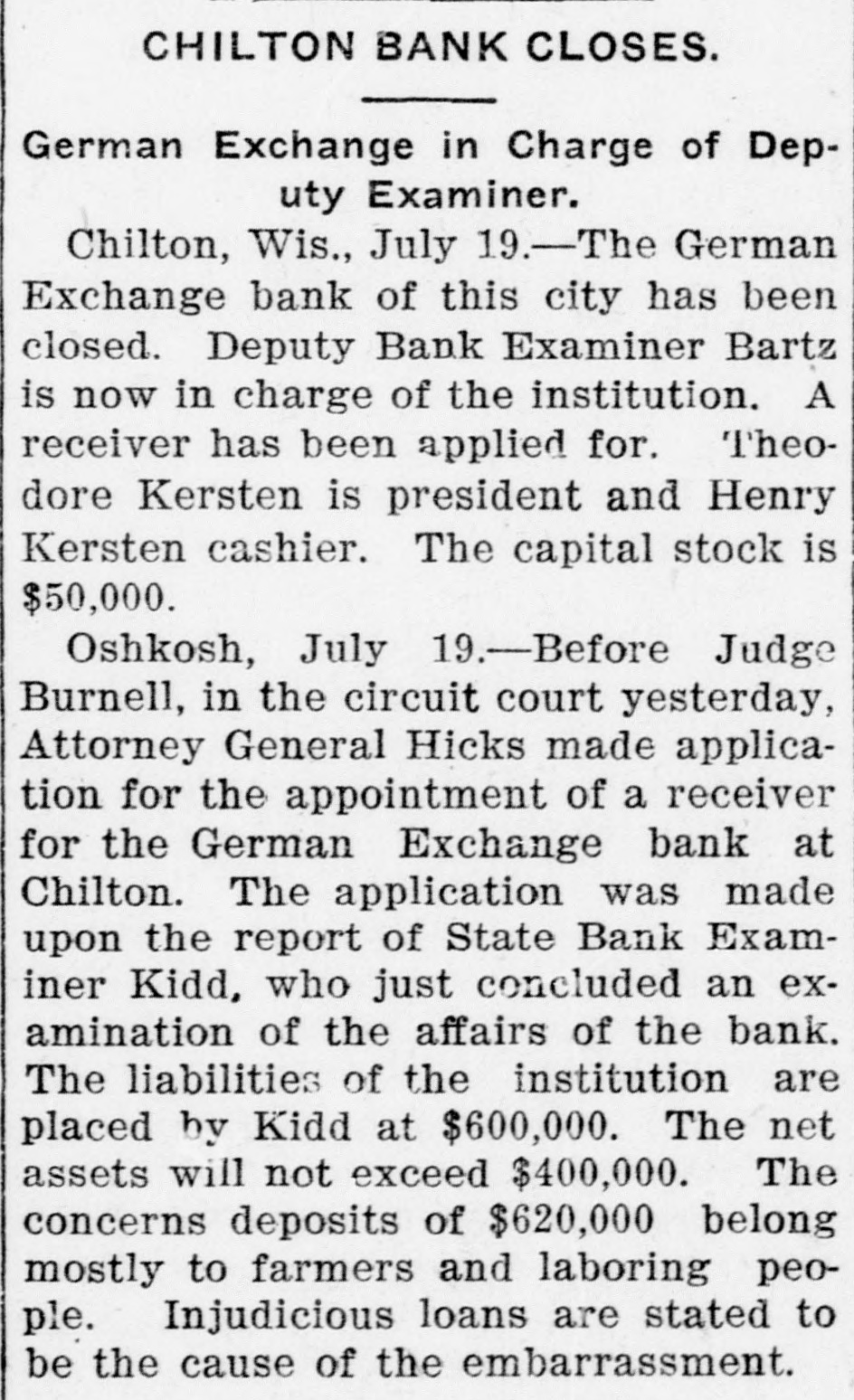
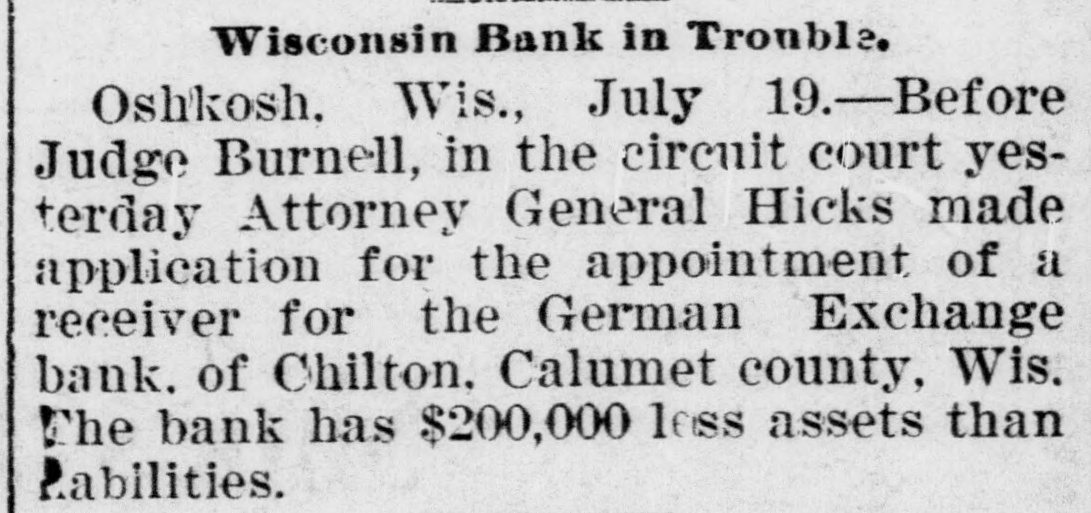
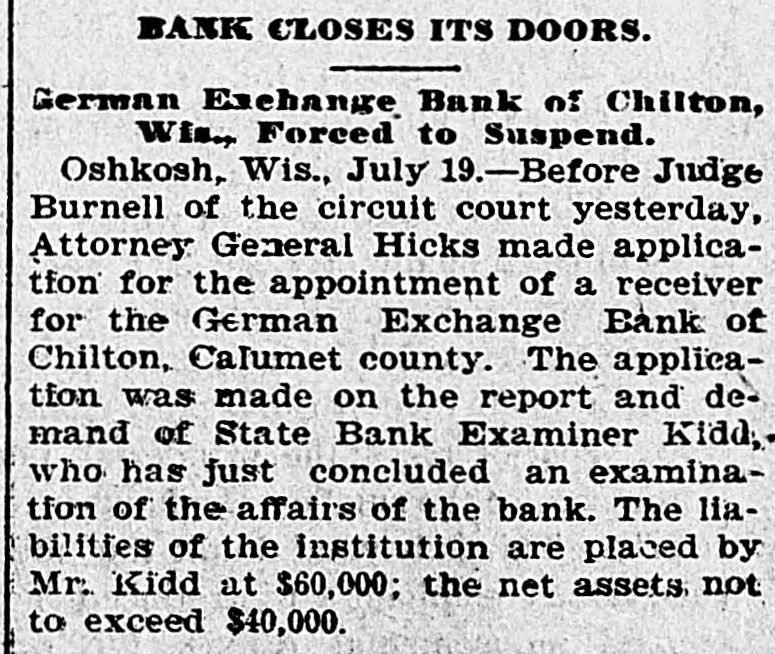
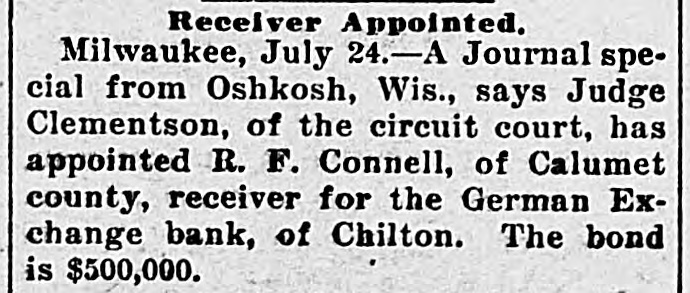
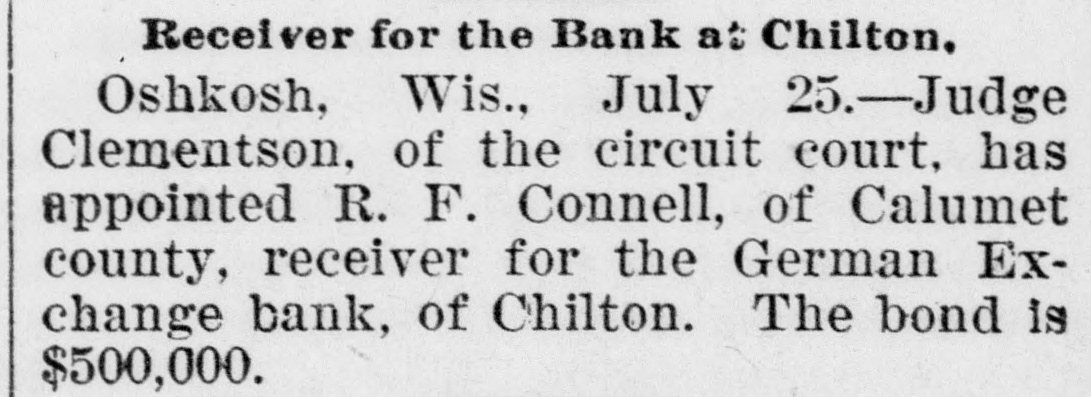
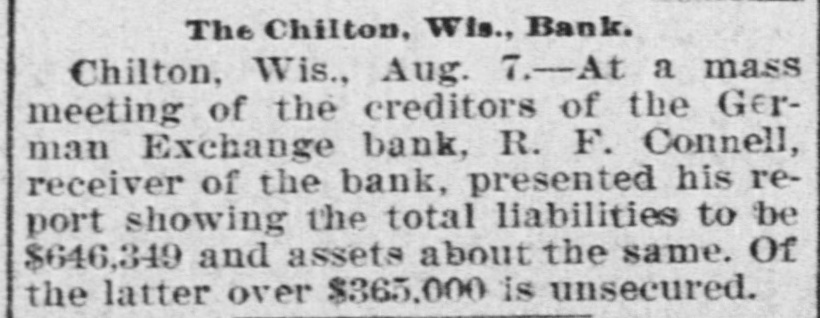
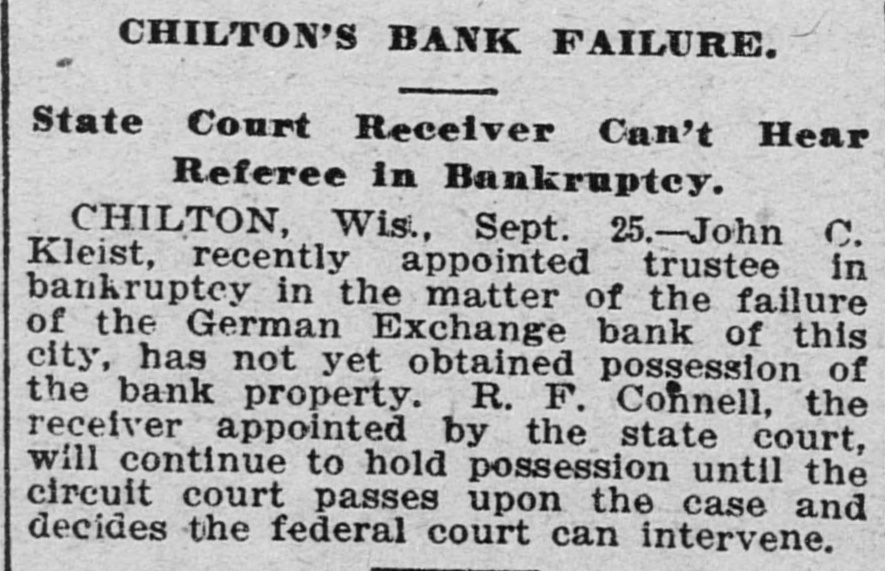
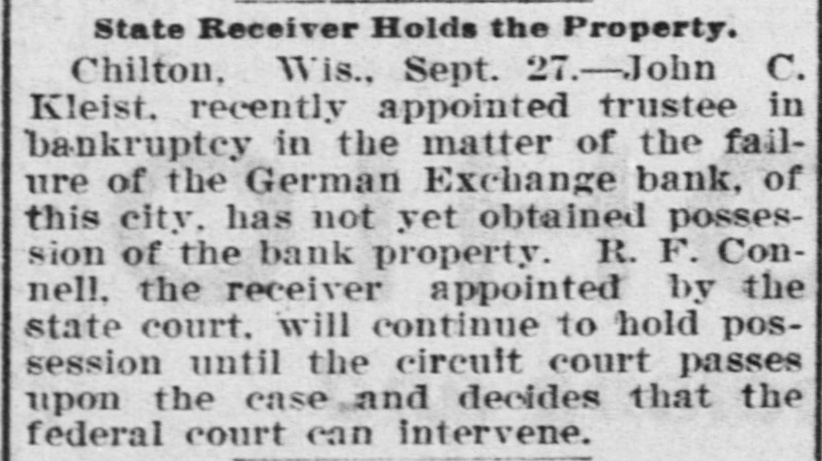
Chilton, Wis., July 18.-The German Exchange bank of Chilton, of which Theodore Kersten, well known in Democratic politics and conspicuous as one of the leading gold Democrats of this part of the state is president, was closed today by order of State Bank Examiner E. I. Kidd, of Madison, who has been making an examination of the condition of the institution since the latter part of May and who arrived here last evening to attend to winding up the affairs of the bank. The liabilities are given by Mr. Kidd as about $600,000. The net assets aggregate $350,000 to $400,000. and will not exceed 70 per cent of the liabilities. The cash on hand at the present time is $145,000, while a week ago it was up to $175,000. The bank was a private copartnership enterprise, organized by Kersten Brothers in 1875, with a capital stock of $50,000. The president is Theodore Kersten and the cashier Henry Kersten, both men of high standing in the community. The assets of the bank are derived most entirely from local deposits of farmers in the surrounding country. The bulk of the deposits, about $570,000, is in time certificates, the balance, some $46,000, being subject to call of depositors. The bank has loaned a great part of this money to H. Zeck & Co., operators of a large sawmill and manufacturing plant at Crevitz, Wis., in the upper part of Marinette county. Zeck & Co., owned 15,000 or 20,000 acres of land, which was devoted to a Polish colonization venture. The loans to Zeck & Co., aggregate $360,000, only part of which is considered protected by good security. When State Bank Examiner Kidd made his finding at the close of banking hours Wednesday he immediately notified Attorney General E. R. Hicks of the insolvency of the institution. Thereupon the attorney general made application to Judge G. W. Burnell, of Oshkosh, of the Third judicial circuit district, in which Calumet is located, for a receiver. The arguments for the application will be heard Saturday at 2 p. m. at Oshkosh. An Oshkosh man, it is said, is likely to be recommended for the receivership. Until last winter the statutes of the state simply authorized the state bank examiner to examine banks and if they were found shaky to notify the bank officials to remedy matters. If they failed to heed his warning within thirty days all he could do was to publish in the newspapers the conditions he found. He could not close the bank. If a bank could get ready money to allay the suspicions of depositors when they applied for their holdings the banker was enabled to keep the institution going right in the face of the state examiner's report, even though the bank was in an insolvent condition. Last winter, however, the legis-