Chippewa Bank (St Louis, MO)

Episode Information

Episode UID
3430876991488
Episode Type
Suspension → Closure
Bank Type
state
Bank ID
343087699 hash
Start Date
December 21, 1923
Location
St Louis, Missouri (38.627, -90.198)

Metadata

Model
gpt-5-mini (chosen from majority vote of a three-model LLM ensemble)
Short Digest
40f93cba2b17d5be

Response Measures

None

Description

State finance commissioner took charge and suspended operations after cashier admitted large irregularities; bank did not reopen.

Events (1)

1. December 21, 1923 Suspension
Cause
Government Action
Cause Details
State finance commissioner ordered suspension after discovery of large irregularities/shortages by cashier Joseph S. Carr (admitted $34,000; further discrepancies alleged up to ~$200,000).
Newspaper Excerpt
The Chippewa Bank ... failed to open its doors this morning, and it was announced that the cashier, Joseph S. Carr, had admitted and paid irregularities amounting to $34,000.
Source
newspapers

Newspaper Articles (12)

Article from The St. Louis Star and Times, December 21, 1923

Click image to open full size in new tab

Article Text

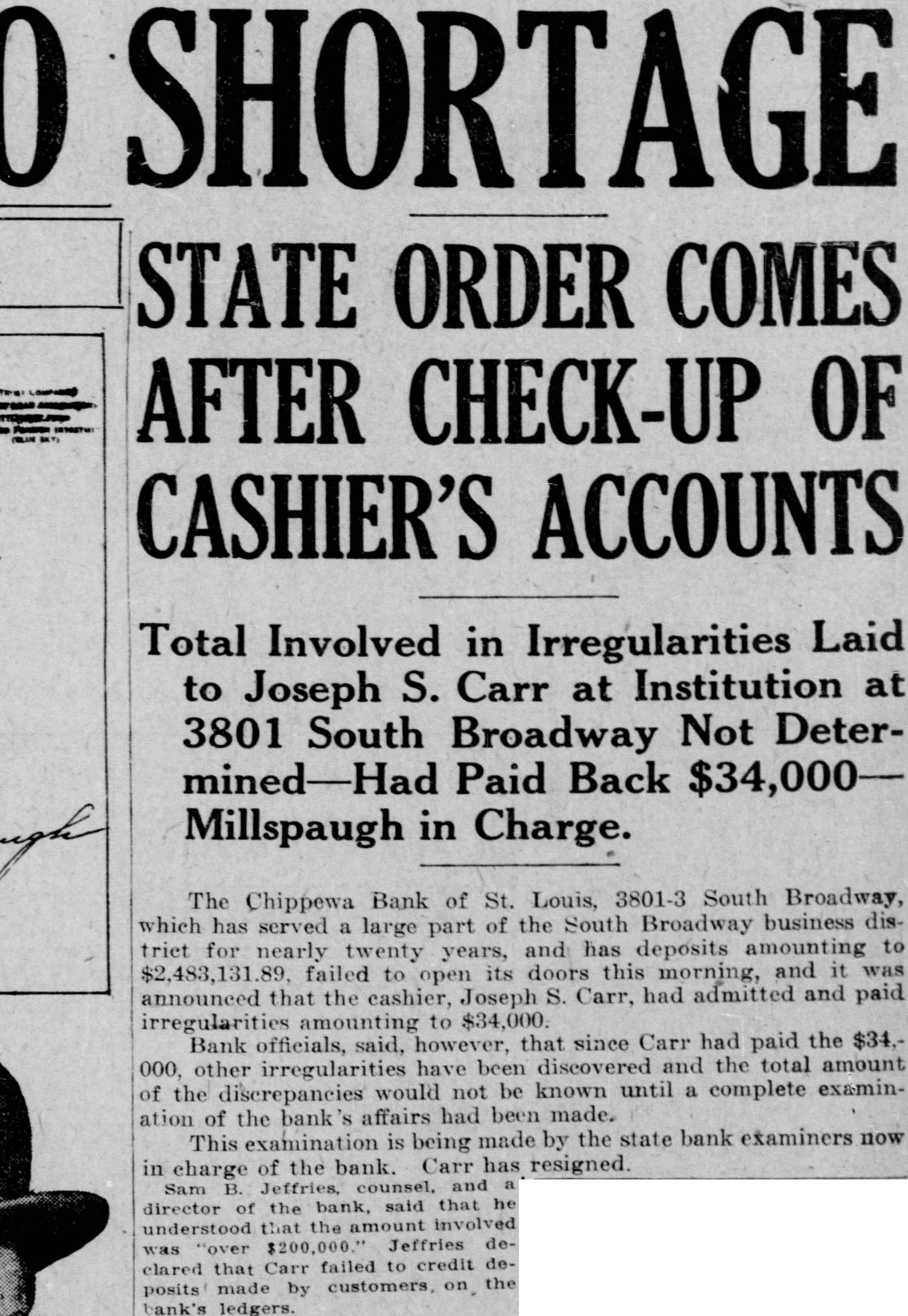
STATE ORDER COMES AFTER CHECK-UP OF CASHIER'S ACCOUNTS Total Involved in Irregularities Laid to Joseph S. Carr at Institution at 3801 South Broadway Not Determined—Had Paid Back $34,000—Millspaugh in Charge. The Chippewa Bank of St. Louis, 3801-3 South Broadway, which has served a large part of the South Broadway business district for nearly twenty years, and has deposits amounting to $2,483,131.89, failed to open its doors this morning, and it was announced that the cashier, Joseph S. Carr, had admitted and paid irregularities amounting to $34,000. Bank officials, said, however, that since Carr had paid the $34,000, other irregularities have been discovered and the total amount of the discrepancies would not be known until a complete examination of the bank's affairs had been made. This examination is being made by the state bank examiners now in charge of the bank. Carr has resigned. Sam B. Jeffries, counsel, and a director of the bank, said that he understood that the amount involved was "over $200,000." Jeffries declared that Carr failed to credit deposits made by customers, on the bank's ledgers.


Article from The St. Louis Star and Times, December 21, 1923

Click image to open full size in new tab

Article Text

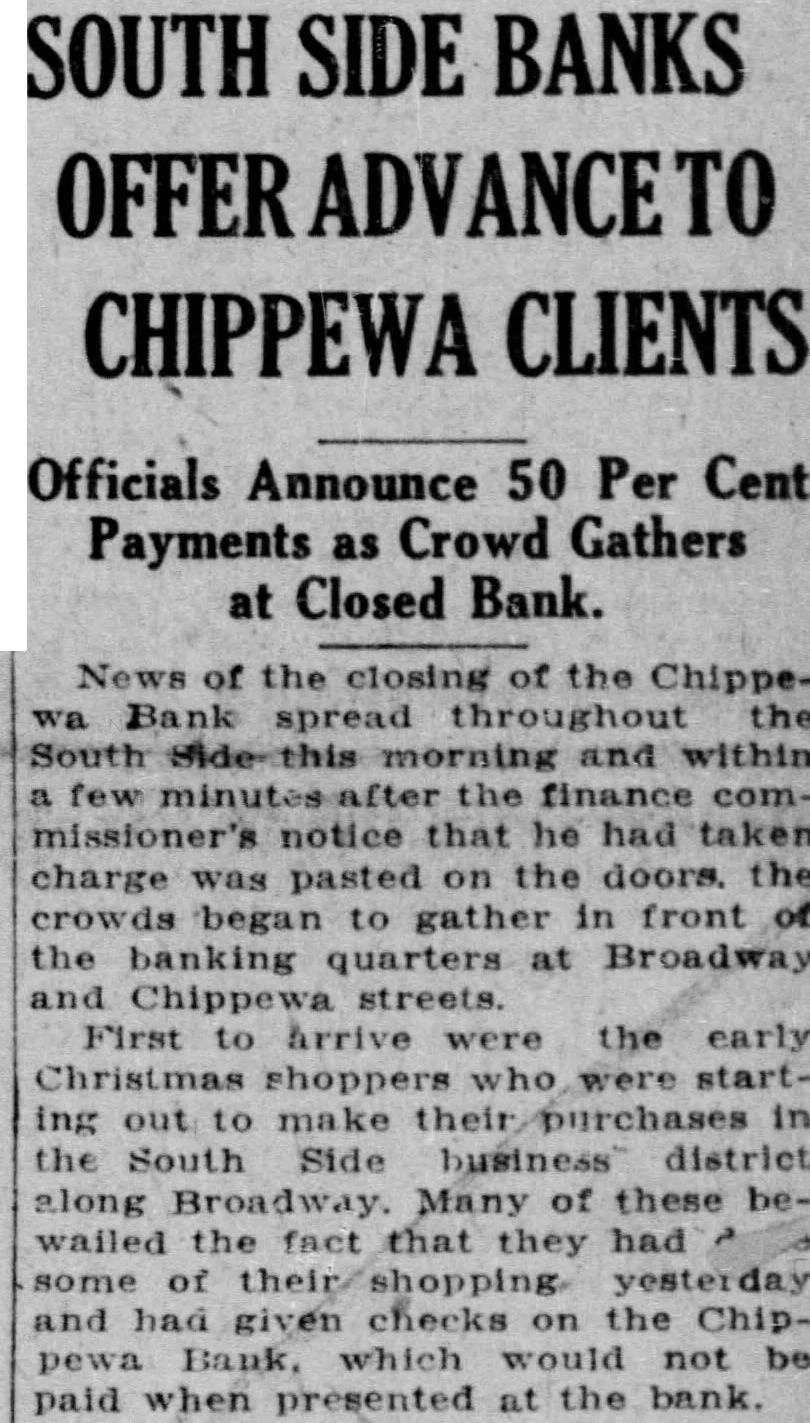
SOUTH SIDE BANKS OFFER ADVANCE TO CHIPPEWA CLIENTS Officials Announce 50 Per Cent Payments as Crowd Gathers at Closed Bank. News of the closing of the Chippewa Bank spread throughout the South Side this morning and within a few minutes after the finance commissioner's notice that he had taken charge was pasted on the doors, the crowds began to gather in front of the banking quarters at Broadway and Chippewa streets. First to arrive were the early Christmas shoppers who were starting out to make their purchases in the South Side business district along Broadway. Many of these bewailed the fact that they had done some of their shopping yesterday and had given checks on the Chippewa Bank, which would not be paid when presented at the bank.


Article from The St. Louis Star and Times, December 22, 1923

Click image to open full size in new tab

Article Text

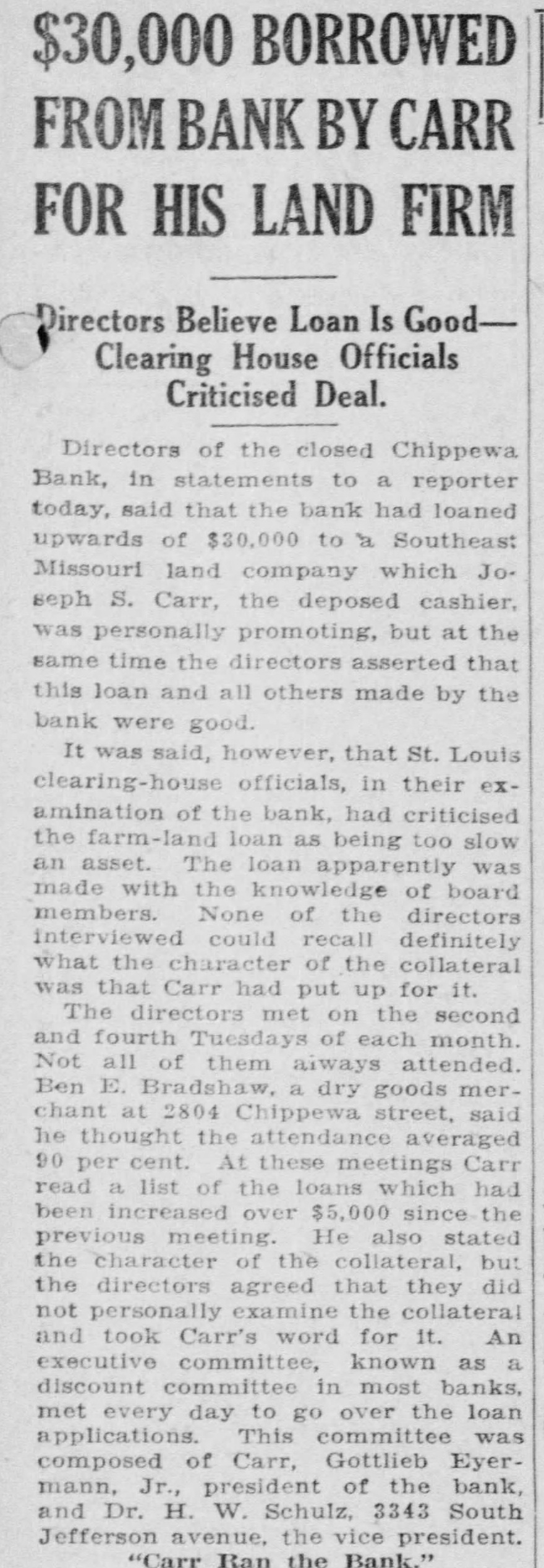
$30,000 BORROWED FROM BANK BY CARR FOR HIS LAND FIRM Directors Believe Loan Is Good—Clearing House Officials Criticised Deal. Directors of the closed Chippewa Bank, in statements to a reporter today, said that the bank had loaned upwards of $30,000 to a Southeast Missouri land company which Joseph S. Carr, the deposed cashier, was personally promoting, but at the same time the directors asserted that this loan and all others made by the bank were good. It was said, however, that St. Louis clearing-house officials, in their examination of the bank, had criticised the farm-land loan as being too slow an asset. The loan apparently was made with the knowledge of board members. None of the directors interviewed could recall definitely what the character of the collateral was that Carr had put up for it. The directors met on the second and fourth Tuesdays of each month. Not all of them always attended. Ben E. Bradshaw, a dry goods merchant at 2804 Chippewa street, said he thought the attendance averaged 90 per cent. At these meetings Carr read a list of the loans which had been increased over $5,000 since the previous meeting. He also stated the character of the collateral, but the directors agreed that they did not personally examine the collateral and took Carr's word for it. An executive committee, known as a discount committee in most banks, met every day to go over the loan applications. This committee was composed of Carr, Gottlieb Eyermann, Jr., president of the bank, and Dr. H. W. Schulz, 3343 South Jefferson avenue, the vice president. "Carr Ran the Bank."


Article from The St. Louis Star and Times, December 22, 1923

Click image to open full size in new tab

Article Text

BANK WAS ONE-MAN INSTITUTION, AVERS CASHIER J. S. CARR 'I Was the Man,' He Says in Taking Blame for the Shortage. Continued from Page One. are all high-grade stocks and include stocks in five Missouri banks. Another item was gilt-edge promissory notes worth $207,000. This totals approximately a million dollars and the quick sale, net value is easily between $700,000 and $800,000. In addition to these items, I gave the commissioner a lot of doubtful paper, upon which we placed no value, but upon which some cash can be realized." Carr asserted that upon one occasion he had taken 125,000 in questionable paper from the bank—paper upon which he had made loans—and replaced the paper with high class securities from his own private fortune. He also said that on another occasion he took a $25,000 note out of the bank, given him by a company which later failed, and replaced the note with cash from his own account. Charles N. Gilles, chief examiner in charge of the bank, said today that only the last day's business had been checked and that the examiners had not yet examined any of the more than 8,000 individual savings and checking accounts. "Our examination was delayed so much yesterday by the necessity of testifying at the Donald W. Ross trial that we have only been able to balance the books up to the time the bank was closed," Gilles said. "The books balance all right and the cash agrees with the figures shown on the books. "We can say nothing about any discrepancies until we have had a chance to trace the individual depositors' accounts. That will take several days. Deposit Boxes Closed. "The first thing we want to do is to get the cash off our hands and out of the bank. We probably will be able to start on our hunt for discrepancies later in the day. "I don't know where Sam B. Jeffries gets his information given out in his statement that there is a shortage of more than $200,000. No such information has been given to the examiners." From the statement of Gilles, that the cash in the bank checks with the amount entered on the bank's books, it is evident that the irregularities are due to the fact that deposits made by customers have not been credited to them. This was the case in the discrepancy of $4,600 in the account of Richard H. Levy, the discovery of which by a Clearing House examiner led to examination of the bank's books. Renters of safe deposit boxes were not permitted to open their boxes today. They probably will be allowed to do so in a few days. Fought Branch Banks. Carr had many other interests, both business and social, beyond his work at the Chippewa Bank. One of the chief of these was his work as president of the Chippewa-Broadway Business Association. As head of the bankers' organization Carr was active in their fight against the establishment of branch banks by the large institutions, and on one occasion about two months ago he appeared before a congressional committee here to ask why more smaller banks were not admitted to the federal reserve system. Beyond these activities Carr also had a number of other business interests, as is evidenced by the list of his assets. One of these was the Bryte-Nelson Refining Company, which has offices in the Arcade Building, and a plant on North and South road at the River des Peres. Refining Firm Stock.


Article from The Day, December 22, 1923

Click image to open full size in new tab

Article Text

CHRISTMAS PAROLES FOR KANSAS FELONS LANSING, Kans., Dec. 22—Twenty-five convicts, serving terms at the Kansas penitentiary here, are at liberty today on 15 day Christmas paroles granted by Gov. Jonathan M. Davis. They are on honor to return at the expiration of that period. William La Trasse, train robber, whose escapades have kept him confined in penitentiaries of the middle west most of the time since 1911, is one of those released. "No one will ever find me against the law again," declared La Trasse when he stepped through the prison gate last night, "I'll never again do anything that will lead me toward the place I just left." CASHIER OFFERS ASSETS OF FIVE TIMES SHORTAGE ST. LOUIS, Dec. 22—Joseph S. Carr, whose alleged irregularities as cashier of the Chippewa bank of this city are estimated to amount to more than $200,000, causing the closing of the bank, has pledged assets valued by him at more than $1,000,000 to protect depositors. Thomas R. Harlan, attorney for Carr, says no shortage exists. "There may have been some irregularities which attracted the attention of the bank examiners and resulted in the order for the closing down of business but so far as I know there has been no wilful manipulation of funds by Carr to the detriment of the bank." THIN ICE ON POND BRINGS DEATH TO TWO WOODSMEN JACKMAN, Me., Dec. 22.—Two woodsmen, whose names have not been learned, were drowned last night when they attempted to cross Long pond on the ice. Their cries for help attracted attention of a train crew on a siding at Long Pond, but before help could reach them, the men had disappeared under the ice.


Article from Evansville Press, December 24, 1923

Click image to open full size in new tab

Article Text

CASHIER TO PAY LOSS AT BANK Pledges Million to Protect Depositors United Press Leased Wire ST. LOUIS, Dec. 24.—Joseph S. Carr, cashier of the Chippewa bank, closed when discrepancies were announced by bank officials, has completed pledging $1,000,000 in stocks, bonds and real estate, to protect depositors of the bank. Irregularities in the accounts will disclose a shortage of $200,000, officials of the bank said. The first shortage of $34,000 has already been repaid by Carr, bank officials announced. Carr's attorney today said "Carr admits no irregularities." "He ran the bank his own way, and is prepared to explain his actions whenever the authorities request him to appear." tence will be imposed Jan. 12 on three officials of the Gearless Motor corporation who were found guilty by a jury in federal court here on charges of conspiracy to use the mails to defraud. Thousands of dollars worth of worthless stock was said to have been sold by the men in western Pennsylvania, West Virginia and Ohio. Vin Hepatica, "Nature's own prescription" sold by H. A. Woods Drug Co.


Article from Waterloo Republican, December 26, 1923

Click image to open full size in new tab

Article Text

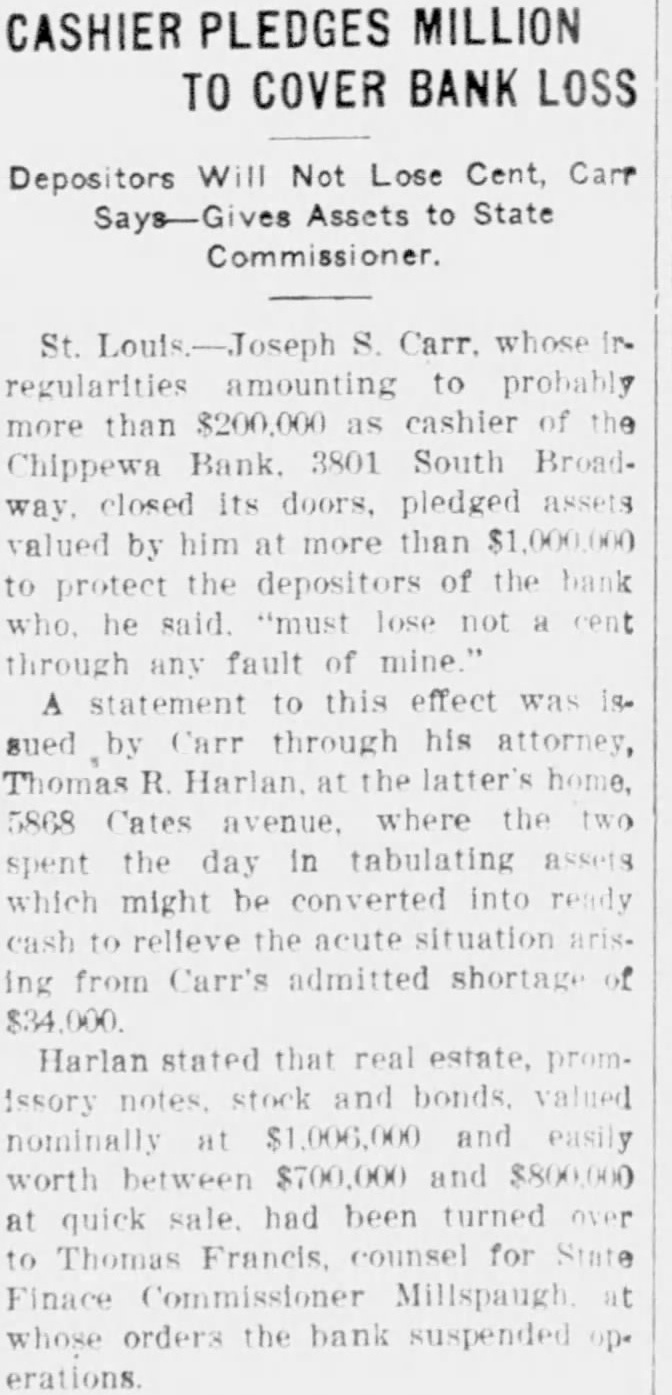
CASHIER PLEDGES MILLION TO COVER BANK LOSS Depositors Will Not Lose Cent, Carr Says—Gives Assets to State Commissioner. St. Louis.—Joseph S. Carr, whose irregularities amounting to probably more than $200,000 as cashier of the Chippewa Bank, 3801 South Broadway, closed its doors, pledged assets valued by him at more than $1,000,000 to protect the depositors of the bank who, he said, "must lose not a cent through any fault of mine." A statement to this effect was issued by Carr through his attorney, Thomas R. Harlan, at the latter's home, 5868 Cates avenue, where the two spent the day in tabulating assets which might be converted into ready cash to relieve the acute situation arising from Carr's admitted shortage of $34,000. Harlan stated that real estate, promissory notes, stock and bonds, valued nominally at $1,006,000 and easily worth between $700,000 and $800,000 at quick sale, had been turned over to Thomas Francis, counsel for State Finance Commissioner Millspaugh, at whose orders the bank suspended operations.


Article from Greenville Sun, December 27, 1923

Click image to open full size in new tab

Article Text

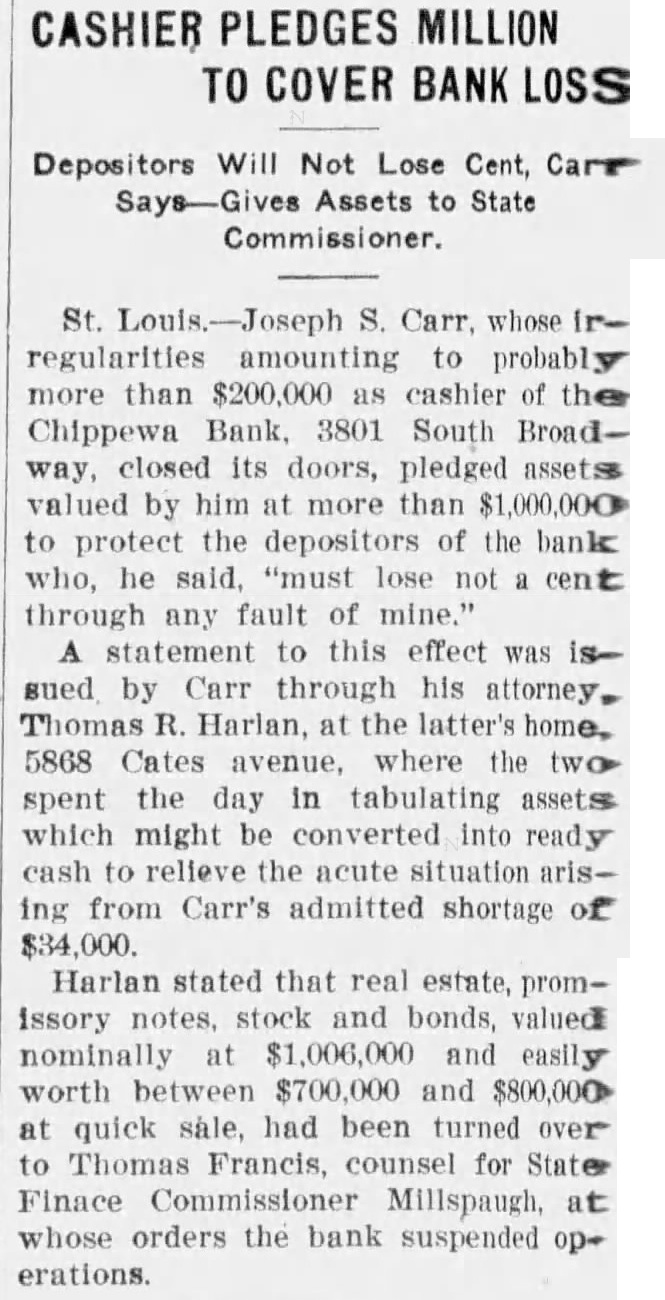
CASHIER PLEDGES MILLION TO COVER BANK LOSS Depositors Will Not Lose Cent, Carr Says—Gives Assets to State Commissioner. St. Louis.—Joseph S. Carr, whose irregularities amounting to probably more than $200,000 as cashier of the Chippewa Bank, 3801 South Broadway, closed its doors, pledged assets valued by him at more than $1,000,000 to protect the depositors of the bank who, he said, "must lose not a cent through any fault of mine." A statement to this effect was issued by Carr through his attorney, Thomas R. Harlan, at the latter's home, 5868 Cates avenue, where the two spent the day in tabulating assets which might be converted into ready cash to relieve the acute situation arising from Carr's admitted shortage of $34,000. Harlan stated that real estate, promissory notes, stock and bonds, valued nominally at $1,006,000 and easily worth between $700,000 and $800,000 at quick sale, had been turned over to Thomas Francis, counsel for State Finance Commissioner Millspaugh, at whose orders the bank suspended operations.


Article from Tri-County News, December 27, 1923

Click image to open full size in new tab

Article Text

MISSOURI News Nuggets LATE STATE EVENTS CONDENSED FOR THE BUSY READER Officers of the Missouri state penitentiary in Jefferson City believe that a desperate plot to escape, formulated by several of the most notorious characters of the prison, has been frustrated by the discovery of a loaded .38-caliber automatic pistol beneath the floor in the cell of Arthur "Fighting" Davis, convict sent to the prison from Kansas City in April, 1921, to serve thirty-five years for burglary and attempted assault with intent to kill. Davis refuses to talk, according to the authorities, and has been placed in solitary confinement. It is known, however, according to the officers, that the gun is one that disappeared from the governor's mansion last August. It is believed by them to have been stolen by a negro trusty who worked at the mansion, whose prison term has expired, and who has been released. Creditors of the Forked Leaf White Oak Lumber Company, Eminence, may lose approximately $500,000 as a result of action taken by James W. Byrne, present receiver for the Shannon County corporation, in refusing to include many of the assets claimed by the officers. Assets of the company listed at $5,476,716.81, in a report filed several days ago by a receiver, who has since been removed, are placed at $220,572.37 in a report just presented. The $5,476,716.81 total is found in the last report of Edwin R. Butler, promoter of the company, before he was removed as receiver about two months ago. The $220,572.37 valuation is made in a report filed by Byrne. Calculation of the values of land and lumber owned by the company is the point on which the receivers differed greatly in listing assets. Enumeration, enrollment and average attendance for all high and grade schools of Missouri in 1923 show a decided increase over 1922, according to a report issued in Jefferson City by Charles A. Lee, state superintendent of schools. The report, in part, is as follows: "For the first-class high schools, the enumeration in 1922 was 507,401; in 1923 it was 511,104. The enrollment the previous year was 397,265 and in 1923 it was 405,451. The average daily attendance in 1922 was 324,327 and the past year it was 336,860." Lee's report gives the total assessment valuation of high school districts in Missouri as $2,324,032,321. The total cost of the high school system is $34,470,971, and the balance on hand June 30, 1923, was $14,215,160. The University of Missouri, Columbia, poultry judging team won first place in the Midwest poultry judging contest which was held in Chicago, according to word received in Columbia by the poultry department of the university. The winning team was made up of the following men: Chas. G. Fox, Columbia; H. L. Allen, Oregon, Mo.; Robert Smith, Memphis, Mo., and Frank Wright of Fayette. Fox was third man in the contest, Allen was fourth and Smith placed tenth. This is the second year Missouri placed first in the contest, the 1920 team having won the honor first. Gov. Hyde in Jefferson City issued a requisition on the governor of Kansas for the return to Kansas City of Robert R. Meyers and Rhea Gould, who are charged in Kansas City with having held up and robbed Victor Schutte of two diamonds valued at $3,500. The robbery occurred January 9, 1923. The requisition papers state that immediately following the robbery the pair left Kansas City and went to Paola, Kan., where they were subsequently married and where both are under arrest. The Chippewa Bank of St. Louis, 3801-3 South Broadway, which has served a large part of the South Broadway business district, and has deposits amounting to $2,483,131.89, failed to open its doors, and it was announced that the cashier, Joseph S. Carr, had admitted and paid irregularities amounting to $34,000. Bank officials said, however, that since Carr had paid the $34,000, other irregularities have been discovered and the total amount of the discrepancies would not be known until a complete examination of the bank's affairs had been made. The concentrate mill at Iron Mountain has been overhauled, modern machinery replacing inadequate machinery, according to word from Bismarck. The work has been done without a shutdown or reducing the daily output of the mill. This rebuilt plant has a capacity of 500 tons of iron concentrates daily. The California Debating Club of California defeated Blackwater in the state debating contest. California was represented by Myrl Kay and Mary Kiely. In Springfield a committee composed of Congressman Roscoe Patterson, J. E. Cahill, a member of the constitutional convention, and Perry H. Smith, Deputy United States Marshall, was named at a meeting of local Republicans to secure the annual Lincoln Day banquet for Springfield. Peyton D. Fitch, former mayor of Warrensburg, died, aged 69. He was born in Fleming County, Ky. He came to Missouri with his parents in 1866. His early manhood was spent in operating coal mines and a store at Montserrat, Mo.
Article from Tri-County News, December 27, 1923

Click image to open full size in new tab

Article Text

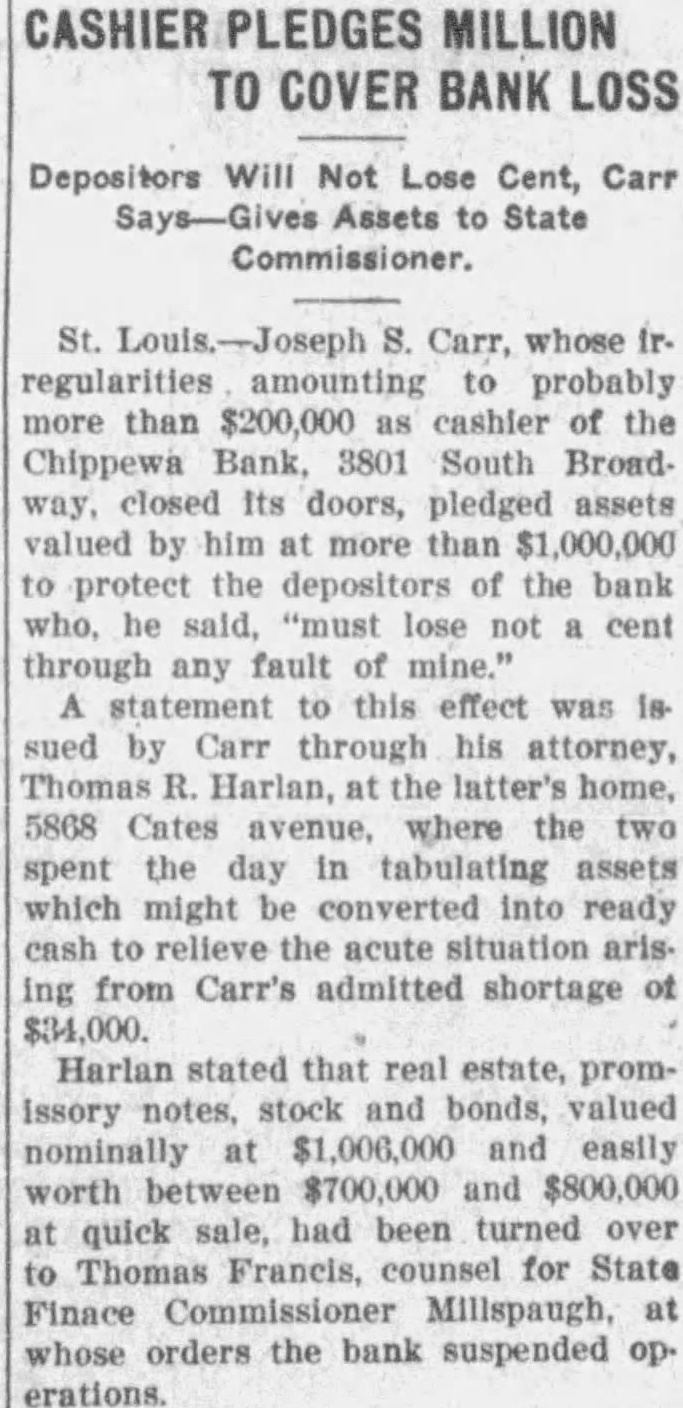
CASHIER PLEDGES MILLION TO COVER BANK LOSS Depositors Will Not Lose Cent, Carr Says—Gives Assets to State Commissioner. St. Louis.—Joseph S. Carr, whose irregularities amounting to probably more than $200,000 as cashier of the Chippewa Bank, 3801 South Broadway, closed its doors, pledged assets valued by him at more than $1,000,000 to protect the depositors of the bank who, he said, "must lose not a cent through any fault of mine." A statement to this effect was issued by Carr through his attorney, Thomas R. Harlan, at the latter's home, 5868 Cates avenue, where the two spent the day in tabulating assets which might be converted into ready cash to relieve the acute situation arising from Carr's admitted shortage of $34,000. Harlan stated that real estate, promissory notes, stock and bonds, valued nominally at $1,006,000 and easily worth between $700,000 and $800,000 at quick sale, had been turned over to Thomas Francis, counsel for State Finance Commissioner Millspaugh, at whose orders the bank suspended operations.


Article from Jefferson County Record, January 3, 1924

Click image to open full size in new tab

Article Text

CASHIER PLEDGES MILLION TO COVER BANK LOSS Depositors Will Not Lose Cent, Carr Says—Gives Assets to State Commissioner. St. Louis.—Joseph S. Carr, whose irregularities, amounting to probably more than $200,000 as cashier of the Chippewa Bank, 3801 South Broadway, closed its doors, pledged assets valued by him at more than $1,000,000 to protect the depositors of the bank who, he said, "must lose not a cent through any fault of mine." A statement to this effect was issued by Carr through his attorney, Thomas R. Harlan, at the latter's home, 5868 Cates avenue, where the two spent the day in tabulating assets which might be converted into ready cash to relieve the acute situation arising from Carr's admitted shortage of $34,000. Harlan stated that real estate, promissory notes, stock and bonds, valued nominally at $1,006,000 and easily worth between $700,000 and $800,000 at quick sale, had been turned over to Thomas Francis, counsel for State Finance Commissioner Millspaugh, at whose orders the bank suspended operations.


Article from St. Louis Post-Dispatch, January 1, 1928

Click image to open full size in new tab

Article Text

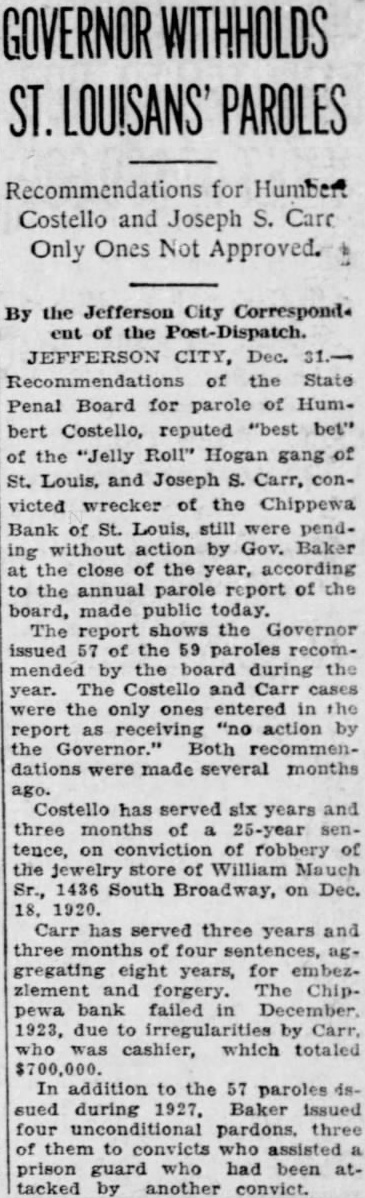
PAROLES Recommendations for Humbert Costello and Joseph Care Only Ones Not By the Jefferson City ent the JEFFERSON CITY, Dec. Recommendations of the State Penal Board for parole of Humbert Costello, reputed "best bet" of the "Jelly Roll" Hogan gang of St. Louis, and Joseph Carr, convicted wrecker of the Chippewa Bank of St. Louis, still were pendwithout action by Gov. Baker ing at the close of the year, according the annual parole report of the board, made public today. The report shows the Governor issued of the 59 paroles recommended by the board during the year. The Costello and Carr cases were the only ones entered in the report as receiving "no action by the Governor." Both recommendations were made several months ago. Costello has served six years and three of 25-year sentence, on conviction of robbery of the jewelry store William Mauch 1436 South Broadway, on Dec. 18, 1920. Carr has served three years and three months of four sentences, ag. gregating eight years, for embezzlement and forgery. The Chippewa bank failed December, 1923, due irregularities by Carr, who cashier, which totaled $700,000. In addition to the 57 paroles sued during Baker issued four pardons. three of them to convicts who prison guard who had been attacked by another convict.