Fidelity National Bank (Cincinnati, OH)

Episode Information

Episode UID
346101050
Episode Type
Run β†’ Suspension β†’ Closure
Bank Type
national
Bank ID
34610 national
Charter Number
3461
Start Date
June 21, 1887
Location
Cincinnati, Ohio (39.103, -84.515)

Metadata

Model
gpt-5-mini (chosen from majority vote of a three-model LLM ensemble)
Short Digest
027369d8ce16218e

Response Measures

Full suspension, Books examined

Clearinghouse involved: Yes (loan, examination, or other measures)

Receivership Details

Depositor recovery rate
60.0%
Date receivership started
1887-06-27
Date receivership terminated
1909-10-30
OCC cause of failure
Fraud
Share of assets assessed as good
41.9%
Share of assets assessed as doubtful
15.6%
Share of assets assessed as worthless
42.5%

Description

Run apparently precipitated by mysterious withdrawal circulars while the bank was also insolvent from wheat speculation.

Events (5)

1. February 27, 1886 Chartered
Source
historical_nic
2. June 21, 1887 Run
Cause
Rumor Or Misinformation
Cause Details
Mysterious circulars advising withdrawing funds circulated nationally and prompted depositor withdrawals, per later accounts; occurred amid underlying bad wheat speculation.
Measures
None described beyond reports that the examiner took charge and police guarded the doors.
Newspaper Excerpt
Just before the bank closed, banks all over the country received mysterious circulars advising the withdrawal of all funds from the Fidelity National. A run on the bank followed
Source
newspapers
3. June 21, 1887 Suspension
Cause
Government Action
Cause Details
National bank examiner and government representative took charge and closed the bank after overdrafts/proved impairment of resources.
Newspaper Excerpt
The Fidelity National Bank, of Cincinnati, closed its doors yesterday. A receiver will be appointed.
Source
newspapers
4. June 27, 1887 Receivership
Source
historical_nic
5. June 27, 1887 Receivership
Newspaper Excerpt
A receiver will be appointed. John R. Decamp ... has been appointed receiver to wind up the business of the bank. (receiver references in June articles; known receivership date 1887-06-27.)
Source
newspapers

Newspaper Articles (23)

Article from Richmond Dispatch, June 22, 1887

Click image to open full size in new tab

Article Text

The Fidelity National Bank, of Cincinnati, closed its doors yesterday. A receiver will be appointed. A telegram from Cleveland, Ohio, says that the steam-barge P. H. Walters vas sunk in a storm off Black river, Ohio, Mon. day night, and eight lives were lost.


Article from The Palatka Daily News, June 22, 1887

Click image to open full size in new tab

Article Text

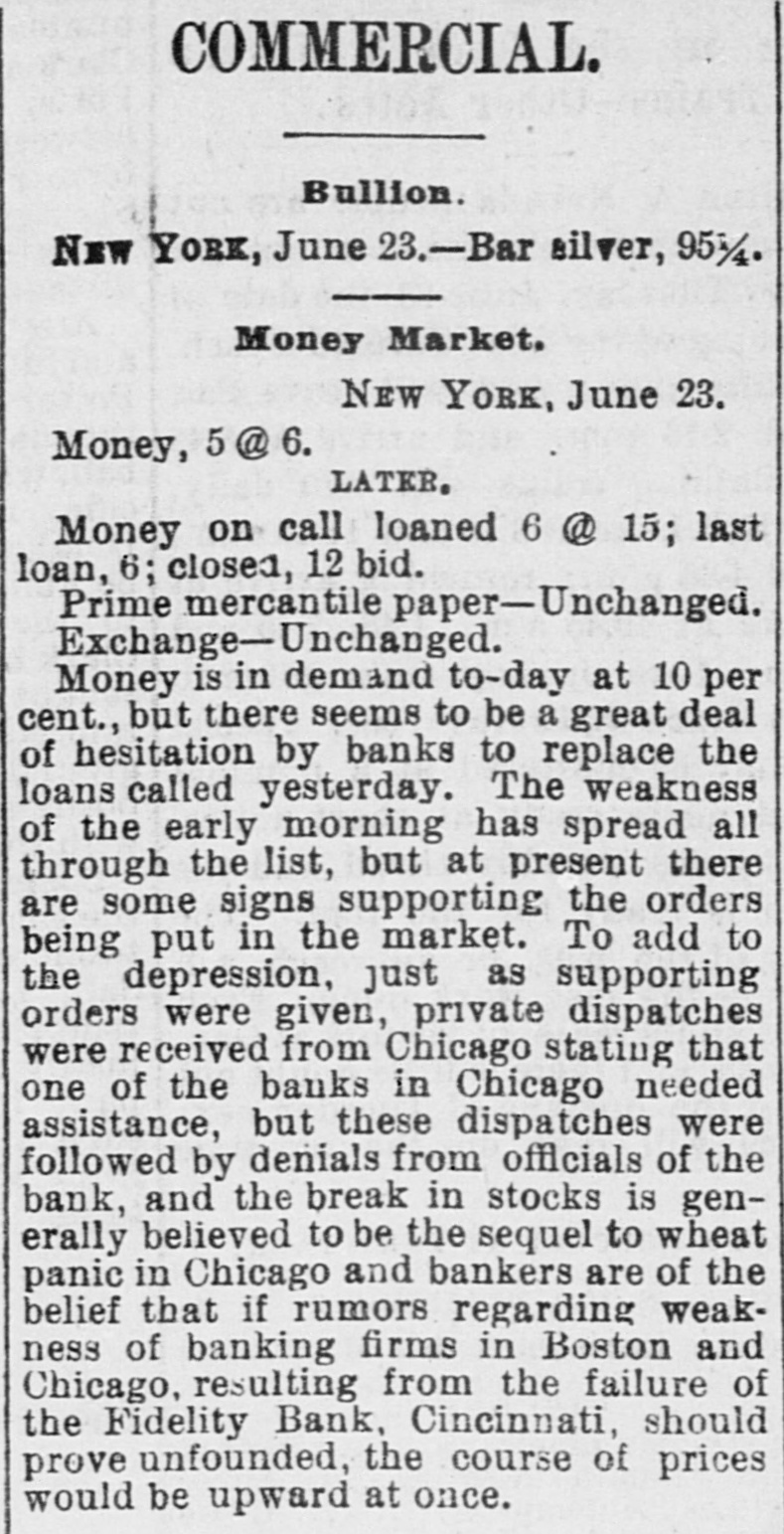
Erie Texas Pacific 396 324 East Tennessee 1314 l'enn Coal & Iron. 3814 Lake Shore Union Pacific 981/2 60% Louisville & Nash. 671/8 New Jersey Cen 804 Memphis & Char... 58 Missouri Pacific. 107 Mobile & Ohio 1396 Western nion. 7734 Cotton Seed Oil Tr.. 50 *Asked. +Bid. The renewal of panicky feeling in the Chicago market was supplemented to-day by closing the doors of the Fidelity Bank of Cincinnati. With these influences in their favor and the market lacking stimulus of moderate buy ing orders from London, usual of late, the bearish room traders hammered prices all around the room throughout almost the entire day Trading, which was dull and feverish. was more purely local than has been seen for some time. Late in the day advices were received that the Fidelity Bank would resume business shortly, and coal stocks, aided by the advance in price of coal in Philadelphia, led to a general recovery, buying of Reading being especially heavy in the last hour. Pacific Mail was special object of attack in the early morning, and did not recover the loss. Trading in the last hour was the heaviest of the day. and all the active stocks shared in the improvement, most of them being carried to the heaviest figures of the day. Specialties were unusually quiet and featureless. The opening was weak at declines from yes. terday final figures, ading to one-half per cent, and under the lead of Pacific Mail, which dropped 14 in the first fifteen minutes, further fractional declines were made in the general list. After the first half hour the market relapsed into extreme dullness, although a heavy tone continued until noon. After that time there was a change for the better in tone and speculation, although no feature was developed until the last hour, when decided strength was shown by the entire list, and Reading vanced 11/4 per cent. Total sales were 196,000 shares. Net result of the day's business is that prices are irregularly changed, although the differences are for fractional amounts only, except for Reading, which is up 11/2 per cent. Cotton. NEW YORK. June Greene & Co's report on cotton futures says "It has beena feverish market all day, and while cost on the old erop ranged to 10 points at times the advance was not maintained, and the early gain was due in great measure to manipulation on the part of the "bull" combination, through which local scalpers on the "short" side were induced to cover, but during the afternoon buy ers became scarce and there was a reactionary feeling. There was failure of a Cincinnati bank and the break here in wheat and coffee, coupled with the indifferent demand for spots, all appeared to earry more or less reflected influence. The erop was firm in the morning. but afterward eased somewhat under better weather reports. Afternoon report Cotton Net and gross reeipts, 3,035. Futuresclosed steadp; sales, 11 Jnue, 10 76@10 78 July 10 78 August, 10 83 @ 10 84; September, 10 45@10 46 October, 10 02 @10 03 November. 9 85@9 86 December, 9 84@9 85; January, 9 89@9 90 February, 9 96 @997; March, 1003@ 10 04; April 10 11@10 Cotton quiet; sales today 163 Middling Uplands, 11; Orleans 11 3-16; net receipts, 324; exports to Great Britain 669; to the Continent, 1,117; stock, 297,581. GALVESTON, June 21. Cotton nominal: middling, 10 9-16; net receipts, gross, -; sales, 67: stock, 5,739; exports coastwise, NORFOLK, June 31. Cotton quiet: middling. 11: net receipts, 3 gross receipts, 3: sales, stock, 3,048; exports coastwise, 38. BALTIMORE, June 21. Cotton firm mid dling, 11% net receipts, gross, sales, stock, 3,254; exports to Creat Britain, coastwise, BOSTON, June 21. Cotton quiet middling, 11Β½; net receipts, 86; gross receipts, 340 sales, none; stock, exports to Great Britain, WILMINGTON, June 21. Cotton firm middling, 11 net receipts, 2: gross receipts, : sales, none; stock, 1,603; exports coastwise PHILADELPHIA, June 21. Cotton quiet: middling, 11%; net receipts, gross receipts, stock, 13,875; exports to Great Britain, SAVANNAH, June 21. Cotton firm middling, 10% net receipts, 28; gross, 28 sales, : stock, 3,229; exports coastwise, NEW ORLEANS, June 21. Cotton dull middling, 10 11-16; net receipts 181; gross receipts, 181: sales, 750; stock, 89,030; exports to Great Britain, to the Continent, coastwise, none. MOBILE, June 21.- Cotton easy; middling, 1034: net receipts, 2: gross receipts, = sales, i stock, 382: exports coastwise, MEMPHIS, June 21. Cotton quiet middling, 104 net receipts, 63; gross receipts, 64; shipments, 125; stock,"8,190. AUGUSTA, June 21. Cotton quiet; middling, 10 15 16; net receipts, 10; gross receipts, sales, CHARLESTON. June 21. Cotton quiet but firm middling, 10%; net receipts, = gross receipts, 2: sales. stock, 724; exports coastwise, General Markets. CHICAGO, June 31.-An oppressively weak feeling prevailed in wheat at the opening, and traders were feeling decidedly blue July opened 3/4e lower at 69%, but some little effort was made to sustain the market, and a few minutes later July was selling at 69%c. The support was only temporary, however, and bank wheat being put on the market, July soon reacted to 69%, around which figure it held steady during the first hour of the session. At the end of that time "tailers" found they had sold themselves short, and began to cover, and July went up to 70% under this influence. Marketing bank wheat again caused July to ease back to 60% There was no let up in sales of wheat for account of banks to-day, and realizing continued straight up to the close of the session. The effect of the general selling was to break wheat from 6916 to 6834 for July, the latter figure being reacted about noon at bottom price. There were many good buying orders, and the reaction sent the price of July up to 69%, at which the morning session closed. Heavy exports from seaboard and covering by short interest made the afternoon market stronger. July sold up to 70% and closed at 20. Fluctuations in June were not very marked. It opened at 68% and 69. and closed at Corn was moderately active, with feeling somewhat unsettled. Prices were generally weak and lower. Trading was largely local and offerings were quite free, but the demand was very light. The weaker feeling which prevailed in the wheat market during the earlier hours of the session also had a depressing effect on corn. July opened at 36 and sold down to 351/4, but in ympathy with wheat during the afternoon session reactted, closing at 364 Oats were dull and weak. There was little speculative interest centered in the market; July opened 1/20 lower at 251/4, sold down to 25. and closed at the opening figure. Quite an active speculative business was transacted in the provision market, but the feeling was greatly unsettled. and prices ruled weak and lower. Offerings were quite liberal, while the demand was only fair and mainly from parties who covered outstanding contracts at a profit. Receipts of hogs were light, and prices ruled higher, but nervous feeling in grain markets had considerable effect on prov isions. July lard opened at $6 25, sold up to $6.30 and down to $6.25, closing at the opening figure. July spare ribs opened at $7.3216, sold up to $7.35 and down to 10, closing at $7.27% Cash quotations wereas follows: Flour ruled quiet, with prices steady at former quotations. No. 2 Spring W heat, 683/4e No. 3 Spring Wheat, No. 2 red. 74. No. 2 Corn. 35360 No. Oats, 24Β½. Mess Pork, $2. Lard, $6.200 $6.25 Short rib sides, loose, $7.20. Dry salted shoulders, boxed, $5.60@5.70. Short clear sides, boxed, $7,55@7.60. Whisky, $1.10. Leading futures closed as follows: Wheat June, 69 July, 70: August. 74%: Corn June, 35Β½; July, 361/4 August, 37% Oats, June, 2434; July, 44; August, 25% Mess Pork June, $150 Lard June, $6.25 : July $6.25; August, $6.35. Short Ribs June, $7.27%: July. $7.2736; August, $7.3714. NEW YORK, June 21.- Southern Flour dull and heavy common to fair extra. $3.40 good to choice do. $4 10@5. 10. Wheat No. : red, 88@924: June, 87@94; July, August, 3@85. Corn 1/4e lower No. = 4614; June, nominal: July, 4616@40%. Oats a shade lower No. = 33Β½: No. June, 33@33%: July 3440 32% Hops quiet and steady Coffee fair Rio nominal at 1814: No. Rio July, $16 75: Angust, $16.25@16.95; September, $16.50617.05. Sugar steady and quiet Molasses steady -one cargo 50 test, 1916. Rice firm. CottonSeed Oil, 240 for refined; crude nominal. Rosin dull at $1.234@1.274. Turpentine dull and weak at 34Β½. Hides quiet and steady wet salted New Orleans selected, 45 and 60 pounds, 9Β½ 10 Texas selected, and 60 pounds, 10. Wool


Article from The Indianapolis Journal, June 22, 1887

Click image to open full size in new tab

Article Text

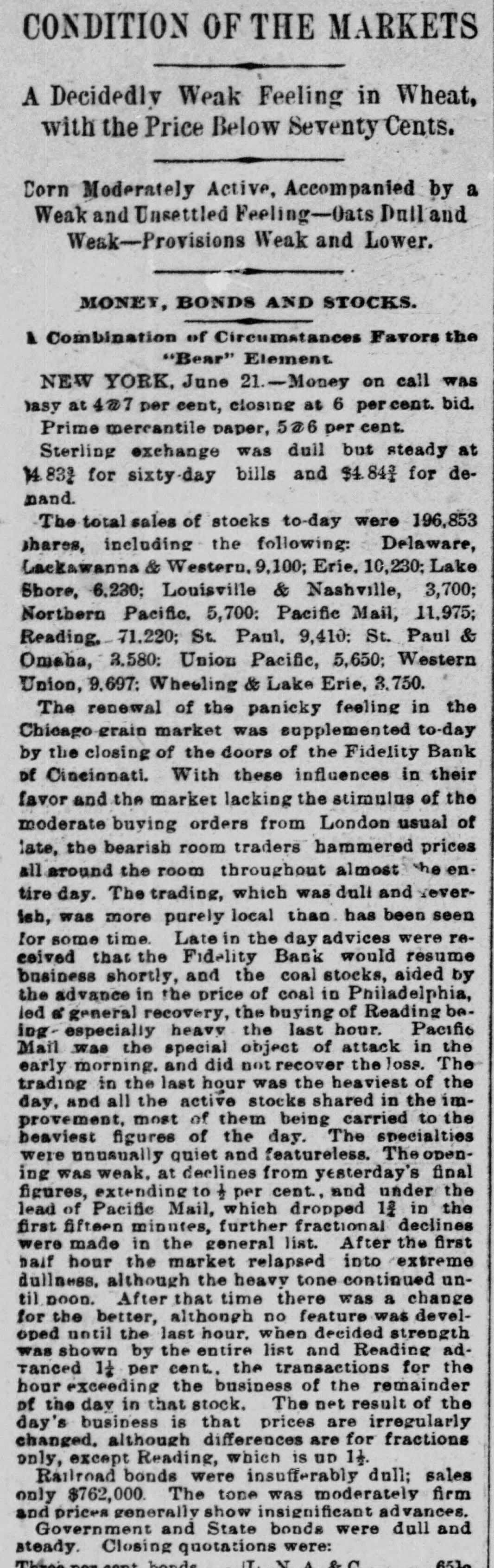
CONDITION OF THE MARKETS A Decidedly Weak Feeling in Wheat, with the Price Below Seventy Cents. Dorn Moderately Active, Accompanied by a Weak and Unsettled Feeling-Oats Dull and Weak-Provisions Weak and Lower. MONEY, BONDS AND STOCKS. a Combination of Circumstances Favors the "Bear" Element NEW YORK, June 21.-Money on call was asy at 4@7 per cent, closing at 6 percent. bid. Prime mercantile paper, 5a6 per cent. Sterling exchange was dull but steady at 14.83% for sixty-day bills and $4.843 for demand. The total sales of stocks to-day were 196,853 shares, including the following: Delaware, Lackawanna & Western. 9,100; Erie, 10,230; Lake Shore, 6,230; Louisville & Nashville, 3,700; Northern Pacific, 5,700: Pacific Mail, 11,975; Reading. 71.220; St. Paul, 9,410; St. Paul & Omaha, 3.580: Union Pacific, 5,650; Western Union, 9,697: Wheeling & Lake Erie, 3,750. The renewal of the panicky feeling in the Chicago grain market was supplemented to-day by the closing of the doors of the Fidelity Bank of Cincinnati. With these influences in their favor and the market lacking the stimulus of the moderate buying orders from London usual of late, the bearish room traders hammered prices all around the room throughout almost the entire day. The trading, which was duli and reverish, was more purely local than has been seen for some time. Late in the day advices were received that the Fidelity Bank would resume business shortly, and the coal stocks, aided by the advance in the price of coal in Philadelphia, led of general recovery, the buying of Reading being- especially heavy the last hour. Pacific Mail was the special object of attack in the early morning. and did not recover the loss. The trading in the last hour was the heaviest of the day, and all the active stocks shared in the improvement, most of them being carried to the beaviest figures of the day. The specialties were nusually quiet and featureless. The opening was weak. at declines from yesterday's final figures, extending to 1 per cent., and under the lead of Pacific Mail, which dropped 14 in the first fifteen minutes, further fractional declines were made in the general list. After the first half hour the market relansed into extreme dullness. although the heavy tone continued until noon. After that time there was a change for the better, although no feature was developed until the last hour. when decided strength was shown by the entire list and Reading advanced 11 per cent. the transactions for the hour exceeding the business of the remainder of the day in that stock. The net result of the day's business is that prices are irregularly changed. although differences are for fractions only, except Reading, which is up 11. Railroad bonds were insufferably dull; sales only $762,000. The tone was moderately firm and prices generally show insignificant advances. Government and State bonds were dull and steady. Closing quotations were: Three cent hands IT. V & C 651g


Article from St. Paul Daily Globe, June 22, 1887

Click image to open full size in new tab

Article Text

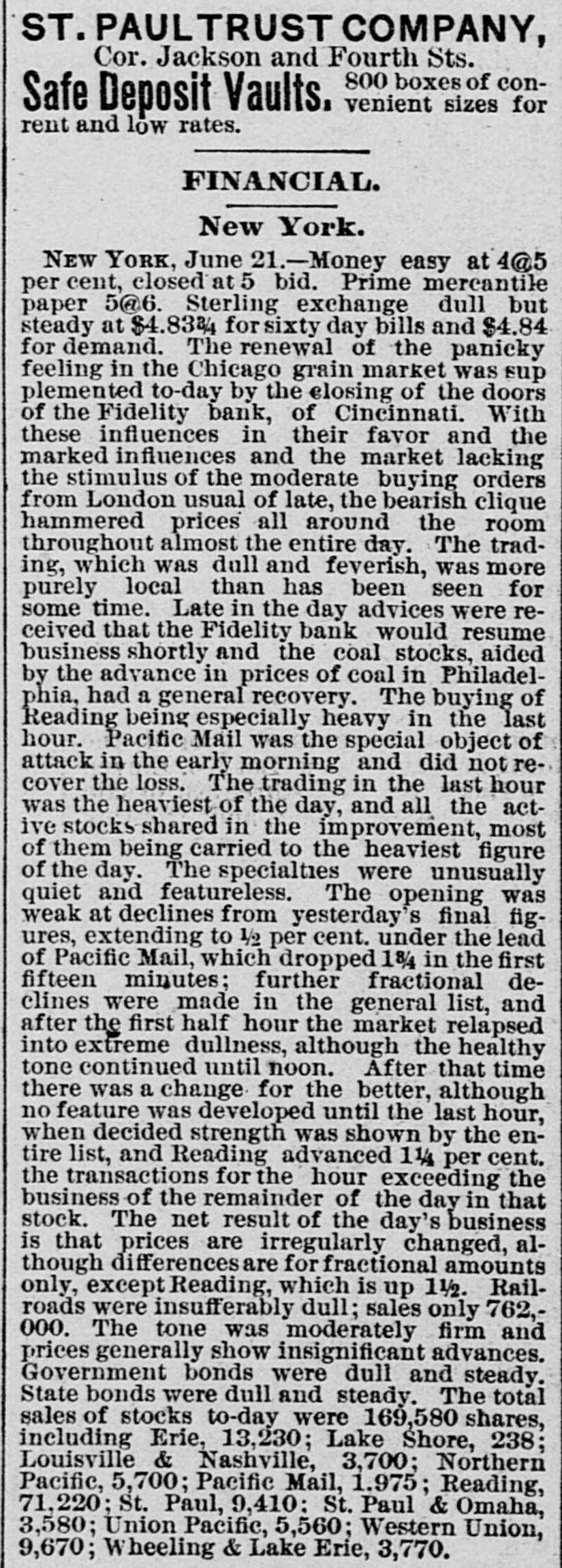
ST. PAULTRUST COMPANY, Cor. Jackson and Fourth Sts. 800 boxes of convenient sizes for Safe Deposit Vaults. rent and low rates. FINANCIAL. New York. NEW YORK, June 21.-Money easy at 4@5 per cent, closed at 5 bid. Prime mercantile paper 5@6. Sterling exchange dull but steady at $4.83% for sixty day bills and $4.84 for demand. The renewal of the panicky feeling in the Chicago grain market was sup plemented to-day by the closing of the doors of the Fidelity bank, of Cincinnati. With these influences in their favor and the marked influences and the market lacking the stimulus of the moderate buying orders from London usual of late, the bearish clique hammered prices all around the room throughout almost the entire day. The trading, which was dull and feverish, was more purely local than has been seen for some time. Late in the day advices were received that the Fidelity bank would resume business shortly and the coal stocks, aided by the advance in prices of coal in Philadelphia, had a general recovery. The buying of Reading being especially heavy in the last hour. Pacific Mail was the special object of attack in the early morning and did not recover the loss. The trading in the last hour was the heaviest of the day, and all the active stocks shared in the improvement, most of them being carried to the heaviest figure of the day. The specialties were unusually quiet and featureless. The opening was weak at declines from yesterday's final figures, extending to 1/2 per cent. under the lead of Pacific Mail, which dropped 18/4 in the first fifteen minutes; further fractional declines were made in the general list, and after the first half hour the market relapsed into extreme dullness, although the healthy tone continued until noon. After that time there was a change for the better, although no feature was developed until the last hour, when decided strength was shown by the entire list, and Reading advanced 11/4 per cent. the transactions for the hour exceeding the business of the remainder of the day in that stock. The net result of the day's business is that prices are irregularly changed, although differences are for fractional amounts only, except Reading, which is up 11/2. Railroads were insufferably dull; sales only 762,000. The tone was moderately firm and prices generally show insignificant advances. Government bonds were dull and steady. State bonds were dull and steady. The total sales of stocks to-day were 169,580 shares, including Erie, 13,230; Lake Shore, 238; Louisville & Nashville, 3,700; Northern Pacific, 5,700; Pacific Mail, 1.975; Reading, 71,220; St. Paul, 9,410: St. Paul & Omaha, 3,580; Union Pacific, 5,560; Western Union, 9,670; Wheeling & Lake Erie, 3,770.


Article from The Indianapolis Journal, June 23, 1887

Click image to open full size in new tab

Article Text

weeks ago. A MR. DECAMP has been made receiver of the Fidelity Bank, of Cincinnati. What's the use of putting a man with a name like that in charge of a bank when there is nothing left to decamp with?


Article from Butte Semi-Weekly Miner, June 25, 1887

Click image to open full size in new tab

Article Text

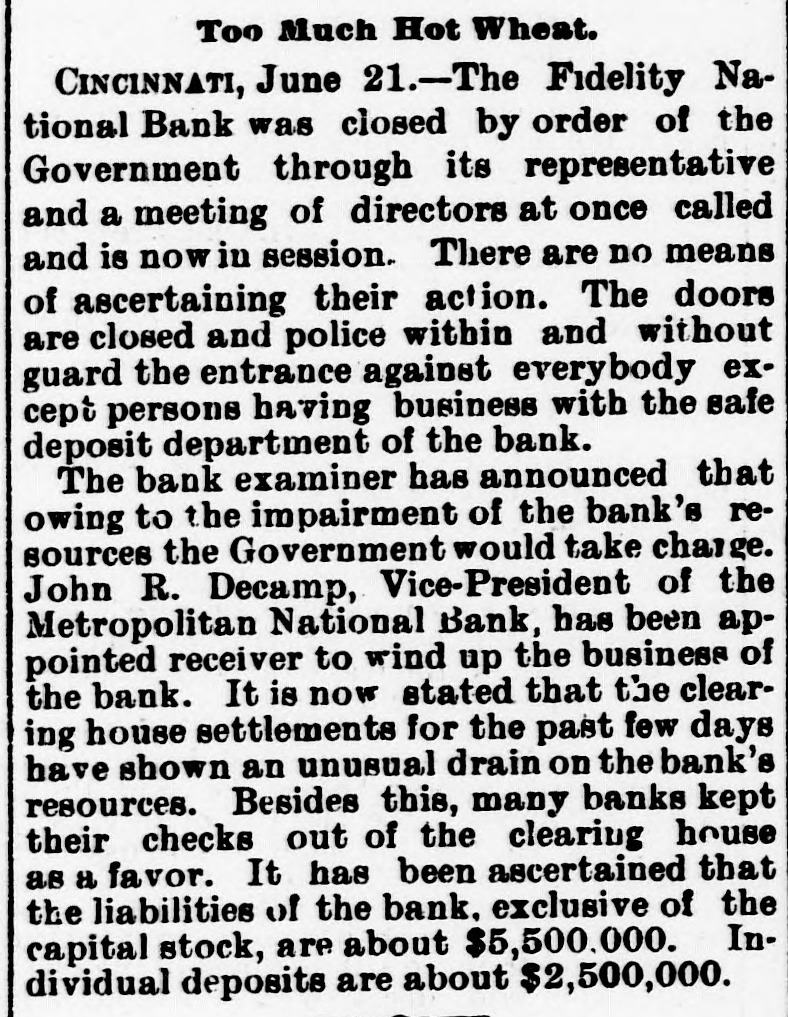
Too Much Hot Wheat. CINCINNATI, June 21.-The Fidelity National Bank was closed by order of the Government through its representative and a meeting of directors at once called and is now in session. There are no means of ascertaining their action. The doors are closed and police within and without guard the entrance against everybody except persone having business with the safe deposit department of the bank. The bank examiner has announced that owing to the impairment of the bank's resources the Government would take charge. John R. Decamp, Vice-President of the Metropolitan National Bank, has been appointed receiver to wind up the business of the bank. It is now stated that the clearing house settlements for the past few days have shown an unusual drain on the bank's resources. Besides this, many banks kept their checks out of the clearing house as a favor. It has been ascertained that the liabilities of the bank. exclusive of the capital stock, are about $5,500.000. Individual deposits are about $2,500,000.


Article from Clarksville Weekly Chronicle, June 25, 1887

Click image to open full size in new tab

Article Text

THE Fidelity Bank of Cincinnati suspended on the 21st and nearly two millions of the people's money have "gone where the woodbine twineth."


Article from Fort Worth Daily Gazette, June 26, 1887

Click image to open full size in new tab

Article Text

FROM the published reports it would appear that the Fidelity Bank of Cincin nati was run on a species of rascality worse than ever characterized a "brace" game of faro or the legerdemain of & three-card monte game. There should be an example made of these rascals and it is likely that there will be.


Article from The Big Sandy News, June 30, 1887

Click image to open full size in new tab

Article Text

The Fidelity National Bank, of Cincinnati, the largest in the city, was closed by order of the Government one day last week. Assets $8,000,000, and liabilities $9,000,000. Wheat speculation was the cause of the ruin of the bank. Several failures resulted from the suspension. Harper and Hopkins, two officials of the bank, are imprisoned in the jail.


Article from The Manitowoc Pilot, June 30, 1887

Click image to open full size in new tab

Article Text

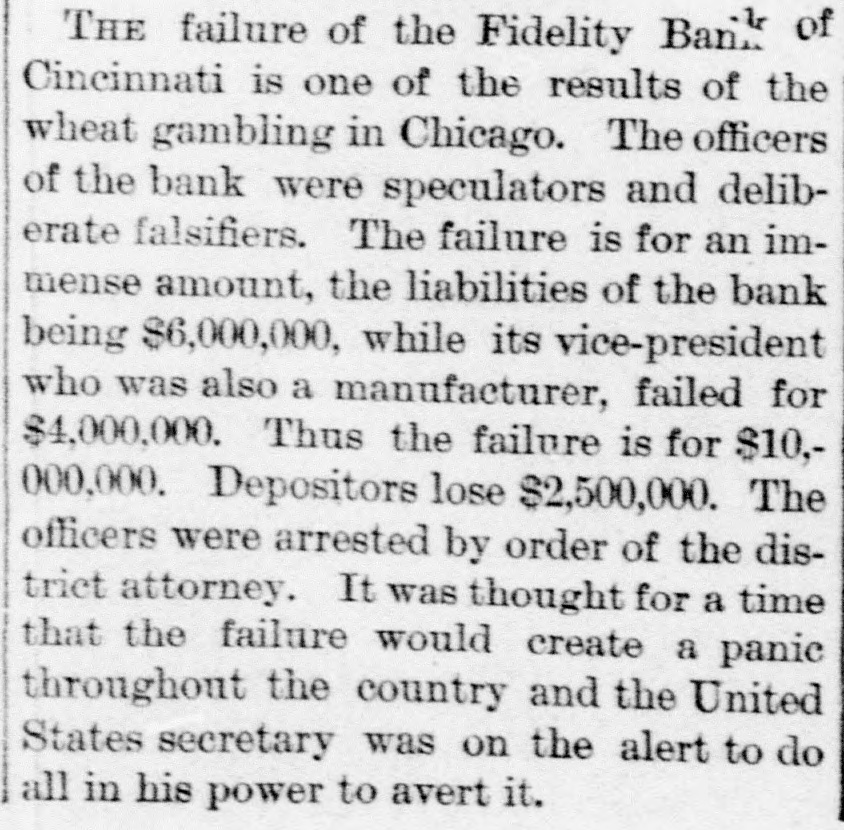
THE failure of the Fidelity Ban." of Cincinnati is one of the results of the wheat gambling in Chicago. The officers of the bank were speculators and deliberate falsifiers. The failure is for an immense amount, the liabilities of the bank being $6,000,000, while its vice-president who was also a manufacturer, failed for $4,000,000. Thus the failure is for $10,000,000. Depositors lose $2,500,000. The officers were arrested by order of the district attorney. It was thought for a time that the failure would create a panic throughout the country and the United States secretary was on the alert to do all in his power to avert it.


Article from The Universalist, July 2, 1887

Click image to open full size in new tab

Article Text

FIELD AGENTS: REV. J. W. McMastER, S. S. WILLIAMS. SATURDAY, JULY 2, 1887. THE country stands financial disturbance better than at any previous time in its history. The failure of the Fidelity National Bank in Cincinnati last week,-a bank utterly ruined by speulative rascality-is a larger failure than that of the Ohio Life and Trust Company in 1857, which precipitated a panic throughout the country. But general business goes on as usual, and the honest banks of Cincinnati and the Ohio cities are not perceptibly disturbed.


Article from Springfield Daily Republic, July 6, 1887

Click image to open full size in new tab

Article Text

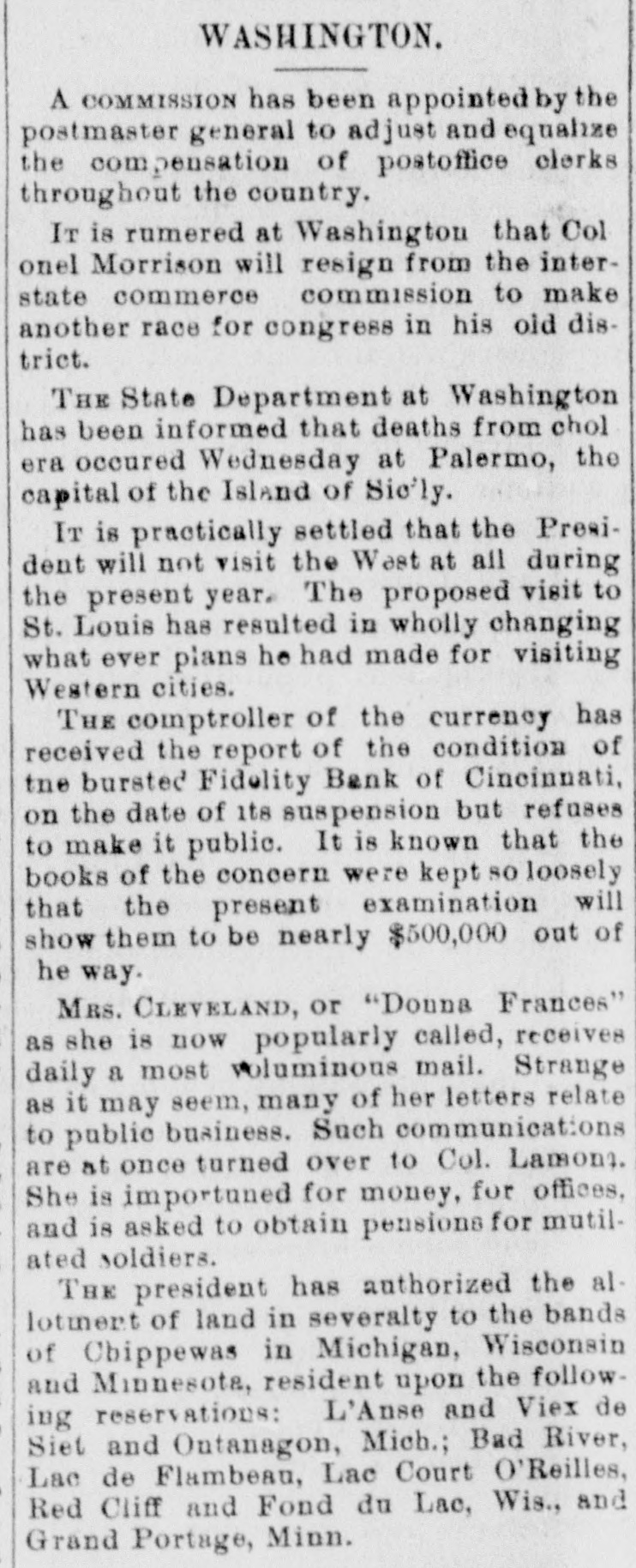
The books of the Fidelity National bank of Cincinnati were so loosely kept that they are reported not to show the actual condition of the bank on the day of suspension within $500,000.


Article from Macon Beacon, July 9, 1887

Click image to open full size in new tab

Article Text

The Books Kept Loosely. CINCINNATI, July 5.-The books of the Fidelity National Bank, this city, were so loosely kept that they are reported not to show the actual condition of the bank on the day of suspension within $500,000.


Article from St. Paul Daily Globe, October 25, 1887

Click image to open full size in new tab

Article Text

The Fidelity Bank. CINCINNATI, O., Oct. 24.-It is annouced on the authority of Receiver Armstrong that the Fidelity bank will declare a dividend of 25 per cent. Oct. 31.


Article from Jamestown Weekly Alert, October 27, 1887

Click image to open full size in new tab

Article Text

Not a Complete Wreck. CINCINNATI, Ohio, Oct. 25.-It is an nounced on the authority of Receiver Armstrong that the Fidelity bank will declare a dividend of 25 per cent. Oct. 31.


Article from Fort Worth Daily Gazette, December 14, 1887

Click image to open full size in new tab

Article Text

HARPER, the Napoleon of finance, etc., who run and wrecked the Fidelity bank of Cincinnati, has received the just reward of his conduct, and is now serving a term of ten years in the penitentiary. His career was bright, brief, and terminated most ingloriously. It is the old story over and over again of the man spending some one else's money. Harper is more unfortunate but not more criminal than thousands of others, who even now are doing as he has done. Some of them may work out by good luck, others may be caught and punished, and others still may go unwhipt of justice, but they are liable at any time to be caught up with. Men who are entrusted with the money of others should always have the lesson before them, that rascality of any kind may flourish for a time, but only for a time.


Article from Pittsburg Dispatch, May 17, 1890

Click image to open full size in new tab

Article Text

A Judgment Rendered. CINCINNATI, May 16,-A judgment for $85,000 has been rendered by the United States Court against J. W. Wilshire in tavor of David Armstrong, receiver of the Fidelity National Bank.


Article from The True Northerner, May 28, 1890

Click image to open full size in new tab

Article Text

# A JUDGMENT FOR $95,000 A JUDGMENT for $95,000 has been rendered by the United States court at Cincinnati against J. W. Wilshire in favor of David Armstrong, receiver of the Fidelity National bank.


Article from The Daily Sentinel, May 4, 1909

Click image to open full size in new tab

Article Text

FINAL CHAPTER IN FAMOUS CASE [By Associated Press.] Cincinnati, O., May 4.-The last vestige of the once famous Cincinnati case involving the collapse of the Fidelity National Bank and the fall of E. L. Harper and his efforts to corner the wheat market, will be cleaned up here on May 17 when a 5-million-dollar judgment against E. L. Harper will be offered for sale by George C. Rankin, the receiver of the bank. Harper speculated on the Chicago board of trade 20 years ago and failed in running a wheat corner. He served several years in the penitentiary at Columbus, O., for using the funds of his bank to bolster up his wheat corner. Thousands of persons here were plunged into despair when the Fidelity National Bank failed.


Article from The Marion Daily Mirror, July 22, 1910

Click image to open full size in new tab

Article Text

appeared in the New York papers today announcing that Strange & Company of Cincinnati held a judgment against E. L. HΓ₯rper for $7,000,000 and that they were willing to part wjith it for a paltry $1,000. E. L. Harper at one time essayed a corner in wheat, and brought about the wreck of the Fidelity National bank of Cincinnati. He was sent to the Ohio penitentiary for ten years. At the conclusion of his term he attempted bankruptcy proceedings. The receiver of the Fidelity Trust company contested the proceedings and finally got a judgment for $7,000,000.


Article from The Salt Lake Herald-Republican, August 31, 1910

Click image to open full size in new tab

Article Text

MAY PROBE BANK FAILURE Effort to Be Made to Revive Investigation Into Collapse of Cincinnati Institution Years Ago. Washington, Aug. 30.-Another effort to revive an investigation of the Fidelity National bank failure in Cincinnati 23 years ago, is about to be made by Chicago men, headed by A. W. Green, a broker in that city, The Fidelity failure, the most gigantic in its time, was related to a speculation in Chicago wheat in which the bank was ruined and President E. L. Harper was sentenced to ten years in a penitentiary. Just before the bank closed, banks all over the country received mysterious circulars advising the withdrawal of all funds from the Fidelity National. A run on the bank followed and after $200,000 of overdrafts had been protested a national bank examiner took charge. The Chicago men claim to have information that the circulars were put out by a rival brokerage house,


Article from The Evening Standard, August 31, 1910

Click image to open full size in new tab

Article Text

FIDELITY NATIONAL BANK FAILURE INVESTIGATION Washington, Aug. 31.-Another effort to revive an investigation of the Fidelity National Bank failure in Cinnati 23 years ago, is about to be made by Chicago men, headed by A. W. Green, a broker in that city, The Fidelity failure, the most glgantle of its time, was related to a speculation in Chicago wheat In which the bank was ruined and Pres. ident E. L. Harper was sentenced to ten years in a penitentiary Just before the bank closed, banks all over the country received mysterious circulars advising the withdrawal of all funds from the Fidelity National. A run on the bank followed and after $200,000 overdrafts had been protested, a national bank examiner took charge. The Chicago men claim to have information that the circulars were put out by a rival brokerage house.


Article from The Salt Lake Tribune, September 1, 1910

Click image to open full size in new tab

Article Text

SEEKING NEW LIGHT ON OLD BANK FAILURE WASHINGTON, Aug. 31.-Another effort to revive an investigation of the Fidelity National bank failure in Cincinnati twenty-three yaers ago, is about to be made by Chicago men, headed by A. W. Green, a broker in that city. The Fidelity failure, the most gigantic of its time, was related to a speculation in Chicago wheat in which the bank was ruined and President E. L. Harper was sentenced to ten years in the penitentiary. Just before the bank closed. banks all over the country received mysterious circulars advising the withdrawal of all funds from the Fidelity National. A run on the bank followed and after $200,000 overdrafts had been protested, a national bank examiner took charge. The Chicago men claim to have information that the circulars were put out by a rival brokerage house. Tribune Want Ads. Bell Main 5200. Independent 360.