Spring Garden National Bank (Philadelphia, PA)

Episode Information

Episode UID
346801097
Episode Type
Run โ†’ Suspension โ†’ Closure
Bank Type
national
Bank ID
34680 national
Charter Number
3468
Start Date
May 8, 1891
Location
Philadelphia, Pennsylvania (39.952, -75.164)

Metadata

Model
gpt-5-mini (chosen from majority vote of a three-model LLM ensemble)
Short Digest
b993c7bde84f695d

Response Measures

Full suspension, Books examined

Clearinghouse involved: Yes (loan, examination, or other measures)

Receivership Details

Depositor recovery rate
25.7%
Date receivership started
1891-05-21
Date receivership terminated
1901-12-09
OCC cause of failure
Fraud
Share of assets assessed as good
12.1%
Share of assets assessed as doubtful
23.9%
Share of assets assessed as worthless
64.0%

Description

Later criminal charges and embezzlement discovered against officers; receiver appointed.

Events (5)

1. March 13, 1886 Chartered
Source
historical_nic
2. May 8, 1891 Run
Cause
Bank Specific Adverse Info
Cause Details
Large withdrawals during prolonged financial stringency and weakening credit; reports of bank weakness and related scandals created depositor flight.
Measures
Placed the bank in the hands of National Bank Examiner Drew; closed by order of the Comptroller.
Newspaper Excerpt
News of the suspension spread through the city like wildfire, and it was not long before the frightened depositors began to gather around the bank building...Men and women with bank books in their hands thronged about the doors demanding admittance.
Source
newspapers
3. May 8, 1891 Suspension
Cause
Government Action
Cause Details
Comptroller/national bank examiner ordered the bank closed and took charge following inability to meet withdrawals and weakened reserves.
Newspaper Excerpt
This bank is closed by order of the controller of the currency until further notice. W. B. DREW, National Bank Examiner.
Source
newspapers
4. May 21, 1891 Receivership
Source
historical_nic
5. May 21, 1891 Receivership
Newspaper Excerpt
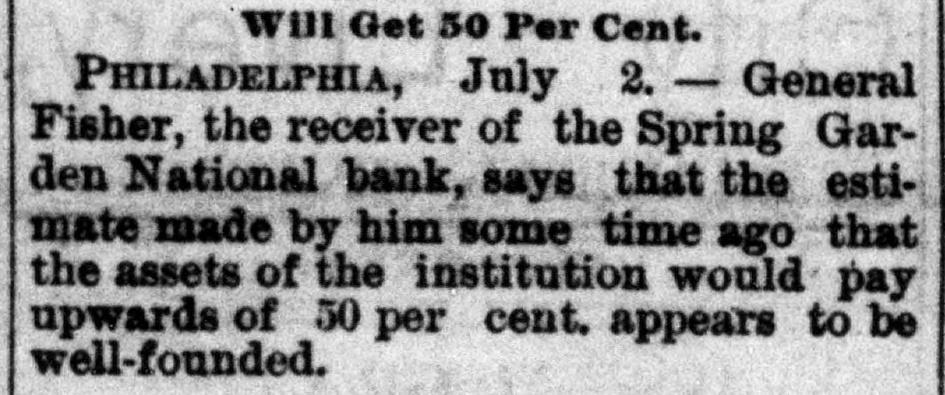
General Fisher, the receiver of the Spring Garden National bank, said this afternoon that his estimate...that the assets of the bank would pay upwards of 50 per cent, appeared to be very well founded-
Source
newspapers

Newspaper Articles (24)

Article from The Dalles Daily Chronicle, May 8, 1891

Click image to open full size in new tab

Article Text

A National Bank Suspends. PHILADELPHIA, May 8.-The Spring Garden National bank closed its doors at 11 o'clock this morning. Among the stock holders and depositers a strong feeling prevails that the closing of the bank will prove but temporary, and that they will receive their money.


Article from The Morning News, May 9, 1891

Click image to open full size in new tab

Article Text

A BANK SHUTSIIS DOORS. THE SPRING GARDEN NATIONAL OF PHILADELPHIA FAILS. The Crash followed by the Suspen8 on of the Penn afe Deposit and Trust Company-The Failures a Eurprise to the Public-Fair Rep rts at the Last Showing. PHILADELPHIA, May 8.-Under an order received from Controller of the Treasury Lacey the doors of the Spring Garden National Bank were cl sed at 11 o'clock this morning. News of the suspension spread through the city like wildfire, and it was not long before the frightened depositors began to gather around the bank building at Twelfth and Spring Garden streets. Scarcely had the announcement of the failure of the Spring Garden bank been made before there was a rumor afloat that the Penn Safe Deposit and Trust Company, also located at Twelfth and Spring Garden streets, had also suspended payment. A SURPRISE. To the general public the crash was a great surprise, for at the last sale of Spring Garden' bank stock on April 28, 1891, the price obtained was $121 50, which is exactly $21 50 above par. The capital stock of the institution was quoted at $750,000 and there was supposed to be a surplus of $130,000. A dividend of 21/2 per cent. was paid upon the capital stock at the last annual meeting and the bank was therefore generally supposed to be sound. THE CITY CAUGHT. The bank is a large depository of the city's money. According to the statement of City Treasurer Bardsley he has $144,000 on deposit in the institution. The officers of the bank are: President, Francis W. Kennedy; cashier, Henry H, Kennedy; assistant cashier, S. A. McClure. The board of directors were Francis W. Kennedy, Nathan Middleton, Ephraim Turland, Nelson F. Evans, Ephraim Young, Robert C. Thomas and John B. Stetson. At 11:30 the following notice was placed upon the door: This bank is closed by order of the controller of the currency until further notice. W. B. DREW, National Bank Examiner. A STATEMENT BY THE PRESIDENT. When the people gathered immediately af er the doors had closed, President Kens nedy looked outof a side door and called out that he had no statement to m ke. As soon as he had finished speaking ne disappeared inside, amid the shou S and jeers of t e disappoint crowd. Later he gave out the following statement: We have this morning decided to place the bank in the hands of Mr. Drew. the national bank examiner. This step has been forced upon us principally by reason of the large withdrawal of deposits during the financial stringency which commenced last September, and the continued dullness of general business since. To meet these demands and maintain our reserve it was found impossible to realize rapidly enough upon the assets. We have been below our reserve for some weeks past, and can see no immediate prospects of increasing it. We still owe a balance to the clearing house committee for outstanding loan certificates, the payment of which is being pressed These facts, coupled with the disturbances of the past week, have caused increased weakness on the part of some of our depositors, together with weakening of our credit with other banks. We trust that the suspension will be only temporary. FRANCIS W. KENNEDY, President. THE TRUST COMPANY. The Penn Trust Company is now a state institution, but it was originally an outgrowth of the bank in this city. The stockholders of the bank are also largely stockholders of the trust company. Samuel B. Huey was consulted by persons interested and connected with the trust company 88 to the di

Article from Pittsburg Dispatch, May 9, 1891

Click image to open full size in new tab

Article Text

ANOTHER BANK GONE. The Spring Garden of Philadelphia Forced to Stop Business. BANK EXAMINER DREW CLOSES IT. Again Philadelphia City Is a Loser to the Extent of $144,000. PENN TRUST COMPANY ALSO ASSIGNS ISPECIAL TELEGRAM TO THE DISPATCH.1 PHILADELPHIA, May 3.-National Bank Examiner Drew, by order of the Controller of the Currency, to-day closed the doors of the Spring Garden National Bank, at Twelfth and Spring Garden streets. The Penn Trust and Safe Depost Company, an institution doing business in the same building and having practically the same set of officials, went into the ha nds of an assignee. While the President and other officers claim that the chances of the bank's resuming business are good and that the suspension would be only temporary, the general impression on the street is that the affairs of the bank are in very bad shape. No detailed statement was made public to-day, and President Kennedy said that it would be impossible to prepare one for-several days. Bank Examiner Drew took charge of the bank at 11:30 o'clock; at 1 o'clook closed the doors and soon afterward a squad of police marched up and took up their stations around the bank. The news of the closing of the bank spread quickly and within half an hour there was a crowd about the building, that steadily increased. Men and women with bank books in their hands thronged about the doors demanding admittance. Philadelphia Caught for 8144,000. To all the same answer was returned: "No one is allowed inside." Meanwhile all sorts o! rumors were set afloat regarding the condition of the bank and the causes which led to its closing. Many indignant depositors claimed that they had deposited money in the bank within a half hour of the time of the closing. Again the city is caught in the ruin, the Spring Garden Bank having been named as one of the depositories of the city's money, and when the doors closed there was $144,000 on deposit there. City Treasurer Bardsley and City Controller Thompson were both at the bank during the afternoon, but both claimed to know nothing of the causes which led to the suspension, and had very little to say about the suspension. Mysterious rumors connecting the defunct Keystone Bank with the suspension are afloat and together with the reports that are current regarding the affairs of the closed bank and its management, have created great excitement, At 12 o'clock the suspension was announced at the Clearing House, and the news: circulated throughout the business centers rapidly. Causes of the Failure. Each car which arrived brought people to swell the crowd, which it required the entire efforts of the police to keep moving. No one was admitted to the bank, and all the satisfaction the public got out of repeated inquiries at the door as to the cause which led to the closing of the bank was the following statement, issued by President Kennedy shortly after 12 o'clock: We have this morning decided to place the bank in the hands of Mr. Drew, the National Bank Examiner. This step has been forced upon us principally by reason of thelarge withdrawal of deposits during the financial stringency which commenced last September, and the continued dullness of general business since. To meet these demands and maintain our reserve. it was found impossible to realize rapidly enough on the assets. We have been below in our reserve for some weeks past, and can see no immediate prospect of increasing it. We still owe a balance to the Clearing House Committee for outstanding loan certificates, the payment of which is being pressed. These facts, coupled.with the disturbances of the past week, have caused increased uneasiness upon the partof some or our depositors, together with the weakening of our credit with the other banks. We trust that the suspension will only be temporary. Finances of the Bank. The bank's stock was quoted two days since at 121, par $100, and on Tuesday last it declared a dividend of 2ยฝ per cent on its capital of $750,000 and carried $2,500 to its surplus fund, making its total surplus $132,500. The last statement of the bank, under the Controller's call showed loans and discounts $2,170,028 18; National bank notes outstanding, $45,000; individual deposits, subject to check, $1,998,830 34; demand certificates of deposit, $8,000; undivided profits, $41,725 04. The officers of the bank are F. W. Kennedy, President; H. H. Kennedy, Cashier; N. Middleton, Vice President. It is supposed that the Kennedy family was largely interested in various real estate operations. Some years ago, when the Spring Garden was a State institution, the Kennedys were heavily interested in real estate at Bradford Hills, near Downington. The Spring Garden Bank was established in 1871 under the State banking law and continued in operation as a State bank for a period of 14 years. In the fall of 1885 the institution was reorganized as a National bank. The Penn Safe Deposit and Trust Company, which was an adjunct of the Spring Garden National Bank, is a State institution, and was incorporated November 8, 1870, with a capital of $125,000, par $100. No dividends have ever been paid.


Article from Fort Worth Gazette, May 9, 1891

Click image to open full size in new tab

Article Text

ANXIOUS DEPOSITORS. THE PHILADELPHIA TRUST COMPANY CLOSES DOWN. The Comptroller of the Currency Orders the Doors of the Spring Garden National Bank Closed. PHILADELPHIA, PA., May 8.-The Pennsylvania trust company, which has its office in the Spring Garden national bank building, made an assignment this afternoon. The National trust company, which made an assignment this morning is really a part of the bank that is said to be solvent, the assignment being simply for the protection against a run. The capital stock of the bank is $750,000, fully paid in, and by the February statement the reserve fund amounted in round figures to $150,000. On Tuesday last the bank declared a semi-annual dividend of 21/2 per cent, and the stock sold at $1.21, par being $100. The bank's line of deposits amounted to about $2,000,000, and the city of Philadelphia, who has $400,000 locked up in the broken Keystone bank, again suffers to the extent of $154,000. SPRING GARDEN NATIONAL OF PHILADELPHIA. PHILADELPHIA, Pa., May 8.-Another of Philadelphia's national banks closed its doors this morning by order of the comptroller of the currency. After doing business for one hour and a half this morning the Spring Garden national bank closed its doors and posted the following notice: "By order of the comptroller of the currency this bank is closed until further notice. W. P. Drew, national bank examiner." The news of the closing of the bank spread rapidly and a large crowd soon collected, but admittance was denied to all. In answer to requests sent to President Kennedy asking for some information as to the reason of the bank closing, the following note was sent out: "We have this morning decided to place this bank in the hands of Mr. Drew, national bank examiner. This step has been forced upon us, principally by the large withdrawal of deposits during the financial stringency, which commenced last September, and the continued dullness of business since. To meet these on OUR reserves, it was found impossible to realize apidly on our assets. We have been below 111 our reserve for some weeks past, and can see no immediate prospects of increasing it. We still owe a balance to the clearing house committee for outstanding loan certificates, payment of which is being pressed. These facts, coupled with the disturbances of the past week, have caused increased uneasiness on the part of some of our depositors, together with a weakening in our credit with other banks. We hope the suspension will only be temporarily. W. F. KENNEDY, President."


Article from The Climax, May 13, 1891

Click image to open full size in new tab

Article Text

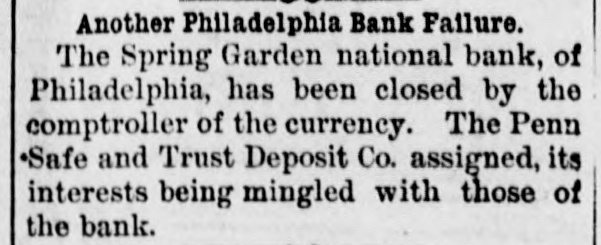
Another Philadelphia Bank Failure. The Spring Garden national bank, of Philadelphia, has been closed by the comptroller of the currency. The Penn Safe and Trust Deposit Co. assigned, its interests being mingled with those of the bank.


Article from Macon Beacon, May 16, 1891

Click image to open full size in new tab

Article Text

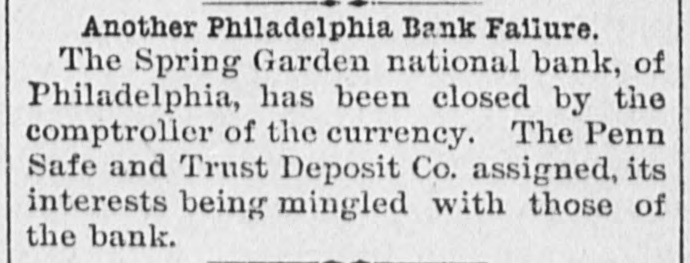
Another Philadelphia Bank Failure. The Spring Garden national bank, of Philadelphia, has been closed by the comptroller of the currency. The Penn Safe and Trust Deposit Co. assigned, its interests being mingled with those of the bank.


Article from The Ohio Democrat, May 16, 1891

Click image to open full size in new tab

Article Text

Another Philadelphia Bank Failure. The Spring Garden national bank, of Philadelphia, has been closed by the comptroller of the currency. The Penn Safe and Trust Deposit Co. assigned, its interests being mingled with those of the bank.


Article from The True Northerner, May 27, 1891

Click image to open full size in new tab

Article Text

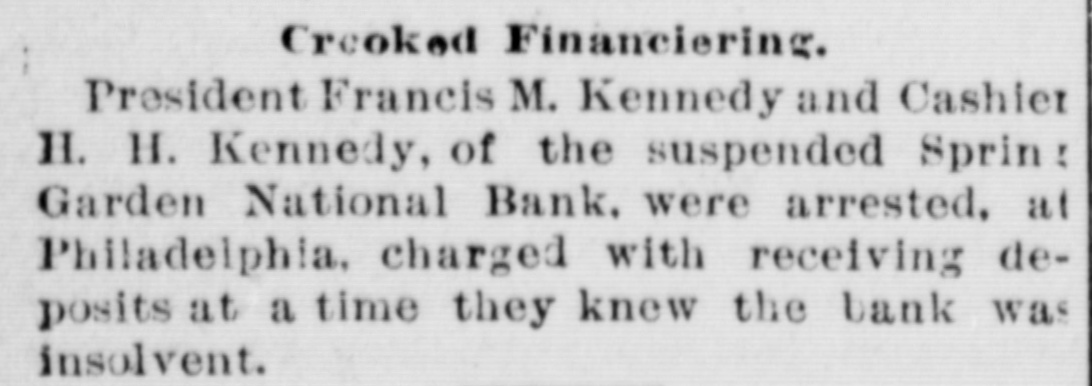
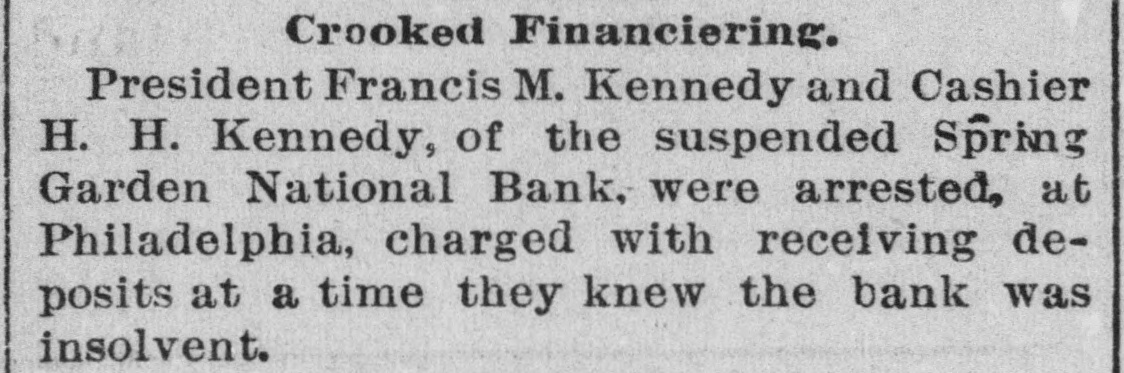
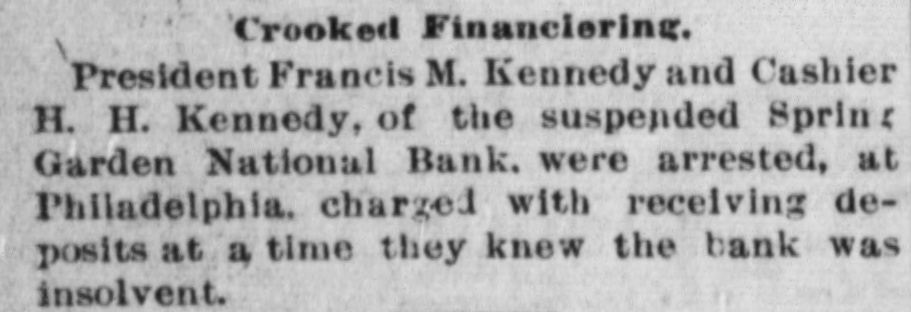
Creoked Financiering. President Francis M. Kennedy and Cashier H. H. Kennedy, of the suspended Sprin ! Garden National Bank. were arrested, at Philadelphia, charged with receiving deposits at a time they knew the bank was insolvent.


Article from The Telegraph-Courier, May 28, 1891

Click image to open full size in new tab

Article Text

Crooked Financiering. President Francis M. Kennedy and Cashier H. H. Kennedy, of the suspended Spring Garden National Bank, were arrested, at Philadelphia, charged with receiving deposits at a time they knew the bank was insolvent.


Article from Crawford Avalanche, May 28, 1891

Click image to open full size in new tab

Article Text

Crooked Financiering. President Francis M. Kennedy and Cashier H. H. Kennedy, of the suspended Spring 4 Garden National Bank. were arrested, at Philadelphia. charged with receiving deposits at a time they knew the bank was insolvent.


Article from Los Angeles Herald, May 29, 1891

Click image to open full size in new tab

Article Text

The Kennedys Arrested. PHILADELPHIA, May 28.-Francis W. Kennedy, president of the suspended Spring Garden national bank, was arrested this morning on a warrant charging him with making false entries in the books, false returns to the comptroller of


Article from The Dalles Daily Chronicle, June 2, 1891

Click image to open full size in new tab

Article Text

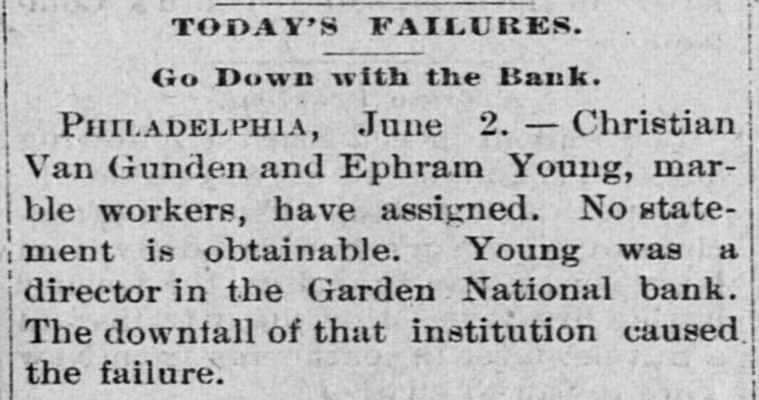
TODAY'S FAILURES. Go Down with the Bank. Philadelphia, June 2. - Christian Van Gunden and Ephram Young, marble workers, have assigned. No statement is obtainable. Young was a director in the Garden National bank. The downtall of that institution caused the failure.


Article from The Mt. Sterling Advocate, June 2, 1891

Click image to open full size in new tab

Article Text

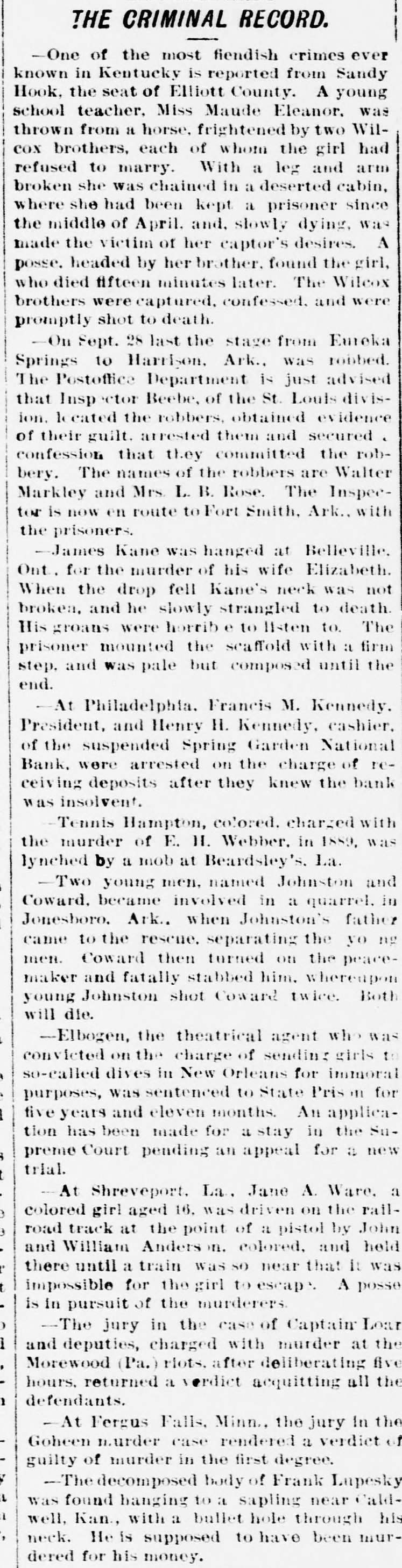
More crooked financiering has been discovered in Philadelphia. FranX cis W. Kennedy, President, and Henry Kennedy, Cashier, of the suspended Spring Garden National Bank, were arrested on a number of charges, the principal of which is the embezzlement of $100,000.


Article from Evening Capital Journal, June 2, 1891

Click image to open full size in new tab

Article Text

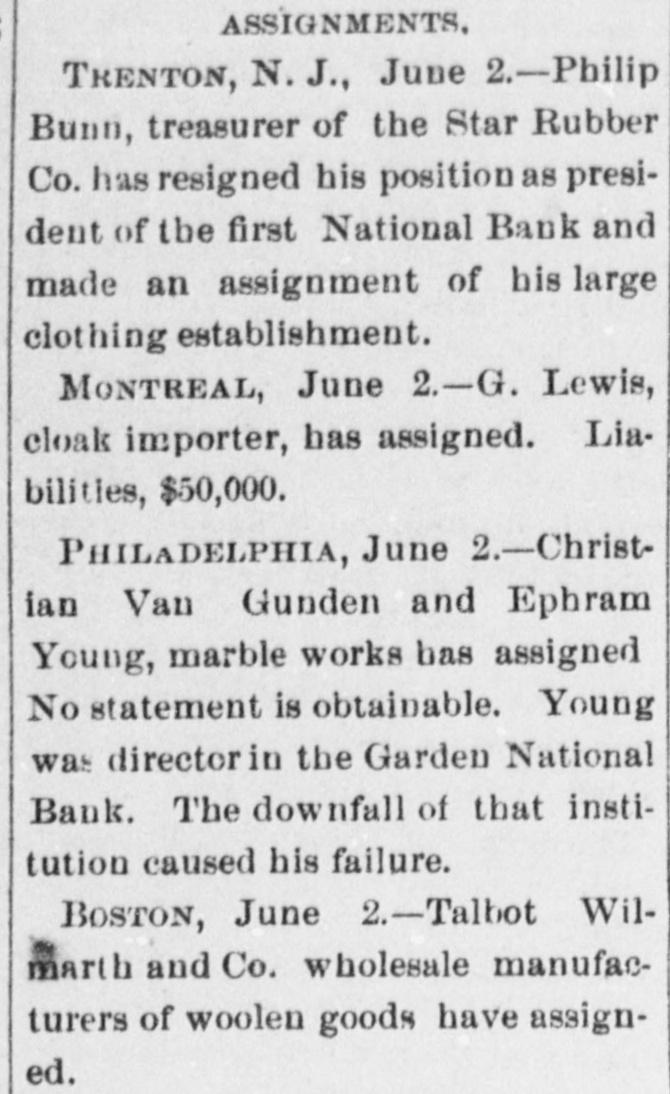
ASSIGNMENTS. TRENTON, N.J., June 2.-Philip Bunn, treasurer of the Star Rubber Co. has resigned his position as president of the first National Bank and made an assignment of his large clothing establishment. MONTREAL, June 2.-G. Lewis, cloak importer, has assigned. Liabilities, $50,000. PHILADELPHIA, June 2.-Christian Van Gunden and Ephram Young, marble works has assigned No statement is obtainable. Young was directorin the Garden National Bank. The downfall of that institution caused his failure. BOSTON, June 2.-Talbot Wilmarth and Co. wholesale manufacturers of woolen goods have assigned.


Article from The Morning Call, June 3, 1891

Click image to open full size in new tab

Article Text

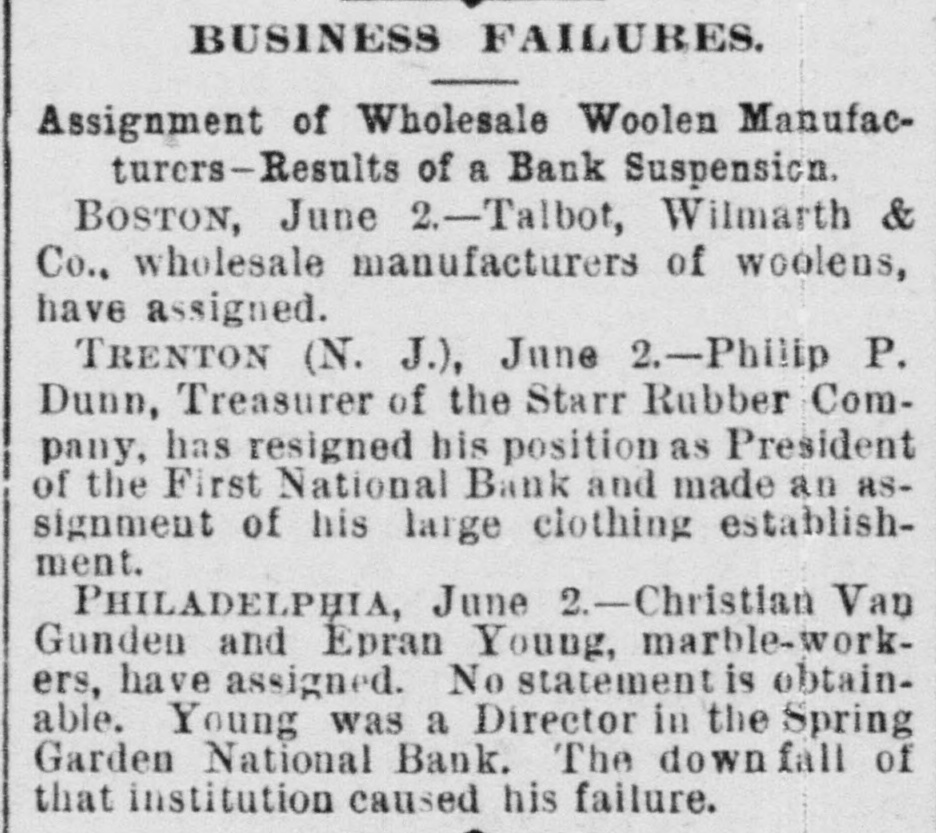
BUSINESS FAILURES. Assignment of Wholesale Woolen Manufacturers-Results of a Bank Suspension. BOSTON, June 2.-Talbot, Wilmarth & Co., wholesale manufacturers of woolens, have assigned. TRENTON (N. J.), June 2.-Philip P. Dunn, Treasurer of the Starr Rubber Company, has resigned his position as President of the First National Bank and made an assignment of his large clothing establishment. PHILADELPHIA, June 2.-Christian Van Gunden and Epran Young, marble-workers, have assigned. No statement is obtainable. Young was a Director in the Spring Garden National Bank. The down fall of that institution caused his failure.


Article from Los Angeles Herald, June 3, 1891

Click image to open full size in new tab

Article Text

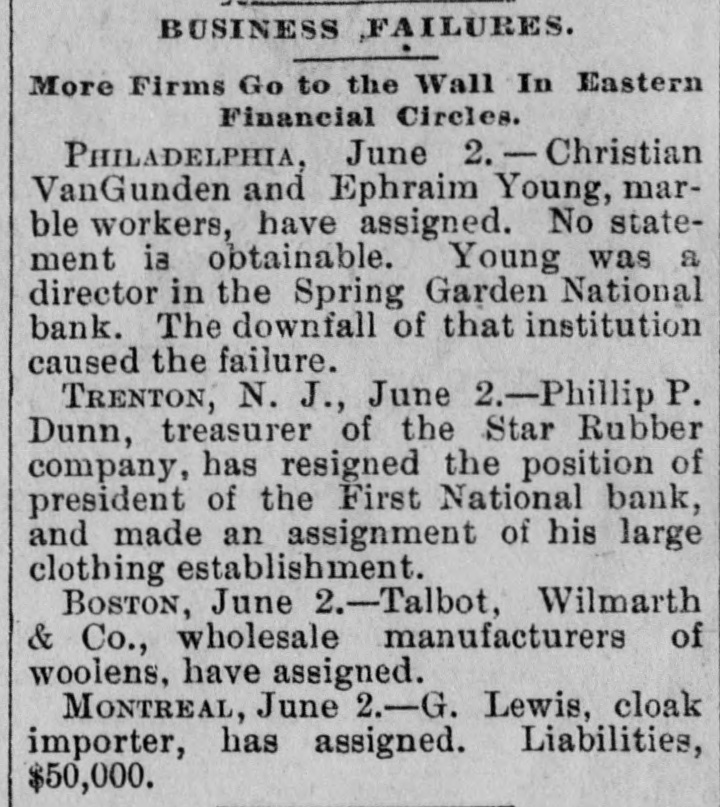
BUSINESS FAILURES. More Firms Go to the Wall In Eastern Financial Circles. PHILADELPHIA, June 2. - Christian VanGunden and Ephraim Young, marble workers, have assigned. No statement ia obtainable. Young was a director in the Spring Garden National bank. The downfall of that institution caused the failure. TRENTON, N. J., June 2.-Phillip P. Dunn, treasurer of the Star Rubber company, has resigned the position of president of the First National bank, and made an assignment of his large clothing establishment. BOSTON, June 2.-Talbot, Wilmarth & Co., wholesale manufacturers of woolens, have assigned. MONTREAL, June 2.-G. Lewis, cloak importer, has assigned. Liabilities, $50,000.


Article from Wheeling Register, June 13, 1891

Click image to open full size in new tab

Article Text

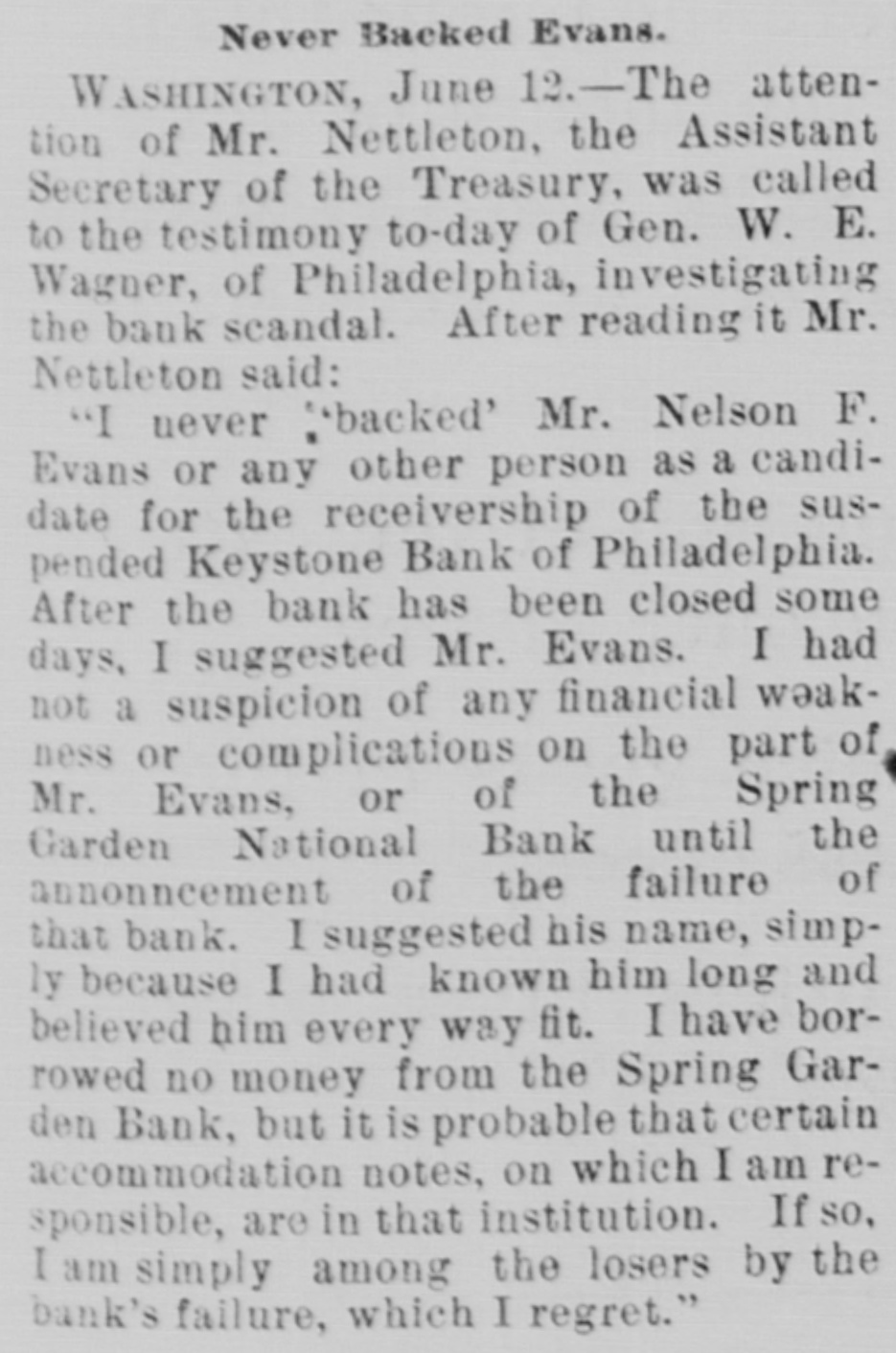
Never Backed Evans. WASHINGTON, June 12.-The attention of Mr. Nettleton, the Assistant Secretary of the Treasury, was called to the testimony to-day of Gen. W. E. Wagner, of Philadelphia, investigating the bank scandal. After reading it Mr. Nettleton said: "I never "backed" Mr. Nelson F. Evans or any other person as a candidate for the receivership of the suspended Keystone Bank of Philadelphia. After the bank has been closed some days, I suggested Mr. Evans. I had not a suspicion of any financial weakness or complications on the part of Mr. Evans, or of the Spring Garden National Bank until the annonneement of the failure of that bank. I suggested his name, simply because I had known him long and believed him every way fit. I have borrowed no money from the Spring Garden Bank, but it is probable that certain accommodation notes, on which I am responsible, are in that institution. If so, I am simply among the losers by the bank's failure, which I regret."


Article from Waterbury Evening Democrat, July 1, 1891

Click image to open full size in new tab

Article Text

Bank Failures to be Investigated. WASHINGTON, July 1.-Comptroller Lacey has sent a communication to Receiver Yardley, of the Keystone National Bank of Philadelphia, enclosing a communication to Mayor Stuart, which is the first notification that the Government is going to take action in the affairs of the Keystone and Spring Garden National banks. A rigid examination is to be made by the Government.


Article from The Evening Herald, July 1, 1891

Click image to open full size in new tab

Article Text

Bank Failures to be Investigated. WASHINGTON, July 1.-Comptroller Lacey has sent a communication to Receiver Yardley, of the Keystone National Bank of Philadelphia, enclosing a communication to Mayor Stuart, which is the first notification that the Government is going to take action in the affairs of the Keystone and Spring Garden National banks. A rigid examination is to be made by the Government.


Article from St. Paul Daily Globe, July 1, 1891

Click image to open full size in new tab

Article Text

gen Will Pay 50 Per Cent. PHILADELPHIA, Pa., June 30.-Gen. Fisher, receiver of the Spring Garden National bank, said this afternoon that his estimate made some time ago that the assets of the benk would pay upwards of 50 per cent, appeared to be very well founded-


Article from The Madison Daily Leader, July 2, 1891

Click image to open full size in new tab

Article Text

Will Get 50 Per Cent. PHILADELPHIA, July 2. - General Fisher, the receiver of the Spring Garden National bank, says that the estimate made by him some time ago that the assets of the institution would pay upwards of 50 per cent. appears to be well-founded.


Article from Evening Journal, January 28, 1892

Click image to open full size in new tab

Article Text

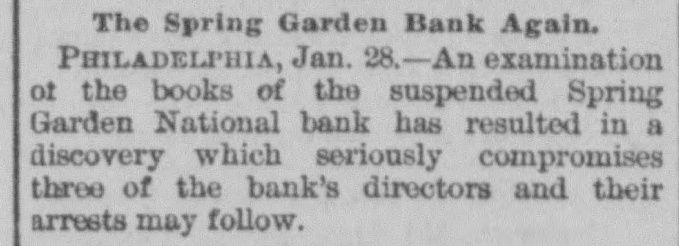
The Spring Garden Bank Again. PHILADELPHIA, Jan. 28.-An examination of the books of the suspended Spring Garden National bank has resulted in a discovery which seriously compromises three of the bank's directors and their arrests may follow.


Article from The Herald, July 17, 1893

Click image to open full size in new tab

Article Text

Committed Suicide. PAILADELPHIA, July 16.-John A. Lombard, manager of the Hero Fruit Jar company, which was involved in the failure of the Spring Garden National bank, and who was defendant in suits brought by the receiver of the wrecked institution, was found dead with his throat cut at his home last night, having evidently committed suicide.


Article from Evening Star, July 18, 1894

Click image to open full size in new tab

Article Text

Ex-Congressman Robert M. Yardley, receiver of the Keystone National Bank of Philadelphia, has been rotified that he had also been made receiver of the Spring Garden National Bank of Philadelphia.