J. L. & S. Joseph & Company (New York, NY)

Episode Information

Episode UID
3469616290447
Episode Type
Suspension β†’ Reopening
Bank Type
private
Bank ID
346961629 hash
Start Date
March 17, 1837
Location
New York, New York (40.714, -74.006)

Metadata

Model
gpt-5-mini (chosen from majority vote of a three-model LLM ensemble)
Short Digest
0d158cc84e372835

Response Measures

None

Description

OCR in some articles is noisy but the key facts (suspension dated March 17, 1837 due to New Orleans failures) are clear.

Events (1)

1. March 17, 1837 Suspension
Cause
Correspondent
Cause Details
Suspension triggered by large returned acceptances and heavy liabilities held by the Josephs on failed New Orleans houses (Herman & Son, Herman & Briggs, T. Barrett & Co.).
Newspaper Excerpt
the extensive Banking house of Messrs J. L. & S. Joseph & Co. stopped payment on Friday.
Source
newspapers

Newspaper Articles (14)

Article from The Herald, March 18, 1837

Click image to open full size in new tab

Article Text

CaCommercial Crisis Come. Great the Messrs. Josephs, in lamity Failure was the of beginning of the House end" of New the The York. Yesterday The failure of the to meet Banking their engagements in result Wall Messrs. Josephs & announced Co., at an early such hour a at the banks, was the apprehension in of consequence of the To there. public their mind. was street. the news known To from a for few, New a few Orleans, such days a past, suspicion of several never heavy entered failures this by announcement had astonishment created if an earthquake could swallowed The not half have the been it business was greater known, district the of our news and splendid would flew like city. lightning-people As soon as rubbed of the their fact. eyes, Crowds filled colbelieve the reality busy avenue was in Wall the live long with anxious believed to houses lected scarcely This failure faces street-and is generally through suspension that of several day. have a been few at by the recent of Josephs received, caused The house that had whelmago, intelligence connections; but up days New ed their Orleans. New Orleans believed of the they calamity could brought weather to Thurs- such the night, they Mail of Thursday all farther deemed the storm. day gloomy The accounts Express from unavailable. New Orleans, that announcement is Yesterday were of morning, their affairs, therefore, the managers consultation, on of several to would ascer- of of the banking state institutions, not held be a furnished, that The whether aid them over the sofficient to United States to raise $1,200,000, our tain be Morris Canal, others, carry could united Bank, to Merchants breakers meet these Bank, en- or it and several satisfactory security of their affairs, of $1,500,000, on an investigation on the part that it of any broke was all their of. The the matter gagements. the house found On disposed could securities not be effected meeting and value having that up, been already to any conclusion, there being a hope, without coming to Monday next, from New Orin the interval, favorable based, weknow was leans laid of over SODA news expectation may be character, received is but upon arrival what net. of the foundation Things continued such mail, an about in this four position yesterday following till the afternoon. letter, for the By this Express mail the we house have received been permitted to publish 19 copy the information of which of the public NEW ORLEANS, March 9, 1337. the S. Joseph & Co. the 7th just in relation matters Mesars. affairs Dear of Sirs J. Her L differer nann, & We addressed iggs turas. and Oil Co. satisfact on at Since last of by then the the adjustment. proposition their a rangement. wition of of hich in a taken terlay. severals promise an doubt, early and tanks the themselves.ing points to effect there iss come from the taken up in for any ott now to say measure. areely being all leisure endeavoring Suffice it. however et.and both these CON arleaves HA no bes oit new house ing rangeme ments, our ad must is Byme the affairs of Hermann. carried- certainly t-day Reynolds, the liquidation firtunes will and in be the course that Our time Natchez for Marsha their whole d llars- into the measure payment in Co and which three millions certain's months come for the for first. or not morrow 9. 12. 15. 18. liabilities to be mi the in our giving less the parties than all be banks orthern Our po 21 and itist 21 seriously affict place ques- but netheir deb debts-th vet fixed credit for while business in we remit we trust. poss bly tion of the manner has which much is our not mat impa were on turities you our our the only but whole reliance the to very amount all the moment of parties, .vv.id our their debt concerned. it, surpend in some Net-led, of we other. accs do not you Jose by the parties not Yester shape In th mean time as you will neither days after this to the proposes mea-wre. boards under your parm cash nts. advance of the many bank learnt had agreed that two more. whose & GO. have just truly, day and we morning have met, sis this have moment also come THOMAS BARRETT Messra. Josephs, Yours being perused, honorable the feelings, which On this impulse letter of those them, immediately an- tounder the distinguished resuming payments nounced always have their soon intention as this announcement of respectable was business known, men the day. As of intelligent and in theevening, to discuss Thematassembled number at their resumption office of payment. the state of the of such in all its bearings already ter was vassed the in the disorders the government propriety country considered can still excitement existing currency, produced and came thus by the matter in all its was imprudent the general unwise the action the of measure ramifications, the they course and viewing to the conclusion would that not be sustained having by the fullest premature, and Messrs. Josephs, of their adof confidence events. in The the judgment sacrificed and their friendship own position, feelings, until and visers, reluctantly upon their previous New Orleans, fell they back, shall therefore, receive further of advices their correspondents' from the best credit and of the re-establishment They have therefore, for on the present, that quarter. suspended payments. Mail in advice, that this day's Express with a strong the perplexing but settle in a state the great laws of maturest but may therefore, favorably hope by of hope and question. fear, trade We sad are left, has shown, the that loss of credit for half a day experience and of public opinion, loss for half a century. It is diffis The equivalent liabilities to the its of fact, this but house rumor are of fixes heavy. dollars. it at a Another varying gum cult to of get fice at to eight that millions as far as acertained exceed their their lia- asmentions current value, is a correct at their to $1,000,000. failure will be $750,000 on present value, how assets great. Sad a bankruptcy. statement statement, bilities sets, experience present proves the If this diminish invol- very gentlemen in value after and sympathise with Josephs the and their partners York.We in feel this calamity. of the The merchants of business New their ved the favorites aptitude for conduct -their of Their were liberality behaviour, -their and manners their honorable have made friends. for We will gentlemanly fran k, unaseuming prosperity, troops of and honor for these them, personal of we can the say heart them, in see their who days will feel qualities, and sympathise, in their days each-" of adin principally versity. From better spared a Josephs better were man." they years could The have operations of the exchanges. During business. the last two Mr. foreign and have domestic gone largely into that

Article from The Rhode-Island Republican, March 22, 1837

Click image to open full size in new tab

Article Text

States, to be repaid whenever it should be called for by the General Government. To convert this into a permanent plan of distribution is the favorite policy of the opposition. They are aware that if they can succeed in such a scheme, their political as. cendency will be secured It is to this end that the efforts of the aristocracy are directed -and they care not how far corruption triumphs, or how soon consolidation may ensue. GREAT FAILURES IN NEW ORLEANS & NEW YORK.-The New York papers 'received by Steamboat on Sunday morning, bring intelligence that the extensive Banking house of Messrs J. L. & S. Joseph & Co. stopped payment on Friday. The news created great excitement and alarm in Wall street, and caused an almost entire suspension of business. Stocks immediately fell from 5 to 10 per cent, and the whole financial operations of the city were thrown into complete disorder and confusion. The failure was occasioned by the stoppage of the houses of Herman & Son, Herman & Briggs, and T. Barrett & Co, of New Orleans, whose liabilities were held by the Messrs Josephs, to the amount of twelve hundred thousand dollars. The news reached Philadelphia on Thursday, and Mr. Biddle, knowing how extensively the Messrs Joseph were interested, immediately forwarded them an offer of $1,000,000, on satisfactory security. The managers of several of the banking institutions in NewYork held a consultation upon the subject, and agreed to loan them from 12 to $1,500000, to enable them to meet their engagements. These facts being made known to the Messrs Josephs, they at once determined to go on, and a bulletin appeared in Wall street on Friday evening, announcing that they should resume payments on Saturday morning. A meeting of their friends, however, was subsequently held, and they were urgently advised to defer the resumption of business until some further advices should be received from the south, as the express mail of Saturday was expected to bring more definite and satisfactory intelligence. Upto 12 M, on Saturday, it was confidently believed that they would recommence business on Monday.


Article from Burlington Free Press, March 24, 1837

Click image to open full size in new tab

Article Text

NEW YORK, March 17. 1837. # Crash! Crash! Crash! The fall of the granite pile in Wall street was a most ominous disaster. The owners, the Messrs. Josephs, the great bankers here, have suspended payment to day, in consequence of the return of large acceptances from New Orleans. An immense sensation has been produced in Wall street. It is said that Mr Biddle has offered to aid the house to the amount of one million, and that a similar amount might be obtained here. But it has been thought the safer course to suspend at present. Every thing on Change wears a most gloomy aspect. Every thing is low and discouraging. # FALL OF BUILDINGS AT NEW YORK On Monday morning the fronts of two lofty brick warehouses in building in Fulton street, New York, fell down, but the work men, thirty in number, having just left the premises, fortunately no one was injured. The Journal of Commerce says: "The party walls of the block had been run up first, and the fronts afterwards. It was not very strange, therefore, that the fronts should fall, though many fronts put up in this very imperfect and dangerous manner do not fall." The N. Y. Transcript says, "The mortar with which the bricks were nominally cemented, appears to be very innocent of lime, and to this, in conjunction with the coming out of the frost, the fall must be ascribed." At one o'clock, on Tuesday morning, in the same city, one half of a new building recently erected by the Messrs Josephs, at the corner of Wall and Hanover streets, for a Bank, fell to the ground with so tre- mendous a crash that it could be heard nearly half a mile off. The Journal of Commerce says, preparations are making to puli down the remainder, The building must go up new from the foundations. It was not finished within, although the walls were up and the roof on. The plan was, to make it incombustible: and accor- edingly the floors were made of stone, res- eting on arches. These arches, particular- ely those sustaining the second floor, ap- pear to have been too flat, so that the pressure, instead of being chiefly perpendi- cular, was much of it horizontal; and the exterior wall being insufficient to sustain it, gradually pressed out, and in spite of the certificate of experienced builders that all was safe and well, finally gave way, and the greater part of the building tumb- led into ruins. Many thousands of spec- tators have been attracted to the spot to see the wreck. The loss of property must amount to $20,000 or $30.000. It is re- markable, says the Journal, that three buildings in this city, should have fallen within the space of 24 hours. And still more remarkable that many others do not keep them company. The New Orleans correspondent of the Courier describes the following strange duel. We commiserate the fate of the poor horse. Yesterday, a duel was fought in this city between Captain Shamburg and Mr. Cuvil- lier. The quarrel originated in a ball room, some weeks since, between the former and a brother of the latter. They passed on the Levee next day: Cuvillier accosted Shamburg in a manner he believed to be insulting. Some hostile motion being mu- tually made by the parties, Shamburg drew a sword cane, and run it in the arm of Co- villier: whereupon the latter discharged two pistols at the former, without effect. Here the matter rested for some days, save that Shamburg underwent a kind of trial, and was discharged. The brother of the wouuded Cuvillier took up the quarrel, and challenged Shamburg. and the meeting took place yesterday, with broadswords, on horseback. They paraded at the proper hour, on fine looking geldings, armed with swords--took their positions, and awaited like knights of old, the word to be given for combat. The result was, that after some close cutting and thrusting, Sham- burg had his hat cleft in twain, and his horse killed under him; and Cuvillier had a division made of his clothing across his whole front, leaving it is said a slight flesh wound; and here the affair terminated. While the high mettle of southern blood keeps up, I do not see how duelling is to be prevented. The duel was at a public place, and from the mode of fighting, a large number of perrons were drawn to the spot to witness the combat. To-day is Sunday, and as usual, the place is full of military parade; and, by a strange arrangement, this day, the 26th, is set apart for the military honors due to the 22d. which came past on Wednesday last, and was then celebrated by splendid balls. To- day, the military intend to honor it by par- ade and firing. Pursuant to this arrange- ment, 26 rounds of cannon were fired at the "Place d'Arms," this morning at day light and the military corps all in lively activity. # MR WEBSTER,S RECEPTION AT NEW YORK On Wednesday, is described by the public Journals of that City as literally triumphal, far surpassing the expectations of his political friends who supposed tha enthusiastic expression of patriotic feeling


Article from Rutland Herald, March 28, 1837

Click image to open full size in new tab

Article Text

From the Boston Daily Times. Great Failure in New York. The New York papers of the 17th and 18th, bring intelligence that the extensive Banking house of Messre J. L. and S. Joseph & Co stopped payment on Friday. The news created great excitement and alarm Wall street, and caused an almost entire suspense of business. Stocks immediately fell from 5 to 10 per cent, and the whole financial operation of the city were thrown into complete disorder and confusion. The failure was occasioned by the stoppage of the houses of Herman & son. Herman & Brigge, and T. Barratt & Co, of New Orisans, whose liebilities were held by the Messrs Josephs, to the a. mount of twelve hundred thousand dollars. The news reached Philadelphia Tuesday, and Mr Biddle, knowing how extensively the Messrs Jo. sephs were interested. immediately forwarded them an offer of $1,000,000, on satisfactory security. The managers of several of the banking institutions in New York held a consultation upon the subject, and agreed to loan them from 12 to $1,500,000, to enable them to meet their engagements. There facts being made known to the Mesers Josephs, they at once determined to go on, and a bulletin appeared in Wall street on Friday evening, announcing that they should resume payments on Saturday morning. A meeting of their friends, however, was subsequently held, and they were urgently advised to defer the resumption of business until some further advices should be received from the south, as the express mail of Saturday was expected to bring more definite and satisfactory intelligence. Up to 12M, on Saturday, it was confidently believed that they would recommence bn. siness on Monday, (this day) but at the time of the boat's leaving, (3 P M, it was rumored that the suspension would continue for the present. Whether this last rumor was occasioned by the receipt of further intelligence from the south, is not known.


Article from The Herald, April 6, 1837

Click image to open full size in new tab

Article Text

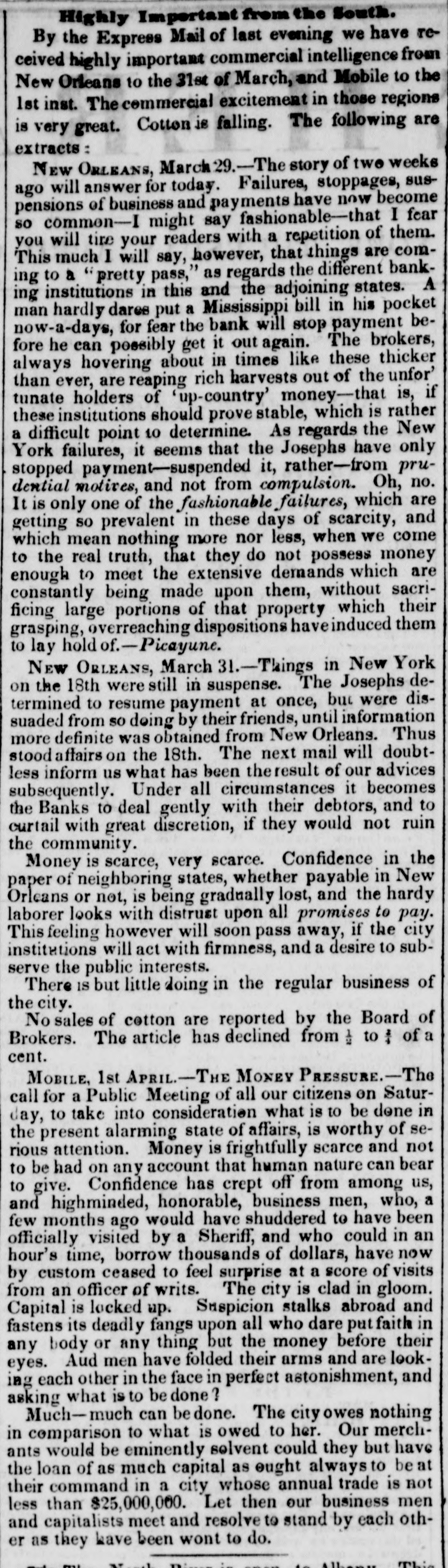
Highly Important from the South. By the Express Mail of last evening we have received highly important commercial intelligence from New Orieans to the 31st of March, and Mobile to the 1st inst. The commercial excitement in those regions is very great. Cotton is falling. The following are extracts : NEW ORLEANS, March 29.-The story of two weeks ago will answer for today. Failures, stoppages, suspensions of business and payments have now become so common-I might say fashionable-that I fear you will tire your readers with a repetition of them. This much I will say, however, that things are coming to a "pretty pass," as regards the different bankthis and the adjoining states. A dares a Mississippi for fear the stop ing now-a-days, man institutions hardly in put bank will bill in payment his pocket before he can possibly get it out again. The brokers, always hovering about in times like these thicker than ever, are reaping rich harvests out of the unfor' tunate holders of 'up-country' money-that is, if these institutions should prove stable, which is rather a difficult point 10 determine. As regards the New York failures, it seems that the Josephs have only stopped payment-suspended it, rather-from prudential motives, and not from compulsion. Oh, no. It is only one of the fashionable failures, which are getting so prevalent in these days of scarcity, and which mean nothing more nor less, when we come to the real truth, that they do not possess money enough to meet the extensive demands which are constantly being made upon them, without sacrificing large portions of that property which their grasping, overreaching dispositions haveinduced them to lay hold of.-Picayune. NEW ORLEANS, March 31.-Things in New York on the 18th were still in suspense. The Josephs determined to resume payment at once, but were dissuaded from so doing by their friends, until information more definite was obtained from New Orleans. Thus stood affairs on the 18th. The next mail will doubtless inform us what has been the result of our advices subsequently. Under all circumstances it becomes the Banks to deal gently with their debtors, and to curtail with great discretion, if they would not ruin the community. Money is scarce, very scarce. Confidence in the paper of neighboring states, whether payable in New Orleans or not, is being gradually lost, and the hardy laborer looks with distrust upon all promises to pay. This feeling however will soon pass away, if the city institutions will act with firmness, and a desire to subserve the public interests. There IS but little doing in the regular business of the city. sales of cotton are reported by the Board of Brokers. The article has declined from 1/2 to I of a cent. MOBILE, 1st APRIL.T-E MONEY PRESSURE.-The call for a Public Meeting of all our citizens on Saturday, to take into consideration what is to be done in the present alarming state of affairs, is worthy of serious attention. Money is frightfully scarce and not to be had on any account that human nature can bear to give. Confidence has crept off from among us, and highminded, honorable, business men, who, a few months ago would have shuddered to have been officially visited by a Sheriff, and who could in an hour's time, borrow thousands of dollars, have now by custom ceased to feel surprise at a score of visits from an officer of writs. The city is clad in gloom. Capital is locked up. Suspicion stalks abroad and fastens its deadly fangs upon all who dare put faith in any body or any thing but the money before their eyes. Aud men have folded their arms and are looking each other in the face in perfect astonishment, and asking what is to be done? Much-much can be done. The city owes nothing in comparison to what is owed to her. Our merchants would be eminently solvent could they but have the loan of as much capital as ought always to be at their command in a city whose annual trade is not less than $25,000,000. Let then our business men and capitalists meet and resolve to stand by each other as they have been wont to do. This


Article from Maumee Express, April 8, 1837

Click image to open full size in new tab

Article Text

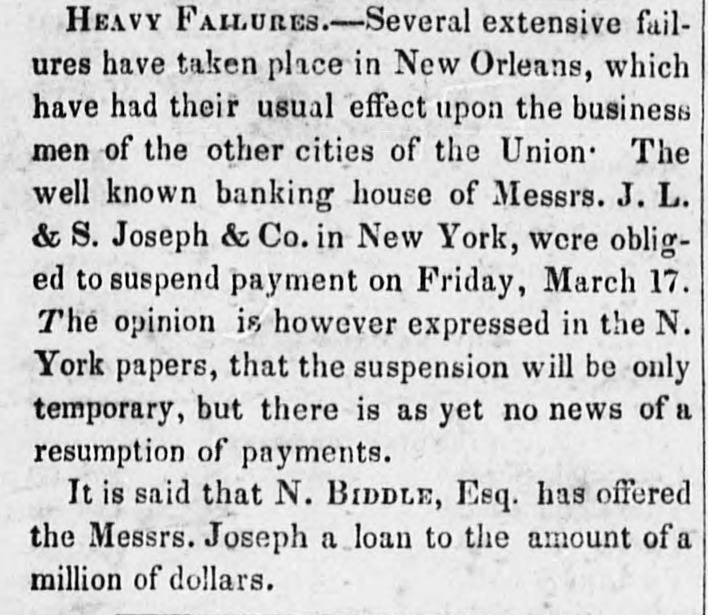
HEAVY FALLURES.-Several extensive failures have taken place in New Orleans, which have had their usual effect upon the business men of the other cities of the Union The well known banking house of Messrs. J.L. & S. Joseph & Co. in New York, were obliged to suspend payment on Friday, March 17. The opinion is however expressed in the N. York papers, that the suspension will be only temporary, but there is as yet no news of a resumption of payments. It is said that N. BIDDLE, Esq. has offered the Messrs. Joseph a loan to the amount of a million of dollars.


Article from Constantine Republican, April 12, 1837

Click image to open full size in new tab

Article Text

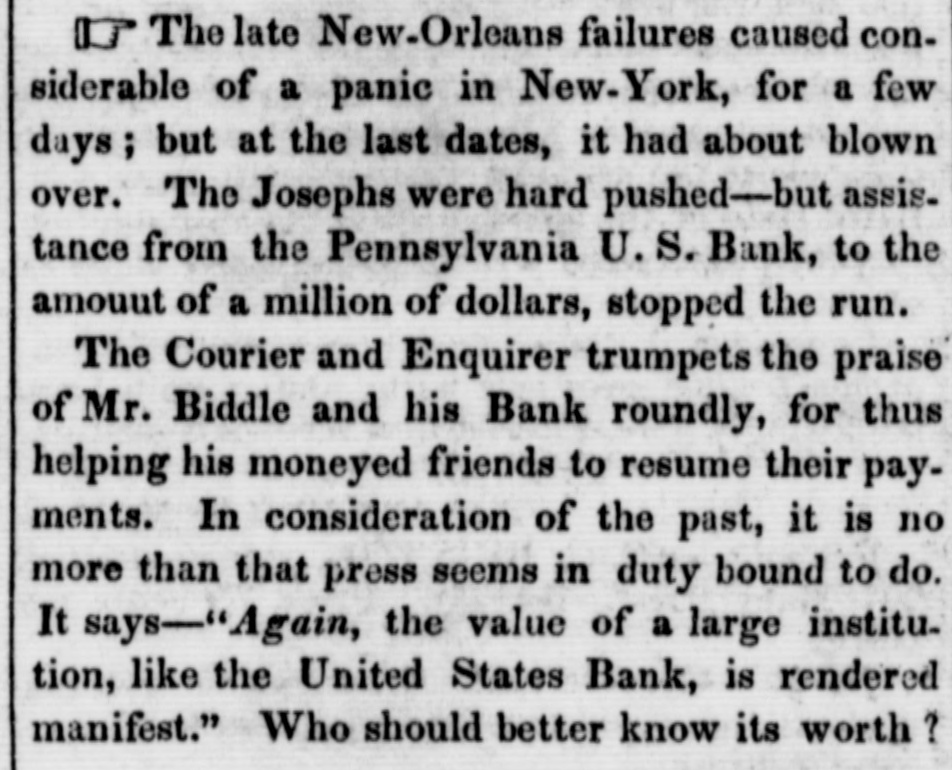
I The late New.Orleans failures caused considerable of a panic in New-York, for a few days; but at the last dates, it had about blown over. The Josephs were hard pushed-but assis. tance from the Pennsylvania U.S. Bank, to the amount of a million of dollars, stopped the run. The Courier and Enquirer trumpets the praise of Mr. Biddle and his Bank roundly, for thus helping his moneyed friends to resume their payments. In consideration of the past, it is no more than that press seems in duty bound to do. It says-"Again, the value of a large institution, like the United States Bank, is rendered manifest." Who should better know its worth ?


Article from The Arkansas Advocate, April 17, 1837

Click image to open full size in new tab

Article Text

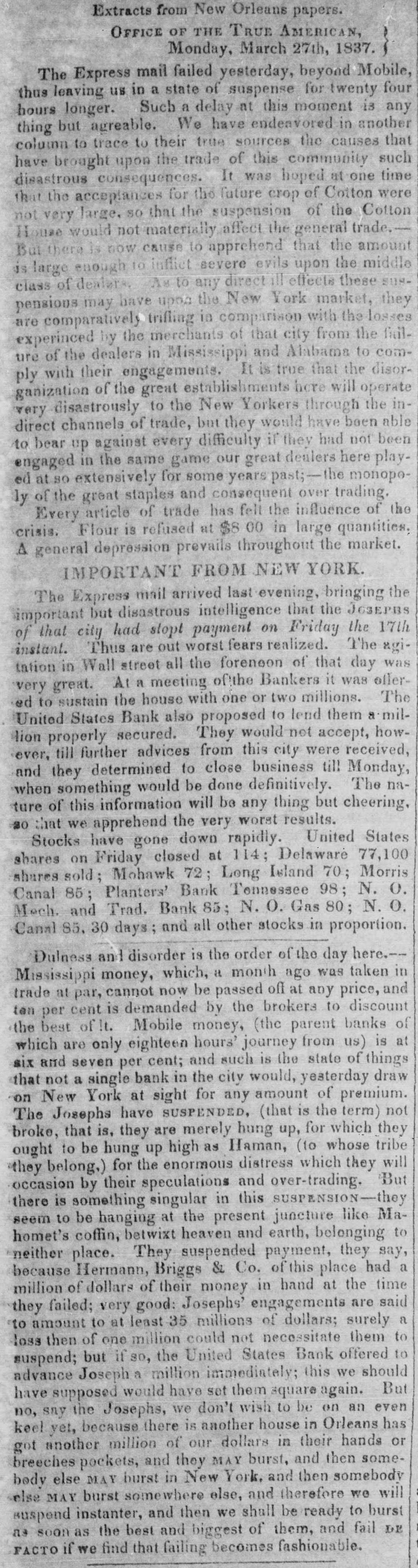
Extracts from New Orleans papers. OFFICE OF THE TRUE AMERICAN, Monday, March 27th, 1837. The Express mail failed yesterday, beyond Mobile, thus leaving us in a state of suspense for twenty four hours longer. Such a delay at this moment is any thing but agreable. We have endeavored in another column to trace to their true sources the causes that have brought upon the trade of this community such disastrous consequences. It was hoped at one time that the acceptances for the future crop of Cotton were not very large. so that the suspension of the Cotton House would not materially affect the general trade.But there is now cause to apprehend that the amount is large enough to inflict severe evils upon the middle class of dealers As to any direct ill effects these suspensions may have upos the New York market, they are comparatively trifling in comparison with the losses experinced by the merchants of that city from the fill ure of the dealers in Mississippi and Alabama to comwith true disoroperate ply ganization their of the engagements. great establishments It is here that will the very disastrously to the New Yorkers through the indirect channels of trade, but they would have been able to bear up against every difficulty if they had not been engaged in the same game our great dealers here played at so extensively for some years past;-th monopoly of the great staples and consequent over trading. Every article of trade has felt the influence of the crisis. Flour is refused at $8.00 in large quantities, A general depression prevails throughout the market. IMPORTANT FROM NEW YORK. The Express mail arrived last evening, bringing the important but disastrous intelligence that the JOSEPBS of that city had slopt payment on Friday the 17th instant. Thus are out worst fears realized. The agitation in Wall street all the forenoon of that day was very great. At a meeting of the Bankers it was offered to sustain the house with one or two millions. The United States Bank also proposed to lend them a million properly secured. They would not accept, however, till further advices from this city were received, and they determined to close business till Monday, when something would be done definitively. The nature of this information will be any thing but cheering, 20 that we apprehend the very worst results. Stocks have gone down rapidly. United States shares on Friday closed at 114; Delaware 77,100 shares sold: Mohawk 72; Long Island 70; Morris Canal 85; Planters' Bank Tennessee 98; N. O. Mech. and Trad. Bank 85; N. O. Gas 80; N. O. Canal 85, 30 days ; and all other stocks in proportion. Dulness and disorder is the order of the day here.-Mississippi money, which, a month ago was taken in trade at par, cannot now be passed off at any price, and tan per cent is demanded by the brokers to discount the best of !t. Mobile money, (the parent banks of which are only eighteen hours' journey from us) is at six and seven per cent; and such is the state of things that not a single bank in the city would, yesterday draw on New York at sight for any amount of premium. The Josephs have SUSPENDED, (that is the term) not broke, that is, they are merely hung up, for which they ought to be hung up high as Haman, (10 whose tribe they belong,) for the enormous distress which they will occasion by their speculations and over-trading. But there is something singular in this suspension-they seem to be hanging at the present juncture like Mahomet's coffin, betwixt heaven and earth, belonging to neither place. They suspended payment, they say, because Hermann, Briggs & Co. of this place had a million of dollars of their money in hand at the time they failed; very good: Josephs' engagements are said to amount to at least 35 millions of dollars; surely a loss then of one million could not necessitate them to suspend; but if so, the United States Bank offered to advance Joseph a million immediately; this we should have supposed would have set them square again. But no, say the Josephs, we don't wish to be on an even keel yet, because there is another house in Orleans has got another million of our dollars in their hands or breeches pockets, and they MAY burst, and then somebody else MAY burst in New York, and then somebody else MAY burst somewhere else, and therefore we will suspend instanter, and then we shall be ready to burst as soon as the best and biggest of them, and fail DE FACTO if we find that failing becomes fashionable.


Article from Rutland Herald, March 28, 1838

Click image to open full size in new tab

Article Text

From the Boston Daily Times. Great Failure in New York. The New York papers of the 17th and 18th, bring intelligence that the extensive Banking house of Messrs J. L.. and S. Joseph & Co stopped payment on Friday. The news created great excitement and alarm in Wall street, and caused an almost entire suspense of business. Stocks immediately fell from 5 to 10 per cent, and the whole financial operation of the city were thrown into complete disorder and confusion. The failure was occasioned by the stoppage of the houses of Herman & son. Herman & Brigge, and T. a GU, or New Orleans, whose lia. bilities were held by the Messre Josephs, to the A mount of twelve hundred thousand dollars. The news reached Philadelphia on Tuesday, and Mr Biddle, knowing how extensively the Messra Jc. sephs were interested. immediately forwarded them an offer of $1,000,000, on satisfactory security. The managers of several of the banking institutions in New York held a consultation upon the subject and agreed to loan them from 12 to $1,500,000 to enable them to meet their engagements. There facts being made known to the Mesara Josephs, they at once determined to go on, and a bulletin appeared in Wall street on Friday evening, amount cing that they should resume payments on Saturday morning. A meeting of their friends, how. ever, was subsequently held, and they were ut. gently advised to defer the resumption of business until some further advices should be received from the south, as the express mail of Saturday was ex. pected to bring more definite and satisfactory in. telligence. Up to 12 M, on Saturday, it was confidently believed that they would recommence bu. siness on Monday, (this day) but at the time of the boat's leaving, (3 P M, it was rumored that the suspension would continue for the present Whether this last Tumor was occasioned by the receipt of further intelligence from the south, is not known.


Article from The New York Herald, June 7, 1858

Click image to open full size in new tab

Article Text

Mirs Emma Stapley gave her wonderful and entrancing performance of the Neven Ages of Woman," also full and appreciating audience. City Intelligence. FIRE IN BIGHTEENTH STREET FIVE HORSES AND ONE COW BURNED TO DEATH. Shortly before three o'clock on Saturday morning, a fire broke out in a three story brick building situate at Nos. 293 and 295 East Eighteenth street, between avenues A and B. The building was totally destroyed, together with a two story brick building adjoining. The three story building was owned and occupied by Charles A. Doughty, carpenter and builder. The estimated value of the building is about $1,500; on this there was an insurance of $1 200, divided between the St. Nicholas and Pacific Insurance Companies. This insurance included the stock on the premises. Attached to the carpenter sho were stables to which Mr. Doughty had one horse and cow, and six borses stabled by Zieder & Herr, screengers; out of this number only two horses were extricated. Mr. Doughty lost his horse and cow, and Zeider & Horr four horses. The two story building was oweed by Mr. IcDormick and occupied by Burroughs & Bain, staircane builders loss S will amount Their about is Ad: 600; insurance. joining the two two story building was a one story frame and owned snuff occupied by Disney Cappel manufacturer. Bis stock was damaged to the amount of $66; no insurance In the rear of the latter premises E. Hunt kept wood yard and manufactured kindlings. Loss about $75; said to be insured. It was rumored that the fire was the work of an incomdiary as two boys were seen to jump over the fence from the carpenter shop at the time the fire broke out. The Fire Marabal was early at the premises, and, aided by the police of the Eahter ward, went into an immediate in vestigation One of the boys who is said to have jumped over the fence in question the Marshal directed to be sent to the station house, there to await an examination. There seems to be but little doubt that the fire was the wilful act of some ODE, but whether the boys are the guilty parties is matter yet to be developed. CHURCH OF THE HOLY BEDEEMER, THIRD STREET The NOTvices in the above church were peculiarly interesting rday, yesterday, and high mass was celebrated by the Germans with great pomp and solempity. The Rev. William Wyrich, C. S3 R a native or this city, having been or. dained prieet on the 29th ust in Baltimore, celebrated his first mass. and from the fact that be is the first priest given to the church by the above parish, the attendance WSB unusually large. From an early hour the chapel was depsely crowded by Germats, and when the services comm commenced a large number were obliged to remain outside, being unable to obtain admission The church was testefully decorated with flowers, and the lighted candles on the altars, together with the uniforms of the guard" attached to the church who occupied seats before the alter presented an imposing and solemn spectacle After the mass Father Holson delivered an eloquent ser mon in the German language, in which he feelingly alluded to the accession of Mr. Wyrich to the priesthood, and the religious feeling which was manifested by the parish DEATH OF JOSEPH L. JOSEPH.-Previous to the panic of 1837 the banking house of Joseph Brothers was reported to be the wealthiest in this country. Certain it is that their operations ns were on a most extensive scale, and their l'abilities when they failed were counted by millions. of the the were this in Rothschilds Josephs agents country, and 80 unbounded was their credit that when failure their the came did crash 3 the more precipitate great panic of 1837 than any other one event of the time. In their failure fact, similar and : to, very produced pretty much the same effect as did that of the Ohio Life and Trust Company, in 1857 The house occupied by the stood Josephartood OD the same lot as the house now occupied by Brown Brothers & Co ; and what was a gular, the bouse, which was new, fell a few days before the firm did commercially. The fall took place at midnight, and no one was injured. On Saturday last, it was announced that Joseph L. Joseph, who was the head of this cnce great banking firm, was dead. Since the failure the brothers have pursued various occupations, but have never been heard of as bankers. There were several of them, and they are all understood to be poor. THE DIFFICULTY AT ZION'S COLORED CHURCH in Sixth street is not yet adjusted, and there is likely to be much trouble before it is. On last Friday evening high words passed between the brethren, and on Saturday complaints were made before Justice Brennan, and warrants issued for the arrest of several of the al eged disturbers. Rev. Mr Till man still keeps possession of the pulpit, and as the majoof the the other him, sustain rity ngregation preacher, Rev. Mr. Coleman, " can't come in." The former pastor occupied the pulpit yesterday morning and evening. STABBING AFFRAY ON THE FIVE POINTS POINTS-Farly Early on Sun day morning two men, named Timothy J. Sullivan, living at No. 9 Mulberry street, and Patrick Shay, of No. 5 Mis sion place, got into a fight together on the Five Points, when the former drew a knife and stabbed his adversary in the face, inflicting a severe wound. Sullivan was promptly arrested by the Sixth ward police, and commit Justice ted for Osborne ! S trial. by Shay conveyed the New York Hospital. SERIOUS AFFRAY -About two o'clock on Sunday morn ing a collision took place between some young men who were walking down the Bowery and others who were go ing ing up. A fight ensued, and one of the party, named James Quinn residing at 145 Forsyth street, was stabbed the thigh and cheek. but not dangerously. His wounds were dressed by Dr. Wells, after which he was conveyed to his residence. THE DANCES OF ALL NATIONS-Mra. Kate Luby, at her academy in Bleecker street, delivered, the other evening, a delighted audience, a learned and interesting lecture "on the dances of all nations." Her descriptions of the various dances of civilized, semi civilized and savage countries were very Instructive and suggestive, even to the historical student, and the moral applied by the ac. complished lecturer was certainly very encouraging to the profession. The contended that the exercise of dan cing developed the physical frame; that from the earliest times the pations most celebrated for their dances were a 80 the most distinguisbed for their warriors; and that in our OWD day the pations the most ivanced in civiliza = the the and and also tion arts most of are was, peace and celebrated for their accomplishments in dancing. The lecture was followed by a hop, involving twenty different dances by the company Mrs Luby bails from the " old eod," and in this effort to show that her native Ireland "could do some things as well as others," she achieved a decided success. DESCENT UPON AN IMPROPER HOUSE Housa-The Tenth ward poLice on Saturday night made a descent upon an alleged resort of thieves, abandoned females and others, keg) by le . will Essex and arrest German. one Heniger, street, ed the proprietor and twenty five males and females The prisoners were taken before Justice Breanan. who locked up the most of them, and discharged the others with reprimand. Honiger was held to answer the charge of keeping a disorderly house. FIRE IN AVENUE B.-About two o'clock on Saturrday morning a fire broke out in the cabinet shop in the rear of No. 226 Avenue B, owned by Sebastian Fredericks. The firemen promptly extinguished the fire. The damage done to the stock will be about $30; no insurance. The building is owned by George Gould. It is damaged about $160, and is insured for $300 in the City Insurance Compamy. The fire originated in the privy, and was no doubt the work of an incendiary. FIRE IN BROADWAY.-Shortly before 10 b'clock on Satur. day night, a fire was discovered in the range factory of Cornell & Budd, No. 886 Broadway, in the basement. The firemen were promptly at the premises and extinguished the fire. The damage done was trifling. FIRE IN CBRYSTIR STREET.-About 8 o'clock on Sunday morning a fire broke out on the roof of the frame building No. 147 Chrystie street. It was soon extinguished; damage about $10. Insured in the Stuyvesant Insurance Company, and owned by Wm Van Wort. Some slight damage was done by water to the furniture of the occu floor The . milk depot first occupied pants. by Charles Kubn: stock damaged by water about $6. Insured for $300 in the Astor Insurance Company. The fire originated from a defect in the chimney flue. FIRE IN HUDSON STREET.-Between seven and eight o'clock last evening the alarm for the Eighth district was caused by a fire breaking out in the carpenter shop belonging to Albert Cheeseborough and H. M. Smith situated at No. 20 and 32 Hudson street. The firemen were very quickly at work and subdued the flames before they the originated the fire which to building beyond spread


Article from New-York Daily Tribune, June 7, 1858

Click image to open full size in new tab

Article Text

Joseph L. Joseph died at his residence in this city on Friday, aged 61. Mr. J. was the senior partner in the great banking-house of J. L. & S. Joseph, which, in 1836, was the most extensive establishment of the kind in the country. It was the first leading house that went down in the panic of the succeeding year, and its fall created an intense excitement, far mere than the failure of the Ohio Life and Trust Company last season. Mr. J. had not recently been in business.


Article from New-York Daily Tribune, June 7, 1858

Click image to open full size in new tab

Article Text

AMUSEMENTS.-Burton's Theater.-Mr. Burton comes to the rescue in propria persona to-night, and appears in the comedy of Turning the Tables." The ballet troupe also appear in three pieces, "The Two Hypocrites," The Painter's Illusion," and The Village Apothecary." Laura Keene's Theater.-Mrs. Bowers abdicated in favor of Mr. Sothern, who announces as his first star, Mrs. Matilda Heron Staepel. She will enact the heroine in & play entitled "Mathilde," for the first time, to-night. She will be supported by Mr. Sothern and an efficient company. Niblo's Garden.-This is the last week but one of the Ravel Family. They appear to-night in Pongo," and in the funny pantomime of "M. Duchalumeau." Wallack's Theater.-" Deseret Deserted" is still the attraction here, and will be played every night this week. Bowery Theater.-Three plays to-night: The "Scalp-Hunters," Harvey Birch," and The FireRaiser." Purdy's National Theater.-Three pieces are also anrounced here: The Roman Traitor," the Red Gnome and White Warrior," and the Dumb Sailor Boy.' Barnum's American Museum.-Mrs. Kate Denin Ryan appears here to-night for the first time. She will play in the beautiful drama of "Two Loves and a Life." Wood's Minstrels.-A panorama of the Hudson, from the Battery to Newburgh, is to be added to the customary attractions here, for the first time this evening. Bryant's Minstrels.-An farce is to be done here; it is called Darkey Assurance," and the characters are by Jerty and Dan Bryant. Other entertainments, of course. Peel's Minstrels.-Songs, dances, and the capital farce of "The Virginia Mummy," are the attractions here this week. YOUNG MEN'S REPUBLICAN GENERAL COMMITTEE. -This Committee met on Friday evening at the Republican Headquarters, Broadway, and fully organiby the choice of the following other of permanent officers: Vice Presidents-Henry C. Boyd, Thirteenth Ward; Richard Wynkowp, Secretaries-John Fifteenth Ward. J. Shaw, Eighth Ward; Wm. M. Wade, Fourteenth Ward. Treamver-Erasmus Sterling Sergeant-at-Arms-Charle= Missing, Twentieth Ward. A series of resolutions (introduced by Mr. McLeod of the Sixteenth Ward) approving of the action of the Republican Senators in reference to the British outrages, were tabled by a large majority, members being almost unanimously of the opinion that it would be time to act when England shall have approved the conduct of her naval officers in the Gulf. CASE OF CANCEMI.-The third trial of Michael Cancemi, for the murder of Eugene Anderson, is set down for to-day, in the Supreme Court, Circuit. A large number of jurors have been summoned. Joseph L. Joseph died at his residence in this city on Friday, aged 61. Mr. J. was the senior partner in the great banking-house of J. L. & S. Joseph, which, in 1836, was the most extensive establishment of the kind in the country. It was the first leading house that went down in the panic of the succeeding year, and its fall created an intense excitement, far mere than the failure of the Ohio Life and Trust Company last season. Mr. J. had not recently been in business. THE LAST OF A LIBERTY POLE.-The liberty pole at the corner of Franklin street and West Broadway, which has been 80 often used by our city firemen to test the power of their machines, was removed Saturday by order of the Street Commissioner, as it was in 80 shaky a condition that it was feared a good gale of wind would blow it down. This pole was really an old landmark. It was erected in 1834, by the Democrats of the Fifth Ward, during the pending election for Governor of the State, when Seward and Marcy ran for the first time. The next year it was shivered by a stroke of lightning-it however was soon repaired. We learn that the carriage and harness presented to Mr. Fillmore, by his political friends, was sold on Saturday at auction by Mr. A.J. Bleecker for the sum of $391. ANOTHER LARGE ACCESSION TO PLYMOUTH CHURCH. -Yesterday morning about 185 persons joined Mr. Beecher's Church, 160 on profession of faith and 25 by letter. A much larger number than usual were baptized. There was & very large congregation preseut: the pulpit was ornamented with flowers, and the venerable father of the pastor was on the platform. The invitation of the pastor to all who professed to be Christians to participate in the sacrament was accepted by nearly 2,000 persons. The June term of the Court of General Sessions com. mences to-day, before Recorder Barnard. The number of cases to be tried is not unusually large, but the calendar presents no less than six cases of murder. Martin Dowd is to be tried for the murder of John Dooley, Daniel Cunningham for the murder of Paudeen, Paul Hernandez for the murder of his wife, Leroy Rusher for the murder of John McCarthy; & colored man named Hilton for the murder of his wife, or rather of a woman who assumed that relation without the warrant of the law or the church; and Charles O'Riley for the murder of the sailor Williams. The cases of Duffy and Drake for manslaughter, and Finley and the woman Howley for kidnapping & colored girl, will also come before the Recorder. The calendar is as follows: Grand larceny, 31 cases; burglary, 20; forgery, 6; assault and battery, 13; murder, 4; perjury, 6; bighway robbery, 4: false pretenses, 3; throwing witriol, 1; kidnapping, 2; arson, 2; rape, 3; msnslaughter, 2; with seve al other minor offenses making 109 in all. SCHISM IN A COLORED CHURCH.-The congregation composed of colored people worshiping in Zion's Church, Fourth street, on the east side of the city, had quite & time among themselves on Friday night last. It appears that a short time ago the major part of the orgregation held & meeting and by unanimous resolution connection (Congregationalist) and unite with the Methodist Episcopal Conference. Their resolutions were carried out to the letter, and upon due application the Conference appointed a pas.


Article from The Wheeling Daily Intelligencer, August 2, 1872

Click image to open full size in new tab

Article Text

# The Intelligencex. Something About Wall Street. The New York correspondent of the Rochester Democrat contributes the following gossip: "It is eighty years since the merchants of this city instituted a bank, and this being the only one in the city, it was called the 'Bank of New York.' It was placed at the corner of Wall and William streets, and thus attracted finance. The Bank of New York still flourishes. It commenced with one book-keeper and now has a score, and its stock is worth a large premium. As might be expected, it has the old fashioned business men among its patrons, and one of these is Commodore Vanderbilt, whose deposits range from $1,000,000 upwards. The Bank of New York enjoys the distinction of being the centre of all gold operations, and the checks in the gold room are always drawn on this institution. Here the forgeries of Ketchum centred, and from its vaults he drew enormous sums, for which he stoned in the penance of Sing Sing. Wall street has been identified with governmental uses from an early age. The Treasury office employs one hundred clerks, all under charge of the sub-treasurer, who is our chief financial officer. In fact, the chief employment of the Treasury at Washington is, as they say, 'to look after that in New York.' Almost all the government payments and receipts are made here. Every day the gold received at the Custom House for duties is wheeled up to the Treasury in a common hand-cart. The distance is about eight hundred feet, and the amount averages $500,000, The way they handle specie in this institution certainly strikes a stranger as free and easy in the extreme. The bags, containing $5,000 apiece, are tossed to and fro as though they held gravel or brickbats, and the clerks count up $1,000,000 as easily and as rapidly as a retailer counts up his dimes and pennies. The safe is a large room, say 20 feet square and about 15 feet high, with tiers of iron doors about three feet in length, ranging one above the other. These are full of bags containing specie, and at set times they are counted, the surveyor of the port being always present on such occasions. There are about $80,000,000 of gold and greenbacks in store here, and to make the safe burglar proof the space next to the street is filled with musket balls, several thousand in number. Now, if a burglar should get through the outside he would meet this loose mass, which would roll upon him and sufficiently embarrass his progress. The treasury contains a number of experts in detecting base coin. You may place a counterfeit gold piece in a heap of similar coin, and the clerk will close his eyes and pick out the counterfeit by the sense of touch. This man can not tell how he distinguishes the good from the bad. The faculty is indescribable, and can only be acquired by years of practice. "Panics always begin in Wall street. The great pressure of 1837 commenced with the fall of Joseph's banking house. They were reported to be rich, and had just put up an elegant building which cost $15,000, a large sum then. Just as the contractor was about to place the keys into the owner's hand the building fell and the former had to bear the loss, which ruined him. That day the Josephs' failed, and the panic began. Twenty years afterwards (1857) the great panic was commenced by the failure of the Ohio Life and Trust Company, and continued with fearful result for two months, until every business man with few exceptions had failed. Here, too, the gold panic on 'Black Friday' carried its work of destruction, in September; 1869; and should any pressure again take place it would first be felt here. At present, however, there is little prospect of any such disaster. Wall street is full of money, which is let at cheap rates to any man who has security. Take government bonds into any bank and you can get a call loan at four per cent. I presume that a hundred millions might be borrowed in this manner. Money centres here, and all the financial operations of the continent can be manipulated in Wall street. Hardly a railroad is built that does not offer its bonds here, and you can, if you have the means, control any such institution without traveling five hundred feet."


Article from Staunton Vindicator, July 12, 1878

Click image to open full size in new tab

Article Text

A Van Buren Democrat on Mr. Stuart's Letter on Finance. Editors Vindicator. When you published Mr. Stuart's letter on the financial history and prospects of the country, it appeared to me there were important errors in it that should not be allowed to pass unnoticed. Seeing that it has been somewhat extensively published, one must presume it is thought worthy of high consideration. Whether that consideration arises from a belief in its correctness, or merely from a respect for its author; a gentleman to whom we owe a debt of gratitude we can never repay (his services on the reconstruction question,) and for which I would readily forgive all of what I, as a Democrat, might think, the faults and errors of his political life-yet seeing no reply to it, I hope it will not be deemed arrogance in me that I should set up my opinion against so prominent a jurist-an ex-member of Congress and an ex-member of the cabinet. In our country it is the duty of the citizen to think for himself, as well as he can, and not take for gospel the opinions of any man, no matter how high his position or extensive his acquirements. While I would yield to none in admiration of the ability and patriotism of Clay, of Clayton, of Webster and of Crittenden; I dont like to see the ability and patriotism of my political idols Jackson, Van Buren, Benton, Forsyth and Silas Wright, sneered at. They were the men who shaped the legislation, who carried the country though a long and troubled course of years. They were not demagogues, they were not political fanatics. Truly it was an age of giants; we look in vain for their peers to-day. No financial measure ever brought before Congress equalled in importance the Sub Treasury Act, passed in Mr. Van Buren's administration. When the political whirlwind took place that elected Harrison, in 1840 his party could not wait for the regular session, but called an extra. The first thing done, was to repeal the Sub Treasury Act, then they wrangled for months over a Uuited States Bank until compelled to give it up in despair, and Mr. Clay resigned from the senate, disgusted with political life. Mr. Polk was elected in '44, the Sub Treasury was quietly restored and from that day to this no voice has been raised against it. Mr. Stuart says that the veto of the United States Bank by Gen. Jackson, the removal of the deposits to the State Banks, and the increased issues of those banks by reason of holding the government moneys, at length opened the eyes of congress.: that congress in '36 seeing all this, created the Sub-Treasury system, which was the crowning act of all the measures that produced the crash of May, '37. When Mr.Stuart wrote his letter he had the authorities at his elbow to refer to-I have nonΓ© but my memory and that nothing to boast of but I'll risk it against his statement. In 1836 the democrats had ne thought of removing the government moneys from the State banks, or of a Sub Treasury. Mr. Van Buren, was elected in '36, took office March 3, '37. A few weeks after, the extensive banking house of the Josephs in New York went down, a few days more the U. S. Bank suspended, immediately all the banks in the United States suspended. In the winter of '37, 6 months after the suspension, Mr. Van Buren in his message proposed an entire separation of the government from all banks that the government should recognize gold and silver only as money, that this change should be gradual but complete in 5 years. A measure so extraordinary startled the whole country, Whigs and Democrats alike. It was most violently opposed by the whole banking interest and all whom they could influence, nine-tenths of the Democrats who were holders of banking stock went over to the enemy. That was the real cause of Van Buren's defeat in 1840. the sole cause, all other causes were as nothing. The Sub Treasury act was passed after a most bitter struggle, I think in '39, and I think it required that after 12 months from its passage one-fourth of all sums due the government should be paid in gold or silver, after 24 months one half, after 36 three-fourths, and after 48 all in gold or silver. So that all things considered I can't see that the sub treasury bill had more to do with causing the crash of May, 1837, than it had in causing the war of 1812. In my opinion congressional legislation had nothing to do with that crash. It was the natural and inevitable result of other causes, over which congress had no control. It might be useful and interesting, but there is neither time no space to consider it now. Mr. Stuart in his letter puts the circulation of 1865 at $1,800,000,000 and goes on to say that in the thirteeen intervening years it has been reduced to $700,000,000 and that this is the cause of the present hard times. Here, with all respect for Mr. Stuart, I must say is gross error. The circulation at the close of the war was not even $700,000,000. The $85,000,000 certificates of debt were certificates given daily by quartermasters and other agents of the government for supplies furnished; they were of every imaginable sum, from $55,29 up or down. They were cashed at government offices, generally within a month of their date. If the holder of the certificate wanted his money and couldn't wait he took it to a broker or to any one who had money lying idle and sold it for 1 or 2 per cent. discount as they might agree. They had no fixed, positive value, (they were nothing more than A. B's note of hand to C. D. of $59,62 for a horse, payable about a month after date.) Consequently they never at any time entered into circulation as money. I suppose during the war their issue might have been $1,600.000,000. They were generally paid within a month of their date, some of them given after the surrender, and no doubt the last dollar of them cashed within two months after the surrender. The $217,000,000 compound interest legal treasury notes issued during the early part of the war never circulated -put away for the interest, more precious than gold, as gold did not pay interest. Consequently there wasn't a dollar of that issue in circulation in 1865. The $810,000,000 of 7.30 notes did not differ much from a government bond of to-day, and never at any time appeared in circulation, any more than a U. S. bond does to-day. I question if more than one man in ten thousand ever saw one of them. The real circulation at the close of the war was 2636,000,000, and no more. These $1,100,000,000 of which Mr. S. speaks were not in circulation as money.