First National Bank (Ocala, FL)

Episode Information

Episode UID
347001144
Episode Type
Run โ†’ Suspension โ†’ Closure
Bank Type
national
Bank ID
34700 national
Charter Number
3470
Start Date
April 20, 1895
Location
Ocala, Florida (29.187, -82.140)

Metadata

Model
gpt-5-mini (chosen from majority vote of a three-model LLM ensemble)
Short Digest
a8f7b89a103eff29

Response Measures

Accommodated withdrawals, Capital injected, Full suspension, Books examined

Receivership Details

Depositor recovery rate
28.2%
Date receivership started
1895-04-22
Date receivership terminated
1899-06-30
OCC cause of failure
Fraud
Share of assets assessed as good
43.9%
Share of assets assessed as doubtful
33.2%
Share of assets assessed as worthless
22.9%

Description

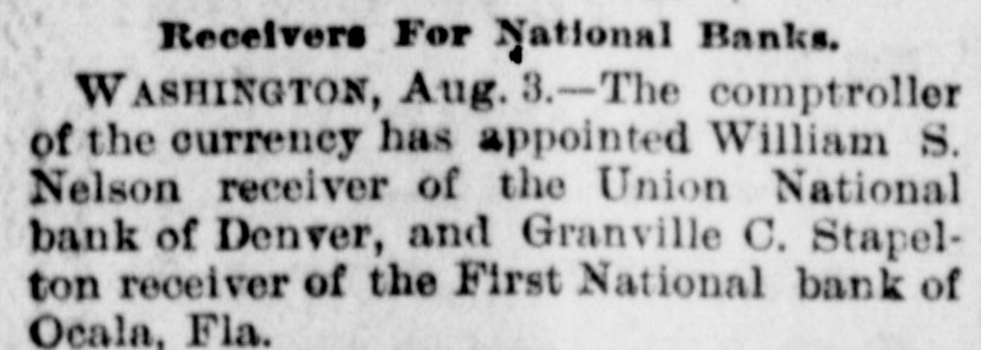
Controller Eckels closed the bank (comptroller action) and a receiver was later appointed Aug 3, 1895.

Events (5)

1. March 16, 1886 Chartered
Source
historical_nic
2. April 20, 1895 Run
Cause
Bank Specific Adverse Info
Cause Details
Large withdrawals triggered by reports of insolvency and impaired capital from bad loans; correspondent refused aid.
Measures
Offers of outside capital were tendered (e.g., $50,000 offer) but too late; directors notified comptroller.
Newspaper Excerpt
within the last seven days $17,000 in currency was paid out over the counter.' ... reports were vigorously set afloat over the state of the insolvency of the bank.
Source
newspapers
3. April 20, 1895 Suspension
Cause
Government Action
Cause Details
Closed by the Comptroller of the Currency and placed in charge of a bank examiner after capital impairment from bad loans and heavy withdrawals.
Newspaper Excerpt
Controller Eckels to-day closed the First National Bank of Ocala, Fla., and placed it in charge of Bank Examiner McDonald.
Source
newspapers
4. April 22, 1895 Receivership
Source
historical_nic
5. August 3, 1895 Receivership
Newspaper Excerpt
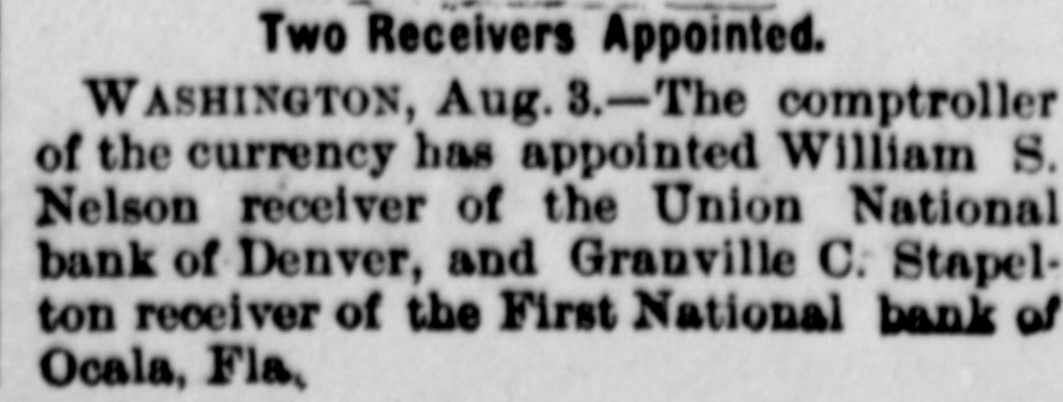
the comptroller of the currency has appointed ... Granville C. Stapelton receiver of the First National bank of Ocala, Fla. (Aug. 3, 1895 reports).
Source
newspapers

Newspaper Articles (22)

Article from The Morning News, April 21, 1895

Click image to open full size in new tab

Article Text

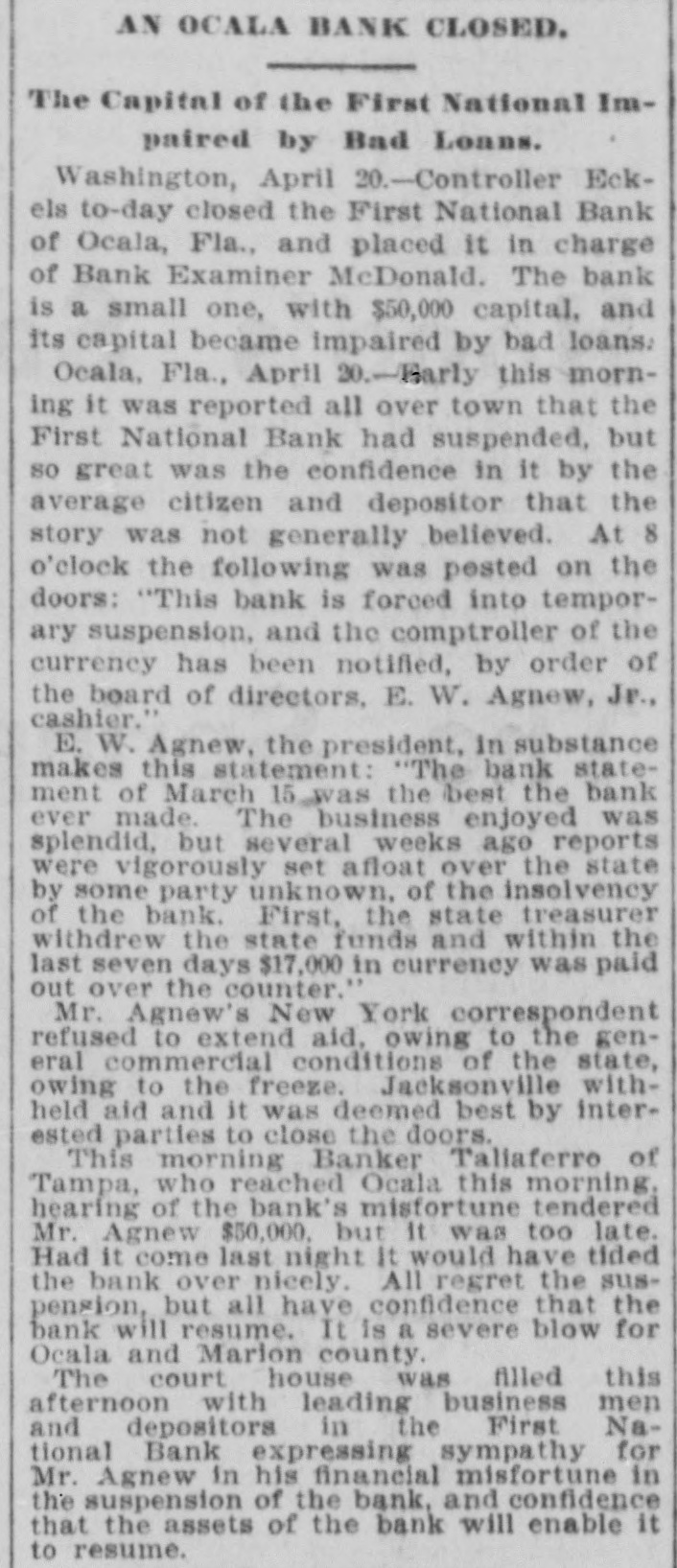
AN OCALA BANK CLOSED. The Capital of the First National Impaired by Bad Loans. Washington, April 20.-Controller Eckels to-day closed the First National Bank of Ocala, Fla., and placed it in charge of Bank Examiner McDonald. The bank is a small one, with $50,000 capital, and its capital became impaired by bad loans: Ocala, Fla., April 20.-Harly this morning it was reported all over town that the First National Bank had suspended, but so great was the confidence in it by the average citizen and depositor that the story was not generally believed. At 8 o'clock the following was pested on the doors: "This bank is forced into temporary suspension, and the comptroller of the currency has been notified, by order of the board of directors, E. W. Agnew, Jr., cashier. E. W. Agnew, the president, in substance makes this statement: "The bank statement of March 15 was the best the bank ever made. The business enjoyed was splendid, but several weeks ago reports were vigorously set afloat over the state by some party unknown, of the insolvency of the bank. First, the state treasurer withdrew the state funds and within the last seven days $17,000 in currency was paid out over the counter.' Mr. Agnew's New York correspondent refused to extend aid, owing to the general commercial conditions of the state, owing to the freeze. Jacksonville withheld aid and it was deemed best by interested parties to close the doors. This morning Banker Taliaferro of Tampa, who reached Ocala this morning, hearing of the bank's misfortune tendered Mr. Agnew $50,000. but It was too late. Had it come last night It would have tided the bank over nicely. All regret the suspension, but all have confidence that the bank will resume. It is a severe blow for Ocala and Marion county. The court house was filled this afternoon with leading business men and depositors in the First National Bank expressing sympathy for Mr. Agnew in his financial misfortune in the suspension of the bank, and confidence that the assets of the bank will enable it to resume.


Article from The Morning News, April 23, 1895

Click image to open full size in new tab

Article Text

AGNEW SELLS HIS BUSINESS. A SURPRISE IN CONNECTION WITH THE BANK CRASH, The Action Said to Have Been Taken to Protect New York Creditors and Avoid Complications at Ocala-A One-Third Interest Sold to H. B. Masters of New York for $105,000. The Other Two-Thirds Conveyed to W. H. Couch. Ocala, Fla., April 22.-The community was surprised this morning to find that E. W. Agnew & Co. had sold their merqantile business to H. B. Masters of New York for $105,000, including stock, notes and accounts, and the other personal property of the firm, including a onethird interest in the storeroom and warehouse at the Florida Central and Peninsular railroad crossing. A notice was posted in the windows announcing this fact and that the services of B. A. Weather had been temporarily secured as manager. Mr. Weathers was the junior member of the firm of E. W. Agnew & Co. This action caused much talk, and many were the gratuitous comments and surmises. The sale was made to protect the New York creditors and prevent complications arising from the First National Bank's suspension, as E. W. Agnew, the senior member of the mercantile firm, was also president of the bank. It will also assist the bank, as many of the country merchants are debtors to the firm and bank, and the new management will greatly assist them in cancelling their obligations with the bank. The new proprietor is one of the oldest and best known merchandise brokers in New York. He enjoys the respect and confidence of the business world of the metropolis and holds a high position in the military and social world, backed by @ fat bank account. He has been E. W. Agnew & Co.'s New York broker since the war. The town was full of country people to-day, who came to see about the suspended bank and what show there was for their deposits. Generally speaking, they returned home satisfied that they will get 100 cents on the dollar. Speculators are buying deposit accounts on the bank for 50 cents on the dollar. Citrus county sent up a big delegation. Their county treasurer has $6,000 of county money in the bank and it is satisfied will come out again to Citrus county. A party from Citrus county offered a deposit of $1,900 for $1,000 in cash and when the party tendered the cash he backed out. Bank Examiner McDonald has arrived and is examining the bank. The feeling is more hopeful to-night among depositors. Saturday a deed was filed conveying to W. H. Couch a two-thirds interest in the business here of E. W. Agnew & Co., and the same interest in the warehouse. The deed was given in 1893, but was held in reserve.


Article from Morris Tribune, April 24, 1895

Click image to open full size in new tab

Article Text

the agreest previous week. The increase, compared with the corresponding week in 1894. was 1.3. WILLIAM CRAMER, about 30 years of age, shot and fatally wounded his divorced wife at Decatur, Ill., and then killed himself. SIR BELIVERE, the champion St. Bernard and one of the most famous dogs in the world, owned by Capt. S. A. Pratt, and valued at $20,000, died at Little Rock, Ark. THROUGH undervaluation of imported goods at the port of New York it was said the government would lose over $100,000. SIXTY business houses at Ardmore, I. T., were destroyed by fire, the total loss being $600,000. THERE were' 241 businessfailures in the United States in the seven days ended on the 19th, against 207 the week previous and 219 in the corresponding time in 1894. A CYCLONE sweptaway twenty houses at Matties Landing, Ala., and killed three persons. FIRE in the building in Philadelphia occupied by the New York Biscuit company caused a loss of $300,000. BALDWIN BROS. & Co., brokers at Boston, with branch offices in over fifty New England cities and in New York, suspended with liabilities of over $500,000. PATRIOTS' day, the anniversary of the battle of Lexington, was generally observed throughout New England. THORNTON PARKER (colored) was hanged at Westchester, Va., for assault on Mrs. Melton, and Frank Fuller (also colored) was hanged at New Orleans, La., for murdering Henrietta Gardner. FIVE HUNDRED garmentworkers went on a strike at St. Louis against the sweating system. THE Furnas county bank at Beaver City, Neb., closed its doors with liabilities of $27,000. JOHN B. THOMAS, late editor of the Mount Vernon (Ind.) Republican and a cripple, left Evansville to go round the world in a wheel chair in two years without a cent of money except what he earns on his way. MRS. DELIA T. S. PARNELL, 80 years of age, mother of the late Charles Stuart Parnell, was murderously assaulted by highwaymen near Bordentown, '[ N HARRY BLAKE, Patrick Harvey and William Hardpke were killed and John Conly and J. J. Hand were fatally injured by the collapse of hoisting machinery in the Chicago Ship Building company's yards at South Chicago. JUDGE EVERETT, of the superior court at Lafayette, Ind., in the case of Helen M. Gougar, decided that women were not entitled to the right of suffrage in Indiana. THE National Union of Heavy Hardware Dealers began its annual meeting in Louisville, Ky. THE percentages of the baseball clubs in the National league for the week ended on the 20th were: Boston, 1.000; Cincinnati, 1.000; Pittsburgh, .667; Chicago, .667; New York .500; Brookyn, .500; Baltimore, .500; Philadelphia, 500; St. Louis, .333; Louisville, .333; '000' :000* A TRAIN on the Philadelphia & Readng railroad struck a wagon containng Mr. and Mrs. Henry Frank, aged 2 and 65 respectively, near Richland, Pa., and both were instantly killed. THE Chicago Times-Herald and the Chicago Evening Post were purchased Rohnsant "H "H "W Aq THE forty-second regular session of the Wisconsin legislature adjourned sine die. THE First national bank of Ocala, Fla., closed it doors. LAKESIDE, a summer resort on Pewaukee lake, about twenty miles east of Milwaukee, was destroyed by fire. DURING a storm at Fort Worth, Tex., a portion of the roof of the tabernacle rave way and fell on part of an audince of 10,000 listening to Evangelist Dwight Moody, fifty persons being inured. MATTHEW CALLOWAY, a negro who nurdered Jim Walters (colored) at Santa Fe in July last, was executed at Columbia, Tenn. JULIUS and Ernst Haefelin and John Miller were drowned in the Delaware river at Philadelphia by the upsetting f a boat. HENRY A. SHIRLEY and James S. Amerton, English capitalists, were irowned south of San Antonio, Tex. HENRY WILLIAMS, of Hillsboro, Tex., killed his wife because she refused to ret up and make breakfast and then oisoned himself. ALL persons using profane or vulgar anguage on the streetsof McKeesport, 'a., will be arrested by order of the nayor. AFTER serving continuously in the ervice of the United States for period f forty-three years, Maj. Gen. Alexnder McDowell McCook retires from he army, the age of 64 years having een reached.
Article from The Morning News, May 15, 1895

Click image to open full size in new tab

Article Text

OCALA'S BANK CRASH. The Creditors in Favor of Giving It a Chance to Resume. Ocala, Fla., May 14.-The depositors of the First National Bank met this afternoon in Knights of Pythias hall, which was crowded. H. W. Long was made chairman and T. T. Munroe secretary. Dixon Grovine stated the object of the meeting to be to confer with the stockholders about resumption, and to assist in the same. Judge W. S. Bullock spoke for the stockholders and especially for E. W. Agnew, and as a depositor, said he was not an applicant for the receiver's position, and the stockholders did not want one appointed. A. receiver meant the destruction of every depositor's interest. When Bank Examiner J. K. McDonald took charge the officers of the bank become dead. The examiner acted for the stockholders. A statement was not yet ready and he could not say when it would be. This was in the discretion of the examiner. It might be a day, it might be ten, no one would know its contents. The examiner could not even intimate what it would be. It would take a week from the time the controller received the examiner's report until it was made public. Then those interested could say if the bank should go on. He was authorized to say Mr. Agnew had offers of help from several parties if the examiner's report was favorable, which would mean a new organiztion, new officers and fresh capital. Bank Examiner McDonald was highly spoken of as a man and an official. He opposed the appointment of a receiver until the inevitable come, as it would take him three or four years to complete his work. Col. Edward Spencer moved that the meeting adjourn until the last Wednesday in May, but at the request of B. Arentz, Mr. Spencer withdrew his motion and Mr. Arentz substituted one which said it was the sense of the depositors present that if the bank can resume that the depositors will give all the time needed. One man shouted "Five years, if Agnew wants it." The resolution passed. Joseph A. Horns said he had known Mr. Agnew since he was a boy, that no one knew the financial condition of the creditors of the bank as Mr. Agnew did. and he was willing to let him be the judge of their likelihood to pay. Mr. Agnew was called for and said the day the bank closed it owed $235,000. If reasonable time was given for the assets of the bank to be collected he had no doubt that after paying off all the depositors there would be a surplus of $100,000. He thought, in case of resuming payment to depositors could be made in eight installments, say three months apart, though it might not require six months to do this. He then reiterated Judge Bullock's statement about help and reorganization. Judge Bullock said the proceedings of this meeting would be reported to Controller Eckels and suggested that the number of depositors and their proxies be sent him. Six additional secretaries were appointed and 315 depositors and proxies were found present, and it was requested that no receiver be appointed until the meeting of May 29 so ordered. Every person present was in the best of spirits and felt confident that Mr. Agnew would pull the bank through all right if time was given him. Senator S. H. Blitch was present. He will go to inspect the convict camp at Oxford to-night and return to Tallahassee tomorrow.


Article from The Morning News, June 15, 1895

Click image to open full size in new tab

Article Text

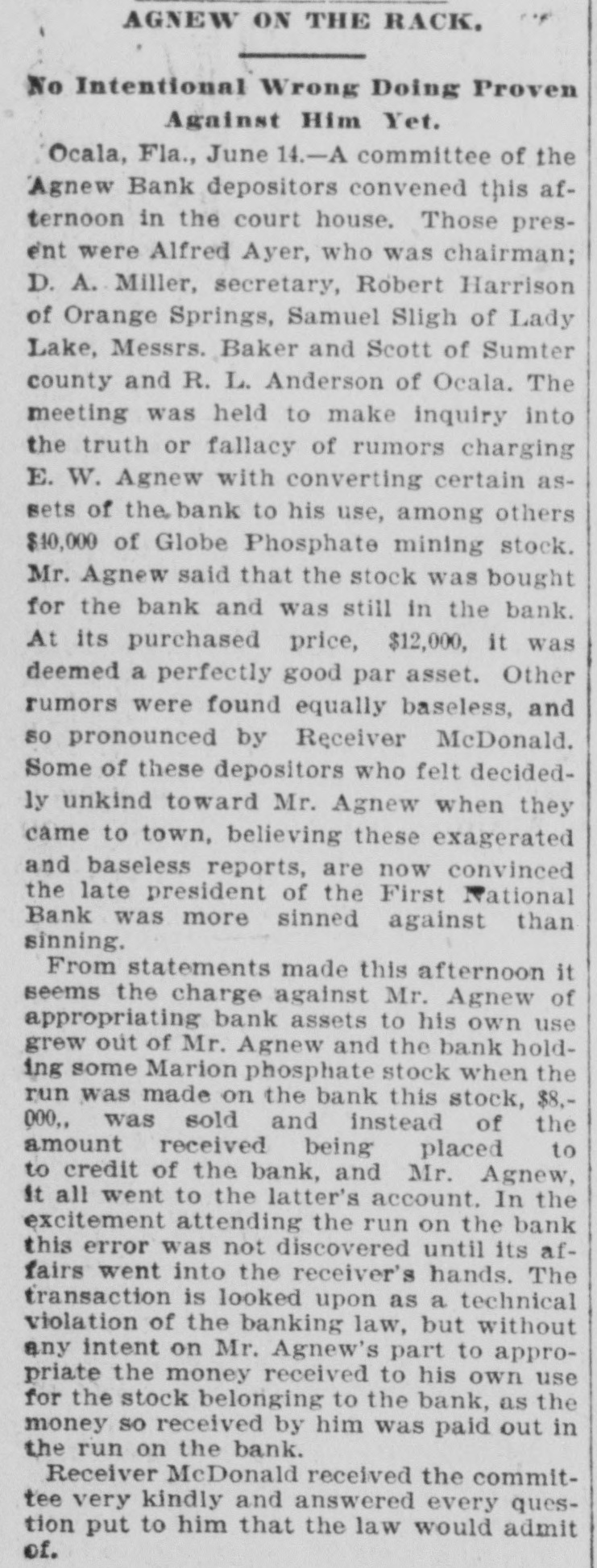
AGNEW ON THE RACK. No Intentional Wrong Doing Proven Against Him Yet. Ocala, Fla., June 14.-A committee of the Agnew Bank depositors convened this afternoon in the court house. Those present were Alfred Ayer, who was chairman; D. A. Miller, secretary, Robert Harrison of Orange Springs, Samuel Sligh of Lady Lake, Messrs. Baker and Scott of Sumter county and R. L. Anderson of Ocala. The meeting was held to make inquiry into the truth or fallacy of rumors charging E. W. Agnew with converting certain assets of the, bank to his use, among others $40,000 of Globe Phosphate mining stock. Mr. Agnew said that the stock was bought for the bank and was still in the bank. At its purchased price, $12,000, it was deemed a perfectly good par asset. Other rumors were found equally baseless, and S0 pronounced by Receiver McDonald. Some of these depositors who felt decidedly unkind toward Mr. Agnew when they came to town, believing these exagerated and baseless reports, are now convinced the late president of the First National Bank was more sinned against than sinning. From statements made this afternoon it seems the charge against Mr. Agnew of appropriating bank assets to his own use grew out of Mr. Agnew and the bank holding some Marion phosphate stock when the run was made on the bank this stock, $8,000,, was sold and instead of the amount received being placed to to credit of the bank, and Mr. Agnew, It all went to the latter's account. In the excitement attending the run on the bank this error was not discovered until its affairs went into the receiver's hands. The transaction is looked upon as a technical violation of the banking law, but without any intent on Mr. Agnew's part to appropriate the money received to his own use for the stock belonging to the bank, as the money so received by him was paid out in the run on the bank. Receiver McDonald received the committee very kindly and answered every question put to him that the law would admit of.


Article from Richmond Dispatch, June 23, 1895

Click image to open full size in new tab

Article Text

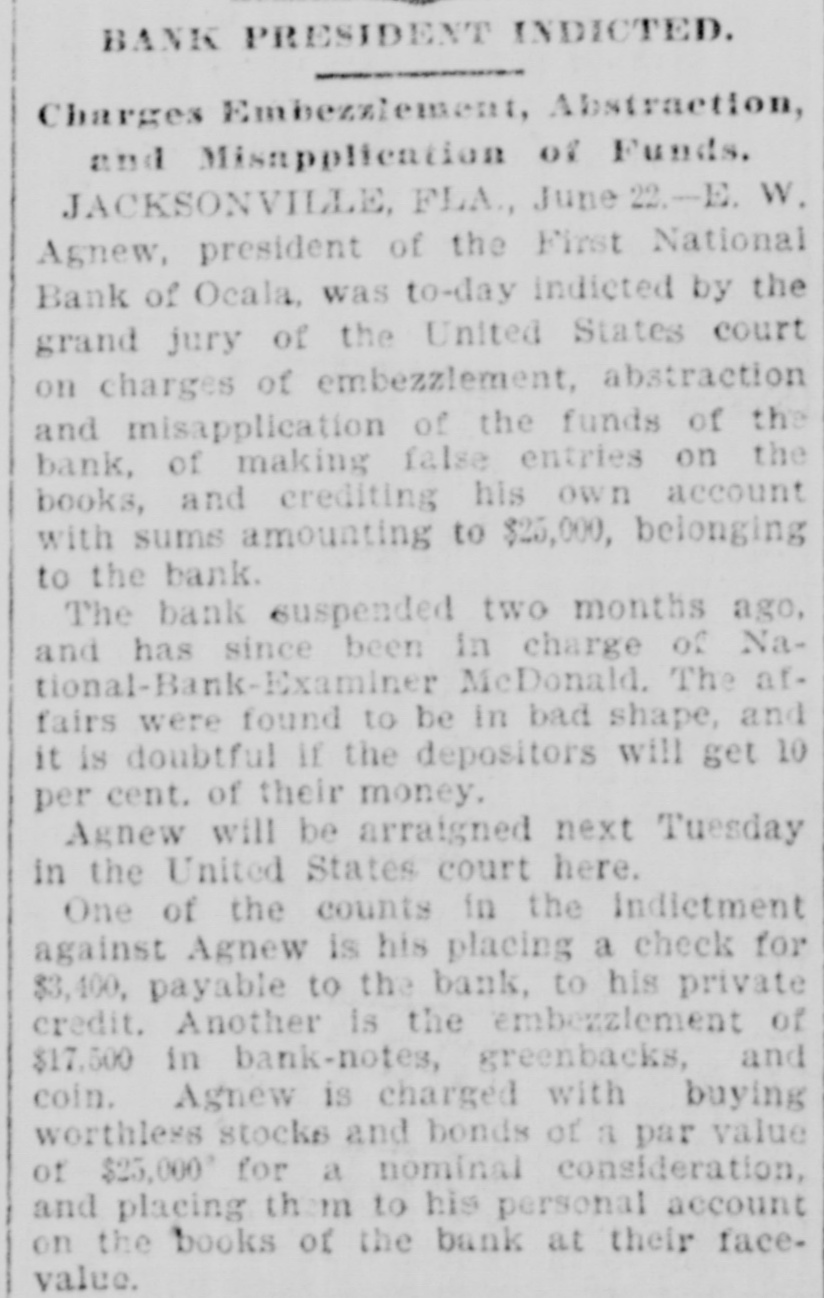
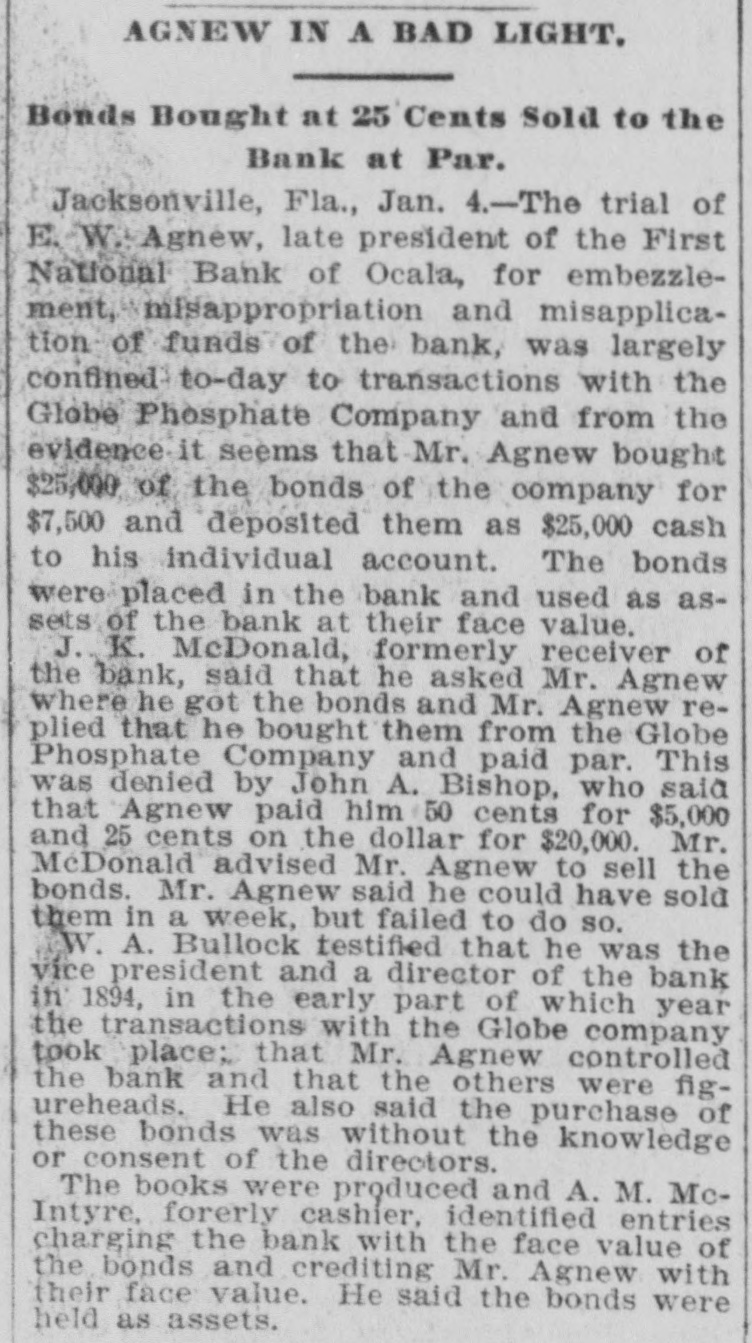
BANK PRESIDENT INDICTED. Charges Embezzlement, Abstraction, and Misapplication of Funds. JACKSONVILLE, FLA., June 22.-E. W. Agnew, president of the First National Bank of Ocala, was to-day indicted by the grand jury of the United States court on charges of embezzlement, abstraction and misapplication of the funds of the bank, of making false entries on the books, and crediting his own account with sums amounting to $25,000, belonging to the bank. The bank suspended two months ago, and has since been in charge of National-Bank-Examiner McDonald. The affairs were found to be in bad shape, and it is doubtful If the depositors will get 10 per cent. of their money. Agnew will be arraigned next Tuesday in the United States court here. One of the counts in the indictment against Agnew is his placing a check for $3,400, payable to the bank, to his private credit. Another is the embezzlement of $17,500 in bank-notes, greenbacks, and coin. Agnew is charged with buying worthless stocks and bonds of a par value of $25,000ยฐ for a nominal consideration, and placing them to his personal account on the books of the bank at their facevalue.


Article from Birmingham Age-Herald, June 23, 1895

Click image to open full size in new tab

Article Text

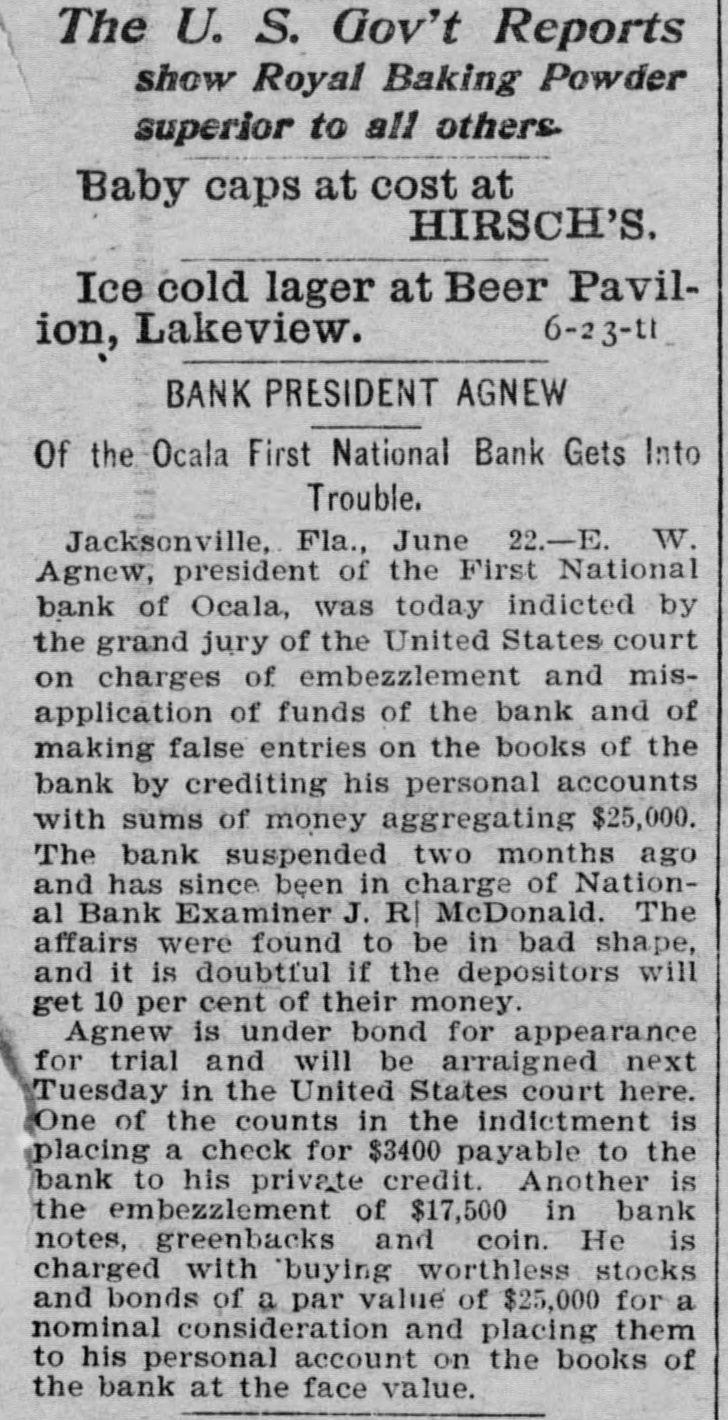
The U. S. Gov't Reports show Royal Baking Powder superior to all others. Baby caps at cost at HIRSCH'S. Ice cold lager at Beer Pavil6-23-tt ion, Lakeview. BANK PRESIDENT AGNEW Of the Ocala First National Bank Gets Into Trouble. Jacksonville, Fla., June 22.-E. W. Agnew, president of the First National bank of Ocala, was today indicted by the grand jury of the United States court on charges of embezzlement and misapplication of funds of the bank and of making false entries on the books of the bank by crediting his personal accounts with sums of money aggregating $25,000. The bank suspended two months ago and has since been in charge of National Bank Examiner J. R| McDonald. The affairs were found to be in bad shape, and it is doubtful if the depositors will get 10 per cent of their money. Agnew is under bond for appearance for trial and will be arraigned next Tuesday in the United States court here. One of the counts in the indictment is placing a check for $3400 payable to the bank to his private credit. Another is the embezzlement of $17,500 in bank notes, greenbacks and coin. He is charged with 'buying worthless stocks and bonds of a par value of $25,000 for a nominal consideration and placing them to his personal account on the books of the bank at the face value.


Article from The Morning News, June 23, 1895

Click image to open full size in new tab

Article Text

BANKER AGNEW IN A BAD BOX. HE IS CHARGED WITH WHOLESALE CROOKEDNESS. Embeszlement of His Bank's Funds, Falsification of the Books and Other Offenses Alleged-One of the Counts Recites That He Bought Very Low-Priced Securities and Turned Them Into the Bank at Par. Jacksonville, Fla., June 22.-E. W. Agnew, president of the First National Bank of Ocala, was to-day indicted by the grand jury of the United States court on charges of embezzlement, abstraction and misapplication of funds of the bank, and of making false entries on the books of the bank by crediting his personal acwith sums of money aggregating bahk suspended $25,000. count The charge two months of Naago and has since been in tional Bank Examiner J. R. McDonald. Its affairs were found to be in bad shape and it is doubtful If the depositors will get 10 per cent. of their money. Mr. Agnew is under bond for appearance for trial and will be arraigned next Tuesday in the United States court here. One of the counts in the indictment is placing a check for $3,400 payable to the bank to his private credit. Another is the embezzlement of $17,500 in bank notes, greenbacks and coin. He is charged with buyworthless stocks and bonds of a par value of $25,000 for a nominal consideration and placing them to his personal account on the books of the bank at the face value. The first indictment had eight counts, the first of which charges that knowing his personal accounts to be overdrawn, and that he was largely indebted to the bank, he caused a check for $3,400 to be entered to his credit. The check was drawn by J. Rauers, on the Merchants National Bank of Savannah, and was made payable to the First National Bank of Ocala, as payment in full for 1,700 shares of the Union Phosphate Company's stock. The second count charges that he caused a certain deposit slip to be made showing by entries thereon credit to his private account of $9,350, and that he had placed to his credit the said amount on the individual ledger of the bank. It further charges that this entry is false. The third account charges that on Jan. 1894, he did embezzle $2,500 in bank notes, 12, greenbacks, silver certificates, gold and silver coin. In the fourth count Mr. Agnew is charged with having purchased from John A. Bishop, president of the Globe Phosphate Company, bonds of the said company of the face value of $5,000 and placed the bonds in the bank as part of the credits and assets of the bank, and did credit and cause to be credited to his personal account the sum of $5,000, knowing the bonds to be worthless. The embezzlement of $7,500 on Feb. 12, 1894, is charged in the fifth count. The sixth count charges that he bought from John A. Bishop, president of the Globe Phosphate Company. bonds of the company of the face farue of $10,000 and paid therefor $2,500, and had the same credited to his account as $10,000, although he knew the bonds were worthless and of no value. In a seventh count he is charged with the embezzlement of $7,500 in cash and checks. The eighth count is identical with the sixth. The second indictment contains two counts, the first to the effect that on Dec. 14 Mr. Agnew, who was president of the bank, did there unlawfully and wilfully misapply the moneys, funds and credits of the bank with intent to convert the same to his own use, and with intent to defraud said bank. The specific charge is that Mr. Agnew, as president of the bank, did solicit and procure from George W. Martin, who was not in anywise indebted to Mr. Agnew or the bank, a promissory note for $4,200 payable four months after date. Mr. Martin 'received no benefits therefrom and no considerations therefore, but Mr. Agnew is charged with having placed said worthless note among the credits and assets of the bank and caused the personal account of himself to be credited on the books with the sum of $4,200 for his own benefit and use, with intent to defraud the bank. It is also charged in this indictment that on Aug. 5, 1893, the firm of Barretto, Luis & Co. was credited on the individual ledger with the sum of $8,245 and that the money was not received and the entry was false. It is set forth that at the time this entry was made the firm was insolvent and indebted to the bank in the sum of $13,381.86. It is charged that the amount of the false entry was made up by notes given by H. L. Anderson for $2,425, J. W. Pearson for $2,910 and R. L. Anderson for $2,910, aggregating $8,245, and that the notes were procured by Mr. Agnew on an understanding that the makers would never be called upon to pay the amounts or any part thereof. On be next as to libarraigned his these guilt various or innocence. charges Tuesday Mr. He to Agnew is plead still will at erty under bonds in the sum of $5,000.


Article from The Ocala Evening Star, June 26, 1895

Click image to open full size in new tab

Article Text

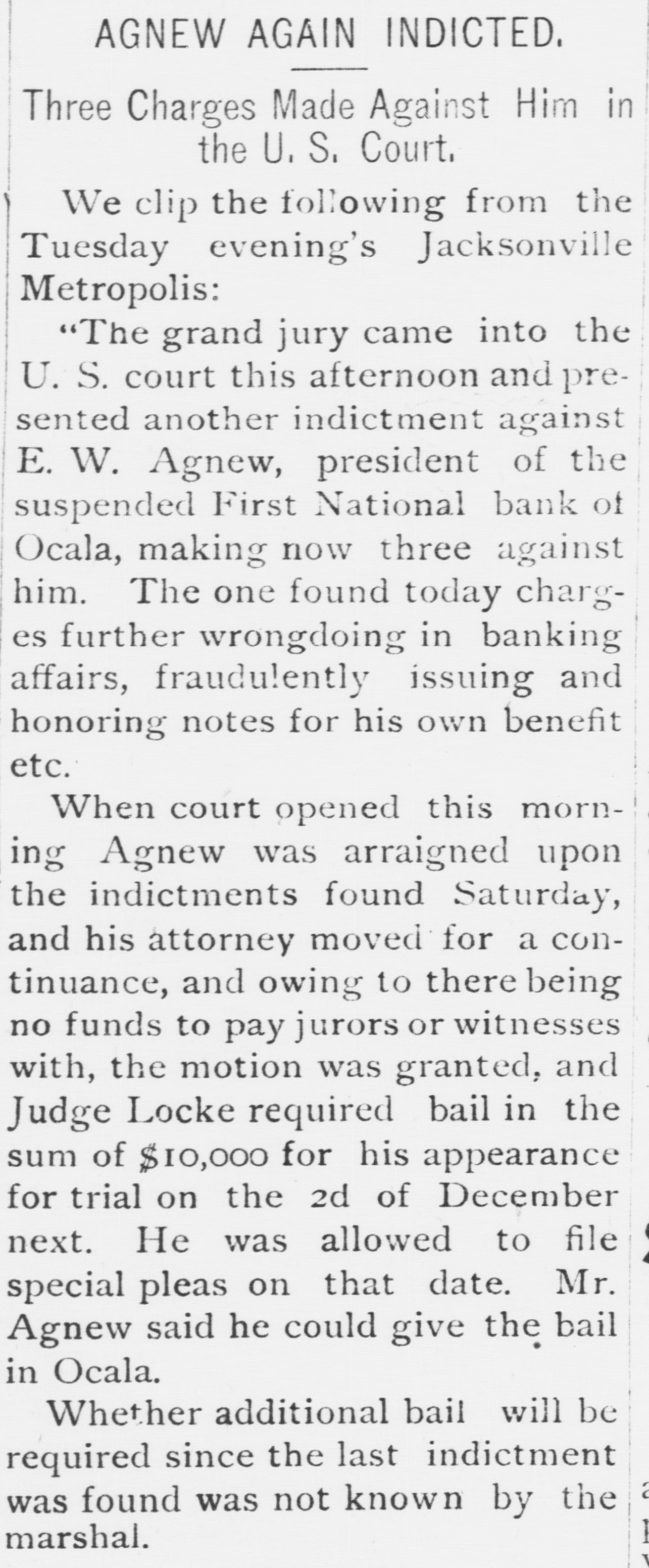
# AGNEW AGAIN INDICTED. Three Charges Made Against Him in the U. S. Court. We clip the following from the Tuesday evening's Jacksonville Metropolis: "The grand jury came into the U. S. court this afternoon and presented another indictment against E. W. Agnew, president of the suspended First National bank of Ocala, making now three against him. The one found today charges further wrongdoing in banking affairs, fraudulently issuing and honoring notes for his own benefit etc. When court opened this morning Agnew was arraigned upon the indictments found Saturday, and his attorney moved for a continuance, and owing to there being no funds to pay jurors or witnesses with, the motion was granted, and Judge Locke required bail in the sum of $10,000 for his appearance for trial on the 2d of December next. He was allowed to file special pleas on that date. Mr. Agnew said he could give the bail in Ocala. Whether additional bail will be required since the last indictment was found was not known by the marshal.


Article from Pawtucket Tribune, August 3, 1895

Click image to open full size in new tab

Article Text

Two Receivers Appointed. W ASHINGTON, Aug. 3.-The comptroller of the currency has appointed William S. Nelson receiver of the Union National bank of Denver, and Granville C. Stapelton receiver of the First National bank of Ocala, Fla,


Article from The Providence News, August 3, 1895

Click image to open full size in new tab

Article Text

Receivers For National Banks. W ASHINGTON, Aug. 3.-The comptroller of the currency has appointed William S. Nelson receiver of the Union National bank of Denver, and Granville C. Stapelton receiver of the First National bank of Ocala, Fla.


Article from Evening Star, August 5, 1895

Click image to open full size in new tab

Article Text

Bank Receiver Appointed. The controller of the currency has appointed William S. Nelson receiver of the Union National Bank of Denver, Col., and Granville C. Stapylton receiver of the First National Bank of Ocala, Fla,


Article from The Morning News, October 1, 1895

Click image to open full size in new tab

Article Text

A Bank's New Attorney. Ocala, Fla., Sept. 30.-Attorney Robert McNamee of Leesburg is the new attorney for Receiver Stapylton of the defunct First National Bank. He will make Ocala his home and bring his family here.


Article from The Morning News, January 30, 1897

Click image to open full size in new tab

Article Text

first became aware of his power, and does not even know how he discovered it. He says that when the figures are given him he sees their answer immediately. Simply by glacing at a long line of figures he can tell immediately what the addition is. FLORIDA. Alachua county's jail only contains four prisoners. Ripe Japan plums made their appearance in Gainesville last week. Strawberry and celery shipments will soon be made daily from the Gainesville section. The stockholders of the Brooksville State Bank are negotiating for a loan to pay off the depositors and resume business with every prospect of success. The Key West Advertiser says the judgment in the case of Baer vs. the city of Key West amounting to $11,523.71 with 8 per cent. interest from March 1894, now amounts to $30,000. It is now reasonbaly certain that a harness factory will be established in Gainesville before next spring. The factory will be started by a stock company of business men of that city. The Tallahassee and Gulf Railway Company is putting up poles for the new telephone service between Minneola and Tavares for the benefit of the truckers during vegetable season. The telegraph line has been removed. In the United States court at Jacksonville Thursday morning the two children of John B. O'Neil, a former Georgian, but now a resident of Arkansas, were turned over to the father in accordance with the granting of an application brought by the father in habeas corpus proceedings. Representative-elect Crampton of Cedar Key spent several days among the people of Eastern Levy county recently, in company with his friend, Rev. Dr. DePass. It is said that Mr. Crampton intends to introduce a bill in the legislature soon to assemble releasing the county from taxation. The name of the Russell house at Key West has been changed by the new lessees the Florida East Coast Line, to "Hotel Key West," and it will be opened on next Saturday, with Leon H. Cilley as manager, who is well known to the traveling public as manager of the Maplewood Cottage, Maplewood, N. H. J. K. McDonald, national bank examiner, who had charge of the First National Bank of Ocala for some time after Its suspension in 1894, arrived in Ocala Thursday and will assist Examiner E. T. Shubrick in the work of making up the reports of the suspended Merchants National. A report will in all probability be made to the controller within the next three days. The Florida Farmer and Fruit Grower copies the substance of a recent report made to the United States department of agriculture concerning the Mexican orange worm, in which the facts are stated that no specimens of the worm are to be found save in oranges that were grown in the state of Morelos, about 100 miles south of the City of Mexico, and that no fears are entertained that the pest will be introduced into the United States. Dr. J. T. Godfrey, one of the most eminent physicians of Hamilton county, and whose residence is at Belleville, in the upper part of the county, has been recently sorely afflicted. On Monday of last week, one of his daughters (Delia, 17 years old) died. Wednesday his only son (Joshua, just grown to manhood) died. Another daughter (Emma, about 15) is not expected to recover. The doctor himself has been very sick. A few days ago he seemed better and could get up, but has relapsed and is not now expected to live. The cold Thursday morning throughout Florida was the most intense since February, 1895. Across the northern counties from Jacksonville to Pensacola the thermometer ranged generally between 20 and 24 degrees, going here and there as low as 17 degrees. Frost in lesser degree was felt as far south as Rockledge on the east coast, and the neighborhood of Tampa on the west. At Palm Beach 45 degrees was the minimum. Reports from the districts devoted to the orange culture indicate that, except in the more exposed situations, little injury was done. In some instances, the groves will lose part of their follage or the latest shoots. Not sufficient sap was in the wood to cause material damage. The losses of the truck farmers in the Gainesville district will prove more severe. A. considerable percentage of the growing lettuce, beets and cabbage was killed, but no close estimate can yet be formed. The late Henry C Houghton the pub


Article from The Ocala Banner, February 19, 1897

Click image to open full size in new tab

Article Text

Call on or write to Receiver of the First National Bank, Ocala, Florida, for list of real estate, improved and unimproved, now offered for sale. 1-1-97


Article from The Ocala Banner, February 26, 1897

Click image to open full size in new tab

Article Text

Call on or write to Receiver of the First National Bank, Ocala, Florida, for list of real estate, improved and unimproved, now offered for sale. 1-1-97


Article from The Ocala Banner, March 19, 1897

Click image to open full size in new tab

Article Text

Real Estate! Real Estate! Call on or write to Receiver of the First National Bank, Ocala, Florida, for list of real estate, improved and unimproved, now offered for sale. 1-1-97


Article from The Ocala Banner, April 30, 1897

Click image to open full size in new tab

Article Text

For Sale. Ocala Steam Laundry. Here is an opportunity for a permanent business. Must be sold at once, for the best offer. G. C. STAYPLETON, Receiver First National Bank. 4-30-1t.


Article from The Ocala Evening Star, May 12, 1897

Click image to open full size in new tab

Article Text

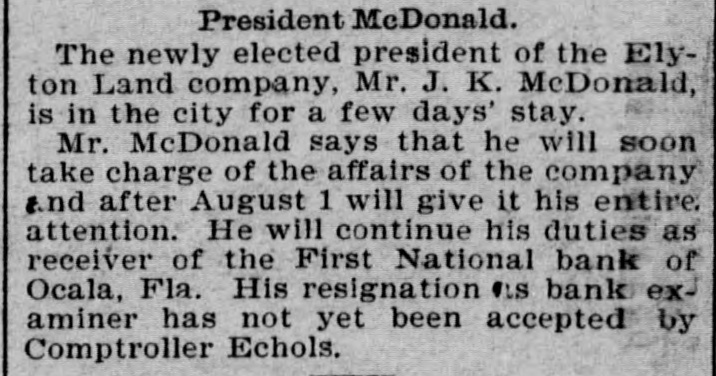
Consolidated. G. C. Stapylton, receiver of our two defunct banks, has moved the business of the First National into the office of the Merchants' National, thereby saving a great deal of time and expense, as he and Mr. Massey can now transact the entire business.


Article from The Ocala Evening Star, April 27, 1899

Click image to open full size in new tab

Article Text

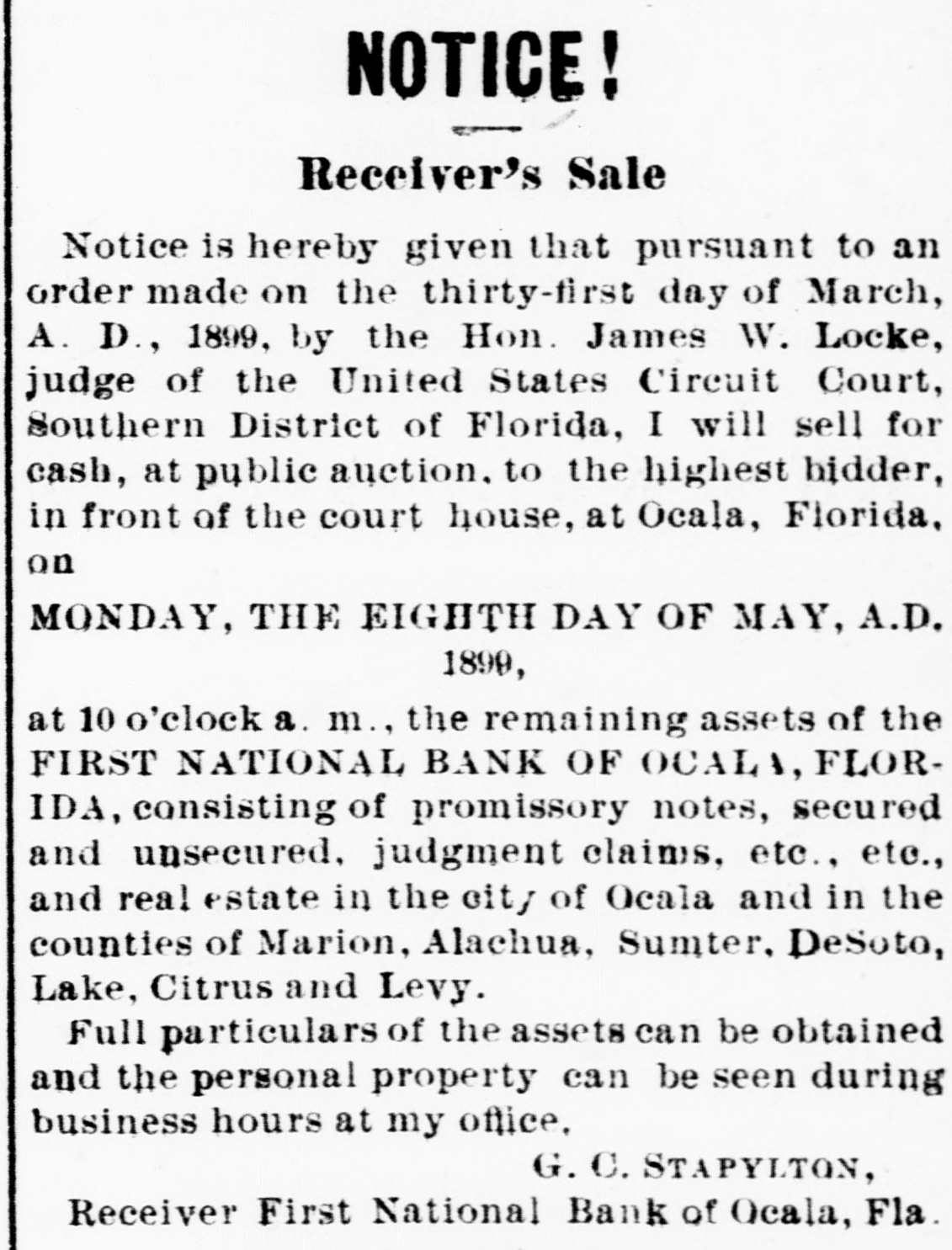
NOTICE Receiver's Sale Notice is hereby given that pursuant to an order made on the thirty-first day of March, A. D., 1899, by the Hon. James W. Locke, judge of the United States Circuit Court, Southern District of Florida, I will sell for cash, at public auction. to the highest hidder, in front of the court house, at Ocala, Florida. on MONDAY, THE EIGHTH DAY OF MAY, A.D. 1899, at 10 o'clock a. m., the remaining assets of the FIRST NATIONAL BANK OF OCALA, FLORIDA, consisting of promissory notes, secured and unsecured, judgment claims, etc., etc., and real estate in the city of Ocala and in the counties of Marion, Alachua, Sumter, DeSoto, Lake, Citrus and Levy. Full particulars of the assets can be obtained and the personal property can be seen during business hours at my office. G. C. STAPYLTON, Receiver First National Bank of Ocala, Fla.


Article from The Ocala Evening Star, May 4, 1899

Click image to open full size in new tab

Article Text

Monday next Receiver Stapylton of the First National Bank of Ocala, will sell at auction, in front of the court house, all of the assets of the bank.


Article from The Ocala Evening Star, December 24, 1921

Click image to open full size in new tab

Article Text

tower on the corner of Fort King and big Osceola, where Ben Condon's formerly the Star office/ now store, stands. The volunteer fire depart- rewas very efficient. I don't member ment ever seeing the fire engine, good tho' I heard of it, for Ocala had water pressure even at that time. The electric light plant was the old it, sheetiron building, or part of of down in the hollow at the crossing It South Main and South Fourth. ad, think, two small engines. The streets were illuminated on dark nights by are lights at long intervals. the I think there were four ares on public square, all of them equal probably to one of the present white way a lamps. They were strung along block apart on the principal streets. the Interiors of buildings were lit by old-style incandescents. Not more than ten per cent of the residences were lit by electricity. There was in not an electric motor nor stove town, and butยฎ few electric fans. The street lights followed the moon-the the is, they were not shining when moon was. The incandescents were cut off in stores and residences at midnight. There never was any current in the daytime, and the luxury of turning on a light on a dark day or as SOOR as the dusk began to gather was unknown. The electric light plant and belonged to a private company, while its rates were reasonable than for then, they were much higher they are now. Ocala had a good water supply, but the it would not meet a fourth of a present demand. The power was couple of old-style engines in a little brick house at the corner of Fourth street and Orange avenue. There the were two or three good wells, and reservoir was on the brick tower at the top of the hill on what is now Camp Heights. A simple plant, but a very reliable one. Few towns in the state had such a powerful water pressure. The water company was economical and its rates were high. very People paid a dollar a month it for one faucet, and additional if was used to supply a garden hose. The people were yet drawing a large supply of their water from surface wells, and typhoid fever was not un1 common. Like the electric light plant, 7 the waterworks belonged to a private e company, Ocala had two banks-the First National, where the Commercial now stands, and the Merchants' National, in the same building now occupied by the Munroe & Chambliss National t The two banks were at war each other, and the '93 Bank. with Merchants' of aided by the panic the freeze of '95, It was a vicFirst National, and National. downed Pyrrhic the tory, and in '96 the Merchants' National also went smash. At that time, Ocala touched rock bottom. Scores left the city and Money was so of the families county. never hundreds Yet scarce nor business so dull. there was very little actual suffering. People` continued to eat and wear clothes, and as there were scores of houses empty nobody had to stay out in the rain. The county had to build a new jail, and the city managed to buy the old t and move its into where they have been ever jail it, building offices since. , fire hall was built, the fire departconcentrated in it, a ment The volunteer with force few paid men and a big to The city and began to aid trie them. light plant bought the improve elechas been improving it ever e Then it bought s and concentrated since. it, works and the the water two on their present location e has been a great deal money utilities There these of opee and some wasted in but the people more n received their money rations, spent than have back in lower rates. w The county has built a new court 1 and two new jails, the latter it in use, at a combined of The federal house now $150,000. government expense n erected a solid and well constructer ed and a cost e has postoffice courthouse, block at that of about $100,000 on a city g was ground up two "busted" banks been The unoccupied have to 1907. t by three, the Munroe and r the Ocala and Either a the Chambliss, replaced Commercial. National of the firstn two does much more business 's the two old put tonamed than both banks If The Munroe & Chambliss y and the Commercial reh the buildings modeled gether. Bank they have bought and the of the dead and made them from gone firms executors handsome National e h and uptodate. The Ocala d has put up a good-looking and subn stantial building of its own. One of the greatest institutions of e the city was not even thought of in 1892. I refer to the Marion County f Hospital, now a large, well-equipped