Park Bank (Baltimore, MD)

Episode Information

Episode UID
3633701491572
Episode Type
Run โ†’ Suspension โ†’ Closure
Bank Type
state
Bank ID
363370149 hash
Start Date
December 12, 1930
Location
Baltimore, Maryland (39.290, -76.612)

Metadata

Model
gpt-5-mini (chosen from majority vote of a three-model LLM ensemble)
Short Digest
9607ccb9847c4f38

Response Measures

None

Description

A mild rumor-driven run occurred in Dec 1930; the bank later closed Aug 11, 1932 and entered receivership after evidence of unsafe operations and heavy insider loans.

Events (3)

1. December 12, 1930 Run
Cause
Rumor Or Misinformation
Cause Details
Rumor spread after many Christmas savings club depositors cashed checks, prompting mass withdrawals though funds were available.
Measures
President Webster Bell issued a public statement assuring depositors the bank was sound and kept the bank open beyond legal hours to pay depositors; many redeposited funds.
Newspaper Excerpt
A mild run on the Park Bank developed here today ... because a great number of women were seen cashing checks, a rumor spread that depositors were flocking in to withdraw their money
Source
newspapers
2. August 11, 1932 Receivership
Newspaper Excerpt
State Bank Commissioner George W. Page, bank receiver, said ... the Park Bank, which closed last August 11. ... suits asking total of $432,851.54 from Webster Bell, president ... were filed ... by George W. Page, State bank commissioner and receiver for the bank.
Source
newspapers
3. August 11, 1932 Suspension
Cause
Bank Specific Adverse Info
Cause Details
Bank closed by state authorities after mounting losses, heavy insider/director borrowing, deteriorated securities values and unsafe operations disclosed by examinations.
Newspaper Excerpt
it stated, has been closed by the Maryland Banking Department.
Source
newspapers

Newspaper Articles (21)

Article from Times Herald, December 12, 1930

Click image to open full size in new tab

Article Text

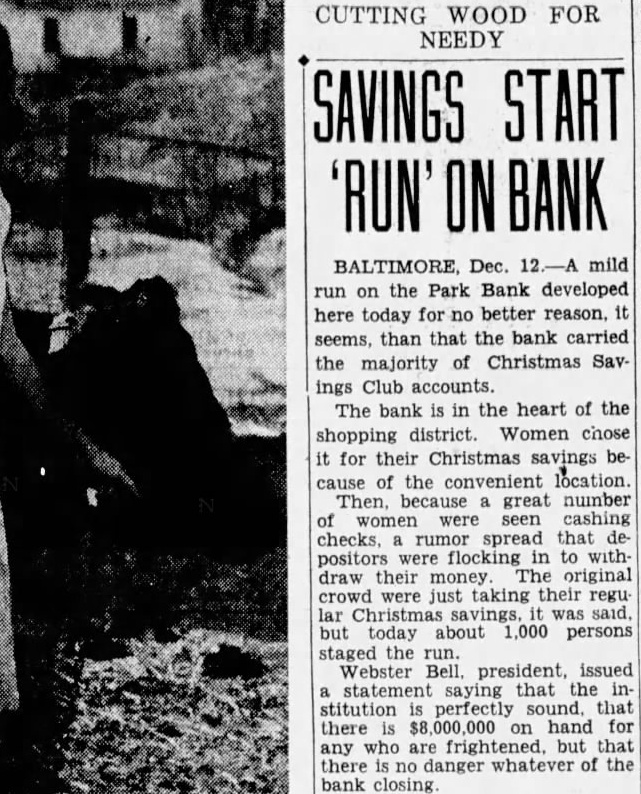
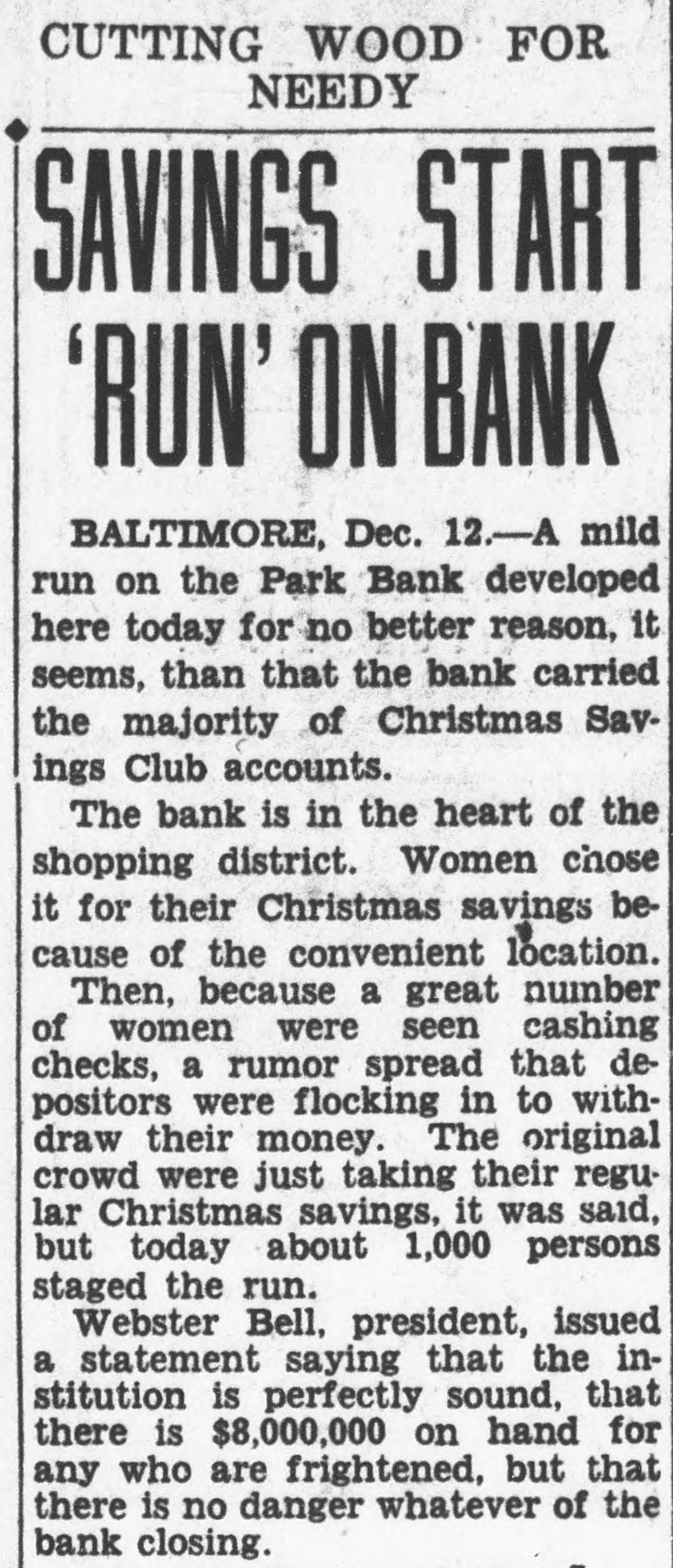
CUTTING WOOD FOR NEEDY SAVINGS START 'RUN' ON BANK BALTIMORE, Dec. 12.-A mild run on the Park Bank developed here today for no better reason. it seems, than that the bank carried the majority of Christmas Savings Club accounts. The bank is in the heart of the shopping district. Women chose it for their Christmas savings be cause of the convenient location. Then, because a great number of women were seen cashing checks, a rumor spread that de positors were flocking in to withdraw their money The original crowd were just taking their regu lar Christmas savings, it was said, but today about 1,000 persons staged the run. Webster Bell. president, issued a statement saying that the institution is perfectly sound. that there is $8,000,000 on hand for any who are frightened. but that there is no danger whatever of the bank closing


Article from The Washington Times, December 12, 1930

Click image to open full size in new tab

Article Text

CUTTING WOOD FOR NEEDY SAVINGS START RUN' ON BANK BALTIMORE, Dec. 12.-A mild run on the Park Bank developed here today for no better reason, it seems, than that the bank carried the majority of Christmas Savings Club accounts. The bank is in the heart of the shopping district. Women chose it for their Christmas savings because of the convenient location. Then, because a great number of women were seen cashing checks, a rumor spread that depositors were flocking in to withdraw their money. The original crowd were just taking their regular Christmas savings, it was said, but today about 1,000 persons staged the run. Webster Bell, president, issued a statement saying that the institution is perfectly sound, that there is $8,000,000 on hand for any who are frightened, but that there is no danger whatever of the bank closing.


Article from Evening Star, May 24, 1931

Click image to open full size in new tab

Article Text

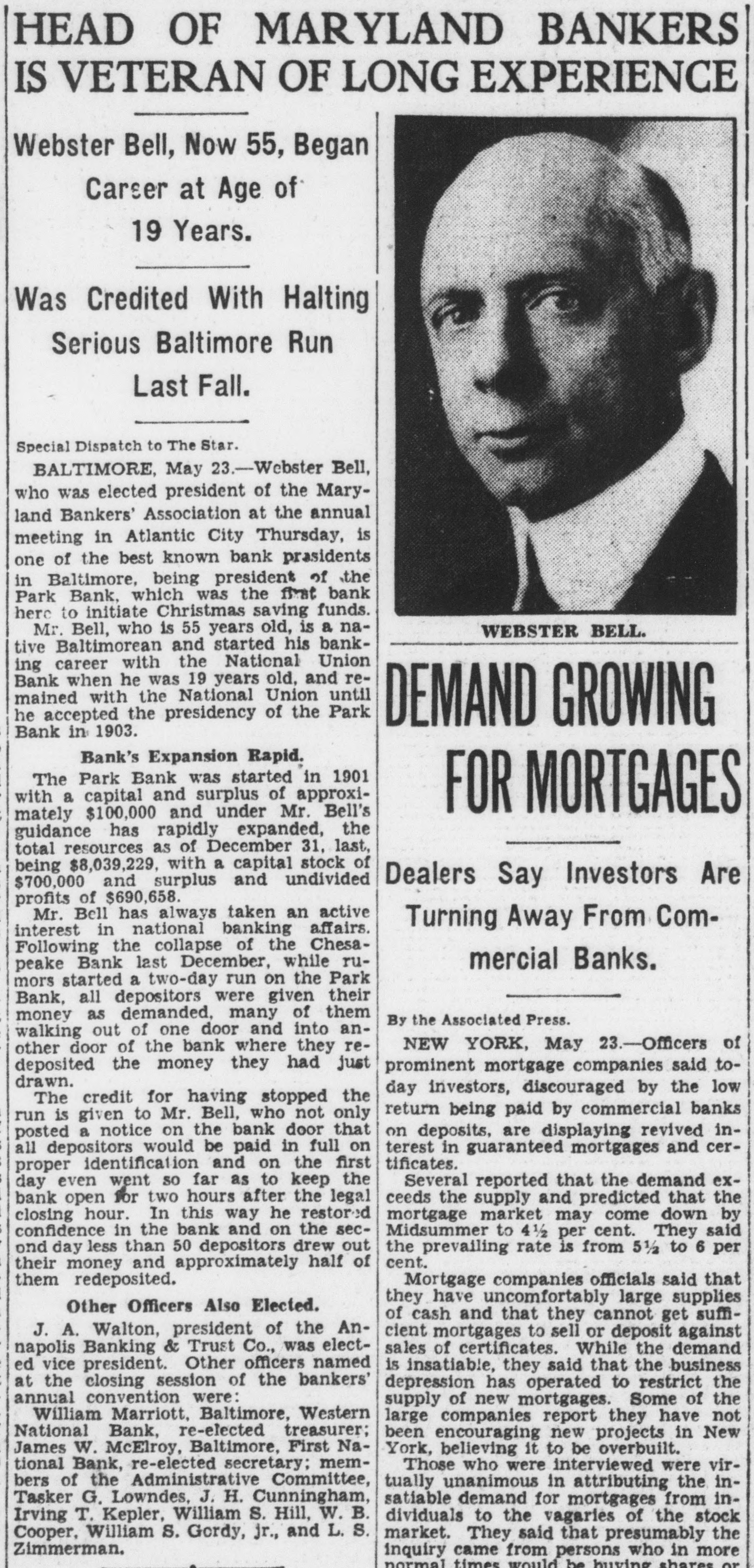
HEAD OF MARYLAND BANKERS IS VETERAN OF LONG EXPERIENCE Webster Bell, Now 55, Began Carser at Age of 19 Years. Was Credited With Halting Serious Baltimore Run Last Fall. Special Dispatch to The Star. BALTIMORE, May 23.-Webster Bell, who was elected president of the Maryland Bankers' Association at the annual meeting in Atlantic City Thursday, is one of the best known bank prasidents in Baltimore, being president of the Park Bank, which was the first bank here to initiate Christmas saving funds. Mr. Bell, who is 55 years old, is a naWEBSTER BELL. tive Baltimorean and started his banking career with the National Union Bank when he was 19 years old, and remained with the National Union until he accepted the presidency of the Park DEMAND GROWING Bank in 1903. Bank's Expansion Rapid. The Park Bank was started in 1901 with a capital and surplus of approxiFOR MORTGAGES mately $100,000 and under Mr. Bell's guidance has rapidly expanded, the total resources as of December 31, last, being $8,039,229, with a capital stock of Dealers Say Investors Are $700,000 and surplus and undivided profits of $690,658. Mr. Bell has always taken an active Turning Away From Cominterest in national banking affairs. Following the collapse of the Chesamercial Banks. peake Bank last December, while rumors started a two-day run on the Park Bank, all depositors were given their money as demanded, many of them By the Associated Press. walking out of one door and into anNEW YORK, May 23.-Officers of other door of the bank where they redeposited the money they had just prominent mortgage companies said todrawn. day investors, discouraged by the low The credit for having stopped the return being paid by commercial banks run is given to Mr. Bell, who not only on deposits, are displaying revived inposted a notice on the bank door that terest in guaranteed mortgages and cerall depositors would be paid in full on tificates. proper identification and on the first Several reported that the demand exday even went so far as to keep the ceeds the supply and predicted that the bank open for two hours after the legal closing hour. In this way he restored mortgage market may come down by confidence in the bank and on the secMidsummer to 4ยฝ per cent. They said ond day less than 50 depositors drew out the prevailing rate is from 5ยฝ to 6 per cent. their money and approximately half of Mortgage companies officials said that them redeposited. they have uncomfortably large supplies Other Officers Also Elected. of cash and that they cannot get suffiJ. A. Walton, president of the Ancient mortgages to sell or deposit against sales of certificates. While the demand napolis Banking & Trust Co., was elected vice president. Other officers named is insatiable, they said that the business at the closing session of the bankers' depression has operated to restrict the annual convention were: supply of new mortgages. Some of the William Marriott. Baltimore, Western large companies report they have not National Bank, re-elected treasurer; been encouraging new projects in New James W. McElroy, Baltimore, First NaYork, believing it to be overbuilt. tional Bank, re-elected secretary; memThose who were interviewed were virbers of the Administrative Committee, tually unanimous in attributing the inTasker G. Lowndes, J. H. Cunningham, satiable demand for mortgages from inIrving T. Kepler, William S. Hill, W. B. dividuals to the vagaries of the stock Cooper, William S. Gordy, jr., and L. S. market. They said that presumably the Zimmerman. inquiry came from persons who in more normal times would be huving shares or


Article Text

HEAD OF MARYLAND BANKERS IS VETERAN OF LONG EXPERIENCE Webster Bell, Now 55, Began Carser at Age of 19 Years. Was Credited With Halting Serious Baltimore Run Last Fall. Special Dispatch BALTIMORE, May Bell, who elected president of the Maryland Bankers' Association at the annual meeting in Atlantic City Thursday, one the best known bank being the Bank. the first bank initiate Christmas saving funds. Mr years old, tive and started his bankcareer the National Union Bank years old. remained with the National Union the presidency of the Park Bank in 1903. Bank's Expansion Rapid. The Park Bank was started in 1901 with capital surplus approximately under Bell's guidance has rapidly expanded, capital stock $700,000 undivided profits Bell has always taken an active interest affairs. Following the Chesapeake last December, rurun on the Park Bank, all depositors given their money demanded, many them walking out other the they deposited the they had just drawn. The credit for having stopped run Mr. not the bank be paid full and on the first so keep bank open hours the closing this he the secdepositors their half them redeposited. Other Officers Also Elected. Walton, of the Banking Trust electpresident. Other officers named closing session the bankers' annual Western Bank, re-elected James First Committee, Tasker Lowndes, H. Irving Kepler, Hill, Cooper, William S. Gordy, jr., and Zimmerman.


Article Text

Park Bank Depositors Prepare To Organize Protective Association Will Be Formed By Committee-Attorneys Explain Efforts Seven hundred Park Bank depositors, meeting at the Polytechnic Institute last night, delegated to permanent committee of nine the task organizing depositors' protective sociation. Named to the committee were the three arranged for the meeting, William Bauer, Hartnett and Gibbs LaMotte and the following six: Eugene Blair, Howard S. Robertson, Frank Potthast, Thomas Sprague and Harry Ebitt. The meeting also heard an explanation of the efforts of group of six attorneys, including James LindDemocratic floor leader in House Delegates, Emanuel Gorfine, Fourth district member of that body, to halt the practice of having special counsel appointed for the State Bank Commissioner in receivership cases. They advocated having the Atoffice called upon provide the service. hearing their petition vacate the appointment of John Semmes special counsel for the Park Bank receiver will held before Judge Charles Stein in the Circuit Court today.


Article from Evening Star, September 8, 1932

Click image to open full size in new tab

Article Text

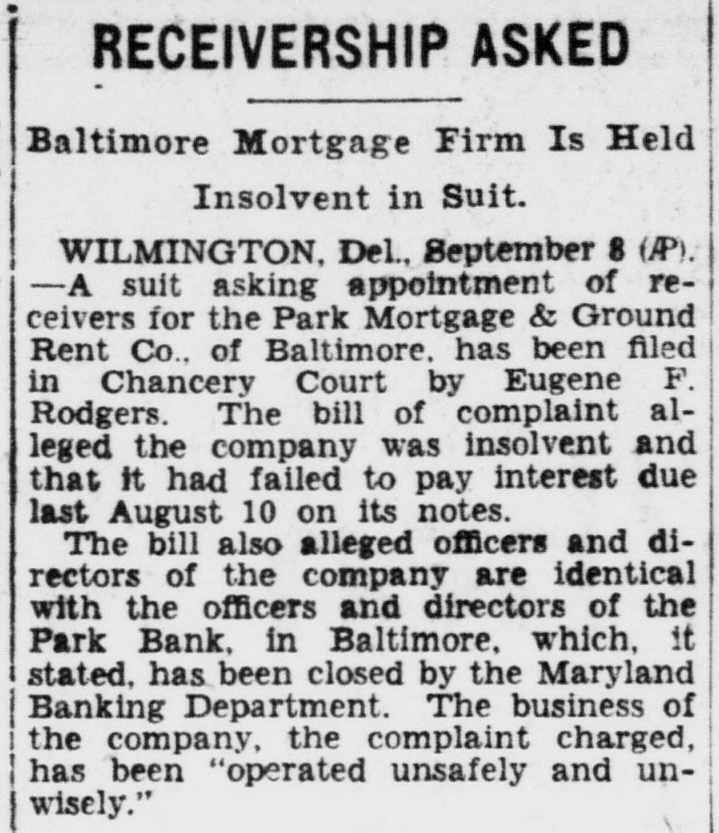
RECEIVERSHIP ASKED Baltimore Mortgage Firm Is Held Insolvent in Suit. WILMINGTON, Del., September 8 (AP). -A suit asking appointment of receivers for the Park Mortgage & Ground Rent Co., of Baltimore, has been filed in Chancery Court by Eugene F. Rodgers. The bill of complaint alleged the company was insolvent and that it had failed to pay interest due last August 10 on its notes. The bill also alleged officers and directors of the company are identical with the officers and directors of the Park Bank, in Baltimore, which, it stated, has been closed by the Maryland Banking Department. The business of the company, the complaint charged, has been "operated unsafely and unwisely."


Article Text

Advances By Were $497,046, Receiver's Report Shows Loans the Park Bank by the Reconstruction Finance Corporation totaled when the bank closed last August and the governmental agency's with loans Baltimore banks, totaled $993,539.97 disclosed today in report filed was the receiver the bank. The reshowed that had port paid curtailment of the loans. The loans, it said, were heavily secured. The report showed still due by the closed band due the governmental corporation and the group Baltimore banks. Claim On Baer Estate The bank practically the time that the report filed. entered claim of against the estate of the late John Baer based two five. day notes, one dated July for the other dated July for and in the names of the late Mr. Baer and Mrs. his wife The late Mr. Baer suithe of his Charles street July 26th, the the Mr. estate has placed der the the Circuit Court. the bank that claim does constithe the against the but only the obligations Mr. Baer and his The receivership filed sixty law. was submitted in the Circuit Court State Bank ComPage, the by John for The report handed Judge Charles Stein by William have been by ceiver between the the August 12 and tember receipts stated chiefly notes paid by from the Disbursments Listed during the same placed most the payments curtailment the loans from the Reconstruction Corporation The report that paid the leaving still due to the corporation. Records of the bank of the closdate show loans from the group Baltimore banks outstanding report showed that paid curtailment the the balance $326,583.12 still from the banking for asked why the the Finance Corporation the group of paid before any was made other creditors. Collateral Exceeds Loans the Reconstruction Corporation and the group Baltimore banks secured said had pledged for the loans. The Finance the banks dthe to power held collateral. the liberal spirit that the equity for the be large as possible. that the value of the pledged considerably amount the


Article from Evening Star, October 12, 1932

Click image to open full size in new tab

Article Text

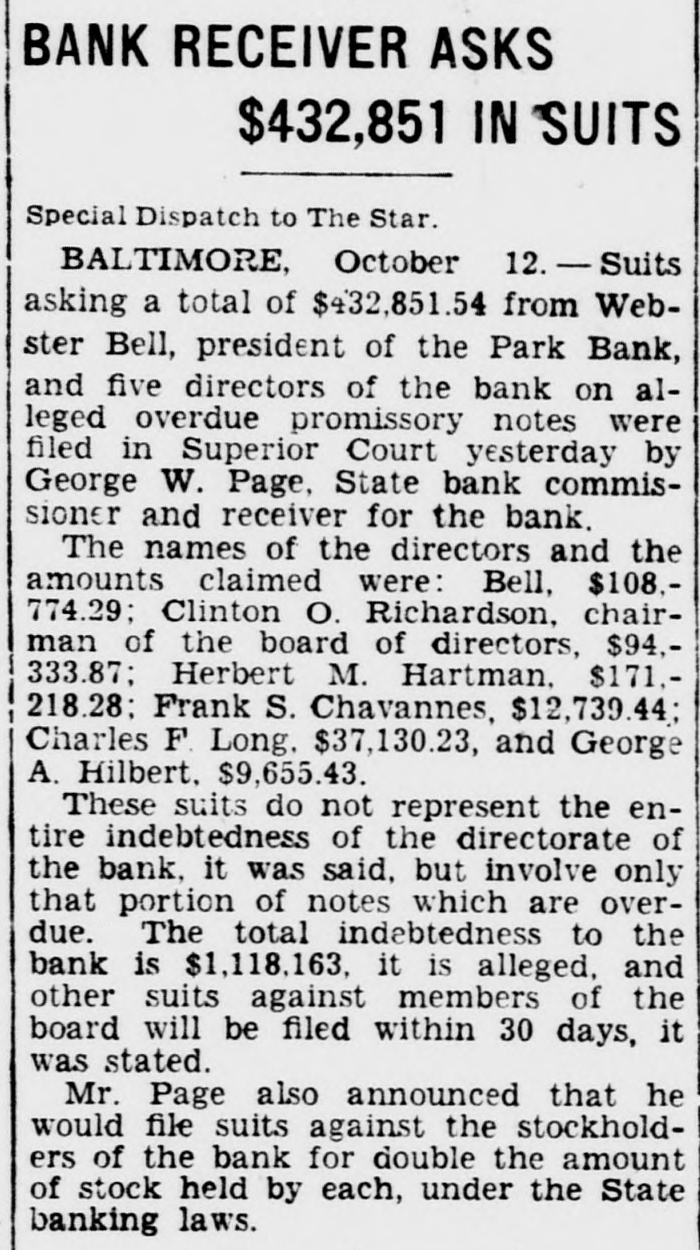
BANK RECEIVER ASKS $432,851 IN SUITS Special Dispatch to The Star. BALTIMORE, October 12. - Suits asking a total of $432,851.54 from Webster Bell, president of the Park Bank, and five directors of the bank on alleged overdue promissory notes were filed in Superior Court yesterday by George W. Page, State bank commissioner and receiver for the bank. The names of the directors and the amounts claimed were: Bell, $108.774.29; Clinton O. Richardson, chairman of the board of directors, $94,333.87; Herbert M. Hartman. $171.218.28; Frank S. Chavannes, $12,739.44; Charles F Long. $37,130.23, and George A. Hilbert. $9,655.43. These suits do not represent the entire indebtedness of the directorate of the bank. it was said, but involve only that portion of notes which are overdue. The total indebtedness to the bank is $1,118,163, it is alleged, and other suits against members of the board will be filed within 30 days, it was stated. Mr. Page also announced that he would file suits against the stockholders of the bank for double the amount of stock held by each, under the State banking laws.


Article Text

REOPENING OF PARK BANK IS CONSIDERED Depositors' Group Gets Court Permission To Study Institution's Books [Continued From Page 32] ferred with the cour: today indicated that about $1,000,000 of new capital has been promised in case the protective association is successful in carrying out the plan. Approximately $1,000,000 more would be needed, it was said. Thorough Examination The committee pointed out that thorough examination and investigation of the bank's situation, including an appraisal of its accounts. would be necessary before definite and final proposals could be made toward the suggested opening of the bank. The committee that conferred with Judge Stein consisted of John P. Alberts, chairman; Frank Potthast and Louis Donovan. Judge Stein ganted them the right to examine the bank situation. Trust Company's Offer A trust company here is said, have considered making an offer to liquidate the bank and under certain agreements to make portion of the depositors' funds available to them The plan has not yet been formally or officially proposed or submitted to the court. State Bank Commissioner George W. Page, bank receiver, said today the protective group committee had not yet conferred with him since obtaining court authority to examine bank accounts.


Article from The Washington Times, October 26, 1932

Click image to open full size in new tab

Article Text

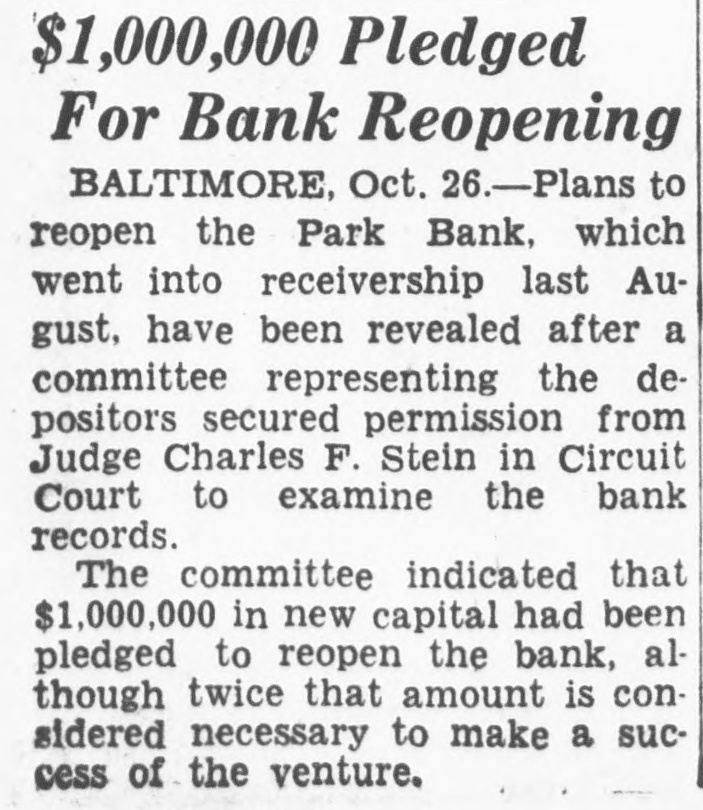
$1,000,000 Pledged For Bank Reopening BALTIMORE, Oct. 26.-Plans to reopen the Park Bank, which went into receivership last August, have been revealed after a committee representing the depositors secured permission from Judge Charles F. Stein in Circuit Court to examine the bank records. The committee indicated that $1,000,000 in new capital had been pledged to reopen the bank, although twice that amount is considered necessary to make a success of the venture.


Article Text

PARK BANK LOANS ARE 30% INTERNAL Officials, Employes Appear On Books As Borrowing $1,148,658 DIRECTORS OWE MOST Page In Report To Court Says He Warned President Against This Condition (Continued from Page 20) they were required to lodge with the bank a check against their loans, which was certified by the bank. Mr. Page's report reveals in minute detail the change in the bank's position during the two years previous to its close. In this connection he said that 'on December 31, 1929, the institution's securities were given book value of $1,269,014.50, while on the cloting day they were valued on the books at $651,053.31. Value Again Drops The securities on August 11, when the bank was closed, however, had market value of but $280,367. or $370.686.31 less than the book value, the commissioner reported. On December 31, 1929. the bank had deposits totaling $6,820,736.27. The deposits increased to $7,353,664.47 by September of the year following. In December, 1930, the bank was subjected to two-day run, which followed the closing of the Chesapeake Bank. By the end of that month its deposits had dropped to $5,509,725.53. or loss of $1,843,938.94 in four months. Borrowed On Building During the run, the bank borrowed $650,000 by mortgaging its property and borrowed $990,000 from two banks. On the day the bank closed its deposits had decreased to $3,607,200.84. The figures show shrinkage of $3.213,535.43 in nearly two years. During this same period the institution's bills payable increased $843,539.97. including the sum obtained under the mortgage. According to the report, the undivided profits amounted to $90,960.96 as of December 31, 1929. and $92,341.88 as of June 30 the same year. Starting from the latter date the sum began to decrease in fluctuating amounts and by March 31. 1932. it was exhausted and "the surplus account, moreover, itself reduced." Dividends Paid The report disclosed that the following net profits, less charges off, had been made during the respective sixmonth intervals ending on the dates given and that dividends in the amounts specified had been paid: Net Profit Before Date. 1929. $35,000 June 30, 1930 36,380.92 35,000 8,316.65 35,000 June 30, 1931 36,859.24 35,000 June 30. 1932 3,553.34 17,000 After tabulating these figures the report continued: "Whether or not any of the aforementioned dividends were illegally declared under Sections 70 and 71 cited above can better be determined by having special audit made for that purpose." Sections 70 and 71 of the banking laws provide the method for declaring dividends. Statements Of Examiners The report contained portions of three statements made to Mr. Page by Xexaminers in his office during the two years previous to the bank's close. Each of the papers was given the commissioner after an examination had been made of the bank. The first statement contained in the report was dated August 18, 1930, and the examiner in commenting on the loans of the institution, wrote: "Bank carries many large lines with which the directors are very closely allied. The money advanced the directors has materially increased, largely due to the taking over of part of the bank's assets. These items show a considerable loss." Notes Directors' Debts The examiner (apparently in another part of his statement) also is quoted as reporting: "Condition of this bank is good. It is dominated by the president. "Directors are large borrowers and lines have increased. Firms and corporations they are allied with also heavy borrowers. Employes have large lines. Stock taken over from bank by directors-too many shares bank stock held as collateral. Park Mortgage Company is large borrower and they hold great deal of the stock." The second statement referred to in the report was dated May 11, 1931. It was quoted in part as follows: "The directors' loans, both direct and indirect, aggregate about twenty per cent. of the entire loan account. This is not taking into consideration doans to concerns with which the directors are affiliated. Taken as whole there is an undue concentration of directors' papers in the loan account. Calls Cash Position Weak "The cash position of this bank, in view of the large amount of borrowed money, is weak and would be well if this situation could be relieved through reductions in loans, preferably those of the directors.' After pointing out that all of the directors' collateral loans "are short, the statement drew to Mr. Page's attention that the bank had loaned four of its officials, other than directors, sums totaling about $60,000 and that these loans were "all largely unsecured." As result of this statement. according to the report, Mr. Page wrote Webster Bell. president of the bank. and drew to his attention that loans to its directors "approximated something in excess of $1,000,000." Hoped To Reduce Loans In reply to this letter. Mr. Bell, the report revealed. wrote Mr. Page that "during the next six months we be- lieve there will be a material reduction TEAR GAS QUELLS in the amount of these loans." The last statement referred to in Mr. Page's report to the court was HUNGER MARCHERS dated April 25. 1932. The portion quoted read, in part, as follows: "Loan department needs closer atWilmington Police Beaten tention. Too many single name loans. After Quarrel Breaks Out Too many demand loans unsecured, should be on time basis and require Among Women regular curtailments. Too much of bank's own stock as collateral-14,044 (Continued from Page 20) shares. tions made weekly by the Board of "Too much of Park Mortgage and Estimates for unemployment relier, Ground Rent Company stock as col- which approximate $100.000. lateral-4.317 shares. Card record of Earlier this year the Salvation Army, collateral not kept in good shape. at a cost of about $100, fed about 750 Errors in listing and amounts. ValuaCommunists who were marching on tions on collateral are high. Washington, and Captain Marshall said Called Bad Practice "Statements should be required from all large borrowers, including directors. Stocks 'owned by bank mostly in name of president. (Bad practice). Should be transferred in name of bank. "Stock of First National Bank owned by this bank. Pledged on loans of Webster Bell at Western National Bank and money now carried in the certificates of deposit account of bank. This should be on the bank's books as bills payable. This whole transaction is irregular and should be eliminated, though authorized by board. Second Mortgages Cited "Bank holds too many second mortgages. Examiner believes a more aggressive attitude be taken in regard to loans short of collateral and singlename notes to further secure these or at least get small reductions when possible. "It is significant to note that of the total loan account of $4,080.897 no less than $1,249,636 is due and owing by the directors." As a result of this statement, according to the report, Mr. Page conferred with Mr. Bell and subsequently the board of directors appointed a special committee from its members. The small group met at the bank each day and passed on all loans and other matters that came before it.


Article Text

Depositors Prepare Depositors of the Park Bank, special meeting their protective held today the Park Bank building, papers of be filed with the State for known the Park Bank DepositProtective Association, Inc. This taken preliminary step the presentation meeting of depositors be held next Monday night the Polytechnic stitute plan for the formation national bank take over the assets of the defunct Park Bank. The incorporathe association John Albert. Gibbs LaMotte and Howard Hyde. four will also the tion together with LeRoy James and Frederick Ryan. depositors named Arthuc Eby, Baltimore attorney, as general counsel for the organization.


Article from The Washington Times, December 16, 1932

Click image to open full size in new tab

Article Text

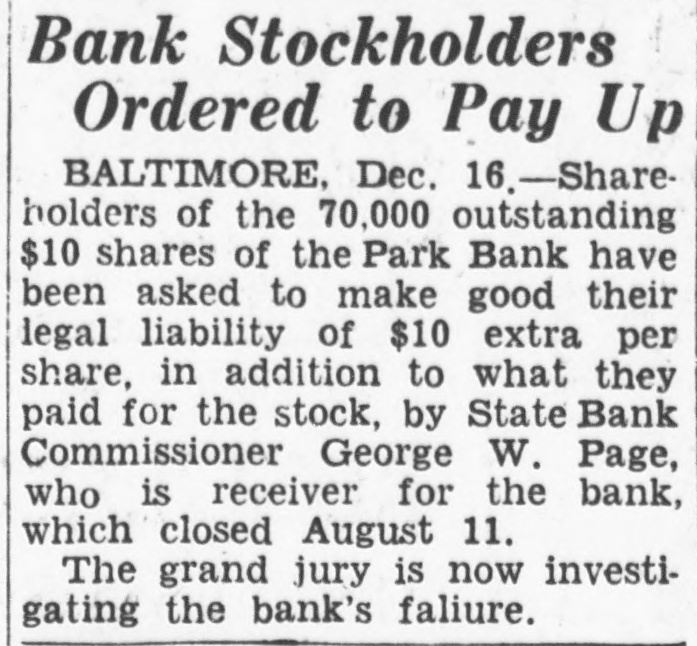
Bank Stockholders Ordered to Pay Up BALTIMORE, Dec. 16,-Shareholders of the 70,000 outstanding $10 shares of the Park Bank have been asked to make good their legal liability of $10 extra per share, in addition to what they paid for the stock, by State Bank Commissioner George W. Page, who is receiver for the bank, which closed August 11. The grand jury is now investigating the bank's faliure.


Article Text

PARK BANK OF BALTIMORE OFFICIALS IN president, two and the closed Park Bank of Baltimore were presented one depositor the grand jury on charges of violating the state today by city laws. Those against whom presentments were retained were: Bell, president of the bank for years; Clinton Richardson, chairman of the board of directors the Park Bank; Herbert M. Hartman, director the and known Baltimore automobile dealer; Wilbur Parker, Bell was named in each of the four presentments, one of him alone as from the bank than allowed by The other three presentments named the four accusations cheat defraud depositors of the conspiracy and conspiracy to do acts prejudicial to the institution and to enable Bell to borrow in excessive amounts. Bell's borrowing from the bank the time closed last August according to George Page, state bank commissioner receiver the totaled Hartman, Richardson and Parker also were large borrowers. The report submitted recently in the circuit court receivership Page as receiver stated the heavy borrowing by the president by directors apparently were within the legal percentage of the tal and surplus but the report suggested that special of the might show the real amount capital and surplus to be less than amount given in the statement issued by the bank.


Article Text

BALTIMORE BANKER TAKES STAND, TELLS OF BANK FAILURE Baltimore, Bell, of the closed Park ster president Bank took the witness stand in crimincourt here today and testified that on the of the general part hoarding and public, were for runs ments his bank in 1930. Bell on trial jointly with Clinton Richardson, chairman of board directors, for conspiracy defraud depositors. He said newspaper accounts bank failures to upset the held what he termed erroneous newspaper statements last July, the effect that John Baer, was vice of the Park Bank, for heavy The bank closed last August 11.


Article Text

Session Testimony Morning Bank Conspiracy bank tion) will not simply be making William State called record another aminer, the first Mr. O'Conor declared that he could the morning His testimony agreement with Mr. was confined Bank May 1931. Curran, but him that Park not trying this merely to make Defense tried bring out witness that banks record for the crash had not "We don't mind giving your Honors after stock sold out when you can judge immediately collateral dropped below this Mr. Curran asserted, the value The State we don't then want that record the face value of note. the ground another trial.' jected the testimony on be judged cannot the Judge that borrowers and while may Stanton declared. "All can do the same light one another, accord- rule what before have been banking ethics, should have Recounts Experience sold Mr. began systematic Court's Remark this Chief Judge Dennis In regard "John Rockefeller's loan would secured by shares good Ohio common. Each Baltimore and unique Mr. Curran asserted, didn't treat ourselves any differfrom customers and our bank ent different didn't treat what banks President the United States, the the Secretary the Treasury, thought through storm said: going Don't sell customers. "That assertion was made on the theory that sold out the customers collapse would follow. The panic came on because great banks what Graham's bank We did what every bleeding didn't out and because are going the Penitentiary. The attorney was interrupted by Mr. "Now what Mr. Curran says the country representatives asked the Park Bank done right here. But don't hold Mr. Curran's opinion. "Banks may have granted indulgences, that the question here. Here we have the very substance bank eaten own Mr. Gerbig followed on the stand by Carroll Jenkins. assistant cashier the Park Bank the closure. that setting interest charges due both Mr. Richardson's personal and the syndicate account were sent out regularly. Previous to calling Mr. Bell the Mr. Curran pointed out that there were several pending against his client, and although he Mr. Bell testify he wanted be sure that "they (the prosecu- account his banking experience the history the Park Bank. He entered the National Union Bank 1895. In 1913 went with the Park Bank and year later made president. The total then "There the went With aid of the stopped In had grown such an extent that went into larger quarters. capital increased in


Article Text

SUITS FILED AGAINST BANK'S STOCKHOLDERS BALTIMORE JUNE 30. suits against stockholders of the closed Park Bank filed today the by bank's receiver to colthe liability of the stockholders. Of the $700,000 stockholders' rability, only about $63,000 has been paid attorneys said.


Article Text

PLEDGES GOOD APPOINTEES FOR OFFICES Expects To Choose Men Of Only Highest Qualifications OBJECTS TO GIVING JOBS FOR FAVORS Candidate Wants Practical Insurance Man As Commissioner (Continued from Page 24) failure upon the part of the Bank Commissioner's office to meet the situation which confronted the country immediately after the Presidential election. "However, an examination of the record discloses that over period of years prior to that time, case after case arose which should not only have put the Bank Commissioner upon otice, but should have been warning to the Chief Executive of Maryland, that steps should be taken 'then and at once to protect and safeguard the depositors in the banks. Not Matter Of Politics "It can make no difference whether these banks were officered by gentlemen who are affiliated as Republicans or Democrats. That should not enter into the question. Futhermore, am not, in any sense of the word, condemning the management of all banks. am directing my remarks against certain banks which have heretofore termed the 'political banks. If it had not been for the dismal failure of these banks, the situation in Maryland would not and could not have been so disastrous to the general public. "On December 13. 1930, the Chesapeake Bank of Baltimore was placed in the hands of the State Bank Commissioner as receiver. The record of that proceeding shows the grossest sort of negligence on the part of the Bank Commissioner and bank examiners, in permitting that institution to continue in the manner in which had been conducted. According to the official examination which was reported in those proceedings in the Circuit Court No. of Baltimore city, it appears that the reserves of this bank, required by law, were exhausted." Bank Runs Are Cited "At that time great fear was entertained and wide disseminated that the Park Bank was in bad condition. So acute was this situation, you will that there were great runs on the Park Bank and some other banks in the city of Baltimore, including the Union Trust Company. "This condition itself should have been notice to the Chief Executive of this State that the office of the Bank Commissioner of Maryland was not functioning as it should. In spite, however, of these warnings and the repeated instances of remissness in the discharge of his duties as the Bank Commissioner of Maryland, he was, nevertheless, continued in office. "It must be remembere that shortly after the failure of this bank the Legislature Legislature by the present State Democratic machine, but there was no voice raised in protest, nor single line of remedial legislation enacted. Then came more rumors which involved the Union Trust Company and the Baltimore Trust Company, so that great runs were made upon both of these institutions. Unremedied, He Says "Still, the face of this, with knowledge which the Chief Executive must be charged with, of the inefficiency of the Bank Commissioner's office, the office was permitted to be carried on under the administration of the same


Article Text

Politicana Annapolis, Nov. 1 (P)-Confidence for Governor Ritchie and the entire Democratic ticket. that Governor Ritchie would be re- elected by majority as great or larger than the 66,000 he received in 1930 was expressed tonight by Daniel S. Sullivan, who managed Dr. Charles Conley's primary campaign at an Anne Arundel county Democratic rally held at Crystal Beach. Approximately 3,000 persons, from every section of the county, gathered in and around the auditorium to hear local candidates speak. It was one of the largest rallies ever held in the county. Sullivan, who is chairman of the Democratic campaign speakers' committee, declared the attendance showed that Anne Arundel county was safe inefficient executive. Still nothing was done to remedy this situation or to take steps to protect the money of the many thousands of depositors. [Mr. Nice here read extracts from an address by Isaac Lobe Straus relating to the banking situation.] Questions Raised "I ask you, am right when I say there must be searching, thorough and impartial investigation? Am right when say that believe that if the true facts can disclosed, there may result some additional relief to the many thousands of unfortunate depositors, through salvaging and distribution of additional sums? "Are the people of Maryland to be forever kept in ignorance of the true facts, or are we, the people of Maryland, going to find out what became of our money? Are we not entitled to know, so that at least we may be able to profit by our sad experiences and provide against such condition in the future? Much has been said and written about this matter by worthy and respectable members of the Governor's own party. Criticism Is Cited "No denunciation I can make can be more severe than that of the Governor's opponent in the late primary and other prominent members of his own party. submit to you, the present Democratic dynasty to be continued in control, at sacrifice of the people's interest, and their right to know the conditions, so that, so far as it is humanly possible, these ditions may be rectified, or at least prevented in the future? "I propose searching, thorough and impartial investigation. propose that this shall be made by commission of three distinguished outstanding citizens to be appointed by me, regardless of their party affiliations, to whom shall delegate power equal to that of legislative inquisitorial investigators, and who shall report to me, so that may report to you. ask you, whose responsibility is it that at the close of business on April 29, 1933, there was total of State funds on deposit in various institutions to $7,112,759.42, of which more than two millions had been deposited by Mr Dennis, the State Treasurer, in the Union Trust Company, of which he was the president. Points To Deposits "Over one-half million was on deposit in the Baltimore Trust Company, and approximately $200,000.00 in the Title Guarantee and Trust Company, aggregating over $3,000,000 of the State's in these three banks, practically half of the total amount of the deposits of the State. "Upon the other hand, in the five national banks-the First National Bank, the Canton National Bank, the National Marine Bank, the National Central Bank and the Western National Bank-all of unquestionable solvency, there was less than $250,000 of the State's money on deposit. "I charge that the Governor of the State of Maryland knew the condition of these failing institutions. He could not have helped knowing it. His own appointee was Bank Commissioner of the State of Maryland. It was the latter's duty to keep the Chief Magistrate of this State advised. If he failed in this duty, then the Governor was Approximately For Nice thousand persons jammed into the Baltimore Talmud Torah Hall, 22 North Broadway last night to hear Harry W. Nice, Republican candidate for Governor and other members of the State-wide ticket. The rally was held under auspices of the East End Republican Club of which Samuel G. Lipman is president. Joseph Davis presided at the meeting. Harry F. Klinefelter, For Phelps vice-president of the Twenty-seventh Ward Republican Organization, went on record last night as indorsing John Phelps, independent candidate for judge of the Supreme Bench. derelict in his duty in not compelling him to keep him advised. "For months and months, however, running into years, it was common knowledge there was something wrong. Runs were being made upon these banks. Emergency meetings were being held, calls for aid were being sent to the Reconstruction Finance Corporation and large sums were secured from this source. "Why, under such circumstances. was this condition in the banking system of Maryland permitted to go on? There is only one answer. The political connections of the officers of these banks with the Democratic administration and the Chief Executive of the State were too close. The responsibility is on him and him alone. But this was not all. Long before the red flag of danger was waving over the Union Trust Company and the Baltimore Trust Company there had been two other failures in Baltimore city, to which have already referred. Way back in 1930 the Chesapeake Bank; then the Park Bank, with 80,000 or more depositors, working people, whose savings represented their all to them. "Nor were the depositors the only sufferers. Stockholders Hit, Claim "There were innocent, unsuspecting stockholders who had been led to believe that their investments in the stock of these institutions were safe. Stockholders who were induced to purchase stock of the Baltimore Trust Company within the last few weeks before its collapse, all of whose investments in this stock were wiped out completely. [At this point Mr. Nice referred at length to a description of the banking situation by Dr. Charles H. Conley an address at Hagerstown on June 19, 1934.] "Under the law of this State no stockholder be sued for double liability, save and except through receiver. It is pertinent, therefore, to inquire why the caused to be passed at the recent special session of the Legislature law preventing the appointment of receivers for these political banks, thus prohibiting the State Bank Examiner, under penalty of the law, from giving out information in connection with these political banks, safeguarding the large stockholders of such banks from being subject to double liability, and thus preventing the depositor from profiting from such action, while the stockholders of the smaller banks throughout the State were compelled to meet this obligation. This law has been extended for another year by executive proclamation. Calls Hold Too Strong "This political machine, however, built up with the people's money, was too powerful to overcome, and today the Democratic party, regard- shall not be selected for office merely less of the views of those thoughtful as reward for political favors. citizens who realized that the best "I have assured the people of this interests of their State and party State that the office of Insurance Comwould have been best served by missioner shall be filled by man of change of administration, finds itself in experience in insurance, competent and capable of fulfilling the duties the strangle hold of this Democratic which the office imposes upon him, machine. "Do those gentlemen who officered who will give his entire time to the discharge of his responsibilities. these banks and who are now straining every nerve and sinew to hold "I solemnly promise that when am elected Governor there shall be control of the State government. desire such an investigation? No. They no one appointed to fill public office have no love for the present Chief merely because of his political activiExecutive of this State, but to them ties. Appointees shall and must be he is safe. They are interested in men and women of high character and themselves, not in him. Their interest ability. is in maintaining the status quo, Refers To Auto Commissioner keeping the lid on, so that you and "What justification or excuse can the people of the State will never there be for the present automobile know the truth about these banks. who recently was ediWill Seek Advice torially called upon by The Evening "I have been questioned concerning appointments which I may make when am elected Governor. have stated, not once. but many times, that when am elected Governor, shall. in making my appointments, expect the assistance and advice of all associations which may be interested in the particular subject matter of the board or commission to be appointed. "I have laid down, as a primary principle, that there shall be minority representation on all boards and commissions. have criticized, and still criticize, the Public Service Commission as now composed. This Commission is of semi-judicial character. and, as such, its members should be and remain free from all political activities which might affect or tend to influence the exercise of their free will and judgement. "I am opposed to the practice of State Executive appointing. during the terms for which they are elected, members of the Legislature to public office or employment. Not Based On Favors "I have pledged myself that the police magistrates shall be men of high character and principle, and that they Sun to resign? For the present conservation commissioner, who has permitted an industry which, in 1919 was worth over $7,000,000 to the people of this State, to fall to such low level that today it is worth, according to the Governor's own statement, $2,000,000, and requires an expenditure of half million dollars to save it? "How can the Governor justify the appointment of an insurance sioner who lacked experience in insurance matters and who has failed to enforce the law providing for reserves to be put up by foreign insurance and casualty companies doing business in Maryland. which has caused great loss and suffering to those who have been so unfortunate as to have carried in such panies, relying upon the State insurance department to afford them
Article Text

Broening, Others In Park Bank Suit Receiver Seeks To Collect $75,000 On Mortgage Given To Bank State Bank Commissioner John J. Ghingher, as receiver of the Park Bank, today filed suit in the Baltimore City Court, asking $75,000 from former Mayor William F. Broening, John T. Donohue, Thomas J. Donohue, William H. Gontrum, Lee B. Tucker and Margaret M. Donohue, in connection with a mortgage given to the bank. Mr. Broening and other defendants had signed mortgage agreement executed in 1930 from the Donohue Hilton Company as mortgagors to the Park Bank, was alleged. Mr. Broening was one of the directors of the company and Thomas J. Donohue was president, was said. The receiver's suit alleged that the mortgage debt matured in 1931 and remains unpaid. A statement filed with the proceedings gave the original of the mortgage debt at $40,000, plus interest of $9,980 up to last November


Article Text

Former Mayor Broening Named In $75,000 Suit He And Five Others Defendants In Action By John J. Ghingher As Park Bank Receiver Former Mayor William F. Broening and five other persons yesterday were named in $75,000 suit filed in the City Court by John J. Ghingher, receiver of the Park Bank. It was alleged that the defendants joined in execution of a $40,000 mortgage from the Donohue-Hilton Com- pany to the Park Bank in September 1930, becoming jointly and severally liable to pay the debt. The mortgaged property is located at Caton and Monastery avenues. Although the debt is due and demand for its payment has been made, it has not been paid, the suit alleged. The amount claimed, with interest, is $49,980. The defendants, in addition to Mr. Broening. are John T. Donohue, Thomas J. Donohue, William H. Gontrum. Lee B. Tucker and Margaret M. Donohue.