Click image to open full size in new tab
Article Text
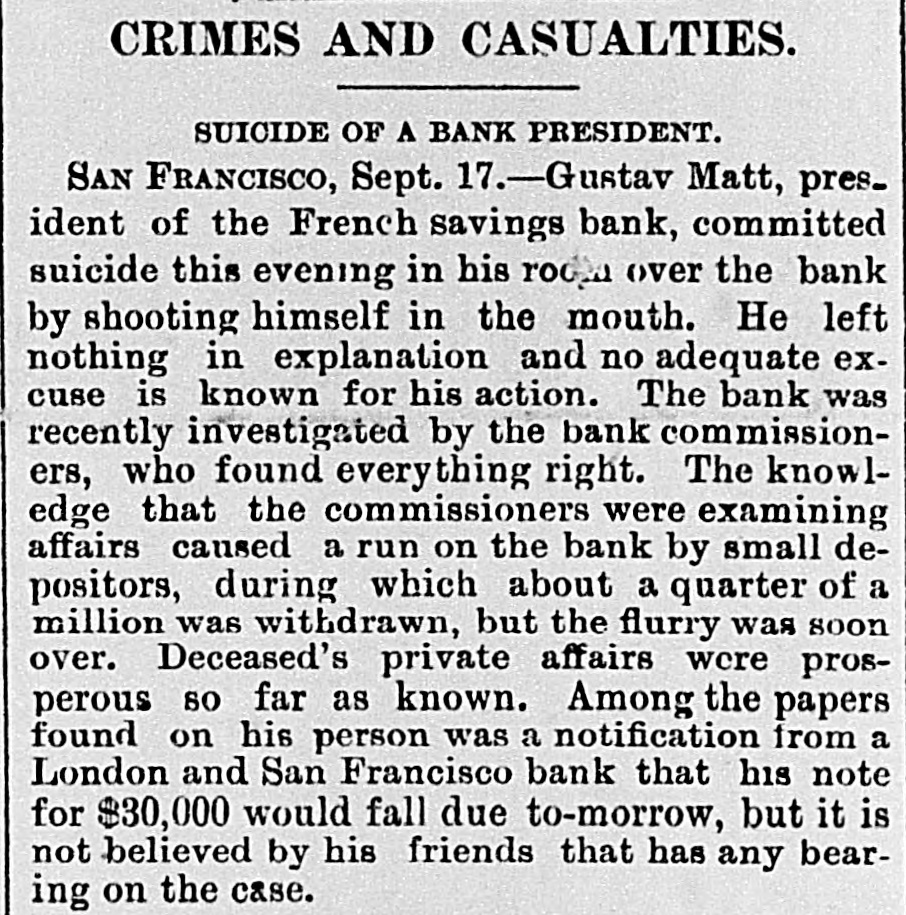
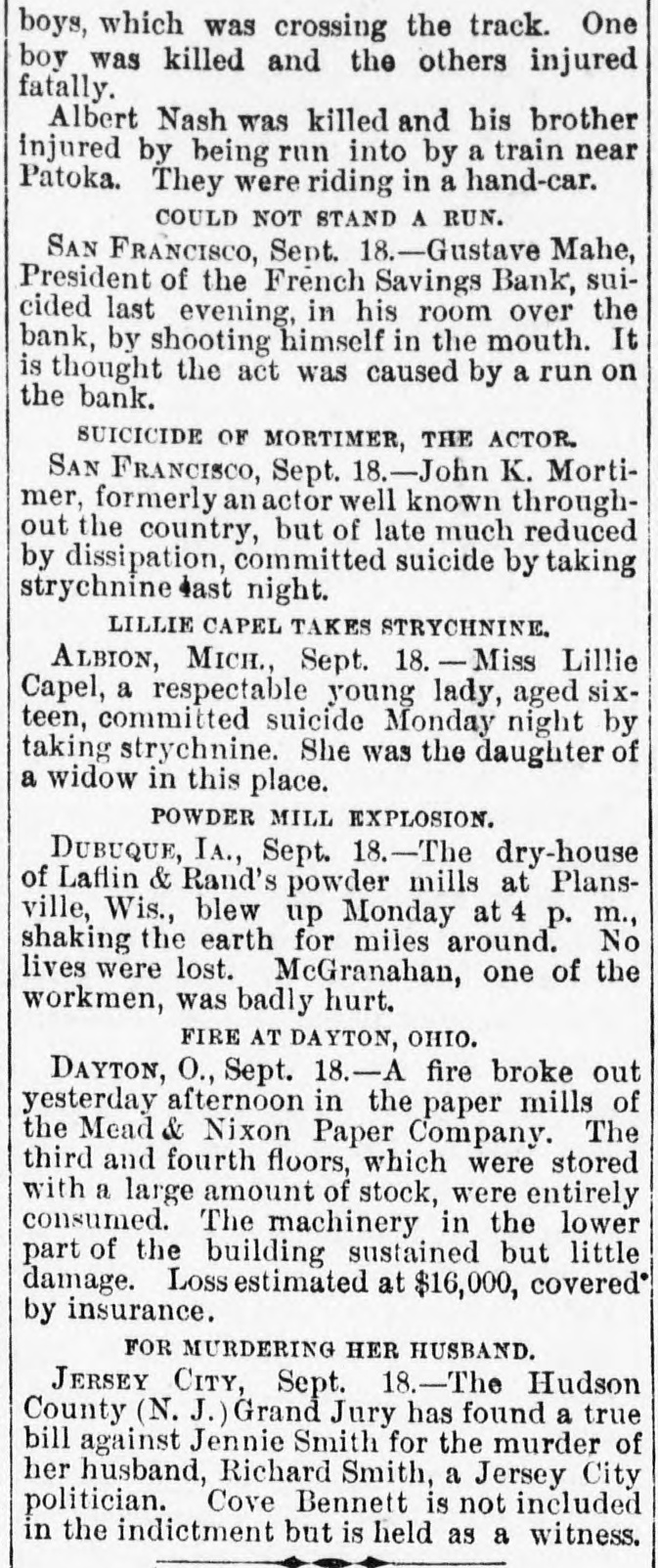
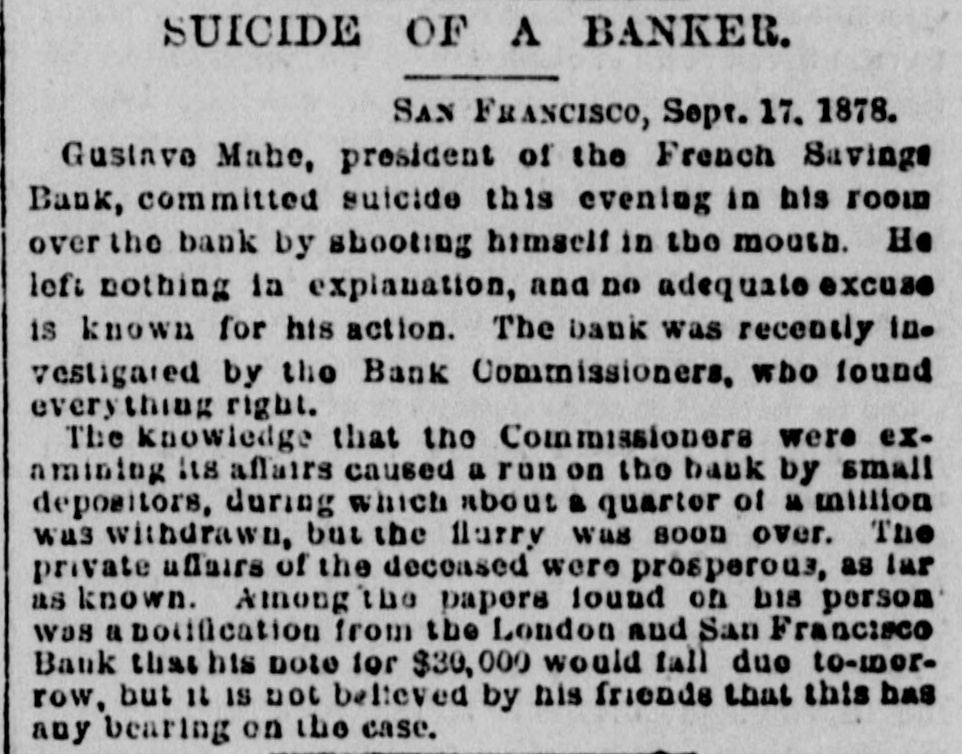
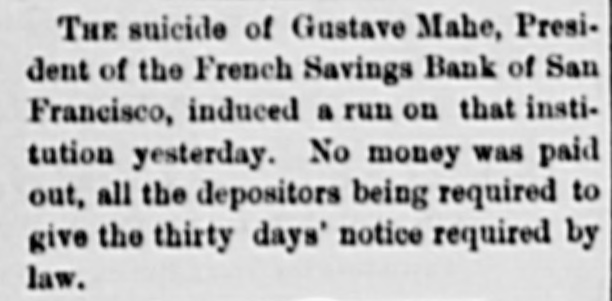
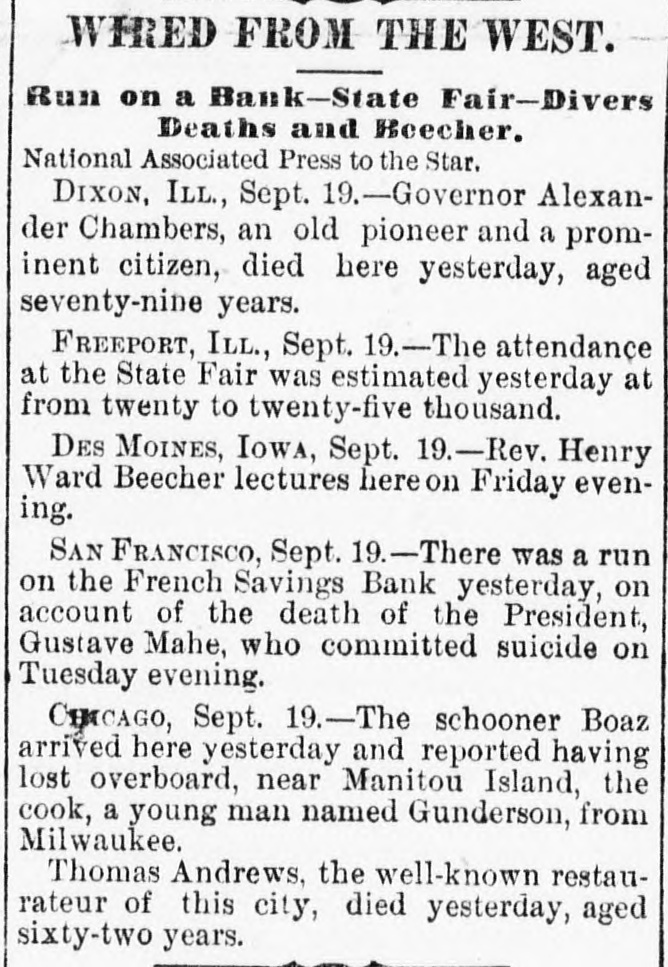
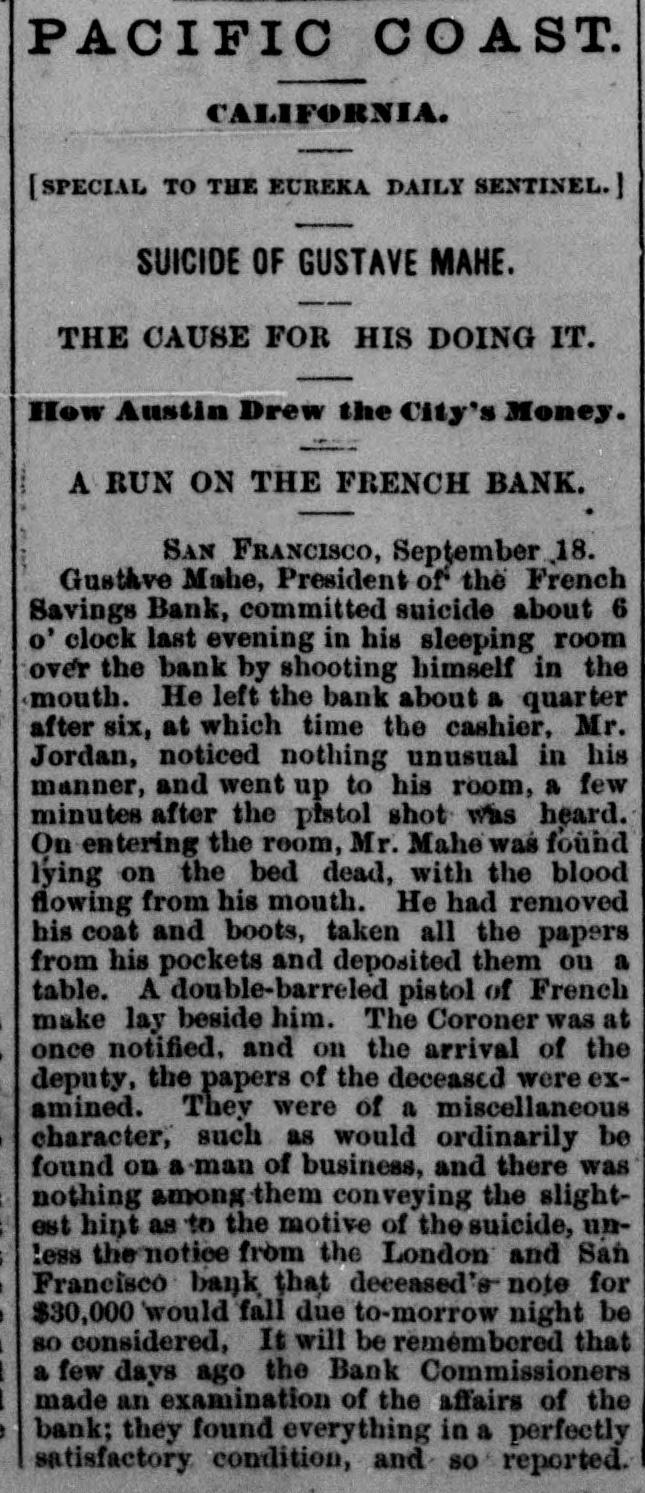
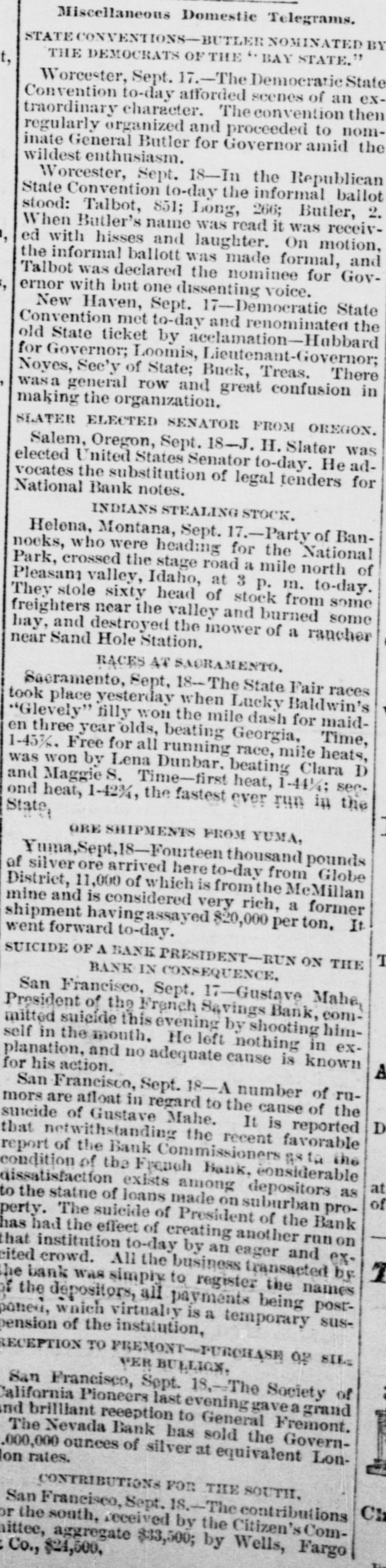
lasting or the withdrawal of about a quarter of a million of dollars. Mr Jourdan, cashier, states that the deceased apparently felt no uneasiness about the run. and, although it apparently annoyed him somewhat, he cannot think that it had anything to do with the suicide; neither does be believe that the note coming due to-morrow is in any way responsible for deceased's action, as he considers Mr. Mahe a man of considerable wealth. He professes to be at an utter loss to account, on any reasonable hypothesis, for the suicide. Mr. Mahe's family are at present at San Mateo, with the exception of one son, who is now in Europe at school. Deceased was about 56 years of age and an old and esteemed citizen. A number of rumors are afloat as to the cause on Gustave Mahe's suicide. It is reported that, notwithstanding the recent favorable report of the commissioners as to the condition of the bank, considerable dissatisfaction and distrust exists among depositors as to the status of loans made on suburban property. It is understood that the commissioners have made an examination of the property in question, but have not yet reported on it. The city real estate was found to be practically what it was rated at by the bank, but there is an impression that some of the outside property has largely depreciated in value. There is one loan of $700,000 on property near San Miguel, belonging to the estate of the late F. L. A. Pioche. on which no interest has been paid for the last five years, and it is believed that the property has depreciated to less than half the amount of the loan. It is further said that the depositors had concluded to call a meeting and obtain a full statement from the management of the bank concerning these matters that as a matter of courtesy deceased was requested to call a meeting that he failed to do so, and in consequence the depositors called a meeting themselves for next Saturday, and that it is proposed at the meeting to demand the removal of deceased from the directory. It is believed that the prospect of a removal from the position which he has held for the last 18 years influenced Mahe to take his life. LATER.-The doors of the French Savings Bank closed this morning; no money was received or paid out. A line of depositors stand outside, but are refused admittance. The Cashier and assistants are busy over the accounts. Two of the Directors, who were on band, stated that they knew nothing to account for the suicide of Mr. Mahe, and but little about the affairs of the bank, but that a meeting would be held this afternoon, at which some course of action would be agreed upon. At the office of the Bank Commissioners some information was obtained tending to throw more light on the subject. Commissioner Coleman states that at the time the recent letter from the Commission was made public, to the effect that the bank was in a sound condition, their investigations all pointed to that conclusion, and the letter was given to allay the fears of depositors. Since that some matters have come to light to make the showing less favorable. It was ascertained that a loan of $45,000 had been made secured on real estate, which was already encumbered by a mortgage in excess of its value. Other assets to the amount of $168,000 were found to be in an unsatisfactory condition. Commissioner Coleman called Mahe's attention to these facts, and reproached him with a lack of candor in his presentation of the affairs of the bank. This seemed to affect Mahe greatly, and the want of confidence expressed by Coleman moved him to tears. He made over real estate yesterday to cover the $45,000 loan, and gave his personal guarantee to secure the $168,000 case. It is considered possible that other such cases may be discovered in further digging into the affairs of the bank, and the impression is that the suicide of Mahe is owing to these complications. The Commissioners express the opinion that with the guarantees given by the deceased President the bank can work its way out and the depositors suffer no loss, and incline to the opinion that this will be the best course to pursue, as the bank is a purely mntual institution, and there are no stockholders to fall back upon. The Finance Committee of the Board of Supervisors this morning examined the books of J. M. Walker & Co., on which exTax Collector Austin was a member, to ascertain how Austin drew the city's money. The great bulk of the amount of over a quarter of a million was drawn out by Austin's checks, ranging mostly in handreds, and in every case payable to bearer, leaving no clue to the disposal of the funds. The Committee is as much in the dark as ever. The contributions for the South received by the Citizens' Committee is $33,500, and by Wells, Fargo & Co., $21,500. In pursuance to an order by the Board of Supervisors, the extra clerks in the different departments of the City Government have been discharged to the number of thirty-five, saving some $4,000 a month. The Register and Receiver of the United States Land Office received the following dispatch from Washington to-day: WASHINGTON, September 18. To the Register and Receiver, San Francisco: Receive no more applications to select lands under the one hundred and fifty thousand acre grant, the full quantity having already been selected. J. A. WILLIAMSON, Commissioner. The dispatch relates to the Agricultural College grant, set aside by the United States for the benefit of the University of California. In the matter of the bankruptey of the o Sierra Flume & Lumber Compiny of r Shasta & Tehama, and Butte Company adjudged bankrupt on its own petition, a warrant in bankruptcy has been issued out of the United States District Court against said bankrupts, giving notice of a meeting of creditors to be held at the Court of in Bankruptcy, on the 30th instant. to choose one or more assignees of the estate. The creditors number over 2,100. The suicide of the Managing Director of the French Savings Bank, had the effect of creating a run on that institution. To-day to an eager and excited crowd was gathered, who, forming into line, streamed into the bank to leave their names, calling for their deposits under the thirty days rule. All the business transacted by the bank was simply to register the names of those de-