Carnegie Trust Company (New York, NY)

Episode Information

Episode UID
3649913891333
Episode Type
Run โ†’ Suspension โ†’ Closure
Bank Type
trust
Bank ID
364991389 hash
Start Date
January 1, 1911
Location
New York, New York (40.714, -74.006)

Metadata

Model
gpt-5-mini (chosen from majority vote of a three-model LLM ensemble)
Short Digest
05e372b7d575650d

Response Measures

None

Events (3)

1. January 1, 1911 Run
Cause
Bank Specific Adverse Info
Cause Details
Persistent withdrawals following discovery of a suspect draft and knowledge of shaky affairs and alleged misconduct by an official (Joseph G. Robin).
Measures
None specified beyond calling in state banking superintendent.
Newspaper Excerpt
officials of the bank issued a statement saying a quiet run had been in progress for a week and ready available resources had been used up.
Source
newspapers
2. January 7, 1911 Suspension
Cause
Government Action
Cause Details
State Superintendent of Banks Cheney took charge and closed the company after determining it was unsound to continue.
Newspaper Excerpt
The superintendent of banks has taken charge of the property and business of the Carnegie Trust Company...conclude that it is in an unsound condition to transact business
Source
newspapers
3. April 12, 1911 Receivership
Newspaper Excerpt
Payson Merrill was appointed receiver with bond of $100,000. An involuntary petition in bankruptcy was filed against William J. Cummins, president of the failed Carnegie Trust Co.
Source
newspapers

Newspaper Articles (24)

Article from Evening Journal, January 7, 1911

Click image to open full size in new tab

Article Text

BIG TRUST CO. CLOSES New York Bank Superintendent Takes Charge of the Carnegie Institution QUIET RUN ON IT FOR MORE THAN A WEEK By United Press Leased Special Wire. NEW YORK, Jan. I.-The Carnegie Trust Company was closed today by State Superintendent of Banks Cheney. The company was chartered in 1907 and had a paid up capital of $1,500,000; surplus and undivided profits of $737,000 and gross deposits of " about $8,900,000. J. T. Howell was d president. Superintendent Cheney of the Banking Department issued the following S statement: 9 "The superintendent of banks has taken charge of the property and business of the Carnegie Trust Company. The examination of the affairs of the company has caused the superintendent to conclude that it is in an unsound condition to transact business, and that it is not safe for it to continue. "The examination is not yet complete and no further statement can be made at this time." Officials of the closed institution stated that there had been a quiet run d on it for more than a week and that this had used up all of the available ready resources so the State Banking Department was called on to interfere to protect the rank and file of the depositors.


Article from The Salt Lake Tribune, January 8, 1911

Click image to open full size in new tab

Article Text

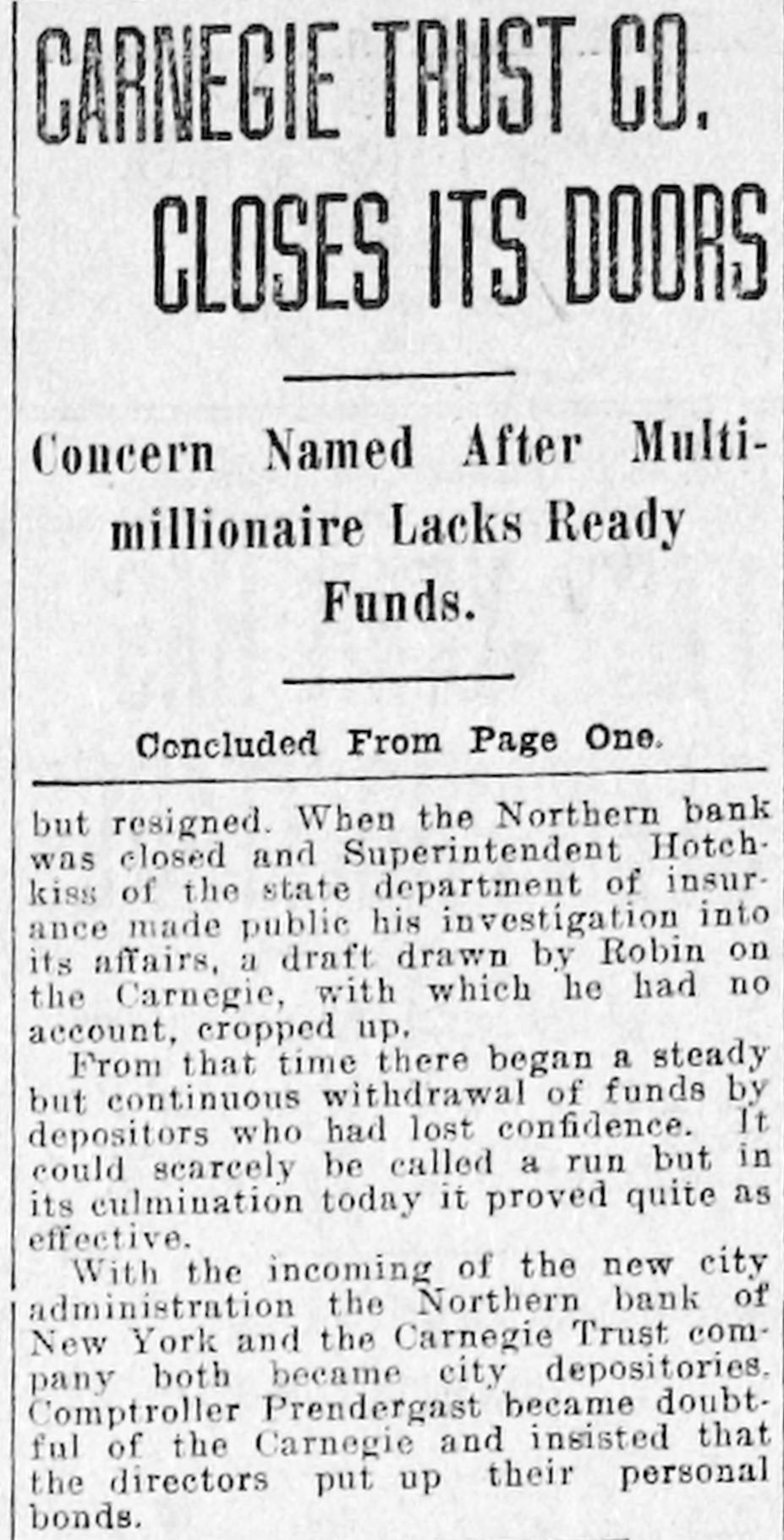
CARNEGIE TRUST CO. CLOSES ITS DOORS Concern Named After Multimillionaire Lacks Ready Funds. Concluded From Page One. but resigned. When the Northern bank was closed and Superintendent Hotchkiss of the state department of insurance made public his investigation into its affairs, a draft drawn by Robin on the Carnegie, with which he had no account, cropped up, From that time there began a steady but continuous withdrawal of funds by depositors who had lost confidence. It could scarcely be called a run but in its culmination today it proved quite as effective. With the incoming of the new city administration the Northern bank of New York and the Carnegie Trust company both became city depositories. Comptroller Prendergast became doubtful of the Carnegie and insisted that the directors put up their personal bonds.


Article from Newark Evening Star and Newark Advertiser, January 9, 1911

Click image to open full size in new tab

Article Text

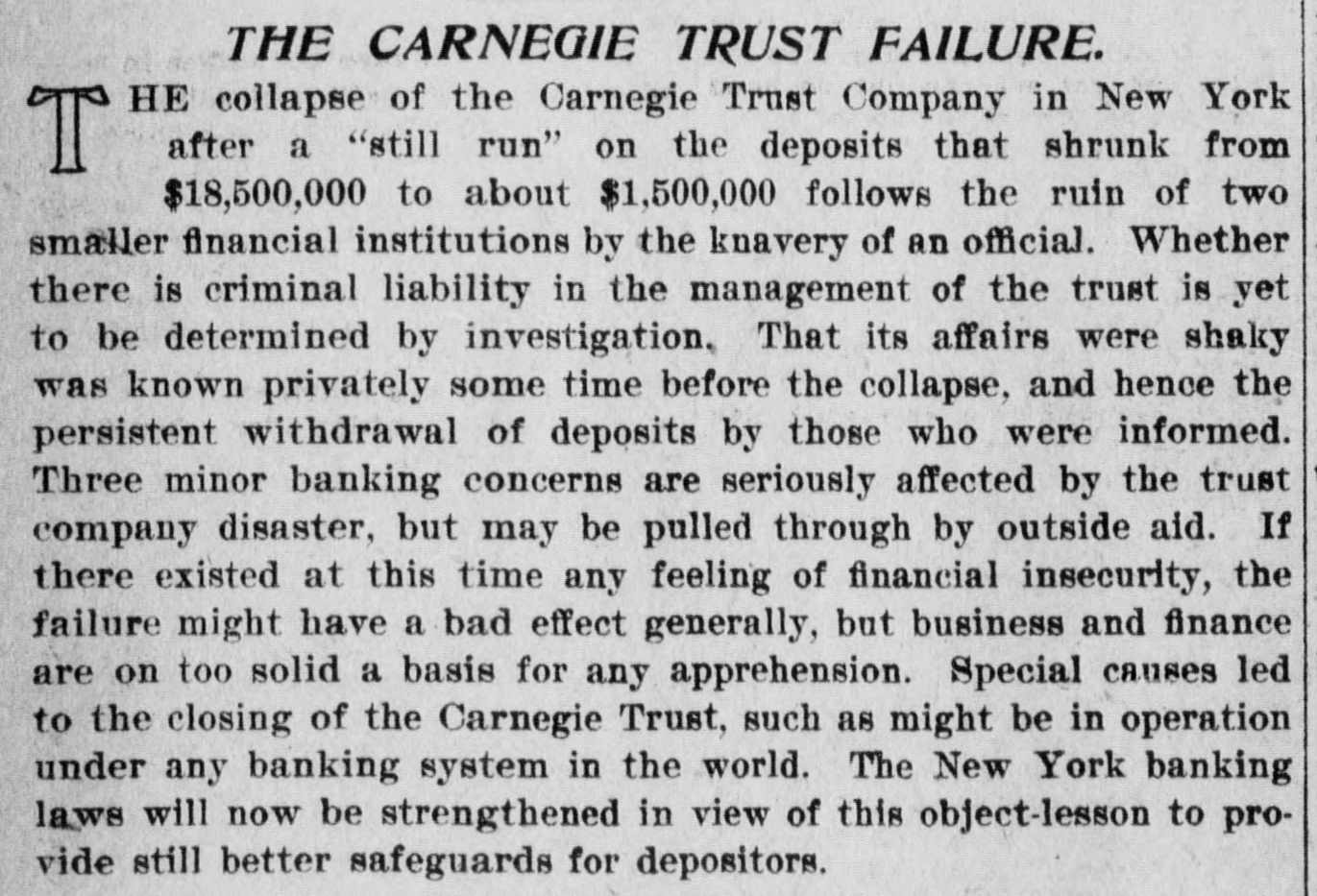
THE CARNEGIE TRUST FAILURE. HE collapse of the Carnegie Trust Company in New York after a "still run" on the deposits that shrunk from T $18,500,000 to about $1,500,000 follows the ruin of two smaller financial institutions by the knavery of an official. Whether there is criminal liability in the management of the trust is yet to be determined by investigation, That its affairs were shaky was known privately some time before the collapse, and hence the persistent withdrawal of deposits by those who were informed. Three minor banking concerns are seriously affected by the trust company disaster, but may be pulled through by outside aid. If there existed at this time any feeling of financial insecurity, the failure might have a bad effect generally, but business and finance are on too solid a basis for any apprehension. Special causes led to the closing of the Carnegie Trust, such as might be in operation under any banking system in the world. The New York banking laws will now be strengthened in view of this object-lesson to provide still better safeguards for depositors.


Article from Las Vegas Optic, January 9, 1911

Click image to open full size in new tab

Article Text

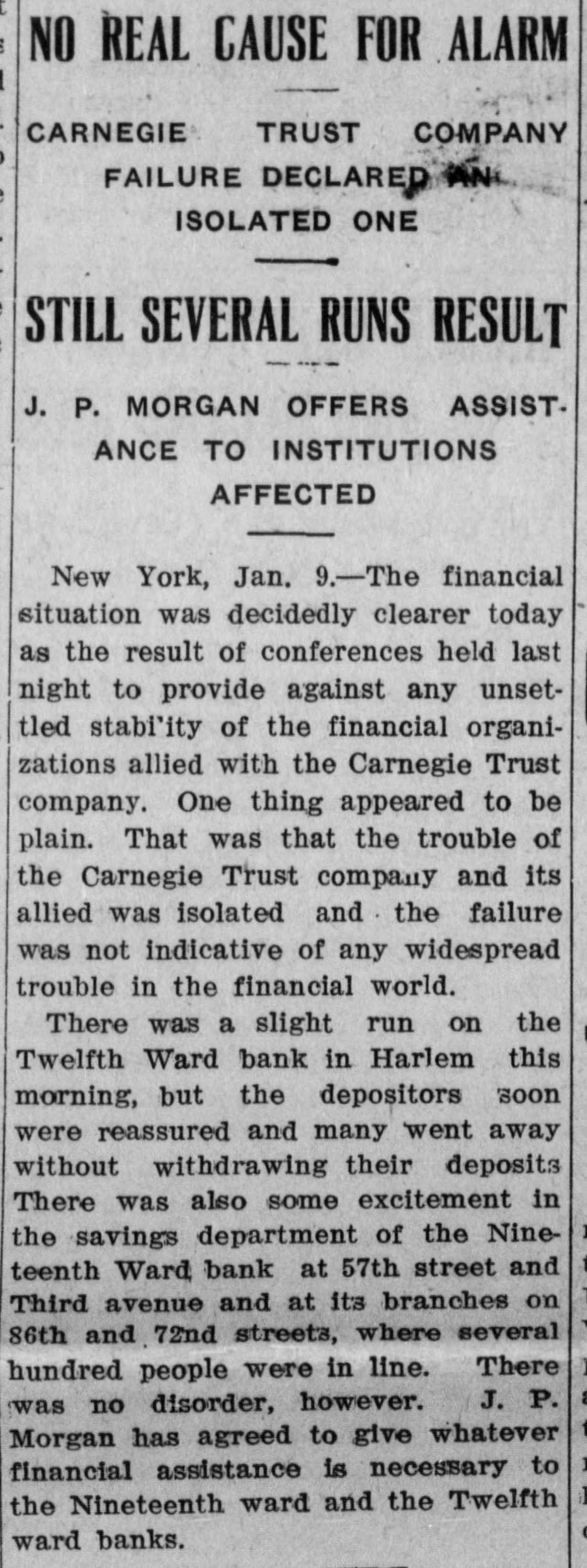
NO REAL CAUSE FOR ALARM TRUST CARNEGIE COMPANY AN FAILURE DECLARED ISOLATED ONE STILL SEVERAL RUNS RESULT J. P. MORGAN OFFERS ASSIST. ANCE TO INSTITUTIONS AFFECTED New York, Jan. 9.-The financial situation was decidedly clearer today as the result of conferences held last night to provide against any unsettled stabi'ity of the financial organizations allied with the Carnegie Trust company. One thing appeared to be plain. That was that the trouble of the Carnegie Trust company and its allied was isolated and . the failure was not indicative of any widespread trouble in the financial world. There was a slight run on the Twelfth Ward bank in Harlem this morning, but the depositors soon were reassured and many went away without withdrawing their deposits There was also some excitement in the savings department of the Nineteenth Ward bank at 57th street and Third avenue and at its branches on 86th and 72nd streets, where several hundred people were in line. There was no disorder, however. J. P. Morgan has agreed to give whatever financial assistance is necessary to the Nineteenth ward and the Twelfth ward banks.


Article from The Fairmont West Virginian, January 10, 1911

Click image to open full size in new tab

Article Text

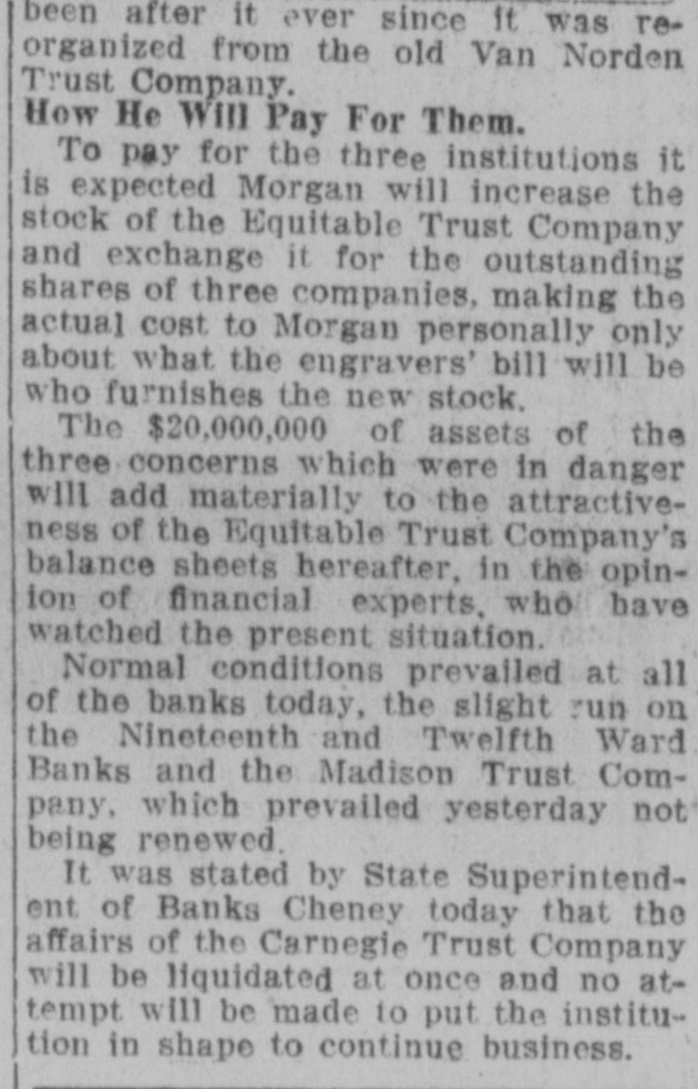
MORGAN COMES TO RESCUE AND STAYS A PANIC J. P. MORGAN AND ALLIED INTERESTS COME TO THE RESCUE OF NEW YORK BANKS THREATEN. ED WITH RUNS BECAUSE OF THEIR CONNECTION WITH THE CARNEGIE TRUST COMPANY.


Article from The Parma Herald, January 12, 1911

Click image to open full size in new tab

Article Text

Carnegie Trust Company Closed. New York.-The Carnegie Trust company has been closed by State Bank Commissioner Cheney. The company was chartered in 1907 and had a paid-up capital of a million dollars. Its surplus was $500,000 and its undivided profits aggregated $73,000. Its gross deposits amounted to $8,900,000. The officials of the bank issued a statement saying a quiet run had been in progress for a week and ready available resources had been used up.


Article from Heppner Gazette, January 12, 1911

Click image to open full size in new tab

Article Text

Carnegie Trust Company Closed. New York.-The Carnegie Trust company has been closed by State Bank Commissioner Cheney. The company was chartered in 1907 and had a paid-up capital of a million dollars. Its surplus was $500,000 and its undivided profits aggregated $73,000. Its gross deposits amounted to $8,900,000. The officials of the bank issued a statement saying a quiet run had been in progress for a week and ready available resources had been used up.


Article from Watertown Leader, January 13, 1911

Click image to open full size in new tab

Article Text

SUPPORT HALTS BANK TROUBLES Quick Action by Big Interests Prevents Possible Runs. New York.-Owing to the quick and strong support given by J. P. Morgan & Co., Kuhn, Loeb & Co. and other powerful banking interests to a situation that for a short time was delicate, the city of New York was saved from bank runs that might have led to general excitement and temporary financial derangement. When it became known that the interests named had organized themselves into a committee of defense against the probable bad effects of the failure of the Carnegie Trust Co., the apprehended runs on the Madison Trust Co. and its subsidiaries, the Twelfth Ward bank and the Nineteenth Ward bank, with several branches scattered through the city and all affiliated with the unfortunate Carnegie Trust Co. were virtually averted. Although there were steady withdrawals from these banks and their several branches all day, at no time was there a panicky feeling.


Article from The Alaska Citizen, January 16, 1911

Click image to open full size in new tab

Article Text

Money Kings Avert Panic. NEW YORK, Jan. 10. - The money kings of Wall street met the financial disturbances that arose over the failure of the Carnegie Trust company, and a panic was thereby averted.


Article from Vilas County News, January 18, 1911

Click image to open full size in new tab

Article Text

SUPPORT HALTS BANK TROUBLES Quick Action by Big Interests Prevents Possible Runs. New York.-Owing to the quick and strong support given by J. P. Morgan & Co., Kuhn, Loeb & Co. and other powerful banking interests to a situation that for a short time was delicate, the city of New York was saved from bank runs that might have led to general excitement and temporary financial derangement. When it became known that the interests named had organized themselves into a committee of defense against the probable bad effects of the failure of the Carnegie Trust Co., the apprehended runs on the Madison Trust Co. and its subsidiaries, the Twelfth Ward bank and the Nineteenth Ward bank, with several branches scattered through the city and all affiliated with the unfortunate Carnegie Trust Co. were virtually averted. Although there were steady withdrawals from these banks and their several branches all day, at no time was there a panicky feeling.


Article from Vernon County Censor, January 18, 1911

Click image to open full size in new tab

Article Text

SUPPORT HALTS BANK TROUBLES Quick Action by Big Interests Prevents Possible Runs. New York.-Owing to the quick and strong support given by J. P. Morgan & Co., Kuhn, Loeb & Co. and other powerful banking interests to a situation that for a short time was delicate, the city of New York was saved from bank runs that might have led to general excitement and temporary financial derangement. When it became known that the interests named had organized themselves into a committee of defense against the probable bad effects of the failure of the Carnegie Trust Co., the apprehended runs on the Madison Trust Co. and its subsidiaries, the Twelfth Ward bank and the Nineteenth Ward bank, with several branches scattered through the city and all affiliated with the unfortunate Carnegie Trust Co. were virtually averted. Although there were steady withdrawals from these banks and their several branches all day, at no time was there a panicky feeling.


Article from The Lake County Times, January 20, 1911

Click image to open full size in new tab

Article Text

The failure of the Carnegie Trust Company has caused a slight run on some of the New York City banks, and a curious state of affairs has developed. Depositors in three of the banks whose officers were interested in the Carnegie Trust Company have stood in line waiting to withdraw


Article from The Fargo Forum and Daily Republican, April 12, 1911

Click image to open full size in new tab

Article Text

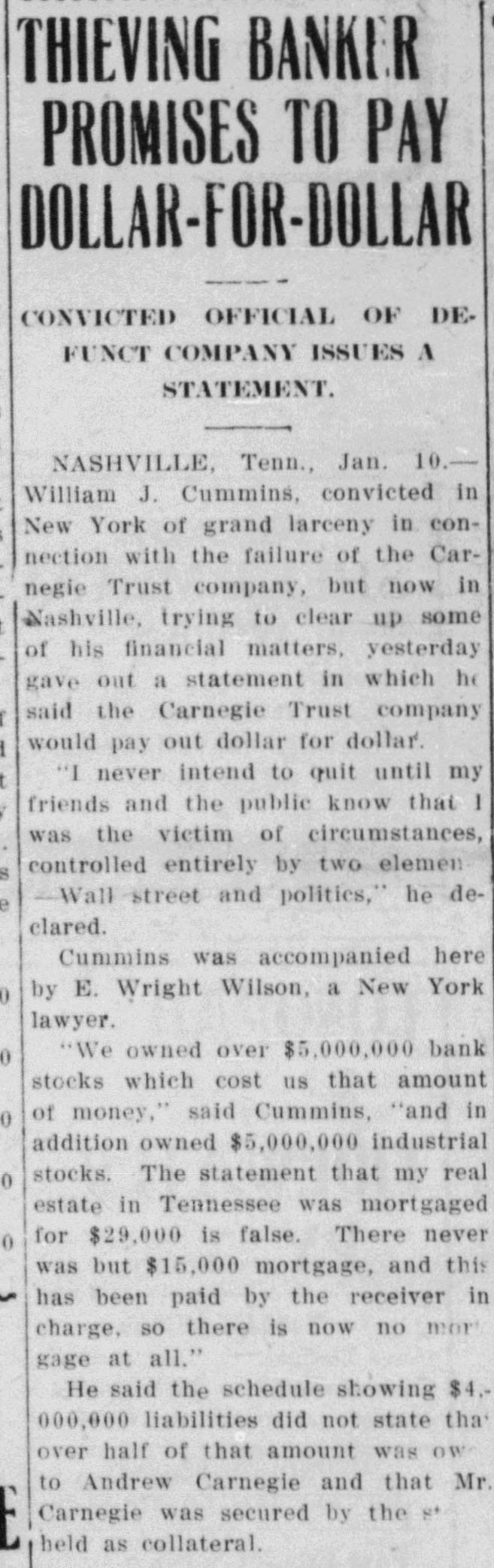
LIABILITIES ARE IN THE MILLIONS New York, April 12.-An involuntary petition in bankruptcy was filed here today against William J. Cumming, president of the failed Carnegie Trust Co., and now under indictment. His liabilities were given as $5,000,000 and assets as worth $4,000,000. Payson Merrill was appointed receiver with bond of $100,000. Two other petitions in bankruptcy were filed against Charles Arthur Moore, jr., director of the Carnegie Trust Co., and Martin J. Condon also a director. The liabilities of Moore are given as $2,000,000 with assets of $100,000, and Condon's liabilities are $6,500,000 and assets of $500,000.


Article from The Daily Telegram, April 12, 1911

Click image to open full size in new tab

Article Text

According to Petition Filed in Court by Three of the Creditors. ASSETS VERY SMALL Receiver is Appointed for Official's of Failed Trust Company. NEW YORK, April 12-An Involuntary petition in bankruptoy was filed here today against William J. Cummins, president of the failed Carnegie Trust Company, now under indictment. His liabilities are given as $5,000,000 and assets as $400,000. Payson Merrill was appointed receiver with bond at $100,000. Two other petitions in bankruptcy were filed against Charles Arthur Moore, Jr., a director of the Carnegie Trust Company, and Martin J. Condon, also a director. The Nabilities of Moore are give. as $2,000,000 and his assets as $100,000, and Condon's liabilities are $6,500,000. and assets $500,000. The three petitioning creditors allege preferential payments and transfers of property while insolvent. It is said that Cummins is no win Nashville, Tenn. The actions were not brought against the respondents as directors in the Carneie Trust Company, but as individuals. The Carneigie Trust Company and Long and Edge failures were thrust over the precipice by the failure and indictment of Joseph G. Robin.


Article from Las Vegas Optic, April 12, 1911

Click image to open full size in new tab

Article Text

CUMMINS FORCED INTO BANKRUPTCY THE BREEZY TENNESSEAN WHO BLEW INTO WALL STREET, HARD UP New York, April 12.-An involuntary petition in bankruptcy was filed here today against William J. Cummins, president of the failed Carnegie Trust company and now under indictment His liabilities are given at $5,000,000 and the assets at $400,000. Payson Merri11 was appointed receiver. Two other petitions in bankruptcy were filed against Charles Arthur Moore, jr., a director of the Carnegie Trust company and Martin J. Condon, another director. The liabilities of Moore are given at $2,000,000, with assets of $190,000 and Condon's liabilities at $6,500,000 and assets at about $500,000.


Article from Alexandria Gazette, April 12, 1911

Click image to open full size in new tab

Article Text

Petitions in Rantruptcy, New York, April 12.-Petitions in bankruptcy were filed with Judge Holt, in the United States district court today against William J. Cummins, for mer head of the Carnegie Trust Company; M. J. Condon, a promoter, and Charles A. Moore, by H.C. Brewster, Herbert Hatfleld, and J.S. Watson. Judge appointed B. Payson Morrill, receiver. and issued a restraining order, directing that all persons shall turo over to the receiver any property of the defendants now in their hands. It is- alleged that Cummins' liabilities alone are $5,000,000 with assets of only $500,000, while Condon's Habilities are said to be $6,500,000 and his assets $500,000.


Article from The Fargo Forum and Daily Republican, April 12, 1911

Click image to open full size in new tab

Article Text

LIABILITIES ARE IN THE MILLIONS New York, April 12.-An involuntary petition in bankruptcy was filed here today against William J. Cumming, president of the failed Carnegie Trust Co., and now under indictment. His liabilities were given as $5,000,000 and assets as worth $4,000,000. Payson Merrill was appointed receiver with bond of $100,000. Two other petitions in bankruptcy were filed against Charles Arthur Moore, jr., director of the Carnegie Trust Co., and Martin J. Condon also a director. The liabilities of Moore are given as $2,000,000 with assets of $100,000, and Condon's liabilities are $6,500,000 and assets of $500,000.


Article from Evening Star, April 15, 1911

Click image to open full size in new tab

Article Text

# Moore Leaves Rome for North. ROME, April 15.-Charles Arthur Moore, jr., director of the suspended Carnegie Trust Company of New York, and against whom an involuntary petition in bankruptcy was filed recently, left here last Thursday for the north of Italy. It is believed he is on his way to America.


Article from New-York Tribune, April 16, 1911

Click image to open full size in new tab

Article Text

# C. A. MOORE. JR., LEAVES ROME. Rome, April 15. - Charles Arthur Moore, jr., a director of the suspended Carnegie Trust Company, of New York, and against whom an involuntary petition in bankruptcy was filed recently, left here last Thursday for the north of Italy. It is believed he is on his way to America.


Article from Perth Amboy Evening News, June 12, 1911

Click image to open full size in new tab

Article Text

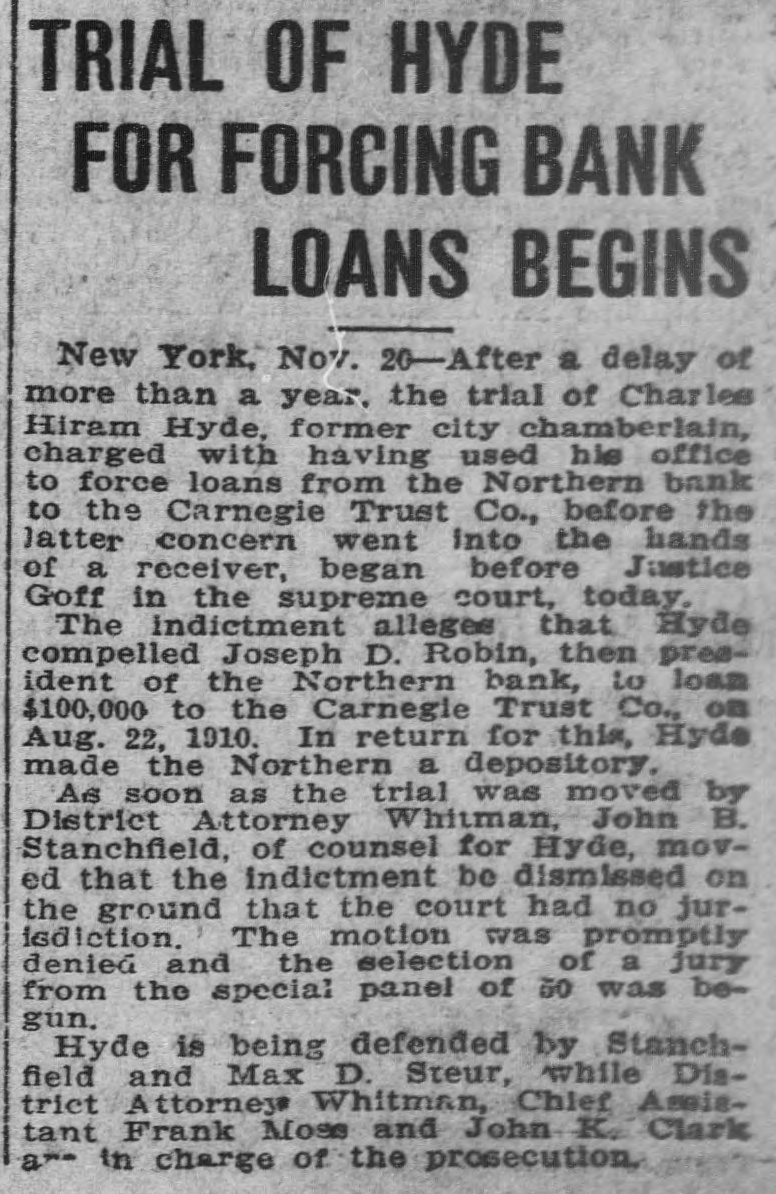
No Immediate Trial for Hyde. Special by United Press Wire. New York, June 12:-Justice McCall today denied the request of former City Chamberlain Charles H. Hyde, indicted on a bribery charge in connection with the suspension of the Carnegie Trust Company, for an, immediate trial.


Article from The Sentinel=record, June 24, 1911

Click image to open full size in new tab

Article Text

CARNEGIE TESTIFIES. New York, Jupne23.-A deposition given by Andrew Carnegie before he sailed for Europe was read today in a civil suit in which the Ironmaster declared he knew nothing of the atfairs of the suspended Carnegie Trust Company. He said he had loaned the Company $1,000,000 to help it out of its troubles.


Article from The Calumet News, November 24, 1911

Click image to open full size in new tab

Article Text

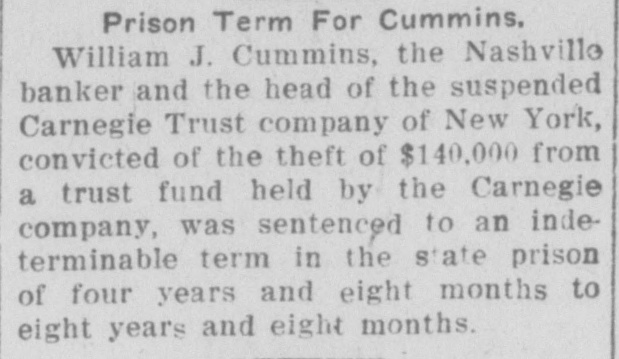
Cummins Sentenced Today. New York, Nov. 24. -William J. Cummirs of Nashville, Tennessee, the banker recently convicted of the theft of $140,000 from the suspended Carnegie Trust Co., of this city, of which he was head, was today sentenced to an indeterminate term.


Article from Rock Island Argus, March 30, 1912

Click image to open full size in new tab

Article Text

New York - Andrew Carnegie filed suit Friday in the supreme court to recover $2,000,000 and interest lent to the Carnegie Trust company Dec. 28, 1909. The Carnegie Trust company suspended early in 1911.


Article from The Richmond Virginian, April 8, 1913

Click image to open full size in new tab

Article Text

RICH STOCK HOLDERS CAN NOW BE SUED NEW YORK. April 7.-Supreme Court Justice Whitaker decided today that the superintendent of banks may sue Charles M Schwab, Joseph G. Robin, and other stockholders of the Carnegie Trust company to compel them to make up the deficit due the general creditors of the trust company, after all the assets have been distributed. Justice Whitaker rules also that stockholders who have assigned their stock. but neglected to have the stock transferred on the books are liable. Defenses by certain stockholders that they held the stock only as collateral security and not in their own right are upheld.