Farmers Bank (Harrisburg, PA)

Episode Information

Episode UID
3678816291118
Episode Type
Suspension โ†’ Reopening
Bank Type
trust
Bank ID
367881629 hash
Start Date
February 20, 1893
Location
Harrisburg, Pennsylvania (40.276, -76.885)

Metadata

Model
gpt-5-mini (chosen from majority vote of a three-model LLM ensemble)
Short Digest
2f0de8fa0e846b68

Response Measures

None

Description

Suspension caused by alleged embezzlement by cashier F. C. Fink; bank later reopened to pay depositors a dividend.

Events (2)

1. February 20, 1893 Suspension
Cause
Bank Specific Adverse Info
Cause Details
Cashier F. C. Fink allegedly short about $40,000 from speculative use of bank funds; assignee/inspector investigation; capital impaired.
Newspaper Excerpt
The suspension of the Farmers' bank... failure is due to the stock speculations of F. C. Fink, the cashier, who is alleged to be short about $40,000.
Source
newspapers
2. March 3, 1893 Reopening
Newspaper Excerpt
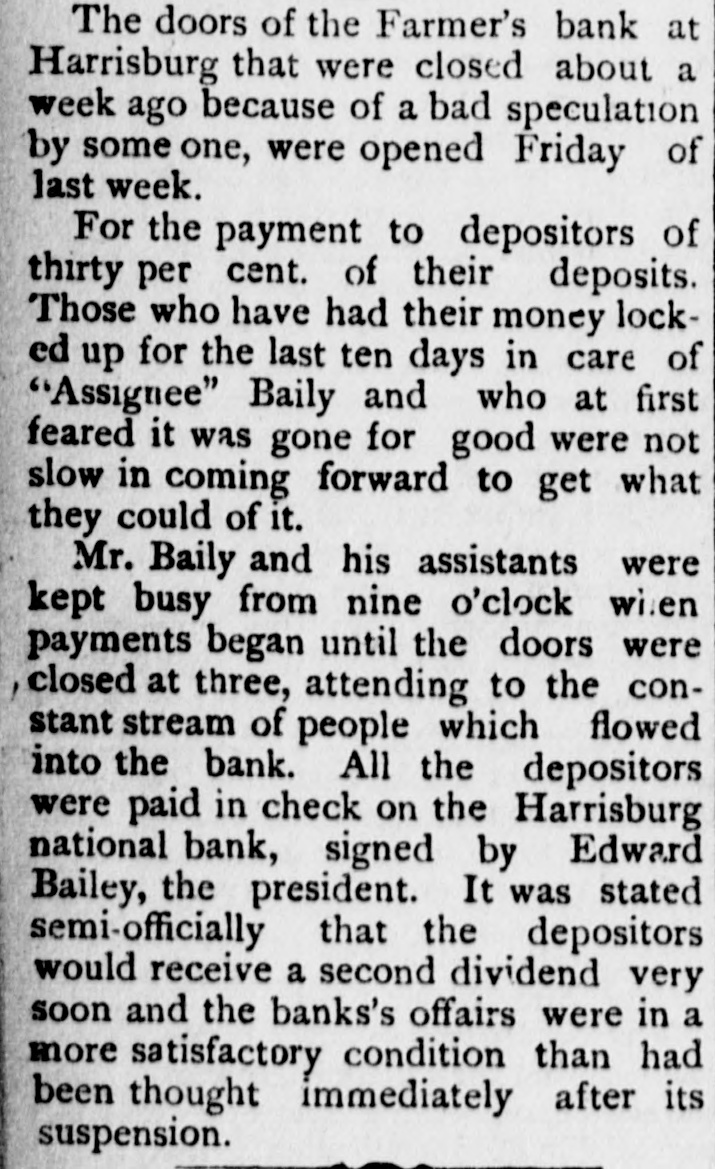
The doors of the Farmer's bank at Harrisburg... were opened Friday of last week for the payment to depositors of thirty per cent. of their deposits. All the depositors were paid in check on the Harrisburg national bank, signed by Edward Bailey, the president.
Source
newspapers

Newspaper Articles (11)

Article from The Wilmington Daily Republican, February 21, 1893

Click image to open full size in new tab

Article Text

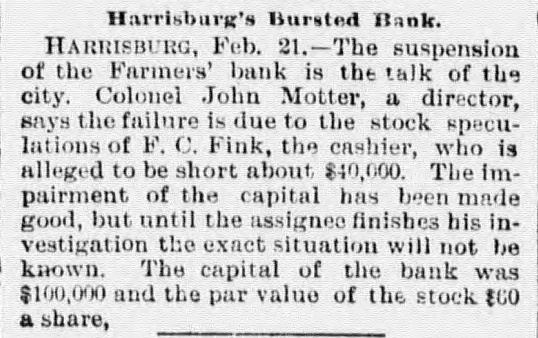
Harrisburg's Bursted Bank. HARRISBURG, Feb. 21.-The suspension of the Farmers' bank is the talk of the city. Colonel John Motter, a director, says the failure is due to the stock speculations of F. C. Fink, the cashier, who is alleged to be short about $40,000. The impairment of the capital has been made good, but until the assignee finishes his investigation the exact situation will not be known. The capital of the bank was $100,000 and the par value of the stock $60 a share,


Article from The Indianapolis Journal, February 21, 1893

Click image to open full size in new tab

Article Text

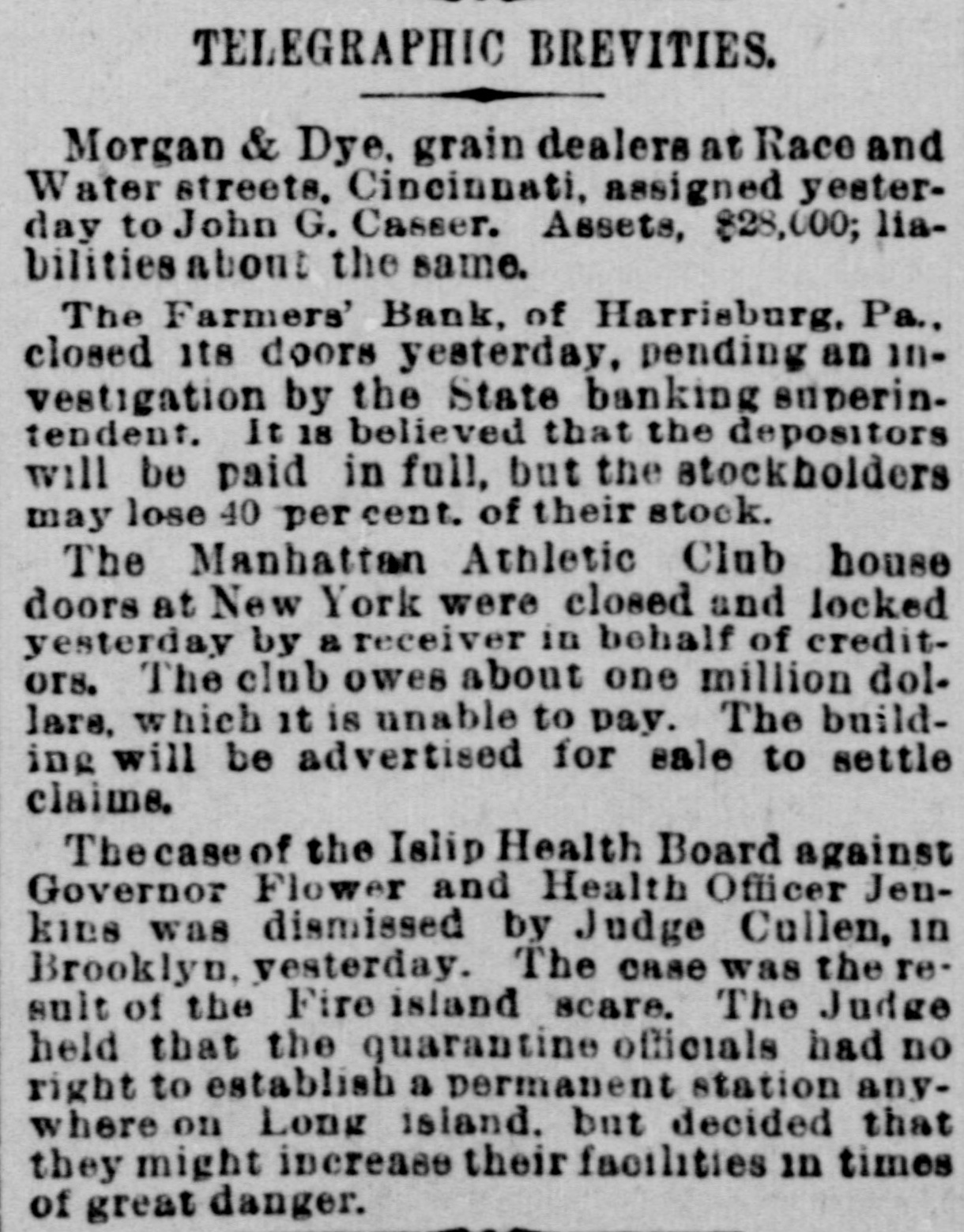
TELEGRAPHIC BREVITIES. Morgan & Dye. grain dealers at Race and Water streets, Cincinnati, assigned yesterday to John G. Casser. Assets, $28,000; liabilities about the same. The Farmers' Bank, of Harrisburg, Pa., closed its doors yeaterday, pending an 10vestigation by the State banking superintendent. It 18 believed that the depositors will be paid in full, but the stockholders may lose 40 per cent. of their stock. The Manhattan Athletic Club house doors at New York were closed and locked yesterday by a receiver in behalf of creditors. The club owes about one million dollare, which it is unable to pay. The building will be advertised for sale to settle claims. The case of the Islip Health Board against Governor Flower and Health Officer Jenkins was dismissed by Judge Cullen, in Brooklyn, yesterday. The case was the resuit of the Fire island scare. The Judge held that the quarantine officials had no right to establish a permanent station anywhere on Long island. but decided that they might increase their facilities in times of great danger.


Article from Evening Journal, February 21, 1893

Click image to open full size in new tab

Article Text

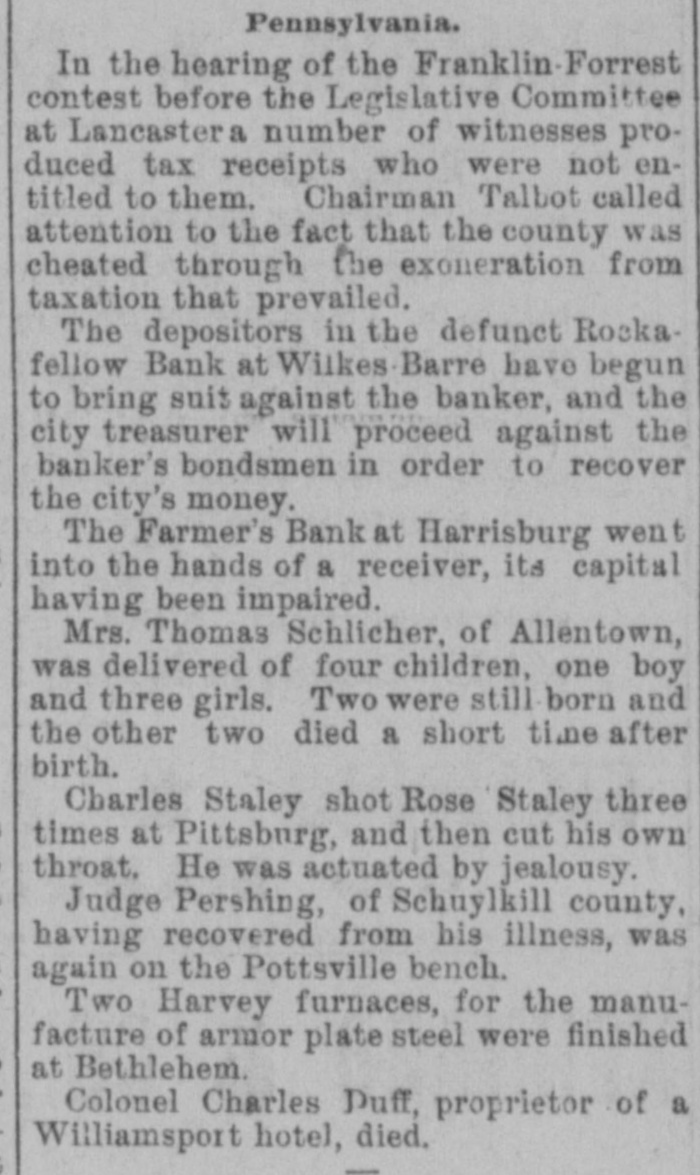
Pennsylvania. In the hearing of the Franklin-Forrest contest before the Legislative Committee at Lancastera number of witnesses produced tax receipts who were not entitled to them. Chairman Talbot called attention to the fact that the county was cheated through the exoneration from taxation that prevailed. The depositors in the defunct Rockafellow Bank at Wilkes-Barre have begun to bring suit against the banker, and the city treasurer will proceed against the banker's bondsmen in order to recover the city's money. The Farmer's Bank at Harrisburg went into the hands of a receiver, its capital having been impaired. Mrs. Thomas Schlicher, of Allentown, was delivered of four children, one boy and three girls. Two were still born and the other two died a short time after birth. Charles Staley shot Rose Staley three times at Pittsburg, and then cut his own throat. He was actuated by jealousy. Judge Pershing, of Schuylkill county, having recovered from his illness, was again on the Pottsville bench. Two Harvey furnaces, for the manufacture of armor plate steel were finished at Bethlehem. Colonel Charles Puff, proprietor of a Williamsport hotel, died.


Article from The Cambria Freeman, February 24, 1893

Click image to open full size in new tab

Article Text

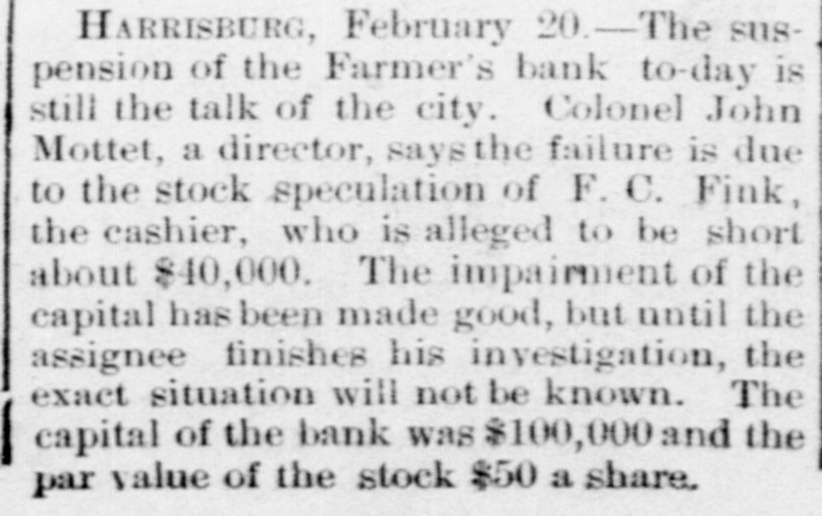
HARRISBURG, February 20.-The - suspension of the Farmer's bank to-day is still the talk of the city. Colonel John Mottet, a director, says the failure is due to the stock speculation of F. C. Fink, the cashier, who is alleged to be short about $40,000. The impairment of the capital has been made good, but until the assignee finishes his investigation, the exact situation will not be known. The capital of the bank was $100,000 and the par value of the stock $50 a share.


Article from The Cambria Freeman, February 24, 1893

Click image to open full size in new tab

Article Text

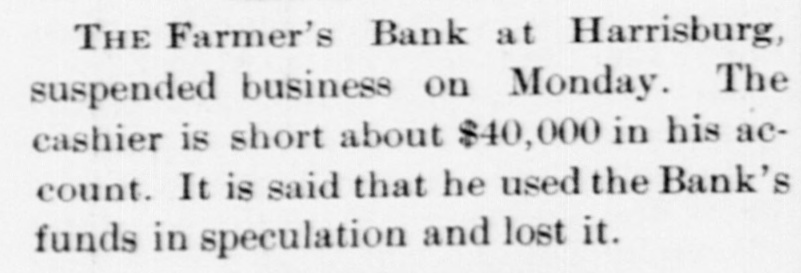
THE Farmer's Bank at Harrisburg, suspended business on Monday. The cashier is short about $40,000 in his account. It is said that he used the Bank's funds in speculation and lost it.


Article from The Forrest City Times, February 24, 1893

Click image to open full size in new tab

Article Text

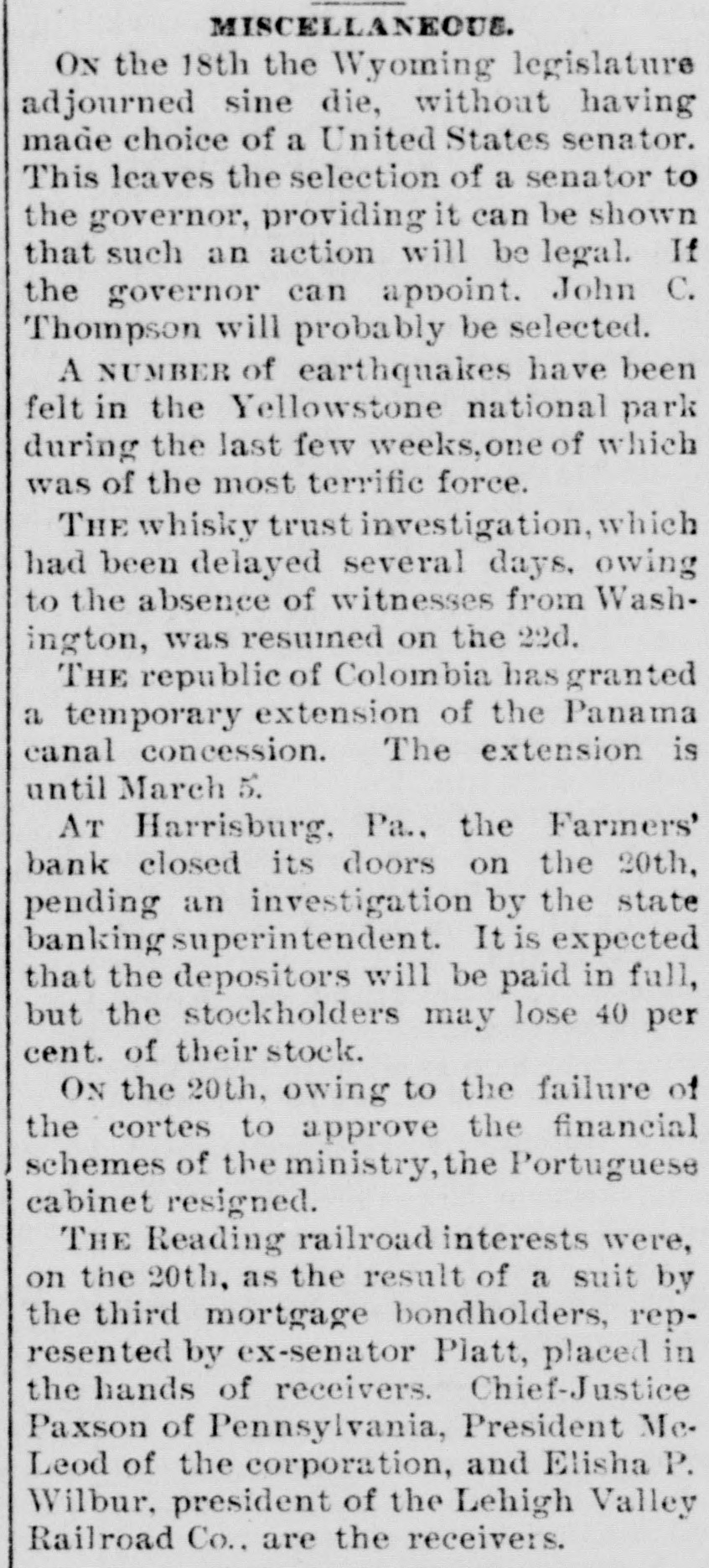
MISCELLANEOUE. ON the 18th the Wyoming legislature adjourned sine die, without having made choice of a United States senator. This leaves the selection of a senator to the governor, providing it can be shown that such an action will be legal. If the governor can appoint. John C. Thompson will probably be selected. A NUMBER of earthquakes have been felt in the Yellowstone national park during the last few weeks, one of which was of the most terrific force. THE whisky trust investigation, which had been delayed several days. owing to the absence of witnesses from Washington, was resumed on the 22d. THE republic of Colombia has granted a temporary extension of the Panama canal concession. The extension is until March 5. AT Harrisburg, Pa., the Farmers' bank closed its doors on the 20th, pending an investigation by the state bankingsuperintendent. It is expected that the depositors will be paid in full, but the stockholders may lose 40 per cent. of their stock ON the 20th, owing to the failure of the cortes to approve the financial schemes of the ministry, the Portuguese cabinet resigned. THE Reading railroad interests were, on the 20th, as the result of a suit by the third mortgage bondholders, represented by ex-senator Platt, placed in the hands of receivers. Chief-Justice Paxson of Pennsylvania, President MeLeod of the corporation, and Elisha P. Wilbur, president of the Lehigh Valley Railroad Co., are the receivers.


Article from The Times, February 24, 1893

Click image to open full size in new tab

Article Text

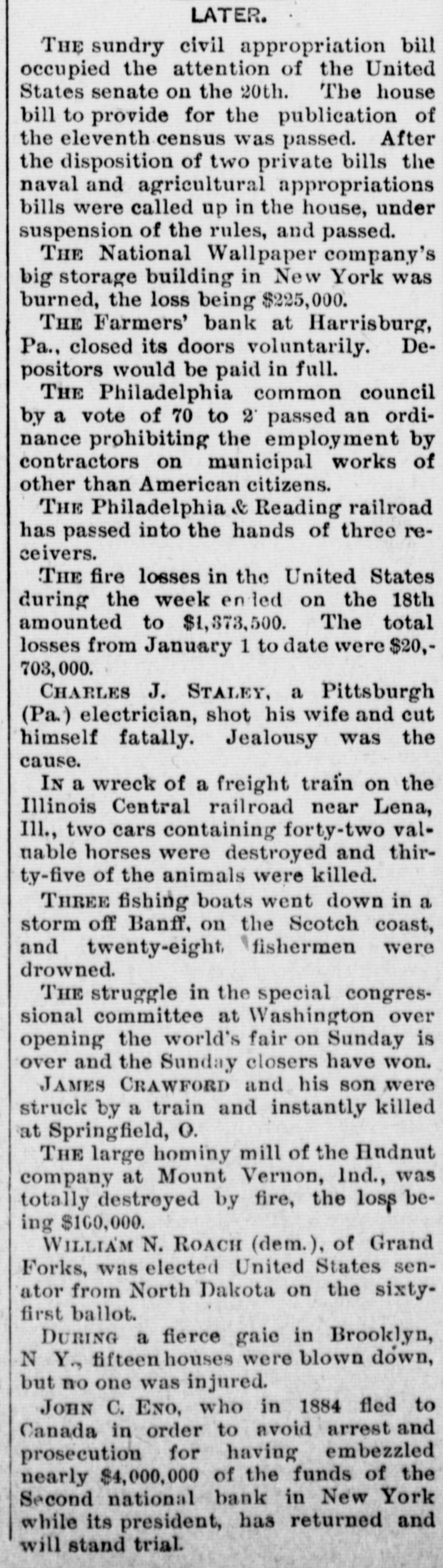
LATER. THE sundry civil appropriation bill occupied the attention of the United States senate on the 20th. The house bill to provide for the publication of the eleventh census was passed. After the disposition of two private bills the naval and agricultural appropriations bills were called up in the house, under suspension of the rules, and passed. THE National Wallpaper company's big storage building in New York was burned, the loss being $225,000. THE Farmers' bank at Harrisburg, Pa., closed its doors voluntarily. Depositors would be paid in full. THE Philadelphia common council by a vote of 70 to 2 passed an ordinance prohibiting the employment by contractors on municipal works of other than American citizens. THE Philadelphia & Reading railroad has passed into the hands of three receivers. THE fire losses in the United States during the week en red on the 18th amounted to $1,373,500. The total losses from January 1 to date were $20,703,000. CHARLES J. STALEY, a Pittsburgh (Pa.) electrician, shot his wife and cut himself fatally. Jealousy was the cause. IN a wreck of a freight train on the Illinois Central railroad near Lena, III., two cars containing forty-two valnable horses were destroyed and thirty-five of the animals were killed. THREE fishing boats went down in a storm off Banff, on the Scotch coast, and twenty-eight fishermen were drowned. THE struggle in the special congressional committee at Washington over opening the world's fair on Sunday is over and the Sunday closers have won. JAMES CRAWFORD and his son were struck by a train and instantly killed at Springfield, O. THE large hominy mill of the Hudnut company at Mount Vernon, Ind., was totally destreyed by fire, the loss being $100,000. WILLIAM N. ROACH (dem.), of Grand Forks, was elected United States senator from North Dakota on the sixtyfirst ballot. DURING a fierce gaie in Brooklyn, N Y., fifteen houses were blown down, but no one was injured. JOHN C. ENO, who in 1884 fled to Canada in order to avoid arrest and prosecution for having embezzled nearly $4,000,000 of the funds of the Second national bank in New York while its president, has returned and will stand trial.
Article from Huntsville Gazette, February 25, 1893

Click image to open full size in new tab

Article Text

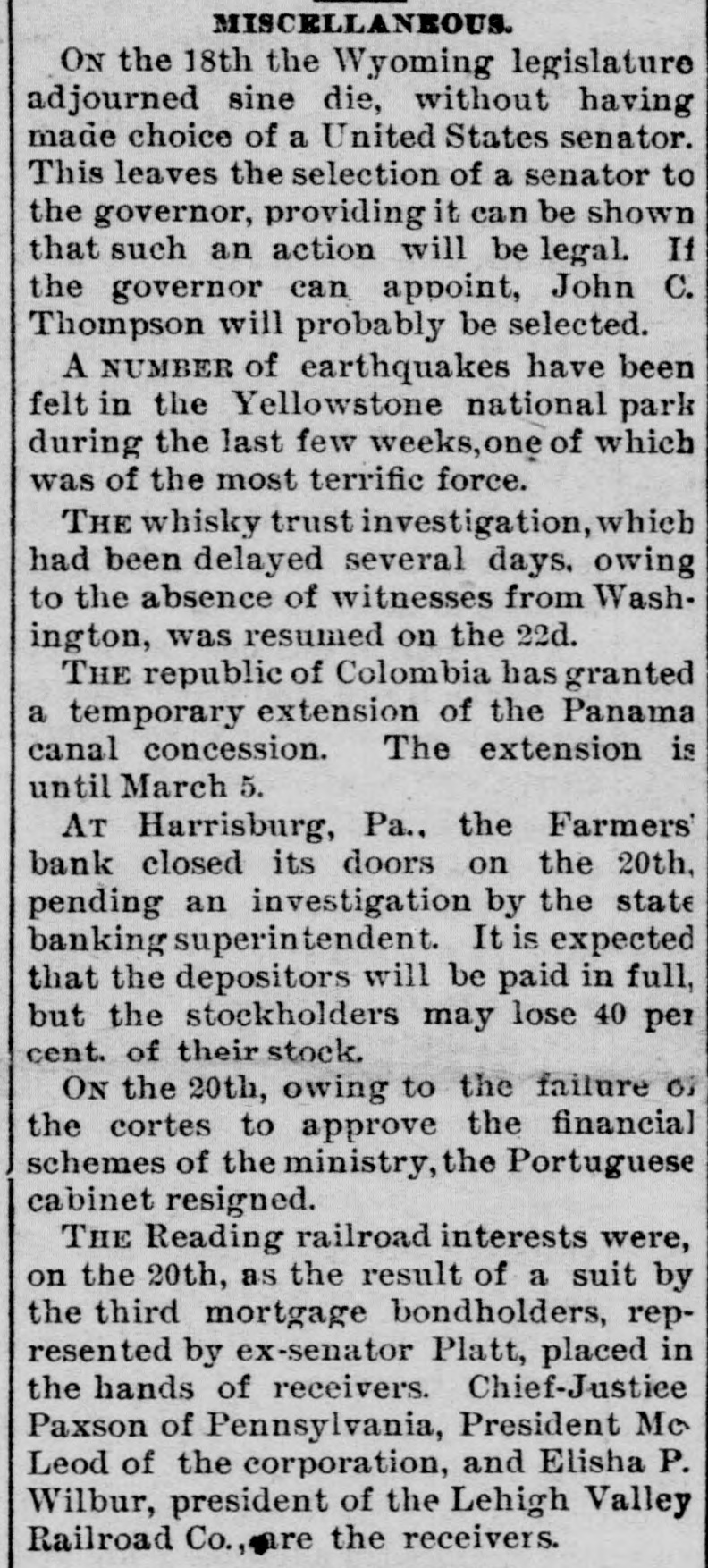
MISCELLANEOUS. ON the 18th the Wyoming legislature adjourned sine die, without having made choice of a United States senator. This leaves the selection of a senator to the governor, providing it can be shown that such an action will be legal. If the governor can appoint, John C. Thompson will probably be selected. A NUMBER of earthquakes have been felt in the Yellowstone national park during the last few weeks, one of which was of the most terrific force. THE whisky trust investigation, which had been delayed several days. owing to the absence of witnesses from Washington, was resumed on the 22d. THE republic of Colombia has granted a temporary extension of the Panama canal concession. The extension is until March 5. AT Harrisburg, Pa., the Farmers' bank closed its doors on the 20th, pending an investigation by the state bankingsuperintendent. It is expected that the depositors will be paid in full, but the stockholders may lose 40 per cent. of their stock. ON the 20th, owing to the failure of the cortes to approve the financial schemes of the ministry, the Portuguese cabinet resigned. THE Reading railroad interests were, on the 20th, as the result of a suit by the third mortgage bondholders, represented by ex-senator Platt, placed in the hands of receivers. Chief-Justice Paxson of Pennsylvania, President Mc Leod of the corporation, and Elisha P. Wilbur, president of the Lehigh Valley Railroad Co., are the receivers.


Article from The Carbon Advocate, February 25, 1893

Click image to open full size in new tab

Article Text

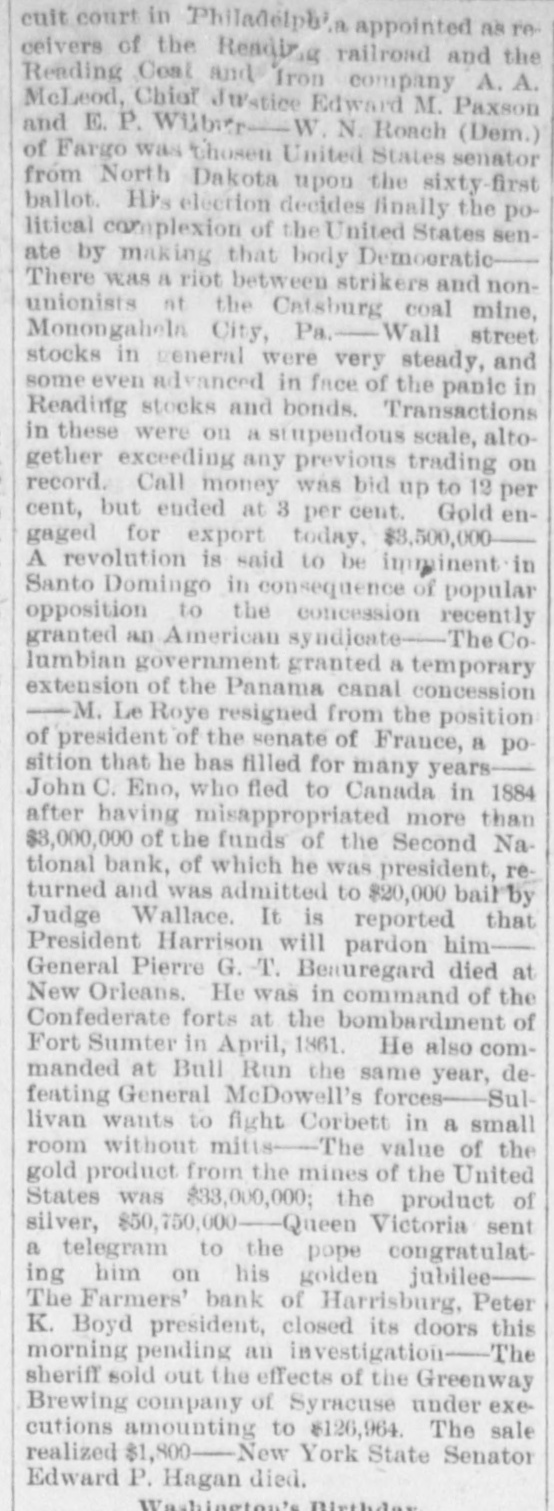
cuit court in Philadelpb'a appointed as re ceivers of the Readj g railroad and the Reading Coal and Iron company A.A. McLeod, Chief Justice Edward M. Paxson and E. P. Wilber- W. N. Roach (Dem.) of Fargo was thosen United States senator from North Dakota upon the sixty-first ballot. His election decides finally the political complexion of the United States senate by making that body Democratic There was a riot between strikers and nonunionists at the Catsburg coal mine, Monongaheln City, Pa. -Wall street stocks in general were very steady, and some even advanced in face of the panic in Reading stocks and bonds. Transactions in these were on a stupendous scale, altogether exceeding any previous trading on record. Call money was bid up to 12 per cent, but ended at 3 per cent. Gold engaged for export today. $8,500,000 A revolution is said to be imminent in Santo Domingo in consequence of popular opposition to the concession recently granted an American syndicate-The Columbian government granted a temporary extension of the Panama canal concession --M. Le Roye resigned from the position of president of the senate of France, a position that he has filled for many years John C. Eno, who fled to Canada in 1884 after having misappropriated more than $3,000,000 of the funds of the Second National bank, of which he was president, returned and was admitted to $20,000 bail by Judge Wallace. It is reported that President Harrison will pardon himGeneral Pierre G. T. Benuregard died at New Orleans. He was in command of the Confederate forts at the bombardment of Fort Sumter in April, 1861. He also commanded at Bull Run the same year, defeating General McDowell's forces- Sullivan wants to fight Corbett in a small room without mitts-The value of the gold product from the mines of the United States was $33,000,000; the product of silver, 850,750,000-Queen Victoria sent a telegram to the pope congratulating him on his golden jubileeThe Farmers' bank of Harrisburg, Peter K. Boyd president, closed its doors this morning pending an investigation-The sheriff sold out the effects of the Greenway Brewing company of Syracuse under executions amounting to $126,964. The sale realized $1,800-New York State Senator Edward P. Hagan died. Woshingtous Birthday


Article from The Western Sentinel, March 2, 1893

Click image to open full size in new tab

Article Text

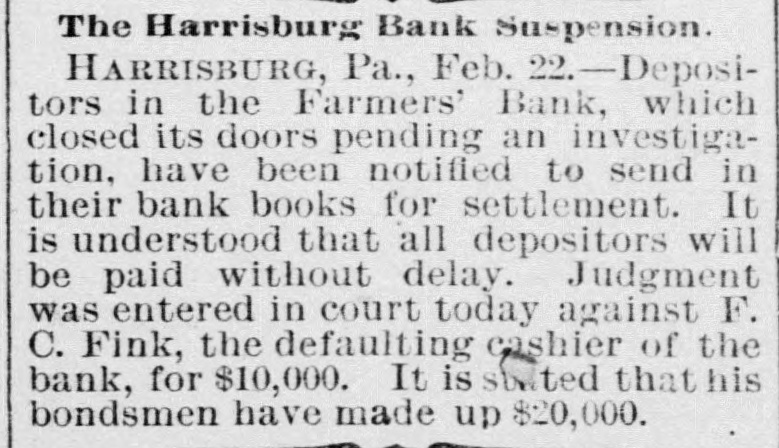
The Harrisburg Bank Suspension. HARRISBURG, Pa., Feb. 22.-Depositors in the Farmers' Bank, which closed its doors pending an investigation, have been notified to send in It their bank books for settlement. is understood that all depositors will be paid without delay. Judgment was entered in court today against F. C. Fink, the defaulting cashier of the bank, for $10,000. It is stated that his bondsmen have made up $20,000.


Article from The Columbian, March 10, 1893

Click image to open full size in new tab

Article Text

The doors of the Farmer's bank at Harrisburg that were closed about a week ago because of a bad speculation by some one, were opened Friday of last week. For the payment to depositors of thirty per cent. of their deposits. Those who have had their money locked up for the last ten days in care of "Assignee" Baily and who at first feared it was gone for good were not slow in coming forward to get what they could of it. Mr. Baily and his assistants were kept busy from nine o'clock witen payments began until the doors were closed at three, attending to the constant stream of people which flowed into the bank. All the depositors were paid in check on the Harrisburg national bank, signed by Edward Bailey, the president. It was stated semi-officially that the depositors would receive a second dividend very soon and the banks's offairs were in a more satisfactory condition than had been thought immediately after its suspension.