Chestnut Street National Bank (Philadelphia, PA)

Episode Information

Episode UID
372301176
Episode Type
Run β†’ Suspension β†’ Closure
Bank Type
national
Bank ID
37230 national
Charter Number
3723
Start Date
December 20, 1897
Location
Philadelphia, Pennsylvania (39.952, -75.164)

Metadata

Model
gpt-5-mini (chosen from majority vote of a three-model LLM ensemble)
Short Digest
6bb83594496b8242

Response Measures

Capital injected, Full suspension, Books examined

Receivership Details

Depositor recovery rate
100.0%
Date receivership started
1898-01-29
Date receivership terminated
1916-09-30
OCC cause of failure
Fraud
Share of assets assessed as good
43.2%
Share of assets assessed as doubtful
12.1%
Share of assets assessed as worthless
44.7%

Description

Suspension ordered by bank examiner Dec 23, 1897; voluntary liquidation efforts failed and receiver appointed in late Jan 1898.

Events (5)

1. June 14, 1887 Chartered
Source
historical_nic
2. December 20, 1897 Run
Cause
Bank Specific Adverse Info
Cause Details
Steady withdrawals driven by revelations of William M. Singerly's heavy losses (notably an unproductive paper mill) and deterioration of bank reserves.
Measures
Committee of local bank officials tried to raise funds; proposal to float Record Publishing stock to cover debts; negotiated voluntary liquidation plan discussed.
Newspaper Excerpt
it is said ... there have been quiet though steady runs on both banks for several days past.
Source
newspapers
3. December 23, 1897 Suspension
Cause
Bank Specific Adverse Info
Cause Details
Examiner-ordered closure following depleted reserves and Singerly's business losses, producing suspension of the National bank and affiliated trust company.
Newspaper Excerpt
The doors of the Chestnut Street National bank were closed this morning by direction of the bank examiner.
Source
newspapers
4. January 29, 1898 Receivership
Source
historical_nic
5. January 29, 1898 Receivership
Newspaper Excerpt
Comptroller Dawes announced ... he would appoint George H. Earle, Jr., receiver of the Chestnut National bank.
Source
newspapers

Newspaper Articles (22)

Article from San Antonio Daily Light, December 23, 1897

Click image to open full size in new tab

Article Text

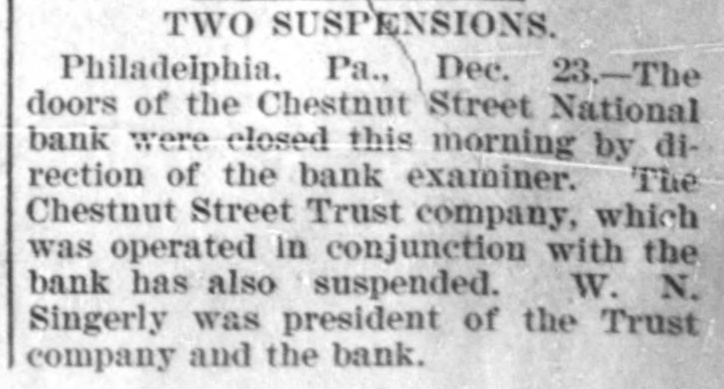
TWO SUSPENSIONS. Philadelphia. Pa., Dec. 23.-The doors of the Chestnut Street National bank were closed this morning by direction of the bank examiner. The Chestnut Street Trust company, which was operated in conjunction with the bank has also suspended. W. N. Singerly was president of the Trust company and the bank.


Article from The Record-Union, December 24, 1897

Click image to open full size in new tab

Article Text

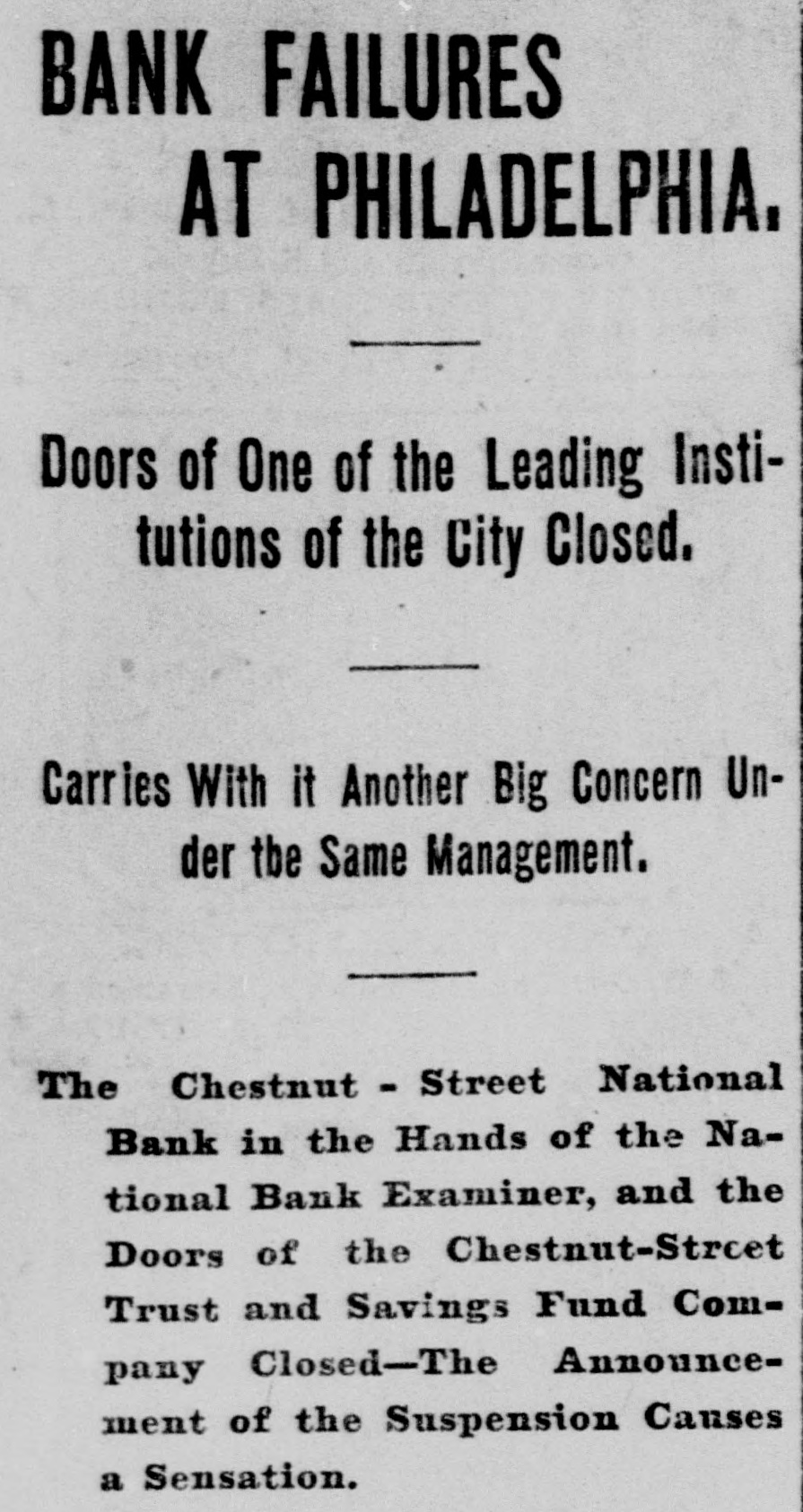
BANK FAILURES AT PHILADELPHIA. Doors of One of the Leading Institutions of the City Closed. Carries With it Another Big Concern Under tbe Same Management. The Chestnut - Street National Bank in the Hands of the National Bank Examiner, and the Doors of the Chestnut-Strcet Trust and Savings Fund Company Closed-The Announce= ment of the Suspension Causes a Sensation.


Article from The Wilmington Daily Republican, December 24, 1897

Click image to open full size in new tab

Article Text

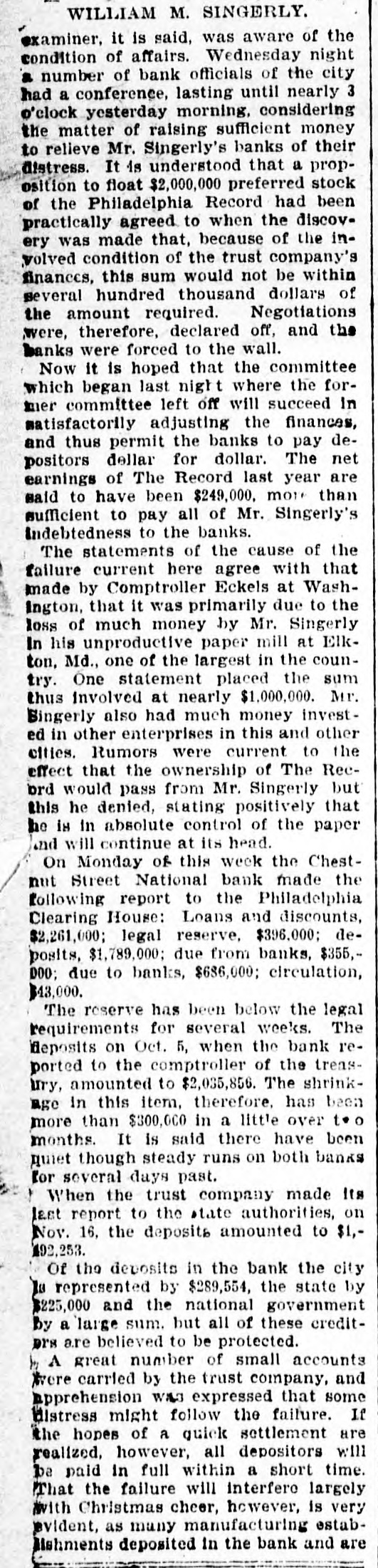
WILLIAM M. SINGERLY. examiner, it is said, was aware of the condition of affairs. Wednesday night number of bank officials of the city had a conference, lasting until nearly 3 o'clock yesterday morning, considering the matter of raising sufficient money to relieve Mr. Singerly's banks of their distress. It is understood that a proposition to float $2,000,000 preferred stock of the Philadelphia Record had been practically agreed to when the discovery was made that, because of the involved condition of the trust company's finances, this sum would not be within several hundred thousand dollars of the amount required. Negotiations were, therefore, declared off, and the banks were forced to the wall. Now it is hoped that the committee which began last night where the foriner committee left off will succeed in satisfactorily adjusting the finances, and thus permit the banks to pay depositors dellar for dollar. The net earnings of The Record last year are said to have been $249,000. more than sufficient to pay all of Mr. Singerly's Indebtedness to the banks. The statements of the cause of the failure current here agree with that made by Comptroller Eckels at WashIngton, that it was primarily due to the loss of much money by Mr. Singerly In his unproductive paper mill at Elkton, Md., one of the largest in the country. One statement placed the sum thus involved at nearly $1,000,000. Mr. Bingerly also had much money invested in other enterprises in this and other cities. Rumors were current to the effect that the ownership of The Recbrd would pass from Mr. Singerly but this he denied, stating positively that he is in absolute control of the paper and will continue at its head. On Monday of this week the Chestnut Street National bank made the following report to the Philadelphia Clearing House: Loans and discounts, $2,261,000; legal reserve, $396.000; deposits, $1,789,000; due from banks, $355,000; due to banks, $686,000; circulation, $43,000. The reserve has been below the legal requirements for several weeks. The deposits on Oct. 5, when the bank reported to the comptroller of the treasury, amounted to $2,035,856. The shrinkage in this item, therefore, has been more than $300,000 in a little over to months. It is said there have been quiet though steady runs on both banks for several days past. When the trust company made Its last report to the state authorities, on Nov. 16, the deposits amounted to $1,493.253. Of the deposits in the bank the city la represented by $289,554, the state by $225,000 and the national government by a large sum. but all of these creditDrs are believed to be protected. to A great number of small accounts Xvere carried by the trust company, and apprehension WAS expressed that some distress might follow the failure. If the hopes of a quick settlement are realized, however, all depositors will be paid in full within a short time. That the failure will interfere largely with Christmas cheer, however, is very evident, as many manufacturing estabMishments deposited in the bank and are


Article from Alexandria Gazette, December 24, 1897

Click image to open full size in new tab

Article Text

When the news of the closing of the Chestnut Street National Bank of Philadelphia, of which Wm. M. Singerly is president, reached Elkton, Md., yesterday afternoon it had a disturbing effect upon the depositors in the Second National Bank of Elkton of which Mr. Singerly is vice president and a heavy stockholder. This morning there was a run on the bank but the excitement soon subsided.


Article from The Salt Lake Herald, December 24, 1897

Click image to open full size in new tab

Article Text

QUAKER CITY'S BIG SENSATION Greatest Banks In Philadelphia Suspend Payment. DEPOSITS AMOUNT TO THREE MILLIONS Singerly, Owner of the Record, President of Both Companies. Chestnut Street National Bank and Chestnut Street National Trust Company Did Business Under the State Banking Law-An Unproductive Paper Mill Lies at the Foundation of Singerly's Troublesβ€” Steps Taken For Voluntary Liquidation.


Article from The Copper Country Evening News, December 28, 1897

Click image to open full size in new tab

Article Text

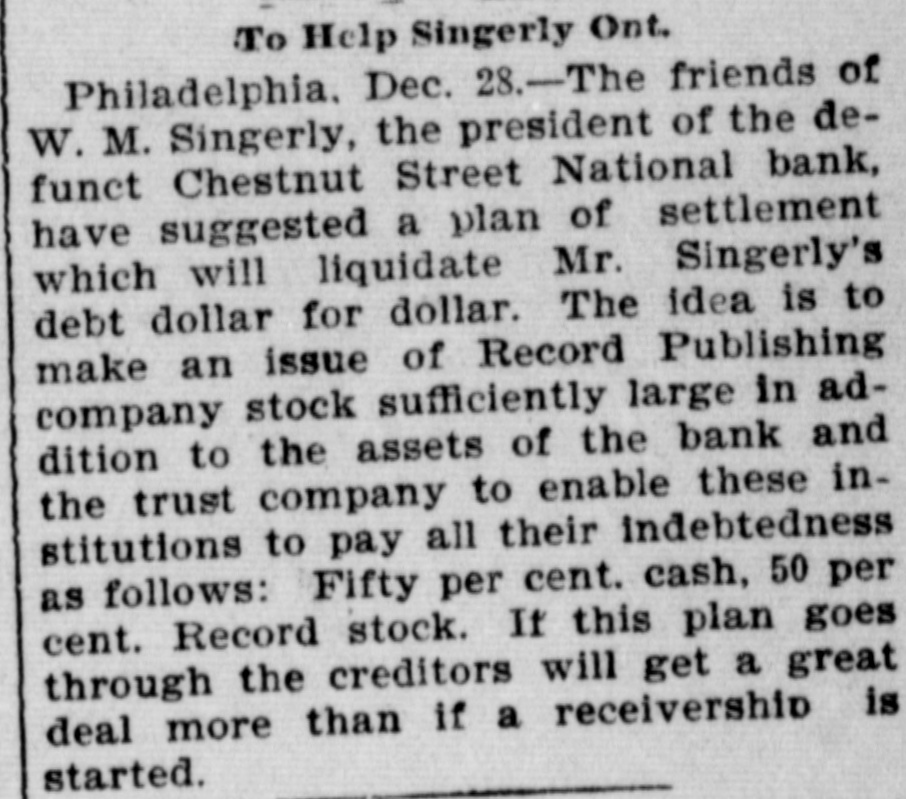
To Help Singerly Ont. Philadelphia. Dec. 28.-The friends of W. M. Singerly, the president of the defunct Chestnut Street National bank, have suggested a plan of settlement which will liquidate Mr. Singerly's debt dollar for dollar. The idea is to make an issue of Record Publishing company stock sufficiently large in addition to the assets of the bank and the trust company to enable these institutions to pay all their indebtedness as follows: Fifty per cent. cash, 50 per cent. Record stock. If this plan goes through the creditors will get a great deal more than if a receivership is started.


Article from Elmore Bulletin, December 29, 1897

Click image to open full size in new tab

Article Text

BIG BANK FAILURE. Greatest Banks in the City of Philadelphia Suspend Payment. Philadelphia, Dec. 27. A sensation was created in this city by the an nouncement of the suspension of the Chestnut Street, National bank, reas one of the finangarded strongest The cial institutions in the city. suspension carried with it the closing of the Chestnut Trust and Savings Fund company. doing business under the state banking laws. William M. Singerly, publisher of the Philadelphia Record, is president of both companies and the saine men, with one exception act as officers and directors. The first information the public received that the banks were in trouble was in the form of a notice posted on the door of the building occupied jointly by the concerns, signed by National Bank Examiner William M. Hart, to the effect that the Chestnut Street National bank had closed its doors pending an investigation of its affairs. No statement of assets and liabilities is available, but it is stated that the deposits of the Chestnut Street bank amounted to $1,700,000, and of the trust company $1,300,000. President Singerly gave out a brief statement tonight in which he said: "We are working to secure the indebtedness of the two banks so that they can go into voluntary liquidation, and thus avoid a receivership. The net earnings of the Record last year are said to have been $249,000, more than sufficient to pay dividends on a sum sufficient to pay all of Mr. Singerly's indebtedness to the banks. The statements of the cause of the failure current here agree with those made by Comptroller Eckels at Washington, that it was primarily due to the loss of much money by Mr. Singerly in his unproductive paper mill at Elkton, Md., one of the largest in the country. One statement placed the sum thus involved at nearly a million dollars. Mr. Singerly also has much money invested in other enterprises in this and other cities. Rumors were current that the ownership of the Record would pass from Mr. Singerly, but this he denied, his friends stating positively that he is in absolute control of the paper, and will continue at its head. On Monday of this week the Chestnut Street National bank made the following report to the clearing house: Loans and discounts, $2,261,000; legal reserve, $396,000; deposits, $1,789,000; due from banks, $355,000; due to banks, 9686,000; circulation, $43,000. The reserve has been below the legal requirements for several weeks. The deposits on October 5, when the bank reported to the comptroller of the treasury, amounted to $2,239,955. The shrinkage in this sum, therefore, has been more than $300,000 in a little over two months. It is said that there have been quiet but steady runs on both banks for several days past Of the deposits in the bank, the city is represented by $289,554; the state by $225,000, and the national government by a large sum, but all of these creditors are believed to be protected. Much sympathy is expressed on all s sides for Mr. Singerly. He has occupied such a prominent place in the affairs of the state and city for years past that the news of his financial difficulties naturally created a sensation.


Article from Connecticut Western News, December 30, 1897

Click image to open full size in new tab

Article Text

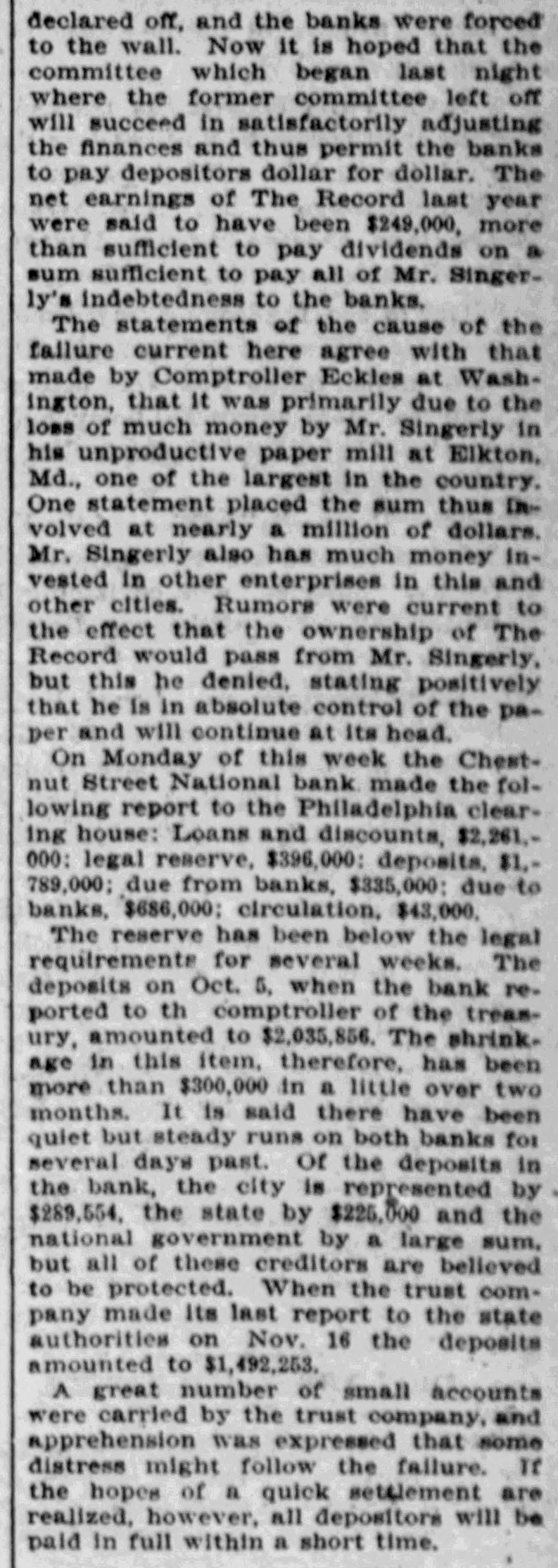
declared off, and the banks were forced to the wall. Now it is hoped that the committee which began last night where the former committee left off will succeed in satisfactorily adjusting the finances and thus permit the banks to pay depositors dollar for dollar. The net earnings of The Record last year were said to have been $249,000, more than sufficient to pay dividends on a sum sufficient to pay all of Mr. Singerly's indebtedness to the banks. The statements of the cause of the failure current here agree with that made by Comptroller Eckles at Washington, that It was primarily due to the loss of much money by Mr. Singerly in his unproductive paper mill at Elkton, Md., one of the largest in the country. One statement placed the sum thus involved at nearly a million of dollars. Mr. Singerly also has much money Invested in other enterprises in this and other cities. Rumors were current to the effect that the ownership of The Record would pass from Mr. Singerly, but this he denied, stating positively that he Is in absolute control of the paper and will continue at its head. On Monday of this week the Chestnut Street National bank made the following report to the Philadelphia clearing house: Loans and discounts, $2,261.000: legal reserve, $396,000: deposits, $1.789,000; due from banks, $335,000; due to banks, $686,000; circulation, $43,000. The reserve has been below the legal requirements for several weeks. The deposits on Oct. 5. when the bank reported to th comptroller of the treasury, amounted to $2,035,856. The shrink. age in this item, therefore, has been more than $300,000 in a little over two months. It is said there have been quiet but steady runs on both banks for several days past. Of the deposits in the bank, the city is represented by $289,554. the state by $225,000 and the national government by a large sum, but all of these creditors are believed to be protected. When the trust company made Its last report to the state authorities on Nov. 16 the deposits amounted to $1,492,253. A great number of small accounts were carried by the trust company, and apprehension was expressed that some distress might follow the failure. If the hopes of a quick settlement are realized, however, all depositors will be paid In full within a short time.


Article from Iron County Register, December 30, 1897

Click image to open full size in new tab

Article Text

THE Chestnut Street national bank of Philadelphia suspended on the 23d. It was a city depository, and held city funds to the amount of $289,854. The state of Pennsylvania also had on deposit with the bank on December 1, $225,000. The bank was also a deposito but tory of the national ted the government i against loss by hol States bonds as se


Article from Pike County Press, December 31, 1897

Click image to open full size in new tab

Article Text

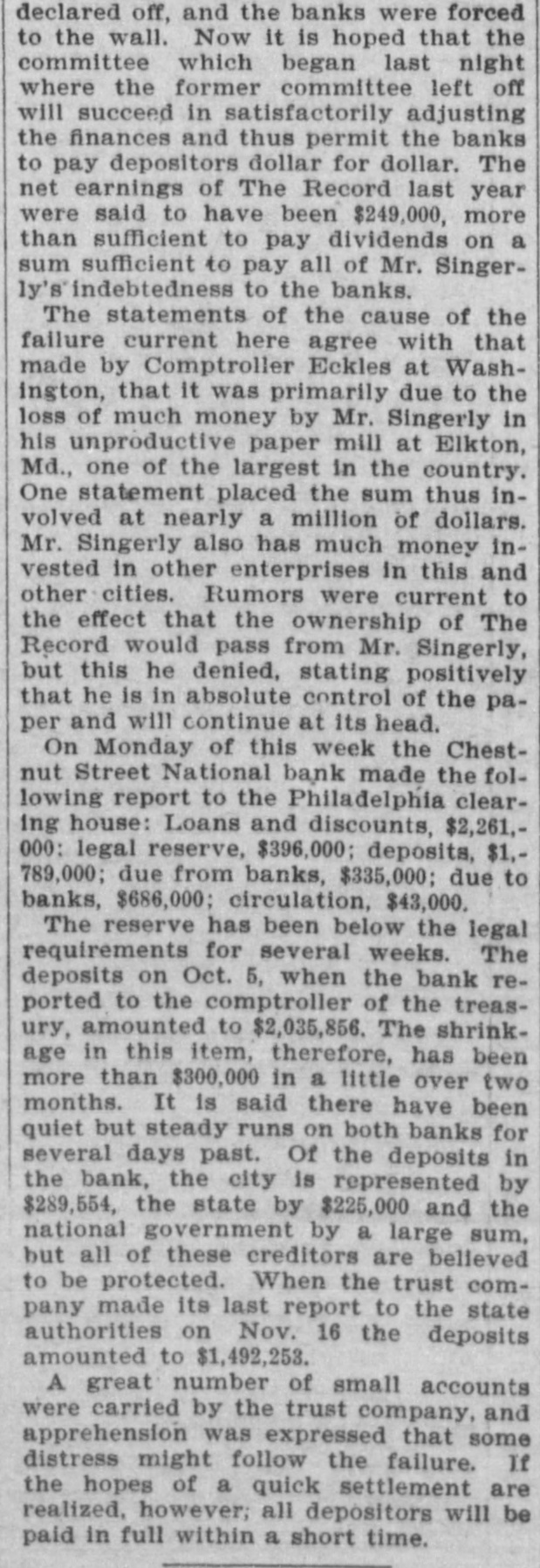
declared off, and the banks were forced to the wall. Now it is hoped that the committee which began last night where the former committee left off will succeed in satisfactorily adjusting the finances and thus permit the banks to pay depositors dollar for dollar. The net earnings of The Record last year were said to have been $249,000, more than sufficient to pay dividends on a sum sufficient to pay all of Mr. Singerly's' indebtedness to the banks. The statements of the cause of the failure current here agree with that made by Comptroller Eckles at Washington, that it was primarily due to the loss of much money by Mr. Singerly in his unproductive paper mill at Elkton, Md., one of the largest in the country. One statement placed the sum thus involved at nearly a million of dollars. Mr. Singerly also has much money invested in other enterprises in this and other cities. Rumors were current to the effect that the ownership of The Record would pass from Mr. Singerly, but this he denied, stating positively that he is in absolute control of the paper and will continue at its head. On Monday of this week the Chestnut Street National bank made the following report to the Philadelphia clearing house: Loans and discounts, $2,261,000: legal reserve, $396,000; deposits, $1,789,000; due from banks, $335,000; due to banks, $686,000; circulation, $43,000. The reserve has been below the legal requirements for several weeks. The deposits on Oct. 5, when the bank reported to the comptroller of the treasury, amounted to $2,035,856. The shrinkage in this item, therefore, has been more than $300,000 in a little over two months. It is said there have been quiet but steady runs on both banks for several days past. Of the deposits in the bank, the city is represented by $289,554, the state by $225,000 and the national government by a large sum, but all of these creditors are believed to be protected. When the trust company made its last report to the state authorities on Nov. 16 the deposits amounted to $1,492,253. A great number of small accounts were carried by the trust company, and apprehension was expressed that some distress might follow the failure. If the hopes of a quick settlement are realized, however; all depositors will be paid in full within a short time.


Article from Daily Capital Journal, January 5, 1898

Click image to open full size in new tab

Article Text

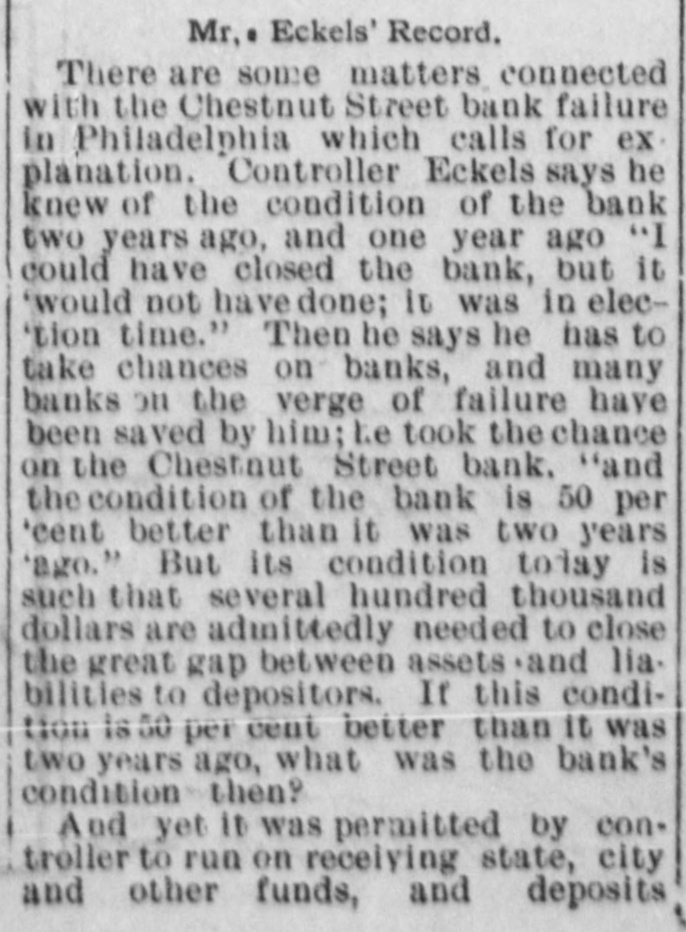
Mr. Eckels' Record. There are some matters connected with the Chestnut Street bank failure in Philadelphia which calls for explanation. Controller Eckels says he knew of the condition of the bank two years ago, and one year ago "I could have closed the bank, but it 'would not have done; it was in elec'tion time." Then he says he has to take chances on banks, and many banks on the verge of failure have been saved by him; te took the chance on the Chestnut Street bank. "and the condition of the bank is 50 per 'cent better than it was two years ago." But its condition today is such that several hundred thousand dollars are admittedly needed to close the great gap between assets and liabilities to dΓ©positors. If this condition is 50 per cent better than it was two years ago, what was the bank's condition then? And yet it was permitted by controller to run on receiving state, city and other funds, and deposits


Article from Kansas City Journal, January 21, 1898

Click image to open full size in new tab

Article Text

A FEW STILL HOLD OUT. Plan for Settling the Singerly Failure Not Yet Unanimously Approved. Philadelphia, Jan. 20.-With to-day expired the period set by the comptroller of the currency for the receipt of depositors' assents to the plan of voluntary liquidation proposed for the Chestnut Street National bank. Unanimous assent is necessary, and it was stated to-night that all the depositors had been favorably heard from except a few. representing about $25,000. While this prevents the plan from becoming at once operative, it is hoped that it will soon be effected. and the statement from Comptroller Dawes has encouraged the managers. who are anxious to avoid the appointment of a receiver. Apart from the few withholding depositors, the state has not yet assented to the plan, and as it has an account in the bank of $205,000 from the state treasurer this may prove a stumbling block to the success of the plan.


Article from The Indianapolis Journal, January 21, 1898

Click image to open full size in new tab

Article Text

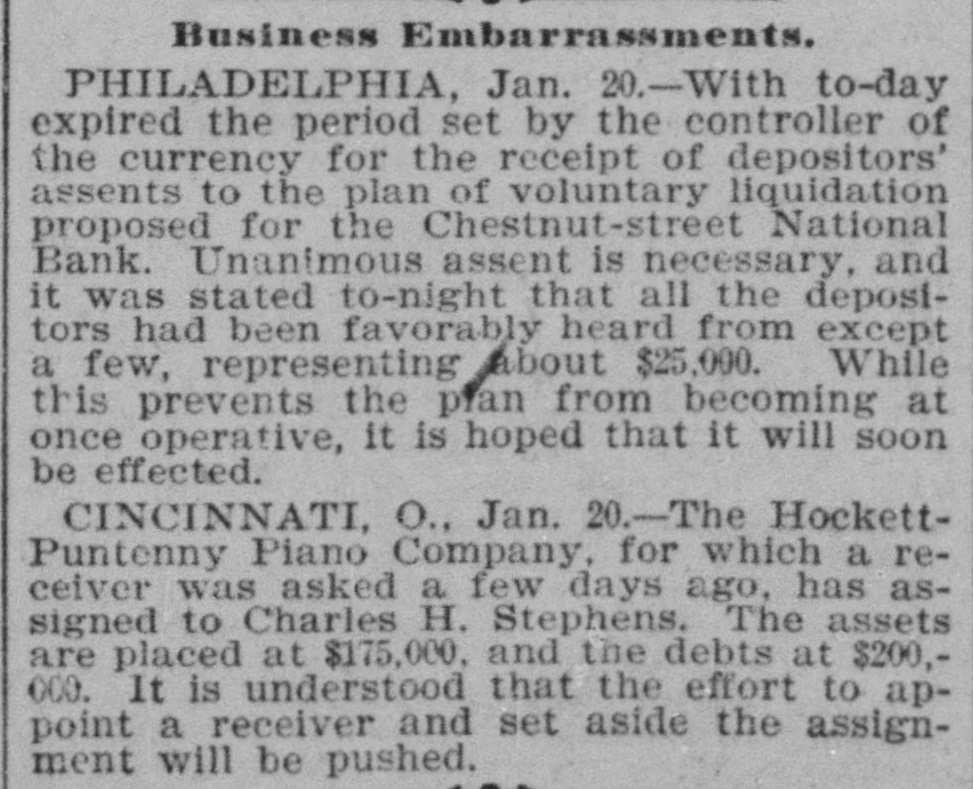
Business Embarrassments. PHILADELPHIA, Jan. 20.-With to-day expired the period set by the controller of the currency for the receipt of depositors' assents to the plan of voluntary liquidation proposed for the Chestnut-street National Bank. Unanimous assent is necessary, and it was stated to-night that all the depositors had been favorably heard from except a few, representing about $25,000. While this prevents the plan from becoming at once operative, it is hoped that it will soon be effected. CINCINNATI, O., Jan. 20.-The HockettPuntenny Piano Company, for which a receiver was asked a few days ago, has assigned to Charles H. Stephens. The assets are placed at $175,000. and the debts at $200,000. It is understood that the effort to appoint a receiver and set aside the assignment will be pushed.


Article from The Morning News, January 21, 1898

Click image to open full size in new tab

Article Text

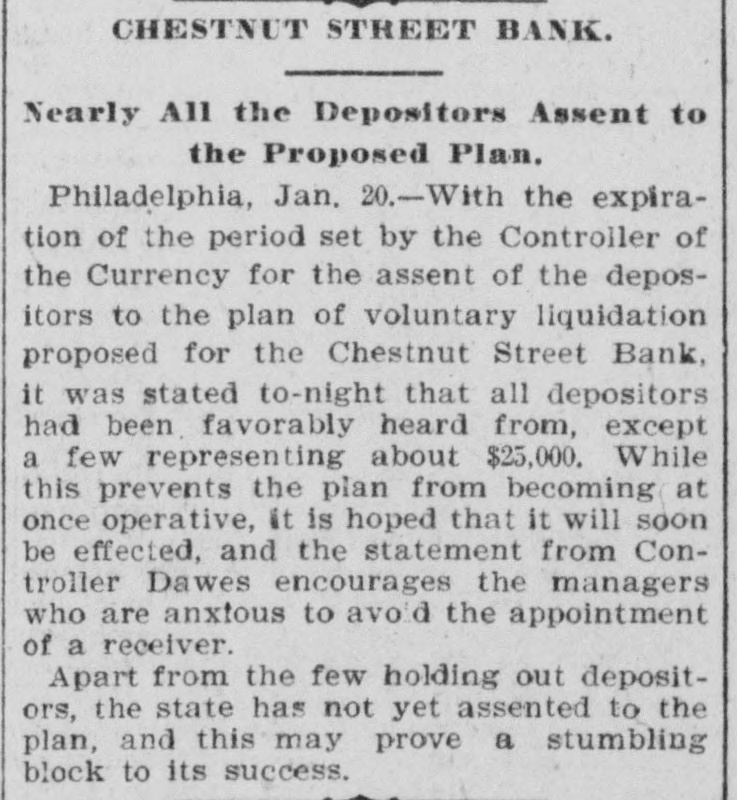
CHESTNUT STREET BANK. Nearly All the Depositors Assent to the Proposed Plan. Philadelphia, Jan. 20.-With the expiration of the period set by the Controller of the Currency for the assent of the depositors to the plan of voluntary liquidation proposed for the Chestnut Street Bank, it was stated to-night that all depositors had been favorably heard from, except a few representing about $25,000. While this prevents the plan from becoming at once operative, it is hoped that it will soon be effected, and the statement from Controller Dawes encourages the managers who are anxtous to avoid the appointment of a receiver. Apart from the few holding out depositors, the state has not yet assented to the plan, and this may prove a stumbling block to its success.


Article from El Paso Daily Herald, January 28, 1898

Click image to open full size in new tab

Article Text

Receiver Appointed. PHILADELPHIA, January 28.-Comptroller Dawes announced today that he would appoint George H. Earle, Jr., 88 receiver of the Chestnut National bank.


Article from Wheeling Register, January 29, 1898

Click image to open full size in new tab

Article Text

APPOINTED A RECEIVER Philadelphia, Pa., January 23.Comptroller of the Currency Dawes came here to-day to confer on the plan of the voluntary liquidation of the Chestnut Street National Bank. The comptroller later appointed George H. Earle, Jr., receiver.


Article from The Sun, January 30, 1898

Click image to open full size in new tab

Article Text

Receiver For Singerly's Bank. WASHINGTON, Jan. 20.-The Comptroller of the Currency this afternoon appointed Mr. George H. Earle, Jr., to be Receiver of the Chestnut Street National Bank of Philadelphia. Pa. The commission was made out late this afternoon.


Article from The Somerset Herald, February 2, 1898

Click image to open full size in new tab

Article Text

COMPTROLLER of the Currency Dawes has refused to accept the plan presented by William M. Singerly for the payment of the creditors of the Chestnut Street National Bank in Philadelphia, and has placed the affairs of the institution in the hands of a receiver.


Article from Hot Springs Weekly Star, February 4, 1898

Click image to open full size in new tab

Article Text

Bank in Receiver's Hands. The comptroller of the currency went to Phliadelphia Saturday and failing to agree with the managers for the voluntary liquidaton of the Chestnut Street National Bank, selected G.S. Earle, jr., as receiver.


Article from Evening Journal, February 18, 1898

Click image to open full size in new tab

Article Text

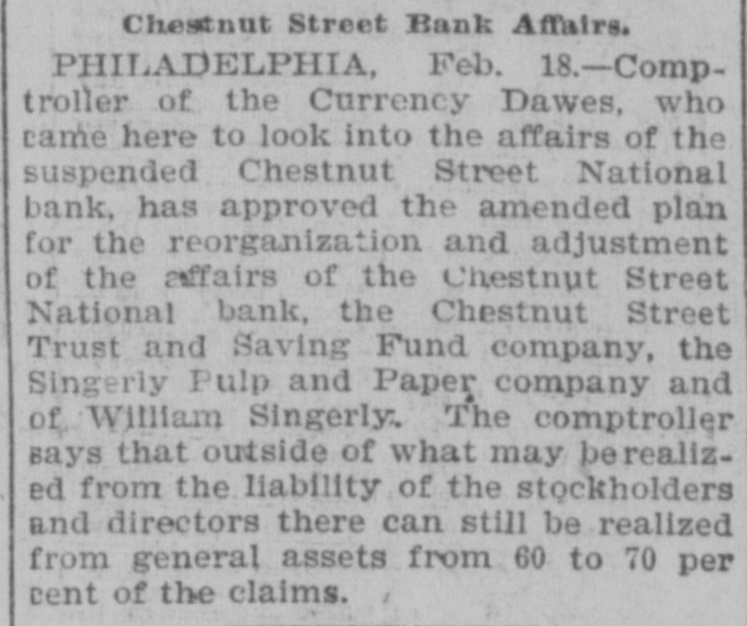
Chestnut Street Bank Affairs. PHILADELPHIA, Feb. 18.-Comptroller of the Currency Dawes, who came here to look into the affairs of the suspended Chestnut Street National bank, has approved the amended plan for the reorganization and adjustment of the affairs of the Chestnut Street National bank, the Chestnut Street Trust and Saving Fund company, the Singerly Pulp and Paper company and of William Singerly: The comptroller says that outside of what may berealized from the liability of the stockholders and directors there can still be realized from general assets from 60 to 70 per cent of the claims.


Article from Evening Journal, March 30, 1898

Click image to open full size in new tab

Article Text

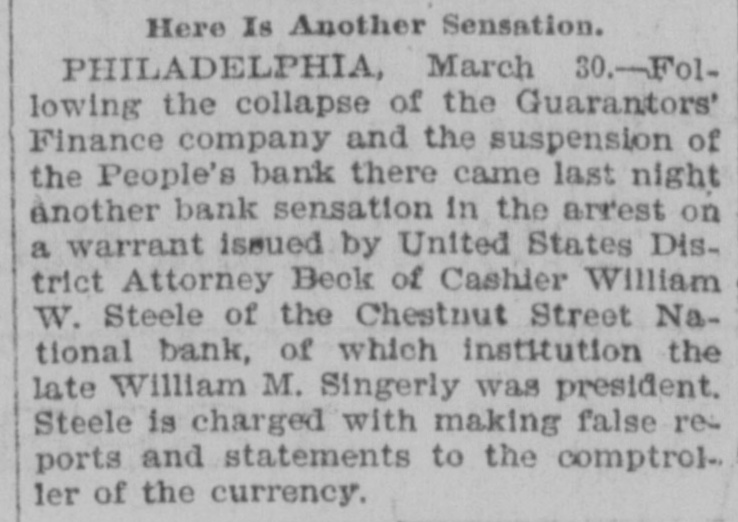
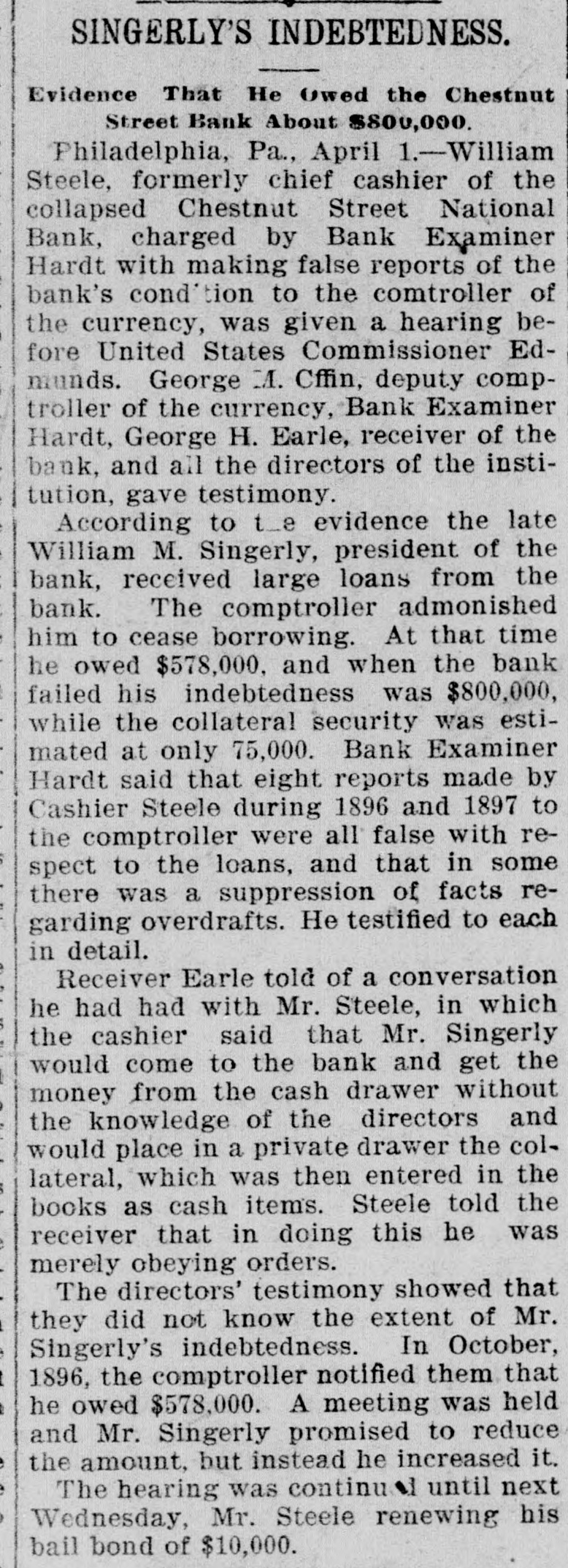
Here Is Another Sensation. PHILADELPHIA, March 30.-Following the collapse of the Guarantors' Finance company and the suspension of the People's bank there came last night Another bank sensation in the arrest on a warrant issued by United States District Attorney Beck of Cashier William W. Steele of the Chestnut Street National bank, of which institution the late William M. Singerly was president. Steele is charged with making false reports and statements to the comptrol1er of the currency.


Article from The Emmett Index, August 5, 1909

Click image to open full size in new tab

Article Text

ence the conduct of an honorable man or the suspicions of one of like character. # H. W. Taft Appears In New York. Lawyers and financial men in New York who have followed the sugar trust matter are recalling this corre- spondence with not a little interest. The firm of attorneys "with Washing- ton connections" was Strong & Cad- walader, of which, at the time Mr. Earle wrote, both Henry W. Tart, a leading counsel for the sugar trust in all the litigation growing out of the Segal loan, and George W. Wicker- sham, the present attorney general, were members. The fact that Henry W. Taft is an attorney of the sugar trust in this identical Segal case, thus involving the law firm of which Attorney General Wickersham was a member, raises an interesting question as to what the present administration will do toward prosecuting the trust. Judging by the vigor with which Collector Loeb pro- ceeded against the same trust in the matter of the short weight frauds, the law business of Henry W. Taft and of the firm of Strong & Cadwalader will have little or no influence on President Taft, and the prosecution will go for- ward with the same vim that marked a Receiver Earle's case. If a private in- dividual could accomplish what he did, what could not the United States gov- ernment accomplish if it proceeded against the trust with all its great power? One of the most remarkable interviews that have appeared in years grew out of this identical suit. It was from no less a man than Sam- uel Untermyer, the famous corporation lawyer of New York, who was re- tained by Segal. Mr. Untermyer stated in effect that the government, if it were in earnest, could not only suc- cessfully prosecute the sugar trust, but many other gigantic corporations that pursue the same methods. That inter- view took the lid off. Whatever the government does, how- ever, George H. Earle has given the sugar trust a staggering blow. He has not alone wrested from it many mil- lions of dollars, but has shown the country what can be done in curbing criminal combinations by any man who means business. That perhaps is the greatest service of all. Moreover, he has put the Real Estate Trust Com- pany of Philadelphia on its feet, thus saving the money of thousands of in- nocent depositors, and has made it possible for the Pennsylvania Sugar Refining company to open its Camden plant and resume business. For his services to the trust company he was unanimously elected Its president. # Other Concerns Saved by Earle. This is but one of a long series of tottering or wrecked institutions that George H. Earle, Jr., has successfully reorganized. Among the others are the Pennsylvania Warehousing and Safe Deposit company, which he took when its stock was down to $5 per share and by cutting out the dead wood, ju- dicious buying of wharfs and busi- ness principles brought it up until its stock is in the neighborhood of $100 per share; the Finance Company as of Pennsylvania, which needed a strong bracing and in Earle's hands got it; the Tradesman's National bank, which got into deep water with its stock down to 50, called on Earle, was set on its feet and now is above par; the Market Street National bank, which was floundering, sent out a hail for Earle and is now selling at a pre- mium of 60: the Reading railroad, which the last time it failed was put back on its feet by Earle and Freder- ick P. Olcott of New York; the Choc- taw, Oklahoma and Gulf railroad, which struck a slump and went under, but with Earle as chairman of its com- mittee of reorganization has been made a paying property, and the Chestnut Street National Bank and Trust company, involving the owner- ship of the great newspaper, the Phila- lelphia Record, all three of which Mr. Earle, with the help of one other re- ceiver, put back into flourishing con- dition, although the bank and trust company had actually falled and the paper was heavily involved. This noteworthy triple success was perhaps Earle's greatest achievement up to the time that he reinstated the Real Estate Trust company and the Pennsylvania Sugar Refining company and forced the sugar trust to disgorge several millions of money, credits, stocks and bonds. And now, after the famous street car strike in Philadel- phia, Mr. Earle has been asked by the mayor and councils to take charge of this situation and in a letter that boldly outlines his views and cuts to the heart of the question has consent- ed to do so. The regard with which he is held in Philadelphia is shown by the fact that since his appointment public confidence that the traction question is at last in the hands of a man who will solve it has been gener- lly expressed. The same trust in his ability and integrity was displayed several years ago when he took charge of a failed trust company. The man- ner in which this particular failure had been brought about had enraged the depositors, large numbers of whom entered suit. On Mr. Earle's mere ap- peal these suits were all withdrawn. He was given complete voting power for the depositors, and he finally paid them every cent with interest.