Known receivership date (1893-06-09) used as authoritative; contemporary reports give June 15 possession date by receiver.
Events (5)
1.August 5, 1887Chartered
Source
historical_nic
+5.8 years
2.May 23, 1893Suspension
Cause
Bank Specific Adverse Info
Cause Details
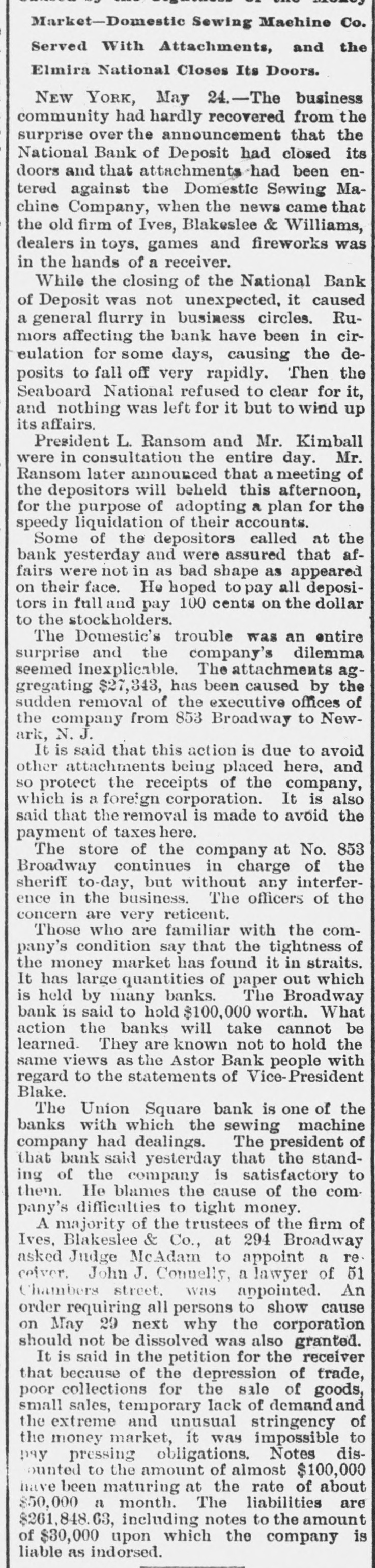
Rapid deposit withdrawals, refusal of Seaboard National to clear its paper, attachments and impaired capital led to suspension.
Newspaper Excerpt
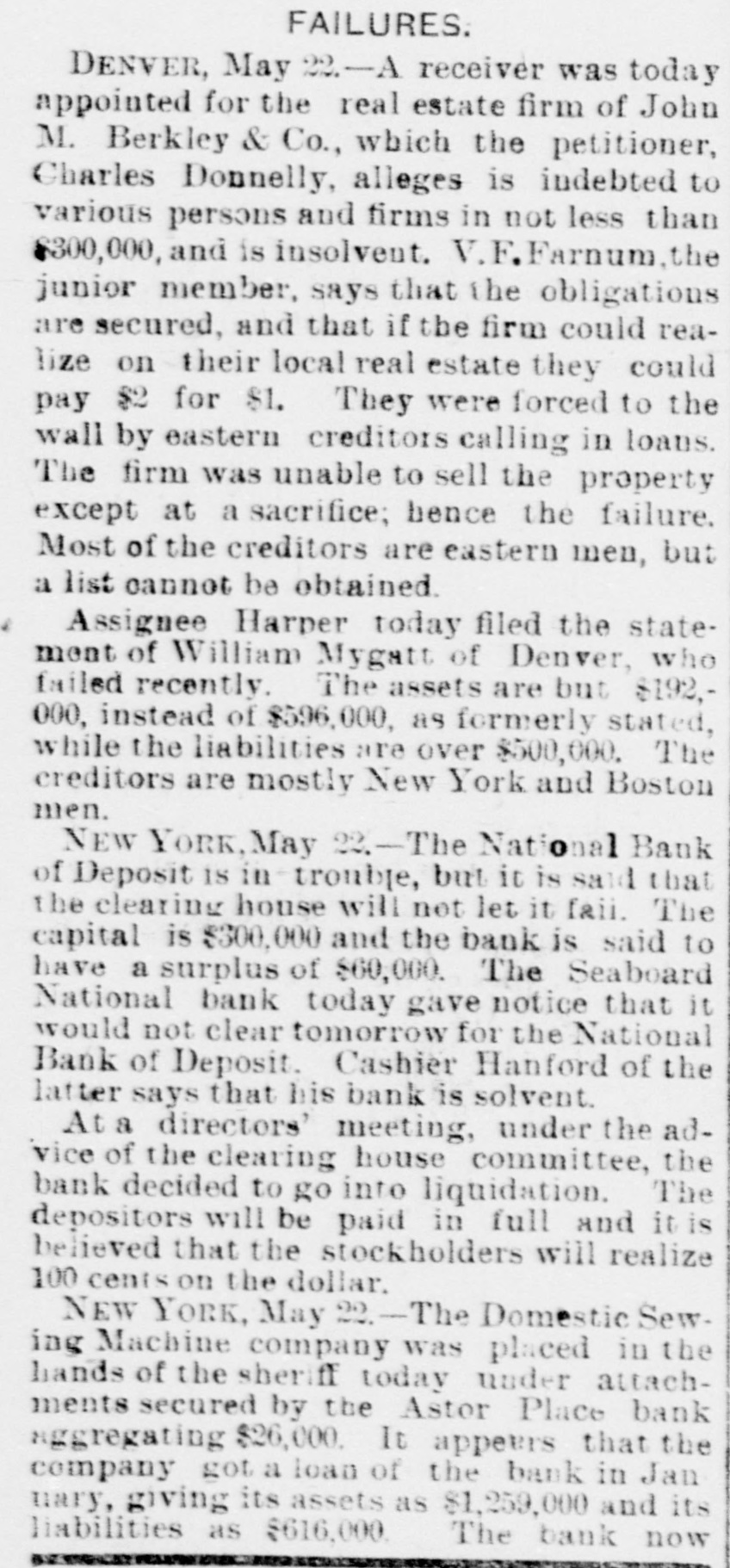
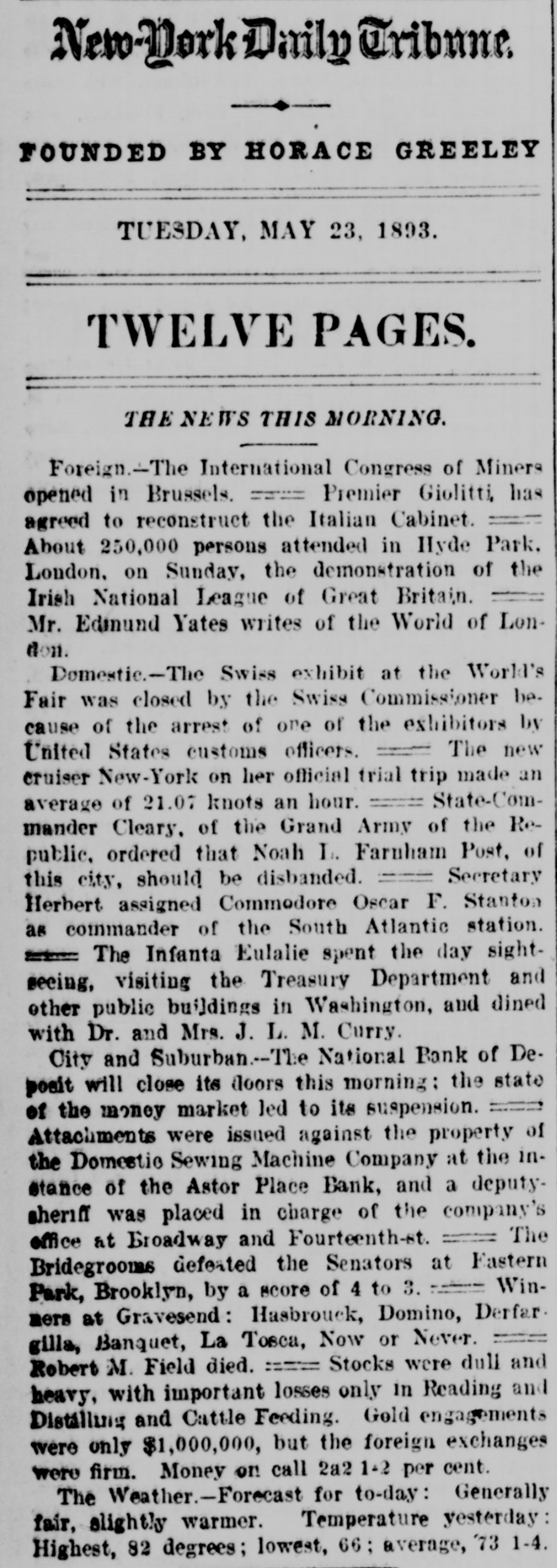
The National Bank of Deposit will close its doors this morning: the state of the money market led to its suspension.
Source
newspapers
+2 days
3.May 25, 1893Other
Newspaper Excerpt
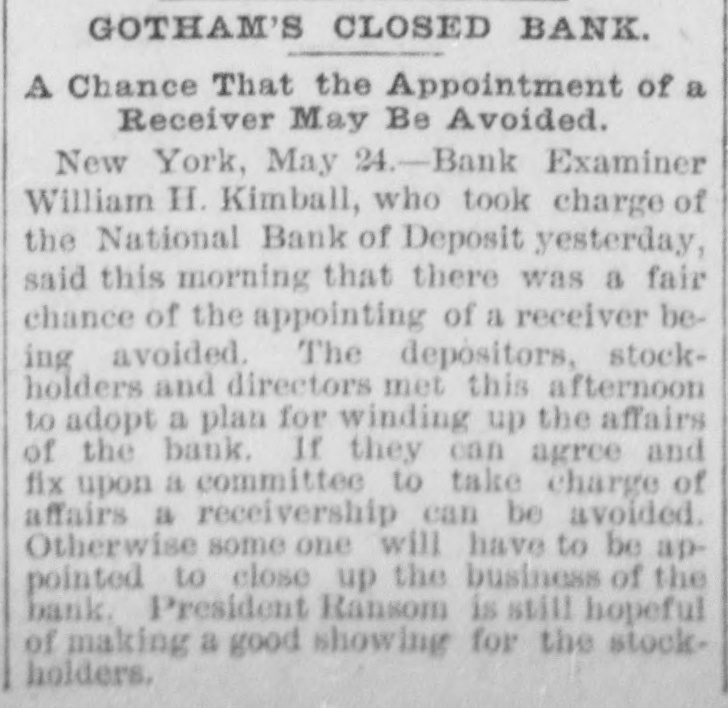
Depositors met and appointed a board of trustees to manage affairs to avoid a receiver; examiner Kimball in charge and negotiations with depositors and trustees continued.
Source
newspapers
+15 days
4.June 9, 1893Receivership
Newspaper Excerpt
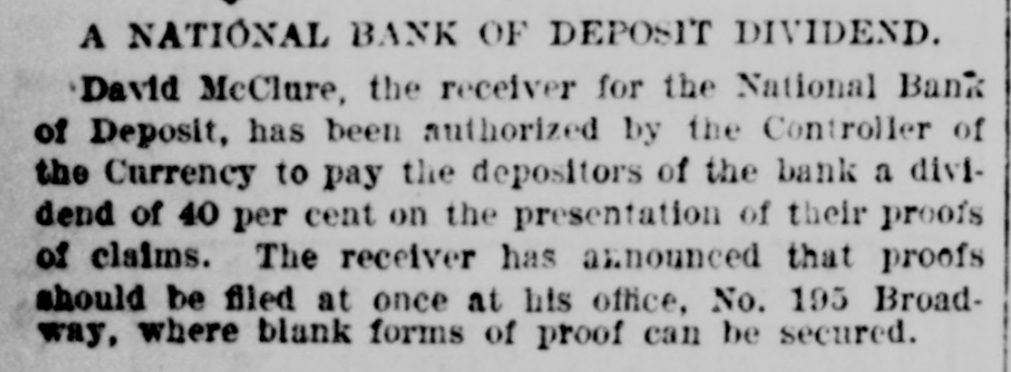
David McClure, the receiver for the National Bank of Deposit, has been authorized by the Controller of the Currency to pay the depositors of the bank a dividend of 40 per cent on the presentation of their proofs of claims.
Source
newspapers
same day
5.June 9, 1893Receivership
Source
historical_nic
Newspaper Articles (25)
1.May 23, 1893The Wichita Daily EagleWichita, KS
Click image to open full size in new tab
Article Text
FAILURES
DENVER, May - A receiver was today appointed for the real estate firm of John M. Berkley & Co., which the petitioner, Charles Donnelly, alleges is indebted to various persons and firms in not less than $300,000, and is insolvent. V.F. Farnum, the junior member, says that the obligations are secured, and that if the firm could realize on their local real estate they could pay $2 for $1. They were forced to the wall by eastern creditors calling in loans. The firm was unable to sell the property except at a sacrifice; hence the failure. Most of the creditors are eastern men, but a list cannot be obtained Assignee Harper today filed the statement of William Mygatt of Denver, who failed recently. The assets are but $192,000, instead of $596,000, as formerly stated, while the liabilities are over $500,000. The creditors are mostly New York and Boston men. NEW YORK, May 22 The National Bank of Deposit IS in trouble, but it is said that the clearing house will not let it faii. The capital is $300,000 and the bank is said to have a surplus of $60,000. The Seaboard National bank today gave notice that it would not clear tomorrow for the National Bank of Deposit. Cashier Hanford of the latter says that his bank is solvent. At a directors' meeting, under the advice of the clearing house committee, the bank decided to go into liquidation. The depositors will be paid in full and it is believed that the stockholders will realize 100 cents on the dollar. NEW YORK, May -The Domestic Sewing Machine company was placed in the hands of the sheriff today under attachments secured by the Astor Place bank aggregating $26,000. It appeurs that the company got a loan of the bank in Jan uary, giving its assets as $1,259,000 and its liabilities as $616,000. The bank now
2.May 23, 1893New-York TribuneNew York, NY
Click image to open full size in new tab
Article Text
New-Work? Daily Uribune FOUNDED BY HORACE GREELEY TUESDAY, MAY 23, 1893. TWELVE PAGES. THE NEWS THIS MORNING. Foreign.-The International Congress of Miners opened in Brussels, ==== Premier Giolitti, has -agreed to reconstruct the Italian Cabinet. About 250,000 persons attended in Hyde Park. London, on Sunday, the demonstration of the Irish National League of Great Britain. Mr. Edmund Yates writes of the World of London. Domestic.-The Swiss exhibit at the World's Fair was closed by the Swiss Commissioner be. cause of the arrest of one of the exhibitors by United States customs officers. - The new cruiser New-York on her official trial trip made an State-Comaverage of 21.07 knots an hour. mander Cleary. of the Grand Army of the Republic, ordered that Noah I. Farnham Post, of this city, should be disbanded. Secretary Herbert assigned Commodore Oscar F. Stanton as commander of the South Atlantic station. - The Infanta Eulalie spent the day sightseeing, visiting the Treasury Department and other public buildings in Washington, and dined with Dr. and Mrs. J. L. M. Curry. City and Suburban.--The National Bank of Deposit will close its doors this morning: the state of the money market led to its suspension. 100 Attachments were issued against the property of the Domestic Sewing Machine Company at the instance of the Astor Place Bank, and a deputysheriff was placed in charge of the company's office at Broadway and Fourteenth-st. = The Bridegrooms defeated the Senators at Eastern Park, Brooklyn, by a score of 4 to 3. - Winmers at Gravesend: Hasbrouck, Domino, Derfar gilla, Banquet, La Tosca, Now or Never. Robert M. Field died. Stocks were dull and heavy, with important losses only in Reading and Distilling and Cattle Feeding. Gold engagements were only $1,000,000, but the foreign exchanges were firm. Money on call 2a2 142 per cent. The Weather.-Forecast for to-day: Generally fair, slightly warmer. Temperature yesterday: Highest, 82 degrees; lowest, 66; average, 73 1-4.
Served With Attachments, and the Elmira National Closes Its Doors. NEW YORK, May 24.-The business community had hardly recovered from the surprise over the announcement that the National Bank of Deposit had closed its doors and that attachments had been entered against the Domestic Sewing Machine Company, when the news came that the old firm of Ives, Blakeslee & Williams, dealers in toys, games and fireworks was in the hands of a receiver. While the closing of the National Bank of Deposit was not unexpected, it caused a general flurry in business circles. Rumors affecting the bank have been in cirreulation for some days, causing the deposits to fall off very rapidly. Then the Seaboard National refused to clear for it, and nothing was left for it but to wind up its affairs. President L. Ransom and Mr. Kimball were in consultation the entire day. Mr. Ransom later announced that a meeting of the depositors will beheld this afternoon, for the purpose of adopting a plan for the speedy liquidation of their accounts. Some of the depositors called at the bank yesterday and were assured that affairs were not in as bad shape as appeared on their face. He hoped to pay all depositors in full and pay 100 cents on the dollar to the stockholders. The Domestic's trouble was an entire surprise and the company's dilemma seemed inexplicable. The attachments aggregating $27,343, has been caused by the sudden removal of the executive offices of the company from 853 Broadway to Newark, N. J. It is said that this action is due to avoid other attachments being placed here, and SO protect the receipts of the company, which is a foreign corporation. It is also said that the removal is made to avoid the payment of taxes here. The store of the company at No. 853 Broadway continues in charge of the sheriff to-day, but without any interference in the business. The officers of the concern are very reticent. Those who are familiar with the company's condition say that the tightness of the money market has found it in straits. It has large quantities of paper out which is held by many banks. The Broadway bank is said to hold $100,000 worth. What action the banks will take cannot be learned. They are known not to hold the same views as the Astor Bank people with regard to the statements of Vice-President Blake. The Union Square bank is one of the banks with which the sewing machine company had dealings. The president of that bank said yesterday that the standing of the company is satisfactory to them. He blames the cause of the company's difficulties to tight money. A majority of the trustees of the firm of Ives, Blakeslee & Co., at 294 Broadway asked Judge McAdam to appoint a re ceiver. John J. Connelly, a lawyer of 51 Chambers street. was appointed. An order requiring all persons to show cause on May 29 next why the corporation should not be dissolved was also granted. It is said in the petition for the receiver that because of the depression of trade, poor collections for the sale of goods, small sales, temporary lack of demandand the extreme and unusual stringency of the money market, it way impossible to pay pressing obligations. Notes disounted to the amount of almost $100,000 have been maturing at the rate of about $50,000 a month. The liabilities are $261,848.63, including notes to the amount of $30,000 upon which the company is liable as indorsed.
4.May 25, 1893The Morning NewsSavannah, GA
Click image to open full size in new tab
Article Text
GOTHAM'S CLOSED BANK
A Chance That the Appointment of a Receiver May Be Avoided. New York, May 24.-Bank Examiner William H. Kimball, who took charge of the National Bank of Deposit yesterday, said this morning that there was a fair chance of the appointing of a receiver being avoided. The depositors, stockholders and directors met this afternoon to adopt a plan for winding up the affairs of the bank. If they can agree and fix upon a committee to take charge of affairs a receivership can be avoided. Otherwise some one will have to be appointed to close up the business of the bank. President Ransom is still hopeful of making a good showing for the stockholders.
5.May 25, 1893New-York TribuneNew York, NY
Click image to open full size in new tab
Article Text
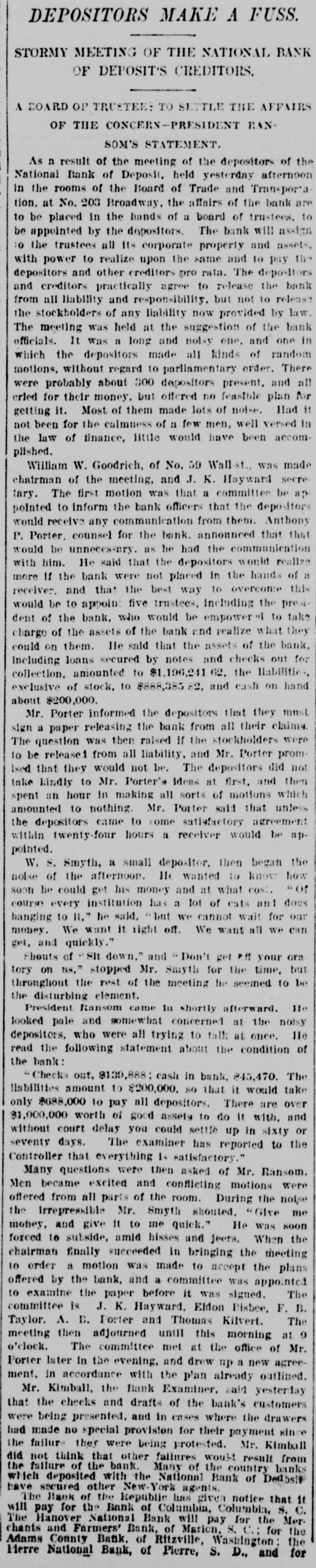
DEPOSITORS MAKE A FUSS
STORMY MEETING OF THE NATIONAL BANK OF DEPOSIT'S CREDITORS. A DOARD OF TRUSTEE: TO SETTLE THE AFFAIRS OF THE CONCERN-PRESIDENT RANSOM'S STATEMENT. As a result of the meeting of the depositors of the National Bank of Deposit. held yesterday afternoon in the rooms of the Board of Trade and Transporta tion, at No. 203 Broadway, the affairs of the bank are to be placed in the hands of a board of trustees. to be appointed by the depositors. The bank will assign :0 the trustees all its corporate property and assets, with power to realize upon the same and to pay the depositors and other creditors pro rata. The depositors and creditors practically agree to release the bank from all liability and responsibility. but not to release the stockholders of any liability now provided by law. The meeting was held at the suggestion of the bank officials. It was a long and nolsy one, and one in which the depositors made all kinds of random motions, without regard to parliamentary order. There were probably about 300 depositors present. and all cried for their money. but offered no feasible plan for getting it. Most of them made lots of noise. Had it not been for the calmness of a few men, well versed in the law of finance, little would have been accomplished. William W. Goodrich, of No. 59 Wall-s was made chairman of the meeting, and J. K. Hayward secre tary. The first motion was that a committee be ap pointed to inform the bank officers that the depositors would receive any communication from them. Anthony P. Porter, counsel for the bank. announced that that would be unnecessary. as he had the communication with him. He said that the depositors would realize more If the bank were not placed in the hands of a receiver. and that the best way to overcome this would be to appoint five trustees. including the pre-ident of the bank, who would be empower d to take charge of the assets of the bank and realize what they could on them. He said that the assets of the bank. including loans secured by notes and checks out for collection, amounted to $1,196,241 62, the liabilities exclusive of stock, to $888,385.82. and cash on hand about $200,000. Mr. Porter informed the depositors that they must sign a paper releasing the bank from all their claims. The question was then raised if the stockholders were to be release 1 from all liability. and Mr. Porter promIsed that they would not be. The depositors did not take kindly to Mr. Porter's ideas at first, and then spent an hour In making all sorts of motions which amounted to nothing. Mr. Porter said that unless the depositors came to some satisfactory agreement within twenty-four hours a receiver would be appointed. W. S. Smyth, a small depositor. then began the noise of the afternoon. He wanted to know how soon he could get his money and at what cost. "Of course every institution has a lot of cats and dogs hanging to 11," he said, but we cannot wait for our money. We want it right off. We want all we can get, and quickly." Shouts of Slt down," and Don't get all your ora tory on us." stopped Mr. Smyth for the time, but throughout the rest of the meeting he seemed to be the disturbing element. President Ransom came in shortly afterward. He looked pale and somewhat concerned at the noisy depositors. who were all trying to talk at once. He read the following statement about the condition of the bank: Checks out. $139,888; cash in bank, 845,470. The liabilities amount to $200,000. so that it would take only $688,000 to pay all depositors. There are over $1,000,000 worth of good assets to do It with, and without court delay you could settle up in sixty or seventy days. The examiner has reported to the Controller that everything 1. satisfactory." Many questions were then asked of Mr. Ransom. Men became excited and conflicting motions were offered from all parts of the room. During the noise the Irrepressible Mr. Smyth shouted. "Give me money, and give It to me quick." He was soon forced to subside, amid hisses and jeers. When the chairman finally succeeded in bringing the meeting to order a motion was made to accept the plans offered by the bank, and a committee was appointed to examine the paper before it was signed. The comtrittee is J. K. Hayward, Eldon Bisbee, F. B. Taylor. A. B. Porter and Thomas Kilvert. The meeting then adjourned until this morning at 9 o'clock. The committee met at the office of Mr. Porter later In the evening, and drew up a new agreement. in accordance with the plan already outlined. Mr. Kimball, the Bank Examiner, said yesterday that the checks and drafts of the bank's customers were being presented, and in cases where the drawers had made no special provision for their payment since the failure they were being protested. Mr. Kimball did not think that other failures would result the failure of the bank. Many of the country banks from which deposited with the National Bank of Dedosit have secured other New-York agents. The Bank of the Republic has given pay the Bank of Columbia, National Bank will for chants The will Hanover for pay Columbia, notice the that S. Mer- C. it and Farmers' Bank, of Marion, S. C.: for Adams County Bank. of Ritzville, Washington : the Herre National Bank, of Pierre, S. D., and the for
NEW YORK, May 25.-Bank Examiner William H. Kimball, who took charge of the National Bank of Deposit, says that there is a fair chance of the appointing of a receiver being avoided.
7.May 26, 1893New-York TribuneNew York, NY
Click image to open full size in new tab
Article Text
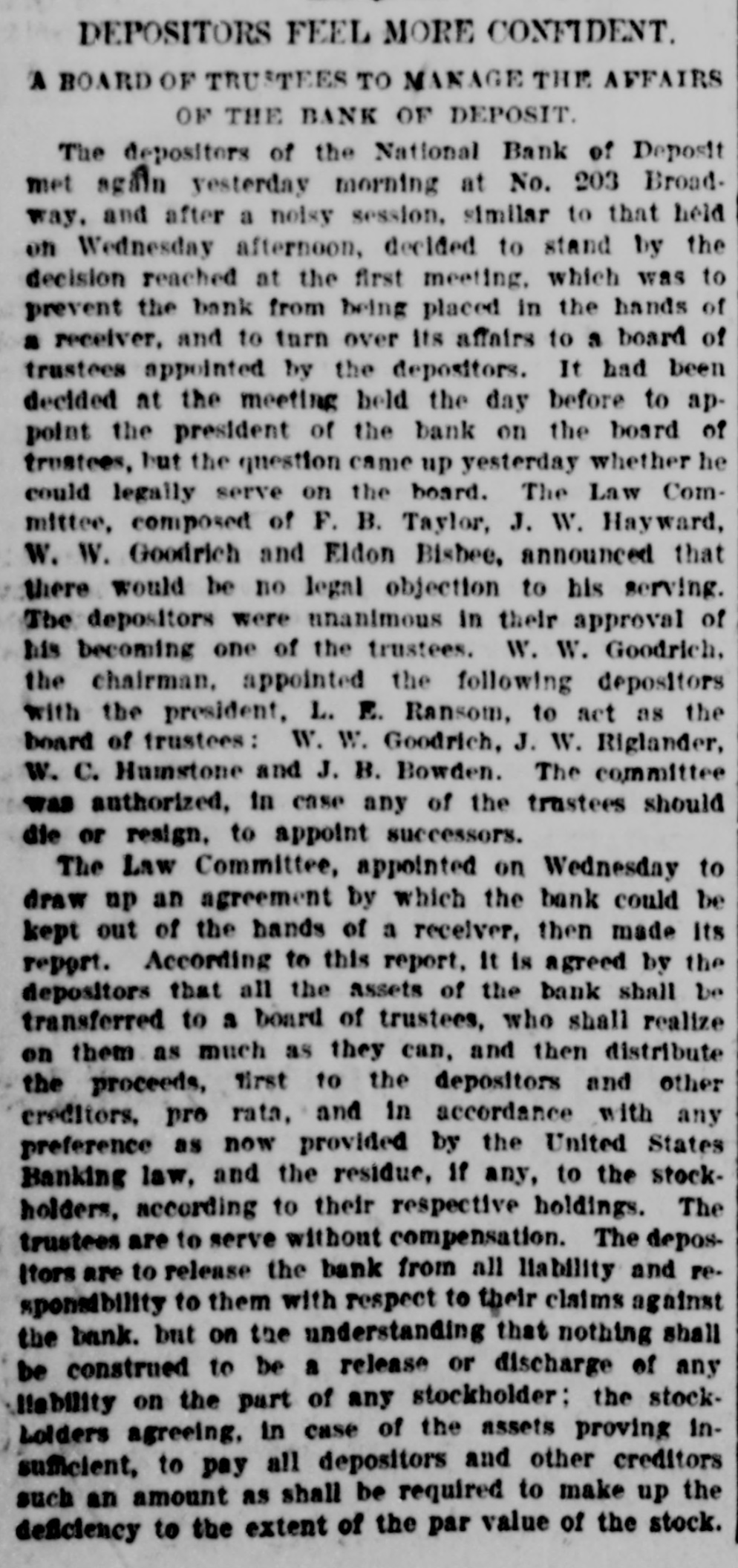
DEPOSITORS FEEL MORE CONFIDENT
A BOARD OF TRUSTEES TO MANAGE THE AFFAIRS OF THE BANK OF DEPOSIT. The depositors of the National Bank of Deposit met again yesterday morning at No. 203 Broadway. and after a noisy session. similar to that held on Wednesday afternoon, decided to stand by the decision reached at the first meeting. which was to prevent the bank from being placed in the hands of n receiver, and to turn over Its affairs to a board of trustees appointed by the depositors. It had been decided at the meeting held the day before to appoint the president of the bank on the board of trustees, but the question came up yesterday whether he could legally serve on the board. The Law Committee, composed of F. B. Taylor, J. W. Hayward, W. W. Goodrich and Eldon Bisbee, announced that there would be no legal objection to his serving. The depositors were unanimous in their approval of his becoming one of the trustees. W. W. Goodrich. the chairman. appointed the following depositors with the president, L. E. Ransom, to act as the board of trustees: W. W. Goodrich, J. W. Riglander, W. C. Humstone and J. B. Bowden. The committee was authorized, in case any of the trastees should die or resign. to appoint successors. The Law Committee, appointed on Wednesday to draw up an agreement by which the bank could be kept out of the hands of a receiver, then made Its report. According to this report, It is agreed by the depositors that all the assets of the bank shall be transferred to a board of trustees, who shall realize on them as much as they can, and then distribute the proceeds, first to the depositors and other creditors. pre rata, and in accordance with any preference as now provided by the United States Banking law, and the residue, If any, to the stockholders, according to their respective holdings. The trustees are to serve without compensation. The deposItors are to release the bank from all liability and responsibility to them with respect to their claims against the bank. but on the understanding that nothing shall be construed to be a release or discharge of any liability on the part of any stockholder: the stockLolders agreeing, in case of the assets proving Insufficient, to pay all depositors and other creditors such an amount as shall be required to make up the deficiency to the extent of the par value of the stock.
8.May 27, 1893The Washington BeeWashington, DC
Click image to open full size in new tab
Article Text
In Financial Trouble
The Elmira National Bank closed its doors Tuesday morning. The bank's failure is the result of the recent financial troubles of Col. D. C. Robinson. The deposits in the bank amount to about $200,000 and will be paid in full. The suspension of the bank caused a big run on the Elmira Savings Bank, but all demands were promptly met. The big toy firm of Ives, Blakeslee & Williams, in New York city, with branch stores at Bridgeport, Conn., Elkland, Pa., and Chicago, Ill.. has gone into the hands of a receiver. The liabilities are $261,848, and assets $70,298. The National Bank of Deposit in New York city was forced to suspend and is now in possession of the Comptroller of the Currency. The Exchange Bank of Tingley, Iowa, has suspended, and the cashier, Robert Bennet, has left for parts unknown. The cash has also disappeared. Deposits were received up to the day of closing.
9.June 1, 1893Barton County DemocratGreat Bend, KS
Click image to open full size in new tab
Article Text
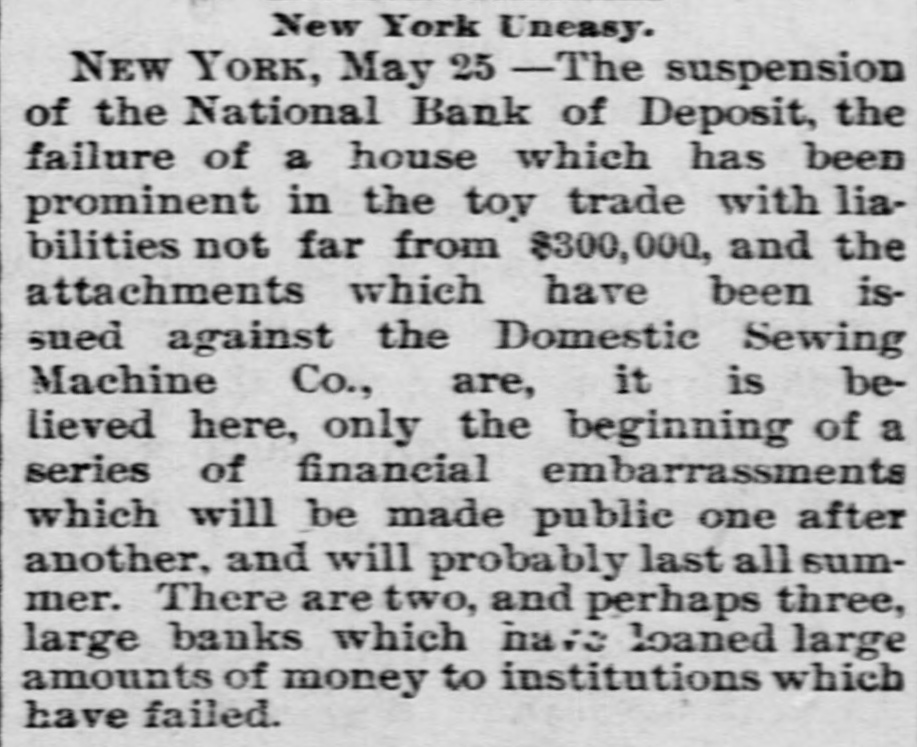
New York Uneasy
NEW YORK, May 25 - -The suspension of the National Bank of Deposit, the failure of a house which has been prominent in the toy trade with liabilities not far from $300,000, and the attachments which have been issued against the Domestic Sewing Machine Co., are, it is believed here, only the beginning of a series of financial embarrassments which will be made public one after another, and will probably last all summer. There are two, and perhaps three, large banks which nate loaned large amounts of money to institutions which have failed.
10.June 2, 1893The Iola RegisterIola, KS
Click image to open full size in new tab
Article Text
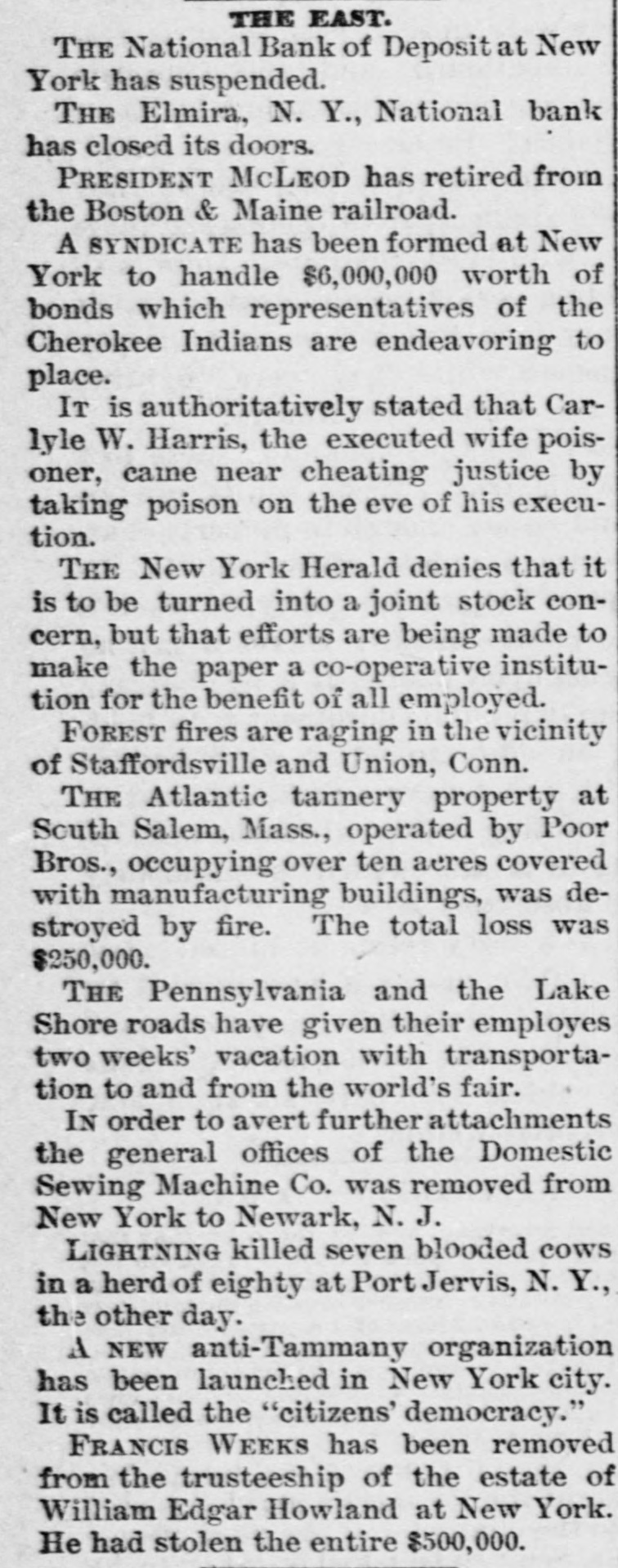
THE EAST
THE National Bank of Deposit at New York has suspended. THE Elmira, N. Y., National bank has closed its doors. PRESIDENT McLeod has retired from the Boston & Maine railroad. A SYNDICATE has been formed at New York to handle $6,000,000 worth of bonds which representatives of the Cherokee Indians are endeavoring to place. IT is authoritatively stated that Carlyle W. Harris, the executed wife poisoner, caine near cheating justice by taking poison on the eve of his execution. TEE New York Herald denies that it is to be turned into a joint stock concern, but that efforts are being made to make the paper a co-operative institution for the benefit of all employed. FOREST fires are raging in the vicinity of Staffordsville and Union, Conn. THE Atlantic tannery property at South Salem, Mass., operated by Poor Bros., occupying over ten acres covered with manufacturing buildings, was destroyed by fire. The total loss was $250,000. THE Pennsylvania and the Lake Shore roads have given their employes two weeks' vacation with transportation to and from the world's fair. IN order to avert further attachments the general offices of the Domestic Sewing Machine Co. was removed from New York to Newark, N. J. LIGHTNING killed seven blooded cows in a herd of eighty at Port Jervis, N. Y., the other day. A NEW anti-Tammany organization has been launched in New York city. It is called the "citizens' democracy." FRANCIS WEEKS has been removed from the trusteeship of the estate of William Edgar Howland at New York. He had stolen the entire $500,000.
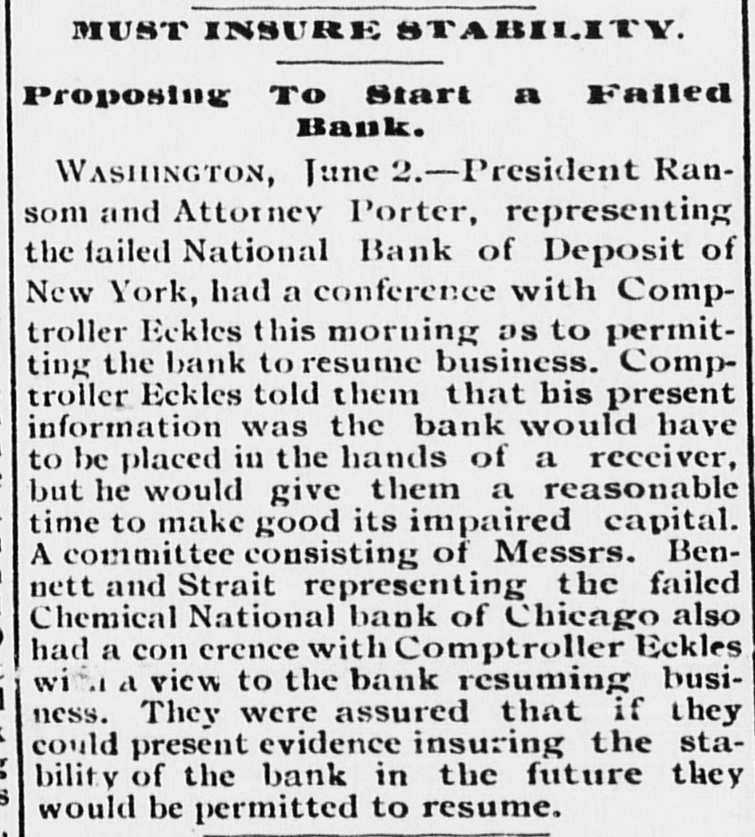
Proposing To Start a Failed Bank. WASHINGTON, June 2.-President Ransom and Attorney Porter, representing the failed National Bank of Deposit of New York, had a conference with Comptroller Eckles this morning as to permitting the bank to resume business. Comptroller Eckles told them that his present information was the bank would have to be placed in the hands of a receiver, but he would give them a reasonable time to make good its impaired capital. A committee consisting of Messrs. Bennett and Strait representing the failed Chemical National bank of Chicago also had a con crence with Comptroller Eckles WI... a view to the bank resuming business. They were assured that if they could present evidence insuring the stability of the bank in the future they would be permitted to resume.
12.June 2, 1893The Iola RegisterIola, KS
Click image to open full size in new tab
Article Text
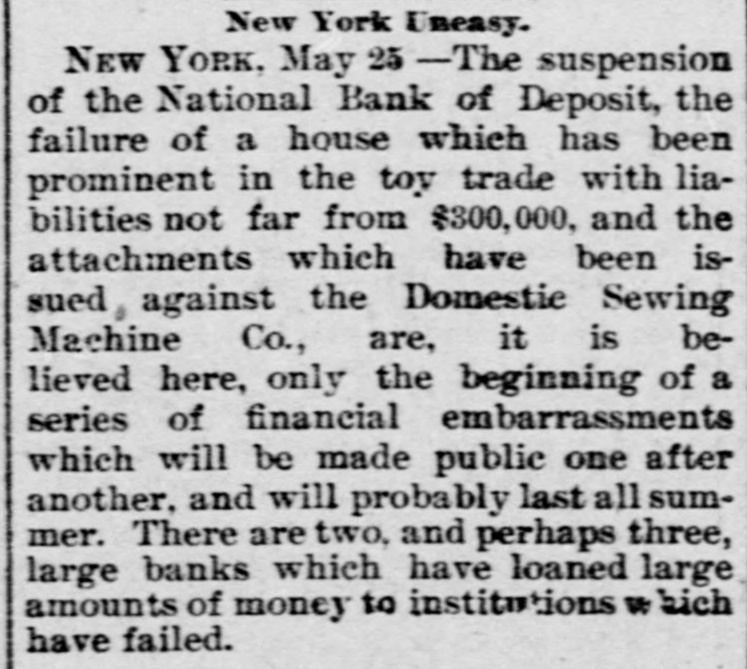
New York Uneasy
NEW YORK, May 25 - The suspension of the National Bank of Deposit, the failure of a house which has been prominent in the toy trade with liabilities not far from $300,000, and the attachments which have been issued, against the Domestic Sewing Machine Co., are, it is believed here, only the beginning of a series of financial embarrassments which will be made public one after another. and will probably last all summer. There are two. and perhaps three, large banks which have loaned large amounts of money to institutions * bich have failed.
13.June 3, 1893The TimesRichmond, VA
Click image to open full size in new tab
Article Text
BANKS WANT TO RESUME
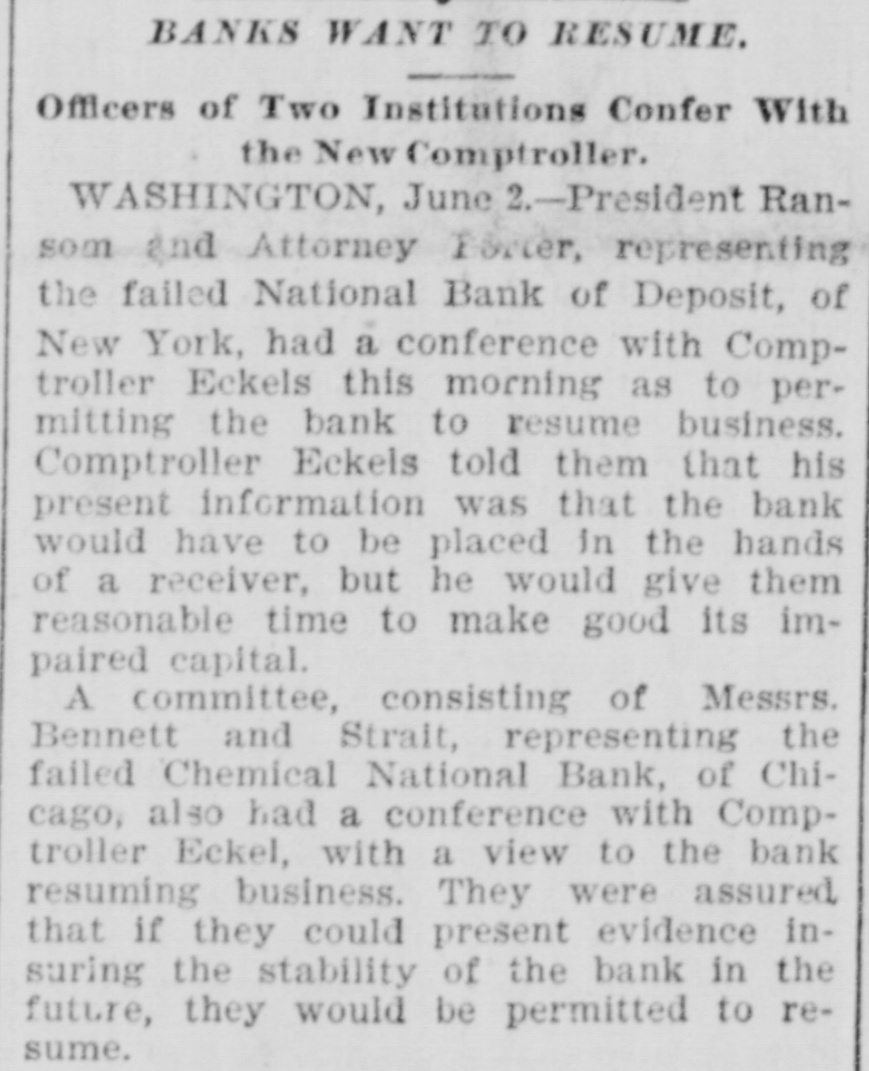
Officers of Two Institutions Confer With the New Comptroller. WASHINGTON, June 2.-President Ransom and Attorney Ibeter, representing the failed National Bank of Deposit, of New York, had a conference with Comptroller Eckels this morning as to permitting the bank to resume business. Comptroller Eckels told them that his present information was that the bank would have to be placed in the hands of a receiver, but he would give them reasonable time to make good its impaired capital. A committee, consisting of Messrs. Bennett and Strait, representing the failed Chemical National Bank, of Chicago, also had a conference with Comptroller Eckel, with a view to the bank resuming business. They were assured that if they could present evidence insuring the stability of the bank in the future, they would be permitted to resume.
14.June 3, 1893The Morning NewsSavannah, GA
Click image to open full size in new tab
Article Text
BANKERS WANT TO RESUME
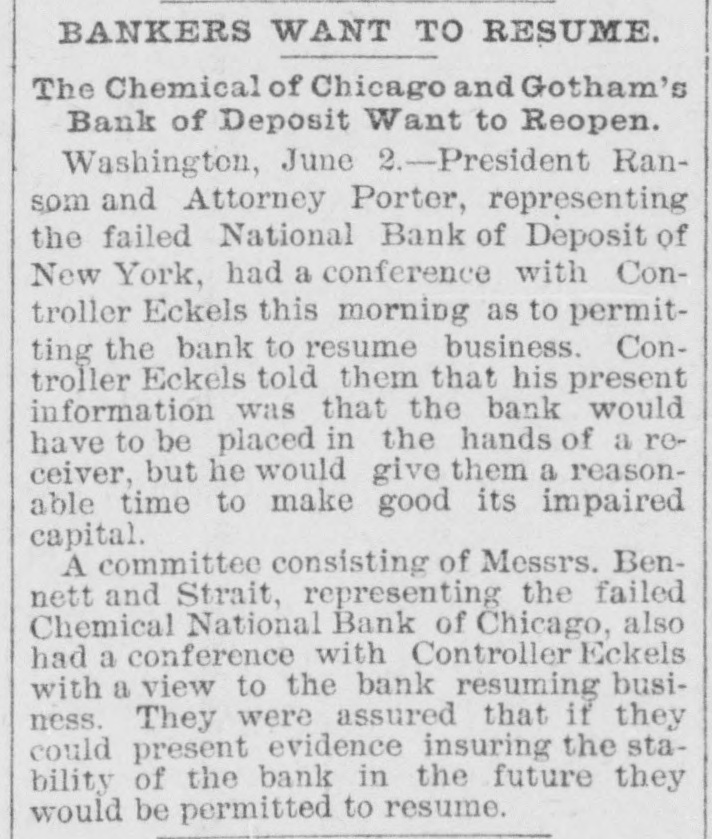
The Chemical of Chicago and Gotham's Bank of Deposit Want to Reopen. Washington, June 2.-President Ransom and Attorney Porter, representing the failed National Bank of Deposit of New York, had a conference with Controller Eckels this morning as to permitting the bank to resume business. Controller Eckels told them that his present information was that the bank would have to be placed in the hands of a receiver, but he would give them a reasonable time to make good its impaired capital. A committee consisting of Messrs. Bennett and Strait, representing the failed Chemical National Bank of Chicago, also had a conference with Controller Eckels with a view to the bank resuming business. They were assured that if they could present evidence insuring the stability of the bank in the future they would be permitted to resume.
15.June 3, 1893New-York TribuneNew York, NY
Click image to open full size in new tab
Article Text
AFFAIRS OF THE BANK OF DEPOSIT
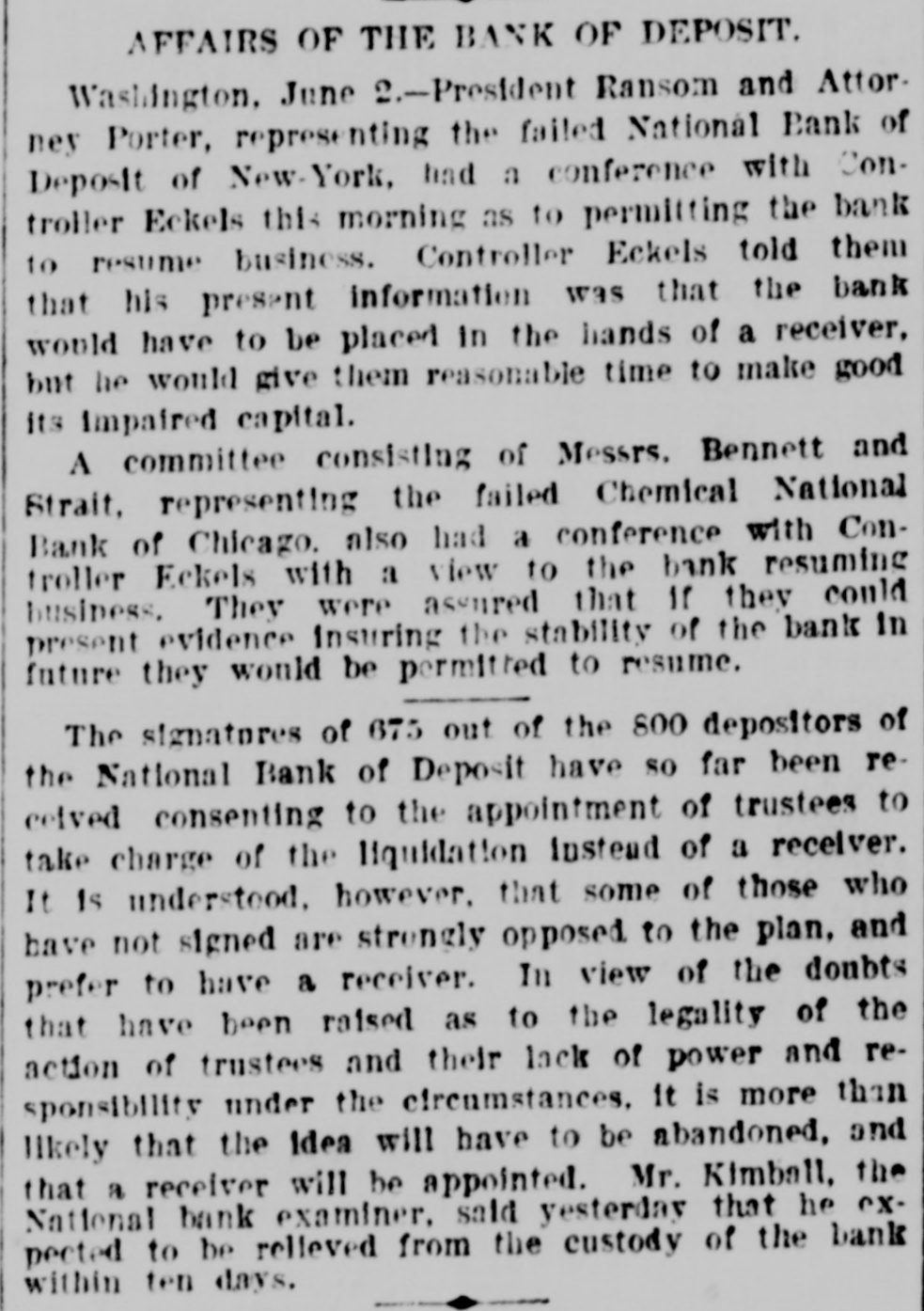
Washington. June 2.-President Ransom and Attorney Porter, representing the failed National Bank of Deposit of New-York, had a conference with Controller Eckels this morning as to permitting the bank to resume business. Controller Eckels told them that his present information was that the bank would have to be placed in the hands of a receiver, but he would give them reasonable time to make good its impaired capital. A committee consisting of Messrs. Bennett and Strait, representing the failed Chemical National Bank of Chicago. also had a conference with Controller Eckels with a view to the bank resuming business. They were assured that If they could present evidence insuring the stability of the bank in future they would be permitted to resume. The signatures of 675 out of the 800 depositors of the National Bank of Deposit have so far been recelved consenting to the appointment of trustees to take charge of the liquidation instead of a receiver. It is understood. however, that some of those who have not signed are strongly opposed to the plan, and prefer to have a receiver. In view of the doubts that have been raised as to the legality of the action of trustees and their lack of power and responsibility under the circumstances, it is more than likely that the Idea will have to be abandoned, and that a receiver will be appointed. Mr. Kimball, the National bank examiner. said yesterday that he expected to be relieved from the custody of the bank within ten days.
16.June 3, 1893The SunNew York, NY
Click image to open full size in new tab
Article Text
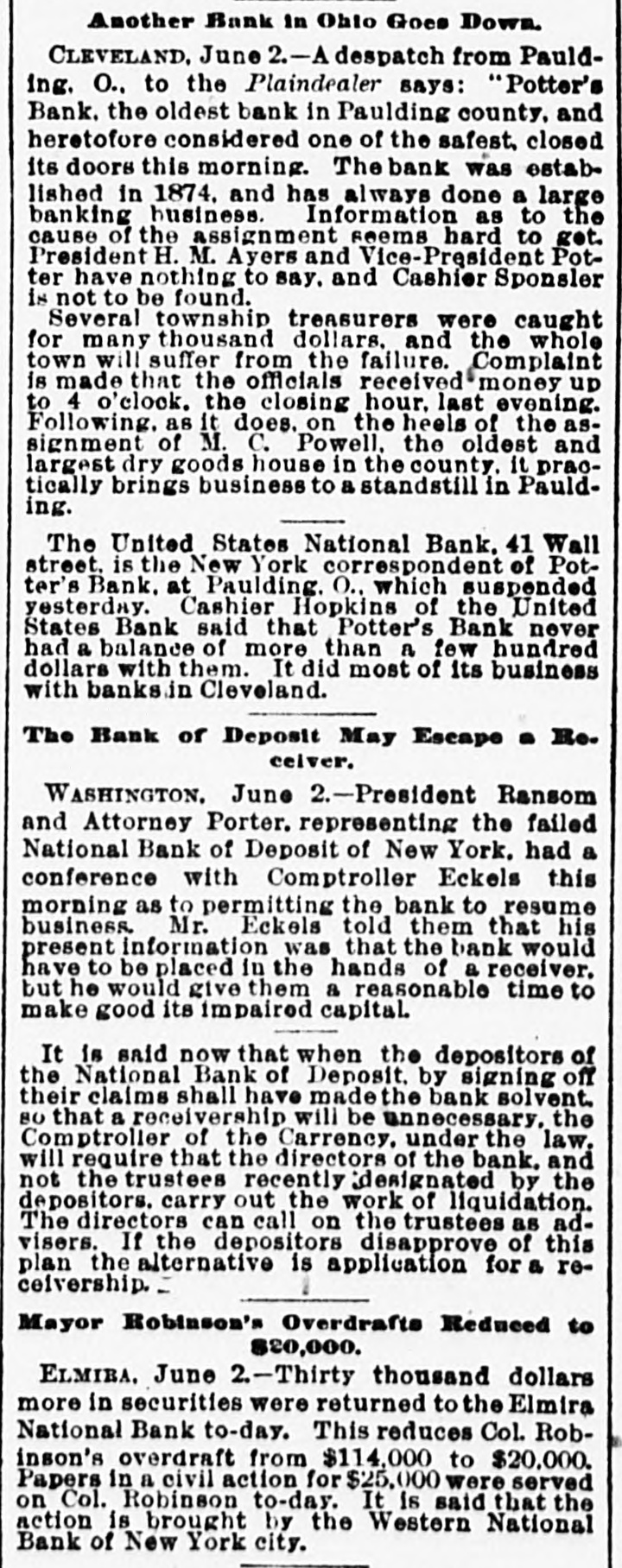
Another Bank in Ohio Goes Down. CLEVELAND. June 2.-A despatch from Paulding. O., to the Plaindealer says: "Potter's Bank. the oldest bank in Paulding county. and heretofore considered one of the safest. closed its doors this morning. The bank was established in 1874. and has always done a large banking business. Information as to the cause of the assignment seems hard to get. President H. M. Ayers and Vice-President Potter have nothing to say. and Cashier Sponsler is not to be found. Several township treasurers were caught for many thousand dollars. and the whole town will suffer from the failure. Complaint is made that the officials received money up to 4 o'clock. the closing hour. last evening. Following. as it does. on the heels of the assignment of M. C. Powell, the oldest and largest dry goods house in the county. it practically brings business to a standstill in Paulding. The United States National Bank. 41 Wall street. is the New York correspondent of Potter's Bank. at Paulding. O., which suspended yesterday. Cashier Hopkins of the United States Bank said that Potter's Bank never had a balance of more than a few hundred dollars with them. It did most of its business with banks.in Cleveland. The Bank of Deposit May Escape a Re. ceiver. WASHINGTON. June 2.-President Ransom and Attorney Porter. representing the failed National Bank of Deposit of New York. had a conference with Comptroller Eckels this morning as to permitting the bank to resume business Mr. Eckels told them that his present information was that the bank would have to be placed in the hands of a receiver. but he would give them a reasonable time to make good its impaired capital. It is said now that when the depositors of the National Bank of Deposit. by signing off their claims shall have made the bank solvent. 80 that a receivership will be unnecessary. the Comptroller of the Carrency. under the law. will require that the directors of the bank. and not the trustees recently :designated by the depositors. carry out the work of liquidation. The directors can call on the trustees as advisers. If the depositors disapprove of this plan the alternative is application for a receivership. Mayor Robinson's Overdrafts Reduced to $20,000. ELMIRA. June 2.-Thirty thousand dollars more in securities were returned to the Elmira National Bank to-day. This reduces Col. Robinson's overdraft from $114,000 to $20,000. Papers in a civil action for $25,000 were served on Col. Robinson to-day. It is said that the action is brought by the Western National Bank of New York city.
17.June 3, 1893Baxter Springs NewsBaxter Springs, KS
Click image to open full size in new tab
Article Text
THE EAST
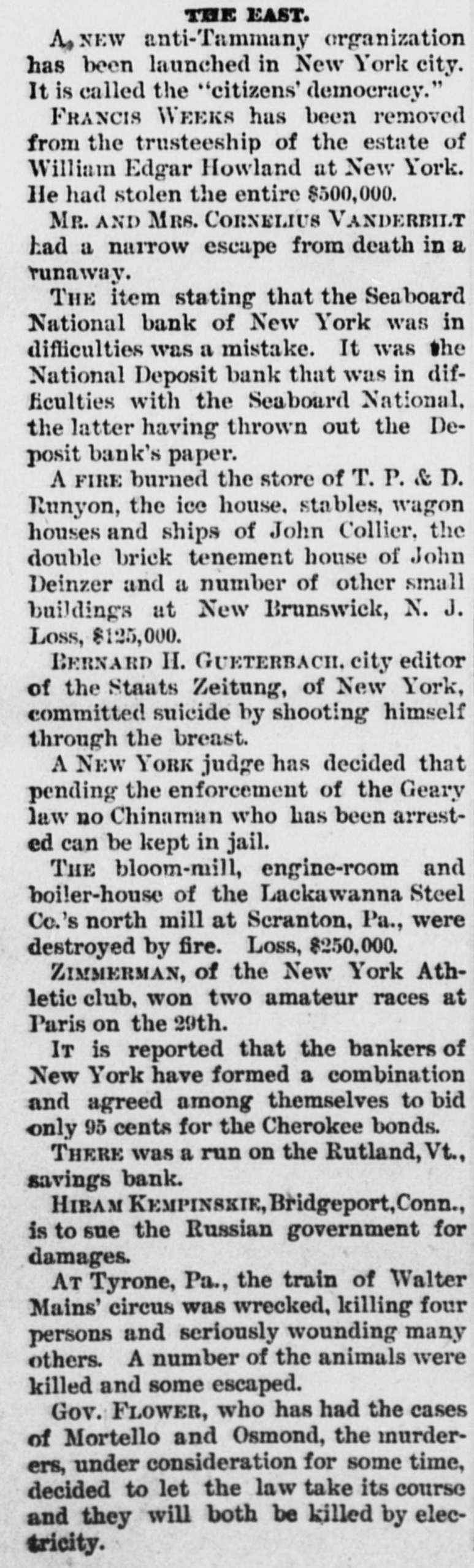
As NEW anti-Tammany organization has been launched in New York city. It is called the "citizens' democracy." FRANCIS WEEKS has been removed from the trusteeship of the estate of William Edgar Howland at New York. He had stolen the entire $500,000. MR. AND MRS. CORNELIUS VANDERBILT had a narrow escape from death in a runaway. THE item stating that the Seaboard National bank of New York was in difficulties was a mistake. It was the National Deposit bank that was in difficulties with the Seaboard National, the latter having thrown out the Deposit bank's paper. A FIRE burned the store of T. P. & D. Runyon, the ice house. stables, wagon houses and ships of John Collier, the double brick tenement house of John Deinzer and a number of other small buildings at New Brunswick, N. J. Loss, $125,000. BERNARD H. GUETERBACH. city editor of the Staats Zeitung, of New York, committed suicide by shooting himself through the breast. A NEW YORK judge has decided that pending the enforcement of the Geary law no Chinaman who has been arrested can be kept in jail. THE bloom-mill, engine-room and boiler-house of the Lackawanna Steel Co.'s north mill at Seranton, Pa., were destroyed by fire. Loss, $250,000. ZIMMERMAN, of the New York Athletic club, won two amateur races at Paris on the 29th. IT is reported that the bankers of New York have formed a combination and agreed among themselves to bid only 95 cents for the Cherokee bonds. THERE was a run on the Rutland, Vt., savings bank. HIRAM KEMPINSKIE, Bridgeport, Conn., is to sue the Russian government for damages. AT Tyrone, Pa., the train of Walter was many Mains' persons circus and seriously wrecked, wounding killing four others. A number of the animals were killed and some escaped. Gov. FLOWER, who has had the cases of Mortello and Osmond, the murderers, under consideration for some time, decided to let the law take its course and they will both be killed by electricity.
18.June 4, 1893The Indianapolis JournalIndianapolis, IN
Click image to open full size in new tab
Article Text
Other Business Troubles
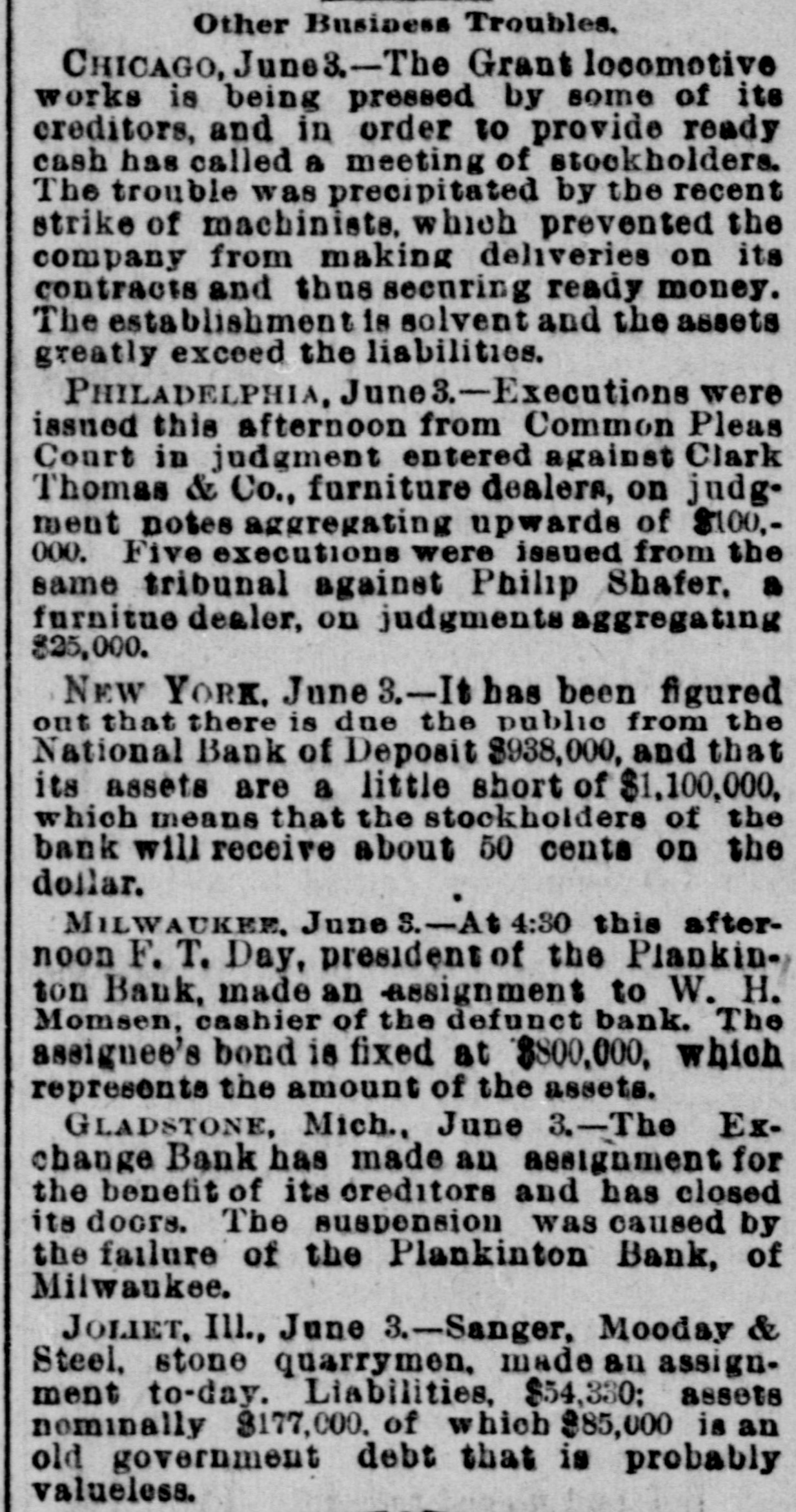
CHICAGO, June 3. - The Grant locomotive works is being pressed by some of its creditors, and in order to provide ready cash has called a meeting of stockholders. The trouble was precipitated by the recent strike of machinists. which prevented the company from making deliveries on its contracts and thus securing ready money. The establishment is solvent and the assets greatly exceed the liabilities. PHILADELPHIA, June 3. -Executions were issued this afternoon from Common Pleas Court in judgment entered against Clark Thomas & Co., furniture dealers, on judgment notes aggregating upwards of $100,000. Five executions were issued from the same tribunal against Philip Shafer. a furnitue dealer, on judgmentsaggregating $25,000. NEW YORK. June 3.-It has been figured out that there is due the public from the National Bank of Deposit $938,000, and that its assets are a little short of $1,100,000, which means that the stockholders of the bank will receive about 50 cents on the dollar. MILWAUKEE, June S.-At 4:30 this afternoon F. T. Day, president of the Plankinton Bank, made an assignment to W. H. Momsen, cashier of the defunct bank. The assignee's bond is fixed at $800,000, which represents the amount of the assets. GLADSTONE, Mich., June 3. -The Exchange Bank has made an assignment for the benefit of its creditors and has closed its doors. The suspension was caused by the failure of the Plankinton Bank, of Milwaukee. JOLIET, III., June 3.-Sanger, Mooday & Steel, stone quarrymen. made an assignment to-day. Liabilities, $54,330: assets nominally $177,000. of which $85,000 is an old government debt that is probably valueless.
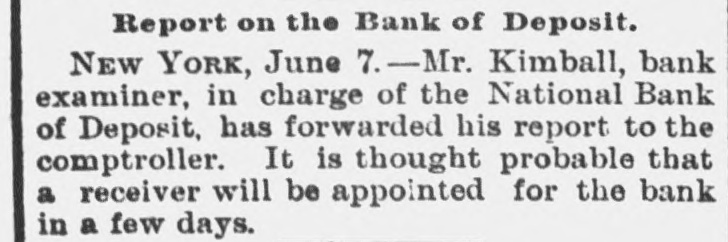
Report on the Bank of Deposit. NEW YORK, June 7.-Mr. Kimball, bank examiner, in charge of the National Bank of Deposit, has forwarded his report to the comptroller. It is thought probable that a receiver will be appointed for the bank in a few days.
20.June 7, 1893The Evening HeraldShenandoah, PA
Click image to open full size in new tab
Article Text
Report on the Bank of Deposit. NEW YORK, June 7.-Mr. Kimball, bank examiner, in charge of the National Bank of Deposit, has forwarded his report to the comptroller. It is thought probable that a receiver will be appointed for the bank in a few days.
21.July 15, 1893Evening StarWashington, DC
Click image to open full size in new tab
Article Text
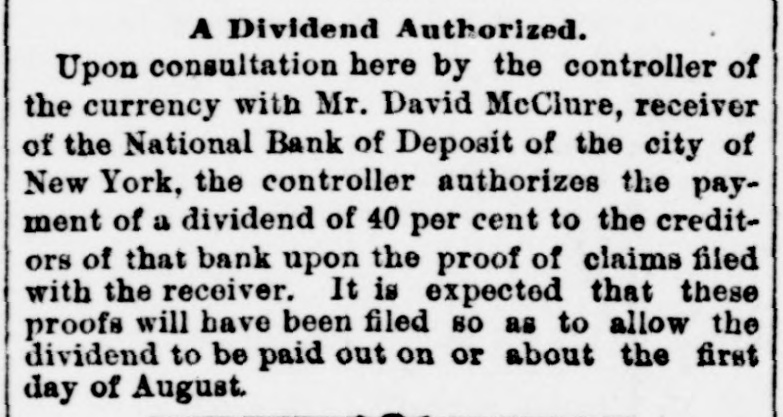
A Dividend Authorized
Upon consultation here by the controller of the currency with Mr. David McClure, receiver of the National Bank of Deposit of the city of New York, the controller authorizes the payment of a dividend of 40 per cent to the creditors of that bank upon the proof of claims filed with the receiver. It is expected that these proofs will have been filed so as to allow the dividend to be paid out on or about the first day of August.
22.July 15, 1893The SunNew York, NY
Click image to open full size in new tab
Article Text
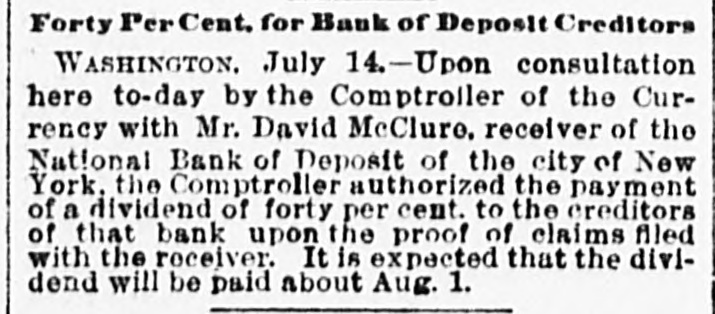
Forty Per Cent
for Bank of Deposit Creditors WASHINGTON. July 14.-Upon consultation here to-day by the Comptroller of the Currency with Mr. David McClure. receiver of the National Bank of Deposit of the city of New York. the Comptroller authorized the payment of a dividend of forty per cent. to the creditors of that bank upon the proof of claims filed with the receiver. It is expected that the dividend will be paid about Aug. 1.
23.July 18, 1893New-York TribuneNew York, NY
Click image to open full size in new tab
Article Text
A NATIONAL BANK OF DEPOSIT DIVIDEND
David McClure, the receiver for the National Bank of Deposit, has been authorized by the Controller of the Currency to pay the depositors of the bank a dividend of 40 per cent on the presentation of their proofs of claims. The receiver has announced that proofs should be filed at once at his office, No. 195 Broadway, where blank forms of proof can be secured.
24.February 15, 1894San Antonio Daily LightSan Antonio, TX
Click image to open full size in new tab
Article Text
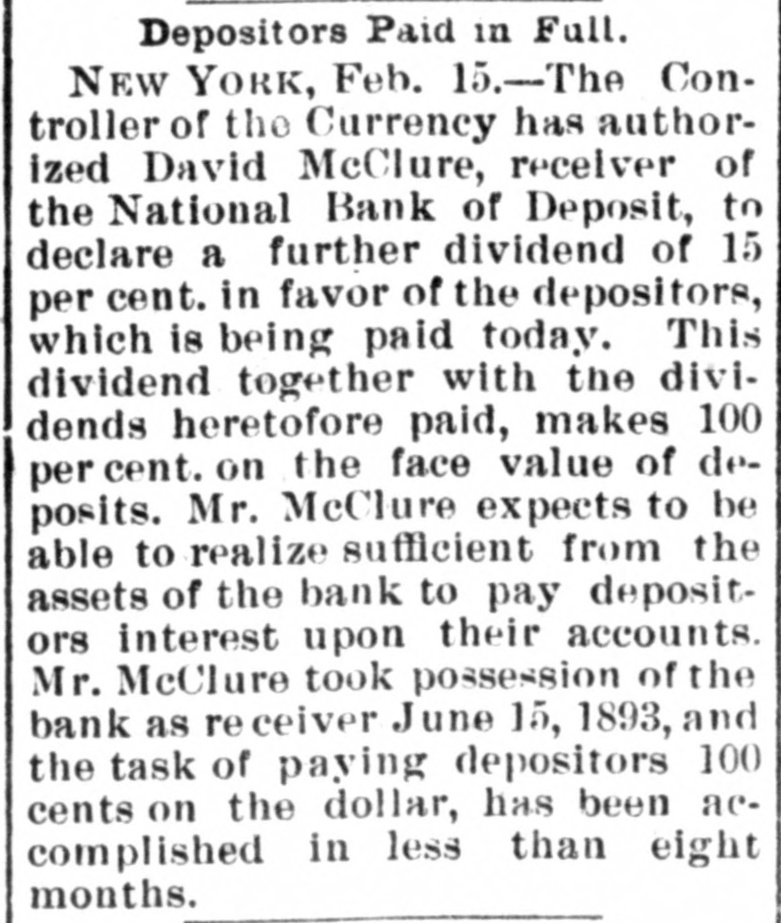
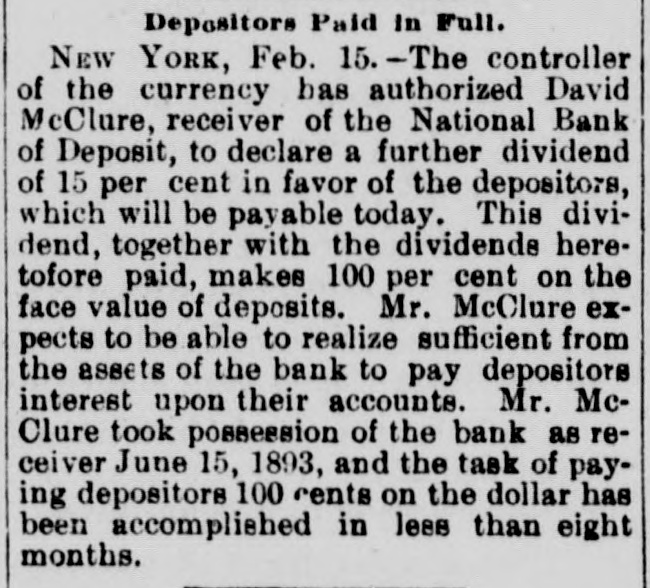
Depositors Paid in Full
NEW YORK, Feb. 15.-The Controller of the Currency has authorized David McClure, receiver of the National Bank of Deposit, to declare a further dividend of 15 per cent. in favor of the depositors, which is being paid today. This dividend together with the dividends heretofore paid, makes 100 per cent. on the face value of deposits. Mr. McClure expects to be able to realize sufficient from the assets of the bank to pay depositors interest upon their accounts. Mr. McClure took possession of the bank as receiver June 15, 1893, and the task of paying depositors 100 cents on the dollar, has been accomplished in less than eight months.
25.February 23, 1894Idaho County Free PressGrangeville, ID
Click image to open full size in new tab
Article Text
Depositors Paid In Full
NEW YORK, Feb. 15.-The controller of the currency has authorized David McClure, receiver of the National Bank of Deposit, to declare a further dividend of 15 per cent in favor of the depositors, which will be payable today. This dividend, together with the dividends heretofore paid, makes 100 per cent on the face value of deposits. Mr. McClure expects to be able to realize sufficient from the assets of the bank to pay depositors interest upon their accounts. Mr. McClure took possession of the bank as receiver June 15, 1893, and the task of paying depositors 100 cents on the dollar has been accomplished in less than eight months.
Bank runs are almost always and everywhere a deterioration of bank fundamentals.
But not for you.
You are the measure-zero exception: great fundamentals, solid bank, and yet the Diamond Dybvig fairy spread its rumor. Depositors woke up. Your collateral was not prepositioned. The Clearinghouse had it for you.
Do not pass Go. Do not collect $200. Go directly to jail… or worse.