Commercial Bank (Fulton, MO)

Episode Information

Episode UID
37839291225
Episode Type
Suspension โ†’ Closure
Bank Type
state
Bank ID
3783929 hash
Start Date
January 17, 1902
Location
Fulton, Missouri (38.847, -91.948)

Metadata

Model
gpt-5-mini (chosen from majority vote of a three-model LLM ensemble)
Short Digest
c461af8bf8e4c228

Response Measures

None

Description

Cashier P. S. Adams absconded with bank funds, prompting state authorities to close and place the bank in receivership.

Events (3)

1. January 17, 1902 Suspension
Cause
Bank Specific Adverse Info
Cause Details
Cashier P. S. Adams disappeared after taking $4,500 (reports vary up to $10,000) in gold and currency, and books were found in disarray; state examiner closed the bank.
Newspaper Excerpt
The Commercial Bank of Fulton was closed this morning by George B. Carstarphen, chief of the State Banking Department.
Source
newspapers
2. January 18, 1902 Receivership
Newspaper Excerpt
W. E. Jameson was appointed [temporary] receiver and will have charge until it is deemed advisable to release him.
Source
newspapers
3. March 13, 1902 Other
Newspaper Excerpt
Receiver ... paid depositors and creditors a 50-per-cent dividend; cashier P. S. Adams was located in Honolulu; later final dividend paid and affairs wound up in 1903.
Source
newspapers

Newspaper Articles (19)

Article from The Indianapolis Journal, January 18, 1902

Click image to open full size in new tab

Article Text

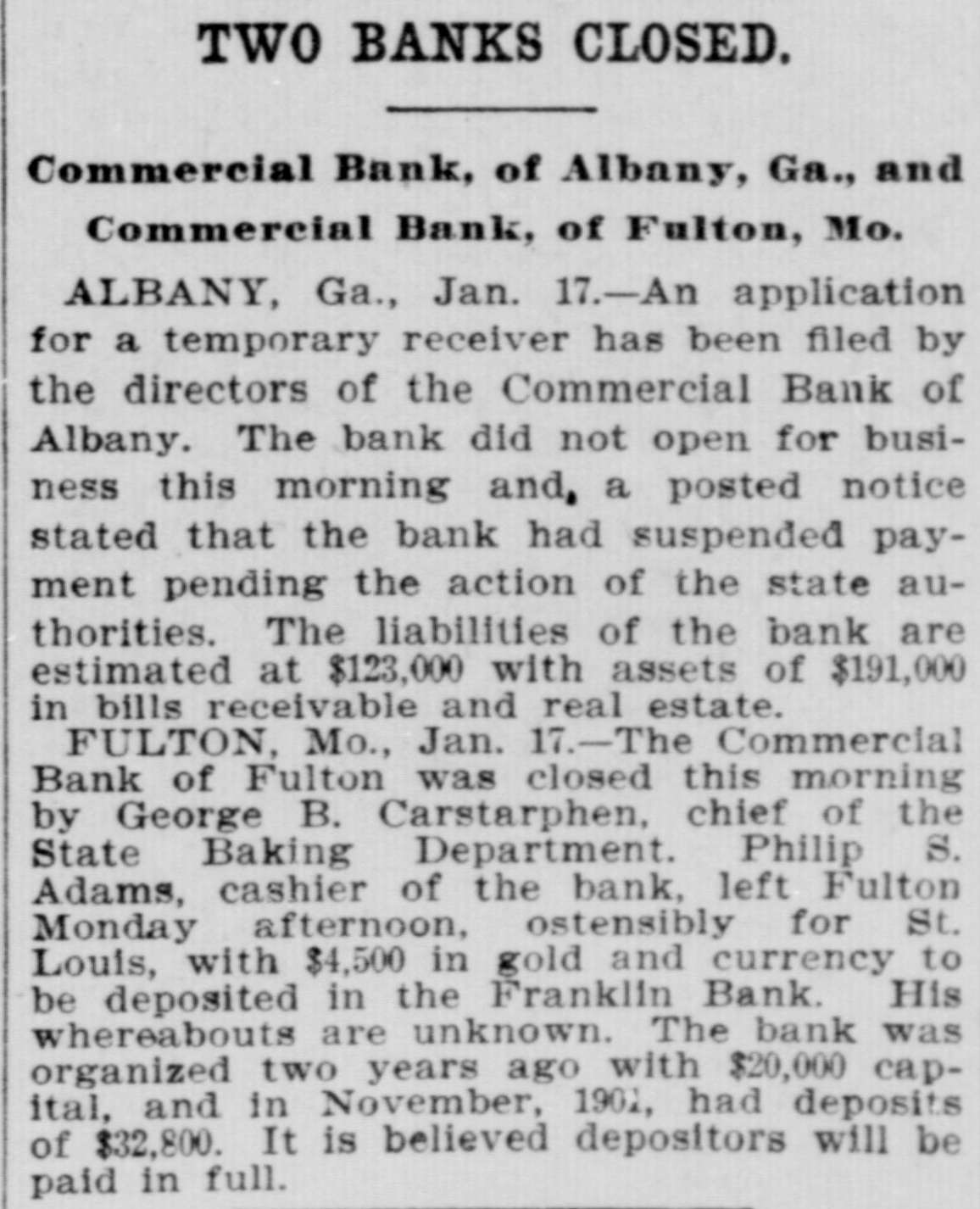
TWO BANKS CLOSED. Commercial Bank, of Albany, Ga., and Commercial Bank, of Fulton, Mo. ALBANY, Ga., Jan. 17.-An application for a temporary receiver has been filed by the directors of the Commercial Bank of Albany. The bank did not open for business this morning and, a posted notice stated that the bank had suspended payment pending the action of the state authorities. The liabilities of the bank are estimated at $123,000 with assets of $191,000 in bills receivable and real estate. FULTON, Mo., Jan. .-The Commercial Bank of Fulton was closed this morning by George B. Carstarphen, chief of the State Baking Department. Philip S. Adams, cashier of the bank, left Fulton Monday afternoon, ostensibly for St. Louis, with $4,500 in gold and currency to His be deposited in the Franklin Bank. whereabouts are unknown. The bank was organized two years ago with $20,000 capital, and in November, 1901, had deposits of $32,800. It is believed depositors will be paid in full.


Article from The St. Louis Republic, January 18, 1902

Click image to open full size in new tab

Article Text

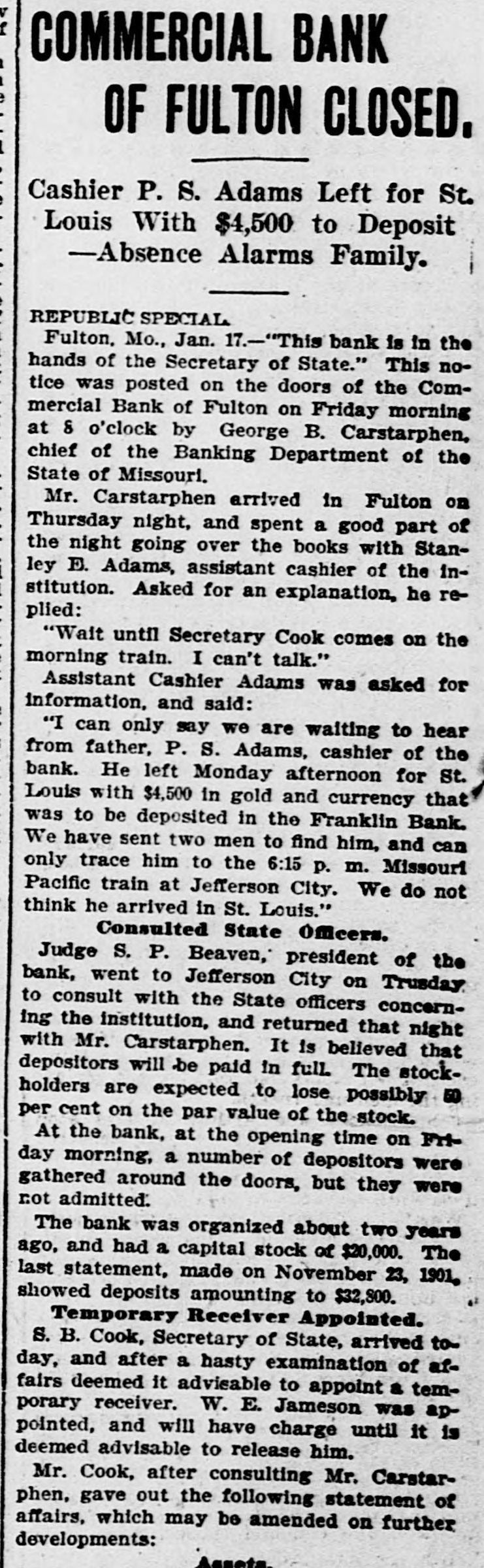
COMMERCIAL BANK OF FULTON CLOSED. Cashier P. S. Adams Left for St. Louis With $4,500 to Deposit -Absence Alarms Family. REPUBLIC SPECIAL Fulton, Mo., Jan. 17.-"This bank is in the hands of the Secretary of State." This notice was posted on the doors of the Commercial Bank of Fulton on Friday morning at 8 o'clock by George B. Carstarphen. chief of the Banking Department of the State of Missouri. Mr. Carstarphen arrived in Fulton on Thursday night, and spent a good part of the night going over the books with Stanley E. Adams, assistant cashier of the institution. Asked for an explanation, he replied: "Wait until Secretary Cook comes on the morning train. I can't talk." Assistant Cashier Adams was asked for information, and said: "I can only say we are waiting to hear from father, P. S. Adams, cashier of the bank. He left Monday afternoon for St. Louis with $4,500 in gold and currency that was to be deposited in the Franklin Bank. We have sent two men to find him, and can only trace him to the 6:15 p. m. Missouri Pacific train at Jefferson City. We do not think he arrived in St. Louis." Consulted State Officers. Judge S. P. Beaven, president of the bank, went to Jefferson City on the State officers and returned ing to consult the institution, with that concern- Trusday night with Mr. Carstarphen. It is believed that depositors will be paid in full. The stockholders are expected to lose possibly 50 per cent on the par value of the stock. At the bank, at the opening time on Frtday morning, a number of depositors were gathered around the doors, but they were not admitted. The bank was organized about two years ago, and had a capital stock of $20,000. The last statement, made on November 23, 1901. showed deposits amounting to $32,800. Temporary Receiver Appointed. S. B. Cook, Secretary of State, arrived ta day, and after a hasty examination of affairs deemed it advisable to appoint a temporary receiver. W. E. Jameson was appointed, and will have charge until it is deemed advisable to release him. Mr. Cook, after consulting Mr. Carstarphen, gave out the following statement of affairs, which may be amended on further developments: Assets


Article from The Saint Paul Globe, January 18, 1902

Click image to open full size in new tab

Article Text

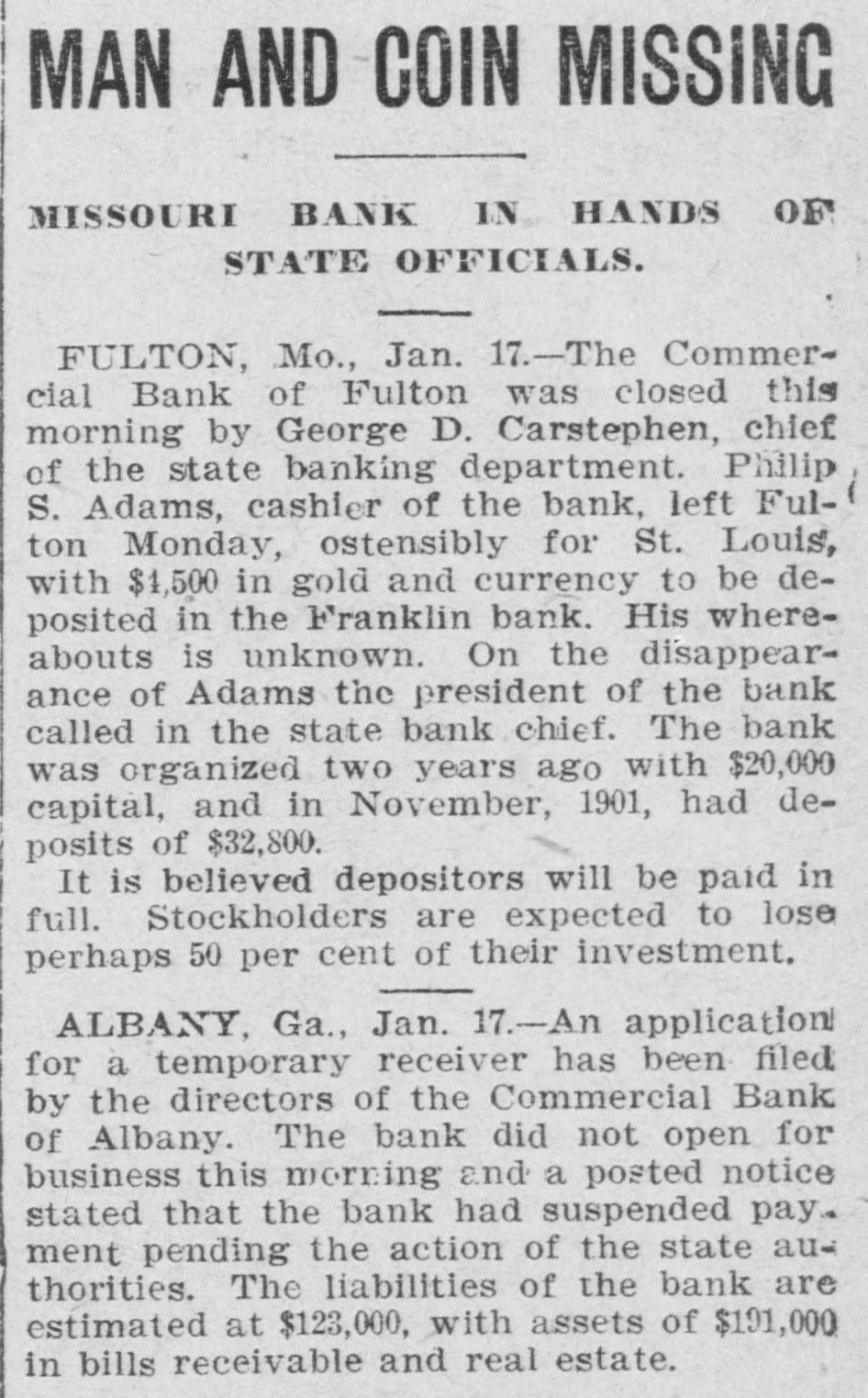
MAN AND / COIN MISSING MISSOURI BANK IN HANDS OF STATE OFFICIALS. FULTON, Mo., Jan. 17.-The Commercial Bank of Fulton was closed this morning by George D. Carstephen, chief of the state banking department. Philip S. Adams, cashier of the bank, left Fulton Monday, ostensibly for St. Louis, with $1,500 in gold and currency to be deposited in the Franklin bank. His whereabouts is unknown. On the disappearance of Adams the president of the bank called in the state bank chief. The bank was organized two years ago with $20,000 capital, and in November, 1901, had deposits of $32,800. It is believed depositors will be paid in full. Stockholders are expected to lose perhaps 50 per cent of their investment. ALBANY, Ga., Jan. 17.-An application for a temporary receiver has been filed by the directors of the Commercial Bank of Albany. The bank did not open for business this morning and a posted notice stated that the bank had suspended pay. ment pending the action of the state authorities. The liabilities of the bank are estimated at $123,000, with assets of $191,000 in bills receivable and real estate.


Article from The Evening Times, January 18, 1902

Click image to open full size in new tab

Article Text

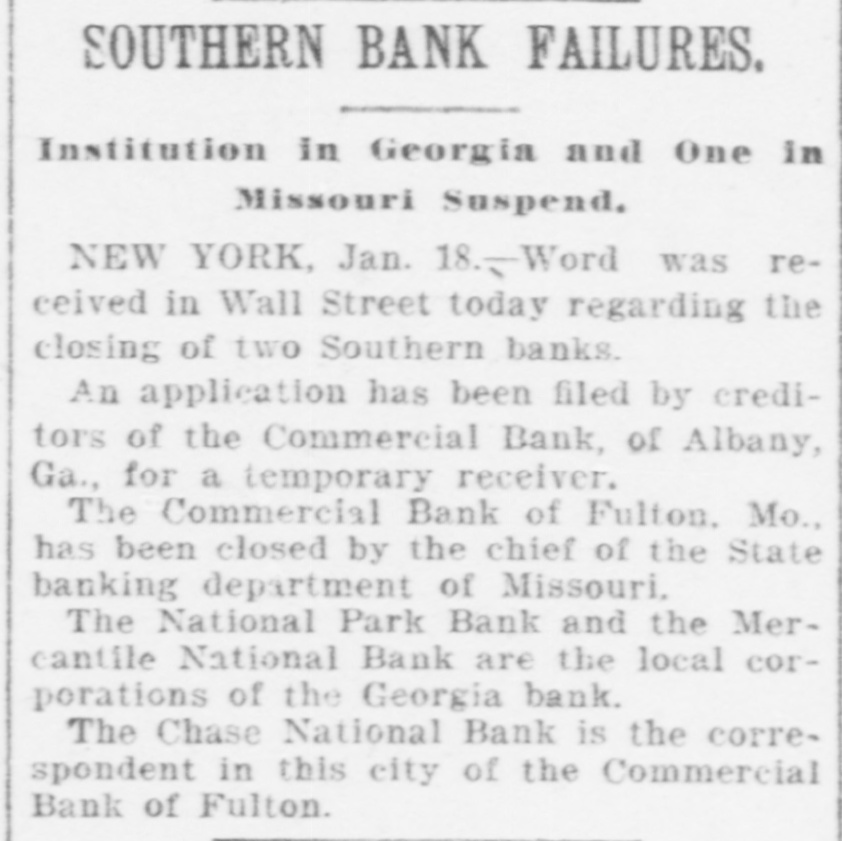
SOUTHERN BANK FAILURES. Institution in Georgia and One in Missouri Suspend. NEW YORK, Jan. 18.-Word was received in Wall Street today regarding the closing of two Southern banks. An application has been filed by creditors of the Commercial Bank, of Albany, Ga., for a temporary receiver. The Commercial Bank of Fulton. Mo., has been closed by the chief of the State banking department of Missouri. The National Park Bank and the Mercantile National Bank are the local corporations of the Georgia bank. The Chase National Bank is the correspondent in this city of the Commercial Bank of Fulton.


Article from The Chickasha Daily Express, January 20, 1902

Click image to open full size in new tab

Article Text

The Cashier Is Missing. Fulton, Mo., Jan. 19.-A receiver has been appointed for the Commercial bank here. This action followed the disappearance of P. S. Adams, the eashier, with $10,000 in cash.


Article from Mexico Weekly Ledger, January 23, 1902

Click image to open full size in new tab

Article Text

P S ADAMS MISSING. d AS HIER OF THE FULTON COMd B MERCIAL BANK HAS BEEN GONE SINCE MONDAY. BANK CLOSED BY DIRECTORS. Stockholders Will Probably Lose From 40 to 50 Per Cent of Par Value of Stock It is Claimed That Adams Met With Foul Play From the Fulton Sun. e The directors and depositors of the n Commercial Bank, of Fulton, were thrown in a flurry of excitement ; Thursday afternoon when it was ascertained that the bank was neither receiving nor paying out money. d After four o'elock the rumor became current that Mr. P. S. Adams, the cashier, had been missing since Monday and that he had taken with him $4. 500.00 in currency. It was soon learned definitely that had left for Mr. St. Adams Louis, taking Monday with him afternoon fortyfive hundred dollars in cash to be deposited in the Franklin Bank. That some checks had been presented late Monday afternoon and pay ment had been withheld. That E. N. Tuttle, a stockholder, had been in St. Louis all day Thursday looking for Mr. Adams and has found no trace nor tracks of him. That Mr. Adams had not reported to the Franklin Bank of St. Louis, nor had the $4,500 been deposited there to the credit of the Commercial Bank of Fulton. The family was very uneasy about Mr. Adams, fearing that he had been dealt with foully. P. the noon Commercial Judge S. Bank, Beaven, learning President at of Thursday that some trouble existed, made haste to Jefferson City to acquaint the State Department of the condition and ask for a bank examiner. Mr. George Carstarphen, at the head of the bank examining department, with Judge Beaven arrived at Fulton, by hack at 9:30 last night. The directors of the bank, Mr. Carstarphen and Mr. Stanley Adams to the bank to bank books amination proceeded of and make securities. an exMr. Carstarphen, after two hours work, at midnight said the books appeared to be in good condition and that the securities were all accounted for. Judge Beaven supported this statement and said further that the notes were good. In the hasty, yet careful examination last night forty-five thousand securities were of a dollars which were in pronounced good found & except Booth. all note of $2,300 against Wible This amount agrees with the books of the bank. The liabilities of the bank appear, on hasty examination, to be about fifty thousand dollars. Depositions, $30,000 and stockholders, $20,000. Of with Mr. Adams return bank will at once cash, with course, the the forty-tive hundred resume dollars but it is feared met with foul and Adams business: has play that Mr. that a receiver will, of necessity, be appointed to wind up the affairs of the bank. The Commercial Bank was organized on the 7th day of November, 1899, with a capital stock of $20,000. W. E. JAMESON RECEIVER B. Cook, Secretary of State, morning a arrived Si Friday affairs and after found examination of stock of the so that he adthe paired hasty capital deemed bank it imvisable to appoint a temporary recelver. Mr. W. E. Jameson was appointed and will have charge stock of until the capital the is deemed bank is made good or until it advisable to wind up the affairs of the bank. Mr. Cook, after consulting with Mr. Carstarphen, was able to give out the the following statement of affairs, which may be amended on further developments. ASSETS


Article from Eagle River Review, January 25, 1902

Click image to open full size in new tab

Article Text

CASHIER GONE BANK FAILS. I Commercial of Fulton, Mo., Forced to Suspend After Official's Departure. With its cashier missing and its financial affairs in a tangle the Commercial Bank of Fulton, Mo., was closed by George L. Carstarphen, chief of the State banking department. Philip S. Adams was cashier of the bank. He left on a recent afternoon, ostensibly for St. Louis, with $4,500 in gold and currency to be deposited in the Franklin bank. His whereabouts is unknown. On the disappearance of Adams the president of the bank called in the State bank chief. The bank was organized two years ago with $20,000 capital and in November, 1901, had deposits of $32,800.


Article from Vilas County News, January 27, 1902

Click image to open full size in new tab

Article Text

Domestic. New York is to have a new $2,500,000 postoffice building. From Ashland a party of 150 hunters left to hunt wolves. The estate of Playwright Charles H. Hoyt amounted to $125,380. At Janesville all fees for county officers have been abolished. President Roosevelt will start for the Charleton Expostion February 10. L. Roeder of Quincy, Ill., 102 years of age, fought in the battle of Waterloo. At Trenton, Iowa Felgar Prothers' store was destroyed by fire. Loss $5,000. Ex-Postmaster-General Smith left Washington for his home in Philadelphia. The Bellevue hotel, a summer resort on Powers lake, Wis., burned. Loss $6,000. Fire destroyed the elevator at Dallas, Wis. The loss is $5,000; partly insured. Four prisoners, including a murderer, escaped from jail at Birmingham, Ala. The employment of child labor in Illinois has increased 39 per cent. in the last year. Senator Hale severely criticised the bill to establish a department of commerce. Henry Schaub, who murdered his wife and child, will be hanged in New York Feb. 28. A Kansas City Southern Railroad passenger train was held up at Spiro, Indian territory. The man charged with the murder of Mabel Schofield is placed on trial at Des Moines. Five Indians were killed during the recent trouble at the Tongue river agency in Montana. At Council Bluffs, Ia., George F. Smith, father of Congressman Smith, was suffocated by gas. Mrs. Alexander Garwood of Decatur, Ind., died of grief when told of the murder of her son. An electric railroad to connect New York, Chicago, and St. Louis is planned by a syndicate. The Minneapolis board of health has ordered every member of the board of trade to be vaccinated. Miss Katherine Kaye, a relative of President Roosevelt, has begun a stage career in New York. At Appleton the county board recommended an appropriation of $7,000 for a soldiers' monument. Ore valued at $1,000,000 was stolen during the year from the Independence mine at Cripple Creek. At Chippewa Falls Steven Cartwright, aged 60 was arrested charged with stabbing John Harrington. Mrs. Elizabeth Howe Dale, formerly of Chicago, once accused of poisoning her little girl, sailed for Europe. Rev. G. F. B. Howard of Horton, Mich., was sentenced to imprisonment for using the mails to defraud. The government will probably enact laws providing for the control of wireless telegraphy in time of war. President and Mrs. Roosevelt gave a dinner in honor of the justices of the supreme court and their wives. At Albany, Wis., W. A. Covill, hardware dealer, has made an assignment. Liabilities, $9,000; assets, $4,000. Congressman Mann will attempt to have a law passed providing for a national dairy and food commission. At Houghton, Mich., Charles Johnson has made a complete confession of he murder of Mal Smette of Jan. 7. The cashier of the Commercial bank of Fulton, Mo., embezzled $4,500 which caused the bank's suspension. George Rea, a favorite guide of Pres-


Article from Wausau Pilot, January 28, 1902

Click image to open full size in new tab

Article Text

CASHIER GONE BANK FAILS. I Commercial of Fulton. Mo., Forced to Suspend After Official's Departure. With its cashier missing and its financial affairs in a tangle the Commercial Bank of Fulton, Mo., was closed by George L. Carstarphen, chief of the State banking department. Philip S. Adams was eashier o. the bank. He left on a recent afternoon, ostensibly for St. Louis, with $4,500 in gold and currency to be deposited in the Franklin bank. His whereabouts is unknown. On the disappearance of Adams the president of the bank called in the State bank chief. The bank was organized two years ago with $20,000 capital and in November, 1901, had deposits of $32,800.


Article from Mexico Weekly Ledger, February 6, 1902

Click image to open full size in new tab

Article Text

W. ED JAMESON, of Fulton, has been appointed permanent receiver of the Commercial Bank of that city. This is the bank with which P.S. Adams, who went to Old Mexico, carrying a large portion of the funds, was connected. Mr.Jameson is one of Fulton's most successful, conservative young business men, with known integrity, and his appointment will be most satisfactory to all who are interested in the economical and honestadjustment of the business of thatinstitution.


Article from Mexico Weekly Ledger, February 13, 1902

Click image to open full size in new tab

Article Text

e BANKER TURNS TEAMSTER. l e Son of Defaulting Fulton Cashier is Hauling Sand at So Much Per Day - Supports Family. S d From the Sedalla Sentinel. f Two weeks ago Phillip Adams, one o of the most widely known financiers in e Missouri and at one time a large propa erty owner in Kansas City, disappearS ed from his home town, Fulton, Mo., leaving the books of the Commercial e Bank, of which he was organizer and t cashier, in such a tangled condition that the doors of the institution had to be closed and a receiver appointed. S His sudden exodus left his family without a dollar of ready money to meet the necessary running expenses of a home and his youngest sons, Stanley and Paul, who held positions in the bank as assistant cashier and bookkeeper, were thrown out of employment. It was to these boys that the mother turned for aid in the time of trouble. That they have met her expectation cannot be denied. The older, Stanley, who served as a Second Lieutenant in Company F,Sixth Missouri Volunteers, during the Spanish-American war, was retained by Mr. Carstarphen, State Bank Examiner, as assistent to the receiver. His wages, however, were not sufficient to support the home, even though all the servants had been dismissed. It fell to the lot of Paul, the youngest boy, who had been the petted one of the family, to prove that the everyday grind of ordinary life presents facts as interesting and characters as self-sacrificing as those which have made history's pages in the past. To want work, and to get it in a small country town, is an entirely different proposition, as is shown by the large influx of country boys to the cities each year. Young Adams wanted work-paying work,* and although he had been brought up in a life of ease and luxury, he was not too proud to accept the first thing offered. This was driving a sand wagon at $2.50 per day. No sooner had the position been offered than the young man accepted. Being a bank clerk and driving a sand wagon, especially at this time of the year when the mercury has been so persistently hovering near the zero point, is perhaps a phase which many young men would have been reluctant to accept. Not so with young Adams. He was profuse in his thanks to his employers and immediately set about his work in a manner which excited the admiration and friendship of his fellow teamsters. The well-groomed coach team of Mr. Adams, no longer attended by a hostler, but by the young man himself, adjusted itself to the new conditions with seemingly as much interest as their master. The ease in which young Adams descended goes to show that his grit and adaptability to conditions bid fair to place him among the successful business men of the day.


Article from The St. Louis Republic, March 13, 1902

Click image to open full size in new tab

Article Text

FULTON BANK CASHIER SEEN? P. S. Adams of Commercial Bank of Fulton at Honolulu. REPUBLIC SPECIAL. Fulton, Mo., March 12.-W. E. Jameson, receiver for the Commercial Bank of Fulton, the institution that was closed on account of the defaulting of Cashier P. S. Adams. to-day paid depositors and creditors a 50-per-cent divident, amounting to $16.183.40. A letter from Thomas Yates. dated Honolulu, Hawaii, to his father at Williamsburg, states that he saw P. S. Adams as he landed at that place from the steamer. He says he did not speak to him. Inquiries for full particulars will be made.


Article from Omaha Daily Bee, March 13, 1902

Click image to open full size in new tab

Article Text

MISSING CASHIER IN HAWAII Man Who Absconds with Funds is Detected by Acquaintance in Honolulu. FULTON, Mo., March 12.-P. S. Adams, jr., cashier of the Commercial bank of Fulton, which failed two months after he absconded with part of the bank's funds, has been located in Honolulu, Hawaii. Benjamin Yates has received a letter from his son, Thomas Yates, today from Honolulu, stating that he saw Adams there as he landed from a steamer a few weeks ago. The receiver of the bank announced today that depositors would be paid 50 cents on the dollar immediately and that another payment will be forthcoming shortly.


Article from Vilas County News, March 17, 1902

Click image to open full size in new tab

Article Text

CASHIER IN HONOLULU. Missing Banker of Fulton, Mo., Located in Hawaiian Islands. Fulton, Mo., March 13.-P. S. Adams, cashier of the Commercial bank of Fulton, which failed two months ago after he disappeared, has been located in Honolulu, Hawaii. The receiver of the bank announced yesterday that the depositors would be paid 50 cents on the dollar immediately and another payment would be forthcoming shortly.


Article from The Farmington Times, March 20, 1902

Click image to open full size in new tab

Article Text

ABSCONDER LOCATED. Missing Cashier of the Commercial Bank of Fulton Seem in HonoJulu, Hawaii. Fulton, Mo., March 13.-P.S. Adams, Jr., cashier of the Commercial Bank of Fulton, which failed two months ago, after he absconded with part of the bank's funds. has been located in Honolulu, Hawaii. Benjamin Yates has received a letter from his son, Thomas Yates, yesterday, from Honolulu, stating that he saw Adams there as he landed from a steamer a few weeks ago. The receiver of the bank announced yesterday hat depositors would be paid 50 cents on the dollar immediately, and that another payment would be forthcoming shortly.


Article from Mexico Weekly Ledger, March 20, 1902

Click image to open full size in new tab

Article Text

Cashier Adams In Hawaii. FULTON, Mo., March 12.-P. S. Adams, Jr., cashier of the Commercial bank, of Fulton, which failed two months ago, has been located in Honolulu, Hawaii. Benjamin Yates received a letter from his son, Thomas Yates, to-day, from Honolulu, stating that he saw Adams there as he landed from a steamer a few weeks ago. Receiver of the bank announced to-day that depositors would be paid 50 cents on the dollar immediately, and that another payment would be forthcoming shortly.


Article from Iron County Register, March 20, 1902

Click image to open full size in new tab

Article Text

ABSCONDER LOCATED. Missing Cashier of the Commercial Bank of Fulton Seen in Honolulu, Hawaii. Fulton, Mo., March 13.-P. S. Adams, Jr., cashier of the Commercial Bank of Fulton, which failed two months ago, after he absconded with part of the bank's funds, has been located in Honolulu, Hawaii. Benjamin Yates has received a letter from his son, Thomas Yates, yesterday, from Honolulu, stating that he saw Adama there as he landed from a steamer a few weeks ago. The receiver of the bank announced yesterday that depositors would be paid 50 cents on the dollar immediately, and that another payment would be forthcoming shortly.


Article from The Butler Weekly Times, March 20, 1902

Click image to open full size in new tab

Article Text

Adams Has Fled to Hawaii. Fulton, Mo., March 13.-Benjamin Yates, of this place, has just received a letter from his son, Thomas, of Honolulu, Hawaii, in which the writer says he saw P.S. Adams, cashier of the Commercial Bank of Fulton, leaving a steamer at Honolulu recently. The bank's receiver has announced that depositors will be paid 50 cents on the dollar soon and that another payment will be made later.


Article from Mexico Weekly Ledger, May 21, 1903

Click image to open full size in new tab

Article Text

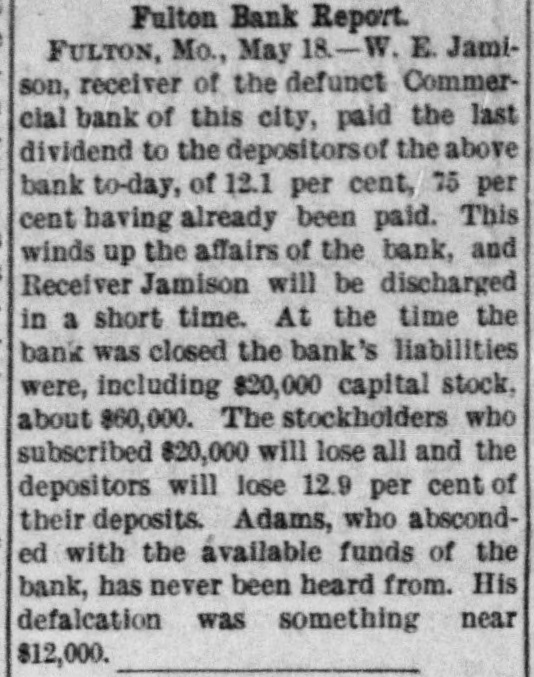
Fulton Bank Report. FULTON, Mo., May 18.-W. E. Jamison, receiver of the defunct Commercial bank of this city, paid the last dividend to the depositorsof the above bank to-day, of 12.1 per cent, 75 per cent having already been paid. This winds up the affairs of the bank, and Receiver Jamison will be discharged in a short time. At the time the bank was closed the bank's liabilities were, including $20,000 capital stock, about $60,000. The stockholders who subscribed $20,000 will lose all and the depositors will lose 12.9 per cent of their deposits. Adams, who absconded with the available funds of the bank, has never been heard from. His defalcation was something near $12,000.