Asbury Park National Bank (Asbury Park, NJ)

Episode Information

Episode UID
379201099
Episode Type
Suspension โ†’ Closure
Bank Type
national
Bank ID
37920 national
Charter Number
3792
Start Date
July 1, 1891
Location
Asbury Park, New Jersey (40.220, -74.012)

Metadata

Model
gpt-5-mini (chosen from majority vote of a three-model LLM ensemble)
Short Digest
3318a1228b8847a4

Response Measures

None

Receivership Details

Depositor recovery rate
100.0%
Date receivership started
1891-07-02
Date receivership terminated
1892-06-30
OCC cause of failure
Fraud
Share of assets assessed as good
21.4%
Share of assets assessed as doubtful
28.5%
Share of assets assessed as worthless
50.1%

Description

Depositors were later paid in full; stockholders lost value.

Events (4)

1. September 17, 1887 Chartered
Source
historical_nic
2. July 1, 1891 Suspension
Cause
Government Action
Cause Details
Closed by order of the Comptroller/Bank Examiner after examiner found bad loans, heavy building asset load and impairment of capital.
Newspaper Excerpt
The doors of the Asbury Park National Bank were closed this afternoon, under orders from the Controller of the Currency
Source
newspapers
3. July 2, 1891 Receivership
Source
historical_nic
4. July 2, 1891 Receivership
Newspaper Excerpt
the comptroller of the currency had decided to place the Asbury Park National Bank ... in the hands of a receiver to wind up its affairs.
Source
newspapers

Newspaper Articles (17)

Article from New-York Tribune, July 2, 1891

Click image to open full size in new tab

Article Text

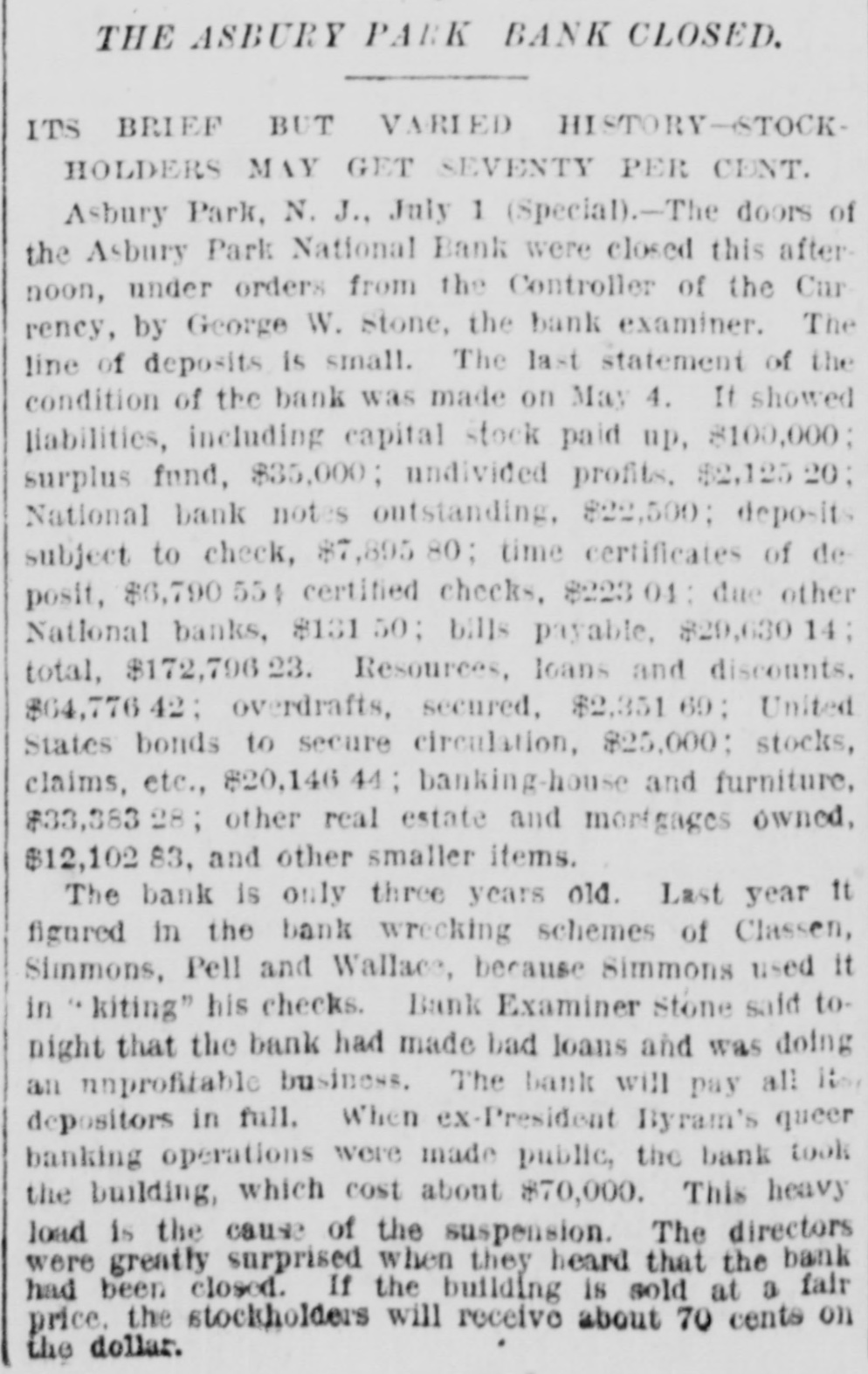
THE ASBURY PARK BANK CLOSED, ITS BRIEF BUT VARIED HISTORY-STOCKHOLDERS MAY GET SEVENTY PER CENT. Asbury Park, N. J., July 1 (Special).-The doors of the Asbury Park National Bank were closed this after noon, under orders from the Controller of the Cur rency, by George W. Stone, the bank examiner. The line of deposits is small. The last statement of the condition of the bank was made on May 4. It showed liabilities, including capital stock paid up, $100,000; surplus fund, $35,000; undivided profits. $2,125.20 National bank notes outstanding, $22,500; deposits subject to check, $7,895.80; time certificates of de posit, $6,790.55 certified checks, $223 01: due other National banks, $131.50; bills payable. $29,630 14: total, $172,796 23. Resources, loans and discounts. $04,776 42; overdrafts, secured, $2,351.69; United States bonds to secure circulation, $25,000; stocks, claims, etc., $20,146 44 ; banking-house and furniture, $33,383.28 other real estate and mortgages owned, $12,102 and other smaller items. The bank is only three years old. Last year It figured in the bank wrecking schemes of Classen, Simmons, Pell and Wallace, because Simmons used it in "kiting" his checks. Bank Examiner Stone said tonight that the bank had made bad loans and was doing an unprofitable business. The bank will pay all lis, depositors in full. When ex-President Byram's queer banking operations were made public, the bank took the building, which cost about $70,000. This heavy load is the cause of the suspension. The directors were greatly surprised when they heard that the bank had been closed. If the building is sold at a fair price. the stockholders will receive about 70 cents on the dollar.


Article from The Seattle Post-Intelligencer, July 2, 1891

Click image to open full size in new tab

Article Text

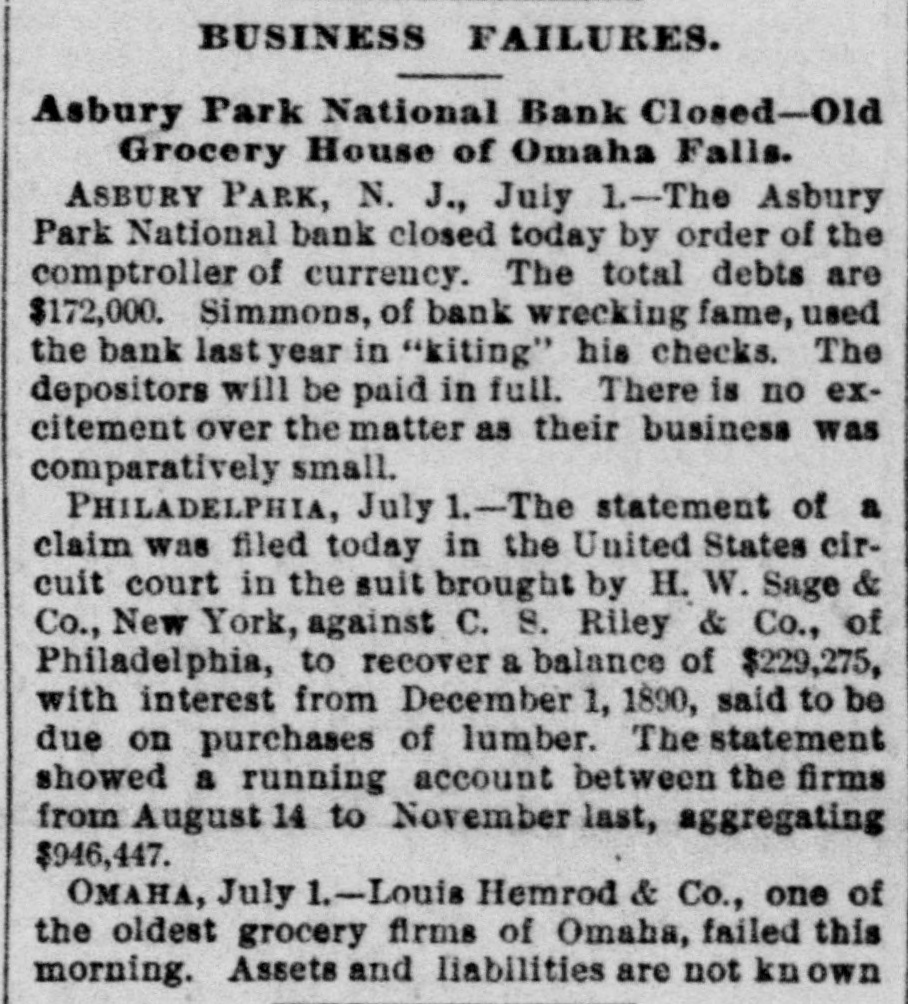
BUSINESS FAILURES. Asbury Park National Bank Closed-Old Grocery House of Omaha Falls. ASBURY PARK, N. J., July 1.-The Asbury Park National bank closed today by order of the comptroller of currency. The total debts are $172,000. Simmons, of bank wrecking fame, used the bank last year in "kiting" his checks. The depositors will be paid in full. There is no excitement over the matter as their business was comparatively small. PHILADELPHIA, July 1.-The statement of a claim was filed today in the United States circuit court in the suit brought by H. W. Sage & Co., New York, against C. S. Riley & Co., of Philadelphia, to recover a balance of $229,275, with interest from December 1, 1890, said to be due on purchases of lumber. The statement showed a running account between the firms from August 14 to November last, aggregating $946,447. OMAHA, July -Louis Hemrod & Co., one of the oldest grocery firms of Omaha, failed this morning. Assets and liabilities are not kn own


Article from Evening Star, July 2, 1891

Click image to open full size in new tab

Article Text

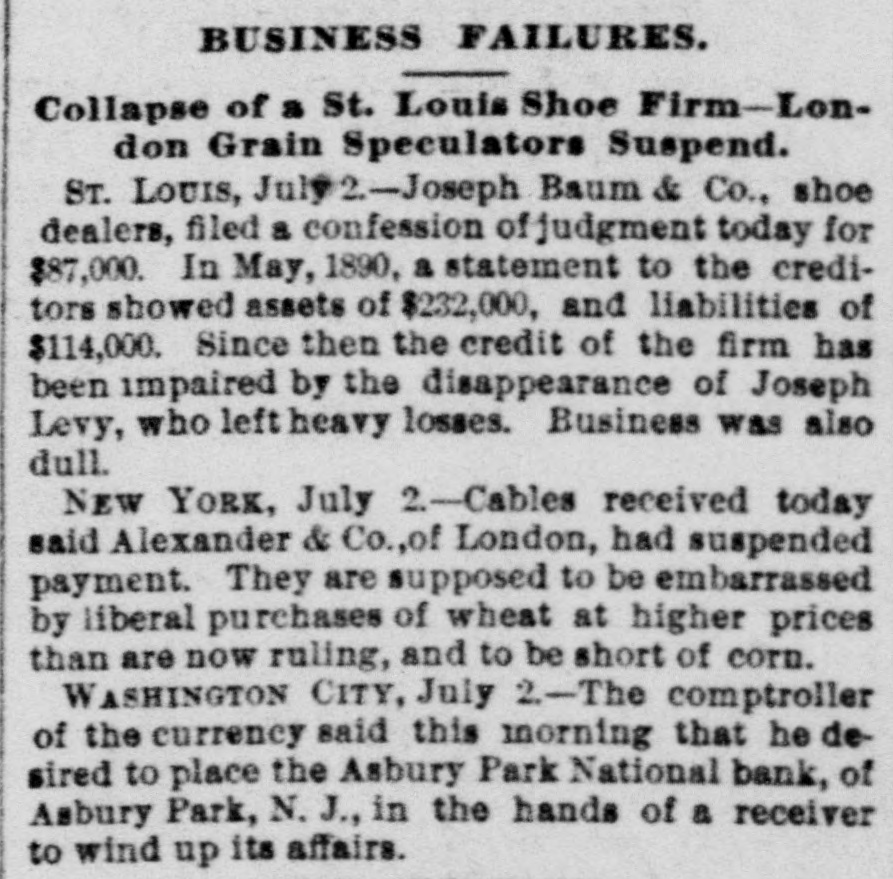
To WIND UP ITS AFFAIRS-The controller of the currency said this morning that he had decided to place the Asbury Park National Bank of Asbury Park, N.J., in the hands of a receiver to wind up its affairs. -


Article from The Wilmington Daily Republican, July 3, 1891

Click image to open full size in new tab

Article Text

To Wind Up Its Affairs. WASHINGTON, July 3. - The comptroller of the currency has decided to place the Asbury Park National bank, of Asbury Park, N. J., in the hands of a receiver to wind up its affairs.


Article from The Salt Lake Herald, July 3, 1891

Click image to open full size in new tab

Article Text

Ashbury Park National Bank Receiver. WASHINGTON, July 2.-The comptroller of the currency said this morning he had decided to place the Asbury Park National bank, Ashbury, N.J., in the hands of a receiver to wind up its affairs.


Article from New-York Tribune, July 3, 1891

Click image to open full size in new tab

Article Text

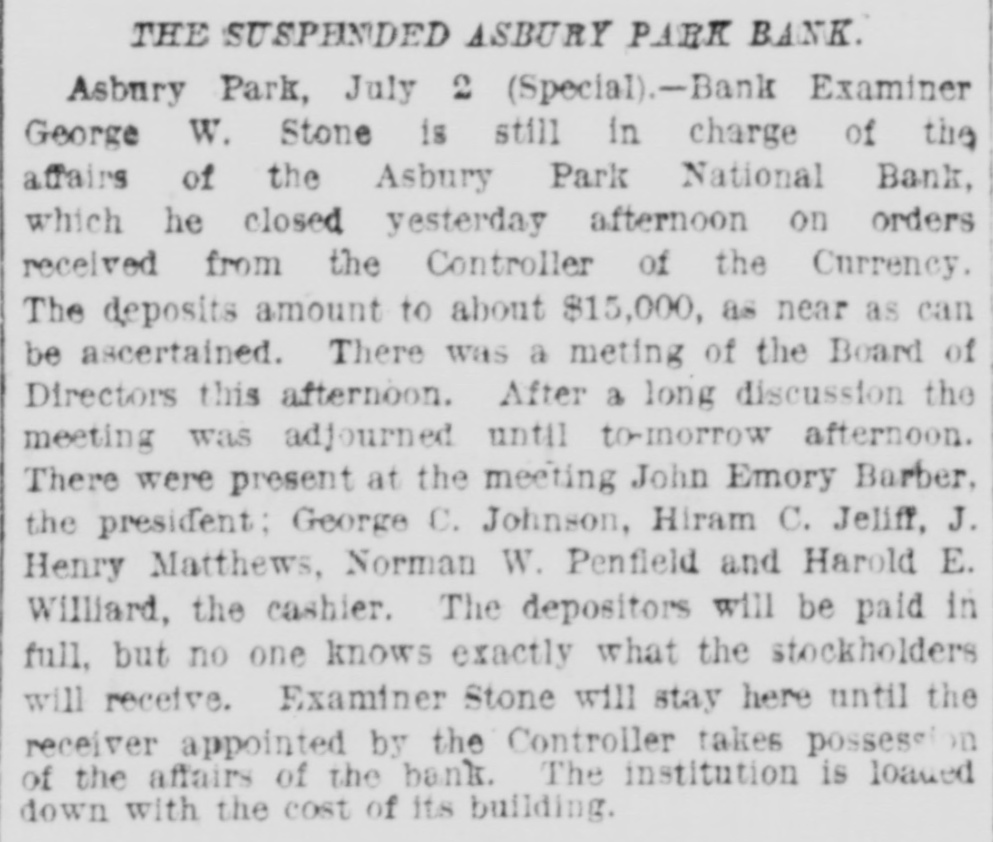
THE SUSPENDED ASBURY PARK BANK. Asbury Park, July 2 (Special).-Bank Examiner George W. Stone is still in charge of the affairs of the Asbury Park National Bank, which he closed yesterday afternoon on orders received from the Controller of the Currency. The deposits amount to about $15,000, as near as can be ascertained. There was a meting of the Board of Directors this afternoon. After a long discussion the meeting was adjourned until to-morrow afternoon. There were present at the meeting John Emory Barber, the president; George C. Johnson, Hiram C. Jeliff, J. Henry Matthews, Norman W. Penfield and Harold E. Williard, the cashier. The depositors will be paid in full, but no one knows exactly what the stockholders will receive. Examiner Stone will stay here until the receiver appointed by the Controller takes possession of the affairs of the bank. The institution is loaued down with the cost of its building.


Article from The Sun, July 3, 1891

Click image to open full size in new tab

Article Text

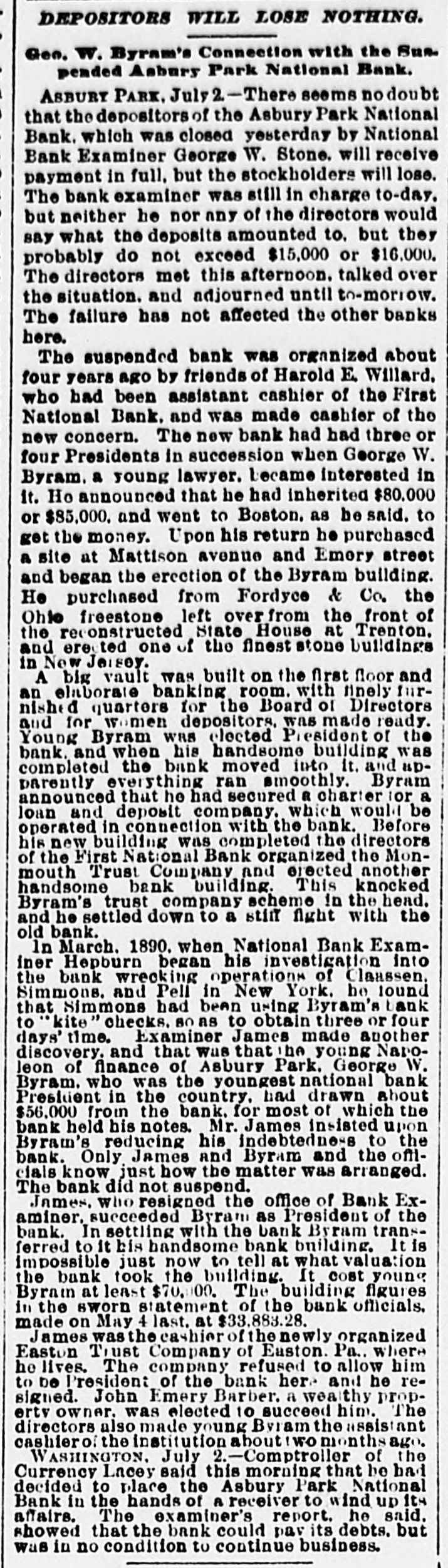
DEPOSITORS WILL LOSE NOTHING. Gen. W. Byram's Connection with the Sunpended Asbury Park National Bank. ASBURY PARK, July 2-There seems no doubt that the depositors of the Asbury Park National Bank. which was closed yesterday by National Bank Examiner George W. Stone. will receive payment in full. but the stockholders will lose. The bank examiner was still in charge to-day. but neither he nor any of the directors would say what the deposits amounted to, but they probably do not exceed $15,000 or $16,000. The directors met this afternoon. talked over the situation. and adjourned until to-morrow. The failure has not affected the other banks here. The suspended bank was organized about four years ago by friends of Harold E. Willard. who had been assistant cashier of the First National Bank. and was made cashier of the new concern. The new bank had had three or four Presidents in succession when George W. Byram. a young lawyer. became interested in it. Ho announced that he had inherited $80,000 or $85,000. and went to Boston. as be said. to get the money. Upon his return he purchased a site at Mattison avenue and Emery street and began the erection of the Byram building. He purchased from Fordyce & Co. the Ohio freestone left over from the front of the reconstructed State House at Trenton. and ere one of the finest stone buildings in New Jersey. A big vault was built on the first floor and an elaborate banking room. with finely furnished quarters for the Board of Directors and for women depositors, was made ready. Young Byram WRS elected President of the bank. and when his handsome building was completed the bank moved into it. and apparently everything ran smoothly. Byram announced that he had secured a charter or a loan and deposit company. which would be operated in connection with the bank. Before his new building was completed the directors of the First National Bank organized the Monmouth Trust Company and erected another handsome bank building. This knocked Byram's trust company scheme in the head. and he settled down to a stiff fight with the old bank. ln March. 1890. when National Bank Examiner Hepburn began his investigation into the bank wrecking operations of Classen. Simmons. and Pell in New York. he tound that Simmons had been using Byram's bank to "kite" checks. 80 as to obtain three or four days' time. Examiner James made another discovery. and that was that he young Naroleon of finance of Asbury Park. George W. Byram. who was the youngest national bank President in the country. had drawn about $56,000 from the bank. for most of which the bank held his notes. Mr. James insisted upon Byram's reducing his indebtedness to the bank. Only James and Byram and the officials know just how the matter was arranged. The bank did not suspend. James. who resigned the office of Bank Examiner. succeeded Byram as President of the bank. In settling with the bank Byram transferred to it his handsome bank building. It is impossible just now to tell at what valuation the bank took the building. It cost young Byram at least $70,000. The building figures in the sworn statement of the bank officials. made on May 4 last. at $33,883.28. James was the cashier of the newly organized Easton Trust Company of Easton. Pa.. where he lives. The company refused to allow him to be President of the bank here and he resigned. John Emery Barber. a wealthy propertv owner. was elected 10 succeed him. The directors also made young Byram the assistant cashier of the institution about ! WO months ago. WASHINGTON. July 2.-Comptroller of the Currency Lacey said this morning that be had decided to place the Asbury Park National Bank in the hands of A receiver to wind up its affairs. The examiner's report. he said. showed that the bank could pay its debts. but was in no condition to continue business.


Article from New-York Tribune, July 4, 1891

Click image to open full size in new tab

Article Text

A RECEIVER FOR THE ASBURY PARK BANK. Asbury Park, N. J., July 3 (Special).-The Board of Directors of the Asbury Park National Bank met this afternoon to select some person to recommend for the receivership of the institution. Before the board took any salian Bank Examiner Stone told them that he had Aved a dispatch from the Controller, stating that it had appointed A. D. Lynch as receiver. Mr. Lynch is not known here.


Article from Pittsburg Dispatch, July 5, 1891

Click image to open full size in new tab

Article Text

IT IS satisfactory to observe that the Asbury Park National Bank was closed on July 1, and on July 2 the announcement was made that the Comptroller of the Currency had decided to put it in the hands of a receiver. It is pleasant to have evidence the Comptroller has learned wisdom by experience.


Article from Wheeling Register, July 6, 1891

Click image to open full size in new tab

Article Text

THE Asbury Park National Bank closed its doors July 1, and the next day the Comptroller of the Currency promptly announced his intention to appoint a receiver. There was no highup government official to shield in this case.


Article from Delaware Gazette and State Journal, July 9, 1891

Click image to open full size in new tab

Article Text

# IN GENERAL. John Warfield, sheriff and collector of Desha county, Arkansas, is missing. He is short in his accounts about $25,000. Clarence Busbee, assistant treasurer of the Buena Vista Saddle and Harness Company, in Lexington, Virginia, has disappeared. His accounts are short. At Brierfield, Ala., yesterday week, Dr. G.B. Croweshotand fatally wounded B. F. Glass, a prominent citizen. The trouble grew out of a remark made by Glass. The Right Rev. Ethelbert Talbot, missionary Bishop of Western Idaho and Wyoming, was last week elected Bishop of Georgia by the Protestant Episcopal Diocesan Convention. The Asbury Park National Bank, at Asbury Park, New Jersey, was closed yesterday week by order of the comptroller of the currency. Impairment of its capital is assigned as the cause. The coroner's jury, in New York, in the case of Theodore Larbig, found last night week that death was caused by a pistol shot, fired by Darwin Meserole and that Mrs. Comstock was an accessory to the killing. The strike of the 350 cloakmakers of Landesman, Heischeimer & Co., at Loudon, Ohio, was settled Tuesday week by A. W. Wright of the general executive board of the Knights of Labor, who went from Columbus for the purpose. New York card sharpers Tuesday week drove from Saratoga to Ballston and buncoed Eli Rathrick, farmer, out of $3,000. Later they dined at White Sulphur Springs and then, driving to Wayville, caught a Fitchburg train and escaped. The President last week approved the rules and regulations prepared by the Civil Service Commission, which, from October 1st next, will govern in the appointment of Indian agency physicians, superintendents, assistant superintendents, teachers and matrons of Indian schools. William Mizener, a wealthy farmer of West Salem township, near Greenville, Pa., was buncoed out of $3,000 last week by two confidence men, who succeeded in getting him to play three-card monte. Mizener did not have much cash at home, and the party induced him to come to the bank and get the money. It is understood that President Harrison will appoint William E. Simonds of Hartford, Connecticut, to be commissioner of patents, vice Charles E. Mitchell, resigned. Mr. Simonds is a member of the firm of Simonds & Burdette of Hartford and represented the First district of Connecticut in the last Congress. Governor Pattison has appointed Miss Mary S. Garrett of Chester to be a member of the commission to select a site and erect a suitable home for the training in speech of deaf children under the school age, vice John F. Lewis. The commission organized yesterday week by electing Gov. Pattison president and Mr. Megargee secretary. The commissioner of pensions has received reports from pension agents giving the unexpended balance of pension funds in their hands at the close of business June 30th. All have not yet reported, but the indications are that the balance in the hands of agents will be about $5,000,000. Under the law the balance unexpended is turned into the treasury. The Pike's Peak railway in Colorado is now in operation, the first passenger train having gone to the summit on Tuesday week. The lower terminus of the line is 6,400 feet above the sea level, the upper 14,147. The distance is nine miles and the steepest grade 1 in 40. The style of the road and arrangement of the engine and cars resemble those on the Mount Washington railway in New Hampshire. Dr. I. I. Kinyoun of the Marine Hospital, arrived at New York last week. The doctor was sent to Berlin last December under special commission of President Harrison with instructions to study the operations of the Koch lymph. After investigating this matter thoroughly Dr. Kinyoun visited Paris and studied with Pasteur. The doctor will proceed to Washington and take charge of the Bacteriological Laboratory in the Marine Hospital. Daniel Burch, colored, aged 35 years, attempted to feloniously assault a young woman, whose room he entered near Bluffton, Georgia, on Sunday week. Being captured, he confessed his guilt. A mob of 200 men took him from the sheriff, and after horribly mutilating him with a pocket knife, strung him to a tree and riddled him with bullets. Brush had served a five years' term in the penitentiary for an offence similar to that which cost him his life. It is learned that the western sales agents of the anthracite coal companies, at their meeting in New York last week, decided that the July output be limited to 3,000,000 tons, and that the July circular be as follows: For free burning coal, free on board, net-Broken, $3.50; egg, $3.75; stove, $4; chestnut, $3.75, and no coal to be sold for less. July's schedule for the east provides for an increase of 10 cents a ton on egg and chestnut coal and 15 cents on stove grades, grate being unchanged. Secretary Rusk said last week that the results of the pork inspections at Chicago have been very satisfactory. The proportion of animals found effected is less than was expected, and he believes less than exists in the hogs of any other country. Our pork, he continued, is the most wholesome of any produced, in the world, because our hogs are raised under the best sanitary conditions. They are not confined to small pens and filthy quarters, as in other countries, but they have the run of large fields and are fed upon clover and corn.
Article from The Evening World, July 11, 1891

Click image to open full size in new tab

Article Text

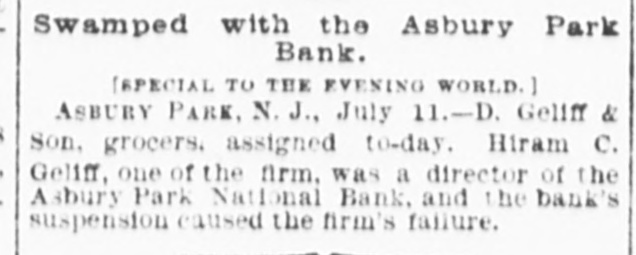
Swamped with the Asbury Park Bank. [SPECIAL TO THE EVENING WORLD.] ASBURY PARK, N.J., July 11.-D. Geliff & Son. grocers. assigned to-day. Hiram C. Geliff, one of the firm, was a director of the Asbury Park National Bank, and the bank's suspension caused the firm's failure.


Article from New-York Tribune, July 13, 1892

Click image to open full size in new tab

Article Text

DEPOSITORS TO GET THEIR MONEY. Asbury Park, N. J., July 12 (Special).-Augustus D. Lynch, of Washington, the receiver of the suspended Asbury Park National Bank, sent out noticos to the depositors to-day, asking them to call at his office and receive the amounts due them. The claims of the de. positors, about $60,000, will be paid in fun.


Article from Waterbury Evening Democrat, July 13, 1892

Click image to open full size in new tab

Article Text

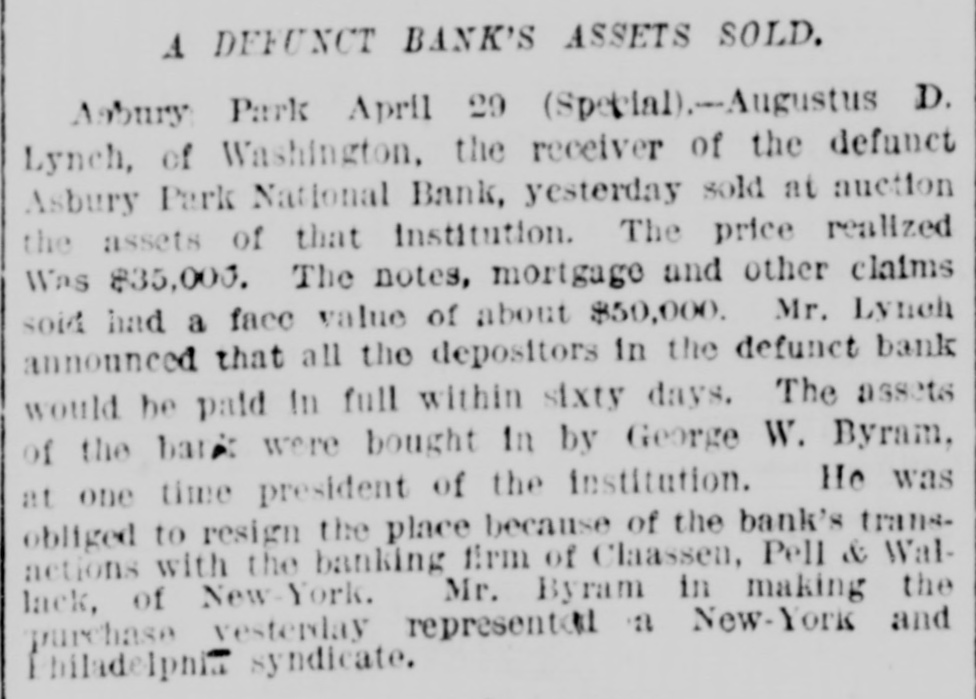
Claims Will be Paid in Full. ASBURY PARK, N. J., July 13.--A. D. Lynch, receiver of the defunct Asbury Park National Park, has notified the depositors that their claims would be paid in full. The claims aggregate $60,000. The stockholders will not receive anything. The capital of the bank was $50,000. The assets of the bank, such as notes, protested checks, etc., were recently purchased by a Philadelphia syndicate for $82,000.


Article from Evening Journal, July 13, 1892

Click image to open full size in new tab

Article Text

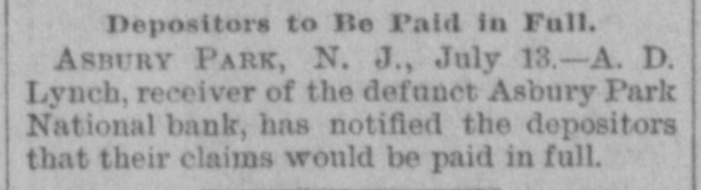
Depositors to Be Paid in Full. ASBURY PARK, N. J., July 13.-A. D. Lynch, receiver of the defunct Asbury Park National bank, has notified the depositors that their claims would be paid in full.


Article from The Evening Herald, July 13, 1892

Click image to open full size in new tab

Article Text

Claims Will be Paid in Full. ASBURY PARK, N. J., July 13.-A. D. Lynch, receiver of the defunct Asbury Park National Park, has notified the depositors that their claims would be paid in full. The claims aggregate $60,000. The stockholders will not receive anything. The capital of the bank was $50,000. The assets of the bank, such as notes, protested checks, etc., were recently purchased by a Philadelphia syndicate for $82,000.


Article from The Star and Newark Advertiser, February 13, 1909

Click image to open full size in new tab

Article Text

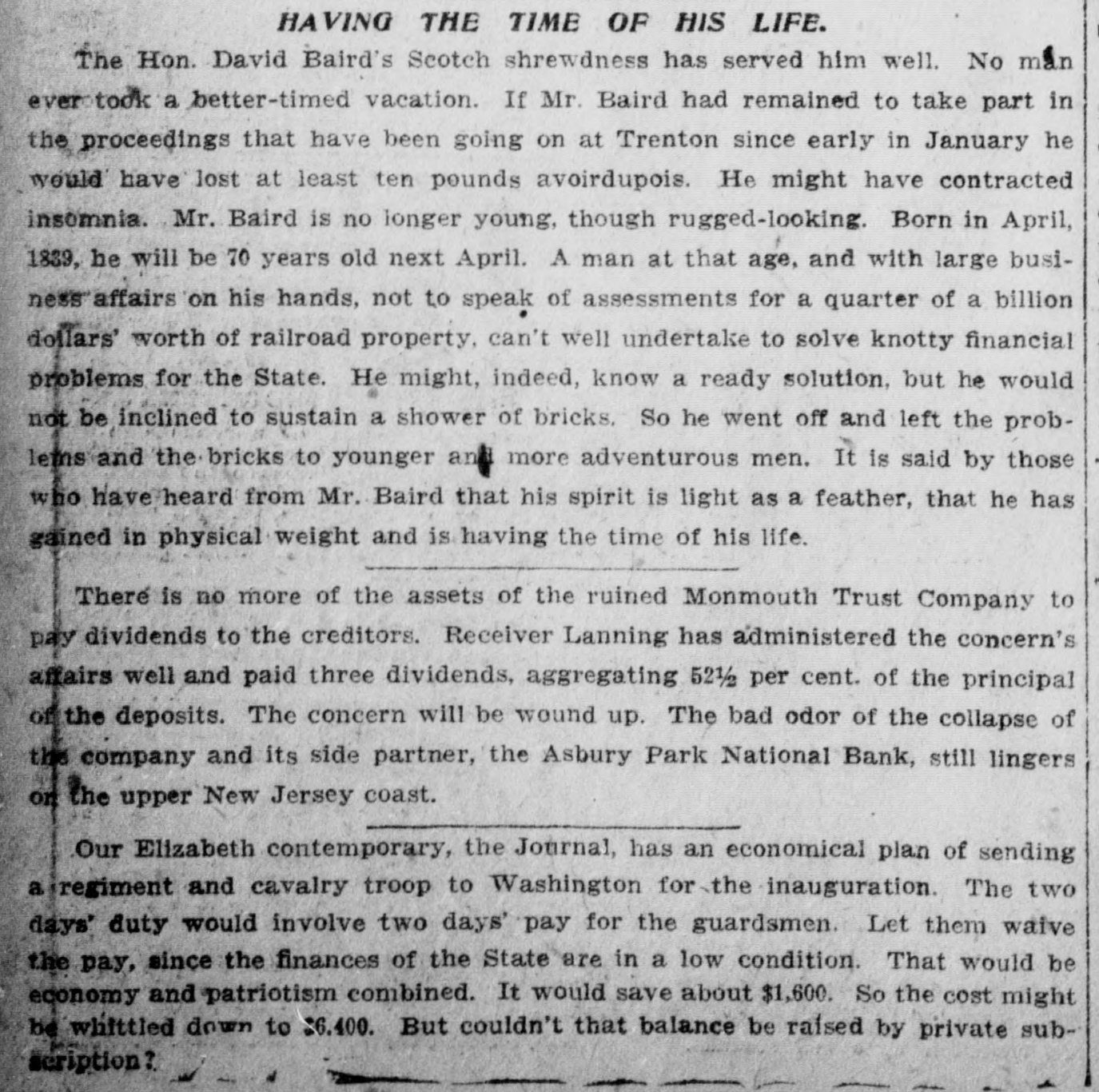
HAVING THE TIME OF HIS LIFE. The Hon. David Baird's Scotch shrewdness has served him well. No man ever took a better-timed vacation. If Mr. Baird had remained to take part in the proceedings that have been going on at Trenton since early in January he would have lost at least ten pounds avoirdupois. He might have contracted insomnia. Mr. Baird is no longer young, though rugged-looking. Born in April, 1839, he will be 70 years old next April. A man at that age, and with large business affairs on his hands, not to speak of assessments for a quarter of a billion dollars' worth of railroad property, can't well undertake to solve knotty financial problems for the State. He might, indeed, know a ready solution, but he would not be inclined to sustain a shower of bricks. So he went off and left the probleins and the bricks to younger and more adventurous men. It is said by those who have heard from Mr. Baird that his spirit is light as a feather, that he has gained in physical weight and is having the time of his life. There is no more of the assets of the ruined Monmouth Trust Company to pay dividends to the creditors. Receiver Lanning has administered the concern's affairs well and paid three dividends, aggregating 521/2 per cent. of the principal of the deposits. The concern will be wound up. The bad odor of the collapse of the company and its side partner, the Asbury Park National Bank, still lingers on the upper New Jersey coast. Our Elizabeth contemporary, the Journal, has an economical plan of sending a regiment and cavalry troop to Washington for the inauguration. The two days' duty would involve two days' pay for the guardsmen. Let them waive the pay, since the finances of the State are in a low condition. That would be economy and patriotism combined. It would save about $1,600. So the cost might be whittled down to 36.400. But couldn't that balance be raised by private subscription?