Bank of Americus (Americus, GA)

Episode Information

Episode UID
3806663991117
Episode Type
Suspension โ†’ Closure
Bank Type
trust
Bank ID
380666399 hash
Start Date
January 21, 1893
Location
Americus, Georgia (32.072, -84.233)

Metadata

Model
gpt-5-mini (chosen from majority vote of a three-model LLM ensemble)
Short Digest
40650495a643a72c

Response Measures

None

Description

Initial suspension linked to heavy railroad-related losses; later statements cite correspondent misunderstanding but bank ultimately liquidated.

Events (4)

1. January 21, 1893 Receivership
Newspaper Excerpt
A few creditors yesterday afternoon applied to Judge Fish for a temporary receiver. He appointed W. A. Dodson ... The hearing for a permanent receiver is set for Feb. 4.
Source
newspapers
2. January 21, 1893 Suspension
Cause
Bank Specific Adverse Info
Cause Details
Embarrassment attributed to large indebtedness to the Savannah, Americus and Montgomery ('Sam') railroad and close financial ties to its construction and bonds.
Newspaper Excerpt
The Bank of Americus ... suspended payment yesterday.
Source
newspapers
3. April 28, 1893 Suspension
Cause
Correspondent
Cause Details
Officers attributed this suspension to a misunderstanding with their New York correspondents causing inability to meet demand payments.
Newspaper Excerpt
The Bank of Americus has again suspended payments. The officers claim ... owing to a misunderstanding with their New York correspondents
Source
newspapers
4. May 13, 1893 Suspension
Cause
Bank Specific Adverse Info
Cause Details
Stockholders voted to permanently suspend and liquidate due to insolvency stemming from prior railroad-related losses and ongoing financial problems.
Newspaper Excerpt
At a meeting of the stockholders of the bank of Americus to-day it was decided to permanently suspend business and liquidate the affairs of the bank.
Source
newspapers

Newspaper Articles (20)

Article from The Morning News, January 22, 1893

Click image to open full size in new tab

Article Text

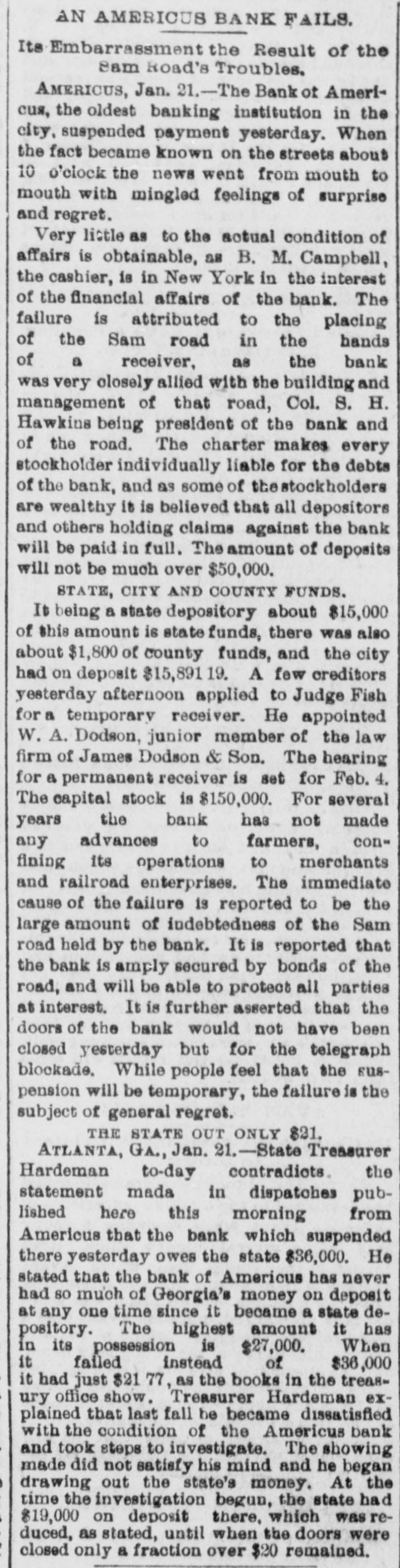
AN AMERICUS BANK FAILS. Its Embarrassment the Result of the 8am Road's Troubles. AMERICUS, Jan. 21.-The Bank of Americus, the oldest banking institution in the city, suspended payment yesterday. When the fact became known on the streets about 10 o'clock the news went from mouth to mouth with mingled feelings of surprise and regret. Very little as to the actual condition of affairs is obtainable, as B. M. Campbell, the cashier, is in New York in the interest of the financial affairs of the bank. The failure is attributed to the placing of the Sam road in the hands of a receiver, as the bank was very closely allied with the building and management of that road, Col. S. H. Hawkins being president of the bank and of the road. The charter makes every stockholder individually liable for the debts of the bank, and as some of bestockholders are wealthy it is believed that all depositors and others holding claims against the bank will be paid in full. The amount of deposits will not be much over $50,000. STATE, CITY AND COUNTY FUNDS. It being a state depository about $15,000 of this amount is state funds, there was also about $1,800 of county funds, and the city had on deposit $15,891 19. A few creditors yesterday afternoon applied to Judge Fish for a temporary receiver. He appointed W. A. Dodson, junior member of the law firm of James Dodson & Son. The hearing for a permanent receiver is set for Feb. 4. The capital stock is $150,000. For several years the bank has not made any advances to farmers, confining its operations to merchants and railroad enterprises. The immediate cause of the failure is reported to be the large amount of indebtedness of the Sam road held by the bank. It is reported that the bank is amply secured by bonds of the road, and will be able to protect all parties at interest. It is further asserted that the doors of the bank would not have been closed yesterday but for the telegraph blockade. While people feel that the suspension will be temporary, the failure is the subject of general regret. THE STATE OUT ONLY $21. ATLANTA, GA., Jan. 21.-State Treasurer Hardeman to-day contradiots the statement mada in dispatches published here this morning from Americus that the bank which suspended there yesterday owes the state $36,000. He stated that the bank of Americus has never had so much of Georgia's money on deposit at any one time since it became a state depository. The highest amount it has in its possession is $27,000. When it failed of instead $36,000 it had just $21 77, as the books in the treasury office show. Treasurer Hardeman explained that last fall be became dissatisfied with the condition of the Americus bank and took steps to investigate. The showing made did not satisfy his mind and he began drawing out the state's money. At the had was retime $19,000 the on investigation deposit there, begun, which the state duced, as stated, until when the doors were closed only a fraction over $20 remained.


Article from The Dawson News, February 15, 1893

Click image to open full size in new tab

Article Text

Date Surplus. From the Macon Evening News. AMERICUS, Ga., Feb. 6 -The application of certain creditors of the Savannah Americus and Montgomery railroad to have the road taken into Judge Speer's court is the last straw. It has broken Col. Hawkins down, and whether the application is successful or not makes but little difference. The history of the "Sam" road. as it is familiarly called, reads more like a 10mance than of a staid railroad. By the building of the road Col. Hawkins became, from an ordinary bank president, the great railroad king of Southwest Georgia, He virtually dictated the great business interests of this section and those who opposed him or his plans, or who did not "DOW the knee," were made to feel his displeasure. As long as the road ran from Lumpkin to even after the heavy exof from a narrow a pense Abbeville, changing it made to broad guage was incurred, money. But Col. Hawkins was ambiti. us. He tried to gain control of the Atlanta and Florida railroad, when that road got into trouble. Failing in this he decided to build on to Montgomery. Many of his most trusted friends and advisers protested against this move and it was only by using the strongest of arthat he succeeded in getting in Baltimore to a guments his backers give reluetant consent. The road was built. It cost very near twice as much as was expected and bank rupted the construction company, composed of the friends of Hawkins, who contracted to build it. It runs through a poor country after crossing the Chattahoochee and it has never paid. In building it Hawkins borrowed money right and left. For months every cent of its earnings went into leaving many bills for supplies unpaid. Then the financial crash came By tremendous exertions the road managed to meet the interest on its bonds, but'people were beto feel shaky were more in their payginning pressing demands and for the ment of their bills. The Bank of Americus, with a capital of $100,000 and a surplus of $150,000, was gutted. It diopped its commercial basiness entirely, and months before it failed many predicted the result. The Americus Investment Company, whose stock went to 300, was all wind, as shrewd financiers saw when it declared a dividend in stock of 100 per cent. Its stock is now selling for-well, almost nothing, as no one will handle as its assets are composed of stock in the Sam road and a few farms and buildlings. Since the bondholders have the road the stock is worthless. The bondholders are running the road, and Col. Hawkins, though a co-receiver, has nothing to say about its management, Mr. Gabbet having complete charge. Hawkins' own sons, who had lucrative and easy positions, are now out. Said Col. Hawkins to a friend not long ago: "If it were possible, I would sacrifice everything I have to get away :from Americus. My best friends have deserted and are traducing me." The change in sentiment of the town from a few years ago is wonderful. A few years ago he had elected a council known as the "Sam" council. When it retired the city was nearly bankrupt. Today he could not influence ten votes. SO his enemies say. Hundreds of people are badly caught by loans made or money advanced. There is hardly a firm or company in this section that is not involved, and as a consequence times are Sharder] here now thau they have ever been known. Several concerns known to have been closely connected with Hawkins, are very shaky, and many prophecy that the end of the failures are not yet. It is not yet known if the stockholders of the Bank of Americus will be assessed, but if they are, there will be wailing and lamentation in the land, and curses loud and deep. Already the individual expressions of one old and well known stockholder, who would skin a flea for its hide, are picturesque and enlivening when dilating on the bank affairs. Others are threatened with absolute poverty, who before were in compara-


Article from The Morning News, February 22, 1893

Click image to open full size in new tab

Article Text

of by Clerk Badly Drunken Drummer-A Former Slave Finds His Mother After a Separation of Many Years. GEORGIA. The Georgia Baptist convention will convene Dawson on April 4 several hundred strong. Howard White of Macon leaves to-day for Prescott, Ariz, where he will go into business. An inaugural ball will be given at Amoskeag hall, at Amoskeag, on Thursday evening, March 2. The Southern Medical Society of Atlanta" will give its annual banquet on the evening of March 1,at the Kimball. Douglas superior court was postponed until the third Monday in May on account of the ill. ness of Judge Janes. B. M. Waltom and James Barnes have bought the stock of goods in the James block at Douglasville and have opened a store. W. R. White of Macon leaves to-day for Atlanta, where he will engage in the brick manufacturing business with Jim Collins. James Ostrand, of the Southern Exchange Bank and Trust Company of Atlanta, has been prospecting among Rockmart's business men with a view to starting a bank J.T. Clonts, who has been in business at Douglasville for several years, is closing out his business preparatory to inoving away. He will locate at Embry, Paulding county. At Monticello Tu eddy while out with a party of young people, practicing pistol shooting, Miss Ina Kelly was accidentally shot by her cousin, Miss Brown of Kentucky, who is visiting her. The wound was a slight one and not so serious. She was unconscious for awhile, but soon regained consciousness. The Bank of Americus, which suspended business about a month since, will, it is said, BOOD be organized upon a solid basis. George W. Glover, one of Americus' most prominent and successful business men, has been tender d the presidency of the bank and that he will probably accept. Cashier M. B Campbell and Assistant Cashier Cooper will doubtless again assume the duties of their former positions. Quartermaster General Andrew J. West of Atlanta who went to Washin ton to arrange accommodations for the governor's staff during the inauguration, secured quarters at the Hotel Oxford, one of the neatest and most convenient in Washington The proprietor, an old friend of Capt. West, agreed to let him and Gov. Norther have his own pair of horses. the fine st grays in town. Splendid horses from a livery stable were engaged for all the staff. At Thomasville Monday Harry Williams inserted his hand into a wood box sitting by the fireplace in his room to get a splinter. Much to the astonishment and fright of the little fellow when he withdrew his hand he held in his grasp, not the desired piece of kindling, but a live rat snake about two feet long. To say that Harry was scared is putting it very mildly. He hasn t recovered from his fright yet, and now when splinters are wanted some one else has to get them. Eugene Everett of Macon was attended by two physicians on Saturday night. Mr. Everett is the clerk at the Brown house. While standing in the corridors, a drummer. somewhat under the influence of liquor. playfully struck at him, thinking that Mr. Everett would dodge the blow. This he failed to do and received it on the crown of his head. The force of the blow almost deprived him of consciousness. and he was taken suddenly sick. Two physicians were summoned and he is able to be out again. Macon Evening News: A rather romantic and interesting episode was evolved recently by a communication received in Macon by Hope Holhill. The story dates back several months, in fact just subsequent to the trouble between Polhill and Dasher, and came in the shape of a letter to Mr. Polhill from a negro named John Hammond of Hamilton, III. Hammond's eye had caught accounts of the difficulty between Polhill and Dasher, and he had written Mr. Polhill to ascertain the whereabouts of young master, who was Capt. J. H. Polhill of Louisville, Ga. Hammond had run away at the opening of the civil war and gone west, and sinde then his family had lost all trace of him. His communication to Hope Polhill was instrumental in supplying him with information which led to his discovering the whereabouts of his aged mother, whom he had not seen or heard from in over thirty years, and supposed she was dead and gone. He came to Georgia a few weeks since, and the reunion was a happy one. He found his old mother living in Augusta, and he was restored to her after more than thirty years.


Article from The Morning News, April 29, 1893

Click image to open full size in new tab

Article Text

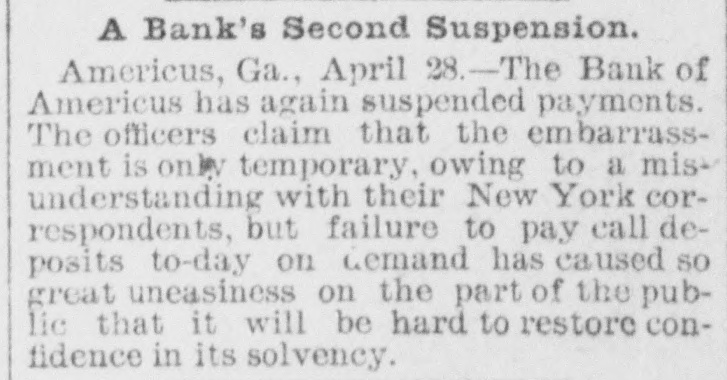
A Bank's Second Suspension. Americus, Ga., April 28.-The Bank of Americus has again suspended payments. The officers claim that the embarrassment is only temporary, owing to a mis+ understanding with their New York correspondents, but failure to pay call deposits to-day on demand has caused so great uneasiness on the part of the publie that it will be hard to restore confidence in its solvency.


Article from Passaic City Record, May 6, 1893

Click image to open full size in new tab

Article Text

South and West. "JIM" BURKE and "Sam" Massey, colored, were hanged in Bonham, Texas, in the presence of 10,000 people. WHEN the Liberty bell reached Indianapolis, Ind., on its way to Chicago, ex-President Harrison delivered an address on it before the school children of the city. AT Seattle, Washington, Nelsonton Sandborn, aged thirty, shot and killed Mrs. Mary Jensen, aged fifty, and then killed herself in the same manner. Mrs. Jensen was a rich widow; Sandborn was her gardner. THE country northwest of Alton, III., was visited by a severe hail storm. The average size of hailstones was as large as an egg. Many roofs were shattered. The Missouri, Kansas and Eastern road's new tracks were washed away, causing a loss of $100,000. LOOSE business methods and slow collections caused the failure of the private Bank of Salem, near Sioux Falls, South Dakota. The banking establishment of I. M. Strong & Son, at Bancroft, Mich., is in the hands of the Sheriff. The Bank of Americus, Ga., has again suspended payment. GEORGE W. MOREHOUSE, Police Magistrate of Great Falls, Montana, placed a revolver in his mouth and blew off the top of his head. He was three months behind in making his financial report to the council, and that body bad voted to call upon his bondsmen to make good his deficiency. TWENTY-TWO THOUSAND coal miners in Ohio went on strike; work was suspended in every important mine in the State. THE World's Fair, at Chicago, will probably not be in complete order before June 1; the work of finishing the buildings and installing the exhibits is going on rapidly; the New Jersey Building has been dedicated.


Article from Fisherman & Farmer, May 12, 1893

Click image to open full size in new tab

Article Text

South an West. "JIM" BURKE and "Sam" Massey, colored, were hanged in Bonham, Texas, in the presence of 10,000 people. WHEN the Liberty bell reached Indianapolis, Ind., on its way to Chicago, ex-Prestdent Harrison delivered an address on it before the school children of the city. AT Seattle, Washington, Nelsonton Sandborn, aged thirty, shot and killed Mrs. Mary Jensen, aged fifty, and then killed herself in the same manner. Mrs. Jensen was a rich widow; Sandborn was her gardner THE country northwest of Alton, III., was visited by a severe hail storm. The average size of hailstones was as large as an egg. Many roofs were shattered The Missouri, Kansas and Eastern road's new tracks were washed away, causing a loss of $100,000. LOOSE business methods and slow collections caused the failure of the private Bank of Salem. near Sioux Falls, South Dakota. The banking establishment of I. M. Strong & Son, at Bancroft, Mich., is in the hands of the Sheriff. The Bank of Americus, Ga., has again suspended payment. GEORGE W. MOREHOUSE, Police Magistrate of Great Falls, Montana, placed a revolver in his mouth and blew off the top of his head. He was three months behind in making his financial report to the council, and that body had voted to call upon his bondsmen to make good his deficiency. TWENTY-TWO THOUSAND coal miners in Ohio went on strike; work was suspended in every important mine in the State. THE World's Fair, at Chicago, will probably not be in complete order before June 1: the work of finishing the buildings and installing the exhibits is going on rapidly the New Jersey Building has been dedicated.


Article from The Morning News, May 14, 1893

Click image to open full size in new tab

Article Text

ALL ABOUT AMERICUS. Bank to Liquidate-A Lawyer Attacked by Vertigo. Americus, Ga., May 13.-At a meeting of the stockholders of the bank of Americus to-day it was decided to permanently suspend business and liquidate the affairs of the bank. T. Wheatley was selected to take charge pending the settlement. The assets will more than pay the depositors, but the stockholders are expected to lose a large percentage of their holdings. Between 4 and 5 o'clock this afternoon while the funeral services of Col. Hollis were in progress at the residence on Taylor street a sensation was created by Col. James Dodson, a leading attorney of this city, falling over into a fit of vertigo. The presence of physicians who promptly applied restoratives relieved him and he soon returned to consciousness, and tonight his condition is alot considered serious. t The friends of Capt. Myrick are beginning to lose confidence in his chances of securing a government place abroad.


Article from The Abbeville Press and Banner, May 17, 1893

Click image to open full size in new tab

Article Text

South and West. "JIM" BURKE and "Sam" Massey, colored, were hanged in Bonham, Texas, in the presence of 10,000 people. WHEN the Liberty bell reached Indianapolis, Ind.. on its way to Chicago, ex-President Harrison delivered an address on it before the school children of the city. AT Seattle, Washington, Nelsonton Sandborn, aged thirty, shot and killed Mrs. Mary Jensen, aged fifty, and then killed herself in the same manner. Mrs. Jensen was a rich widow Sandborn was her gardner. THE country northwest of Alton, Ill., was visited by a severe hail storm. The average size of hailstones was as large as an egg. Many roofs were shattered. The Missouri, Kansas and Eastern road's new tracks were weshed away, causing a loss of $100,000. LOOSE business methods and slow collections caused the failure of the private Bank of Salem, near Sioux Falls, South Dakota. The banking establishment of I. M. Strong & Son, at Bancroft, Mich., is in the hands of the Sheriff. The Bank of Americus, Ga., has again suspended payment. GEORGE W. MOREHOUSE, Police Magistrate of Great Falls, Montana, placed a revolver in his mouth and blew off the top of his head. He was three months behind in making his financial report to the council, and that body had voted to call upon his bondsmen to make good his deficiency. TWENTY-TWO THOUSAND coal miners in Ohio went on strike; work was suspended in every important mine in the State. THE World's Fair, at Chicago, will probably not be in complete order before June 1; the work of finishing the buildings and installing the exhibits is going on rapidly; the New Jersey Building has been dedicated.


Article from The Morning News, March 18, 1894

Click image to open full size in new tab

Article Text

AN ABUSED BANKING LAW. Ex-Stockholders of Twenty Years Ago Liable for a Recent Failure. Americus, Ga., March 17.-Judge Fish to-day granted a very important order that is far reaching in its results. He ordered the receiver of the Bank of Americus, T. W. Wheatley, to file with the clerk of the court a complete list of the stockholders for the twenty years prior to his appointment as receiver. The bank of Americus has a clause in its chater making each stockholder personally liable for all the debts of the bank. The object of this order is to furnish information to all holding claims against the bank when it suspended business, upon which to base action to recover. Besides many local business men nearly all the leading banks of the state, and at least a score of banks in New York and other nothern cities have been stockholders during the time covered by the order. CONTENTION OVER A FEE. There was quite a contention over the fee, claimed by Judge Fort for drawing the order to place the Americus Investment Company in the hands of a receiver. Fifteen hundred dollars. the fee claimed, was considered by interested parties as excessive. Judge Fish fixed the fee at $300.


Article from The Morning News, May 9, 1896

Click image to open full size in new tab

Article Text

IN GEORGIA AND FLORIDA. NEWS OF THE TWO STATES TOLD XI GEORGIA. The Woman's Parsonage and Home Mission Society is in session at the First Methodist church at Rome. Dr. and Mrs. Robert Fleming Taylor of Cassville celebrated the golden anniversary of their wedding Tuesday. The seventeenth great sun council fire of the great council of Georgia of the Improved Order of Red Men will be kindied in Atlanta next Tuesday. The peach crop in Houston will be very much smaller than it was last year. The curculio has done much damage. Young trees are holding more fruit than the old souo Charlie Milner, while handling a breechloading shotgun at Barnesville Thursday, received the load in his head, the gun being discharged accidentally. He died immediately. W. J. Boon of near Perry. has invented a scalper proof railroad ticket, which is said to be just the ticket needed by several prominent railroad officials. A patent has been applied for. Judge Richard Johnson, chief of the state pension department, has completed paying the pensions to soldiers. The appropriation has been exhausted. and more payments will be made this year. The grand encampment and grand lodge of the Independent Order of Odd Fellows of the state of Georgia will be held an Atlanta-the former on the fourth Tuesday, the 26th, and the latter on the 10urth Wednesday, the 27th. J. M. High, a dry goods merchant of Atlanta, is ill at Paris, France, and has been compelled to retire from business. will remain abroad indefinitely, and business will be succeeded to by Frank W. Holt and John E. McLelland. The Whitehall trousers factory at Athens continues to increase the capacity of its plant, so large have become the orders for its products. They are now sperating sixty machines and are adverusing for twenty-five extra girl operators. J. W. Allen dropped dead at Griffin Monanday afternoon at 3 o'clock, while sitting an a chair in Farley's pool room talking to some friends. He was apparently the best of health, and at the moment and his taking off was conversing with business JO matter e uo Bridges D THE Capt. J. F. Stone, the efficient traveling representative of the Savannah Morning News, has struck a rich and inexhaustible mine of kaolin on his farm in Decatur county, and he is making arrangements to sell it in large quantities to a New York firm for $11 a ton delivered on the cars at his farm. Berner Edwards had a narrow escape from accidental death at Juliette a few days ago. He was driving a team of mules across the Southern railroad track and the wagon was hit by the train and torn to pieces. Mr. Edwards and a negro liaved themselves by jumping, and a tro boy, who was also in the wagon, was thrown out and seriously hurt. Phillip De Vald of Montgomery county tnd Miss Mertha Berkleman of Florida were married at Cordele Tuesday. The groom is about 56 years old and his bride, pretty brunette, is 19. Mr. De Vald statatd that the parents of the bride objected to the match, and he gave $10 to a party deliver a note to Miss Berkleman. The couple left the same afternoon for Montjomery. Hon. R. L. Greer of Macon county was at Americus Tuesday as special master to lear and report upon all claims against the old Bank of Americus, which suspend. ad three years ago. He is to ascertain he total amount of the bank's indebtdness and to whom due, and will file Report of same at the regular term of Sumter superior court. The liability of tockholders of the defunct bank will not determined at this time. The amount of the bank's indebtedness is net known, but will probably exceed $100,000. Auditor J. M. Pace has filed in the office of the clerk of DeKalb superior court complete reports of the liabilities of ex-TreasTurer J. A. Mason. The amount of short. is placed at $19,200 with interest since 1893, which will swell the total to $23,000 Mason's bondsmen are M. A. Steele,


Article from The Morning News, July 27, 1897

Click image to open full size in new tab

Article Text

BANK OF AMERICUS. Objection Made to the Adoption of the Report of the Auditor. Americus, Ga., July 26.-In the superior court to-day, Judge Spence presiding for Judge Littlejohn, exceptions were filed to the report of R. L. Greer as auditor in the Bank of Americus receivership. Objection was made to final adoption of the report, in that it did not cover all the issues involved, and the entire case was referred to the auditor. About $60,000 in cash and realty will be distributed among the creditors in the wind-up of the bank's affairs.


Article from The Morning News, June 13, 1898

Click image to open full size in new tab

Article Text

ALL ABOUT AMERICUS. Seventy-Five Volunteers for the Regiment of Immunes. Americus, Ga., June 12.-By a decision of the Superior Court of Sumter county, rendered yesterday, about $30,000 of assets of the Bank of Americus, which failed in 1893, will be distributed among local creditors. When the bank failed a deed to all its property was made in favor of Northern creditors. This deed was attacked by local unsecured creditors, with the result as stated. The commencement sermon to the graduating class of Furlow High School was preached to-day at the First Baptist Church by Rev. L. G. Henderson. Services at the other churches were suspended, and an immense congregation heard Mr. Henderson. The graduating class numbers fourteen this year. Americus is making an effort to secure the camp for troops soon to be located at some interior point. Hon. E. B. Lewis, representative in Congress, is actively at work to have the camp located at some point in this part of the state. The primary election for county officers takes place on the 23d inst. and is the most spirited in years. There are four candidates for sheriff in the race, with a host of aspirants for the other offices, and the campaign will wax red hot before the day of election. Ben Davis, the negro who robbed the postoffice in the little town of Plains, near Americus, was sentenced yesterday in the Federal court at Macon to two years in the penitentiary. Rev. Sidney Beckwith, who was recently called to the rectorship of Calvary Episcopal Church in this city, arrived yesterday, and at once enters upon his duties here. Mr. Beckwith's family will remain in Michigan during the summer months. There has been no general rain in this part of the state in six weeks, and crops of all kinds are being ruined by the drought. Cotton and corn are badly injured already, and in some sections the yield will be cut off 50 per cent. even should it rain now. All smaller crops are parched by the hot sun. Capt. John A. Cobb was appointed local inspector of illuminating oils by Commissioner R. T. Nesbitt yesterday. The position pays $400 annually and there were a half dozen applicants for it. Americus will furnish a full company of volunteers for Col. Ray's regiment of immunes, now being organized at Macon. Fully seventy-five volunteers have been secured here, and these will go to Macon Wednesday to be mustered into service. This makes a total of 110 men. Americus has furnished for the war with Spain, provided all the immunes are accepted.


Article from The Morning News, August 4, 1899

Click image to open full size in new tab

Article Text

DEPOSITORS WILL SHARE. Bank of Americus' Deed of Trust Has Been Set Aside. Americus, Ga., Aug. 3.-A decision of the Supreme Court, rendered yesterday, in the case of Clarke, trustee, versus Ingram, is of the greatest interest to Americus and Southwestern Georgia. The decision sets aside a deed of trust made by the Bank of Americus of assets and properties at the time of its failure, six years ago. This deed of trust was executed in favor of three Northern banks and in consequence the depositors of the bank got nothing. A legal fight had since been in progress and according to the decision of the Supreme Court yesterday in setting aside this deed of trust the creditors and depositors will share in the distribution of the bank's assets by the receiver. These assets amount to perhaps $50,000, a very large portion of which will be distributed in Americus and towns in this section of Georgia.


Article from Americus Times-Recorder, May 3, 1901

Click image to open full size in new tab

Article Text

TO RECOVER BANK'S PROPERTY. A Suit to This End Has Been Filed in Court. Attorneys for the receiver of the old Bank of Americus on yesterday filed suit in Sumter superior court to recover or bring back into the hands of the receiver certain property alleged to have been illegally disposed of after the collapse of that institution in 1893. This was done, it appears, by W. W. Flannagan, acting as trustee for certain creditors of the bank. It is now sought to bring back these properties into the hands of the receiver, T. Wheatley, for general distribution. The properties named in the suit are the bank building on Cotton avenue and a residence on Felder street.


Article from Americus Times-Recorder, January 10, 1903

Click image to open full size in new tab

Article Text

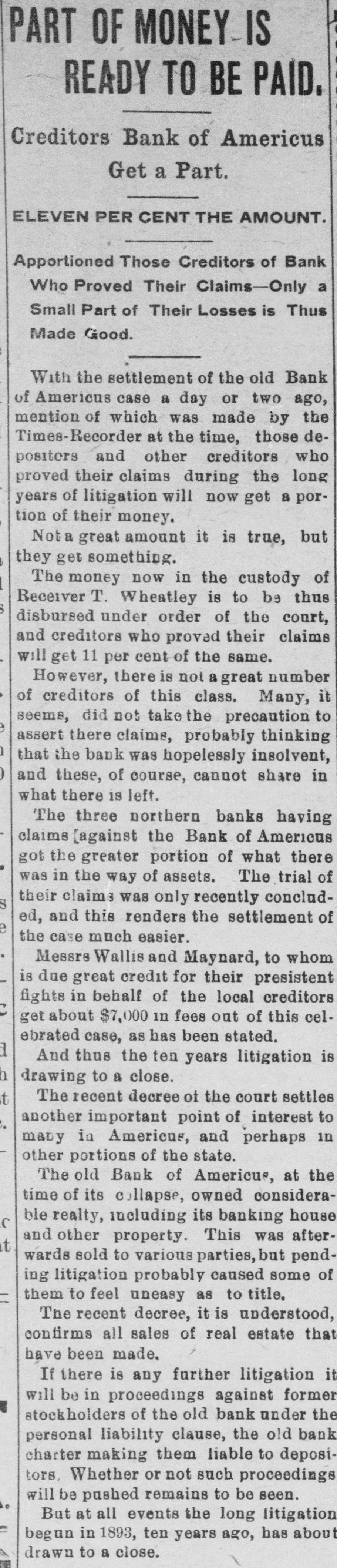
PART OF MONEY_IS READY TO BE PAID. Creditors Bank of Americus Get a Part. ELEVEN PER CENT THE AMOUNT. Apportioned Those Creditors of Bank Who Proved Their Claims-Only a Small Part of Their Losses is Thus Made Good. With the settlement of the old Bank of Americus case a day or two ago, mention of which was made by the Times-Recorder at the time, those depositers and other creditors who proved their claims during the long years of litigation will now get a portion of their money. Not a great amount it is true, but they get something. The money now in the custody of Receiver T. Wheatley is to be thus disbursed under order of the court, and creditors who proved their claims will get 11 per cent of the same. However, there is not a great number of creditors of this class. Many, it seems, did not take the precaution to assert there claims, probably thinking that the bank was hopelessly insolvent, and these, of course, cannot share in what there is left. The three northern banks having claims [against the Bank of Americus got the greater portion of what there was in the way of assets. The trial of their claims was only recently concludS ed, and this renders the settlement of the case much easier. Messrs Wallis and Maynard, to whom is due great credit for their presistent fights in behalf of the local creditors get about $7,000 in fees out of this celebrated case, as has been stated. And thus the ten years litigation is drawing to a close. The recent decree of the court settles t another important point of interest to many in Americus, and perhaps in other portions of the state. The old Bank of Americus, at the time of its collapse, owned considerable realty, including its banking house C and other property. This was aftert wards sold to various parties, but pending litigation probably caused some of them to feel uneasy as to title. The recent decree, it is understood, confirms all sales of real estate that have been made. If there is any further litigation it will be in proceedings against former stockholders of the old bank under the personal liability clause, the old bank charter making them liable to depositors, Whether or not such proceedings will be pushed remains to be seen. But at all events the long litigation begun in 1893, ten years ago, has about drawn to a close.


Article from Americus Times-Recorder, November 4, 1903

Click image to open full size in new tab

Article Text

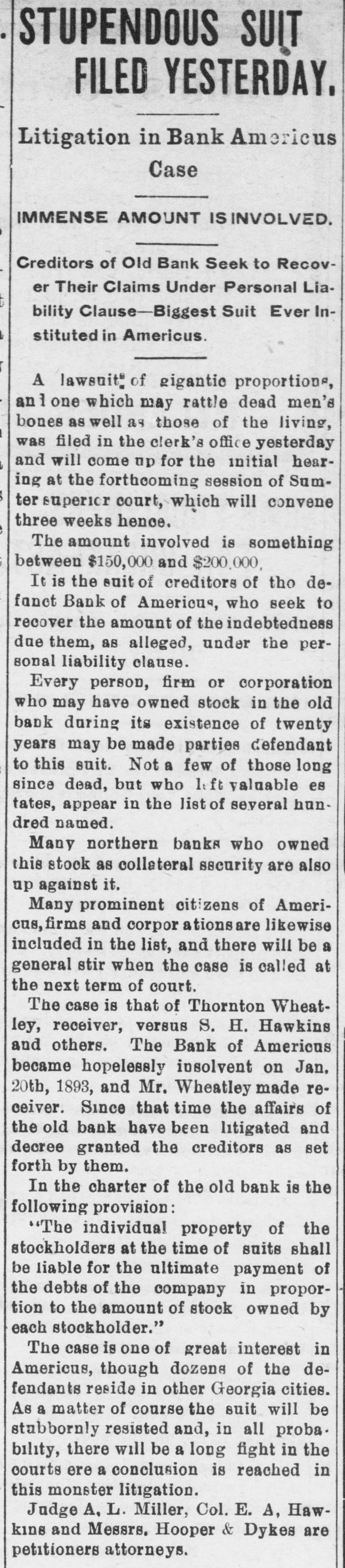
STUPENDOUS SUIT FILED YESTERDAY. Litigation in Bank Americus Case IMMENSE AMOUNT ISINVOLVED. Creditors of Old Bank Seek to Recover Their Claims Under Personal Liability Clause-Biggest Suit Ever Instituted in Americus. A lawsnit. of gigantic proportions, an 1 one which may rattle dead men's bones as well as those of the living, was filed in the clerk's office yesterday and will come up for the initial hearing at the forthcoming session of Sumter superior court, which will convene three weeks hence. The amount involved is something between $150,000 and $200,000, It is the suit of creditors of tho defunct Bank of Americus, who seek to recover the amount of the indebtedness due them, as alleged, under the personal liability clause. Every person, firm or corporation who may have owned stock in the old bank during its existence of twenty years may be made parties defendant to this suit. Not a few of those long since dead, but who left valuable es tates, appear in the list of several hundred named. Many northern banks who owned this stock as collateral sscurity are also up against it. Many prominent citizens of Americus, firms and corpor ationsare likewise included in the list, and there will be a general stir when the case is called at the next term of court. The case is that of Thornton Wheatley, receiver, versus S. H. Hawkins and others. The Bank of Americus became hopelessly insolvent on Jan. 20th, 1893, and Mr. Wheatley made receiver. Since that time the affairs of the old bank have been litigated and decree granted the creditors as set forth by them. In the charter of the old bank is the following provision: "The individual property of the stockholders at the time of suits shall be liable for the ultimate payment of the debts of the company in proportion to the amount of stock owned by each stockholder." The case is one of great interest in Americus, though dozens of the defendants reside in other Georgia cities. As a matter of course the suit will be stubbornly resisted and, in all proba. bility, there will be a long fight in the courts ere a conclusion is reached in this monster litigation. Judge A. L. Miller, Col. E. A, Hawkins and Messrs. Hooper & Dykes are petitioners attorneys.


Article from The Savannah Morning News, November 4, 1903

Click image to open full size in new tab

Article Text

STOCKHOLDERS SUED BY CREDITORS OF THE OLD BANK OF AMERICUS. BANK FAILED 10 YEARS AGO AND NOW STOCKHOLDERS FIND THEMSELVES DEFENDANTS. There Was a Personal Liability Clause in the Bank's Charter, and It Is Upon the Strength of This That the Suits Are Instituted. There Are Several Hundred Defendants Named-Are Widely Scattered. Americus. Ga., Nov. 3.-A law suit of the first magnitude was filed in Sumter Superior Court, this afternoon by creditors of the old Bank of Americus, which collapsed ten years ago. Petitioners bring suit through Thornton Wheatley, formerly receiver for the bank, and all stockholders living and dead who ever owned stock in the old bank are named as defendants to this suit. The amount involved is nearly $200,000, and the suit is brought under the personal liability clause in the bank's charter, which provides that the individual property of stockholders at the time of suits shall be liable for the ultimate payment of the debts of the company in proportion to the amount of stock owned by each stockholder. There are several hundred defendants named, and these reside in nearly every city in Georgia, and in the North as well. Many large Eastern banks, which held stock of the old Bank of Americus as collateral security, are among the defendants in this suit. Hundreds of people owned stock in this bank since its establishment, thirty years ago, and as none of these published notice of transfer of stock at any time, all many be parties to this litigation. The case will come up on its first hearing on the fourth Monday in November at Sumter Superior Court, and wide interest is centered in the result.


Article from Americus Times-Recorder, February 21, 1905

Click image to open full size in new tab

Article Text

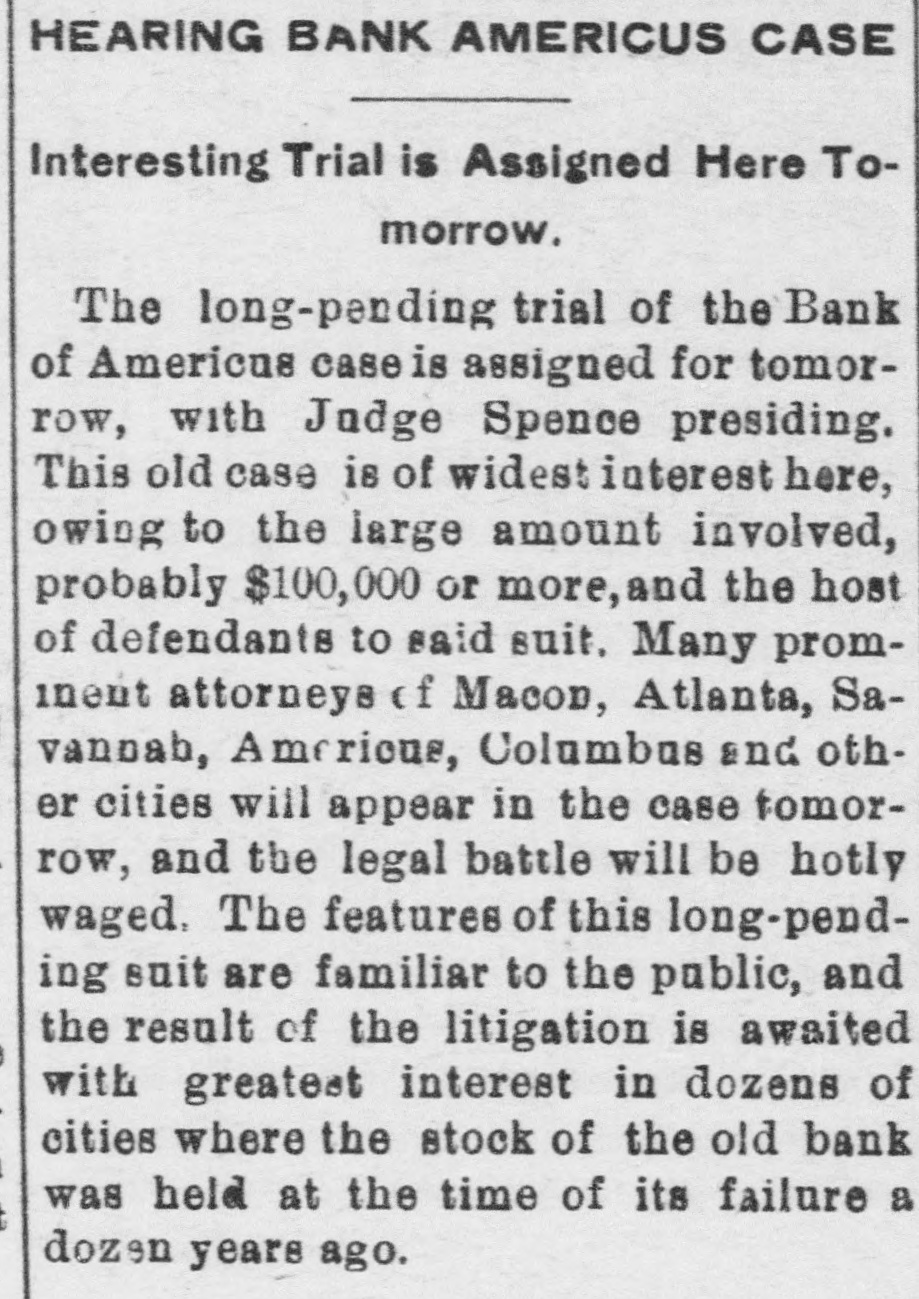
HEARING BANK AMERICUS CASE Interesting Trial is Assigned Here Tomorrow. The long-pending trial of the Bank of Americus case is assigned for tomorrow, with Judge Spence presiding. This old case is of widest interest here, owing to the large amount involved, probably $100,000 or more, and the host of defendants to said suit. Many prominent attorneys of Macon, Atlanta, Savannab, Americus, Columbus and other cities will appear in the case tomorrow, and the legal battle will be hotly waged. The features of this long-pending suit are familiar to the public, and the result of the litigation is awaited with greatest interest in dozens of cities where the stock of the old bank was held at the time of its failure a dozen years ago.


Article from Americus Times-Recorder, May 20, 1906

Click image to open full size in new tab

Article Text

GIVES A DECISION IN CASE OF OLD BANK. Liability of the Stockholders Settled OPINION FROM SUPREME COURT Bank of Americss Case Is Determined Before That Tribunal-Holders of Stock at Time of Receivership Alor e Liable for Debt. The Sapreme Court of the State has just rendered a decision in the case of the defunct Bank of Americus, holding that only those who held stock in the broken bank at the time of suit against the stockholders can now be held liable for its indebtedness. This decision affirms.that of Judge Spence, who presided here in a trial of this important case a year or two ago. His decision was affirmed in part and reversed in part. The part affirmed is that given ab ve relative to the liability of stockholders at time of Fuit. Jodge Spence decided, and his decision is upheld by the Supreme Court, that stockholders who had sold and transferred their stock in the old bank prior to the receivership, could not be held liable for the debts of the defunct institution. And the Sapreme Court, in affirming that decision, affords relief to hundreds of innocent people here. Upon the other hand the Supreme Court reversed Judge Spence upon the point that the receiver for the old bank could not bring suit upon the judgment previously secured by creditors, holding that such judgment was prima facie evidence of indebtedness. This referred to the suit brought by said creditors against the receiver of the old Bank of Americus. Under this decision, the hundreds of people who owned stock in the old bank during the long years preceding its collapse are not liable for its debts under the "liability clause" in the bank's charter, though they gave no notice of sale of stock. The ultimate liability of stockholders, who at the time of the back's fail ure in 1893 held stock therein, is not yet fully determined, The case'is one of greatest interest to hundreds of people in Americus and throughout the state, Under the "liability clause" in the charter of the old Bank of Americus all stockholders were made liable for its indebtedness, unless at the time of sale or transfer of stock public notice of such sale was given by legal publication. Few knew of such requirement or provision, and no transfers, or few, were eyer published. After the bank failed, northern creditors brought suit against all the stockholders for the enormous debts of the old bank. Among these were included stockholders who years and years before the bank failed had sold their stock. These stockholders are scattered over Georgia and a dozen states, or dead. But all were made defendents to this great suit.. The decision of the Supreme Court will thus afford relief of all who did not hold stock when the bank collapsed.


Article from Americus Times-Recorder, April 29, 1924

Click image to open full size in new tab

Article Text

THIRTY YEARS AGO TODAY (From The Times Recorder. April, 29, 1894.) Dr. and Mrs E. J. Eldridge and Mr. and Mrs. G. M. Eldridge leave tomorrow on a two weeks visit to relatives in Maryland. They will also visit Mr. and Mrs. A. R. Eldridge at their home inj Saratoga, 'before returning here. Misses Eula Wells, Bertha Jennings, and Hattie McAfee a trio of Smithville's prettiest young ladies, will return home today after a pleasant visit of a week to Miss Myrtice Allen, at her home on Lee street. Will Harper, formerly of this city but now of Atlanta, came down yesterday to spend a day or two with his sister, Mrs. L. D. Lockhart. In Chambers yesterday Judge Fish passes an order instructir Mr. Thornton Wheatley, receiver of the Bank of Americus to pay over $1,000 as state and county taxes due by the bank for 1892. This does not cover the full amount and is only to be a credit upon the tax fifa. Is it not quite time for early closing season to begin? The jewelly stores will begin closir at 6 P. M. on Tuesday, independently, or merchants in other line. Let all follow in this movement and begin the early closing season regularly either on the 1st or 15th of May. Two of Sumter's best knowr. citizens, Dr. S. S. Bird and Mr. Seaborn J. Walters are seriously ill at their respective homes near the city.